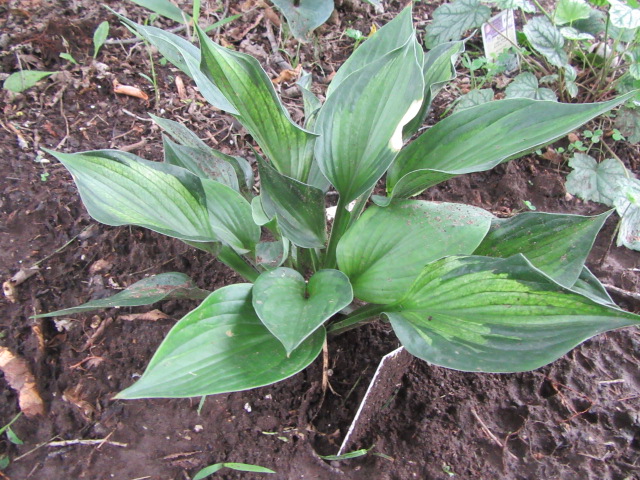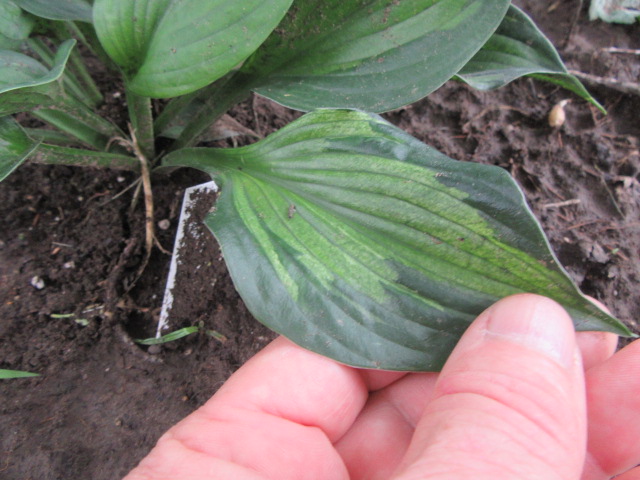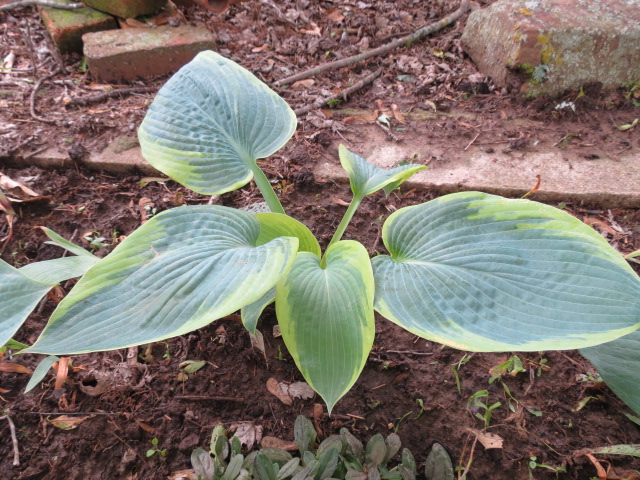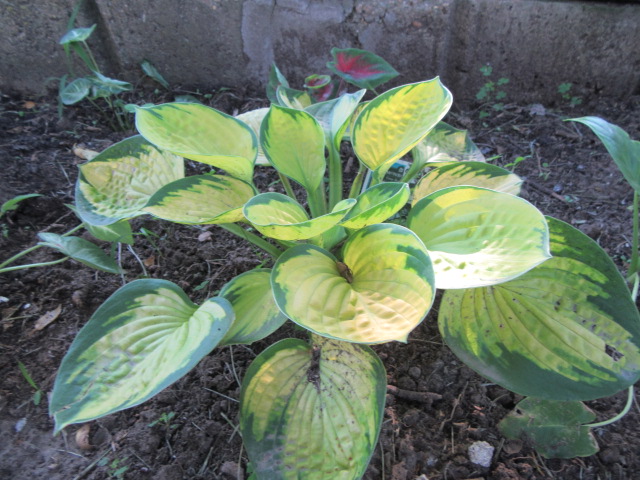
Cephalanthus, Monarda, & Teucrium

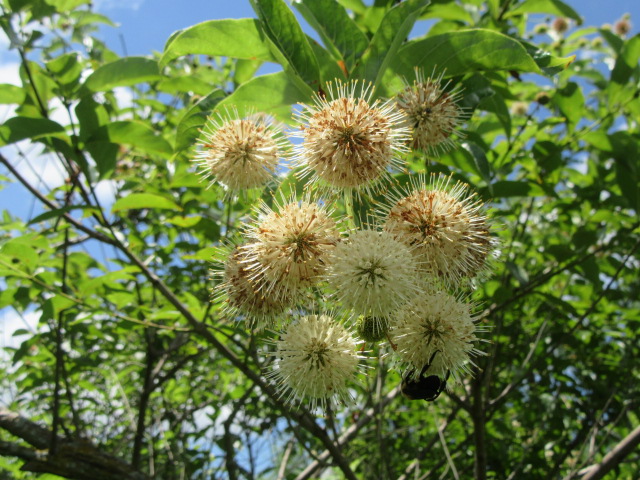
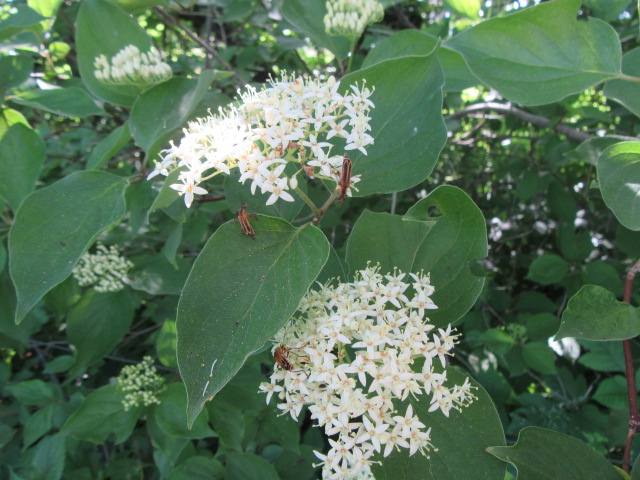
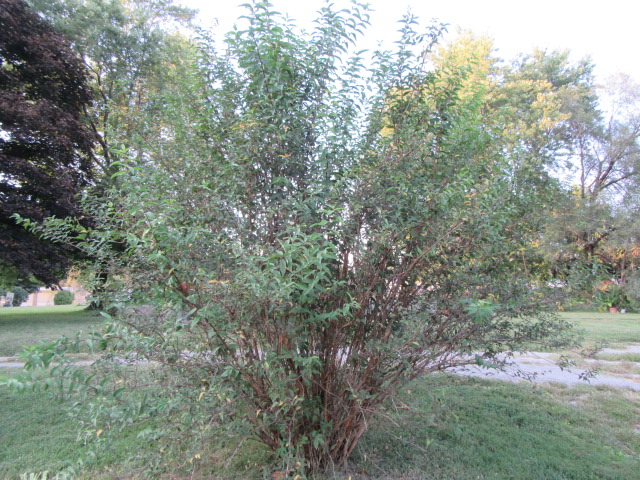
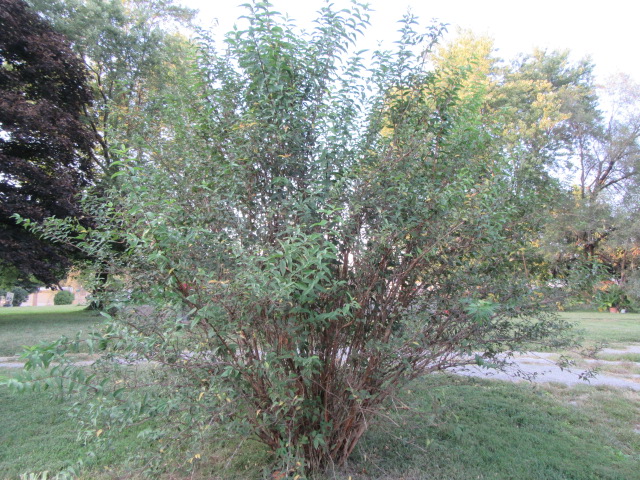
Cephalanthus occidentalis (Buttonbush) on 7-4-18, #469-10.

Hello folks! I hope this post finds you all well. Spring is an amazing time of the year and filled with a lot of anticipation. What will return and what will not. Some plants can hardly wait to start flowering while others take a bit longer. Some flowers bloom over a long period while others for only a week or so (or even a few days). There have been flowers I have seen in the pasture and along fence rows I needed photos of but didn’t have my camera. Then, when I went back later to take photos, it was already too late.

I have been watching the two Buttonbush trees (Cephalanthus occidentalis) behind the south pond so I could get some photos of their flowers. I thought I had taken photos before, but there were none in the folders by plant name or finder. So, I guess these fall under the “flowers I missed” category.


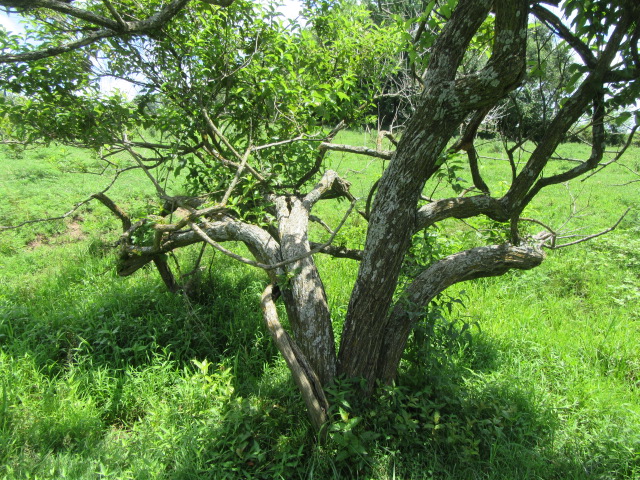
The two Buttonbush trees (Cephalanthus occidentalis) are indeed a strange looking pair.


They are small trees here on the farm, but in some areas, they are more of a bush.


Their trunks are kind of contorted and interesting. They are suitable trained as a small shrub for home landscape use. However, they prefer moist conditions and are often found in low areas around ponds and creeks. These two trees are growing behind the old pond next to the ditch that runs from the other pond. The ditch drains water from the ponds and pasture and eventually runs into the park lake.


The flowers have a very sweet scent and are loved by bees and butterflies.


Two of the common names are Honey Balls or Honey Plant. After flowering, they have small seed capsules containing two seeds that persist throughout the winter.

For more information, visit the Missouri Botanical Garden, Missouri Department of Conservation, and the Wikipedia page.


<<<<+>>>>

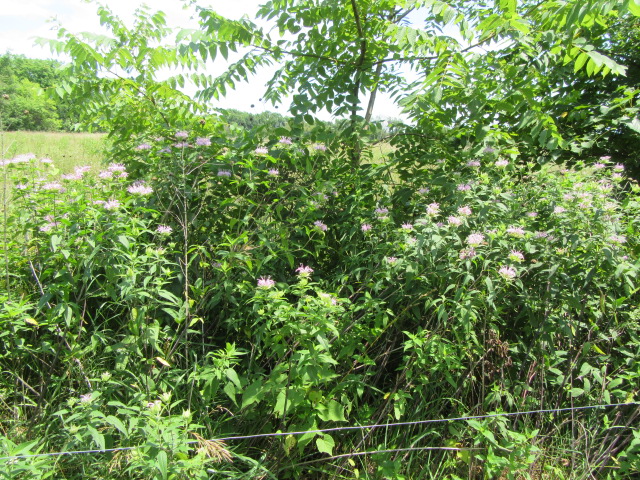
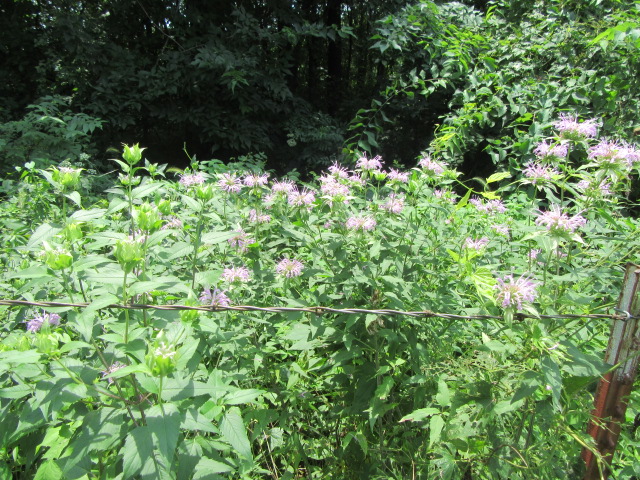
The Monarda fistulosa (Bee Balm, Oswego Tea, Bergamot, etc.) are definitely in full swing now. This group is in the fence row between the pasture and the south hayfield. There are a few smaller patches along the lane that goes to the back pasture.


I don’t remember seeing these when I lived here before. Even when I moved back in 2013 there were just a few here and there.


Now there are big patches everywhere! There are MANY huge patches along the boundary of the pasture and the Rock Island Trail.


There is even a HUGE patch between the street and fence along the front of the pasture. The Bumblebees were on this patch by the hundreds. I never saw so many in one place at the same time. As strange as it may sound, I never even noticed this patch along the street until this year. Let me see… A neighbor cut this area before in 2013. In 2014 or 2015 (or both) we had an Amish cut it. Last year, I think the county did it. Anyway, we came home from somewhere one day and it was all cut down. I don’t cut the right of way because there are too many stumps for the mower and it is not very wide between the fence and deep ditch. There is a telephone pole in the way and I can get in there anyway unless I go all the way down to the end of the pasture. Then how do I get back out? 🙂 Excuses, excuses! Well, the other reason is that I don’t want to.


I wish I could get the red flowered Monarda started to do as good…


Some of the flowers had a lot of ants on them. Even though the flowers are pinkish, they are nice and provide food for bees, butterflies, hummingbirds and the hummingbird moths. They flower over a long period, too.


<<<<+>>>>

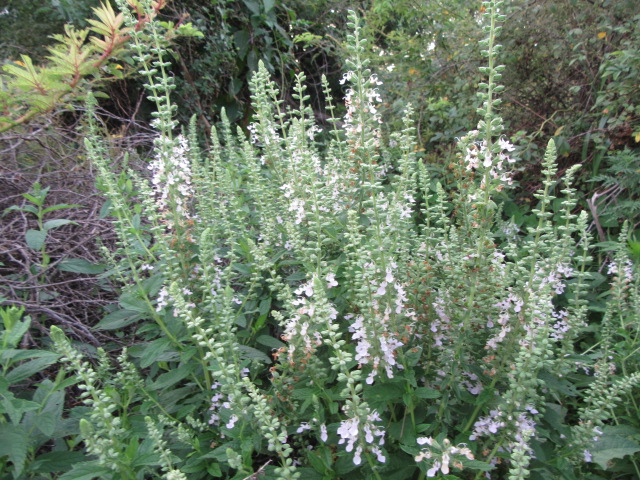
I just noticed the Teucrium canadense (American Germander) a couple of years ago next to a HUGE Multiflora Rose bush in the back pasture.


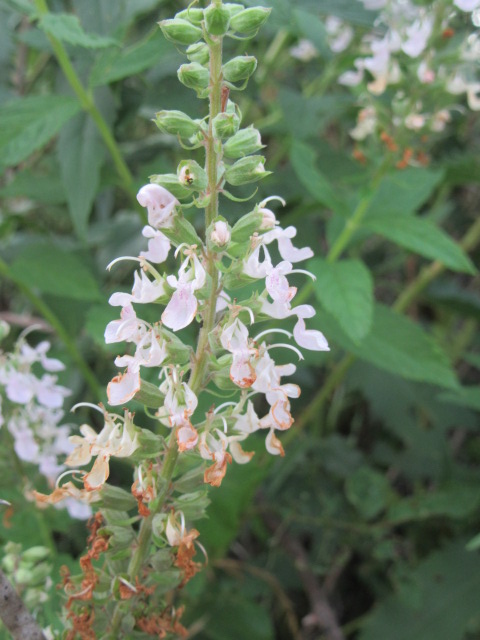
The individual flowers aren’t very big, so taking good photos wasn’t easy. ID wasn’t that hard, though.


While this species has a lot in common with other members of the mint family, this one is unique… There appears to be NO upper lip. You can see the two upper lobes that point upward like horns. Then the other two rounded side lobes that look like ears to me. Then, the larger lower lip with the cup-shaped bottom lobe… This is the only member of this family in Missouri with this unique corolla configuration.


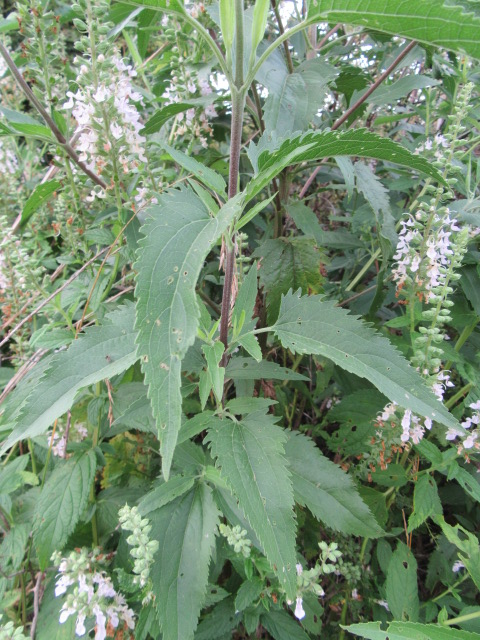
Characteristic square stems…


Leaves are opposite, lanceolate, and sharply pointed…


I think we are blessed to have so many wildflowers on the farm that feed such a wide variety of insects and birds. I haven’t been to the swamp for several years, so I think I need to do that soon. Well, I guess it really isn’t a swamp, but that’s what I call it. Dad called the area “OH, you mean back in the corner”. Yep, back in the corner for sure. There are some very interesting wildflowers in the swamp and one I have seen nowhere else but here. Then again, I don’t get out much. 🙂 I will go check tomorrow… Oh. It is 1:28 AM. It is tomorrow already.

Until later… Stay well, be safe, stay positive, keep warm or cool depending on where you are. GET DIRTY if you can!

Overnight Disaster-Japanese Beetle Invasion

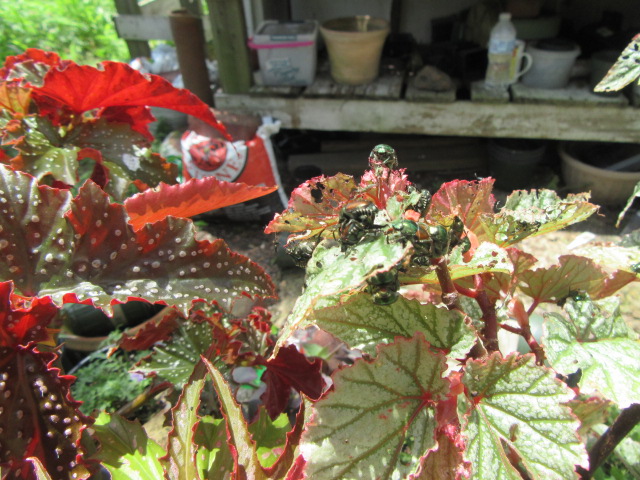
Hello folks! I hope this post finds you all well. The Japanese Beetles (Popillia japonica) have been back for a while now, but they are getting ridiculous. Every year they come and feed mainly on the leaves of the Chinese Elms. They also eat the flowers on the roses. My plant tables next to and behind one of the sheds is under a Chinese Elm. It normally provides the perfect light for the potted plants, cactus, and succulents. The shade beds are also under a maple and two Chinese Elms. In that area, the light changes from shade to light shade.

Well, that is just nature. Until last year, there was really no problem. Then last year, the Japanese Beetle population turned into an invasion. I hoped that the colder than usual January would have helped control them and there wouldn’t be as many. But, that wasn’t the result. This year, they are worse than ever. Now, the Japanese Beetle lay eggs in the ground and then turn into their larvae stage. Then in June (maybe starting in late May), they become adults. Their main goal is to feed and mate.

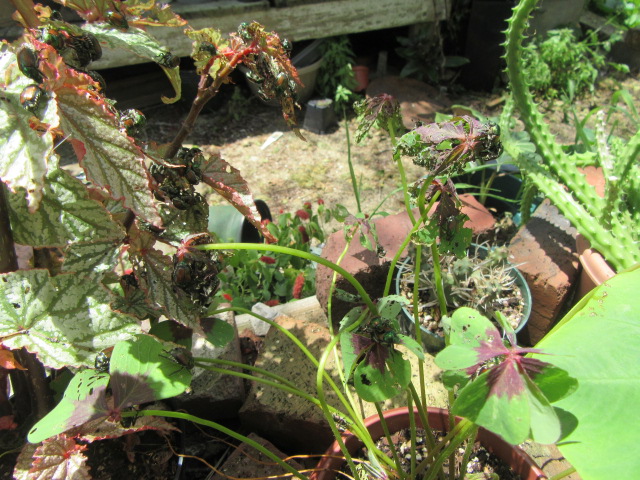
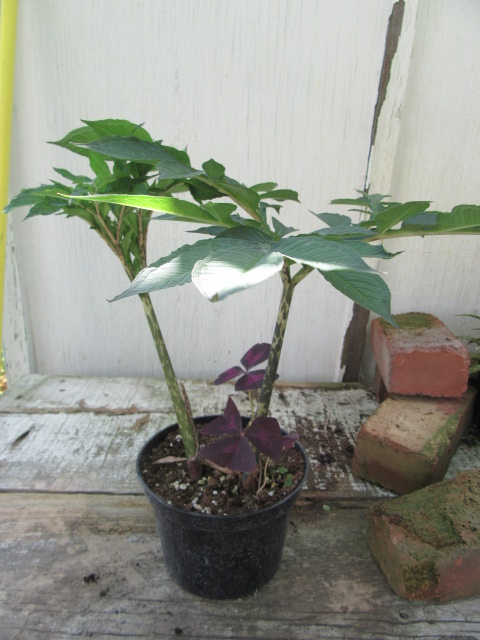
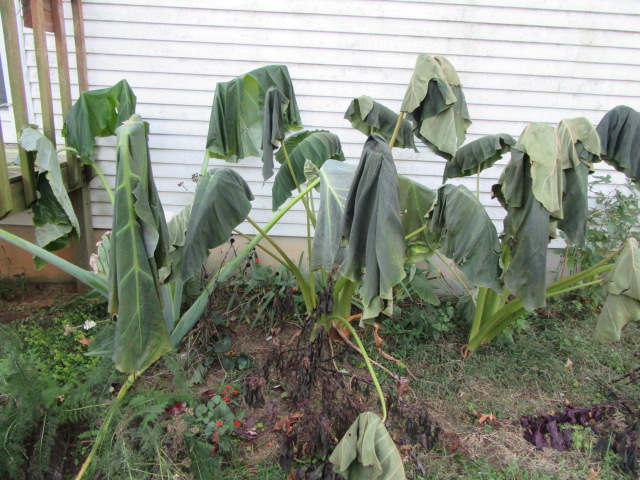
They had really done no damage to the potted plants, mainly feeding on the leaves of the Chinese Elm. Then, on July 2 I noticed them on the Amorphophallus and a few on the Calla. So, I moved those two plants to the side porch.

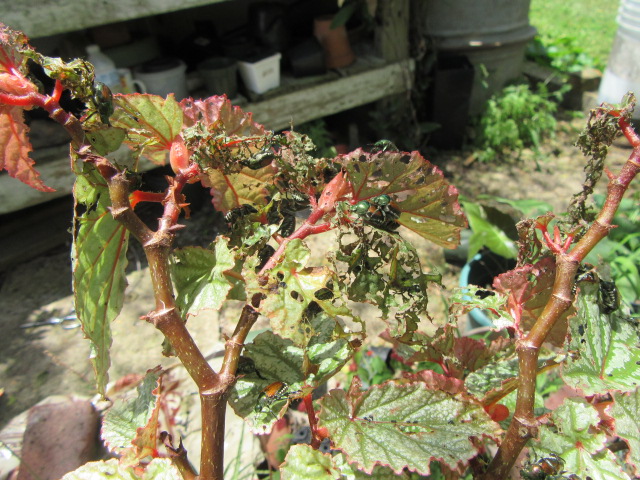
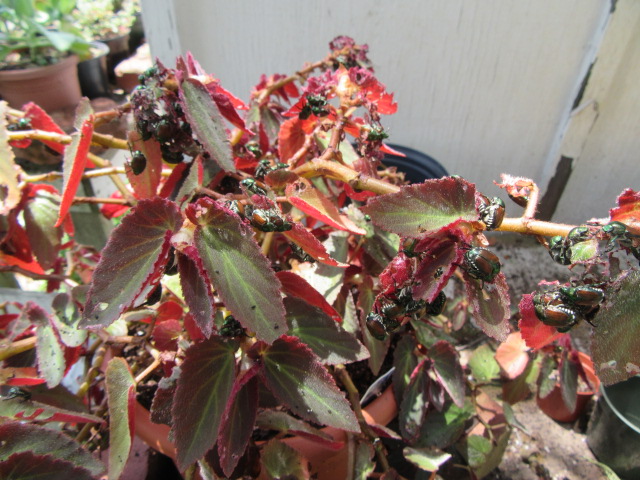
Then, on July 4, it was much worse…


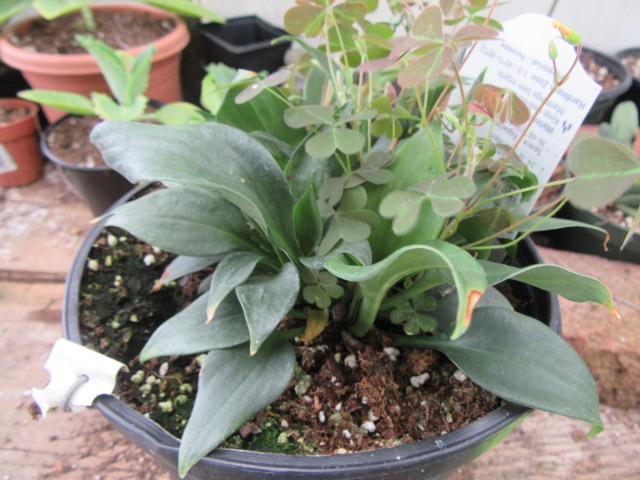
They attacked the Begonia ‘Frosty’ and even the Oxalis triangularis subsp. papilionaceae and Oxalis tetraphylla (Iron Cross).


GEEZ!!!


They are easy to get off. Just shake the plant they fly off.


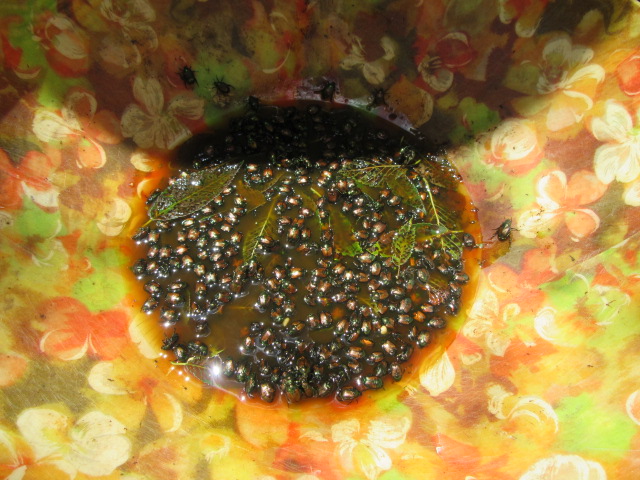
The bowl I mix potting soil in had water in it and A LOT od drowned Japanese Beetles.


They attacked the Begonia ‘Brazilian Lady’…


And even the Bryophyllum daigremontiana (Mother of Thousands).


I went over to the Chinese Elm growing on the old back porch to get a photo, but they took off by the thousands!


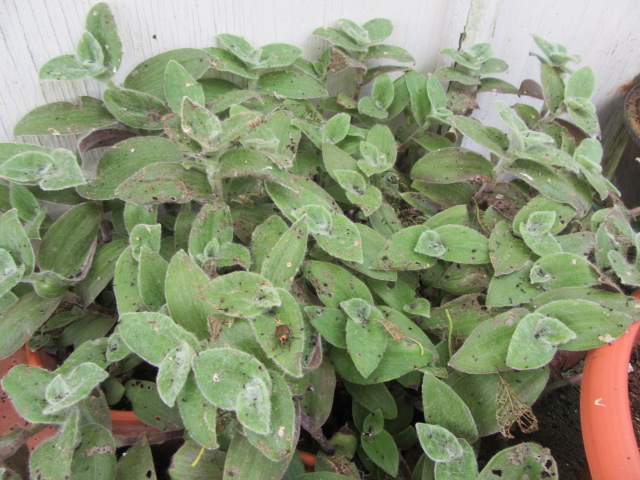
They didn’t chew much on the Tradescantia sillamontana, but their leaves were covered in poop and debris from the elm tree.


I had to take all the plants off the longer table behind the shed and drag it (upsidedown) to the front porch. Then I took several wheelbarrow loads of plants…

The light here is not the best for some of the plants, either too much or not enough for some, but it will have to do for now. The beetles didn’t chew on all the plants I moved, but you never know. Not only that, they leave a big mess behind on the leaves from the elm tree. Fallen leaves and lots of poop. I watered the shade bed and the leaves of the Alocasia and Hosta were covered with poop and debris from the elm trees. So far they haven’t been feeding on them.


The Amorphophallus sp. is now safe on the side porch. Believe it or not, there are eleven Amorphophallus in this pot now… Up from two last year!


They had just chewed on a few leaves of the Calla, but I moved it to the side porch, too.

As far as the shade beds are concerned… It won’t be so shady now. Most of the plants will be OK except for maybe the Brunnera ‘Jack Frost’. Unless the beetles turn to the Hosta, Alocasia, and Heuchera.

I can see why the moles are so active in the yard in front of the chicken house and the shade beds. They are after the larvae… Spraying plants with neem oil doesn’t help fight against Japanese Beetles. About the only thing is to use milky spore which was developed by the USDA and applying it to the soil to kill their grubs.

You can read more about this crazy critter on the Wikipedia page by clicking HERE. Ther are thought to have come to the US on shipments of Iris bulbs from Japan before 1912… They have natural predators in Japan which keep them in control, but here and other countries they are now in, they have none… They feed on many plants besides the Chinese Elm, including many vegetables and other food crops and ornamentals.

Well, that’s it for this post. I hope you are all well and staying cool during the heat of the summer. Take care, stay well and be positive! Of course, GET DIRTY when you have the chance!

Beetles In The Pasture Video

Hello folks! I just wanted to show you a short video of the beetles I saw in the pasture a couple of days ago. I was living in Arkansas in 1989 (I think) in an old country home when I first saw this ritual. I saw them here a couple of years ago and then again a few days ago. I think they only do this a few days each year.

I was told the males fly around looking for a mate then go down into the grass. Well, I didn’t do any research for this post, so I’m not sure about the details…

I hope everyone is enjoying your 4th of July. Until next time, stay well, be safe and GET DIRTY!

<<<<UPDATE ON THIS VIDEO>>>

I looked up what type and species of beetle this could be on the Missouri Department of Conservation website. My best guess is that it is a Green June Beetle (Cotinis nitida). It is one of over 1,700 species of Scarab beetles native to North America above Mexico.

The Wikipedia has some interesting reading about this species. If this is indeed a June Beetle, it isn’t a dung beetle. Click HERE for the Wikipedia article.

Short Sunday Drive And A Visit

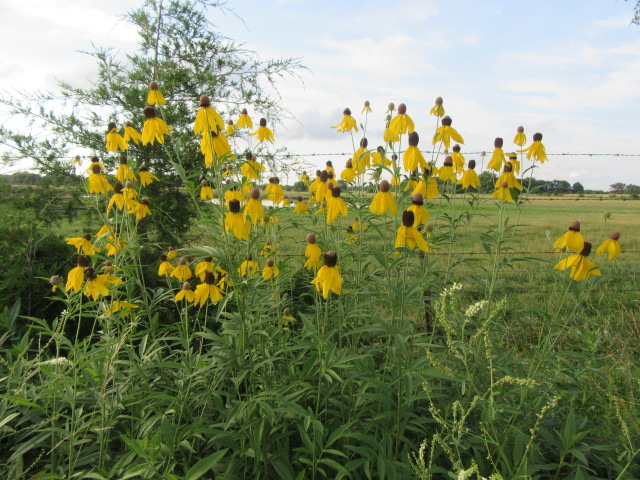
Echinacea paradoxa (Yellow Coneflower) on 7-1-18, #467-15.

Hello folks! I hope this post finds you all doing very well. A week or so ago I went to visit a friend who lives a little farther in the country and noticed a few nice patches of Yellow Coneflower (Echinacea paradoxa) along the way. I had left my camera at home so I didn’t get a photo then. I am trying to remember to always take my camera because you never know what you will find to shoot. So, early Sunday evening I decided to go for a little drive. It was only a few miles away and I needed to take some photos.


Echinacea paradoxa is the only species in the genus to have yellow flowers. All others are purple shades. Hmmm… I thought there was a white-flowered species. Of course, that is not counting the varied colored and weird looking cultivars of Echinacea purpurea. As a matter of fact, I think I have seen a few with white flowers along the highway. Maybe they are a variation (mutation) of Echinacea purpurea. Echinacea paradoxa does hybridize with other species in the genus if they are close by.

Most of the plants are at least 3 feet tall, and some came up to my shoulder which is close to 5′. Well, I suppose I was standing a little lower than the plants. 🙂


The genus name comes from the Greek word, echinos, which means hedgehog or sea urchin because of the shape of the cone. The species name, paradoxa, is in reference to it being a paradox as to why its flowers are yellow instead of purple like the rest of the species in the genus. 

The cones remain erect after the flowers fade and the seeds are eaten by Goldfinches during the winter.


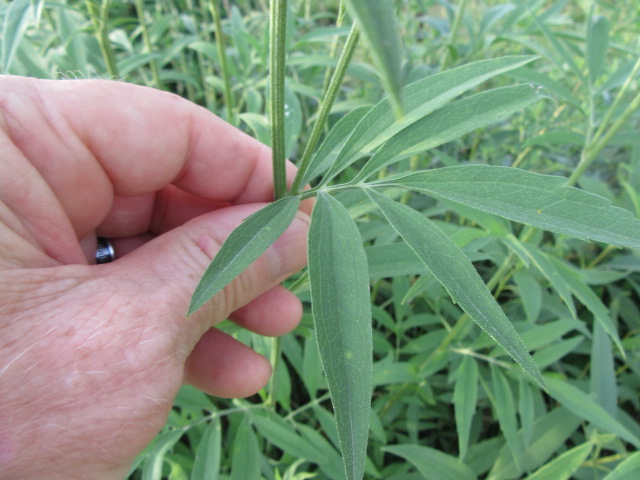
The leaves are very different from the Echinacea purpurea I brought home this spring.


Very interesting how a stem grows between the main stem and the leaf. Kind of like a sucker on a tomato.

I headed down the road and found…


A nice clump of Asclepias tuberosa known as the Butterfly Weed. I have a lot of Milkweed on the farm but NONE of these. There is a very small single clump across the back fence that I have been tempted to dig up, though. But when it is time to dig, I may not be able to find it. I could mark it with an electric fence post or something. Oh, yeah, it isn’t on our property. Oh well, maybe some will miraculously appear someday.


I had never been up close and personal with an Asclepias tuberosa before and this was my chance when no one was looking. Just look at this AWESOME flower!


Asclepias tuberosa does not have milk-sapped stems like most species of milkweeds. The flowers are a favorite food source of butterflies and bees and of course, the leaves are food for the Monarch Butterfly caterpillar.


The genus name comes from the Greek god of medicine, Asklepios. The species name is in reference to the plant’s deep taproot.

Then I ran across a plant I have seen along the highway in huge groups. I have often wanted to get out and photograph…


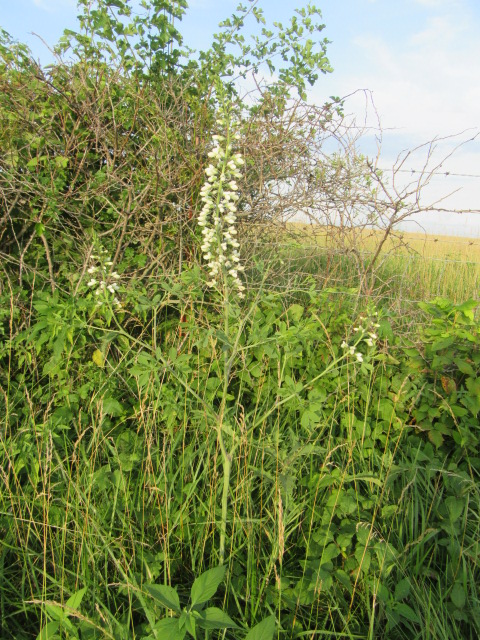
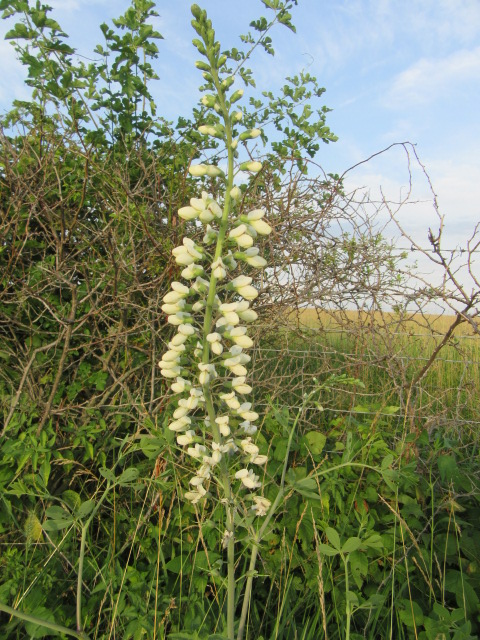
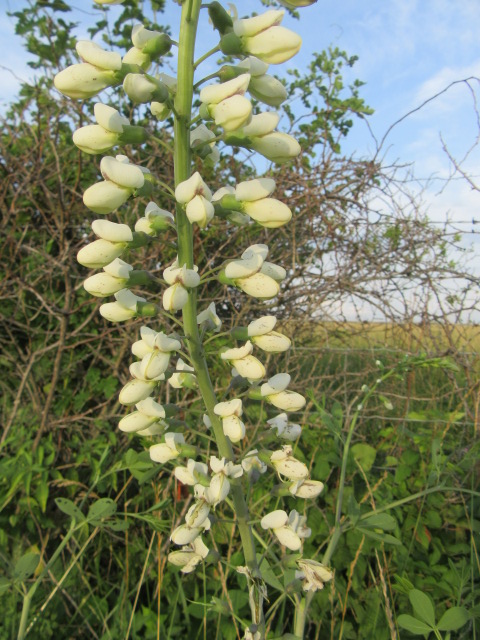
I didn’t know what this plant was until I got out of the car and saw its leaves. Instantly I knew it was a species of Baptisia. It is kind of hard to tell when you are driving down the highway about 60 mph. and have no safe place to pull over and investigate. When I returned home I did a search and found out it was definitely a Baptisia alba. The Wild White Indigo (or False White Indigo, False Indigo).


Tall flower spikes, easily between 12-18 inches long or more.


The flowers are pea-like, like other members of the Fabaceae family.


The leaves look similar to the Baptisia ‘Lunar Eclipse’ in my flower bed.


Not far from the first plant I saw was another small group. They had a more open growth habit and the flowers were not as close together on the stem.

I went down the road and headed back toward town. I got to my friend’s mother’s farm and decided I would get out and take a photo of her…


Opuntia compressa which is a species of Prickly Pear intermingled with some very healthy Poison Ivy.


The pads of this species are not near as thorny as the Prickly Pear I had in Mississippi. I think it was last year when I was talking to his mom when she was out working in the yard. The cactus had fruit at the time and I asked her if she had ever eaten any. She said no and went right over a picked one off and ate it. 🙂


She also has several Yucca filamentosa (Adam’s Needle) growing in her yard.


They were LOADED with flowers earlier now they are LOADED with seed pods.

Then I went down the road toward home but I had to take the opportunity…


To have a closer look at this Cylindropuntia imbricata (Tree Cholla). I remember earlier when I first saw it I almost ran off the road. How could I have missed it before since I had driven by it so many times? This time there was a car in the driveway so I pulled in to see if I could take a photo. Low and behold, when the lady came to the door I recognized her. She was in my sister’s class in school. Anyway, she said the cactus was her brothers but said I could take a photo.


She came outside and we walked in her yard so I could get a good photo of the whole thing. She seemed a little embarrassed because the crabgrass was so tall and thick and started pulling it away from the cactus. I started helping a little and said I understood. It had been hot and then it rained… Not to mention chiggers and the grass was a little wet. You know how crabgrass is. She said she wasn’t bothered by chiggers as I could almost feel my hands starting to itch. 🙂 I hate chiggers and pulling crabgrass because of them.

As we walked back to the house, she said her brother “Bill” had a lot of plants and said that was his garden as she pointed toward it. She said he had more plants in the back. Many years ago, another friend of mine lived in her house for many years and had a tackle shop behind the house. He was a very well-known rod maker and famous for “The Crappie Stick”. Anyway, Bill now lives in his old shop.

We walked to the back of the house and Bill came out. We shook hands and I told him I hadn’t seen him in years. We started talking and he took me to his garden and showed me his Prickly Pear, cucumbers, and tomatoes.


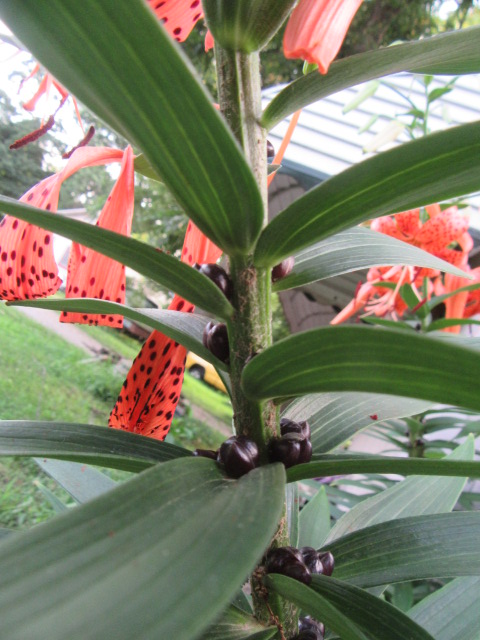
He had a nice group of Tiger Lilies (Lilium lancifolium) which were the real deal!


My grandma had these in her yard but they eventually fizzled out. Big, bright orange, spotted flowers with recurved petals. The plants are very tall.


One characteristic of this species is the seeds that grow along the stem.

After visiting around the garden, we walked back over to his Tree Cholla. He said he had it for around 15 years and was given his start by another old friend around the corner who passed away several years ago.

So, Sunday was a good day. I never would have thought that Bill was a gardener. I took photos of the Echinacea paradoxa which is the only place I have ever seen them growing. I was able to photograph an Asclepias tuberosa and Baptisia alba without getting run over along the highway.

What discoveries have you made recently? That’s it for now. I hope you have a great week ahead. Stay well, positive, enjoy nature when you can, and GET DIRTY!

A Little Repotting

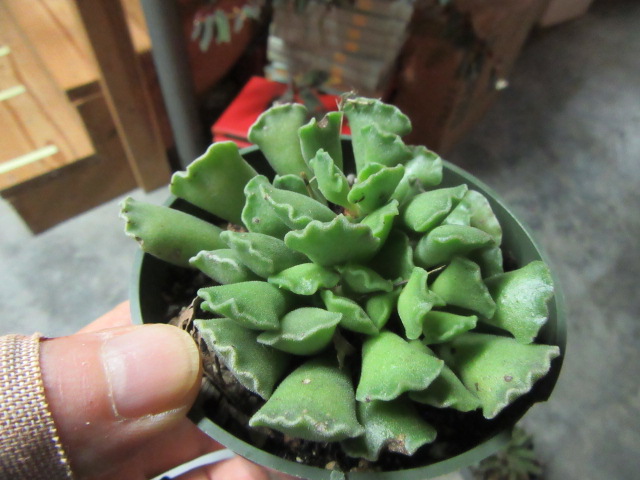
Adromischus cristatus at 1 1/2″ tall X 4″ wide on 10-17-17, #384-1.

Hello folks! I hope this post finds you well. Some of the plants in the beds are growing like crazy and I really need to work on the south bed before it gets out of hand. It is just to hot during the day and that bed remains in full sun until late in the afternoon. It was OK, then it rained last week so the plants I need to remove really shot up. Then, of course, the grass needs cut again and the shrubs in front of the house need to be trimmed now.

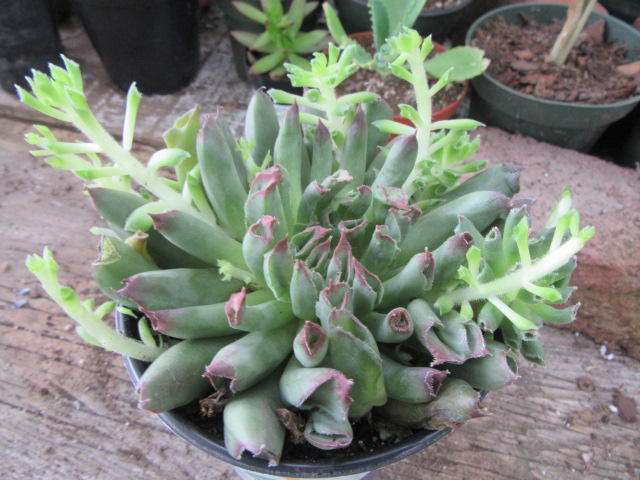
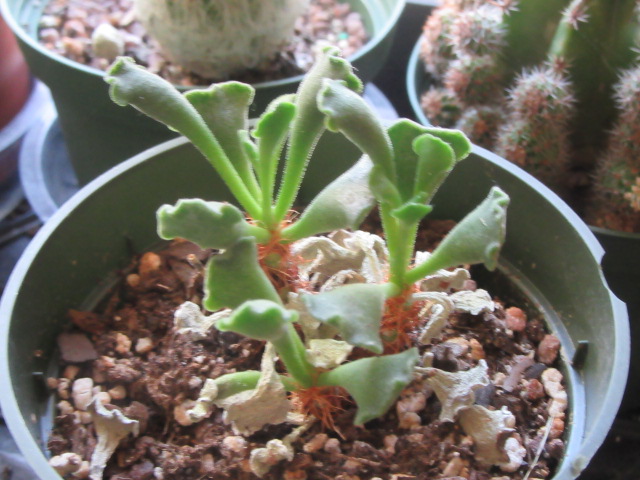
I took a little time last week to do a little repotting and dividing when the grass was wet. The Key Lime Pie (Adromischus cristatus) did very well last summer then went mostly dormant during the winter. The above photo shows what it looked like on October 17 last year. Most of the leaves fell off over the winter and then it grew an offset.


Adromischus cristatus (Key Lime Pie) on June 14, 2018, #459-4.

It started growing more of these roots along the stem and the offset was also growing. At least I think this is an offset of this plant. 🙂 So, while everything was wet from all the rain, I decided to take the opportunity to give this plant a makeover on June 28.


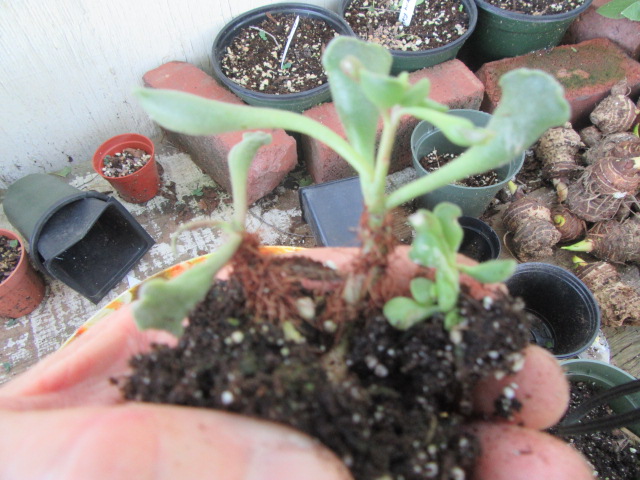
I removed the plant from the pot and separated the offset


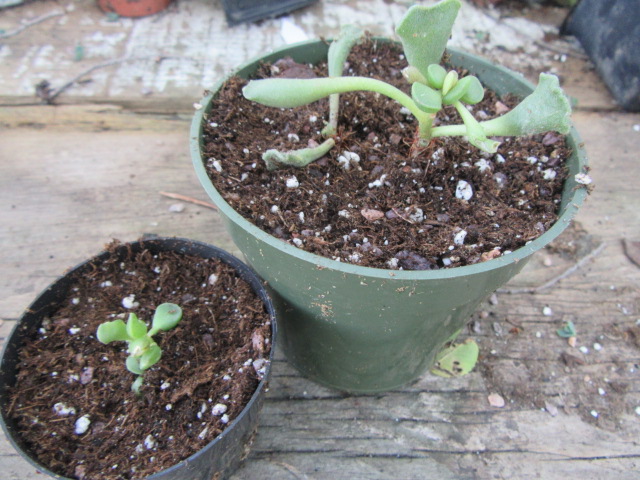
Then I put the older plants deeper into the soil and put the offset in its own pot. Now, I will see for sure if the offset is from this plant or a sneaky Bryophyllum daigremontiana (Mother of Thousands)(Syn. Kalanchoe daigremontiana) I don’t think it is a Kalanchoe (or whatever you call it now), because this offset appeared over the winter and the Kalanchoe was under the table and the Adromischus was on top. The “other plant” had no plantlets at the time either. It is so hard calling the Kalanchoe daigremontiana a Bryophyllum after all these years of it being a Kalanchoe.

The other strange thing is the new growth on top of one of the older plants… Hmmm…


Then on June 30, I separated the offsets from the Kalanchoe luciae (Paddle Plant, etc.).The original plant looks a little weird after it took a growth spurt last fall and its stem grew crooked. There are roots growing under the leaves but it would be very difficult to restart it the plant like that. So, I just put the plant farther down into the soil. I put her babies in their own pots so they can all do their own thing.


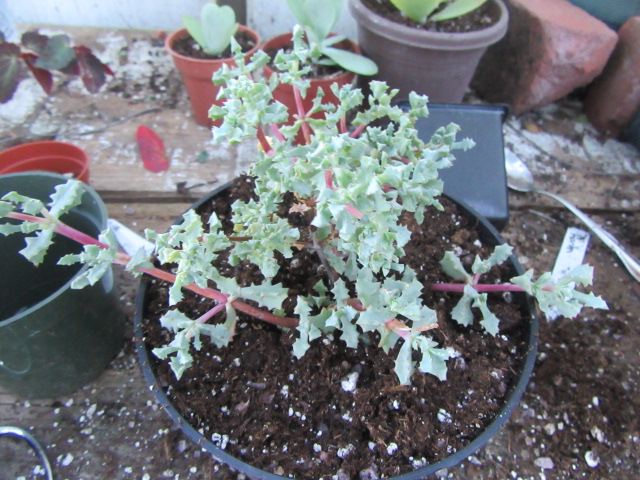
The Oscularia deltoides (Deltoid-Leaved Dew Plant) was growing all silly and lop-sided so I put it in a different pot, too.

I am trying a new potting soil this year that has a lot of perlite so I just added chicken grit to the mix. So far it seems to be working OK. Cactus and succulent specialists recommend mixing 2 parts potting soil with 1 part grit and 1 part pumice. I can’t find pumice around here and haven’t bought any online.

That’s it for this post and on to the next one. Stay well, be positive, and give someone a big hug. As always… GET DIRTY!

Ahhh… New Cactus Flowers

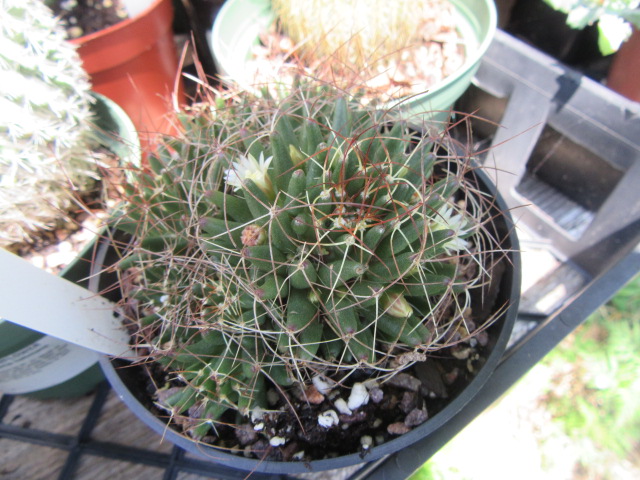
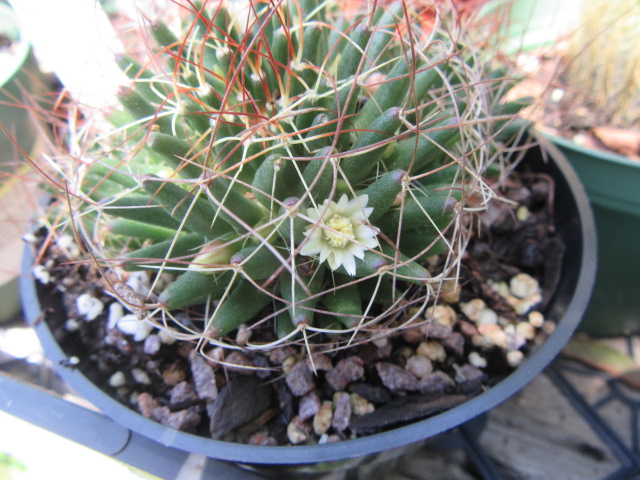
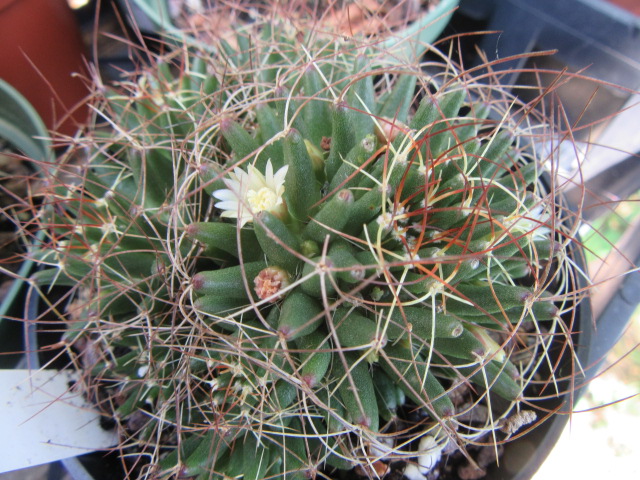
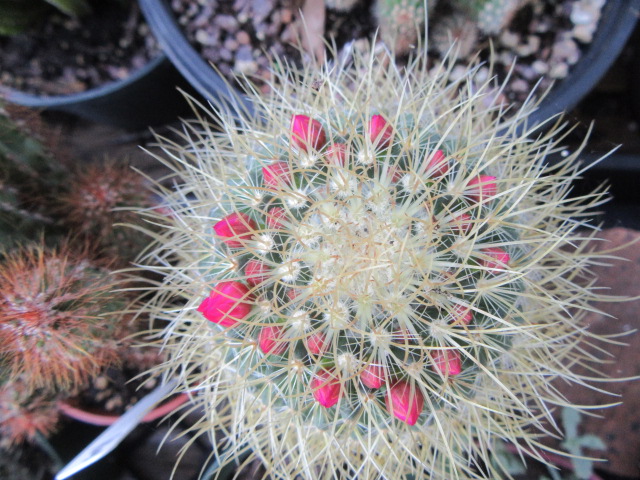
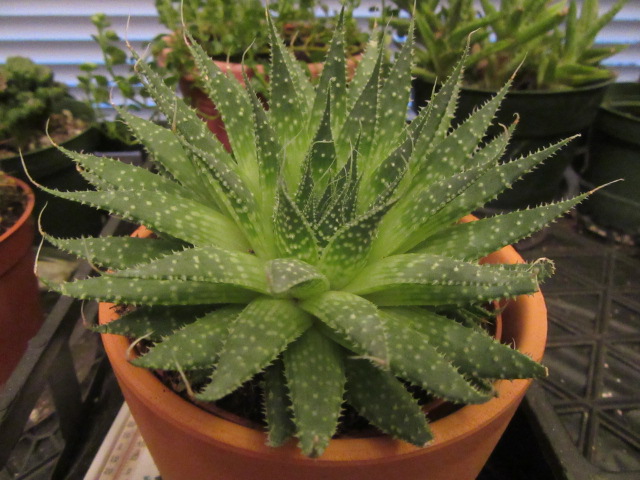
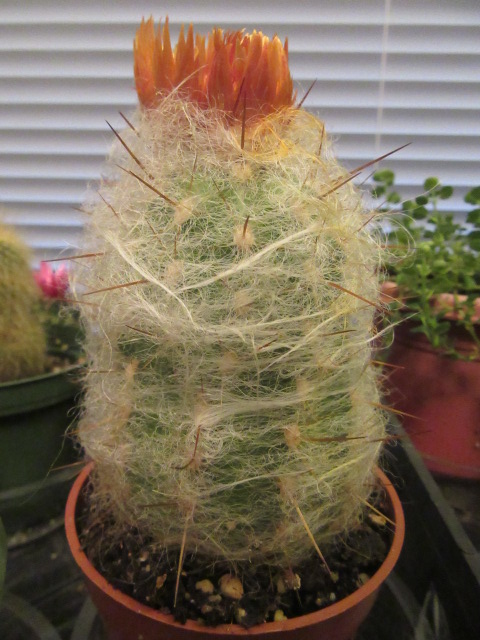
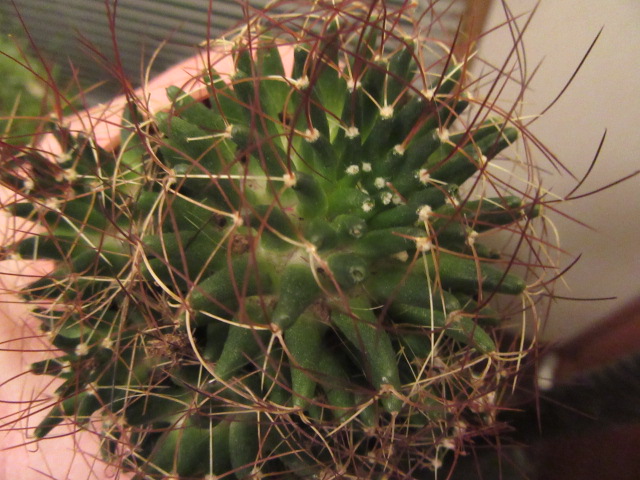
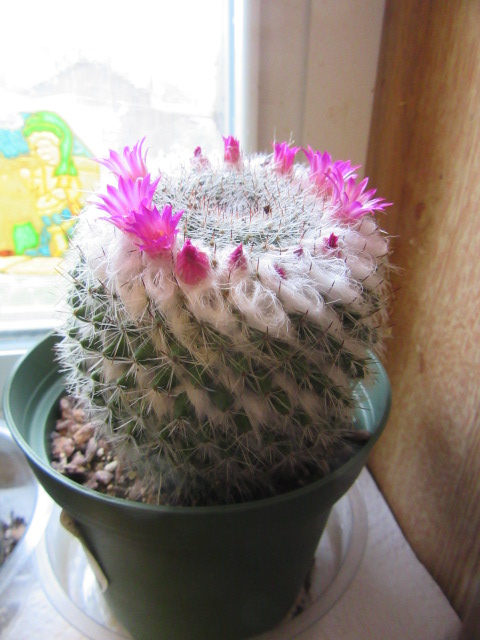
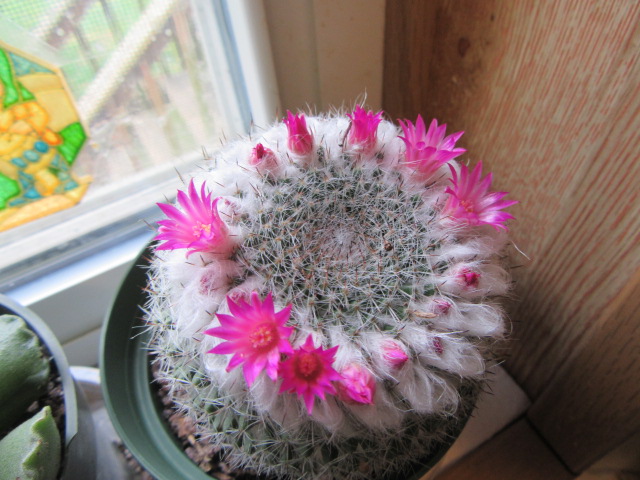
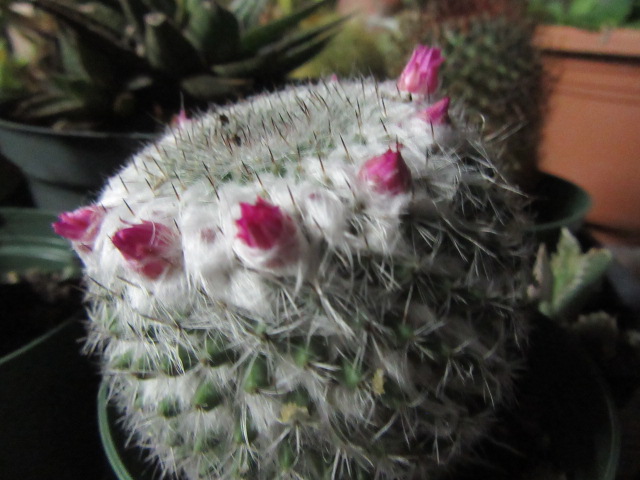
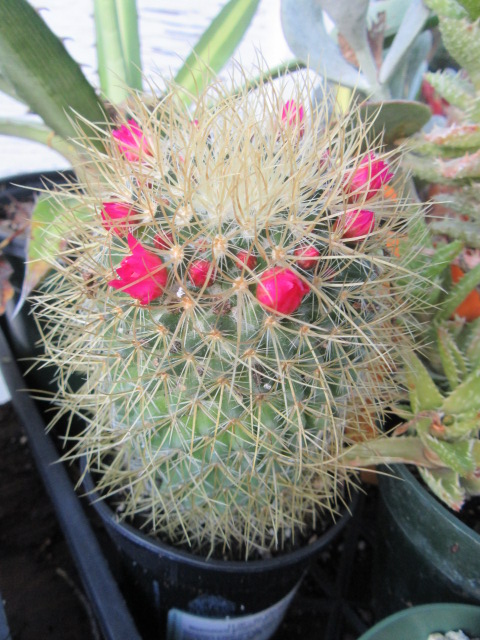
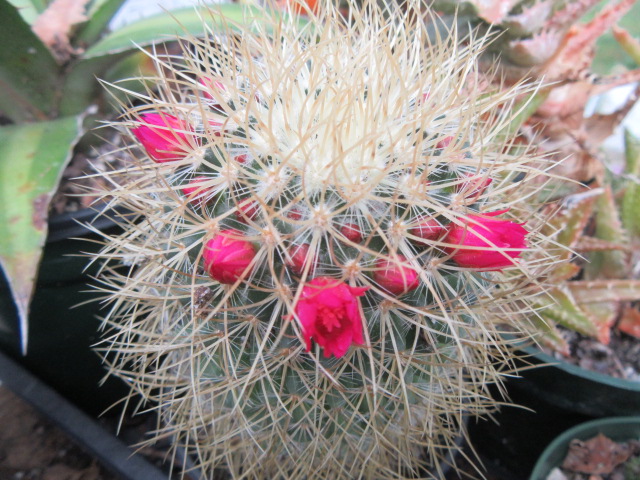
Hello there! I hope this finds you all doing very well and enjoying the heat of the summer. Thursday afternoon I was surprised to find the Mammillaria decipiens (Bird’s Nest Pincushion) with flowers. I noticed it had a few buds on June 24 and I took these photos on June 28.


I really enjoy cactus and this one is one of my more recent finds from Wal-Mart on March 18 (2018). I put it in a larger pot shortly after I brought it home because the side of the one it was in was bulging.


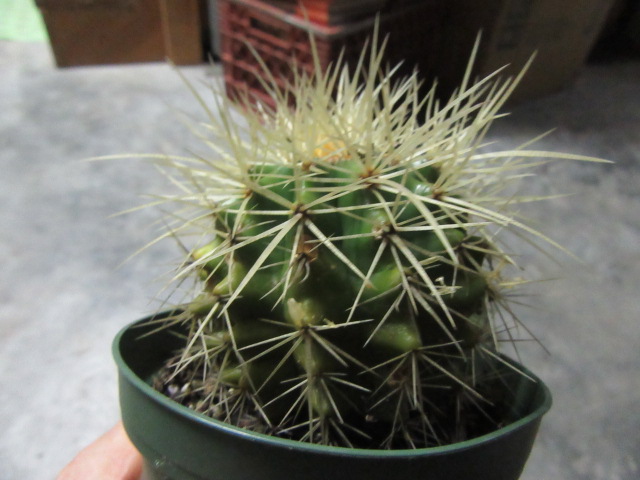
I really like it when my cactus flowers, especially when they aren’t pink… Mammillaria decipiens have long white radial spines that grow sideways from the tubercles and brown central spines that stick out like stiff hair. Cactus that have protruding tubercles like this one are often called nipple cactus. OUCH!


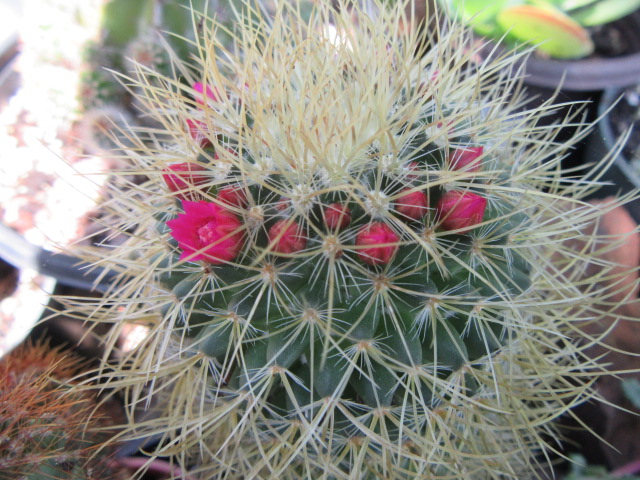
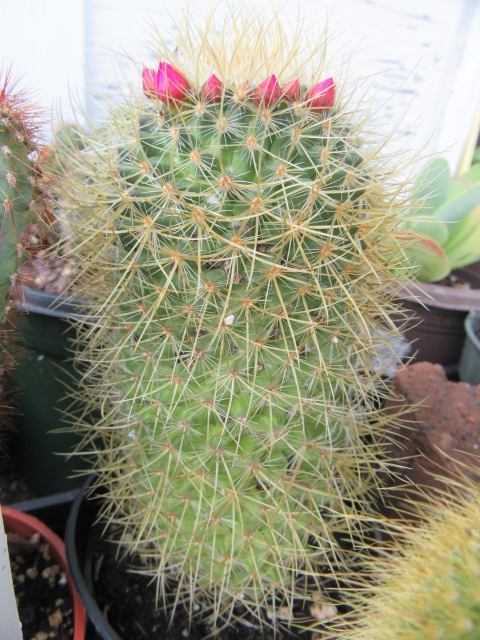
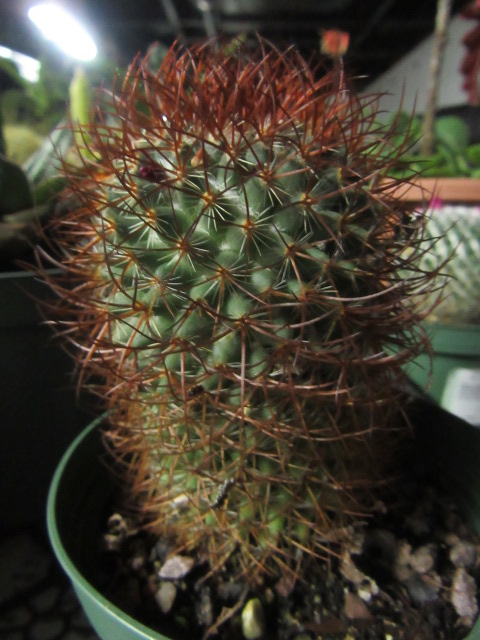
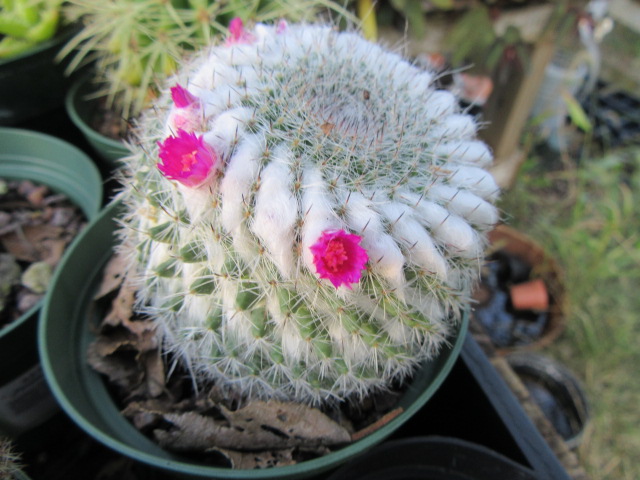
The Mammillaria pringlei (Lemon Ball Cactus) is also at it again after MONTHS of buds. It started budding right after its last flush of flowers in October-November. It is so weird how long it takes for buds to open.


The “definitely pink” flowers are arranged in a circle around the top of the cactus. I guess they are its halo. 🙂


They start closing up in the late afternoon/early evening and kind of resemble tiny tulips.


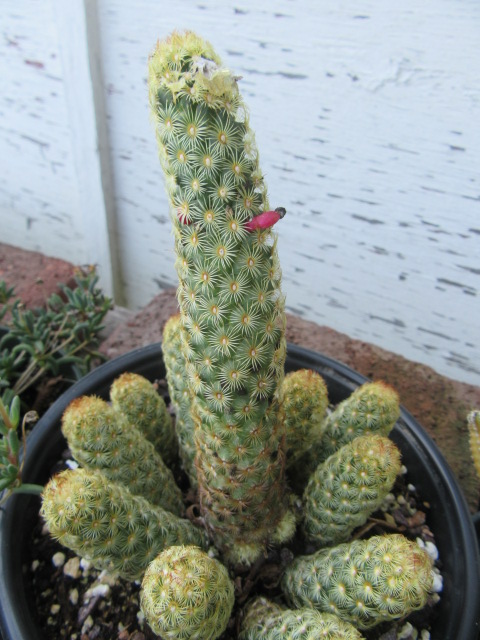
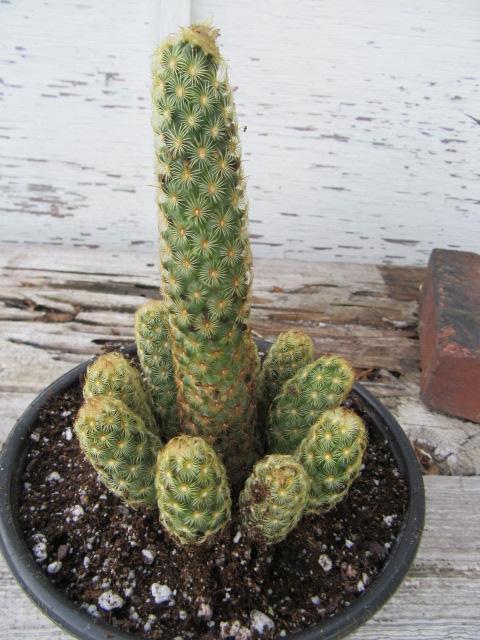
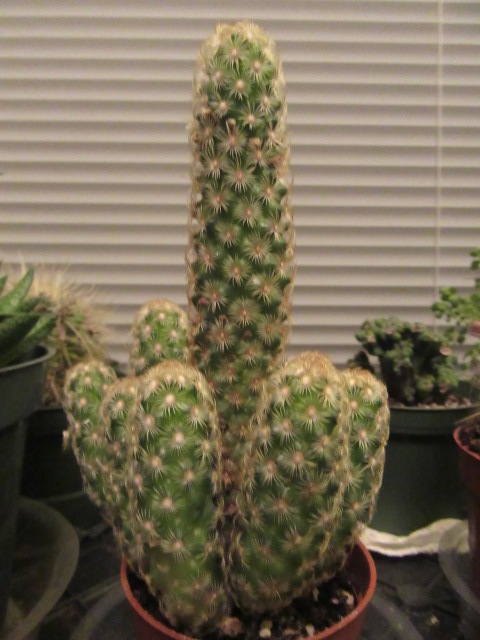
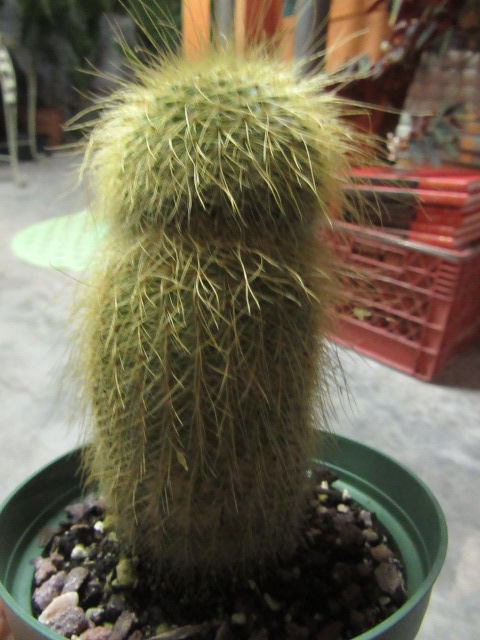
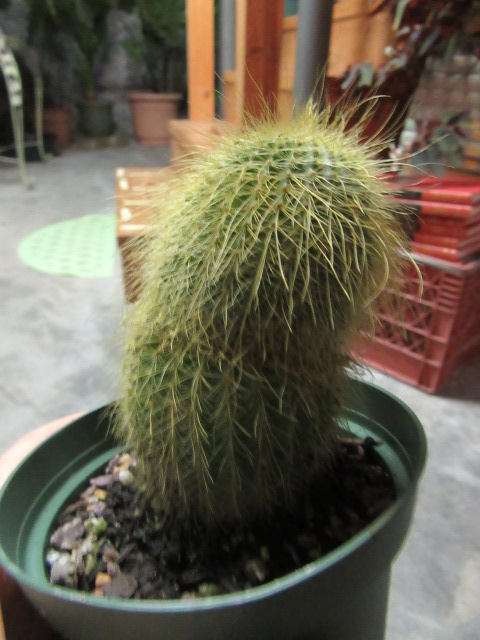
The Mammillaria elongata (Lady Finger Cactus, Golden Stars) has remnants of a few flowers when I brought it home from Wal-Mart on March 18. Of course, there were “strawflowers” hot-glued to the top of a few of the spiny fingers. Now I see it has a fruit where the flower had been. I never had a cactus do that before. I always remove the strawflowers the best I can without damaging the plant. Supposedly the hot glue will eventually fall off. Removing the glue yourself is very tricky and you can damage the plant if you force it off. Been there, done that. Every so often I check to see if more will come off with a little gentle persuasion. Sometimes it is just stuck in the needles, but sometimes it is stuck on the fleshy part.

Personally, I think hot-gluing strawflowers on cactus and painting them different colors is inhumane to plants and is also a deceptive selling tactic.

I think this is one of the shortest posts I ever made. Well, the next one will also be short.

Until next time, I hope you stay well, be positive, and GET DIRTY!


Holy Hosta

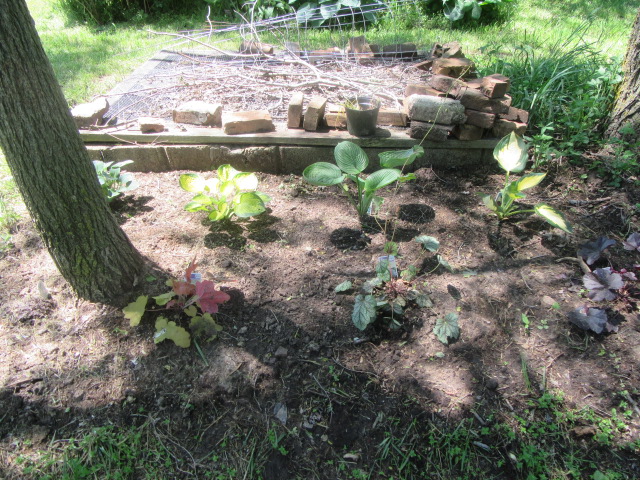
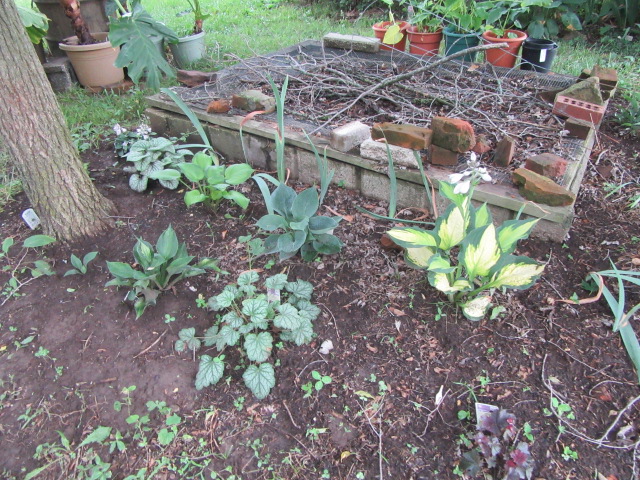
The original Hosta bed I made after returning back to the family farm in 2013. I brought these six Hosta with me from Mississippi. From left to right: Hosta ‘Red October’, Hosta ‘Krossa Regal’, Hosta sieboldiana ‘Elegans’, Hosta ‘Francis Williams’, Hosta ‘Dream Queen’, and Hosta ‘Potomac Pride’. This photo was taken on June 8, 2013, #154-10.

OK, so maybe they aren’t exactly holy, but I do seem to spend a little time bowing around them and on my knees pulling out grass and weeds. Kind of like meditation… I don’t spend enough time doing either one. Prayer is easy, though. 🙂

Hello, everyone! I hope this post finds you all well and enjoying the great outdoors when you aren’t inside enjoying the AC. I now have 14 Hosta cultivars and have lost four over the years. They are very easy to grow if you follow a few basic rules and give them an environment they like. For more information, you can read HOSTA: Information and Sources I wrote especially for Hosta. Each Hosta cultivar below is linked to their own page to the right if you would like to read more about them.

Plants of the World Online lists 21 species of Hosta but I’m not sure how many of them were actually used to make the cultivars. There are several websites that give a lot of information, depending on what you are looking for. I like The Hosta Helper by Plants Galore. It says W.George Schmid found evidence of 43 different species and 16 different naturally occurring variations (varieties) in the wild. In 1988, Paul Aden wrote there were at least 600 registered cultivars. In 2010, hybridizer and author Mark Zillis wrote there were over 8,000 identified types of Hosta and over 5,000 registered cultivars with the American Hosta Society. The Hosta Helper has information on 9,425 species and named cultivars (registered and non-registered) with photos of 3,107.

I enjoyed living at the mansion in Mississippi, but many Hosta cultivars just don’t do well in the south and neither do Heuchera and other favorite Hosta companions. Along with the Hosta listed in the above photo, I had also bought a Hosta ‘Robert Frost’ and ‘Josephine’ while living in Mississippi which didn’t survive there.

When I moved back to the family farm in mid-Missouri in 2013, I brought the remaining six Hosta with me. I dug a bed for them where I had a flower bed back in the early 1980’s when I first moved to the farm after my grandpa passed away. The mess behind the Hosta is on a concrete slab where grandpas old metal shed was. I guess dad tore it down many years ago after they moved to the farm in 1996. Well, I don’t know when he tore it down actually, but it isn’t there now.

I planted the Iris in this bed here in the early 1980’s and was surprised to see they were still coming up after 30 years. Back then this was a sunny bed with no trees now it is shade with three big trees. Not exactly an ideal spot for Iris but great for Hosta. My Hosta bed in the 1980’s was along the northeast corner of my grandparent’s house. Now that the house is gone, it is a sunny bed.


<<<<2015>>>>

Original Hosta bed on June 3, 2015, #265-16.

Along with the Hosta, I also brought the Ajuga reptans ‘Chocolate Chips’ I had bought from Lowe’s in Greenville, Mississippi in 2009 or 2010. I added the Heuchera ‘Palace Purple’ and Hosta ‘Guacamole’ (far left) in 2014.

Hosta ‘Francis Williams’ didn’t do well in 2014 and didn’t return in 2015. While ‘Dream Queen’ did very well in 2013 and 2014, it was very late to come up in 2015 and barely grew. It didn’t return in 2015.

You will also notice the Hosta ‘Krossa Regal’ in the above photo not doing so well. The Iris was also doing very well and spreading like crazy. They are a beautiful gold color but don’t flower well now because of all the shade.


<<<<2017>>>>

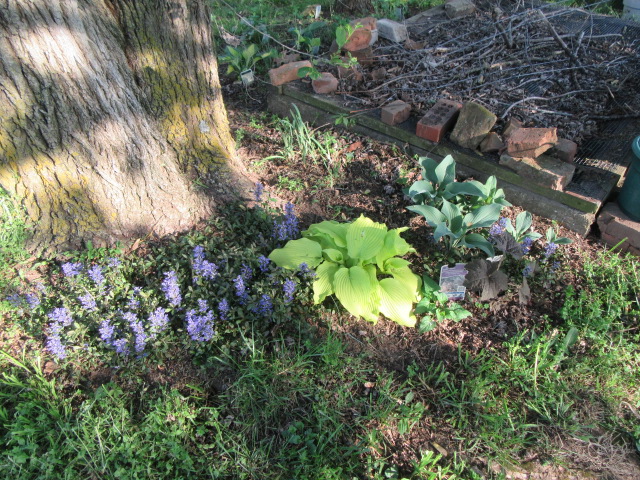
The original Hosta bed on April 23, 2017, #321-2-10.

The 2016-2017 winter was very mild and we had an early spring. The above photo was taken on April 23, 2017 and the Hosta ‘Potomac Pride’ (right) and Hosta sieboldiana ‘Elegans’ (center) were already beginning to look very good. The Hosta ‘Red October’ was still doing well although it is a medium-sized cultivar. You can barely see ‘Guacamole’ (far left) and ‘Krossa Regal’ isn’t even visible in this photo. As time went by, I knew Hosta ‘Krossa Regal’ needed a change.


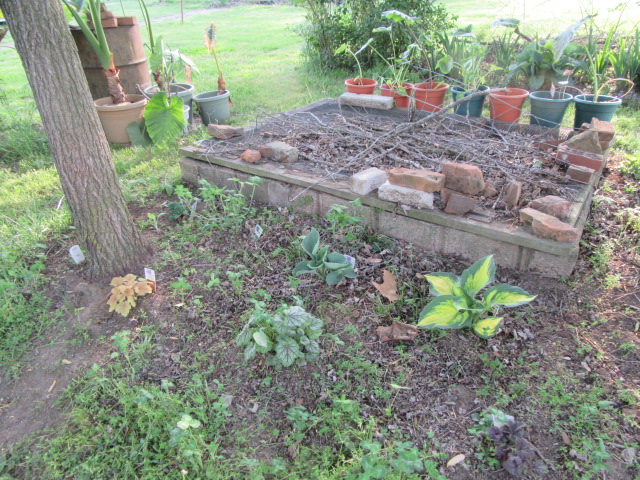
The new shade bed on May 7, 2017, #327-24.

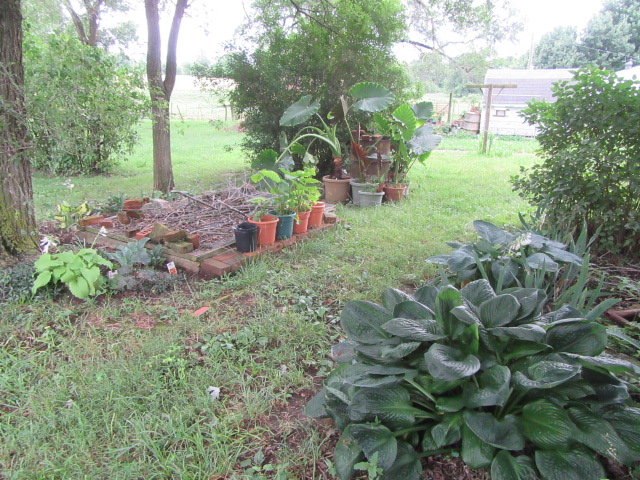
The area on the east side of grandmas old goldfish pool had been driving me crazy for quite a while. I wanted a shade bed all the way around it like I had before but conditions had drastically changed since the early 1980’s. I had put a brick walkway around the pool and made flower beds between the bricks and the fences that used to be here. The bricks were still there but under several inches of soil and grass. The fences were gone and the tree roots were also a big problem. But, I went to work and removed the bricks and dug the area up in 2017 anyway and added four new Hosta and three new Heuchera. Hosta from left to right are Hosta ‘Blue Mouse Ears’, Hosta ‘Rainforest Surprise’, Hosta ‘Abuqua Drinking Gourd’, and Hosta ‘Forbidden Fruit’. The Heuchera are ‘Southern Comfort, ‘Venus‘ and ‘Obsidian‘. I also bought a Leptinella squalida ‘Platt’s Black’ which is on the left side of the tree. I had also bought a bag of Caladium ‘John Peed” bulbs and put them here and there in this bed. I also put the Calla I bought in this bed but it isn’t in this photo.


New corner shade bed on May 23, 2017, #332-5.

I bought the Hosta ‘Dancing Queen’ in 2017 which was my first gold-leaved cultivar and put it, along with the Hosta ‘Krossa Regal’, in what I call the corner shade bed. I also moved the ailing Heuchera “Palace Purple’ from the original bed here along with an offset from Hosta ‘Red October’ (far right).


The new shade bed on September 10, 2017, #373-18.

About four months later everything was doing very well. I had also bought several other Caladiums and add them to this bed and another one in the corner bed.


<<<<2018>>>>

Original Hosta bed on May 6, 2018, #436-54.

The winter was a weird one for sure and we had a very cold January. A few of the Hosta started sprouting the last part of February-early March but that was all they did for a long time. Cold temps hung on and it was a good thing they didn’t start to leaf out. I kept them covered with leaves the best I could but sometimes the wind would blow them off. FINALLY, spring did arrive and the Hosta started growing.

As you can tell from the above photo, the Hosta ‘Guacamole’ and ‘Red October’ next to it were not happy. I was busy with other things and didn’t have time to investigate right away.


Corner shade bed on May 6, 2018, #436-55.

In the above photo on May 6, the Ajuga reptans ‘Chocolate Chips’ were flowering up a storm. They also suffered a loss during the winter but are doing handsomely well now.  The Hosta ‘Dancing Queen’ and ‘Krossa Regal’ made it through the winter with flying colors as did the Heuchera ‘Palace Purple’. The Iris fulva (between the tree and fish pool) I brought from Mississippi had always done very well but have really struggled since this past winter. No flowers this year…


The new shade bed on May 6, 2018.

All the new Hosta came up in this bed except ‘Rainforest Sunrise’. It was a very nice Hosta but you just never know. The Heuchera were doing very well until something snacked on ‘Obsidian’ (front right). Then something started digging in front of ‘Southern Comfort (next to the tree) and somehow affected its growth. Whatever happened affected its crown and it went downhill fast. I decided to move it to the corner bed to see if it would recover.

I must apologize for the untidiness of the beds and the surroundings. The concrete slab behind the original bed and fish pool seem to be an easy place to put to put branches when they fall out of the trees. There are no fish in the old fish pool because there are cracks in the side. I also get behind weeding and trimming sometimes but I take photos anyway.


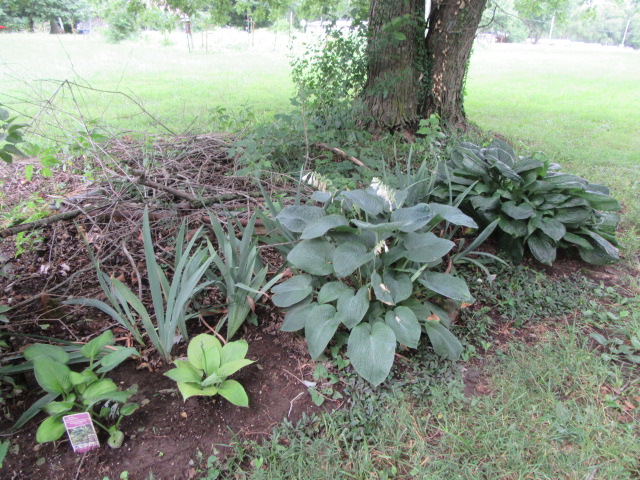
The original Hosta bed on June 21, 2018, #462-21.

On June 21st I finally dug under Hosta ‘Red October’ to see what was ailing it. To my surprise, there was a HUGE hole right under it. The roots under the plant weren’t even touching the soil and any water it was getting was going right down the hole. The whole area, even under Hosta ‘Guacamole’ and the Iris, was a series of holes that had been made by a mole. So, I dug the area really good and moved the Hosta‘ Red October and replaced it with the new Hosta ‘Sum and Substance’. I also divided Hosta ‘Guacamole’ and put half in the new shade bed.


Corner shade bed on June 21, 2018.

I put the new Hosta ‘Blue Angel’ in the corner bed behind ‘Dancing Queen’ and ‘Kross Regal’. Right now it looks weird and you might be thinking the smaller Hosta should be in front. Well, ‘Blue Angel’ is a giant type and someday it will be MUCH larger than the other two. Patience is supposed to be a virtue but sometimes I wonder. Something seems a little off though, I must admit. I bought Hosta ‘Blue Angel’ on June 7 and it has barely grown a lick…

I put the Heuchera ‘Southern Comfort’ to the right of ‘Palace Purple’. It is not recovering and growing new leaves now. I thought I was going to lose ‘Palace Purple’ a few years ago but it has certainly made a huge comeback in this area as well. You just never know…


The new shade bed on June 21, 2018, #462-22.

The new shade bed is shaping up but there are a lot of bare spots. The third Hosta from the right is the other half of Hosta ‘Guacamole. The second plant from the left on the back row is the new Brunnera ‘Jack Frost’. So, on the back row, from left to right, is Hosta ‘Blue Mouse Ears’, Brunnera ‘Jack Frost’, Hosta ‘Guacamole’, Hosta ‘Abiqua Drinking Gourd’, and Hosta ‘Forbidden Fruit’. The front row from left to right is one of the Hosta ‘Red October’ (in front of the tree), a smaller Hosta ‘Krossa Regal’, the NEW Hosta ‘Whirlwind’, Heuchera ‘Venus’, and Heuchera ‘Obsidian’. The Heuchera ‘Obsidian’ has really struggled since it was munched on the last of April.

The new Heuchera ‘Lime Ricky’ and the Leptinella squalida ‘Platt’s Black’ are on the other side of the tree on the left.


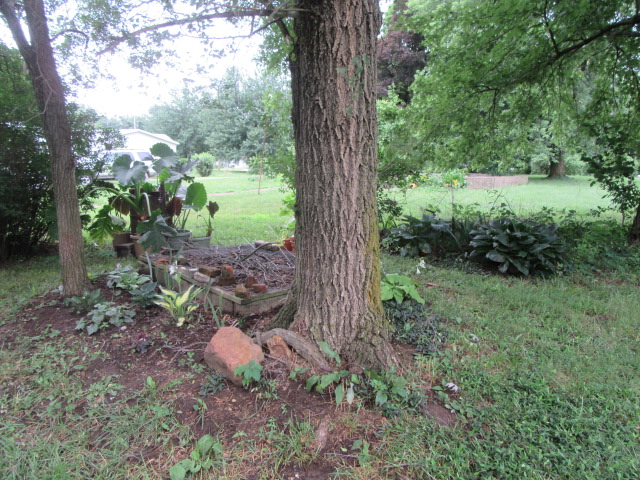
Shade beds from the northwest corner on June 21, 2018, #462-24.

This is a view of the shady area from the northwest corner. The Alocasia are on a concrete slab around the barrel that is covering the pipes from my grandparents old well. Man, that was some good water! The HUGE Alocasia to the left of the barrel is ‘Calidora’. The wind blew it over TWICE and the petioles grew crooked in only a few hours before I saw it on its side. It only took a few hours for them to get crooked and I thought they would straighten back up. Now I have a concrete block next to the pot so it won’t blow over. Bricks were usually enough before. The four pots along the goldfish pool are Alocasia gageana, the Dwarf Alocasia.


Shade beds from the northeast corner on June 21, 2018, #462-25.

This is a view of the shady area from the northeast corner. One of the other Hosta ‘Red October’ is next to the tree in the middle of the photo. It is doing so much better.

Trying to find a good spot for Hosta around trees can be a big pain because of the roots. Hosta don’t seem to mind tree roots, though, as long as they have soil and ample water.


<<<<CURRENT HOSTA, A THROUGH W>>>>

Hosta ‘Abiqua Drinking Gourd’ on June 21, 2018, #462-2.

Hosta ‘Abiqua Drinking Gourd’

2014 Hosta of the Year

The Hosta ‘Abiqua Drinking Gourd’ is one of the four Hosta I bought from Lowe’s in 2017. It has AWESOME blue-green leaves that are very thick, puckered, heavily veined, corrugated, and cupped. This cultivar grows to around 18″ tall with clumps as wide as 36 to 48″ after a few years.


Leaf of the Hosta ‘Abiqua Drinking Gourd’ on June 21, 2018, #462-3.

The cupped leaves are very interesting. The underside of the leaves have a powdery appearance which gives a two-toned effect. The thickness and texture of the leaves make Hosta ‘Abiqua Drinking Gourd’ slug and snail resistant.


<<<<+>>>>

Hosta ‘Blue Angel’ on June 21, 2018, #462-4.

Hosta ‘Blue Angel’

I brought this Hosta home from Mast’s Greenhouse while plant shopping with my sister and brother-in-law on June 7. This is one of the giant cultivars that can grow to 36″ tall and have clumps as wide as 72″ in time. Information online says it is one of the fastest growing of the blue Hosta and multiplies more rapidly. Well, it has been in the ground for a few weeks and hasn’t grown that fast yet. It is still only 4″ tall x 9 1/2″ wide. It just seems a little strange why it is so small if it is going to be a giant. If you compare it to, for example, Hosta ‘Sum and Substance’ which is also new. Not only that, this ‘Blue Angel’ is already a small clump of plants, not just a single specimen. So, why is it still so small? Could it be mislabeled? There were several pots of ‘Blue Angel at Mast’s and they were all small like this. Then when we went to Muddy Creek Greenhouse up the road, they also had several ‘Blue Angel’ that were only a little larger. Only time will tell… Its almost like they were mislabeled.


<<<<+>>>>

Hosta ‘Blue Mouse Ears’ on June 20, 2018, #461-10.

Hosta ‘Blue Mouse Ears’

Hosta ‘Blue Mouse Ears’ is another cultivar I added in 2017. It is the first miniature Hosta I have tried so it will be interesting to watch. The clump measured only 5″ tall x 9″ wide when I took the above photo on June 20.


Hosta ‘Blue Mouse Ears’ flowers on June 20, 2018, #461-11.

Even the flower stems are very short, measuring only 6 1/2″ tall.


Leaves of the Hosta ‘Blue Mouse Ears’ on June 21, 2018, #462-5.

The largest leaf measures only approximately 1 1/2″ wide x 2″ long. The leaves are very thick and smooth. Hosta ‘Blue Mouse Ears’ is a multiple award winner.


<<<<+>>>>

Hosta ‘Dancing Queen’ on 6-20-18, #461-12.

Hosta ‘Dancing Queen’

I added this cultivar in 2014 and it is the first gold-leaved Hosta I have tried. Its leaves are so bright it brightens up the whole area. Even from a distance, you can see this Hosta glowing. The clump is now 10 1/2″ tall x 24″ wide.


Leaf of the Hosta ‘Dancing Queen’ on June 21, 2018, #462-6.

The leaves aren’t all that thick but they are heavily veined. The leaf edges are kind of rippled which is known as a “pie-crust” edge. The largest leaf is currently about 5″ wide x 7″ long.


<<<<+>>>>

Hosta ‘Empress Wu’ on June 21, 2018, #462-7.

Hosta ‘Empress Wu’

Hosta ‘Empress Wu’… I always wanted a Hosta ‘Empress Wu’ since I heard about it a few years ago. I like HUGE plants and this Hosta is reportedly now the largest cultivar in the world. It can grow 48 to 60″ tall x 72 to 96″ wide when it reaches maturity after maybe five years. When I moved back here in 2013, my eye was on the corner next to the side porch for a Hosta ‘Empress Wu’ but I didn’t want to pay the price online. Last year I bought a Leucocasia (formerly Colocasia) gigantea ‘Thailand Giant’ and put it next to the porch. A few weeks later I found ‘Empress Wu’ at the garden center in Clinton but they were from Monrovia and still over $20.00. Then, to my complete surprise, I found a few at Muddy Creek Greenhouse while plant shopping with my sister an niece and they were half the price and not as large. I didn’t have the money at the time, but a few days later I did, so I high-tailed it to the greenhouse and bought one along with the Hosta ‘Dancing Queen’.  Since I already had the Leucocasia gigantea where I would have put ‘Empress Wu’, I put it in the corner. Then this spring I moved ‘Empress Wu’ out of the corner where it could have more room. The ‘Thailand Giant’ bulb rotted near the end of the winter, so I bought a bulb and planted it several feet away from ‘Empress Wu’. It is good to have the largest Hosta in the World and what was the largest Colocasia cultivar. I guess we can’t say that ‘Thailand Giant’ is the largest Colocasia anymore since the name changed.


Hosta ‘Empress Wu’ leaf on June 3, 2018, #452-12.

Currently, the Hosta ‘Empress Wu’ measures 18″ tall x 32″ wide and is MUCH bigger than it was by the end of last season. Its largest leaf is now  7 1/2″ wide x 11 1/2″ long but can grow as long as 18″.


Hosta ‘Empress Wu’ flowers on June 21, 2018, #462-8.

It started sending up a flower stem around the first of June and now the stem is 31″ tall.


<<<<+>>>>

Hosta ‘Forbidden Fruit’ on 6-20-18, #461-13, #461-13.

Hosta ‘Forbidden Fruit’

This is another Hosta I brought home from Lowe’s in 2017 for the new shade bed. It is a “non-registered” sport of Hosta ‘Orange Marmalade’ but was granted a U.S. patent in 2011. Hosta ‘Forbidden Fruit’ was created by Marco Fransen of the Netherlands. The plant measured 11 3/4″ tall x 18″ wide when the above photo was taken.


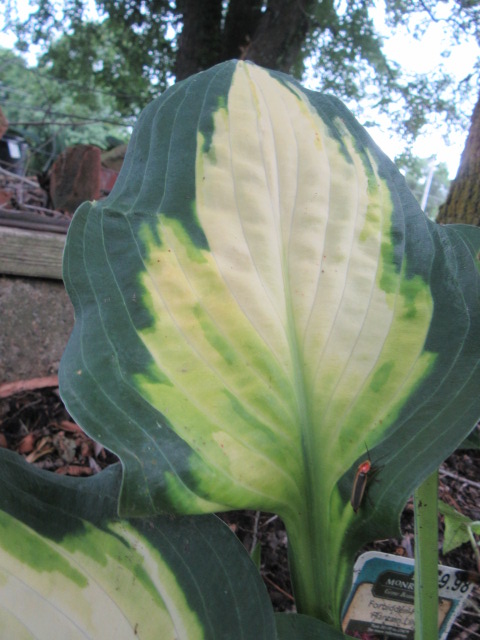
Hosta ‘Forbidden Fruit’ leaf on June 21, 2018, #462-9.

It has very bright creamy white leaves with irregular green margins and the largest is currently 5 1/4″ wide by 9″ long. As you can see in the above photo a firefly is resting on a leaf. We have more fireflies than I have seen in MANY years so you are probably going to see them in several photos as time goes by.


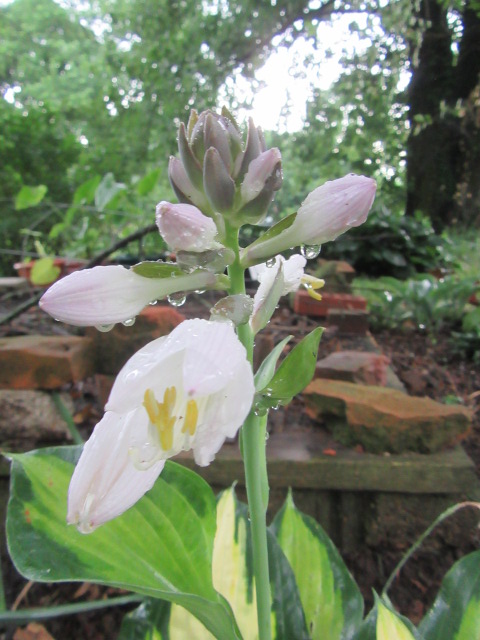
Hosta ‘Forbidden Fruit’ flowers on June 20, 2018, #461-14.

The buds on this Hosta are very tight and clustered together while others are more open. The flower stem is very stiff and is currently 20″ tall. I think this is a nice cultivar and worth watching for.


<<<<+>>>>

Hosta ‘Guacamole’ in the original Hosta bed on June 21, 2018, #462-10.

Hosta ‘Guacamole’

The Hosta ‘Guacamole’ has done very well every year since I added it in 2014. This spring it was slower than usual to come up and then very slow growing when it did. Then I found the mole holes under it and ‘Red October’. When I removed it from the bed to “fix” the mole holes, I decided to divide it and leave half the clump in the original bed and put the other half in the new bed. The clump in the original bed currently measures 11″ tall x 18″ wide.


Hosta ‘Guacamole’ in the new shade bed on June 21, 2018, #462-11.

The clump I put in the new bed measures 9″ tall x 19″ wide.


Hosta ‘Guacamole’ leaf on 6-21-18, #462-12.

The leaves of Hosta ‘Guacamole are a nice medium green with a narrow irregular darker green margin. The largest leaf is 5 1/4″ wide x 7″ long. The leaves change color somewhat during the summer.

<<<<+>>>>

Hosta ‘Krossa Regal’ in the corner shade bed on June 21, 2018, #462-13.

Hosta ‘Krossa Regal’

I bought my first Hosta ‘Krossa Regal’ from Bluestone Perennials in the early 1980’s and it was one of the first I bought in 2009 when I was in Mississippi. This cultivar is definitely one of the classics of all time with its nice blue-gray leaves and unique vase shape. It looks awesome when it is happy. Although Hosta ‘Krossa Regal’ can grow to 36″ tall and form clumps as wide as 60″, it is a slow grower. So, if you purchase one, you may not want to plant it with the larger, faster-growing cultivars at first. I can’t very well measure the clump because it has been divided, but the largest plant measures 8 1/2″ tall x 13″ wide.

I moved it to the corner bed in 2017 because it wasn’t happy in the other bed. Strange as it may sound, I don’t think it liked the Iris. I divided the clump and wound up with five plants. Two of the three grew faster while one was much slower and the other two… Well, they barely grew at all so this spring I moved them to other locations. They STILL aren’t growing well like they have a problem. I don’t understand how that can happen when they came from the same clump and did very well before.


Hosta ‘Krossa Regal’ leaf on June 21, 2018, #462-14.

The largest leaf measures 3 1/2″ wide x 6 1/2″ long.


<<<<+>>>>

Hosta ‘Potomac Pride’ on June 14, 2018, #459-36.

Hosta ‘Potomac Pride’

Hosta ‘Potomac Pride’ is another awesome cultivar I bought in 2009 when I was living at the mansion in Mississippi. While most of the other Hosta barely did OK there, this one did very well. It has continued doing very well here and has grown to 20 1/2″ tall and the clump currently measures 50″ wide. It usually flowers in June, but for some reason, it appears it is going to skip this year. Maybe it will be a late bloomer this year.


Hosta ‘Potomac Pride’ leaf on June 14, 2018, #459-37.

Its AWESOME dark green leaves are fairly thick, heavily veined, ribbed, corrugated and puckered making it very slug and snail resistant. The leaves are oval to round tapering to a point. The largest leaf is currently 8 1/2″ wide x 12″ long.


<<<<+>>>>

Hosta ‘Red October’ on June 21, 2018.

Hosta ‘Red October’

My Hosta ‘Red October’ is another cultivar I bought in 2009 while living at the mansion in Mississippi. It is considered the best red-stemmed Hosta and gets its name from its red petioles. Although its name may suggest it flowers in October, it starts for me in September.

It had been growing in the original bed since 2013 but I moved it this spring. Well, I mentioned the story earlier in this post about the mole holes. I also moved it because Hosta ‘Potomac Pride’ and Hosta sieboldiana ‘Elegans are so big that ‘Red October’ looked a little out of place because it is much smaller.


Hosta ‘Red October’ on June 24, 2017, #349-46.

It is having its issues right now but is a really nice looking Hosta when it is feeling well. The above photo of Hosta ‘Red October’ was taken last June.


Hosta ‘Red October’ leaf on June 21, 2018, #462-16.

The long, lance-shaped leaves have chalky-white undersides. Kind of makes you wonder if it has powdery mildew or something. The leaves are not slug and snail resistant.


<<<<+>>>>

Hosta ‘Sum and Substance’ on June 20, 2018, #461-16.

Hosta ‘Sum and Substance’

I bought this legendary Hosta from Mast’s Greenhouse this spring and was glad I found it. It is considered a giant type and will eventually grow to a height of 36″ and have a mound up to around 70″ wide. It currently measures 8″ tall x 14″ wide. It is starting to flower and currently, the flower stem is 17″ tall. Well, it wasn’t that tall when I took the photo but several days have passed and it is growing quickly.

This multiple award winner was registered in 1980.


Hosta ‘Sum and Substance’ leaf on June 21, 2018, #462-17.

Someday the leaves will grow much larger, but when this photo was taken the largest was 5 1/4″ wide x 7 1/2″ long.


<<<<+>>>>

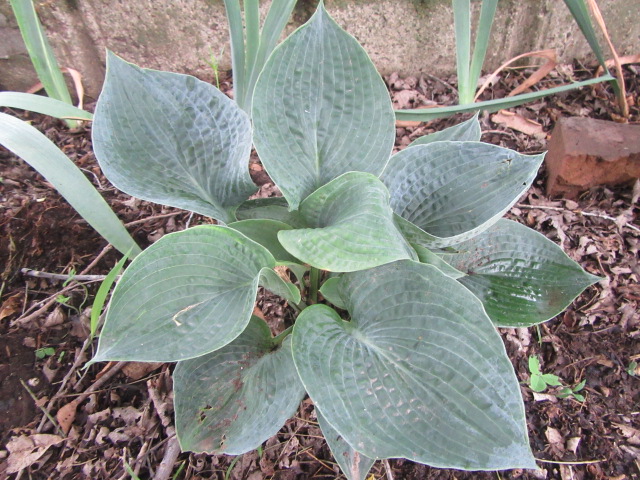
Hosta sieboldiana ‘Elegans’ on June 14, 2018, #459-42.

Hosta sieboldiana ‘Elegans’

OK, folks… This photo of Hosta sieboldiana ‘Elegans’ is pale in comparison to what it looks like in person. I have taken a lot of photos of this cultivar over the past few years and none are good enough to capture its awesomeness.  Right now, the clump measures 22″ x 41″, but in time it will average at least 28″ tall x 60″ or so wide. This is for sure a legendary giant blue Hosta that was first introduced in Germany by Georg Arends in 1905. There are at least 25 registered sports from this cultivar and it is one of the parents of at least 85 registered seedlings.


Hosta sieboldiana ‘Elegans’ leaf on June 14, 2018, #459-43.

Its AWESOME blue-green leaves are heavily veined and corrugated making it slug and snail resistant. Its largest leaf measures 10″ wide x 12″ long.


<<<<+>>>>

Hosta ‘Whirlwind’ on June 21, 2018, #462-18.

Hosta ‘Whirlwind’

I bought this nice Hosta at Lowe’s on June 10. I didn’t know anything about it but I liked the color and its really nice, thick leaves. It is classed as a medium sized Hosta that typically matures at 18″ tall with clumps 40″ wide after a few years. It is currently 8″ tall x 15″ wide.


A leaf of the Hosta ‘Whirlwind’ on June 21, 2018, #462-19.

The leaf colors change with age, light, and time of the summer.


An older leaf of the Hosta ‘Whirlwind’ on June 21, 2018, #462-20.

The largest Hosta ‘Whirlwind’ leaf is currently 3″ wide x 5 1/2″ long.


<<<<GONE BUT NOT FORGOTTEN>>>>

Hosta ‘Dream Queen’ on June 29, 2014, #230-57.

Hosta ‘Dream Queen’

I bought Hosta ‘Dream Queen’ while living at the mansion in Mississippi in 2009. I brought it with me when I moved back to the farm and it very well until the spring of 2015. It was very slow coming up andf barely grew all summer and didn’t return in 2016.


Hosta ‘Francis Williams’ on June 1, 2013, #151-50.

Hosta ‘Francis Williams’

I also bought my Hosta ‘Francis Williams’ in 2009 while I was in Mississippi then bought it with me. It did very well in 2013, but not so good in 2014. It didn’t return in 2015. Hosta ‘Francis Williams’ is a multiple award winner that has remained popular for MANY years. It has a long list of registered sports and progeny.


Hosta ‘Queen Josephine’ on May 1, 2009, #12-39.

Hosta ‘Queen Josephine’

I bought this Hosta in 2009. I think I bought it from a seller on Ebay that had it listed as Hosta ‘Josephine’. It isn’t ‘Josephine’ but does look similar to ‘Queen Josephine’ so maybe the seller was misinformed when they acquired it. This plant fizzled out in 2012 and never made it to Missouri.


Hosta ‘Rainforest Sunrise’ on July 9, 2017, #355-24.

Hosta ‘Rainforest Sunrise’

I bought this Hosta ‘Rainforest Sunrise’ from Lowe’s in 2017 for the new shade bed. It did perfectly fine all summer but did not return in 2018.


Hosta ‘Robert Frost’ on April 15, 2012, #86-42.

Hosta ‘Robert Frost’

I bought my Hosta ‘Robert Frost’ from Lowe’s in 2009 while living at the mansion in Mississippi. Although it is a multiple award winner, it never did very well. Most of the time I thought it was going to die. It kept hanging on and eventually gave it up in 2012.

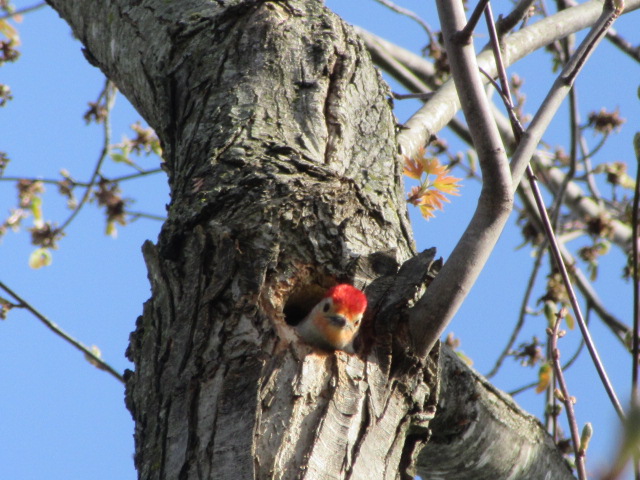
I started writing this post on June 21 and just now finished it on the 28th. 🙂 Now I can work on a few more because there have been some interesting things happening. I had an unexpected visitor today stuck between the screen and glass of the sliding door. It wasn’t actually stuck, it crawled through a hole in the screen then couldn’t find its way back out… Care to guess what it was?

Well, I better stop for now. I hope you are doing well. Until next time, take care, be safe, stay positive, and GET DIRTY!

Mid-June Plant & Bed Update

Acalypha pendula (Chenille Plant) on 6-14-18, #459-1.

Hello folks! I hope this finds everyone well. I don’t know about where you live, be it has been pretty hot here lately. It hasn’t been so bad the last couple of days and we were cooled down by a nice rain today.

I haven’t made a post since June 12, so I thought I better make one so you can see how the beds are doing and the plants are growing. Even though I haven’t made any posts I have taken well over 100 photos. I have been kind of busy outside and working on pages for the new plants. Then I get tired and wind up leaning back in my chair and falling asleep. It is amazing how well the office chair doubles as a recliner when I put my feet up on the desk.

Some of the plants have grown so fast the 89 photos I took last week are already out of date. BUT, don’t worry because I took 22 more today. I am going to leave out the Hosta and make a separate post for them.

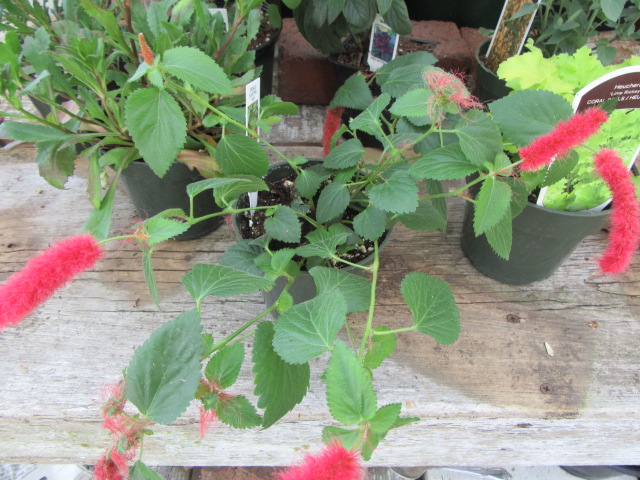
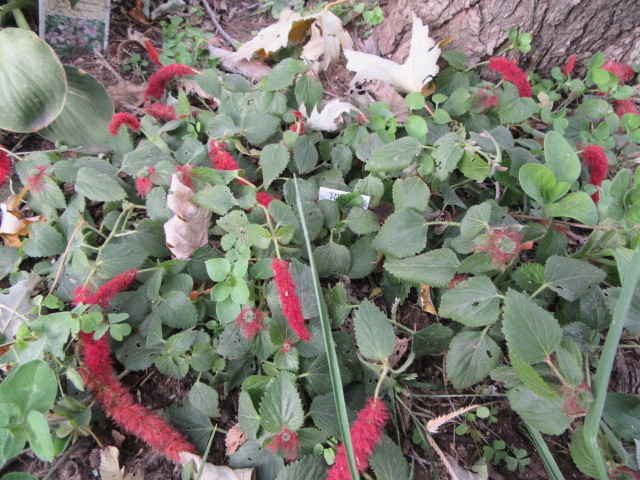
Last year I put the Acalypha pendula (Chenille Plant) in the new shade bed. This year I decided to put in a larger pot that way I can bring it inside for the winter much easier. They are very easy to grow and make very good plants for hanging pots.


The Aloe x ‘Lizard Lips’ is blooming up a storm right now. It has five flower stems and the tallest is 20″. It will continue flowering all summer and even some in the winter.


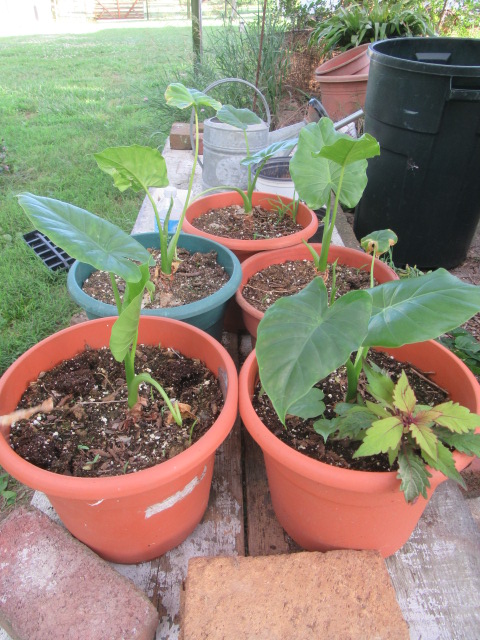
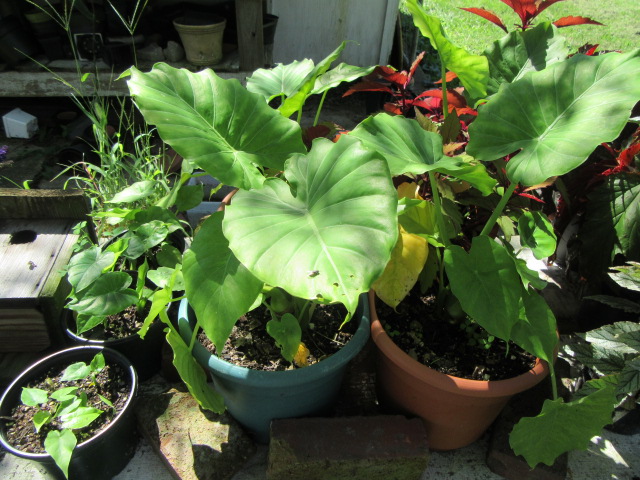
Well, I was hoping for flowers but maybe these Amorphophallus are too young still. I am not sure how old or large the bulbs have to be before they produce flowers. There were two plants in the pot when I brought it home last year, now there are SIX! One of them is just beginning to peek through the soil and the tallest is now 16″. The part in the middle that looks like a stem is actually the petiole and what looks like multiple branches on top is all one leaf.

If you remember a few posts ago I had found three bulbs and pushed the “unknown” bulb in the center down into the pot. Well, oddly enough, when it came up, it looked like a Colocasia esculenta. GEEZ! Ok, when I brought the pot home last year, I just transferred the whole thing into a larger pot without disturbing the plants. There was this “strange” looking stem in the middle with no leaves or anything. So, as I mentioned in a few posts ago, this spring I pulled the “strange” stem up and there were no roots. I could tell there was a “bulb” on top of it, which I hadn’t taken a closer look at before. Umm… So, I pushed it down into the soil. Next thing I knew, it was coming up and it looked like a Colocasia esculenta. Two thoughts came into my mind, actually three. One was, “Who would put a Colocasia esculenta in a pot with Amorphophallus? The second was, “WOW, it sure fooled you!” The third was to put it in a pot by itself in case it wasn’t a Colocasia esculenta. No matter what it was, it had to come out of the pot! Well, time has passed and it STILL looks like a Colocasia esculenta.


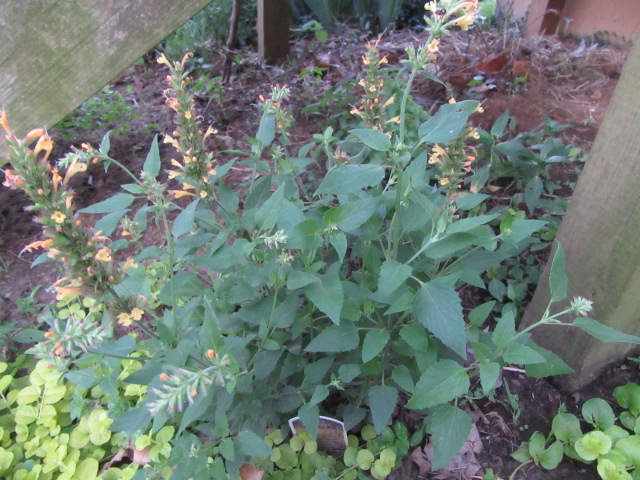
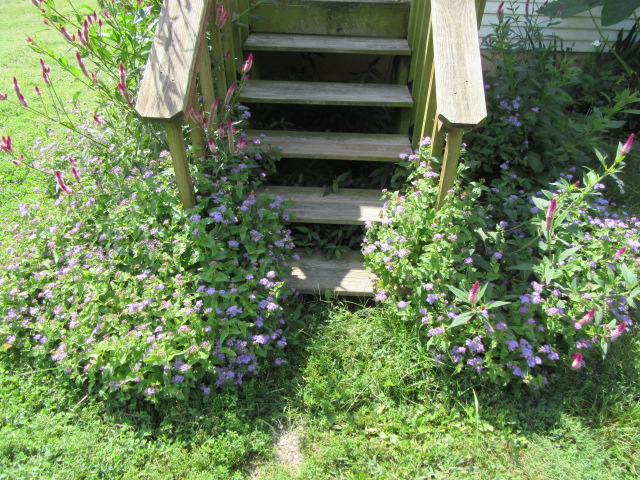
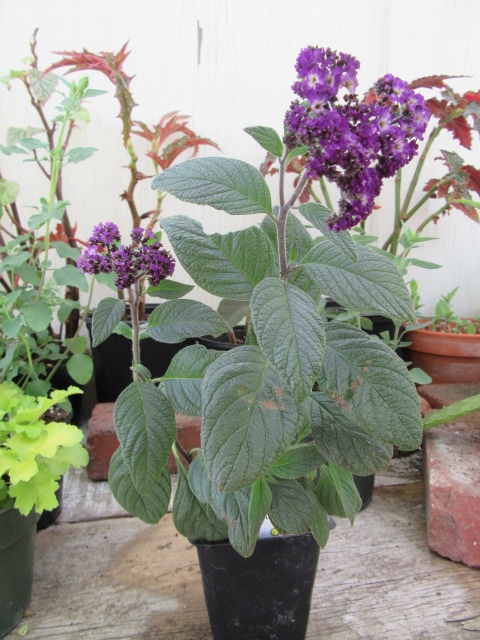
The northeast corner bed underwent quite a change since the Conoclinum coelestinum (Hardy Ageratum, Floss Flower or whatever you want to call them) didn’t come up. They have been on both sides of the steps for MANY YEARS. Finally, I noticed a couple as I was digging out the old dirt and adding “the good stuff”. This bed has the Salvia microphylla ‘Hot Lips’, three Agastache aurantiaca ‘Apricot Sprite’, Heliotrope ‘Marine’ (far right), Gomphrena globosa ‘Gnome White’ and ‘Purple’ (two of each), Isotoma fluviatilis (Blue Star Creeper), and the two Hardy Ageratum. The Cenchrus setaceus (Purple Fountain Grass) is behind the Agastache where it wasn’t intended to be. It was supposed to go where the Heliotrope wound up and the Crocosmia x Curtonus ’Lucifer’ was supposed to go where the Purple Fountain Grass is. I thought the Heliotrope wasn’t going to make it because a mole kept digging it up. This week the mole left it alone and it perked up…


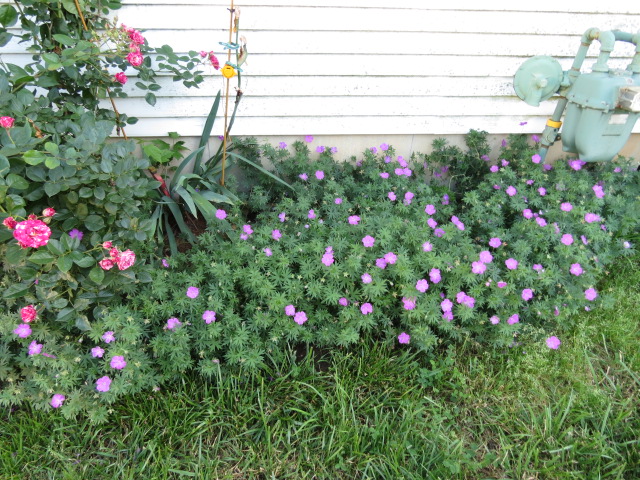
I know this looks like a mess, but what can I say. It’s a work in progress I think. The Crocosmia x Curtonus ’Lucifer’ wound up in the corner behind Hosta ‘Empress Wu’. I moved the biggest clump of Achillea millefolium in front of the barn but didn’t move the other clump by the wall. I had to move the Hosta farther away from the corner because it will get MUCH bigger in time. The “Elephant Ear” in the right side of the photo is the Leucocasia gigantea ‘Thailand Giant, which used to be Colocasia gigantea ‘Thailand Giant’ before the name changed. I put the new Astilbe x arendensii Fanal’ kind of in front of the Hosta and to the left a little. The three Agastache ‘Kudos Gold’ are next to the porch and doing AWESOME. I am going to put the Monarda didyma Super Buzz™ ’Cherry Pops’ (GEEZ) next to the steps instead of next to the back porch. I put the two largest Colocasia esculenta bulbs (tubers) farther up in this bed, too. The other Astilbe and Geranium sanguineum (Bloody Cranesbill) are also there.

I almost forgot to mention the Lysimachia nummularia ‘Goldilocks’ (Creeping Jenny) that is really enjoying itself.


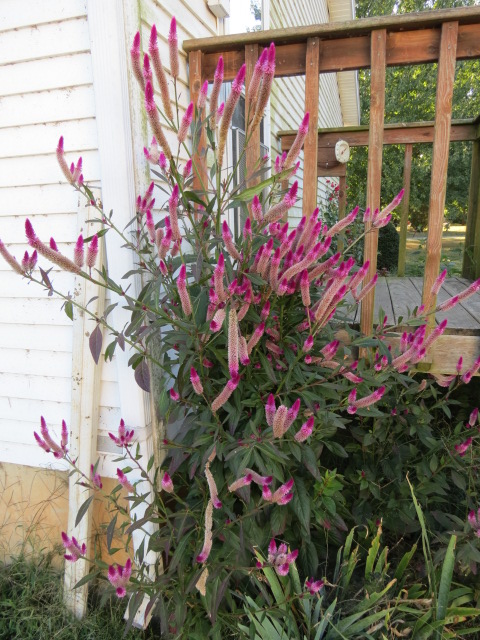
The south bed from the left… A continual work in progress but almost there. I had a few big surprises in this bed. The Marigold ‘Brocade’ and Talinum paniculatum Jewels of Opar) didn’t come up very well from seed probably because of the winter. Actually, it was a good thing so I am definitely not going to complain. The Celosia spicata ‘Cramer’s Amazon’ made up for them and as usual, there are MANY more than I can use. I have already transplanted all I need along the wall and there are hundreds left over. I hate to pull them up and throw them away, but if I transplant them somewhere else just think of how many there will be next spring. Maybe I can move some here and there on the farm along the fence rows. Umm… Then, next thing you know, the Missouri Conservation Department can add them to their list of wildflowers. 🙂 Wonder what would happen if I scatter some seed along the highway? I am not going to say they are invasive. The other surprise was all the Rudbeckia hirta ‘Denver Daisy’ that came up from seed. Luckily they came up in a group so I decided to just leave them where they were.

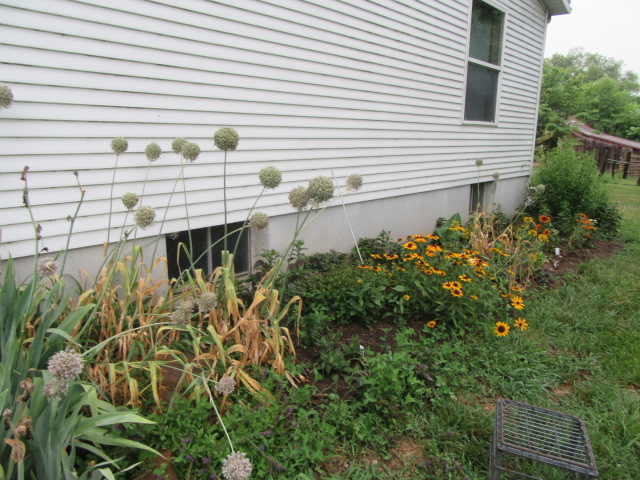
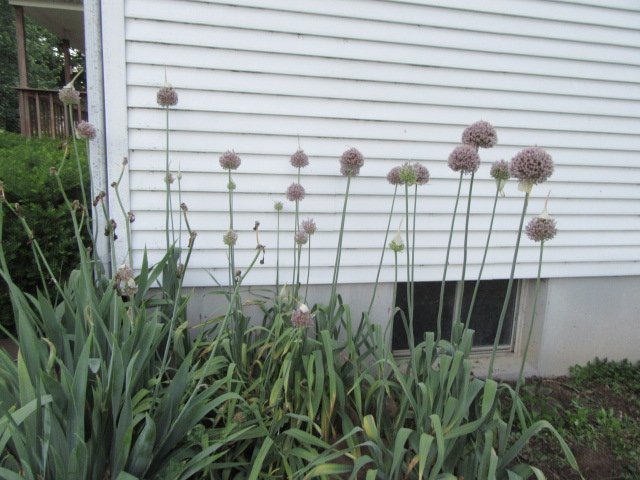
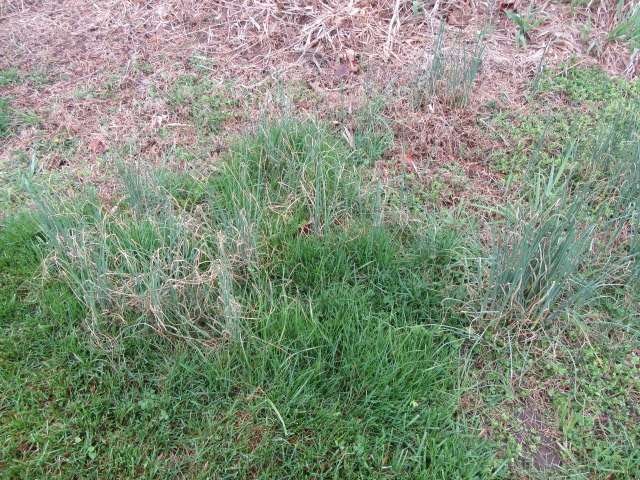
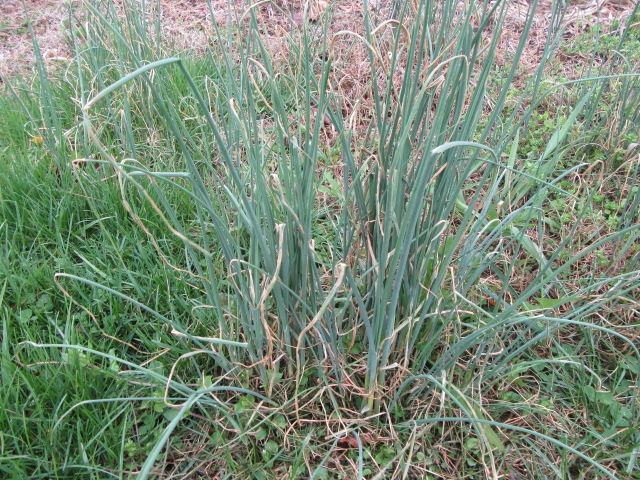
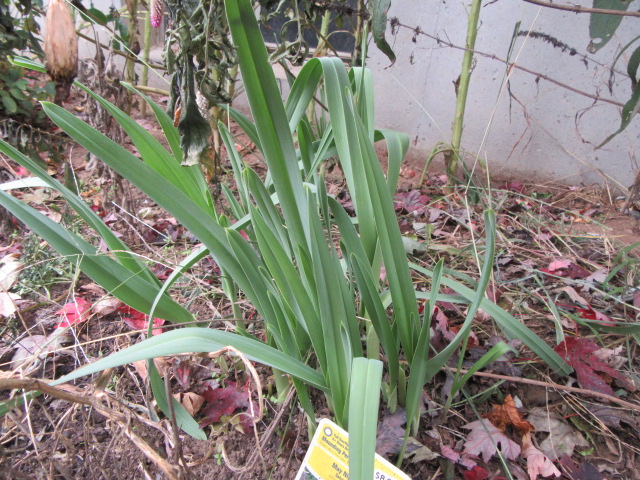
The Elephant Garlic always does very well in the south bed. I measured the flower clusters and they are 5″ across.


The south bed from the right side… The Salvia x sylvestris ‘Mainacht’ is soooo much happier after I moved the clump of Elephant Garlic from behind it. After all these years of not spreading, it is now 3 times the size it was before.

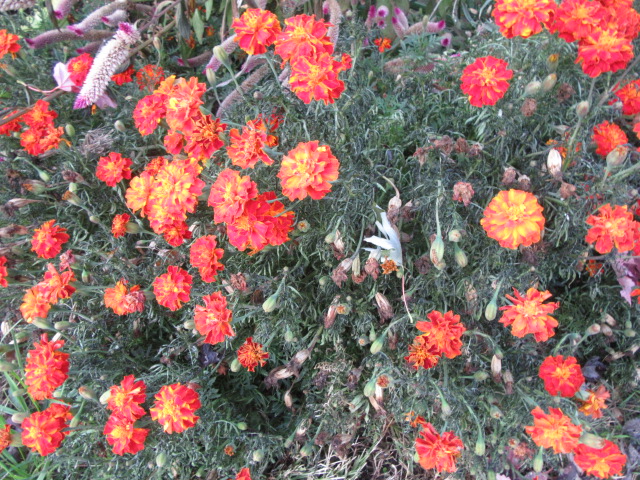
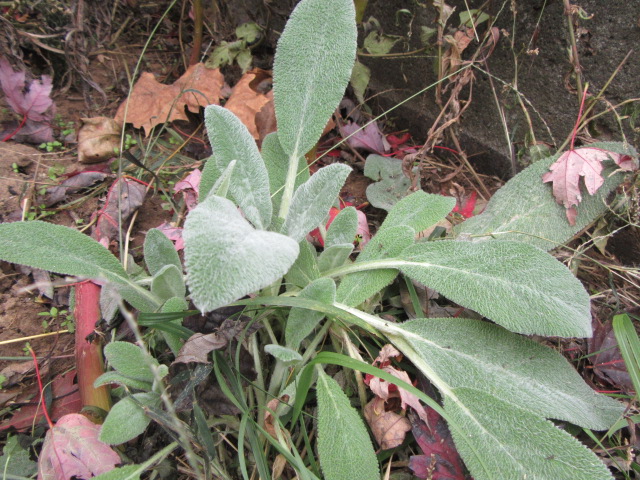
Plants in the south bed, from downspout to downspout, include in alphabetical order: Achillea ‘Moondust’, Allium ampeloprasum var. ampeloprasum (Elephant Garlic), Buddleja ‘White Profusion’, Celosia spicata ‘Cramer’s Amazon, Rudbeckia hirta, Rudbeckia hirta ‘Cherokee Sunset’, Salvia farinacea Cathedral™ ‘Blue Bicolor’, Salvia nemorosa ‘New Dimensions Blue’, Salvia pratensis Fashionista™ ‘Midnight Model’, Salvia x sylvestris ‘Mainacht’ (‘May Night’), Stachys byzantina (Lamb’s Ears), Tagetes patula (Marigold) ‘Brocade’, and Talinum paniculatum (Jewels of Opar). I still have to transplant a few ‘Brocade’ Marigold and Jewels of Opar into this bed, but not near as many as I did last year. Even though they did not come up well here from self-sowing, they came up in the other beds.


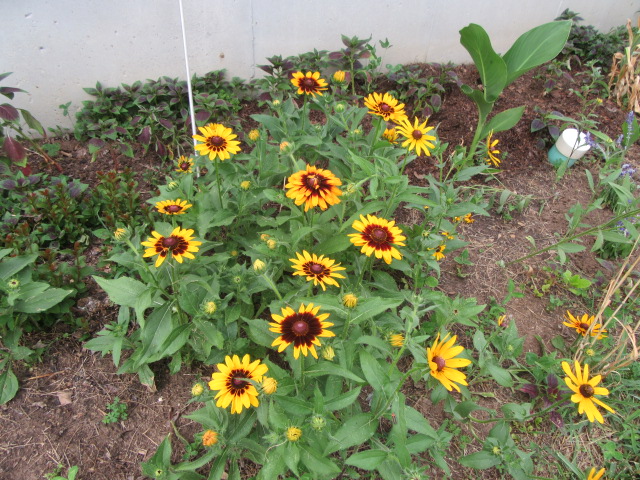
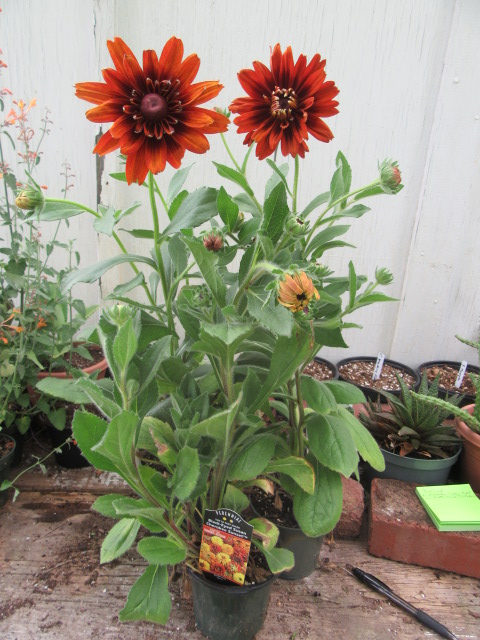
The Rudbeckia hirta ‘Denver Daisy’ are doing really well and blooming like crazy. The above photo was taken on June 14 while the photo of the bed was taken on the 20th. So, you can see there are many more flowers now. Some of the flowers measure 4 1/2″ across.

Ignore the Canna. Pretend it is invisible…


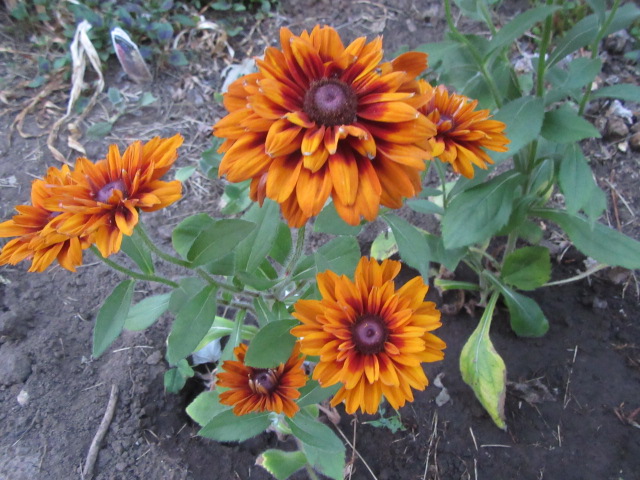
Out of all the flowers in the ‘Denver Daisy’ colony, there are two plants that are producing doubles… The above photo was taken in the afternoon while the one before it was taken in the morning. That may be one reason why it looks like it is a different shade. The other reason is that it kind of is a little darker.


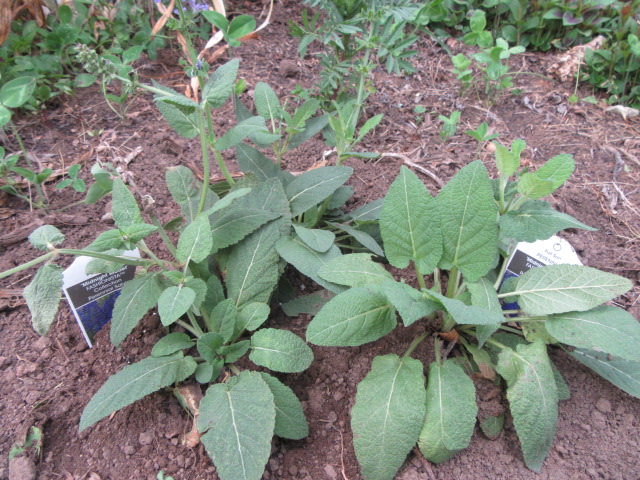
There are several different colors in the Cathedral™ Series of Salvia farinacea but I think these are ‘Blue Bicolor’. The tag with them just says ‘Cathedral™ Series’. I have to keep an eye on these three plants because I think they require a little more moisture. Unfortunately, these may not return next spring because we are not in their “zone”. Lowe’s shouldn’t sell perennials that are not perennial in their local store’s zone. They probably didn’t realize it or maybe they wouldn’t have. I grew Salvia farinacea ‘Blue Bedder’ from seed in Mississippi.


The Salvia pratensis Fashionista™ ‘Midnight Model’ are nice plants and


They have really neat flowers. Their top lip looks like a hook! I have to make sure I keep up with deadheading or these plants may stop flowering.


The above photo of the Rudbeckia hirta ‘Cherokee Sunset’ was taken on June 15. They are looking even better now and some of the flowers are 5″ across!


On the other side of the downspout is the southeast corner bed. The Jewels of Opar were not all that close to this bed last summer, but as you can see a few came up here this spring. I am going to move them and the Marigolds to the south bed this week. The Celosia spicata ‘Cramer’s Amazon’ doesn’t need to be here either. This bed is mainly for the Angelonia angustifolia hybrid Angelface® ‘Perfectly Pink’. There are also a couple of the Echinacea purpurea (Purple Coneflower) I brought home earlier in this bed. On the right is one of the clumps of Stachys byzantina (Lamb’s Ears) that has done well here. The Nandina domestica (Heavenly Bamboo) in the corner is doing well after a cold winter that I thought did it in.


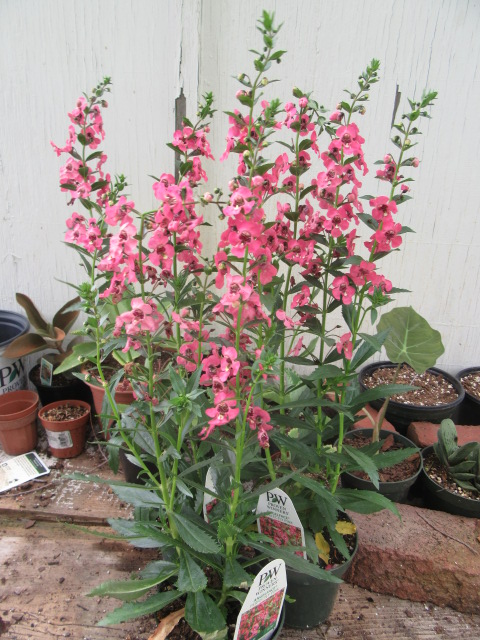
The flowers on the Angelonia ‘Perfectly Pink’ are really interesting!


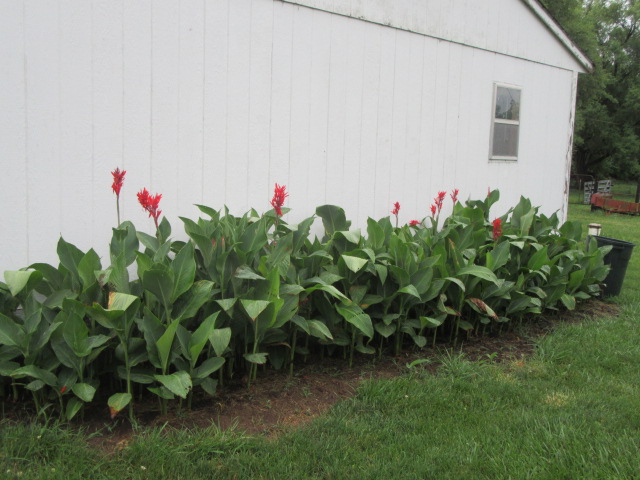
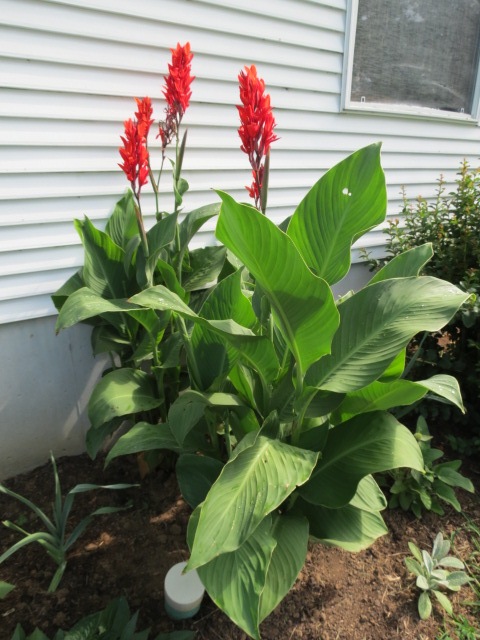
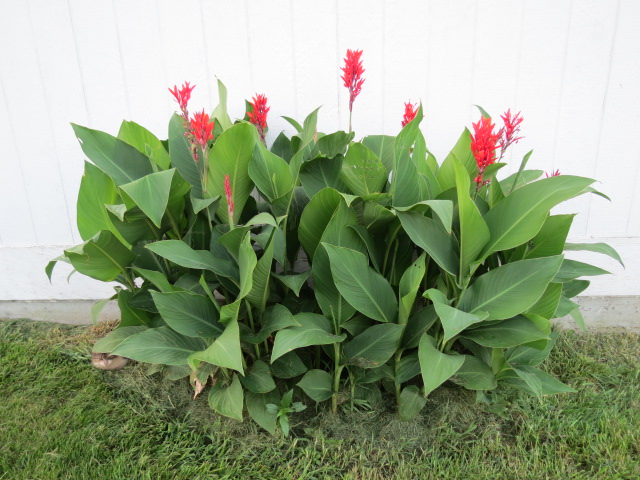
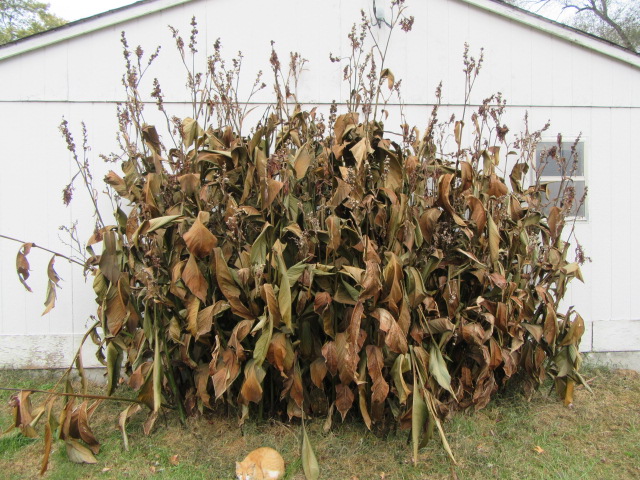
The Cannas are looking good now and I am much happier since they are spread out the entire length of the garage. They grew to 12′ tall last year but they may not grow as tall this year since I dug them all up. I put several Colocasia esculenta along the front of them but they have barely started growing. That may have been a mistake, but we shall see in time. I think they will be OK as long as I give them plenty of water.

I have a few more photos, but it’s getting late and I am about to fall asleep in my chair again. SO….

Until next time, stay well, stay positive, be thankful and GET DIRTY!!!

New Plants Update

Hello folks! I hope this post finds you all well. Before I get sidetracked I wanted to make a post about the latest new additions. I will need them as I move from bed to bed getting them ready for the summer. Oh, summer is already here, huh? Well, I had to think of a good reason that didn’t sound like an excuse.

The plants I bought on May 5 are all doing well. When My sister wanted to go back to the greenhouses on June 7, of course, I went. I may have gotten a little carried away but I visualized in my mind where they all would go (for the most part). The south bed needs work for sure so most of what I brought home will go there. Then on Sunday, I went to Lowe’s and found a few more plants. Actually, I went to Sedalia to go grocery shopping but my first stop was Lowe’s. I didn’t want my ice cream to melt. 🙂

It took as long time at Lowe’s and I put several succulents back I decided I didn’t need. Over the years I have learned what succulents work OK over the winter in the house. No need to buy, no matter how AWESOME some of the Echeveria look during the summer, they don’t work well in lower light inside over the winter. I put back a really nice Crassula because of the same reason. The worse things was seeing all the cactus and succulents labeled “succulent”. GEEZ! What is their name, for crying out loud?!?! You know how many cactus and succulent species are variable that look so much alike? Resisting plants is not my strong point, but I did…

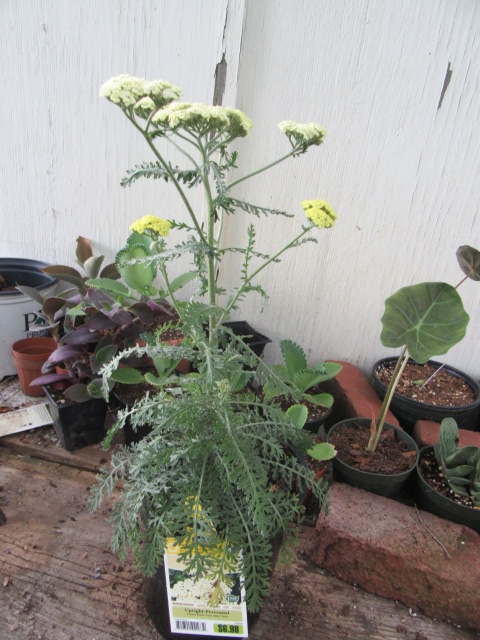
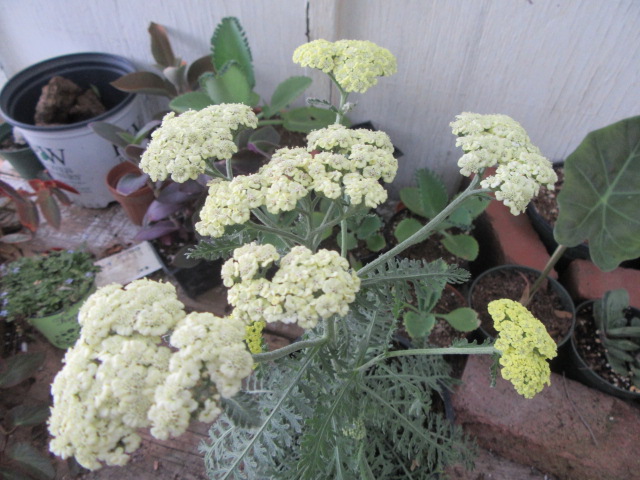
Anyway, after I bought only a few plants and was leaving, I saw the Achillea ‘Moondust’. So, I picked one out and went back inside and paid.


You can’t go wrong with Achillea in the full sun so this one will go in the south bed for sure. The leaves are quite a bit different than Achillea millefolium, so I need to do some investigation. Is Achillea ‘Moondust’ it a cultivar of a certain species or a hybrid? Hmmm…


Agastache ‘Kudos Gold’.

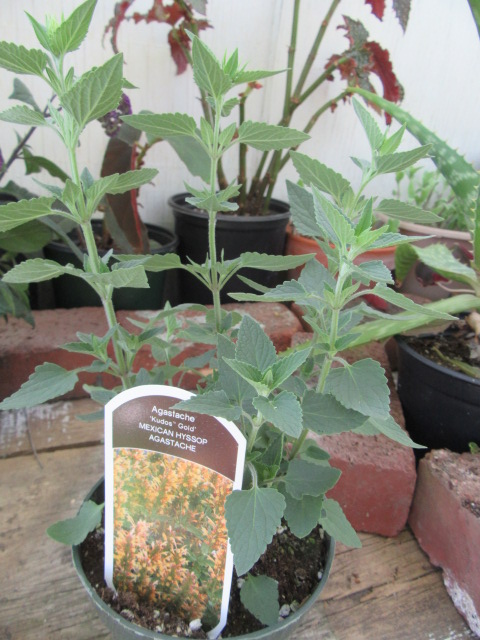
I bought two more Agastache ‘Kudos™ Gold’ to go with the first one I bought on May 5. They will go in the north bed next to the porch steps on the right side.


Agastache aurantiaca ‘Apricot Sprite’ after I brought them home on 6-7-18, #455-2.

I bought most of my plants from Wildwood Greenhouse. It is the smallest greenhouse here but they always have a very good selection and their prices are very reasonable. I bought these Agastache aurantiaca ‘Apricot Sprite’ for the bed on the left side of the north porch. That bed is basically finished now but I ran into a snag… That is for another post :).


GEEZ! Yeah, I know the Angelonia angustifolia hybrid Angelface® ‘Perfectly Pink’ is pinkish but I have the perfect spot for them. I put them in the southeast corner bed.


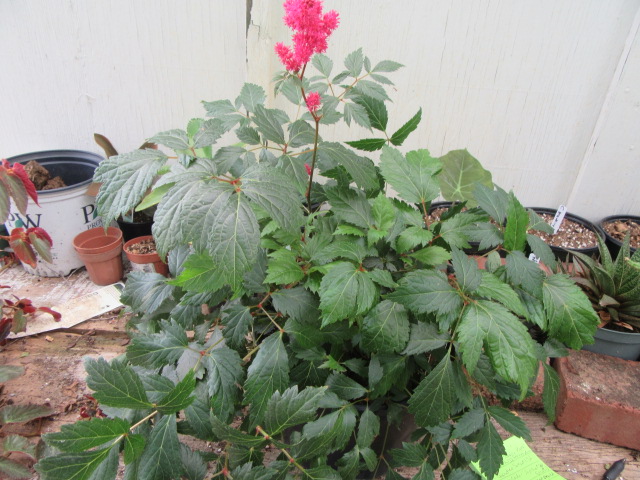
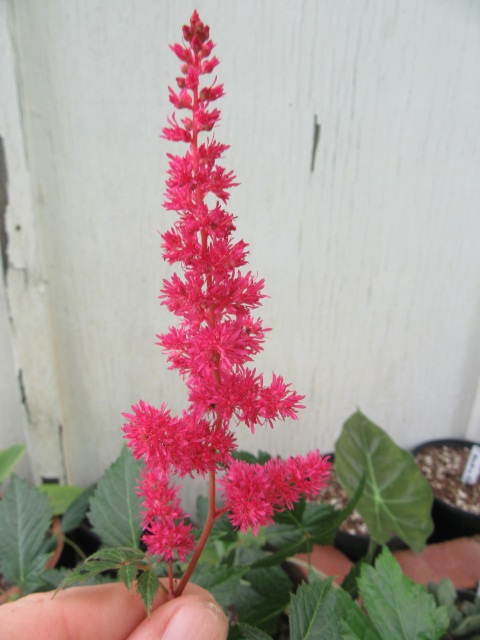
The Astilbe x arendsii ‘Fanal’ is one of the only plants I bought that I have no idea where it will go. Probably somewhere in the north bed between the Colocasia esculenta and Leucocasia gigantea ‘Thailand Giant’. Wildwood had several of these and they are very nice plants in good sized pots for a very good price. Who could resist? I put this plant in the north bed.


Depending on which website you are on, the flowers are a deep garnet red, deep red, bright red. I am calling them red but they really are neat.


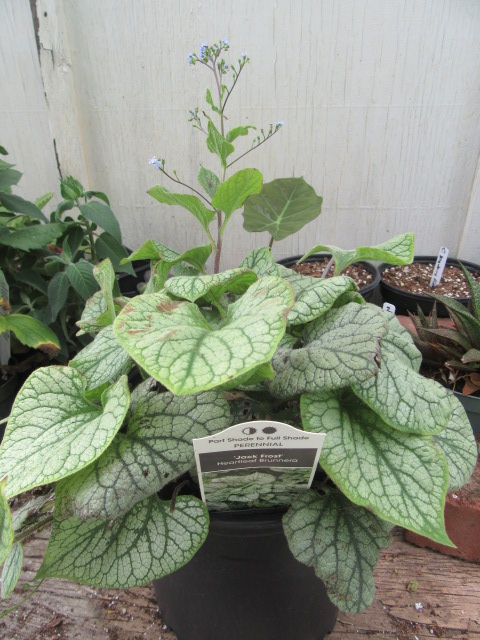
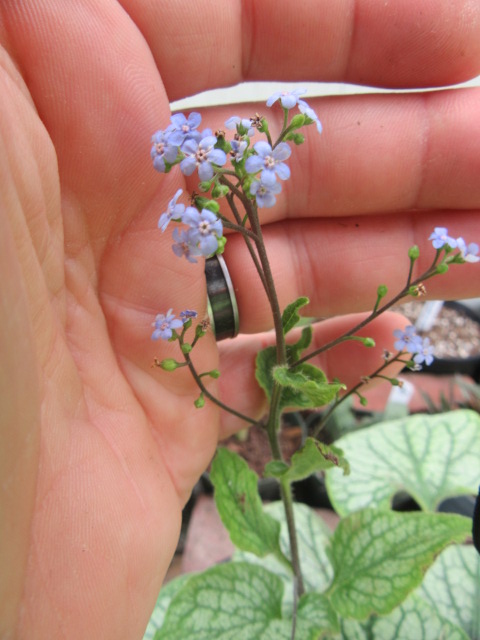
I found this Brunnera macrophylla ‘Jack Frost’ at Muddy Creek. I had a Brunnera ‘King’s Ransom’ when I was in Mississippi that I bought off the discount rack at Lowe’s. It was pretty much shot and didn’t survive. They don’t like high heat and humidity and need consistently moist soil. ‘Jack Frost’ is supposed to tolerate drier conditions so we shall see what happens. It was introduced by Walter’s Gardens in 2000 and won the Perennial Plant of the Year in 2012. It is already in the shade bed.


Brunnera macrophylla have neat and happy small pale blue flowers.


I had a plan for the Crocosmia x Curtonus ‘Lucifer’ but somehow forgot to put them where I intended in the bed on the right side of the north porch. Well, I had to make a change and put the Heliotropium arborescens ‘Marine’ where I wanted the…


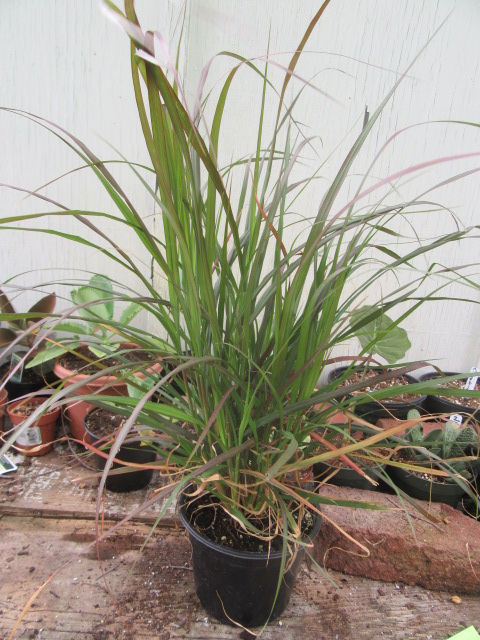
Cenchrus setaceus ‘Rubrum’ (Purple Fountain Grass). So, I had put this plant where I wanted the Crocosmia. Then, after I moved the Heliotrope something (like a cat or mole) dug in the bed and kind of screwed it up. Well, something is also weird with the soil… So, the Heliotrope may not make it and I can put the Fountain Grass in that spot after all. Then the Crocosmia can go where I wanted them in the first place or next to the porch instead of the steps.

Now, if you are wondering why I am calling the Purple Fountain Grass a Cenchrus setaceus instead of Pennisetum setaceum it is because the name changed in 2010.


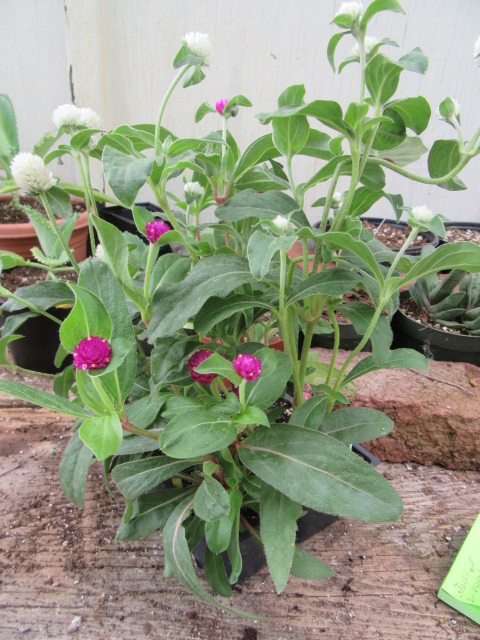
Since the Blue Mistflower (Conoclinum coelestinum) didn’t come up from seed this spring, it left the areas next to the steps without anything. When we were at Muddy Creek Greenhouse I found these Gomphrena globosa ‘Gnome Series’. They had quite a few 4-packs with a mixture of white, purple and pink. I found a pack with two white and two purple to bring home. I put them in the bed on the left side of the steps. They will get plenty of morning sun.


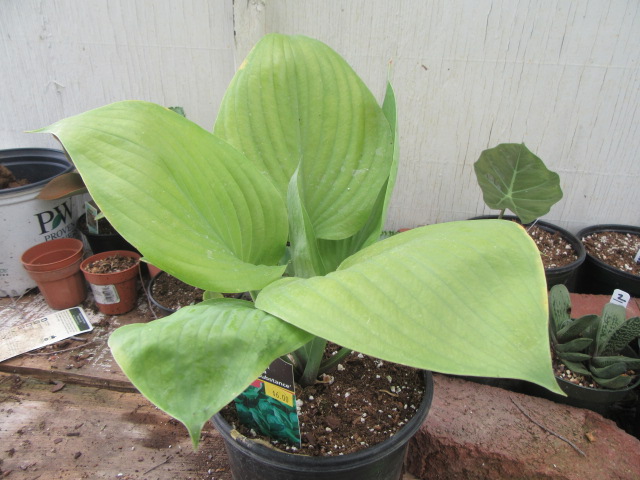
Mast’s Greenhouse had a couple of Hostas I had to bring home. The one in the above photo is Hosta ‘Blue Angel’. They had several of these plants, but I bought this one because the Yellow Wood Sorrel (Oxalis stricta) in the pot has different colored leaves than the ones growing in my flower beds (and the yard). My dad’s mom had a purple-leaved Wood Sorrel in her flower bed which I got a start from when I was around eight. I have not seen any since (It is NOT the same as Oxalis triangularis). Then when we went to Muddy Creek and they had larger plants for around the same price.

Hosta ‘Blue Angel’ can grow to around 3′ tall x 5′ to 6′ wide in time.


I also brought this Hosta ‘Sum and Substance’ from Mast’s Greenhouse. Hosta ‘Sum and Substance’ is a legendary cultivar and may be the largest of the chartreuse/gold cultivars available. Hosta ‘Sum and Substance’ can grow around 3′ tall x up to 6′ wide within a few years.


Even though there were several Hosta cultivars at Lowe’s I didn’t have, I resisted. I had originally picked out a Hosta ‘Wide Brim’, but then decided on this Hosta ‘Whirlwind’. It’s thick, dark variegated leaves won me over and I put the ‘Wide Brim’ back. I put this in the new shade bed I made in 2017.


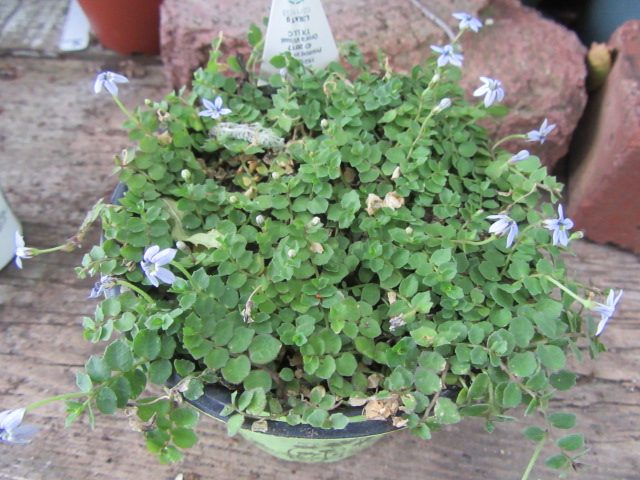
I found this plant called Blue Star Creeper (Isotoma fluviatilis) I had never heard of before. The label says they like full sun, so I thought I would bring one home and give it a try. Ummm. Depending on what the roots look like, I will either plant the whole pot in one place or divide it into four and put them in different locations.


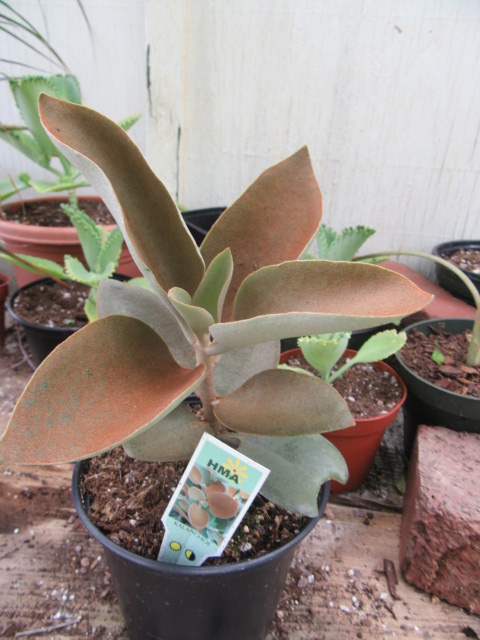
Then I found this AWESOME Kalanchoe orgyalis whos common name is Copper Spoons. Of course, this plant will stay on the plant tables next to the shed.


I really like Kalanchoe and I couldn’t resist this plant… The leaves have a felt-like texture.


I found these Bee Balm called Monarda Super BuzzCherry Pops‘ for the northeast corner bed by the back porch. I had bought a Monarda at one of the local garden clubs plant sales last spring but it didn’t survive. I decided I may put them on the right side of the steps on the north side of the house.


I also bought three more Rudbeckia hirta ‘Cherokee Sunset’ from Wildwood for the south bed. I tried them there last summer, but the ‘Brocade’ Marigolds and Celosia spicata ‘Cramer’s Amazon’ overwhelmed them (and me, too). I didn’t think any seed from these plants came up from last year, but I am not 100% sure now. When I was getting the bed ready a few days ago I noticed there are plants in the right side of the south bed that have similar leaves. They have no buds yet but they do have leaves like this plant and the species Rudbeckia hirta.


Lowe’s had A LOT of these Salvia farinacea Cathedral™ ‘Blue Bicolor’. I had Salvia farinacea ‘Blue Bedder’ in Mississippi I grew from seed. They always did very well and also reseeded. So, I will put these in the south bed.


Wildwood Greenhouse had several Salvia cultivars but I had to bring three Salvia pratensis ‘Midnight Model’ home with me. They will go in the south bed. I love Salvia and it is always good when I find a species I haven’t tried before.


I always liked the Pincushion Flower but hadn’t ever grown any. So, when Lowe’s had several Scabiosa columbaria ‘Blue Note’ (Dwarf Pincushion), I had to bring one home. I am not sure where I will put it yet…


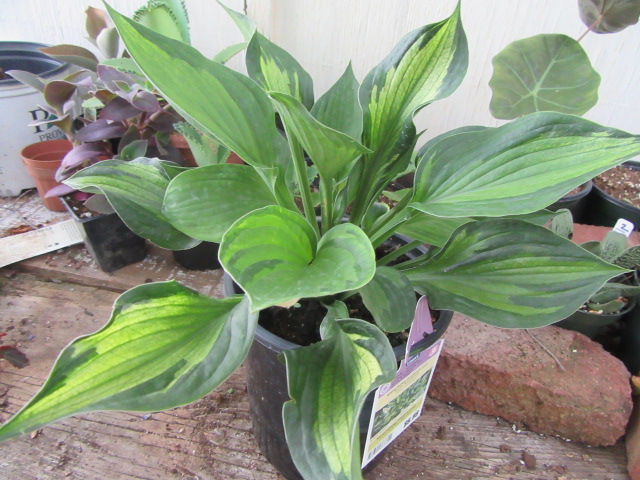
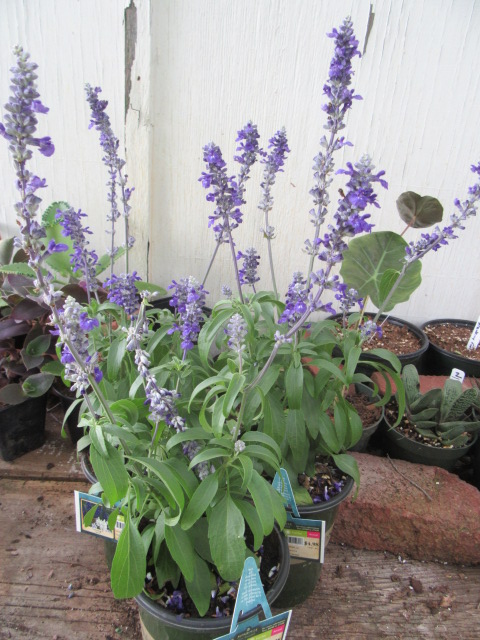
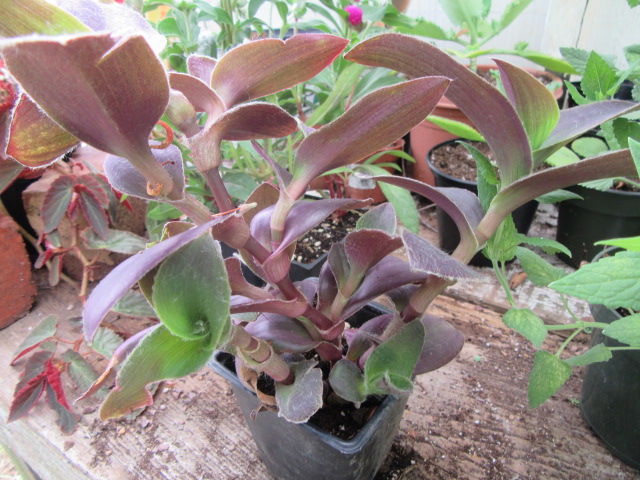
Wildwood also had a few pots of Purple Heart (Tradescantia pallida) like I had in Mississippi. They are perennial there but I will have to keep it in a pot so I can bring it inside here. I will put it in the basement where it will go dormant over the winter like I do the Tradescantia sillamontana. We will just have to see. I will no doubt take a few cuttings and experiment a little and put one upstairs to how it does there. They do make good houseplants but they need the proper amount of light or they get weird.


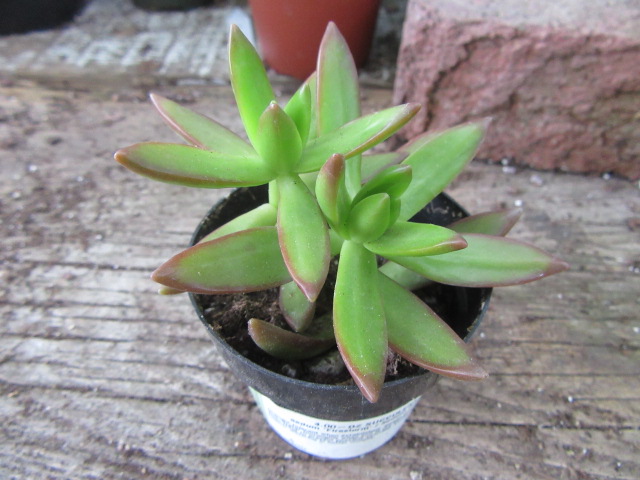
I finally found a Sedum adolphii ‘Firestorm’ at Lowe’s. I already have a Sedum adolphii (which needs some work) I have had for a few years. Now I will see how this one does.


Last in alphabetical order is the always GREAT Sempervivum ‘Oddity’. I lost this plant a couple of years ago (and no, I don’t want to talk about it). I found another one at Wagler’s in 2016, but it didn’t do well. So, now that I have another one… HANDS OFF! 🙂

I think that is it for the new plants for now. Hopefully, all will do well and thrive just as I hope you are all doing well and thriving. I will finish working on the pages to these plants now. 🙂 Until next time, take care, stay well, positive, be safe and GET DIRTY!


Then on May 31…

Hello folks! I hope this post finds you all doing well. The title sounds somewhat strange because I already did an update through June 3.  Not only that, it is June 11 already and I am making a post about what happened on May 31st! But, like I mentioned, I am somewhat behind and things have been off track the past week.

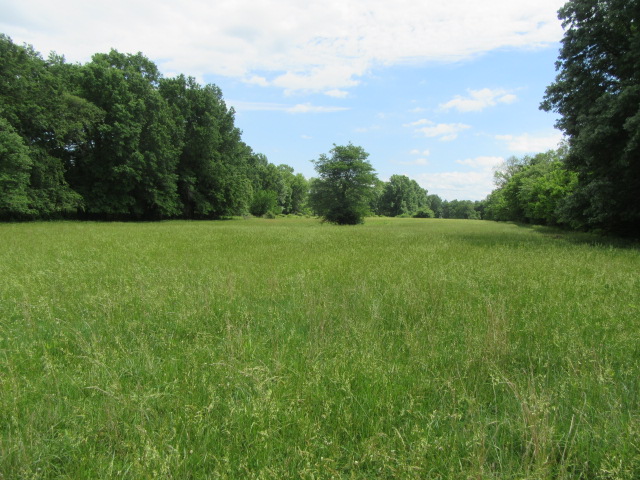
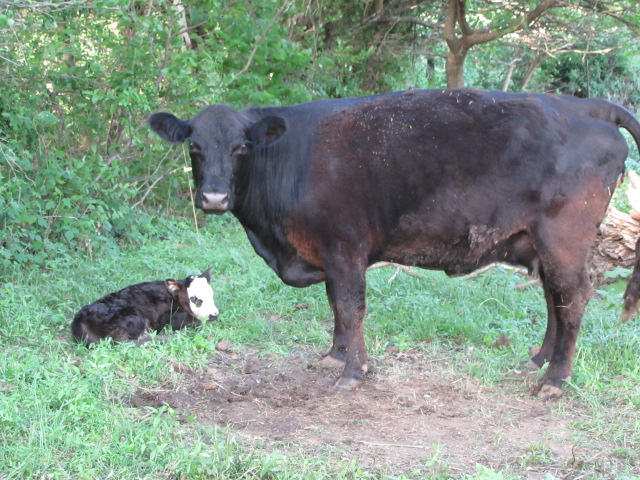
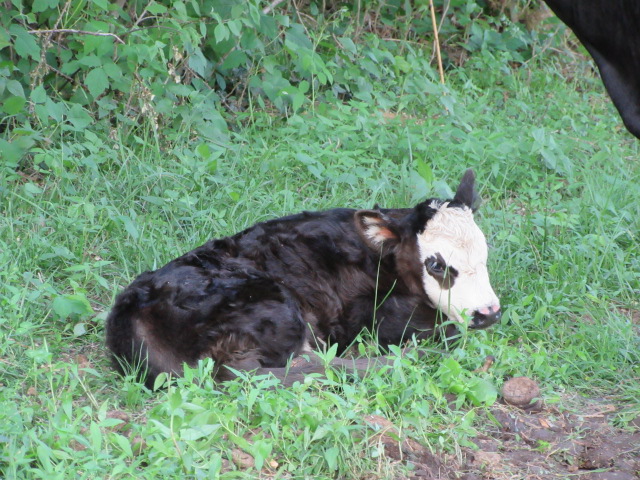
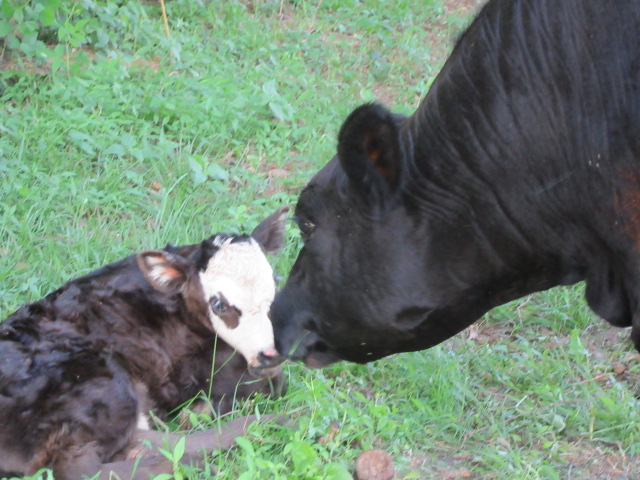
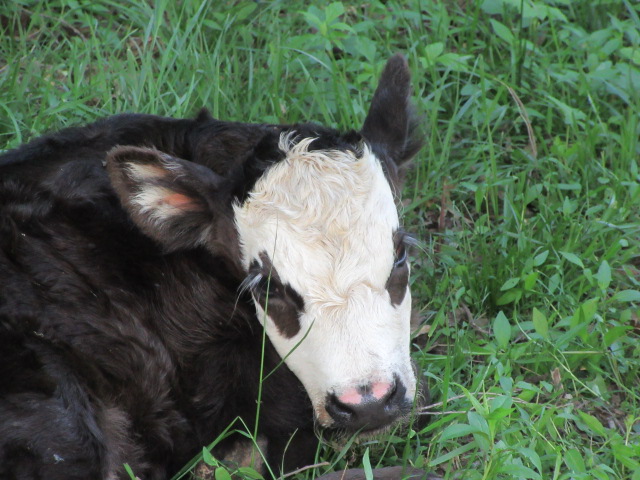
The back pasture is looking really good since the cows haven’t been back there to graze. I decided to let them back there on May 31 after I had the fence row taken care of. They hadn’t been back here (there) since the ordeal with the fencer. I was so glad I got that straightened out! It is such a strange and hard to explain feeling when the cows are not where they are supposed to be. Even stranger when you see a broken wire and the cows didn’t cross it and get in the backyard. Well, for the most part, our cows are very good and won’t try a fence just to see if it is hot. Kind of like me, I guess. I used to touch it to check it, now that only happens by accident which is MUCH worse.


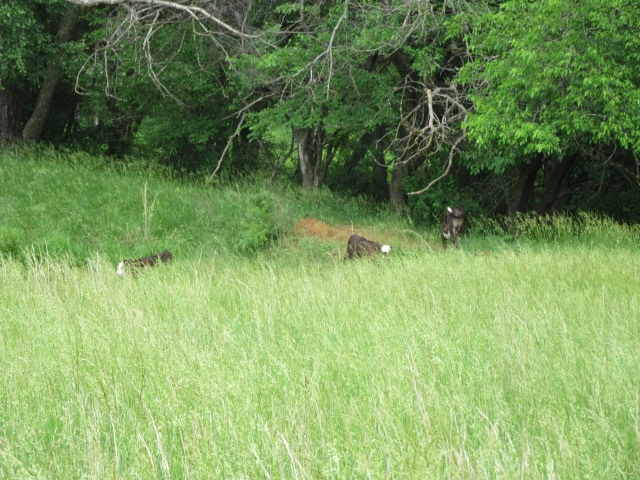
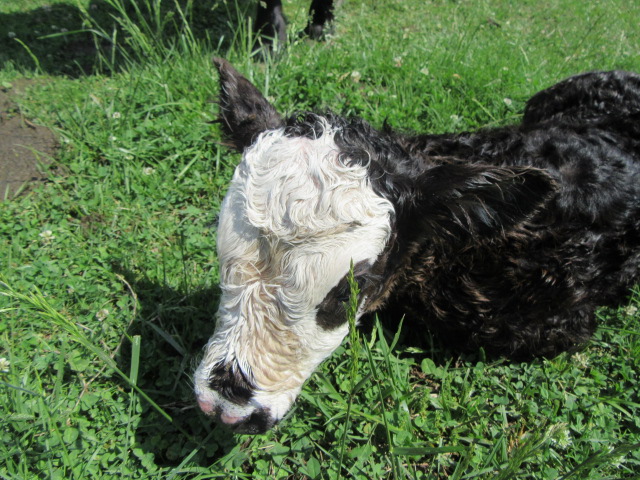
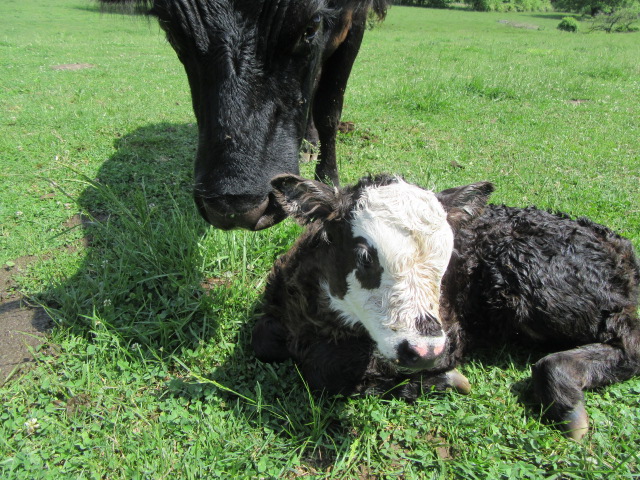
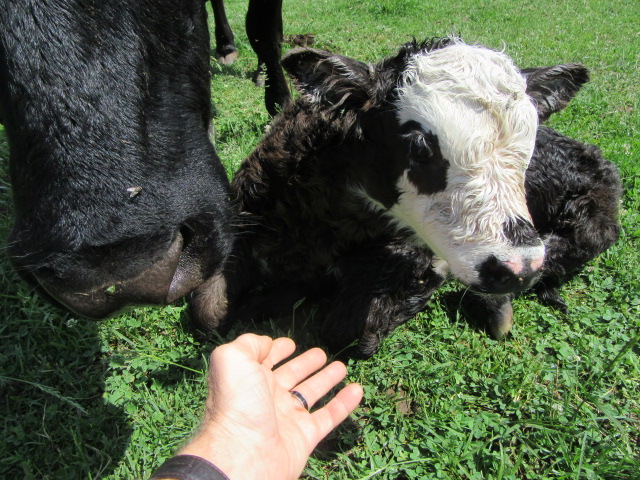
This was the first day the calves had been to the back pasture. They were having a lot of fun exploring and it was fun to watch them.


Calf #1 born on May 1 decided to get in the pond with her mother. This is the first time I saw any of the calves in the pond.

I walked behind the pond to see what I could find…


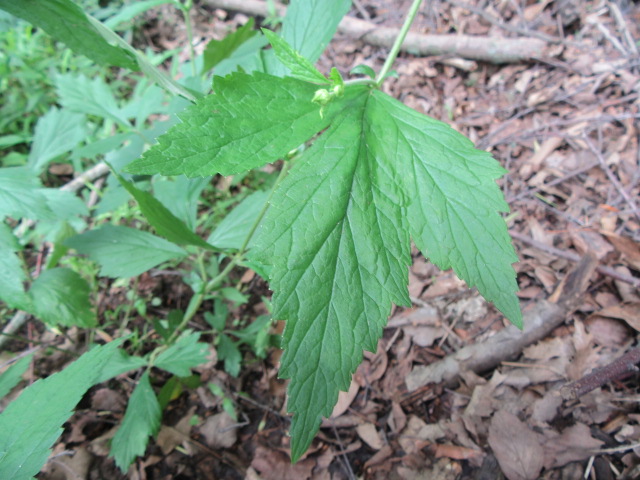
There are a lot of wildflowers you don’t really notice when the cows have been grazing because they eat them. I was very fortunate to have found this White Avens (Geum canadense) flowering. I took quite a few more flowers but they were blurry. Then I went back the next day to take more and I couldn’t find any flowers. It is a really neat flower and I need to get some better photos so I can make a good page to the right.


How the flower stem grows out of the leaf is pretty cool! (Umm, I never said that before…) At this point, until I find out something bad about it, the whole plant is pretty, ummm, cool. 🙂


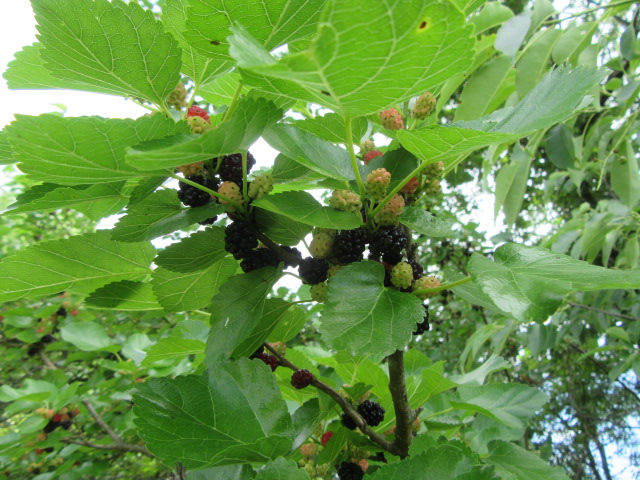
We have quite a few Red Mulberry trees (Morris rubra) and some of them are LOADED while others not so much. I always have to pick a few because they are quite tasty.


There are also quite a few White Mulberry Trees (Morris alba) on the farm. They are sweeter and kind of syrupy. Ang sarap!


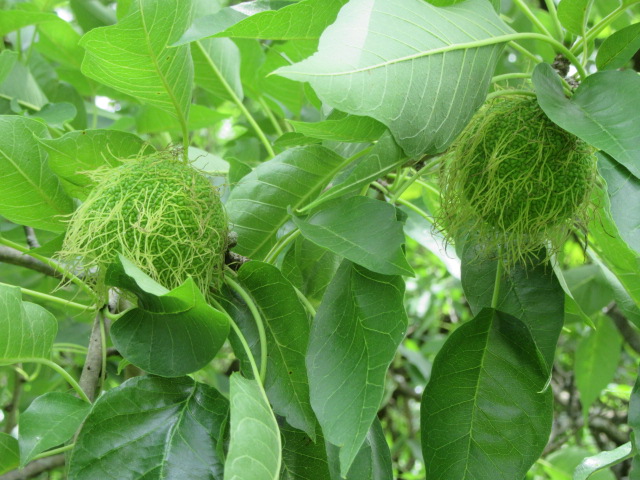
One of the most interesting things I saw of the day were the fuzzy balls on the Osage Orange (Maclura pomifera). I have never seen them at this stage before. Isn’t nature just amazing?


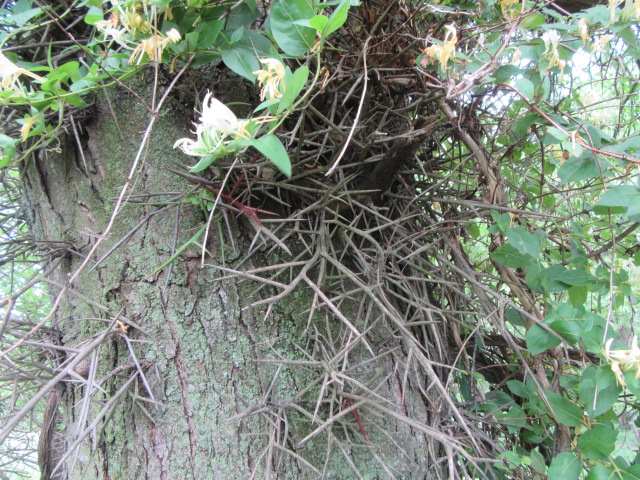
Yeah, this is a Honey Locust (Gleditsia triacanthos). Not everyone favorite tree, but I kind of think they are AWESOME! They make a great tree because their leaves provide filtered light instead of deep shade. Well, maybe that isn’t so good in certain circumstances depending on what is growing under it.


There are thornless cultivars available and they would definitely be much better for a shade tree in the yard. They have very small ferny leaves that don’t need to be raked in the fall. The Honey Locust can be a problem for many farmers because those thorns can go right through a tractor tire. Not to mention a boot sole. Forget about going barefooted. OUCH! Of course, there has to be a Japanese Honeysuckle in this photo.


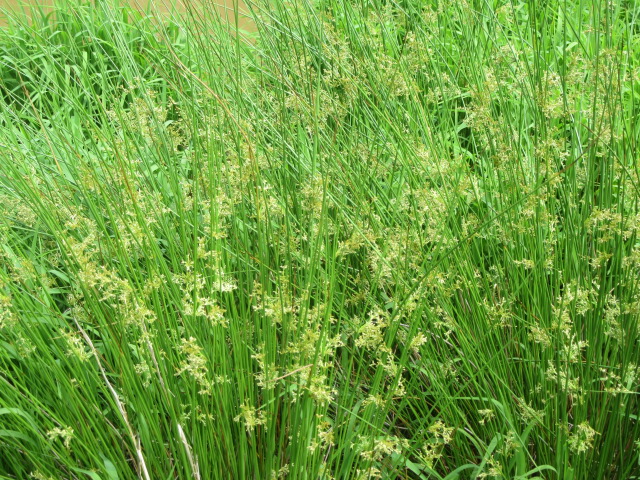
I think this small clump is probably a Soft Rush (Juncus effusus). There are quite a few Juncus species to choose from. The cultivar ‘Big Twister’ comes to mind and I would have been amazed to see some curly stems along the pond. Well, as they say, this is a “variable” species.


Then, on the other side of the pond, there is this entire colony! I intended to go back and get more photos to make sure my ID was correct, but I haven’t made it yet.


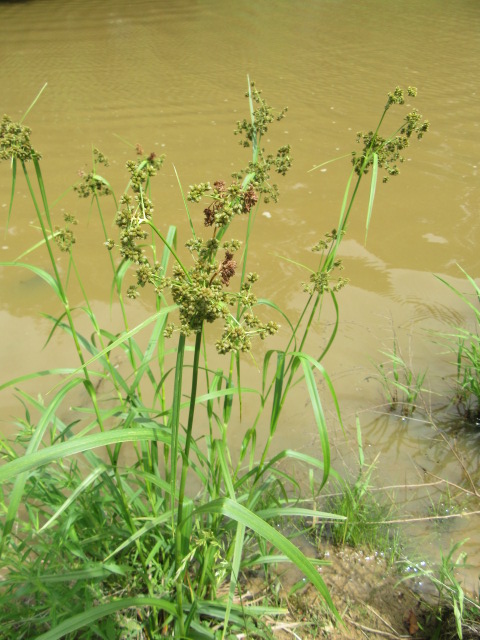
I think this is a species of Carex but I need to go back and take more photos for a positive ID.

We also have Cattails but they aren’t that interesting right now…


Most of the Black Walnut trees (Juglans nigra) don’t have many walnuts this year but a couple has A LOT!


We have A LOT of Black Medick (Medicago lupulina) in the hayfield and back pasture. Not so much in the front pasture though. Maybe the cows like it. I thought it was some kind of small yellow clover until I took the photo and did some research. I will do a more thorough write up with I publish the page for it to the right.


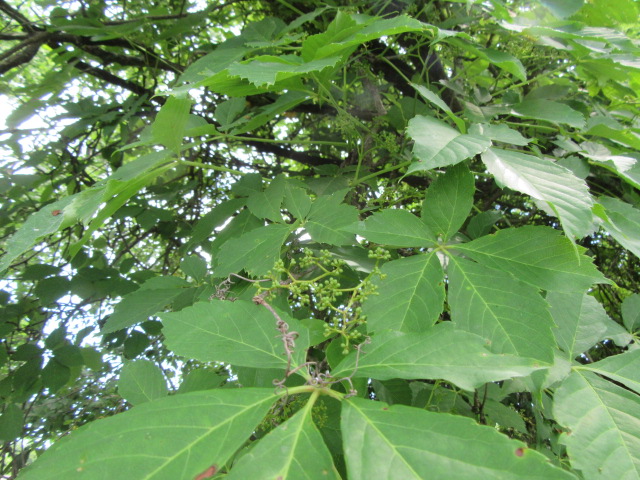
Another plant that can get quite carried away is the Virginia Creeper (Parthenocissus quinquefolia). It is way up on the top of a short list of plants I could easily live without.


The Virginia Creeper is also flowering now which are not near as showy as Poison Ivy. Some people also have a similar reaction to the sap of the Virginia Creeper as Poison Ivy. I haven’t noticed having a problem with although many times I am in both at the same time because they seem to like to grow together. The previous photo shows them both growing up in the same tree.


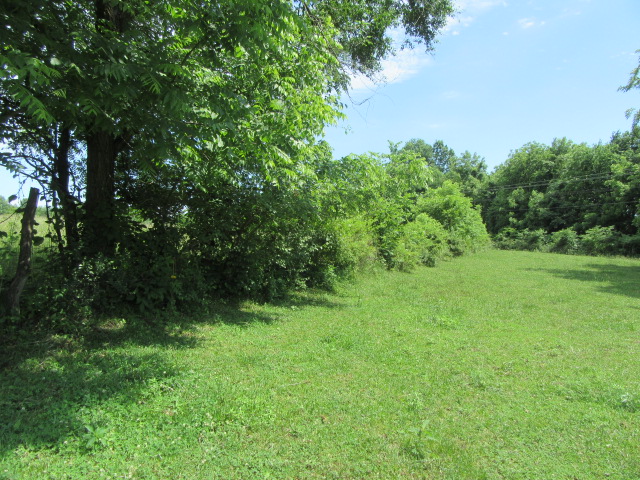
This fence row in front of the south hayfield also needs to be cleaned out. Dad and I worked it over in 2013 but it is overgrown again. I keep the vegetation off the wire but it doesn’t take long before it needs to be trimmed again. The wire here is still good so it won’t need to be replaced but I would really like to put barbed wire here. In my opinion, an electric fence should only be an inexpensive, temporary solution, not a permanent one.

There is always plenty of work to do on the farm in the spring and summer months.


There is part of the corral that is blocked off that is just the place for unwanted trees to grow. I have cleaned it out twice already now I need to do it again. The problem has always been that the stumps always send up new growth which happens much faster than you might think, too. I found a product I can use to kill the stumps, so the next time I clear this mess out I am going to get a bottle. It is a late afternoon/early evening project so the area will be in the shade.

Sorry, I don’t have links to the species listed on this post because I don’t have pages for them ready yet. It’s a work in progress deal. 🙂

That’s it for this post. May you stay positive, happy, healthy and embrace life. Don’t forget to GET DIRTY!

Canna Bed Extended

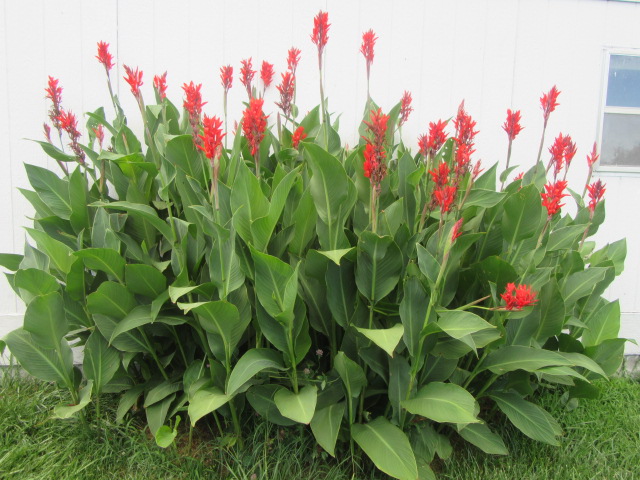
Dad’s red Cannas on July 3, 2013.

Hello folks! I hope this post finds you all well. When I came back to the farm in 2013, dad had a small group of Cannas along the south side of the house. When fall came I supposed they would have to be dug up but dad said he just cut off the stems and lay them on top and they survive. Before, I remembered grandma always digging hers up and putting the tubers in the basement. I certainly had no issue with mulching them and leaving them in the ground, but I told dad that they should be mulched with leaves instead of their stems.

The thing I noticed most was dad’s Cannas had been in this spot for many years and had not spread that much. I explained to dad mulching with their stems was causing most of their tubers to either rot or not survive the winter.


Dad’s red Cannas on 6-12-14, #229-12.

So, in the fall of 2013, I mulched the Cannas with leaves. As you can tell, the colony is a little larger than in 2013.


Dad’s red Cannas on 6-27-15, #270-8.

Dad mentioned he would like the Cannas along the side of the garage and I thought that was a great idea. Funny, but I had also been thinking the same thing. So, in the spring of 2015, I dug a new bed and but the Cannas along the side of the garage. I know I planted them a little to close together but the bed was already twice the size as where they were. Of course, dad mentioned they were to close together. 🙂

One interesting thing was that the grasshoppers didn’t bother them here like on the south side of the house.

I didn’t take any photos of the Cannas in 2016.


Dad’s red Cannas on 6-24-17, #349-22.

The Cannas were looking very well when the above photo was taken on June 24, 2017. I told dad they drastically needed to be spaced out more and I would like to dig the bed the entire length of the garage.


Dad’s red Cannas on 10-2-17, #380-2.

Well, 2017 was definitely perfect for Cannas! I measured them and the tallest was around 12 feet tall. They seem to do their best in cramped conditions.


Dad’s red Cannas on 5-17-18, #443-23.

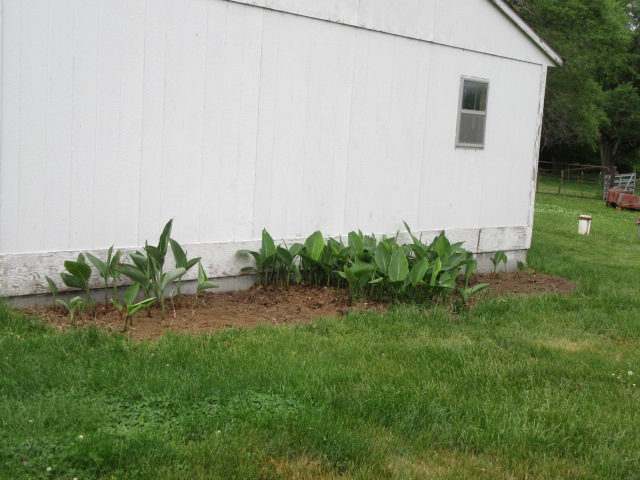
Now, this spring was strange and a lot of plants were slower to come up. I decided I would go ahead and start digging to extend the Canna bed. When I first started I noticed that they weren’t so thick. So many of the tubers didn’t even sprout but that hadn’t rotted either. In the above photo taken on May 14, I had dug the entire bed and put a few on each end. I had a plan but…

It was pretty hot during the day so I only worked on the bed after the area was in the shade after dinner until dark. The yard light helped some but I eventually had to stop. The neighbors may have realized how whacky I really was if I worked all night. I actually did that a few times in Mississippi, but that is a different story.


Dad’s red Cannas on 5-25-18, #448-4.

We had rain and I didn’t get to finish as soon as I wanted. As you can tell, they grew by the time I was able to get back into the bed. I had also been working on the fence around the hay field and mowing the yard and doing other things. I was beginning to wonder if I was ever going to get finished.

BUT…

Dad’s red Canna bed on June 1, 2018, #451-1.

I was NOT happy with the way it was turning out. So, on May 29 I think, I started removing ALL the Cannas out of the bed.


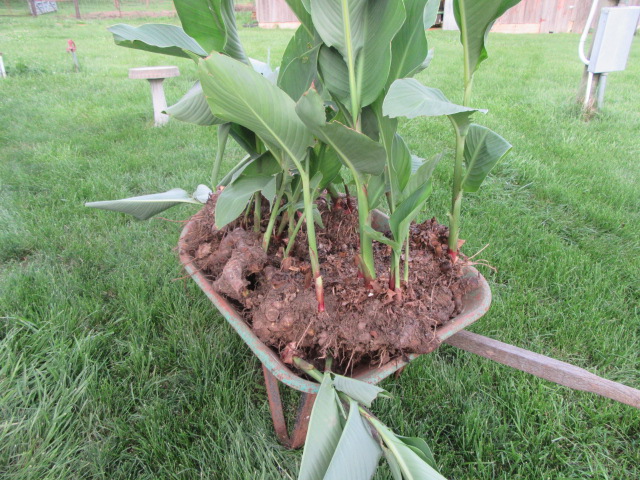
A load of “THE GOOD STUFF” on 6-1-18, #451-2.

I had noticed a spot where I fed hay several years ago had no weeds growing on it (which was strange in itself), and a light came on in my head. After I had all the Cannas out of the bed, I went and got a couple of 5-gallon buckets of “THE GOOD STUFF’. Well, I could see that was going to be a slow process, so I hooked up the wagon and brought back a bigger load I mixed about half the load into the soil. The goal was to scatter the rest on top after I was finished.


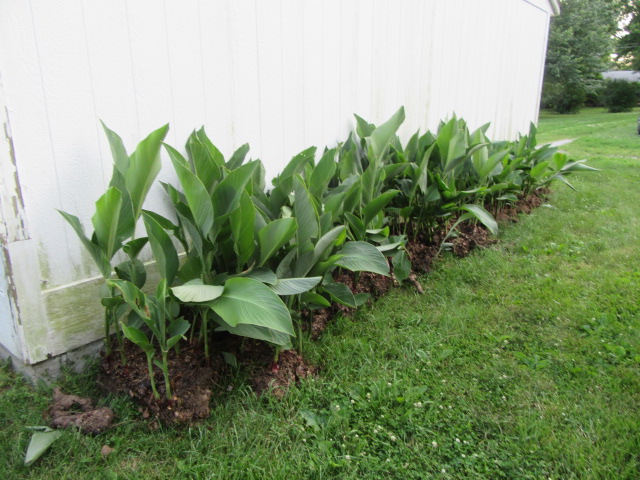
Dad’s red Cannas along the north side of the garage on 6-1-18, #451-4.

Umm… I had put all the Cannas from the south side of the garage along the north side so they wouldn’t be in the sun during the day. I had no idea how long replanting them would take. They kept growing even though they weren’t even in the ground! It looked like so many now!


One wheelbarrow at a time…

Then, one wheelbarrow at a time I took them to the bed and spaced them out better. Digging the hold the appropriate depth for each clump. Some were very large!


The finished and extended Canna bed on 6-4-18, #453-6.

I finally finished the Canna bed on June 4 and I was very glad. The Cannas aren’t near as tall as they were this time last year, but at least the bed is finished. Looking back to the first photo in 2013 until now, I guess mulching with leaves did the trick. Even dad said they had done so well because of the leaves. I still have a wheelbarrow full of bulbs that didn’t come up. I have no clue what I am going to do with them…

Until next time, be well, stay positive, embrace life the best you can and GET DIRTY!


Fence Row Finished, A New friend, Cornus drummondi, etc.

Hello folks! I hope this post finds you all doing very well. I finished with the fence row along the back of the hayfield on May 25. The Multiflora Roses and blackberries were getting a little carried away and I had to do something about them. Multiflora Roses do provide some hiding places for rabbits and quail, but I haven’t seen any rabbits in this area and we have no more quail. There are still several Multiflora Roses, one half the size of the house, that will do the job. Enough is enough anyway.

This fence runs north and south and connects to the fence that runs east and west up the lane and to the fence in the next photo. That may make no sense to you, so you will just have to trust me.


This is another part that runs east and west that connects to the part that runs north and south. This one connects to the back boundary of the farm. There were a lot of blackberries in this fence while the other one had mostly Multiflora roses.

I put new wire along the lane and around the back part and may have enough left for the front part of the hayfield, too. If not, I will have to get another roll.


When I went to work on the fence in the afternoon I forgot to take the camera. I didn’t remember until I saw this friendly Three-Toed Box Turtle.


It was sitting close to where the corner post was and I wanted to get a photo because I had not seen one with the white color. Since I had no camera with me, I put it in the back of the pickup so I could take a photo later. One time I saw one that was mostly orange.


After a few photos, I put the turtle by the chicken house so it could get back to looking for food. I think turtles are amazing creatures.

I have gotten into the habit of taking my camera with me most of the time because you never know what you will see.

After getting the new wire around the hayfield, I started trimming around the fence on the south end of the back pasture. Since I didn’t have the camera, I went back in the afternoon of the 27th because there were some photos I needed to take.


I have wanted to identify this vine for several years and noticed it was flowering when I was working on the fence row. After a few photos and looking on the internet I was STILL confused. At first, I thought it was a species of Hydrangea but the leaves didn’t match. So, I posted a few photos on the Facebook group called Missouri Native Plant Society.


A few other members quickly commented with the correct ID. As it turns out, it is a Rough-Leaved Dogwood (Cornus drummondi) and it not a vine after all. Later on, I saw one in the area next to the chicken house while I was mowing. GEEZ! It was there all this time and never realized it was the same as the one in the back of the farm. Once they finish flowering, they just become part of the rest of the brush.


The beautiful and amazing Toxicodendron radicans is also flowering now. I am just kidding about the beautiful and amazing part. There is nothing amazing about Poison Ivy and there is plenty here is anyone needs a start. I will give you a shovel and you can take your pick and have all you want. It is very healthy.


You can also have all you want of the Lonicera japonica, which is the Japanese Honeysuckle. Seriously, though, the flowers and the fact that hummingbirds love it are just a disguise to this plant’s invasive agenda.

OK, I am publishing this post and moving on to the next one…

Until then, stay positive, be thankful, stay blessed and GET DIRTY!

May 25 Through June 3 Update

Echinopsis ‘Rainbow Bursts’ in a new pot on 5-25-18, #448-8.

Hello folks! I hope this post finds you all doing well. I haven’t made a post since May 24 even though I have taken A LOT of photos. I finally finished the fence in the back of the hayfield then started on the Canna bed extension. I have repotted several of the cactus and succulents and had a weird surprise. Some of the plants have been photographed more than once over the past couple of weeks because they get outdated by the time I get around to making a post. This post will cover photos from May 25 through June 10… Each plant mentioned is linked to its own page, but the page may not be updated yet. I made a few changes along the way, so some of the earlier published pages are not updated with links… Plus, I still have to add some photos I took afterward. I will get caught up some day. 🙂

The Echinopsis ‘Rainbow Bursts’ in the top photo is now in its new pot. The sides were beginning to bulge so I thought it was time. When I bought this plant from Wal-Mart on February 1, 2016, the label said it was an Echinobivia ‘Rainbow Bursts’ and it was an intergenetic hybrid between Echinopsis and Lobivia. Well, the species in the Lobivia genus were moved to the Echinopsis genus, so I guess that means it isn’t an intergenetic hybrid after all. Yeah, I know. You are only supposed to increase the pot size by 1/2-1″ diameter larger but I thought the babies may eventually fall off and need room, too.


Cylindropuntia imbricata on 5-25-18, #448-7.

The Cylindropuntia imbricata (Tree Cholla) is doing very well and going through a growth spurt. There for a while, when it was very cold, I had begun to wonder if it survived the winter. But, as you can see, all is well. This cactus is very interesting to watch in the spring and early summer. It is cold hardy in USDA zones 4a-11 (down to -30) so it was OK here in zone 6a even though it completely changed color like it was dead.


Geranium sanguineum on 5-25-18.

The Geranium sanguineum (Bloody Cranesbill) is now flowering up a storm. I need to take some measurements of the flowers this summer to see if it is a Geranium sanguineum var. striatum.


Mammillaria elongata in a new pot on 5-25-18, # 448-11.

I had to put the Mammillaria elongata in a new pot because it looked like it was giving me the finger all the time. But, even after it was comfortably in the larger pot it STILL continues to make the same gesture. Well, I guess I deserve that because I did knock it off the table while it was in my bedroom and most of the offsets broke off. That happened only a few days after I brought it home so I guess we got off to a bad start. On the brighter side, the offsets all have roots. I had debated whether or not to put the offsets that fell off in their own pots but decided I didn’t need that many more pots of the same species so we shall see what happens next.


Sedum spathulifolium ‘Cape Blanco’ on 5-25-18, #448-17.

The new Sedum spathulifolium ‘Cape Blanco’ isn’t doing so well. It started rotting soon after I put it in a pot so when I took the plants outside I put many of the rosettes other pots to see if they would take root. I took a more recent photo but this one looks the best. Surely, a few will take root!


I let the chickens out on May 27th after the family reunion which was the first time since last year. I would let them out more but there is no fence to keep them safe. Never know when a fox or the neighbor’s dog will pay a visit.


The White Chantecler rooster is proud to be the new sheriff since the Delaware was de-throned. I am not exactly sure how that happened because the Chantecler is not a fighter unless it is with the bantam rooster.


This is a photo of two of the White Chantecler hens. There are three of them but one did not get in this photo. She is the weird one who tries to eat water instead of drinking it. They are very calm dispositioned although one is beginning to growl.


Once the bigger chickens went around to the side of the chicken house…


I let out the Old English Game Bantams. I can’t let them out together because they DO NOT like each other. Not only do the roosters not like each other, but the hens really get into it. They soon went to their favorite spot under the lilac bush by the shade bed and behind the shed.


Some of the big girls started sunbathing. Then after a while, they ventured to the backyard where the shade bed is. Now, the bigger chickens aren’t like the bantams and pay absolutely no attention to where they are going. They never have a plan and are not concerned with making one. I have to watch them or they start digging where they aren’t supposed to. The bantams never disturb any of the plants even when they fly on the plant tables and walk on the edges of the pots. They seem much more intelligent and are VERY alert. When the bigger hens moved to where the bantams were, the bantams went to snoop in the chicken house. They seem to try to avoid a fight but sometimes they just can’t control themselves. 🙂 None of the hens actually start the fight, it is just automatic. The roosters are a different story. It’s all about protecting their hens, their territory, and their dignity.


Alocasia ‘Calidora’, Portora’, and ‘Mayan Mask’ in the ground on 5-31-18, #450-1.

On May 27 I decided to move an Alocasia ‘Calidora’ (right), Alocasia ‘Portora’ (center), and Alocasia ‘Mayan Mask’ (left) to the corner bed along the old foundation. I have smaller and larger plants, but I chose three average size plants for this experiment. Normally I put most of the smaller Colocasia esculenta in this spot but they don’t seem to get anywhere here because there isn’t enough sun. With no pot to slow the Alocasia down, they may get bigger here. We shall see.

I still haven’t decided where to put the rest of the Colocasia esculenta. I am considering digging a bed on the east side of the house.


Agastache ‘Kudos™ Gold’ on 6-3-18, #452-1.

The Agastache ‘Kudos™ Gold’(Dwarf Hummingbird Mint) is doing very well in the north bed but the color just doesn’t seem right for a Hyssop.


Allium ampeloprasum var. ampeloprasum (Elephant Garlic) on 6-3-18, #452-2.

The Elephant Garlic (Allium ampeloprasum var. ampeloprasum) is looking really good. They are an Allium so why not keep them in a flower bed? Plus they are great in sphagetti sauce! I think it is weird how some variety names are the same as the species.


Baptisia ‘Lunar Eclipse’ on 6-3-18, #452-3.

Well, I certainly goofed here! I planted the Baptisia ‘Lunar Eclipse’ in the southwest corner bed next to the Phlomis ‘Edward Bowles’ last spring. They got along perfectly well until this spring. The Baptisia decided it would take over the entire corner. The Baptisia did flower but I may not have put in a post…


Just in case I didn’t post the flowers, here it is. There were only a few clusters and they didn’t flower for very long. The above photo was taken on May 11.


Now it has giant peas!


Phlomis ‘Edward Bowles’ on 6-3-18, #452-15.

Now the poor Phlomis ‘Edward Bowls’ is not the center of attention in the corner bed now. It needs more light and it didn’t flower! GEEZ! I think I may have to give the Baptisia a good shearing.


Leucocasia/Colocasia gigantea ‘Thailand Giant’ on 6-3-18, #452-9.

The Colocasia gigantea ‘Thailand Giant’ is now poking through. 🙂 The post on May 23rd is about the Colocasia gigantea ‘Thailand Giant’. Oh, crap! I forgot the name changed to Leucocasia gigantea.


Hosta ‘Empress Wu’ on 6-3-18, #452-11.

The Hosta ‘Empress Wu’ I bought last spring is now moved out of the corner and already has a bud. The first Hosta bud of the season. Normally Hosta ‘Potomac Pride’ is the first.

The bigger clump of Achillea millefolium is now at the corner of the barn but isn’t ready for a photo as it is still acclimating to its new site. It does seem to approve, though. The other clump of Achillea (now behind the H. ‘Empress Wu’) is much bigger now and may make its way to the south bed. It won’t like the shade anyway. There are also several new sprouts that have ventured out into the sun… Like I said, if the Achillea doesn’t like where it is, it will move all by itself. The Achillea in front of the chicken house is trying to move around the corner as well. GEEZ!


The leaves of the Hosta ‘Empress Wu’ will get very large but it will take several years for the clump to reach its mature size. It is the worlds largest Hosta cultivar. I can hardly wait to see how big the Colocasia gigantea ‘Thailand Giant’ will get this year. They are neighbors in the north bed.

Even with all the excitement spring brings, probably the best news this spring is…


Sedum spurium ? on 6-3-18, #452-23.

I brought this Sedum spurium ? home from the greenhouse in 2015 with no label. It has many of the characteristics of Sedum spurium ‘Dragon’s Blood’ but I hoped for flowers to make a closer positive ID. After all this time…


It has a few buds! 🙂 Now maybe I can say for sure it is ‘Dragons Blood’ or not.


Sedum kamtschaticum ‘Variegatum’ on 6-3-18, #452-27.

Plus the Sedum kamtschaticum ‘Variegatum’ is going to flower for the first time since 2012 when we were, I mean I was, in Mississippi. I almost lost this plant and we really struggled for several years. I mean we struggled with just one stem a few times but it still hung on. Then I moved it to the cast iron planter with the Sempervivum ‘Killer’ last year and it did a little better. This spring it came up with a new lease on life. I was shocked!


Another weird thing is one of its stems is a different color. Maybe it has given me a new variety. 🙂


Sedum kamtschaticum on 6-3-18, #452-25.

The non-variegated Sedum kamtschaticum is doing AWESOME as always. I have to measure this plants leaves and size this summer because it may be a Sedum kamtschaticum subsp. ellacombeanum which is larger than the species. Unless… OK, I am not getting into the “unless” on this post because it is already on this plants page.


Sedum spurium ‘John Creech’ on 6-3-18, #452-29.

The Sedum spurium ‘John Creech’ is doing very good tucked in this spot between the cast iron planter and the foundation. I can see it is trying to escape…


It also has a few buds! Sorry I didn’t get a clear photo even though I took quite a few to choose from. You just never know…

I am going to close this post because I have three or four more right in line. Two have been a work in progress. Well, this is going to be a very different and exhausting end of the week.

So for now, be safe, stay positive, never give up on anything worthwhile and important. As always, GET DIRTY!

Amorphophallus, Caladium, Colocasia, & Zantedeschia Bulbs. It’s A Family Thing.

Amorphophallus sp. on 7-1-17, #353-1 after I brought it home.

Hello again, folks! I hope this finds you all doing well and that you have been getting your hands in the dirt. It’s the time of year we can enjoy being out with nature before the mosquitos get too bad. I have seen a few already so I try to be quiet so they don’t hear me.

I mentioned in the last post I had taken a few photos of the bulbs so I thought I would ramble about them for a bit. All these plants are in the Araceae family of aroids. All I can say about this family is that I need more.

I found this Amorphophallus (a-mor-fo-FAL-us) in the above photo to bring home at Wagler’s Greenhouse last summer. She had several pots but I took this one home because it also had an Oxalis triangularis subsp. papilionaceae growing with it. 🙂  According to the Wikipedia, the common name of the genus is Zaminkand but some of the species are referred to as Voodoo Lilies or other strange names. Of course, as with most of Wagler’s “pass-along plants”, there was no label and she had no clue what species it was (Well, heck, she doesn’t even know the genus like most normal folks). Plants of the World Online list 220 accepted species of Amorphophallus but luckily only a few are popular in cultivation so MAYBE I can soon figure out the species if it flowers. Despite the name being hard to spell or type really fast, it is a very interesting plant like most aroids.

The Amoororphooophaalluuus and Oxalis both went dormant when cool temperatures started getting close even before I moved the potted plants inside. The pot had been in the basement during the winter and I moved them outside on April 29 to play the waiting game.

When I went to the greenhouse a few weeks ago with my sister and niece, I asked Mrs. Wagler if she was going to have more Voodoo Lilies later. She didn’t know what I was talking about. I tried to explain the plant by reminding her of the story she told e about her mother growing them when she was a kid. Still, it didn’t ring a bell. I should have asked what she called the plant last year instead of just asking what species of Amorphophallus it was. I always get a blank stare… Sometimes a grin, though.


The Oxalis started coming up soon after I moved the pots outside but there was no sign of the “others”. I am done writing that name for this post… So, after being patient long enough, I ran my fingers through the potting soil to see what I could find. Low and behold I found a bulb and it was sprouting. I thanked the universe and the creator. Yeah, I know, most people would say thank God. OK, thank you, God. Feel better now?


I dug around a little more and found the other one. What I found strange last year was this stem in the middle of the pot with no plant. It remained there all winter with no change. It didn’t rot, either. You can see it here in the photo. It looked like it was starting to green up, though.


So, out of curiosity, I pulled it out to have a look. Well, GEE WHIZ! It had no roots! Once I pulled the stem out I could tell the bulb that needed to be in the soil was on top. Many aroids do this. They grow a new bulb on top of the old one, including the Colocasia esculenta. So, I pushed the whole thing into the soil down to where the top was covered up. Hmmm. I wonder how old that stem is?


I had also bought a few Caladiums last year. I thought I would attempt to overwinter their bulbs, too, but they didn’t fare so well. They were kind of moldy but I put them in pots anyway. We shall see what happens. I have heard that overwintering Caladium bulbs is tricky. If you do successfully overwinter them, trying to figure which side is up is also confusing. Supposedly, the smooth side goes down and the knobby side goes up. They will grow either way, but apparently, they will peep through the soil faster if they are planted the right way and the plants will do better.


Now, for the Colocasia esculenta. The two larger bulbs (tubers) on the right were the plants growing on the north side of the house for the past two years. There were three but one rotted instead of coming up last spring. The other two next to the bucket and the bulbs in the bucket were growing on each side of the… Well, what used to be the foyer of my grandparent’s house. The smaller bulbs in the clay pot were a few of what I didn’t plant last year. They stayed perfectly fine all summer and during the winter. They sprouted a little last summer but they didn’t grow past that.


I didn’t count them once I cleaned them off, but there are plenty. I took the smaller bulbs ad the ones in the clay pot and planted them along the north side of the chicken house. I will plant the largest bulb along with the Colocasia gigantea, I mean Leucocasia gigantea ‘Thailand Giant’ in the north bed. I need to move the Hosta ‘Empress Wu’ farther out of the corner in the north bed so I will only have room for two bulbs. I can’t put the other big bulb farther down the bed because of the Geranium sanguineum (Bloody Cranesbill). So, maybe, I will put the other big bulb around the corner on the east side of the house. MMMAAAYYYBBBEEE I will put the rest along the east side, too, since I really need to do something there. They don’t grow that well in front of the old foundation because they don’t get enough sun. Maybe I will sneak a few in dad’s Canna bed, too. 🙂

Oh yeah… You can see, especially with the two larger bulbs (tubers) the old bulb on the bottom with the newer bulb on top. The “stem” is right on top of the bulb and actually seems to be part of the bulb. The petioles grow from the stem and as the petioles and leaves die, the new tuber is formed (above ground). You can actually separate the two and plant them both. I should have taken a photo to explain it better… If you look at the old bulbs, you can see rhizomes coming out. Those will also make new plants and the old bulb will rot. The little “bumps” on the bulbs will grow into rhizomes if you have them in good light where they will grow well. In to much shade, that doesn’t seem to happen as much. They can be quite productive!


Now, for the Zantedeschia aethiopica (Calla Lily). This cluster did really well over the winter and started sprouting without even any soil. I put them in this pot the same day I moved the plants outside.


I decided I better put them in a larger pot and saw all these nice roots. I had planted them in the shade bed last year but read where they do better in more sun. I saw a HUGE plant growing by a sign in Clinton right out in full sun and it was looking really AWESOME! Well, you never know. Maybe they just planted the pot before I saw it because I hadn’t seen them there before. So, just to be on the safe side…


I put the Calla in this pot so I can move it if I need to. I think I will put this pot on the north porch once they start growing well. I don’t have a page for the Zantedeschia elliottiana (Golden Calla Lily) yet. Still working on the ‘T’s (Tephrocactus articulatus var. papyracanthus).

I am finished now. So, what have you been planting?

Until next time, stay well, be positive, hug your mate, enjoy nature and GET DIRTY!

New ‘Thailand Giant’ Bulb

Hell0 again! I hope this post finds you all well. The new Colocasia gigantea ‘Thailand Giant’ (I mean Leucocasia gigantea ‘Thailand Giant’) I bought from an Ebay seller arrived on Tuesday. It was wrapped in a newspaper printed in Chinese. I looked the newspaper over and found out it was The Epoch Times.

I know this is supposed to be a post about the new bulb but I had to further investigate this newspaper. 🙂 The Epoch Times was founded in 2000 in New York City by a group of Chinese-American Falun Gong practitioners. The newspaper is either sold or distributed free of charge in 35 countries in 21 languages. The founders say they were responding to censorship inside China and a lack of international understanding about the Chinese repression of Falun Gong. The newspaper can be read online and receives 105 million page views per month from 20 million visitors. Anyway, the Wikipedia article and the newspaper’s website are quite interesting.


I unwrapped the newspaper to find a box…


I opened the box to find an envelope…


I opened the envelope to find a, umm, sweet potato? Well, it sure looks like the white sweet potatoes I grew in 2016.


Well, I am pretty confident it is a Colocasia, I mean Leucocasia gigantea ‘Thailand Giant’. It looks nothing like what I expected, though. I expected it to look like a bulb similar to the Colocasia esculents judging from the bulb that grew from the ‘Thailand Giant’ I grew last year. It looks similar to the rhizomes that grow from my Colocasia esculenta only MUCH, MUCH larger.


PREVIOUSLY…

Previously, I had bought a Colocasia gigantea from Wellspring Gardens as a starter plant in 2009. Then, in 2012, I bought a ‘Thailand Giant’ from him. The first one died after a week or so and he promptly replaced it free of charge. I didn’t complain, I just told him it died and I was going to buy another one. The above photo was taken on April 15, 2012.


I put them both in a larger pot after they arrived. He said they don’t like a lot of water when they are small. Who would have thought that from a Colocasia? I followed his advice and the second did fine. This photo was taken on June 11, 2012.


After it grew a little larger I planted in the ground. I took this photo of the ‘Thailand Giant’ in the backyard of the mansion on September 24, 2012. It didn’t grow that large, though. Not near as big as any of the Colocasia esculenta.

THEN…

This is the plant I bought from Wildwood Greenhouse on May 20, 2017. It was MUCH larger than the starter plants I had bought from Wellspring.


The above photo was taken on September 23 with 4 flowers. It went on to produce 6 flowers from one petiole… No wonder this plants name was changed back to Leucocasia gigantea. The flowers are typical aroid but none of my Colocasia esculenta or any of my Alocasia produce flowers in a cluster like that. Well, my Alocasia lauterbachiana did do something weird, too.


It grew to almost 6 feet tall by the time we had our first frost. Its biggest leaf grew to nearly 48″ long x almost 36″ wide. I have seen many photos online of the ‘Thailand Giant’ growing to at least 10 feet tall. It isn’t uncommon for its leaves to grow 4 to 6 feet long x 3 to 5 feet wide.


By the time we had our first frost, it had produced 6 flowers from one petiole and three from another.


When I dug the bulb, it measured around 5″ in diameter.

The seller’s listing said he gets his bulbs from a “supplier” and they are from the Wellspring Gardens strain… Well, I suppose that means his supplier’s original plants came from Wellspring Gardens. There are many websites online that sell “Colocasia gigantea” ‘Thailand Giant’ but they are plants. I have not seen any bulbs of this plant except from the listings from the seller I bought mine from on Ebay… Click HERE for a link to his listing. Yeah, I know. Technically they aren’t called bulbs.

I took photos of the Colocasia esculenta and Amorphophallus bulbs today. I put the Caladium bulbs in a pot and repotted the Calla. I also planted the smaller Colocasia esculenta bulbs along the north side of the chicken house. I worked a while on the Canna bed and hope to work on it more today. I would say tomorrow, but right now it is almost 2 AM on Wednesday so it is already tomorrow. 🙂 Maybe I can also plant the rest of the Colocasia and the ‘Thailand Giant’. It is going to take a getting used to calling it Leucocasia gigantea.

So, until next time, stay well, be positive, and as always GET DIRTY!

SUPRISE! SUPRISE! Names Change When We Aren’t Looking!

Hello folks! I hope this post finds you all well! I wanted to share a couple interesting name changes with you. One I completely was shocked about but the other not so much. I have rewritten this post many times because I kept rambling on and on. I will try and make this short and to the point.

While I was making the last post, I attached links to the plant names I mentioned to their pages in the right column of the blog. I knew I needed to update most of the pages I had published from January through October 2017 because most of them still mentioned The Plant List as a reference. After that, I started using Plants of the World Online by Kew because The Plant List hadn’t been maintained since 2013.

I had also started adding links for further information at the bottom of the pages and attaching a link to the author’s names to their Wikipedia page. Some of the botanists who named and described plants have a very interesting history. Well, at least I found it interesting.

ANYWAY, as I was attaching the link to the plant’s pages, I realized I had to go back and make sure their pages were updated. Now, when I wrote originally their pages, I made sure their scientific names were correct and updated. In late October last year, when I found out about the new Plants of the World Online, I went back and made sure all the names were correct, MANY had changed just since January. GEEZ! I am starting to ramble AGAIN.

At the bottom of every page I have been attaching a link to Plants of the World Online about the genus and species… Most of the plant names on the last post were the same except for two…

First, when I went to add the link to the Coleus ‘Spiced Curry’. I went to Plants of the World Online, typed in Plectranthus scutellarioides (which was the last accepted scientific name for the Coleus), and POWO said that name was NOW a synonym of Coleus scutellarioides. I thought Plants of the World had lost their mind! That was the name applied to the species in 1830! OK, the Coleus we all know and love has had MANY scientific names. Carl Linnaeus described the species as Ocimum scutellarioides in the second edition of Species Plantarum in 1763. Since then, the name has changed several times using the original name as a basionym. Not to mention all the other names given to the species by other botanists that were later found out to be synonyms. POWO currently lists 57 synonyms and the 2013 version of The Plant List named 66. You could read all about the names on my Coleus scutellarioides page, but it isn’t updated yet. 🙂 The first scientific name I was familiar with for the Coleus was Solenostemon scutellarioides. Then, after I started using The Plant List, I found out the name had changed back to Plectranthus scutellarioides. Even the family name had changed.

When a species has had MANY names, it is no shock when it changes again. Botanists continue to be in disagreement and any plant databases author’s can choose whatever name they choose. That sounds strange, but it is true. I can even choose to use the name applied by Carl von Linnaeus in 1763 since it was the original name for my blog if I choose.

The shock really came when I went to update the Colocasia gigantea ‘Thailand Giant’ page. I went to Plants of the World Online, attached the Link for the genus Colocasia but when I went to find the species name, it was not on the list. Now, that really confused me. How could Colocasia gigantea not be on the list? It was there before! Maybe I hadn’t checked before since the page was originally written earlier, before October 2017, and every other database and information online said Colocasia gigantea was the accepted name.

SO, I went back to the POWO home page and typed in Colocasia gigantea. LOW AND BEHOLD it said that name was a synonym of Leucocasia gigantea. I thought they had really lost their mind then! Apparently, a genetic test had been done, and they found out this species was more closely related to Alocasia than Colocasia. Since there were other “unique” characteristics, they returned it back to Leucocasia gigantea like it had been named in 1857. This species was first named Caladium giganteum in 1823. Now it is in a genus all by itself.

At least the, ummm, Leucocasia gigantea change has testing to back up the change. I have no idea why the Coleus name changed AGAIN and I have found no evidence of any testing. I sent an email to Rafael Goverts, the top the editor of Plants of the World Online and many other Kew resources, to quiz him a little. He accepted the name Plectranthus scutellarioides on the World Checklist of Selected Plant Families but it clearly says he did not accept the name Coleus scutellarioides in 1999 and 2003. Even the current biography on the Coleus scutellarioides page on POWO says he didn’t approve. So, how is it that they say it is now the accepted name? 

Well, Mr. Goverts is currently at the Chelsea Flower Show so I won’t hear back from him until he gets back. 

I will go ahead and update the Colocasia gigantea page because of the testing but I will wait for his reply before changing the Coleus pages AGAIN.

SOOOOO, until next time. Stay well, be positive, etc. and GET DIRTY!

The Tour Part 1: The North Bed 2013-May 19, 2018

Hello everyone! I hope this post finds you all well. I thought I better get this post finished. Truthfully, I have started this post many times and even changed the name.

I didn’t know where to go with it. Currently, there isn’t much to show and I have barely gotten started. I have been busy with this and that and the fences. I decided to share a few photos of the yard and beds from the beginning when I moved back to the farm in 2013. Kind of the highlights.

One thing I need you to keep in mind is that I get behind weeding. I don’t have a well-manicured yard or well-kept beds. Mississippi was a different story. I had plenty of time there and the mansion was on one of the main streets in the historic district. It wasn’t perfect and was always a work in progress. I think that is the same with everyone, though. Our yards, beds, and gardens are always a work in progress.

The above photo was taken on May 6 (2018) of our house and yard. It was just beginning to green up well.


When I moved back here, I think on February 22 in 2013, there was already plenty of snow. A good friend helped me move from Mississippi and it was in the 30’s the entire 8-9 hour trip. We ran into snow about 2 hours away near Springfield. It was around 8 PM when we arrived at my parent’s home. It was dark and snowing a little still. Thomas and I unloaded the plants I brought with me and took them to the basement. Some that would be OK were left in the garage (because they were dormant). Everything else I brought was unloaded in the garage so Thomas could be on his way.


The above two photos were taken on March 2 in 2013. Dad was 82 at the time and mom was going to turn 81 on April 20. I was glad to be back on the farm and truthfully I have no idea where I would have went if he hadn’t asked me to move back. I had just sold the mansion and I had A LOT of plants. When dad asked me to move back, I told him I had a lot of plants. He said, “Yeah.” I know he had no idea and he couldn’t hardly hear what I was saying on the phone.

After I arrived he told me I could do whatever I wanted. GEEZ! He was the third person that told me that. None of them had any clue what they had said.


THE BED ON THE NORTH SIDE OF THE HOUSE…

Naturally, as the temperatures started warming up my wheels began turning. I brought my old spade with me from Mississippi, plus dad had a shovel, and my hands were anxious to get around the handle and my fingers were itching to get into the dirt. The last time my hands were in the dirt in this location was when I had a garden here in the early 1980’s. Dad’s house is where one of grandpa’s gardens had been that I took over after he passed away. Yeah, things were really different than before and I had a new challenge.

This area receives morning and late afternoon sun. It is a perfect spot for plants that like a good amount of light but need protection from midday sun.


Conoclinium coelestinum ‘Aunt Inez’ on September 6, 2014.

Right off the bat, dad told me I couldn’t dig in the area on either side of the steps. He said he had flowers there that were from Aunt Inez. Aunt Inez was his mother’s sister. Sure enough, they started coming up from seed they had self-sown. By the time they had started growing good and started budding, I realized they were Hardy Ageratum, Blue Mistflower (or whatever you want to call them). They have continued coming up every year although I have only seen one so far this year. They grew very tall in 2017 and flopped over so most of their seeds may be in the grass. I made a mistake and didn’t cut their stems off and lay them in the bed last fall. That is the only thing I did differently and that won’t happen again. This may be a mistake that will be hard to correct with just one plant coming up.


Geranium sanguineum (Bloody Cranesbill) on the right side of the north bed on June 11, 2013.

I was very glad to see that dad had moved the Geranium sanguineum (Bloody Cranesbill) from the bed behind the old foundation to this bed. I bought their descendants from Bluestone Perennials after I moved to the farm in 1981.

These plants make a great groundcover but you do have to keep an eye out for crown rot especially when they get really thick. I think I am going to move a few to where they will get more sun to see how they do. This soil stays damp longer on the north side of the house and doesn’t drain well in the winter.


The flower bed on the north side of the house on June 12, 2014.

Hmmm… 2014. Oh yeah. This is the spring I moved one of the clumps of Achillea millefolium (Fern Leaf Yarrow) I brought from Mississippi to the north bed. I added the Astilbe with no label, Lysimachia nummularia ‘Goldilocks’, Agastache ‘Black Adder’, a few Coleus, and other miscellaneous plants I can’t remember right off the top of my head. Oh, yeah! I put a Lavandula angustifolia ‘Platinum Blond’ between the Coleus. I had bought the Coleus from Harrison Greenhouse and they were unlabeled. They grew MUCH larger than I expected and the next thing I knew the Lavandula had disappeared. Well, I had gotten busy on the farm and with other things and completely missed it was in trouble.

The Achillea doesn’t like it here and keeps moving farther away from the house every year. All by itself. I promised it I would move it where it will get more sun, probably back to the south side. I am also eyeballing a spot by the barn for the Achillea or maybe some Celosia spicata ‘Cramer’s Amazon.’


Bed on the north side of the house on October 3, 2015.

In 2015 I had found a Salvia elegans (Pineapple Sage) from Wagler’s Greenhouse and it was the highlight of the north bed. I had also moved the Rudbeckia fulgida ‘Goldsturm’ to this bed which spread so well I started moving it to other beds as well. I am going to put a few back in the south bed this year. I always plant a few Coleus in this bed and they always do very well.


Salvia elegans (Pineapple Sage) on October 18, 2015.

The Pineapple Sage has awesome red flowers and a nice scent. It is also a hummingbird magnet.


Celosia spicata ‘Cramer’s Amazon’ by the porch on the north side of the house on October 3, 2015.

I also transplanted a Celosia spicata ‘Cramer’s Amazon’ that didn’t have variegated leaves on the left side of the porch. They always look great in mass plantings, but as a specimen they are AWESOME!


Conoclinium coelestinum ‘Aunt Inez’ and Celosia spicata ‘Cramer’s Amazon’ next to the steps on the north side. This photo was taken on September 3, 2016.

In 2016 I put a few more Celosia spicata ‘Cramer’s Amazon on the north side. There are always a few that come up without variegated leaves that I separate from the others so I put them here.


Colocasia esculenta in the north bed on October 27, 2016.

2016 was the first year I planted the Colocasia esculenta in the north bed. I had been planting the bigger bulbs in front of the chicken house but they seemed to be getting smaller there. Smaller is NOT a good thing when it comes to Elephant Ears. They did AWESOME in the north bed.

Of course, as always, a few more Coleus. I really like the cultivar called ‘Dipt In Wine’. The red flowers are Salvia coccinea (Scarlet Sage).


Bed on the north side of the house on July 30, 2017.

I found a Colocasia gigantea ‘Thailand Giant’ at Wildwood Greenhouse in 2017 which I planted next to the porch. I also FINALLY found a Hosta ‘Empress Wu’ I put in the corner behind the ‘Thailand Giant’. I had wanted a Hosta ‘Empress Wu’ for this spot for a long time but they were generally pretty expensive online. I found one at the Green Street Market (a great garden center) in Clinton but I didn’t want to pay $20.00. Luckily, I found a smaller pot at the Muddy Creek Nursery locally for half the price.


Colocasia esculenta and Colocasia gigantea ‘Thailand Giant’ (on the left) at 67″ tall on October 8, 2017.

The two Colocasia esculenta on the right were already bigger than the ‘Thailand Giant’ when I brought it home. Once it caught up with the other two, they were neck in neck the rest of the season. The Coleus ‘Spiced Curry’ was also a beautiful plant. I had also put a Lavandula dentata (French Lavender) next to the corner post of the porch.

I stored the Colocasia in the basement for the winter and they were all doing fine until recently. I noticed the ‘Thailand Giant’ rotted. I found a listing on Ebay so I ordered a bulb. It should be here this week and I will plant it in this same spot along with the two larger Colocasia esculenta. I may move them farther to the right so they will be in the center of the bed. The seller said he sent me one that weighed a pound so it may get REALLY HUGE! 🙂


The left side of the porch on May 18, 2018.

Well, it certainly doesn’t look like much now. As I mentioned above, the Conoclinium coelestinum ‘Aunt Inez’ is not looking good. I amend the soil on both sides of the steps every year because it gets hard as a brick. One year I completely dug up the soil and removed it and added new and it goes right back to the way it was. It’s like the new soil disappears and now there is a sunk in spot. Hopefully, more will come up besides just one. I have watered the area because it was so dry and thought maybe the additional water would soften the soil somewhat.


The right side of the porch on the north side of the house on May 18, 2018.

The Hosta ‘Empress Wu’ is looking really good but I think it needs to be moved farther away from the corner. I am going to move the Achillea where it will get more sun, too. The Lysimachia nummularia ‘Goldilocks’ (Creeping Jenny) continues to travel. I have already added an Agastache ‘Kudos Gold’ next to the corner post.


The right side of the north bed on May 18, 2018.

The entire north bed needs to be more elevated to allow for better drainage but that chore will be for another time perhaps. I just have to learn to stop planting perennials that need good winter drainage to survive.

When I started this post it was going to be about all the beds around the house. Well, it became too long so I thought I better finish it in part 2. I hope you enjoyed this little journey in time. It’s all a work in progress. We learn as we grow what works well in certain areas and what doesn’t. I have realized that when labels and information say full sun to part shade the plants will do their best somewhere in between, especially during the heat of the summer. The north bed is that somewhere in between.

It may sound strange, and I do consider this my home, but something is definitely missing. I know what it is… I think I long for a tropical climate without winter.

Until next time, stay well, be positive, get out and enjoy nature, and GET DIRTY!

#7! It’s A Heifer!

Hello folks! When I got up this morning I saw a calf sleeping on the wrong side of the fence. It had been sprinkling for quite a while and was still at it. I am not really fond of cold water, so I didn’t go out to get the calf back where it belonged. I couldn’t tell which calf it was at first because it was always sleeping. Then, one time, its head was up but I could only see half. It looked like #6.

Dad came in and sat down in the dining room and said we had a new calf. I didn’t argue with him because maybe he was right. It is always amazing to me how dad knows what is going on with the cows when he can only see very little of the pasture in three small areas. He doesn’t get off the porch unless we go to town.

Finally, it stopped sprinkling and I went out to see if I could get the calf back where it belonged. I didn’t understand why #6 would have been across the fence AGAIN since she already tangled with it pretty good. Normally when they get a good zap they don’t bother it again.

I knew I had to be cautious and not get in a hurry because if you scare a sleeping a calf, they take off running and have no idea where they are going. The calf was laying down so I had to make a little noise so it would wake up and get up without being startled.

It got up and started walking toward the corner of the fence slowly so I moved in behind it. We got around the corner and it turned around and faced me and I was able to pet it. Finally, I saw its face. I said, “Wait a minute, are you #6 or what?’ Momma was on the other side of the fence and she said, “Have you lost your mind? Do I look like Fatty?”

Maybe you are wondering who Fatty is now. Late last summer I was looking at the cows and there was one that was looking HUGE. She had gotten so large, even her face didn’t look like one of our cows. For a while, I thought maybe one of the neighbor’s cows got in with ours. I counted and there wasn’t an extra. So, I started referring to her as Fatty although I never called her that to her face. I would definitely never call anyone fat let alone give the cow that name. So, I think I need to have a chat with her to come up with a better name. Any suggestions?


After the calf walked under the electric fence with no problem, momma and baby started walking fairly fast. I stepped over the fence because I needed to get some photos if this was a new calf. Then I saw 100% proof this was a new calf. The afterbirth.


They walked around to where the rest of the cows were and there to greet the new arrival was #6. She said, “Hey, sis! You look like me.” #7 replied, “I already know. The human already thought I was you.”


#6 told her she had a black spot above her nose and the “human” should be able to tell the difference.


Then #5 came up to greet the new girl.


This is the whole gang so far. Nine cows, four heifer calves, and three bull calves. All are doing well. There are still two cows to go, but personally, I think the heifer lost her calf because she is no longer looks pregnant. I was never really sure about the other one either, so seven may be all the calves we get.


Father up in the pasture I could see what I thought was turkeys. I zoomed in and saw they were Turkey Vultures instead.


Later in the afternoon…

I went out to check on the cows and new calf about 3 in the afternoon. Momma and the new calf were laying down while the calf was taking a nap. Momma heard me coming and turned around then got up. The calf woke up and turned to look at me, too.


I started rubbing the calf on its back then it tried to stand up a few times. She was to tired to stand.


The mother didn’t mind me rubbing her new daughter a little at first.


Then she decided enough was enough. So, I got up and did a little weeding.

That’s it for this post. Another one is on the way. I better get it finished because several I was working on are already outdated.

Until next time, stay well, be positive, and GET DIRTY!

Project Echinacea purpurea. Finally!

Hello folks! I hope this finds you all well. I finally did it! Since I came back here in 2013, I have been eye-balling the Echinacea purpurea (Purple Coneflower) in front of the sign of a business on the corner of County Line Road and 52 Highway. When I first came back, the building was not being used but a couple of years ago a business moved in. Actually, I think a business was there before the one now but it didn’t last long. GEEZ! It was originally a bank in the early 1980’s and before that, it was a pasture. Afer the bank it was a clinic, then the clinic moved uptown (where an old theater turned apartment building once was).

Where was I? Oh, yeah. The Echinacea. Anyway, I devised a plan to take them a couple dozen eggs as a bribe for a few plants. I figured they may have been renting the building and would tell me that the plants weren’t theirs. Anyway, this afternoon I went with two dozen eggs and went inside. A lady came up to me and I told her I bought her a couple dozen eggs. She smiled and said, “Oh, eggs!” I explained they were a bribe for a few of the Coneflower in front of the sign. As expected, she said they weren’t hers but said she guessed it would be OK. I told her I would tidy up the bed and remove the old flowers from last year. I told her no one would even notice I removed a few. So, after dinner, I went back when I had time to see what I could do.


I took my camera to take a “before” shot of the bed in front of the sign. The bed not only had LOTS of Echinacea (hundreds), it had several other intruders as well. A few thorny vines, a couple of little trees, etc. I removed all that and the old stems from last year. I told her I would only take 3-4… Well, not actually knowing how these plants spread or the condition of the bed, I guess I shouldn’t have told her 3 or 4 plants… I have never grown Echinacea and the only other time I was around them was at my brother’s home in Minnesota which were grown in different conditions. They weren’t forced to grow through a few slits.

This bed, as I suspected even before I saw it, was covered with a fabric mulch then with bark. The Echinacea was growing only on one end and had been planted in slits in the fabric and no telling how many plants are under the fabric wanting to get out. Anyway, I removed three clumps and went to the car. Then I remembered I forgot to take a “before and after” photo. 🙂


When I returned home I separated the clumps. I put three plants in the southeast corner bed on the south side of the house.


Then I put three more in the northeast corner bed by the back porch. I made this bed last year for the Monarda (Bee Balm) I found at a garden club plant sale. (Plus I needed another place for the ever-multiplying ‘Brocade Marigolds). So, I thought this would be a good place. It has that old weird red dirt, but maybe they won’t mind. Well, it surprised me, but that dirt seems to grow plants pretty well. It doesn’t seem to drain well in the winter, though. It needs to be amended or replaced with “the good stuff” and elevated. Oh, yeah… I have a plan as usual.

Purple Coneflower are great plants and the Finches love their seeds. They also make great companions for Rudbeckia fulgida and hirta (Black and Brown-Eyed Susans), etc. Of course, Echinacea is one of the most popular herbs for the immune system. There are also many cultivars, two of which I tried last year that didn’t return.

I took the rest (first two photos) and put them in the top level of the bed behind the old foundation in the “other yard”.

I am trying to find more plants that successfully overwinter here instead of just “supposed to” overwinter. Maybe I should bring Jimson Weed, dock (or whatever it is), Mullen, and Wild Parsley into the beds. Just kidding.

I have taken AAAAA LLLLOOOOTTTT of photos for posts and the pages to the right. I keep taking more photos for the yard and bed tour, which will take several posts. The problem is, right now the beds don’t look so good. OK, that is the biggest understatement of the week. I know what exaggerate means, but what is the opposite?

I have not done much work in the beds yet because I have been working on the fence and fence rows. Ummm… No, I don’t want to take a photo. I like taking photos of things that are interesting and of plants and certainly not of what I am about to tackle. You have no idea and right now I would like to keep it that way (but it concerns a fence).

I just deleted two paragraphs! Now I need to do a page about the Echinacea purpurea (Eastern Purple Coneflower). I still have LOTS of pages to add to the right and… 🙂 But you know what? One day leads to another which leads to right now. I am not behind even though I used to think so. Everything on my to-do list wanted top priority so I stopped making a to-do list. I feel MUCH better now. 🙂

Well, I better close this post. I hope you all had a great week and have a great week ahead. Stay well, be safe, stay positive, etc. Don’t forget to get as dirty as you can whenever you get a chance. It’s very good for you in more ways than one!

#6! It’s A Heifer. Plus Unwanted Visitors…

Hello folks! I hope this finds you all well. Yesterday morning the cows and geese were having some issues. It’s hard to imagine, but our cows do not like geese. A few years ago a pair of Canadian Geese from the park (next door) brought their young to the farm and it didn’t work out so well. The cows went NUTS and attacked the goslings, killing most of them. I tried to get them separated but that proved not to be a good idea and nearly impossible. I had never seen the cows behave this way before and thought maybe it was because of the noise the goslings made.

Yesterday morning when I heard the cows and geese in a dispute, I thought the same ordeal was happening again. By the time I got outside the geese had moved away from the cows and were heading around the pond. There were no goslings, dead or alive.

All the cows were under the mulberry tree south of the pond except for one. She had been staying away from the other cows for a couple of days and I knew she was getting close. Yesterday morning she was behind the chicken house.


I went to check on her and saw the calf’s feet were already sticking out. I went ahead and gave the chickens fresh water then went back inside the house to tell dad the news.

I went back out to watch the cow because I wanted to get some photos of her giving birth for the blog…


By the time I returned she had already had the calf. I didn’t stay long because momma didn’t want me there. I did check and saw the calf was a heifer.


Later on in the afternoon, momma and baby were doing well.


Lisa mentioned #4 looking like Spanky’s dog, well this one does too. 🙂


The two pair of geese hung around all day. Every time they would get close to each other, the dominant gander would chase the other pair off then the male and female would squawk in victory. I think the noise is what annoyed the cows before.


A little later I was up by the barn and the geese were walking next to the east side of the pond. There was one cow nursing where they were but she didn’t make any move against them because the geese were quiet. Then, all the sudden, the geese started honking and flew past the cow. The cow let out a LONG MOO as they flew past her and most of the other cows mooed, too.

This morning around 5:30 momma cow was not happy. The new calf was laying down next to the chicken house on the wrong side of the fence. Despite momma demanding her little girl to come back where she belonged, the calf would not budge. She didn’t know what all the fuss was about. She probably she was the one that should be complaining because of the zap she got when she went under the fence. I hesitated going out to put the calf where she belonged and figured she would eventually go back on her own. Then I got to thinking since the fencer is reading 16.0, the calf may not want to go back. So, I went out, half asleep, to see what I could do.

I went to the farthest post to raise the wire and the heifer got up and ran through the fence like she had been shot. Shot, because as soon as she hit the fence, it broke and she fell to the ground. She didn’t get up right away, though, and I could hear the fence snapping on the ground. Being half asleep, I reached down and picked up the hot wire… Oddly, I could barely feel it. I touched one of the posts with the wire and it popped pretty good, just as you would expect for a reading of 16.0. I thought something must be screwy with the fence again. I went ahead and temporarily put the fence together and went in to check the fencer. It was still reading 16.0 so I unplugged it and finished fixing the fence.

It was very strange how I was barely getting zapped then I realized I had on rubber boots instead of my work boots?

That’s it for now besides we are finally getting some rain. It sprinkled a little earlier but not to amount to anything. At about 5:45 it started raining along with a little hail. At 6:25 the rain slowed down to a few sprinkles.

Until next time, stay well, be positive, proper and GET DIRTY!

#5 Is A Bull Calf!

Hello AGAIN! I had to go out of town this afternoon so I didn’t go out and check on the cows until 6:30. A few of the cows were on the southeast side of the pond bank so I went there first. This cow was laying next to her calf, who was sleeping, and I thought it looked a little different. It looked new… I went around to where I could see its face and it was all white. The first calf has an all white face but this was a new one.


I started looking it over and saw it was a bull calf. Mom decided I had looked long enough and taken all the photos I needed. Touching was off limits and she didn’t even want me to touch her. I reached out to pet her and she thought a headbutt was a better idea. SO, I went on.


There were seven Yellow Legs on the pond bank so I had to watch them for a while. Several of them were very small and for a little bit I didn’t think they were all Yellow Legs. Their legs are very long but I could tell that some of their legs were way down in the mud. They are so funny to watch.

THE NEXT AFTERNOON…

I went out to check on the cows and #5 walked right up to me.


He smelled my hand so he could remember me…


And I showed him how good a little rub felt.


And a little scratch behind the ears.

That’s all I have to say right now. Until next time, take care, stay well, be thankful and GET DIRTY!


#4. It’s A Heifer!

Hello again! I started working on the electric fence issue this afternoon and the first thing I noticed was the wire between the chicken house and gate was broke. I think probably a deer must have done that because the cows had been content in the hayfield where they weren’t supposed to be. HAHAHAHA! I think if the cows had have done it they would have been in the backyard. One other time the wire was broke and some of the cows were right next to it but hadn’t noticed yet. I get a strange feeling when that wire is broke because it keeps the cows out of the yard. There three places dad put an electric fence that I just don’t understand. Between the chicken house and gate, behind the lagoon, and in front of the south hayfield. Make that four. The electric fence along the swamp behind the south hayfield. If the cows get out any of those places… Now, if they get in the hay lot because of a broken wire that is usually as far as they go. But, if there is a broken wire somewhere around the hay lot, that would be another story, too.

One way or another, I am going to put up barbed wire everywhere it should be instead of an electric fence. Seriously, it is kind of stressful wondering if the cows are where they belong or out grazing on the neighbor’s lawn. Most of the electric fence is rusty and needs replacing anyway.

Anyway, while I was working on the fence and the cows were in the hayfield, I heard a cow let out a LOUD moo. She was down by the walnut trees giving birth. I was back and forth from the chicken house to plug in and unplug the electric fencer as I attempted to find the short. Earlier, I had disconnected the wire going to the electric fence and the fencer went from 0.0 to 14.0. So, I knew there was a short but finding it was a different story. I did figure it out and the last time I checked the fencer was reading 16.4. 🙂 Only one cow, the one who broke the fence, will be brave enough to touch it. She is smart enough to know, since I was working on the fence, that it is working now so she may not even touch it either. Cows are no dummies!


By the time I was finished with the fence, the new calf was already up and nursing. I walked over to have a look and saw it was July (the cow’s name). I could tell it was her mainly because of her personality since she is a regular pet. Well, I spoiled her at a very young age. She had no problems with me coming right up to her and petting her. Hmmm… Maybe this isn’t July. Well, for now, this is July unless I find out different.


Some calves have issues nursing, but this one had no problem. It took the second calf almost all day to figure it out.


What a cutie, huh? One thing good about using a Hereford bull is that all the calves look different. With the cows, you have to get to know them to tell them apart. Maybe they have a white spot on their udder, a white tip on their tail or their navel is bigger. The older cows have bigger udders, too. If all else fails, their personalities are all different.


She has a lot of whiskers, too. Just look at the freckles on her nose and those long eyelashes!


She already has her moms personality! She walked right up to me and her mom didn’t object one bit. If this had have been one of the first two cows, this would have NOT been allowed.


Now she knows who I am and a little scratch behind the ears feels good. The first and third calf won’t let me pet them but the second one does. This afternoon after I finished up with the fence, he was laying just inside the hayfield, almost under the electric fence. I pet him a little then rolled him under it. Since he is a couple of days old now, his mother is OK with it. Plus, I helped him walk to the shade behind his mother when he was just a few hours old. I pet #3 while he was sleeping out in the hayfield but when he realized I wasn’t his mother licking him, he got up and took off like he had been shot.


When I first came back in 2013 I would sit out in the pasture and the calves would come up behind me and check me out. Eventually, we became good friends and July is one of those calves. I also kept one of her half-sisters.

Calves are very curious and will follow you until you turn around. After a while, when I am moving the cows from the back pasture, the calves will be waiting for me to come up the lane behind them.

Well, I suppose I better close this post. It is about 1 AM and I guess I should go to bed. Until next time, stay well, be safe, positive and be thankful! As always, GET DIRTY!

#3. Another Bull Calf!

Hello there! I hope this post finds you all well! I came back from town a little after 6 PM yesterday and saw a cow by the hay lot licking her calf. I looked toward the pond and the other two were there. I walked out to the fence by the chicken house to get a closer look.  So, I went inside and picked up the camera then went back outside to investigate.


Another one of the older cows had a bull calf. This cow isn’t quite as protective so she didn’t mind me getting closer.


I mentioned the last calf’ had a lot of whiskers, so this time I took a close-up of the calf’s face. He doesn’t seem quite a hairy as the last one but he still has a lot. I looked at the heifer and her face isn’t as hairy. I wonder if this is a newborn thing and some of the facial hair falls off. Hmmm…

While I was looking at the calf, the cow that was in the hayfield yesterday morning was looking the electric fence over and gazing off into the hay field. Since she got in there yesterday, she knew the fence wasn’t hot. I looked at her and said, “Oh, I know what you are thinking.” I knew she was about to try something.

After dinner I decided to go visit a friend I hadn’t seen for a while. I looked toward where the calf was and sure though, the cows were in the hay field. I went out to see what they had done and found the gate wire was broke. Since the electric fence is having issues, I knew there wasn’t a whole lot I could do about it. They were in the 12-acre hay field, calmly eating, so I decided that was much better than them getting into the hay lot or the yard.

Yesterday the repairman came to recharge the AC and I had him check the voltage where the fencer plugs in. It read 110 which is what it was supposed to say. He suggested the fencer lost its ground and I should put in a new ground rod. We looked over the line between the barn and chicken house and made a plan to replace it.

So, after he left, I went to town and bought a new rod and line. Then I put in the new rod and hooked it all back up. STILL, it reads 0.0 instead of 13.0. If the rod isn’t deep enough, it still won’t work. GEEZ! I drove in 6 out of 8 feet already! Well, I have some experimenting to do and I am going to run the wire from the barn to see if that will temporarily charge the fence. While the cows are in the hay field, contently eating, and not getting into more mischief. One thing I need to do is eventually, but soon, eliminate some of this electric fence…

Until next time, stay well, stay positive, be prosperous and get as dirty as you can!

#2, It’s A Bull Calf!

Hello, everyone! I got up Monday morning and went in to make my coffee and dad said there was a cow in the hay field. Well, the electric fence issue still isn’t solved and I figured if one cow was in the hayfield they were probably all in the hay field. Maybe the calf was in the hay field as usual and the mother went in after her. I realized there was no use getting in a hurry because there wouldn’t be a whole lot I could do about it. Then dad said I should let them all in the hay field to get something to eat. I had a big question mark in my mind when he said that! “LET THEM IN THE HAY FIELD?”

After a few sips of coffee, I went outside to check out the situation. Well, sure enough, there was a cow in the hayfield. She was just standing there looking at me, not grazing. The rest of the cows were in the pasture under the mulberry tree. I decided to go ahead and feed and water the chickens as I thought over the deal because this was weird. Her calf must me in the hay field and she was with it. She is looking at me like maybe she thinks she is in trouble.

After I was finished with the chickens, I walked toward the gate to the hay field and the cow started walking toward me. I thought, “this is going to be easier than I thought.” Then the other cows noticed I was walking toward the gate and started coming, too. Then I noticed the cow in the hay field was NOT the cow that had the calf. I counted all the cows and there were eight instead of nine… GEEZ! So, I walked all over the hay field and the missing cow was nowhere. Then when I came back to the pasture, there were nine plus the calf. The insulators were all on the posts so I have no idea where the cow got in the hayfield.

BUT, one of the old cows was about to have a calf…  The other cows were heading toward the gate to the back pasture and she headed that way, too. I told them there was no way they were going anywhere, so the birthing mother went back and laid down under the mulberry tree.


I went back inside and after a while, she was making a lot of noise. I never heard any of the cows make so much noise while giving birth so I thought maybe she was having trouble. I went back outside and she had already given birth and was just talking to the baby. She was cleaning it off and pushing it around more than usual. Maybe she thought it was dead and that’s why she was acting like that.


After a good licking and being pushed around for a while, it started trying to get up. Now, folks, this cow was another one that doesn’t particularly care for human involvement, especially in the beginning, and she let me know several times she didn’t need my help.


So, after she had it all cleaned off and I determined it was a bull calf, I went back to the house.

I went back later, without the camera (GEEZ!) and the calf had managed to get up and was trying to nurse. If you haven’t been around newborn calves, I will tell you it is quite an effort. They look all over for it and sometimes it takes a while. Sometimes I can help out, but sometimes I am not allowed and this was one of “those times”. The cow didn’t like where the calf was, right out in the sun, and she seemed to be asking for my help. So, she let me help her guide the calf to the shade.

While I was mowing the yard they were along the edge of the pond laying down. Then later in the afternoon they were on the other side of the pond where she was grazing and the calf was sleeping AGAIN. Well, at least they were away from the pond.


Then, about sundown, they were laying down in another spot…


The little girl is doing fine.


As with all calves, she runs around with her tail in the air and practices bucking like a bronco. Her two back feet are white.

One thing I noticed about the little bull calf was his hairy nose. I need to get a photo so you can see what I am talking about. 🙂

All life is special and newborns of any kind are a miracle of nature. I always wonder what they must be thinking when they get squeezed out then licked all over. Then after a few days, they are walking around exploring and getting into mischief.

Well, I will close this post for now. Until next time, stay well, stay positive, get out and breath in some good fresh air. Close your eyes and listen to the sounds around you and realize how AWESOME this universe really is. And YOU are AWESOME and part of this AMAZING planet. GET DIRTY!

A Visit To The Greenhouses With My Sister & Niece.

Hello everyone! I hope this posts finds you all well and enjoying the nice spring weather. My sister and niece came down from the city on Saturday to do some plant shopping at the four local Amish greenhouses. The above photo is my sister’s trunk AFTER I took out my plants. We had a great time and there were A LOT of people shopping. You would be really surprised how many people come from the city to shop at the Amish greenhouses and two stores. Wagler’s Greenhouse and the Kuntry Store are southeast of town and the Wildwood, Mast’s, and Muddy Creek greenhouses are northwest of town, along with Lilac Lane Country Store.

Since my sister and niece came, I had a good excuse to go. I was the guide. 🙂 Even though I was somewhat disappointed, I did manage to get a few plants…


FIRST STOP-WAGLER’S GREENHOUSE

Last year Mrs. Wagler gave me an Amorphophallus which had this really nice Oxalis triangularis subsp. papilionaceae growing in the pot. I moved the Amorphophallus outside a few days ago, which is STILL dormant, and the Oxalis hadn’t come up either. So, while I was at Waglers I found several pots that I thought I needed. I told her you can never have too many. The bigger pot has a good-sized clump.

A good friend of mine gave me a few of these while I was living in Mississippi, but they didn’t grow as large and had smaller leaves. You would never know the taxonomists have had a little fun with their name because they seem perfectly happy. I think the larger “version” is Oxalis triangularis subsp. papilionaceae and the smaller species is Oxalis triangularis. They can be either green or purple. Common names include False Shamrock, Wood Sorrell, Love Plant, etc.


Wagler’s also had a couple of the Oxalis tetraphylla which is also known as the Iron Cross. Now there is a REAL four-leaved clover in the backyard. 🙂

Then when I was putting the plants on the table behind the shed I looked over at the pot of Amorphophallus


How about that! The Oxalis triangularis subsp. papilionaceae came up now hopefully the Amorphophallus will be next! Now, you may be wondering why I bought two more pots. Well, for one, I didn’t buy them. I give them plants so they give me plants that are offspring of their own collection. If I pick plants they bought or seeds for, then I have to buy. Remember, you can never have too many Oxalis. 🙂 I am sure we all have Wood Sorrels in one form or another. Plants of the World Online lists 551 species.


I bought a Heliotrope a couple of years ago so I decided to bring home another. These would look very good clustered with something red. Wagler’s had several of these but I had to really look for one that was in fairly good shape. The label says MARINE Heliotrope, which is actually Heliotropium arborescens ‘Marine’.

She has several other perennials that are just coming on and I did spot some taller Coreopsis (Tickseed) I may go back for later. I am not ready yet.


THE KUNTRY STORE

After we left Wagler’s I asked if they wanted to stop at The Kuntry Store. I told them they had plants that were sometimes different than Wagler’s. My sister picked out a few more plants and I found an Agastache ‘Kudos™ Gold’. I had an Agastache ‘Black Adder’ a few years ago and it did very well. So, we’ll see how this one does. The deer liked the last one and came to the house for a nibble once in a while. At least they didn’t eat much of it each time.

The tag says Mexican Hyssop but they also go by Hummingbird Mint and probably other names. They have a nice honey-minty-licorice scent. Well, at least that’s how the scent is described online but you really have to have a trained smeller to get all that. Kind of like wine tasting. I went to a wine store in Minnesota with my brother a few times and the descriptions of wine and their flavors were very interesting. I am definitely not a wine connoisseur or sommelier and I could never figure out how to separate the flavors. I do have a vivid imagination sometimes, but there must be a limit. Personally, I prefer a glass of sweet tea to wine any day.


I also found a MUCH NEEDED Crassula ovata ‘Ladyfingers’. He had several other succulents, but like this one, they were unlabeled. This was the only Crassula ‘Ladyfingers’ he had so I didn’t hesitate. I did very well, I have to admit, not buying unlabeled plants. This was an exception because I already knew what it was. I wonder where he gets his plants anyway.

Of course, we went inside the store and browsed around a bit and they picked up a few other items.


WILDWOOD GREENHOUSE

From The Kuntry Store, we went to the other side of town and our first stop was the Wildwood Greenhouse. I can never think of the name of this place! Anyway, even though this is the smallest of the four, their quantity and quality is always VERY good. There were several of these Delosperma cooperi ‘Jewel of Desert Grenade’ (Ice Plant) that my sister and I both had to have. As with last year, they had a nice selection of Sempervivum (Hens-and-Chickens) from Chick Charms. Even though I would like to have a whole collection of “named” cultivars, I didn’t buy any.

They had this HUGE, HUGE Aeonium in a combination planter I nearly drooled over. There were several smaller ones in single pots but they were ALL unlabeled. SO, I didn’t buy. I have never had an Aeonium as a companion but I am wondering…


However, I couldn’t resist this AWESOME Heuchera ‘Lime Ricky’. What a bright plant! Now there are two bright plants in the shade garden. Last year I brought a Hosta ‘Dancing Queen’ home now there will be a chartreuse-green Coral Bell. 🙂

My sister bought several plants at Wildwood but I only bought two there. This is where I found the Colocasia gigantea ‘Thailand Giant’ last year and I was hoping to find another. I asked him and he said he got his order in too late. He said he had to buy Colocasia ‘Coffee Cups’… Well, CRAP! I grew ‘Coffee Cups’ in 2012 in Mississippi and I have been wanting to try them here, so maybe I will go back and get one later.

I needed another Colocasia gigantea ‘Thailand Giant’ because a few days ago I discovered mine must have rotted toward the end of the winter. Every time I checked during the winter it was still OK. Now I am ‘Thailand Giantness’.

Oh, yeah… He also had several nice miniature variegated Agave I passed up. I may have to go back and adopt one of those, too. They have labels! 🙂


MAST’S GREENHOUSE

From Wildwood, our next stop was Mast’s Greenhouse. They are probably the largest and always have a nice variety. I found this Oscularia deltoides. This is a “type” of Ice Plant and was first named Mesembryanthemum deltoides. Well, any succulent with “Mesembryanthemum-type” flowers were in that genus at one point. One of the common names of this plant is Pink Ice Plant, but the one I like best is Deltoid-Leaved Dew Plant. That is much more catchy. This is a native from somewhere in South Africa where many very interesting succulents come from. I really like it’s curious looking leaves. My thanks to a member of the Facebook group, Succulent Infatuation, for identifying this plant. Yep, it was unlabeled. I will get a page written about this plant soon.


When I was finished looking, my sister was still not satisfied so I started following her around. Wouldn’t you know it, she spotted a few Salvia microphylla ‘Hot Lips’ I had missed. I told her she should get one and told her sometimes the flowers would be bi-color, sometimes solid white or reddish. She said she wanted one that was all bi-color and didn’t buy one. GEEZ, SIS! I don’t think she got what I said… There were only two or three left so you can bet I brought one home. I read how to propagate them so I am going to give it a try. 🙂

I did NOT venture to their tomatoes even though they always have a lot. I brought home whiteflies from Mast’s last year and I am not going to do that again…


MUDDY CREEK GREENHOUSE

Acalypha pendula on 5-5-18, #435-1.

On farther down the road from Mast’s is Muddy Creek. Muddy Creek is laid out very well, very clean and SPOTLESS! They are very good sized and have a great variety and some of their prices on some items are better. This is where I found the Hosta ‘Dancing Queen’ and ‘Empress Wu’ last years, plus the Buddleja ‘Pugster Blue’. I think I also bought most of the tomatoes here and should have bought them all here.

I didn’t buy anything there but my sister bought this Acalypha pendula (Chenille Plant) for me. I think she had already bought one at one of the other greenhouses. I brought one of these home last year but was undecided whether to bring it inside for the winter. I have always read where they can have issues with mealy bugs and other critters. I was also going to try to overwinter the Begonias and didn’t want any bugs on them. By the time I thought I would bring it inside, mother nature was tired of waiting and sent a good zap. That was that.

Also last year I put the Chenille Plant in the ground instead of a larger pot like most normal people. It did fine and spread out over the gound very nice. This time I believe I will keep it in a pot and let it hang over the sides and then bring it inside for the winter.

Ummm…


I picked up this Fan Flower, Scaevola aemula ‘Scalora® Brilliant’, somewhere but I can’t remember where. I brought a Fan Flower home from Wagler’s last year but they didn’t have any I could see this time. So, I am pretty sure it didn’t come from there. Maybe I found it at Mast’s? Maybe Wildwood? Heck, maybe I found it at The Kuntry Store… No, it isn’t a sign of aging because that would be impossible. I am immortal. 🙂

I mentioned earlier I was disappointed. I was looking for plants for the south side of the house and didn’t see any like I found last year. I’m sure you all experience this same problem when you try to find plants you always had and now can’t find them. It’s like they have suppliers that persuade them to buy certain plants. There were plants I would have bought if their tag didn’t say “MIXED” or some cultivar I didn’t like. Most of the time I buy “MIXED” they turn out pink! I want the old tried and true cultivars or the straight species but they are hard to find at garden centers… I ordered a catalog from the Missouri Wildflower Nursery and I am VERY tempted… I think there may be something whacky with some of the hybrids and cultivars that won’t come up the next spring. I found some… Oh, I will wait for that one. 🙂

I am not complaining about the Amish greenhouses and realize they all work very hard. They do a very good job and present their plants very well. They do a lot of work on their hanging baskets and combination planters and they always look really great. One problem is that there are four greenhouses, and while that does bring in many customers, they all go to every greenhouse. While they may start some of their own plants from seed (very few) they buy a majority of the plants they sell. Some are taken from cuttings of their own plants, too. But, by buying from suppliers, they get what is trending or what their supplier’s suppliers are trying to promote. Most of the time when I go to the greenhouses the rush of traffic is over. This time, the customers were out in full force and I was able to observe their reaction. Many were just walking around looking and couldn’t find everything they were looking for. Sure, they had a lot of plants that many people buy and they were selling a lot of plants. Impatiens, petunias, vinca, begonias, and so on just as usual. Cultivar’s change but unnoticed because they almost always look alike.

I have my eye on some Echinacea purpurea (Purple Coneflower) up the road. Problem is their location. In front of a business sign, in a businesses yard, on the corner… Well, I took them some free eggs last summer so maybe I should pay them a visit with more eggs and mention the Echinacea. 🙂 They will probably tell me they are renting the building… GEEZ!

Since I already know what the local greenhouses have, the next trip will be the Green Street Market in Clinton. There is also the plant sale sponsored by one of the local garden clubs I need to be watching for. I need another Bee Balm or three because the one I bought last year didn’t come back up. I know why, so maybe I will do better this time.

But for now, I better stop rambling because I have photos for three posts ready. Oh yeah, the calf is doing fine but she likes sleeping in the hayfield. She goes under the electric fence and up about 20 feet or so in the hayfield in the old sage grass and hides. A few days ago she walked under the fence by the chicken house, walked around the corner into the other yard and laid down in front of the trailer. She isn’t getting a very good ZAP because there is a problem… I think the electric line between the barn and chicken house needs replaced and the current is bleeding out somewhere along the way. The fencer says 0.0 in the chicken house where it is plugged in and over 13.0 when I tried it in the barn. There is still a little current because I checked it… No, I didn’t stick my tongue on it. 🙂 The repairman is coming to charge the AC Tuesday and I am going to get his opinion.

OK, now I am finished. Not really because I am going to continue in the next post. Until then, stay well, be thankful, be safe, positive and GET DIRTY!

First Calf of 2018-It’s A Heifer

Hello folks! I hope this post finds you all well! It’s that time of year once again when the cows start calving. Yesterday, when I was going to take the cows to the back pasture, they all headed for the gate except one of the older cows. She was completely not interested. I walked up to her and said, “Don’t you want to go to the back?” She said, “No I better not.” I walked up to her and started looking her over. Normally, I can walk up to her and pet her with no problem unless she is in one of her moods. She was definitely in one of her moods yesterday and tried to give me a good head-butt. So, I left all the cows in the front pasture.

For the past few weeks, I have been observing certain signs you just learn to watch for if you have cows. Their udders start getting bigger as they get closer to having a calf for one thing. This morning her udder was very full and she had a little, umm, discharge. I pretty much knew today would be the day.

Then, in the afternoon, I went out to do some work on the fence and she was in the corner by the walnut trees in front of the south hay field. I worked my way up to where she was and could tell she was very close. She was up and down and keeping her eye on me. I worked my way up to within maybe 100 feet of her and decided to give her privacy. I went to the pickup and watched her for a few minutes. She said, “Do you mind? I don’t need an audience and I have done this many times.” So, I left her in peace. This was about 5 PM.

At a little after 6 PM I went out to the gate by the barn with the binoculars and saw a big white spot… I looked through the binoculars and she had her calf already. It was up walking around and nursing.

So, I had to go meet our new arrival and take a few photos. Most of the cows have no problem with me handling their babies, but never this one.


The rest of the cows walked to the gate to the back pasture as if they were saying, “OK, she’s done now.” I told them, “Do you know what time it is? This is when I normally bring you back.” They just looked at me and said nothing. I have news for them tomorrow because they are STILL not going to the back pasture.

I apologize for not doing the post about the beds and their location yet. I am about ready, though. I did move the plants from the basement outside on Sunday but the cactus and succulents are still inside. We had some pretty good wind the past couple of days but none of the plants blew over. I put bricks around their pots and gave them a good soaking.

I will close this post for now and hope you all stay well. Stay positive and be thankful. IT’S SPRING! Time to get growing and GET DIRTY!

Dead Nettle VS. Henbit & Viola sororia

Hello AGAIN… While I was mowing Friday I noticed a patch of Henbit that didn’t look like the others. These were not as tall and at the time the flowers seemed a little bluer. So, today, I decided to go investigate further.

Upon further research, I found I had been mistaken before. I thought Henbit and Dead Nettle were the same and my photos were all labeled Lamium amplexicaule… As it turns out, Dead Nettle and Henbit are two different species…


As you can tell, the leaves of Lamium amplexicaule, commonly known as Henbit, are small and round.


The plants I had been calling Henbit are actually Dead Nettle, Lamium purpureum. The plants are taller, up to 10″, and the longer heart-shaped leaves are arranged in groups of four with a pagoda or pyramidal-type growth habit.


Other common names for the Lamium purpureum include Red Dead Nettle, Purple Dead Nettle, Red Henbit, and Purple Archangel.

The entire Lamium genus is known as the dead-nettles. They are native to parts of Africa, Europe, and Asia but somehow made their way to North America. Currently, Plants of the World Online by Kew lists 29 accepted species in the Lamium genus.

Both species are edible (stems, leaves, and flowers) and have a sweet peppery flavor and reminiscent of Celery.

Both species are very important to the ecosystem as they are one of the first wildflowers to bloom. They are very important to bees when they first come out of hibernation when food is scarce. I am not sure about the Henbit, but Dead Nettle has red pollen, so if you see bees with red on their hair you know they have been feeding on Dead Nettle.

The leaves are also eaten by deer and rabbits and their seed is eaten by birds. So, both these plants are very beneficial…


The Common Violet, or Common Blue Violet, is now flowering here. Originally, I had their folder and photos labeled Viola papilionaceae but today I noticed that name is now a synonym of Viola sororia. There are A LOT of these in the yard behind the old foundation and in the ditch by the street. There were also MANY in the backyard of the mansion in Mississippi.


Last spring I noticed a HUGE patch of these “oniony” looking plants growing by the lagoon. I didn’t mow them off at first, but after a while I did. It was strange I hadn’t noticed them until last spring. Where did they come from and how did the colony get so large without being noticed? I mentioned them to dad last spring and he didn’t have any comment. Sometimes I think he probably wonders about me… Well, anyway, they returned again.


They are fairly tall and the leaves don’t seem as thick as they were last spring. The weather has had a big impact on many species growth this spring. Although these definitely do look like some kind of an onion, their leaves don’t have much of an “oniony” odor when I squeezed them. Well, you never know… There are Grape Hyacinths and chives growing in the yard and they all look the same. I can only tell the difference when I mow over them or smell their leaves… Normally, the Hyacinths are all flowering this time of the year while the chives are not. This year, no. Most of the Hyacinths are not flowering (at least not yet).

While, no doubt, they are some kind of an Allium species like onions, shallots, garlic, etc., who knows which species. There are 960 Allum species… I would definitely like to know more about this colony so I will have to either mow around them or relocate them.

That’s it for this post. Now, I will work on the yard and bed tour… Until then, stay well, be safe, count your blessings and be thankful. Don’t forget to hug your loved ones and tell them they are AWESOME! They may even tell you that you are AWESOME, too! GEEZ! I feel a much-needed post coming on… Well, I have a problem I need to talk about but it will have to wait…

As always GET DIRTY!!!

Tulips, Muscari, and Red-Bellied Woodpecker Male…

Hello again! When I was mowing Friday afternoon I saw the red tulips in front of the old foundation were flowering. Dad said he didn’t plant them and I don’t think I did in the 1980’s. So, apparently, they have been here since grandma planted them. The last photos I took of them was on April 10, 2015. There used to be a good-sized tulip bed in the middle of the front yard. When I lived here in the early 1980’s I decided to dig the tulips up and move them along the fence next to the garden where I had planted other tulips. Although I did manage to dig some of them out, a lot of them were way to deep to even find. To this day, there are tulips coming up in the front yard. I would like to know how deep the bulbs are for the ones in the above photo so maybe I will check once they go dormant.


We have a lot of Grape Hyacinths (Muscari armeniacum) in both yards and some in the ditch. They have had a lot of difficulty growing and flowering this spring for some reason. There are several nice sized colonies and hundreds of stragglers I try to mow around the best I can. Even if I mow them off, it seems they are flowering again within a few days.

The woodpecker has really been loud lately in “the other yard”. Hmmm… If I am in “the other yard” taking photos, is it actually the other yard if I am standing in it? 🙂 A few days ago I was out by the shade beds and a Downy Woodpecker was up and down making its noise. You know, that strange “nasal” Roadrunner beep-beep. Once in a while, there was the louder call like the Red-Bellied Woodpecker but the only I woodpecker I could see was the Downey… I told him, “MAN, you sure are loud for a little guy.” Then I realized the Downy was not making the call and I think it was a female. I didn’t have my camera with me and I still don’t have a photo of the Downey Woodpecker male or female. There is also a pair by the hayfield about 1/4 of the way up the lane.

So, on Friday while I was a photo of the tulips, the woodpecker was at it as usual. He was really carrying on! I went out to the tree next to the shade bed and I could not see him anywhere. I knew where the sound was coming from, but there was no woodpecker… I walked around to the other side and looked up into the tree and got a glimpse of something red. I turned on the camera and zoomed in…


He said, “Here I am human!” It was the Red-Bellied male! IN A HOLE! He is calling out to the female but she was nowhere around. The only other woodpecker was a Downy female in the same tree. I told this guy I thought she liked him.


He gave me a puzzled look and said he already knew his female was nearby but she was playing hard-to-get. Well, a few posts ago, I did share a photo of the female in question… So, we both know she is around somewhere.

Now, if I could just get the Downy Woodpeckers to sit still…

Well, that’s it for this post and on to the next one. I am also about ready for the yard tour. 🙂 As always, stay positive, be safe, be well and GET DIRTY!

The Farm & My Grandparents

Hello folks! This started out to be a tour of the yard and the farm then I became sidetracked. I started looking at old photos and memories started coming back so vividly. I spent a lot of time on the farm when I was a kid, mostly with my grandpa, but a lot of the time I was by myself exploring. Grandpa kept pretty much everything so there was always something to find. So, this post wound up being about the farm and several memories about my grandparents.

I took a screenshot of the above photo from the Maps app on my iMac. It would be nice to know the date, but as I zoomed in as close as I could get, I could tell it is definitely NOT current.

The farm runs at an angle on the south side along the former Rock Island Railroad which is now a public trail. The Farrington Park is on the other side of the trail. Our home is in the lower left corner which is the northeast corner of the farm. County Line Road runs north and south which is one of only two streets that run parallel to the universe in the whole town. The street is called County Line Road because it is a boundary line between Henry and Pettis County. Although our farm is not in the city limits, the church next door (north side), the park, and across the street are in the city limits.


So, I tried Google Earth which is also NOT current. The Farrington Park is next to the farm and it says “Windsor Christmas Display”. While the above photo does show the trees changing color in the fall, if the Christmas displays were up in the park the trees would be bare. The bales of hay are also in the hay fields, so I know this is not a current photo because I move the hay off the fields long before fall. When I zoomed in closer I could tell the hay was being moved off the field because some of the bales are in the lot we keep the hay and there are tractor tire marks in the hay field. You can tell some of the hay has been moved and some are still there. I also put the hay in the lot different than dad did and I didn’t start moving the hay until 2014. We cut some trees down between the hay lot and hayfield in 2013 and the trees are in this photo… Since I moved back here in 2013, there have always been blackberry vines growing in the electric fence around the hay field… There are none in this photo.

Back when I was a kid there weren’t as many trees in the fence rows. Grandpa only had one hayfield, which is the area that kind of looks like a triangle. Dad started using another 12 acres for hay as well which is in the left side of the photo. The boundary line between the farm and the trail is grown up in blackberry vines and Japanese Honeysuckle now. The fence, for the most part, doesn’t even exist. Dad said the people who trim for the power company tore the fence up many years ago and no one ever replaced it.


The garden looks strange, though… The shrubs in the front of the house don’t look like that now, and haven’t for several years, because I let them grow together to kind of make a hedge. There are some other interesting things about this photo. Dad’s car isn’t in the garage and the pickup isn’t in the driveway. It is possible he had the pickup under a shade tree but if it were after 2013, unless I wasn’t home, my Ford Explorer would be in the driveway on the left. The pickup is usually in the center driveway. If I could zoom in clearly on the flower bed behind the foundation I could tell you 100% if it was 2013 or after. Well, either way, it is quite obvious it is before 2013.


My grandparents bought the farm in the 1950’s and bought a “kit home” from Aladdin Homes possibly in 1958. I found a 1958 catalog with the words written: “our home” on the page of the home they selected. I also found the complete set of blueprints that came with the kit. They bought the kit and it came by rail and the railroad left the boxcar on the tracks next to the farm. Grandpa only had a certain amount of time to unload the boxcar because the train would be coming back to pick it up. There was only one set of tracks… I found the above photo online, but the drawing in the catalog showed a white house.


Grandpa was never much of a carpenter and usually didn’t use enough nails, or even enough boards for that matter. It was a good thing the kit came with everything, but even so, there were boxes of parts in the basement he didn’t use. Such as a few glass door knobs and window locks he never put on. There was an old barn where the lagoon is now… Grandpa and Uncle Author (grandmas sister’s husband) went somewhere and tore it down and brought it back and rebuilt it. It was put together with square nails, which they saved, and used to put it back together. It was very old and you had to be very careful walking around in the loft when putting hay in it. I fell through once when I was a kid… Dad tore it down after they moved here in 1996. The barn that is still here, according to dad, was also torn down by grandpa and Uncle Author and rebuilt.

When I was in high school, one of the Vo-Ag teachers found an old 1960 Missouri Poultry Association Yearbook. It was pretty thick and there were chicken house plans from the University of Missouri Extension. One of the floor plans was the chicken house grandpa built. I don’t think grandpa built it because it is very well made. The walls and roofs 2 x 4’s are on 16″ centers like a house which grandpa wouldn’t have done himself. The old rabbit house that was next to the chicken house was the same size as the 20′ x 30′ chicken house. There was no concrete floor and there were only four poles on each side, a couple in the center, and on each end that held it up. By the time I tore it down in the early 1980’s you could actually move it from side to side. There were several other small outbuildings and other chicken and rabbit coops.


I took this photo of the foundation where my grandparents home was on June 24, 2013. I moved to the farm after my grandpa passed away at 83 in April 1981 and lived here until July 1987. Grandma was a diabetic and my mother came to their home every morning and evening to give her a shot. So, when grandpa died she went to live with my parents. My grandparents used to own the home where my parents lived (where I grew up) and grandma’s parents lived next door after they moved from their farm. My aunt Gladys moved there later then moved to a new house across town.

Both of my mother’s parents moved to the Windsor area from Oklahoma before they met. Grandpa moved here by himself, but grandma’s whole family moved here. I’m not sure when either one actually came here, though. My grandmother’s parents moved to a farm south of town in an area known as Fort Lyon (I think that is the correct spelling).

OH, where is this going?


The William G. Moore Family. From left to right, Maggie, William More, Gladys, their mother, Sara Ellen (my grandma), Lucy, Joe, and Eva.

William G. Moore (grandma’s dad) was the son of Daniel and Nancy Moore who moved from Madison County, Kentucky to Guthrie, Oklahoma. I think all their children were born in Oklahoma and possibly moved here when the girls were all teenagers. All the daughters lived in the Windsor area but Uncle Joe didn’t live here. He may have been old enough to have already left home by the time they moved here. Aunt Lucy was the only daughter that left the area and she and her husband lived in California. After Uncle George retired in the 1970’s they moved back to Windsor. Aunt Maggie also may have moved to Kansas City when she married her second husband. I always remembered Aunt Maggie because when we had family reunions she always looked upset. The rest of the family were always smiling. Even in the above photo, with Aunt Maggie on the far left, she isn’t smiling… Well, neither is Grandpa Moore. Aunt Gladys did an unexpected thing and married after many years of being a widow. That is a whole completely different story and I don’t know the detais very well. It happened after I moved away.


The Tracy Family photo taken on February 26, 1928. The children’s names are Theodore, Franklin, Lillie, Viola, Sumner, Minerva, Dewey, Vezy, Millie, Lula, and Velta. Those names are not in any order. 

My grandpa, Dewey, is the second from the right in the back row. His name was Dewey Seabird Tracy and his father’s name was Squire Simeon Tracy and his mother was Lydia Belle Ellison Tracy. They were originally from Indiana but moved to an area called Pleasant Valley in Oklahoma, somewhere near Guthrie. Grandpa’s brother, Vezy, was named after his grandfather. One of his brothers invented some kind of plow but couldn’t afford to get it patented. Next thing he knew, John Deere patented the same plow… At least, that’s the story I heard.


Grandpa and his father with their 500-pound pig.

What is very strange is that Grandma’s family was from Guthrie, Oklahoma, and her grandparents are buried there. Grandpa’s mom and dad were also buried in Guthrie, Oklahoma. Even though they were from around the same area, they didn’t know each other. I don’t know how grandpa and grandpa met, but grandpa was living in the country close to a nearby town called Leeton and grandma was a telephone operator in Windsor. After I moved to the farm, I found a box full of letters in a cedar chest too and from each of them before they were married. Leeton isn’t that far from Windsor and you would think by the time their letters got to each other… It’s like they dated through the mail even though they didn’t live that far away from each other. Well, things were a lot different back then.

One thing I will mention is that grandpa’s family were very short and grandma’s family were tall… There is a photo of them together where grandpa is taller than grandma. The story is that grandma was sitting in a chair and grandpa was standing on a stool. After years went by it was a joke that grandma worked the legs off of grandpa. 🙂


Both my grandparents were avid gardeners and grandpa was very proud of the fruit of his labor. He entered vegetables and fruit at the Missouri State Fair and Calhoun Colt Show every year. If he grew something unusual or very large, he would get his photo in the newspaper which happened at least once a year. The above photo is grandpa and a couple of Guinea Beans. They were a type of gourd and when dried, he would cut the ends out of them and use them for Wren houses. There are more photos of him and his vegetables, but I have yet to find them.

Grandpa always saved his own seed but he also bought seed. He would send for catalogs and if there was something different or interesting he would try it. GEEZ! That sounds so familiar.


I remember the headline… It said something about grandma wasn’t going to let grandpa outdo her. Now, that is some tall corn! Grandma was probably close to 6′ tall but grandpa… 4′ 11″. Besides gardening, canning, making quilts, and cooking, grandma also raised rabbits. Although she raised a lot of rabbits for the market, she had many breeds that were for show and won numerous blue ribbons at the Missouri State Fair. Oh, yeah, she also had Angora rabbits and sold the fur.


Grandpa raised chickens, ducks, guineas, and pigeons when I was a kid. He was a flockowner for Grain Belt Hatchery for many years and one year he decided to quit. Many years earlier he had raised Columbian Plymouth Rocks, so he decided he would stop being a flockowner and ordered Columbian Rocks and Wyandottes from Murray McMurray Hatchery in Iowa. The owner of Grain Belt persuaded him to sell their eggs to him because he didn’t want to lose grandpa as a flockowner plus he didn’t have either of those two breeds. After grandpa passed away, I continued selling their eggs to Grain Belt for the 2013 season. Since I was working at Allen Hatchery at the time, I started raising chickens for Allen’s and then became co-owner in 1985 when I was 24…

I spent a lot of time with grandpa and I considered him to be as saintly of a man as I ever met. Human, yes. When his feathers would get ruffled they laid back down fairly quick. He also knew that even at his age he never stopped learning. I remember being in the chicken yard with him one time and one hen did something to another that he never saw before. He looked rather bewildered and said, “I’ll be jumped up. I never saw anything like that before.” Well, I was much younger and many years have gone by and to this day I have never seen anything like that since. I think it was a once in a lifetime deal.

I never heard him swear. He had his own choice of words but he didn’t use them when he became upset. To be honest, I don’t remember him being upset. If something were hard to do or he was amazed or astonished, surprised or shocked… He would say words like “I’ll be jumped up”, by “jemminy”, or “I’ll be a cat’s hair”.

Now, I mentioned earlier about grandpa being very short. He could barely see over the steering wheel when he was driving (he wasn’t the only one in the town like that) and everyone knew to watch out for him. They knew he didn’t stop at many of the stop signs (he wasn’t the only one who did that either). His last car was a 1974 Ford Galaxie 500 and I remember riding with my grandparents to take rabbits to sell in Clinton when they need to. He would load the trunk down with cages and off we would go. Grandpa would be driving and looking around a little, talking about this and that along the way. Grandma would be looking straight ahead and barely ever saying a word (she could be a very serious woman). Once in a while grandpa would reach over and give her a little pinch then they would start cutting up for a few seconds. Grandma would tell him he better watch the road. Sometimes grandpa would start slowing way down. I could never figure out why unless he was getting tired and falling asleep at the wheel, even though his eyes were open. Then if someone would start to pass, he would speed up so they couldn’t. 🙂

Then there was the old truck. The first pickup I remember was a late 1948-1952 Chevrolet. Then he bought an old Ford with a 1960 cab and a 1970-71 bed. It was pretty weird. Later he bought another pickup, maybe a 1976 Ford. He never used 2nd gear… We would go somewhere in the pickup and he would shift from first to third. Now you know that you need to be going a certain speed to shift from one gear to another. So when grandpa would shift, he was only going fast enough to go to second. The pickup would have its fits but eventually would go fast enough to straighten up. Grandpa would usually say something like, “what’s the matter with you”? After I got my driver’s license grandpa would let me drive and when I shifted into second, grandpa would be quick to tell me I didn’t need to do that.

The scariest time was when we went past Knob Knoster to buy hay one winter and we had to cross the interstate… Traffic was coming so he stopped at the first stop sign. He took off in first and immediately put it into third. The truck was barely moving, jumping and backfiring, with traffic coming. I thought we were going to die right there. Then, since it was a divided highway, there was another stop sign which grandpa completely ignored. Well, somehow we survived but I think I drove back home. I don’t remember, but I do remember crossing the interstate.

This was supposed to be a post about the yard. GEEZ!!! Well, the next post will be a tour of the yard and flower beds even though I have a few photos in the camera for another post.

Until next time, stay well and positive. Don’t forget to go outside and take a deep breath and be thankful. Life is a very amazing thing and not just our own. We are never actually alone even though we may feel like it sometimes. Don’t forget to get dirty as often as you can. 🙂

Ajuga, Heuchera, Hosta, Leptinella & Zantedeschia Update

Ajuga reptans ‘Chocolate Chip’-Bugleweed

Hello again! I am back with round two of the update. The Ajuga reptans ‘Chocolate Chip’ has struggled through the winter and probably 80% of has died out. What is left is beginning to bud. Later on, I will have to replant what has died with new plants from what is left. They can spread pretty fast so that won’t be a problem. You have to be careful with Bugleweed as they have a tendency to become too thick which can lead to crown rot.

In an earlier post, I mentioned that only two of the Hosta I bought last year survived the winter. Well, I made a very good discovery Friday… I was looking for the new Hosta behind the tags and they were in front of them. SO, the only one that didn’t return is Hosta ‘Rainforest Sunrise’. The following are in the order the photos were taken.


Hosta ‘Empress Wu’

I am very glad the Hosta ‘Empress Wu’ survived the winter. I planted this Hosta last spring by the porch on the north side of the house because I want something there that makes a statement. I have had this cultivar in mind for this spot for several years but I could only find them online. Last spring I found one at a garden center in Clinton but didn’t want to pay over $20.00 for a gallon size pot. Then I found the Colocasia gigantea ‘Thailand Giant’ which I planted there but farther away from the wall because I knew it would get big. Then after that, I found a smaller Hosta ‘Empress Wu’ at a local greenhouse. Well, even though I had kind of used that spot for the Colocasia ‘Thailand Giant’, I still had to have the Hosta ‘Empress Wu’. I planted it behind the Colocasia in the corner. In time, this Hosta will be very big as it is the largest Hosta cultivar available.


Hosta ‘Guacamole’

Hosta ‘Guacamole’ appears right on the heels of ‘H. ‘Potomac Pride’. I bought this award-winning Hosta from Lowe’s in the spring of 2014. The clump has spread nicely and it always makes a good show during the summer. It is always good to see it return in the spring.


Hosta ‘Red October’

The Hosta ‘Red October’ has been with me since 2009 I brought from Mississippi. Last year it showed some signs of needing help, so this spring I may need to give it some attention. I have lost two Hosta I brought with me and I don’t intend to lose a third which is why I moved H. ‘Krossa Regal’ last spring.


Hosta sieboldiana ‘Elegans’

Hosta sieboldiana ‘Elegans’ is another award-winning Hosta I bought in 2009 while living in Mississippi. This clump gets larger every year and the plant keeps getting more dramatic. It is a beautiful blue-green Hosta with AWESOME thick, puckered and corrugated leaves!


Hosta ‘Potomac Pride’

Hosta ‘Potomac Pride’ is always the first to appear in the spring so it is always the one I check first. I brought this cultivar with me from Mississippi, too. It keeps getting bigger every year and has never ceased to be AWESOME!


Hosta ‘Krossa Regal’

I bought this plant from an Ebay seller in 2009 while living at the mansion in Mississippi, too. I actually bought my first Hosta ‘Krossa Regal’ after I moved to the farm when my grandpa passed away in 1981. I always liked its vase-shaped growth habit and leaf color, kind of a powdery blue-green. I had to relocate this clump last spring so I divided it while I was at it. I was a little worried at first this spring because it looked like most of it didn’t survive. Fortunately, it appears all the plants from the division have made it now.


Heuchera ‘Palace Purple’

Thank goodness the Heuchera ‘Palace Purple’ survived the winter. I bought this cultivar in the spring of 2014 but I thought it was a gonner in 2016. Fortunately, it came back again in 2017 so I moved it in front of where I moved the Hosta ‘Krossa Regal’. Hopefully, it will do better this year. Heuchera ‘Palace Purple’ was the Perennial Plant Association’s Perennial Plant of the Year in 1991. It was also the number one selling Heuchera for 20 years straight.


Hosta ‘Dancing Queen’

Hosta ‘Dancing Queen’ was new for me last spring and my first gold-leaved cultivar. It is certainly a show stopper with its bright leaves you can see from far away. I am anxious to see how well it does this year.


Iris fulva-Copper Iris

I brought this AWESOME iris from Mississippi where I found it growing in the backyard at the mansion. I couldn’t leave without bringing several tubers with me and they have spread nicely. This past winter proved they are hardy down to -10° F!


Hosta ‘Forbidden Fruit’

“HERE I AM!!!” I almost S–T!!! It isn’t every day your Hosta calls out to you like that. Just look how big it is already!!! I was looking behind the tag this whole time and it was in front of it instead covered with leaves. GEEZ! WOW, was I glad to see it!


Hosta Abique Drinking Gourd’

Since the Hosta ‘Forbidden Fruit’ was in front of its tag, I look in front of the lag for H. ‘Abiqua Drinking Gourd’. Sure enough, there it was, too! Very good! This cultivar was the 2014 American Hosta Growers Association Hosta of the Year. It has thick puckered leaves that are cup-shaped. I am looking forward to seeing what this plant can do as the years go by. It will be AWESOME!


Hosta ‘Blue Mouse Ears’

Hosta ‘Blue Mouse Ears’ is just sitting there looking like it has the last three times I have taken its photo. I am not complaining because at least it survived the winter and without much mulch a lot of the time. It is on the end and the wind seems to blow its cover off and on and it isn’t as deep as the others so some of its roots are exposed. I cover it up and it disappears. Hosta ‘Blue Mouse Ears’ is a MULTIPLE award winner and am glad I found it last spring at Lowe’s. This Hosta was introduced 18 years years ago and is still very popular.


Heuchera ‘Obsidian’

I wasn’t worried about the new Heuchera surviving the winter because there were visible signs of them the whole time and they all came through with flying colors. Heuchera is a Terra Nova introduction and is supposed to be the “blackest” Heuchera. It did very well last summer and I have no doubt it will be great in 2018 as well.


Heuchera ‘Venus’

Heuchera ‘Venus’ sure looks different when it first starts growing in the spring compared to how it looks in the summer. The leaves will be a silvery-green with maroon veins. Well, that depends on the light and time of the year. Heuchera ‘Venus’ is part of the Planet Collection hybridized by Wijnhout from the Netherlands and introduced in 2003. I had several similar cultivars on my wishlist but I had not heard of this one until I found it at Lowe’s last spring. It was a very good performer last year and had the tallest flower stems.


Heuchera ‘Southern Comfort’

The Heuchera ‘Southern Comfort’ is another Terra Nova introduction I found at Lowe’s last spring. Earlier during the winter, something dug a hole in front of this plant. I filled the hole in but whatever it was kept coming back. This plant is kind of on a slope which didn’t help either. Fortunately, it wasn’t affected by having its roots partially exposed off and on. The wind kept the leaf mulch blown off this plant, too. This cultivar is fun to watch during the summer as its leaves change color with age. It is a very nice Coral Bell for sure!


Leptinella squalida ‘Platt’s Black’-Brass Buttons

I was just thrilled and overjoyed that the Leptinella squalida ‘Platt’s Black’ survived the winter. It is without a doubt one of the most dainty plants I have ever grown and here it survived a very cold January, even down to -10° F temperatures on more than one occasion. 🙂


Zantedeschia elliottiana-Golden Calla Lily

A few weeks ago I noticed the Calla Lily sprouting where I had it stored in the basement. It was really nice last summer in the shade bed, but I will put it where it will get a little more sun this year. I guess I need to put it in a pot, huh? I had a pretty large clump in Mississippi from bulbs I found in a box of Suzanne’s but it turned out to be pink. I used to remove them and bring them inside for the winter as a houseplant until I found out it was pink. After I started leaving it outside, it spread like crazy! It was a different species because the leaves were solid green. The species name on the label from this one says Zantedeschia hybrida. GEEZ! It is without a question, a Zantedeschia aethiopica hybrid because it has spotted leaves. It also has very yellow flowers. 🙂 Ummm. I don’t have a page for the Calla yet…

So, the only Hosta that didn’t survive the winter was the Hosta ‘Rainforest Sunrise’. Maybe someday it will come up after all.

I think that is it for now. I went out earlier and took photos for the next post. It will be a tour of the yard (s) and where all the beds are. I know I get confused how to explain where the beds are and when I talk about “the other yard”. Maybe I will draw a map. 🙂

Until next time, be safe, stay well and positive. Oh yeah… GET DIRTY! 🙂


New Plants & Update

Hello folks! I hope this post finds you all well, safe, warm, and prosperous! I just wanted to take a few moments and share with you what has been happening since the last update. I took photos April 8 but didn’t finish the post. After a week of warmer weather, most of the perennials had grown so had to start over.

First, I wanted to share a photo of one of the baby grasshoppers that have been in my bedroom windowsill for about a month. I have never seen baby grasshoppers before let along having them hatch out in the house. I tried to take photos before, but they were too tiny for me to get a good photo. Sunday, the 8th, I finally got a photo that wasn’t blurry.

The first three photos are from April 8 and I didn’t take new photos of them on the 13th.


Achillea millefolium-Fern Leaf Yarrow

Sunday afternoon I as I took my camera outside, I started on the west side of the north bed next to the porch. First, the Achillea millefolium is continuing to grow… Not only are they among the last to be affected by colder temperatures, they are also among the first to return in the spring. In fact, they peek out off and on during the winter everytime we have a few days of warmer weather.


Lysimachia nummularia ‘Goldilocks’

If you need a spreading ground cover that you don’t mind crawling among your other plants, then you should try Lysimachia nummularia. Here in mid-Missouri, the Creeping Jenny all but disappears during the winter. They, too, are among the first to return in the spring. I bought this Creeping Jenny cultivar in the spring of 2014 and they have spread nicely in the north bed. I think this year I am going to move them around in other beds to see how they do in different areas.

More of these have come back up in the past week, even in places I didn’t have them as much last year. What a traveler!


Geranium sanguineum-Bloody Cranesbill

The patch of Geranium sanguineum or Geranium sanguineum var. striatum has been struggling for the past couple of years. I think maybe they had an episode of crown rot a couple of years ago so maybe I need to dig the area up and replant them. They are normally pretty hardy but when they get really thick they can have a few issues. Many plants do this, including the Ajuga (Bugleweed). These are the descendants of the Geranium sanguineum I bought from Bluestone Perennials in the early 1980’s when I first moved to the farm when grandpa passed away in 1891. Dad moved them to this spot after my parents bought a manufactured home and moved to the farm in 1996. This species could be Geranium sanguineum var. striatum which has larger flowers than the species so this year I will measure the blooms…


NEW PLANTS!

I am a member of several plant groups on Facebook, including one called Cheap Succulents and Cacti. I had never bought plants from anyone on the Facebook groups before but when I saw this particular Sedum from Elizabeth Li I couldn’t help myself. I contacted her and she said she had other plants, too. I checked her offering and they were mostly Echeveria. But she also had a Kalanchoe that also looked tempting… So, bought two plants. She shipped them on Monday and they arrived on Friday (April 13).


They were shipped bareroot and she had them all nicely packed in shredded paper.


They have a good root system…


Kalanchoe marmorata-Penwiper Plant

The Kalanchoe marmorata has very thick leaves, kind of rubbery, with brownish-purple blotches. The leaves have a weird sticky feeling that is hard to explain. Common names include Penwiper Plant, Pen Wiper Plant, Spotted Kalanchoe, Penwiper, and Baby Penwiper. They are native to West and Central Africa where they grow up to 48″ tall but in pots, they normally grow to about 16″. The species was first described by John Gilbert Baker in Gardener’s Chronicle & Agricultural Gazette in 1892.


 STARTING OVER ON FRIDAY AFTERNOON…

Now, let’s start over in the south bed…

Phlomis ‘Edward Bowles’-Jerusalem Sage

Phlomis ‘Edward Bowles’ continues to do well despite it normally doesn’t come back up until May. Every time the forecast says the temp is going to be below 35 during the night, I run out and put the pot back over it before I go to bed. 🙂


Baptisia ‘Lunar Eclipse’-False Indigo

The Baptisia x ‘Lunar Eclipse’ has really taken off this past week. Hopefully, it will flower and we can really see what it can do. This is the first Baptisia I have had since I have been back on the farm and only the second I have ever tried. I tried ‘Carolina Moonlight’ in 2012 while I was in Mississippi but then I forgot about and left it behind when I moved here in February 2013. Well, it was dormant and I may not have even been able to find it. I am really looking forward to this plant flowering!


Salvia nemorosa ‘New Dimensions Blue’

The Salvia nemorosa ‘New Dimensions Blue’ was new last spring. I also bought a ‘New Dimension Rose’ but it didn’t do well during the invasion of the Marigold ‘Brocade’ last summer and did not return this spring.


Salvia x sylvestris ‘Mainacht’

The Salvia x sylvestris Mainacht is doing well as usual. Always one of the first to come up in the spring and will flower continually throughout the summer. That is, as long as I keep it deadheaded.


Stachys byzantina-Lamb’s Ears

All I can say it was a good thing I divided the big clump of Lamb’s Ears last spring because the bigger clump all but died out over the winter. The photo above is from the division I made and put in the southeast corner bed in the somewhat amended crappy fill dirt. The other division is in the southwest side and it is only doing fair. I have heard the Stachys byzantina can be somewhat invasive but I have never had that problem. I think location plays an important part, especially during the winter months. Even though plants may be very cold tolerant, they still need protection with a layer of mulch. The larger clump is on the edge of the bed and the wind keeps any type of cover blown off. Normally I don’t remove the dead leaves and stems until spring when new growth starts to emerge. I think that was a big problem because I pretty much cleared off the south bed last fall.

I haven’t gotten the page for the Stachys byzantina added on the right yet. I am on the “S’s”, but STILL working on the Sedum pages. I got stumped on one species for several days just trying to figure out who actually named the plant. Finally, I just had to admit it was actually unknown so I could move forward.


Iris x violipurpurea ‘Black Gamecock’-Lousiana Iris

The Iris x violipurpurea ‘Black Gamecock’ is still alive and seemingly OK. I am debating moving this clump, too, because I think it would do much better elsewhere. It is in the area between the basement steps and the back porch. I had certain plans for this spot when I moved here in 2013, but those plans did not materialize. When I started working in this area there were about 20 cats here. I amended the fill dirt but the cats thought it was a good spot to dig… Then dad bought a few roses and wanted them planted along the basement steps… So, I did. I also have Zinnias along the steps every year, but someday…


Prunus calleryana-Bradford Pear

Dad planted this Bradford Pear shortly after they moved their manufactured home here in 1996. It is usually LOADED with flowers every spring and the bees and pollinating flies just love it. Outside of a few wildflowers that are already blooming, there isn’t much for the honey bees and other pollinators to feed on.


The tree has had a lot of issues in the past and does need some pruning to get it back in shape. The wind took the top out of it several years ago, before I returned, and there are several dead limbs that need to be removed.


Progne subis-Purple Martin

The Martins have officially returned for 2018. I have an issue… Even though I pretty much do everything on the farm and have certain ways I do things or think they should be done, sometimes dad will have a different opinion. Normally, I just do what needs to be done and tell him what I did after the fact. Last summer, after the Martins left, I was getting ready to clean out the Martin house and put the covers on the holes. Dad said to just cover the holes and clean it out next year. GEEZ! So, I did. Last week, when three Martins showed up, I need to go clean it out and open the holes. Dad said to just open the top two rows or the sparrows would try and take it over. GEEZ AGAIN! So, I went out, cleaned out all the nests and only left the top two rows open. Within a couple of days, there were A LOT more Martins so I had to lower the house AGAIN and remove the rest of the covers. You know, they are fighting over the nests in the top two rows… Can’t they see they are all open now? If you have never seen male Martins fight over nesting rights, I will tell you they are very determined and vicious! You would think they were going to kill one another.


Nepeta x faassenii ‘Walker’s Low’-Catmint

The Catmint in the corner on the right side of the back porch is doing really well despite it being in the crappy fill dirt. I keep calling it crappy dirt, but there must be some value in it. It sure can grow weeds! Soon, the Catmint will be LOADED with flowers!


Cydonia oblonga-Flowering Quince

The Flowering Quince is now LOADED with flowers.


Sedum spurium ‘John Creech’

The Sedum spurium ‘John Creech’ is doing much better now. It seems to do weird things over the winter but at least it survived… I really like this Sedum with it smaller leaves. It also spreads very well. I do not have its page ready yet, hopefully within the next few days. It is next on the list and there doesn’t appear to be anything whacky with its name.


Sedum kamtschaticum-Orange or Russian Stonecrop

This is also one of my favorite Sedums. It has fairly good sized bright green leaves and will produce an abundance of yellow flowers later. This plant could also be Sedum kamtschaticum var. ellacombeanum but I am not sure. That variety is somewhat larger so I will be taking measurements this summer. This species, along with many other Sedums, were moved to various other genera to reclassify them into groups according to various traits. Sedum kamtschaticum became Phedimus kamtschaticus. Apparently, the name change didn’t win much favor because the Phedimus genus is now a synonym of Sedum, at least on most plant name databases. I wonder what the results of a polygenetic test would say?


Sedum kamtschaticum ‘Variegatum’

Well, the Sedum kamtschaticum ‘Variegatum’ survived the winter and hopefully, it will spread a little more this summer.


Sedum ‘Unknown’

HA! I am still uncertain what the species of this Sedum is. I have a few ideas and I will have to make my decision soon. I found a tag that says Sedum ‘Cherry Tart’ which I bought in 2016 but this plant is older. I believe I bought it unlabeled from Wagler’s Greenhouse in 2015. It could be Sedum spurium ‘Dragon’s Blood’…


Sempervivum x ‘Killer’

The Sempervivum x ‘Killer’ is still looking very good despite the frigid temperatures in January. I just bought it last spring and since it survived the winter, I know it will be around for a very long time.


Physostegia virginiana-Obedient Plant

Well, GEEZ! I bought this plant last spring from a local garden club’s plant sale. I knew the Obedient Plant could be invasive which is why I bought it especially for this spot (a corner along the foundation which used to be my grandparent’s old house). The leaves always pile up in this spot over the winter and when I pulled them back to check on this plant… Well, as you can see, one plant turned into many. 🙂


Cylindropuntia imbricata-Tree Cholla

Alive or dead? I don’t know yet. When Mrs. Wagler gave me this cactus in the spring of 2016, she said it was hardy outside. It survived last winter with no problem but this winter was much colder. So, I am patiently waiting. A photo taken of this plant last April 20 showed it was growing those new limbs. It still feels solid in the ground, so maybe after more warmer temperatures, it will show signs of life.


Tephrocactus articulatis var. papyracanthus-Paper Spine Cactus

You know, I have had some oddballs, and this cactus is certainly no exception. If this plant were in a larger pot, or outside, its odd balls would be falling off and growing new plants. It usually just sits there, not making any sign of life, making me wonder if it alive or dead. Then, I noticed it had new growth. When did it do that? When I was buying plants from Wal-Mart in February 2016, a piece fell off of one of the other cactus so I put it in my pocket and brought it home. 🙂  I don’t consider that stealing when you think of what could have happened to it otherwise. Maybe swept up off the floor and thrown in the trash. So, I have had this plant for two years and it has been in this same small pot the whole time.

I think I will close this post for now and save the Heuchera and Hosta update for the next post. Maybe tomorrow. 🙂

SO, until then, stay well, positive, safe and GET DIRTY!

Bluebird, Nuthatch, Titmouse, & Yellowlegs

Mourning Dove and Field Sparrow

Hello everyone! I hope this post finds you all doing well. Last Wednesday afternoon I decided I would burn the brush pile while I had a chance. The birds were coming down to the feeder when I noticed a Titmouse… I decided I better get the camera because I didn’t have a photo of that bird yet. When I came back with the camera, I knelt down behind one of the plant benches behind the shed and rested it on a brick. I was only maybe 20 feet from the bird feeder.

If you want to read more about the birds below, you can click on the link attached to their names in bold. You will be redirected to their information on All About Birds.

The first birds to land after I returned was a Mourning Dove and Field Sparrow. Then, after awhile, the Tufted Titmouse returned.


Tufted Titmouse.

Tufted Titmouse (Baeolophus bicolor)

The Titmouse was very cautious, flying to the feeder and grabbing a bit then hurriedly flying back into the closest lilac bush. I tried several attempts to get a good photo then I decided I would just zoom in on the feeder hoping it would come back. Finally, I managed to get a good shot. 

Information on All About Birds says the Tufted Titmouse will make frequent visits to bird feeders so they can store their food. They take one seed at a time and usually shell it before hiding it. 

Tufted Titmouse.

Sometimes one of the young will remain with its parents during the breeding season and help care for the young. They make their nests in natural cracks in trees or in holes made by woodpeckers. There are certain types of nest boxes you can build for them. They often line their nests with hair plucked directly from living animals. I would like to get a photo of them plucking shedding hair from the cows. According to All About Birds, hair from raccoons, opossums, mice, woodchucks, squirrels, pets and even humans have also been found in their nests. 

Although the Tufted Titmouse is a year-round resident here, I hardly ever see them except in the spring and fall. One of their songs is similar to a Cardinal. Maybe sometimes what I am hearing is actually a Titmouse instead.

As I was focused on the feeder, this other bird came and went so fast I couldn’t tell what it was at first. Then it came again, landed on top then crawled down to the tray. It was a Nuthatch! I was so excited I missed it!


White-Breasted Nuthatch.

White-Breasted Nuthatch (Sitta carolinensis)

I waited patiently, froze to the feeder. Then it came back and I snapped several photos but only one was not blurry.

This is the small bird we see moving up and down on the trees hunting for insects and making that weird noise. Backward, forwards, and upside-down, always very busy. They also visit bird feeders where they prefer sunflower seeds, peanuts, and suet.

White-Breasted Nuthatch are territorial and the pairs stay together. If the male is alone, he spends a lot of time watching out for predators. When the pair is together, that chore is shared by two. The problem for the female is, her mate is somewhat pushy when it comes to foraging, so she spends a lot of her time watching out for him. 

During the winter, the Nuthatch may join foraging Chickadees and Titmouse at feeders. The Nuthatch is always paranoid about predators, so they think the more birds there are, the more they can all keep an eye out.


Brown Thrasher.

Brown Thrasher (Toxostoma rufum)

Then while I was watching, the Brown Thrasher that had been on the other side of the house flew under the bird feeder. I wondered where she had been because I hadn’t seen her for quite some time.

She stayed a while then flew off to “the other” brush pile in the area where grandpas old peach orchard used to be. Here I was thinking I needed to burn it this year since I have been putting it off since 2013… Now, I can’t because the Brown Thrasher probably is nesting there. I needed a good reason instead of an excuse. 🙂

Well, after a while, all the birds became paranoid and flew off and it was time for me to get the cows from the back pasture. As I was walking close to the pond, I noticed some odd critters walking in the water. I had to go back to the house to get the camera.

I posted more about the Brown Thrasher in a previous post, “Our Winter Bird Friends”.


Greater Yellowlegs.

Greater Yellowlegs (Tringa melanoleuca)

Now, if you have things to do, don’t get stuck watching these birds. They have some strange habits for sure. Of course, I had no idea what these birds were at the time, but later I identified them as either Greater or Lesser Yellowlegs.

They are a type of sandpiper, I think, identifiable first by their bright yellow legs. The two species are hard to distinguish unless you see them both together. The Greater Yellowlegs are slightly larger and have bills a little longer than the Lesser Yellowlegs. Their color of breeding adults and juveniles is also different.

There isn’t a whole lot of information about these birds online because of the environments they live in. Possibly the pair stays together, and maybe not alone. There were two pairs on the pond when I took these photos and one day the cows scared off six. 

Another day, as I was walking by the pond, one of the Yellowlegs was a few inches from the edge, rocking up and down in perfect rhythm staring into the water. Once again I had left the camera in the house. That would have made a good video!

I finally had to pull myself away from watching the yellow legs and head to the back of the farm to get the cows. I went through the first gate and had walked maybe a quarter of the way up the lane when I heard the sound of a Nuthatch. So, I stopped and looked for it in the tree I thought it was in…

White-Breasted Nuthatch.

There is was. Just sitting perfectly still looking down at me. Very seldom have I ever saw one not moving. 

There was another Nuthatch in the tree next to this one but it was to busy to pose for a photo. After a few minutes, they both flew off together.

I made my way to the back pasture and the cows were grazing past the pond. Some evenings they are waiting by the gate but this wasn’t one of those days. I called them but the wind was blowing and maybe they didn’t hear me. Maybe they were pretending not to hear me.


I picked up a stick and whacked it on a tree branch a few times and that perked them up. They immediately started walking toward the gate. Then when they arrived at the gate, they all stopped and looked at me. They have gotten into that habit lately for some reason. Maybe they are telling me about their day. And what is the deal with the stick? They can be ignoring me but when I pick up a stick they start paying attention. I do not beat the cows, but on occasion, like when they wouldn’t come out of the area I store hay, I had to let them know I meant business. They knew they weren’t supposed to be in that lot but they were having so much fun. Round and round until I finally had to get a stick… It didn’t take them long to go back where they belonged. Well, they wouldn’t have been in the hay lot, but apparently the deer and went through the electric fence. After a while, the cows couldn’t take it anymore, and probably one pushed another in the lot since none of them wanted to be first. Yeah, I am laughing now. 🙂

Then this morning, when I looked out of the bedroom window, was another bird I have needed a photo of…

Eastern Bluebird.

Eastern Bluebird (Sialia sialis)

The Eastern Bluebird is a year-round resident here and most of the eastern half of the United States and parts of Mexico. They also do a little migrating farther north during the breeding season and a little more west during the winter. 

Dad has two Bluebird houses up, one behind the house and one in the chicken yard (or what used to be grandpas chicken yard). Normally, they will have one brood in one and then use the other one later. In 2016 they choose to use a hole in a fence post made by a woodpecker and didn’t use either birdhouse. In 2017, I borrowed the post from the chicken yard house for a tomato stake. I looked into the other house and found out why they hadn’t been using it. There was a HUGE old paper wasp nest in it. 

Bluebirds are territorial and if nest boxes are placed to close together, they will be used by the same pair, like ours has been doing. I told dad I needed to move it farther away so another pair could use it. There are other Bluebirds along the hayfield and in the back of the farm that could use the box. Sparrows and swallows are also known to use Bluebird houses.

I always noticed there were several Bluebirds together during the winter months. I found out that the young from their last brood stay with their parents over the winter.

Typically Bluebirds do not feed at bird feeders unless there is a supply of mealworms.

We have about 40 acres here and there is plenty of natural habitat for birds and other wildlife along the fence rows and other neglected spots. If you have space, like we do, it is important to leave plenty of dead trees and limbs for birds to feed and nest in. 

I will be taking my camera with me more often as I move the cows to the back pasture in the morning and bring them back in the evening. I am always missing something if I don’t take the camera.

Oh yeah, before I finish, I also noticed the Killdeer have returned a few days ago. They can be annoying sometimes, but it wouldn’t be the same without them running around in the pasture. One summer, one even nested in the garden. Trying to work in the garden with her shrieking at me was nuts. She finally moved her one baby farther away unless the cats found it.

I took more photos in the afternoon, so another post is on the way. I hope you are all doing awesomely well and are looking forward to a wonderful summer. Ummm… We are having a cold snap and it even snowed at least 2” today. Nice, big, wet snowflakes 🙂 I can’t believe I said “nice”. Snow is the “S” word. 

One more thing… “GET DIRTY! 

Red-Bellied Woodpecker & House Finch Females

Red-Bellied Woodpecker female on March 29, 2018, #422-12.

Hello folks! I hope this post finds you all well. I was surprised this morning to see my first Red-Bellied Woodpecker and Purple Finch females. I know they have been here but they haven’t been feeding when I was watching. I was glad to see them so I could get a few photos.


House Finch female on March 29, 2018, #422-8.

When I first saw the female House Finch I had been looking at a female House Sparrow, which I didn’t recognize at first either. I know that sounds pretty funny, huh? Not recognizing a bird as common as a House Sparrow.


House Sparrow female on March 29, 2018, #422-3.

I didn’t recognize her because I never paid much attention before to their color pattern, especially up close. On the south side of the house, there are usually a lot of males but no females. I guess maybe they don’t stay together until mating season.


Red-Bellied Woodpecker female on March 29, 2018, #422-13.

The female Red-Bellied Woodpecker lacks the red crown of the males but has a red nape and the orange-red color above her bill.


Red-Bellied Woodpecker female on March 29, 2018.

She was flying from the tree in front of the window then back down to the feeding area in front of the window. She went back and forth several times like she was picking up food and taking it back to the fork in the tree.


Purple Finch female on March 29, 2018, #422-6.

The female Purple Finch certainly doesn’t have any purple color on her anywhere. One might mistake her for a sparrow. She does have the same wing bars and white edged wings and similar tail as the males.


Purple Finch female on March 29, 2018.

AHHHH! She has a sunflower seed that she can crack open easily with her strong bill.


Purple Finch male on March 29, 2018.

There several males feeding this morning but I only saw two females.


The Grackles were back in full force again and I was wondering if I should put seed in the feeder in the “other yard”. It was almost empty but I knew the Grackles would eat most of the seed and the smaller birds wouldn’t have a chance. I put food out anyway then poured out another gallon under the tree in front of the flower bed in front of the window. As you can see in the photo, there are two Red-Winged Blackbird males. They barely have any red showing on their wings until they fly. Non-breeding males lack the red. A few days ago I took a few photos but they looked weird. It looked like they had snow on their backs. That look is also associated with non-breeding males…

I must have flipped! I am studying and taking photos of birds instead of plants! I need to get back to adding more plant pages. I am in the “S’s” now and am ready to add the Saxifraga stolonifera (Strawberry Begonia), Scaevola (Fan Flower), Schlumbergera truncata (Christmas Cactus) then the 13 Sedums… 🙂

Until next time, be well, stay warm, be thankful and stay positive. As always, GET DIRTY!

Our Winter Bird Friends

Hello everyone! I have been talking about making a post about the birds we have had over the winter so here it is… I guess it all started on December 24 when I started feeding the birds when led to me taking photos. GEEZ! I had grown several sunflowers during the summer for the birds so I put a couple of them under a tree on the south side of the house so I could see what the birds would do. I always fed the birds during the winter in the feeder in “the other yard” but we couldn’t watch them.

Normally, I don’t pay that much attention to birds. I just put their feed in the feeder and that’s about it. But this winter has been weird for me… I went from feeding maybe 100 pounds of mixed grain (or scratch) during the past winters to 40 pounds or more of wild bird seed every week since mid-December. The feeder in the “other yard” doesn’t always need to be filled every day unless the deer eat it during the night. I also take 1 gallon every day and scatter it in front of the flower bed next to my window and under the tree. Dad and I take turns buying the birdseed so it won’t cost him so much (or me either). Almost every morning he will tell me the birds are waiting for me or ask if I fed them.

The last few years dad has also changed his attitude about the opossums and raccoons on the back porch eating cat food at night. He used to scare them off and bring in the cat’s pans inside at night. Now he not only allows them to eat but puts out a little extra for them. He also likes watching the raccoons now and talks about how big they are getting. I know there are at least three or four because I have seen that many at one time. They will let us watch them through the sliding door with no problem and even walk right up to the door and look at us.

So, where do I begin… I have identified 20 different species of birds over the winter from my window that feed under the tree and by the house and have photos of 19. Most of the photos I took were through the window. At first, there was no screen on the window because I had to take it in for repair (from the Crap Myrtle bush). Then after I replaced the screen and zoomed in, the screen also zoomed in. These photos are far from professional quality. 🙂 The birds are always busy hopping around so getting good zoomed in photos is not easy. It may take 10 photos of a bird to get one or two. I think I need advice from Tom Hutton of Tootlepedal’s Blog. He takes some INCREDIBLE photos of birds!

I will start in alphabetical order instead of by date because every bird species have their own folder. Some of the photos have snow…
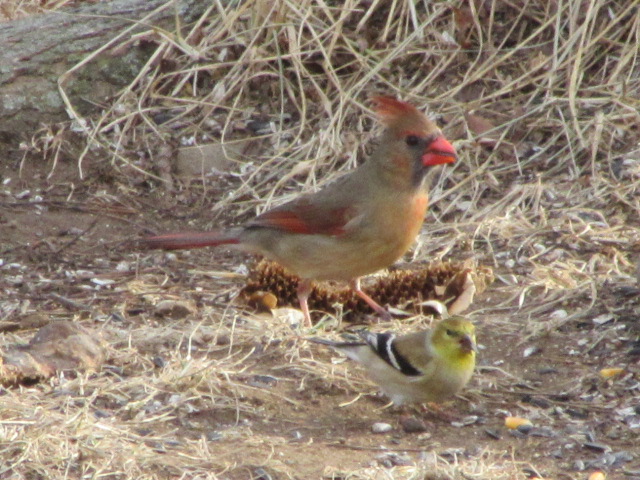
 

Northern Cardinal and American Goldfinch females on January 21, 2018.

AMERICAN GOLDFINCH (Spinus tristis)

While the Northern Cardinals (Cardinalis cardinalis) are here all the time, I have only seen the American Goldfinch a couple of occasions. The first photo above was taken on January 21 and then again Monday morning. Both the males and females have different plumage color during the winter. They both look similar during the winter, but the female has the grayish color on her breast but not the males. During the summer, their colors are much brighter. This photo was better because I was in the backyard when I took the shot.

American Goldfinch male on March 26, 2018.

The Goldfinch I saw Monday morning is a male. You can see the black feathers on his head which will be a solid black cap during the summer. His body will be bright yellow. The American Goldfinch is the only finch that molts twice a year, once in late winter and again in late summer.

The Goldfinch is a vegetarian and only occasionally swallows an insect by accident. Sometimes the Brown-Headed Cowbirds will lay its eggs in the nest of a Goldfinch. If the egg hatches, the chick will only survive a few days because they can’t handle the all-vegetarian diet of the Goldfinch.

The American Goldfinch is a year-round resident here and is the state bird of three states.

You can read more about the American Goldfinch on All About Birds by clicking HERE.

<<<<+>>>>

The American Robin hunting for worms on March 23, 2018.

AMERICAN ROBIN (Turdus migratorius)

Although a few stay here all winter, most of them come in early spring and leave in the fall. I remember walking to work several years ago at 4:30 AM and the Robins would be out singing their morning song. If you aren’t an early riser, you may miss out on the chorus. They sing off and on all day, but nothing like their morning song when hundreds of them are doing it all at once in unison.

Don’t you think it is the Robin that led to the phrase “the early bird gets the worm”? It is always fascinating to watch the Robins hop around during the day hunting for worms. They will hop around then stop and look at the ground. Then all the sudden, they get excited and start tugging at something and pull out a worm.

Although we think of the Robin of only feeding on earthworms, they also like hulled sunflower seeds, suet, peanut hearts, fruit, and mealworms. Robins eat a lot of fruit during the fall and winter and if they feed entirely on honeysuckle berries they become intoxicated.

Robins can brood up to three times a season but only 40% of the nests successfully produce young. Then, only 25% of the young survive to November.

All About Birds says Robin roosts can be quite large, as many as 250,000 birds. When I lived in Mississippi, every spring and fall they would swarm into my backyard to feed and roost in the holly trees behind the old shed. I never saw so many in one place before. Several times I have seen a few hundred, at least, in our yard during their migration.

I didn’t know it, but you can also build next boxes for Robins to build their nests on. During nesting season, the females sleep in their nests while male birds congregate and roost together. Once the females are finished nesting, they join the males.

You can read more about the American Robin on All About Birds by clicking HERE.

<<<<+>>>>
Black Capped Chickadee on February 23, 2018.

BLACK-CAPPED CHICKADEE (Poecile atricapillus)

I haven’t seen many Black-Capped Chickadees yet. They are similar to the Carolina Chickadee, but the Black-Capped species chest is more irregular and the Carolina Chickadee lacks the white wing feathers. There are both species in Missouri. This fellow was next to the flower bed so I was able to get a good photo.

We are kind of on the borderline for Chickadees but making feed they like available and providing nest boxes can attract breeding pairs to remain year round. Wrens will also nest in the same type of box, so they need to be placed in an area Wrens don’t like.

Chickadees will hide seed and other food for later and they can remember thousands of hiding places.

You can read more interesting information about the Black-Capped Chickadee on their page on All About Birds by clicking HERE.

<<<<+>>>>
Blue Jay on December 25, 2017.

BLUE JAY (Cyanocitta cristata)

Of course, there are always several Blue Jays. They are not friendly birds, and in the beginning, they would chase the others away. As time went by they seemed to have mellowed somewhat. For one thing, there are a lot more birds feeding now than before so maybe they felt outnumbered.
Blue Jay and European Starling on January 15, 2018.

After we had a snow I put a lid from an old barrel next to the tree for the bird seed. The Blue Jay was the first to dig in.

Blue Jays are known for their intelligence, complex social systems, and tight family bonds. You should read more about the Blue Jay on their page on All About Birds by clicking HERE. I think you will be surprised.

<<<<+>>>>
The Brown Thrasher on January 16, 201.

BROWN THRASHER (Toxostoma rufum)

She first appeared on January 15 from out of nowhere. She was trying to eat by the tree but a Blue Jay wouldn’t have any part of her so now she eats by the bedroom window. At first, I thought she was a Wood Thrush, but she had a much better disposition. The Brown Thrasher, according to research, is normally a summer resident of Missouri but this one decided to spend the winter
The Brown Thrasher resting in the Buddleja ‘White Profusion’ on January 16, 2016.

Her breast is more streaked than the Wood Thrush and her color is a nice mahogany brown.
The Brown Thrasher posing for a photo on January 16, 2018.

She doesn’t fly off even though she sees me through the window. Many of the birds have gotten used to me watching them through the window while others don’t have time to pay attention. I keep calling her she but I don’t know if she is a female or male.

Brown Thrashers are the only Thrasher east of Texas. They are very protective of their nests and have been known to strike people and dogs hard enough to draw blood.

They are a Mockingbird relative and can sing more than 1,100 different song types. Quite often I hear what I think is a Mockingbird, but it may very well be this Brown Thrasher. I hardly ever see a Mockingbird here although I was very familiar with one in Mississippi and California (which is a story for another time).
The Brown Thrasher close-up on January 16, 2018.

If every bird sat this still when I was taking photos it would be awesome!

Both males and females help to incubate their eggs and feed the young which are sometimes fully feathered within 9 days after hatching and ready to leave the nest.

It seems the Brown-Headed Cowbird prefers to lay their eggs in the Brown Thrashers nest more than any other host. However, the Brown Thrasher often rejects their eggs.

To read more about the Brown Thrasher on All About birds click HERE.

<<<<+>>>>
A small group of Common Grackle on March 27, 2018.

COMMON GRACKLE (Quiscalus quiscula)

Who loves the Common Grackle? I have no idea who would. There are a few bird species that most people, and other birds, think they can live without. The Common Grackle and the Starling are two of them. They are larger than the other birds and sure push their weight around. When the Grackles come to feed, most of the other birds fly off. They don’t seem to mind sharing with Blue Jays and Cardinals as long as there aren’t too many.
Common Grackle on March 27, 2018.

They swarm into the land like a big black cloud in the spring. In the early evenings, they find trees to spend the night and holler at each other to shut up so they can sleep. There are always a few that spend the summer as they scatter out across the land. Then, in the fall, they swarm once again as they fly south for the winter. Several people, including my former neighbor, would stock up on bottle rockets on during the summer to shoot at these birds if they tried to roost in their trees. He is an older gentleman and it was funny to watch him.

The Common Grackle is a feared predator at times and has adapted many ways of survival and do a number of things uncommon to most birds such as “anting”. To read more about the Common Grackle, visit their page on All About Birds by clicking HERE.

<<<<+>>>>
Dark-Eyed Junco male on December 25, 2017.

DARK-EYED JUNCO (Slate-Colored) (Junco hyemalis)

The Dark-Eyed Junco is a winter resident of Missouri and seems to be here by the hundreds. The females are a duller color than the males. These are the bird my dad always called Snowbirds.
A Dark-Eyed Junco perched in the tree on January 15, 2018.

It always amazed me this winter where they would be when the feed was all gone. As soon as I scatter it out and go to the house, they swarm in and start eating.
Oregon Form of the Dark-Eyed Junco on March 27, 2018.

I was looking for a female Dark-Eyed Junco Tuesday (March 27) morning and spotted a few of these I had not noticed before. SO, I naturally did a search. As it turns out, there are 16 described races of Dark-Eyed Junco, of which six forms are easily distinguished from the others. According to All About Birds, five of these used to be in their own species until the 1980’s. Hmmm… Sounds like the plant kingdom. There are two “forms” that look similar, the “Oregon” and “Pink-sided”. The Oregon form has darker crowns and the Pink-sided form has slate gray crowns. Just guessing, I would say the fellow above is a “Pink-sided”. Apparently, they all migrate together but the “Pink-sided form are “of” the Rockies and Western Great Plains. The Missouri Department of Conservation Field Guide says the Oregon Junco appears in northern counties but is not that common. It only mentions the pink-sided as being found “elsewhere” on the continent… Somehow there are a few in my yard… Maybe the wind blew them in.
A small swarm of Dark-Eyed Juncos on January 16, 2018.

The Dark-Eyed Junco spends the winter in much of the United States then goes into Canada to nest. There are areas in the western part of the country they stay year round. The females build their nests on the ground instead of in trees. I was surprised how many birds do that…

To read more about the Dark-Eyed Junco, visit their page on All About birds by clicking HERE.

<<<<+>>>>
Eurasian Collared Dove on January 19, 2018.

EURASIAN COLLARED DOVE (Streptopelia decaocto)

The Eurasian Collared-Dove was introduced to the Bahamas in the 1970’s and made their way to Florida in the 1980’s. Although their clutches only contain 1 or two eggs, they can have 3-6 broods per year. Incubation is for 14-19 days and the young are ready to fly after about 17 days. They are considered an invasive species and there are no hunting restrictions on them.

They don’t like other birds around and all the birds stay away from, even the Grackles and Blue Jays.

This is the dove dad calls the western pigeon and every time he hears one cooing, he will say, “there’s Hootie”. Even if we are across town and hears one he seemed to think it was the same one. One day I had to break the news to him. I told him they are called the Eurasian Collared Dove and are an invasive species. I still don’t think he believes me.

The first time I saw one of these doves was when I was living in Leland, Mississippi at the mansion. I saw only one walking around with a pair of Mourning Doves. I mentioned to the neighbor about it and he said he saw it, too. He said they were a few down in southern Lousiana and must have blown to Mississippi during the hurricane. GEEZ!!! Well, I can tell you, we have more than a few here. One day I counted over 20 feeding under the tree.

I thought I had taken other photos of these birds, but I guess they have been lost in space. I will have to take more.

You can read more about the Eurasian Collared-Dove on All About Birds by clicking HERE.

<<<<+>>>>
Field Sparrow on January 2, 2018.

FIELD SPARROW (Spizella pusilla)

I am pretty sure, though not 100%, that this is a Field Sparrow. They are similar to the Chipping Sparrow and White-Throated Sparrow but they have dark bills where the Field Sparrow has a pink bill. Photos of Field Sparrows online show birds with lighter brown on their head and a brown patch behind their eyes… Maybe birds are like plants and they are “variable”. What do you think?

I know I am picking on the Brown-Headed Cowbirds a lot in this post because I didn’t know they laid their eggs in the nests of other birds. According to All About birds, in study areas in Iowa and Illinois, 50 to 80% of Field Sparrow nests contained the eggs of Brown-Headed Cowbirds.

To read more about the Field Sparrow om All About Birds, click HERE.

<<<<+>>>>

A typical House Sparrow male on March 27, 2018.

HOUSE SPARROW (Passer domesticus)

Well, these sparrows are certainly nothing new. They seem to be everywhere and will nest anyplace they can stuff grass or whatever they can find. They are here 12 months a year and right now. They like to nest in the Martin house if they can get away with it. This photo came out pretty good because I took it above the screen.

It seems a little strange, but all the House Sparrows I see feeding, at least on the south side of the house, are all males.

To read more about the House Sparrow, visit their page on All About Birds by clicking HERE.

<<<<+>>>>
A Mourning Dove on January 15, 2018.

MOURNING DOVE (Zenaida macroura)

I like these doves. They never cause any problems and don’t mind feeding with the other birds. They mate for life and during the summer you will usually only see a pair or two hanging around together. If you see one by itself, it is usually because the female is nesting or it has lost its mate.
Mourning Doves in the tree on January 29, 2018.

I didn’t know a whole lot about birds until lately. Well, I still don’t know much. 🙂 Anyway, I had no idea Mourning Doves flocked together during the winter.
Mourning Doves feeding under the tree on February 6, 2018.

Many days I have seen 12-20 eating where I feed next to the window. There are 15 in the above photo but I didn’t get them all in this shot.

The oldest recorded banded male lived to be 30 years old when it was shot in Florida in 1998. It had been banded in Georgia in 1968. The Mourning Dove is a favorite gamebird for hunters and over 20 million are harvested annually. Even at that rate, they are still our most abundant game bird with an estimated 350 million in the U.S.

To read more about the Mourning Dove, click HERE for their page on All About Birds.

<<<<+>>>>
Northern Cardinal male on December 25, 2017.

NORTHERN CARDINAL (Cardinalis cardinalis)

What would life be like without the brightly colored Cardinal? Everyone loves the Cardinal! I didn’t know what to say about the Northern Cardinal. I know the male is red and the female is every bit as attractive in her colors. I know their song well. They have crests. They stay here 12 months a year. They congregate in the winter. They like sunflower seeds. So, I did a bit of research and found out a little more.
Female Northern Cardinal on March 27, 2018.

Cardinals don’t molt. Most birds molt and many are a different color in the winter. Cardinals are the same color 12 months a year

Along with the American Robin, they are one of the first birds to start singing in the morning. Very few North American female songbirds sing and the female Cardinal is one of them. Her song may even be longer and more complex than the male.
Male Northern Cardinal on March 27, 2018.

During the beginning of the mating season, male Cardinals defend their territory fiercely. Many of us have witnessed male Cardinals attacking their own reflection in windows, car mirrors and chrome bumpers.

The Cardinal is the state bird of seven states.

Cardinals can live a very long time. The oldest recorded was a female from Pennsylvania that lived for almost 16 years.

To read more about the Northern Cardinal, view their page on All About Birds HERE.

<<<<+>>>>
Northern Flicker on the tree on January 15, 2018.

NORTHERN FLICKER (Colaptes auratus)

I don’t see the Flicker feeding on the south side of the house very often. They prefer eating ants and beetles as their main diet. They do like sunflower seeds, suet, cracked corn, peanuts, safflower seats and millet and they don’t mind eating from a feeder. Although they are a woodpecker, they prefer to find their food on the ground.

They remain here year round, but in some parts of the country they do migrate. There are a few different species of Flickers and some even hybridize (I almost said cross-pollinate).

Like most woodpeckers, they drum on objects that make a sound noise as a form of communication and territory defense.
The Northern Flicker thinking about it on January 15, 2018.

When I took the above photo, the Flicker was just sitting there like it wasn’t sure what it was going to do next. The Flicker isn’t really a social bird and it is good sized so most birds give them plenty of room. A Blue Jay came along and drove her away, though.

To read more about the Northern Flicker, visit their page on All About Birds by clicking HERE.

<<<<+>>>>
A Purple Finch on March 27, 2018.

HOUSE FINCH (Haemorhous mexicanus)

Tuesday was only the second time I saw a House Finch this winter. I didn’t get a photo the first time but this time it was eating near the window so I got a few good shots. The House Finch prefers sunflower seeds the best but also like safflower and niger seed. They use their strong bills to crack seeds and nuts many species cannot. They are only here during the winter.

To read more about the House Finch, you can visit their page on All About Birds by clicking HERE.

<<<<+>>>>
The Red-Bellied Woodpecker male on December 25, 2017.

RED-BELLIED WOODPECKER (Melanerpes carolinus)

The Red-Bellied Woodpecker is one of the most entertaining birds here but can sometimes be rather noisy. Like all woodpeckers, they like to drum on objects to communicate and mark their territory, like metal gutters on buildings. I always wondered why they do that. They get along with other birds as long as they don’t get to close.
The males have red heads and many people call them a “red-headed” woodpecker. The females lack a red crown but have a red nape. They sometimes have an orange-red color behind their bill. I always wondered why it is called “red-bellied” because there is no red on its belly. Apparently, there is red there but it is covered by other feathers. Hmmm. Maybe I should catch one to check, huh?
The Red-Bellied Woodpecker watching me through the window on December 26, 2017.

This guy often flies on the window like he is asking for food or maybe just wants to say HI. Then he flies up toward the roof and starts drumming.

Red-Headed Woodpeckers store food in the cracks on trees and fence posts to eat later. They have a long tongue that can stick out two inches past their barbed beak. Their “spit” is sticky and the males have wider tongues than females.

You can read more about the Red-Bellied Woodpecker by visiting their own page on All About Birds by clicking HERE.

<<<<+>>>>
The Savannah Sparrow in the garden on March 9, 2018.

Savannah Sparrow (Passerculus sandwichensis)

I saw this bird on March 9 on the ground in the garden. It just hopped a few feet away but didn’t fly off. I hadn’t seen one of these before so I had to do an online search for the ID. I think Savannah Sparrows are here in my part of Missouri year-round, but farther north they migrate south.

I originally thought this bird was a Song Sparrow, but after submitting the observation on iNaturalist, members suggested it was a Savannah Sparrow. If you notice, there is a yellow spot in front of this bird’s eye. That is a key feature to distinguish this species from the Song Sparrow and other species of sparrows.
All About Birds says, “Savannah Sparrows are one of the most numerous songbirds in North America, and while sometimes overlooked, are likely visitors across the continent. In summer, they don’t hesitate to advertise their location, belting out a loud, insect-like song from farm fields and grasslands.”
You can read more about the Savannah Sparrow on All About Birds by clicking HERE.

NOTE! I originally thought this was a Song Sparrow (Melospiza melodia) which you can check out by clicking HERE.

<<<<+>>>>
White-Crowned Sparrow on December 25, 2017.

WHITE-CROWNED SPARROW (Zonotrichia leucophrys)

Second in line as far as the quantity goes is the White-Crowned Sparrow. They are just here for the winter, too. They have black and white heads and a pale beak which makes them easy to identify.
White-Crowned Sparrow on January 15, 2018.

Scientists placed a White-Crowned Sparrow on a treadmill and it ran 1/3 mile an hour without tiring out. 🙂 One was tracked during its migration and it flew 300 miles in a single night. Alaskan White-Crowned Sparrows migrate about 2,600 miles to winter in Southern California.
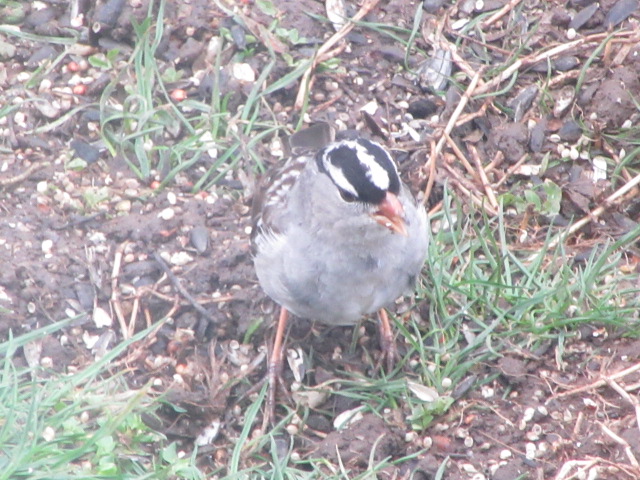
White-Crowned Sparrow on March 27, 2018.

White-Crown Sparrow males develop dialects according to where they were raised. Males on the edge of two dialects often become bilingual…

They stay around until March or April. Today I didn’t see any feeding on the south side of the house.

To read more about the White-Crowned Sparrow, visit their page on All About Birds by clicking HERE.

<<<<+>>>>
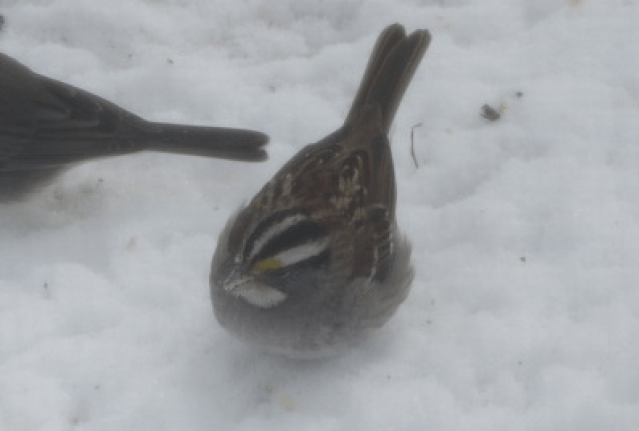
White-Throated Sparrow on January 15, 2018.

WHITE-THROATED SPARROW (Zonotrichia albicollis)

The White-Throated Sparrow is similar to the White-Crowned Sparrow but have three unique features. They have a white throat,  dark bills, and some individuals have a yellow patch above their eyes. There are actually two color forms, the white-crowned and the tan-crowned. Strangely, they almost always mate their opposite form. Males of both color types prefer females with white stripes while females of both types prefer males with tan stripes. White-Crowned Sparrows have also been known to mate with the Dark-Eyed Junco. I took photos of some birds with the tan crowns that lacked the yellow patch but they also had pale bills. So, they turned out to be Field Sparrows.
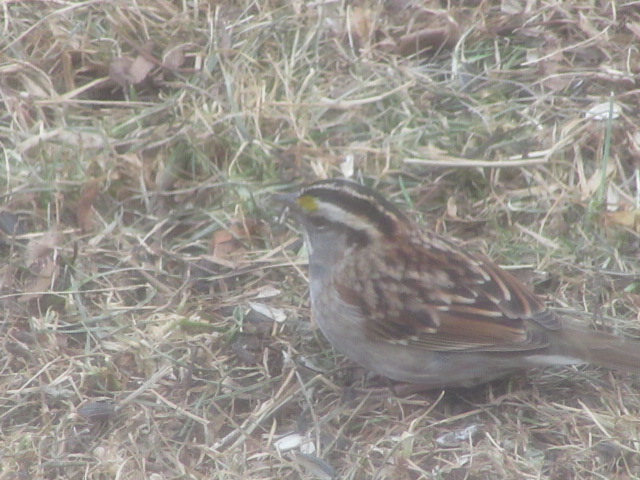
White-Throated Sparrow on January 20, 2018.

You can read more about the White-Throated Sparrow by visiting their page on All About Birds by clicking HERE.

<<<<+>>>> + <<<<+>>>>

I have found myself being entertained watching the White-Crowned Sparrows and Junco’s scratch for their food… It is like they hop and scratch with both feet at the same time. I should take a video. 🙂

We have several Red-Winged Blackbirds that nest in a willow by the lagoon and I have seen them feeding under the tree a few times lately. I haven’t been able to get good photos yet, though. Umm… I also forgot to take photos and mention the Starling. I suppose because I don’t have much interest in them. Well, what can I say? 🙂

There are also a lot of different birds in the back of the farm that doesn’t come for food. There is also a species of Wren that stays here during the winter, but they migrate south for the summer as the House Wren comes in. I have only seen it a few times.

I mainly used the Missouri Conservation Department Field Guide for ID but also the Audubon Society website. Then Monday I found All About Birds which I like really well. Each page gives a link for the bird’s preferred food and nesting information if you can build a box for them. All About Birds is from the Cornell Lab of Ornithology.

Well, I hope you enjoyed this post as much as I have writing it and learning more about the birds in our yard. If you notice I have made a mistake or have more to add, please leave a comment below.

Until next time, stay healthy, be safe, stay positive and be thankful. As always, GET DIRTY whenever you get the chance. 🙂
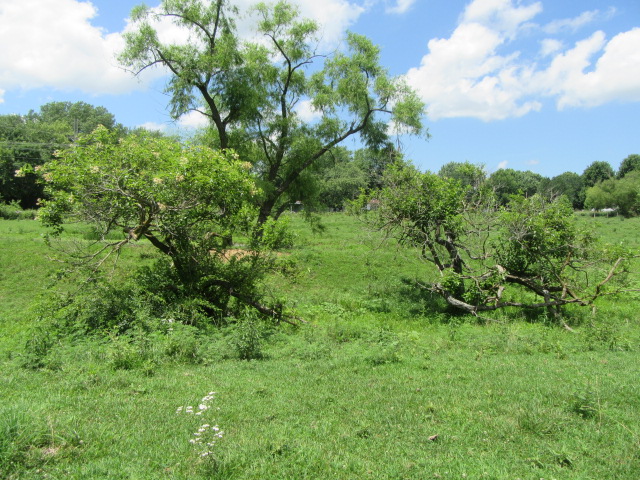
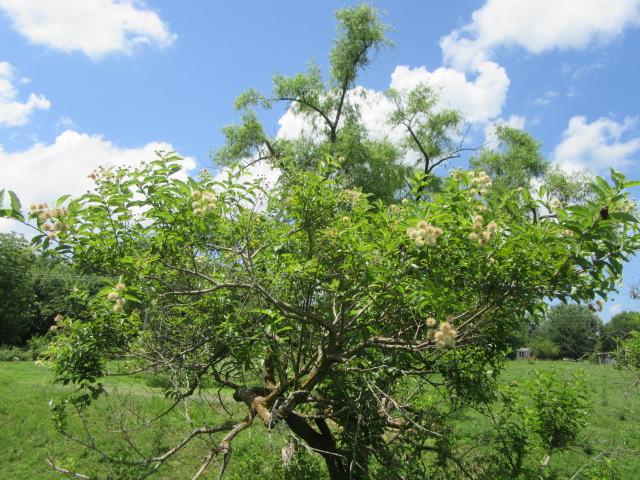
 

First New Plants of 2018

Aristaloe aristata (Lace Aloe) after I brought it home on 3-19-18, #418-1.

Hello Folks! I hope this post finds everyone doing awesomely well! We had a couple of thunderstorms pass by and this morning sure looks like a spring day. The first storm passed over around 10 PM but didn’t rain much. Then I heard another one at around 6 AM this morning but again heard no rain. I have no idea what happened in-between. When I got out of bed later I saw it had rained at some point. AccuWeather.com says it is currently 41° F with a high of 61° with more rain and a thunderstorm. I decided to put out the rain gauge.

The perennials that started coming up before are still the only ones I can see. They haven’t grown much, though, except for the Achillea millefolium and Catmint. I am still amazed the Leptinella squalida ‘Platt’s Black” came back up and the Phlomis came up already instead of waiting until May.

I am somewhat behind in making a post for the new plants I brought home last Monday (March 19)… A couple of weeks earlier dad and I went to Wal-Mart and I snuck off to the garden center to see if they had any new cactus and succulents. Well, they did, but I am not sure when they came in. They were still in plastic sleeves and soaking wet. On the 19th, they were STILL in their sleeves and STILL soaking wet! When I started going over them, I found most of the sleeves were around the plants but the bottom was open. Some, however, were in sleeves with no way for water to drain out. They were still dripping with water which isn’t good for cactus and succulents, as anyone should know. Plus all the cactus had those ridiculous “strawflowers” hot glued to them.

Outside of the usual complaints, their selection was pretty good. I tried to not bring home to many, but I did rescue six plants. Four cacti and two succulents. 🙂 One thing I noticed right off the bat is NONE of the plants were labeled! GEEZ! That is one reason I didn’t bring more home than I did because I knew I would have to figure out what they were.

Aristaloe aristata (Haw.) Boatwr. & J.C.Manning

The above photo is the Aristaloe aristata commonly known as the Lace Aloe, Guinea Fowl Aloe or Torch Plant. Besides it being a neat little plant, it is very unique… It was originally named Aloe aristata by Adrian Hardy Haworth in 1825 BUT phylogenetic studies show this plant is NOT an Aloe at all but more closely related to the Astrolabes and four species of Haworthia. Because of its unique genetics, it has been given its very own genus… It is also only native to the southern tip of South Africa in the Cape Provinces, Free State, KwaZulu-Natal, and Lesotho. One unique feature of this plant is the leaf tips are “tufted”… The leaves are slightly incurved and the white spots feel like sandpaper. There are already three offsets in the pot. The Aristaloe aristata has also received the Royal Horticultural Society Award of Garden Merit.


Gasteria sp. on 3-21-18, #419-4.

Gasteria sp.

I was also pleasantly surprised to find a Gasteria species commonly known as Ox Tongue, Cow Tongue or Lawyer’s Tongue. I have never grown any Gasteria before so this was a great find. Plants of the World Online list 22 accepted species of Gasteria but there are several species with unique differences. Some Gasteria species have leaves similar to Aloe while others leaves have given rise to the common name Ox Tongue with thick, rough leaves. A few other species have similarly shaped leaves but they are smooth like mine. That narrows down the search for what species this is even more. Then, when you take into consideration what species are commonly available, especially for Wal-Mart, that leaves only a few possibilities. One website says the most common species of Gasteria without “warts” is Gasteria maculata. Well, Llifle says Gasteria maculata is a synonym of Gasteria bicolor while Plants of the World Online says that name is a synonym of Gasteria oblique. HA! Llifle says Gasteria oblique is a synonym of Gasteria bicolor. 🙂 Since POWO is supposedly the most up-to-date, it is highly possible, I suppose, this plant is Gasteria oblique

While the leaves are definitely weird and feel like an old rubber tricycle tire, the flowers are also very unique. The base of the flowers are inflated, which gave rise to another common name, Lawyer’s Tongue… I can hardly wait till it flowers!!! The leaves are very hard and solid and the edges feel like a closed zipper. Smooth but rough. 🙂

The Gasteria I brought home was already pot bound with roots coming out of the drain holes. The pot has two larger plants plus a baby peeking through the soil. I already repotted this plant into a larger pot.


My new Oreocereus celsianus after I brought it home on 3-19-18, #418-14.

Oreocereus celsianus (Lem. ex Salm-Dyck) A.Berger ex Riccob

I also found a few Oreocereus celsianus who’s common name is Old Man of the Andes. I bought my first one in February 2016 but it passed on during the next winter. I was glad to find a couple to choose from at Wal-Mart. This one is 3 1/2” tall x about 2 1/2” wide without the fuzz and thorns. Removing the “strawflower” from this one was impossible…


Mammillaria elongata after I brought it home on 3-19-18, #418-13.

Mammillaria elongata DC.

There were several Mammillaria elongata to choose from. There were several Mammillaria species available, but trying to figure out what species you have can be a nightmare since so many look alike. So, when I find unlabeled Mammillaria they need to be unique so their names are easier to figure out. Mammillaria species are quite variable which only makes it worse. While there are several Mammillaria species that are similar to the one I bought, there are a few hints that narrow down the search. Especially when I sent photos to Daiv Freeman of the CactusGuide and posted to a couple of groups on Facebook. We all agreed this cactus is Mammillaria elongata as named and described by Augustin Pyramus de Candolle in Mémoires du Museum d’Histoire Naturelle (Paris) in 1828.

The main stem, which the rest grew from, is 5 3/4″ tall and there are 12 “stems” in all. There are remnants of yellow flowers and perhaps some buds. 🙂

I have a question? What is the first thing that comes to your mind when you see the photo? This is like an ink blot test. To me, it looks like it is giving me the birdie… 🙂 Well, it would have a good reason. A few days ago I slung my pants across the bed and knocked it on the floor. Of course, it fell apart so I had to put all the stems back in the pot. They all stuck together because of the spines and every piece is touching the soil whereas a few of them had been attached to the main stem. GEEZ!


Cereus repandus var. monstrosus ‘Rojo’ after I brought it home on 3-19-18, #418-4.

Cereus repandus f. monstrosus ‘Rojo’

I finally found another Cereus repandus f. monstrosus ‘Rojo’! Although it looks much different than the one I had before, it is still definitely the cultivar commonly sold as Cereus peruvianus f. monstrose ‘Rojo’. Well, the history of the name of this plant is complicated to explain for sure and quite lengthy and it definitely needs a polygenetic test to be sure. There are many “monstrosus” forms of several species in the wild, but the cultivar ‘Rojo’ had some additional help by its creator which is why this plant is unique and unquestionably ‘Rojo’ no matter what shape it has taken… The infraspecific name I chose to use is also questionable because I don’t agree with Plants of the World Online… I refuse to call it Cereus hildmannianus without a polygenetic test. You can read my page about it if you like and maybe you will understand why. 🙂 Oh, yeah… This plant is 5 1/2″ tall.


Mammillaria decipiens (Bird’s Nest Pincushion) on 3-21-18, #419-12.

Mammillaria decipiens Scheidw.

I could not resist this odd-looking cactus and had no clue what it was. Drive Freeman of the CactusGuide said it is a Mammillaria decipiens commonly known as Bird’s Nest Pincushion which was backed up by a member of the Mammillaria Group on Facebook. I would not have guessed it was a Mammillaria species. Cactus of this type are referred to as nipple cactus. OUCH! There are a few subspecies of this one, but I am fairly confident is is not one of them. Each nipple or “tubercle” has several incurved white radial spines growing sideways plus a brown central spine that remind me of stiff pigs hair. Some photos of one of the subspecies show much longer radial spines but lack the brown central spines.

This is a smaller cactus, measuring only 1 1/2” tall x about 3” wide with a few offsets. The pot was only 2 3/4” diameter so I put it in a larger pot. I took many photos just to get a few good ones because this one wanted to be difficult…


Wal-Mart has their bulb and perennial bags out so I picked up this bag that said “Tennessee Ostrich Fern”… There wasn’t much information on the bag so of course, I had to do some research. I want some Ostrich Fern, which is why I bought the bag. A friend of mine in Minnesota has a lot of Ostrich Fern and I think they would look great along the chicken house and barn. However, when I did research, this fern is the Diplazium pycnocarpon which is the Tennessee Glade Fern… Not an Ostrich Fern like I am wanting. Well, I like most ferns so this will be OK for now. There are A LOT of fern species for sure and several with “Ostrich” in their common name.

Last fall I dug up the Caladium and Calla bulbs and put them in the basement for the winter. I had never brought in Caladium bulbs before so I am anxious to see if they will come back up. The Calla Lily bulbs are already beginning to root, so I better get them in a pot.

I promise to do the post about the birds next. Maybe I can get that done today since it is rainy. I have been steadily working on the pages to the right and I am sorry I haven’t read many of your posts lately. I think I need to set aside some time every day, or maybe one day a week just to read other posts.

So, until next time… Be safe, be well, stay positive and most of all GET DIRTY!

Surprises Are Green…

Hello folks! I hope this post finds you all well and as anxious for spring as I am. The grass is greening up a bit and the trees and a few shrubs are starting to bud. The wild roses are also beginning to bud.

Yesterday I took a peek under the Phlomis ‘Edward Bowles’ and was shocked to see it sprouting! It doesn’t normally do this until May! I cleaned off all the dead leaves I had left on all winter as added insulation under the big flower pot I cover it with. Now, I have to watch the weather forecast for drops in temperature and cover it all back up if needed.


I checked on the progress of the Hosta and nothing much has changed. The new growth is still just like it was the last time I checked. Then I went to where the Leptinella squalida ‘Platt’s Black’ was and pushed back the leaves not expecting to see anything. WOW! WAS I SURPRISED! It actually survived the winter! You can see three tiny leaves in the above photo. I first thought maybe it was just grass so I took a closer look. It is definitely the Leptinella! Seriously, I didn’t expect it to come up.


The Rhubarb (Rheum rhabarbarum) is also coming up…


So is the Horseradish (Armoracia rusticana)…


The Daffodils (Narcissus) are budding… The Crocus ssp. came in went already


The Flowering Quince (Cydonia oblonga) been at it for several weeks.


Some of the Maple trees are blooming while others are just beginning to bud. A few of the Chinese Elm (Ulmus parvifolia) trees are way ahead of the rest. Why don’t they all do it at the same time when they are the same species and just 100 feet or so apart?


A few wildflowers are blooming like this Bird’s Eye Speedwell (Veronica persica) are also starting to flower. I also saw a few Henbit (Lamium amplexicaule) flowering today.


A few days ago I saw this interesting bird when I went out to the garden. It wouldn’t even fly away like it was too young to fly. I haven’t identified it yet but it is probably a species of Sparrow… Yeah, I know I still have to do a post about the birds. I took lots of bird photos hoping for a few good ones. I never imagined taking photos of birds was so difficult. They don’t stand still long enough to get good photos most of the time.


I saw three deer clear on the other side of the hayfield. The zoom feature is AWESOME! Last night there were four deer in the backyard.


I walked around a little to see what else nature had left behind from days gone by. Things I didn’t notice during the past summer when taking photos of flowers was on my mind.


I am no bug expert even though I took an entomology course for a while when I was in college. GEEZ! That was way back in 1980! This used to be a leaf…


Talk about thorns! This vine has all the armor to keep it from being eaten…


Talk about swelling? What did this?


Hmmm… I took all those wildflower photos last summer but I am at a loss to which this one belonged to… Maybe the Bee Balm (Wild Bergamot), (Monarda fistulosa).

I guess I need to pay more attention to what goes on around me on the farm. Nature always has a way of surviving and we can all learn a few lessons from observation. What does nature have to teach me in 2018? Can I stop, be still, and observe? I guess we will find out…

Well, I better close for now and get back to the pages on the right. I am working on the ten Salvia species now so I have been making progress. I still have a long way to go and also need to go back and make updates.

So, until time. Be safe, stay well, be thankful and GET DIRTY!


March 3 Update

Hello folks! I hope this finds you all well. The anticipation of spring this year is a little different because I bought several new perennials last year. Wondering if they will return or not keeps me checking every few days as temps warm up. We had a weird winter with many very cold days which can definitely decrease the chances of survival for some perennials.

The Crocus species that started coming up a few years ago from nowhere did return again. I had been watching for them and when I went out to take photos, they were there. 🙂 It is also nice to see the grass starting to green up now.


I don’t know what species of Crocus this is YET but I took a few more photos that may help make that determination. Plants of the World Online lists 220 accepted species. GEEZ!!! Believe it or not, there are NONE that are native to the United States. There are several websites I can check to get a positive ID.


Baptisia x ‘Lunar Eclipse’

I was very glad to see the Baptisia x ‘Lunar Eclipse’ coming up. I bought this plant last spring but it didn’t flower. Since it returned and looks very good, hopefully, it will flower this year.


Hosta ‘Potomac Pride’

The older Hosta are starting to emerge and ‘Potomac Pride’ is always the first followed by ‘Guacamole’. I moved the ‘Krossa Regal’ last spring and so far I only see one plant that may come up… Doesn’t look good for the others.


Hosta ‘Blue Mouse Ears’

Of the new Hosta, I only see signs of life for ‘Empress Wu’, ‘Dancing Queen’ and ‘Blue Mouse Ears. Nothing visible for ‘Rainforest Sunrise’, Abique Drinking Gourd’ or ‘Forbidden Fruit’ and there is no trace of their roots.


Salvia nemorosa ‘New Dimensions Blue’

The Salvia nemorosa ‘New Dimensions Blue’ is still looking good but the ‘New Dimensions Rose’ did not come back, or at least not yet.


Salvia x sylvestris ‘Mainacht’

I had begun to wonder about the Salvia x sylvestris ‘Mainacht’. It is usually the FIRST perennial to come up but that wasn’t the case this year. Finally, it came to life…


Sedum kamtschaticum ‘variegatum’

I was also wondering if the Sedum kamtschaticum ‘variegatum’ survived. It is weird, but this Sedum has been barely hanging on for several years. I moved it to this spot last year hoping it would do better. It does appear it has managed to spread somewhat. The Sedum kamtschaticum is doing very well, though.


Stachys byzantina

The oldest clump of Stachys byzantina (Lamb’s Ears) may not have survived this winter. Luckily, the one in the corner bed survived and when I took these photos, I noticed the one I put in the west side of the bed had also started to come up.

Time will tell for the rest as it is still early. Some perennials take their time and apparently want to make sure warmer temps are here to stay before they wake up. The Kniphofia uvaria are still doing good and will hopefully flower this year.

Spring is right around the corner! We had nice temps last week but the wind was still a little on the breezy side. Then, of course, another cold front came bring a lot of wind. Today it snowed but there was no accumulation. But, it isn’t over yet. I will not forget the snow we had a few years ago in May.

Dad and went to Wal-Mart a few days ago and I snuck off to the garden center. I had to see if they had a cactus shipment like they did last year this early. Low and behold, they did. There were several I would have brought home, but I hesitated since dad was with me. It was sad to see the cactus and succulents still wrapped in their sleeves they were shipped in and were soaking in water. I wonder if they ship them all wet like that or if the Wal-Mart employees watered them. Either way, WHY would they ship cactus wet or why would an employee soak cactus and succulents like that. GEEZ!!!!

I still have to make a post about the birds. Dad and I have been taking turns buying their seed this winter because they are eating 40 pounds a week! I didn’t realize how difficult it was taking photos of birds, especially the smaller ones. They won’t sit still!

Well, that’s it for this post. What is coming up in your yard? Stay safe, be well and GET DIRTY!

Interesting Mud Castles

Hello everyone! I hope this post finds you all well. When I went out to feed and water the chickens this morning I saw something very interesting I had never seen before. We have a lot of new molehills lately which is anything but interesting. But yesterday we had a little rain followed by freezing rain. This morning the molehills had turned into very interesting sculptures.


You know the saying, “don’t make mountains out of molehills”, or something like that? Well, this is one time the molehills really did turn into mountains. Looks kind of like brown coral…


Maybe this can be kind of like an ink blot test. What comes to your mind when you first see the photos? What do you see?


How about if you felt this blindfolded… What would it feel like?


Imagine, still blindfolded, and you smell it… What would it smell like?


Nature can be strange and wonderful at the same time. For several days I have been complaining about all the new molehills and today I took photos of them.


Just goes to show you how nature has a way of making us smile and marvel at the beauty of even the smallest of things. Well, I know what this one looks like…


I am not even sure how this happened with the molehills. Maybe as the rain fell fairly hard in freezing temps, and the soil started washing away it all froze.


Ice can make some really neat sculptures all on its own… This was probably a puddle of water that froze on top. Then as the water under the ice absorbed into the ground, the ice remained long enough to get this photo.


While I was taking photos for the last post, I forgot to check to see if the Daffodils and Surprise Lilies were coming up. Sure enough, they are. No trace of the Crocus that strangely came up last spring from nowhere. Never saw them before even when I lived here in the early 1980’s and dad said he didn’t remember them either. Now, how could that even be possible?


The Suprise Lilies are always interesting because the leaves will go dormant then the flowers emerge from dormant bulbs. I had thought for a long time that they were Amaryllis belladonna, then when I made the page to the right I found out they are actually Lycoris squamigera. They both have similar characteristics and flowers, but the petals of the Amaryllis species are pointed at the tip and the Lycoris are rounded. The other common name is Ressurection Lily.


I thought I would take another photo of the Equisetum hyemale while I was at it. It looks just like the last photo I took of it. It will all probably have to be cut down because it is laying flat as a pancake and surely it won’t stand back up…

Well, that’s is for this post. I just thought I would share some mud photos with you. What have you found interesting over the winter?

Until next time, take care, stay well, happy, positive and GET DIRTY!

Spring Is In The Air & In The Soil

Achillea millefolium on 2-18-18, #411-1.

Hello folks! I hope this post finds you all well and anxiously waiting for spring as much as I am Not to mention the plants staring out the window all day. They know its cold so they are glad they are inside for now. Some of them let their anxiety get the best of them and let out a scream sometimes. I have to tell them to calm down and that spring is right around the corner. I didn’t take a photo of it today, but the Cereus hildmannianus subsp. uruguayanus (Fairy Castles) is going through a growth spurt. That wouldn’t necessarily be strange, but this plant hasn’t hardly grown a lick for almost two years. Sadly, the Faucaria tigrina isn’t looking so well, though.

But this post isn’t about the indoor plants. It is about what’s going on outside. This winter has been weird. We have had our extreme ups and downs lasting for several days at a time. January saw four days below zero but many days the windchill was well below zero. The high on January 1 was 10 degrees with a low of -9. Then, on January 21st it was 68. February has been wild, too. On February 4th, the high was 41 then the temp dropped 4 degrees by morning! This past week we had a low of 9 degrees on the 12th and a high of 73 on the 15th. GEEZ!!!

I’m not sure what the high was today, but the thermometer on the back porch said around 70. Now, folks, I have mentioned to you before about the thermometer on the back porch. It is 100% senile! Sometimes I will be on the computer and I will dad say what the temperature is, according to the thermometer on the back porch. I will check the temp on the internet and go tell him what it really is. But you know what? I think he would rather believe the thermometer. I feel like throwing it in the pond sometimes and getting a new thermometer. Maybe I should get a new one and put it next to the old one.

ANYWAY, getting back to the reason for this post. A few days ago when I was hauling out hay I noticed the elm trees by the pond were budding. It was a fairly warm day, warm enough that I was just in a T-shirt. When I was finished with the hay, I decided to check the Hosta. There is nothing like checking the Hosta to get your blood flowing and start making your fingers itch. Well, they are all firm which is a good sign, but H. ‘Potomac Pride’ has sprouts above ground. Of course, I have leaves covering it this winter which I haven’t had to do in years.

So, this afternoon, I decided to walk around and take a few photos because my fingers are starting to itch and my wheels are starting to turn. That is NOT a good idea in February.

So, as I went out the door on the north side of the house, I first noticed the Achillea millefolium was coming up. Well, I saw it a few days ago actually. Normally, it has to be really cold for the Achillea to go completely dormant.


Rudbeckia fulgida ‘Goldsturm’ on 2-28-28, #411-20.

The Rudbeckia fulgida ‘Goldsturm’ looks like it is giving it a shot. I have it in several areas but the leaves are covering them up. This north bed is a challenge to keep covered because the wind blows the leaves off during the winter.


Lysimachia nummularia ‘Goldilocks’-Golden Creeping Jenny on 2-18-18, #411-16.

In an above average winter, the Lysimachia nummularia ‘Goldilocks’ has no problem surviving. Although they are cold hardy down to USDA Zones 3a (-40° F), they will definitely die back to almost nothing. The past summer it did very well and almost filled the area. Right now, it has been reduced to a few noticeable areas along the foundation.


Geranium sanguineum on 2-18-18, #411-7.

The Geranium sanguineum can certainly hold its own during the winter even though most of the leaves are brown. It is also hardy down to -40. This plant has been here in this spot since around 1996 and is a descendant of the plant I bought from Bluestone Perennials in 1981. So, you can bet, this species is one tough cookie and isn’t about to let the cold get the best of it. They are survivors!


Phlomis ‘Edward Bowles’ on 2-28-28, #411-18.

HELLO! IS ANYONE HOME? Probably the plant I am most anxious to see show a sign of life in the spring is the Phlomis ‘Edward Bowles’. Typically, this plant shouldn’t survive in this zone, but it has since I bought it in the spring of 2013. Last winter I didn’t cover it and thought it was dead, then it sprouted new growth. It did remarkably well last summer as usual but didn’t flower… I covered it this year with a big pot which it completely fills. In warmer areas, this plant can get as tall as 6 feet.


Baptisia x ‘Lunar Eclipse’ on 2-18-18, #411-3.

I piled a bunch of leaves around the new Baptisia x ‘Lunar Eclipse’ a few months ago. It was new last spring and didn’t flower, so I am hoping it will return and flower this spring.


Iris on 2-18-18, #411-14.

The bearded Iris typically have new growth during the winter. I always leave the old leaves attached until the spring clean up for a little protection over the winter. They don’t need much here.


Allium ampeloprasum var. ampeloprasum-Elephant Garlic on 2-18-18, #411-6.

This is the first year I can remember the Elephant Garlic leaves freezing. This is their growing period. The leaves froze in January then it grew new leaves and they froze again. This has happened several times but they are surviving. 🙂


Salvia nemorosa ‘New Dimensions Blue’ on 2-18-18, #411-21.

I was really surprised to see the Salvia nemorosa ‘New Dimensions Blue’ coming up! The pink one is showing no sign of life, though. Normally one of the first perennials to come up is the Salvia x sylvestris ‘Mainacht’… No sign of it coming up yet. I hope it survives but I checked the stems and it doesn’t feel good…


Kniphofia uvaria-Red Hot Poker on 2-18-18, #411-15.

Two of the three Kniphofia uvaria (Red Hot Poker) have survived the winter with flying colors. Even during the coldest temps and I see this plant flat as a pancake, it stands right back up when the temps rise. I think one is completely dead though, although I thought it was dying before and it didn’t. So, we shall see.


Stachys byzantina-Lambs Ears on 2-18-18, #411-25.

Sadly, this is the only trace of the Stachys byzantina (Lambs Ears). The biggest and oldest plant has survived since 2013 and normally part of it stays green over the winter. The only thing left of it now is an old flower stem sticking out of the ground. Luckily, I divided it a little last spring and put one plant on the left side of the bed and this one in the corner bed on the southside. The soil in this spot is crappy fill dirt amended just a little with “The Good Stuff”. This plant, however, is in crappy soil. How did it survive? Well, maybe because it is right next to the foundation and had has a little leaf cover off and on. Most of the leaves on the south side of the house blow off. Ummm… I also cleaned off the south bed after the big “F” and most everything died. SO, there is basically no covering on the south bed…


Iris x violipurpurea ‘Black Gamecock’ on 2-18-18, #411-13.

The Iris x violipurpurea ‘Black Gamecock’ had also survived the winter. This spring I will be relocating it. It does not grow well between the basement steps and back porch


Canna on 2-18-18, #411-4.

I looked down in the leaves to check the Cannas. After the “BIG ONE” and the Cannas all shot craps, I cut them down and piled leaves from the yard on top of the tubers. I don’t mean a couple of inches either… More like 8-10 inches because they aren’t supposed to survive the winter in zone 6a. During the winter this is a favorite spot for the cats to lay in the sun so that 8-10″ gets packed down somewhat.

Information online varies somewhat, but Cannas are a tropical plant that should not be left in the ground below at least zone 7. Dad always cut their stems off after a frost and piled them on top over the winter. This caused a lot of rotting so I started piling on leaves from the yard. It worked so well the amount of plants has more than tripled in the past couple of years. I wanted to experiment with the Colocasia esculenta and try the same thing but I chickened out… It’s not like I don’t have plenty to experiment with.


Phytostegia virginiana-Obedient Plant on 2-18-18, #411-19.

The Phytostegia virginiana (Obedient Plant) is doing very well under a pile of loose leaves. I covered them back up…


Cylindropuntia imbricata-Tree Cholla on 2-18-18, #411-5.

Well, folks… I am not sure about the Cylindropuntia imbricata (Tree Cholla). I have had this cactus for several years and it has survived outside as I was told. Since this winter has been colder than usual, it may be a different story. I had debated bringing it inside earlier but, as you can see, I didn’t. I am tempted to go to Wagler’s and see if hers is faring better than mine. Because, if necessary, I will definitely need another one.


Sempervivum x ‘Killer’ on 2-18-18, #411-24.

The Sempervivum hybrid ‘Killer’ has survived all winter and is sporting its red color. There are plenty of brown leaves but they will be easy to remove in the spring.


Sedum sp. cv. ? on 2-18-18, #411-23.

This Sedum always survives it’s just a shame I don’t know the name. It could be ‘Dragon’s blood but I don’t remember buying one. I did find an old label from a Sedum called ‘Coral Reef’ I bought from Mast’s Greenhouse in 2016. I also found a photo of a cutting I took from somewhere in 2016 called ‘Cherry Tart’… Undoubtedly, this Sedum is one of them so I need to do some leaf research… Truthfully, I just now noticed the photo of ‘Cherry Tart’ from 2016 and I  found the top of the old tag that says ‘Coral Reef’ a few weeks ago.


Sedum kamtschaticum-Russian Stonecrop on 2-28-28, #411-22.

THANK GOODNESS! The Sedum kamtschaticum (Russian Stonecrop) is doing well. This past summer it covered up by the Celosia spicata ‘Cramer’s Amazon and almost gave up. I guess I wasn’t paying enough attention and by the time I removed some of the Celosia this plant was all but dead. I am glad to see it is alive and well. The variegated form is still barely hanging on. It doesn’t grow as well… I didn’t take a photo of the Sedum spurium ‘John Creech’, but it has also survived the winter although not as well…


Tagetes patula ‘Brocade’ Marigold on 2-18-18, #711-17.

GEEZ! I cleaned off the south bed but I didn’t three other beds yet. I opted not to cut off the dead ‘Brocade’ Marigolds yet because I do want their seeds to come up again. I know what a struggle it was getting them going although they have thrived the last few years. I did not collect seeds just in case because I figured there would be thousands of seedlings come up this spring.


Hosta ‘Potomac Pride’ on 2-18-18, #411-12.

The Hosta ‘Potomac Pride’ is always the first to sprout in the spring. As I mentioned earlier in this post, I noticed it had sprouted a few days ago. So, today, I pushed back the leaves to take a photo as evidence. The rest of the Hosta are firm but no sprouts yet. Although…


Hosta ‘Dancing Queen’ on 2-18-18, #411-11.

I did see some green on the Hosta ‘Dream Queen’ under the leaves. 🙂


Abuja reptans ‘Chocolate Chips’ on 2-18-18, #411-2.

NORMALLY the Ajuga reptans ‘Chocolate Chips’ has predominately been evergreen. This winter, it is predominately the opposite. The leaves I covered it with blew off… I usually don’t even have to worry about mulching them.


Heuchera ‘Obsidian’ on 2-18-18, #411-8.

Then I checked the new Heuchera (Coral Bells) I bought last spring. Heuchera ‘Obsidian’ is already growing new leaves.


Heuchera ‘Venus’ on 2-18-18, #411-10.

The Heuchera ‘Venus’ is showing signs of life…


Heuchera ‘Southern Comfort’ on 2-18-18, #411-9.

Heuchera ‘Southen Comfort’ is a little behind but still alive and well. The new Hosta, including ‘Empress Wu’ are still dormant, but their underground part (whatever you call it) is still firm.

I know it has been a while since my last post but I did make a few drafts that I didn’t finish. I have taken a lot of photos of the birds, which I identified, but didn’t post. I never noticed them that much before because the feeder is in the “other” yard. This winter I decided to feed them on the ground under a maple tree about 40 feet from my bedroom window and along the flower bed next to the window. I have been amazed at how many birds have come to eat and expect to be fed. I am not exaggerating, but some days it seems there must be nearly 200. There are easily over 100 Dark-Eyed Juncos (Snow Birds), about 20 Cardinals, at least three species of Sparrows, a Northern Flicker that also looks in my bedroom window, a Brown Thrasher that isn’t supposed to be here, and so many Morning Doves it is hard to count (42 one day all at the same time). Some days there are also quite a few Eurasian Collared Dones. Of course, we have Blue Jays and Starlings.

Dad has always tickled me about the doves… There is one he calls “Hootie”, or at least he seems to think it is always the same one. One day a couple of years ago, we were at the feed mill and he heard “Hootie”. He said he flies all over town. I hated to break the news to him, but “Hootie” is a Eurasian Collared Dove and they are an invasive species… I do like to hear any species of doves call, though. It gives one a peaceful country feeling.

Well, I better get back to working on the pages to the right. I have just finished the “L’s and am getting ready to start on the “M’s”. First up is Mammillaria. Umm, I just counted and I still have close to 200 pages to add or finish (that includes the ones with the “*” that are still under construction). I must say, I am doing more thorough research and learning a lot. I am reading a lot more information and it is taking more time. Several names have changed and need updating. I am not in any hurry and I am just taking my time. I have other things to do around the farm from time to time. I am not going into a lot of detail about “how to grow” plants, just my experience with them. I am adding links for other information from others who know more about growing plants than I do. I just like growing plants, taking photos, doing a little research, blogging and writing about my experience.

I have also started reading more about the authors, the men and women who discovered and named the plants (the explorers). You would be amazed who some of these people are and what they accomplished. Some of my future posts will be about them. This past week I accidentally found a Wikipedia article titled “List of botanists by author abbreviation“. I almost fell out of my chair! Why didn’t I find this way before now? Maybe it’s fairly new. Every person who named and described plant genera, species, etc. is on this list and nearly every one has a Wikipedia page. A few weeks ago I was puzzled about the “L.f.” Of course, “L.” is Carl von Linnaeus, but what does the “f.” mean. I searched and found out that is the abbreviation for Carl von Linnaeus the Younger, the son of Carl von Linnaeus who actually wrote Plantarum Supplementum… He carried on after his father. Well, that is just one of many very important men I have read about. Check out the link and look up some of the older authors. Check out Joseph Pitton de Tournefort (Tourn.)(1656-1708). He actually named a lot of plants before Linnaeus even though the “L.” is often used instead of Tourn. ex L.

OK, I am finished now. I hope you stay well, safe, positive, prosper and everything else AWESOME! Just be happy and know you are blessed! Be thankful, love and be loved. Until next time… Take care and GET DIRTY!

January 12, 2018 Update… IT’S COLD!

Hello folks! I hope this post finds you all well even though it may be very cold where you are. We had a couple of warmer days then this morning it was cold again. It hasn’t been this cold here for several winters so I hope the perennials make it.


The Phlomis ‘Edward Bowles’ is tucked safely under this big pot. Every time the temps were going to drop I would go out and cover it with this pot. Last winter I didn’t do it and thought it was a goner but luckily it did come back up.


I uncovered it yesterday to see what it looked like so I thought I would take this photo today to show you. Well, it looks a lot better than dead.


Even the Elephant Garlic which is normally green and growing all winter is looking pretty pitiful.


Susie and The Barn Cat are enjoying the sun on the south side of the house. ‘The Barn Cat” is her name because apparently she always stayed in or around the barn.


The Nandina domestica (Heavenly Bamboo) is sporting its normal winter colors but is still alive and well.


I have never grown Rosemary (Rosmarinus officinalis) before so I don’t know how it will fare by the time winter is officially over. It appears to still be alive although its color has changed.


This is the only clump of Stachys byzantina (Lamb’s Ears) that is showing any sign os still being alive.  Hopefully the other two will return in the spring.


The Coop Cat was taking a nap until I disturbed her. You know, this cat was untouchable by anyone besides mom until last month. One evening she was at the back door asking for food after the raccoons and opossums finished it off earlier. I opened the door to give her more and she actually let me pet her while she was eating. I was shocked! She looked at me as if to say, “Don’t get used to it.” She got the name “Coop Cat” because she always had her kittens in the coop by the back porch.


It has always amazed me since I came back from Mississippi how well the Alocasia do in the basement over the winter. At this point, they seem perfectly content but they do need to be rotated. The Colocasia bulbs, or tubers (whatever you call them) are being stored. They seem OK so far. I am somewhat concerned about the ‘Thailand Giant’ because I may have dug it up a little too soon. It started coming back to life after I put it in the basement so I had to move it to a darker spot.


Even the Billbergia nutans (Queen’s Tears) doesn’t mind it in the basement and continues to flower all winter.


The cactus and succulents in the kitchen windowsill are still doing fine although the Kalanchoe lucia (on the left) says she needs a drink. If you look close, you can see there are wrinkles on the leaves. That means it needs a little drink, just a little because it is winter and it is kind of sort of dormant. Kalanchoe are summer dormant but they also slow down considerably during the winter, which means kind of sort of. A couple of days ago dad asked me why it was crooked… I took the pot and explained to him what it was doing. He just looked at me so I am not sure what that meant, and probably don’t want to know what he was thinking. I inherited a troublesome trait from him, though, and sometimes it can be irritating. Perfection. Everything has to be straight up, level, or perfectly square… That is unless it isn’t supposed to be. What in nature is perfectly level, straight or square? Hardly anything. After all, the best things in life are nice and curvy and go with the flow… Nature cannot be forced, neither can our natural instincts. You just have to go with it and enjoy the outcome. Well, there are exceptions, and we have to choose what is best for us and those around us. GEEZ! My mind kind of wandered off topic!


I am not sure how old this Philodendron hederaceum is. I think it came from moms second cousins funeral many years ago. It was almost dead when I moved here and after a while I couldn’t take it anymore. I told mom and dad it needed to hang, or at least part of it because that is the way it goes in nature. So, I made a few adjustments and hung one stem on the wall. Next thing you know it was growing. I had a couple of these in Mississippi that I hung in a tree during the summer and they just loved it outside. How many times has the “official” accepted scientific name changed for this plant? Let me see…


This Epipremnum aureum came from moms funeral and has grown nonstop. It is trailing across the floor in front of the counter and has almost reached the end. I told dad it needed to be strung up across the ceiling but he didn’t seem to like that idea… Some morning he will wake up to find it on top of the cabinet with its stems hanging down to the floor or across the ceiling. There is some white in some of the leaves and the leaves are larger and thicker than the Philodendron hederaceum. There are other differences between the two. When I get to the “P’s” I will do some thorough research AGAIN. I am just now on the ‘E’s”. I had two other peoples Pothos at the mansion because they couldn’t get them to grow. It was like I was a plant doctor or something! I had to give them back when I moved. Most people think Pothos are Philodendrons but they are different.


I always have at least one Alocasia odora/ A. gageana in the dining room over the winter. They aren’t as cold tolerant as the hybrids so I get a little paranoid about them even being in the basement even though it is around 65 degrees down there. If you remember, since I separated the pot of this species this past summer and wound up with 25… I think there are three in this pot now. Anyway, I told dad I have more in the basement I can bring up. I told him I could bring the biggest Alocasia ‘Calidora’ upstairs and it would fill the whole area. He said one was enough.


These are the cactus and succulents in my bedroom in the south-facing window. When it was warmer outside they looked sad. Then when it started getting cold and even snowed, they were very glad they were inside. I have had no complaints from them since.


I KNOW, I KNOW! The Adromischus cristatus (Key Lime Pie) looks like she is on her last leg. I am resisting giving it water because I know what will certainly happen if I do. She is sleeping now, or at least I hope so. A few months ago she had filled the pot. When I bought this plant last year I reminded myself of what I was supposed to remember about succulents with large, fat, fuzzy leaves. My first experience with that kind of plant was a beautiful Aeonium lindleyi var. lindleyi (labeled ‘Irish Bouquet’ by the industry). I smack killed it the first winter in 2009 with TLC. My reminder also said that I was to remind myself I didn’t do well with that kind of succulent. I told my reminder I was a succulent newbie at the time and maybe this time will be different. OH, S–T! I am talking to myself while writing this post! Seriously, though, if you have a succulent with large, fat, fuzzy leaves, don’t water it in the winter. If you do, just do it very sparingly maybe once a month. If you notice in the above photo, the leaves that are left are not shriveled… I keep telling myself to be patient and see what happens. If it dies, it would no matter if I water or not. It is a succulent from South Africa not a Philodendron from the rainforest in South America. The weird thing is that the dormancy table says the Adromischus and Aeonium are summer dormant and slow down in the winter. It was perfectly AWESOME during the summer. Sometimes I think the dormancy table is not right for some of the plants listed. Maybe it isn’t for the U.S………… Maybe it has more to do with day length. Maybe I should do further research.


I decided to keep the Aloe x ‘Lizard Lips’ upstairs this winter to see if it would do better. It doesn’t like the basement although the Aloe maculata does much better there over the winter. As you can see, A. x ‘Lizard Lips’ is doing quite well.


The Aloe juvenna also needs bright light 12 months a year otherwise its leaves will stretch and look weird. Its leaves tell the tale and show periods of when it didn’t have enough light and when it was just right.


xGasteraloe ‘Flow’ is looking really good and her kids are doing quite well, too. When I uploaded the photo I noticed that red speck on a leaf. A red flag came up so I went to check what kind of bug it was. Luckily, it was just a piece of red lint. The only thing red in the room is my union suit… GEEZ! Maybe I should have retaken the photo without the lint, huh? Tomorrow I will retake the photo and replace this one otherwise I will have to explain what it is every time the photo is used. Anyone can use my photos as long as they tell where they are from. It is funny how many websites I have been on that have used my photos without my knowledge and no mention of where they got it. I always send them an email, note or a comment and introduce myself usually with no reply. It would be weird to see this photo somewhere with the red lint…


Yeah, I know, I screwed this plant up. When my sister came this past summer to go plant shopping, she finally found a Baby’s Tears she had been wanting. When she was leaving I asked if I could have a piece so I could find out what it was. Man, if looks could kill! She finally said OK. I did identify the Baby’s Tears as Soleirolia soleirolii, also called Mind-Your-Own-Business, Peace-In-The-Home, Pollyanna Vine, Polly Prim, Mother of Thousands, and the Corsican Curse. I thought it was weird, though, because Soleirolia soleirolii photos online have smooth round leaves and this plant’s leaves are somewhat serrated… Every time I question this plants identity it tells me to mind my own business. Anyway, I screwed this plants growth habit up because I didn’t stick the end in the soil. I just laid it on top and it took root and started growing the same direction it was in the beginning. That’s why there is only one main stem. It needs to be repotted pretty bad and needs water every two or three days. I will say this, though, it is one vigorous growing plant!


Of course, the Huernia schneideriana (Carrion Plant) is doing just awesome as usual. Kate, do you remember telling me what this plant was? I think you told me it was a Carrion Plant way back in 2013 or 2014. I did research and narrowed it down to a few possible genera and MANY species that all look alike when not in flower… I had to wait until it flowered so find the exact match. MOST of them have large and amazing flowers and it was agonizing waiting for mine to flower. I was really disappointed when mine produced tiny maroon flowers but at least I did find the exact match. 🙂 Well, I got over the initial disappointment and am always happy to see its flowers. It is still a challenge to get good photos of something so small. This plant absolutely DOES NOT like cold. If you notice the stem hanging over the bottom right you will see part of it is white looking. That is scarring from when I put the plants outside last spring. To say the least, this is a very interesting plant that roots quite easily.
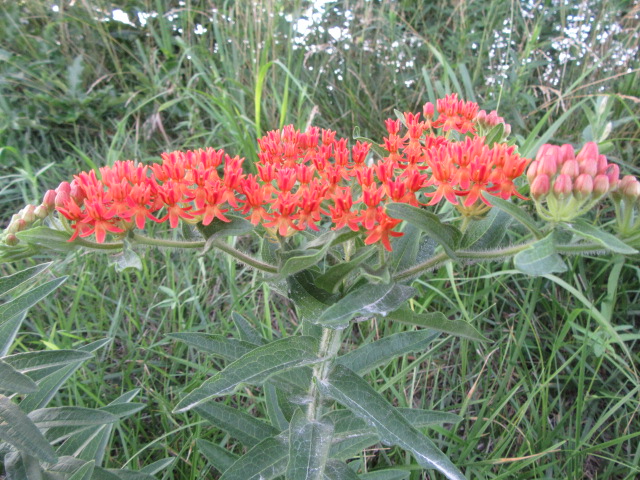
 

I finally made the switch from plant type to family name. It took several days to go through the whole list of plants and find their family name, type in the plant’s name under each family. I had to go down the above list, plant by plant. I had to change several more names along the way because of the name changes. The above photo is just a small sample of my plant list with over 400 plant names. Plants I have grown or encountered on the farm. There are a few from the park and a few that were other peoples plants. Most are plants I have grown, though. The P and D on the left means published on the blog already or as a draft. I finished down the list to the “E’s”. Since I am now finished with the family name project, I can get back to work on the plant pages. The pages already published with the * after the name means that page is still under construction and I haven’t gotten to those names yet. When I initially started the Belmont Rooster for the third time in January 2017, my thought was to go down the list and make a page even if it was to be finished later. I grew tired of that and started making drafts. I grew tired of that, too. Then I started going down the alphabetical list of plants instead of the photos which were organized by plant type. Then the family name project started and now is complete. GEEZ!!! It took only a few weeks to get my first Belmont Rooster blog finished in 2013 and the second one in 2015. It has taken me over a year this time but I had other ventures at first, too.

After I finished that, I went down the list of families and put them on the list to the right on the blog. Every family page has some information, some more than others, with links to where I found the information. You would be surprised how many names have changed. Some of the family names used to be the genus names so they changed the spelling a little. Many genus names, or species names, end with “cea” and family names mainly end with “ceae”. Then when a family becomes a subfamily, the spelling gets changed again. It’s complicated and I have said that over and over on the family pages. Not only complicated to me, but also for the people doing the reclassifying. I know they are somewhat confused but they refuse to admit it. Many family names were given and described many years ago but genus and species have been changed and moved around here and there and back again. Some new family names are not new, just resurrected, which was really interesting to find out. The phylogenetic testing has caused a lot of confusion and some are in disagreement. It is so weird how so many plants that look nothing alike and seem to have nothing in common turn out to be related. I guess it is more amazing than weird and my feelings are now realizing it is a good thing. I know many, many more changes are ahead and many of the names that have been changed may be moved back later. I know the results of these tests are surprising to the APG. I can just imagine how they feel everytime they present their findings and change the rules again… They are working on the fourh system since 2009 I think. Every upgrade not only changes what we know, but also many times the changes they previously made.

Plants of the World Online by Kew, and the other Kew sites don’t mention subfamilies on their list. It just says what family they are in. Once you get into the page, it does mention subfamilies if there are any, but not always. Either they don’t agree or they just haven’t gotten around to it. Plants of the World Online is a new venture, so they are still uploading data. Some information I look for isn’t even on the World Checklist of Selected Plant Families. I mean, well-known plants and families that should be there such as Crassulaceae. When I type in the subfamily name on Plants of the World Online, it will say “no results found”. If I type in the old family name, it says they are synonyms of the current family, when many are considered as subfamilies now. The Wikipedia articles list the subfamilies, which, in most cases, were families before the testing. Several families are now HUGE, bigger than before, because several families were clumped together in the same family.

Well, I better stop writing for now and get back to work. I am going down the list, one name at a time, making sure every plant gets its name updated, has its own page and it gets put under the correct family name, etc. Every page either has or will have links for further reading. Some of the earlier pages I published will still need some tweaking.

OK, I am finished now! I hope you are all well and continue to do well and be amazing! Don’t forget to go outside and get dirty, even if it is cold. Bring a bag of dirt in the house so you can run your fingers through it every day. Put a handful up to your nose and take a deep smell… Put some in something you can get your feet in. Not potting soil! I mean REAL DIRT! Then tell me it didn’t bring a smile to your face. Until next time…. You know the drill!


Euphorbia pulcherrima-The Poinsettia

The Poinsettia photos in this post were taken at The First Christian Church where I am a member.

The Poinsettia

Euphorbia pulcherrima

yoo-FOR-bee-uh  pul-KAIR-ih-muh

Euphorbia pulcherrima Willd. ex Klotzsch is the correct and accepted scientific name for the Poinsettia. It was named and documented by Carl Ludwig Willdenow and Johann Friedrich Klotzsch in Allgemeine Gartenzeitung in 1834.

Hello everyone! I hope you had a great Christmas and all is well. I wanted to write this post to give you some information about the origin of our favorite Christmas flower, the Poinsettia.

First of all, the Wikipedia says, “The poinsettia is native to Mexico. It is found in the wild in deciduous tropical forests at moderate elevations from southern Sinaloa down the entire Pacific coast of Mexico to Chiapas and Guatemala. It is also found in the interior in the hot, seasonally dry forests of Guerrero, Oaxaca, and Chiapas.” In its native habitat, the Poinsettia can grow between 2 and 14 feet tall.

The story begins in the 16th century with a little girl who was too poor to provide a gift for the celebration of Jesus’ birthday. The story goes on to say that she was inspired by an angel to pick weeds from the roadside to place in front of the church altar. Crimson flowers sprouted from the weeds and became Poinsettias.

In the 17th century, Franciscan friars in Mexico used them in their Christmas decorations.

The star-shaped leaf pattern symbolizes the Star of Bethlehem and the red color represents the blood of Jesus.

In Mexico and Guatemala is called Flor de Noche Buena, meaning Christmas Flower. It is known as Flor de Pascua, in Spain, meaning Easter Flower. It is known as Crown of the Andes in Chile and Peru.

The common name was given to the plant in honor of the first United States Minister to Mexico, Joel Roberts Poinsett, who introduced the plant to the United States in 1825.

The Poinsettia as we know it today mainly started with a German immigrant, Albert Ecke, who moved to Los Angeles from Germany in 1900. He opened a dairy and orchard in the Eagle Rock area and started selling Poinsettias on street stands. His son, Paul Ecke, developed a grafting technique which revolutionized the industry. Paul Ecke, Jr. took over the family business in 1963 and really got it rolling, promoting the Poinsettia as the Christmas flower.

Until the 1980’s, The Ecke Ranch had the monopoly of the Poinsettia industry. In the late 1980’s, a university researcher named John Dole discovered the method the Eckes used to create a much busier plant than their competition. Until then it was only known by the Eckes. He published his discovery, which allowed their competition to expand, especially those using low-cost labor in Latin America.

Paul Ecke III took over the Ecke Ranch in 1992 and started production in Guatemala. Somewhere in there, they stopped production in the U.S. He sold the company in 2012 then it was taken over by Dümmen Orange in 2015. In the article, Dümmen Orange CEO says all the companies they acquired have a rich and successful history.

The Eck Ranch was the worlds largest Poinsettia producer and still had 70% of the U.S. market, and 50% worldwide when Paul Ecke III decided to sell. HERE is a link to an interview with Paul Ecke III with him explaining the news.

It is always sad when a family-owned business is taken over by large corporations that have taken over many family businesses. I guess as their competition increases with rising costs to produce their product, something has to change. Once they start downsizing to avoid losses, it is only a matter of time. It seems to be easier for new businesses to start than for older business to hang on.

Well, I better close and get back to work on the pages to the right. I am just about ready to start on the “D’s”… I have a question for you… I have the plant pages on the right categorized by plant type but I am thinking about changing and listing them by family name at some point. That could complicate things, though, as even family names are and will continue to change. Even deciding what “category” is difficult because what are grown as annuals here are perennials or even houseplants in other zones. Maybe I should just do them in alphabetical order… What do you think?

Well, I’ll go for now. Tomorrow is going to be very cold with an expected high of 19 degrees! HOLY CRAP! So, until next time, stay happy, healthy, positive, and warm. Get dirty if you can. I am thinking about bringing a bucket of dirt in my room just so I can get my hands dirty.


Merry Christmas From The Belmont Rooster!

MERRY CHRISTMAS
FROM
THE BELMONT ROOSTER!

I hope this post finds you all well and hopefully enjoying your Christmas. I know when I was a kid, Christmas was always exciting, as it is for most kids. I have a secret to tell that no one ever knew, though. Yeah, we have all shook and felt our gifts to try and figure out what they were. But, Ummm…. As I got older, wiser, and smarter I began secretly opening my packages to see what was inside. Then I would wrap them back up. Of course, that just screwed up everything. How could I pretend to act surprised especially since I knew what was inside was something I wasn’t that crazy about. I mean, what kid wants a shirt or socks for Christmas?

Christmas is, or should be, a time when families and friends gather and have a nice meal, sing carols, etc. For some, it is the time when family members come that we may only see once a year. It should be a great day.

If you are a Christian, Christmas is about the birth of Jesus and giving. Believe me, I deleted my first post because I wrote A LOT about that topic.

For many, however, it is not a happy time. For people who work or live far away that don’t get to spend time with their family, it can be a sad time. Sometimes friends or co-workers invite them over for Christmas, but for many, one day is like any other. Thinking about their family back home when they can not be there with them is very difficult. If you know someone who is away from their family, invite them for Christmas dinner.

Maybe they are older, like my dad, and their husband or wife passed around Christmas time and it brings back sad memories.

Remember those who are in the Philippines now that have been displaced due to the typhoons there a few days ago. They are not at home, many have lost their homes and loved ones. Think about the people in California who lost their homes from the fires.

Just think about all the people who spend so much for Christmas it takes them the next year to pay for it. Or those who can’t afford Christmas for their family. Think about all those in homeless shelters or in the alleys with nowhere to stay (Even though some want it that way), those n the hospital and nursing homes. Christmas should be a time when we invite people in for a meal who can’t afford it, people who have no one to share Christmas with? Yeah, I have done that, and it is an AWESOME feeling.

When I was living in Mississippi a friend used to come over almost every day. During this time of the year he would say, “Why are you so grumpy?” That was funny because I have always been positive minded. Well, he knew it was because I couldn’t get outside and get my hands in the dirt. I am very thankful for all my friends there who always treated me like family and invited me to their family gatherings during the holidays.

Seriously, I do wish you a VERY, VERY MERRY CHRISTMAS. I hope your day is filled with joy. I hope you are with family and friends to celebrate this day however you choose.

In the year ahead, stay positive, give thanks for your blessings share your heart, be more understanding of each other, embrace nature… Just take time to be thankful! If you are in a situation you don’t like, do something about it! There is plenty of help. Awaken yourself! The universe is waiting and wants you to know that YOU ARE AWESOME!

Begonia x withlacoochee ‘Brazilian Lady’ PLUS

Begonia x withlacoochee ‘Brazilian Lady’ on 8-7-17, #365-2.

Hello folks! I hope this post finds you all well. I have been going down my list of plants, one by one, adding new pages, updating published pages, and publishing drafts. I finally made to the B’s and ran across an interesting name.

In 2013, when I had my first Belmont Rooster blog, I had a Begonia that was given to me by the owner of Pleasant Acres Nursery in Leland, Mississippi. She gave me two cuttings from this AWESOME Begonia but didn’t know the name. Thanks to a follower of my blog, the Begonia was finally named.

He suggested it was Begonia ‘Brazilian Lady’ and he was right. Yesterday when I was doing further research so I could publish its page, I did further research and found out something very strange… The correct name is Begonia x withlacoochee ‘Brazilian Lady’. I know what I think of when I see the word coochee, but who would name a plant after… I will stop there. Maybe I should look that word up on  Google images and see if I am even on the right page. Maybe in a private window just in case. GEEZ! I thought so… Well, there are other meanings and it just depends on what you are thinking. The Wikipedia reminded me of various uses for the term in whole or in part. I cannot share that link, though, because this is a family show.

At first, I thought that was a very strange species name and thought surely it was just some made up name. Then, I found it on the EOL (Encyclopedia of Life) website, which is an “official” website. What further verified it as a correct hybrid name was that the information on EOL was submitted by none other than the Royal Botanic Garden Edinburgh…

Then I thought that was kind of strange because the Royal Botanic Garden is Kew, or at Kew, in London, England. SO, I had to look into that. This is what I found out…

Royal Botanic Garden-Kew in London England. Kew is involved in A LOT of extensive work and there are many divisions and websites including the Plants of the World Online and the World Checklist of Selected Plant Families. They work with MANY other organizations including the Missouri Botanical Garden.

Royal Botanic Gardens Edinburgh is the second oldest botanic garden in Britain, located in Edinburgh, Scotland and founded in 1670.

Royal Botanic Garden Sidney in Australia

Royal Botanic Gardens Victoria. Two locations in Melbourne and Cranbourne in Australia

Real Jardín Botánico de Madrid (Spanish for Royal Botanical Garden of Madrid). The garden was founded in 1755 by King Ferdinand VI.

Royal Botanical Garden in Ontario, Canada.

I also found this website from Kew called State of the World’s Plants. Reports from 2016 and 2017 are available. I was stuck on this website for a while… INCREDIBLE! 1,730 new plant discoveries in 2016 with photos and locations It only shows a few on the website and I didn’t download the chapter. 225 plant species now have whole genome sequences and that is just the beginning. 28,187 species are recorded as being of medicinal use. Around 340 million hectares of the earth’s vegetated surface burns every year. There are 6,075 species now documented as being invasive. There is a lot more on this website.

GEEZ! This post was supposed to be about the Begonia x withlacoochee ‘Brazilian Lady’ not the Royal Botanic Garden!

The last two times I started the Belmont Rooster blog it seemed I was finished adding all the pages within a few weeks. Do you realize this time I started in January 2017 and have just barely finished a few pages?

It seems I get fascinated and have to learn more and more. That is truly a research disorder and the only cure is research. There are a few other areas of interest I had and have that I designate time for and it has been good to look at other areas. We live in a whole HUGE magnificent universe and there is truly a lot of exploring to do. I just wish I had found out many, many years ago some of the things I know now.

Dad watches the news and tells me this and that is going on. I sometimes read the headlines but rarely the entire articles on my homepage. I don’t even thinking about the US being attacked by North Korea or any other country because I don’t believe it will ever happen. If someone attacked our home and I went outside and saw my Phlomis on fire, it would not be a good thing… OH, my Phlomis!!! I need to make a post about the Phlomis… Nearly everything is dead or dormant except for my Phlomis because I have been covering it up at night with a big flower pot. Guess what else? Last time I checked, the Leptinella squalida ‘Platt’s Black’ was also still alive. When temps were going to drop last week, I covered it up with shredded leaves. I need to check on it. Maybe with the flashlight tonight. Just kidding, I may wait until tomorrow.

Well, I better stop so I can get this post published. I have this imprint on my mind now of what I just saw on Google images, but it doesn’t require further research. I have work to do.

SO, for now, stay happy, healthy, awesome, positive and GET DIRTY!!!

Surprise Name Changes

Abelia x grandiflora/Linnaea x grandiflora on 5-20-17, #331-1.

Hello, folks! Sorry for my absence lately. I have been working to get the plant pages on the right updated and more added. Last week ended and this week began with two surprises. Saturday I was making the page for Abelia x grandiflora and found out the name had changed to Linnaea x grandiflora. What is a Linnaea? A new family name was also proposed, but for now remains the same. Then on Sunday I went to the next plant on the list to update, Aloe ciliaris, and found that name had also changed to Aloiampelos ciliaris. TWO IN A ROW! While the Abelia, Aloe, and Linnaea genera were all named by Carl von Linnaeus in 1753 (or at least he was the first to publish the names), the Aloiampelos genus was created in 2013. Yeah, I know I am somewhat behind but I only checked when I was working on these pages.

Aloe ciliaris wasn’t the only species of Aloe effected. The names of 18 species were changed.

Aloiampelos ciliaris (Syn. Aloe ciliaris) on 7-12-14, #231-13.

Aloe ciliaris is now Aloiampelos ciliaris. Another surprise was that I have been misspelling the species name ciliaris for five years. I have been spelling it cillaris. 18 Aloe species have been affected by name changes, that I know of so far. I found this useful information on Succulents and More. Then when I went to the Wikipedia, I found a link to this article published in PHYTOTAXA about the reclassification of the genus Aloe. Believe me, it is VERY COMPLEX and hard to understand. I learned a lot by reading the article but I am not sure what I read. It is like a whole new language. I was very fortunate to find a link to this article because not just anyone can read their articles. You have to subscribe and the subscription costs A LOT!!! I have never seen a subscription to anything that expensive! OH CRAP! That article was written in 2013!

Since I first started blogging in 2009, the family that Aloe has been in has changed at least 3 times: Aloaceae>Xanthorrhoeaceae>Asphodelaceae. I think now the family is Xanthorrhoeaceae and Asphodelaceae is the subfamily. OH, WAIT A MINUTE! That was in mid-2013! According to the APG IV System (2016), the family is Asphodelaceae, the subfamily is Asphodeloideae and may be placed in the tribe Aloeae. I also read, “in the past, it has been assigned to the family Aloaceae (now included in the Asphodeloidae) or to a broadly circumscribed family Liliaceae (the lily family)”. WHAT?!?! “OR”?!?! GEEZ! I had to correct circumscribed because I misspelled it circumcised.

The 2013 version of The Plant List included 558 accepted species (plus 23 infraspecific names), 560 synonyms, and 105 unresolved names in the Aloe genus. TODAY, the Plants of the World online website lists 576 accepted species in the Aloe genus… including 11 infraspecific names.

I know taxonomists have a tough job know what they are doing. At first, I thought they were crazy and just making a lot of confusion for everyone because they have the authority to do so. Apparently, way back when Carl von Linnaeus and other botanists, horticulturalists, collectors, etc. were naming plants, families, etc., they were just using their eyes and experience. As a result, some genera became quite large and really didn’t belong there. Now, they have phytogenetic analysis that allows for a better understanding of how they should be classified. It does cause a lot of confusion as plants are reclassified into other genera, and even families. Heck, they are creating new genera and renaming family names. Some new genera have only one or two species, but some of the old names have always been that way. They are proposing new ways to classify plants which are, I guess, better ways. For the most part, it does make better sense if you look at the big picture. We have better tools now to classify plants that weren’t available before. Before phytogenetic analysis was used, they did a lot of reclassifying because so many plants had many different scientific names. But even then, a lot of them were still misplaced. SO, even though I feel like having a few drinks of an alcoholic beverage when I read about name changes, I do kind of sort of understand with just water.

SO, as I go down my list of over 400 plants, I am sure I will find more changes. The Plant List is no longer being maintained, so I have switched mainly to using the Llifle (Encyclopedia of Living Forms) website and the new Plants of the World online. The World Checklist of Selected Plant Families (also a part of Kew) is probably the most up to date list on the planet. I will still use Tropicos as the main source for information on authors names and where they were published because I can click on the abbreviation and get the full names and titles. The Wikipedia has also been an AWESOME resource for information. Without just a few sources, this blog probably wouldn’t even exist.

So, right here and right now, I publically want to thank all the contributors to The Plant List, Llifle, Missouri Botanical Gardens and Tropicos, Daiv Freeman for his CactusGuide and SucculentGuide, the founder of Wikipedia and making it the only advertising free source of information (we should all donate funds), The Royal Botanic Garden (including Kew Science, Plants of the World Online, World Checklist of Selected Plant Families), all the  taxonomists, botanists, horticulturalists, plant collectors, etc. that work very hard growing, collecting data, photograps, and all that they do to make reliable and useful information available. There are many more organizations whose data and information are used, not to mention the colleges and universities throughout the world. The many organizations that work in the preservation of our natural resources, like with the many rainforests throughout the world. We owe these people a lot and you can also donate funds.

Well, I better end this post and get back to work. I hope you have a great week! Stay happy, healthy, positive, cool or warm (depending on where you are). As always GET DIRTY when you have the chance!

The Stripped Mesembryanthemum Genus

Fenestraria rhopalophylla ssp. aurantiaca-Baby Toes, on 7-15-09, #22-8.

Hello folks! How have you been doing? This past week has been cloudy, cooler and rainy. I have been steadily working on the list of plants to the right. For the past few days, I have been editing what was already published or under construction because I noticed a problem. No one could leave comments so I had to go through 18 pages of pages, click on “quick edit” and check “allow comments”. That was the easiest of the two ways. When you set up your blog you can select to allow comments from the beginning and never have to worry about it. No so with “pages”. There is no place to select comments to be allowed in the setting for all pages. If you ever notice anything weird on my posts or pages, please let me know so I can fix it.

When I was working on the Fenestraria rhopalophylla subsp. aurantiaca (Baby Toes) page, I thought it was very interesting what happened with the Mesembryanthemum genus and thought I would share it with you. The first name for this species was Mesembryanthemum rhopalophyllum.

First, the above photo is a photo of the Baby Toes I bought when I was living at the mansion in Leland, Mississippi. I had bought it from Lowe’s in 2009, so it was among my first succulents. The label said it was a Fenestraria aurantiaca. Well, that name is a synonym of Fenestraria rhopalophylla subsp. aurantiaca. There is STILL some debate over whether or not it should be classified as it’s own species or subspecies. To read more about the Fenestraria rhopalophylla subsp. aurantiaca (Baby Toes), click HERE.

According to Llifle (Encyclopedia of Living Forms) website, there is STILL only one accepted species, one accepted subspecies, and one accepted variety of the subspecies in the Fenestraria genus.

I used The Plant List when I first did my research for this plant. Although it is no longer maintained, I still get a lot of information on the website. According to the 2013 version of The Plant List, the genus Mesembryanthemum consisted of 1,119 names (yep, it listed them all). There were 76 accepted species and 3 accepted infraspecific names. 126 were synonyms and a WHOPPING 914 names were STILL UNRESOLVED! Carl von Linnaeus officially named the Mesembryanthemum genus in Species Plantarum in 1753. It seems that every succulent type of plant that had flowers like the Mesembryanthemum were automatically put in that genus. Botanists, horticulturalists and other groups are trying to get them all straightened out and they have done a pretty good job so far. To view the ENTIRE list of species in the Mesembryanthemum genus on the 2013 version of The Plant List, click HERE.

Delosperma cooperi-Ice Plant on 4-24-10, #52-8.

The above photo is of the Delosperma cooperi (Ice Plant) I bought from Lowe’s in Greenville, Mississippi in 2010. It fizzled out during the summer maybe from too much water when I was watering the flower bed it was in. This species was first named Mesembryanthemum cooperi.

According to the Llifle website, there are currently 11 accepted species names in the Delosperma genus (It says 15 but I think they screwed up because five on their list are synonyms of other species on the list). There are an additional six species that have been transferred to other genera. To view their list, click HERE.

The new Plants of the World Online website lists 155 accepted species of Delosperma… Hmmm. To view their list, click HERE.

To read more about the Delosperma cooperi on The Belmont Rooster, click HERE.

According to the Llifle website (Encyclopedia of Living Forms), as of 11-15-17, there are currently 16 accepted names in the Mesembryanthemum genus and 289 have been moved to other genera… To check out the list on the Llifle website, click HERE. I wonder what happened to the other 824 names on The Plant List (NO, I am not going to check). I confused myself for a few minutes… They say 15 for Delosperma and 16 for Mesembryanthemum.

Faucaria tigrina-Tiger Jaws on 11-3-17, #389-2.

Yes, even the Faucaria tigrina (Tiger Jaws) was first named Mesembryanthemum tigrinum by Adrian Hardy Haworth in Observations on the Genus Mesembryanthemum, in two parts in 1795. To read more about the Faucaria tigrina, click HERE. (GEEZ! I have to put more photos on that page).

The Llifle website lists 49 accepted species in the Faucaria genus, but again lists the synonyms and accepted names on the same list, so there aren’t actually 49 accepted species… Should I point this issue out? To check out the list, click HERE. Several species on the list are synonyms of the same accepted name.

I checked out the Wikipedia’s article about the Faucaria genus. It says, and I quote, “Faucaria is a genus of around 33 species of succulent subtropical plants in the family Aizoaceae.”

The Aizoaceae Family:

The Llifle website lists 53 accepted genera in the Aizoaceae family, some of which are synonyms of accepted names. To view their list, click HERE.

The Wikipedia lists 135 genera and says they include “about” 1,900 species.

BUT, the NEW World of Plants Online lists 133 accepted genera in the Aizoaceae family. Hmmm… Check out their list of genera in the Aizoaceae Family, click HERE!

Well, folks… Clearly, with The Plant List being unmaintained and the new World of Plants Online not even having all their data uploaded, there is certainly a lot of confusion… The Llifle website, which is certainly reliable and possibly the most correct, also has some issues. Saying there an “X” number of accepted species and the list includes both the accepted names and their synonyms on the same list… Someone needs to count again and make a list of only the accepted names or just give a number for accepted names. The Plant List also showed graphs and showed how many were accepted names, synonyms, infraspecific names, and how many were still unresolved.

Well, here is a great example of how The Plant List described the family Aizoaceae… Even though it has not been maintained since 2013, it is still a great source of information. You can see the charts at the bottom. On top of the page is a complete list of 146 genera in the family, all can be clicked on for further research.

The problem with using the Plants of the World Online website, since they are STILL uploading data, it is listing accepted names that certainly must not be now. How could the Llifle website, that is continually and correctly updated, say there are so many less accepted names? Probably, if I go down the list of names on the Plants of the World Online site, it will say many of them are synonyms now… SO, the list is not accurate. GEEZ!!! This is going to puzzle me until I actually check the entire list and cross-reference it with the Llifle site.

Well, I am out of words and now I am a complete blank…

SO, for now, PLEASE stay happy, healthy, positive, and hopefully be prosperous. GET DIRTY whenever you have a chance even though your weather may be keeping you indoors.

Understanding & Writing Scientific Plant Names

Salvia elegans L.-Pineapple Sage. The photo was taken on 5-19-15, #273-2.

Hello, friends! I hope this post finds you all doing well and doing something incredibly AWESOME. Well, maybe not right this second because you are reading posts, but you know what I mean.

I decided to write this post about understanding and writing scientific names of plants. Pronouncing them is a different problem, but on the pages to the right, for the ones that are finished, I include the pronunciation as well. I started writing this post on October 20th. I am serious! There are a lot of plant on the list to the right that aren’t finished and some are used in this post. I had to finish them before I could publish this post.

I have re-read this post many times and each time I find out I need to add something else. It is times like this when I really do think I am crazy!

WHAT IS IN A NAME AND WHY IS IT IN LATIN?

Many plants have many common names which vary from location to location. There are also many plants with the same common names. Each country has many plants with common names in their language. Swedish botanist Carl von Linnaeus, who is considered to be the father of botany, chose to use Latin names for all plants because the use of Latin as a scientific language had already been widely used in Europe. Many people say he named most of the plants, but truthfully, a lot of them already had Latin names, especially those used for herbal remedies. It is also interesting that Linnaeus stated that there were fewer than 10,000 species of plants in existence. We now believe there are more than 400,000 different species of flowering plants alone. Well, that’s what the Wikipedia says anyway…

The Latin name for a plant is unique to that plant. The genus and species both have Latin names so they can be better categorized into groups. The genus name, which is the larger of the two groups, would be similar to the use of our last names and the species name would be similar to our first name. Latin names can tell you 1) where the plant is from, 2) the color of the flowers or foliage, 3) what the plant is used for, 4) the shape of the plant, etc. Some plants are named in honor of a person. SO, combining the genus and species names we can tall a lot about the plant. The genus name is a noun and the species name is descriptive.

Someone once said, “Botany is the science in which plants are known by their aliases.” Indeed, the study of botany includes learning the scientific names of plants. The origin of the word botany came from the Greek word botane, which means “grass” or “pasture.” I found that online…

From the Wikipedia:
Botanical nomenclature is the formal, scientific naming of plants. It is related to, but distinct from taxonomy. Plant taxonomy is concerned with grouping and classifying plants; botanical nomenclature then provides names for the results of this process. The starting point for modern botanical nomenclature is Linnaeus’ Species Plantarum of 1753. Botanical nomenclature is governed by the International Code of Nomenclature for algae, fungi, and plants (ICN), which replaces the International Code of Botanical Nomenclature (ICBN). Fossil plants are also covered by the code of nomenclature.
Within the limits set by that code there is another set of rules, the International Code of Nomenclature for Cultivated Plants (ICNCP) which applies to plant cultivars that have been deliberately altered or selected by humans. If you want to read more from the Wikipedia, click HERE.

<<<<NORMAL UNCOMPLICATED NAMES:>>>>

IN biology each living organism has been classified using a scientific name of two words. This is called binomial nomenclature, Latin in form and usually from Latin or Greek roots.

Agave americana L.  ‘K & K’ approximately 30″ T x 53″ W at the mansion in Mississippi on 6-2-12, Photo #96-1.

The genus name is ALWAYS capitalized and is written first and is always italicized or underlined. Well, I can’t underline on WordPress or even italicize in some places (like on the list to the right and the title).

Example: Agave

The species name is written second and is never capitalized and are always underlined or italicized. The species name is also called a specific epithet.

Example: Agave americana

Following the species name is an abbreviation or name of the author. This means when someone finds a plant, gives it a name, then writes about it in a publication, it becomes official. (Well, that depends on the publication and other criteria because there are rules). In this case, the letter L. is used to indicate that Carl von Linnaeus first described this plant in Species Plantarum in 1753. The author’s abbreviation is not italicized. He also named the genus. Now, folks, Carl von Linnaeus named many plants but I am not sure how many he actually discovered, if any. I need to check that out.

Example: Agave americana L.

The Latin meaning of Agave is “noble or handsome”. The meaning of americana is “of the Americas”.

I was given this plant as a pup by the owner of K & K Nursery in Cleveland, Mississippi in August 2009 so I named it ‘K & K’. You can give your plants whatever name you choose just as you would name your children, pets or whatever. That is allowed. I don’t mean you can give then whatever genus or species name you want. That is NOT allowed. LOL! Seriously, folks, we are all Homo sapiens with many names.

To read more about this beautiful Agave on its own page, click HERE.

<<<<Synonyms>>>>

Before I go on I need to say a word about synonyms. A synonym is when a plant has, or had, other names besides the current accepted scientific name. The other names, besides the currently accepted name, are called synonyms. They are synonymous with the accepted name. They are all the same plant…

Austrocylindropuntia salmiana on 7-14-13, #162-21.

A friend of mine in Mississippi, Kyle Hall, was always bringing me cuttings or something of plants he found while walking around town. He is also the one who brought me my first Aloe, a pup from his grandmothers, which I named ‘Kyle’s Grandma’ because I didn’t know what it was at first. That was in 2009! Anyway, one day he brought me a few pieces of this cactus he found growing in a fence row. Of course, I put them in soil and they rooted. Finding the names of cactus back then was a terrifying ordeal, so I sent a photo to the owner of Big Foot Collections... He immediately replied with the name. The list of synonyms for this species of cactus on his site was staggering… It was first named Opuntia salmiana by Antoine Auguste Parmentier and Louis (Ludwig) Karl George Pfeiffer in Enumeratio Diagnostica Cactearum in 1837. The name was changed to Austrocylindropuntia salmiana (Pharm. ex Pfeiff.) Backeb. when Curt Backeberg described it as such in Die Cactaceae in 1941 (or 1942 depending on what site you are on). The Plant List (although unmaintained) says Austrocylindropuntia salmiana (Pharm. ex Pfeiff.) Backeb. is an unresolved name even though it lists SIX synonyms. The Llifle (Encyclopedia of Living Forms) says it is the accepted name. TheCactusGuide says that Opuntia salmiana is STILL the accepted name…

Synonyms of this cactus include: Opuntia salmiana, Cylindropuntia salmiana, Platyopuntia salmiana, Salmonopuntia salmiana, Opuntia spegazzini, Opuntia albiflora, Opuntia ipatiana, Austrocylindropuntia ipatiana, Salmonopuntia salmiana f. rosea, Austrocylindropuntia salmiana var. albiflora, Austrocylindropuntia albiflora, Salmonopuntia salmiana f. alba, Austrocylindropuntia salmiana var. spegazzinii, Austrocylindropuntia spegazzinii, Opuntia salmiana var. spegazzinii, Opuntia spegazzinii, Salmonopuntia salmiana f. glauca… I think I missed at least one.

Just think, a while back, some of those were accepted names at the same time in various publications. One more interesting thing to point out is the reason I used this plant as an example… It was once in the Opuntia genus which is mainly a genus of Prickly Pears. Even though The Plant List is unmaintained and not updated since 2013, I need to use it as a reference here because there is no better site for someone with a research disorder. According to The Plant List, in 2013, there are/were 194 accepted species (plus another 32 accepted infraspecific names). There are/were a total of 387 synonyms (THREE HUNDRED AND EIGHTY SEVEN) and another 389 that ARE/WERE STILL UNRESOLVED! Most, folks, are Prickly Pear! Well, the cactus in the above photo is definitely NOT a Prickly Pear.

WHAT IF…

Oxalis sp. at the mansion in Mississippi on 5-10-10, Photo #55-40.

If you have a plant that you know the genus name but not the species name simply write the genus name followed by “sp.” or “species”. Italicize or underline the genus name but not the “sp.”.

EXAMPLE: Oxalis sp.

This Oxalis species was growing wild in my yard at the mansion in Mississippi. It didn’t even mind being in a pot. I searched the many Oxalis species online and couldn’t find an exact match although some were very close. Some species are variable from one place to another and makes identification nearly impossible. This one has pink flowers with a dark throat with no white inside…

Oxalis in Latin means, “Sour, referring to oxalic acid in leaves and roots”.

<<<<WHEN NAMES CHANGE>>>>

Stenocereus pruinosus on 9-5-17, Photo #371-22.

When you do plant name research, you can tell when a name has changed because the previous author’s name is in parenthesis. For example, this plant’s current scientific name is Stenocereus pruinosus (Otto ex. Pfeiff.) Buxb.. That means there was a previous known name that was replaced. SO, Mr. Buxbaum decided to change the species name. Now, sometimes even the genus name changes, which is the case of this plant. First of all, in the beginning, this plant was named Echinocactus pruinosus Otto ex. Pfeiff. by Christoph Friedrich Otto and Louis (Ludwig) Karl George Pfeiffer in 1837.  Ummm, this gets complicated… Stenocereus was considered a subspecies of the Cereus genus and was documented as such by Alwin Berger in 1905. BUT, Vincenzo Riccobono decided it was its own genus in 1909. It wasn’t until 1961 the currently accepted name became Stenocereus pruinosus. SO, the accepted genus name is currently and correctly Stenocersus (A.Berger) Riccob. because it also changed.  GEEZ! What if we had to write all that out and even go back farther? How long would it be? How about Stenocereus (A.Berger) Riccob. pruinosus (Otto ex Pfeiff) Buxb.? 

Now, if there are no parenthesis in the name, it means they have been that name always, BUT… If a synonym has no parenthesis, it means someone named this plant and didn’t realize it was already named by someone else. For example, if someone is out in the wild and sees this plant and realizes it is a Stenocereus but doesn’t realize it has already been named… Say be calls it Stenoceraus mexicaulus or something. His name is Jim Ruebush so he names this plant Stenocereus mexicaulus Rub. and describes it in a scientific plant publication. Well, since it was already named Stenocereus pruinosus, his name is a synonym… If his name replaced the other name, it would be written Stenocereus mexicaulus (Buxb.) Rub. Sorry, Jim if I misspelled your name.

One other thing… When I bought this plant in 2016, the label said it was Lemaireocereus pruinosus. VERY FUNNY!!! Come to find out that was the third name…

To read more about the Stenocereus pruinosus click HERE.

<<<MUTATIONS:>>>

Agave americana ssp. protoamericana Gentry on 6-2-12, Photo #96-2.

NOW, this can get interesting. The subspecies… What is a subspecies? Sometimes a plant will decide to mutate IN NATURE and some of its offspring will produce individuals of different colors, sizes or growth habit. In other words, they go their own way and do their own thing. If they produce offspring just like they are, then a new subspecies has been created. They are the same species, but now have their own subspecies name because of they only have a few different characteristics. That doesn’t mean that someone else down the road won’t come along and try claim it is a completely different species.

Example: Agave americana subsp. protoamericana Gentry

Some authors name is not abbreviated as with Mr. Gentry’s. The word or abbreviation for subspecies can be written as “subsp.” or “ssp.” and is NOT italicized. The subspecies name is ALWAYS italicized or underlined.

At one point, this Agave was listed online as Agave protoamericana and in a few catalogs but it was never an approved species (it is not on any “list”). Howard Scott Gentry was the first to document this Agave as a subspecies of A. americana in Agaves of Continental North America in 1982. There are several websites that are a little screwy… They have photos of Agave americana subsp. protoamericana for Agave americana and visa versa. SO, other than their photos their descriptions were good. I was SO CONFUSED! You can clearly see the difference… The older leaves of the Agave americana curl downward and the leaves have smooth lines. Notice the leaves of the Agave americana ssp. protoamericana… As the leaves start to form, they are wrapped up so tight that they develop patterns on the leaves and the older leaves do not curl under either. Pretty neat, huh? Photos of their leaves are on their specific plant pages.

I bought my Agave americana ssp. protoamericana from an Ebay Seller in the spring of 2009. It was listed as Agave americana ‘Blue Monster’. Well, it is not an Agave americana and I haven’t seen any other Agaves with the name ‘Blue Monster’ even though that is a very good name. You can read more about this AWESOME Agave on its own page, click HERE.

<<<<VARIETY NAMES:>>>>

Athyrium niponicum var. pictum on 6-9-12, Photo #98-4.

The label on this plant said Athyrium niponicum ‘Pictum’ when I bought it from Lowe’s in Greenville, Mississippi in 2012. The name ‘Pictum’ on the label made it sound like a cultivar name. There are several cultivars of the Japanese Fern as well as this variety, but “pictum” is a recognized scientific “variety” not a cultivar. Athyrium niponicum by itself is a Japanese Painted Fern but this variety has some differences whose offspring continued the traits. That isn’t the only confusing thing about this plant but that is saved for its own page… I apologize for using a blurry photo but that is the best I can do. Every photo I took of this plant was screwed up.

Up to this point, we have learned about genus, species and subspecies names. The genus name represents the genus as a whole. The species names represent that one single species as it is different from all the other species in the genus. The subspecies name represents a child that went their own way. Now, we are getting into names that represent individual plants in those species, what sets them apart from other members of the species. Ummm… Isn’t that what a subspecies is? I have read some whacky and confusing answers to “what is the difference between the two”. I read this article written by Z. J. Kapadia and published by the International Association for Plant Taxonomy (iapt) in 1963… I read it several times and was still somewhat confused. In Zoology there is no classification below the subspecies anymore. They consider “varieties” as outdated synonyms for subspecies. Apparently, in botany, a variety differs from a subspecies in that the variety does not differ as much from the species as a subspecies does. GEEZ!!! If I am incorrect, someone please correct me!

A variety name is given when a mutation occurs in nature (in the wild). If it occurs in cultivation, with the help of humans, it would be called a cultivar. SO, after the species name, the abbreviation for variety is written (var.) and is NOT capitalized. Then the variety name is written and only capitalized if the name is a proper noun. I have grown over 400 different plants and none have a variety name that is a proper noun… The variety name is always underlined or italicized.

Example: Athyrium niponicum var. pictum (Maxwell) Fraser-Jenk.

The 2013 updated version of The Plant List says that the name of this plant changed to Anisocampium niponicum (which I never even heard of). SO, I had to check that out. Apparently, based on a phylogenetic analysis done in 2011, they found out this plant’s true history. However, no website is in agreement, not even The Missouri Botanical Garden’s website, which is Tropicos. Tropico’s and many other organizations contributed to The Plant List. SO, how do I say the Japanese Painted Fern is Anisocampium niponicum when one of the worlds leading authorities is still saying it is Athyrium niponicum? What about the 2010 version of The Plant List when they said the accepted name was Athyrium brevisorum? The Latin word “niponicum” means “of or from Japan”. The Latin word for brevisorum means…. UM, “no results found”. SO, if the name Athyrium niponicum var. pictum is good enough for the Missouri Botanical Garden, then it is good enough for The Belmont Rooster.

To read more about the Japanese Painted Fern on its own page, click HERE.

(NOTE: I just looked up Anisocampium niponicum on the new Plants of the World Online and it says “no results”. No results for Athyrium brevisorum either).

<<<<FORM (forma) NAMES:>>>>

Some of the most spectacular plants in the cactus and succulent world are the mutations… Monstrous, cristate, spirals, all caused by an injury to the plant’s stem. Whether it be from insects or something in nature or from man in cultivation, they hardly resemble their true species…

Austrocylindropuntia subulata f. cristata hort. on 9-17-13, Photo #188-46.

Some mutations aren’t so drastic and may just be a different flower color, longer leaves or maybe a stripe down the center. The word “forma” or the abbreviation “f.” is used to say the mutation is a form and is NOT italicized. The word following the “f.” is italicized but not capitalized. The form name signifies what form it is.

Example: Austrocylindropuntia subulata f. cristata hort.

Well, so much for a “not so drastic” example. There are many species of cacti that do this weird crested mutation. Seldom are any mutations cited with any abbreviation besides “hort.” because that signifies that “it ain’t natural”.

When I bought this plant in 2012 the label said Opuntia subulata f. cristata. FIRST, it was named Pereskia subulata by F. Muehlenpfordt in 1845. The scientific name was Pereskia subulata Muehlempf. Then, in 1883, Georg (George) Englemann changed the name to Opuntia subulata. Then it was written Opuntia subulata (Muehlempf.) Engelm. Curt Backeberg changed the name in 1942 then it became Austrocylindropuntia subulata (Muehlempf.) Backeb. When you have a period at the end of an abbreviation, do you add another period if it also the end of a sentence? SO, if the name changed in 1942, why was it still being marketed under the name Opuntia subulata in 2012?

To read more about this AMAZING cacti, click HERE.

<<<<CULTIVAR NAMES:>>>>

Cereus repandus f. monstruosus cv. ‘Rojo’ on 2-7-13, Photo #208-23.

Mutations occur outside of nature from human influence, but not by crossbreeding. Could be from applying mutagens or through certain propagation methods that I don’t understand or even though selection. The abbreviation “cv.” is used to say the mutation is a cultivar and is written after the species name and is NOT capitalized, underlined or italicized. The cultivar name comes after “cv.” and IS capitalized but NOT italicized. It can be written inside single quotes but not necessarily.

When I bought this cactus from Lowe’s in 2010, the label said Cereus peruvianus monstrose cv. ‘Rojo’. Actually, the name of this cactus can be written several ways because it is also a monstrose mutation…

Examples:
Cereus peruvianus monstrose cv. ‘Rojo’, Cereus peruvianus f. monstrose cv. ‘Rojo’, Cereus cv. ‘Rojo’ or even…  GEEZ! Maybe they feel like I do… I don’t care what you call me as long as you call me to dinner.

BUT… In this case, the name changed. The species was formerly Cereus peruvianus but it changed to Cereus repandus. SO, the cultivar name is supposed to be transferred to the new name although I have never seen it listed that way online. The species name, peruvianus, changed because it is NOT from Peru even though this cactus is still very well known by that name.

Example: Cereus repandus monstruosus cv. ‘Rojo’

The name could be written Cereus (L.) Mil. repandus (L.) Mil. f. monstruosus hort. cv. ‘Rojo’. BUT actually, if we were describing a plant that has always been known as Cereus repandus, we wouldn’t need to use the (L.) because the species name didn’t change. Only when we are describing Cereus peruvianus as a synonym of Cereus repandus would we need to use the (L.) after the species name. I think I just confused myself AGAIN…

NOW, if you look online for Cereus repandus (or Cereus peruvianus) monstrose, you will see many photos that look nothing like ‘Rojo’ because it a mutation due to human influence… The Cereus repandus monstrose mutations in nature do NOT look like this because something else was added by man.

The history of the two names goes all the way back when Carl von Linnaeus himself listed both species as Cactus peruvianus and Cactus repandus in Species Plantarum in 1753, as TWO separate and accepted species. Then, in 1768, Philip Miller changed both of their names and described them as Cereus peruvianus and Cereus repandus. SO, their scientific names were then written as Cereus peruvianus (L.) Mill. and Cereus repandus (L.) Mill….. How many periods? I don’t know when it was decided that Cereus peruvianus became a synonym of Cereus repandus but the industry still markets this species under the name Cereus peruvianus. That is probably because no one knew the name changed for all these years.

To read more about the Cereus repandus monstruosus cv. ‘Rojo’, click here.

<<<<OTHER MUTATIONS:>>>>

Cereus forbesii monstrosa ‘Ming Thing’ on 8-7-09, Photo #27-16.

When I bought the above plant from Lowe’s in 2009, the label said Cereus forbesii monstrose ‘Ming Thing’. The name Cereus forbesii changed and it took me on a long and confusing hunt to find the currently accepted scientific name. It is another example of how human involvement pretty much made a plant that is not visually recognizable. It is probably a Cereus because the breeders were there when it happened but do not resemble any naturally occurring Cereus monstrosa forms in the wild. SO, what is its true name? I STILL have no idea. What The Plant List says is accepted, Llifle says is a synonym. What Dave’s Garden says, The Plant List and Llifle says is a synonym. The Cereus genus has really been screwed over and many species have been transferred to other genera, leaving behind a group that doesn’t fit anywhere else. Personally, I love this mutation whatever its name is!

To read more about the Cereus forbesii monstrose ‘Ming Thing’, I mean, Cereus validus monstrosa ‘Ming Thing’, NO, WAIT! I mean Cereus hankeanus monstrose ‘Ming Thing’ click HERE.


Euphorbia flanaganii f. cristata (branch cristation) hort. Photo taken on 6-25-13, Photo #158-3.

I bought this AWESOME little succulent from Lowe’s in 2013. It is part of the HUGE and widely variable Euphorbiaceae (Spurge) Family which includes species of succulents, perennials, annuals, trees. I think they all secrete a white, milky sap (latex).

To read more about the Euphorbia flanaganii f. cristata, click here.

<<<<NOW for HYBRIDS:>>>>

Salvia x sylvestris ‘Mainacht’ on 5-8-15, Photo #251-17.

When we think of hybrids, we usually think of someone crossing two species of the same genus or two different cultivars to get a specific result. BUT, it also occurs in nature. Like when us humans… I better skip that example.

There are several ways to write scientific names when it comes to hybrids. Let’s look at the beautiful and AWESOME Salvia x sylvestris ‘Mainacht’. This plant is a cross between Salvia nemorosa and Salvia pratensis and occurred in nature. Salvia x sylvestris is commonly known as a Wood Sage and was even recognized and described by Carl von Linnaeus in Species Plantarum in 1753. So this hybrid is actually an accepted “infraspecific” name and has been unchallenged since 1753. That’s almost a miracle in itself! This name is an example of a name created where neither parents name was used.

The name can be written:
Salvia x sylvestris ‘Mainacht’
Salvia x ‘Mainacht’

The genus name Salvia comes from the Latin word salveo meaning to “save or heal”. The hybrid name sylvestris comes from the Latin word meaning “forest or wood”.

The cultivar ‘Mainacht’ was selected for improved performance and is a multiple award winner including the 1997 Perennial Plant of the Year and the Award of Garden Merit (RHS). It is also marketed under the name of ‘May Night’ in the US, as well as Salvia nemorosa ‘May Night’ or ‘Mainacht’.

To read more about the beautiful Salvia x sylvestris ‘Mainacht’, click HERE.


Nepeta x faassenii/Nepeta racemosa ‘Walker’s Low’-Catmint. Photo taken on 7-19-17, #357-56.

This Catmint, Nepeta x faassenii “Walker’s Low’, is a good example of a created hybrid developed by J.H. Faasen. It is a sterile cross between Nepeta racemosa x Nepeta nepetella. The hybrid was named after Mr. Faasen. There are websites that say ‘Walker’s Low’ is a cultivar of Nepeta racemosa.

To read more about the Nepeta x faassenii/Nepeta racemosa ‘Walker’s Low’ click HERE.

<<<<INTERGENERIC CROSSES:>>>>

xGasteraloe cv. ‘Green Gold’ on 7-12-14, Photo #231-56.

There are many intergeneric crosses when it comes to plants. Normally, the seeds are sterile. The plant databases list all these such hybrids with an “x” before the name. The more common examples of intergenetic succulents are xGasteraloe (Gasteria x Aloe), xGraptosedum (Graptopetalum x Sedum), and xGraptoveria (Graptopetalum x Echeveria).

I have only grown three different xGasteraloe (xGasteraloe cv. ‘Green Gold’, xGasteraloe cv. ‘Flow’ and xGasteraloe cv. ‘White Wings’) and one xGraptosedum. Well, the latter was somewhat controversial. When you write the genus name alone, it is italicized or underlined. But, when adding the cultivar name it is not. I have a list of the various species of Aloe and Gasteria species that have been used in creating the many xGasteraloe cultivars. Their names can be written at least two ways…

Example: xGasteraloe cv. ‘Green Gold’ or xGasteraloe ‘Green Gold’


WHAT DID I LEARN WITH THIS POST?

I learned that Arthyrium niponicum is now supposedly Anisocampium niponicum .but no one is using that name.

I learned about phytogenetic analysis.

I learned that I have no idea if the ‘Walker’s Low’ Catmint is a cultivar of Nepeta x faassenii or Nepeta racemosa.

I also learned that The Plant List spelled faassenii wrong instead of every other website, including myself since I was using the spelling on The Plant List. When I sent an email to the editors of The Plant List, I learned that it was no longer maintained. The man who replied to my email about the spelling informed me of a new website being built and maintained by Kew Gardens called Plants of the World Online.

I finally settled my confusion about the difference between a subspecies and variety names.

I found out what causes a mutation in nature.

I found out that even though, in my settings, “comments allowed” is checked, it only works for posts. When I make a new page, however, I have to publish the page, then click on edit, then click on more options, then click on allow comments. EVERY TIME… SO, MOST of the pages to the right have to be edited to allow comments. GEEZ!!! Now I have to remember to do that on close to 400 more pages.

NOTE TO YOU: Folks, I must admit I do like to have a little fun when I write but there are some things I am serious about. Several times I mentioned being confused, but that rarely happens… (I laughed when I wrote that).

I hope you enjoyed this post as much as I did writing it. I always like to learn something when I write a post and I did this time. I am sure I will think of something I forgot, too.

SO, until next time, stay happy, healthy and prosperous. As always, GET DIRTY when you get a chance!

The Tiger Has A Flower In Her Jaws!

Hello folks! I hope this post finds you all well. I want to share the excitement of the first flower on the Faucaria tigrina Tiger Jaws). I took this photo this morning (11-6-17) and it may be fully open now. Just have to see what it does next.


When I brought the plants inside for the winter on October 17 I noticed it had two new leaves starting. Well, that’s what I thought anyway, BUT, as the above photo from on October 31 shows, it was a bud and not new leaves.


Last Friday (November 3) It still hadn’t fully opened.


Then I noticed that there could be another bud to the left of the flower. I didn’t even notice until I was looking at the photo. It could be a new set of leaves so we’ll just have to wait and see.


Tha mammillaria hahniana (Old Lady Cactus) is STILL strutting her stuff. Cactus flowers sure last a very long time!!!


It is so neat how they grow in a circle.


The Mammillaria pringlei started flowering in in August and now it is doing it again. There are quite a few buds all around it.


The redheaded Mammillaria rhodantha also has several buds. Not only do Mammillaria flowers last a long time, waiting for the buds to open will drive you insane!

I will be glad when the Parodia (Syn. Notocactus) leninghausii flowers because they will be yellow. But, the wait will be long because it takes FIVE YEARS before they will flower!

Well, I better get back to getting the post about scientific names ready. The post is basically finished but there are several photos of other plants with links to their pages which are not all finished. I still have three to go but the last two took a lot of time.

Until then, take care, stay happy, healthy, prosperous and, if you can, GET DIRTY!!!


First “F” & Uprooting The Colocasia

Hello, folks! Saturday morning (October 28) I walked out the side door to see this… I knew it would happen sooner or later as usual but it is always a shock. I can never get used to it. Still, some of the plants seemed unaffected by it. At this point, if the temperatures warm back up, the Colocasia will start sending out new leaves like they did in Mississippi. But, this is not Mississippi and it is just the beginning…


The flowers on the Colocasia gigantea ‘Thailand Giant’ are still standing upright as if nothing happened. Probably the leaves protected them. We had already gotten a couple of very light frosts where hardly anything was damaged.

Although the Marigolds did get zapped, their flowers still looked pretty good.


The Talinum paniculatum (Jewels of Opar) still looked very good.


Dad’s red Cannas didn’t look so good, though. Looks like they have been burned. OUCH!!!

It didn’t stop… A few more night’s of frost pretty much did just about everything in… SO, I decided I better dig up the Colocasia.


I took this photo of the Colocasia on Tuesday afternoon (October 31) before I started digging.


Now the flowers weren’t standing up…


The Colocasia gigantea ‘Thailand Giant’ tuber measured almost 6″ across! Taking a photo proved to be a little inaccurate because of the angle. Holding the tape measure with my right hand while holding the camera with my left and trying to press the button… Kind of like tapping your head and rubbing your stomach at the same time (well, I mastered that eventually). The button to take the photo is on the right side of the camera so my right hand holding the tape kept moving when I would press the button to take the photo… VERY FUNNY! Hmmm… Wonder what would happen if I turned the camera upside down? There were NO offsets on the Colocasia gigantea ‘Thailand Giant’.


The Colocasia esculenta in the middle had three large offsets that were almost as large as the main tuber.  The tuber wasn’t quite as large as the plant on the right even though the plant grew taller.


The one on the far right was slightly larger than the one in the middle but you can’t tell by this photo.It had a few smaller offsets that had not come up yet.

I haven’t dug the smaller Colocasia tubers yet because I am going to experiment with some of them…


The Lysimachia nummularia ‘Goldilocks’ is still doing fine. The golden color of the leaves has now turned green. Weird how that happens when the temps get cooler.


The Geranium sanguineum var. striatum is pretty much evergreen all winter.


The Phlomis ‘Edward Bowles’ (Jerusalem Sage) is still looking fine, too. The large pot I keep over it during the winter is close by. Last winter I didn’t cover it and darn near lost it so that won’t happen this year.


The Baptisia x ‘Lunar Eclipse’ is also looking fine. Hopefully, it will survive the winter and next year we will be blessed with flowers…


Although the south bed is now a disaster area there are still signs of life…


The Elephant Garlic is green and growing and so is the Kniphofia. Well, the Kniphofia was protected by the Celosia ‘Cramer’s Amazon’ so it may soon get zapped, too.


The Rosemary still looks fine, too.


The Stachys byzantina (Lambs Ears) seems to be enjoying itself, too. That will change before long, though.


After a couple more “F’s” dad’s Cannas really looked like crap!


As I came around the house, dad was on the side porch smoking his pipe. When I got up to him he asked. “Well, what do you think now?” I thought to myself, “VERY FUNNY.”


I walked over to the shade beds and saw that the Hosta and pretty much everything there hasn’t been zapped yet. The leaves of the Maple trees there are still giving them some protection. The Alocasia that I planted in the bed bit the dust, though. The Caladiums were gone a while back, too. The Leptinella squalida ‘Platt’s Black’ (above photo) is still alive.


The Acalypha hispida (Chenille Plant) is also still alive although the leaves are a bit droopy. I am still debating if I should bring it inside… I better make up my mind soon!

Well, I guess I better end this post for now. I am STILL working on the post about scientific names. Actually, the post is basically finished but I am still working on the pages that are linked to it. There is also something exciting I need to show you but I didn’t want to add it to this post… Wait until you see it! Maybe tomorrow.

Until next time, stay happy, healthy, positive and GET DIRTY!


WELCOME PLANTS OF THE WORLD ONLINE!

Hello folks! I hope this post finds you all well. I have been working on a post titled “Understanding and Writing Scientific Plant Names” for the past week. It has been very interesting and fun putting it together and I have learned a few things along the way. That is always a very good thing.

Yesterday I was working on the post and noticed a misspelling on The Plant List. Well, I sent an email to the editors to point it out. I also quizzed them about when a new version was coming out. I pointed out that many other websites are updating names and The Plant List hasn’t been updated since 2013. It makes them look bad, especially since some of the sites are maintained by organizations that contribute to The Plant List. It is strange that The Plant List will say that a name has changed when the Missouri Botanical Garden website didn’t change the name. The Missouri Botanical Garden, along with Kew (Royal Botanical Garden) and many other top plant organizations have links on The Plant List to verify certain information or do further research.

I had sent other emails before and never received any replies. SO, I was very surprised when I checked my email today and had a reply. I replied back and, WOW, he replied right back AGAIN! BUT, sad to say, he told me that The Plant List was no longer being maintained. He said it was because of lack of funding. He did send a link to another website called Plants of the World Online (POWO). He said that all the updated data could soon be found on that website.

It seems that Tropicos and the Missouri Botanical Garden may not be involved with this project (or the many other organizations linked with The Plant List. KEW, The International Plant Names Index (IPNI) and World Checklist of Selected Plant Families seem to be the ones responsible for this new undertaking.

To check out Plants of the World Online click HERE!

To check out The Plant List 2013 version click HERE.

I put both links so you can see the difference.

I must admit I am a bit relieved to know why The Plant List hasn’t been updated since 2013. Maybe now I can stop pulling out my hair and standing on my head. It is getting a bit cold to run around the house in the middle of the night and jumping in the pond because I was frustrated. The cows thought I had gone mad. The owls will no longer have to put up with me joining them in the tree and the bobcat will be relieved that I will no longer be chasing him down the Rock Island Trail.

SO, from here on out, it looks like I will be using a new website for plant name research.  I still have close to 400 plant pages that are under construction and/or drafts that are not even on the list to the right, so I can easily make necessary adjustments. Now I have to make some fixes on the post I am working on.

SO, for now, I have to get back to the new post I am working on and make sure everything I wrote is correct. God only knows what names have changed since the 2013 version of The Plant List.

Take care and may the Universe bless you abundantly! Don’t forget to get dirty. I know it is getting cooler here, but one little run around the house barefooted won’t hurt you. No matter where you are and what the temperature is.

Cactus & Succulent Update

Hello folks!  I measured the cactus and succulents on Tuesday to see how they had progressed. Yeah, I know it is Friday already and I am just now finishing the post. Some of them are going on their second winter and haven’t been measured since I bought them. Normally I measure the plants when I buy them, but the last group I did not measure. It may sound a little strange for someone to measure their plants, but some cactus grow so slow you can even tell they are growing unless you measure them from the beginning. We measure our babies when they are born, so why not out plants?

I bought the Adromischus cristatus (Key Lime Pie, Crinkle Leaf Plant) from Lowe’s on April 23, 2017. I didn’t measure it when I bought it home, but it was in a 2 3/8″ tall x 2 1/2″ diameter pot. Soon after I bought it, I repotted it into a 3 1/2″ tall x 4″ diameter pot. As you can see, it has grown to 1 1/2″ tall x 4″ wide. I am going to place this plant on the kitchen windowsill for the winter.


This Aloe x ‘Lizard Lips’ has done very well over the summer. In 2014, I gave up most of my plants including my first Aloe x ‘Lizard Lips’ I had bought in 2009. Luckily, I had given Mrs. Wagler of Wagler’s greenhouse a start, so in 2016 she gave me one back. It now measures 4 1/2″ tall x 10″ wide. It did well in my bedroom window last winter, so I guess I will put it there again for this winter.


I am not sure what the deal is with this Cereus hildmannianus subsp. uruguayanus (Fairy Castles). It was nice and green when I bought it from Wal-Mart on January 28, 2016, but then turned kind of yellowish over the first summer and is STILL like that. I thought it was dying but it is growing. When I bought it, it was 6 1/8″ tall x 3 1/2″ wide. Now it is 6 7/8″ tall x 4″ wide…


Well, even though the name isn’t correct any longer, the Echinobivia ‘Rainbow Bursts’ has always done very well. I bought this cactus from Wal-Mart on February 1, 2016, when it was in a small 4 oz pot and measured 2 1/4″ tall x 3 1/2″ wide. I repotted it into a 3″ tall x 4″ diameter pot and now it measures 2 3/8″ tall x 4″ wide… The sides of the pot are bulging so it needs repotting again. This is the plant I mentioned that “was” a cross between the Echinocactus and Lobivia generas. When the 2013 updated version of The Plant List came out, it said all the species in the Lobivia genus were transferred to Echinocactus and Rebutia. Today, I am able to open the Llifle website, which is continually updated, and it says all the Lobivia species are Echinocactus now. SO, I guess this is not an “intergenetic” cross after all… At least for now.


When I came home from Wal-Mart after buying several cacti, I noticed I had two Echinocactus grusonii (Golden Barrel Cactus). Then I noticed there were 3 species I had accidentally bought two of. Anyway, when I bought these on February 2, 2016, one was smaller than the other. The larger one measured 2 1/2″ tall x 2″ wide and now is 4″ tall x 4″ wide.


The smaller one measured 2 1/8″ tall x 2 1/4″ wide and now it is 3 3/4″ tall x 4 1/2″ wide. I can’t remember if I included the spines when I first measured it or not, but I did this time.


The Echinocactus grusonii is definitely one vicious looking cactus!


OK, don’t laugh! We have all had bad hair days. This is the Espostoa melanostele, Peruvian Old Lady… She measured approximately 2 3/4″ tall x 1 3/4″ wide when I brought her home from Wal-Mart on February 1, 2016. Now she is 5 3/8″ tall x 2″ wide, so she has grown A LOT! Strange as it sounds, it seems to have grown the whole top part because… OK, you see where it looks like an invisible rubber band is wrapped around it?  The whole part above that is new growth since I brought it home. Hmmm… Maybe I need to check to see if there is something wrapped around it.


Well, at least she isn’t bald on top.


Well, the photo of the Faucaria tigrina (Tiger Jaws) didn’t come out very well. I bought my first one of these in June 2014 and this one this past April 23. The first one was bigger, but this one has done very well and is now 1 1/2″ tall x 3″ wide. I took other photos but they were more blurry than this one… I put this plant on the kitchen windowsill.


The Gasteraloe ‘Flow’ has done very well and now measures a whopping 4″ tall x 6″ wide. I bought this plant unlabeled in July 2016 so I had to do some research to find the name. I am not 100% sure the name is correct, but it is close enough! I really like Gasteraloe’s! My first one was Gasteraloe ‘Green Gold’ which I gave up in 2014. I also bought a Gasteraloe ‘White Wings’ in July 2016, but it died over the past summer. Every year it seems at least one pot was adopted by ants. When I was taking photos, I found out it is this pots turn. SO, every time I water it this winter, the ants will come out. HOLY CRAP! Maybe I better remove the plant and put it in new potting soil and put the pot outside. Last year one of the Echeveria in my bedroom had ants and they would come out each time I watered or even touched the pot. They would eventually all go back to the pot.


The big Kalanchoe x laetivirens (Mother-of-Thousands) got a little weird (actually, very weird) this past summer and finally fizzled out. BUT, she left behind A LOT of kids. If you have ever thought about bringing one of these home, or a friend offers one to you, just remember they aren’t called Mother-Of-Thousands for no reason. The other thing you need to know, for them to do well and look like they are supposed to they need ample light. The first one I had did very well and had HUGE leaves.


The Mammillaria hahniana (Old Lady Cactus) quite a cactus! I bought it from Wal-Mart on February 1, 2016, when it measured 1 7/8″ tall x 2 3/8″ wide. Now it is 2 1/2″ tall x 2 3/4″ wide.


The Mammillaria hahniana has that spiral look like many cacti do. There are quite a few Mammillaria species that have the cottony looking fluff. Maybe they were running through a cotton field and got tangled up.


Although the label on this Lemon Ball Cactus says Mammillaria pringlei, the name has changed. It is now Mammillaria rhodantha subsp. pringlei. Just when you think you know someone, they go and change on you. The weird thing is that it was described as Mammillaria pringlei twice, which means it was given the same name by two different men. John Merle Coulter named it in 1894 then K. Brandegee gave it the same name in 1900. Then, in 1923, Nathaniel Lord Britton and Joseph Nelson Rose named it Neomammillaria pringlei.  Finally, in 1997, David Richard Hunt decided it was a subspecies of Mammillaria rhodantha. There are so many subspecies of Mammillaria rhodantha it is crazy!

I bought this cactus from Lowe’s on April 23, 2017, making it my newest Mammillaria. I guess I didn’t measure it then, but it now stands 4 1/2″ tall x 3 1/2″ wide.


This is the top view of the Mammillaria rhodantha subsp. pringlei showing all its buds. I don’t think I am going to take a whiff.


This is a “real” Mammillaria rhodantha and the plant that was just labeled “Mammillaria species” that I couldn’t figure out. Try looking at hundreds of photos of the vast number of Mammillaria species. Finally, I sent a photo to the owner of The CactusGuide and he told me what it was. I bought this plant from Wal-Mart on February 1, 2016, but don’t have a measurement documented. It now measures 3 3/4″ tall x 3″ wide.


I just noticed when I was taking photos that it also has buds. OH, I forgot to mention the common name for this cactus is Rainbow Pincushion.


I also accidentally bought two of the Parodia leninghausii (Yellow Tower Cactus, Golden Ball or Lemon Ball) from Wal-Mart on February 1, 2016. I only have measurements for one of them documented so I will have to go back to my old notes to check again. Anyway, the measurements I have says it measured 1 7/8″ tall x 1 3/4″ wide without the fuzz. The taller one in the above photo, which I am calling #1, now measures 4 3/4″ tall x 3 1/4″ wide.

It was also incorrectly labeled Notocactus leninghausii which was the name given to it by Karl Moritz Schumann in 1895. After that, it was also renamed Eriocactus leninghausii by Curt Backeberg and Julius Schäffer in 1942. OH, it gets more complicated… Actually, its first name was Piloscocereus lenninghausii by Friedrich Adolph Haage, spelled with 2 “n’s” which is why the correct scientific name is Parodia leninghausii (Haage) F.H. Brandt. Then when you go to check out that name, it changes to Parodia leninghausii (K. Schum.) F.H. Brandt, which The Plant List says is STILL an unresolved name. VERY FUNNY! One time, Haage also named it Pilocereus leninghausii. No wonder this cactus looks frazzled!


The other one, which I am calling #2, is a little slouched over. It measures 3 3/4″ tall x 2 3/4″ wide.


How’s that for a hair-doo? I think they want to be in their own TV show. These guys will have yellow flowers.


Then, of course, there is the Stenocereus pruinosus (Gray Ghost, Organ Pipe, Pitayo de Octubre, Pitaya). I also bought this cactus from Wal-Mart on February 1, 2016, and it measured 2 7/8″ tall x 2 3/4″ wide. Now it measures 3 3/4″ tall x 2 3/4″ wide, so it grew taller but not wider. This plant was mislabeled Lemaireocereus pruinosus, which is what it was named way back in in 1920 by Nathaniel Lord Britton and Joseph Nelson Rose. Umm, FIRST it was named Echinocactus pruinosus by Christoph Friedrich Otto and Louis K. G. Pfeiffer in 1837. Then Mr. Otto shortened it to Cereus pruinosus in 1846. Then it was named Lemaireocerus pruinosus in 1920 like I already mentioned. THEN, Sten0cereus pruinosus by Franz Buxbaum in 1961 (which is now the accepted name). But, it was also named Rathbunia pruinosa by Paul V. Heath in 1992 when he attempted to create a new genus. Alessandro Guiggi also attempted a new genus and named it Griseocereus pruinosus in 2012. BUT, Stenocereus pruinosus won.

As you can tell, I like doing plant name research. Maybe I should write a post about understanding plant names. That’s a good idea for this winter when there isn’t much to write about. What do you think?

Well, that’s it for this post. Until next time, stay happy, healthy, positive, prosperous and try and GET DIRTY!!!

All Inside For The Winter :(

Here we go again! Cooler temps forecasted for Sunday night forced me to move the potted plants inside. The number of Alocasia I brought in is A LOT more than before because, of course, they multiply. I put the larger plants in the back on the floor and the smaller pots of Alocasia odora/gageana (whatever they are), A. “Mayan mask’ and A. ‘Portora’ on a table next to the stairs. The tallest is the bigger Alocasia ‘Calidora’ at 60”, not including the pot. I will probably move the Alocasia odora/gageana to the dining room because I am not so sure they will like the basement. They have always been upstairs over the winter. The plant in the bottom left corner is the big Bromeliad, Billbergia nutans (Queen’s Tears). It has been in this spot every winter since I moved back here in February 2013.


The cactus and succulents are in their temporary spot for now. Most will be moved to the bedroom and kitchen windowsill. The Begonias will stay in the basement where they will continue to grow, go dormant or die. I may put them in the front bedroom, but I haven’t decided. If I put them upstairs, they may or may not survive anyway. SO, either place their chances are about the same. Besides that, the Begonia ‘Frosty’ had mealy bugs a month or so ago, so that is not a good thing to have upstairs where it will be warmer. I didn’t see any on it when I brought the plants inside, but you never know…

As strange as it may sound, cactus don’t seem to mind a few months in the basement. I never will forget the cactus I found in my grandparent’s basement after he passed away in 1981. When I was cleaning out the basement, there was a good-sized clay pot with another pot on top of it. I took off the pot on top and there was a HUGE barrel cactus in the pot! I had never seen it before and never knew grandma had a cactus. How long it had been there is a complete mystery, maybe for YEARS!


The Begonia ‘Brazilian Lady’ will be fine in the basement as the one I had before did fine there. Well, it lost about all of its leaves but then grew new ones even before I put it back outside.


The Callisia fragrans is a new plant for me this year so I am not sure what to think about it. Should I keep it downstairs or move it upstairs? Umm… It was only maybe 8″ tall when I brought it home now it is 18 1/2″ tall! Not to mention all the kids it has now! SERIOUSLY this plant went banananananas!

I took measurements of the cactus and succulents today so the next post will be the results.

SO, until next time, take care, stay healthy, happy, prosperous, and GET DIRTY!

Cooler Weather Approaches

Hello folks! Cooler weather is upon us and I am at a loss for words. I started this post a couple of days ago, but a couple of the photos were taken on the 8th. Cooler temperatures mean we can get outside and work without having to deal with the heat. There are several good things about this time of the year, I know, but… For those of you who know me, you know the “F” word means frost or freeze which usually happens sometime in October. Well, according to the weather forecast, it is supposed to get down to 40 degrees (F) Sunday night which means I have to bring the plants inside. I always wait until I absolutely have to bring them inside because I like them outside as long as possible. The basement is usually around 65 degrees so I like the outside temp about the same so there isn’t much of a  temperature difference.

I remember my first winter in Mississippi… It was in December 2009. One night I was sitting in the recliner in the den watching TV when a cool blast of air came in through the open sliding door. I jumped up and said, “This is where my world comes into yours.” I spent the next 2-3 hours bringing plants inside using a flashlight so I could see. Who was I talking to? Well, the mansion was haunted.

I finally did trim back the Aralia x grandiflora to 55″. I didn’t predetermine the height, I just picked a spot and started cutting.

The above photo was the last one I took on September 10. I hated to cut it down, but it was beginning to be a pain to mow and trim around. There were a few dead branches that needed to come out, too. I measured the tallest stem after I cut it off and added it to the 55″. Together, they measured 13 1/2 feet! After I started cutting I noticed the stems are hollow. It is recommended that hollow stemmed perennials shouldn’t be cut off until in the spring because water during the winter can get into hollow stems and kill the roots. Well, this is not a perennial it is a shrub, which I guess is kind of a perennial in a way. SO, hopefully, it will be OK. If I knew it was hollow-stemmed I may have waited until the spring to cut. Oh, well, too late now.

I need to prune the Forsythia and Quince and cut a Redbud down that grows in the ditch. There are trees around the lagoon and a few in the fence that need to be cut also. I have put it off for cooler weather, so now there are no excuses. Maybe it will rain, or the cold wind will blow. I am sure I can come up with something.


The Colocasia gigantea ‘Thailand Giant’ is now sending up flowers from another petiole. The one the left sent up seven so we’ll see how many the one on the right gets to send up before we get an “F”.


The Colocasia gigantea ‘Thailand Giant’ (on the left) and the Colocasia esculenta (in the center) have been about the same height for a while now. They are both 67″ tall now but the Colocasia esculenta on the right is a little shorter but it has had bigger leaves than the one in the center. The biggest Colocasia gigantea leaf is now 38″ wide x 45″ long. It may be a little larger if it was flattened it out.


While some plants are about ready to call it quits, some actually seem to be enjoying the cooler weather. The Acalypha hispida has had a new flush of flowers. The Caladiums have all bit the dust and went dormant except for ‘John Peed’.


Last week I thought the Leptinella squalida ‘Platt’s Black’ was gone. But then on the 11th when this photo was taken, I saw it was fine and growing new leaves again. The clump has spread a little and I hope it survives the winter.


All of the Alocasia, except for Alocasia odora/gageana (whatever you call it), will go in the basement. Alocasia odora/gageana stays in the dining room. OH, CRAP! Instead of one of pot as usual, now there are seven! I will have to think about that.


The Amorphophallus has already gone dormant so it just needs a cool dark place for the winter. Since this is a new plant for me, I am anxious to see how it does over the winter and what will happen when it comes up again in the spring. Will it give us a stinky flower? We shall see.


The cactus and succulents will go in my room and in the kitchen windowsill. I will take measurements when I bring them inside to see how much they have grown. I know that may sound weird, but some of them grow so sssslllloooowwww I like to take measurements so make sure they are actually growing.


I will probably put the Aloe maculata in the basement because it doesn’t like it upstairs over the winter. Warmer air and low light are not its thing. In fact, it is just now looking better from last winter when the leaves became etiolated from stretching to get more light. Normally, I grow my Aloe in part shade because the leaves burn and get all brown in full sun. Aloe enthusiasts, who know what they are talking about, say this is a good thing and quite normal. Which looks better to you? Dried up brown leaves or green and beautiful? Just look at this plant… The five leaves on top have grown in just the last month or so. Don’t they look happy and healthy? Before, all my Aloe companions always looked great over the summer months and continued growing. I could never figure that out because Aloe are summer dormant. Well, this summer, I kept this plant in full sun. It hardly grew at all, if at all, until the past few weeks. Now it is looking good again. SO, maybe if they are grown in part shade over the summer they don’t go dormant at all. I have hundreds of photos of my Aloe maculata (not this particular plant) which proves it. Summer dormant means they are “dormant” during the warmer months, May through August, which I think depends on where you live. My Aloe flowered over the summer, so how could it be dormant. Even when the Aloe maculata looked like crap, it still produced a couple of flowers. Summer dormant succulents do most of their growing in the spring and autumn months, which is what this plant is doing now. Their growth rate also slows down over the winter, and being in a cooler basement will also help with that. Well, maybe I am just nuts and they are supposed to look like crap during the summer. But, to me, a green and growing plant is a happy plant. If they are happy, I am happy.


From experience, I do know the Aloe juvenna needs more light or the leaves will become weird and long. Regardless whether or not their leaves turn brown, it is still best. They should have short leaves which they can only have in full sun, or mostly so. Their leaves will turn a reddish color with more light, which is OK. I still don’t like them burning to a crisp, so if that starts to happen I give them more shade. Then we are both happy.


I think the Adromischus cristatus has done really well. The common name on the label is Key Lime Pie, but the REAL common name is Crinkle-Leaf Plant. It is recommended they be grown in full sun, but in their native habitat in South Africa, they grow under shrubs to escape the intense heat of the summer. I have been growing it in an area where it gets an ample amount of sun but it is also filtered somewhat. It has done well and grown quite a bit. They are also a summer dormant plant, but an African website says their growth period is from spring through fall. Hmmm….

What else is interesting? I took 57 photos but I don’t want to put them all on this post.Most of the photos I take will go in the plant pages to the right, eventually. I have to have something to write about this winter, too!


OK, what about this one? The label says Echinobivia ‘Rainbow Bursts’. It is supposed to have been an intergenetic cross between the genera Echinopsis and Lobivia. Well, that can’t be the case now because the genus Echinopsis were transferred to the… WAIT A MINUTE!!! I have that backward… The species in the Lobivia genus have been transferred to the Echinopsis and Rebutia genus. Just checking AGAIN but the Llifle website won’t open up… Safari says it can’t open the page. The Plant List says one thing and the Llifle website says another. This was the plant that no one seems to be in agreement about. In the first place, according to the 2013 updated or outdated “THE Plant List”, there are/were 38 accepted species of Echinopsis plus an additional 8 accepted infraspecific names. There were 147 species (including infraspecific names) listed as synonyms and 127 names that were still unresolved. The Llifle website has been updated regularly but their site won’t open up today. GEEZ! I had something important to tell you! I have it documented, but I wanted to double check to make sure since name changes are taking place all the time. Names that were changed a few months ago have a way of changing back again or even to another genus. I have seen species go from one genus to another then they all get transferred to the genus that some of them were removed from in the first place. Anyway, what I was originally trying to say was that the Echinobivia ‘Rainbow Bursts’ name has to change now. It can’t be an Echinobivia because the “bivia” part no longer exists, or at least it didn’t previously. SO, does that mean this lant isn’t an intergenetic cross now, or maybe between Echinopsis and Rebutia? How about Echinobutia? Heck, that was changed 4 years ago and I bought this plant when? In February 2016. I think they also screwed around with the Rebutia genus but The Plant List is out of date and I STILL can’t get the Llifle website to open up. I don’t want to talk about Dave’s Garden right now. It says the name Echinobivia ‘Rainbow Bursts’ doesn’t exist. Well, GEEZ!!! It should say the name changed! Surely a contributor on Dave’s Garden bought this plant! When a cross is made and released to the public, the actual parent’s names should be public. LOL… My birth certificate has my parents name on it.

Well, all that just made me tired so I think I need to take a nap now. Maybe a few more photos…


The Mammillaria pringlei is STILL at it. The flowers last A LONG time and it is STILL growing more buds.


The Old Lady Cactus, Mammillaria hahniana, is growing more buds, too. This is a really neat cactus! They are all neat in my opinion.


The red-headed Mammillaria rhodantha still has just one flower.

OK, that’s enough for now. Until next time, take care, be happy, healthy and prosperous. Take time and hug one another and go outside and take a deep breath. Close your eyes and just listen to nature around you. You are NOT alone! Don’t forget to GET DIRTY! Take off your shoes and get your feet into it. The chiggers are about gone now, hopefully, so now I can take off my boots and walk around in the grass barefooted. Actually, I haven’t done that in YEARS! SO, I will do it now. Maybe even before I take my nap just to see what it feels like… OK, hold on while I try this…

OH, that feels pretty good. The ground is nice and cool. How many years has it been since I actually walked around barefooted in the grass? So long I can’t remember.

NOW, I will take a nap!


Monday Evening

Hello, folks! It was about 6 PM and I had been working on the page for the Concilium coelestinum (Hardy Ageratum, Blue Mistflower) and I needed a photo of the mildew. Well, you know me, I couldn’t just take one photo.

Susie was taking a nap on the railing of the side porch as I walked out the door.

She thought it was time I took her photo so I told her to smile. Then I asked her if her if she spelled her name Susie or Suzie. She told me she had no idea what I was talking about.


She finally moved out of the way so I could take a photo of the Colocasia from the porch.


Even though the daylength is steadily decreasing and the temperature, especially at night, is cooler the Colocasia are still growing new leaves.


Now the 7th flower has emerged on the Colocasia gigantea ‘Thailand Giant.


The other petiole has not produced any flower (s) yet as I thought it may. I have no idea what that, umm, is… It has two of “those” now.


The Conoclinium coelestinum (Hardy Ageratum, Blue Mistflower) is not doing well. A few weeks ago it started getting powdery mildew. The plants on the other side of the step have almost all died. It has been because of the temperature and humidity. Some of the Lilac always get it every year.


Ummm… I kind of screwed up. I was supposed to take a photo of the Conoclinium coelestinum with powdery mildew and wound up taking one of the Lilac instead… That was the whole purpose of taking “a” photo anyway.


The flower on the Lavandula dentata (French Lavender) STILL hasn’t opened up.


The Coleus ‘Spiced Curry’ is still doing very well but I need to remove the flowers. BUT…


The Coleus ‘Songbird’ has seen better days. Some Coleus reach their limit before others and should be noted when selecting Coleus for the future.

I guess there will be no more photos of the Black and Yellow Garden Spiders… No sign of them for several days now.


I walked around to the south side of the house and the cows were in the front pasture. SO, I went down to get a photo.


I noticed “someone” has been messing with the fence… I asked who did it and they just looked at each other. No one wanted to take the blame. NOW I have to put the wire back where it belongs and stretch the fence AGAIN.


We have plenty of Phytolacca americana (American Pokeweed). I always let them grow because I think they are a neat plant. You know you can even buy a gold-leaved cultivar?


We finally have a couple of roses again after the Japanese Beetles obliterated them all summer. I haven’t seen any of the beetles lately so hopefully, they are gone for the year. Maybe there won’t be so many next year.


I planted a few ‘Mammoth’ Sunflowers in the garden this year so I would have seeds for the birds this winter. I was going to leave them on the plants but I noticed that the center was getting mushy. SO, I cut them all off and put them in the shed to dry out.


The Aloe x ‘Lizard Lips’ has another flower. I am not sure how many it has had this year. It is weird how you are supposed to grow Aloe in the sun, but mine always seem to do better in part shade or dappled shade. I think the proper word is “light shade”. I had the Aloe maculata in the sun most of the summer and it didn’t like it at all. It is doing much better since I moved it. It looks so bad I didn’t take a photo of it all summer even though it did flower. Some people grow them in full sun and their leaves change color and almost burn up… They say their leaves “stretch” too much but I have only had that problem with a few species and hybrids.


Dad’s Cannas have really gr0wn this year and are over 12′ tall. This fall I am going to dig up the soil along the whole length of the garage and give them more room.

One more thing I want to mention… A few weeks ago I read an add about Grammarly… SO, I installed on my iMac. It works pretty well, I must say. I have to teach it scientific plant name and people’s names that I already taught my iMac.  It STILL doesn’t understand how to pronounce the words and always wants to capitalize the first syllable. You can choose “ignore”, though. I took all the grammar and vocabulary I could in high school, so I am usually right anyway. But sometimes…. Anyway, it does help and it saves time going back and editing the posts and pages. It just does it as we go. Sometimes I get on a roll and don’t notice I messed up until after I am finished writing. You know, sometimes when we are typing we don’t press a key hard enough and the word gets misspelled. SO, I would say that Grammarly is a good tool for anyone that does a lot of writing.

Well, that’s all for this post! So, until next time, stay well, happy, healthy and positive. As always, GET DIRTY!!!

Colocasia gigantea ‘Thailand Giant’ Plus…

Hello folks! It has been 11 days since I posted about the first flower from the Colocasia gigantea ‘Thailand Giant’. Now there are six coming from the SAME petiole. I am anxious to see how many it will have produced when it is finished.  I measured the longest one, from the sheath to the top and it is 14″ long.


I guess next spring I am going to need to give it more room, especially since it will be the second year and it is likely to grow even larger. Well, considering they can grow to at least 9′. As you can see, the wind whacking the leaf on the left against the porch tore it half off.


I also noticed a new group of flowers starting from a different petiole!


Nature is truly an amazing thing. All six flowers have come from the same petiole.


As with many members of the Araceae Family, a single leaf is formed from each petiole and a new one emerges from the previous one. The sheath just kind of splits open and out pops the new petiole and leaf.


I noticed this male Walking Stick on one of the newer leaves on the farthest Colocasia esculenta. I wasn’t sure if it was a Northern Walking Stick (Diapheromera femorata) or a Giant Walking Stick (Megaphasma denticrus). I measured this critter and it is 5″ long, or is it? Walking sticks have 3 pairs of legs but they move their front legs alongside their antenna to make themselves appear longer. Ummm… I can only see… GEEZ! Now I know what is wrong!!! It is upside down! So, it definitely isn’t 5″ long, it is only approximately 3″ long which definitely makes it a Northern Walking Stick. Where the legs attach to the thorax is called a coxa, similar to our hip. The distance from the first pair of coxa to the head is very short. SO, if you look at the photo you can see the first pair of coxa but no legs. That is because they are alongside the antenna. The front legs appear to be about 2 1/4″ long.


The Black and Yellow Garden Spider (Argiope aurantia) had to move her web when the leaf on the Colocasia gigantea ‘Thailand Giant’ got too low. She was under it. I took this photo a few days ago but she was still there this morning, The other one is still alive and well in the shrubs along the front of the house.

While I am taking photos I just as well go see what she is doing.


Well, what do you know? She moved her web so now it is attached to the grass out in the yard. I am not sure if that was a good idea or not because now she is more in the open for predators.

Now that I am out here with the camera…


Just as well show you what happened with the huge 36″ wide Marigold ‘Brocade’. Looks like someone sat on it, but it just became so heavy with flowers that the branches couldn’t hold them up anymore. Luckily the branches just bent over instead of breaking.


The Celosia spicata ‘Cramer’s Amazon’ are blooming themselves silly.

Oh yeah, I wanted to show you a few more flowers in “the other yard”.


The Mammillaria pringlei is at it AGAIN… This is one of “those” times when you don’t want to smell the flowers.


Now the Mammillaria rhodantha also has a few buds. This is the first time flowering!


The Tradescantia sillamontana is also starting to flower.


Dad was on the porch smoking his pipe when I was finished taking photos and he pointed out there was a baby tree frog sitting on the axis of a Colocasia esculenta leaf. OK, he didn’t really say it like that. He just said “that leaf”.


Then when I went back out later to find the Walking Stick again, I saw another one sitting inside an open sheath on a petiole of the other Colocasia esculenta. Sometimes those little guys are hard to photograph! We have a lot of tree frogs and you just never know where you will find them.

Then later on in the afternoon…


I found this poor dead snake in front of the driveway. I may have run over it when I drove out of the driveway earlier, or perhaps someone else ran over it. Whoever did it, it is dead. I see very few snakes here, mainly the Eastern Garter Snake. I think the dead snake is a Great Plains Rat Snake (Pantherophis emoryi). It is 13 1/2″ long and would have grown to 24-36″ at maturity.

Well, that’s it for this post. I have been continually working on the plant pages on the right and have finally finished with all the bulb, tubers and rhizome plants through the Curcuma petiolata (Hidden Ginger). It took a while to get the Colocasia pages finished. Well, a few pages will never be finished as they are a continual work in progress as I take more photos.

SO, for now, take care, stay healthy, positive, prosperous and GET DIRTY!!!


More Flowers, A Murder, and Tillandsia

Hello folks! This morning I noticed there were two flowers on the Colocasia gigantea ‘Thailand Giant’. So, I went inside to get the camera so I could take a shot. To my surprise, there is a third one peeking out…


The bulb of the Colocasia gigantea ‘Thailand Giant’ is getting HUGE


So is the one on the largest Colocasia esculenta. If it keeps growing, it will be as big as they were in Mississippi!


I went back out in the afternoon and took another photo. What is really weird is that all three flowers are growing from the same petiole… An older petiole to boot! Right out of the sheath where a petiole grew from before!

Colocasia slow down their leaf production as the day length decreases to focus their energy on flowers and seeds. The bulbs swell more and their roots start dying off as they start to prepare for a rest period. While the Colocasia esculenta have not flowered since I have been back to Missouri (that’s 5 summers!), they produced A LOT when I was living at the mansion in Mississippi. The Alocasia do flower and have seeds, though, all summer long, especially the Alocasia ‘Calidora’. Then, I carry them to the basement for the winter, pots and all. The Colocasia bulbs will be lifted after they get a “F”.

When Kate commented on the last post, or the one before, she mentioned that her Alocasia macrorrhizos slows down during the dry season. I found out online even though they don’t completely go dormant in tropical climates, they do this “pseudo-dormancy” thing where they do rest during the dry season. What tropical plants do in nature depends on the type of plant it is, too. Some, plants, such as Pitcher Plants, can even be out in the refrigerator for a while. If you don’t allow some of the tropicals to go dormant, they will wear out and die. I am glad we don’t have to do that with Alocasia!


Well, I don’t know what to say. The evidence speaks for itself… Although she is very small, the Argiope aurantia, umm…. Well, it looks to me like she had a visitor. She either didn’t like him from the first or their courtship was deadly. Either way, she murdered him… She is the smallest of the two, her body only measuring around 1-1 1/4″. The big one that went MIA as at least twice the size. I haven’t seen any evidence of the other one having a caller yet…


When I went to buy potting soil from Lowe’s in August they had quite a few Tillandsia. You know, the “air plants”. They had several individual plants in bags or you could buy them in their little pots. They also had some in magnetic pots you could stick on the side of the refrigerator. I thought that was pretty neat, but I thought surely I could find something better.

I bought two of the individual plants and the potting soil then headed out the door… Dad came with me and was waiting in the car and I am sure he was wondering what was taking me so long. But, he needs to realize that even though I go to Lowe’s for a specific reason, my subconscious mind always has it’s own hidden agenda. Actually, maybe it is my conscious mind, or maybe they are both in agreement. Anyway, when I get into Lowe’s, I get what I need then I get sidetracked. OK, I will be honest. I didn’t get sidetracked. I purposely looked at the plants and they just happened to have these poor little epiphytes. SO, I had to do my duty and rescue a couple.

When I got back to the car, I put the potting soil in the trunk and put the other bag into the back seat while dad wasn’t noticing. I knew if he saw what I bought he would have pity on them and tell me to go back and buy the rest. Ok, that wasn’t the reason…

These are the first Tillandsia I have ever had for companions. Being epiphytes, they grow in tropical climates in trees without soil. They live on the moisture from the air. You don’t have to provide soil, just ample bright indirect light and mist them 1-2 times per week.

I brought them home, having no idea what I was going to do with them. I gave them a good misting and put them in a saucer on a dresser in my bedroom. I walk past them several times a day and assure them I haven’t forgotten about them. By now, I figured they would have learned some sort of sign language, but they just tell me they are doing just fine like they are. I told them I would find something special just for them and they just smile and tell me not to worry… Honestly, most plants left in a saucer in the house would be screaming.

SO, this afternoon I decided I would see what I could come up with. I found an old bag of sphagnum moss in the basement some time ago, so I figured I could use it… Then I went to the barn… Never know what you can find in an old barn, right?

I looked around a little and found this neat old wire basket that had an old plastic pot in it. God only nows where it came from and how long it has been there. It is about 4 1/4″ tall x 4 1/2″ diameter. SO, I thought that looked pretty neat and would work well with the taller plant.


Then I went and looked around the yard for something for the smaller one. I found rocks with holes in them but nothing clicked. Then I found this neat old hollow piece of a hedge post. The light came on! I had to sand off the end a little so it would stand up then stuff a little sphagnum moss in it. Looks fine to me!

I haven’t figured out the species names of them yet because there are a lot that look so similar. In time, as they grow and flower, I will be able to figure it out. Ummm… I have heard collecting Tillandsia is very addictive.

Well, that’s it for this post. I hope you are all doing well, staying positive, and GETTING DIRTY!

C. a. ‘Thailand Giant’ Flower And…

Hello folks! Friday evening I was watering the plants and noticed the Colocasia gigantea ‘Thailand Giant’ was starting to flower. It was to dark to take a photo then, so I wanted until this morning. Since I have been back here on the farm none of the Colocasia esculenta have flowered. The tuber, or whatever you call them (I keep forgetting) on the Colocasia gigantea and the biggest Colocasia esculenta are getting HUGE! I need to take a photo of them, too.

I took photos on the 9th and 10th but I haven’t made any new posts since the 8th. I have been busy working on the plant pages on the right and have gotten many of them updated this week. SO the next few photos were taken on the 9th and 10th of September…


The three Colocasia’s still seem to be in a growing competition. For those of you who don’t know, the two on the right are Colocasia esculenta, descendants from bulbs I bought in 2009. I have more, but these are the biggest. The one on the left, new for 2017, is a Colocasia gigantea ‘Thailand Giant.’ The Colocasia in the middle is trying its best not to let the newcomer get ahead of it. I have news for it, though… It should realize that the ‘Thailand Giant’ is still a baby. I wonder how the Colocasia esculenta will top ‘Thailand Giant’s’ flower…


The Abelia x grandiflora is going to get a good pruning very soon. I am not sure how tall it is and it would be very difficult to measure. I have a way, but the old step ladder isn’t that sturdy and I don’t think the 12′ tape is long enough. The Missouri Botanical Garden says the mature height of this shrub is 6′, Fine Gardening website says 10′. When I prune it I will find the tallest stem, cut it off at maybe 3′, then measure what I cut off.


The big Black and Yellow Garden Spider (Argiope aurantia) I posted about on September 8 disappeared the day after I took her photo. She still hasn’t showed up… BUT, the smaller one under the Colocasia gigantea is still there and I found another one…


The one in the above photo is bigger than the other one, kind of half grown I guess. She is behind her web instead of on the front. Never saw one do that before. I guess it doesn’t matter as long as her prey gets in the web. I tried to put the camera behind the web so I could get a better photo of her… She did not like that and started making her web bounce. So, what happens when winter comes? I only read about them dying after they lay eggs. These smaller females surely won’t lay eggs and die. Do they hibernate or what? Hmmm… I guess i will have to do some more research.

There are also quite a few Spotted Orb Weaver’s (Neoscona crucifera) under the eve of the house. You mainly only see them at night, though. BUT…. When I was mowing I saw this web stretching from one of the shrubs to the railing of the front porch. I was careful not to mess it up. SO, then when I took the photos of the other two spiders, I was surprised to see a Spotted Orb Weaver repairing the web.

I took a lot of photos of her but they were all blurry. SO, I decided to take a video. HOPEFULLY it will show up on the blog when I publish it.


The new shade bed is doing OK, but after it rained and rained it just stopped until last night. I looked at the rain gauge and it said 1 7/8″. Hosta ‘Blue Mouse Ears” is doing the best of the new Hosta and all three Heuchera plants are also doing surprisingly well. The Caladium ‘Strawberry Fields’ was awesome then the heat of the summer really got to it.


The south bed has went completely berserk… It is almost October already and the Celosia spicata ‘Cramer’s Amazon’ will fall short of their usual 8-9′. The plants in the bed in the “other yard” haven’t gotten near that tall in several years. That’s weird!


I am still amazed by the Marigold ‘Brocade’ plants this year. I spaced them out pretty good and they filled in the gaps until there were no gaps. The plant in the above photo is 36″ wide.

I think I will leave off there. Like I said, nothing exciting the past week except for the surprise flower on the Colocasia gigantea ‘Thailand Giant’. SO, how was your week? Any exciting plans for this week?

Until next time, stay well, stay positive, be happy, prosperous and GET DIRTY!!!

The Physostegia virginiana-Obedient Plant

Hello folks! I was mowing a few days ago and was happy to see the Physostegia virginiana (Obedient Plant) with flowers. I almost ran into the side of the foundation as I was making the turn. I bought this plant in the spring of 2016 at one of the local garden club’s plant sales. One of the problems I have with this plant is that they won’t stand up. Supposedly, according to the internet, they will do this if the soil they are in is to rich or they have to much shade. Well, they are in full sun so the shade isn’t the issue. I certainly didn’t think the location where I planted it was “rich” either. Another problem I had earlier was the leaves on top of the plant were black, like they had been burned.

I am glad to see that it is starting to spread a little from the single stem I planted in 2016. Umm… The Obedient Plant is a well-known spreader which is why I planted it in a problem corner. This corner is along the old foundation in “the other yard” where in the early 1980’s I had dug up for a sun garden… It used to be nothing but Bermuda Grass that would send runners all the way up the downspouts and stick out the top. This area would be great for many sun/drought tolerant plants that like a more sandy soil. I had a prickly pear cactus and Achillea millefolium growing here many years ago.

The biggest problem with this area is the Bermuda Grass, which is always a battle. It serves a purpose and makes great lawn grass in some parts of the county, but certainly is not flower bed friendly. My front yard at the mansion was Bermuda Grass and I was glad there wasn’t any in the back yard.

Quiz for you… Do you know why the Physostegia virginiana is called the Obedient Plant?

I think this is the shortest post I ever wrote but I have more to come… Plus, this is my second post for the day! SO, for now, until next time, be happy, healthy, positive, prosperous and always GET DIRTY!

Argiope aurantia-Black & Yellow Garden Spider

Hello folks! How many of these have you seen lately? It is rare these days to see a HUGE Black and Yellow Garden Spider (Argiope aurantia). I remember as a kid we always had at least one every summer along our chicken house. I enjoyed catching grasshoppers and throwing them into the web and watching the spider pounce on them and wrap them up.

When I was living at the mansion in Mississippi there was a big one behind the kitchen one year. A friend came over with his grandmother and a couple of his nephews. Of course, we went outside so I told the boys not to bother the spider. When they left the spider was MIA. It seemed like every summer there I saw one or two very small ones in the garden but they always disappeared. I never knew if they made it or were eaten by a bird.

This summer there was a very small one that made a web between the Colocasia gigantea ‘Thailand Giant’ and the porch. I saw it one day and then it was gone. A couple of days ago while taking photos I spotted this one with its web in the Forsythia. I greeted her then went in to get the camera. She was there when I returned ready for her photoshoot.

Of course, I had to get online and find something interesting about this spider to share. This species is native to the contiguous United States, Hawaii, Canada, Mexico, and Central America.

They have the characteristic black and yellow markings on their abdomen and the white cephalothorax. The Latin name means “gilded silver face”. Actually, the genus name in Latin for Argiope means “silver face” while the species name, aurantia, means “gilded”. Males look nothing like the females and are smaller and brown.

The Black and Yellow Garden Spider is in the family of orb-weavers (Araneidae). Interestingly, this species has three claws per foot instead of the common two, which she uses to help her handle the threads while spinning her web.

Like most spiders in general, she does produce venom to immobilize their prey once caught in their web. Normally, they won’t bite anything but their prey, but they have been known to bite if they are picked up or provoked. Their venom seems to be harmless to humans.

The female’s web is quite interesting and there is a long write up about it on many websites. This spider, however, makes the distinctive zig-zag pattern, known as the stabilimentum, in the center of her web. This is perhaps to act as a camouflage when the spider is in the center of her web, to attract insects or makes the web more visible to birds to they won’t fly into it.

The spider will sit in her web, upside-down waiting for her prey. If there is a predator nearby, she can move her web back and forth to try and keep them from seeing her clearly. She can also cut herself free and drop to the ground.

She eats the center of her web every evening and rebuilds it every morning…

Like a lot of the larger spiders, the females tend to stay in one place much their entire life. She may move to a more suitable spot for more food supply or for better protection. Males roam around in search for a mate and when they find one, they will build their small web close to or even inside the females web. They court the female by plucking strands on her web. He has to be very cautious, so before he approaches the female he will have a “drop line” ready in case she attacks him. OK, this is where it gets weird… If she likes him, he uses his palpal bulbs on his pedipalps to transfer sperm to the female. After inserting the second palpal bulb he dies. Sometimes the female then eats the male… GEEZ!!! Nature is weird! How in the world does he even know how to do that?

During the night she will lay her eggs on a sheet of silky material then cover them with another layer. Then she adds a brownish protective layer then, with her legs, she rolls the sheet into a ball. Sometimes she will suspend the egg sac in the center of her web where she will spend most of her time. Interestingly, she can produce up to four of these, each one containing around ONE THOUSAND eggs. She stands guard over her brood as long as she is able. After a while, as it gets cooler, she starts to become weak and will die before the first hard frost.

In the spring, the baby spiders come out of their sac. They are about the size of particles of dust. Some of the babies stay close while others extrude a strand of silk that will carry them away in the breeze to other locations. I find it very interesting how so many hatch out yet so few actually make it to maturity.

Hmmm…. They actually breed twice a year but the information online is about the second time, I guess. Wonder what happens the first round?

I find it very interesting how so many hatch out yet so few actually make it to maturity.

Yesterday I went out to where the big spider was and her web was all messed up. It isn’t uncommon for this to happen if something fairly large, like a big grasshopper, gets in their web. I went back outside just a few minutes ago to see if she was there and she wasn’t. I looked all around the Forsythia and there is no sign of her. I went over next to the porch and looked under the Colocasia ‘Thailand Giant’ and the smaller garden spider was still there in her web. I hadn’t seen her for several months and she has grown A LOT! There are many other “fat-bodied” spiders along the eve of the house where they are in much less elaborate webs. It is always strange how they disappear during the day.

There were HUGE spiders at the mansion that had webs 20-30 feet in the air stretching from the trees to the side of the mansion. I always wondered how spiders that HUGE could get a web from the trees to the house, some 20′ or so apart. What a marvel of nature!

Well, that is it for this post… I hope you enjoyed reading about the Argiope aurantia, the amazing Black and Yellow Garden Spider. I look forward to reading your comments. Until next time, stay happy, healthy, positive and GET DIRTY when you have the chance!

HARVEY’S SCARE!

Hello folks! This afternoon I was sharpening the blades on the mower and dad was watching me from the porch (the side porch next to the garage). Harvey was about looking for bugs. Then I heard dad talking to someone so I looked up and the boy from across the street was walking across the yard toward him. Dad told him that he needed to keep the dog in the back yard because he chases the cats. Then I saw their big brown dog (umm… one of their dogs) coming around the corner of the house. The boy started calling the dog which paid no attention to him. The dog ran into the other yard, which is also our yard. I get confused talking about two yards. I ignored what was going on because I was busy. Then, after a few minutes, dad said that the dog chased the calico cat up the tree. Not that it matters, but we have at least three calico cats.

Then I stepped out of the garage because I was wondering about Harvey. If you missed who  Harvey is, I named the Old English Game bantam rooster #3 Harvey after the hurricane. He was along the side of the garage so I thought I should put him in his coop. BUT, he sensed that I wanted to catch him and he didn’t want to have any part of it. He had no idea there was a dog in the yard.

Well, I didn’t see the dog, so I started picking up a few limbs from the wind because I was getting ready to mow. Next thing I knew, here comes the dog from where the shade bed is, where he had chased the cat up the tree. Of course, Harvey was right behind me. The dog forgot all about the cat and focused on Harvey. Before I could grab him or tackle the dog, Harvey flew over the garden and disappeared. I saw him fly completely over the garden but the dog thought he was in the garden and immediately started looking for him. SO much for an electric fence! Anyway, I went inside the garden with the dog and there was no sign of Harvey. I know when chickens hide from predators it is not easy to find them until the know the coast is clear. I really wasn’t looking for the rooster, I was mainly making sure the dog didn’t find him.

SO, I called the dog out of the garden, who just walked up to me like we were best friends… I have a different idea of friendship. I pet the dog and started talking to him then he followed me across the street. The gate to the back yard was wide open. There was a small Dachshund mixed dog tied up to the railing on the front porch and a black half Great Dane looking creature tied up in the back yard…. Do you think I could get the brown dog to go into the back yard? NO. Were the neighbors home, yes. Did I knock on their door? NO… Why? Next time I will take a photo and show you why.

Well, the dog went back into our yard. I thought. “This is ridiculous! I am supposed to be mowing the yard, the rooster is MIA and this damn dog is running loose. What if I start mowing and the rooster shows up and the dog catches him while I am mowing?” SO, I started looking for something to put around the dog’s neck that won’t strangle him while I am dragging him across the street. I don’t know this dog even though he introduced himself. I don’t know how he will react to me putting something around his neck… Actually, I didn’t care. I found one of those stretchy tie down straps and put it around his neck and headed across the street.

Once we were there, I had to decide if I wanted to knock on their door or just put the dog in the back yard and close the gate. Knowing the neighbors, the gate won’t even close or is screwed up in some way. SO, I opted to walk the dog up the steps on the front porch and knock on their door… This is not the first time in the past year I have knocked on their door… The first time there was no answer. The second time I heard noises I can’t describe so I left. As I walked up the steps, the dog was somewhat hesitant to follow and whimpered a little. BUT, he came along. I knocked on the door and the lady of the house answered. I asked, “Is this your dog?” She said, “Yes” and thanked me for bringing him home and let him in the house… I told her I would go close the gate and she again, smiled and thanked me…

As it turned out, it was a good thing I took the dog to the front door. As I suspected, the gate would not close. It is a double chain link gate and the post you push down into the dirt to keep it closed was bent. There was a tree growing up where the gate should be, so it wouldn’t even close all the way properly. I managed to get the gate closed enough to wrap the chain that was there around the two gates and dummy lock it with the lock… They probably will tie the dog up because the gate sure won’t keep him in.

Then I went back across the street. Dad was still sitting on the porch, and of course, he had a smile on his face. I told him… Well, I already went through what I did so no use repeating it. Dad said Harvey was in the garden and I told him I was sure he flew across the street. He said he didn’t think so… SO, I went to the garden and there was no sign of Harvey. I went back and told dad if he was in there he is hid pretty good. When the bantams were younger and they got spooked, they would dive into the taller grass or whatever was nearby and be so perfectly still. SO, maybe…

I went ahead and started mowing, thinking Harvey would come out sooner or later. Halfway finished with the front of the yard I heard someone whistling. It was the neighbors, the other neighbors, where I though Harvey had flown into their yard. There was Harvey with them in their yard. Harvey came across the street, walked down the ditch and into our yard.

Harvey wa talking about the ordeal… I told him next time I wanted to catch him during the day it would be for his own good. He then started running across the yard to where dad was sitting and I finished mowing.

When I was finished mowing, I had to go get the camera to take a photo of the flower that FINALLY bloomed! Then I went to put Harvey to bed. Of course, as usual, he didn’t want to go to bed and flew on top of the chicken house. SO, I took a few more photos. He eventually flew down so I picked him up and asked him if any of his feathers turned grey from his ordeal. He had no comment…

Well, that is it for this post. I had taken photos on Saturday and again today, so I need to look through them and get them named and put in their folders. I hope you had, or will have, a great day or evening wherever you may be. Take care, be happy, healthy and prosperous! Take time to breathe in that good fresh air and, or course, GET DIRTY!


Changing Alocasia odora to Alocasia gageana?

Alocasia from Tarlei’s pot on 6-2-12, #95-37.

Well, folks… I am somewhat confused. In the summer of 2011 when I was living at the mansion in Mississippi, I agreed to house sit several plants of good friends of mine from Greenville. Thomas and Tarlei Hitchcock had become very good friends, in fact Thomas was like a brother. Tarlei was an amazing lady! Anyway, I won’t go into all the details of our friendship right now. Tarlei passed away in 2012 after struggling with breast cancer. I could write a thousand words about her and Thomas and still have thousands more to go. She had the largest funeral I ever attended.

Thomas and Tarlei Hitchcock’s HUGE Philodendron bipinnatifidum on 8-19-11, #74-24.

One of her plants was this HUGE Philodendron bipinnatifidum in this HUGE pot. In 2012, I think, I noticed these little plants coming up. They looked like Alocasia because of their leaves and they pointed upward. At first I thought maybe they were babies of Philodendron and the leaves would eventually change… But, that didn’t happen. I asked Tarlei and showed them when they came for a visit. She had no clue and and she said she never had any Alocasia.

The tallest is 12 inches and the shortest is 6 inches on 7-2-12, #105-5.

They kept growing like crazy and they were definitely Alocasia. I sent photos to an aroid “expert” and he suggested they may be Alocasia odora. Well, I looked that name up on the internet and the leaf shape and everything did resemble my new found friends. Information online said they “could” grow to around 8 feet tall. YIKES!!! SO, I changed all the names on the photos to Alocasia odora… There weren’t many photos at the time, so it was no big deal.

The biggest at 22″ tall on 2-17-13, #139-52.

By the time I was about ready to move back to Missouri, the biggest was 22″ tall. I had this TERRIBLE decision to make and had to give away HUNDREDS of plants. But, I did take this one with me… It was cold besides that so I knew many of the plant would like the 8-9 hour drive in the back of a cold trailer. Not to mention I had no idea what I was going to do with them once I arrived at my parents home…

Alocasia odora on 6-1-13, #151-56.

I put the Alocasia odora pot in front of the sliding door the same night I arrived and the other Alocasia I moved to the basement along with MOST of the other plants I brought with me (I don’t remember how many). The above photo was taken on 6-1-13 and the other plants were already outside. She already had two babies…

Alocasia odora on 7-23-13, #164-8.

I had moved the other Alocasia close to this spot already, so I decided to put Alocasia odora there, too. Ummm… The plant looks taller than it really is because that is a small pot. She is only maybe 24″ here. When cooler weather came I took her back in the house and once again put her in the dining room.

I put the Alocasia odora into a larger pot in the spring of 2014. By July 12, 2014 when the above photo was taken, she and her babies had went bananas!

Well, over the 2014-2015 winter “someone” (not telling who) decided to move the pot into the front bedroom. Gradually, little by little, Alocasia odora showed her disapproval. In fact, the above photo looks good compared to what she looked like before I put her back outside.

By July 12, 2015, they were looking really good once again.

The above photo was taken on July 19, 2016… Yeah, I know the pot is getting full and I need to repot…

BUT, I didn’t until June 24, 2017… I removed 5 good sized plants and put them in their own pots and several other smaller ones, 3-4 per pot. I gave one of the larger pots away.

This photo was taken on 8-23-17, when I repotted the Alocasia ‘Calidora’. There are now 25 Alocasia odora, including the new babies in the larger pots.

Now, remember what i said before? Alocasia odora can grow up to 8′ tall… I have always wondered WHY “my” Alocasia odora have grown no taller than about 24″. Seemed a little weird to me. After 5 years, wouldn’t you think they would have gotten bigger? Look at the others and how HUGE they have grown to…

Well, today I was finishing up the page for the Alocasia ‘Calidora’, which is a hybrid between Alocasia gageana and Alocasia odora. Alocasia odora is commonly called the “GIANT UPRIGHT” Elephant Ear. Umm… Alocasia gageana is commonly known as the “DWARF” Elephant Ear. Folks, a light came on. Here I have been looking online for a species of Alocasia that are short and it was right in front of my face all the time. SO, I looked at photos and information online about Alocasia gageana and the leaves and everything look similar, just like Alocasia odora did in 2012. The big difference is their “approximate” full height. Alocasia gageana only grows from 2-4′ tall. SO far, that is the smallest Alocasia species I have found with green leaves and green petioles.

A week or so ago I sent the “expert” that suggested this plant was Alocasia odora in 2012… I told him about my puzzlement because they had not grown as tall as Alocasia odora should be… So far, no response. That doesn’t surprise me because he probably thinks I am an idiot.

So, if I do decide to change the name, I have to rename only 38 photos. That’s not near as bad as when scientific names change and I have a few hundred photos to rename.

Well, that’s it for now. I still have the aroid post to finish. I just got a little excited about possibly figuring out the real name of this plant. Am I sure? NO. Unless you buy a named plant, ever being sure of what you think is always questionable. NO, even though I may have the name, I am still open.

Well, I better stop for now. I am getting tired and think I better take a nap before dinner.

Take care, be blessed, happy, healthy and prosperous. Get dirty when you can and enjoy nature in all it’s amazement!