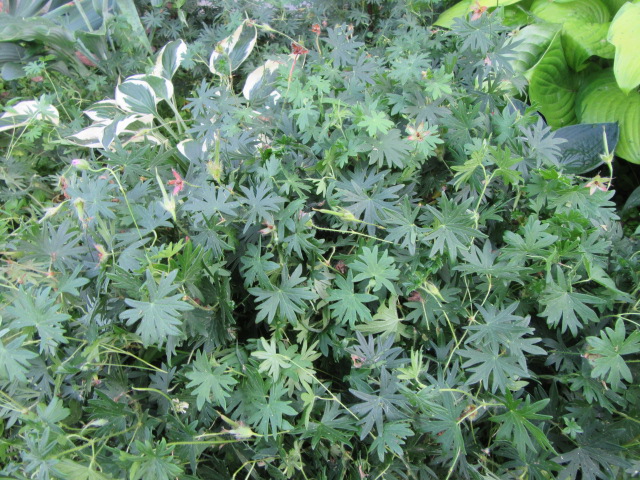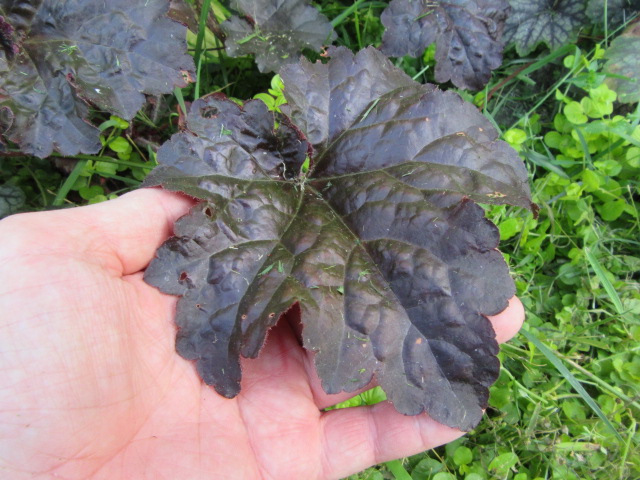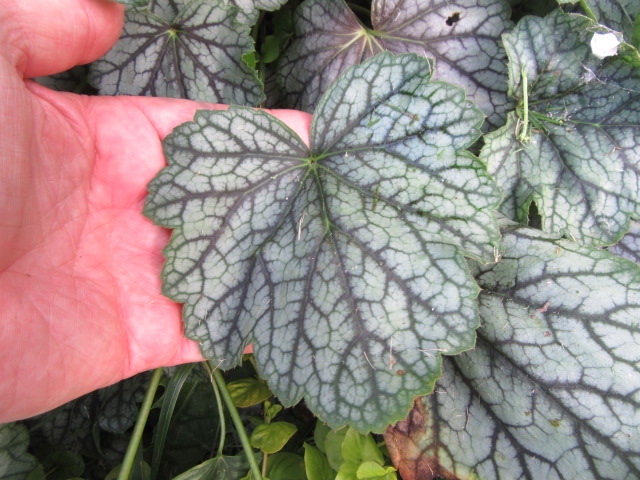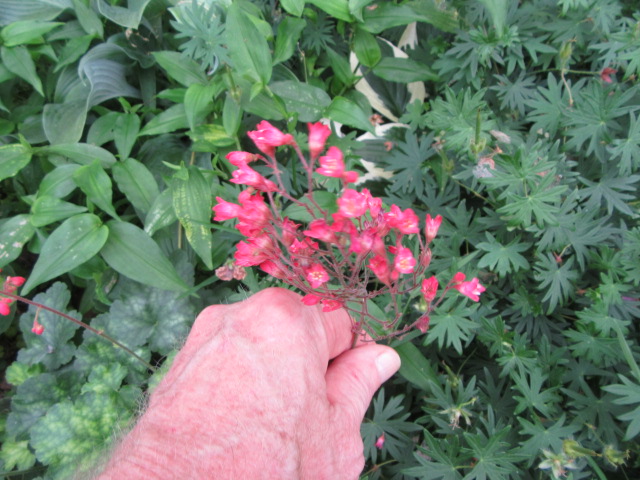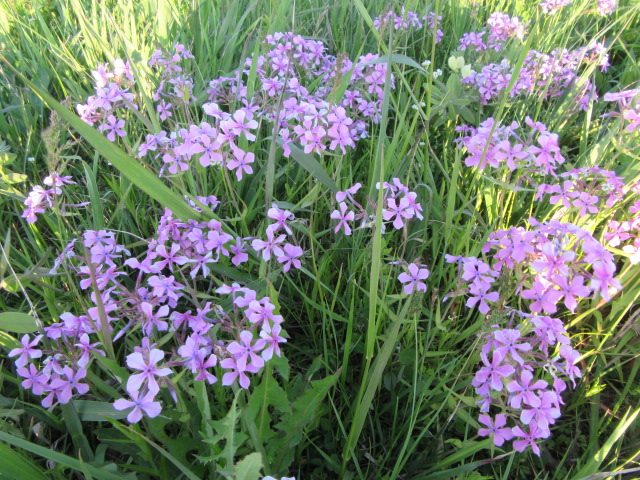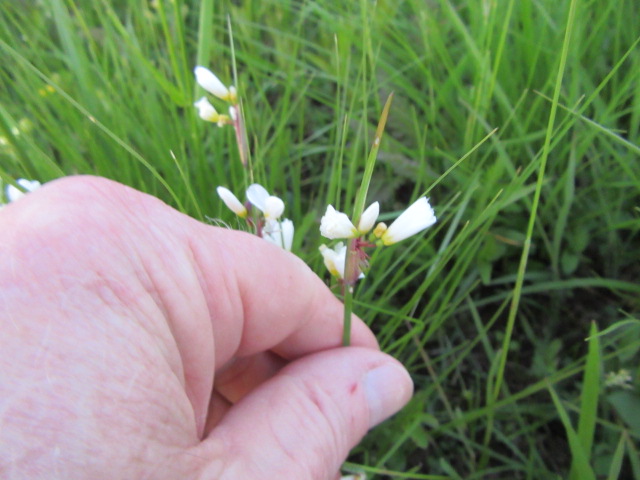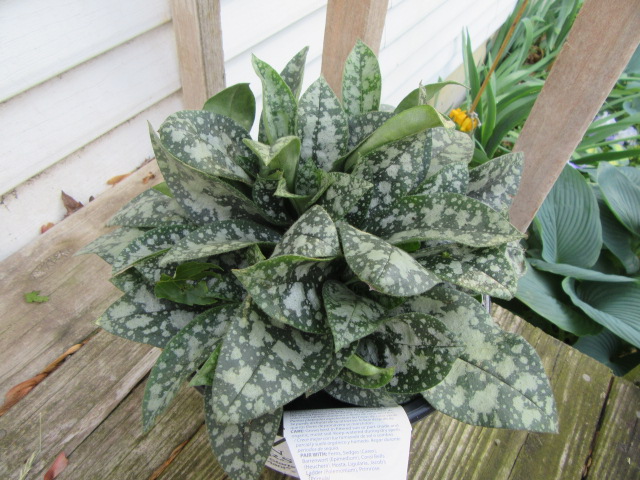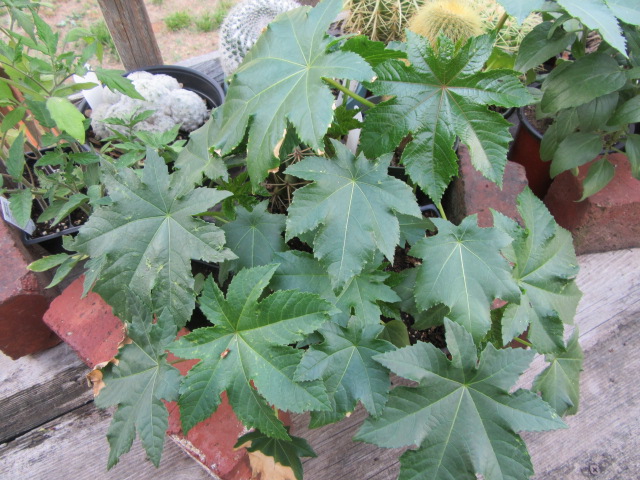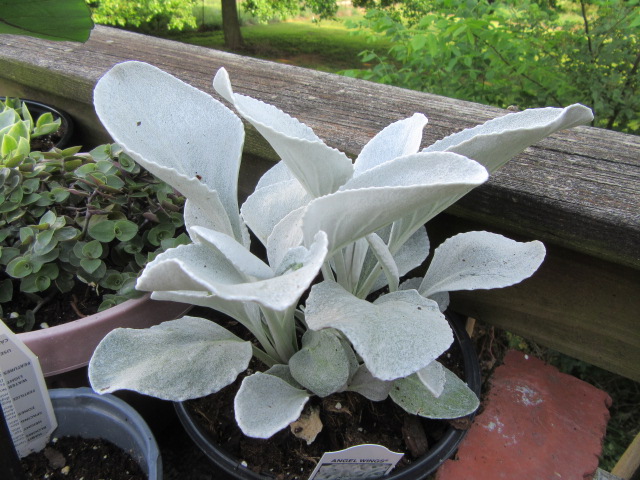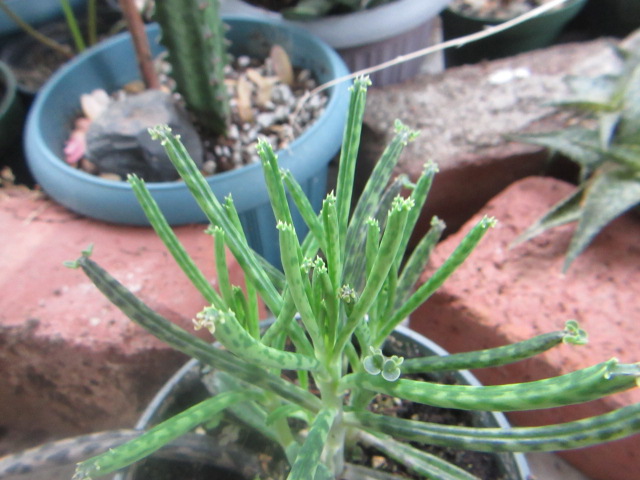
Plants Repotted Part 3…

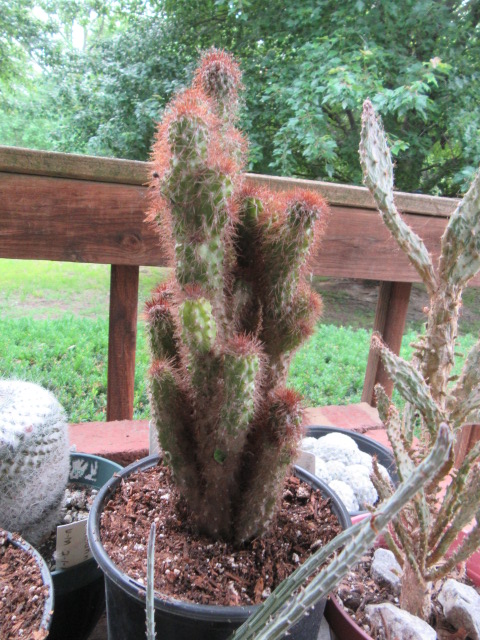
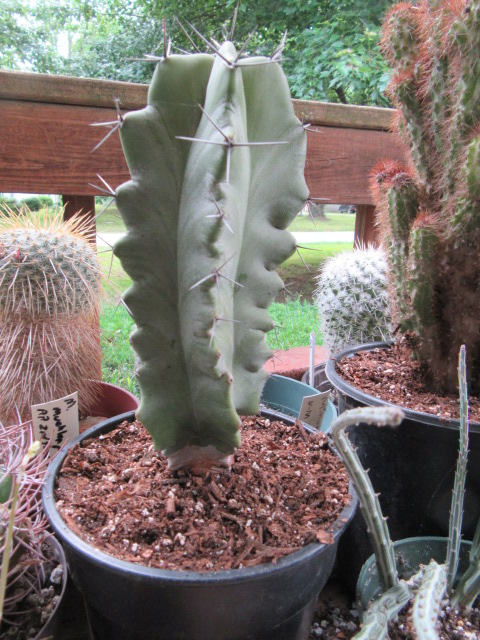
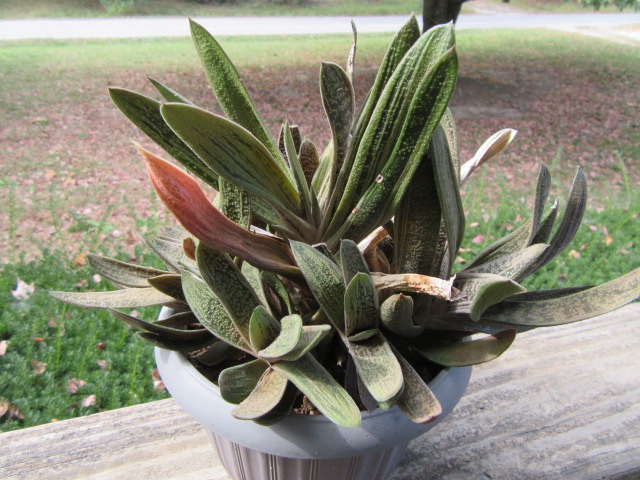
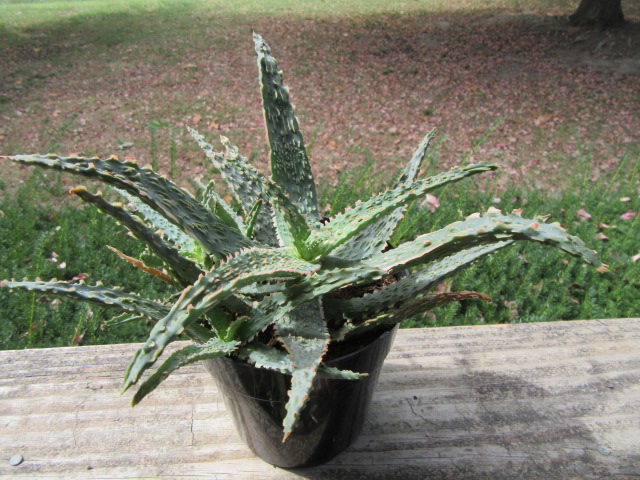
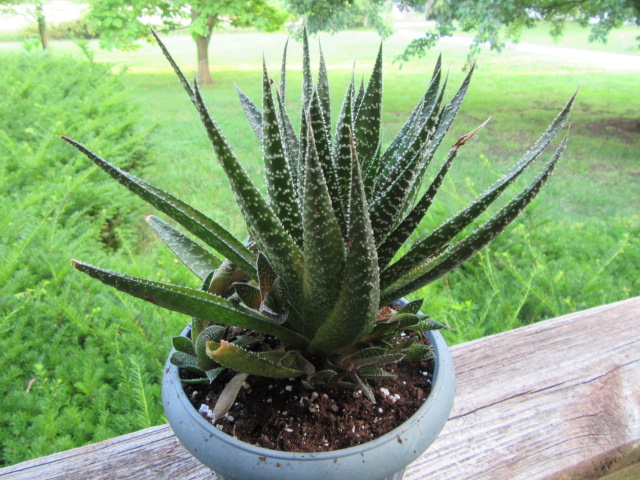
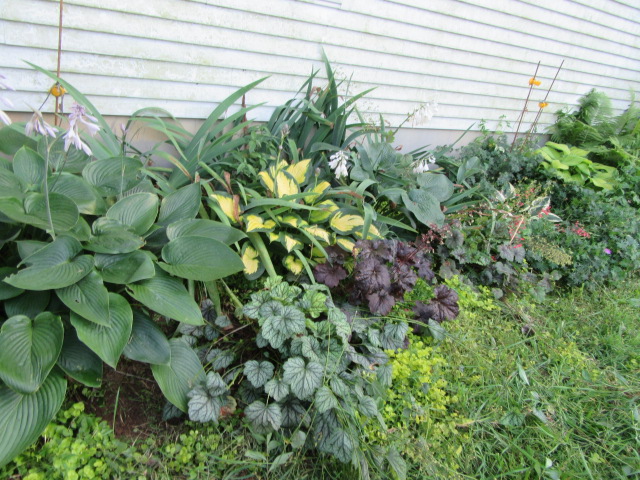
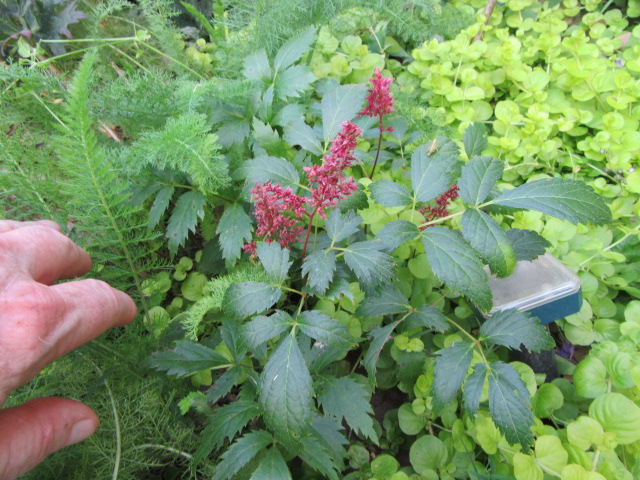
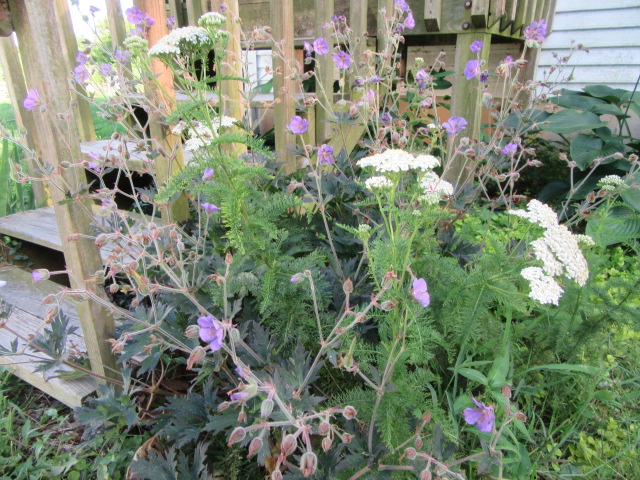
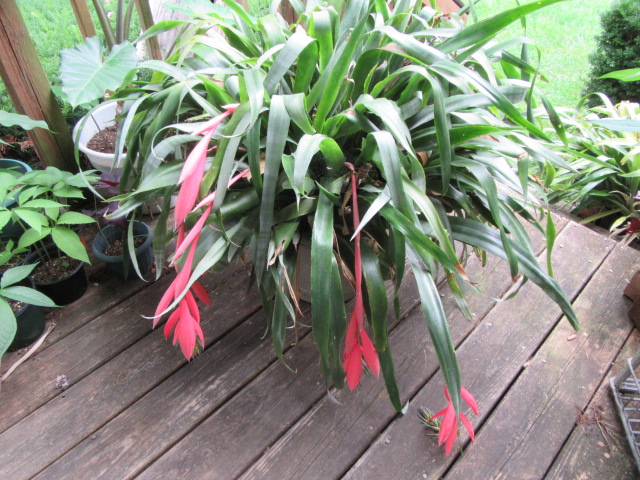
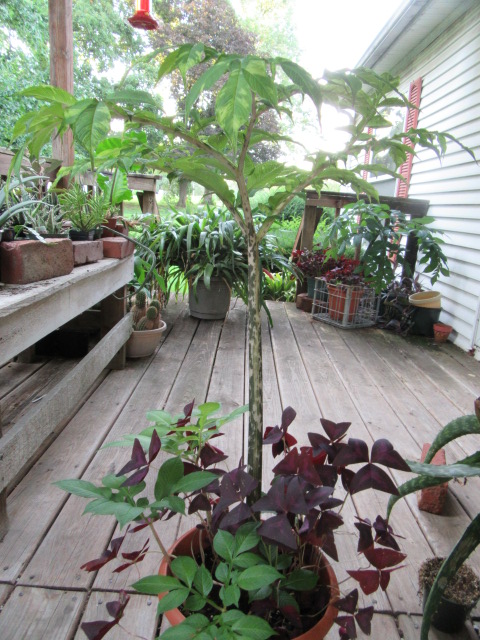
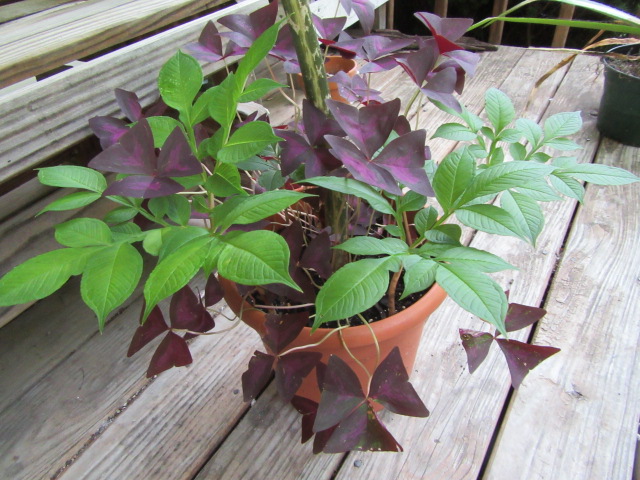
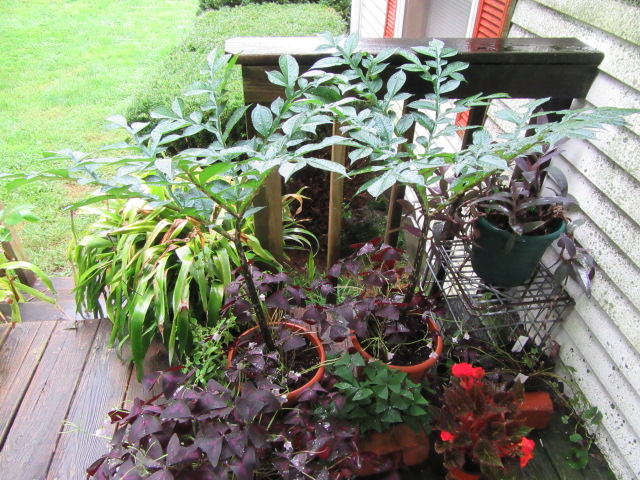
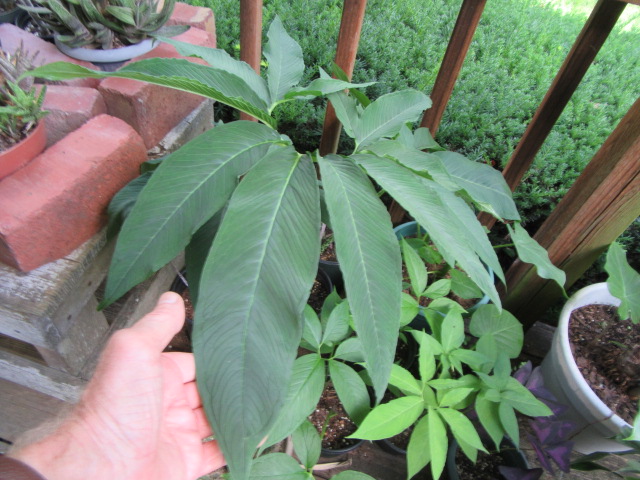
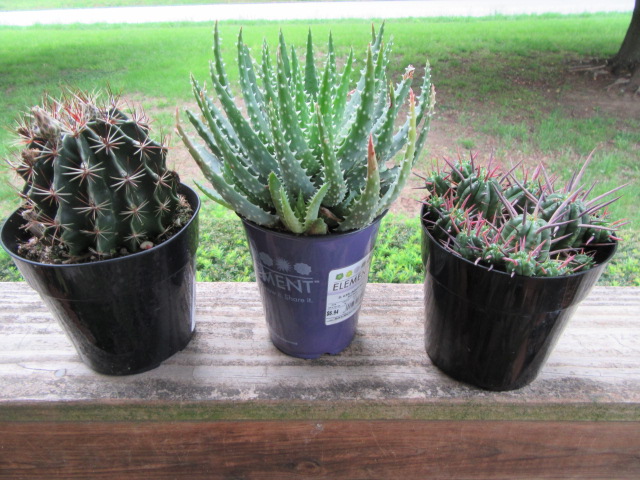
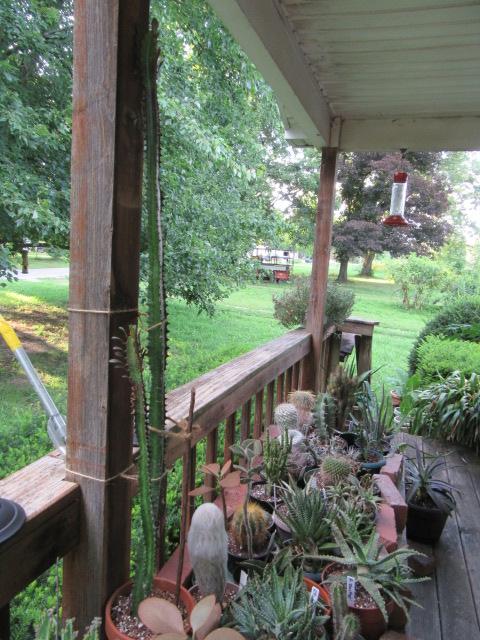
Hello everyone! I hope you are doing well and you are staying cool. It has been quite warm here and the humidity is NUTS! Most of the plants in the above photo have been repotted now, but not all. Of course, there are more that aren’t in the photo…

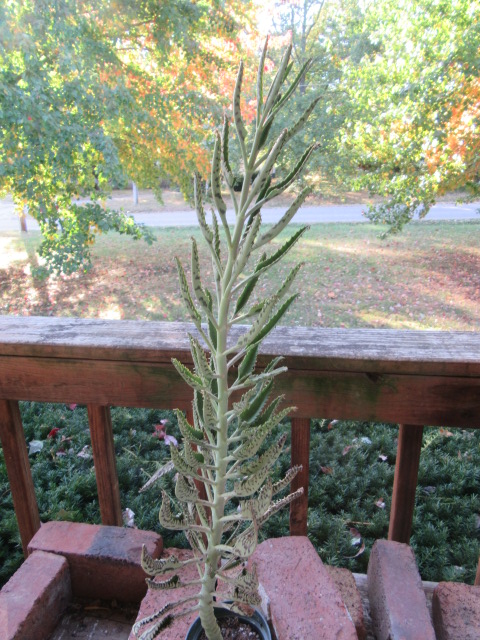
The Euphorbia trigona ‘Rubra’ (or var. rubra) has grown to 42″ tall and I’m not sure what to do with it… Should I hack it into a few pieces? Hmmm… The top of the stem, and the top of the branch, are looking a little weird and turning a light color. Normally, I don’t replant deeper than they were, but one day last fall the wind knocked it out of its pot. “Someone else” opted to put it in a bigger pot and buried it deeper than it was when I wasn’t home. Some plants have a crown and shouldn’t be replanted deeper than the root ball, but I’m not sure about this one. Normally, well maybe not normally, Euphorbia trigona are cut in pieces so they will branch out… So, I’m not sure about doing that, or what the deal is with it turning a lighter color on top. Maybe is isn’t getting enough light up there… Maybe I should check its roots to see if they are OK… I know it doesn’t have much of a root system. Actually, the plant has grown a little over 6″ since I moved it outside this spring, so maybe that is new growth. Hmmm…

This post is part 3 of Plants Repotted.

If you missed part 1, click HERE.

If you missed part 2, click HERE.

Anyway, here we go with part 3 beginning on…

June 8…

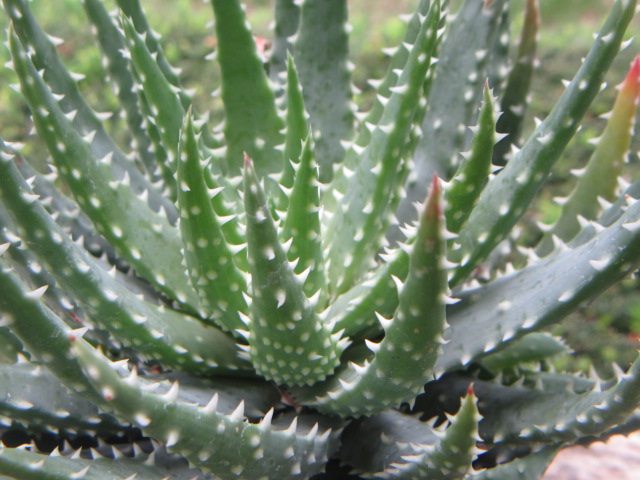
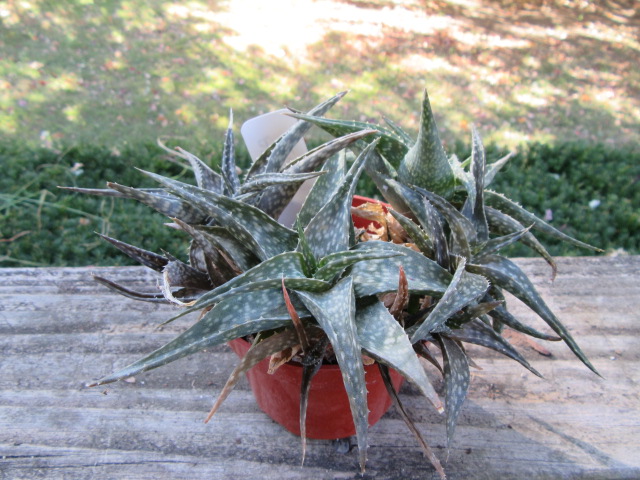
Aristaloe aristata (Lace Aloe) before repotting on 6-8-25, #1054-1.

The Aristaloe aristata (Lace Aloe) has been on the kitchen windowsill for I’m not sure how long. It was looking like it was in need of fresh air, so I put it on the front porch with the rest of the potted plants when temps warmed up enough. I like this plant, but sometimes I think it is a little finicky…

Aristaloe aristata (Lace Aloe) root system on 6-8-25, #1054-2.

I removed the plant from its pot to look at its roots. There was still plenty of room to grow. I trimmed off the dead and dying leaves.

Aristaloe aristata (Lace Aloe) in a larger 4″ tall x 4 1/2″ wide pot on 6-8-25, #1054-.

It was in a 3″ tall x 3 3/4″ wide pot, so I increased the size to 4″ tall x 4 1/2″ wide pot. I used Miracle Grow Cactus Mix with a little extra perlite and chicken grit. There is still another very small offset that that fell off this plant when it was first repotted…

<<<<+>>>>

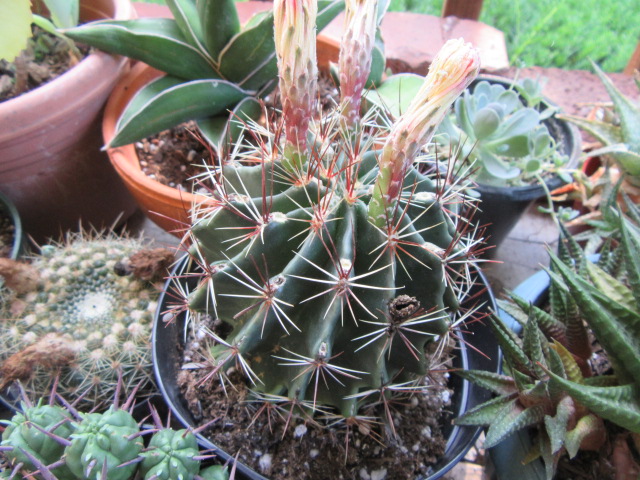
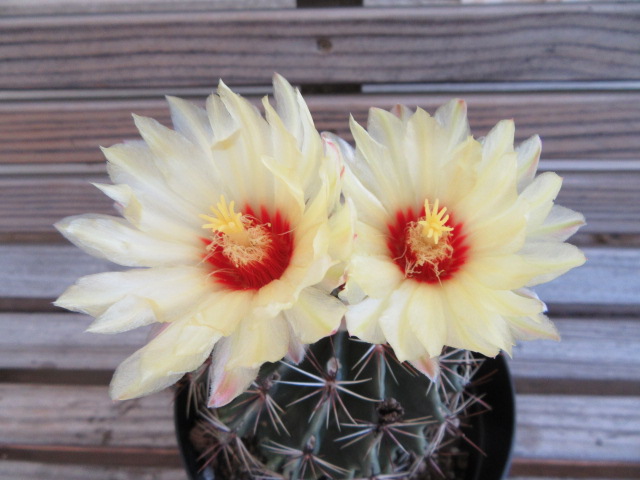
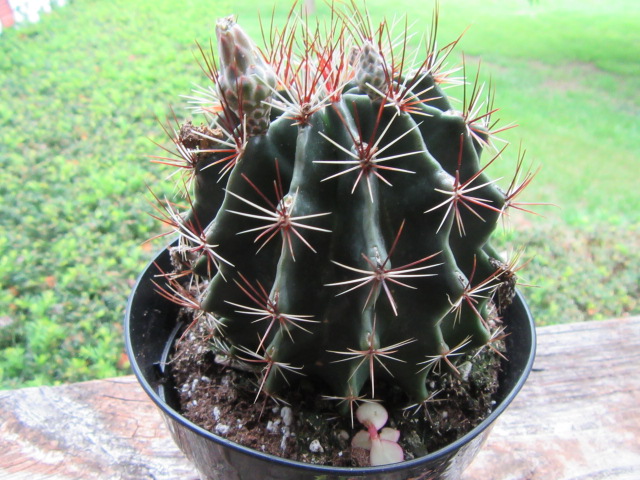
Ferocactus wislizeni (Fishhook Barrel Cactus) before repotting on 6-8-25, #1054-4.

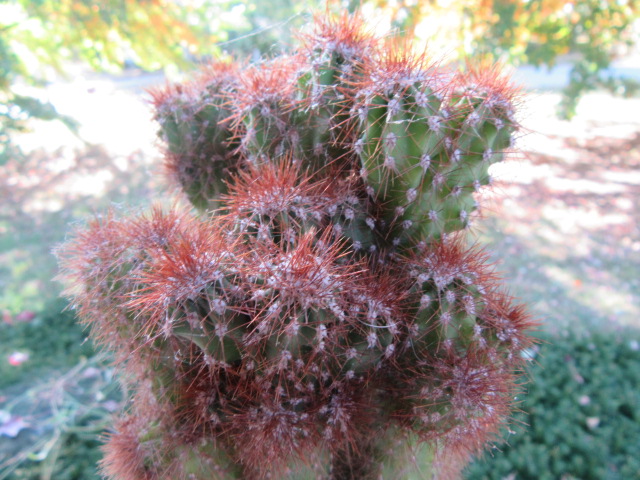
Hmmm… The Ferocactus wislizeni (Fishhook Barrel Cactus) hasn’t looked really great for several years.

Ferocactus wislizeni (Fishhook Barrel Cactus) root system on 6-8-25, #1054-5.

I removed it from its pot to have a look at the roots. To be honest, I’m not sure how alive this cactus really is… Yeah, I know that sounds a little weird… It grew a little from 2022 to 2023, but not from 2023 to 2024. It actually shrunk in diameter 1/2″.

Ferocactus wislizeni (Fishhook Barrel Cactus) after repotting on 6-8-25, #1054-6.

After removing most of the old potting mix and some of the dead roots, I put it back in the same pot with Miracle Grow Potting Mix with a little extra perlite and chicken grit. I noticed a few dead mealybugs, so for now I put it in an area away from the other plants. I’ll keep an eye on it and we’ll see if it grows when I take measurements when I start moving plants inside for the winter…

<<<<+>>>>

Parodia magnifica (Ball Cactus/Balloon Cactus) before repotting on 6-8-25, #1054-7.

The Parodia magnifica (Ball Cactus/Balloon Cactus) is a really neat plant. I brought it home in March 2019 and repotted it in November 2019. It had a really good root system then and needed a larger pot.
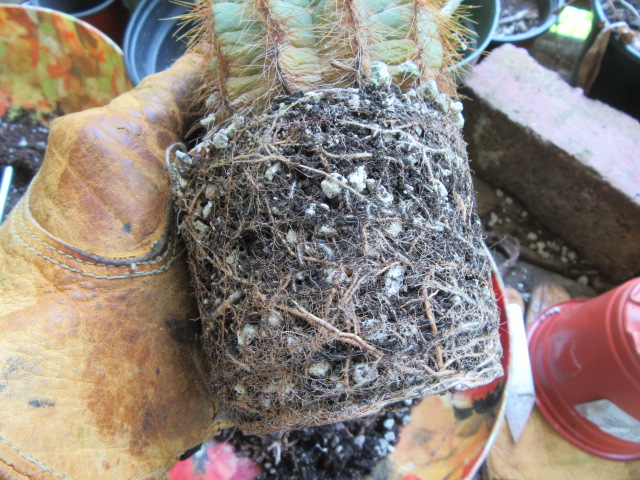
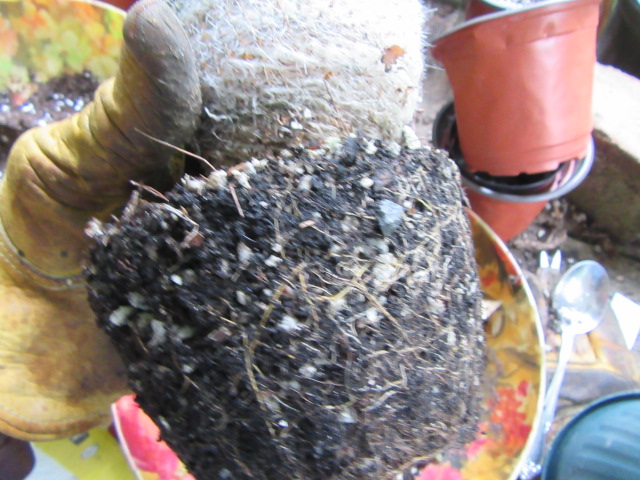
Parodia magnifica (Ball Cactus/Balloon Cactus) root system on 6-8-25, #1054-8.

Well, that is quite a root system! GEEZ!!!

Parodia magnifica (Ball Cactus/Balloon Cactus) in a larger 4 1/2″ tall x 5 3/4″ wide pot on 6-8-25, #1054-9.

After removing most of the old potting mix and some of the dead roots, I put the plant into a larger 4 1/2″ tall x 5 3/4″ diameter pot. I used Miracle Grow Cactus Mix with a little extra perlite and chicken grit. Now, we’ll see how it does.

<<<<+>>>>

June 15…

Ledebouria socialis ‘Paucifolia’ before repotting on 6-15-25, #1058-1.

Well, where do I begin with this one? Actually, the Ledebouria socialis ‘Paucifolia’ is the easy one. It hasn’t grown nearly as much as its cousin which is why it is still in a small pot.
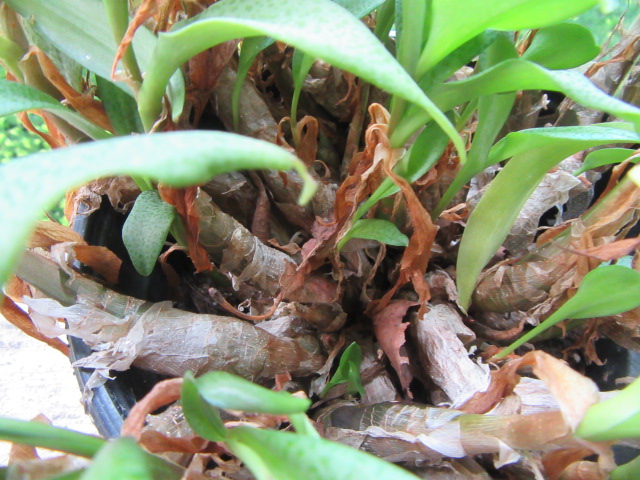
Ledebouria socialis ‘Paucifolia’ before repotting on 6-15-25, #1058-2.

Although not near as crowded as the other one, it is in a smaller pot and still a bit crowded. Looking back at old photos, it was put in a green pot in 2029 and at some point it was put in a somewhat larger black pot. Hmmm…

Ledebouria socialis ‘Paucifolia’ roots on 6-15-25, #1058-1.

It was already growing new roots…

Ledebouria socialis ‘Paucifolia’ in a larger 6″ tall x 9 1/2″ wide pot on 6-15-25, #1058-1.

I pulled the bulbs and roots apart somewhat and put everything in a larger 6″ tall x 9 1/2″ diameter pot. Now it has room to grow more. I used Miracle Grow Potting Mix with a little more perlite and chicken grit.

Ledebouria socialis ‘Violacea’ on 6-12-25, #1056-24.

At some point I need to tackle the Ledebouria socialis ‘Violacea’. It is HUGE!!!

I bought both of the Ledebouria socialis from a seller on Facebook in 2018, so I have had their company for a while now. If you haven’t tried them, I suggest you do. If you want a passalong plant that will produce A LOT, try Ledebouria socialis ‘Violacea’. If you want a plant that doesn’t produce much, try ‘Paucifolia’. They are carefree plants and very easy to grow. Water them regularly during the summer and put them in a cooler room with no water at all during the winter. They have been in the basement with a south facing window over the past two winters with no issues.

<<<<+>>>>

June 27…

Kleinia stapeliiformis (Pickle Plant) before repotting on 6-27-25, #1065-2.

I brought this pot of Kleinia stapeliiformis (Pickle Plant) home from Mast’s Greenhouse in May of 2023. It was from Mr. Mast’s daughters collection. The original stem she used as a cutting was hanging over the pot and there were several smaller “sprouts” a couple of inches tall along one side of the pot. Well, they grew and the original stem broke where it was hanging over the pot (which had grown to about 2′ long). In the spring, I cut the stem that broke in 4 pieces and put them in a pot to see if they would root. The only cutting that survived was the top cutting. Now, I had bought a few cuttings of this species from a seller on Facebook in 2018 and they soon after bit the dust. I was somewhat hesitant to bring home the pot from Mast’s, but I thought anything that weird looking deserved another chance. To be honest, I was surprised they did so well over last summer and even survived the winter on the shelf in my bedroom… But, not only did they survive, they even grew a little during the winter. Since they did so well and looked a little weird on one side of the pot, I thought would al least put them in the middle of the pot…
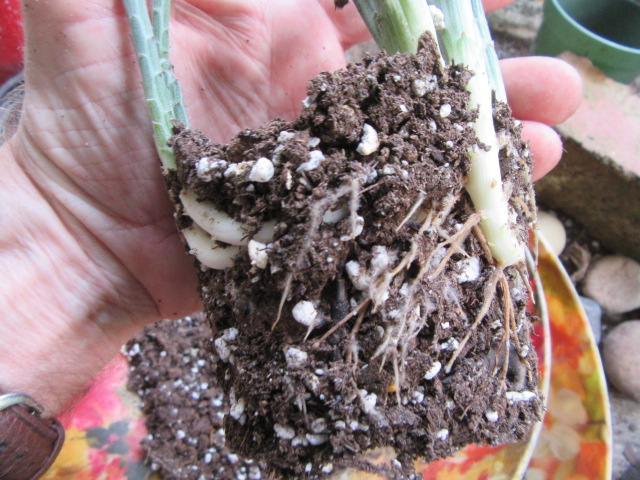
Kleinia stapeliiformis (Pickle Plant) roots on 6-27-25, #1065-3.

So, I carefully removed them from the pot to have a look. I was happy with what I saw.

Kleinia stapeliiformis (Pickle Plant) in a larger 4 1/2″ tall x 5 3/4″ wide pot on 6-27-25, #1065-4.

I didn’t disturb the roots much and carefully put them in a larger 4 1/2″ tall x 5 3/4″ wide pot. I feel like I am whispering… I put the cutting, which hadn’t grown any roots yet, in the pot with the others. I guess it is really their parent… It is the one with the weird shape.
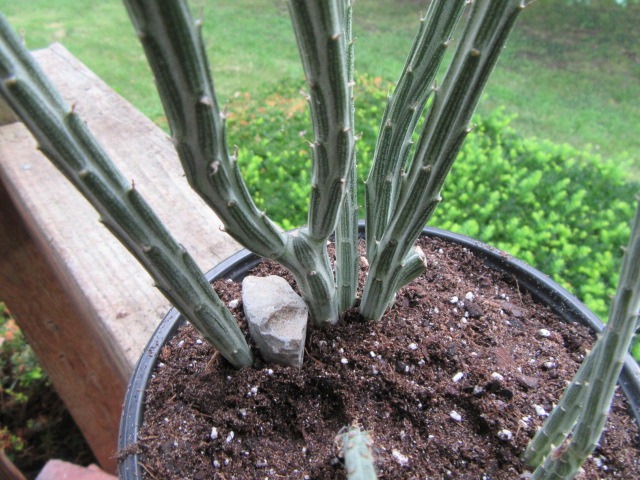
Kleinia stapeliiformis (Pickle Plant) on 6-27-25, #1065-5.

I put in a piece of gravel to hold one of them upright.

When I went to Mast’s on July 3, I walked back to see his daughters collection of plants. A few of her Kleinia stapeliiformis had flowers and seeds. I didn’t have my camera, so I took a few photos with my phone (yeah, I have a cell phone now) but they didn’t come out good. I did get to visit with her and told her I would bring her some Alocasia and the baby Amorphophallus konjac. I guess I should find out her name…

I don’t have a page for this plant yet. I wanted to make sure it would survive…

<<<<+>>>>

Peperomia graveolens (Ruby Peperomia/Ruby Glow) on 6-27-25, #1065-6.

The Peperomia graveolens (Ruby Peperomia/Ruby Glow) is another plant I brought home in 2024 from Mr. Mast’s daughters collection. She first gave me a cutting in 2023, but it didn’t take root. This plant made it through the winter, but wasn’t looking so good. I took it out of the pot and found the stem had broke under the soil and there were just a couple of roots left. SO, emptied the pots old potting soil and put in fresh then buried the plant a little deeper than what it was. Hopefully, it will grow new roots and survive. You just never know…

<<<<+>>>>

Selenicereus anthonyanus (Fish Bone Cactus) before repotting on 6-25-24, #1065-7.

To say the Selenicereus anthonyanus (Fish Bone Cactus) has grown would be an understatement! It only has two leaves sticking out of the pot when I brought it home from Wagler’s Greenhouse in June of 2012. It spent the winter on the kitchen windowsill and continued to grow.
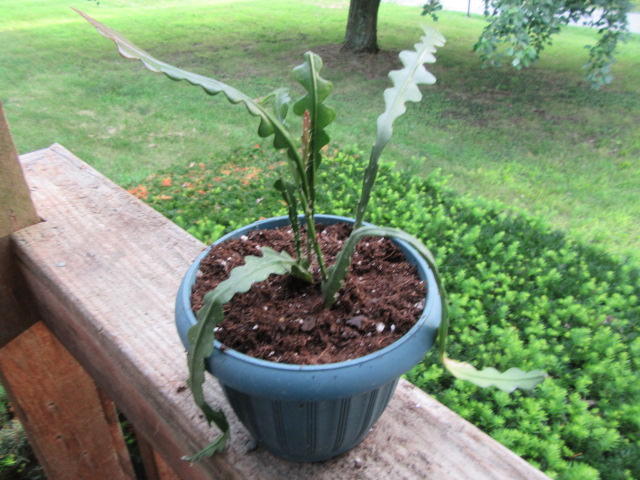
Selenicereus anthonyanus (Fish Bone Cactus) in a larger 4 1/2″ tall x 5 1/2″ wide pot on 6-25-24, #1065-8.

I decided to put it in a larger 4 1/2″ tall x 5 1/2″ diameter pot with Miracle Grow Potting Mix with a little orchid bark. It is an epiphytic cactus from Mexico’s tropical rainforest that grows in trees…
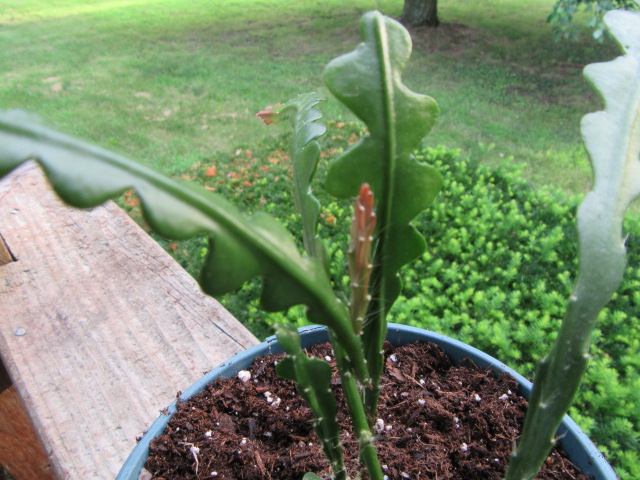
Selenicereus anthonyanus (Fish Bone Cactus) on 6-25-24, #1065-9.

Also known as Ric Rac and Zig-Zag Cactus, this plant is a night bloomer…

<<<<+>>>>

July 2…

x Mangave ‘Inkblot’ before repotting on 7-2-25, #1067-1.

Ummm… I decided it was time to give the x Mangave ‘Inkblot’ a makeover on July 2 and put it in a larger pot. Its kid also needed to be put in a pot of its own. This is an AWESOME plant, by the way.

I need to mention that x Mangave is a hybrid combination of Agave and Manfreda. A few years ago, or whenever it was, I noticed Plants of the World Online said Manfreda (and a few other genera) had become synonyms of Agave. That was kind of confusing for me because there are A LOT of patented x Mangave cultivars. Does that mean the patented x Mangave are now Agave cultivars? Well, I just checked as I was writing this post and it appears Manfreda is ONCE again an accepted genus! So, the hybrid cultivars were once hybrids, then not, now are once again… Now I have to change captions AGAIN… Botanists and taxonomists have to jump few several hoops to change scientific names and it has to be peer reviewed, etc. Then they change the name back AGAIN. What the heck?!?! I’m so glad they have that figured out. 🙂

x Mangave ‘Inkblot’ pup on 7-2-25, #1067-2.

The pup grew almost as tall as the parent…

x Mangave ‘Inkblot’ roots on 7-2-25, #1067-3.

I always think it’s funny how pots get so root bound that the soil disappears. Where does it go?

x Mangave ‘Inkblot’ in a larger 12″ tall x 14 1/2″ wide pot on 7-2-25, #1067-4.

I looked around and found a good-sized pot that I wasn’t 100% happy with. I normally put rocks in the bottom of pots to help with drainage, but this pot has fairly large holes… Oh well, I just went with it. Now, the big plant is in a larger 12″ tall x 14 1/2″ wide pot. Then after I had it finished, I noticed a crack about 3″ long around the bottom of the pot. So, at some point I will have to change the pot again (before the plants come inside for the winter).
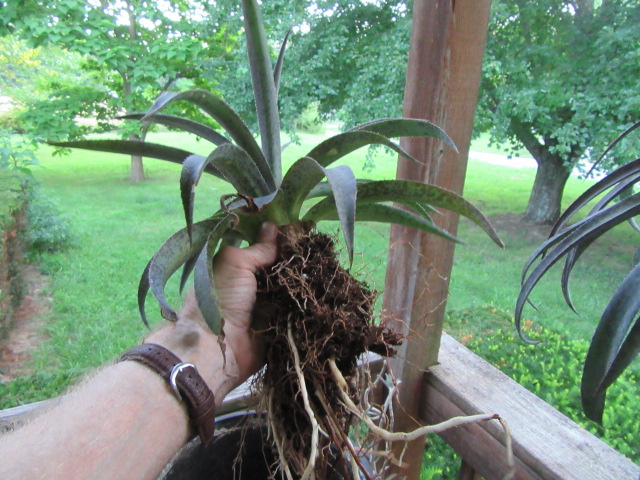
x Mangave ‘Inkblot’ pups roots on 7-2-25, #1067-5.

Now for the pup… I’m not sure why they call the offsets pups… Anyway, it was definitely a good idea to remove the pup from the parent and it really wasn’t attached anymore. It has a nice root system for sure. At least there wasn’t a long runner wrapped around the pot like I have seen before (been there, done that).
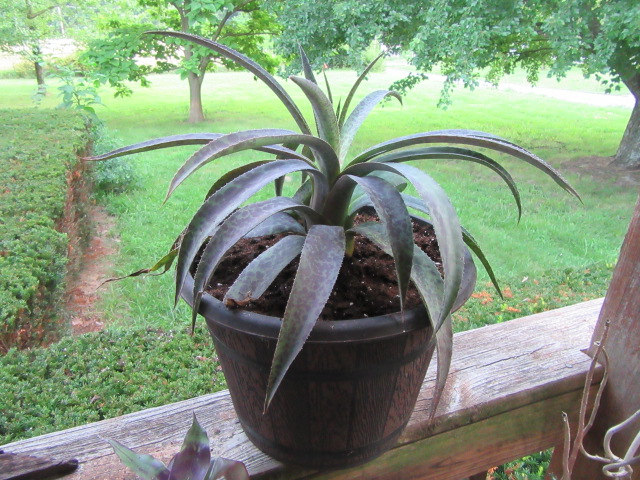
x Mangave ‘Inkblot’ pup in the original 8 1/2″ tall x 10 1/2″ wide pot on 7-2-25, #1067-6.

I put the pup in the original 8 1/2″ tall x 10 1/2″ wide pot.
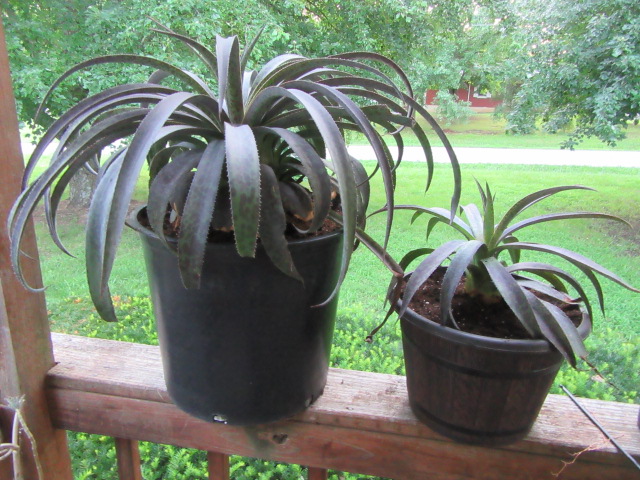
x Mangave ‘Inkblot’ parent and sibling on 7-2-25, #1067-7.

Yep! They were both in the smaller pot…

<<<<+>>>>

July 3…

Callisia fragrans (Grandpa’s Pipe, Etc.) on 7-3-25, #1068-1.

The Callisia fragrans (Grandpa’s Pipe, Inch Plant, Etc.) needed to be repotted, so I put all six in two pots. There were in individual pots, but I decided putting three in two pots would be more than satisfactory. Of course, if they do really well, they will produce a lot of runners and new plants. These plants don’t produce much of a root system, and even with a little neglect, they are virtually indestructible.

<<<<+>>>>

7-10-25…

Mammillaria plumosa (Feather Cactus) before repotting on 7-10-25, #1073-5.

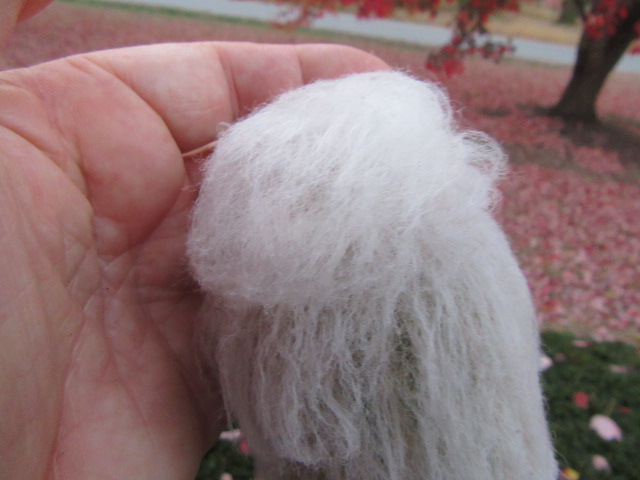
I debated repotting the Mammillaria plumosa (Feather Cactus) for a couple of reasons. For one, I was pretty sure it didn’t need a deeper pot, and two, I thought it might fall apart. 🙂 Now, let me give you a little history (which you can read if you click on it name)… I bought this plant (or clump of plants) from a seller on Ebay in September 2018. It came wrapped in toilet paper and looked like a ball of tiny feathers. I put it in a pot and the rest is history. All you see in the above photo was was what came in the mail only much smaller. It has grown and done extremely well with no issues whatsoever, and it does produce a few flowers. BUT, I don’t believe it has produced any offsets…

Mammillaria plumosa (Feather Cactus) from the top on 7-10-25, #1073-6.

The sides of the cactus were touching the pot in a couple of spots and the soil was almost 2″ from the top of the pot… Well, it hadn’t been repotted since 2019…
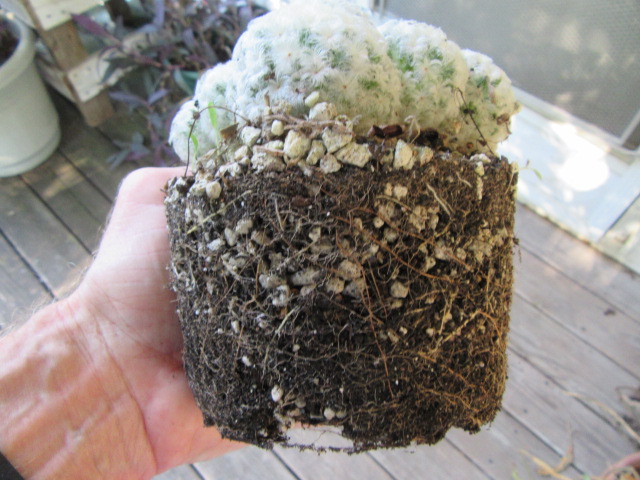
Mammillaria plumosa (Feather Cactus) roots on 7-10-25, #1073-7.

As you can see, there isn’t a massive root system, but still more than I thought there would be. Back in 2019, I used pumice in the mix…

Mammillaria plumosa (Feather Cactus) roots after removing old soil on 7-10-25, #1073-8.

After I removed old potting soil and dead roots, there wasn’t much left. I was very glad the cluster of plants stayed together. I removed the dead roots up to where I saw new ones growing. You don’t have to worry about removing roots because they grow new ones every year. I think I said that before.

Mammillaria plumosa (Feather Cactus) in a larger 5 1/2″ tall x 6 1/4″ wide pot on 7-10-25, #1073-5.

I didn’t like putting it in a deeper pot, but I didn’t have much of a choice for the moment. So, I put it in a 5 1/2″ tall x 6 1/4″ diameter pot with Miracle Grow Cactus Mix with a little additional perlite and chicken grit… I may order a few shallow pots online that are good sized in diameter but shallow. I saw them somewhere…

<<<<+>>>>

x Mangave ‘Pineapple Express’ before repotting on 7-10-25, #1073-11.

I decided July 10 it was time to repot the x Mangave ‘Pineapple Express’. I knew it would be tough… I brought this plant home in May 2019 and first repotted it in November 2019. Information said it was slow to offset, but it already had one by then which I left in the pot. When I moved the plants inside for the winter in 2020, I counted “about” 10… I could have miscounted. 🙂 I still left them all in the same pot. When I measured the plants as I moved them inside in October 2021, this plant measured 11 1/2″ tall x 20″ wide. In 2023, I decided to put it on the back deck in full sun to see how it would do. Well, it did GREAT but changed colors. Then, when it was inside over the winter, it started loosing leaves and I thought it was a goner. But it survived…  After that, I kept it on the porch on the north side of the house. It did fine after that, but measured only 7 1/2″ tall x 13 1/2″ wide when I moved it inside in October 2024. Both of the x Mangave‘s stayed in my bedroom over the winter, which they did not appreciate, and were very glad to get back outside.

x Mangave ‘Pineapple Express’ roots on 7-10-25, #1073-12.Well, to be honest, I knew it was going to be root bound… I’ve been through repotting LARGE Agave when I was in Mississippi. GEEZ!!!

x Mangave ‘Pineapple Express’ pups on 7-10-25, #1073-13.

And, of course, I knew there had been pups in the pot for several years…

x Mangave ‘Pineapple Express’ in a larger 6″ tall x 6 1/4″ wide pot on 7-10-25, #1073-14.

It was not easy unwrapping the old roots and removing the pups, but I managed to get it done. I put the parent in a larger 6″ tall x 6 1/4″ diameter pot with Miracle Grow Cactus Mix with a little extra perlite and chicken grit.

x Mangave ‘Pineapple Express’ with 7 pups in 4″ tall x 4 1/2″ wide pots on 7-10-25, #1073-15.

I successfully removed five pups but I accidentally broke two… I went ahead and put the two I broke in pots like the other 5. I also put the roots of the two that I broke off in a couple of pots, too. The two I broke off will no doubt grow roots (been there, done that), but I’m not sure if the two with just roots will grow new leaves. Time will tell…

That’s all for this post and I am caught up with the plants I have repotted so far, I still have plenty to repot that I will post about soon.

Until next time, be safe, stay positive, be well, stay thankful, and GET DIRTY!


Plants Repotted Part 2…

Hello everyone! I hope you are all doing well and had a great 4th of July. This is part two of Plants Repotted. If you missed part one, click HERE.

I know I’m behind posting about repotting the plants on the front porch, but I’ve been fairly busy and I wasn’t sure if it would be of interest. But, what the heck. Better late than never… So, this post is about plants repotted on June 5.

I always had a problem finding good pots for the plants until Thursday when I went to Mast’s Greenhouse. I hadn’t paid much attention to their garden center in the past because I was more interested in their plants. I was very glad to find they have a good selection of high quality plastic pots so I brought home a few.

I went to four of the five local greenhouses on Thursday looking for a couple of plants my sister wanted. Unfortunately, none were to be found. I kind of figured that would be the case since it is July… Of course, I am using my sister as an excuse to go to the greenhouses. While most of the greenhouses were pretty much out of plants, two still had A LOT. They keep buying more at an auction for some reason…  I found a planter of Rose Moss at Wildwood Greenhouse I thought would look good on the front porch.

Alocasia ‘Calidora’, ‘Mayan Mask’, and ‘Portora’ on July 5.

I have been keeping the Alocasia on the back porch during the summer for the past several years, but I had to do something different with three litters of kittens there. I put the Alocasia along the south side of the house at first, but on July 5 I brought them to the front of the house. All the offsets need to be put in their own pots so I can take them to a couple of greenhouses.

I bought a couple of bags of Miracle Grow Cactus Mix which should be better than their regular potting mix for cactus and succulents (even though I usually add a little extra perlite and chicken grit). I know, I know, if you are a cactus and succulent pro you make your own mix or use something besides Miracle Grow, but in my neck of the woods, our choices are limited. I have used pumice in the past, but I ran out. I guess I could sift it out of the old potting soil, but that’s a lot of trouble…

June 5…

Aloe x ‘Cha Cha’ on 6-5-25 before being repotted, #1053-1.

The Aloe x ‘Cha Cha’ is the last survivor of the plants I received from Succulent Market in 2020. It has been a great plant and has produced flowers consistently. It has been in the same pot since it arrived, so I thought it was high time it had a new one.

Aloe x ‘Cha Cha’ root system on 6-5-25, #1053-2.

Well, that’s a pretty good root system…

Aloe x ‘Cha Cha’ in a larger 4 1/2″ tall x 5 1/2″ diameter pot on 6-5-25, #1053-3.

After giving it a makeover (removing dead leaves), I decided to put it in a 4 1/2″ tall x 5 1/2″ diameter pot.

<<<<+>>>>

Austrocylindropuntia subulata (Eve’s Needle) before repotting on 6-5-25, #1053-4.

This Austrocylindropuntia subulata (Eve’s Needle, ETC.) has grown a lot since I brought it home from Wagler’s Greenhouse in November of 2019. It was only a few inches tall when I brought it home and within a few months it sent up its first offset. As weird as it may sound, it has been repotted several times to put it back in the center of the pot. I always wondered how it moves, not to mention why…

Austrocylindropuntia subulata (Eve’s Needle) root system on 6-5-25, #1053-5.

Well, that’s a pretty good root system in only a year…

Austrocylindropuntia subulata (Eve’s Needle) in a new 5″ tall x 5″ diameter pot on 6-5-25, #1053-6.

After removing most of the old potting mix from its roots, I found a larger 5″ tall x 5″ diameter pot that seemed suitable. The plant is now 8 3/4″ tall…

<<<<+>>>>

Gymnocalycium saglionis (Giant Chin Cactus) before repotting on 6-5-25, #1053-7.

I started repotting the cactus and succulents, so on 6-5-25 I decided it was time to repot this cactus. I hadn’t put it in a new pot since 2021 and the upper rim around the top of the pot had broke off.

Gymnocalycium saglionis (Giant Chin Cactus) roots on 6-5-25, #1053-8.

Yep, judging from its roots, it definitely needed a larger pot…

Gymnocalycium saglionis (Giant Chin Cactus) in a larger 5″ tall x 6 1/2″ wide pot on 6-5-25, #1053-9.

So, I put it in a larger 5″ tall x 6 1/2″ wide pot with Miracle Grow Cactus mix with a little extra perlite and chicken grit. I really like this cactus, so hopefully it will like its new pot and fresh mix…

Gymnocalycium saglionis (Giant Chin Cactus), 3 3/4″ tall x 3 3/8″ wide on 7-6-25, #1070-1.

AH HA! I caught it! July 6 was a rainy day and I noticed something weird with this cactus! Its spines were RED! Then I remembered taking its photo on 10-28-21 (#853-9) and it had red spines in the photo when I uploaded them on the computer. I went out and looked at it, and its spines were gray. It was the last day before moving the plants inside and it had been raining… It’s spines must turn red when it gets wet…

Not only that, it looked larger than when I last measured it at 2 1/2″ tall x 3 1/2″ wide on 10-15-25. I measured it on July 7 and it was 3 3/4″ tall x 3 3/8″ wide. So, watering does make them swell. Case closed! OH, I don’t include the spines in my measurements…

<<<<+>>>>

Mammillaria hahniana (Old Lady Cactus) before repotting on 6-5-25, #1053-10.

I think I put the Mammillaria hahniana (Old Lady Cactus) in this pot in 2021, but that doesn’t mean it needs a larger one.

Mammillaria hahniana (Old Lady Cactus) root system on 6-5-25, #1053-11.

It had a very good root system, but I decided to just clean it up a little. You know, loosen it up and remove some of the dead roots and potting mix

Mammillaria hahniana (Old Lady Cactus) in the same 4 1/2″ tall x 5 1/2″ wide pot on 6-5-25, #1053-12.

I put it back in the same 4 1/2″ tall x 5 1/2″ wide pot using Miracle Grow Cactus Mix with a little extra perlite and chicken grit.

<<<<+>>>>

Mammillaria karwinskiana (Silver Arrows) before repotting on 6-5-25, #1053-13.

The Mammillaria karwinskiana (Silver Arrows) has always been a great cactus, well they have all been for the most part. I brought it home in 2018, so I have had it for quite some time. It had been in this pot since 2021 and I thought it might need one. Mammillaria karwinskiana is one of only a few Mammillaria species commonly referred to as “Owl Eye Cactus” known for their dichotomous branching. This means the plant (stem) divides into two parts. Then the two become 4 and so on…

Mammillaria karwinskiana (Silver Arrows) root system on 6-5-25, #1053-14.

I removed the plant from the pot and saw a really good root system. NICE!

Mammillaria karwinskiana (Silver Arrows) in a larger 4 1/2″ tall x 5 3/4″ wide pot on 6-5-25, #1053-15.

After loosening the roots a bit, I put it in a larger 4 1/2″ tall x 5 3/4″ wide pot.

<<<<+>>>>

Mammillaria muehlenpfordtii (Golden Pincushion) before repotting on 6-5-25, #1053-16.

The Mammillaria muehlenpfordtii (Golden Pincushion) is a really neat cactus, but it needs straightened up once in a while. That’s quite common even if they seem to have a good root system. Once it gets anchored good, roots and all lean. The whole plant has fallen out of the pot more than once…  There is usually a rock (or two) in the pot for it to lean on. It was put in a larger pot in 2020 and 2023, so I didn’t think it needed another one.

Mammillaria muehlenpfordtii (Golden Pincushion) root system on 6-5-25, #1053-17.

I removed it from its pot to have a look and saw it had a pretty good root system. The long white roots around the edge is crab grass coming up in the pot. Normally, the cactus are on the back deck and various seeds would land in the pots and germinate. It’s kind of a pain to remove grass from pots of cactus in more way than one…

Mammillaria muehlenpfordtii (Golden Pincushion) hot glue on 6-5-25, #1053-18.

It’s weird, but the hot glue that was on the plant when I brought it home in 2018 is still stuck to the plant. I checked to see if it would come off, but it is still stuck pretty firm so I left it alone. It’s funny how low it is on the plant now compared to 2018.

Mammillaria muehlenpfordtii (Golden Pincushion) in the same 4 1/2″ tall x 5 1/2″ wide pot on 6-5-25, #1053-19.

After removing most of the old potting mix and trimming the roots a little, I returned the Mammillaria muehlenpfordtii to its same pot with a few friends for support.

<<<<+>>>>

Mammillaria mystax before repotting on 6-5-25, #1053-20.

The Mammillaria mystax has always been a fun cactus with its dark green color and perfect shape. It has been in the same pot since 2021, so I thought I better have a look.

Mammillaria mystax root system on 6-5-25, #1053-21.

I removed the plant from its pot to have a look and found a well developed root system. I think it could fill a larger pot in no time.

Mammillaria mystax in a larger 5 1/2″ tall x 7″ tall pot on 6-5-25, #1053-22.

After removing most of old potting mix and trimming off the dead roots, I put it in a larger 5 1/2″ tall x 7″ diameter pot with Miracle Grow Cactus Mix with a little more perlite and chicken grit. Now, we’ll see how it does.

<<<<+>>>>

Parodia concinna (Sun Cup) before repotting on 6-5-25, #1053-23.

The Parodia concinna (Sun Cup) always makes me smile with its squatty shape and sunk-in center. It had a flower and several buds when I brought it home last May, but hasn’t done anything yet this year. Sometimes you don’t know when plants actually bloom that come from a greenhouse environment in some other state. Plus, living here with me isn’t anything like their natural environment. Well, how would they know since they were likely grown from seed in a greenhouse? Hmmm…

This plant needed a new pot for a while, like right after I brought it home. It nearly filled the whole pot and there are slits (for handles) around the rim of the pot. I think most of the water just ran out…

Parodia concinna (Sun Cup) roots on 6-5-25, #1053-24.

Roots were coming out of the bottom, but they weren’t from this years growth and were easily removed. Obviously, I forgot to take a photo of its roots once I removed it from the pot… GEEZ!

Parodia concinna (Sun Cup) in a larger 4″ tall x 4 1/2″ wide pot on 6-5-25, #1053-25.

We shall see how it does in a larger 4″ tall x 4 1/2″ diameter pot… I need to finish its page…

<<<<+>>>>

Tephrocactus articulatus var. papyracanthus (Paper Spine Cactus) before repotting on 6-5-25, #1053-26.

I had been avoiding repotting the Tephrocactus articulatus var. papyracanthus (Paper Spine Cactus) for a few reasons and they didn’t have anything to do with spines. I knew from the last time it didn’t have much of a root system and it could easily fall apart. Plus, you have to be careful the segments don’t break off… I have had this cactus since 2016 (rescued it as a piece that had fallen off on a shelf at Walmart) and it has been in this same pot since 2018.

Tephrocactus articulatus var. papyracanthus (Paper Spine Cactus) root system on 6-5-25, #1053-27.

I gently removed the cluster from the pot, and from the above photo you can see there just isn’t much there. The potting mix below the roots just fell off…

Tephrocactus articulatus var. papyracanthus (Paper Spine Cactus) in a larger 5″ tall x 6 1/2″ wide pot on 6-5-25, #1053-28.

I definitely thought it needed a wider pot, but not a deeper one. Well, the problem was I didn’t have a satisfactory pot that was wider and not so deep. So, I decided to go ahead and put it in a 5″ tall x 6 1/2″ diameter pot. If I run across a shallow and wide pot at some point, I may repot it again. I may have to get one online…

Tephrocactus articulatus var. papyracanthus (Paper Spine Cactus) segments on 6-5-25, #1053-29.

Fortunately, the cluster stayed together without too much difficulty. There were three segments that weren’t in the soil, but now are.

I think nine plants on this post is enough, but part 3 will be ready shortly.

Until next time, be safe, stay positive, be well, always be thankful and GET DIRTY!

Plants Repotted Part 1…

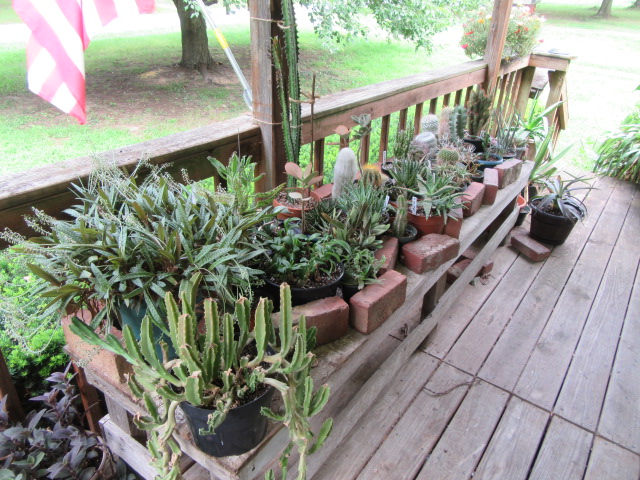
Some of the plants on the front porch on 7-1-25.

Hello everyone! I hope this post finds you well. I don’t have a garden this year, so I can give the plants on the front porch more attention. There are three litters of kittens on the back porch (GEEZ!!!), so all the potted plants are on the front porch. Well, I first put the Alocasia pots along the south side of the house, then moved them in front of the shrubs in front of the house (on July 4). Cactus and succulents aren’t exactly the most needy plants, but at some point, they do need to have larger pots and fresh soil. On the front porch, none of the plants get what we call full sun (6 or more hours of direct sun). The front porch faces west, is covered, and there are two good-sized maple trees providing afternoon sun. All the plants somehow get direct sun at certain times of the day and seem to do amazingly well.

While the plants on the front porch consist mainly of cactus and succulents, there are also other plants… Amorphophallus konjac, Sauromatum venosum, Tradescantia, Callisia fragrans, Ledebouria, Billbergia nutans… You get the picture.

The work table that has been on the back porch since 2019 was moved to the front porch. It’s what I use for repotting. I built this table, as well as the tables I have the plants on, while I was living in Mississippi. The top and shelf of the work table is made of old cypress boards that were once part of the old covered patio behind the mansion. Well, it was a big house… The plant tables are made of boards that were stacked in the old patio that were once part of a fence that surrounded the back yard. I made tables that surrounded the inside of the two large sunrooms in Mississippi. I took a few apart and brought them with me when I moved back here in 2013. They have come in handy…

I repotted a few plants last year (and every year), but I lit in with a purpose on May 30… I wrote that while laughing… I don’t repot everyday, obviously, and some days I just look at the plants with a “?” on my face. Then I realized that some of the plants have the same expression. It like they are saying, “Well, is it my turn yet?” “What about me?”

Every plant gets a before photo, its roots, the new pot is measured, then an after photo is taken. That may seem a bit excessive, but I do that for the plants pages and the journal. Well, I guess the blog is a journal…

So, lets get started before I change my mind or get distracted…

May 30…

Cereus repandus f. monstruosus ‘Rojo’ in a new 6 1/2″ tall x 6 1/4″ wide pot on 5-30-25, #1048-2.

At first, I hadn’t thought of taking before photos and photos of their roots, so the Cereus repandus f. monstruosus ‘Rojo’ and the others repotted on May 30 just have an after photo…

I found a larger 6 1/2″ tall x 6 1/4″ diameter pot that seemed suitable. I had bought a few bags of Dr. Earth Cactus and Succulent Mix last year, so I used what was left on May 30.

Espostoa melanostele subsp. nana (Peruvian Old Lady) on 5-30-25, #1048-8.

I removed the old potting mix and added new to the Espostoa melanostele subsp. nana (Peruvian Old Lady), but I used the same pot it has been in since 2021. She doesn’t have much of a root system, so she didn’t’t need a larger pot. Of course, I had straighten her up a bit (AGAIN) since she is a leaner… Well, she easily leans because she doesn’t have many roots to hold her up. To say she has been in the same pot since 2021 is an understatement, though. She has been in and out and back in multiple times. It isn’t uncommon for there to be rocks in her pot to help with that.

I had to be careful not to mess up her new hairdo… A friend came over one day and thought she was pretty neat. Of course, he had to touch her. He gave her a little squeeze and found out the hard way she has sharp spines under the soft hair. 🙂

Stenocereus pruinosus (Gray Ghost, Etc.) on 5-30-25, #1048-15.

The Stenocereus pruinosus (Gray Ghost, Organ Pipe, Etc.) now has a larger 6″ tall x 6 1/4″ wide pot. It seems to like its new pot and I hope it likes Dr. Earth’s potting mix… This is a well mannered friend.

June 2…

Still, no before photos so I snuck in a few from last October…

Aloe humilis (Hedgehog Aloe) at 5 1/2″ tall x 6 3/4″ wide on 10-14-24, #1022-1.

The Aloe humilis (Hedgehog Aloe, ETC.) was still in its 4 1/2″ diameter x 5″ tall pot I brought it home in 2024. It also had a few dead leaves that needed removed.

Aloe humilis (Hedgehog Aloe) on 6-2-25, #1050-1.

WHOA! When I removed the plant from the old pot, I saw it had a very good root system and could definitely use a larger pot.

Aloe humilis (Hedgehog Aloe) in its new 6″ tall x 6 1/2″ diameter pot on 6-2-25, #1050-2.

I gave it a 6″ tall x 6 1/2″ diameter pot… I ran out of Dr. Earth Cactus Mix, so I just used Miracle Grow Potting Mix with a little extra perlite and chicken grit. I always go to the driveway and put enough rocks in the pot to cover the bottom for drainage.

Gasteria ‘Little Warty’ at 6″ tall x 9″ wide on 10-14-24, #1022-12.

The Gasteria ‘Little Warty’ had been in the same pot since it was repotted in 2021 and was feeling a little cramped up.

Gasteria ‘Little Warty’ in a larger 5″ tall x 6 1/2″ wide pot on 6-2-25, #1050-3.

I decided to give the Gasteria ‘Little Warty’ a makeover and put it in a larger 5″ tall x 6 1/2″ wide pot. It had several dead leaves I needed to remove to tidy it up a bit. As you can see, it has several good-sized offsets.

Haworthiopsis limifolia (Fairy Washboard, Etc.) after it was repotted on 6-2-25, #1050-4.

I put the Haworthiopsis limifolia (Fairy Washboard, File-Leaf Haworthia, ETC.) in this larger pot last year so it was still fine. For some reason I decided it needed new potting mix again.

June 4…

Aloe juvenna (Tiger Tooth Aloe) on 6-4-25, #1052-1.

The Aloe juvenna (Tiger Tooth Aloe) has had its ups and downs the last several years. Judging by its root system, it seemed better suited for a little smaller and shallower pot. To much unused soil under the roots may have been causing problems for this one…

Aloe x ‘Amethyst’ on 10-14-24, #1022-2.

As you can see in the above photo of the Aloe x ‘Amethyst’ taken last October, it definitely needed a new pot…

Aloe x ‘Amethyst’ roots on 6-4-25, #1052-2.

It has a very nice root system.

Aloe x ‘Amethyst’ in a larger 5″ tall x 6 1/2″ diameter pot on 6-4-25, #1052-3.

Looking much better after removing some dead leaves and putting it in a larger 5″ tall x 6 1/2″ diameter pot.

Aloe x ‘Amethyst’ leaves on 6-4-25, #1052-4.

I really like this Aloe and its interesting leaves… Umm, I don’t have a page for this one yet…

Aloe x ‘Pink Blush’ at 4 1/2″ tall x 6 1/2″ wide on 10-14-24, #1022-4.

I brought this Aloe x ‘Pink Blush’ home last spring and it has been doing very well.

Aloe x ‘Pink Blush’ in a larger 4 1/2″ tall x 6″ diameter pot on 6-4-25, #1052-5.

I decided to put it in a larger 4 1/4″ tall x 6″ diameter pot to give it a little more room…

x Gasteraloe ‘Flow’ before repotting on 6-4 25, #1052-6.

I brought this x Gasteraloe ‘Flow’ home in 2022 after I lost the one I had since 2016 to a mealy bug infestation. The plant had been in the same pot since I brought it home and it needed a makeover… This is when I started taking “before” photos…

x Gasteraloe ‘Flow’ root system on 6-4 25, #1052-7.

I took it out of the pot to have a look at its roots. There was a nice root system and many offsets. I trimmed off the dead leaves and removed some of the old potting mix. It doesn’t hurt to trim off some of the old roots as they grow new ones during the growing period.

x Gasteraloe ‘Flow’ in a larger 4 1/2″ tall x 5 1/2″ wide pot on 6-4 25, #1052-.

I decided to put the plant in a larger 4 1/2″ tall x 5 1/2″ wide pot.

I think I will stop with this post and start working on part 2 or it will get very long…

Until next time, be safe, stay positive, stay thankful, and GET DIRTY!


North Bed End Of June Update

Partial North Bed on 6-19-25.

Hello everyone! I hope this post finds you well. We’ve had a hot few days then it started raining and cooled things off a bit. The bed along the north side of the house has been looking GREAT, so I thought I would take a few photos and write a post. Umm… It took longer than expected because photos would get out-of-date fairly quickly. Then, I would take more photos. Time goes by, you know.

So, here we go, in alphabetical order… As always, you can click on the name of the plant to go to their own page (if they have one). Oh, and I’m not using Grammarly right now, so please excuse any goofs. 🙂

Aegopodium podagraria (Snow-On-The-Mountain) on 6-20-25, #1062-2.

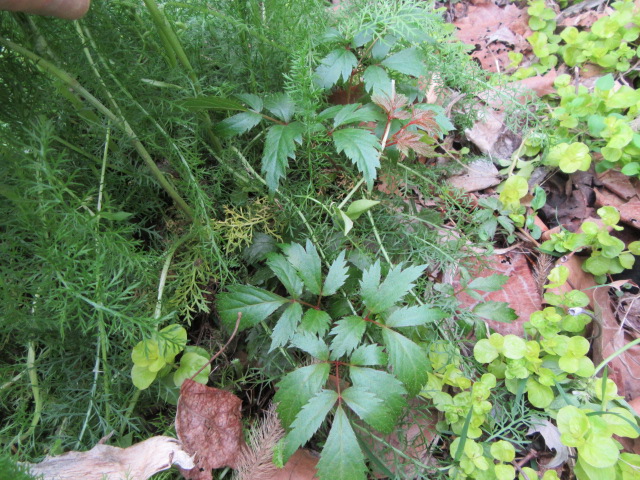
The Aegopodium podagraria (Snow-On-The-Mountain) has been behaving itself so far. I had idea I could just keep it growing along the foundation… Maybe if I ignore it. 🙂 It doesn’t help when it is the first on the list in alphabetical order… No page yet.

Astilbe x arendsii ‘Fanal’ on 6-20-25, #1062-3.

I don’t think the Astilbe x arendsii ‘Fanal’ liked me moving it forward in the spring of 2024 because it has certainly showed its disapproval. It was in front of the Hosta ‘Empress Wu’ which was getting so large it started covering the Astilbe within no time. So, I moved where I thought it was halfway between the ‘Empress Wu’ and the Achillea millefolium. Apparently, the Achillea moved again… Closer to the Astilbe… I really like this plant, so I hope it snaps out of it.

Geranium pratense ‘Boom Chocolatta’ with 32″ tall flower stems on 6-20-25, #1062-4.

The Geranium pratense ‘Boom Chocolatta’ has grown beyond my expectations. It has become rather bored with the Achillea millefolium (Yarrow) next to it, though. It complained somewhat, but I said it was there first. Actually, I didn’t put the Achillea in that spot. I put it closer to the house several years ago and it just traveled to where it liked the light much better.

The plant without the flowering stems was around 22″ tall x 30″ wide when the above photo was taken on 6-20-25. The top of the tallest flowering stem was 32″!

Geranium pratense ‘Boom Chocolatta’ with 8 1/4″ wide leaf on 6-20-25, #1062-5.

I looked for the largest leaf and found this whopper that measured 8 1/4″ wide…

Geranium pratense ‘Johnson’s Blue’ on 6-19-25, #1061-4.

The Geranium pratense ‘Johnson’s Blue’ on the other side of the step has also done great. Although not as robust as ‘Boom Chocolatta’, it is well suited for a front of the border or stand-alone plant without taking up a lot of room. ‘Johnson’s Blue’ is a very old cultivar that is still available.

The mound measured around 14″ tall x 18-20″ wide, while the tip of the tallest flowering stem was 21″ tall on 6-19-25. It is a bit sprawly on one side, so I had to hold the flowering stem up to get the measurement…

Geranium sanguineum (Bloody Cranesbill) on 6-20-25, #1062-8.

After flowering up a storm, the Geranium sanguineum (Bloody Cranesbill) is still looking great. I always have to mention I bought the ancestors of the plants in this bed in the early 1980’s when I was living in my grandparents old house (across the driveway). When my parents moved into the new house and the old house was torn down, dad moved them here to this spot.

Geranium sanguineum (Bloody Cranesbill) leaves on 6-20-25, #1062-10.

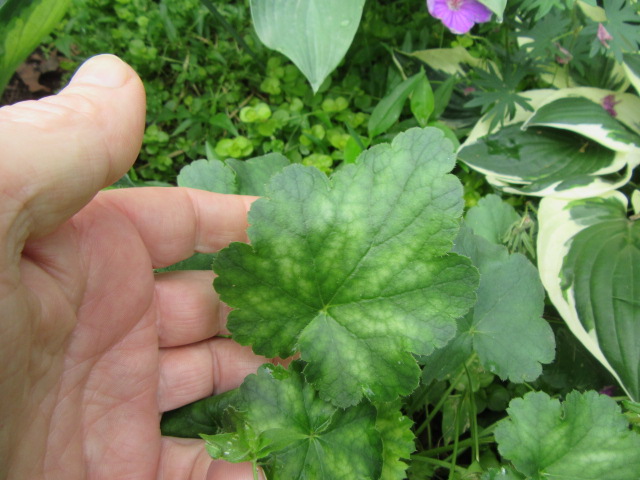
The leaves are a nice dark green…

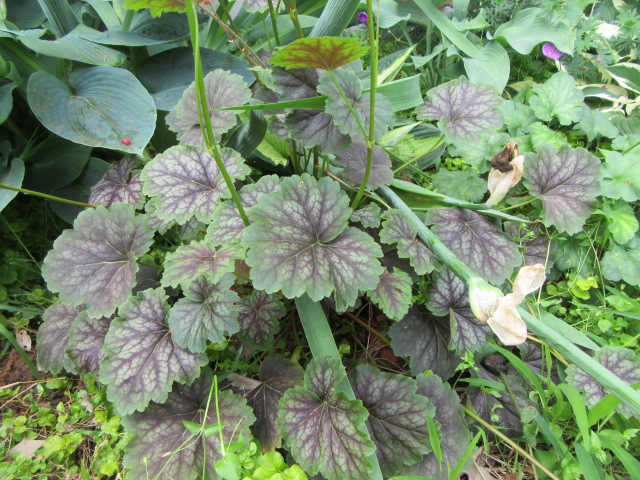
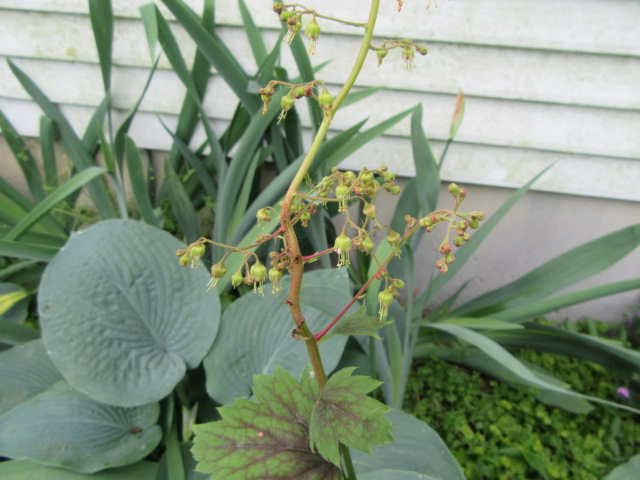
Heuchera ‘Palace Purple’ on 6-20-25, #1062-11.

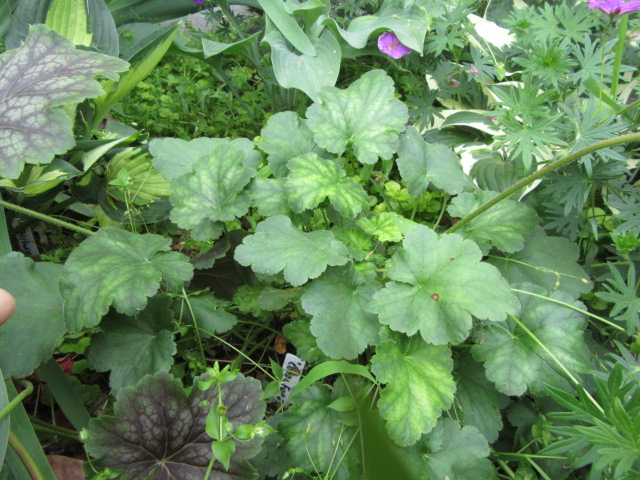
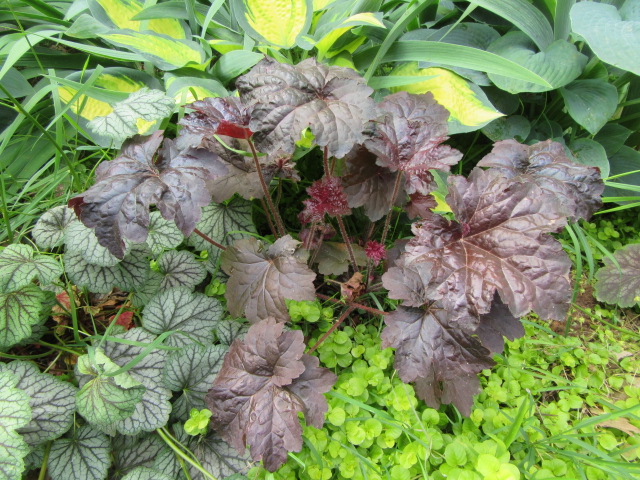
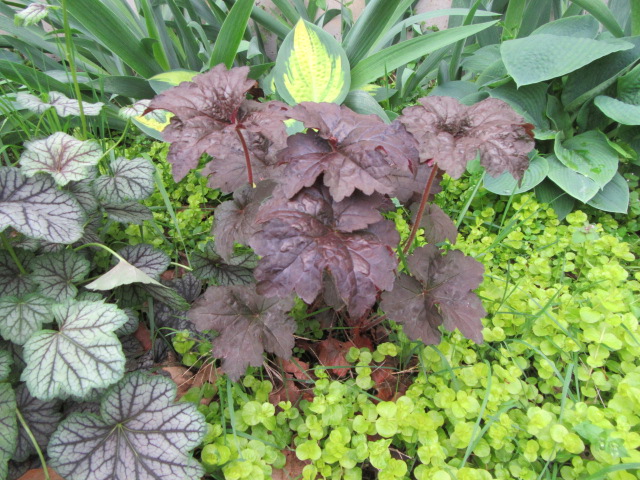
The Heuchera ‘Palace Purple’ has done quite well and has been flowering for a couple of weeks. The dark leaves of this plant and chartreuse leaves from the Lysimachia nummularia ‘Goldilocks’ look very good together.

Heuchera ‘Palace Purple’ on 6-12-25, #1056-6.

Heuchera ‘Palace Purple’ has 32″ stems!

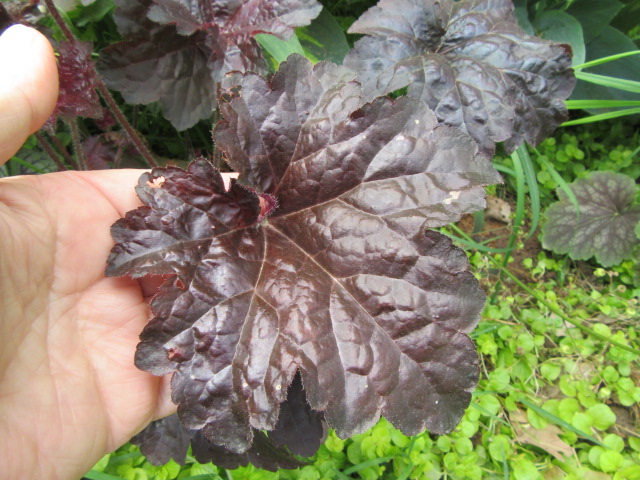
Heuchera ‘Palace Purple’ on 6-20-25, #1062-12.

How’s that for a dark leaf

Heuchera ‘Venus’ on 6-20-25, #1062-13.

The Heuchera ‘Venus’ has been an attention grabber with its size and the color of its leaves. It’s flowers aren’t much to talk about and its tall stems lay down on the job. Well, heck, some of them were over 50″ tall! Soon, I will remove the stems and tidy ‘Venus’ up a bit.

Heuchera ‘Venus’ on 6-20-25, #1062-14.

‘Venus’ is very proud of her leaves…

Heuchera americana ‘Dale’s Strain’ on 6-20-25, #1062-15.

The Heuchera americana ‘Dale’s Strain’ continues to do very well. I measured its flower stems a while back at 51″ tall! Umm… The flowers in the photo definitely do not belong to this plant… No page published yet.

Heuchera americana ‘Dale’s Strain’ leaf on 6-20-25, #1062-16.

The Heuchera americana ‘Dale’s Strain’ definitely has colorful leaves. NICE!

Heuchera sanguinea ‘Coral Forest’ on 6-20-25, #1062-17.

While not a large plant by any means, the Heuchera sanguinea ‘Coral Forest’ has made up for it with its continual show of bright flowers.

Heuchera sanguinea ‘Coral Forest’ on 6-12-25, #1056-10.

It is STILL producing bright flowers and they last A LONG TIME. The flowers are the WOW factor for this plant. It likes sharing them with nearby plants, too (stems won’t stand up straight).

Heuchera sanguinea ‘Coral Forest’ on 6-20-25, #1062-18.

It has smaller marbled leaves that are somewhat fuzzy… No page published for this one either. I’m working on it…

Now for the Hosta…

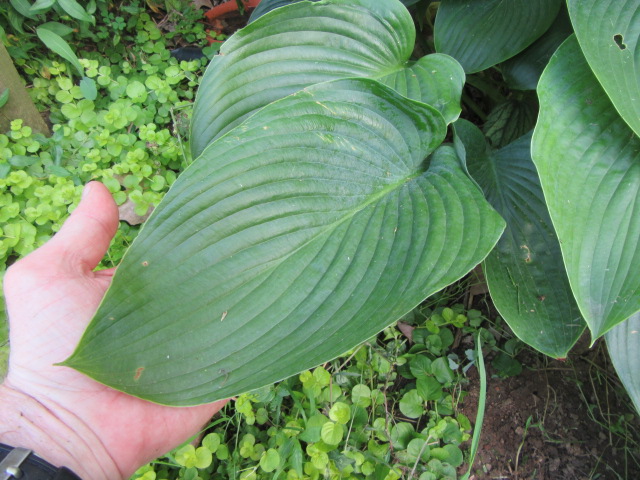
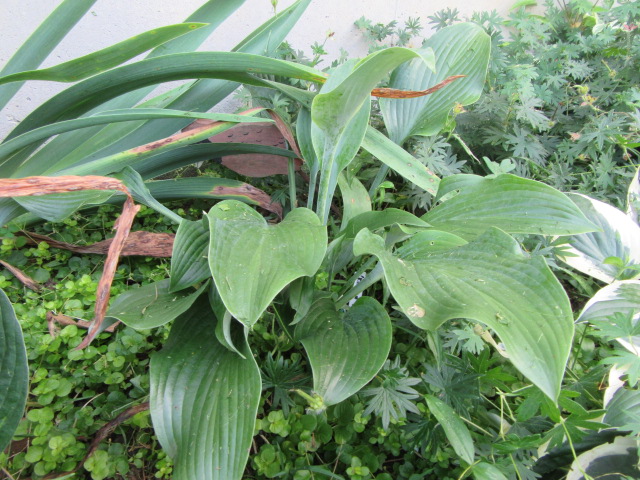
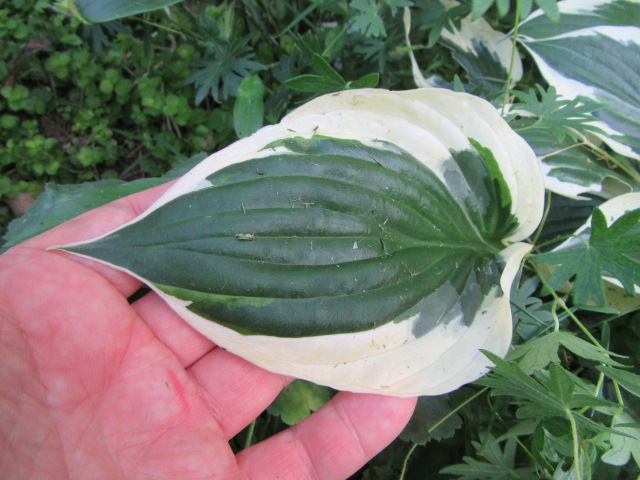
Hosta ‘?’ on 6-20-25, #1062-19.

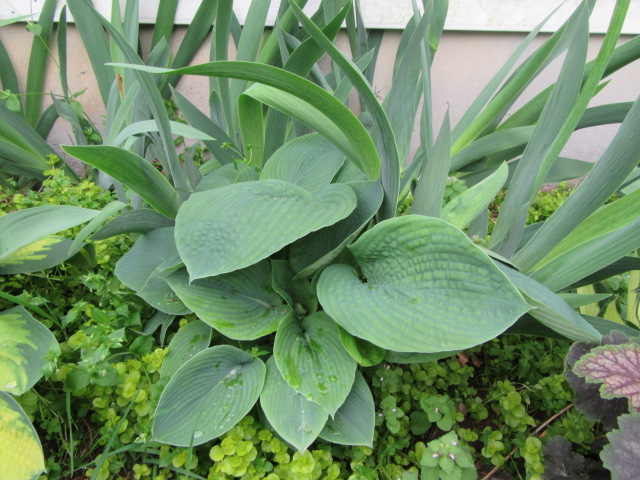
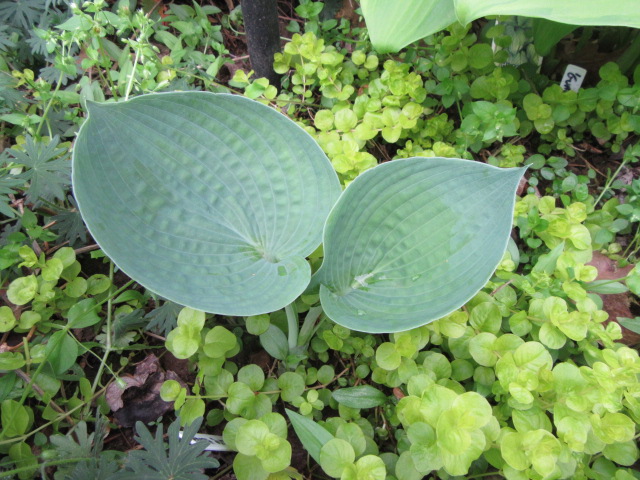
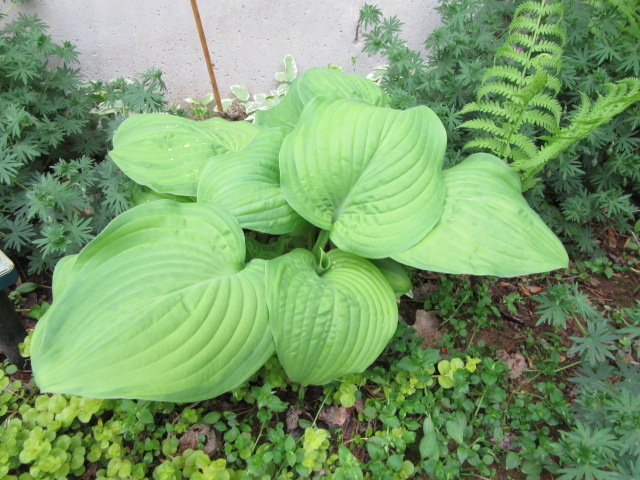
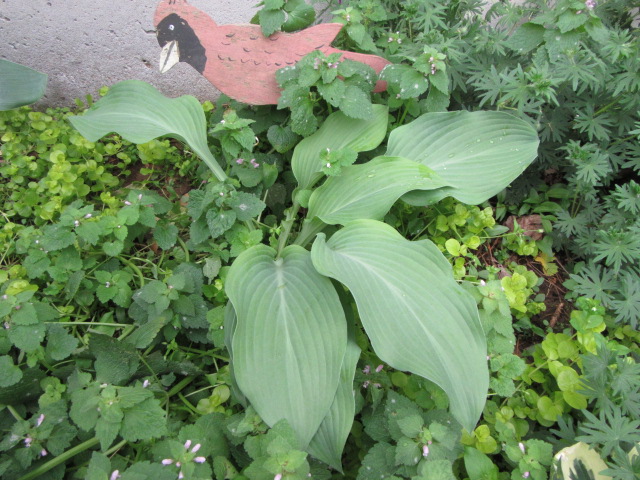
This Hosta ‘?’ has been a great performer for several years after bringing it home from a local garden club plant sale. It wasn’t labeled, but I wanted it anyway. I’m not even sure what year it was and the first photo I took of it was in 2024. To me, it looks exactly like the former outstanding cultivar I had called Hosta sieboldiana ‘Elegans’ that succumbed to mole issues in the shade bed and didn’t return in 2020. Click the link and have a look and tell me what you think. There are a lot of cultivars that look similar, especially when H. sieboldiana ‘Elegans’ is a parent to many other great cultivars.

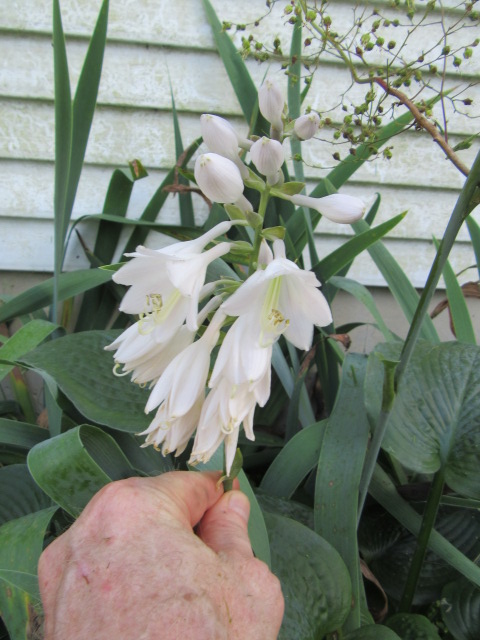
Hosta ‘?’ with 34″ stems on 6-20-25, #1062-20.

I measured the flower stem at 34″ on 6-20-25. Like H. sieboldiana ‘Elegans’, it has white flowers.

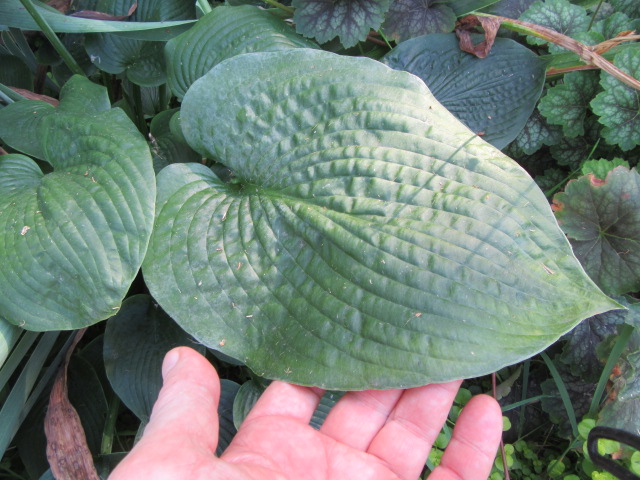
Hosta ‘?’ leaf on 6-25-25, #1064-2.

NICE LEAF! Look at the puckering!

Hosta ‘Abiqua Drinking Gourd’ on 6-20-25, #1062-22.

The Hosta ‘Abiqua Drinking Gourd’ is doing much better now, but still a far cry from what it was several years ago in the old shade bed. It’s a survivor, so I know it will continue to do better.

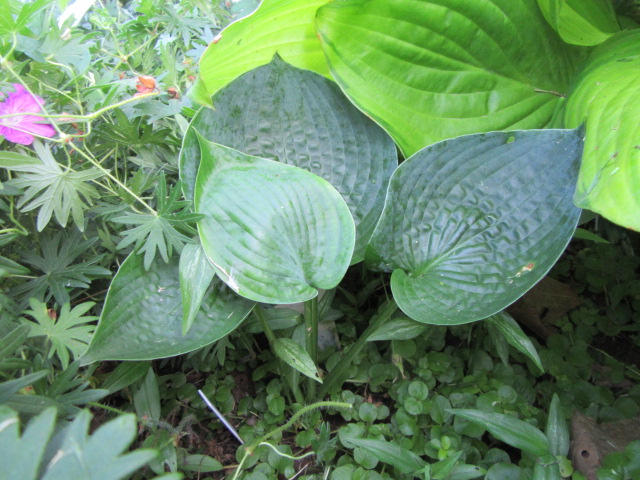
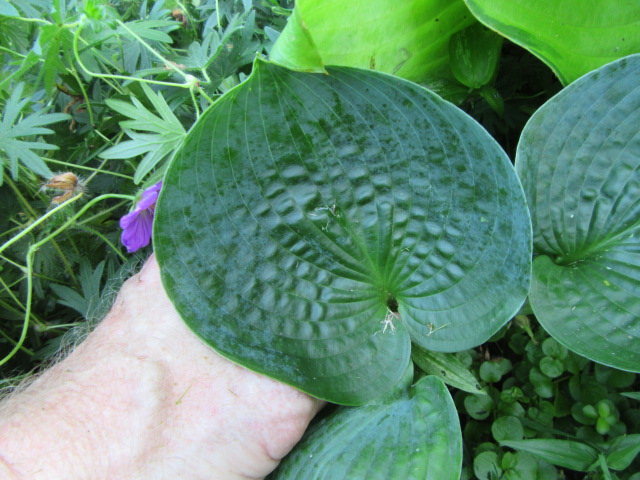
Hosta ‘Abiqua Drinking Gourd’ on 6-20-25, #1062-23.

The leaves of the Hosta ‘Abiqua Drinking Gourd’ are very “puckered” and kind of cup-shaped. I haven’t seen any slugs for MANY years, but they are also snail resistant.

Hosta ‘Dancing Queen’ on 6-20-25, #1062-24.

The Hosta ‘Dancing Queen’ has been doing great adding its bright color to the bed. The one that fizzled out in the shade bed usually flowered in June. One year it started sending up a bud the end of May. This one is doing great, so I guess it will bloom when it gets ready. I only took two photos of it in 2024, one when I brought it home and the other in July. The July photo doesn’t show any signs of a flower stem. Hmmm… I guess we’ll just have to wait and see if it decides to bloom or not.

Hosta ‘Dancing Queen’ on 6-20-25, #1062-25.

It’s leaves are fairly thin so they do have a few holes…

Hosta ‘Empress Wu’ on 6-20-25, #1062-26.

The Hosta ‘Empress Wu’ is a magnificent plant and is still growing… I am usually speechless when it comes to this plant. Imagine that!

Hosta ‘Empress Wu’ on 6-20-25, #1062-27.

It has several flower spikes and this one was 42″ tall when I took the photo.

Hosta ‘Empress Wu’ on 6-20-26, #1062-28.

The leaves are getting larger, too. They have a good thickness, but sometimes a critter still likes to have a nibble.

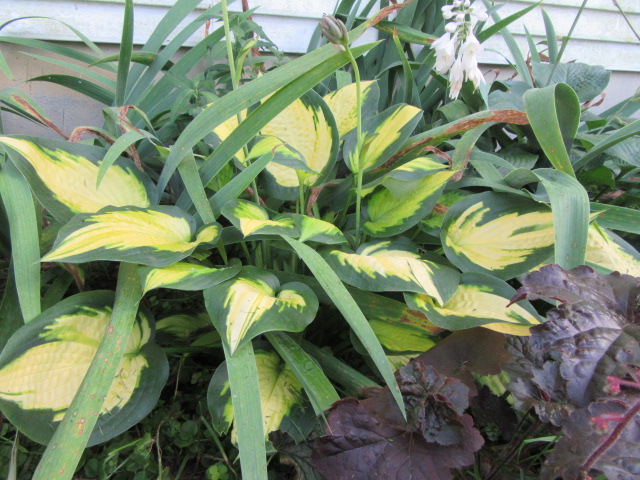
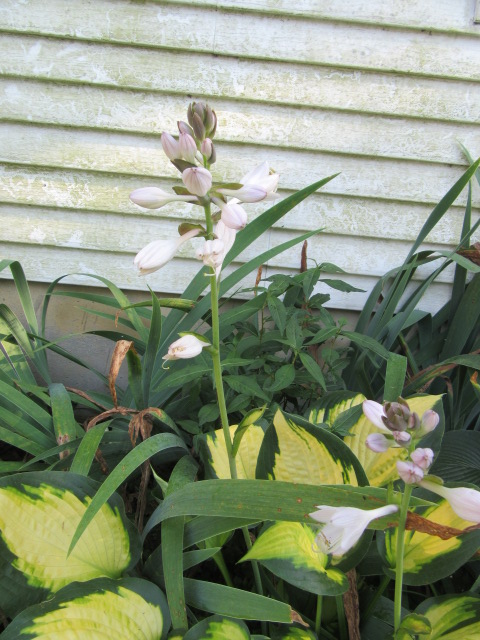
Hosta ‘Forbidden Fruit’ on 6-20-25, #1062-29.

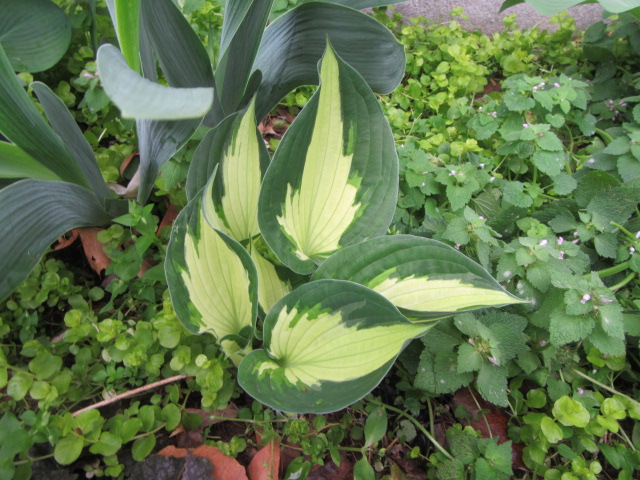
The Hosta ‘Forbidden Fruit’ is one of the nicest Hosta in the bed. I like its dark green margins and the bright centers. The plant has a very good shape!

Hosta ‘Forbidden Fruit’ on 6-25-25, #1064-3.

I took a couple of updated photos on the 25th. It is really strutting with its new flowers!

Hosta ‘Forbidden Fruit’ leaf on 6-25-25, #1064-4.

I forgot to take a photo of its leaf before, so I looked under some of the leaves to see if I could find a bigger one. I think they just keep growing as the summer progresses. It appears to be more green in the center, perhaps because it has been out of the sun… Hmmm… Well, I may have to do a re-take…

Hosta ‘Guacamole’ on 6-20-25, #1062-31.

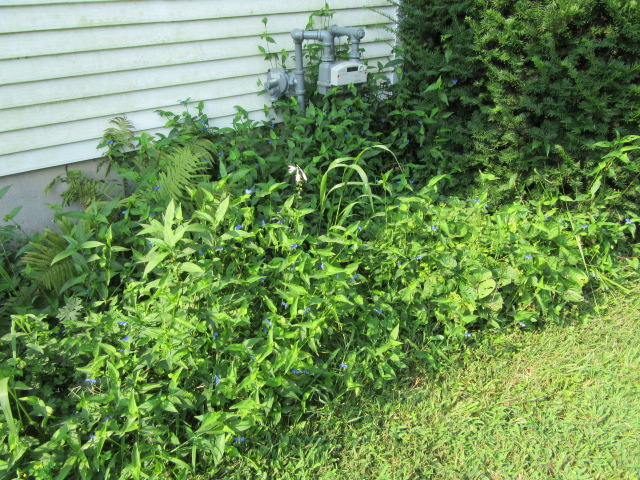
The Hosta ‘Guacamole’ has been its always AWESOME self and grabs a lot of attention. It’s a great performer no matter what! I know you may think there are weeds on its right side, but they are Commelina communis var. ludens (Asiatic Dayflower). OK, so maybe they are weeds in some respect, but I kind of like them…

Hosta ‘Guacamole’ on 6-20-25, #1062-32.

How’s that for a leaf. The specks on the leaves are grass clippings from mowing… I mowed the area in front of the bed with the push mower, but a friend mowed it again while my riding mower was broke down… He didn’t know the “rules” about getting grass clippings in the bed…

Hosta ‘Krossa Regal’ on 6-20-25, #1062-33.

This Hosta ‘Krossa Regal’ has been doing quite well, but isn’t exactly like the last one. It’s leaves don’t have the “silvery glow” for some odd reason… OK, so maybe the “silvery glow” is called bloom…

Hosta ‘Krossa Regal’ on 6-20-25, #1062-34.

It’s leaves are very nice with a thick substance making it pretty snail resistant.

Hosta ‘Patriot’ on 6-20-25, #1062-35.

The Hosta ‘Patriot’ is a brightly colored plant nestled among the Geranium sanguineum (Bloody Cranesbill). Both have done quite well… I have noticed that, while not a large plant, ‘Patriot’ likes to spread out.

Hosta ‘Patriot’ on 6-20-25, #1062-36.

The leaves of ‘Patriot’ have nice dark green centers with a bright white margin. I’m not finished with its page yet…

Hosta ‘Potomac Pride’ on 6-19-25, #1061-10.

The Hosta ‘Potomac Pride’ has been doing GREAT in spite of the Ostrich Fern’s advances. It doesn’t believe in boundaries. ‘Potomac Pride’ has been an impressive companion since 2009 in Mississippi, being moved here to the shade bed in 2013, and to the north side of the house in the spring of 2023. It is very glad to be safe from nibbling deer, too. At least so far…

Hosta ‘Potomac Pride’ on 6-19-25, #1061-11.

It has had a new bud starting when the above photo was taken.

Hosta ‘Potomac Pride’ on 6-20-25, #1062-37.

I really like the large dark green, puckered leaves of the ‘Potomac Pride’.

Hosta ‘Whirlwind’ on 6-20-25, #1062-38.

The Hosta ‘Whirlwind’ is doing quite well now, but for a while was hidden by surrounding plants. Actually, it was slow to come up and I had problems finding it. It seems to think I forgot about it, but the truth is I forgot where I put it because I couldn’t find it. I had to look at photos from 2024 to figure it out… I really like this plant, but sometimes I think I put it in the wrong place, but the Heuchera‘s ‘Dale’s Strain’ and ‘Coral Forest’ were added last spring and weren’t as prolific. OK, so I’m trying to find words to pacify ‘Whirlwind’ so it won’t feel so left out. After all, in alphabetical order, it is last on the list. I’m off the hook for that argument since I didn’t name the plant…

Hosta ‘Whirlwind’ on 6-20-25, #1062-39.

I always compliment if for having such nice leaves, though. Makes it smile…

Lysimachia nummularia ‘Goldilocks’ (Creeping Jenny) on 6-20-25, #1062-40.

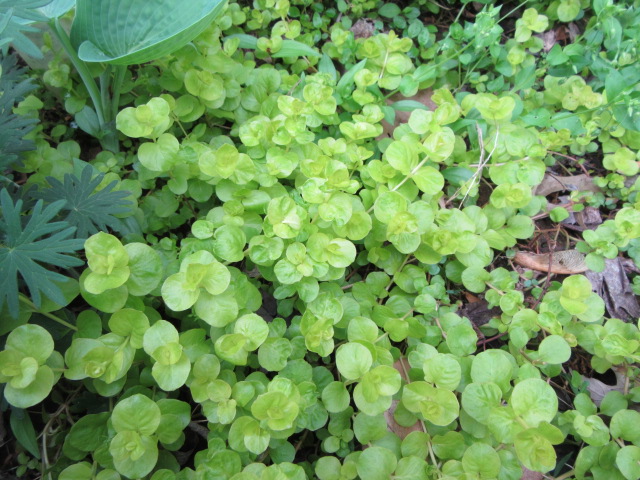
I really enjoy the way the Lysimachia nummularia ‘Goldilocks’ (Creeping Jenny) creeps around in the bed. Sometimes I accidentally pull it up when I am weeding. but I just stick it back in the soil and it continues growing like nothing happened. It is certainly a happy are carefree plant. It does creep out into the grass, but that’s OK…

Matteuccia struthiopteris (Ostrich Fern) on 6-20-25, #1062-41.

Hmmm… I think I may have planted a monster when I put this Matteuccia struthiopteris (Ostrich Fern) in the bed. It has grown by leaps and bounds! I guess all I have to do is move some it to another spot or two.

Matteuccia struthiopteris (Ostrich Fern) on 6-20-25, #1062-42.

I really like the leaves!

I started this post several days ago and it is finally finished. We have had plenty of rain so far, but soon that will likely change. We have had a few hot days with hot wind, then it rained again and cooled off. Soon, that will change and it will get hot and the rain will stop for a while. It always does, but for now we will enjoy the break.

So, what will I write about next? Well, let me see… I did repot several of the cactus and succulents that may make a good discussion. I took plenty of photos and they aren’t likely to grow so fast to make them out of date like the plants in the north bed. I kept taking photos, then more, because they kept growing, then started flowering, so I would have to take more. GEEZ! Well, now this post is finished, so I better hit the publish button.

Until next time, be safe, stay positive, stay well, always be thankful, and GET DIRTY!

Surprise With The Tree Cholla!

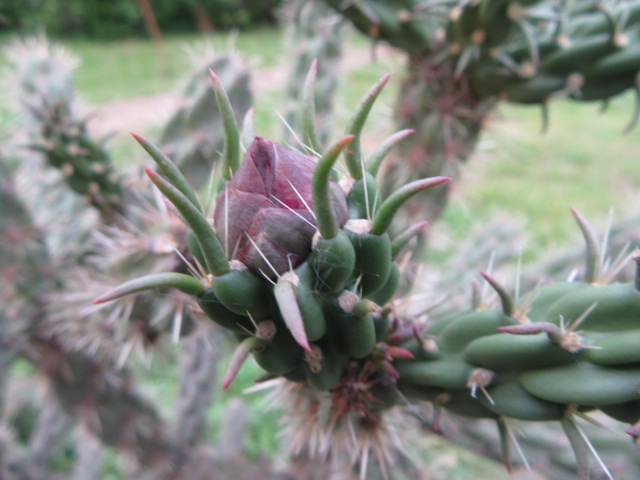
Cylindropuntia imbricata (Tree Cholla) on 5-22-25, #1045-2.

Hello everyone! I hope this post finds you well. We seem to be having a break from cool, cloudy, and rainy weather. I really didn’t mind it because we need the rain and soon it will be getting hot and dry. Time flies, you know, and you never know what the forecast has in store.

I hadn’t taken photos of the Tree Cholla since 2022, so I took a couple on April 21 then two more on May 22.

Cylindropuntia imbricata (Tree Cholla) on 5-22-25, #1045-3.

I’ve always been fascinated with this plant and how it has grown and changed since I brought it home from Wagler’s Greenhouse in 2019. It has grown a little crooked, but you have to admit it has character. It now stands 37″ tall and 18″ wide…

Early Friday evening, my son said he had seen some purple flowers and wondered what they were. I figured they were likely Wild Sweet Peas, but I thought we should investigate just in case something new was happening somewhere.

As we were walking by the Tree Cholla, I told Nathan I really liked this plant because it was always changing. I started showing him the new growth, but what I saw was a complete surprise… It is normally giving me a “come a little closer” look, but this time, I think it was smiling at me..

IT HAS BUDS!!!

Cylindropuntia imbricata (Tree Cholla) on 5-30-25, #1048-3.

I could hardly believe it! It was one of THOSE moments I could hardly believe what I was seeing. I have had many WOW moments and this was definitely one of them. Yeah, I know, it’s a cactus, but I have had several of those moments with cactus. I won’t go down the list at the moment, but maybe it could be a post in the making. Maybe titled, “WOW Cactus Moments…” Trust me, I have had many more “OUCH” moments than “WOW” moments…

Cylindropuntia imbricata (Tree Cholla) on 5-30-25, #1048-4.

Yep, it is really real! It definitely isn’t a strawflower that has been stuck on… No, I didn’t touch it because I know how this cactus can be. I’ve felt its poke many times.

Cylindropuntia imbricata (Tree Cholla) on 5-30-25, #1048-5.

Yeah, I like joking around with my plants, especially the cactus. They always seem so serious so I try to get them to lighten up a little. This one, however, is about as territorial as they come. Every time I pull grass from around it, I get a poke no matter how careful I am. I am sure it does it on purpose.

Cylindropuntia imbricata (Tree Cholla) on 5-30-25, #1048-6.

New growth is always neat and a little more user friendly. It grows odd leaves that eventually fall off. You still have to be very careful touching it, because not only does it have very sharp spines, it all has glochids. You know, those tiny spines that get in your fingers and you can barely see or move.

If you want to go to its own page and see LOTS of photos from 2019 until now, click HERE. I just read the page again for the first time in a long time. It brought back some memories and made me smile. 🙂 I think there are 52 photo on the page.

Well, that’s it for this post. I’ll try to find something to write about soon.

Until then, take care, be safe, stay well, always be thankful, and always GET DIRTY!


Defiant Coral Bell

North bed on 5-23-25.

Hello everyone! I hope this post finds you well. All the plants in the north bed are doing very well. We’ve been getting plenty of rain lately which always helps. I brought home three very large Colocasia esculenta rhizomes a while back that I planted in the bed. One was sprouting already and the other two had started to rot… Hmmm… So, we shall see what happens.

The four Heuchera (Coral Bells, Alum Root, etc.) on 5-23-25.

In a previous post from May 1, I mentioned having to wait for Heuchera americana ‘Dale’s Strain’ to flower before I could make sure it was actually that cultivar. Well, waiting hasn’t done any good because I’m still not sure.

As of 5-24-25, there are 46 species of Heuchera worldwide. According to Flora of North America, 32 of those species are native to North America. There are two listed on the Missouri Plants website…

Heuchera americana ‘Dale’s Strain’ on 5-23-25, #1046-7.

Heuchera, commonly known as Alum Root, Coral Bells, etc., are really neat plants. They grow in a mounded shape for the most part and send up long spikes of flowers that last quite a while. Well, sometimes… There are many cultivars available with very showy leaves like the one pictured above that I “think” is Heuchera americana ‘Dale’s Strain’.

Heuchera americana ‘Dale’s Strain’ on 5-23-25, #1046-9.

Heuchera americana is actually a native wildflower of the United States and has been used as a parent of many cultivars to add hardiness, vigor, and color. The leaves can change color somewhat throughout the season with some cultivars.

Heuchera americana ‘Dale’s Strain with a 51″ tall stem on 5-22-25, #1045-15.

While the mound of leaves is only 12″ tall, the tallest flowering stem (without proper terminology) 51″…

Heuchera americana ‘Dale’s Strain’ on 5-23-25, #1046-8.

The flowers are…. Ummm…. Well, I still don’t know. Information online says it produces white flowers… The Wikipedia  article says. “Loose racemes of insignificant green to cream flowers up to 1 meter tall bloom June to August. It is a monecious plant with 5 stamen and can either have 5 petals and sepals or 5 tepals.” Copied and pasted here… Let’s back up a minute… Information online says ‘Dale’s Strain’ produces white flowers with no mention of them being “insignificant”… So I waited… When it comes to flowering plants, I have now learned what insignificant actually means. It means not to wait for a show.

Heuchera sanguinea ‘Coral Forest’ on 5-23-25, #1046-10.

The Heuchera sanguinea ‘Coral Forest’ started sending up flowering stems about the last part of April. The plant has made it to 10 1/2″ tall. The species is native to Arizona, New Mexico, and northern Mexico.

Heuchera sanguinea ‘Coral Forest’ on 5-23-25.

The leaves of Heuchera sanguinea ‘Coral Forest’ are, well, green… Kind of a mottled bi-color. Sorry, I didn’t measure the leaves because I haven’t thought about it the last 4 times I kept taking photos of these guys for the day (and twice yesterday). I didn’t think about until now…

Heuchera sanguinea ‘Coral Forest’ with 31″ stems on 9-22-25, #1045-18.

Even though the height to the tallest leaf is 10 1/2″ tall, the tip of the longest (or tallest) flowering stem is 31″! It would be really neat if the stems would stand up straight. Ummm… I didn’t count how many stems there are either. GEEZ! The things you don’t think about!

Heuchera sanguinea ‘Coral Forest’ on 5-23-25, #1046-12.

This plants flowers have been open the entire month of May! Yeah, it actually has flowers that you can see and they are so bright it is hard to get a good photo… The first flower photos I took of this plant was May 8 but that was because I didn’t have time sooner.

As you can see in the photo, the Geranium sanguineum (Bloody Cranesbill) is now blooming like crazy.

Heuchera ‘Palace Purple’ on 5-23-25, #1046-1.

The Heuchera ‘Palace Purple’ has had its ups and downs since I brought it home in 2014, but it is doing great in this bed. The mound is 16″ tall x 21″ wide now.

Heuchera ‘Palace Purple’ on 5-23-25, #1046-2.

I really like the deep maroon color of the leaves. This one hasn’t started sending up flowering stems yet, but the flowers are kind of a pinkish color. I have taken photos of its flowers, but you’ll have to go to its own page to see them.

Heuchera ‘Venus’ on 5-23-24, #1046-3.

Heuchera ‘Venus’ has undoubtedly been the hardiest Heuchera I have grown. It just keeps going no matter what! Even during the winter, this plant took the cold temps without hesitation. It is now 12″ tall x 32″ wide… Yep, 32″!

Heuchera ‘Venus’ on 5-23-24, #1046-4.

Heuchera ‘Venus’ was hybridized by Wijnhout of the Netherlands. Information on this plant’s page says it grows to a height of 12″ tall and a width also of 12″… Hmmm…

Heuchera ‘Venus’ on 5-23-25, #1045-5.

There are many Heuchera cultivars with similar leaves, so it’s a good thing I know what this one is. The leaves to change color with the seasons.

Heuchera ‘Venus’ with a 53″ flowering stem on 5-23-25, #1046-6.

Well… Information online says Heuchera ‘Venus’ produces white flowers on 18″ stems… I measured the tallest stem, which was on the ground, at 53″ tall. So, if the stems are on the ground, are they tall or long? I didn’t take any close-ups of its flowers, but they are, as with Heuchera americana ‘Dale’s Strain’, insignificant… I guess with amazing leaves, flowers aren’t important.

I have grown a few other Heuchera over the years that didn’t make it. They can heave during the winter, but I think their biggest problem were the moles burrowing under their roots during the winter. Then, rather than heaving, the plants would fall in the tunnels during the winter and their crowns would get covered up causing them to die. Even though I would replant them if I could, they would just kind of fizzle out.

Here are some of their best photos…

Heuchera ‘Lime Rickey’ on 5-25-19, #576-30.

Heuchera ‘Lime Rickey’ was a neat small Coral Bell with chartreuse leaves that produced dainty racemes with white flowers. It fizzled out and didn’t return in the spring of 2024.

Heuchera ‘Obsidian’ on 10-11-17, #382-30.

The Heuchera ‘Obsidian’ is the darkest leaved Heuchera cultivar, or at least it was at the time of its introduction by Terra Nova. I brought it home in 2017 and it had its share of ups-and-downs. There wasn’t much left of it when I moved the Heuchera to the north bed in 2023, then it didn’t come back up in 2024…

Heuchera ‘Purple Petticoats’ on 5-1-09, #12-35.

Hmmm… I brought this Heuchera ‘Purple Petticoats’ home when I lived in Mississippi. Well, the heat apparently got to it and it didn’t last the summer… I didn’t bring home any other Coral Bells while living in Mississippi… This is the only photo I have of this plant.

Heuchera ‘Southern Comfort’ on 5-31-17, #339-13.

I brought this Heuchera ‘Southern Comfort’ home in 2017 when I made the “new” shade bed. It was a neat plant and although I moved it a couple of times, it eventually fizzled out during the summer of 2018. Moles were its biggest issue and one day I found it was pushed clear out of the ground…

The shade bed was initially a great place for the Heuchera and Hosta, but it did have its issues. The moles were a problem, it was handy for deer to nibble on the plants on occasion, it was next to the old goldfish pool so it was a mosquito haven, and it was under two elm trees whose leaves would be eaten to shreds by Japanese Beetles. No leaves, no shade…

The north bed is a much better spot and the Hosta and Heuchera seem to be doing very well. It is also much easier to keep them well watered and maintained along the house.

If you haven’t tried them, Coral Bells are great plants and easy to maintain if you live where they will thrive. There are many cultivars and hybrids available with very showy leaves. Just watch out for the moles and their roots heaving over the winter.

Well, I think that’s all for this post. At least it’s time to stop before I decide to add something else.

Until next time, be safe, stay well, always be thankful, and GET DIRTY!!!

Surprise Visit To A Native Prairie

Native prairie on 5-5-25.

Hello everyone! I hope this post finds you well. Sunday evening, a friend contacted me and asked if I wanted to go to a native prairie on Monday. Of course, I said yes. On the way there, he told me a little about the place. It is privately owned farm that has never been plowed, grazed, or planted. It gets bailed in September every year which is why it is short now. There are two public prairie sites, one across the road and one next to this property (which used to be part of this farm). I can’t tell you where it is because I said I wouldn’t. There are are two other public areas not far away… If I gave you the names of the conservation areas, then you would be close. 🙂

I am going back at some point, and to the conservation areas. When I go to the state conservation areas, I will give you the name of the site. If you stumble upon this private land, the owner will surely run you off. She showed up within 10 minutes after we got there because she didn’t recognize my friend’s van… All was good!

Native prairie on 5-5-25.

So, we pulled up in front of this area and my jaw dropped. I wasted no time getting the camera and walking into the prairie. It was almost like I died and went to heaven. Well, maybe that is getting a little carried away… Within a few minutes, I was taking photos of a wildflower I didn’t recognize. By the time it was too dark to take photos, I had photographed 11 species to identify. As a matter of fact, I only found two species I recognized, Achillea millefolium (Yarrow) and Galium pedemontanum (Piedmont Bedstraw).

There were areas where certain species was predominant, and others were many species we together. Since this is only the beginning of May and no pasture grass has been sown here, the native grass that grows here was almost non existent. Unlike public conservation areas which has grown up, this prairie was well maintained.

So, I’m going to show you what I found in alphabetical order.. Most of species on this post flower from April-May so they will be fizzled out soon…

Baptisia leucophaea (Cream Wild Indigo) on 5-5-25, #1041-1.

Baptisia leucophaea Nutt. (1818)

bap-TIS-ee-uh  loo-koh-FAY-uh

I was kind of in shock for a minute when I found this plant. I just stood there looking at it like I was weird or something. I have seen a few along 52 Highway on the way to Clinton in the past couple of years, but here it was right in front of me. Baptisia leucophaea (Cream Wild Indigo).

Baptisia leucophaea (Cream Wild Indigo) on 5-5-25, #1041-3.

Unlike most Baptisia species with upright racemes, B. leucophaea racemes droop and hang to the ground. The whole stem was very stiff.

Baptisia leucophaea (Cream Wild Indigo) on 5-5-25, #1041-5.

The flowers have short peduncles (flower stems) and face the sun.

<<<<+>>>>

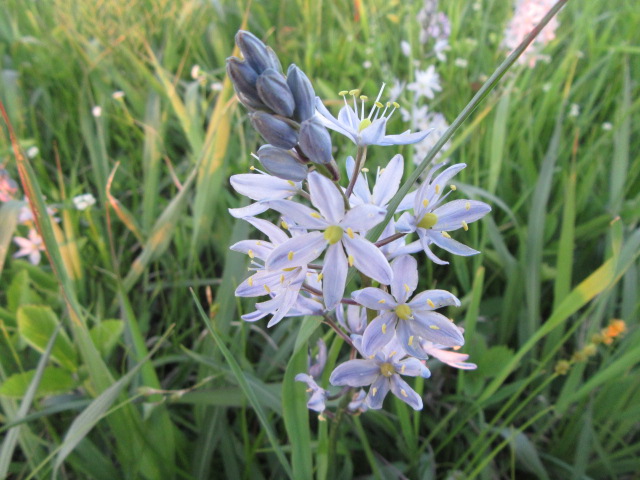
Camassia scilloides (Wild Hyacinth, Atlantic Camas) on 5-5-25, #1041-7.

Camassia scilloides (Raf.) Cory (1818)

kuh-MAS-ee-uh  sil-OY-dees

There were several large colonies of Camassia scilloides also known as Wild Hyacinth and Atlantic Camas. Seeing them in mass was such a WOW moment.

Camassia scilloides (Wild Hyacinth, Atlantic Camas) on 5-5-25, #1041-6.

This is a bulbous perennial wildflower whose racemes terminate with 7-50 flowers.

Camassia scilloides (Wild Hyacinth, Atlantic Camas) on 5-5-25, #1041-10.

Flowers of this species can range from light blue to white and have such bright yellow anthers and filaments. The flowers produce three-lobed fruit.

<<<<+>>>>

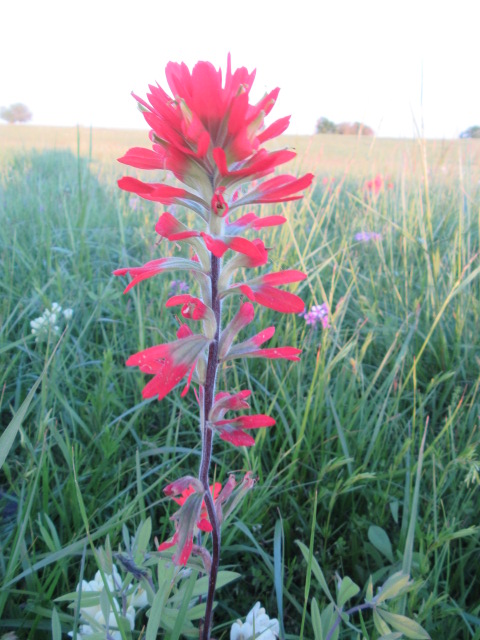
Castilleja coccinea (Indian Paintbrush) on 5-5-25, #1041-13.

Castilleja coccinea (L.) Spreng. (1825)

kas-tee-LEE-uh kok-SIN-ee-uh

Finally! The Castilleja coccinea were in large colonies here and there throughout the prairie. I have seen them here and there in the same area along the highway and always wondered what they were. Common names include Indian Paintbrush, Painted-Cup Paintbrush, Scarlet Indian Paintbrush, and a few others.

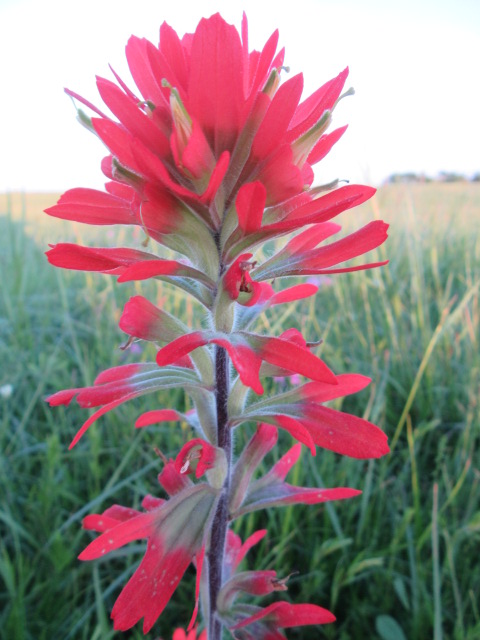
Castilleja coccinea (Indian Paintbrush) on 5-5-25, #1041-14.

This species is a member of the plant family Orobanchaceae which is also a new family for me. In fact, there were members of three families I was unfamiliar with. Like this species, three were hemiparasitic meaning they get part of nutrients from the roots of of other species. Also new to me. Never heard of hemiparasitic before…

Castilleja coccinea (Indian Paintbrush) on 5-5-25.

The color was so vivid! As with Poinsettias, the red color is not from petals but leaf-like bracts. The flowers are inconspicuous with red-tinged sepals.

Castilleja coccinea (Indian Paintbrush) on 5-5-25, #1041-16.

Let’s get a little closer… According to information online, the color has polymorphism meaning they can be scarlet or yellow depending on the availability of pollinators. More pollinators means better pollination so the color is scarlet. Less pollination and the color will be yellow. Yellow flowered specimens were formerly Castilleja coccinea f. lutescens which is now a synonym according to Plants of the World Online. I guess someone figured that out… Apparently, red colors are harder for insects to see but hummingbirds also pollinate the flowers… Hmmm… I didn’t see any hummingbirds or even any bees for that matter…

This species can be either perennial or biennial. Some seeds will germinate in the fall and and produce flowering plants in the spring. Seeds that germinate in the spring will produce plants that flower the following year. Fruits have 2 divisions and once ripe, they split open allowing up to 300 seeds to be dispersed by the wind.

I read where Native Americans used the flowers as a love charm but also as a poison against their enemies… Hmmm… I “think” the roots of an eastern species was cooked and eaten like potatoes. NOT this species and don’t quote me on that…

<<<<+>>>>

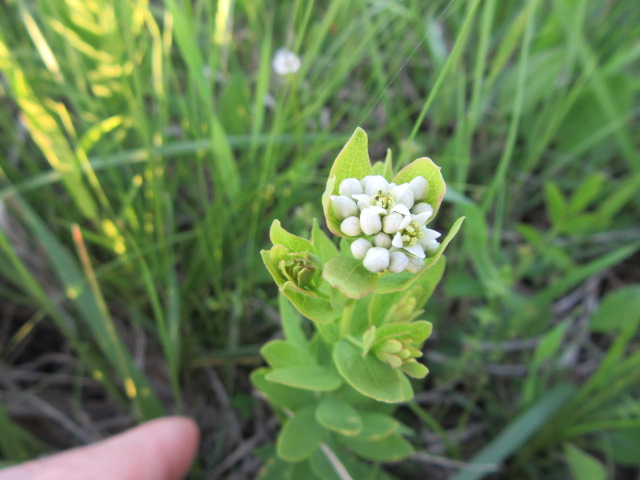
Comandra umbellata (Bastard Toadflax) on 5-5-25, #1041-17.

Comandra umbellata (L.) Nutt. (1818)

koh-MAN-druh um-bell-AY-tuh

This one is called Comandra umbellata (Bastard Toadflax) and it is also hemiparasitic from the new-to-me plant family Santalaceae. The genus name comes from the Greek word for “male hairs” that refers to the hairs at the base of it’s flowers stamens… 

Comandra umbellata (Bastard Toadflax) on 5-5-25, #1041-18.

The flowers have 5 greenish-white sepals and no petals. I need to go back and get more photos of this one when the flowers are open up till July…

Information online says they parasitize over 200 known plant species…

<<<<+>>>>

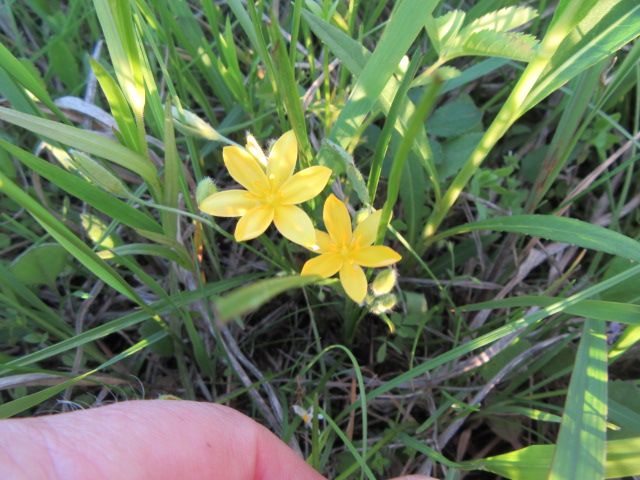
Hypoxis hirsuta (Yellow Star Grass) on 5-5-25, #1041-21.

Hypoxis hirsuta (L.) Coville

hy-POK-sis  her-SOO-tuh

This dainty little grass, Hypoxis hirsuta, commonly known as Yellow Star Grass, hails from the “new-to-me” plant family Hypoxidaceae. It may be somewhat confused because it has been or is sometimes placed in the families Amaryllidaceae and Liliaceae… Depends on what website you are on or if it is up-to-date.

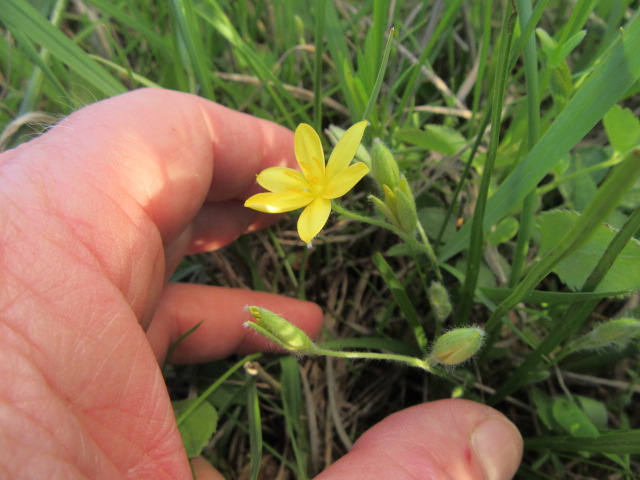
Hypoxis hirsuta (Yellow Star Grass) on 5-5-25, #1041-22.

Yellow Star Grass grows from a corm and has 3-lobed fruit. The stems grow from rosettes of grass-like leaves. Both the stems and leaves have small white hairs and stems (peduncles) terminate in 3-6 bright yellow, star-shaped flowers. I didn’t notice many of these compared to the other species, but their bright color stood out among the other vegetation.

OH, the flowers close when it gets hot and the fruits are covered with tiny bumps or spines. The anthers “diverge” in the lower half giving the stamens an arrowhead-like appearance… Maybe I could have taken a close-up if I had known that at the time…

<<<<+>>>>

Lithospermum canescens (Hoary Puccoon) on 5-5-25, #1041-23.

Lithospermum canescens (Michx.) Lehm. (1818)

lith-oh-SPER-mum  can-ESS-kens

This half-wilted plant is in the plant family Boraginaceae and goes by the name of Lithospermum canescens (Hoary Puccoon) due to its hairy leaves. The plants are referred to as distylous because they have two flower forms (on the same plant). The genus name means “rock seed” because of its shiny, white, rock hard seeds. Formerly named Batschia canescens by André Michaux in Flora Boreali-Americana in 1803.

Lithospermum canescens (Hoary Puccoon) on 5-5-25, #1041-24.

Apparently, the taproot produced a reddish-purple juice that Native American children would chew on it to make their gum red. Roots were used to treat asthma, lung complaints, and as a sedative. The white seeds were also used as ceremonial beads.

<<<<+>>>>

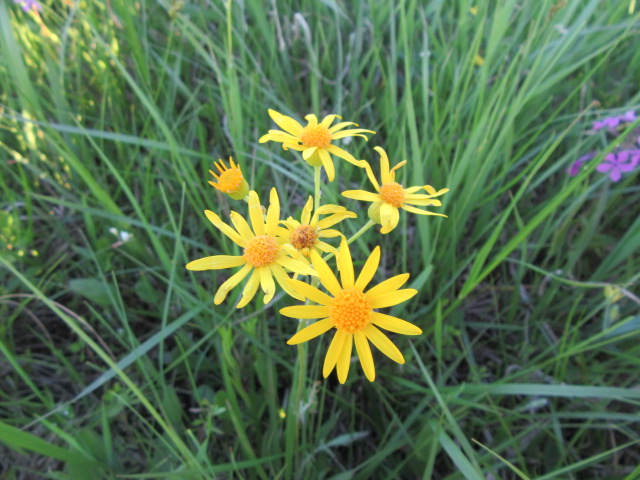
Packera plattensis (Prairie Groundsel, Prairie Ragwort) on 5-5-25, #1041-25.

Packera plattensis (Nutt.) W.A.Weber & Á.Löve (1981)

PAK-er-uh  plat-EN-sis

This species, Packera plattensis is a member of the familiar plant family Asteraceae and can be either a perennial or biennial. It was formerly formally named Senecio plattensis by Thomas Nuttall in Transactions of the American Philosophical Society in 1841. Common names include Prairie Groundsel, Prairie Ragwort, Platte Groundsel, Squaw Weed, and possibly others.

I found a single Packera glabella (Butterweed) in a wooded area behind the chicken house 2022. Never saw it again so I was glad I found this species in the prairie.

<<<<+>>>>

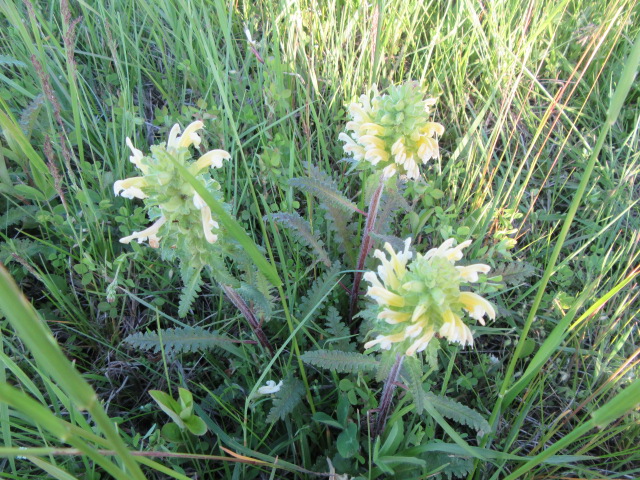
Pedicularis canadensis (Wood Betony) on 5-5-25, #1041-28.

Pedicularis canadensis L. (1767)

Pe-dik-yoo-LAIR-is  ka-na-DEN-sis

This plant made me smile with the spiral-growing flowers. Another member of the plant family Orobanchaceae, it is also hemiparasitic. The roots have a symbiotic relationship with a fungus that helps it gather nutrients. Some references say they accomplish this through “haustoria”, tissue connections that develop between the roots of parasitic plants and host plants…

Common names of Pedicularis canadensis include Wood Betony, Canadian Lousewort, Common Lousewort, and possibly others.

Pedicularis canadensis (Wood Betony) on 5-5-25, #1041-29.

The upper corollas have a pair of teeth at their tips (characteristic of this species).

Pedicularis canadensis (Wood Betony) on 5-5-25, #1041-31.

I noticed several clumps of rosettes with no flowers, so maybe they can be perennial or biennial. I didn’t see it mentioned, but why else would some plants not have flowers and some not? Another plant mentioned somewhere above has similar leaves, but these clumps were among the Wood Betony. I had to reassure myself for a minute… GEEZ! I have to look into that more…

Why the common name “Lousewort?” Well, apparently, the name came from an old belief that your cattle would get lice if they consumed this plant. Another belief was that a strong concoction made from the leaves would eliminate lice…

Plants were eaten by American Indians, sometimes as a soup. It was added to oats and used as horse feed. A root infusion was used for stomachaches, diarrhea, anemia, and heart issues. Poultices were used for swellings, tumors, and sore muscles…

I also read where the Menomini Indians called the root “enticer root” and carried it as a charm when they wanted to seduce the opposite sex. The root was also used to heal broken marriages by adding it to the food the couple would then eat, hoping its magic would rekindle romance…

<<<<+>>>>

Phlox pilosa (Prairie Phlox) on 5-5-25, #1041-33.

Phlox pilosa L. (1753)

floks  pil-OH-suh

This species looked very familiar and was indeed a Phlox. Even so, the plants were much shorter than the species I have become familiar with. The species here is Phlox pilosa with the common names Prairie Phlox, Downy Phlox, Deam’s Phlox, Hairy Phlox, and possibly others.

Phlox pilosa (Prairie Phlox) on 5-5-25, #1041-35.

While the sessile, lance-shaped leaves grow in an opposite manner, they are smaller and narrower than Phlox divaricata (Wild Blue Phlox).

<<<<+>>>>

Primula meadia (Common or Eastern Shooting Star) on 5-5-25, #1041-38.

Primula meadia (L.) A.R.Mast & Reveal (2007)

PRIM-yew-luh  MEE-dee-uh

After we had walked into the prairie for a while, Walter mentioned me hadn’t seen any Shooting Star yet. He said they would be growing above the other plants. After a few minutes, I looked off in the distance and saw what could be a few. We walked in that direction, and sure enough, found a few. Primula meadia may remind you of a plant that grows from a bulb, but in fact is a rhizomatous perennial member of the plant family Primulaceae. Their common name is Common or Eastern Shooting Star, and likely others. It was previously named Dodecatheon meadia by Carl von Linnaeus in the first volume of the first edition of Species Plantarum in 1753. You know, Linnaeus re-named A LOT of species which was a good thing…

Primula meadia (Common or Eastern Shooting Star) on 5-5-25, #1041-40.

The plants produce good-sized clumps of wide leaves. Plants send up single stems terminating with 5-20 nodding, deeply-lobed flowers with 5 exerted stamens.

The Missouri Plants website says Steyermark (Steyermark’s Flora of Missouri) commented that the flowers have an aroma of grape juice and the rootstock like that of cored beef…

This species had gained the Royal Horticultural Society’s Award of Garden Merit. There is also at least one cultivar that produces larger flowers on taller plants.

<<<<+>>>>

Sisyrinchium albidum (White Blue-Eyed Grass) on 5-5-25, #1041-41.

Sisyrinchium albidum Raf. (1832)

sis-ee-RINK-ee-um  AL-bi-dum

I’m not 100% sure this species is Sisyrinchium albidum, commonly referred to as White Blue-Eyed Grass, Blue-Eyed Grass, and possibly others. I have Sisyrinchium angustifolium (Narrow-Leaved Blue-Eyed Grass) and Sisyrinchium campestre (Prairie Blue-Eyed Grass) here on the farm and they are both similar.

Sisyrinchium albidum (White Blue-Eyed Grass) on 5-5-25, #1041-42.

There were several large colonies of this species on the prairie. Unfortunately, none of the flowers were open.

Sisyrinchium albidum (White Blue-Eyed Grass) on 5-5-25, #1041-44.

Their leaves are grass-like.

Sisyrinchium albidum (White Blue-Eyed Grass) on 5-5-25, #1041-46.

The Blue-Eyed Grass on the farm typically have blue flowers but can be white. S. albidum typically has white flowers but can also be blue… Other features that could distinguish this species from others are not readily noticeable unless you take a closer look. Supposedly, S. albidum has an extra leaflike bract that encloses one or two inflorescences… Something you may not always remember to check… If you look at the first photo, you can see two leaf-like bracts. Is that the tell-tale sign? Hmmm…

After a while, it started getting to dark to take photos…

I think I have them all now. It was a great adventure and one worth sharing. Hopefully, I can get back out to the prairie, and the others, very soon. Now, I need to work on a page for each species… 🙂

Until next time, be safe, stay positive, always be thankful, and GET DIRTY!
North Bed Comes Back To Life…

Most of the flower bed on the north side of the house on 4-29-25.

Hello everyone! I hope this finds you all well and out and about. Spring is a great time of year and filled with so much energy. The grass and other plants are growing, but so are the weeds! I know I have been absent from posting for a while, but I am still alive and well.

I did have a couple of setbacks last year but I seem to have recovered well. From past posts, if you remember, I normally always avoided going to the doctor and taking natural food supplements, trying to eat well, etc. I thought I was fine, but I injured my shoulder last April and things got weird from there. I had insurance, then not, then again. I went to the doctor and my blood pressure was VERY high. He put me on blood pressure medicine and gave me a shot in my shoulder. Well, it helped, but not always. Some nights the pain would be unbearable, so I would take a couple of pain pills and go to bed. The pain would stop and I would be OK for a few days. The blood pressure thing persisted and one day I had to go to the walk-in clinic locally. My blood pressure was WAY HIGH and my medication was doubled… One night, the pain wouldn’t stop and was all across my chest and up to my chin. I drove to the ambulance garage, it was around midnight. They checked me out and rushed me to Research Hospital. Once there, they were ready and waiting… They said I was “having a heart attack. Hmmm… Anyway, they put in three stints on October 4 and I was ready to go home after surgery. I felt great! Well, they had other plans. I had to stay for a few days and was told I needed two more in a month! My blood pressure meds had to be decreased by half, but I am taking a total of 10 different prescription meds! GEEZ! They want me to take that many for a year! Let’s just say I have a new respect for modern technology.

I’m not sure what happened, but I think the shoulder injury and pain contributed to the high blood pressure in the beginning, then somehow half of my heart wasn’t working due to my arteries being plugged or something. How can I feel GREAT until my shoulder issue? Well, I had a lot of questions and my shoulder issue is is still somewhat bothersome, but usually no pain. Still taking a shot for that once a month or so. An X-Ray showed arthritis back in April last year, but the insurance company wouldn’t pay for an MRI. Still can’t have one because of the metal in the stints, and the magnetic pull from an MRI wouldn’t be good for a while… GEEZ!

Then a couple of months ago I came down with the flu which led to more meds. I thought I was going to die for a few days, but after a week I felt better. Then, one day my breathing was weird. Went back to the clinic and they took another X-Ray and said I had bronchitis… More meds! The X-Ray showed I has a nodule on my lungs and some other weird stuff. That led to a CT scan and a visit with a pulmonary doctor… He said all that stuff was likely from the flu. He scheduled a breathing test (can’t remember the name of it) followed by another visit with him. He said the test results were perfect but wants another CT scan in July.

Thank God for insurance! Thank God for the doctors, the surgeon, and all the staff that have cared for me and all they have done. I’m still alive and I feel great now.

My main computer started going whacky a while back, so I transferred all the photos and documents to the old computer (2009 iMac). That took a while… I took the main computer, which was a 2012 iMac, to the shop. I called a couple of days later and the tech said, “Do you want the good news or the bad news first?” I’m not going to tell you what happened to the computer, but I wound up with a newer 2017 iMac out of the deal that cost me $100. It works like a charm so far. The few days I had to use the old computer almost drove me batty… If I hadn’t transferred all the stuff to it, though, it would have been a disaster. The only problem is that hundreds of bookmarks I saved from research were lost as well as an important document that seems to have disappeared. Well, it was an entire list of species I have identified and all the notes that went along with it. The document was transferred to the old computer fine, but somehow it disappeared after I transferred it to the new one. Between the photo folder, another list, and the blog, I am making a new list like the one that disappeared.

I am now teaching the new computer botanical language. It thinks I’m illiterate… I haven’t installed Grammarly on this one yet because it also thinks I am illiterate… So, forgive me if I have misspelled something while on a roll typing. The spell check works very well without Grammarly and it doesn’t try to correct my grammar. 🙂 We all have our own style of writing and at 64, I think I’m doing OK. I can spell just fine, it’s just that sometimes I hit the wrong button and don’t notice it. Enough babbling and on with the post!

Astilbe x arendsii ‘Fanal’ on 4-29-25, #1039-2.

I moved the Achillea x arendsii ‘Fanal forward last spring because it was getting covered up by the increasing size of Hosta ‘Empress Wu’. Now it has the Achillea millefolium to contend with… Maybe I moved it to far…

Geranium pratense ‘Boom Chocolatta’ on 4-29-25, #1039-5.

I was very glad to see the Geranium pratense ‘Boom Chocolatta’ return this spring. I really like its dark leaves!

Geranium pratense ‘Johnson’s Blue’ on 4-29-25, #1039-3.

I was just as glad to see the Geranium pratense ‘Johnson’s Blue return. It is in a spot nothing has ever returned before for more than 2 years. Hopefully, it will continue to enjoy it here. Both of the above cultivars were new last spring. Ummm… I don’t have a page for either one YET…

Geranium sanguineum (Bloody Cranesbill) on 4-29-25, #1039-6.

The old Geranium sanguineum (Bloody Cranesbill) is still alive and well after being here for over 40 years! I planted it in a bed I made behind my grandparent’s old house in the early 1980’s and dad moved it here when they built the new house. There are several clumps of it in the north bed now. Soon it will be alive with color!

Heuchera ‘Palace Purple’ on 4-29-25, #1039-7.

The Heuchera ‘Palace Purple’ is ready for 2025. I brought this one home in 2014… I like its dark leaves! It is a later bloomer…

All four Heuchera (Coral Bells) returned for 2025. Well, they are kind of evergreen, so I knew they would spring to life once temps warmed up…

Heuchera ‘Venus’ on 4-29-25, #1039-8.

The Heuchera ‘Venus’… Kind of at a loss for words! All winter, no matter how cold it was, this plant was letting me know it would’t stay cold forever. On warmer days, it would perk up a little, and on cold days it would be flat. Once the temps were more agreeable, its color came back and it started growing like mad. It is getting close to flowering now… I brought this one home in 2017.

Heuchera americana ‘Dale’s Strain’ on 4-29-25, #1039-9.

I bought the Heuchera americana ‘Dale’s Strain’ and the one below last spring. This plant has grown A LOT and has its eye on ‘Venus’. The plant above didn’t have a tag but there were some flats that did. Well, the tags were all mixed up and I wasn’t sure what was what… Being they were small and in May, they didn’t bloom last year. There were three different tags to choose from, so I brought home one of each to try and figure them out… Well, I ruled one out.

I thought the one in the above photo was H. sanguinea ‘Coral Forest’ but apparently not…

Heuchera sanguinea ‘Coral Forest’ on 4-29-25, #1039-10.

This one is “likely” Heuchera sanguinea ‘Coral Forest’. Information online says it is supposed to have red flowers and ‘Dale’s Strain’ is supposed to have white flowers. The leaves of both species are also different and so on… If the one I am calling ‘Dale’s Strain’ doesn’t have white flowers, I will still be confused… Heck, with the tags at the greenhouse like they were, neither one may be right. It’s not the greenhouse’s fault. They came that way from the grower and the flats were bought at an auction… No page for either one until I make up my mind… GEEZ!

NOW, for the Hosta! All 10 came up!

Hosta ‘?’ on 4-29-25, #1029-11.

I brought this Hosta ‘?’ home from one of the local garden club’s plant sale several years ago and put it here in the north bed. It was unlabeled, so I have no idea what cultivar it is. It has aways done GREAT and has a great color and awesome leaves. There are so many cultivars that look so much alike I will likely never figure it out. As long as it is happy, I am happy. 🙂

Hosta ‘Abiqua Drinking Gourd’ on 4-29-25, #1039-12.

The Hosta ‘Abiqua Drinking Gourd’ made it up but the clump isn’t as big as before. It had its ups and downs in the shade bed the last couple of years it was there, but it did much better here last year. I brought it home in 2017 and I really like its leaves. It was the American Hosta Growers Association Hosta of the Year in 2014.

Hosta ‘Dancing Queen on 4-29-25, #1039-13.

I had to bring home a new Hosta ‘Dancing Queen’ last year after the old one had a battle with the deer and didn’t make it through 2022. I was really glad I found it because it adds so much brightness. I was glad to see it return this spring. Just look at how bright it looks nestled among the Viola sororia (Common Blue Violet).

Hosta ‘Empress Wu’ on 4-29-25, #1039-14.

The Hosta ‘Empress Wu’ didn’t raise any time strutting its stuff. It keeps growing and growing. It was reportedly the largest growing Hosta in the world, but I’m not sure if that is still the case. It is a spectacular plant for sure! If you can bring one home, I would highly recommend it!

Hosta ‘Forbidden Fruit’ on 4-29-25, #1039-15.

The Hosta ‘Forbidden Fruit’ is looking great!. Actually, I couldn’t find it at first and forgot where it was until I saw if behind a photo of the Heuchera sanguineum ‘Coral Forest’ from last year. I went and checked and found it starting to come up. The tag was gone on several of the Hosta, including this one, so I made a new one for each plant… I have had this one since 2017.

Hosta ‘Guacamole’ on 4-29-25, #1039-16.

I replaced the old Hosta ‘Guacamole’ I had since 2014 with this new one last year. The old one had issues with moles in the shade bed and didn’t return in 2023. The new one was a good-sized plant when I brought it home and took right off. As you can see, the new one is off to a great start for 2025! Always a nice plant!

Hosta ‘Krossa Regal’ on 4-29-25, #1039-17.

This Hosta ‘Krossa Regal’ is another one I brought home in 2024 to replace the old one that didn’t return in the shade bed in 2023. I had the old one since 2009 and brought it with me when I moved from Mississippi. I was glad I found this one in 2024. I always like the vase-shape growth habit of this cultivar and its leaf color. I grew my first H. ‘Krossa Regal’ in the early 1980’s.

Hosta ‘Patriot’ on 4-29-25, #1039-18.

This Hosta ‘Patriot’ was new last year and doesn’t have a page. It was a great performer in 2024 and is already looking bright and lively. This one was easy to spot when it started coming up because it had purple sprouts. Now I need to make a page for it…

Hosta ‘Potomac Pride’ on 4-29-25, #1039-19.

Hosta ‘Potomac Pride’ now has the privilege of being the oldest Hosta in the group. I bought it in 2012 while I was in Mississippi and brought it with me when I moved back here in 2013. It likes it here much better! It also likes it here in the north bed better without the deer nibbling on it leaves and the moles playing with its feet in the shade bed. It is a great cultivar for sure and one worth trying.

Hosta ‘Whirlwind’ on 4-29-25, #1039-20.

The Hosta ‘Whirlwind’ has always been slow to come up, so I was beginning to wonder. Finally, it showed up! This is a new plant with kind of twisted leaves with a great color. It is a smaller Hosta that doesn’t take up a lot of space…

That’s it for the Hosta so far. There is always room for more…

Lysimachia nummularia ‘Goldilocks’  (Creeping Jenny) on 4-29-25, #1039-21.

I should mention the Lysimachia nummularia ‘Goldilocks’ (Creeping Jenny) since it is an important part of the north bed and it has been here since 2014. I really like the way is meanders through the other plants. It has a very shallow root system so it doesn’t compete for moisture from the other plants. It hugs the ground so it doesn’t cover up other plants. The bright chartreuse color is an added bonus.

Matteuccia struthiopteris (Ostrich Fern) on 4-29-25, #1039-22.

Last, but not least, is the Matteuccia struthiopteris (Ostrich Fern). When I started taking photos of the plants in the north bed on April 9, the Ostrich Fern hadn’t even sprouted yet. The “stumps” were firm so I knew there was something in there. Then rained for a couple of days, and the next thing I knew they were a foot tall! Now they are growing like mad and spreading a little. I planted one root here several years and it came up but then didn’t come up for a couple of years. Then, in 2022 it came back to life and has done fine since…

That’s all I have for this post! Until next time take care, stay positive, stay well, and always be thankful! Oh, yeah… GET DIRTY!


First Sighting: Passerina cyanea (Indigo Bunting)

Passerina cyanea (Indigo Bunting) on 4-30-25, #1040-6.

Amaranthus cruentus ‘Red Spike’ Review

Amaranthus cruentus ‘Red Spike’ on 9-3-24, #1021-1.

Hello everyone! I hope this post finds you well! Temperatures are definitely getting cooler. The sweet corn and green beans have been harvested with great results. The ‘Incredible’ sweet corn produced 200 ears and the ‘Peaches and Cream’ produced 141 ears. Most of them made it to the freezer… The last planting of ‘Provider’ green beans was weird, but I still put 21 quarts in the freezer. That should last me for a while.

This post is about the Amaranthus cruentus ‘Red Spike’ I brought home from Wagler’s Greenhouse on June 11. I saw them on an earlier visit but knew it would grow fairly large so I wanted to make sure I had a proper location. I decided it would fit on the left side of the steps on the north side of the house, so I went back and picked one out.

Amaranthus cruentus ‘Red Spike’ on 9-3-24, #1021-2.

I hadn’t planted any Amaranth since I lived in Mississippi, so I thought it would be a good idea. Information online says ‘Red Spike’ grows 48-60″ tall, but this plant has grown to approximately 80″ tall and 60″ wide.

Johnny’s Selected Seed says ‘Red Spike’ is the darkest red in their trials. The color of the flowers is indeed dark red, but in full sun they seem to almost glow.

Amaranthus cruentus ‘Red Spike’ on 9-3-24, #1021-3.

While Amaranth is said to be deer-resistant, other critters like grasshoppers like their leaves. Judging by the fellow hiding in the above photo, they may also like the flowers.

Amaranthus cruentus ‘Red Spike’ on 9-3-24, #1021-4.

I found this inchworm snacking on the leaves as well when taking photos on September 3. I’m not sure if he was saying “hi” or “get lost”… Perhaps he was posing for a photo.

So, what is my impression of this cultivar? I would definitely give it a 5-star rating for color, robust growth, ease of care, and drought tolerance. It just grows without much care at all. I did have to tie it to the porch railing which is normal for plants of this size.

Most of you probably know what Amaranth is, but for those of you who don’t, I’ll fill you in a little. As of right now, there are 93 species in the Amaranthus genus that are either native or introduced to nearly every country in the world. There are 183 genera in the plant family Amaranthaceae. While I have enjoyed growing several members of the family (Alternanthera, Amaranthus, Celosia, and Gomphrena), the dreaded Amaranthus spinosus (Spiny Amaranth/Pigweed) and Chenopodium album (Lamb’s Quarters) grow wild on the farm.

Amaranth cruentus is a native of Central America that has been introduced to other countries. Like many Amaranth species, they have been in cultivation since around 4,000 BC being used as a grain crop and a leaf vegetable. The seeds are often ground into flour and the young leaves are used like spinach. The seeds can also be popped like popcorn.

If you are interested in giving Amaranthus cruentus ‘Red Spike’ a shot, there are many websites selling seed online. One of my favorites from the past was Amaranthus caudatus (Love Lies Bleeding). Plants are easy to grow from seed by pressing seed into the soil, either in the ground after all danger of frost has passed or inside. Just remember, when you transplant young plants, they will need to be spaced 3-4 feet or more apart to allow for their ultimate size.

Click HERE to view the page for the plant family Amaranthaceae I have had experience with. There are links to their own pages.

Until next time, be safe, stay positive, always be thankful, and GET DIRTY!


Meeting The Hummers…

Archilochus colubris (Ruby-Throated Hummingbird) on 8-30-24, #1019-3.

Hello everyone! I hope this post finds you well. I bought a new hummingbird feeder this spring with perches to see if I could take a few good photos. Well, oddly, they didn’t seem to feed during the summer because the nectar level was always the same. Obviously, it would sour and have to be replaced. Once I filled the jar half full and marked it so I could tell if they were feeding. The level would stay the same dafter day. Every year, I only see one on occasion, and usually it is because the feeder is empty. It would fly around my head while I was working in the flower bed or watering plants on the porches. Last week, my son said he saw 2-3 hummingbirds flying around the feeder… Hmmm…

I refilled the feeder with just enough nectar to fill the bottom (with a little visible in the jar) so it wouldn’t spoil. Friday, I decided I would have lunch on the front porch. Well, she finally showed up when I didn’t have the camera… Then a little after 6 PM, I went to the front porch and sat down with the camera. Well, she finally showed up and I managed to get the above photo… 🙂 She wouldn’t sit on the perch and seemed a little nervous. She kept looking at me like she was somewhat reluctant about being watched.

Later on Friday evening, I posted the photo to iNaturalist and it was confirmed she is an Archilochus colubris (Ruby-Throated Hummingbird) female.

Archilochus colubris (Ruby-Throated Hummingbird) on 8-31-24, #1020-1.

Then on Saturday, I decided to sit on the front porch for lunch again. Within a few minutes, there was not only one, but TWO! For probably a half hour, one was chasing the other away constantly. She would even perch in the tree and wait for the other. FINALLY, she allowed the other to feed.

Archilochus colubris (Ruby-Throated Hummingbird) on 8-31-24, #1020-2.

Then I got them both together…

Archilochus colubris (Ruby-Throated Hummingbird) on 8-31-24, #1020-3.

Then she finally sat on the perch…

Archilochus colubris (Ruby-Throated Hummingbird) on 8-31-24, #1020-4.

So, I zoomed in to get a good shot! WOW!

It has been a long time since I was able to photograph a hummingbird!

Archilochus colubris (Ruby-Throated Hummingbird) on 7-28-18, #486-4.

The first and only time I took photos was on July 28 in 2018. The old feeder used to be on the back porch. It would feed then fly in a maple tree. One day, I saw it fly on a branch in the redbud tree behind the porch. I ran for the camera and took several shots.

I have never seen a male since they don’t stick around long after courtship.

The legs of hummingbirds are very short and they have no knees… They short of shuffle along on branches rather than hopping. Somehow, they still manage to scratch their head and neck with their feet.

The Ruby-Throated Hummingbird has the widest breeding area of any species of hummingbird. In 2021, there were an estimated 34-36 million in their breeding range. Apparently, both males and females may have many partners… The oldest banded female lived to be 9 years old while males rarely survive past 5.

They beat their wings 53 times per second and their heart beats up to 1260 beats per minute. They take about 250 breaths per minute even at rest.

According to the Wikipedia article I read, “their muscles make up 25–30% of their body weight, and they have long, blade-like wings that, unlike the wings of other birds, connect to the body only from the shoulder joint. This adaptation allows the wing to rotate almost 180°, enabling the bird to fly not only forward but backward, and to hover in mid-air, flight capabilities that are similar to insects and unique among birds.”

I thought it was interesting that Hummingbirds are only native to the Americas and nowhere else in the world…

Well, that’s all for this post. Until next time, be safe, stay positive, always be thankful, and GET DIRTY!
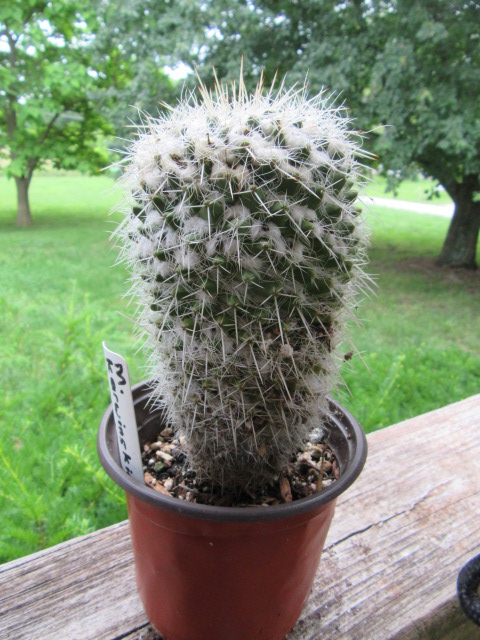
 

8-6-24: First Sweet Corn Harvest Of 2024

Hello everyone! I hope this post finds you well! August 7 was an exciting day with it being the first sweet corn harvest. Waiting for this day can drive one nuts! The anticipation around growing sweet corn can be mentally and physically challenging. Planting sweet corn seed and waiting for several days to see how well it comes up is the first thing, Then waiting to be able to till between the rows since the grass and weeds grow as fast as the seedlings. Then you have to pull up the grass in the rows and maybe do a little thinning since the seeder plants 2-3 seeds per hole. I usually wait for a while to thin to see which seed produces the best plants. Sometimes I may leave two, but usually one. Sometimes it is difficult to choose and I don’t like pulling up a good plant. Then, after a while, the corn has to be hilled up and the suckers removed. I usually do it at least twice, but because of the continual rain, the first planting was only hilled once. Come to think of it, the second planting was only hilled once, too. After the first hilling, the corn was fertilized. This year, all the corn was only fertilized once… It takes some work and a lot of waiting…

Not every stalk produces an ear, but the others seem to have two good ears.

On the first pass. I picked two 5-gallon buckets from the first double row. Sometimes with the first picking, I get anxious and pick several that could have waited a few more days…

A lady from church, who also grows ‘Incredible’, said her sweet corn didn’t have a single worm. Well, nearly every ear I picked had a corn earworm…

Hmmm… That’s likely from a small armyworm… Earworms get in from the top…

Well, no one seems to be at home…

Well, it either moved to the top or…

Oddly, there was no worm to be found… I think it fell off when I was removing the wrapper leaves.

Most of the earworms were a brownish color but some were greenish…

NICE!

Once I was finished shucking the first two buckets, I went back to the garden to take a few shots. Ummm… I should have done that before I started picking…

Not bad, huh?

I took the first round to the house and put them in the freezer. Then I went back again for two more buckets. I started picking a little after 1 PM which was unusual. Normally, I start later in the day because of the heat but it was not hot at all. It was cloudy and windy and looked like it could rain. In all, I have picked 78 ears. That includes six from a few days ago, nine to the neighbor, and six that were given to the chickens that weren’t quite mature…

Until next time, be safe, stay positive, always be thankful, and GET DIRTY!

Sitting on Saturday: A Date With The Green Beans

Hello everyone! I hope this post finds you well. It’s been another hot week! Yesterday wasn’t so bad and there was a nice breeze. As I am writing this post it is 82° F but it is supposed to get up to 90. We did have rain, though this past week. I have been eating lunch at the senior center, and one day one of the ladies across from me looked out the window and said it was raining. I turned around to look and the sun was shining… It was over that fast! Then one night when I was in bed, it started thundering and then poured! It lasted maybe a minute and that was that!

The last planting of sweet corn was looking very dry, so I decided to buy a couple of 50′ soaker hoses. The idea was to cut them in half and attach the ends with pieces of an old hose. It worked great! So, the next day, I moved the soaker hoses to the the first planting. I also gave the cantaloupe a good soaking with the sprinkler a couple of evenings. I still have an aphid issue on the cantaloupe I need to address further.

The green beans needed to be picked AGAIN, so yesterday afternoon I picked a 5 gallon bucket full. The neighbor helped me with the first picking last week, which was maybe close to a half a bucket or so. I gave them all to him because he has been trimming the ditch along the street and around the garden. Earlier in the week, I picked enough to freeze seven quart bags…

I snapped a few yesterday evening, then decided it was time to go to bed… The idea was to work on as many as I could on Saturday.

When I got out of bed, I thought a nice cup of White Mocha Latte from The Pour Poet was in order. Then I wrote this post and sat down with the green beans. I wonder what I will watch on TV? Oh, yeah! I started re-watching The Rings of Power on Prime. Season 2 has started, but I thought I would re-watch season one first.

Until next time, be safe, stay positive, always be thankful and GET DIRTY!

Six on Saturday: Garden Update 7-26-24

Hello everyone! I hope this post finds you well. I just wanted to write a quick post about how the garden is coming along.

I wrote this post on Thursday evening and set the time to publish for Friday at 9 AM. Well, it didn’t work. Here it is 10:40 PM and I am just now checking… I saved it as a draft, so maybe that’s where I messed up… Any suggestions?

I decided to go ahead and make this a Six On Saturday post…

#1) The Sweet Corn ‘Incredible’ is looking great!

The pollination is coming along really well and the honeybees are hard at work collecting pollen.


I saw one collecting pollen, or trying to, where it has collected where the leaves come from the stalk… Those flying around the tassels had their legs full. One was so heavy it was having a hard time flying.


Some of the pollen is really packed…


OH, the carnage! Dead aphids were everywhere on the 2nd planting… I bought a new sprayer. Well, the Neem oil killed most of them when I just sprayed the tops of the stalks the day before. I sprayed Sevin the next day from top to bottom and under the leaves.


#2) The ‘Provider’ Bush Green Beans are still loaded with flowers on top of the plants.


I picked around 3 gallons early Friday evening. My neighbor helped pick them, so I gave him the whole bucket.


#3) The above photo is the biggest ‘Hale’s Best Jumbo’ Cantaloupe. NICE! Friday after the greens were picked, I found A LOT of aphids on the cantaloupe, so I retaliated with Sevin. GEEZ!


#4) One of the ‘Red Duce’ Tomatoes is almost ripe. One of the ‘Celebrity’ is next in line…


#5) I picked the first two ‘Black Zucchini’.

Amaranthus cruenthus ‘Red Spike’.

#6) I had to take a photo of the Amaranthus cruenthus ‘Red Spike’ on my way inside. It seems to get taller every day.

Amaranthus cruenthus ‘Red Spike’.

Pretty neat with all those tiny flowers.

That completes my Six on Saturday kindly hosted by Jim from Garden Ruminations. Be sure to check out the other Six on Saturday posts.

Well, that’s it for this post! Until next time, be safe, stay positive, always be thankful, and GET DIRTY! It will pay off!


Commelina communis var. ludens (Asiatic Dayflower)

Commelina communis var. ludens (Asiatic Dayflower) on 7-25-24, #1010-1.

Hello everyone! I hope this post finds you well. As I started this post at 10:48 AM, it is a sunny Thursday morning at 82° F. It is supposed to get up to 90…

I thought I would highlight the Commelina communis var. ludens (Asiatic Dayflower) that are growing in the north bed in this post. It has been a great year for the Asiatic Dayflower…

Commelina communis var. ludens (Asiatic Dayflower) on 7-25-24, #1010-2.

They have been producing A LOT of flowers for a while and seem to be trying to become a common weed…

Commelina communis var. ludens (Asiatic Dayflower) on 7-25-24, #1010-3.

Commelina communis is an introduced species from several Asian countries. It can be found in North America from the midwest eastward. Commelina communis var. ludens has a much smaller range being found in only a handful of states, and a small range in their native countries.

Commelina communis var. ludens (Asiatic Dayflower) on 7-25-24, #1010-4.

Here on the farm, Commelina communis var. ludens primarily grows in the north bed and several other areas in the yard. This year, they have been pretty abundant…

Commelina communis var. ludens (Asiatic Dayflower) on 7-25-24, #1010-5.

This subspecies features maroon dots on their false anthers which sets them apart from from Commelina communis var. communis.

Commelina communis var. ludens on the left and Commelina communis var. communis on the right on 9-1-19, #620-10.

I had a lot of fun with both of them in 2019 when both varieties were quite abundant. In fact, Commelina communis var. communis had quite a territory in two areas… Strange, but I haven’t found any since 2019…

You will notice Commelina communis var. communis on the right has paler petals and there are no maroon dots on their false anthers. I initially thought they were Commelina erecta, which is a native species with a BROAD range, but I was mistaken…

Commelina communis var. ludens (Asiatic Dayflower) on 7-25-24, #1010-6.

Dayflowers always seem so happy-looking. Perhaps looks are deceiving and those filaments hanging down could be perceived as fangs…

Commelina communis var. ludens (Asiatic Dayflower) on 7-25-24, #1010-7.

Looks like the kids are trying to leave their cradle…

Commelina communis var. ludens (Asiatic Dayflower) on 7-25-24, #1010-8.

Hmmm…

Commelina communis var. ludens (Asiatic Dayflower) on 7-25-24, #1010-9.

The spath-like bracts resemble a taco, folded in the center, with the flowers emerging… One of the distinguishing features of this species is that the spath-like bracts enclosing the flowers are free to the base… In other words, the outer margins of the bract are not fused together from about the midpoint to the base as with C. erecta… With some flowers, they may appear fused, but they can easily be separated. Up to three flowers can emerge from the same bract in succession (usually). The ovaries are formed inside the bracts…

Commelina communis var. ludens (Asiatic Dayflower) on 7-25-24, #1010-10.

The bracts are smoothly rounded, while they have kind of a flat area with C. erecta. I have not personally found any C. erecta, but that’s what the descriptions say.

As with many wildflower species, Commelina communis can be somewhat variable which can make ID more challenging…

I have pages for both varieties which you can view by clicking Commelina communis var. communis and Commelina communis var. ludens

Until next time, be safe, stay positive, always be thankful, and GET DIRTY!

Wordless Wednesday: Proxys punctulatus (Black Stink Bug)

Proxys punctulatus (Black Stink Bug) on 7-24-24, #1009-6.

Four In A Row…

Lathyrus latifolius (Everlasting/Wild Sweet Peas) on 7-26-22, #901-26.

Hello everyone! I hope this post finds you well. I received a notification from WordPress saying I posted 3 days in a row… Hmmm… I couldn’t break very well stop now when I am on a roll!

I couldn’t think of anything to write about, so I thought I would just add a photo of something that has caught my attention for the past week. The Wild Sweet Peas are blooming up a storm that are growing in the ditch have been in flower for a while. Tony Tomeo wrote about them in his Six on Saturday post which got me to thinking about them even more…

I haven’t taken any new photos of them since 2022, but I guess I should. Besides growing in the ditch, they also grow in and around a brush pile (that keeps getting bigger) in an area east of the garden. I am pretty sure they are Lathyrus latifolius. Common names include Broad-Leaved Sweet Pea, Everlasting Pea, Wild Sweet Pea, Perennial Pea, Perennial Peavine, Everlasting Vetchling, Sweet Pea, and probably others.

There are 30 species of Lathyrus that are native to North America but Lathyrus latifolius is native to parts of Europe and Northern Africa. This species made its way to American gardeners in the 1700’s and escaped. Now, they are a common wildflower throughout the country and is even declared an invasive species in some areas.

I remember as a kid there were several growing on the fence between our house and the neighbors. Likely, my grandmother planted sweet peas here which could be the ancestors of what is here today.

Even though there are many cultivars of Sweet Peas available in seed catalogs and online I rarely hear much about them. I have plenty of fences for them to grow on, so I think next year I will give a few a shot… Sounds like a good plan. How about you?

Maybe I’ll find something to photograph for Wordless Wednesday. Heck, it is 11:10 PM. It’s almost Wednesday already… Could it become 5 days in a row?

Until next time, be safe, stay positive, always be thankful, and GET DIRTY!


Silent Sunday: Billbergia nutans (Queen’s Tears)

Billbergia nutans (Queen’s Tears) on 7-21-24, #1008-1.


Billbergia nutans (Queen’s Tears) on 7-21-24, #1008-1.

Garden Update 7-19-24

2024 Garden from the southwest corner.

Hello everyone! Back again so soon. 🙂 I hope this post finds you doing well. I thought it was time I made a post about the garden. It has been a weird summer because it wouldn’t stop raining. I’m certainly not going to complain about the rain compared to the heat and drought last summer. It just takes longer to keep the grass and weeds out of the rows, but it eventually gets done. We haven’t had any rain for a few days and the soil is crusty on top now.

Rhubarb.

Where should I begin? Well, just as well start with the rhubarb… I think it was back in 2o13 (the year I came back home) when dad went to an old friend’s home and brought back some rhubarb plants. He wanted me to plant it in the old flower bed by the northeast corner of the old foundation with the horseradish. I did but it has been iffy for the past several years and I wanted to move it to the garden. On May 28 when my sister and her husband were here plant shopping, I brought home 6 Rhubarb ‘Victoria’.

Rhubarb ‘Victoria’.

I put them in a row next to the tomatoes. I dug their holes and dumped in compost and cow manure and planted the rhubarb… All the plants did very well except for one. It up and died… Rhubarb are clumping plants, so I can fill in the spot.

Rhubarb ‘Victoria’.

Rhubarb ‘Victoria’ is a popular red variety that has been around for many years. I thought I would give it a shot.

Green Rhubarb.

I dug up most of the green rhubarb from the flower bed, divided it, and then filled in the rest of the row. I grew up on green rhubarb so I was very glad when dad brought it home. He had a HUGE patch of it in the garden where I grew up but for some reason, he didn’t bring any here when they moved.

Green Rhubarb.

NICE! There are still a few plants in the flower bed for back-up…

Tomato ‘Celebrity’.

I have grown ‘Celebrity’ for several years since Jim Ruebush of “How I See It” said he planted this variety and recommended it. Most tomato varieties do OK, but this one has done somewhat better than some of the others, so I keep planting it. I really like homegrown tomatoes but it seems like I really haven’t mastered growing them. I think I expect fruit that looks like the ones from the grocery store with the homegrown flavor and juiciness… I have seen other people’s tomatoes and wondered how they look like that? Notice I am not showing you the stem where the fruit is attached… There is a black ring. Perhaps it is from so much rain…

Tomato ‘Red Duce’.

While I was a Mast’s Greenhouse, I ran across a variety I hadn’t seen before called ‘Red Duce’. I decided to give them a shot, and so far they have done very well. I’m not going to say it out loud in the garden, but to be honest with you, ‘Red Duce’ is… UMMM… Outperforming ‘Celebrity’. Now, to be honest with you again, I brought home four of each and two plants of each are doing better than the others. Well, a cutworm destroyed one of the ‘Celebrity’ so there are only three left.

You may have noticed the excessive use of jute twine in the above photos. Well, last summer I watched a video on YouTube from Hoss… He was trellising determinate tomatoes using what he called the “Florida Weave’ so I thought I would give it a shot. The only difference is that he plants two tomato plants between the stakes and I only have one… That’s because I’ve been leaving the stakes in the garden from one year to the next… What is funny is that I thought ‘Celebrity’ was an indeterminate but the tag, which I didn’t pay any attention to until this year, says they are determinate… Hmmm… ‘Red Duce’s is also determinate so I am trying a variation of the Florida weave.

Tomato ‘Pineapple’.

Normally, I plant ‘Goliath’ and an heirloom variety (like ‘German Johnson’), but this year I couldn’t find either one. So, I brought home four ‘Pineapple’ which I had grown before. The plants are going insane…

Yellow Cherry Tomato.

When we had our family reunion, my niece brought a container of cherry tomatoes ith her. They were very good, so I went to Wagler’s Greenhouse to see if they had any ‘Sweet 100’ because I thought I had seen them earlier. Mrs. Wagler said they didn’t have any, but there were a few yellow cherry tomato plants left. She said they were very good so I brought one home to try out.

I grew red cherry tomatoes in Mississippi and several plants would come up every year in the garden where they hadn’t been before. Grandpa always grew red and yellow pear tomatoes in their garden and they would always come up volunteer. I guess perhaps birds eat them which is how the seeds spread…

Black Zucchini.

Hmmm… I learned my lesson with planting zucchini so I only planted one. Next thing I knew two plants were coming up. I must have dropped a seed…

Black Zucchini.

Yep! Already underway…

Cantaloupe ‘Hale’s Best Jumbo’.

I couldn’t find enough cantaloupe last year so I planted my own. I have had less than desirable results with watermelon and I haven’t grown cantaloupe since the 1980’s.

The worst thing about growing melons is tilling around the vines. GEEZ! All those little weeds and the Foxtail popping up here and there…

Sweet Corn ‘Incredible’.

When I moved back here in 2013 and it was time to plant the garden, we went to my cousin’s seed company in Clinton (Miller Seed Company). Several years prior my cousin had recommended the sweet corn ‘Incredible’ when it came out. The local farmer’s co-op had it at $14.00 per pound which was more expensive than any other variety! Mike always gave Dad his seed which was a much better option. Now, I buy it from the co-op for $7.95 per pound… It is one of the best varieties I have grown, so I will keep growing it. I was late getting it planted, June 7, because of the rain. Umm… I could have planted it sooner, but I could hear  dad in my head saying, “It isn’t the right sign yet.” So, I waited until the moon sign said it was time.

A couple of weeks ago, I started having a slight issue with corn borers. The moths lay eggs on the leaves and when they hatch the caterpillars start chewing on the leaves, As they get bigger, they make their way to the rosette of leaves on top and then bore down into the stalk. Well, I couldn’t have that so I bought a Sevin and sprinkled it on the affected corn… The next day I found a couple of dead caterpillars. Then I got to thinking it wouldn’t do much good to use it on the plants that were already damaged, so I bought Sevin as a hose-end sprayer and sprayed the entire garden. Since then, I have hardly seen a bug of any kind… I’m not one to use chemicals in the garden, but I thought it was necessary… The sweet corn is looking great and it looks like there will be a bumper crop…

Bush Green Bean ‘Provider’.

As always, I went to Green Street Market in Clinton to buy green bean seeds. It was no surprise when they were out of ‘Top Crop’, so I bought ‘Provider’ again. Last year I tried three varieties because there was no ‘Top Crop’ and ‘Provider’ came to the rescue because the other two fizzled out from the heat (even though I watered it). As you can tell, the ‘Provider’ is looking great… I still have green beans from last year in the freezer, but I planted more.

Bush Green Bean ‘Provider’.

There are A LOT of flowers and even a few tiny beans here and there. Looks like someone had been nibbling on the leaves…

Sweet Corn ‘Peaches and Cream’.

I also planted four double rows of ‘Peaches and Cream’ sweet corn… I haven’t been able to find ‘Peaches and Cream’ for several years because it was always sold out. I tried ‘Ambrosia’ in its place for a couple of years, but it didn’t do very well. Luckily, I found ‘Peaches and Cream’ this time around and so far it has done well. I finally finished weeding and hilling these four rows after a couple of weeks of rain every few days. Normally, I pile up dirt around the sweet corn several times, but this year only once… I am sure at some point the wind will come and I will have to stand it back up…

Aphids…

Now, there are aphids to deal with… In the past, there have always been beneficial insects to help with the aphids. This year, I have seen very few anywhere. It’s not because I sprayed with Sevin a few weeks ago, either. Well, perhaps that didn’t help, but even where I haven’t sprayed there have been very few.

Bush Green Bean ‘Provider’.

I’m not sure what I was thinking, but I planted a second double row of ‘Provider’… I fertilized the sweet corn but definitely not the green beans.

That’s it for the 2024 garden…

Until next time, be safe, stay positive, always be thankful, and of course, GET DIRTY!


Farewell To An Old Friend…

My  Amorphophallus after I brought them home on 7-1-17, #353-1.

Hello everyone! I hope this post finds you well. It took me a week to write this post because I kept taking more photos…

Tragedy has struck… The above photo is of the two Amorphophallus I brought home from Wagler’s Greenhouse on July 7 in 2017. I picked this pot because not only were there two, but there was also an Oxalis tetraphylla (False Shamrock) with them. Since 2017, the Amorphophallus have produced MANY, MANY offspring (corms) and the Oxalis has done quite well, too.

Amorphophallus konjac (Konjac) on 7-9-24, #1002-.4.

When I took the plants to the front porch, I checked both Amorphophallus by sticking my finger in the hole where the petiole (stem) was before. Both had sprouted but it takes a while for them to emerge from potting soil. After a while, one came up but the other was still way down in the hole. I thought something was weird, so I took the pot to the table on the back porch and removed the potting soil down to the corm. It seemed fine, so I covered it back up. I found several corms that I put in the potting soil along with Oxalis triangularis rhizomes, which I had to remove.

After about a month, the second Amorphophallus started to emerge from the potting soil. Once its leaves unfurled, I saw something very weird… Its leaves were variegated… Hmmm… That never happened before.

Amorphophallus konjac (Konjac) #2 on 7-9-24, #1002-6.

Hmmm… I was very puzzled.

Amorphophallus konjac (Konjac) #2 on 7-9-24, #1002-7.

Well, I went to Facebook and messaged a friend from Alabama, Robert McCracken, and sent the photos. He is an avid plant collector, which is putting it mildly. Then I typed in the browser, “Why is my Amorphophallus leaf variegated?”

Well, a link to the IAS Aroid Quasai Forum came up. It is a forum on the International Aroid Society website. The question I read was similar to mine for this fellow’s variegated leaf on what he believed was an Amorphophallus muelleri. He wrote, “I have what I believe is an Amorphophallus muelleri that has put up a variegated leaf. I don’t believe I have heard anyone mention such an animal. Do I have a sick plant/tuber? Or is this something that happens once in a blue moon?”

There were various answers suggesting nutrient deficiencies or a virus… I checked out the virus and did some reading, but nothing hit the nail on the head as far as I was concerned that would hit the nail on the head, so to speak. The articles I read were more about seed-grown plants in fields where Amorphophallus konjac were grown for medicinal uses. I found out that China grows over 170,000 hectares of A. konjac and around 10% have the virus! It’s either Konjac Mosaic Virus or Dasheen Mosaic Virus. While the Konjac Mosaic Virus is specific to two Amorphophallus species, the Dasheen Mosaic Virus affects several species of members in the Araceae (Aroid) family.

Later on in the evening, Robert messaged me and we started talking. He started mentioning what I already read about the viruses. I told him I already read this and that or he would have started sending links… 🙂 He said he didn’t know much about Amorphophallus and suggested putting photos on a Facegroup called Amorphophallus. He sent a link for me to join, which I did. I wrote a post and submitted the photos and once I was approved to join, the post was up and running.

After a while, there were three comments and 11 likes… Hmmm… LIKES? Two of the comments agreed it was a virus, while the other was completely irrelevant. Apparently, to find out which virus it is I would have to send samples to a lab. Which is also irrelevant… It is a virus! Not only do I have to discard the plant but also the offspring that came up from the corms… It doesn’t matter which virus it is!

The only good thing that came out of this virus is that I am now pretty sure my Amorphophallus is A. konjac… I had been waiting for flowers to figure it out, but instead, it took a virus…

Amorphophallus konjac (Konjac) #2 on 7-14-24, #1004-5.

A lot of questions ran through my mind… How could it contact a virus after 7 years? Why does only one have it when there were two in the same pot for several years? Do I have to get rid of the new plants from the corms in the pot? Being a virus from seed-grown plants, how did my plant get it when it likely came from a corm instead of from a seed? Likely, both plants had the same parent so why does only one have the virus? I moved #2 to the other side of the porch…

Amorphophallus konjac (Konjac) #1 on 7-14-24, #1004-2.

One appears perfectly healthy. I might mention here for those of you who haven’t experienced an Amorphophallus… The corm produces one petiole (stem) which produces a single leaf with many leaflets. The leaf is round in outline (sort of) and it is like a big umbrella. Very neat! It takes several years for the corm to produce a flower from the dormant corm which is what I have been waiting for. Oh yeah, it stinks like rotting flesh…

As of today, Plants of the World Online lists 245 species of Amorphophallus… Until the virus showed its ugly face, I didn’t know for sure what species my plants were. I was pretty sure it was A. konjac since it was likely to be the most common. Amorphophallus is commonly referred to as a Voodoo Lily, Dragon Tongue, Corpse Lily, etc. As it turns out, A. konjac is simply called Konjac…

Amorphophallus konjac (Konjac) #2 on 7-15-24, #1005-7.

It’s sad to have to dispose of my friend of 7 years and its 7 new offspring. Just think I have given away so many of its offspring that are possible carriers of the virus…

I took a lot of photos over several days trying to get a few that were good enough for this post. They are all at the bottom of its own page which you can view by clicking HERE. The page is about my journey with the two Amorphophallus since I brought them home in 2017.

Once looking at all the photos on the page, I realized #2 had always been slow to emerge, something I hadn’t thought about until now. Now, I realize it probably had the virus all along…

Amorphophallus konjac (Konjac) at 32″ tall on 7-15-21, #812-1.

Well, we’ve had some interesting and memorable moments together, but that time is coming to a close with #2. #1 and I will continue… The above photo and the one below were taken on July 15 in 2021.

Amorphophallus konjac (Konjac) plants from the smaller rhizomes on 7-15-21, #812-2.

One of the memorable moments was in the spring of 2021 when I decided to put the larger Amorphophallus in their own pots (before they started sprouting). I wrote two posts when I repotted the Amorphophallus, the last one titled, “Repotting the Amorphophallus & Oxalis triangularis” on April 6, 2021. The above photo was the result of their offspring…

I could add more memorable photos, but you can visit their page…

Sauromatum venosum (Voodoo Lily) on 7-19-24, #1006-1.

Of course, we aren’t alone. The Sauromatum venosum (Voodoo Lily) is on the front porch, too… I bought four corms from a seller on Ebay in 2021 and they are doing quite well. The seller stated in the listing, “These are my own mixed hybrids of a cross between normal venosum and Indian Giant, you can get these anywhere else.” Plant Delight’s says, “Sauromatum venosum ‘Indian Giant’ is similar to the species, except the tropical-looking leaves are about trice as large (up to40” across), and the stalk is a dusty light-green with fewer, but much larger, black freckles. This stem pattern is much more dramatic than the typical form and, so far, it has proven equally as hardy.” I’m not sure if they misspelled twice or if they meant 3 times the size…

Monarch of the East is another common name for Sauromatum venosum if you want a name that isn’t so dark sounding…

Sauromatum venosum (Voodoo Lily) on 7-19-24, #1006-2.

How’s that for a leaf? Umm… I’m not finished with its page yet…

Well, that’s it for this post! NEXT, I will post about the garden…

Until next time, be safe, stay positive, and ALWAYS be thankful. GET DIRTY!


New Plants Update

Aegopodium podagraria (Snow In The Mountain/Goutweed) on 7-5-24, #1000-1.

Hello everyone! I hope this post finds you well. I thought I would write a post about the new plants I brought home in 2024. Some of the new plants complained because I didn’t write a new post when I brought them home, so this is an apology to them. A few are grouping together and are still snubbing me. GEEZ!

Some plants listed are replacements and already have a page (highlighted in green) but most are new and have no page YET. In alphabetical order…

<<<<#1>>>>

I remembered my grandma Miller having plants along the back of their house that were green and white variegated. I didn’t know what they were called and couldn’t find any locally. I saw a house on Main Street that had A LOT next to their house but I didn’t want to stop and ask for a start…

Finally, I found a few at Wagler’s Greenhouse on May 25. Well, of course, I had to grab one. I really knew nothing about their behavior, or even their name, until I drug a photo onto iNaturalist… I think drug is an appropriate word for drag and drop. Anyway, Aegopodium podagraria is the scientific name for this plant that, according to information online, will soon become “plants” as it is a spreader. The common name is Goutweed while the variegated form is usually called Snow-In-The-Mountain… Umm, a different species is called Snow On The Mountain so we don’t want to get confused. Time will tell if I actually want it in the north bed but I can’t hesitate if I choose to relocate it. I read it can be hard to get rid of…

<<<<#2>>>>

Aloe x ‘Amethyst’ on 7-5-24, #1000-2.

I really like Aloe, so when I find a new one of interest I have to bring it home. This Aloe x ‘Amethyst’ caught my eye at Lowe’s on May 9 so I brought it home. Its leaves are definitely unique with all the lumps and strangely toothed margins.

<<<<#3>>>>

Aloe x ‘Pink Blush’ on 7-5-24, #1000-3.

Then on May 10, I ran across this Aloe x ‘Pink Blush’. I had one before, in 2014, that I guessed was ‘Pink Blush’ although it was unlabeled. This time it had a label. Well, I brought it home…

<<<<#4>>>>

Aloe humilis (Hedgehog Aloe) on 7-5-24, #1000-4.

Then there was this really spiny Aloe at Walmart on May 6 I put in my cart (not alone). This one was unlabeled and I had a heck of a time deciding what it was. I put photos on a couple of Facebook Groups and it seemed, at first, one of the suggestions for Aloe x spinosissima could have been correct. But, when I looked up information online, I hoped it wasn’t. Then, while adding captions to the photos I remembered putting the photo on the SucculentGuide Forum. I checked the post I made and several members posted suggestions that didn’t match this plant. One, however, suggested Aloe humilis (Hedgehog Cactus). I happily changed the caption because I like it much better. I’m certainly hoping it is an Aloe humilis

<<<<#5>>>>

Amaranthus cruentus ‘Red Spike’ (Red Amaranthus) on 7-5-24, #1000-5.

I spotted several Amaranthus cruentus ‘Red Spike’ (Red Amaranthus) at Wagler’s Greenhouse on June 11. At first, I just looked at them as I passed by but then turned around and picked one up. Hmmm… I haven’t grown any Amaranthus since 2012. It has grown A LOT!

Amaranthus cruentus ‘Red Spike’ (Red Amaranthus) on 7-5-24, #1000-6.

Now it has a bud…

<<<<#6>>>>

Coleus ? on 7-5-24, #1000-7.

I haven’t grown any Coleus (Coleus) for several years because I couldn’t find any suitable. I found this one at Wagler’s on May 20 that looked similar to one of the Kong Series so I brought it home. It has done quite well but the flowers need to be removed… I have grown some nice Coleus, and this one is proving itself quite well.

<<<<#7>>>>

Euphorbia ferox (Pincushion Euphorbia/Thorn Noors) on 6-5-24, #1000-8.

You know I couldn’t pass this thorny guy up when I found it at Walmart on May 6. Euphorbia ferox is called Pincushion Euphorbia on many websites, but iNaturalist says its common name is Thorn Noors. Hmmm… I’m not sure what that means but the thorn part is quite evident. If you look closely, you can see small leaves. Yep, it is a Euphorbia… It isn’t fond of being touched…

<<<<#8>>>>

Thelocactus setispinus (Miniature Barrel Cactus) on 7-5-24, #1000-9.

This Thelocactus setispinus (Miniature Barrel Cactus) was the featured photo in the last post. It has had many buds, but it has been somewhat difficult to see them open. I watched every day and all I would see was buds about to open, then the next day they would be wilting like they had already opened. The few times I did see them, they would be fully open for several days. What the heck is that? Now there are three at once… I hope it doesn’t bloom itself to death.

*NOTE: Originally, I thought this cactus was Ferocactus hamatacanthus (Turk’s Head), but thanks to an anonymous reader, I changed the name. So, in alphabetical order, now it should be on the bottom…

<<<<#9>>>>

Geranium pratense ‘Boom Chocolatta’ on 7-5-24, #1000-10.

This Geranium pratense ‘Boom Chocolatta’ is from Muddy Creek Greenhouse that I brought home on May 10. It has very dark green leaves and now it has flowers. NICE!!! Muddy Creek usually sells out early, so I was fortunate this one was still there.

Geranium pratense ‘Boom Chocolatta’ on 7-5-24, #1000-11.

How’s that for a happy leaf? I put this plant between the steps on the north side of the house and an Achillea millefolium… The Achillea was taller, so the Geranium had to grow even taller to strut its stuff.

<<<<#10>>>>

Geranium pratense ‘Johnson’s Blue’ on 7-5-24, #1000-12.

I have wanted a Geranium pratense ‘Johnson’s Blue’ for many years and Wagler’s has several to choose from. I didn’t bring one home until May 28 because I didn’t know where I would put it. Finally, I brought one home anyway… On the third trip… It set in its original pot for so long that it started objecting about its roots getting cramped up. SO, I put it in the northeast corner bed next to the steps. Ummm, between the Amaranthus ‘Red Spike’ and Echinacea purpurea I put there previously…

Hmmm… I moved an Echinacea purpurea to this spot because it came up right next to the Phlomis ‘Edward Bowles’ in the southeast corner bed. Edward objected so I moved the Echinacea. When my sister was here plant shopping, when I first saw the Geranium ‘Johnson’t Blue’, I had a plan to give her the Echinacea so I could go back and get the Geranium. Well, it didn’t work… She wants this and that, but for some reason, she doesn’t want a Purple Coneflower…

Geranium pratense ‘Johnson’t Blue’ on 5-28-24, #994-3.

The above photo was taken of its flower when I brought it home on 5-28-24… NICE!

<<<<#11 & 12>>>>

Heuchera sanguinea ‘Coral Forest’ on 7-5-24, #1000-13.

OK, so Wagler’s had quite a few Heuchera but I was somewhat confused. There were plants with variegated leaves and some with plain green leaves all in the same flats. Some of each had the same label that said Heuchera sanguinea ‘Coral Forest’. I brought home one of each on May 25. A few days later, I went back and there were other flats farther down the greenhouse that were the same but with other labels… Some said Heuchera americana ‘Dale’s Strain’ and others said Heuchera sanguinea ‘Firefly’. Hmmm…

Heuchera americana ‘Dale’s Strain’ on 7-5-24, #1000-14.

I did some research and found out that H. ‘Coral Forest’ has variegated leaves, H. ‘Firefly’ has green leaves, and the leaves of H. ‘Dales Strain’ start out green then they develop olive-green markings… At first, I thought I must have an H. ‘Coral Forest’ and an H. ‘Firefly’. The next thing I knew, ‘Firefly’ became ‘Dale’s Strain’. GEEZ!!!

Now, I have to back up a little. In the spring of 2023, I moved the Hosta and Heuchera from the shade bed to the bed along the north side of the house (the north bed). I had lost several and wanted them replaced. So, on May 6 I went to the Green Street Market (a garden center) in Clinton since they always have a good selection of Hosta.

<<<<#13>>>>

Hosta ‘Dancing Queen’ on 7-5-24, #1000-15.

At Green Street, I found a Hosta ‘Dancing Queen’ to replace the one that the deer destroyed in 2021. Only one leaf came up in 2022 then it fizzled out… The new one likes its new spot except for one thing. The Viola sororia are rather pushy…

<<<<#14>>>>

Hosta ‘Guacamole’ on 7-5-24, #1000-16.

The Hosta ‘Guacamole’ also didn’t return in 2024 so I was happy I found a good selection at Green Street. What would a Hosta collection be without this one? As you can see it is looking great and getting ready to flower.

<<<<#15>>>>

Hosta ‘Patriot’ on 7-5-24, #1000-18.

The Hosta ‘Patriot’ is a new one I decided to bring home from Green Street. It is doing well and it has already produced flowers. No page yet…

<<<<#16>>>>

Hosta ‘Krossa Regal’ on 7-5-24, #1000-17.

Then on May 10, I found a Hosta ‘Krossa Regal’ to replace the one that didn’t return in the shade bed in 2023. I had it since 2009… It is OK but seems a little bewildered by so much company… Ummm… Its color is a bit off, too.

<<<<#17>>>>

Kumara plicatilis (Fan Aloe) on 7-5-24, #1000-19.

For #17 is the Kumaria plicatilis (Fan Aloe) from Walmart on May 20. The label said it was Aloe plicatilis, but it was given a new name in 2013. Ummm… The genus name, Kumaria, was conserved and there are only two species in the genus. The other was renamed in 2014. I thought it was a neat plant but after reading about it I found out it can get quite large and tree-like. Hmmm… Perhaps the tag is totally wrong and it is the other species, Kumara haemanthifolia which is a low-growing species. Well, I guess time will tell…

<<<<#18>>>>

Orostachys malacophylla var. iwarenge (Chinese Dunce Cap) on 7-5-24, #1000-20.

Probably the weirdest plant I brought home this year is the Orostachys malacophylla var. iwarenge (Chinese Dunce Cap) I found at Wagler’s on May 28. It is native to Northern China Mongolia, and Japan and it is cold hardy in USDA Zones 5-10. Hmmm… It is a member of the plant family Crassulaceae and its growing habit is similar to Hens and Chicks. It is named for its “spires of silvery lavender cone-shaped rosettes.” As you can probably guess, it spreads from the runners. So far, it seems happy here, but time will tell. According to what I read about its “needs”, it should be repotted into a more suitable potting mixture…

<<<<#19>>>>

Parodia concinna (Sun Cup) on 7-5-24, #1000-21.

I found this Parodia concinna (Sun Cup) at Lowe’s on May 9. I brought this one home because it had several buds. The label said it was a Notocactus elegans, but there was no such accepted name in the Notocactus genus… Notocactus species were mostly moved to the Parodia genus some time back. I put photos on a couple of Facebook groups and the Cactiguide Forum. Several names were suggested which I checked out but none clicked. Finally, someone suggested Parodia ottonis which is a synonym of Parodia concinna. BINGO! It is a short, squatty fellow with a concaved apex which sets it apart from most members of the genus Parodia… There were a few other possibilities, but I am sticking with Parodia concinna.

Parodia concinna (Sun Cup) ? on 5-12-24, #990-2.

How’s that for a flower? It bloomed several times, once with two flowers at once. The above photo was taken on May 12…

<<<<#20>>>>

Pelargonium denticulatum (Tooth-Leaved Pelargonium) on 7-7-24, #1001-1.

Hmmm… I needed photos for the Pelargoniums, but when I was taking photos on July 5 they weren’t looking so hot. Well, I think they were hot and needed water. They looked much better after a good drink. Then on the 7th, they were in too much sun when I was working on the post, so I decided to take a nap. It was sprinkling when I woke up but I stood back under the roof and zoomed in a bit to get a couple of shots.

I found the above mislabeled plant at Wagler’s on May 28. The label said “Mosquito Plant” and said the name was Pelargonium citronellum. I could have easily called it that but the photo on the tag wasn’t the same as the plant I brought home. I had already figured out the above plant was Pelargonium denticulatum (Tooth-Leaved or Toothy Pelargonium) but I became stumped. I had a previous Pelargonium denticulatum in 2014 that looked completely different with more frilly leaves. Then I found a website belonging to a Pelargonium specialist from Greece. It is an awesome site and the Pelargonium denticulatum on her site had leaves like the one in the above photo. Well, she has a Facebook page, so I messaged her. I sent her photos of this plant and the one below. She, like me, said they were P. denticulatum and P. quercifolium like I thought. One thing led to another and I wound up sending photos of the Geraniums in the flower bed and the two native species…

OH, when I sent her a photo of the P. denticulatum from 2014, she replied that it looked like a cultivar called ‘Filicifolium’… Well… The caption under the photo and on its page says Pelargonium denticulatum ‘Filicifolium’… Before she had messaged me back, I had already looked it up online and had a good laugh. The cultivar has more frilly leaves. I wrote the page about it in 2014 which was transferred to this site in 2017. Ummm… That’s all I have to say about it…

If you want to learn more about Pelargoniums, go to Pelargonium Species World. If you have bought a Pelargonium, the name on the tag is likely incorrect like both of mine this year. Click HERE to go to the photo gallery and scroll all the way down for a chart with leaves. There you can click on a links to the various species that match the leaf shapes.

Pelargonium denticulatum (Tooth-Leaved Pelargonium) on 6-29-24, #999-4.

The above photo of the flowers of P. denticulatum was taken on June 29. Oh yeah, it has a caption…

<<<<#21>>>>

Pelargonium quercifolium (Oak-Leaved Geranium) on 7-7-24, #1001-2.

I brought this Pelargonium quercifolium (Oak-Leaved Geranium) home from Walmart on May 20. It had a dangly tag that said… Well, I’ll just show you a photo…

Hmmm…

The back of the tag says “Selection of Pelargonium Crispum or Quercefolia”… Well, it isn’t a P. crispum and P. quercifolium is spelled wrong. 🙂 As far as either one being a mosquito shocker… There are still mosquitos on the back porch. I didn’t buy them to repel mosquitos although they both smell very good.

Pelargonium quercifolium (Oak-Leaved Geranium) on 6-21-24, #997-2.

As the caption says, the above photo was taken on June 21.

<<<<#22>>>>

Peperomia graveolens (Ruby Peperomia/Ruby Glow) on 7-5-24, #1000-22.

When I went to Mast’s Greenhouse last year, I spotted a couple of Peperomia graveolens (Ruby Peperomia/Ruby Glow) in one of Mr. Mast’s daughter’s private collection. She reluctantly gave me a cutting which didn’t work out so well. This year, there were a few available for sale so, of course, I brought one home. It is doing fine so far but it seems to be a slow grower. Of course, it needs a better potting mixture since it is in commercial potting soil…

<<<<#23>>>>

Ptilotus exaltatus ‘Joey’ (Pink Mulla Mulla) on 7-5-24, #1000-23.

The strange flowers of this plant caught my eye when I was at Wagler’s on May 25. There was no label or tag so I used the drag-and-drop feature on iNaturalist. To my surprise, it came up with the name Ptilotus exaltatus (Pink Mulla Mulla). Then I checked online and came up with a cultivar called ‘Joey’. The species is an annual native to Australia… It has done OK, but I don’t think it likes as much rain as we have gotten lately.

<<<<#24>>>>

Selenicereus anthonyanus (Fish Bone Cactus/ Zig Zag Cactus) on 7-5-24, #1000-24.

On my fifth and final trip (so far) to Wagler’s on June 12, I found this Selenicereus anthonyanus (Fish Bone Cactus, Zig Zag Cactus). I asked Mrs. Wagler what it was, and she gave it to me. Well, I asked what it was not because I wanted it, but how could I refuse? According to the Wikipedia article, it was first discovered in 1946 and first flowered in captivity in 1950. It is a rarely collected and most plants in cultivation descend from the first collection. It is an epiphyte growing in trees whose stems are ascending or climbing, branching in clusters at intervals along the stem. The flowers in the photos are quite interesting, but it flowers at night and only for one night… Other common names include Rickrack Cactus and St. Anthony’s Rickrack. Hmmm…

I am finally finished with this post and I promise I will get another one ready soon. Probably about the garden.

Until next time, be safe, stay positive, be thankful, and GET DIRTY!

HAPPY FORTH OF JULY!

Thelocactus setispinus (Miniature Barrel Cactus) on 6-23-24, #998-2.

Helly everyone! Happy Fourth of July! The festivities at the park were canceled about a week ago because rain was in the forecast. Indeed, it was in the forecast right up until last night. I checked the weather one last time before I went to bed last night and a storm was on the way. It came with heavy rain for a few minutes then I went to sleep. I woke this morning with the birds singing and the sun was shining. I thought that was weird… I got up, went to the kitchen, then checked the rain gauge. There wasn’t hardly a cloud in the sky and the rain gauge only had 1/10″… No rain in the forecast until after 5 PM. You would think the planners of the Fourth of July festivities at the park would realize the weather is unpredictable and they wouldn’t have canceled the events. Everyone would know if it is raining the events would be canceled. Now we have a perfectly nice day and nothing is going on at the park… The fireworks have been rescheduled for Saturday evening.

OH, our local newspaper will no longer be published after July 5… The owners of the local newspaper publishes several weekly newspapers for other smaller communities. All will cancelled and their local offices closed… I’m not sure where the main office is, but it’s a sad thing to have to close for these smaller communities that have poor circulation. I think the Windsor Review has been in business since 1870…

The above photo is of the Thelocactus (Miniature Barrel Cactus) I spotted at Walmart on May 6. It already had several buds so I brought it home… It had had several flowers and it at it again… Well, I didn’t just bring that one home…

Anyway, I am still alive and well although I haven’t posted anything lately. I guess I need to catch up… The garden is late but looking great. It’s muddy now because of the rain which is much different than last summer…

Until next time, be safe, stay positive, and GET DIRTY!


New Plants for 2024 (So Far)…

New Hosta on 5-6-24.

Hello everyone! I hope this post finds you well. We had more rain during the night… Last Monday I went to the Green Street Market in Clinton (Missouri) to get a few garden seed. Well, it didn’t stop there… I browsed their plants and my feet took me to there selection of Hosta. Last year I moved the Hosta and Heuchera to the bed along the north side of the house because of the mole issue in the former shade bed. I had lost several so I needed to replace them. Well, maybe I didn’t need to but I just wanted to. Green Street always has great plants and their Hosta are always great.

Hosta ‘Dancing Queen’ on 5-6-24, #987-10.

I was glad I ran across this Hosta ‘Dancing Queen’ to bring home to replace the one I lost in 2022. The deer ate it to a point it never recovered in 2021 and onle one sprout came up in 2022 and then it just fizzled out. I brought it home in 2017 and it was always a big hit. Hosta ‘Dancing Queen’ is so bright cheerful you can see it from quite a distance. This hosta was introduced by Kent Terpening and Alttara Scheer in 2005.

Hosta ‘Guacamole’ on 5-6-24, #987-11.

I just had to bring home another Hosta ‘Guacamole’ to replace the one that didn’t return in 2023. I brought home the first one in 2014 and we never had any problems until the moles started messing with its roots in 2018. GEEZ! We had our issues after that and I even moved part of it to another location in the shade bed, then back again… It came back great then barely any sprouts came up in 2022. It didn’t return in 2023. Hosta ‘Guacamole’ is a multiple-award winner introduced by Bob Solberg in 1994. I am so glad to have another one!

Hosta ‘Patriot’ on 5-6-24, #987-13.

I decided to bring this Hosta ‘Patriot’ home to see what it would be like. I don’t know much about it yet, so we shall see what it does. I went to the Hoata Helper website to check it out, but unfortunately, the site wasn’t cooperating… Hmmm… Anyway, I will give it a shot.

From Green Street Market, I needed to go to Walmart for a few things and somehow wound up in the garden center…

New Cactus and Aloe on 5-6-24.

I have brought home quite a few cactus and succulents from Walmart over the years and have had mixed results. I still have a few of them, but you know how plants are. Some do well and others don’t. The ridiculous thing is the labeling not being accurate or just saying “succulent” or “cactus”. DUH! Then I have to figure out what species. I keep telling myself not to bring home plants without a proper label, but when I find one I really like that rule doesn’t seem to apply… The rack of smaller pots of cactus and succulents looked fairly pitiful but there was a rack of bigger plants that looked pretty good. So good most of them had a shocking price of $24.95!  Well, that price was out of the question! I looked around and found 3 plants I hadn’t grown before that were reasonable enough…

Aloe humilis (Hedgehog Aloe) on 5-6-24, #987-1.

Hmmm… The tag on this pot says it is an Aloe. GEEZ! Here we go AGAIN! I took photos and put them on the Facebook group called Succulent Infatuation like I have before with great results. This time it wasn’t so favorable but one suggestion was Aloe x spinosissima (Spider Aloe). Then later on, someone on the SucculentGuide Forum suggested Aloe humilis (Hedgehog Aloe). I decided that was much more favorable, so I am sticking with it…

Aloe humilis (Hedgehog Aloe) on 5-6-24, #987-2.

The plant seemed in great shape and who could resist a thorny Aloe?

Euphorbia ferox (Thorn Noors/Pincushion Euphorbia) on 5-6-24, #987-3.

Then there was this interesting plant that was correctly labeled Euphorbia ferox. Well, I like Euphorbia and they always do well so I put it in my cart.

Euphorbia ferox (Thorn Noors/Pincushion Euphorbia) on 5-6-24, #987-4.

The common names include Thorn Noors (iNaturalist) and Pincushion Euphorbia (Llifle) which seems to be the most common of common names… I like its thorns and small leaves that have just started growing. Ummm… Its stems seem to have a waxy sheen that I’m not sure was added or if it’s a normal thing. If it was added, why only this pot? I guess I’ll have to see what happens to its glow… Maybe it will fade like a car eventually does after a good wax job…

Thelocactus setispinus (Miniature Barrel Cactus) at 3 1/2″ tall x 3 1/2″ wide after I brought it home on 5-6-24, #987-12.

Then there was this gem of a cactus I had to put in the cart. Ummm… It did have a label that says Hamatocactus hamatacanthus. As it turned out, that name is a synonym of Ferocactus hamatacanthus with the common name Turk’s Head. Then an anonymous blog reader suggested Thelocactus setispinus (Miniature Barrel Cactus). After a little research, I think they were correct. I changed the name…

Thelocactus setispinus (Miniature Barrel Cactus) on 9-6-24, #987-13.

This cactus seems to be in good shape besides a few scars and missing spines. It is good-sized at 3 1/2″ tall x 3 1/2″ wide (without the thorns) and has several buds…

Thelocactus setispinus (Miniature Barrel Cactus) on 5-6-24, #987-14.

The largest bud has looked like this for several days. The anticipation for it to fully open is exhausting! Its fully open flower could be a clue to what the species name really is (unless it’s a hybrid)…

Then on May 9, I had to go to Sedalia so I stopped by Lowe’s. I debated stopping and passed the first entrance and drove in the second… My higher self said it would be OK. GEEZ!

I walked through the garden center and then inside because I had to go to the restroom. Then I walked back to the inside garden center to check out the cactus and succulents. Well, it was very disappointing and they were mostly in a pitiful state. Then I went to the outside garden center and walked around quite a bit. Their plants were great and I found a few perennials I thought about bringing home, but then put them down. I left with only two plants…

Aloe x ‘Amethyst’ on 5-9-24, #988-1.

I found this Aloe x ‘Amethyst’ one of the racks inside I decided to rescue. It looked pretty good although somewhat pale from being in low light. We’ll see how this one does… At least it had a correct label to go with it…

Parodia sp. on 5-9-24, #988-5.

I found this one with four buds, one almost open, that I decided to grab. The label said Notocactus elegans which, of course, was not correct. I’ve gone through that before with Notocactus… The genus is a synonym of Parodia and there is no such species name as Notocactus or Parodia elegans. So, it gets labeled Parodia sp

Parodia sp. on 5-9-24, #988-6.

This one is interesting because it is one of those cacti that is, umm, concave at its apex. Kind of like someone sat on it. While it is only 1 1/8″ (ish) tall, it is 3 1/8″ wide.

Parodia sp. on 5-12-24, #990-2.

The flower didn’t fully open until 5-12-24…

I lost my two Parodia lenninghausii to mealy bugs after I had them for several years. Information online said it would take 10 years for them to flower, and maybe not even then. It makes me wonder how old this cactus is, or any of them in my collection for that matter.

Then, on May 10 I went to the three local greenhouses…

Aloe x ‘Pink Blush’ on 5-10-24, #989-1.

I went to Wagler’s first because I needed to check out their tomato plants. They sold out of ‘Celebrity’. They had a lot of tomato plants but I just brought home 4 ‘Pineapple’ and this Aloe x ‘Pink Blush’. I brought one home in 2014 that I murdered, so I’ll give another one a shot.

Hosta ‘Krossa Regal’ on 5-10-24, #989-3.

I was very happy to find a replacement for the Hosta ‘Krossa Regal’. I bought my first one in 2009 while I was in Mississippi and brought here in 2013. It always did very well until the deer kept eating all three clumps in 2021. Only one came up in 2022 and didn’t do well. When I moved the Hosta to the new bed in 2023, there was only one very small plant that I put in a pot. It didn’t do well and didn’t return this spring. I am very glad to have a new one. What would a Hosta bed be like without ‘Krossa Regal’?

Then I went to Mast’s Greenhouse on the other side of town…

Peperomia graveolens (Ruby Peperomia/Ruby Glow) on 5-10-24, #989-4.

Last year Mr. Mast’s daughter gave me a cutting of her Peperomia graveolens (Ruby Peperomia/Ruby Glow) but didn’t have any luck with it. She had three good-sized plants, but she was saving them to take cuttings of. Luckily, she had better luck and Mast’s had several available for sale. I’m not sure how many kids Mr. Mast has, but this daughter is maybe 14… She had her own private collection…

I also bought four ‘Celebrity’ and four ‘Red Duce’ tomato plants while I was there…

Well, I had to go to Muddy Creek Greenhouse since it was right down the road. This is one greenhouse you have to go to early because they seem to sell out sooner than the others. Well, Wagler’s buys more plants throughout the season so they never run out until the end. Muddy Creek only had a few plants left, but…

Geranium pratense ‘Boom Chocolatta’ on 5-10-24, #989-2.

I found this Geranium pratense ‘Boom Chocolatta’ I decided to bring home. I really like its dark leaves and I will put it next to the steps on the north side of the house.

I haven’t found anything to put on the east side of the steps yet, and didn’t plant any Colocasia (yet). I may bring home more plants at some point, but maybe not… Last year’s drought has made me rethink how many beds to try to maintain. So far this year we have had enough rain to last about all summer! GEEZ! The garden isn’t even tilled yet. 🙂

Well, that’s it for this post. Until next time, be safe, stay positive, always be thankful, and GET DIRTY!

5-3-24: Second Wildflower Walk of 2024…

Hello everyone! I hope this post finds you well and enjoying your spring. I apologize for this post being somewhat late. I don’t really have a good reason for being late, but I have been fairly busy doing other things.  During the winter I watched more movies after dinner rather than spending more time on this site once updates were made. Then spring came and I was still stuck in slow motion.

I finally made it back to Kevin’s woods on May 3 after a downpour. I had hoped to get back to the woods before because I needed more photos of several wildflowers growing there. I especially needed photos of the White Fawnlily (Erythronium albidum) because I have yet to get photos of its flowers. They supposedly bloom March-May. On the last visit on March 31, there were ALOT of White Fawnlily along the creek and the hillside. Well, folks, on May 3, there were none to be found… If they bloomed, they had already gone dormant. GEEZ! A lot can happen in these woods along the creek after a downpour, and that happened as well. The creek overflowed and I could tell there had been a few landslides covering up most of the Cut-Leaved Toothwort and Dutchman’s Breeches. Their flowers were all gone… I hoped they were still there so I could get more photos… GEEZ!

Arisaema draconitum (Green Dragon) on 5-3-24. #986-1.

There wasn’t that many Arisaema draconitum (Green Dragon) this time and what I did find weren’t blooming yet…

Arisaema triphyllum (Jack-In-The Pulpit) on 5-3-24, #986-3.

There were more Arisaema triphyllum (Jack-In-The-Pulpit) than Green Dragon, but I only found one with a flower. They weren’t as plentiful as usual either. It could have been because of the drought last summer.

I walked up the steep hillside and crossed the fence… This can be a challenge but there are a few wildflowers I needed to locate.

Ellisia nyctelea (Aunt Lucy) on 5-3-24, #986-9.

I did find plenty of Ellisia nyctelea (Aunt Lucy) on the hillside to photograph. This is a new species for me for 2024 so I don’t have a page for it yet…

Ellisia nyctelea (Aunt Lucy) on 5-3-24, #986-12.

I was very glad several plants had flowers. They are fairly small and dangle downward from fairly long hairy pedicels.

Ellisia nyctelea (Aunt Lucy) on 5-3-24, #986-14.

Some of the plants also had fruit. I am working on getting a new camera so I can take better close-ups without having to use a magnifying glass…

Once I took several photos of Aunt Lucy, I headed farther south along the fence toward the other fence, but not quite all the way there… Kind of hard to explain, but I knew where I was headed to find one of the most special plants in Kevin’s woods… I have only found one, and this is the only place I have ever seen them.

Triosteum perfoliatum (Perfoliate Tinker’s Weed) on 5-3-24, #986-33.

The Triosteum perfoliatum (Perfoliate Tinker’s Weed) is such a magnificent plant. In my opinion, any plant with perfoliate leaves is awesome! This plant grows really fast, and by May 3 it had already grown nearly waist high.

Triosteum perfoliatum (Perfoliate Tinker’s Weed) on 5-3-24, #986-34.

It is a member of the Honeysuckle family Caprifoliaceae and has very interesting flowers.

Triosteum perfoliatum (Perfoliate Tinker’s Weed) on 5-3-24, #986-35.

By now, the flowers are much longer. I first found this plant by chance on May 10 in 2020 and it has always been the highlight of my trips to Kevin’s woods. It only grows in one spot and finding it after the undergrowth starts growing is very difficult.

Botrypus virginianus (Rattlesnake Fern) on 5-3-24, #986-4.

When I was getting ready to leave the woods, I stumbled upon a Botrypus virginianus (Rattlesnake Fern). I was surprised since I hadn’t found any ferns growing in Kevin’s woods before. I always thought it was odd since these woods would make a perfect habitat for ferns. I first identified this species growing in the woods along the Rock Island Spur of the Katy Trail along the south side of the farm in 2022. Sorry, I don’t have a page for it yet…

As I was getting ready to leave…

Viola eriocarpa (Smooth Yellow Violet) on 5-3-24, #986-37.

What used to be Viola pubescens (Downey Yellow Violet) is now Viola eriocarpa (Smooth Yellow Violet)… Ignore the Persicaria virginiana (Jumpseed) in the photo… Anyway, Viola pubescens used to be very unique with its yellow flowers and fuzzy fruit but unfortunately, a former synonym, Viola pubescens var. eriocarpon is now the accepted Viola eriocarpa

Viola eriocarpa (Smooth Yellow Violet) on 5-3-24, #986-38.

While Viola pubescens is still an accepted scientific name, it has been discovered Viola eriocarpa is much more widespread… So much so that most of the observations submitted to iNaturalist are actually V. eriocarpa. Ummm… Viola pubescens have basal leaves while in flower and fruiting, while V. eriocarpa doesn’t. I suppose the above photo confirms V. eriocarpa in Kevin’s woods since there are no basal leaves. Hmmm… Now I have to update the page properly and change the captions under the photos. GEEZ!

That’s it for this post! I have photos of new plants including new Hosta, Aloe, cactus, etc. I didn’t get too carried away with new plants this year… A new post is coming soon.

Until next time, be safe, stay positive, always be thankful and GET DIRTY!

3-31-24: First Wildflower Walk of 2024…

Hello everyone! I hope this post finds you well. We finally had a good soaking on Monday! Lighting, thunder, and lots of rain! The rain gauge said 1 3/4″ in the end.

I went Moral mushroom hunting on Saturday and found around 20, but most of them were on the small side so I left them behind. I found a few that were big enough to fill a 9″ skillet.

Then on Sunday, the day before it rained, I went to my friend Kevin’s secluded woods to look around. I didn’t go in 2023, so I was glad to get back in the woods again. This woodland isn’t really that secluded since it is along the highway, but it is very healthy. Normally, the creek is running but it was mostly dry this time. This rain will get it going and likely wash out a few areas along the hillside. Even though 1 3/4″ doesn’t sound like that much, a little goes a long way in a downpour when the water is going down a steep hillside.

Cardamine concatenata (Cut-Leaved Toothwort) on 3-31-24, #981-1.

There were A LOT of Cardamine concatenata (Cut-Leaved Toothwort) growing on the hillside along the creek. Many were blooming quite well, while even more hadn’t started yet. Most of the flowers were wide open this time.

Cardamine concatenata (Cut-Leaved Toothwort) on 3-31-24, #981-2.

I need to go back to the woods to get photos when they set fruit, dry, and split… I have to replace the ones I borrowed. 🙂

Claytonia virginica (Virginia Spring Beauty) on 3-31-24, #981-3.

There were loads of Claytonia virginica (Virginia Spring Beauty) in several areas along the creek and on the hillside in Kevin’s woods. In 2020 I found a single plant growing close to the fence in the southeast pasture (where I live), and about 20 feet away there A LOT more.

Claytonia virginica (Virginia Spring Beauty) on 3-31-24, #981-5.

Then in 2022, I found hundreds in Kevin’s woods… And again in 2024.

Dicentra cucullaria (Dutchman’s Breeches) on 3-31-24, #981-11.

The Dicentra cucullaria (Dutchman’s Breeches) were just as plentiful as the Cardamine cucullaria and they grow together in many areas. I am going out later to dissect a flower because they are very interesting… Not only do the flowers have nectar glands in a weird place, but the seeds have masses of elaiosomes which ants use as food. They carry the seeds back to their nests and discard them which aids in the spread of the plants.

Dicentra cucullaria (Dutchman’s Breeches) on 3-31-24, #981-10.

I wrote descriptions for this species on March 5 and really learned A LOT. If you want, you can click on the link to its page above to check out the detailed photos I borrowed. I want to dissect a flower to check its inside out for myself and hopefully get a few good close-ups… Practice makes perfect. 🙂

Ellisia nyctelea (Aunt Lucy) on 3-31-24, #981-12.

I climbed the steep hillside and crawled under the fence to look for a certain plant and ran across several colonies of a species I hadn’t identified before. I took a few shots and uploaded them on iNaturalist for an ID and they turned out to be Ellisia nyctelea, commonly known as Aunt Lucy… Hmmm… It is currently the only species in the genus. There were none with flowers, but the Missouri Plants website says they bloom from April to June. Maybe next time I go out there will be flowers.

Ellisia nyctelea (Aunt Lucy) on 3-31-24, #981-13.

The common name will be easy to remember since I had an aunt named Lucy. Once I find flowers, I will be able to write its own page. 🙂 You can check out the species page on the Missouri Plants website by clicking HERE.

Erythronium albidum (White Fawnlily) on 3-31-24, #981-14.

Almost everywhere I looked along the creek and on the hillside were hundreds of Erythronium albidum (White Fawnlily/White Dogtooth Violet). They start flowering sometime in March and continue through May but I haven’t seen any YET. I am determined to find flowers so I can finish its page… The flowers are supposed to be really neat… Check out the page for the species on the Missouri Plants website by clicking HERE.

Phlox divaricata subsp. laphamii (Wild Blue Phlox) on 3-31-24, #981-15.

There were several Phlox divaricata subsp. laphamii (Wild Blue Phlox) but not as many as before. They were also very short this time…

Triosteum perfoliatum (Perfoliate Tinker’s Weed) on 3-31-24, #981-16.

The main reason I climbed up the hillside and crawled under the fence was to see if I could find the Triosteum perfoliatum (Perfoliate Tinker’s Weed). I couldn’t find it the last several times I checked because the brushy undergrowth was too tall and thick. I knew where to look, and to my surprise I found it!

Triosteum perfoliatum (Perfoliate Tinker’s Weed) on 3-31-24, #981-17.

I was very excited! This amazing plant grows fairly tall and has odd flowers, similar to a honeysuckle (in the same family). I went earlier than usual so it was only maybe around 8″ tall and there was only one…

Triosteum perfoliatum (Perfoliate Tinker’s Weed) on 3-31-24, #981-18.

Of course, the perfoliate leaves are one of the highlights of this plant. I like the way they clasp the stem making it look like there is only one with the stem running through the center.

Viola pubescens (Downy Yellow Violet) on 3-31-24, #981-19.

There are several spread-out colonies of Viola pubescens (Downy Yellow Violet) in Kevin’s woods but I only found one with flowers. It’s the fuzzy fruit that is unique to this species… Or was unique…

Viola pubescens (Downy Yellow Violet) on 3-31-24, #981-20.

Due to a taxon split, it is possibly now Viola eriocarpa (Smooth Yellow Violet)… On the list of synonyms for V. pubescens is Viola pubescens var. eriocarpa. Viola pubescens was named by William Aiton in 1789 and the variety was named by Thomas Nuttall in 1818. Viola eriocarpa was named by Lewis (or Ludwig) David von Schweinitz in 1822.

Two more attempts were made to make it part of Viola pubescens with Viola pubescens f. eriocarpa by Oliver Atkins Farwell in 1923 and another V. pubescens var. eriocarpa by Norman Hudson Russell in 1965. The last two are synonyms of V. eriocarpa… Just a little extra (useless) information. 🙂

I just found out about the taxon split when I was writing this post. I added the photos to its page and then clicked on the link on iNatualist for the species. To my horror, their page said it is an inactive taxon! While Viola pubescens is still an accepted species (with a different assigned number), apparently it was discovered most of the observations for V. pubescens are now Viola eriocarpa… My former observations for V. pubescens were automatically transferred to V. eriocarpa. Hmmm…

According to iNaturalist, V. eriocarpa differs from V. pubescens by having a virtual absence of basal leaves and having 2-3 cauline leaves clustered in the upper 2/3 of the stem, etc. They further state, “Viola eriocarpa is by far the more common of these two species, occurring over a wider geographic range, and in a greater variety of habitats. When it was included in V. pubescens sensu lato, it was sometimes differentiated as V. pubescens var. scabriuscula. Ummm… They also state “Viola pubescens is very uniform in morphology while V. eriocarpa is much more variable which it is often confused.” Hmmm… Well, according to my photos, it is likely the Viola pubescens I identified are likely Viola eriocarpa. That means I have to check the leaves and stems on the plants in Kevin’s woods. In the past, I found several in the woods behind this farm (the neighbors), and in 2022 I found a few on my side of the fence. I didn’t see them last year, and I noticed “something” has been digging in the ground where they were growing along the fence. Possibly that darn Armadillo!!!

At any rate, I will likely be overhauling the Viola pubescens page…

Hopefully, I will be going back to Kevin’s woods in a few days. The Green Dragon and Jack-In-The Pulpit weren’t up yet.

Until next time, be safe, stay positive, and always be thankful. It’s almost time for me to get my hands in the dirt. 🙂

The Crocus Are Blooming!

Crocus sp. near the southeast corner of the foundation on 2-21-24.

Hello everyone! I hope this post finds you well. February is coming to a close and I always wondered why the shortest month of the year seems to last so long. Tuesday, I was in town and a friend said his Crocus were starting to come up, so I checked the plants in the “other yard” to see what they were doing. As usual, the Crocus there were already blooming up a storm.

Crocus sp. next to the northwest corner of the foundation on 2-21-24.

They have been coming up in two areas close to the foundation of my grandparent’s old house since 2019 (or 2018) out of the blue. The first photos I took of them was in 2019, but it seems like they came up before that. I’m sure if they did, though, I would have taken photos. Dad was still alive when I first saw them, and neither one of us had seen them before. I lived in my grandparent’s house from April 1981 to July 1987, and there were no Crocus… They are all yellow in a small area fairly close to the southeast corner of the foundation while next to the northwest corner, they are yellow, and a really pale blue.

Crocus sp. on 2-21-24.

It is a very good sign that spring is almost here when the Crocus starts blooming and the daffodils and tulips start coming up.

Crocus sp. on 2-21-24.

I guess the Crocus near the southeast corner aren’t really yellow, more like a golden yellow with maroon markings. They are growing in full sun and the soil in this spot is fairly sandy. I had a flower bed in this area when I lived here before, and I had to dig a big hole in the ground once to clean out the pipe that I thought went to the septic tank… Well, folks, there was no pipe. It was what I was told was “land tile” and there was no cement between the tile. I’m not sure if land tile is the proper name or not, but they were around a foot or so long and ran under the driveway. I never did find the septic tank nor could I find any land tile on the other side of the driveway… There is a deeper pipe that drains the basement. Well, that is just a memory that popped into my head…

Crocus sp. on 2-21-24.

The pale blue flowers are nearly white. The lower flower in the above is completely white…

Crocus sp. on 2-21-24.

While the others have bluish-purple streaks.

Crocus sp. on 2-21-24.

The leaves have a silver streak along the midrib. Some species form fruit in the area where the papery sheath is, but I checked the plants growing in the yard, and there was nothing there. I checked the spent flowers where the ovaries usually are on other plants, and saw nothing… Hmmm… If there are no seeds, where did these plants come from in the first place? Well, at some point, there have to be seeds so I will keep checking… Maybe not all flowers produce seeds… At any rate, they spread through bulb division, which they have done quite well.

Crocus sp. on 2-21-24.

The flowers appear to be what is known as “perfect” having both male (staminate) and female (pistillate) flowers.

Crocus sp. on 2-21-24.

Some are a little farther along.

Finding out the species of these Crocus led me on a wild goose chase. You know how I need to know the species names… I figured they were a wild species, but apparently maybe not… I’m not sure.

Distribution map for the Crocus genus from the USDA Plants Database. Published on the internet at https://plants.sc.egov.usda.gov/home. Retrieved on February 22, 2024.

The USDA Plants Database says there are no wild species in Missouri. In fact, all seven species listed are introduced… You can click HERE to see the maps for all seven species by clicking on subordinate taxa.

Distribution map of the Crocus genus from Plants of the World Online. Facilitated by the Royal Botanic Gardens, Kew. Published on the Internet; http://www.plantsoftheworldonline.org/. Retrieved on February 22, 2024.

Plants of the World Online lists currently lists 243 species in the Crocus genus. Areas in green are where the members of the genus are native and purple are where they have been introduced.

The above map shows where observations of Crocus have been made worldwide by iNaturalist members. The iNaturalist website is published on the internet at https://inaturalist.org. The iNaturalist website is a joint initiative of the California Academy of Sciences and National Geographic Society. This map was retrieved and shared on this site on February 22, 2024, by permission.

I checked out the observations on iNaturalist for Missouri and there were 19. None were verified. Well, except for one but it was observed in October so it doesn’t count. 🙂

As of 2-22-24, the map on iNaturalist shows 36,747 observations. I clicked on about 40 observations and less than 10 have been verified by other members making them Research Grade. Most of the observations are listed as Genus Crocus or Complex Crocus vernus. Some are listed with a species name, but still all but a few have been verified… 

So, I did some research and read a little of several scientific documents online. You know, papers written by botanists and scientists. I could understand them somewhat, but they were way above my head. In a nutshell, Crocus species are very complicated and seem to be still evolving… Many species are very similar so it takes complicated lab work to figure them out. 

Naturalized Crocus can be found on old homesites throughout the country just like Iris and daffodils. You can plant them in beds or in your yard where they come up and spread. The key is not to mow the area until the leaves have completely disappeared so they can store energy in the corms. If you mow them off before that, you will eventually lose your Crocus.

I guess what species that are growing in the yard will remain a mystery and I have to continue calling them Crocus sp. and be happy with it…

I am very glad we have been having mild temperatures this past week and will continue for a while.

Until next time, be safe and stay positive. It’s almost time to GET DIRTY!


Baptisia alba var. macrophylla > B. lactea > Baptisia leucophaea > Taxon Split

Baptisia lactea (Wild White Indigo, Western White Indigo, ETC.) on 7-22-21, #817-1.

Hello everyone! I hope this post finds you all well. We have had some weird weather in January. If we don’t like something, we can usually change it but weather isn’t one of those things (unless we move). Otherwise, all is well here.

I finished updating The Belmont Rooster 20 days earlier that last year because it went so smoothly. I didn’t have to make a lot of changes as far as species names and synonyms was concerned. But, there was one snag… I remember it well… It was on December 17 when I came to the Baptisia alba var. macrophylla page. The first thing I did was go to Plants of the World Online to make sure the scientific name was the same and the number of synonyms was still correct. Well, there was a HUGE problem. POWO said Baptisia alba var. macrophylla (Larisey) Isely is now a synonym of Baptisia leucophaea Nutt……… Well, I checked out Baptisia leucophaea online, looked at photos, and my first reaction was completely blank. Baptisia leucophaea has pale yellow flowers and the stems are horizontal… Baptisia alba and Baptisia alba var. macrophylla have white flowers on erect racemes (flower stem). How in the heck could a white flowered variety (var, macrophylla) become a synonym of a species of with yellow flowers with horizontal stems?

Well, I sent an email to the editor of POWO like I always do when I have a question. He has always been very helpful, and sometimes I have found a definite error. Sometimes I think I could be a bit of a pest, but he hasn’t complained. You know, I am not a botanist, but anyone could see there was definitely something whacky. His prompt reply was that the name was changed on Flora of North America and apparently they did a study of Baptisia (maybe not in those exact words). That was also puzzling because Flora of North America didn’t have anything online about the plant Fabaceae… SO, I sent an email to my contact from FNA. His prompt reply was they had Fabaceae published but it wasn’t online yet. Fortunately, he sent a PDF of what was to be online eventually. Once I read it, the muddy water cleared somewhat.

But the question still remained… How could a white flowered variety become a synonym of a species with yellow flowers… Since I still had the synonyms of B. alba var. macrophylla, I read the original publications of every one of them. Most were vague and all but two are now synonyms of Baptisia lactea var. lactea. Hmmm… One is a synonym is B. lactea, and one a synonym of Baptisia leucophaea. WAIT A MINUTE! Baptisia lactea

I had work to do, so I skipped the whole ordeal until I was finished with the rest of the updates. Still the thought of the change kept popping up.

When I was finished I went back to solve they mystery behind the name change. Back to reading the original publications again. To be honest, when some “authors” wrote descriptions in the past, they weren’t quite clear. Some point to another author’s description which was just as bad.

It is quite clear that what most of the websites are and have been calling Baptisia alba var. macrophylla is definitely NOT and never will be Baptisia leucophaea. So, lets have a look at the the ONLY white-flowered Baptisia now found in Missouri, according to FNA’s PDF, which, as I said, isn’t online yet… Baptisia lactea

Baptisia lactea (Raf.) Thieret was a synonym of Baptisia alba var. macrophylla (Larisey) Isely as named and described as such by Duane Isely in Sida (Contributions to Botany) in 1986. It was previously named and described as Baptisia pendula var. macrophylla by Mary Maxine Larisey in Annals of the Missouri Botanical Garden in 1940. Baptisia pendula var. macrophylla is now “a synonym” of Baptisia leucophaea Nutt... Ahhh… There you see the only former synonym of B. alba var. macrophylla that possibly caused that name to become a synonym of B. leucophaea… Larisey’s original publication of B. pendula says “branches… spreading, declined”…. “corolla white (?)”… If she actually saw the plant, why did she say corolla white (?). Would there be a “?” ? Just thinking…

Now going back a bit further… The former synonym Baptisia lactea (Raf.) Thieret has now been resurrected. It was named as such by John William Thieret in Sida in 1969. It was first named Dolichos lacteus by Constantine Samuel Rafinesquei in Florula Ludoviciana ( A Flora of the State of Louisiana) in 1817.

Let’s go back a little further while I’m on a roll to Dolichos lacteus Raf. from 1817 which is the basionym of Baptisia lactea (Raf.) Thieret… Starting with POWO, going to IPNI (International Plant Names Index) via “other data”, then to the original publication on BHL (Biodiversity Heritage Library) via IPNI… Plants of the World Online allows you to get to the nitty gritty. IPNI doesn’t actually give a link to Dolichos lacteus, but it is on page 103 of Florula Ludoviciana (a Flora of the State of Louisiana). When you open the publication, just scroll down down and click on any species name, click on BHL, then scroll down to page 103. There you will find:

Caule erecto terei glabro, apice ramoso, ramis horizontalis; foliolis oblongis, mollibus: racemis elongatis, leguminibus caliculatis oblongis turgidus. Raf.—Josephine, Rob. p. 502, and 267. Fine perennial plant, sending every year a shoot similar to that of asparagus and glaucous; the folioles are ternated and stipulated, the flower of a milk white, seeds yellow and small; grows in meadows. It is said that it possesses the property of mitigating acute pain, and purifying the blood; the seeds may be eaten.

Latin Translated from Google:

The erect stem is glabrous, with a branched tip, and horizontal branches; oblong, soft leaves: elongated clusters, turgid with oblong caliculate vegetables

[OK, I wouldn’t eat the seeds or recommend using it for pain or to purify the blood unless you get a supplement from a reliable supplier AND get the advice of a doctor.]

That is be beginning of Baptisia lactea. You can do basically the same thing to find information on any species and synonyms… You can do the same thing through Tropicos and World Flora Online as long as there is a link to IPNI or BHL.

Basically, what I am getting at here is that even though Baptisia alba var. macrophylla is now a synonym of Baptisia leucophylla, B. leucophaea is NOT the species represented on the vast majority of websites talking about Baptisia alba. var. macrophylla. That would most likely now be Baptisia lactea.

Let me show you some current maps published on Plants of the World Online:

The genus Baptisia

Distribution map for the Baptisia genus from the USDA Plants Database. Published on the internet at https://plants.sc.egov.usda.gov/home. Retrieved on January 22, 2024.

As of 1-22-24, Plants of the World Online lists 18 accepted species in the genus Baptisia. It is a member of the plant Fabaceae. No map is perfect, but this is from data provided to POWO from Flora of North America.


Baptisia alba (L.) R.Br.

Distribution map for Baptisia alba from the USDA Plants Database. Published on the internet at https://plants.sc.egov.usda.gov/home. Retrieved on January 22, 2024.

The above map for Baptisia alba from Plants of the World Online shows the range for only seven states in the U.S. Alabama, Florida, Georgia, North Carolina, South Carolina, Tennessee, and Virginia. There are no infraspecific names listed…


Baptisia lactea (Raf.) Thieret:

Distribution map for Baptisia lactea from the USDA Plants Database. Published on the internet at https://plants.sc.egov.usda.gov/home. Retrieved on January 22, 2024.

The above distribution map for Baptisia lactea (Raf.) Thieret is from Plants of the World Online. As I mentioned above, this scientific name was a synonym of Baptisia alba var. macrophylla. This map is very close to the former map for Baptisia alba… There are two lower taxon for B. lacteaB. lactea var. lactea (autonym) and B. lactea var. pendula (Larisey) B.L.Turner. When an infraspecific taxon is named, an autonym is automatically created that is closest to the original species… In this case, Baptisia lactea var. pendula is found in Florida, Georgia, North Carolina, and South Carolina. If you remove those states from the above map, you will have the range for Baptisia lactea var. lacteaB. lactea var. pendula has a similar range as B. alba… So, for Missouri where I live, and the species have observed and photographed and have a page for, is NOW Baptisia lactea where it used to be…. Well, you get the idea…

Now for Baptisia leucophaea Nutt….

Distribution map for Baptisia leucophaea from the USDA Plants Database. Published on the internet at https://plants.sc.egov.usda.gov/home. Retrieved on January 23, 2024.

The above distribution map for the resurrected Baptisia leucophaea Nutt. is from Plants of the World Online. Baptisia leucophaea was named and described by Thomas Nuttall in 1818. It became a synonym of Baptisia bracteata var. leucophaea (Nutt.) Kartesz & Gandhi as suggested by John T. Kartesz and Kanchi Natarajan Gandhi in 1991. Well, it now once again Baptisia leucophaea. HOLY CRAP! The above map is almost the same range as Baptisia lactea var. lactea minus a couple of states… Baptisia leucophaea has no lower taxon listed.

I am honestly looking forward to seeing a Baptisia leucophaea in person… According to iNaturalist, there have been observations of B. bracteata and B. bracteata var. leucophaea not far from here. OOPS!!! The range has now changed drastically… Oh, I’m sorry… I almost forgot B. bracteata var. leucophaea is now B. leucophaea. The current native range for B. bracteata is Alabama, Georgia, North Carolina, South Carolina. It has been introduced to Massachusetts and New Jersey.

Time for another flag for iNaturalist. When you flag a species for a taxon change (name change) on iNaturalist, it may take a while for it to be approved. Been there done that, but it is understandable. Especially when you consider the list of flags is growing daily and not for just plants. They deal with pretty much everything living except for humans… I was getting ready to flag a species in January but someone beat me to it… Four years earlier and it is just now in the draft stage. I am certainly not knocking iNaturalist. It is a great site and I post all my observations there. The maps are continually updated as members post observations.

I apologize, I got off track… Now, where was I? Oh yeah, maps. Just remember, the maps may not be 100% accurate, but I think Flora of North America is pretty close. Some people prefer using the maps on BONAP (the Biota Project of North America) or the USDA Plants Database. They should be close since the USDA’s data came from BONAP. Even so, they aren’t always the same. Maps are just a guide and species distribution can change easily because they spread, haven’t been observed even though present, or environmental factors.

I realize most of my blog readers aren’t interested, but it will be published online and maybe others will find this post useful. Likely, the scientific names won’t change on many GREAT websites because once they publish information they never make updates for whatever reason they may have. Maybe they are short staffed or perhaps a one man operation. That’s OK in most cases, as long as the name they use is validly published and a synonym of a species that will point them in the right direction. This is not one of those times as the name change leads in at least two directions… White flowers and/or yellow flowers… Once Flora of North America’s Fabaceae is up and running online, you will be able to see all of the Baptisia species in North America, see the maps, and read descriptions.

By all means, if you see I have made an error, please let me know with a comment or through “contact” at the top of the page.

You can read my page for Baptisia lactea and view all the photos I have taken by clicking HERE. I purposely haven’t changed the URL from Baptisia alba var. macrophylla

I’m finished blabbing now although I get the feeling I left something out…

Until next time, take care, stay positive, and always be thankful. Thanks for visiting!

1-8-24 SNOW!!!

Hello everyone! I hope this post finds you well. It rained almost all night and up until about noon. I checked the forecast and decided I better go to town because snow was in the forecast. Well, by the time I got to the car it had started snowing. I needed to go to the church because we have a leak in the roof and I thought I better check it. Fortunately, the floor was dry this time.

I didn’t check the time when the above photo was taken, and the time on the camera was whacky. It said it was taken at 3:03, but it was more like 1:03. I fixed that issue, even though I thought I had done it before.

By the time I was back home, the snow had started to accumulate. It was 34°F… I scattered some birdseed on the ground and filled the wooden feeder on the pole. The hanging feeder was fine. I put some birdseed on the porch railing so the bird could eat where it was dry.


I took several photos from the bedroom window but they didn’t come out so good…


Sometimes I would look out the window and there would be at least 50 birds. At other times there would be none… A few times I would try to take a shot and they would fly off in the blink of an eye. GEEZ! You would think they would learn to pose for the camera…

By 3 PM, I decided to give up on the birds and publish this post… The snow had let up and it was starting to fall off the trees. BUT, it isn’t over yet… It is supposed to snow for several more hours. Plus, it is supposed to snow tomorrow and again on Friday. Friday the temp is supposed to drop to 24. Yesterday, the forecast said it would get down to 9°F Friday night, now it says 6. The high on Saturday is supposed to be 19, with a low of 12. OK, I am not going to look beyond that. I am expecting an 80° heatwave! Ummm… I may have to take a trip for that.

Yesterday I was digging in the dirt and taking photos of the Wild (or Field) Garlic bulbs for a new page.

Until next time, be safe and stay positive. Depending on where you are, keep warm and/or stay dry. No matter what, always be thankful!


Frosty Morning

Hello everyone! I hope this post finds you well. Thursday night was very foggy and the temp got down to 28°F. When I went in to make a cup of coffee, I looked out the window and saw the fog had frozen to the trees and other plants.


I looked online and found it could called what is known as rime ice. There is hard rime ice or soft rime ice…


Hard rime ice is formed when wind speeds are high and trees can be covered with it.


It can happen when temps are in the 17-28°F range…


Even the guide wires on the antenna were covered.


Soft rime ice is more likely to happen during a freezing fog when the wind is calm. There was hardly any wind on Thursday night.


I walked out into the pasture to take a few more photos. The temperature was rising and the ice crystals had already started to melt…


Water droplets from the fog form when the surfaces of trees or other objects are at or below freezing.


The super-cooled liquid droplets freeze on contact with trees and the tops of grass and weeds (oops… wildflowers).


It makes for quite a display…


The small pond in the front pasture was covered with a thin sheet of ice…


Vines hanging from a guide wire on a utility pole…


Tufted Titmouse…

I walked back to the house since the ice had started melting more quickly in the sun. I saw a couple of Tufted Titmouse at the bird feeder. There was also a White-Breasted Nuthatch that flew up to the hanging feeder quite close to me. I was stunned it came that close but he flew off just as fast so I couldn’t get a photo. The nuthatch is quite a hoot and, like woodpeckers, I think he hides seed in the bark of the tree. Either that, or he finds the seed the woodpeckers have hidden. I like watching the birds through the bedroom window during the day when I am working on the computer.

I finished making annual updates 20 days earlier than last year. Now I am adding new pages and writing descriptions on published pages without descriptions. Writing descriptions in my own words takes a lot of time…

Did you make any resolutions for 2024? I made one last year and did great with it until right at the end… I have a few I am working on for 2024 but I am keeping them a secret. That way if I fail, no one will know. 🙂 I will tell you at the end of 2024.

Until next time, be safe and stay positive! Have a great 2024!

Something Died In My Bedroom…

Stapelia gigantea (Zulu Giant, ETC.) on 11-1-23, #969-1.

Hello everyone! I hope this post finds you well. When I moved the plants inside I had to put the Stapelia gigantea (Zulu Giant, ETC.) in my bedroom. I tried putting it on a table in front of the sliding door in the dining room but that didn’t work. Andrew’s cats took a special interest in the buds dangling beside the table. Nuff said…

The first bud opened on October 30 and I noticed no foul odor. I took the above photo on Wednesday, November 1 and you can see the second flower starting to open… Later in the afternoon when I tried to take my nap, it smelled like something had died. I thought this might happen, but since I didn’t notice the stink with the other flower I thought maybe the other one would be OK… WRONG!!! What could I do? I lit a candle and the smell was gone within 30 minutes.

OH, I have to tell you about a goof… I was working on the 10-24-23 Cactus and Succulent Update Part 3 in the wee hours of the morning and saved it to drafts and went to bed. When I went to finish, I noticed I had comments… Ummm… Instead of saving the post as I draft I accidentally published it before it was finished. I changed it to a draft so I could finish. I couldn’t very well trash it and start over since it already had comments. I changed the published date but since it was previously published… You know the story… So, if you want to have a look click on the link above or HERE… Thanks!

Until next time, be safe, stay positive, and always be thankful…

10-24-23 Cactus & Succulent Update Part 3

Hello everyone! I hope this post finds you well. I went outside this morning and it is definitely getting colder…  The leaves are almost completely gone from the maple trees now. We always know it will happen sooner or later. Prepared? Not exactly but it doesn’t take long since I have been through it many times. I prefer the plants being outside, and I’m sure they do too, but it is kind of nice to have plants inside over the winter months. I neglect them outside, now I can neglect them inside with them watching. 🙂

I messed up! I was working on this post very late one night and clicked on “save draft” and went to bed. The next morning there were 3 comments. I guess I accidentally clicked publish instead. So, I clicked on draft so I could finish… GEEZ!!!

Agave ‘Inkblot’ at 9 1/2″ tall x 30″ wide on 10-24-23, #968-1.

So, I was at Muddy Creek Greenhouse in June and found this Agave  (x Mangave) ‘Inkblot’… I looked at the price and it was OK at the time because I had a little extra cash. I always liked Agave and have grown a few, but some can get QUITE large. I really liked this one, so without reading the label, I put it on the counter. I put it on the side porch and it did quite well and kept growing… To a whopping 9 1/2″ tall x 30″ wide! I measured it three times to be sure. It has at least one pup…

Ummm… I don’t have a page for this one yet…

I checked Plants of the World Online to make sure xMangave and Manfreda are still synonyms of Agave. So far, the name change has stuck… There were other genera involved in this change as well. Many Manfreda species were originally species of Agave. I also noticed many of the species names of Manfreda had to be changed when the move occurred because there was already Agave with the same name. Hmmm…

OK, I promised my wife I wouldn’t talk about taxonomy. OH, wait a minute… I don’t have a wife.

<<<<+>>>>

Aloe ‘Cha Cha’ at 4 1/4″ tall x 8 1/4″ wide on 10-24-23, #968-3.

Aloe ‘Cha Cha’ has done great and the tallest plant is 4 1/4″ tall and the entire clump measured 8 1/4″ wide at the widest point. This is the only plant from Succulent Market that was shipped in 2020 that has survived. This one never had mealybugs while the others succumbed to them. I’m not going to accuse Succulent Market because the plants they shipped were AWESOME so they deserve the benefit of the doubt.

<<<<+>>>>

Aloe juvenna (Tiger Tooth Aloe) on 10-24-23, #968-4.

WHEW! The Aloe juvenna (Tiger Tooth Aloe) had a close call. It was much bigger but it started having a weird issue in 2021 and and darn near died. Fortunately, it has survived and is now growing new offsets. This Aloe has been a steady grower (until its near demise). One stem still looks a little iffy…

<<<<+>>>>

x Alworthia ‘Black Gem’ on 10-24-23, #968-5.

I have had the x Alworthia ‘Black Gem’ since 2019 and it was perfectly fine until last year. It started getting infested with scale. I think it is OK now and I haven’t noticed any scale lately. The plant has done much better over the summer. It is isolated from the other plants and I will keep an eye on it.

<<<<+>>>>

Epiphyllum oxypetalum (Queen of the Night) on 10-24-23, #968-6.

Tony Tomeo sent several Epiphyllum oxypetalum (Queen of the Night) in December 2020 and two have grown by leaps and bounds. The others did well for a while, but eventually died for some reason. There are several common names like Dutchman’s Pipe Cactus, Princess of the Night, Queen of the Night, etc. The official name from iNaturalist is Queen of the Night which it shares with other night-blooming cactus. This plant grows several types of branches. Cactus-like branches grow from main branches that are round with odd spines. As they get older, they flatten out. Strange but true…

Epiphyllum oxypetalum (Queen of the Night) on 10-24-23, #968-7.

I really don’t know much about this species except that they grow in trees in their native habitat. During the summer, I have been keeping the bigger plant in the previous photo next to the Stapelia gigantea on a table under the roof of the back porch. In 2021, the one in the above photo was on a shelf on the back porch, but in 2022 I put it on the front porch. This past summer it was back on the plant shelf on the back porch. On the 23rd I had to move the shelf to my bedroom, so I thought I would temporarily put the plant next to the other one… Well, it had grown a branch that was all the way to the ceiling…

Epiphyllum oxypetalum (Queen of the Night) on 10-24-23, #968-8.

I laid the tall branch along the wall next to a 2 x 4 so it wouldn’t fall over… It had started growing aerial roots…

I need to repot these two and put them in more suitable pots, something that will allow them to hang. I have watched several videos on YouTube about how to grow them… They are definitely interesting and it will be exciting when they bloom. Thanks, Tony! I have a page for this species, but it isn’t finished…

<<<<+>>>>

Euphorbia mammillaris (Indian Corn Cob) on 10-24-23, #968-9.

Hmmm… The Euphorbia mammillaris (Indian Corn Cob) is an oddball of sorts. The main stem and its branches keep getting longer. They don’t want to grow like I want them to, so I have to keep a brick next to the pot to keep it from falling over… Yeah, it has an intruder…

Euphorbia mammillaris (Indian Corn Cob) on 10-24-23, #968-10.

I like its small leaves that grow during the summer…

<<<<+>>>>

x Gasteraloe ‘Flow’ at 6 1/2″ tall x 6 3/4″ wide on 10-24-23, #968-11.

This is my second x Gasteraloe ‘Flow’. I brought home the first one in 2016 and threw it out the back door in January 2021. I could not get rid of its mealy bugs and realized it would die anyway and the bugs could spread to more plants. It looked GREAT before its ordeal which you will see if you go to its page. Fortunately, I found this one in 2022 at the Kuntry Store in 2022. Although they had larger ones, they were all in combination planters. I settled on one 3″ tall x 3 3/4″ wide. I told the owner I wanted one of the larger plants, but not all that came with it. He just smiled… GEEZ! The plant has grown well and looks great at 6 1/2″ tall x 6 3/4″ wide. It has a faster growth rate than the old one. Now, I should mention I bought both plants unlabeled so I am just guessing at the name… There are so many to choose from that look alike, but I am sticking with this one. It is pretty well known.

<<<<+>>>>

Gasteria sp. ? on 10-24-23, #968-12.

The Gasteria sp. ‘?’ survived a bout with mealy bugs two winters in a row… This plant is so tough-skinned you wouldn’t think it would have an issue. The bugs get way down where the leaves emerge and it is hard to get to them. It has been sprayed, cleaned, washed, and repotted multiple times… I have had this plant for six summers and I would hate to have to throw it out the door…  It looked very iffy when I photographed it already needs a going over. I keep it isolated or around plants that are not susceptible to unwanted critters. It grew A LOT of offsets this summer.

<<<<+>>>>

Haworthiopsis limifolia (Fairy Washboard/Swati Haworthia) at 5 3/4″ tall x 7″ wide on 10-24-23, #968-23.

The Haworthiopsis limifolia (Fairy Washboard/Swati Haworthia) is one neat plant! I really like its dark green color and the raised tubercles. Common names include File-Leaved Haworthia, Fairy Washboard, and Fairies Washboard. The iNaturalist website lists the common name as Swati Haworthia… I brought it home in 2019 and it has grown to 5 3/4″ tall x 7″ wide with absolutely no issues.

Haworthiopsis limifolia and kids on 10-24-23, #968-15.

This genus is fairly new, being named in 2013 by George Douglas Rowley. There are currently 19 species in the genus, 15 of which were transferred by Mr. Rowley. There are FIVE accepted varieties of this species including the type specimen. I have no idea which this one is…

<<<<+>>>>

Huernia schneideriana (Red Dragon Flower) on 10-24-23, #968-16.

The Huernia schneideriana (Red Dragon Flower) just keeps growing longer and growing more offsets. It has grown A LOT since I brought it home in 2015. It produces a lot of small maroon flowers with black centers at several different times of the year. This is a carrion flower, but the flowers are so small you don’t notice the smell. I have repotted this plant a few times and it isn’t easy…

Like the Stapelia gigantea (farther down), it is a member of the plant family Apocynaceae, the Milkweeds…

<<<<+>>>>

Kalanchoe daigremontiana (Alligator Plant) at 43″ tall on 10-24-23, #968-17.

OK, I seem to be at a loss for words… I really like Kalanchoe and for the most part, they are easy to grow. The first one I brought home from Wagler’s Greenhouse in 2014. She said it was a Mother of Thousands. Some information online said that the plant was a Kalanchoe daigremontiana, while Llifle (Encyclopedia of Living Forms) showed a completely different plant… After having it misnamed for several years, I put a photo on a Facebook Group and was told it was a Kalanchoe laetivirens (or x laetivirens)… Then finally on May 7 in 2022, Wagler’s had several really nice Kalanchoe daigremontiana… The real deal! Well, I was very excited so I brought one home that was 13 1/2″ tall and it just kept on growing… It was 27 1/2″ tall by the time I moved the plants inside on October 16. It kept growing… I had to rearrange the shelves just for this plant! Well, it started growing buds…

The above photo shows a bent-over stem where the flowers were…

Kalanchoe daigremontiana (Alligator Plant) on 11-6-22, #920-1.

The above photo shows the buds touching the bottom of the shelf on November 6 in 2022… I took it outside for a photo and measurement on November 11 and it was 40 1/2″ tall!

Kalanchoe daigremontiana (Alligator Plant) on 10-24-23, #968-18.

On the 24th, the plant has grown, without the old flower stem, to 43″ tall! I wonder if it will bloom again. Fortunately, it doesn’t have as many kids as the K. laetivirens. Let me rephrase that… Not as many per leaf, which aren’t leaves… What we think of as leaves on these birthing machines, are actually phylloclades which are flattened branches modified for photosynthesis. The Kalanchoe daigremontiana has MANY MORE phylloclades, so in reality, it produces more plantlets. I remove them before I bring them inside or they would be growing in every pot around it…

I thought this species was monocarpic, which means they die after flowering… Guess again! It didn’t die!

<<<<+>>>>

Kalanchoe delagoensis (Mother of Thousands) at 16 1/2″ tall on 10-24-23, #968-20.

I found this Kalanchoe delagoensis (Mother of Thousands) at Mast’s Greenhouse in May this year. It has grown to 16 1/2″ tall and is another one that produces plantlets along its phylloclades.

Kalanchoe delagoensis (Mother of Thousands) on 10-24-23, #968-21.

This one definitely doesn’t produce as many kids…

<<<<+>>>>

Kalanchoe laetivirens (Mother of Thousands) on 10-24-23, #968-22.

The Kalanchoe laetivirens (Mother of Thousands) is the one I had confused with Kalanchoe daigremontiana. I have learned a lot about Kalanchoe with this species, and we have had our ups and downs. This species is actually a hybrid between Kalanchoe daigremontiana and Kalanchoe laxiflora which many list as  Kalanchoe x laetivirens. It really doesn’t matter at this point. Like all members of the Kalanchoe genus with phylloclades, it has been in and out of the Bryophyllum genus multiple times, which is currently listed as a synonym on “most” databases.

I have often said that a well-grown Kalanchoe laetivirens is a beautiful plant and I have experienced that several times. If you don’t have time to cut the stem in half on occasion, they can get tall and just plain weird… Ummm… Like mine are now.

The common names Alligator Plant, Mother of Thousands, Mother of Millions, and so on are shared by other members of the genus that produce plantlets along their phylloclades…

<<<<+>>>>

Kalanchoe luciae (Paddle Plant) group on 10-24-23, #968-23.

GEEZ! The Kalanchoe luciae (Paddle Plant)… I brought home the first plant in 2016 and it has multiplied. They grow plenty of offsets that can lead to more plants. Their stems can grow fairly long if not in full sun which mine, for the most part, haven’t been in full sun. I repotted a few of them this spring since I promised them I would. I became busy and didn’t finish. The odd thing is, the plants I didn’t repot still look better than the ones I did. Some of their stems still need cut and replanted and a couple have bent over the edge of the pot and cut themselves. GEEZ! Once I get situated, I will take care of them better over the winter. Ummm… Kalanchoe luciae are monocarpic and are supposed to die after flowering. Well, as you can see, the plant in the back bloomed last year and didn’t die… Well, not yet anyway.

There is another similar species called Kalanchoe thyrsiflora. It is so similar that most of the K. thyrsiflora being sold are actually K. luciae. Last year, I was at Mast’s Greenhouse and found a few unlabeled plants that were growing in better light and really looked good, “OH WOW! Could it be a K. thyrsiflora?” One thing different about the two species is their flowers… Well, I brought one home and it grew and grew and I knew it was going to flower. I thought it was definitely going to be a K. thyrsiflora so I wrote a page about it. Once it was inside, it started budding and bloomed. Hmmm… It was a Kalanchoe luciae… Click HERE to go to the page about this plant. I suppose being grown in a greenhouse with plenty of light, it was growing the way it was supposed to… Now I have to do something about the page… When I go plant shopping I sometimes forget what I have learned when there is a prospect of bringing home a new species.

Apparently, K. thrysiflora is fairly rare so if you find a plant labeled as such, it may very well be a K. luciae

I intended to put a few K. luciae on the back this summer after I repotted them, but I didn’t. Possibly, if they are in more light, they will grow differently and produce flowers. I have had a few growing in the sun before and they stayed fairly compact and the leaves turned an orangy red. You can see in the above photo one of the plants has orangy leaves from being in more sun.

Hmmm… I should have written a separate post about the Kalanchoe

<<<<+>>>>

Kleinia stapeliiformis (Pickle Plant) on 10-24-23. #968-26.

I found this plant at Mast’s Greenhouse in May 2023 and just had to bring it home. It was unlabeled, and although I said no more unlabeled plants, I couldn’t help myself AGAIN. So, I brought it home and did a little research and found out it was a Kleinia stapeliiformis (Pickle Plant). Then the thought, “OH NO! I brought home a Senecio!” Sure enough, Senecio stapeliiformis is a synonym. I have had issues with other Senecio species before… This one, however, has done quite well… It has grown more offsets and there are two smaller ones on the other side of the pot.

Kleinia stapeliiformis (Pickle Plant) on 10-24-23, #968-27.

Likely, Mast’s stuck the above stem in the pot and it grew offsets… I think it is pretty neat even though it is a Senecio… I will be even more surprised if it survives the winter… Maybe changing the name gave it confidence. 🙂

<<<<+>>>>

Sedum adolphi (Golden Sedum/Coppertone Stonecrop) on 10-24-23, #968-28.

I first brought a Sedum adolphi (Golden Sedum. Coppertone Stonecrop) home in 2012 and brought it with me when I homed back to the family farm in 2013. The second one almost died in 2017, but it managed to survive. To be honest, I think it would be much better on the back deck in more light so it won’t grow so spindly. You should also take leaf cuttings and put them in their own pot (s) just in case something happens. Sedum adolphi is the only Sedum species I have successfully grown in a pot inside over the winter.

<<<<+>>>>

Sedum adolphi ‘Firestorm’ on 10-24-23.

I brought this Sedum adolphi ‘Firestorm’ home from Lowe’s in 2018. It, like the other Sedum adolphii, probably would do better in more sun than the front porch has to offer. GEEZ! There are certainly plenty of leaves to experiment with. This one has produced flowers inside over the winter.

Sedum adolphi ‘Firestorm’ on 10-24-23, #968-30.

It gets its name ‘Firestorm’ from the orangy margins of the leaves. They get brighter with more light.

<<<<+>>>>

Soehrensia huascha (Desert’s Blooming Jewel) on 10-24-23, #968-31.

This pot of Soehrensia huascha (Desert’s Blooming Jewel) used to be a pot of Echinopsis huascha until the name was changed. For the past couple of winters inside, it has had a few mealy bugs. I think it was because it got them from the Echinopsis ‘Rainbow Bursts’. It looked pretty rough in the spring, but I put it on the side porch over the summer and it now looks GREAT again. Yeah, it has a few blemishes, but that is quite normal. I think this is the subspecies grandiflorus with 39 synonyms… It has been in MANY other genera so no wonder it looks a little rough. It keeps getting passed around. I am almost impatiently waiting for it to bloom… The center plant now measures 7 1/2″ tall.

<<<<+>>>>

Stapelia gigantea (Zulu Giant) on 10-24-23, #968-32.

Last but certainly not the least is the Stapelia gigantea (Zulu Giant) from the back porch. I purchased several cutting from a seller on Ebay in 2018 and have been amazed. It produced but while on the fromt porch in 2019 and 2020 but they fell off when I moved the plant inside for the winter. In 2021, I decided to put in on a table under the roof on the back porch. I figured I could move it inside in front of the sliding door when the time came without that much of a change in light. Well, it bloomed before I had to move it inside. It did the same last year as well. This year, it started blooming in September instead of October. I’m not sure how many flowers have opened, but there have been more than before.

Normally, its leaves are green, but the intense heat of the summer must have turned them a reddish color. It has been in the same spot for three years and it never happened before this year.

Stapelia gigantea (Zulu Giant) on 10-24-23, #968-33.

There are still two buds (one behind my hand) and now this plant is in my bedroom! I had to put it in the bedroom because my son’s cats will play with this plant… Once they go, I will put it in the dining room where it belongs. It is supposed to warm up again, so I may be able to put this plant (at least) back outside after Thursday.

I took a few more photos on the 25th so I will probably be posting about them next.

If you missed update #1, you can view it HERE, and number 2 HERE.

Until next time, take care, be safe, and always be thankful!

10-23-23 Cactus & Succulent Update Part 2: Front Porch

Austrocylindropuntia subulata (Eve’s Needle) at 7 1/4″ tall, the offset on the left at 8 1/4″ tall on 10-23-23, #967-2.

Hello everyone! I hope this post finds you well. This is the second part of the 2023 Cactus & Succulent Update. This post is for the plants on the front porch that were photographed on Monday the 23rd until it became too dark to get good photos. As you can see, the leaves of the maple trees are falling…

The above photo is of the Austrocylindropuntia subulata (Eve’s Needle) I bought home from Wagler’s Greenhouse in 2019. The main plant is now 7 1/4″ tall and has many branches. It sprouted an offset in 2020 that is now 8 1/4″ tall. Another offset came up in 2021 that has barely grown. I have been intending to repot this plant, but you know how it is when you have other things to do. It has to be done because somehow there is only 2″ of soil in the pot…

<<<<+>>>>

Crassula ovata ‘Gollum’ at 10 1/2″ tall x 12″ wide on 10-23-23, #967-6.

The Crassula ovata ‘Gollum’ I brought home in 2019 is doing well and is still 10 1/2″ tall but has grown a little wider to 12″. If a leaf or two from the outside falls off it will be narrower again. 🙂

<<<<+>>>>

Espostoa melanostele subsp. nana (Peruvian Old Lady) at 9″ 1/2″ tall on 10-23-23, #967-10.

The Espostoa melanostele subsp. nana (Peruvian Old Lady) has steadily grown to 9 1/2″ tall since I bought it home in 2016. It has always been quite entertaining with its wild hair.

Espostoa melanostele subsp. nana (Peruvian Old Lady) on 10-23-24, #967-11.

I think she has been to the beauty shop…

<<<<+>>>>

Euphorbia trigona ‘Rubra’ (African Milk Tree) at 30 3/4″ tall on 10-23-23, #967-13.

I have to scratch my head every time I look at the Euphorbia trigona ‘Rubra’ (African Milk Tree). It is now 30 3/4″ tall! It was only 6 1/4″ tall when I brought it home in 2021 so this one is a fast grower! If you want a cactus that grows hilariously fast, this is the one to get!

Euphorbia trigona ‘Rubra’ (African Milk Tree) branch at 9″ tall on 10-23-23, #967-14.

It grew a side branch last summer and it is even 9″ tall now…

I put it in a larger pot after I brought the plants inside last fall. They don’t have a very large root system but you need a pot that is less likely to fall over. The only thing that is keeping this plant from falling over is that it is pretty much balanced. You have to make sure that is as perfectly verticle as possible when it is repotted. I tied it to a stick so it wouldn’t jump out of its pot… I keep bricks around all the pots along the edge of the tables to keep them from falling over when they are outside. A couple of weeks ago when the wind started blowing harder, I found this plant on the floor. Pot and all… Luckily, the plant didn’t fall out of the pot and nothing broke. GEEZ!

<<<<+>>>>

Gasteria ‘Little Warty’ at 6 1/2″ tall x 9″ wide on 10-23-23, #967-17.

I really like the Gasteria ‘Little Warty’. It has done very well since I bought it home in 2019 and is now 6 1/2″ tall x 9″ wide. It had tripled in height and has several offsets.

<<<<+>>>>

Kalanchoe orgyalis (Copper Spoons) at 10″ tall on 10-23-23, #967-19.

Hmmm… When I look at these two Kalanchoe orgyalis (Copper Spoons) I always feel like I have some explaining to do. Not to anyone else, but to them. I feel somewhat guilty because I murdered their mother and they know it… I brought their mother home in 2018 when it was smaller than they are now. By the time I brought the plants inside in October 2020, it was 25″ tall and looking somewhat weird. In 2021, I decided to cut off its branches and a few leaves to see if they would root. I cut the main stem in half and figured the mother would grow more leaves and branches, but that didn’t happen. She completely died. Fortunately, two of the stem cuttings survived and now are 10″ tall. I hope they are happy now that I confessed publically.

<<<<+>>>>

Opuntia monacantha var. variegata (Joseph’s Coat) at 14″ tall on 10-23-23, #967-31.

I really like the Opuntia monacantha var. variegata (Joseph’s Coat) even though I am usually reluctant to bring home variegated cacti. I always thought it would be hard to see parasites on a variegated plant. Fortunately, this plant hasn’t had any issues except for the small spiders that like to make webs on it… Actually, I think that is a good thing so I  leave them alone until I bring the plants inside for the winter. This plant has done well and is now 14″ tall. That is almost 10″ taller than when I brought it home in 2020.

Hmmm… I just deleted a whole paragraph of babbling about the scientific name. Reluctantly, I may have to change the name to Opuntia monacanthos, but I will still use var. variegata because it was legitimately mentioned in Gardener’s Dictionary in 1874. Nuff said… I need to rewrite the intro on the plant’s page because it even confuses me.

NEXT!

<<<<+>>>>

Polaskia chichipe (Chichipe, ETC.), the tallest at 5″ tall and the shortest at 4 1/4″ tall on 10-23-23.

There were three plants in this pot of Polaskia chichipe (Chichipe, ETC.) when I brought it home in 2020. The tallest of the two remaining is 5″ tall and the shortest is 4 1/4″ tall. They are lighter green and have a few healed blemishes and growth marks.

Plants can get into trouble outside, and apparently, these two did a couple years ago. I have no idea what nibbled on them but it reminds me of what happened in 2018. The plants were around a shed under an elm tree and I noticed something had been snacking on some of the cactus. I first thought it was grasshoppers, but I never found any on them. I thought maybe it was happening at night, so I took the flashlight to have a look. Sure enough, it was crickets having a feast on the cactus! I had to start moving them into the shed at night… Since the plants have been on the front and back porch, I have had no issues…

<<<<+>>>>

Tephrocactus articulatus var. papyracanthus (Paper Spine Cactus), tallest stem at almost 5″ tall on 10-23-23, #967-38.

The Tephrocactus articulatus var. papyracanthus (Paper Spine Cactus) is one of the most interesting plants in the collection. I found one segment on the shelf when I was plant shopping at Walmart in 2016, so I brought it home. I figured it would have been thrown in the trash anyway. Every time it would grow a new segment it would fall off and take root. Finally, they stopped falling off.

Tephrocactus articulatus var. papyracanthus (Paper Spine Cactus) on 10-23-23, #967-39.

The tallest stem or branch, whatever you choose to call them, is now almost 5″ tall. They have their own little colony in this pot… They need a bigger pot but that could prove tricky…

Tephrocactus articulatus var. papyracanthus (Paper Spine Cactus) on 10-23-23, #967-40.

In the wild, these segments come off easily and attach to the fur of passing critters then fall off and root in another location.

That’s it for this post. I will start working on part 3 for the plants photographed on Tuesday, October 24th. Most of the plants are inside now.

Hmmm… That’s why the plants are coming inside. On the bright side, we have received 1 1/2″ of rain this week. 🙂

Until next time, be safe, stay positive, and always be thankful!

2023 Cactus & Succulent Update Part 1

Agave (Syn. xMangave) ‘Pineapple Express’ at 10″ tall x 18″ wide on 10-23-23.

Hello everyone! I hope tis post finds you well. The temps have been great and we are getting some rain. We have made it through most of October without a dreaded “F”, but this weekend will be very cold. Since it would be raining all week, I decided to bring the plants on the back porch inside on the 23rd before they got wet. As usual, most of them will get measured and photographed. I started with the back porch on Monday the 23rd then moved to the front porch and worked until it was too dark to take photos then finished on the 24th.

In all, despite the heat and drought, the plants on the back porch did quite well. I kept the cactus and succulents on the front porch last summer, but I put the plants on this post on the back porch for 2023. There were no issues with sunburn or anything else.

As usual, you can click on the plant’s name to go to their own pages.

The Agave ‘Pineapple Express’, top photo, has been on the back porch this summer for a change. It changed colors in the sun, but it did very well and has grown to 10″ tall x 18″ wide. It is online as xMangave ‘Pineapple Express’, but as previously mentioned, xMangave is a synonym of Agave. I am curious, though, since Manfredia is now a synonym of Agave, does the patented name xMangave ‘Pineapple Express’ actually become Agave ‘Pineapple Express’? Hmmm…

<<<<+>>>>

Callisia repens (Bolivian Jew) on 10-23-23, #967-3.

Of course, the Callisia repens (Bolivian Jew) isn’t a cactus or succulent, but it is a neat plant and it likes the full sun on the back porch. I have grown these for a few years and they grow and grow until I bring them inside for the winter. They usually fizzle out after that… Their stems take root in every pot around them and would probably be best suited in a hanging pot. Maybe next year…

<<<<+>>>>

Cereus repandus f. monstruosus ‘Rojo’ at 10 3/4″ tall x 4 1/2″ wide on 10-23-23.

The Cereus repandus f. monstruosus ‘Rojo’ had made it through its sixth summer and is now 10 3/4″ tall x 4 1/2″ wide (at its widest part). It is a “monstrose” form of the Peruvian Apple Cactus… It is a really neat cactus and one I should buy more of. No two monstrose forms are alike.

<<<<+>>>>

Delosperma echinatum (Pickle Plant) on 10-23-23, #967-7.

I have grown a Delosperma echinatum (Pickle Plant) for a few years but I haven’t had a good one… I must admit, this one has done much better despite its pot being invaded by its neighbor Callisia repens… The pot is half and half. I brought the pot inside and put it on the kitchen windowsill. We’ll see which one dies first. I haven’t been able to overwinter a Pickle Plant either… No page for this one.

<<<<+>>>>

Dracaena hanningtonii ’Samurai’/‘Dwarf Samurai’ at 4 1/2″ tall x 6 1/2″ wide, the offset 4 1/2″ tall x 4 5/8″ wide on 10-23-23, #967-8.

Hmmm… This Dracaena hanningtonii ‘Samurai’/’Dwarf Samurai’ has grown to 4 1/2″ tall x 6 1/4″ wide. I noticed when I put the plants outside in May it was sprouting a kid… Now, I brought this plant home in January 2020 when it was 3″ tall and it has grown 3/4″ every year. This kid comes along and grows to 4 1/2″ tall x 4 5/8″ wide in just a few months!!! Actually, I fudged a little because the parent is actually only 4 1/4″ tall, but I couldn’t let the kid get the advantage…

If you look for one of these neat plants, it may be labeled as Sansevieria hanningtonii with a cultivar name of ‘Samurai’ or ‘Dwarf Samurai’…

<<<<+>>>>

Ferocactus wislizeni (Fishhook Barrel Cactus) at 3 3/4″ tall x 3″ wide on 10-23-23, #967-15.

I have been wondering about the Ferocactus wislizeni (Fishhook Barrel Cactus) for a while… At one point I thought it was dying, but it always looks a bit pale toward the bottom. It has grown 5/8″ since last October to 3 3/4″ tall x 3″ wide. GOOD JOB Wisley!

<<<<+>>>>

Gymnocalycium saglionis (Giant Chin Cactus) at 2 5/8″ tall x 3 1/2″ wide on 10-23-23, #967-18.

The Gymnocalycium saglionis (Giant Chin Cactus) has been a great plant since I bought home in 2019. It just takes its time watching everything going on around it without complaint. It has made it to 2 5/8″ tall, but shrunk a little around the waist to 3 1/2″. Normally, this guy has no complaints, but I promised him a new pot… Well, it fell apart while I was moving the plant to the table to take his photo. He just looked at me with a “?”…

<<<<+>>>>

Kroenleinia grusonii (Golden Barrel Cactus), both at 4″ tall x 3 1/2″ wide on 10-23-23, #967-20.

Greater and Lessor Kroenleinia grusonii (Golden Barrel Cactus) have finally caught up with each other at 4″ tall x 3 1/2″ wide. Last year Lessor was a little bigger than Greater… You know they always try to fool me, but this time they were calm. Hmmm…

<<<<+>>>>

Mammillaria hahniana (Old Lady Cactus) at 5 3/4″ tall x 3 3/4″ wide on 10-23-23, #967-22.

Mammillaria hahniana (Old Lady Cactus) is looking great as always and has grown to 5 3/4″ tall x 3 3/4″ wide. It had a growth spurt last year while on the front porch growing 1 3/4″ in one year to 5 1/2″. I measured it again a month later and it shrunk to 4 3/4″. That’s normal since it didn’t have any water. You know, they swell up with water… 🙂 I really like this cactus and it is one of several of the older ones I have had since 2016.

<<<<+>>>>

Mammillaria karwinskiana (Silver Arrows) at 5″ tall x 3 1/2″ wide on 10-23-23, #967-24.

The Mammillaria karwinskiana (Silver Arrows) is another great wooly Mammillaria that is easy to grow. It has reached 5″ tall x 3 1/2″ wide and was a mere 1 7/8″ tall x 2 3/16″ wide when I brought it home in 2018.

<<<<+>>>>

Mammillaria muehlenpfordtii (Golden Pincushion) at 5 1/2″ tall x 3 1/2″ wide on 10-23-23, #967-26.

The Mammillaria muehlenpfordtii (Golden Pincushion) is another great Mammillaria I brought home in 2018. I remember it lying on its side out of its pot on the clearance rack. It smiled so I brought it home. Its blue-green color, long golden spines, and club-shaped growth habit make it a great addition to the collection. It is now 5 1/2″ tall x 3 1/2″ wide and hasn’t done much leaning this past year. This is one of a few species that divide dichotomously, meaning it will divide. It may grow offsets, but that hasn’t happened yet either… Believe it or not, a piece of the hot glue used to attach a strawflower to this plant is STILL lower down on the plant…

<<<<+>>>>

Mammillaria mystax at 3 1/2″ tall x 3 1/4″ wide on 10-23-23, #967-28.

Mammillaria mystax is a great companion that always looks great. It has been carefree and dark green since I brought it home in 2018. It was only 1 3/4″ tall then and has grown to 3 1/2″ tall x 3 1/4″ wide.

<<<<+>>>>

Mammillaria plumosa (Feather Cactus) at 2 1/2″ tall x 4 3/4″ wide on 10-23-23, #967-30.

The Mammillaria plumosa (Feather Cactus) has been a charmer for sure. I bought it from a seller on Ebay in 2019 and it came wrapped in toilet paper at only 3/4″ tall with a few offsets that measured a total of 2 1/4″ wide. The tallest in the center is now 2 1/2″ wide and the clump measures 4 3/4″ wide. It may look soft and cuddly, but it does have short spines…

<<<<+>>>>

Parodia magnifica (Ball Cactus/Balloon Cactus) at 3″ tall x 3″ wide on 10-23-23, #967-32.

The Parodia magnifica (Ball Cactus/Balloon Cactus) is always neat with deep ribs, soft golden spines, and an odd hairdo. It was only 1 3/8″ tall x x 2 3/8″ wide when I brought it home in 2019 and is now 3″ tall x 3″ wide.

<<<<+>>>>

Peperomia ferreyrae at 6 1/2″ tall x 7 1/2″ wide on 10-23-23, #967-34.

I finally found another Peperomia ferreyrae at Wagler’s Greenhouse in May, so I had to bring it home. I brought my first one when I was living at the Mansion in Mississippi in 2012 and brought it with me when I moved back here in 2013. I don’t want to talk about what happened to it and most of my other plants, but it won’t happen again… It had nothing to do with my parents. Anyway, this plant has grown well over the summer and now measures 6 1/2″ tall x 7 1/2″ wide.

<<<<+>>>>

Stenocereus pruinosus (Gray Ghost/Organ Pipe) at 7 1/4″ tall x 3 1/4″ wide on 10-23-23, #967-36.

What would life be without the Stenocereus pruinosus (Gray Ghost)? One of the oldest in my cactus collection, now measuring 7 1/4″ tall x 3 1/4″ wide. I brought it home in 2016 when it was 2 7/8″ tall x 2 3/4″ wide. I like the way the pattern of gray bloom spreads out over the stem. It does need repotting like the rest of the cactus do… The coloration at the bottom is normal.

I lost a few last winter due to a mealybug issue still lingering from the plants that were shipped to me a few years ago. Sadly, the pair of Parodia lenninghausii and Echinopsis ‘Rainbow Bursts’ were among them, just as the Mammillaria pringlei and Mammillaria rhodantha were the year before. There have been a few more than that, but I really don’t want to talk about it.

There are a few more plants on the back porch I forgot to take until the 24th that will be on the next post, or maybe the next…

Until next time, be safe, stay positive, and always be thankful!

What A Find: Pseudognaphalium obtusifolia (Sweet Everlasting)

Pseudognaphalium obtusifolia (Sweet Everlasting) on 10-6-23, #964-6.

Hello everyone! I hope this post finds you well. I went to the south hayfield on October 6th to have another look at the Erigeron annuus (Annual Fleabane). I think I have been mistaken, even though I was fairly certain before, in identifying the Erigeron in the south hayfield as E. annuus. Now I am 60/40 in favor of E. strigosus (Daisy Fleabane). GEEZ!  

Anyway, this post is not about Erigeron 

I had intended to stay in the front part of the south hayfield to avoid the velcro-like seeds of the Desmodium, but one plant led to another. The next thing I knew my pants were covered AGAIN so it was no use avoiding them any longer. I looked ahead and I spotted something that looked somewhat odd in the distance. It definitely wasn’t an aster of any kind… I was maybe 60 feet from it, so I had to keep going. Right through the Desmodium 

I took a few photos of the top of this weird plant I had never seen before. I wondered how it escaped me before and realized perhaps I was farther out the in the hayfield in this section. This plant was closer to the blackberry jungle in what had been previously mowed earlier in the summer. This path was mowed just before the drought, so it was still fairly short. Here this plant was growing right in plain sight with very little else growing around it. Hmmm…

Once I returned back at the house and removed the unwanted hitchhikers on my pants, I went into the house and turned on the computer. I uploaded the best photo of the mystery plant on iNaturalist and it suggested Pseudognaphalium obtusifolia (Sweet Everlasting). 

I did more reading about this species and information said it had a faint scent of maple syrup. Well, I had to check that out and get more photos which led to ANOTHER trip to the south hayfield to get another dose of Tick Trefoil seeds… 

Pseudognaphalium obtusifolia (Sweet Everlasting) on 10-6-23, #964-7.

All the lower leaves were dried up, so I squeezed one of the weird fuzzy flowers to see if there was a scent. Well, I didn’t notice any smell at all, so I crushed some of the dried leaves and took another whiff. Well, that time there was definitely a faint scent of maple syrup. Information online says the smell is persistent while others say it is very faint. I didn’t really notice any scent with the upper leaves within the inflorescence…

Pseudognaphalium obtusifolia (Sweet Everlasting) on 10-6-23, #964-9.

I’m not sure I have ever seen more weird flower heads than this… Being a member of the plant family Asteraceae you would expect something completely different. Well, I suppose the same could be said for Erechtites hieraciifolius (Fireweed) and Lactuca species (wild lettuces). They have no ray petals and the disc flowers are barely sticking out of the top. The flowers are surrounded by many layers of tight involucral bracts. This species is similar to that but the bracts (phyllaries) are very wooly…

Pseudognaphalium obtusifolia (Sweet Everlasting) on 10-6-23, #964-10.

In the above photo, what appears to be a flower is not a flower. As the flowers mature, the head swells and the surrounding bracts open up for the seeds to disperse. Hmmm… Maybe I should collect some seeds to sow closer to the house. That way I can avoid walking through the weed seeds this time of the year.

Pseudognaphalium obtusifolia (Sweet Everlasting) on 10-6-23, #964-11.

Pseudognaphalium obtusifolia, pronounced soo-doh-naf-FAY-lee-um  ob-too-sih-FOH-lee-um, is a native wildflower to the central to eastern part of the United States and Canada. Besides the common name Sweet Everlasting, it is also known as Blunt-Leaved Rabbit Tobacco, Cat’s Foot, Fragrant Cudweed, Fragrant Everlasting, Fragrant Rabbit Tobacco, Indian Posy, Life-Everlasting, Old Field Balsam, Rabbit Tobacco, Sweet Cudweed, White Balsam, and probably others.

Pseudognaphalium obtusifolia (Sweet Everlasting) on 10-6-23, #964-12.

The Wikipedia page for this species lists what several Native American Tribes used it for in one way or another.

I do have a page for this species which you can view by clicking HERE. There are several links to other websites for proper ID and further reading.

I am always amazed when I find a new species, especially an oddity like this. So far in 2023, I have identified 13 new wildflower species, 4 butterflies and moths, and 4 other insects… Not bad for a very hot and dry summer considering I didn’t hardly go wildflower hunting for a few months (except for around the yard). Two of the wildflower species were photographed in 2018, but they weren’t properly identified this year…

That’s it for this post! As always, be safe, stay positive, and always be thankful!


9-24-23: Second Wildflower Walk ?

Hello everyone! I hope this post finds you well. The rain in the forecast seems to have disappeared, other than the 3-4/10 of an inch twice earlier in the last week (or the week before). Tuesday night we had a little rain, but the rain gauge only said 1/10″. There was more in the forecast for Wednesday afternoon, but it didn’t happen. So, it is still very dry. Temps have been in the upper 80’s-90 every day which is what was in the forecast.

On Sunday, September 24, I decided to take a walk to the south hayfield and the southeast pasture to see what I could of couldn’t find… The front part of the southeast hayfield gets some afternoon shade, so there is some green even though it is dry.

Ageratina altissima (White Snakeroot) on 9-24-23.

Not far from the entrance of the south hayfield, I found several Ageratina altissima (White Snakeroot). They like at least a little shade for them to do well, and this time of the year they really flourish and are in full bloom. There are a lot of these plants growing in the area north of the chicken house. They are not good plants and are toxic to humans, livestock, and deer. This is the species that causes milk sickness as its toxin (tremetol) is passed through the milk from cattle and goats. Tremetol can also contaminate the meat… Despite its toxicity, insects feed on the nectar with no issue. I didn’t see any butterflies or other insects on the flowers of these plants… I took a few more photos of, or relating to the White Snakeroot later on the walk…

Symphyotrichum lanceolatum (Tall White Aster on 9-24-23.

There were a few hit-and-miss Symphyotrichum lanceolatum (Tall White Aster) in the south hayfield. This is not an abundant species here on the farm, in fact, I first identified it from a single small colony in the main hayfield last summer. There were so many Erigeron annuus (Annual Fleabane) last summer that one would never know unless you accidentally stumbled on a lookalike…

Symphyotrichum lanceolatum (Tall White Aster) on 9-24-23.

Symphyotrichum lanceolatum has 16-50 ray florets in 1-2 series so this one is certainly within those parameters… Hmmm… Am I sure? That is a secret. 🙂

Symphyotrichum lanceolatum (Tall White Aster) on 9-24-23.

One thing for sure, the involucral bracts say this plant is definitely a Symphyotrichum species. It is the only species in the genus on the farm that has white flowers that grow in full sun. OH WAIT A MINUTE!!! I forgot about the Symphyotrichum pilosum (Hairy White Oldfield Aster). HMMM… That species has 15-35 ray florets! GEEZ! Maybe these photos are of S. pilosum! Now I am confused AGAIN… It’s really easy to be confused with some of the species in this genus.

I started walking toward the edge of where the blackberries grow but noticed those darn sticktights were everywhere! Most of the time I call them Desmodium followed by a name I can write here. Well, we are adult humans, so I am sure you would have the same opinion. So, I walked inside the hayfield instead of the edge of where the blackberries are growing.

Tripsacum dactyloides (Eastern Gamagrass) on 9-24-23.

I noticed some grass taller than the Purple Top and got a little excited. I zoomed in a little and took a shot before rushing to the spot…

Tripsacum dactyloides (Eastern Gamagrass) on 9-24-23.

Now isn’t that exciting? Tripsacum dactyloides (Eastern Gamagrass) in the south hayfield!

Tripsacum dactyloides (Eastern Gamagrass) on 9-24-23.

WOW! To the right was a much larger bunch. I suppose this grass has been here for a while (duh) but I just haven’t noticed it. I normally don’t run around in the hayfield that much before it gets cut because it is hard to walk in. Since there was no hay to cut, this grass had a chance to get somewhere. Kevin usually cuts the hay at 3-4″ and this species doesn’t like it below 6″. That is because it needs a good amount of carbohydrates that is stored in its leaves to regrow. I attempted to collect seeds from this grass in the main hayfield, but I am not certain if I was able to get seeds or just what was left after the seeds fell out. We shall see…

Hmmm… No caption needed! I was so excited about the Gama Grass I didn’t pay any attention to the “you know what” in the midst of everything. GEEZ!

Erigeron annuus (Annual Fleabane) on 9-24-23.

There are very few Erigeron annuus (Annual Fleabane) even in the south hayfield where they are normally everywhere. Same as the situation in the main hayfield.

Erigeron annuus (Annual Fleabane) on 9-24-23.

Yes, I am certain about this one. Well, my fingers are crossed since it does have a look-alike. Erigeron strigosus is quite similar but isn’t so “weedy”. I take that to mean they don’t spread as rampant as E. annuus. One has more of a shaggy appearance but I forgot which is which without doing the research AGAIN… I had come to the conclusion the species here is E. annuus so I am sticking with it…

Oenothera sp. (Primrose) on 9-24-23.

Hmmm… I walked toward the area where the blackberries are growing and stumbled upon, of all things, a Primrose. In the hayfield!!! Ok, I suppose that isn’t so unusual except for the fact I have never seen them in the hayfield. There is A LOT of Oenothera biennis (Common Evening Primrose) growing in the cracks of what used to be the back porch of my grandparent’s old house. For the past several years quite a few have been growing in the flower bed next to the porch… The bed I made in the early 1980’s… Until now I haven’t seen them anywhere else on the farm or even on backroads. This year I noticed a small colony along the highway just past a nearby town (Calhoun). I had been working on a house in Clinton so I passed the colony several days in a row. Then one day the highway crew mowed them off…

The Missouri Plants website lists 12 species of Oenothera native to Missouri…

My internet has been quite slow for a while, but lately, it has been insane! I am having a hard time uploading photos…

Symphyotrichum lanceolatum (Tall White Aster) on 9-24-23.

Walking north in front of the blackberry jungle, I noticed a nice cluster of Symphyotrichum lanceolatum (Tall White Aster). Perhaps I shouldn’t jump the gun on this one since I wasn’t right next to it. Yeah, I zoomed in because of what was growing around it. OUCH!!! After I took the photo, I walked away and thought, “What if it isn’t even a Symphyotrichum species?” So, I went back, reached in, and made sure. It is definitely a Symphyotrichum, but I didn’t count the petals. Well, even if I did I would be guessing. I’m not sure, but I think the plants are the only ones that know their true identity while we humans just guess… Some species I know well, but others would require a lot more time to identify in the field and I would have to carry around notes. I am sure I can come up with more reasons (excuses) to just take a guess.

I came to the east end of the south hayfield and had to make a decision. I wanted to walk along the fence of the hayfield on my way back, but I also wanted to take a look at the back pasture… Hmmm… It was already almost 6 PM…

Shortcut to the back pasture…

I decided I should go to the back pasture and see what it looks like. There is one particular place I like to cross that isn’t that bad. Going through at the corner would be impossible since there are A LOT of tall blackberry brambles to walk through. The particular spot I walk through doesn’t even have Poison Ivy! There is a fence, but I can step right over it.

Looking toward the southeast corner…

Once out in the open, I looked toward the end of the back pasture, toward what I call the swamp. I call the whole area behind the south hayfield the back pasture. It gets good afternoon shade because of the trees growing in the fence row. There is some grass growing thanks to the Purple Stem and the Tall Fescue.

Looking north…

Looking north, you can see the trees on the left between the south hayfield and back pasture. To the right are trees on the neighbor’s property that follow a creek. The fence row has a few Multiflora Roses, Eastern Red Cedar, and of course Japanese Honeysuckle.

Solidago sp. (Goldenrod) on 9-24-23.

There has always been a good-sized colony of Solidago at the end of the grassy area of the back pasture. Past them, it is normally a mixture of blackberry briars and more blackberry briars… That may sound weird, but it is true. There is a HUGE mulberry tree in the area and past that is a band of small trees…

Into the swamp…

Just on the other side of the Goldenrod is an area that is usually grown up, but this year I was able to walk through it. Strange how a lot of “crap” seems to be missing here. When we had cattle grazing the back pasture, I had an electric fence in this area so they couldn’t farther down. Tree limbs and blackberry briars made it difficult to maintain the electric fence. As the briars grew farther into the pasture, I would move the fence.

The swamp…

In 2020, a fence was built along the boundary of the south hayfield all the way down to the east boundary fence. We decided to move the fence maybe 60′ or so in front of the old fence. The old fence runs along the boundary and is normally standing in water. There is now a cattle panel for a gate just in case the cows get out. Hmmm… Whenever and if the tenant puts cattle here. If you don’t remember from past posts, the Rock Island Railroad ran along the south side of the farm, which is now part of the Katy (MKT) Trail. On the other side is the city park with a good-sized lake. The lake was once used to fill steam locomotives with water. There is a large culvert where the lake drains. There is also a spillway on the south side of the lake.

This area has changed a lot since I returned in 2023. The swampy area was once filled with Impatiens capensis (Jewelweed) then it was taken over by a species of reed grass. Since this summer has been so dry, even it has refused to grow…

Hmmm… I wonder how many more I can get on my pants?

Asclepias syriaca (Common Milkweed) seeds…

Walking back into the pasture, there is a lot of Asclepias syriaca (Common Milkweed) going to seed now. The plants in the back pasture are always a little behind those in the main hayfield. Likely because the area gets shade in the afternoon.

Midway in the back pasture looking north on 9-24-23.

There were thousands of Rudbeckia hirta (Black-Eyed Susan) in this area earlier in the summer. Now there are none. There is not even a trace of old stems and seeds…

Vanessa cardui (Painted Lady) on 9-24-23.

Hmmm… I was walking along the treeline where there were quite a few White Snakeroots are in flower. I noticed this Vanessa cardui (Painted Lady) so I zoomed in to get a shot. I noticed something weird… It seemed very friendly… It was DEAD! It was hanging by its tongue… White Snakeroot, as you know, is highly toxic but butterflies and other insects can feed on the nectar without harm. Do you think, since there aren’t many flowers to feed on, that too much of a good thing could be lethal?

I knew it was a Painted Lady because of past identifications, but I have no observations posted on iNaturalist nor any photos in my folders. Hmmm… Something is weird… Perhaps I took photos but they were too blurry to save but OK for an ID. According to information online, the Painted Lady (Vanessa cardui) is the most widespread of all butterfly species…

Cirsium altissimum (Tall Thistle) on 9-24-23.

There were still a few Cirsium altissimum (Tall Thistle) blooming but most have already gone to seed. These are “user-friendly” thistles without all the prickles on their leaves and stems.

I left the back pasture and went back into the south hayfield. I walked along the fence where it had been mowed a while back.

Bidens bipinnata (Spanish Needles) on 9-24-23.

WHOA! I almost walked right into a trap of Bidens bipinnata (Spanish Needles)! In a lot of vegetation, they are hard to see. I didn’t want to add the other sticktights on my pants!

Bidens bipinnata (Spanish Needles) on 9-24-23.

I always like to avoid these and normally do a pretty good job.

Vanessa cardui (Painted Lady) on 9-24-23.

Farther down I noticed another dead Vanessa cardui (Painted Lady) on White Snakeroot flowers… Again hanging by its tongue…

Argynnis cybele (Great Spangled Fritillary) on 9-24-23.

Within a few feet was an Argynnis cybele (Great Spangled Fritillary) feeding on A Cirsium altissimum (Tall Thistle) flower. These are one of my favorite butterflies to photo because they don’t fly away so fast. This one isn’t so brightly colored and his wings are torn somewhat. I told it to stay away from the White Snakeroot…

I looked ahead of me and noticed I was in a little bit of a predicament… The vegetation had grown more in this area since it was mowed. I will have to walk through it… Maybe I can get more beggarticks on my pants!

The above photo is what I just walked through (toward the east). You can see where it has been mowed farther up…

Arnoglossum atriplicifolium (Pale Indian Plantain) on 9-24-23.

I ran across a colony of first-year Arnoglossum atriplicifolium (Pale Indian Plantain). I really like their tropical-like leaves.

Arnoglossum atriplicifolium (Pale Indian Plantain) on 9-24-23.

If you are unsure of the species, just turn over the leaves and look for the whiteish underside.

Abutilon theophrasti (Velvet Leaf) on 9-24-23.

I had wanted a few more photos of Abutilon theophrasti (Velvet Leaf) and here I found another plant. I think it was last year I found a single seed pod in the main hayfield.

Abutilon theophrasti (Velvet Leaf) on 9-24-23.

This one has several seed pods and even a few green leaves! The seed pods would be great in dried arrangements.

Ipomoea hederacea (Ivy-Leaved or Blue Morning Glory) on 9-24-23

It even had a Ipomoea hederacea (Ivy-Leaved or Blue Morning Glory) on its stem. I think the south hayfield is the only place I have seen this species of Morning Glory. This is a common species but I first identified it from plants sprawling along the ground in 2021. There is a nice older home in Clinton with Morning Glories planted along its wrought iron fence. Looks really good!

Vernonia missurica (Missouri Ironweed) on 9-24-23.

Finally a nice colony of Vernonia missurica (Missouri Ironweed).

Senna marilandica (Maryland or Southern Senna) on 9-24-23.

Then I stumbled upon this plant along the fence… I identified it as Senna marilandica (Maryland or Southern Senna) but it could be another species of Senna… Another new species identified here. As you can see, it can easily be identified by its leaves and long bean-like seed pods. It is a member of the plant family Fabaceae

Verbesina virginica (White Crownbeard.Frostweed) on 9-24-23.

There is always a large colony of Verbesina virginica (White Crownbeard/Frostweed) along the fence in the south hayfield. We are getting close to the end… This colony is short since they were mowed off previously.

Ageratina altissima (White Snakeroot) on 9-24-23.

Right next to the Verbesina virginica is a good-sized colony of Ageratina altissima (White Snakeroot). As with all of this species on the farm, this colony looks great…

I walked out of the south hayfield getting ready to go back to the house. I decided to walk toward the small pond to cut across the ditch there… Guess what I saw?!?!

Symphyotrichum novae-angliae (New England Aster) on 9-24-23.

Lo and behold it was the clump of Symphyotrichum novae-angliae (New England Aster). If you remember from the last post, I thought they had completely vanished because of the drought. I must have been a little off in the location (a few feet)… What I saw before was just stems and dried leaves so I thought it was something else. Since it rained a little since then, it grew new leaves and flowered. That is a characteristic of several species of Symphyotrichum including S. praealtum (Willowleaf Aster) which hasn’t flowered yet. I can’t find it until it blooms…

Symphyotrichum novae-angliae (New England Aster) on 9-24-23.

The flowers are not nearly as big as usual and not near as many. The plants are usually taller than I am, but this year they are MUCH shorter (which is another reason I couldn’t find them). At least the stems are standing upright where they are usually pretty much on the ground. One thing I appreciate about this species is that they stay put. The clump has gotten bigger, but they don’t pop up everywhere. I am relieved they are still alive!

Torilis japonica (Japanese Hedge Parsley) on 9-24-23.

Another plant I avoid like the plague is Torilis japonica (Japanese Hedge Parsley). I’m not going to repeat my sock story from when I was a kid. A similar species, Torilis arvensis (Common Hedge Parsley), is the same in almost every characteristic. A few years ago I became curious about the Hedge Parsley here. T. japonica has hooked barbs while T. arvensis has curved barbs. I took the magnifying glass and all I looked at had hooked barbs. A while back, a member of iNaturalist disagreed and suggested T. arvensis. I explained the difference and he thought it was the other way around… He tagged another member and he said the best way to tell was T. japonica has a whorl of bracts below the umbellets… Hmmm… I went to check and all the plants I checked were too far along to have leaves let alone bracts. Now I have to wait until next year to check… When the seed gets older, the hooks on the bristles also fall off.

I thought I would take a shot of the main pond behind the barn… It is dry and the ragweed is flourishing…

Darn! I lost a few…

Well, I better close for now. Since it is October now, at some point the potted plants will have to come inside. GEEZ!

Until next time, be safe, stay positive, and always be thankful.


Wildflower Walk ?

Hello everyone! I hope this post finds you all well. I apologize for not posting for a while. It has been a weird summer for sure with the heat and drought. I was busy with the garden picking sweet corn and green beans right up until August 17. Somehow I managed to get 455 ears of sweet corn in the freezer, and thanks to the ‘Provider’ green beans, 34 quarts of green beans. Of course, not all the green beans and sweet corn made it to the freezer. I ate some and gave some away. Some of the sweet corn went to the chickens because of pollination issues and, with some, only half an ear was good enough to go to the freezer. The ‘Tendersweet’ and ‘Contender’ green beans didn’t do well at all. It was so hot the majority of the flowers fell off despite frequent watering. I picked only 7 quarts from 4 double rows 25′ long from them. The ‘Provider’ however, made up for it with 27 quarts from only 2 double rows about the same length. It was planted 2 weeks later.

The above photo of the thermometer was taken on August 24 at 12:15 PM. I had the AC charged so the camera fogged up every time I got ready to take photos. I picked the last green beans on August 16 and 17, 10 gallons, when we had a cool spell (and we had rain). All the next week it was 100 plus every day. What hadn’t burned up before did that week.

Castor Beans on 9-7-23.

I bought a six-pack of Castor Bean plants earlier this spring. I planted them along the garage because I couldn’t figure out where else to plant them. Heck, they were in the pack for 2 weeks before I put them in the ground. They barely grew despite watering them nearly every day. Then they took off like there was no tomorrow. The first two are the tallest… One has green stems and one has red. They are LOADED with seed!

I hadn’t been on a wildflower walk since June 4, so on Sunday, I decided to see what was going on. Despite a little rain recently, it was a pitiful sight…

View of the main hayfield from the northwest corner on 9-10-23.

The wildflowers that are normally still in flower in abundance such as Black-Eyed Susan, Ironweed, and Annual Fleabane didn’t flower very well and are all dried up. Most of the stems are so bare you can’t tell what they once were. I walked along the fence on the north side of the hayfield toward the back. In the distance, I could see the dried-up patches of Asclepias syriaca (Common Milkweed) that had already bloomed, which would be typical this time of the year. But, there are normally several hundred young plants as well. Normally, the hay would have been cut and the milkweed and other persistent plants would start growing again. This year, no hay was cut here because there was no grass in the main hayfield. I will admit that the grass in the hayfields has been scant the last few years anyway.

Solidago sp. (Goldenrod) on 9-10-23.

Several HUGE patches of Goldenrod (Solidago sp.) look great despite the heat and lack of water. Some wildflower species flourish when other species don’t and get an even bigger foothold. I haven’t been to the south hayfield for a while but I am sure there are A LOT of Goldenrod there as well. They used to only be around the fence rows but not so much inside the fields. There are many species of Solidago in Missouri that are quite similar. I think the species on the pasture is Solidago altissima and/or Solidago gogantea.

Asclepias hirtella (Tall Green or Prairie Milkweed) on 9-10-23.

Milkweeds are very drought-tolerant so they came up, flowered, and many of their seed pods have already burst open. The seed pods on this Asclepias hirtella (Tall Green or Prarie Milkweed) are still well intact. The Missouri Plants website says the common name is Prairie Milkweed, while iNaturalist says Tall Green Milkweed. I am not sure why that would be a common name since they don’t grow that tall…

Eupatorium serotinum (Late Boneset/Late Thoroughwort) on 9-10-23.

Walking farther toward the back ponds, there were very few Eupatorium serotinum (Late Boneset/Late Thoroughwort). They are a very tough species, especially around low areas where I found this small colony. There are quite a few growing along the ditch in the front pasture. Ummm… I am pretty sure this is Eupatorium serotinum instead of Eupatorium altissimum (Tall Thoroughwort). They sometimes confuse me.

Vernonia missuurica (Missouri Ironweed) on 9-10-23.

The Ironweeds have really struggled this summer which isn’t good. Most of the Ironweeds, both species, are pretty much all dried up. I think it was in 2021 when the Ironweed was so numerous from late September to early October when the Monarchs were here in mass. I had never seen them like that before or since. It was quite a sight. I wonder what they will do when they come to the Midwest this year and there is hardly any food.

Vernonia missurica (Missouri Ironweed) on 9-10-23

Ahhh… Here’s a clump that looks pretty good. This is Vernonia missurica (Missouri Ironweed). I didn’t see any Vernonia baldwinii (Baldwin’s or Western Ironweed) that wasn’t already dried up. Hmmm… I don’t have a page for either species…

Oh, do I see a touch of yellow?

Bidens aristosa (Bearded Beggarticks/Tickseed Sunflower) on 9-10-23

Well, no doubt the Bidens aristata (Bearded Beggarticks/Tickseed Sunflower) will brighten your day. I haven’t even gotten to the pond yet where they are usually growing in abundance.

Orchelium vulgare (Common Meadow Katydid) on 9-10-23

There weren’t very many butterflies, grasshoppers, or other insects flying around because there wasn’t much food for them. On another Missouri Ironweed with a few flowers was this Orchelium vulgare (Common Meadow Katydid). They are quite common on leaves, but this one seems interested in a dried flower… Hmmm…

Agapostemon virescens (Bicolored Striped Sweat Bee) on 9-10-23

I spotted this small green bee on the same plant as the katydid. I’ve seen these before but I could never get a good shot. It could be an Agapostemon virescens (Bicolored Striped Sweat Bee). I decided to leave it alone and head toward the pond.

Back pond #1 on 9-10-23.

The first pond in the back of the farm isn’t much of a pond even when it has water but there is always a lot going on around it. It always amazes me how many species of plants grow in this pond and around it. It’s like an oasis.

Echinochloa crus-galli (Barnyard Grass) on 9-10-23.

Nearly half the pond is covered with this grass that could be Echinochloa crus-galli (Barnyard Grass). It is considered to be one of the world’s worst weeds It reduces crop yields and causes forage crops to fail by removing up to 80% of the available nitrogen in the soil. Plus it acts as a host for several mosaic virus diseases. Individual plants can produce up to 40,000 seeds per year. Hopefully, it is a species of harmless grass that isn’t an introduced invasive species. I am not really good with identifying grass species except for what is more common.

Bidens aristosa (Bearded Beggarticks/Tickseed Sunflower) on 9-10-23.

On the bank on the south side of the pond was a nice-sized colony of Bidens aristosa (Bearded Beggarticks/Tickseed Sunflower).

Persicaria pensylvanica (Pinkweed) on 9-10-23

Persicaria pensylvanica (Pinkweed) is a common sight around ponds, ditches, fairly shady areas, damp places, and around the house. This species doesn’t seem to get carried away. There is usually a colony next to a gate by the barn but I didn’t notice them.

Persicaria hydropiper (Wild Water Pepper) on 9-10-23.

The other half of the pond is full of Persicaria hydropiper (Wild Water Pepper). This species of Persicaria can get carried away if it so desires. Damp areas are certainly its preference. I have no issues with any Persicaria species since I think they are near plants. They are like a faithful friend that always comes up. There are still 7 species here on the farm…

Symphyotrichum lateriflorum (Calico Aster) on 9-10-23.

I walked to the drainage ditch behind the pond to check on the Symphyotrichum lateriflorum (Calico Aster). At least they didn’t dry up, but waiting for them to flower is like waiting for Christmas on New Year’s Day.

Not sure why I took a photo of one of the two old tires in the wooded area behind pond #2. It was likely thrown back here by my grandpa so it has been here a very long time. Hmmm… There is even life growing on and in it…

Elephantopus carolinus (Leafy Elephant’s Foot) on 9-10-23.

I walked out of the area behind the pond toward the persimmon tree to check on the Elephantopus carolianus (Leafy Elephant’s Foot). They have already flowered and gone to seed. You can tell how dry it is by the way the leaves are shriveled…

Croton capitatus (Wooly Croton) on 9-10-23.

I didn’t go farther down to the southeast pasture on the 10th but maybe I can do that later. There are usually a lot of Black-Eyed Susan in the area still in flower, but not this summer. I walked north from the persimmon tree and stumbled upon several Croton capitatus (Hogwort, Wooly Croton, ETC.) that are blooming now.

Croton capitatus (Wool Croton) on 9-10-23.

I always like their felt-like leaves and small yellow flowers. There are likely several of these farther down in the south part of the pasture.

Back pond #2 on 9-10-23.

Hmmm… That’s all I can say about this pond…

Bidens aristosa (Bearded Beggarticks/Tickseed Sunflower) and Eupatorium serotinum (Late Boneset/Tall Thoroughwort) on 9-10-23.

On the bank of the back pond #2 is quite a large colony of Bidens aristosa and Eupatorium serotinum.

Bidens aristosa (Bearded Beggarticks/Tickseed Sunflower) and Eupatorium serotinum (Late Boneset/Tall Thoroughwort) on 9-10-23.

They must have deep roots to look so well…

Chauliognathus pensylvanicus (Goldenrod Soldier Beetle) on 9-10-23.

There were A LOT of Chauliognathus pensylvanicus (Goldenrod Soldier Beetle) working on the Bidens aristosa. I would normally call this critter Chauliognanthus marginatus (Margined Leatherwing Beetle), but the last time I posted an observation on iNaturalist it was suggested it was C. pensylvanicus. I went ahead and posted the observation of this bug as C. marginatus. An iN member disagreed and said it was C. pensylvanicus because it had black legs… I checked a past observation and they didn’t have black legs. So, there are two species here that look alike with different legs…

Ambrosia bidentata (Lanceleaf Ragweed) on 9-10-23.

Hmmm… I have seen  Ambrosia bidentata (Lanceleaf Ragweed) before, but I just never bothered to give them a proper ID. There were always more interesting species to identify than another Ragweed… Ummm… I was going to say something silly about the species name and President Joe Biden, but I decided I better not get into politics. After all, this is a Ragweed… OUCH! I will take more photos and get a page made for this species.

This area is normally filled with mostly Ironweed. One of the spots where the Monarch Butterflies feed. What Ironweed are here this year are pretty much all dried up…

Tridens flavus (Purpletop Tridens) on 9-10-23.

Walking up into the main hayfield, there is a purple glow from the Tridens flavus. It has several common names including Purpletop, Purple Top, Redtop, Redtop Tridens, Grease Grass, or other similar names. It is a native grass that has been here as long as I can remember and it can grow quite tall in favorable conditions. During the heat of the summer, it was completely unnoticeable, but once temps started cooling off and we received a little rain it started greening up and will soon go to seed. The seeds are somewhat greasy which is where it gets one of its common names. Dad always called it Redtop, but many websites prefer Purpletop.

Tripsacum dactyloides (Eastern Gamagrass) on 9-10-23.

The grass I am keeping an eye on is the Tripsacum dactyloides (Eastern Gamagrass).   I first identified this grass from a small colony I found on a backroad south of town last year. I did some research about it and thought it would be great to have it here. Well, on 6-8-23, I discovered three clumps in the main hayfield. They were blooming at the time and were easily identified. Each time I walked into the hayfield, no matter how hot and dry, this grass was still green and growing. The grass itself gets fairly tall, and the seed heads are taller than me. It is now blooming a second time. I didn’t get seed the first time, so I am keeping an eye on it so I can collect seed and scatter it around. Maybe I will sow some in the area north of the chicken house… This native grass was once very common in prairies throughout the Midwest, but grazing, farming, and planting other grasses took its toll. There are a few companies that specialize in native grass seed and one offers seed at $28.00 per ounce!

Lespedeza cuneata (Chinese Bushclover) on 9-10-23.

There are quite a few Lespedeza cuneata (Chinese Bush Clover) scattered throughout the hayfield now. They are doing great without rain…

Erigeron annuus (Annual Fleabane) on 9-10-23.

It is really weird not seeing the Erigeron annuus (Annual Fleabane) not covering the entire hayfield. They covered the hayfield earlier before the drought set in. Now there are very few with flowers that aren’t dried up…

Rudbeckia hirta (Black-Eyed Susan) on 9-10-23.

Another species that is usually quite prolific is Rudbeckia hirta (Black-Eyed Susan). Normally, they are everywhere but now they are in a terrible state. Before the drought, there were enormous colonies plus many scattered smaller colonies… I will head to the south hayfield and southeast pasture to see the fate of the Black-Eyed Susan soon.

Asclepias syriaca (Common Milkweed) and Tripsacum dactyloides (Eastern Gamagrass) on 9-10-23.

Well, now isn’t that a sight to behold! Tripsacum dactyloides (Eastern Gamagrass) in the middle of one of the largest colonies of Asclepias syriaca (Common Milkweed). I somehow missed this Eastern Gamagrass earlier… Maybe it grew more since I last visited this milkweed colony…

As I left the main hayfield, which is on a hill, I entered a low area between the hayfield and the pond behind the barn. For some odd reason, the temperature drops dramatically, even on a 100° F day. I can’t explain it, but it is cool all the way from the north boundary fence, along the drainage area behind the pond, all the way to the boundary fence along the south side of the pond.

Datura stramonium (Jimson Weed) on 9-10-23.

Along the pond bank, south side, are several Datura stramonium (Jimson Weed). They get quite tall and have this weird odor to their leaves. Of course, as you may know, this is NOT a good plant. Common names include Loco Weed, Devil’s Snare, Stinkweed, Devil’s Trumpet, Hell’s Bells… You get the picture.

Datura stramonium (Jimson Weed) on 9-10-23.

You have to admit, though, they do have beautiful flowers…

Phytolacca americana (American Pokeweed) on 9-10-23.

Well, I can’t leave the area without taking another photo of the Phytolacca americana (American Pokeweed). I like Pokeweed for some odd reason and pretty much allow them to grow wherever they want. There are a few exceptions like in the garden in the rows. Along the fence is fine…

The main pond behind the barn on 9-10-23.

Hmmm… I remember when grandpa had this pond dug when I was a kid. It was so big! Over years of the cows walking on a certain spot on the south side, they created a ditch. When we would get downpours in the spring, the spot would erode until the ditch was much lower than the overflow pipe. Now, even with plenty of rain, it only gets maybe 3-4 feet deep. Right now, I think I could walk right out in the middle.

Part of the cool zone behind the pond…

The above photo is part of the cool zone behind the pond. The pond bank is on the left with a patch of Datura stramonium on the right. At the top of the photo, in the center, you can see the hayfield. Earlier in the summer, there were a lot of weeds here which I mowed. For some odd reason the weeds didn’t grow back and the grass grew. Hmmm… It could be Tall Fescue, but there are no stems. I did see one stem that looked like that Echinochloa crus-galli (Barnyard Grass) in the pond at the back of the farm. HMMMM…. I have no idea why the grass is lying down like that. It looks like a flood came through, but of course, that is impossible… One of those unexplained mysteries for now. Well, it was so hot over the summer and I was busy with the garden.

Erechtites hieraciifolius (Fireweed/Pilewort) on 9-10-23.

From there I walked along the drainage area south of the pond. I first identified Erechtites hieraciifolius (Fireweed/Pilewort) here a few years ago from a few plants growing along the entrance to the south hayfield. Now, there are several very robust plants growing along the ditch toward the small pond in the front pasture. They are pretty neat plants that know how to take advantage of a good thing…

Erechtites hieraciifolius (Fireweed/Pilewort) on 9-10-23.

They have really odd flowers that peek out through the top of the… Ummm… I haven’t got a good word to explain the flower heads. It is kind of tube-shaped. The flowers are so small I likely can’t get a good photo. If you want to get a better idea, you can click HERE to read about this species on the Missouri Plants website.

Then I spotted a plant next to one of the Fireweeds I hadn’t seen before. The flowers were kind of “nightshady”…

Solanum sarrachoides (Hairy Nightshade) on 9-10-23.

I took a few photos and used the drag-and-drop feature on iNaturalist and the only suggestion was Solanum sarrachoides also known as Hairy Nightshade. Well, I was right in my guess. I could tell from the flowers it was a nightshade but I had not encountered this particular species before. The only other nightshade I have seen here was the Solanum americanum (Black Nightshade) back in 2018. I remember it well. When I found it in 2018 it was a huge plant already. Some of the photos weren’t that good, so I went back the next day to take more. The entire plant was completely gone without a trace! WHAT THE HECK! Another mystery. The next one I found was in a flower bed at the end of the drive-up area at the bank. Whoever maintains the beds must have not known what it was, because they left it there all summer. It was growing among the yellow Missouri Primrose. 🙂 I made a comment to a teller about the deadly Black Nightshade in their flower bed. She laughed and said she wasn’t surprised. 

Solanum sarrachoides (Hairy Nightshade) on 9-10-23.

If you see flowers like that, you may have run across a species of Nightshade… I have to take more photos so I can make a page for this species.

I walked on down to where the Symphyotrichum novae-angliae (New England Aster) usually grows next to the front pond. Sadly, there is no sign of it. GEEZ!!!

I crossed the ditch to check on the Frostweed that decided to come up next to the walnut trees this spring. Well, it was still there but not in photo-worthy condition. So, I walked back toward the ditch toward the fence…

Impatiens capensis (Jewelweed) on 9-10-23.

I don’t really have to worry about the Impatiens capensis (Jewelweed). I think they would survive anything… When I first came back in 2013, they had taken over the swampy area in the southeast corner of the farm.  Well, that changed and they were removed from their throne. Then, a few years ago, they had gotten a hold along the fence in the south hayfield. Well, somehow, that changed as well, and last year there weren’t that many. So, I suppose although they can become quite invasive, they have their limits. They have been in this spot for several years now because nothing else wants to grow here.

Impatiens capensis (Jewelweed) on 9-10-23.

You must admit, they do have neat flowers the way they dangle…

Verbesina virginica (Frostweed/White Crownbeard) on 9-10-23.

I crossed the ditch to find the Verbesina virginica (Frostweed/White Crownbeard) kind of lying down on the job. They do that if there isn’t enough moisture to keep them standing up. They are one of my favorite wildflowers, as I have repeatedly said, with their winged stems.

Cauliognathus pensylvanicus (Goldenrod Soldier Beetle) on 9-10-23.

The Cauliognathus pensylvanicus (Goldenrod Soldier Beetle) has gone wild over the flowers of the Frostweed. Well, the males have a different agenda.

There wasn’t much to see along the fence like there usually is, so I walked on back toward the barn. I have two other species to check on…

Sida spinosa (Prickly Fanpetals) on 9-10-23

There are a few Sida spinosa (Prickly Fanpetals) in the pasture just south of the barn but not like last year. To be honest, there are A LOT of them in the garden this year. I’m not too familiar with this species since I first identified them last year. There are A LOT of these in the garden this year I just realized what they are. I had been watching them for a month or so to see what their flowers looked like.

Sida spinosa (Prickly Fanpetals) on 9-10-23.

Unfortunately, you have to get photos of their flowers early in the day or they close up… I did get photos of their flowers last year and if you click HERE you can see where the name “Fanpetals” comes from. They are neat for sure.

Opuntia sp. on 9-10-23.

Before I end this post, I wanted to show you my new Opuntia sp. (Prickly Pear). A friend of mine (and the minister where I go to church) went to an auction to bid on a cart used by the M-K-T railroad. I went to help him load it and spotted a very large pot with a VERY LARGE thornless Prickly Pear. I rescued a large Prickly Pear when I lived in Mississippi, but the thorns were ridiculous. I had wanted one without thorns for many years, so it was my chance to bring a few cuttings home. The lady who had the auction was moving, so I asked if I could have a cutting. She said I could have all I wanted and brought me a box and trowel… I went over to where they were and there were several that had grown into the dirt next to the pot, so I dug up a few, roots and all. Now, I have to figure out where I am going to put them…

Well, that’s all for now. I can’t believe it took me 11 days to finish this post! I was busy, then one thing led to another, or I couldn’t find anything to post about… Lately, I have been watching TV more than working on the blog… 

Until next time, be safe, stay positive, and always be thankful!


Garden Update 7-16-23

Hello everyone! I hope this post finds you well. It has been very dry here and we finally received 1 1/2″ of rain a few days ago. I was very thankful there wasn’t much wind so the sweet corn didn’t blow over. I was prepared, though, because it always happens this time of the year. Just when i start picking corn… The rows have been hilled to the max so I would have plenty of dirt when I need it. Hilling also helps keep it standing to a point, but in high winds it will blow over anyway. The above photo and the one below  were taken on July 13… The ‘Silver Queen’ on the right was planted on May 23 and has been tasseling for a week or so. The beginning ear leaves are coming out closer to the top of the plant than with ‘Incredible’ (right side). There are four double rows of each variety 25′ long (or so). They look very happy.

The above photo is a view from the northeast corner.

On Friday May 14, I had been working in Clinton. I knew there was a storm on the way, and it wasn’t going to be good. Rain wasn’t all that was coming and the sky was telling the tale. I got home and was getting ready to take a nap when the phone rang. The preacher called and asked if I could pick up a lady and her daughter from the ER because he was out of town. I had to drive back to Clinton to to pick them up and bring them back to Windsor where they lived. I was happy to do but I checked the weather first. The weather channel indicated the storm wasn’t going to hit until 7 PM, so I thought I could get there and back by then. After I was on the highway about 5 miles, I didn’t believe the Weather Channel… The wind picked up about 8 miles from Clinton then it POURED!!! The pickup was blowing all over the highway and at times I couldn’t even see the lines on the road. A;; I could think about was the sweet corn. By the time I got to the ER the rain and died down to a sprinkle, but just as I pulled on the highway it hit again. It poured all the way back to Windsor and only died down once the we got into town.

When I came home, I drove by the garden and it didn’t look so bad. But, the wind and rain weren’t over yet…

The rain and wind finally stopped at 8 PM so I went to have a look. GEEZ!!! The ‘Silver Queen’ at around 8′ tall got the worse end of the deal.

The above photo is the dividing line between the ‘Silver Queen’ and ‘Incredible’.

This is a view from the front of the ‘Incredible’. Not near as bad… I had to wait until the next day to stand the corn back up because the ground was so muddy.

On May 15, I went to the garden and stood the corn back up. It took over and hour but all was well. It would have made a great new post about standing corn back up. The first one, “How Does Corn Stand Back Up”, was published on July 1 in 2017 and has had 3039 views so far. It is still getting a lot of views… July 1 in 2020 was the worse when “The Day After: A Miracle?” was published.

Sunday, July 16… Another severe storm is on the way. I think it was about 30 minutes before it was supposed to hit, so I went to the garden to work on the tomato vines. Some of them were getting carried away and needed to have their support tended to.

Bush Green Bean ‘Provider’ on 7-16-23.

The ‘Tendergreen’ and Contender’ Green Beans have been a disappointment 4 double rows 25′ or so long only produced 7 quarts of green beans after several pickings. Even though I watered them every 2-3 days (one night I forgot to turn the water off), the heat and hot wind caused the flowers to abort and fall off. Of course, the watering helped knock off the flowers as well. I had picked a few ‘Provider’ green beans but they were just getting started. While I was standing the corn up next to them I noticed I needed to get busy picking them. I picked A LOT! I wound up with a full 6-quart stock pot to put in the freezer.

Sweet Corn ‘Silver Queen’ on 7-16-23.

I was thinking about picking more sweet corn, but the weather had other plans… I went ahead and took more photos after I was finished with the tomatoes.

Watermelon ‘Sugar Baby’ on 7-16-23.

The Watermelon ‘Sugar Baby’ are doing well. The above photo is the biggest one. I like everything BIG, so I surprised myself by planting small watermelons. I planted them late, but I think they will be fine. They seem to be growing fast.

Tomato ‘Goliath’ on 7-16-23.

The ‘Goliath’ tomato plants are growing fast as usual. I like ‘Goliath’ for the size of their fruit and because I like to watch them grow.

Tomato ‘Goliath’ on 7-16-23.

They grow big clusters of HUGE tomatoes. No problems with army worms “yet”.

Tomato ‘German Johnson’ on 7-16-23.

The Tomato ‘German Johnson’ have been one of my favorite for big tomatoes with a great old fashioned flavor.

Tomato ‘Celebrity’ on 7-16-23.

Of course, I planted ‘Celebrity’ which seems to always do well and tastes very good, too.

Sweet Corn ‘Ambrosia’ on 7-16-23.

Ummm… The ‘Ambrosia’ has been so confusing this year. It was planted the same time as ‘Incredible’ on May 3 and it refused to grow (except on the other end). Corn can be weird, but I have never seen anything like it. It was watered every 2-3 days for 2-4 hours, was fertilized twice, and it has just baffled me. The plants on the other end grew taller while most of it is 3-4 feet. It is supposed to be the same size as ‘Incredible’ like it was in 2021… Even so, I have somehow picked 22 ears, some not so good, but a few have been perfect. If you have grown ‘Ambrosia’, it can be confusing to know when the ears are ready. Yellow corn, like ‘Incredible’ (for example) have good sized ears (with the husks on) that feel nice and full. ‘Ambrosia’ isn’t like that. Even though the silk is dry and appears ready, they and much narrower. You will get fooled if you pass them by. So, you wait a few days and realize they were ready before. But, there are those ears you think are ready that are not. DOUBLE GEEZ! You can check by using your fingernails to open the wrapper leaves, but if the corn isn’t ready, the bugs get in and have an easy snack…

Sweet Corn ‘Ambrosia’ on 7-16-23.

Even the smaller stalks are trying very hard…

Pardon the grass… The grass and weeds have started growing since the rain.

So, around 1:30 when the last photo was taken, the wind was blowing and the storm was about to hit. At least that is what the radar showed when I went outside. One of those where we would be right in the middle of the “orange” when was heavy rain… As I was writing this post I was waiting for it to hit and go back out afterwards for a final photo for this post. The corn had already been whipping around and I was prepared to stand it back up again… But nothing happened. I checked the Weather Channel and the storm completely disappeared!

Well, it takes a while to write a post, so at 3, I had to go check the garden…

Hmmm… The sun was out…

Everything looks fine!

The corn is only slightly leaning….

WHEW! That was a close one. It amazes me how the storm vanished like that!

Now I can take a nap and maybe pick corn afterwards. I have already picked 91 ears…

Until next time, be safe, stay positive, and always be thankful. Get as dirty as you can, it will be OK. I know, because I have gotten plenty dirty this past week and I am feeling GREAT!

Garden Update 6-18-23

The garden from the southeast corner on 6-18-23.

Hello, everyone! I hope this post finds you well. I took photos for a garden update a few days ago, but I decided I would take a fresh batch on Sunday. Everything is growing quickly and doing very well for the most part.

We received 3/10 inch rain overnight and it was cloudy all day. These photos were taken from 1:27-1:34 PM. By early evening the sun was shining. There was more rain in the forecast a few days ago, but that has changed to sunny and 88-90° F through Friday. The intense sun causes the leaves to droop during the afternoon, but they perk back up once the sun goes behind the trees across the street. When the leaves don’t perk back up, I may have to water the next day (early evening). I don’t like to water when plants are in the sun, but I think that is just my preference. I have read the pros and cons of watering in the sun vs. early evening. Early morning could be better, but I am not an early riser…

Allium ampeloprasum var. ampeloprasum (Elephant Garlic) in the garden on 6-18-23.

The cluster of Elephant Garlic I planted a few years ago is spreading nicely. I really like it mainly for their flowers these days, but I do like using it in Italian cooking. I have A LOT in the flower bed on the south side of the house, so I will be saving some of the heads.

The row of tomatoes on 6-19-23.

The row of tomatoes is in the same row as the garlic and the asparagus is at the end…

One of the tomatoes on 6-18-23.

The tomatoes are doing GREAT for the most part. There are a couple that are kind of spindly for some reason. They are blooming up a storm and there are a few small tomatoes. Several years ago I read that tomatoes like growing in the same place year after year so that is what I have done. I think in 2014 I put them in a different area and they didn’t do so well. I was watching a video from Hoss Tools (they have A LOT of videos about gardening on YouTube) and he recommends changing locations because of soil-born diseases that affect tomatoes. I haven’t had any issues with diseases, so until I do I will keep putting them in the same location. Hoss is in a southern state and prefers growing determinate varieties over indeterminate varieties because they seem to provide better leaf coverage which prevents sun-scald. I remember when I grew tomatoes in Mississippi the flowers would fall off when it became very hot, then set flowers again once temps a little. That was frustrating because I would wind up with a lot of green tomatoes at the end of the season. My neighbor, who was also a gardener, put the green tomatoes in paper bags in a cooler where they would ripen. I set a lot of them on windowsills and they would ripen but they didn’t have much flavor…

Green Bean ‘Contender’ on 6-18-23.

I kind of screwed up when I planted the green beans which won’t happen again… I plant the sweet corn 36″ apart and normally do the same with green beans. For some reason I decided 30″ was enough between the green beans. I can barely get the tiller between the rows… That’s not really a big problem since once the garden has been tilled a few times the weeds and grass kind of stop growing between the rows. That is especially true this year with the lack of rain. If you look at the second group of beans in the back half of the garden, you can see a whacky problem… It isn’t really a problem but tilling took a bit of maneuvering.

Green Bean ‘Contender’ on 6-18-23.

The ‘Contender’ green beans are shorter and the flowers are growing under the leaves for the most part. The plants are still growing as well, so I will have to hunt for beans when I pick them.

Bush Green Bean ‘Tendergreen’ on 6-18-23.

The ‘Tendergreen’ plants are taller and still growing. Soon, all the green beans will fill the gaps between the rows. At least that’s what usually happens with ‘Top Crop… As the plants continue to grow, the vines get heavy with beans, and the wind blows, harvesting can become interesting…

So, looking at the second half of the garden you can see the fourth row of sweet corn (from left to right) matches up between the rows of green beans… I planted the second planting of corn 36″ apart, as usual, but they don’t line up with the green beans which are 30″ apart. Plus, I planted the greens beans from right to left, while the sweet corn was planted from left to right. Maybe I should say east to west and west to east… I noticed this when I was planting the corn but I couldn’t very well do anything about it. I pointed that out to my son when he was here and he said no one will notice but you. Hmmm… Anyone who sees it could tell something is off. Maybe they think I did it on purpose. Normally, everything I do is straight or level, so this is way off for me.

Bush Green Bean ‘Tendergreen’ on 6-18-23.

The ‘Tendergreen’ produces these “runners” above the plants where the flowers are produced. This should prove interesting making me wonder how many flowers will fall off in the breeze and rain (or watering). Heat will cause a lot of flowers to abort anyway. I am quite sure there will be plenty…

Watermelon ‘Sugar Baby’ on 6-18-23.

The ‘Sugar Baby’ watermelons are coming along but they are quite small. I need to how between the hills…

Watermelon ‘Sugar Baby’ on 6-18-23.

The package of watermelon seeds says to sow a “few seeds” over a hill 9-12″ tall and 2′ across. When plants are 3″ tall, thin to cutting to 3 plants per hill… Hmmm…  I’ll admit I haven’t planted many watermelons. I think I did get planting the seeds 1/2″ deep right. 9-12″ tall hills?!?!

Sweet Corn ‘Ambrosia’ on 6-18-23.

In my opinion, this planting of ‘Ambrosia’ has been a little weird. The seeds were planted at the same time as ‘Incredible’ but they haven’t grown as well. Maybe they need more fertilizer…

Sweet Corn ‘Ambrosia’ beginning to tassel on 6-18-23.

The taller plants of both varieties are starting to tassel and…

Sweet Corn ‘Ambrosia’ on 6-8-23.

The ears are starting to develop. Since most of the corn came up a week (or so) late because of lack of moisture, I may have to do some hand-pollinating.

Sweet Corn ‘Incredible’ on 6-18-23.

Here you can see the ‘Incredible’ looks much better. The ‘Ambrosia’ and ‘Incredible’ need to be hilled up and de-suckered again. I should write a post about that… Sweet corn needs to be hilled up especially if you have nice loose soil…

Sweet Corn ‘Incredible’ on 6-18-23.

One of the stalks of ‘Incredible’ has striped leaves. I noticed several when I thinned the ‘Silver Queen’.

Sweet Corn ‘Silver Queen’ on 6-18-23.

That’s the way it should look! It rained the day after the ‘Silver Queen’ was planted, so germination was perfect and the corn emerged evenly.

Bush Green Bean ‘Provider’ on 6-18-23.

Double oops! The ‘Provider’ green beans… They came up just fine and are doing GREAT. You know, when you look down the middle of two rows it looks like the plants are smaller at the end and the row becomes narrower. It is the same when you look at a street with a row of buildings on both sides of the street. It is a matter of perspective… In this case, the two rows are definitely closer toward the end because that’s the way I had to plant them. Somewhere, somehow, a row was planted crooked… I couldn’t even get the tiller all the way through. I had to back it down as far as I could go then till forward. Now I have to hoe 6-8′. Once the beans grow and fill it will look normal. These beans need hilled…

Eggplant on 6-18-23.

I almost forgot about the eggplant! The two eggplants have grown A LOT in the past week. This one has a flower…

I noticed a peanut hull in the garden this past week I thought was really strange. Half of the hull was in front of the green beans and the other half was between the tomatoes and the fence. Where in the heck it came from is a mystery… There were also rabbit tracks along the west side of the garden. I haven’t seen a rabbit here since last year. Rabbits don’t last long around here because of the foxes, hawks, and cats.

There’s always something to do in the garden every day. I am behind on re-potting the Alocasia, and I promised some of the succulents I would re-pot them as well. A weird thing happened with one of the Amorphophallus… One was starting to emerge and not the other when they usually emerge at the same time. I stuck my finger in the pot and didn’t feel anything, plus the Oxalis in the same pot weren’t coming up either… So, I decided to check out why.

I found the Amorphophallus and Oxalis rhizomes at the bottom of the pot like it had been knocked over and someone just tossed the dirt and everything in. The Amorphophallus had roots and it had sprouted… UPSIDEDOWN!

Well, that’s it for this post. Until next time, be safe, stay positive, always be thankful, and GET DIRTY!
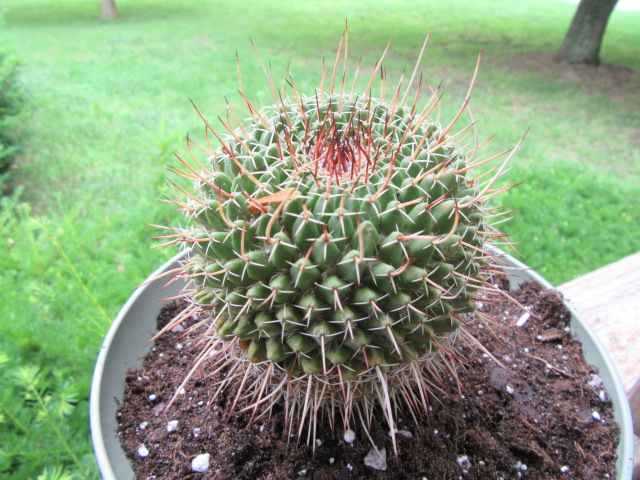
 

Hot And Dry Wildflower Walk, 6-4-23

Leucanthemum vulgare (Oxeye Daisy) on 6-4-23, #943-60.

Hello, everyone! I hope this post finds you well. I decided to go for a wildflower walk on Sunday afternoon even though it was bright and sunny and the temperature was already almost 90° F. There was a nice breeze, so it wasn’t so bad. We haven’t had much rain and it seems many of the wildflowers I usually see are non-existent. Only the toughest can survive in the heat with no moisture.

Species highlighted in green have their own pages. Just click on the name to visit their page.

Sisymbrium officinale (Hedge Mustard) on 6-4-23, #943-78.

The first stop was the Sisymbrium officinale (Hedge Mustard) colony that decided to come up by one of the old Chinese Elms in the chicken yard. Well, it used to be the chicken yard, but the chickens are normally confined to the chicken house these days. The fence is long gone and you never know when a fox or a wandering dog will stop by. I let the chickens out when I am close by… Hedge Mustard is an interesting plant, in my opinion, because it produces a small cluster of very small yellow flowers at the tips of racemes that get longer as the season progresses.

Sisymbrium officinale (Hedge Mustard) on 6-4-23, #943-79.

Long, slender fruit, called siliques, replace the flowers that seem to hug the stems… Ummm… I am still working on the page.

From the Hedge Mustard, I walk to the wooded area north of the chicken house.

Ribes missouriense (Missouri Gooseberry) on 6-4-23, #943-73.

There are quite a few Ribes missouriense (Missouri Gooseberry) bushes on the farm growing in wooded areas. I prefer to snack on them once the berries ripen although the green berries are used in pies and jams. As a kid, I could never understand why grandma always used green berries for pies instead of the sweeter, ripe fruit… I was never a fan of gooseberry pie.

As I was walking through the jungle, I stumbled upon…

Florinda coccinea (Black-tailed Red Sheetweaver) on 6-4-23, #943-55.

This very small Florinda coccinea (Black-tailed Red Sheetweaver) was hanging around in its web waiting for a smaller visitor. What it got was a much larger human visitor with a camera. Being such a small spider with a tiny thread of string trailing from its, umm, butt, it has to weave a “sheet” to catch its victims.

Smilax tamnoides (Bristly Greenbriar) on 6-4-23, #943-80.

While I was in the area, I thought I would check on the Smilax tamnoides (Bristly Greenbriar). It may sound a little weird, but I like this species. I have tried to find its flowers for several years, but they are normally high in the trees. They produce flowers at the end of the vines…

Smilax tamnoides (Bristly Greenbriar) on 5-10-23, #938-36.

I was working on this species page on May 10 and decided to check the vines to see if I could find flowers. Fortunately, a few of the long vines were hanging low and I found flowers… Smilax tamnoides produce male and female flowers on separate vines. I checked on June 4 to see if there were fruit but apparently, the two vines I took flower photos of were male… No fruit.

I was going to proceed with my walk from there, but when I came to the new electric fence I put up, I didn’t remember if it was on or off… The guy who leases the farm (Kevin) was going to put cows here but hasn’t yet… Since I wasn’t sure if I left the fence on, I decided to take an alternate route.

Conium maculatum (Poison Hemlock) on 6-4-23, #943-33.

So, I went around the barn and took a photo of the majestic Conium maculatum (Poison Hemlock). They may be neat-looking plants, but this is what possibly killed Socrates. You can see them growing along highways and back roads, overgrown yards, fields, etc. Such a deadly plant growing right out in the open. Well, you know as well as I do there are A LOT of deadly plants we just ignore as common weeds. Last year was the first time it was growing here and I intended to get rid of them when I took photos of its flowers. But, the hay was baled along with it. I took the above photo on June 4, and on June 5 I mowed them off…

As I headed back to where I left off before, I had to walk through…

Galium aparine (Cleavers/Catchweed Bedstraw) on 6-4-23.

There was a big pile of dead Galium aparine (Cleavers/Catchweed Bedstraw) that I tried to avoid. One of those plants I love to hate. 🙂 Most of these plants are dried up already, in piles just waiting to hitch a ride. Right off the bat, I get them on my pants. 🙂

Elymus virginicus (Virginia Wildrye) on 6-4-23, #943-46.

There is a small area that is open in the middle and surrounded by trees. Over the years, I have found several wildflowers that have come and gone. It is always strange to me how large colonies can appear and disappear within one season. Sunday, I noticed two good-sized colonies of what I think is Elmus virginicus (Virginia Wildrye). It grows here and there on the farm in the borders of shady areas. Birds like the seeds…

Achillea millefolium (Common Yarrow) on 6-4-23, #943-1.

It appears the Achillea millefolium (Common Yarrow) is beginning to flower. They are a common site on the farm and throughout the countryside. They seem to take hot weather and dry conditions with no problem, although a little moisture would make them put on a better show. I have an old cultivar growing in the north bed, in front of the chicken house, and by the barn that was given to me by a friend in Mississippi (when I lived there) that I brought with me when I moved back here in 2013. I can’t forget the plant with pink flowers I found on a friend’s farm in 2019. I think his cows ate the flowers since I couldn’t find it the day after I took its photo…

Allium vineale (Field or Wild Garlic) on 6-4-23, #943-6.

In another small area in the same location, there is always a nice patch of an Allium species I was never able to identify until now. With the help of iNaturalist and the Missouri Plants website, I found out they are Allium vineale known as Wild or Field Garlic.

Allium vineale (Wild or Field Garlic) on 6-4-23, #943-5.

The Missouri Plants website lists seven species of Allium and says this species is easily recognized as the flowers are replaced by bulblets… There are a number of Allium that grow in the yard that I have let mature that don’t do this. I took several photos so now I can write a page for Allium vineale (at some point)…

Sanicula canadensis (Black Snakeroot) on 6-4-23, #943-74.

In the mix of species in this shady area were a few Sanicula canadensis (Black Snakeroot). The flowers were pretty much shot already…

Phytolacca americana (American Pokeweed) on 6-4-23, #943-66.

I walked out of the shady area and had to get a photo of the Phytolacca americana (American Pokeweed). Not that anyone doesn’t know what it is… Over the years, the bank of the pond has been the subject of many territorial disputes and this year it appears to be the Pokeweed’s turn… I would say it is much better than Ragweed! Oddly, I find American Pokeweed an interesting plant and have let it grow along the garden fence, in front of the house, along the fence around the yard… I think the HUGE plant in front of the house has become annoying and perhaps three years is enough. The one along the garden fence didn’t come up this year and the ones that came up in the garden had to go… There is a limit…

I walked around a row of trees in front of the main hayfield to see what I could find…

Dianthus armeria (Deptford Pink) on 6-4-23, #943-39.

There were quite a few Dianthus armeria (Deptford Pink) growing in this area. This species can be easily overlooked, and if it weren’t for the small pink flowers you wouldn’t even notice them at all. Walking around the farm on Sunday, I noticed they were scattered around in many areas from front to back. I think with it being so dry and the grass being so thin, it has allowed many species to flourish that would otherwise go unnoticed.

Erigeron annuus (Annual or Daisy Fleabane) on 6-4-23, #943-50.

Well, what can I say? Typically in an average year, this wouldn’t have happened until after the hay is cut but I have seen it before. Overgrazed pastures and hayfields without good grass become COVERED with Erigeron annuus (Annual or Daisy Fleabane). With the lack of grass, this species will eagerly take over…

Erigeron annuus (Annual or Daisy Fleabane) on 6-4-23, #943-62.

The flowers are kind of interesting and unmistakable as Erigeron annuus with as many as 120 (or so) white ray florets (petals). Both male and female flowers can be self-fertile. Flowers are produced until a good ZAP in October so you can see how this species can get an upper hand. Many species of insects love these plants including MANY butterflies.

Argynnis cybele (Great Spangled Fritillary) on 6-4-23, #943-14.

Among the butterflies flying around the wildflowers was this Argynnis cybele (Great Spangled Fritillary). Most of the butterflies flying around the Erigeron annuus are smaller (short-tongued) while this Great Spangled Fritillary, being larger (long-tongued) was more interested in the Red Clower. I took a few good shots then this one flew off into the brush… I suppose enough was enough. Later on, I took photos of one that wasn’t so shy… I hadn’t photographed a Great Spangled Fritillary until Sunday’s walk. 🙂

Apocynum cannabinum (Hemp Dogbane) on 6-4-23, #943-12.

Farther up into the field, maybe halfway, there is quite a scattered colony of Apocynum cannabinum (Hemp Dogbane) beginning to flower. This species is quite similar to milkweed in appearance, especially from photos. I first identified this species on the farm in 2020 from a single plant, and since then it has made itself quite at home… All parts of this plant are poisonous, the genus name meaning “poisonous to dogs.” Despite its poisonous properties, Wikipedia has a long list of medicinal uses.

It has been used as a fiber plant and also as a psychoactive drug. Native Americans used to grind the seeds down into a powder and they used the plant to make bows, nets, tie-down straps, fishing lines, and clothing.

Pontia protodice (Checkered White) on 6-4-23, #943-71.

Wandering south from the Apocynum, I found this Pontia protodice (Checkered White) fluttering about that had no time for a human visitor. I took two shots and thankfully one was good enough for a proper ID. Butterflies can be tricky and sometimes you have to chase them around. Well, I wasn’t in the mood to chase butterflies but I am glad we met briefly. I am sure there are MANY species of butterflies I haven’t identified here…

Cornus drummondii (Roughleaf Dogwood) on 6-4-23, #943-37.

Walking along the row of blackberries growing where an electric fence used to be, I ran across a few Cornus drummondii (Roughleaf Dogwood). They grow here and there along fence rows and are a favorite of the strange but true Chauliognathus marginatus (Margined Leatherwing Beetle). Hmmm… I think I spelled it right. Those critters like milkweed flowers, too.

Hmmm…

The blackberries have almost all dried up from lack of moisture…

Back pond #2.

I have never seen this pond this low. I am sure the pond behind it is already dry… I may have to fence this pond off before Kevin brings cattle here. The edge is like quicksand and I would have to have a cow get stuck. Kevin says he has had to pull cows out of the mud in the past and it wasn’t any fun.

I didn’t walk in the trees behind the pond because this time of the year it is a real jungle. I walked toward the Persimmon tree south of the pond to check on a friend…

Elephantopus carolinianus (Leafy Elephant’s Foot) on 6-4-23, #943-45.

I checked to see if the Elephantopus carolinianus (Leafy Elephant’s Foot) a while back to make sure they returned in 2023. This is one of my favorite species on the farm, although I haven’t mentioned that to them… There is a story behind my first observation on a friend’s mother’s farm in 2019, and again here in 2021 but I don’t want to repeat it or this post would be much longer. You can read about it by clicking on the name above. 🙂

Leucanthemum vulgare (Oxeye Daisy) on 6-4-23, #943-60.

I first identified Leucanthemum vulgare (Oxeye Daisy) on Kevin’s farm in 2019, and then I found several in the north end of the south hayfield in 2021. Last year I had to cross the fence to get photos so I am glad a colony has made its way to the north pasture.

Leucanthemum vulgare (Oxeye Daisy) on 6-4-23, #943-62.

I like these because the flowers are much larger than the other white members of the family Asteraceae on the farm. I hadn’t been a big fan of daisy-type flowers until I read about how complex they are. Now, I have learned to respect them…

On farther down in the same area…

Helenium flexuosum (Southern Sneezeweed) on 6-4-23, #943-57.

Hmmm… I was walking fairly close to the fence where I had driven the tractor several days before (you can see where the tractor tires have been) and ran across a plant I couldn’t identify. Although it looked kind of familiar in some ways, I just wasn’t sure…

Helenium flexuosum (Southern Sneezeweed) on 6-4-23, #943-58.

Hmmm… When I uploaded photos on iNaturalist, its top suggestion was Helenium flexuosum (Southern Sneezeweed)… Could it really be true? I haven’t seen this species here, or anywhere else, since 2013!!! I guess it is true since another member of iNaturalist agreed and the observation became Research Grade.

Penstemon digitalis (Foxglove Beardtongue) on 6-4-23, #943-64.

I walked down to the lower end of the south pasture to check on the Penstemon digitalis (Foxglove Beardtongue). They have only been coming up here on the farm since 2020 in the lower section of the back pasture. They probably came up here before that but the cows ate them off since the colony was quite large.

Penstemon digitalis (Foxglove Beardtongue) on 6-4-23, #943-65.

The flowers are neat, but I really like their leaves…

There were several of these growing more out in the open, but their flowers had already started turning brown. I took the above two photos in the shade among the…

Dichanthelium clandestinum (Deertongue) on 6-4-23, #943-42.

Dichanthelium clandestinum (Deertongue)… I may be somewhat strange to some, but I kind of like this grass. We have a little history because it took several years to properly identify it. In fact, it wasn’t until I started using iNaturalist in 2019… Even then, I wasn’t sure and thought it was possibly Dichanthelium latifolium (Broad-Leaved Panic Grass). Another member asked if I was sure it wasn’t D. clandestinum?

Dichanthelium clandestinum (Deertongue) on 6-4-23, #943-43.

The latter species produces normal flowers this time of the year and “exerted” flowers later on while D. latifolium only produces exerted flowers at the end of the summer. I made it a goal to keep an eye on the colony in 2021 and positively identified it as D. clandestinum… There is a lot of green in the above photos, but I am holding a stem of flowers. 🙂 Very difficult to get good photos of such thin stems and tiny flowers. I seemed to be in a bit of a hurry, so I didn’t really notice if these were flowers or if they were already in the fruiting stage. Hmmm… There was no need to be in a hurry…

Potentilla simplex (Common Cinquefoil) on 6-4-23, #943-73.

Potentilla simplex (Common Cinquefoil) grows around the same area and seems to have spread out somewhat since it was first identified here in 2021. This species seems to do best in the shade, while the Potentilla recta (Sulfur Cinquefoil) prefers a sunnier location on the rest of the farm…

The back pasture/hayfield on 6-4-23…

Looking toward the north at the back hayfield looks pretty normal at this view…

Hmmm…

Looking down into the grass shows a different story. The blades of grass are very thin and dry. Once the seed dries, we are just going to top it instead of baling it. I stopped grazing this area a couple of years before dad died because it made great hay…

I circled around to go back to the main hayfield and didn’t notice anything special. I walked along the “other” blackberries on the south side to see if they were doing better…

Blackberries…

There were a few that were fair, but still many were dried up. These are a different species from those on the rest of the farm. They are earlier, much bigger, and only produce if there isn’t a frost in early April… The last time they produced a good crop I put 10 gallons in the freezer and gave a lot away… Just along 40′ or so. They are GREAT!

Walking a little further, I looked over into the hayfield and saw purple flowers with a bird on top. I zoomed in with my camera and realized it appeared to be a new species of milkweed, and it wasn’t a bird… I had to get a closer look. 🙂

Asclepias purpurascens (Purple Milkweed) and Argynnis cybele (Great Spangled Fritillary) on 6-4-23, #943-25.

Shhhhh……. What the heck?!?!?! I can’t sneak up on anything with this crunchy grass! Strangely, the butterfly didn’t fly off. This is a new milkweed to photograph and more photos of the Argynnis cybele (Great Spangled Fritillary) would be great. Which one do I choose first? Well, I already have photos of the butterfly and none of the milkweed. But, the butterfly could fly off while the milkweed will still be here. How about both at once?

Asclepias purpurascens (Purple Milkweed) and Argynnis cybele (Great Spangled Fritillary) on 6-4-23, #943-17.

This milkweed species, Asclepias purpurascens (Purple Milkweed) hasn’t been here before. There are two other plants 40′ or so away and not together. I feel like I am whispering in my mind even when I am writing this. Like the butterfly will fly out of the photo… GEEZ!

Asclepias purpurascens (Purple Milkweed) and Argynnis cybele (Great Spangled Fritillary) on 6-4-23, #943-18.

It’s like the butterfly is so busy it didn’t even notice me…

Asclepias purpurascens (Purple Milkweed) and Argynnis cybele (Great Spangled Fritillary) on 6-4-23, #943-22.

Woooo… I think it said, “Don’t push it.”

Asclepias purpurascens (Purple Milkweed) and Argynnis cybele (Great Spangled Fritillary) on 6-4-23, #943-24.

You have to admit the Great Spangled Fritillary is one magnificent creature. Just look at the size and color!

Asclepias purpurascens (Purple Milkweed) on 6-4-23, #943-27.

The Purple Milkweed is nice, too. Much brighter and darker than the other milkweeds here. Strangely, I didn’t notice any Green Milkweed when I saw them in flower along the highway. Maybe I just haven’t located them yet. I just found the Green Milkweed on the farm in 2021 and there were only a couple of plants last year. Hmmm…

I walked on down to the front pasture and in front of the walnut trees…

Verbesina virginica (White Crownbeard/Frostweed) on 6-4-23, #943-81.

“What are you doing here?” The Verbesina virginica (White Crownbeard/Frostweed) just smiled and chuckled a little. It is a good 200′ away from the colony along the fence in more sun. That’s OK since it is another favorite wildflower.

Verbesina virginica (White Crownbeard/Frostweed) on 6-4-23, #943-82.

I really like the winged stems!!!

I guess that wraps up this post. We did get about 5/10″ of rain overnight (early Thursday morning). It sure cooled off.

Until next time, be safe, stay positive, always be thankful, and GET DIRTY!


Garden 2023 And The Strawflower

Garden 2023 on 5-31-23.

Hello everyone! I hope this post finds you well. I don’t know about you, but it seems summer is officially here in Missouri. I do like the way it cools off in the evening, though.

I am very thankful the riding mower didn’t break down like it did in 2022 before I was able to get the garden mowed off. That’s why there was no garden in 2022. If it is as dry all summer as it has been, the yard won’t get mowed that often this year.

I planted 4 double of ‘Incredible’ and 4 double rows of ‘Ambrosia’ on May 3. The rows are 25′ or so long and there is a 4′ space between the varieties. Well, let’s just say the space is not exactly straight for some weird reason. This is the first year I was able to get the garden all ready to plant in April. In fact, I think I tilled it twice in April when it is usually too wet until May. Since I use dad’s old rear tine Troy Built, the garden gets nice and fluffy and you have to wait a few days before it gets planted. Anyway, dad always said the ground needs to settle a little before planting, so I always thought it was best. A nice rain would have done the trick, but that didn’t happen. I went ahead and planted the corn on the 3rd with the old Garden Way seeder. I always complained about the way it planted corn… Sometimes the seed wouldn’t get in a hole and I would have to wait until it started coming up to know where to replant. In 2021 I decided the heck with the seeder and planted it by hand. Well, I still had to replant A LOT even though I put 2-4 seeds every 8″ apart. It was because the seed rotted for some reason… SO, this year I went back to the seeder, and if I noticed no seed was in the hole of the plate, I would put 2-3 in the hole. You also have to tilt the seeder somewhat. The soil was still so fluffy the wheels on the seeder left a kind of a trench. I didn’t water because rain was in the forecast…

As I mentioned in the last post, my sister and niece came to go plant shopping. Besides going to all three greenhouses here, we went to Clinton. Actually, I talked them into going because I needed green bean seed and I also wanted to buy seed for white sweet corn. Unfortunately, there was a crop failure of ‘Top Crop’ Green Beans so I had to settle for an alternate route… Normally, I would have brought home a pound of ‘Top Crop’ but I settled for 1/2# of ‘Contender’, ‘Provider’, and ‘Tendergreen’. Hmmm… I planted either ‘Contender’ or ‘Provider’ when I was in Mississippi because of crop failure, but I can’t remember which one. I could look back in the old photos to find out for sure, but what the heck. So, I bought all three varieties because that’s what they had that wasn’t white-seeded. So, I planted 2 double rows of ‘Contender’ and 2 double rows of ‘Tendergreen’ on May 8… The seed works wonderfully with the seeder. I decided I would wait to plant the ‘Provider’ until later so I wouldn’t have so many beans to pick all at once. The other reason was because I wasn’t so sure where I was going to plant them… I also bought a 1/2# ‘Silver Queen’ Sweet Corn…

Some of the corn had come up by the time I planted the beans, but most of it had just grown roots but seemed to be waiting for moisture.

I decided to give up on the weather, so on May 10 I watered down the rows of the sweet corn and green beans. The trenches made by the seeder worked great when I watered. I didn’t want to water the whole garden with the sprinkler, so I just drug the hose between the first two rows and watered the rows on each side. When I was finished with the first  2 rows, I drug the hose out, skipped a row, and repeated the process. The next afternoon, the rest of the corn was up! It was like a miracle!

Once the beans started popping up, I watered again and they were all up the next afternoon. I can honestly say, I have the best crop of corn and beans I have ever had without replanting.

I planted 4 double rows of the ‘Silver Queen’ Sweet Corn and 2 double rows of ‘Provider’ Green Beans on May 23. ‘Silver Queen’ is an SU variety so the seed is much larger than ‘Incredible’ and ‘Ambrosia’ which are SE varieties. It was a little more tricky to plant, so I had to make sure seed was in the hole of the seeder plate. The ‘Provider’ seed was also larger than the other two varieties. That night we were blessed with 9/10″ of rain.

On the 30th, I planted a few hills of  ‘Sugar Baby’ Watermelon. I checked, and the last planting of sweet corn and green beans was starting to come up. I watered again, and the next afternoon they were out of the ground. I planted ‘Sugar Baby’ Watermelon so I won’t be going through the ordeal I did with the ‘Black Diamond’ a few years ago. No getting excited about how big they are getting and screwing up to see when they are ripe. A friend of mine told me his neighbor grew these and they were great, so I thought I would give them a shot… It’s about a month late planting them, but I didn’t plan on growing any until I noticed a bare spot in the garden. 🙂

Of course, I have tomatoes. Four each of ‘Celebrity’, ‘German Johnson’, and ‘Goliath’. All I need is a few plants, but I always bring home too many. I can’t help myself! I also planted a couple of eggplants.

OH, I almost forgot to mention the new mole repellers… A few years ago, a rep from a pest repellant company in China sent me a couple of mole repellers if I would write a review for them. I agreed so he sent me two… After a few weeks, one quit working but the other one continued to work until last fall. There are A LOT of listing on Ebay, so I decided to buy a box of 4… I put 3 in the garden and one in the corner bed next to the house. One of the 3 in the garden works great and would get a 10 out of 10 rating (for now). One of the others in the garden gets a 3 out of 10, and the other one in the garden gets a 1 out of 10. The one in the corner bed gets a 0. There is a new mole run right next to it because it is so quiet! I checked it again yesterday and I think it has completely quit.  The old mole repeller came on at different intervals and stayed on at different intervals. The company said it was so the rodents wouldn’t get used to it. Well, now that theory has gone out the door. All the listings on Ebay and their website say they come on every 20 seconds and stay on for only a few seconds. Some of the reviews have a similar experience, especially if they buy more than one…

Ummm… Several weeks ago, well maybe earlier than that (like in April), I found Stouffer’s Eggplant Parmesan in the frozen section at the store. It was just enough for one meal and it was delicious. The next time I went, and every time thereafter, they didn’t have it. I even checked at Walmart… So, I decided to buy a couple of eggplants (actual plants) on May 5. I haven’t grown any since I lived in Mississippi, so it will be an experiment. I know they produce A LOT!

I already made my own Eggplant Parmesan… Despite I bought “an” eggplant before I found a recipe that called for three and didn’t buy another one for a week. I opted to make the recipe smaller, then wound up using 2 zucchini to replace the missing eggplant, had to go to the store to buy another jar of spaghetti sauce and another package of mozzarella cheese. It turned out YUMMYLICIOUS! I found out zucchini wasn’t a good substitute when baking with eggplant… The eggplant cooks MUCH FASTER than zucchini which stayed a little crunchy even after baking an additional 20 minutes. This recipe was quite a process and I took photos for a post along the way. I wrote a post and decided I better wait until I don’t use zucchini… The recipe is supposed to have a “crunch” to it, but not because of the half-done zucchini… You know what they say, FAIL means FIRST ATTEMPT IN LEARNING. 🙂 🙂 🙂

Before I wind up this post, I have to show a photo of the Strawflower…

Xerochrysum bracteatum ‘Mohave™ Apricot’ (Strawflower) on 5-31-23.

I should have brought home more of these. I have always wanted to try Strawflower and have bought seeds in the past they didn’t come up. When I was at Wagler’s Greenhouse on May 15 (to buy more plants for Kevin’s Planters), I found a few and brought one home. The tag says ‘Mohave™ Apricot’ Bracteantha. Hmmm… It is actually Xerochrysum bracteatum ‘Mohave™ Apricot’. This plant needs more water than the African Daisy next to it, but its flowers are a big hit! The colors are amazing and very bright and the flowers actually feel like paper. They really do feel like the dreaded fake “strawflowers” glued to cacti at garden centers only these are real. It is kind of late, but I need to go see if Wagler’s has more. They are GREAT!

Until next time, be safe and stay positive, always be thankful and GET DIRTY!


Planters Planted

Most of the plants for Kevin’s planters.

Hello everyone! I hope this post finds you well. I finished the planters for Kevin. You know, the guy who leases my pasture/hayfield, the guy I I feed cattle for on occasion, the guy I do his landscape maintenance for, the guy I wander through his woods and take wildflowers photos, etc. He’s a great guy I have known since high school. We were in the same class so we are the same age. I have been doing his planters for several years now, so I thought I would share what I did. Maybe you can give me some pointers. 🙂

Plants I normally like to use aren’t always available. This year it warmed up in April and a lot of people made a dash to the greenhouses. Well, we had a “you know what” that killed their plants, so they went back to the greenhouses again. Needless to say, when I am late I have to use my imagination a little more. I have never been to Muddy Creek Greenhouse when it was full of plants. Where do they all go so fast? Mast’s Greenhouse still had quite a selection of plants I didn’t want for Kevin’s planters, except for the petunias. Wagler’s has always been #1 for me because I always find great plants and they seem to re-stock. The best one was Wildwood, even though they were much smaller, but they moved out of town. They had a great selection and the plants were of great quality. Plant shoppers come from the city in droves because the prices are so much cheaper…

This is the largest round planter that has a lot of space. I put a large Coleus with no tag in the center and added three Senecio candicans ‘Angel Wings’ and three Gomphrena ‘Buddy Purple’ around the outside. The Coleus could be one of the Kong series. I know the Gomphrena will bush out, but this is the first year I have tried the Senecio ‘Angel Wings’ so we’ll have to see what it does. This is a large planter, so I think it needs to be a focal point. The Coleus came from Mast’s, the Senecio from Skaggs in Clinton, and the Gomphrena from Wagler’s.

Normally, there is a mass of Lysimachia nummularia ‘Goldilocks’ (Creeping Jenny) that has been in this planter for several years. Most of it seems to have died out, but there are still a few clumps I left in the pot. Maybe three years ago I put a Rudbeckia fulgida ‘Goldstrum’ in the center. It came up and spread again but I kind of got bored of it being in the planter so I removed most of it. Hmmm… Now that I think about it, I think I should remove what I left. Normally, all but one other year, I put a few Euphorbia hypericifolia ‘Starblast White’ in this planter but I couldn’t find any to suit me this year.

The above photo is what the planter looked like on August 1 in 2021. You can see how the Euphorbia hypericifolia ‘Starblast White’ filled the planter. You can see the Lysimachia ‘Goldilocks’ is flowing out around the bottom. The Rudbeckia ‘Goldstrum’ is in the center…

There are two tall urns like this, so I put a Geranium (Cranesbill) ‘Johnson Blue’ in one of them. I was hoping to find something else for it so I could keep it for myself… It looks a little lonely so I may take some Lysimachia ‘Goldilocks’ from home to stick in the pot. I have plenty. Wagler’s had several of these, so I will probably go back there and pick up another one for myself. I have to go back there anyway to dig some Mexican Petunia and Primrose from her flower bed. 🙂 Mrs. Wagler and I trade plants often.

I put another Coleus in the other tall urn. I am sure this one is a Kong, maybe Red or Scarlet. Time will tell as the color comes in on the center of the leaves. I have grown several of the Kong series and they are AWESOME! The selection of Coleus has been very wimpy the past couple of years. This one came from Wagler’s.

I have been using these HUGE Wax Begonias in the larger hex planters for several years and they look GREAT! The first time I stuck five of them in both planters and it was a bit much. This year I put only three in one of the planters so see how that works out. The Begonias came from Wagler’s.

The above photo was taken on August 1 in 2021. As you can tell, both pots are packed and the Begonias are LOADED with flowers. If you haven’t tried these begonias, you really should. There have never been any tags in the pots, so I have no idea what the cultivar name is. They are AWESOME!

Instead of putting Begonias in both of the larger hex planters, I decided to put the Osteospermum in the other one. I had a few things in mind since I couldn’t find another Penstemon ‘Blackbeard’ (Beardtongue). First, I decided to alternate the three white Osteospermum with the three colored ones. Well, that didn’t work because I still had an empty smaller hex planter and an extra Gomphrena ‘Purple Buddy’. So I stuck the white Osteospermum in this planter and put the extra ‘Purple Buddy’ in the center. I don’t know how tall the Osteospermum will get since there are no tags and I never grew them before…

Without any other choice besides going to another greenhouse, I decided to put the colored Osteospermum in one of the smaller hex planters. GEEZ! I liked all six in the other planter better, so I may have to do some switching again. Then I will have an extra ‘Purple Buddy’ AGAIN…

I put four Petunia ‘Scarlet™ Velvet’ in the other small hex planter. There were a lot of petunias at Wagler’s but none I really liked. I wanted to mix a dark flower with a yellow or red like I did last year, but there were no yellow petunias to be found that weren’t already in hanging baskets. I found these ‘Scarlet™ Velvet’ at Mast’s a few days earlier… I really like the dark petunias, especially alternated with yellow…

Hmmm… Violas make a great early flower that sometimes fizzles out once it gets hot. Kevin always does a great job watering his planters even when it gets hot and dry, so the Violas last a while longer than they would otherwise. If not… Well, I could stick the extra Gomphrena ‘Purple Buddy’ in their place if they die. I like the smaller flowered Violas rather than the HUGE flowers of the Pansies. I do like the bigger blue bi-colored pansies, the ones that are called “Beaconsfield Blue’. They are NICE!

Now, on to the back deck… I had to wait until the next day to do the planters on the back deck because Kevin wasn’t home. His house is on a hillside, so the deck is on the second floor with a walkout basement. You know what I mean… So, I have to walk through his house to get to the deck. He wasn’t home when I started and finished the planters above, so I went back to Wagler’s to pick up a few more plants for the deck. While I was gone, he came back and left again before I returned…

On the back deck are two large round planters and a pair of boots with hats. I always remove about 1/3 of the old potting soil from the planters on the back deck and put in fresh. Well, I remove some in the other planters as well before planting. As I was removing the potting soil and “weeds” that had snuck in, something jumped out of the pot. It was a tree frog that had changed color to resemble the potting soil! I had never seen one that color before so I thought I would take its photo. It sat next to the pot the whole time I was working on the planter.

I had to go to Wagler’s to find something for the center of this planter. When I went to buy plants last week, I noticed there were a few of the Dracaena. I think these are commonly known as Spikes. I have used them before as well as Cordyline (which I couldn’t find). I also picked up three Gazania rigens (Treasure Flower) last week which I hadn’t used before in planters. Normally, I put in six other plants to go around the outside of these planters. Three accent plants and three that trail over the side… But, four Gazania will have to do.

The Gazania look a little funky, so hopefully they will perk up… After I was finished, Kevin said they didn’t look too good. I told him if they didn’t work out I would find something else.

I put the tree frog back in the pot…

Then…

There was another one in the other planter… Look how well it is hidden!

The second planter looks better with a Zantedeschia ‘Virgin Art’ (Calla Lilly) from Mast’s and three Gerbera Daisies from Wagler’s. Last year I put a Calla Lilly in both planters and they looked GREAT. I also normally put Gerbera Daisies in this pot and they always look pretty good. Still, it would be better with alternating trailing plants…

I really like Calla Lilies, but they can be a bit pricey.

Gerbera Daisy #1.


Gerbera Daisy #2


Gerbera Daisy #3.

Now on to the boots and hats…

There are two pairs of boots and hats on the back deck. They don’t have very much room for potting soil so plants with shallow root systems are needed. I have used  Sempervivum (Hens and Chicks) for several years and they have done well. Sometimes they even over winter, but they didn’t survive this year.

This year I went ahead and put a Sempervivum in both hats.

Wagler’s had several succulents, so I put what appeared to be an x Alworthia ‘Black Gem’ in one of the boots. The tags with the succulents just said “Succulent”, so I’m not really sure if it is an x Alworthia or not… If so, it is a hybrid between Aloe and Haworthia.

In the second boot, I put what appears to be a Sedum adolphi… Again, I’m not 100% sure. Time will tell…

There is a boot on the front porch as well that I have been planting an Oxalis tetraphylla (Iron Cross) in for a couple of years. It works well there, so I put another one there this year. I forgot to take its photo…

So, that’s it for Kevin’s planters and this post. Of course, as always, I picked up a few more plants for myself at Wagler’s on the 15th…

Until next time… Be safe, stay positive, always be thankful, and GET DIRTY!
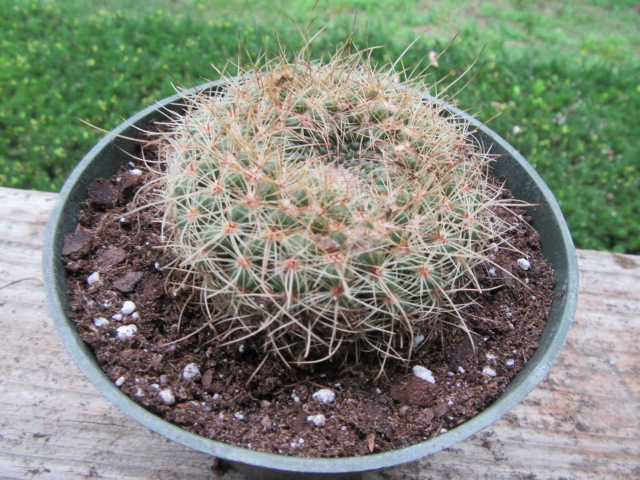
 

New Plants And The Garden…

2023 garden underway (photo taken on 5-10-23).

Hello everyone! I hope this post finds you well. Happy Mother’s Day to all the moms. All is well here and I am so happy to be getting my hands in the dirt. REAL DIRT!

My sister and niece came from KC to go plant shopping on May 8 so of course I went along. I picked up a few plants and scouted around to see what I could put in a friend’s planters. We made the round to all three local greenhouses plus two garden centers in Clinton. I needed more seeds for the garden which is why I wanted to go to Clinton. I will write more about the garden in another post.

What did I bring home?

Agave (Syn. xMangave) ‘Inkblot’

Muddy Creek Greenhouse sells out quickly so they didn’t have many plants left. I spotted several Agave that I thought were quite nice. There were two cultivars I especially liked but I decided on the one named ‘Inkblot’. Of course, its tag says Mangave ‘Inkblot’ which means it is a hybrid between cultivars of Agave and Manfreda. Manfreda species have been absorbed into the Agave genus so I am just calling it an Agave… It hasn’t met the ‘Pineapple Express’ on the back porch yet.

Callisia repens (Bolivian Jew)

I really enjoyed the Callisia repens in 2019, so I brought home another one from Wagler’s Greenhouse. These make nice mounds and eventually trail over the sides of the pot. The flowers aren’t particularly interesting in my opinion, but I brought it home for the foliage. I tried overwintering the first one inside, but it didn’t like it and eventually went on the R.I.P. list.

Osteospermum (African Daisy)

There were several colors of Osteospermum (African Daisy) at Wagler’s but I liked the white ones the best so I brought one home. Yeah, I know they would have looked better in a group in the flower bed, but funds were limited and we still had two more greenhouses to go (Wagler’s is always the first stop). I went back on the 11th and bought three colors for Kevin’s planters. These plants were in their greenhouse which usually has perennials, so I am assuming this plant is a perennial. There were no tags. If they were annuals they would be Dimorphotheca… Does that mean if it doesn’t return in 2024 it is Dimorphotheca? Hmmm… Likely it is a perennial that died over the winter and I will not be crossing my fingers.

Osteospermum (African Daisy)

You have to admit the white ray petals and dark center looks great! It won’t be treated as a wildflower so I don’t have to use botanical terminology…

Penstemon digitalis ‘Blackbeard’ (Beardtongue

This neat Penstemon digitalis ‘Blackbeard’ at Wagler’s wanted to come home and practically jumped in my arms. I agreed it could come home and knew just where I wanted it. I may go back and buy another one for Kevin’s planters. I had some problems finding center plants for a few of his planters, so one of these would be a possibility.

Pulmonaria x ‘Spot On’ (Lungwort)

Hmmm… Have you ever brought home a plant you didn’t know what to do with it? Well, this Pulmonaria ‘Spot On’ from Muddy Creek Greenhouse kind of fits into that category. I had an idea in mind at the time, but then when I got home it became a “?”. I think I will have to shove in the north bed at some point. I think I will transplant it during the night so the other plants will be shocked when they wake up in the morning.

Ricinus communis (Caster Bean)

I wanted “A” Castor Bean for the garden, but was forced to buy four at Wagler’s. They are in a 4-pack so I had no choice. I had never seen these at a greenhouse or garden center before. No doubt if I had bought seeds on Ebay I would have wound up with more than 4. I remember dad always had a few of these in our garden when I was a kid. I always liked the huge plants and leaves…

Salvia farinacea SALLYFUN™ ‘Blue Lagoon’ (Mealycup Sage)

Of course, you may know how I am about Salvia. I have grown other cultivars of this species before and they always did very well. So, we’ll give this SALLYFUN™ ‘Blue Lagoon’ a shot.

Senecio candicans Angel Wings® (Sea Cabbage)

While we were at Skaggs Garden Center in Clinton, I ran across a group of Senecio candicans Angel Wings®. I had to have one then went back on the 10th to bring home 3 more for Kevin’s planters. I think they will look great in the planter with a Penstemon ‘Blackbeard’ (that I have to get).

Kalanchoe delagoensis (Mother of Thousands)

What can I say? I found this Kalanchoe delagoensis (Mother of Thousands) at Mast’s Greenhouse when I went there on the 11th. Not like I needed another Kalanchoe that gives live birth, especially another one with the common name Mother of Thousands.

Kalanchoe delagoensis (Mother of Thousands)

HOPEFULLY, her babies will be limited to the tips and not like the Kalanchoe laetivirens, the other Mother of Thousands.

Kleinia stapeliiformis (Pickle Plant)

If you were here in person, I would go ahead and ask you to slap me. Well, maybe not. So, on the 11th, Mast’s Greenhouse had A LOT of succulents. Most I have, have had or didn’t have adequate space for during the winter. Then there it was. A weird plant that screamed Senecio (the genus). I have had issues with Senecio before (now on the R.I.P. list). But, I couldn’t help myself… Knowing that several species of Senecio were moved to the Kleinia genus was my way out. 🙂 Now that I think of it, I think it is Senecio stapeliiformis that is on the R.I.P. list. I thought it looked familiar!

Kleinia stapeliiformis (Pickle Plant)

I think it was this that caught my eye. I PREVIOUSLY bought cuttings from a Facebook group member that preferred to rot rather than run (root). The snake in the above photo was likely the cutting that was stuck in the pot, which was apparently rooted and the cluster in the previous photo was the result. So, I think we may have a shot… (WE= me, myself, and I).

Peperomia graveolens (Ruby Peperomia/Ruby Glow)

While I was browsing in another section at Mast’s, I stumbled upon an area with several succulents behind a rope with a sign on it… It said NOT FOR SALE. WAIT A MINUTE before you jump to conclusions. I did NOT take a cutting. If I had been at Walmart or Lowe’s and ran across a plant that I wanted that was expensive, maybe. Not saying I have ever done that… ANYWAY, I spotted three Crassulally-looking plants with interesting red and green leaves. I went back to the succulent section to see if I had missed any there. There was none. I went inside where Mr. Mast was and asked about the plants and if perhaps I could have a cutting. He said, “OH, you mean in the corner.” I said, “Yes.” He smiled and pointed to one of his daughters. We went back to the corner and she gave me a cutting. That was AWESOME.

I thought it was some kind of Crassula, so I searched online and found nothing even close. So, I put the photo on a Facebook group for ID. In no time, someone replied. She, who is also an administrator, suggested it was a Peperomia. SO, I checked online and found out it was a Peperomia graveolens with the common name Ruby Peperomia or Ruby Glow. I replied to her with that name and she said, “THAT’S IT.” This morning, she made the comment “I will be contacting you” followed by 4-5 hearts. WHAT THE HECK?!?!?!

North bed…

I decided to move the Hosta and Heuchera (Coral Bells) from the shade bed to the bed on the north side of the house. I have been tempted to do it the past few years but just hadn’t gotten around to it. The moles are gettng crazy there (since the mole repeller shot craps) and the shade is not dependable during the summer (Chinese Elms=Japanese Beetles=no shade). The bed on the north side of the house gets sme morning sun and part of it gets afternoon sun. I planted four Colocasia esculents rhizomes here, so they will give the Hosta plenty of shade. The only issue would be slugs and snails, but most of the Hosta are supposedly slug resistant. There were 12 Hosta in the shade bed but only 7 came up this spring. A couple has fizzled out by last spring. I transplanted 5 Hosta and 3 Heuchera to the north bed, and kept what was left of H. ‘Krossa Regal’ and H. ‘Blue Mouse Ears’ in pots and put them on the front porch. Now I can keep an eye on the Hosta better since they are along the house instead of being about 150′ (or so) feet away. I bought 4 more mole repellers.

Well, that’s it for this post. Spring has sprung and summer is here so now I can get my hands in the dirt and go wildflower hunting…

Until next time! Be safe, stay positive, and always be thankful. Be sure to GET DIRTY!
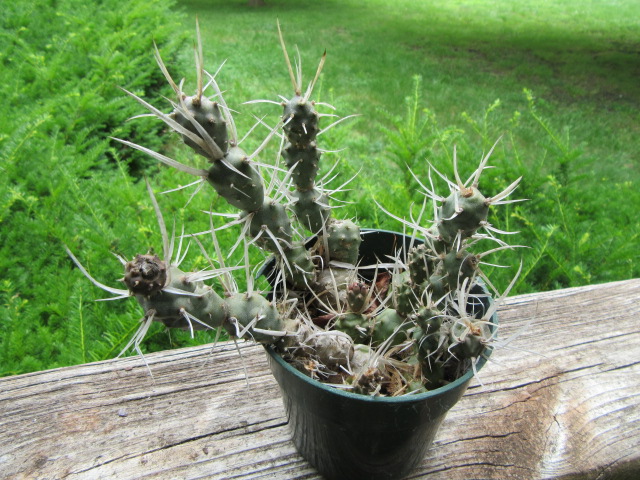
Italian Arum Back From The Dead…

The last photo of the Arum italicum (Italian Arum) was taken on 6-1-13, #151-18.

Hello everyone! I hope this post finds you well. Spring is always an exciting time of the year waiting to see what comes back up and what hasn’t survived the winter. The anxiety is ridiculous especially with our mild temps this year.

I was surprised, actually quite shocked, on February 15. I was just kind of looking around to see if any wildflowers had started blooming yet. The temps were milder than average and the Crocus started blooming several weeks earlier than usual. I dug around in the leaves in the shade bed and noticed several Hosta have sprouted, but they are still very cautious. The Lamium purpureum were all still dead except in the sun along the garage and between the back deck and basement steps. Some of them were already blooming. The daffodils and Surprise Lilies were up and running as well. Now the daffodils are starting to bud. I noticed most of the Ajuga ‘Chocolate’ Chip’ next to the elm tree in the shade bed pretty much fizzled out over the winter. Like non-existent! I decided to check on the ones along the chicken house to see if they were still OK. Oh yeah, I forgot to mention the bulbs that always come up in the shade bed by the hundreds that have survived since my grandparents lived here. I have not properly identified them…

What I saw stopped me dead in my tracks…

Arum italicum (Italian Arum) on 2-15-23, #929-2.

Could it be? The only Aroids I planted along the north side of the chicken house were a few Arum italicum (Italian Arum/Lords and Ladies) in 2013. I brought them with me from Mississippi when I moved back to the family farm since they were supposedly winter-hardy in this zone.

Arum italicum are a little weird in that they are summer dormant and come back up in September and grow all winter. In 2013, they did fine all spring, then did the usual dormancy deal in the summer. They came back up in September or October just fine. However, being in zone 6 in Missouri, they also go dormant in the winter and need a covering of leaves for protection. But, they didn’t come back up in 2014…

Arum italicum (Italian Arum) on 3-5-23, #934-1.

I went out to look around again on Sunday (March 5) and saw the Italian Arum, at least that’s what I think it is, has grown a second leaf…

It is so weird it would come up after being dead for 10 years! I remember when I was in Mississippi I had several Colocasia and Alocasia I was trying. I had them in pots and several died… Completely died with the rhizomes shriveled up and dry. I stacked the pots up only to find a few had somehow come back up. This has happened to other plants as well. I always said, “Just because it is dead doesn’t mean it is dead.”

Basically, everything else is still the same. The perennials are still cautious for the most part. The Achillea millefolium has been growing new leaves basically all winter. The Creeping Jenny is working on it, and the fern called Ebony Spleenwort (Asplenium platyneuron) never did go dormant. Weird. That’s the one that came up in the north bed from out of nowhere in 2021. I didn’t take any photos of it until 2022 because I thought it was a figment of my imagination.

Anyway, spring feels like it is here some days and feels like fall on others. The evening temps are still too cool for the most part for most plants to start popping up. I noticed on Sunday the Veronica persicaria (Bird’s Eye Speedwell) is now blooming up a storm. They are usually the first to bloom, but they are a hair late here. This time the Lamium purpureum (Dead Nettle) wins the prize for being the first.

Well, I better close for now. It is almost 1:30 AM!

Until next time, be safe and stay positive, and always be thankful. Spring is right around the corner.

Crazy Dreams…

Hello, everyone! Have you ever had crazy dreams you woke up laughing from? I had a strange dream before I woke up this morning. I was at this consignment auction and there was this long table with a lot of people standing around it. The stuff looked like someone cleaned off their workbench (and trash can) from their shop.

I was standing next to this guy in overalls that was the spitting image of a famous comedian (not to mention his name). 

He pointed to this round object on the table with a wire running from it to another smaller round object.

He said, “That thar goes to one of them lar detectors.”

I answered, “Oh really?”

He said, “yep.”

I asked, “Do you mean a liar detector to detect lairs, a lidar detector for taking 3D images of the ground, or what?”

His reply was, “Yep, it can do both.” He further said, “I put one on my metal detector a few weeks ago and it went down 20’. It said I found a gold ring. Yep, I had to get the backhoe to dig it up.”

I said, “Oh really?”

He said, “Yep. I dug up a skeleton with a big diamond ring on his finger.”

I said, “Your kidding! How much was it worth?”

He answered, “Don’t know. I wasn’t going to take a ring off a dead man’s finger so I covered it back up.”

I woke up laughing.

What are some of the crazy dreams you have had?

First Photos of 2023-Verbesina virginica (Frostweed/White Crownbeard)

Verbesina virginica (White Crownbeard/Frostweed) on 1-30-23, #928-1.

Hello everyone! I hope this post finds you well. I was in the process of writing descriptions for the Verbesina virginica (White Crownbeard/Frostweed, etc.) page Sunday evening and a thought came into my mind… I have been taking photos of this species since 2018 but had not ventured out in the cold to see if I could find any of its frost flowers. My higher self butted in to the thought and said, “You could try it tomorrow since it will be very cold.” Hmmm… The return thought was it is already January 30 and I should have tried before. My higher self returned with, “There’s that “should have” again.” ”

The White Crownbeard has been one of my favorite wildflowers with its odd winged stems and big clusters of flowers. I first published the page in 2018 and continued adding new photos and finally wrote descriptions.

I always thought the frost flowers were formed during the first hard freeze and that was it. BUT, as I was reading the page for the species on the Arkansas Native Plant Society, I found out it wasn’t a one-time thing.

It was 16° when I got up so I knew I would have to give the chickens fresh water. They don’t particularly like hard water, you know. I also needed to give the birds more seed because they hit the feeders pretty hard when it is cold. So, I got ready to go outside and somehow the camera snuck into my coat pocket. I took a bucket of chicken feed and a bucket for water to the hydrant then looked off in the distance to where the White Crownbeard/Frostweed were. All the way down to the south boundary fence of the farm… All the way and it was 16°.

I did have on an insulated flannel shirt, my heaviest coat, and the warmest gloves. I wasn’t cold yet so I started walking. On the way, the sock on my right foot started sliding down in the rubber boot (at least my boots are Dry Shods).

Once I was at the spot where the Verbesina virginica always grew, all I could see was dead stems. Not that I was expecting anything else since it is January 30.

Verbesina virginica (White Crownbeard/Frostweed) on 1-30-23, #928-2.

Lo and behold I spotted frost weed at the base of two dead stems several feet apart.

Verbesina virginica (White Crownbeard/Frostweed) on 1-30-23, #928-3.

I have seen photos online that looked like frozen waterfalls coming from the stems. Likely, I would have seen that “if” I had looked earlier when we had a first freeze.

Verbesina virginica (White Crownbeard/Frostweed) on 1-30-23, #928-4.

It looks like a blob of ice, but it is actually more like a ribbon. Very thin and brittle…

Verbesina virginica (White Crownbeard/Frostweed) on 1-30-23, #928-5.

I was glad I went out in the cold and took the camera. If anything, it is an inspiration to go out next winter when we have a first freeze.

By the time I got back, my hands were freezing but the coat I had on was making me almost sweat. I got the chickens fed and gave them fresh water and the birds have more seed.

I went to get the mail, and apparently, the mail carrier got a little to close. I noticed before I went outside (looking through the window) the mailbox was leaning a little. There are two mailboxes, one for me and one for across the street. The carrier got them both! How could that happen after so many years? At least the posts are still intact and the mailboxes are OK.

Until next time, be safe and stay positive. Keep warm and always be thankful!


First Annual Updates Finished…

Viola striata (Cream Violet) on 4-29-22, #875-38.

Hello everyone! I hope this post finds you well. I haven’t posted for a while because I haven’t had a lot to say and I have been working on updates.

I started making initial updates on November 4 and finished on January 18. Ummm… 705 pages… But there is a catch. A lot of notes have accumulated on “the wildflower list” to make improvements (I call it tweaking) on various pages. There are A LOT of pages that still don’t have descriptions of the plant’s parts not to mention several drafts that have to be published. Heck, some wildflower species don’t even have drafts! I know there were over 500 pages of plants I am growing or have grown in pots and flower beds, but I moved several of those pages to the trash. I don’t think there is much point in having a page with a single photo, a brief description, and growing information for a plant that bit the dust after a month or less. They may do well for someone else, or br great in a rainforest.

I have identified over 250 species of wildflowers because I counted the list earlier in the spring of 2022. I have no idea how many new species were identified over last summer. Species I haven’t seen before just keep popping up. Like the Viola striata (Cream Violet) in the photo. Where did it pop up? In the flower bed along the north side of the house next to the Hosta ‘Empress Wu’. It couldn’t have picked a better and more handy spot. Where did it come from? Who knows.

It is odd because I have been wanting to locate a white violet for a long time besides the “variant” growing in the yard at the church. I wanted ferns in the north bed so I planted an Ostrich Fern there a few years ago. It died. Then a wild fern came up in the bed from out of nowhere, survived, and spread. Then, the darn dead Ostrich Fern decided to come back to life after skipping a year or two. I am not complaining at all.

Maybe I should tell the Universe what I want more often. A new car or pickup would be nice. How about a Ventrac with several attachments or a greenhouse. A really good one would be to stop aging and wake up with no wrinkles.

So, now I have to go through the list of wildflowers and write new pages and write descriptions. Making new pages is easy. It’s writing descriptions in my own words can be a challenge. I read the technical descriptions written by botanists and explain what it means in ordinary language to go along with photos I have taken.

I still haven’t published the post about the Euphorbia species I have identified here on the farm. It all boiled down to waiting to check the seeds of the Euphorbia davidii and E. dentata to see what colonies were one or the other.

Euphorbia davidii and E. dentata seeds collected from various locations.

Using a magnifying glass, I found out the seeds were all the same. Both species have different seeds which is one sure way of telling the two species apart. So, it proved all the colonies here on the farm are the same species. According to the Missouri Plants website, they are Euphorbia dentata. Unfortunately, other websites say the opposite. It seems as though botanists know their seeds are different but can’t agree on which seeds belong to which species. GEEZ!

I compared the two species on Flora of North America species comparison guide. Apparently, I also have to “count” the staminate flowers… Euphorbia davidii has 5-8, while E. dentata has 8-10… Do you realize how small they are? What if I only come up with 8?

I know the above photo isn’t that great. The seeds are fairly small…

You would think it would be easy to just go by the seeds. But when you have only one species that botanists can’t agree on, it gets more complicated. How do I write a page or post when I don’t know what I am talking about. Even if I were a botanist, I would have to choose sides and still not know what I am talking about.

The post was finished several months ago, all but the information about the Euphorbia davidii and E. dentata. I can go ahead and work on that part and publish the post if you want to read it. I’m sure it would be entertaining…

Until next time, be safe, stay positive, and always be thankful!

Wordless Wednesday: Kalanchoe thyrsiflora (Paddle Plant)

Kalanchoe thyrsiflora (Paddle Plant)

Symphyotrichum Workout

Symphyotrichum lateriflorum (Calico Aster) on 10-9-22, #916-11.

Hello everyone! I hope this post finds you well. The past week has been fairly cool and it finally rained. This is a perfect time of the year to get dirty and do some fall cleanup.

One of the most baffling genera of plants on the farm has been the Symphyotrichum. Even pronouncing it can be a challenge. It’s pronounced sim-fy-oh-TRY-kum… With the help of a curator from iNaturalist, I have figured out the last three of seven species on the farm. That is until I find another species.

BEFORE I GET TOO CARRIED AWAY…

The above image was created by Jenn Deutscher and used here by permission. Her website is Alithographica and can be found online at www.alithographica.com. Retrieved on November 1, 2022.

My thanks to Jenn Deutscher for allowing me to use her illustration above. There is a good write-up about her on her website (linked above). She has won many awards and it is an honor for her to allow me to use just a small sample of her work here.

Explaining flower parts is somewhat confusing without something to go by, so I found the above image online. Flowers of the plant family Asteraceae are very complex. They may appear to be simple flowers, but really there are no simple flowers. Some species in the family have over 1,000 flowers in a single head. I tried writing about the parts, but it became very complex… Kind of reminded me of the old game we used to play as kids called Operation… I will explain a little as we go along.

You can read more information about the flowers in the articles supplied by Britannica article and  Wikipedia. You can also click on the plant’s name under its first photograph which will take you to its own page. There are several links at the bottom of each page.

You may not remember a previous post from last fall, but I found two species I couldn’t figure out. After a few days of their discovery, we had a good ZAP and that was that. I watched them throughout this summer but that was a waste of time since Symphyotrichum species here are fairly late bloomers. When they finally did produce flowers I was surprised…

The two species in question were Symphyotrichum lateriflorum (Calico Aster) and Symphyotrichum ontarionis (Ontario Aster). Last fall when I first found them was a lot different. There was a colony of S. lateriflorum along the drainage ditch behind the north pond at the back of the farm and the S. ontarionis were behind the south pond along the fence. Umm… Both ponds are next to each other and I really never got the story behind that. I seem to remember the south pond being dug when I was a kid and perhaps grandpa was going to make one big pond. The north pond is spring-fed but it does dry up. The south pond never dries up, but the water is always brownish whereas the water in the north pond is always clear. It’s just weird. When I was a youngster, and even a teenager, I didn’t think to ask about it.

Anyway, back to where I was going… Last fall, the S. lateriflorum along the ditch still had quite a few flowers, and there were only a few plants behind the south pond. The plants along the ditch appeared to have been damaged, like from deer foraging, and were short with a lot of smaller leaves. The plant I photographed behind the pond with a few flowers was erect. The flowers in both areas were similar in size and one could have easily said they were the same species. I submitted separate observations of plants in both areas on iNaturalist and then contacted a curator who suggested a different curator. This guy identified them correctly as Symphyotrichum lateriflorum along the ditch and S. ontarionis behind the south pond. Another member disagreed with one observation of S. lateriflorum (but he was correct). At the time, he didn’t say why and I just took his word. I read descriptions online, but they were clear as mud since the S. lateriflorum plants had been damaged.

Symphyotrichum lateriflorum (Calico Aster) behind the south pond on 10-9-22, #916-26.

So, all summer long as I watched the two species growing, they all seemed to be doing the same thing. That’s when I thought maybe they were all the same species after all, likely S. lateriflorum… Then, when they started flowering there were S. lateriflorum everywhere. I was thinking that because plants along the ditch looked like the plants behind the south pond. Then, completely by accident, I spotted a few plants whose flowers were different and they didn’t have sprawling branches… I took photos, of course. Then, as I was leaving the area, I discovered ANOTHER species with hairy leaves. I took photos of that one, too, which turned out to be S. pilosum (Hairy White Oldfield Aster) that is common around where the barn is.

Symphyotrichum ontarionis (Ontario Aster) on the right and S. lateriflorum (Calico Aster) on the left on 10-9-22, #916-32.

This time, when I submitted the photos on iNaturalist, I contacted the curator from before. This time, he wrote why he agreed with the submission… The above photo shows S. ontarionis on the right with larger flowers and brighter yellow disc florets. The S. lateriflorum on the left has smaller flowers, creamy discs, and fewer white ray petals…

OK, let me just say a few things… The ray “florets” (petals, etc.) are what you likely notice first. What looks like an ordinary flat petal is actually tubular. Farther down the petal, you have the corolla that surrounds the stigma and style of the female flower. The disc flowers (florets) in the center contain both female and male parts and are considered perfect flowers.

Symphyotrichum lateriflorum (Calico Aster) on 10-9-22, #916-23.

With Symphyotrichum species, you have to take a close look at the flowers. Count the ray petals (ray florets) and look at the color of the disc flowers. Then, look at the involucral bracts (phyllaries) under the flower head. With Symphyotrichum lateriflorum, there will be 8-16 rays (depending on what site you look at, and what flower you look at) that are usually white. Other species have MORE. The disc florets in the center will be a creamy yellow whereas other similar species will be brighter yellow. These will turn a reddish pink with age and later brown on both S. lateriflorum and S. ontarionis. The involucral bracts of S. lateriflorum, are usually appressed (meaning they lay flat), and in 3-4 layers. The bracts of other species are somewhat “inrolled” toward the base and then “reflexed” where the tips of the bracts curl slightly outward. In the above photo, the flowers are 1/3″ or so wide. The flowers of S. lateriflorum tend to grow on one side of the flowering stems which is another characteristic of the species.

Symphyotrichum ontarionis (Ontario Aster) on 10-9-22, #916-31.

The flowers of Symphyotrichum ontarionis have 16-28 ray florets (ray petals, etc.) with brighter yellow disc florets. It gets more confusing the more websites you read descriptions from. Some list different numbers. GEEZ! The rays are also in 2-3 series which seem to overlap. Information online says the diameter of the flowers are 1/3-1/2″ diameter, but this one was 3/4″. The flowers grow on panicles but when I took the photos, there were only a few flowers open. The curator from iNaturalist said these could be S. lanceolatum, but I am leaning toward S. ontarionis because they prefer growing in wooded areas. S. lanceolatum prefers full sun. There are other reasons as well…

Symphyotrichum ontarionis (Ontario Aster) on 10-9-22, #916-34.

The leaves are also controversial from site to site. It is very hard to see, but there are very tiny hairs on the upper surface, giving them a hard-to-explain feel. Almost smooth, but not quite. The undersurface of the leaves are similar, but the hairs are somewhat longer on the veins. Again, that could apply to either one or both species. I couldn’t tell the difference between either species as far as the leaf hair was concerned. Longer is still barely visible. The margins of the longer leaves are toothed from the midpoint.

Well, I think I have said enough about the S. lateriflorum and S. ontarionis. You can go to their pages, look at the photos, and go to the links at the bottom of the page to check out the other links if you want. Click HERE for S. lateriflorum and HERE for S. ontarionis. Ummm… I may be still working on their pages as far as descriptions are concerned, but there are a lot of photos. Oh yeah, I am going to move them around a bit, too. A work in progress. 🙂

<<<<Symphyotrichum lanceolatum>>>>

Symphyotrichum lanceolatum (Tall White Aster) on 10-9-22, #916-8.

Walking through the pasture on my way back from taking photos behind the pond, I ran across a small colony of what I thought could be Symphyotrichum lanceolatum (Tall White Aster). After all, they were growing in full sun instead of in a wooded area. It was very windy, so getting good close-ups was pretty much out of the question. I tried…

Symphyotrichum lanceolatum (Tall White Aster) on 10-9-22, #916-9.

Typically, S. lanceolatum have flower heads that are 1/2-1″ in diameter and have 16 to 50 ray florets in 1 or 2 series (you can see this where they overlap). Different websites give different numbers, and they are usually white but can be bluish to violet. The disc florets in the center number from 15-40, are brighter yellow, turning a reddish-pink with age. The involucre is cup-shaped to bell-shaped. The bracts (phyllaries) are in 3-5 (6) unequal, overlapping series. They are appressed to slightly spreading… The plants produce quite a number of flowers on long panicles arising from the upper leaf nodes. Missouri Plants says the leaves of S. lanceolatum are very smooth, almost balloon-like, except for a few hairs along the margins.

I only found two plants on the south side of the main hayfield growing among literally thousands of Erigeron annuus (Annual Fleabane). I looked very carefully. The involucre of the Erigeron annuus is completely different and they have MANY more very slender ray petals.

<<<<Symphyotrichum novae-angliae>>>>

Symphyotrichum novae-angliae (New England Aster) on 10-1-22, #913-15.

The clump of Symphyotrichum novae-angliae (New England Aster) finally came up and bloomed again. I began to wonder since they came up so late. They are a perennial like the other Synphyotrichum species, but this species hasn’t spread. I have no idea why and it is weird. The multiple stems grow so tall they can’t stand up. Last year, I measured one of the stems at 78″ tall. The Missouri Botanical Garden says they have a “robust, upright growth habit…” Hmmm… That is until they flop over. It would be a spectacular sight if they stayed upright, but they fall over even before the flowers open.

Symphyotrichum novae-angliae (New England Aster) on 10-1-22, #913-16.

I am not particularly into pink, which I have mentioned before, but these flowers are pretty neat. The flower I measured was 1 1/2″ wide and I didn’t bother to count the ray florets. Information online says there are 50-100! You would think with all flowers that are produced they would spread by seed.

Symphyotrichum novae-angliae (New England Aster) on 10-1-22, #913-17.

No use in denying their involucral bracts are reflexed! They are in 3-6 unequal, overlapping series.

<<<<Symphyotrichum pilosum>>>>

Symphyotrichum pilosum (Hairy White Oldfield Aster) on 10-9-22, #916-35.

This Symphyotrichum pilosum (Hairy White Oldfield Aster) is the one I found growing close to the S. lateriflorum behind the south pond. It isn’t really a good example since the plants growing close to the barn in full sun are LOADED with small white flowers. I was going to take their photos but it was getting late and the sun was going down. After that, it was either windy or rainy, and then we had an “F” which put an end to the whole idea.

The flower heads are from 1/4-3/4″ wide and have 15-35 pistillate ray flowers (florets, petals). The discs are yellow turning reddish with age. The involucral bracts are weird in that they are kind of inrolled at the base then turn outward, then curve upward.

Symphyotrichum pilosum (Hairy White Oldfield Aster) on 10-9-22, #916-37.

The fact that their leaves (and stems) are hairy (pubescent) is a definite indicator that this species is S. pilosum. These plants can grow to around 5′ tall in the right conditions.

<<<<Symphyotrichum praealtum>>>>

Symphyotrichum praealtum (Willowleaf Aster) on 10-12-22, #918-5.

Talk about spreading… The Symphyotrichum praealtum (Willowleaf Aster) has no problems with that. I have taken photos of this species since 2018 but I didn’t get them identified until last year. They grow along the south side of the farm and nowhere else here. They grow in a few areas in front of the blackberry briars in the south hayfield all the way up to the gate along the fence entering the front pasture.

Symphyotrichum praealtum (Willowleaf Aster) on 10-12-22, #918-10.

This species has 20-35 lavender rays in 1-2 series. The yellow disc florets turn reddish purple with age (and it doesn’t take long). It seems that Symphyotrichum species are in such a big hurry since they bloom so late… The flower heads are 1/2-3/4″ across (or so)…

Symphyotrichum praealtum (Willowleaf Aster) on 10-12-22, #918-12.

The involucral bracts are slightly reflexed…

Symphyotrichum praealtum can get very tall, much taller than me.

Well, I guess I should be relieved the Symphyotrichum species here on the farm have been properly identified. At least for the most part. I’m not saying I am quite sure about S. lanceolatum, but I am fairly confident. GEEZ! If I missed talking about something important, just let me know. I am no expert, but I may be able to answer your question.

Now, I will have to check the seeds of the Euphorbia davidii and E. dentata to see if they are dry enough for an ID. Seems silly to have it down to the seeds for a proper ID. What if their seeds were variable. too. After that, the Euphorbia post will be ready.

Until next time, be safe and stay positive. Always be thankful and GET DIRTY! Be thankful you can GET DIRTY!
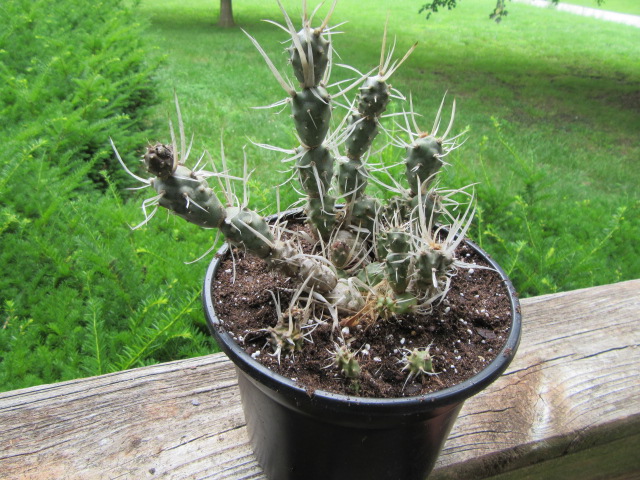
Cactus & Succulent Update 2022

Cereus repandus f. montruosus ‘Rojo’ on 10-16-22, #919-6.

Hello everyone! I hope this post finds you well. The dreaded time of the year has arrived and I had to move the potted plants inside on January 16. I was still working on one last new wildflower ID and still needed a few leaf and stem photos. I had already taken photos, but the leaf and stem photos were blurry. I’m not sure if I can still take any since the “F”, and since then the wind has been blowing. Of course, it warmed back up…

As always, I take photos and measure the cactus and some of the succulents as I bring them back inside. Most of the plants were on the front porch this summer because the heat and the intense sun seemed a little too much for some of them last summer. Yeah, I know they are cacti, but that doesn’t necessarily mean they like intense sun. Many smaller species grow in the shade of taller plants.

Last winter was not too good… My son and his friend were still here so they used the back bedroom. I usually kept the back bedroom cooler with a plant shelf in the south-facing window for the succulents and part of the cacti. but the shelf was placed in front of the east-facing sliding door in the dining room. Instead of the cactus being on a table in front of the sliding door, they were on another shelf in my bedroom. I couldn’t very well keep the temperature cooler in either place. They are gone now, thank goodness, so the plants are basically where they should be.

As a result of more heat, for one thing, I lost a few plants over last winter from mealybugs… GEEZ! I think the worst was losing both Mammillaria pringlei and rhodantha… I also lost the Aloe ‘Lizard Lips’. I had all three of those for MANY YEARS.

Anyway, here we go in alphabetical order… You can click on the plant’s name under the photo to go to their own pages.

<<<<Aloe ‘Cha Cha’>>>>

Aloe ‘Cha Cha’ on 10-16-22, #919-1.

Aloe ‘Cha Cha’ is the last survivor of the five plants I received from Succulent Market in 2020. Ummm… I am trying not to mention… No, I’m not going to do it! I did mention A. ‘Lizard Lips’ contacted mealybugs, but not from A. ‘Cha Cha’. Somehow it never had them and has done weirdly well… Of course, as you may be able to tell, it is a miniature.

<<<<Aloe maculata>>>>

Aloe maculata on 10-16-22, #919-2.

Hmmm… I just discovered a problem with starting at the beginning of the alphabet. Maybe I should have started at the end. Although the Aloe maculata are all doing GREAT as always, I have been promising it I would divide their pot for a couple of years. Maybe three. I had one in another pot that “somehow” contacted mealy bugs last winter and they kept coming back. So, I did a terrible thing and threw it out the back door. The big pot was in my bedroom and it would get an occasional bug but nothing serious. Isolating this plant would be a problem, so I decided to put it in the basement in front of a window. I remember I kept a lot of plants in the basement during the winter before and they always did fine. Well, the bugs didn’t like the conditions and they left and the Aloe came through with flying colors like it had been in perfect conditions. These plants are descendants of the Aloe maculata I called ‘Kyle’s Grandma’ that was given to me by a good friend, Kyle, when I was living in Mississippi. The plant, actually I think there were two, were from his grandma, Brenda, in 2009.

I was just thinking maybe I should use the basement as a quarantine station. 🙂 Well, if the plants are halfway dormant…

<<<<Austrocylindropuntia subulata (Eve’s Needle)>>>>

Austrocylindropuntia subulata (Eve’s Needle) at 7″ tall on 10-16-22, #919-3.

Another hmmm… As I looked at this plant, it started tapping its feet. It asked, “Do you notice something?” I said, “Ummm…” Last fall I told this Austrocylindropuntia subulata that I would move it back to the center of the pot in the spring. As you can see, it is still not in the center. Maybe, in the back of my mind, I was thinking it would move by itself. I know the original plant was in the center when I brought it home from Wagler’s Greenhouse in 2019 when it was just a single stub at only 4 1/2″ tall. Now, it has grown appendages and its offset is 7″ tall…

<<<<Cereus repandus f. montruosus ‘Rojo’>>>>

Cereus repandus f. montruosus ‘Rojo’ at 10″ tall x 4 1/4″ wide on 10-16-22, #919-5.

At least the Cereus repandus f. montruosus ‘Rojo’ didn’t give me any dirty looks and seemed to be quite content on the front porch. It grew another 1/4″ and is now 10″ tall. The top photo is the upper portion of this plant. I brought this plant home in 2018 when it was only 5 1/2″ tall. I really like monstrous forms of cacti.

<<<<Crassula ovata ‘Gollum’>>>>

Crassula ovata ‘Gollum’ at 10 1/2 tall x 10″ wide on 10-16-22, #919-7.

The Crassula ovata ‘Gollum’ did very well in its usual spot over the summer on the front porch. I brought this plant home in 2018 when it was 7″ tall and it is now 10 1/2″ tall. I always like the tree-like appearance of older Crassula ovata. I had a fairly large Crassula ovata and a nice C. ovata ‘Lady Fingers’ that were AWESOME!

Crassula ovata ‘Gollum’ on 10-16-22, #919-8.

They can attract brown scale (from somewhere) which are easily removed with your fingernail. If you don’t keep an eye on them, the scale can spread to all the leaves and become a pain… Especially when you have a bigger plant with A LOT of leaves

<<<<Echinopsis ‘Rainbow Bursts’>>>>

Echinopsis ‘Rainbow Bursts’ at 4 1/4″ tall x 7 1/4″ wide on 10-16-22, #919-9.

The Echinopsis ‘Rainbow Bursts”…GEEZ! I lost my train of thought. I have thought about removing her kids, but then I think about what she would look like all naked. No doubt, her trunk would be all brown and terribly unsightly so I just keep the family together. Someday, I hope to see flowers. After all, I have had this pot since 2016 and who knows how old it was before I brought it home. The main plant was only 2 1/4″ tall x 3 1/2″ wide when I brought it home, and the offsets were growing along its ribs. Now it is 4 1/4″ tall and the whole cluster is 7 1/4″ wide. This plant was originally x Echinobivia ‘Rainbow Bursts’ and was described as an intergeneric cross between Echinopsis and Lobivia. Lobivia is now a synonym of Echinopsis, so I guess it wasn’t an intergeneric cross after all. 🙂 It was named “Rainbow Bursts” because of their “spectacular colors” (so the label said) over the spring and summer. STILL WAITING…

I was watching a YouTube video from Morris Park in the Ozarks a couple of pots that looked similar. With all the offsets and everything.

I still have the big pot of Echinopsis huascha, but they are looking very weird…

<<<<Espostoa melanostele subsp. nana>>>>

Espostoa melanostele subsp. nana (Peruvian Old Lady)at 9″ tall on 10-16-22, #919-10.

The Espostoa melanostele subsp. nana (Peruvian Old Lady) always seems happy no matter where she is sitting. She may have been happier on the front porch out of the wind so her hair doesn’t get messed up. She has grown another 1/2″ over the summer to 9″ tall. Hard to imagine she was only 2 3/4″ tall when I brought her home in 2016.

<<<<Euphorbia trigona ‘Rubra’>>>>

Euphorbia trigona ‘Rubra’ (African Milk Tree) at 19 1/2″ tall on 10-16-22, #919-11.

To say this Euphorbia trigona ‘Rubra’ has grown would be an understatement. I brought it home from Mast’s Greenhouse in June of 2021 when it was 6 1/4″ tall. By the time I moved the plants inside in October, it had grown to 10 3/4″. Every time I looked at the plants over the summer, I noticed this plant was growing and even had an offset. Well, lately, I had been busy and hadn’t paid much attention to the plants on the front porch. So, when I started moving the plants inside in 2022 I was SHOCKED! This plant had grown to 19 1/2″ tall!

Euphorbia trigona ‘Rubra’ on 10-16-22, #919-12.

Euphorbia trigona was named and described as such by Philip Miller in the eighth edition of The Gardener’s Dictionary in 1768. I don’t know where he found it exactly, but it wasn’t in the wild… You see, there are no known plants of this species in the wild, and it is possibly of hybrid origin. Information also says this species does not produce flowers. Hmmm… As with all Euphorbia, it does produce a milky latex sap.

<<<<Ferocactus wislizeni>>>>

Ferocactus wislizeni (Fishhook Barrel Cactus) at 3 1/8″ tall x 3″ wide on 10-16-22, #919-13.

The Ferocactus wislizeni (Fishhook Barrel Cactus) has done quite well on the front porch and has now reached 3 1/8″ tall. This guy always got a little sunburned on the back porch, but it has had no problems on the front porch. It was only 1 5/8″ tall when I brought it home in 2019, so it has done well.

<<<<x Gasteraloe ‘Flow’>>>

x Gasteraloe ‘Flow’ at 4″ tall x 4″ wide on 10-16-22, #919-14.

I had to throw out my older x Gasteraloe ‘Flow’ in January because of mealybugs. I had sprayed, washed them off, etc. and I finally had to give up. Repeatedly working the plant over seemed to make the plant suffer more (especially during its rest period). I was happy to find a new one at the Kuntry Store in July that was 3″ tall x 3 3/4″ wide. There were some really nice larger plants in combination planters, but I only wanted ‘Flow’. GEEZ, I hate it when that happens. It has grown to 4″ tall x 4″ wide since I brought it home. The plant didn’t have any sort of label, but I am assuming it is x Gasteraloe ‘Flow’.

<<<<Gasteria ‘Little Warty’>>>>

Gasteria ‘Little Warty’ at 6 7/8″ tall x 7 1/8″ wide on 10-16-22, #919-16.

The Gasteria ‘Little Warty’ continued to do well and is now 6 7/8″ tall x 7 1/8″ wide. I really like this little guy. It was only 2″ tall x 2 13/16″ wide when I brought it home in 2019. The mealy bugs tried to infect this plant but had no luck.

<<<<Gasteria sp. ?>>>>

Gasteria sp. at 5 1/4″ tall x 7 1/8″ wide on 10-19-22, #919-16.

I thought I was going to lose this Gasteria last winter because of its issues with mealybugs. It still isn’t quite back to normal but it is OK. It even grew to 5 1/4″ tall x 7 1/8″ wide. I think I may put it in the cool front bedroom with plants that aren’t bothered by critters and keep an eye on it. Maybe I should put it in the basement… I would hate to lose it after almost 5 years. I was kind of surprised it had mealy bug issues since its leaves are so hard, but they attacked way down where the leaves attach. A very hard spot to get to.

<<<<Gymnocalycium saglionis>>>>

Gymnocalycium saglionis (Giant Chin Cactus) at 2 3/4″ tall x 3 3/4″ wide on 10-16-22, #919-17.

The Gymnocalycium saglionis (Giant Chin Cactus) had never had one single issue. No rust spots, sunburn, bugs, or anything. It has grown from 1 1/8″ tall x 2 5/8″ wide in 2019 to 2 3/4″ tall x 3 3/4″ wide. It had its biggest growth spurt in the first 7 months after I brought it home, and since then it has just grown slow and steady. At least it is still alive and well.

<<<<Haworthiopsis limifolia>>>>

Haworthiopsis limifolia (File-Leaved Haworthia) at 5 1/8″ tall x 6″ wide on 10-16-22, #919-18.

Formerly Haworthia limifolia, the Haworthiopsis limifolia continues to do remarkably well without a hitch. These plants are normally sold under the name Haworthia limifolia ‘Fairy Washboard’, but that is actually a common name along with File-Leaved Haworthia, Fairies Washboard, Swaiti Haworthia, and possibly others. The last name is possibly what it is called in Southeast Africa where the species grows in the wild. There are five varieties of the species… This plant has now grown to 5 1/8″ tall x 6″ wide from 2 3/8″ tall x 3″ wide when I brought it home in May of 2019. Who wouldn’t like its dark green color with all those ridges on the leaves?

<<<<Kalanchoe daigremontiana>>>>

Kalanchoe daigremontiana (Alligator Plant) at 27 3/4″ tall x 7 1/2″ wide on 10-16-22, #919-19.

I finally found a nice Kalanchoe daigremontiana (Alligator Plant). You may remember the “other” Kalanchoe daigremontiana (Mother Of Thousands) I have… I always thought something was a little whacky with the name, and then I finally figured out it was a Kalanchoe laetivirens. Anyway, when I was plant shopping at Wagler’s Greenhouse this summer, I saw they had quite a few of real Kalanchoe daigremontiana. Of course, I had to bring one home… It was 13 1/4″ tall x 13 1/2″ wide when I brought it home in May and now it is a shocking 27 3/4″ tall. Some of the lower leaves have fallen off, so the width has shrunk to 7 1/2″ wide.

Normally, I would have repotted this plant, but since I was a bad parent in 2022 it is STILL in its 4 1/2″ pot I brought it home in. GEEZ! Luckily, it performs a balancing act quite well. It was between two bricks on the plant table, which most of the plants were (or tucked in pot-to-pot) so the wind would blow them around. Right now, it is standing next to the kitchen sink. I am trying to figure out where to put it for the winter…

Kalanchoe daigremontiana (Alligator Plant) on 10-16-22, #919-20.

Like the Kalanchoe laetivirens (or x laetivirens since it is a cross between two species), this one also gives birth to plantlets along its leaves (which aren’t really leaves). I removed them before I brought it into the house. I learned a lesson from before…

Kalanchoe daigremontiana (Alligator Plant) on 10-16-22, #919-21.

This species has the purplish marking on its, umm… You know what I mean. A spider decided this plant’s “leaves” made a good home and it was COVERED in webs. I should have taken a photo, but that would have proved my neglect… I guess I could have said it was decorated for Halloween. 🙂 I don’t have a page for this plant yet.

<<<<Kalanchoe thyrsiflora>>>>

Kalanchoe thyrsiflora (Paddle Plant) at 14 1/4 ” tall on 10-16-22, #919-22.

I found several awesome Kalanchoe thyrsiflora (Paddle Plant) at Mast’s Greenhouse in May and thought I needed to bring one home. I was surprised with buds when I was bringing the plants inside since they weren’t there the week before (unless I wasn’t paying attention). It was 6″ tall x 7 3/4″ wide when I brought it home, and now it is 14 1/4″ tall including the buds. Won’t this be interesting? Ummm… I have no page for this plant yet either.

The Kalanchoe beharensis ‘Fang’, K. laetivirens, all the K. luciae, and K.orgyalis (Copper Spoons) are still alive but need some work… Sadly, the K. gastonis-bonnieri (Donky Ears) and K. beharensis didn’t survive last winter. The K. marmorata (Penwiper Plant) also finally gave it up. We had our ups and downs since 2018.

<<<<Kroenleinia grusonii>>>>

Kroenleinia grusonii (Golden Barrel Cactus)… Greater (green pot) at 3 1/2″ tall x 3 1/4″ wide, and Lessor (orange pot) at 3 3/4″ tall x 3 1/4″ wide on 10-16-22, #919-23.

These two comedians of the group are still alive and well. The Kroenleinia grusonii (Golden Barrel Cactus) both continue growing head to head. I named them Greater and Lessor in 2016 because the one in the green pot has always been a little taller than the other. Lessor, in the orange or red pot (I can’t decide what color it is), has always been a little shorter and wider. Well, this year they are both 3 1/4″ wide, but Lessor is 1/4″ taller than Greater. Of course, they tried their best to convince me they traded pots. Crazy guys! Measuring them is tricky enough with them jiggling around and standing on their toes.

Apparently, the orange spots on these two guys was rust. Rust can be treated if you know what it is in the first place. Well, the rust issue has gone away, and the orange spots have turned white. Now that I know what it was, I will keep an eye on them.

<<<<Mammillaria hahniana>>>>

Mammillaria hahniana (Old Lady Cactus) at 5 1/2″ tall x 3 3/8″ wide on 10-16-22, #919-24.

This Mammillaria hahniana (Old Lady Cactus) is now the oldest Mammillaria in my collection since M. pringlei and M. rhodantha died. This awesome cactus has now grown to 5 1/2″ tall x 3 3/8″ wide from 1 7/8″ tall x 2 3/8″ wide in 2016. It has been a great cactus and is a free bloomer when it gets in the mood. Old Woman Cactus is the common name iNaturalist gives this species…

<<<<Mammillaria karwinskiana>>>>

Mammillaria karwinskiana (Silver Arrows) at 4 1/2″ tall x 3 1/2″ wide on 10-16-22, #919-25.

When I was measuring Mammillaria karwinskiana (Silver Arrows) it told me it had an itch and asked me to give it a scratch. I was kind of speechless. It has barely ever spoken to me and now it wants a scratch. GEEZ! It just as well ask for a massage. Anyway… This cactus has done very well and has grown another 1/2″ taller and is about the same width as last year. It now stands at 4 1/2″ tall and is 3 1/2″ wide. To think it was just 1 7/8″ tall x 2 3/16″ when I brought it home in 2019. I really like its wool, hairiness, and those long, straight, white spines. But a scratch is out of the question.

<<<<Mammillaria muehlenpfordtii>>>>

Mammillaria muehlenpfordtii (Golden Pincushion) at 5 1/4″ tall x 3″ wide on 10-16-22, #919-26.

The Mammillaria muehlenpfordtii (Golden Pincushion) has been a great plant since I brought it home from Lowe’s in September in 2019. Its pot was lying on the plant shelf with the plant not even in the pot. I am sure it appreciates being brought home. I have always admired its blue-green color and all those golden spines, but the long central spines and short radial spines are also neat. It has grown to 5 1/4″ tall x 3″ wide and was 3 1/4″ tall x 2 1/8″ wide when I brought it home.

<<<<Mammillaria mystax>>>>

Mammillaria mystax at 2 3/4″ tall x 3 1/8″ wide on 10-16-22, #919-27.

Very funny… The Mammillaria mystax shrunk! The measurement from last year was 3 1/4″ tall x 3 1/4″ wide and now it is 2 3/4″ tall x 3 1/8″ wide. Heck, it was 2 3/4″ tall in 2020. It has grown quite a bit, though, since it was just 1 3/4″ tall x 2 1/4″ wide when I brought it home in 2018. Sometimes that happens with cacti when they don’t have enough water. That is likely the case since they were under the roof of the front porch and most of the time just received rain as it blew in on them. I am not complaining that it shrunk especially since it is partly my fault. OK, it was likely all my fault. But, it was safe from the scorching sun on the front porch which I know it appreciated. How do I know? Well, it was smiling at me when I measured it and took its photo.

<<<<Mammillaria plumosa>>>>

Mammillaria plumosa (Feather Cactus) at 2″ tall x 4 1/4″ wide on 10-16-22, #919-28.

It is certainly a good thing this Mammillaria plumosa (Feather Cactus) hasn’t had any problems with mealybugs. How would you tell? I bought this cactus from a seller on Ebay in 2018 and it has been great. In fact, it is the only cactus I bought from Ebay that has survived. Even though it was very small at 3/4″ tall x 2 1/4″ wide it has done very well. The main plant has grown to 2″ tall and the whole cluster is now 4 1/2″ wide. This one you can pet if you so desire…

I lost several Mammillaria since last winter including M. decipiens (Bird’s Nest Cactus) that did very well since 2018, M. elongata (Lady Finger Cactus) that I brought home in 2018, M. pringlei and M. rhodantha I already mentioned, M. senilis (the one with the hooked spines I could never tell if it was alive or dead) since 2020, both M. vetula including ‘Arizona Snowcap’, and M. compressa from 2020. The M. spinosissima ‘Un Pico’ is still alive but looks terrible with A LOT of rust or something… One of the plants in the pot of 3 already died… I have learned that even though many species of Mammillaria are some of the best cacti to grow, when you bring home very small plants you are taking a risk. Also, many species on the market haven’t been in cultivation that long and may not be good choices. Big growers plant seeds by the thousands and don’t necessarily care if they are good choices for pot culture. These days some companies aren’t even putting the names on the pots because they have no clue.

<<<<Opuntia monacantha var. variegata>>>>

Opuntia monacantha var. variegata (Joseph’s Coat) at 12 3/8″ tall x 4 1/2″ wide on 10-16-22, #919-29.

You know, I really haven’t been into variegated cacti, but this Opuntia monacantha var. variegata (Joseph’s Coat) I saw at Wagler’s Greenhouse in 2020 caught my eye. It was only 4 3/4″ tall when I brought it home, and it has grown to 12 3/8″. It is very interesting…

Opuntia monacantha var. variegata (Joseph’s Coat) on 10-16-22, #919-30.

Actually, Llifle (Encyclopedia of Living Forms) has it listed as Opuntia monacantha f. monstruosa variegata (syn. Opuntia monacantha var. variegata cv. Maverick variegata). Which is a synonym of Opuntia monacantha… You know, someone always has to give it a cultivar name when it isn’t necessarily a cultivar. It is one of very few naturally occurring variegated cacti and it is a monstrose form. It is a dwarf, teratological variant of the larger Opuntia monacantha. Anyway, something weird is going on with its main stem… What are those protruberances? Could they be buds? I checked out photos on iNaturalist for the species and that could be very possible… Time will tell and keep your fingers crossed they don’t fall off if they are buds. You never know since I moved it into the house in a different light.

<<<<Parodia lenninghausii>>>>

Parodia lenninghausii, the orange pot on the right is 6 1/2″ tall x 2 3/4″ wide, and the green pot on the left is 7″ tall x 2 1/8″ wide on 10-16-22, #919-31.

The two Parodia lenninghausii (Golden Ball or Lemon Ball Cactus) are more serious than the two Kroenleinia grusonii, but they do have their moments. Sometimes these two agree with each other, and at other times they seem to have had a disagreement and won’t even look at each other. I kind of screwed up and named them Greater and Lessor as well, so I may have to change that. They have also done the switch… Lessor, in the green pot, is now taller than Greater… Lessor is now 7″ tall x 2 1/8″ wide, and Greater is 6 1/2″ tall x 2 1/8″ wide. Hmmm… I have been enjoying these two since 2-1-16. That was when I bought several cacti from Walmart and didn’t notice I bought two Parodia lenninghausii and two Kroenleinia grusonii until I was home… I am glad I brought two of each home to compare with each other as they grow.

<<<<Parodia magnifica>>>>

Parodia magnifica (Ball or Balloon Cactus) at 2 7/8″ tall x 3 1/8″ wide on 10-16-22, #919-32.

The Parodia magnifica (Ball or Balloon Cactus) has done very well and has grown to 2 7/8″ tall but has shrunk 1/8″ to 3 1/8″ wide. It has a few brown spots that I am not sure what the cause is. I was watching a video on YouTube from Morris Park in the Ozarks where he talked about several issues with his cactus. This could be scarring from getting cold or perhaps from stretching as it grows… Apparently, it isn’t hurting it since it is growing and seems healthy otherwise. The marks are smooth without any sign of any kind of infection, past or present.

Parodia magnifica from the top on 10-16-22, #919-33.

I really like the top view with its wool along the tips of the ridges and golden spines.

<<<<Polaskia chichipe>>>>

Polaskia chichipe (Chichipe), the taller plant on the right was 3 7/8″ tall x 1 1/2″ wide, and the one on the right was 3 1/4″ tall x 2 5/8″ wide on 10-16-22, #919-34.

The Polaskia chichipe (Chichipe, ETC.) has done pretty well considering they don’t look that great. I’m not sure what happened to the one on the left, but the one on the right had straw flower damage. You know, those silly fake flowers they stick on with some kind of glue. Perhaps the other marks are naturally occurring as the plants grow. The big scar on the one on the right is likely from the straw flower. There were three plants in the pot, but one died last winter. The plant on the right now measures 3 7/8″ tall x 1 1/2″ wide, while the one on the left is 3 1/4″ tall x 2 5/8″ wide.

<<<<Stenocereus pruinosus>>>>

Stenocereus pruinosus (Gray Ghost, ETC.) at 6 1/4″ tall x 3 1/8″ wide on 10-16-22, #919-35.

The Stenocereus pruinosus (Gray Ghost, Organ Pipe, ETC.) is still alive and well. This has been a great cactus. It now measures 6 1/4″ tall x 3 1/8″ wide from 2 7/8″ tall x 2 3/4″ wide when I brought it home in 2016. I always liked the V-shaped pattern on its trunk. This seems to be an easy-to-grow species, so if you find one…

<<<<Tephrocactus articulatus var. papyracanthus>>>>

Tephrocactus articulatus var. papyracanthus (Paper Spine Cactus) on 10-16-22, #919-36.

The Tephrocactus articulatus var. papyracanthus is always the last on the list but is usually one of the first to be photographed. This Paper Spine Cactus caught my eye when I was plant shopping at Walmart on February 9 in 2016 because of its unusual spines. I was about to put it in my cart when I found a segment lying on the shelf. I decided to take the segment and put the pot back on the shelf. It has been very interesting to watch grow to say the least.

Tephrocactus articulatus var. papyracanthus (Paper Spine Cactus) on 919-37.

In the wild, their segments fall off and take root wherever they land. If an animal passes by, they also hitch a ride on its fur and do a little traveling. When I notice a segment has fallen off I just face it upward in the pot and it takes root. It has done well for the last couple of years and none of the segments have fallen off. The tallest has made it to 4″ tall without falling apart. The pot is getting crowded, so I should give it more space. Ummm… It has been in this pot since 2018. I did put a segment that had fallen off into another pot and it is doing well. I may give it to Mrs. Wagler of Wagler’s Greenhouse since we share plants. I haven’t seen any of these for sale at Wal-Mart or Lowe’s since 2016, so I am very glad I brought the stub home.

Overwintering “desert” cactus isn’t that hard as long as you don’t water them. If you do, just a little no more than once a month )or so) is sufficient. Tropical cacti, like Christmas Cactus and Epiphyllum, need a comfortable temperature and pretty much regular watering. I still have the three Epiphyllum that Tony Tomeo sent and they are doing well. They are quite interesting and somewhat entertaining. One was on the front porch and two on the back porch over the summer with the Stapelia gigantea. The Schlumbergera have had their ups and downs over the summer because they didn’t get enough water (bad parenting). One has buds already and it was outside!

Anyway, there are many websites online about overwintering cacti inside. Reading one is sufficient because if you read several you might be confused. The care they suggest is somewhat controversial especially as far as the temperature. Once temps outside cools off and the day length decreases, they go into dormancy mode. I always put them somewhere the temperature will be about the same when I bring them in. You don’t really want to bring them in from 40° F outside temp to 70° inside. Typically, I water them pretty well a week or so before I bring them inside so I won’t have to water them for a while. Well, I didn’t do that this time because I simply screwed up then evening temps started getting too cool. The debate right now is do I put the cactus in the south-facing window in a cool bedroom, or the west-facing window in the front bedroom, also kept cool. Cool temps do help control parasites, but the light really doesn’t matter because the cactus are sort of dormant. Then again, the cactus did fine with no parasite issues until last winter, and only a few at that. Cactus don’t like to be bothered with sprays over the winter. At least that is my opinion.

Anyway, I will close for now. I have two posts in the making. One about Euphorbia (wildflowers) and the other about the Symphyotrichum species on the farm. I am waiting for the Euphorbia dentata and E. davidii seeds to dry which will determine the species. At least I hope. Both genera have been quite entertaining.

Until next time, be safe, stay positive, and always be thankful!


Silent Sunday-Stapelia gigantea

Stapelia gigantea (Zulu Giant, Starfish Flower) on 10-4-22.

Wildflower Mysteries Along The South Fence…

Humulus lupulus (Common Hops) on 9-2-22, #908-14.

Hello everyone I hope this post finds you all well and enjoying the cooler temperatures. I have been enjoying the cooler temps, but that means wildflower hunting for the year is coming to an end. I suppose that is OK for a while. That means I can update the plant pages and add new pages for what was discovered in 2022. I added 47 new species for 2022 to the list, 31 were wildflowers (including 4 ferns). I am still behind writing posts and it is getting a bit confusing. I try to write a page before I post about the species which isn’t working out so well…

This post is about what I found back on September 2 after 7 PM. The wind was blowing slightly, with little gusts when I would start to take a photo.

Humulus lupulus (Common Hops) on 9-2-22, #908-15.

On September 2, I set out toward the front pasture to check on the progress of the New England Aster (Symphyotrichum novae-angliae). They were still “working on it” as far as flowers are concerned even though the plants are taller than me. They are now blooming up a storm… GEEZ!

I walked around the back side of the old pond and as I approached the fence I noticed the hops vine had climbed up the guide wire of a utility pole. The funny thing was the Japanese Honeysuckle was right behind it. It may have give one the impression the hops fruit belonged to the vine below it. I took a photo but unfortunately it didn’t come out well. The next time I went back the hops had already turned brown.

Humulus lupulus (Common Hops) on 9-2-22, #908-16.

The leaves of Humulus lupulus can be quite variable and always reminded me of a grape vine. In fact, I always thought the vines were grapes. I had checked a few websites before and they showed their leaves were more lobed. Well, this time I confirmed the grape vines were growing hops fruit! Imagine that! Maybe next year I can get to the fence and take photos of their weird flowers…

Amphicarpaea bracteata (American Hog Peanut) on 9-2-22, #908-1.

Then I found something that left me scratching my head… The Japanese Honeysuckle covers the fence, which is an understatement but this flower growing from the honeysuckle left me very confused. Well, I figured if the grape vines could grow hops the honeysuckle may as well do something weird as well.

Amphicarpaea bracteata (American Hog Peanut) on 9-2-22, #908-2.

I dug around a bit and found bean leaves… As you can see in the above photo there were more along the ground (which I didn’t notice until I looked at the photo). I put the flower photo on iNaturalist and it said it was Amphicarpaea bracteata, commonly known as the Hog Peanut or American Hog Peanut… Hmmm…

Amphicarpaea bracteata (American Hog Peanut on 9-2-22, #908-3.

I never saw anything like it. Those are definitely weird flowers!

Amphicarpaea bracteata (American Hog Peanut) on 9-2-22, #908-4.

Then I found a few clusters of seed pods… Well, that got me to wondering why a bean was called a hog peanut? I did some reading and found out the genus name, Amphicarpaea, is Greek for “two-seeded,” referring to the two types of seeds: above and below ground. What? Apparently, there are two types of flowers that both produce different fruit and seeds. The upper flowers (on the vine) are “normal” (chasmogamous) that pollinate like most other flowers. The plant also produces vines, or stems, that spread on the ground that have cleistogamous flowers, which means fertilization occurs inside a permanently closed flower. These flowers are inconspicuous and have no petals…The fruit (seed pods) of the upper flowers contain 2-3 seeds, while those of the lower flowers only have one. What is even weirder, is that they burrow into the ground. Information I read on one site (Climbers by the University of Michigan) that E.J. Trapp’s description in the American Journal of Botany (1988) says “runners (ground level stems) are produced that search out dark crevices in the soil. If these are found, the plant produces an underground flower.” How weird is that?

Pisaurina mira (American Nursery Web Spider) on 9-2-22, #908-28.

While looking around in the leaves, this Pisaurina mira (American Nursery Web Spider) ran for cover. She didn’t seem to appreciate me snooping around.

Fallopia scandens (Climbing False Buckwheat) on 10-2-22, #908-11.

Farther up the fence, since I am walking uphill toward the gate, I noticed another odd creature. What in the heck?!?! The wind was blowing a little, so getting a good photo was a little difficult. I had to have my trigger finger ready and must have took 20 photos!

Fallopia scandens (Climbing False Buckwheat), 9-2-22, #908-13.

I uploaded the good photos on iNaturalist and they came up with Fallopia scandens, the Climbing False Buckwheat. Hmmm… That makes a hop-bearing grapevine, a honeysuckle growing beans, and a fake buckwheat! What a day!

Fallopia scandens (Climbing False Buckwheat), 9-2-22, #908-12.

They have neat little leaves with twining stems that turn red in the sun. But what is it growing on? Hmmm…

Hmmm…

And it has fruit…

Toxicodendron radicans (Poison Ivy), 9-2-22.

GEEZ! Poison Ivy!!!

Well, that’s it for this post and the Euphorbia post is getting close. Just waiting for the seeds to mature so I can confirm two of the species or one…

Until next time, be safe and stay positive. Always be thankful and GET DIRTY. The cooler temps are making it more pleasant to work outside.

Variations Of Rudbeckia hirta (Black-Eyed Susan)

Rudbeckia hirta (Black-Eyed Susan) in the south hayfield on 9-17-22, #912-24.

Hello everyone! I hope this post finds you well. I have been working on a Euphorbia post since the last one, but it is proving somewhat complicated. So, I thought I would work on an easier one for now.

Rudbeckia hirta (Black-Eyed Susan) on 9-17-22, #912-26.

There are Rudbeckia hirta (Black-Eyed Susans) from one end of the farm to the other. You see them everywhere along highways, backroads, pastures, gardens, etc. Pretty much everyone knows what they are. For years, all the Black-Eyed Susans I have seen have been the basic orange-yellow flowers with dark brown discs (receptacles…) in the center. To be honest, I thought a Black-Eyed Susan was a Black-Eyed Susan. Once you see one, you have seen them all. Even so, I read in their descriptions they can have flowers with reddish markings on their petals and I have seen photos online but never in person.

On September 17, I went to the south hayfield to take photos of the Euphorbia nutans (Nodding Spurge) where I knew there were several colonies. Once I did that, I thought I would walk through the Black-Eyed Susans. I certainly didn’t have to look for them since 2/3 of the hayfield is covered with them. There are other wildflowers growing among them so it was no telling what I would find…

Rudbeckia hirta (Black-Eyed Susan) on 9-17-22, #912-25.

After I took several photos of the Euphorbia nutans, I walked about 20′ or so north and spotted something weird… Can you see the difference between the flowers on the right and left…

Rudbeckia hirta (Black-Eyed Susan) on 9-17-22, #912-30.

I have seen some weird things, and this was definitely one of the newest. Not exactly what I was hoping to find, but this was definitely interesting.

Rudbeckia hirta (Black-Eyed Susan) on 9-17-22, #912-32.

I had never seen Black-Eyed Susans with light brown receptacles… The disc “florets” are supposed to be dark purple to purplish-brown. The ray florets (petals) are also darker toward the center… I looked the plants over pretty good from top to bottom, and they are definitely Rudbeckia hirta… You never know since there are several species of Rudbeckia in Missouri. Maybe this is the Black-Eyed Susan’s idea of an albino…

I walked farther out…

Rudbeckia hirta (Black-Eyed Susan) on 9-17-22, #912-33.

HA!!! Would you look at that! I had often wondered if larger colonies would have more variation, and perhaps this is proof of that. Hmmm… Maybe it is from inbreeding.

Rudbeckia hirta (Black-Eyed Susan) on 9-17-22, #912-34.

I was glad I finally found Black-Eyed Susans with reddish color on the petals.

Rudbeckia hirta (Black-Eyed Susan) on 9-17-22, #912-37.

Among the whole area, there were quite a few smaller colonies here and there with these two-one petals.

Rudbeckia hirta (Black-Eyed Susan) on 9-17-22, #912-38.

The colonies with the reddish markings usually were mixed with flowers with two-tone petals.

I am glad I walked out into the Black-Eyed Susans and found the different flowers. I must admit I was surprised.

I will continue working on the Euphorbia post and others at the same time. I am a little behind, but I guess that’s OK.

Until next time, be safe, stay positive, always be thankful, and GET DIRTY!


Two New Species South Of The Barn… Both Herbals

Sida spinosa (Prickly Fanpetals) on 9-1-22, #907-25.

Hello everyone! I hope this post finds you well. You know, time flies when you put things off. Tomorrow seems to come so fast and the next thing you know, weeks have passed! Well, that’s what happened again. I photograph new species I find but maybe some of the photos didn’t turn out very well, so I have to wait until “tomorrow” to take more. Sometimes it is not tomorrow… Then there are “those” plants whose flowers only open in the morning. Well, I am not a morning person, which is another thing I am working on. HA! I have been working on that for a long time. Anyway, on September 1 (yeah, September 1), I needed to go to the hayfield to get photos of the ovaries of the Euphorbia corollata. You read that right, the ovaries. I will post about that later, but the first thing is first. I have to first post about what came first. 🙂

So, I walked through the gate by the barn and headed straight south then after 100′, more or less, I stumbled upon a good-sized patch of a species I hadn’t noticed before. I think the proper word is colony but I am using patch. Neither word really makes botanical sense to me, so I can use either one. I have walked through this area many times and hadn’t noticed them. In a way, I can understand that if the plants are shorter than the grass and everything is green. The only way to notice is if something unusual catches my eye. Sometimes you may find a species that looks like a different species until it does something weird… At a VERY QUICK passing glance, these plants could possibly remind you of Croton glandulosus (Sand Croton). Mind you, a VERY QUICK glance…

Sida spinosa (Prickly Fanpetals) on 9-1-22, #907-29.

This is what caught my eye… The very small wilted flower was waving like a flag in the breeze! “WHAT IS THAT?!?!” I looked around to see if I could find better flower photos but they were all wilted. And there was A LOT!!!

Sida spinosa (Prickly Fanpetals) on 9-1-22, #907-30.

So, are those weird pods buds or fruit? Hmmm… Well, I took enough photos to get an ID on iNaturalist. It is Sida spinosa… Of course, you already know from the captions, huh? The preferred common name on some sites is Prickly Fanpetals, but other common names include False Mallow, Indian Mallow, Prickly Mallow, Prickly Sida, Spiny Sida, Teaweed, Thistle Mallow, White Broomweed, and possibly others.

I looked up the species on the Missouri Plants website and found out Sida is an unusual genus in the plant family Malvaceae and scrolled down to look at the flowers. I could have found that out on iNaturalist, but my habit is always to check on Missouri Plants (since I am from Missouri) and old habits are hard to break.

Flower photos would have been great because they are particularly weird… Well, like I said before, time flies. Missouri Plants says they flower from June through October so I had plenty of time…

Sida spinosa (Prickly Fanpetals) on 9-14-22, #911-1.

I finally made it back to the “patch” a little after noon on the 14th. As you can see from the top photo (top two on the plant’s page), the flowers can be hidden lower down inside the plant. In fact, when I went out this time, the flowers on top were already beginning to close and wilt…

Sida spinosa (Prickly Fanpetals) on 9-14-22, #911-3.

THEN, I finally took this good one. I couldn’t tell if the photos I took were good or not when I was taking them because the sun was bright and the images on the screen weren’t clearly visible. The flowers are very small and I was using a magnifying glass in front of the lens. 🙂

The flowers have a spiral look and the petals are kind of sideways. One side of the petals are longer than the other. How neat is that?!?! The pistol is typical of other members of the family.

When I did my initial research on this species, there wasn’t much at all. Just photos and descriptions. Some sites tell about it as a common weed and how invasive they are in some areas. One thing that caught my eye was how many countries it is considered a native.

I decided to type in “Sida spinosa herbal” and was very surprised. Several Sida species are used by indigenous tribes in South America and other countries for a variety of ailments. Other studies have found out they are good for many other conditions because of its chemical properties. You can read more about this plant, and its contribution to society by going to its own page HERE and scrolling down to the bottom to the links. NOT JUST A WEED! I haven’t written descriptions on its page yet. That is a winter project… 🙂

Now for the other plant on September 2nd… I was headed toward the boundary fence along the front pasture. On the way, I walked through the “patch” of Sida spinosa and stopped DEAD IN MY TRACKS!!! I was shocked at what I had finally found!!!

Physalis angulata (Cutleaf Groundcherry) on 9-2-22, #908-20.

HOLY CRAP! I could hardly believe my eyes! Right there in the grass was a single Physalis species. I looked around for more and couldn’t find any. I hadn’t seen any since 2019 when I found a Physalis longifolia (Smooth Ground Cherry) in a friend’s pasture. The one I found and couldn’t find again. Then, in November 2019, I found a plant here east of the chicken house that I supposed was, or had been, P. longifolia. Since it was November, all that was left were a few dead leaves and dried fruit. This plant had been very tall.

Physalis angulata (Cutleaf Groundcherry) on 9-2-22, #908-23.

The Physalis longifolia looked like a horsenettle, but this new plant didn’t look like that at all. I took photos and uploaded them on iNaturalist for ID. Lo and behold, the new plant is Physalis angulata… Now I am wondering if the dried-up plant that was north of the chicken house was actually the same species. Anyway, I have been looking for them to come up again in the same area, but they never did. The seeds had to go somewhere. I figured unless they had been eaten, they would likely just fall on the ground. I should have picked the husked fruit and planted them myself… Live and learn!

Physalis angulata (Cutleaf Groundcherry) on 9-2-22, #908-21.

Unfortunately, there weren’t any open flowers and it was a little after 7 PM. I would have to go back another day to see if I could take photos of its flowers.

Physalis angulata (Cutleaf Groundcherry) on 9-2-22, #908-26.

Common names for the Physalis angulata include Angular Winter Cherry, Balloon Cherry, Country Gooseberry, Cutleaf Groundcherry, Gooseberry, Hogweed, Mullaca, Sunberry, Wild Tomato, Winter Cherry, and probably others. This species fruit IS EDIBLE! You know, like those husk tomatoes you sometimes see in the grocery store.

Physalis angulata (Cutleaf Groundcherry) on 9-3-22, #909-1.

I went back to this plant on September 3 at about 1 PM and was able to find one of the flowers open. As you can see in the photo, the flowers are small…

Physalis angulata (Cutleaf Groundcherry) on 9-3-22, #909-2.

The flowers of this particular Physalis angulata have no purple marking around the center, but apparently, they can have.

Interestingly, the Physalis angulata and Sida spinosa have a similar native range in North and South America. Both were used by indigenous tribes in South America.

You can visit the page for the Physalis angulata by clicking HERE and going to the links at the bottom of the page as well.

It is amazing how many wildflowers are used as herbals and even in pharmaceutical medicine. We have definitely learned a lot about rainforest plants from the tribes in South America and the Native Americans in the U.S.

I suppose the next post will have to be about the ovaries of the Euphorbia corollata and what else I found on September 1. Then it’s on to the fence along the front pasture. I need to stop watching episode after episode of Game of Thrones and get to work. 🙂

Until next time, be safe, stay positive, and always be thankful. The temps are cooling off nicely, so it is a great time to GET DIRTY. The only problem is the day length is getting shorter. No putting off until tomorrow. 🙂 Take my advice, I am not using it. 🙂