North Bed Up & Growing…

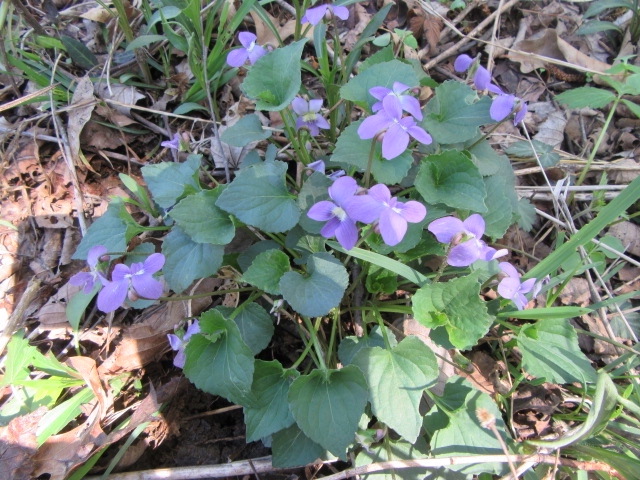
Viola sororia (Common Blue Violet) on 4-5-26, #1085-5.

Hello everyone! I hope this post finds you well. I’ve been working on this post since March 28, but the plants in the north bed have been growing so fast I had to re-take photos three times. This spring has been weird with temps up and down, not to mention the wind and rain. The plants inside want to go out, so that is coming up soon. The grass is growing and I need to fix the riding mower very soon.

The above photo is of a clump of Viola sororia (Common Blue Violet) I photographed in the back of the farm on 4-5-26. I originally photographed a clump from the north bed for this post, but I really liked the way the plants looked at the back of the farm better. Common Blue Violets grow in abundance in several areas on the farm and are always a welcome sight in the spring. There are several other species of Viola here, and I noticed a lot of Viola rafinesquei (American Field Pansy) in the woods next to the old lane that goes to the back of the farm. I rarely get into those trees so I didn’t know they were there in such abundance.

I’m planning on an adventure to my friends secluded woods very soon… You know, one of my favorite spots. I have also decided to go to several native prairies in the area at some point.

Before the photos for this post get out of date, I’ll get started with the bed along the north side of the house…
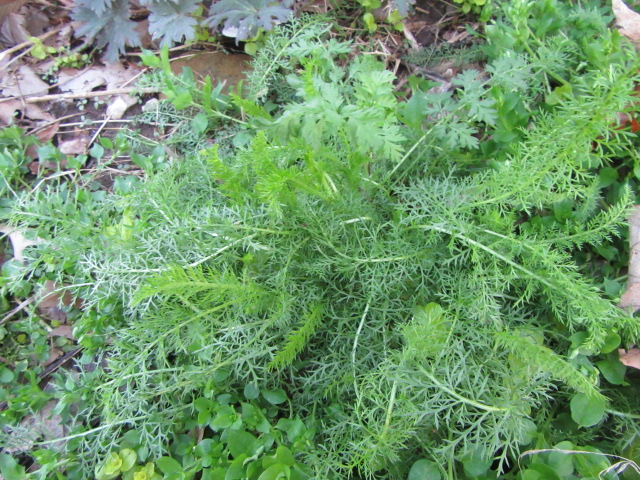
Achillea millefolium cv. ‘?’ on 4-4-26, #1084-1.

First, in alphabetical order, is the Achillea millefolium cv. ‘?’ (Yarrow) that has made its home next to the steps. It is a descendent of plants given to me by my friend Mary Botler when I lived in Mississippi. She gave me a start in 2011 and I have since transplanted them in a few places. It was first closer to the house where it received too much shade so it moved all by itself. This clump has been in this spot for several years, so I guess it has found its home.

<<<<+>>>>
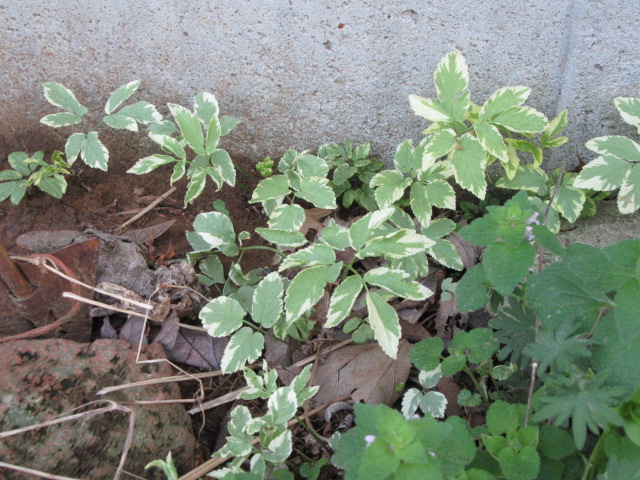
Aegopodium podagraria (Snow-On-The-Mountain) on 4-4-26, #1084-2.

Hmmm… I’m not sure what to say about the Aegopodium podagraria (Snow-On-The-Mountain) except that I was warned about it being rather pushy after I put one plant in the north bed in 2024. I know some perfect places where it could run rampant, but perhaps not where it is… It seems it has somehow spread underground over the winter when its neighbors were sleeping. They woke up to an invasion! Well, it’s not bad yet, but I think it has its own agenda to explore new territory. I don’t have a page for this one yet…

<<<<+>>>>
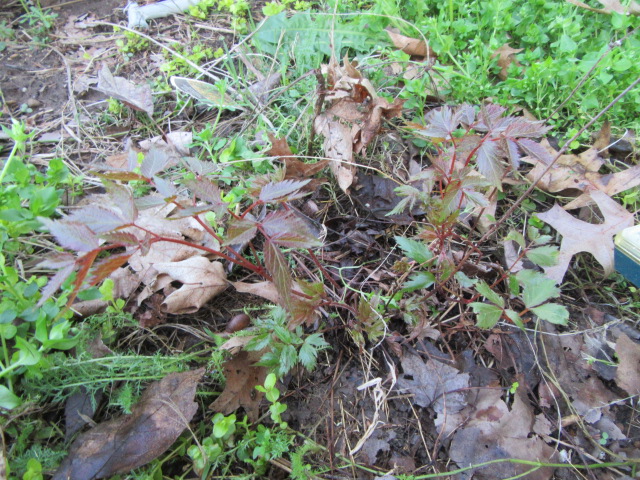
Astilbe x arendsii ‘Fanal’ on 4-4-26, #1084-3.

The Astilbe x arendsii ‘Fanal’ seems to be getting off to a good start. I had to move it over a few feet last spring (I think) because it was next to the ever growing Hosta ‘Empress Wu’. It didn’t seem to appreciate it at the time since it didn’t get very large last summer. I hope it has realized now it was for its own good and will do better this year. I have had this plant since 2018 and have enjoyed its foliage and flowers. This cultivar won the Royal Horticultural Society Award of Garden Merit in 1993.

<<<<+>>>>
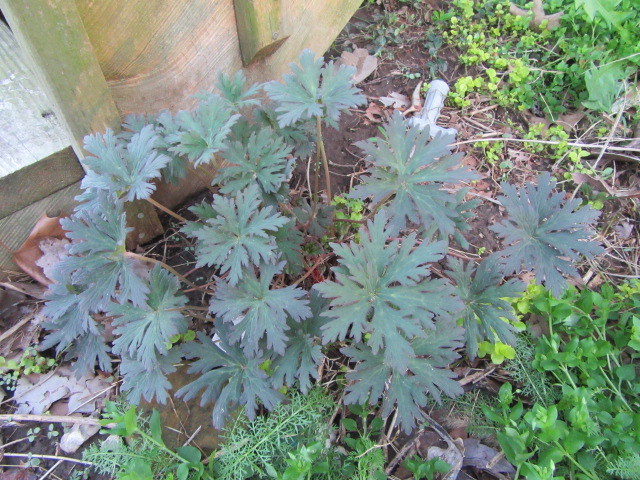
Geranium pratense ‘Boom Chocolatta’ on 4-4-26, #1084-4.

I was very glad to see the Geranium pratense ‘Boom Chocolatta’ had returned for 2026. I brought this plant home from Muddy Creek Greenhouse in 2024 and it has been a great performer, especially last year. I finally have its page finished…

<<<<+>>>>
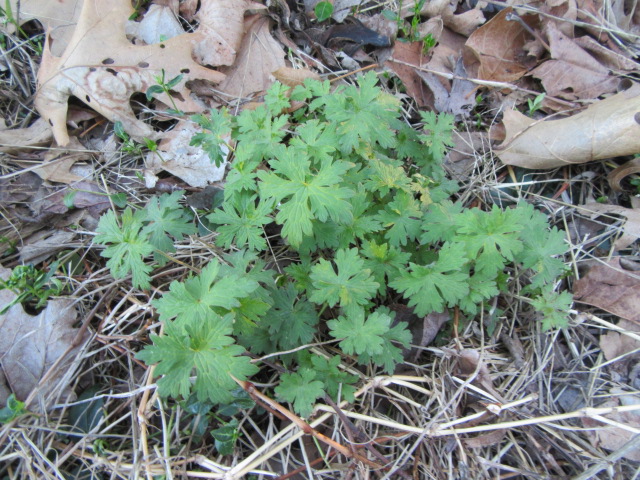
Geranium pratense ‘Johnson’s Blue’ on 4-4-26, #1084-5.

I was equally glad to see the Geranium pratense ‘Johnson’s Blue’ return on the other side of the steps. I’m happy its clump has gotten bigger, too! Although I just brought it home from Wagler’s Greenhouse in 2024, this cultivar has been popular since it was released somewhere around 1950. It has received the Royal Horticultural Society’s Award of Garden Merit and is frequently cited as a top performer. It has a new page, too.

<<<<+>>>>
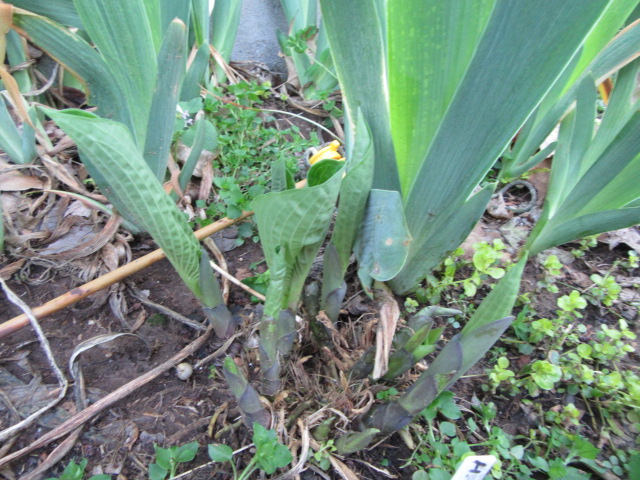
Hosta ‘?’ on 4-4-26, #1084-10.

The Hosta ‘?’ is coming up once again. I brought it home from one of the garden club’s plant sales several years ago and it has done great. It is undoubtedly one of the more popular blue-leaved cultivars, I just don’t know which one since it was unlabeled. Yeah, it was one of those “rule-breakers” where I always say not to bring home plants without labels. There are many blue-leaved cultivars that look so much alike figuring it out would be nearly impossible. I’ve grown several in the past and this one looks like all of them! It grows into a good-sized clump with nice big, puckered leaves and produces bright while flowers. It is just weird it doesn’t have a name… Well, it has one for sure, I just don’t know what it is…

<<<<+>>>>
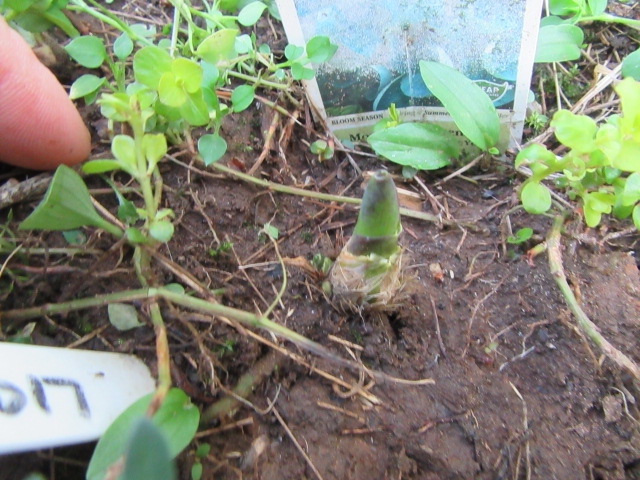
Hosta ‘Abiqua Drinking Gourd’ on 4-4-26, #1084-11.

The Hosta ‘Abiqua Drinking Gourd’ is working on its 10th season. It didn’t do all that great last summer, and has emerged with only one shoot this spring (so far). I really like its puckered, cup-shaped leaves… The American Hosta Society awarded it with the 1996 Lucille Simpler Award and the Best Green Hosta Award also in 1996. It was awarded the Royal Horticultural Society of Garden Merit in 2012 and the American Hosta Growers Association Hosta of the Year in 2014.

<<<<+>>>>
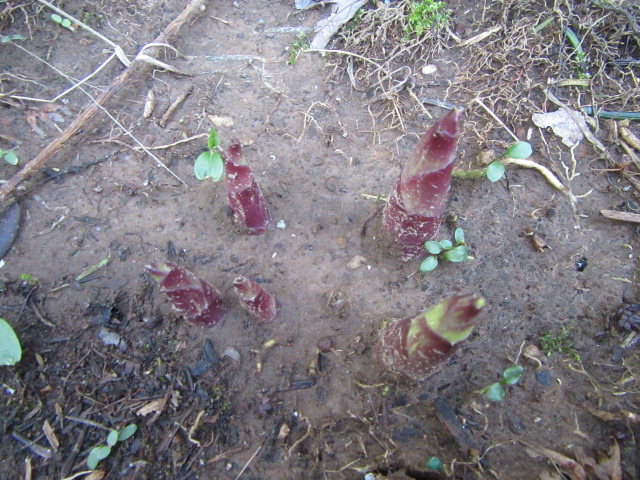
Hosta ‘Dancing Queen’ on 4-4-26, #1084-12.

It seems like the Hosta ‘Dancing Queen’ only one or two tiny sprouts a few days ago, now it is really going! I always liked this cultivar for its bright chartreuse leaves that seem to glow. Hosta ‘Dancing Queen’ was introduced in 2005. The American Hosta Society awarded it with the Benedict Garden Performance Honorable Mention in 2014 and the Benedict Garden Performance Award of Merit in 2015. It was awarded the 2020 Hosta of the Year by the American Hosta Growers Association.

<<<<+>>>>
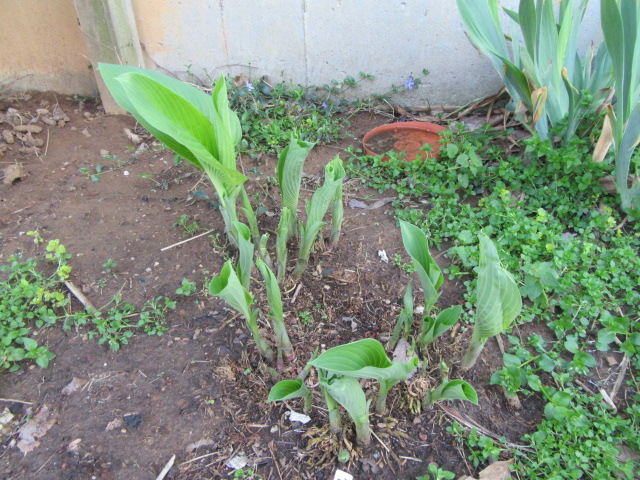
Hosta ‘Empress Wu’ on 4-4-26, #1084-13.

The Hosta ‘Empress Wu’ is up and growing and covering a larger space than before. It didn’t grow as large last year, so maybe it is a sign I should give them all a little food… Sometime the soil runs out of ZIP, you know… Working on its 10th season. I think it is still claiming to the largest Hosta cultivar… In 2023, it was awarded the Proven Winners Hosta of the Year as well as the Hosta Growers Association Hosta of the Year.

<<<<+>>>>
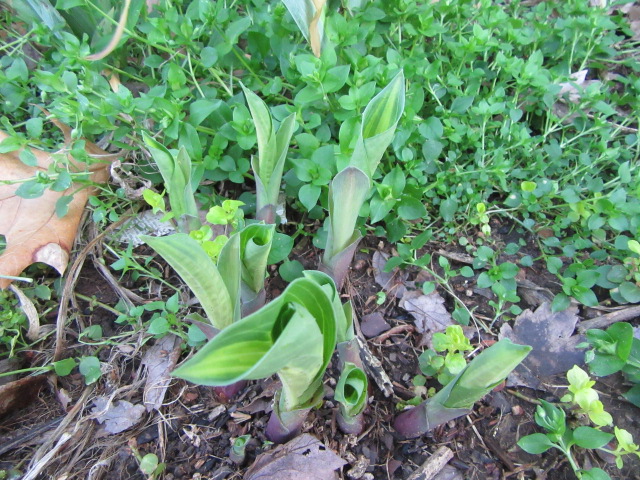
Hosta ‘Forbidden Fruit’ on 4-4-26, #1084-14.

The Hosta ‘Forbidden Fruit’ is always one of the first to come up in the spring and it has really shot up in the past few days. It has always been one of my favorite and always a great performer. Its leaves are nicely variegated and slug and snail resistant. At some point, it was awarded the Royal Horticultural Society of Garden Merit. Even though it hasn’t won that many awards, it is an award winner to me. It is working on its 10th season.

<<<<+>>>>
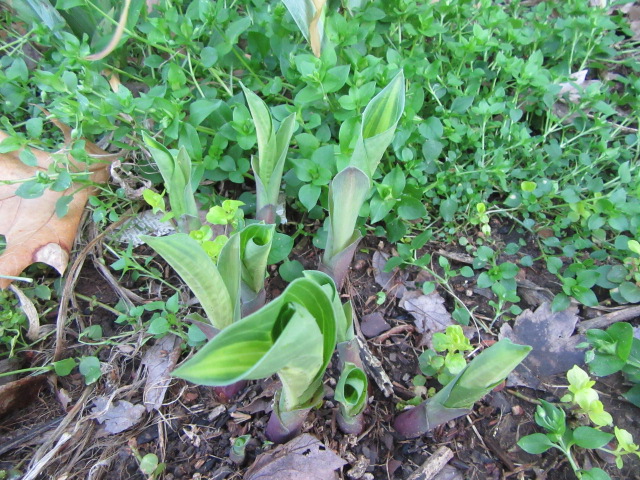
Hosta ‘Guacamole’ on 4-4-26, #1084-14.

It is always great to see the Hosta ‘Guacamole’ coming up in the spring. I always liked its leaves in various shades of green. Always a top performer! It was introduced by Bob Solberg of Green Hills Farm in North Carolina in 1994. It is a reverse sport of Hosta ‘Fragrant Bouquet’ and a descendant of Hosta plantaginea. It was the 2002 American Hosta Growers Association Hosta of the Year. In 2006, the American Hosta Society awarded it with the Benedict Garden Performance Honorable Mention Award, and in 2009 their Benedict Garden Performance Award of Merit. It was also awarded the Royal Horticultural Society Award of Garden Merit.

<<<<+>>>>
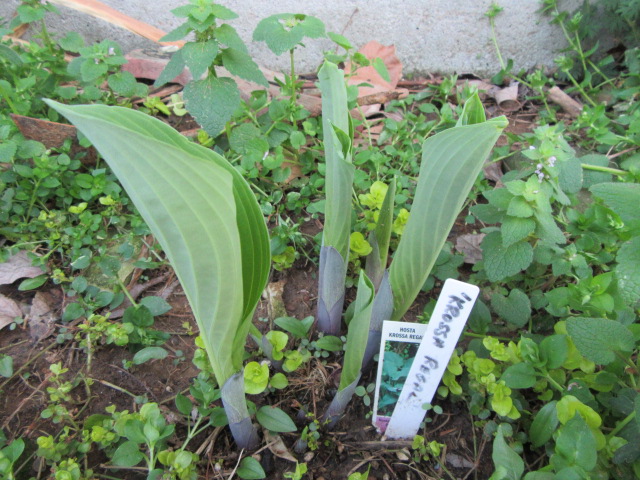
Hosta ‘Krossa Regal’ on 4-4-26, #1084-16.

Hosta ‘Krossa Regal’ has been one of my favorite Hosta cultivars since I first grew it in the 1980’s when I lived here after my grandfather passed away. I purchased my second one in 2009 when I lived in Mississippi and brought it with me in 2013. It did well until the deer kept eating the Hosta leaves in 2021 and it didn’t do so well in 2022. In 2023, only one sprout came up and I moved the Hosta to the north side of the house. I put it in a pot but it barely grew over the summer. It didn’t return in the spring of 2024 but fortunately I found a replacement at Wagler’s Greenhouse. I always liked this cultivars vase-shaped growth habit and chalky blue-green leaves. Last year, one of its flower stems grew to 60″ tall! It is a multiple award winner receiving the Eunice Fisher Award in 1974. The American Hosta Society awarded it with the Alex J. Summers Distinguished Merit Hosta Award in 2001, the Benedict Garden Performance Honorable Mention Award in 2006, and the Benedict Garden Performance Award of Merit in 2008.

<<<<+>>>>
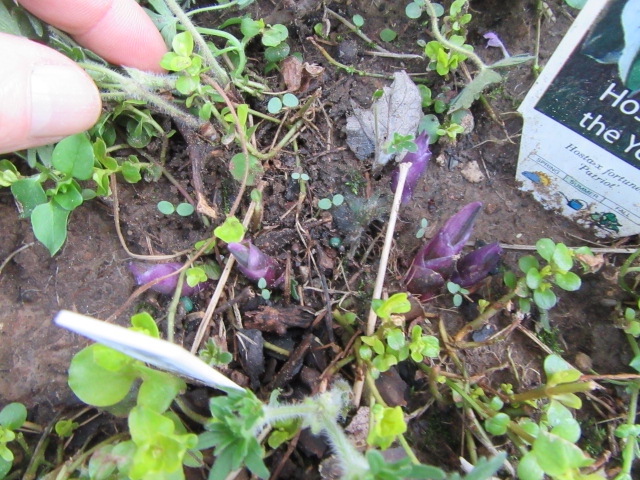
Hosta ‘Patriot’ on 4-4-26, #1084-17.

I was happy to see the Hosta ‘Patriot’ emerging with its lavender sprouts. This one is working on its third season and is sure to be a stunner. It was registered by John Machen, Jr. in 1991 and has become one of of the most popular Hosta cultivars of all time and was the first recognized tetraploid Hosta sport. It was named the Hosta of the Year in 1997 by the American Hosta Growers Association and received the Royal Horticultural Society Award of Garden Merit. It is claimed to be the most popular white-margined Hosta.

<<<<+>>>>
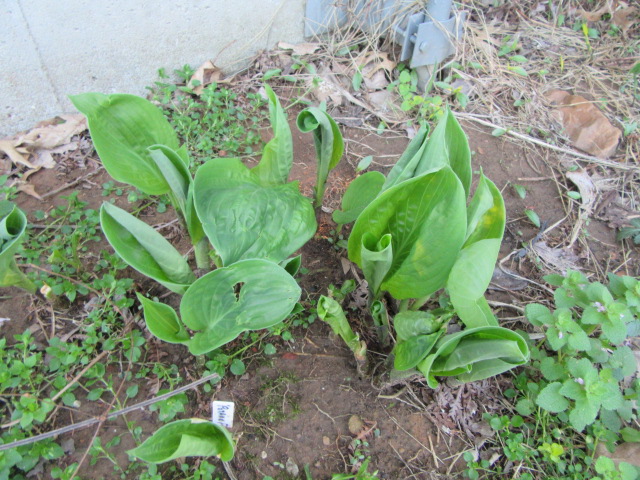
Hosta ‘Potomac Pride’ on 4-4-26, #1084-18.

The Hosta ‘Potomac Pride’ is the oldest cultivar in my small collection. I believe I ordered it from a seller on Ebay in 2009 when I lived in Mississippi, although I have no photos of it until 2010. I moved it to Missouri with me in 2013 and it has done great! Despite the deer nibbling on its leaves nearly every spring in the old shade bed, it continued to grow and thrive. I divided it when I moved it to the north bed along the house in the spring of 2023 and it has continued to do great. It was always one of the first to emerge in the spring and 2026 was no exception. This cultivar was developed by Tony Avent of Plant Delights Nursery and registered with the American Hosta Society in 1995. It was selected as the AHS Convention Plant in the same year. It is a great Hosta with nice dark green leaves and a great performer. It is working on its 18th season!

<<<<+>>>>
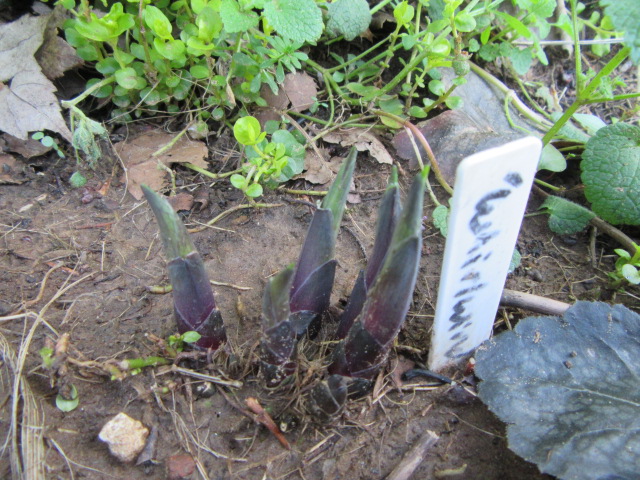
Hosta ‘Whirlwind’ on 4-4-26, #1084-19.

The Hosta ‘Whirlwind’ is looking great so far with several sprouts. I always like this one with its medium and dark green variegated, kind of twisted leaves. They are thick textured so they are slug and snail resistant. I brought this one home in 2018, so it is working on its 9th season. It won the America Hosta Society Benedict Garden Performance Award in 2007 and the Royal Horticultural Society Award of Garden Merit.

Well, I’ll close for now.

Until next time, be safe, stay positive, always be thankful AND, as always… GET DIRTY!


Hot And Dry Wildflower Walk, 6-4-23

Leucanthemum vulgare (Oxeye Daisy) on 6-4-23, #943-60.

Hello, everyone! I hope this post finds you well. I decided to go for a wildflower walk on Sunday afternoon even though it was bright and sunny and the temperature was already almost 90° F. There was a nice breeze, so it wasn’t so bad. We haven’t had much rain and it seems many of the wildflowers I usually see are non-existent. Only the toughest can survive in the heat with no moisture.

Species highlighted in green have their own pages. Just click on the name to visit their page.

Sisymbrium officinale (Hedge Mustard) on 6-4-23, #943-78.

The first stop was the Sisymbrium officinale (Hedge Mustard) colony that decided to come up by one of the old Chinese Elms in the chicken yard. Well, it used to be the chicken yard, but the chickens are normally confined to the chicken house these days. The fence is long gone and you never know when a fox or a wandering dog will stop by. I let the chickens out when I am close by… Hedge Mustard is an interesting plant, in my opinion, because it produces a small cluster of very small yellow flowers at the tips of racemes that get longer as the season progresses.

Sisymbrium officinale (Hedge Mustard) on 6-4-23, #943-79.

Long, slender fruit, called siliques, replace the flowers that seem to hug the stems… Ummm… I am still working on the page.

From the Hedge Mustard, I walk to the wooded area north of the chicken house.

Ribes missouriense (Missouri Gooseberry) on 6-4-23, #943-73.

There are quite a few Ribes missouriense (Missouri Gooseberry) bushes on the farm growing in wooded areas. I prefer to snack on them once the berries ripen although the green berries are used in pies and jams. As a kid, I could never understand why grandma always used green berries for pies instead of the sweeter, ripe fruit… I was never a fan of gooseberry pie.

As I was walking through the jungle, I stumbled upon…

Florinda coccinea (Black-tailed Red Sheetweaver) on 6-4-23, #943-55.

This very small Florinda coccinea (Black-tailed Red Sheetweaver) was hanging around in its web waiting for a smaller visitor. What it got was a much larger human visitor with a camera. Being such a small spider with a tiny thread of string trailing from its, umm, butt, it has to weave a “sheet” to catch its victims.

Smilax tamnoides (Bristly Greenbriar) on 6-4-23, #943-80.

While I was in the area, I thought I would check on the Smilax tamnoides (Bristly Greenbriar). It may sound a little weird, but I like this species. I have tried to find its flowers for several years, but they are normally high in the trees. They produce flowers at the end of the vines…

Smilax tamnoides (Bristly Greenbriar) on 5-10-23, #938-36.

I was working on this species page on May 10 and decided to check the vines to see if I could find flowers. Fortunately, a few of the long vines were hanging low and I found flowers… Smilax tamnoides produce male and female flowers on separate vines. I checked on June 4 to see if there were fruit but apparently, the two vines I took flower photos of were male… No fruit.

I was going to proceed with my walk from there, but when I came to the new electric fence I put up, I didn’t remember if it was on or off… The guy who leases the farm (Kevin) was going to put cows here but hasn’t yet… Since I wasn’t sure if I left the fence on, I decided to take an alternate route.

Conium maculatum (Poison Hemlock) on 6-4-23, #943-33.

So, I went around the barn and took a photo of the majestic Conium maculatum (Poison Hemlock). They may be neat-looking plants, but this is what possibly killed Socrates. You can see them growing along highways and back roads, overgrown yards, fields, etc. Such a deadly plant growing right out in the open. Well, you know as well as I do there are A LOT of deadly plants we just ignore as common weeds. Last year was the first time it was growing here and I intended to get rid of them when I took photos of its flowers. But, the hay was baled along with it. I took the above photo on June 4, and on June 5 I mowed them off…

As I headed back to where I left off before, I had to walk through…

Galium aparine (Cleavers/Catchweed Bedstraw) on 6-4-23.

There was a big pile of dead Galium aparine (Cleavers/Catchweed Bedstraw) that I tried to avoid. One of those plants I love to hate. 🙂 Most of these plants are dried up already, in piles just waiting to hitch a ride. Right off the bat, I get them on my pants. 🙂

Elymus virginicus (Virginia Wildrye) on 6-4-23, #943-46.

There is a small area that is open in the middle and surrounded by trees. Over the years, I have found several wildflowers that have come and gone. It is always strange to me how large colonies can appear and disappear within one season. Sunday, I noticed two good-sized colonies of what I think is Elmus virginicus (Virginia Wildrye). It grows here and there on the farm in the borders of shady areas. Birds like the seeds…

Achillea millefolium (Common Yarrow) on 6-4-23, #943-1.

It appears the Achillea millefolium (Common Yarrow) is beginning to flower. They are a common site on the farm and throughout the countryside. They seem to take hot weather and dry conditions with no problem, although a little moisture would make them put on a better show. I have an old cultivar growing in the north bed, in front of the chicken house, and by the barn that was given to me by a friend in Mississippi (when I lived there) that I brought with me when I moved back here in 2013. I can’t forget the plant with pink flowers I found on a friend’s farm in 2019. I think his cows ate the flowers since I couldn’t find it the day after I took its photo…

Allium vineale (Field or Wild Garlic) on 6-4-23, #943-6.

In another small area in the same location, there is always a nice patch of an Allium species I was never able to identify until now. With the help of iNaturalist and the Missouri Plants website, I found out they are Allium vineale known as Wild or Field Garlic.

Allium vineale (Wild or Field Garlic) on 6-4-23, #943-5.

The Missouri Plants website lists seven species of Allium and says this species is easily recognized as the flowers are replaced by bulblets… There are a number of Allium that grow in the yard that I have let mature that don’t do this. I took several photos so now I can write a page for Allium vineale (at some point)…

Sanicula canadensis (Black Snakeroot) on 6-4-23, #943-74.

In the mix of species in this shady area were a few Sanicula canadensis (Black Snakeroot). The flowers were pretty much shot already…

Phytolacca americana (American Pokeweed) on 6-4-23, #943-66.

I walked out of the shady area and had to get a photo of the Phytolacca americana (American Pokeweed). Not that anyone doesn’t know what it is… Over the years, the bank of the pond has been the subject of many territorial disputes and this year it appears to be the Pokeweed’s turn… I would say it is much better than Ragweed! Oddly, I find American Pokeweed an interesting plant and have let it grow along the garden fence, in front of the house, along the fence around the yard… I think the HUGE plant in front of the house has become annoying and perhaps three years is enough. The one along the garden fence didn’t come up this year and the ones that came up in the garden had to go… There is a limit…

I walked around a row of trees in front of the main hayfield to see what I could find…

Dianthus armeria (Deptford Pink) on 6-4-23, #943-39.

There were quite a few Dianthus armeria (Deptford Pink) growing in this area. This species can be easily overlooked, and if it weren’t for the small pink flowers you wouldn’t even notice them at all. Walking around the farm on Sunday, I noticed they were scattered around in many areas from front to back. I think with it being so dry and the grass being so thin, it has allowed many species to flourish that would otherwise go unnoticed.

Erigeron annuus (Annual or Daisy Fleabane) on 6-4-23, #943-50.

Well, what can I say? Typically in an average year, this wouldn’t have happened until after the hay is cut but I have seen it before. Overgrazed pastures and hayfields without good grass become COVERED with Erigeron annuus (Annual or Daisy Fleabane). With the lack of grass, this species will eagerly take over…

Erigeron annuus (Annual or Daisy Fleabane) on 6-4-23, #943-62.

The flowers are kind of interesting and unmistakable as Erigeron annuus with as many as 120 (or so) white ray florets (petals). Both male and female flowers can be self-fertile. Flowers are produced until a good ZAP in October so you can see how this species can get an upper hand. Many species of insects love these plants including MANY butterflies.

Argynnis cybele (Great Spangled Fritillary) on 6-4-23, #943-14.

Among the butterflies flying around the wildflowers was this Argynnis cybele (Great Spangled Fritillary). Most of the butterflies flying around the Erigeron annuus are smaller (short-tongued) while this Great Spangled Fritillary, being larger (long-tongued) was more interested in the Red Clower. I took a few good shots then this one flew off into the brush… I suppose enough was enough. Later on, I took photos of one that wasn’t so shy… I hadn’t photographed a Great Spangled Fritillary until Sunday’s walk. 🙂

Apocynum cannabinum (Hemp Dogbane) on 6-4-23, #943-12.

Farther up into the field, maybe halfway, there is quite a scattered colony of Apocynum cannabinum (Hemp Dogbane) beginning to flower. This species is quite similar to milkweed in appearance, especially from photos. I first identified this species on the farm in 2020 from a single plant, and since then it has made itself quite at home… All parts of this plant are poisonous, the genus name meaning “poisonous to dogs.” Despite its poisonous properties, Wikipedia has a long list of medicinal uses.

It has been used as a fiber plant and also as a psychoactive drug. Native Americans used to grind the seeds down into a powder and they used the plant to make bows, nets, tie-down straps, fishing lines, and clothing.

Pontia protodice (Checkered White) on 6-4-23, #943-71.

Wandering south from the Apocynum, I found this Pontia protodice (Checkered White) fluttering about that had no time for a human visitor. I took two shots and thankfully one was good enough for a proper ID. Butterflies can be tricky and sometimes you have to chase them around. Well, I wasn’t in the mood to chase butterflies but I am glad we met briefly. I am sure there are MANY species of butterflies I haven’t identified here…

Cornus drummondii (Roughleaf Dogwood) on 6-4-23, #943-37.

Walking along the row of blackberries growing where an electric fence used to be, I ran across a few Cornus drummondii (Roughleaf Dogwood). They grow here and there along fence rows and are a favorite of the strange but true Chauliognathus marginatus (Margined Leatherwing Beetle). Hmmm… I think I spelled it right. Those critters like milkweed flowers, too.

Hmmm…

The blackberries have almost all dried up from lack of moisture…

Back pond #2.

I have never seen this pond this low. I am sure the pond behind it is already dry… I may have to fence this pond off before Kevin brings cattle here. The edge is like quicksand and I would have to have a cow get stuck. Kevin says he has had to pull cows out of the mud in the past and it wasn’t any fun.

I didn’t walk in the trees behind the pond because this time of the year it is a real jungle. I walked toward the Persimmon tree south of the pond to check on a friend…

Elephantopus carolinianus (Leafy Elephant’s Foot) on 6-4-23, #943-45.

I checked to see if the Elephantopus carolinianus (Leafy Elephant’s Foot) a while back to make sure they returned in 2023. This is one of my favorite species on the farm, although I haven’t mentioned that to them… There is a story behind my first observation on a friend’s mother’s farm in 2019, and again here in 2021 but I don’t want to repeat it or this post would be much longer. You can read about it by clicking on the name above. 🙂

Leucanthemum vulgare (Oxeye Daisy) on 6-4-23, #943-60.

I first identified Leucanthemum vulgare (Oxeye Daisy) on Kevin’s farm in 2019, and then I found several in the north end of the south hayfield in 2021. Last year I had to cross the fence to get photos so I am glad a colony has made its way to the north pasture.

Leucanthemum vulgare (Oxeye Daisy) on 6-4-23, #943-62.

I like these because the flowers are much larger than the other white members of the family Asteraceae on the farm. I hadn’t been a big fan of daisy-type flowers until I read about how complex they are. Now, I have learned to respect them…

On farther down in the same area…

Helenium flexuosum (Southern Sneezeweed) on 6-4-23, #943-57.

Hmmm… I was walking fairly close to the fence where I had driven the tractor several days before (you can see where the tractor tires have been) and ran across a plant I couldn’t identify. Although it looked kind of familiar in some ways, I just wasn’t sure…

Helenium flexuosum (Southern Sneezeweed) on 6-4-23, #943-58.

Hmmm… When I uploaded photos on iNaturalist, its top suggestion was Helenium flexuosum (Southern Sneezeweed)… Could it really be true? I haven’t seen this species here, or anywhere else, since 2013!!! I guess it is true since another member of iNaturalist agreed and the observation became Research Grade.

Penstemon digitalis (Foxglove Beardtongue) on 6-4-23, #943-64.

I walked down to the lower end of the south pasture to check on the Penstemon digitalis (Foxglove Beardtongue). They have only been coming up here on the farm since 2020 in the lower section of the back pasture. They probably came up here before that but the cows ate them off since the colony was quite large.

Penstemon digitalis (Foxglove Beardtongue) on 6-4-23, #943-65.

The flowers are neat, but I really like their leaves…

There were several of these growing more out in the open, but their flowers had already started turning brown. I took the above two photos in the shade among the…

Dichanthelium clandestinum (Deertongue) on 6-4-23, #943-42.

Dichanthelium clandestinum (Deertongue)… I may be somewhat strange to some, but I kind of like this grass. We have a little history because it took several years to properly identify it. In fact, it wasn’t until I started using iNaturalist in 2019… Even then, I wasn’t sure and thought it was possibly Dichanthelium latifolium (Broad-Leaved Panic Grass). Another member asked if I was sure it wasn’t D. clandestinum?

Dichanthelium clandestinum (Deertongue) on 6-4-23, #943-43.

The latter species produces normal flowers this time of the year and “exerted” flowers later on while D. latifolium only produces exerted flowers at the end of the summer. I made it a goal to keep an eye on the colony in 2021 and positively identified it as D. clandestinum… There is a lot of green in the above photos, but I am holding a stem of flowers. 🙂 Very difficult to get good photos of such thin stems and tiny flowers. I seemed to be in a bit of a hurry, so I didn’t really notice if these were flowers or if they were already in the fruiting stage. Hmmm… There was no need to be in a hurry…

Potentilla simplex (Common Cinquefoil) on 6-4-23, #943-73.

Potentilla simplex (Common Cinquefoil) grows around the same area and seems to have spread out somewhat since it was first identified here in 2021. This species seems to do best in the shade, while the Potentilla recta (Sulfur Cinquefoil) prefers a sunnier location on the rest of the farm…

The back pasture/hayfield on 6-4-23…

Looking toward the north at the back hayfield looks pretty normal at this view…

Hmmm…

Looking down into the grass shows a different story. The blades of grass are very thin and dry. Once the seed dries, we are just going to top it instead of baling it. I stopped grazing this area a couple of years before dad died because it made great hay…

I circled around to go back to the main hayfield and didn’t notice anything special. I walked along the “other” blackberries on the south side to see if they were doing better…

Blackberries…

There were a few that were fair, but still many were dried up. These are a different species from those on the rest of the farm. They are earlier, much bigger, and only produce if there isn’t a frost in early April… The last time they produced a good crop I put 10 gallons in the freezer and gave a lot away… Just along 40′ or so. They are GREAT!

Walking a little further, I looked over into the hayfield and saw purple flowers with a bird on top. I zoomed in with my camera and realized it appeared to be a new species of milkweed, and it wasn’t a bird… I had to get a closer look. 🙂

Asclepias purpurascens (Purple Milkweed) and Argynnis cybele (Great Spangled Fritillary) on 6-4-23, #943-25.

Shhhhh……. What the heck?!?!?! I can’t sneak up on anything with this crunchy grass! Strangely, the butterfly didn’t fly off. This is a new milkweed to photograph and more photos of the Argynnis cybele (Great Spangled Fritillary) would be great. Which one do I choose first? Well, I already have photos of the butterfly and none of the milkweed. But, the butterfly could fly off while the milkweed will still be here. How about both at once?

Asclepias purpurascens (Purple Milkweed) and Argynnis cybele (Great Spangled Fritillary) on 6-4-23, #943-17.

This milkweed species, Asclepias purpurascens (Purple Milkweed) hasn’t been here before. There are two other plants 40′ or so away and not together. I feel like I am whispering in my mind even when I am writing this. Like the butterfly will fly out of the photo… GEEZ!

Asclepias purpurascens (Purple Milkweed) and Argynnis cybele (Great Spangled Fritillary) on 6-4-23, #943-18.

It’s like the butterfly is so busy it didn’t even notice me…

Asclepias purpurascens (Purple Milkweed) and Argynnis cybele (Great Spangled Fritillary) on 6-4-23, #943-22.

Woooo… I think it said, “Don’t push it.”

Asclepias purpurascens (Purple Milkweed) and Argynnis cybele (Great Spangled Fritillary) on 6-4-23, #943-24.

You have to admit the Great Spangled Fritillary is one magnificent creature. Just look at the size and color!

Asclepias purpurascens (Purple Milkweed) on 6-4-23, #943-27.

The Purple Milkweed is nice, too. Much brighter and darker than the other milkweeds here. Strangely, I didn’t notice any Green Milkweed when I saw them in flower along the highway. Maybe I just haven’t located them yet. I just found the Green Milkweed on the farm in 2021 and there were only a couple of plants last year. Hmmm…

I walked on down to the front pasture and in front of the walnut trees…

Verbesina virginica (White Crownbeard/Frostweed) on 6-4-23, #943-81.

“What are you doing here?” The Verbesina virginica (White Crownbeard/Frostweed) just smiled and chuckled a little. It is a good 200′ away from the colony along the fence in more sun. That’s OK since it is another favorite wildflower.

Verbesina virginica (White Crownbeard/Frostweed) on 6-4-23, #943-82.

I really like the winged stems!!!

I guess that wraps up this post. We did get about 5/10″ of rain overnight (early Thursday morning). It sure cooled off.

Until next time, be safe, stay positive, always be thankful, and GET DIRTY!