New Granddaughter

Hello everyone! I hope this post finds you all well. I just wanted to let you know my daughter has her first baby.


Meet Allison Marie. She was born at 12:30 PM (Jan. 28). She weighed 6 pounds, 2 ounces and was 19 inches long. I had to get out the tape measure for that one… I think she looks like grandpa already.

I think I have four step grandkids (1 boy and 3 girls) but this is my first from my gene pool.

That’s all I have to say for now. I have to get back to work updating pages and writing new ones for the wildflowers I identified over the summer. I still have about 120 new pages to write. I had to check out Steyermark’s Flora of Missouri again (all three volumes).

OH, one more thing. I had an enormous spike in stats today. 490 views! Usually about 60-110, more or less, from about as many visitors. Today, only 42 visitors but 490 views. What is really strange is that 438 views were from the Philippines… No comments or like’s so I have no clue who the culprit is/was. I am sure tomorrow will be back to normal but it would be interesting to have stats that good every day.

I’m finished now.

Until next time, be safe, stay positive, and always be thankful.

Sunday Stroll

Hello everyone! I hope this post finds you all well. It is a nice day with the sun shining and the temperature is 43° F. I decided a walk to the back of the farm was in order.

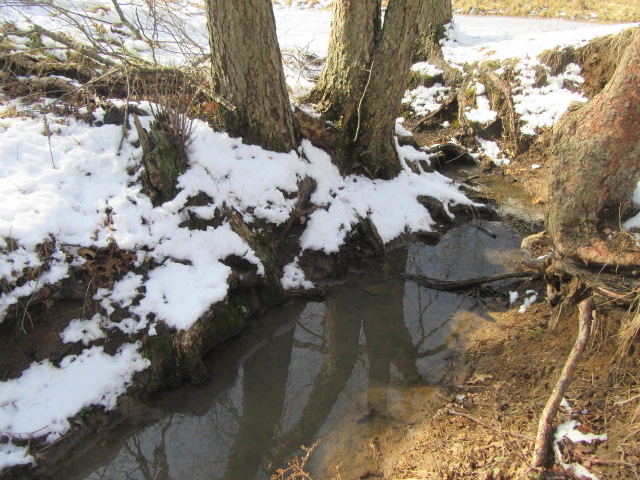
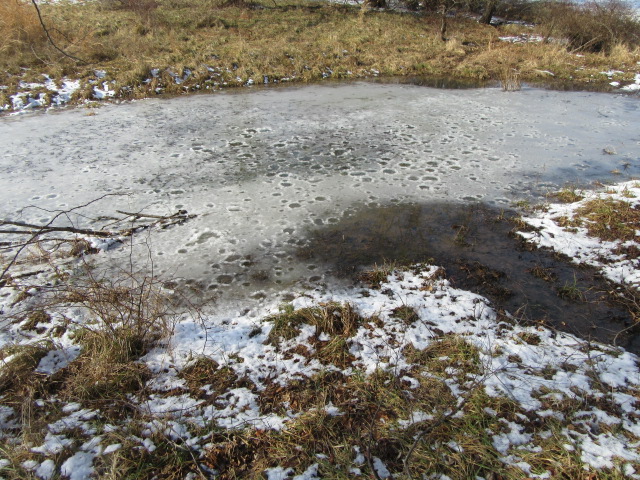
The first photo was taken where one of the ponds drain into the creek about 40 or so feet away. The water was slowly moving.


This is the pond… The melted area is where the water is draining into the first photo… Maybe I should have taken this one first, huh. I just added the photos in the order I took them.

There are two ponds, one right next to the other, in the back of the farm. I always thought it was strange how grandpa dus a new pond next to the old one instead of just making the old one bigger. I imagine the old pond, the one in the photo, is spring-fed. Neither pond is very big so maybe even the newer part was never finished. That happens when water starts coming in before you are finished as with the smaller pond in the front pasture. The dozer man left for lunch and the pond was full of water when he returned.


After I left the area behind the pond(s) I looked toward the southeast pasture. You can see the Farrington Park lake with all the leaves off the trees. I could hear a Barred Owl along the trail toward the west and squirrels barking by the swamp ahead.


This is the only time of the year when you can see the swamp. I suppose it isn’t really a swamp, but that’s what I call it. This area completely grows up mainly with Broad-Leaved Panic Grass (Dichanthelium latifolium) and Jewel Weed (Impatiens capensis) during the summer months. Other weeds grow between this area and where the electric fence is which is where I identified several new species of wildflowers in 2019. It is almost impossible to get to this area late in the summer. You will come out covered with several species of stick-tights and beggarticks.

I was kind of amazed there were very few birds out and about. I only saw a few sparrows, Cardinals, and Blue Jays. I could hear a Nuthatch but I could never spot it.


From the top of the hill looking toward the house, the sky was a beautiful blue with a few clouds.


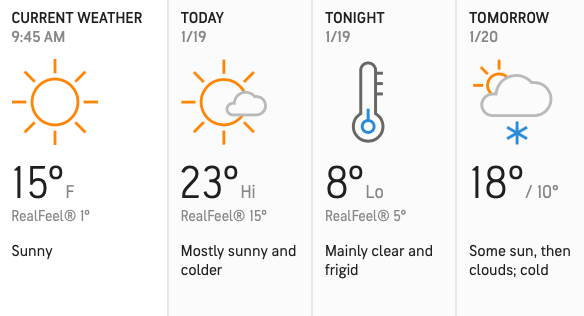
The forecast for the week looks pretty good…

That’s all I have to say for now. Until next time, be safe, stay positive, and always be thankful.

AGAIN WITH THE SNOW

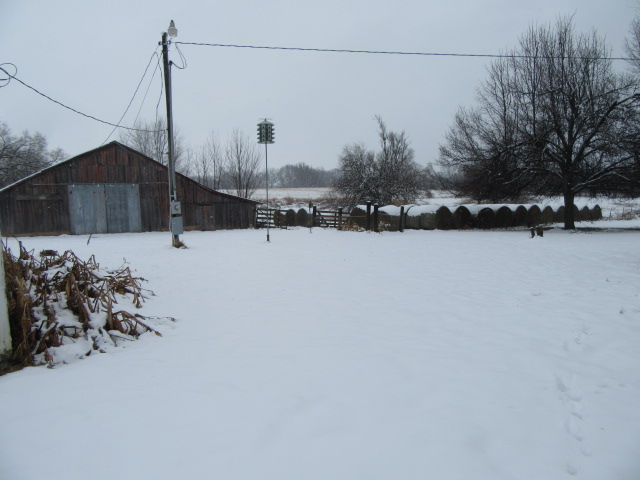
Hello everyone! I hope this post finds you well. Last night I looked ut the door at 1 AM and it was snowing and had already accumulated a little. It snowed all night so when I got up there was plenty. I drove to Kevin’s house to get his truck so I could go feed his cows 12 miles or so out of town. As usual, I couldn’t make it up the hill to his house so I backed down the hill and parked. Then I had to walk up the hill to get the truck. His truck is a 4 wheel drive flatbed so it has no problems.

The highways were cleared off so getting to where I was going was no problem. I fed the cows then came back home safe and sound.

I don’t complain that much about the snow here after spending a winter in Minnesota. All is well.

I read posts on other blogs about harvesting tomatoes and onions in Australia and New Zealand because they are on the opposite side of the planet. For me, I am longing for a tropical climate like the Philippines. 🙂

Until next time, be safe, stay positive, and always be thankful.

Raising Monarch butterflies — Petals and Wings

I reblogged this post from Petals and Wings. The post includes a video you will also want to watch.

We had a very productive last summer. We raised and released 48 Monarch butterflies. We took in 50 eggs but only 48 made it to butterflies. The whole process was much more time consuming than beekeeping. To prevent disease, we changed Milkweed leaves and cleaned the nursery tanks daily. Once the last butterfly fluffed it […]

via Raising Monarch butterflies — Petals and Wings

More Snow, Chickens, Random Photos, and a Miracle Inside!

Hello everyone! I hope this post finds you all well! Well, the temperature dropped to 9 or 10° F but was 16° by the time I got up (which is supposed to be the high for the day). It wasn’t snowing when I got up but it soon started… The birds weren’t very active over the weekend and the feeder remained about 3/4 full. This morning, however, they had been busy and pretty much emptied the feeder so I had to refill it.

I decided I would take some random photos when I went outside…


I went to the chicken house to remove the ice from their waterers and give them fresh water. The Old English Game Bantams (three hens and a rooster) are always happy to see me.


The bigger chickens were also glad to see me but some are camera shy. Most of them come to me but when I pull out the camera they run. Pictured above is the While Chantecler rooster and one of the three hens. The White Chantecler hens are very sweet and well mannered.


The Delawares are friendly unless they are on the nest. If one of them is in the nest I pass her by because they are very protective… I took a photo of one of the black sex-links but for some reason, it wasn’t there when I uploaded the photos. They are very good chickens and great layers and friendly on the nest. Right now they are on vacation from laying…


Equisetum hyemale (Horsetail)

The Equisetum hyemale (Horsetail) always lays down on the job during the winter. They will mostly stand back up when temps warm up in the spring…


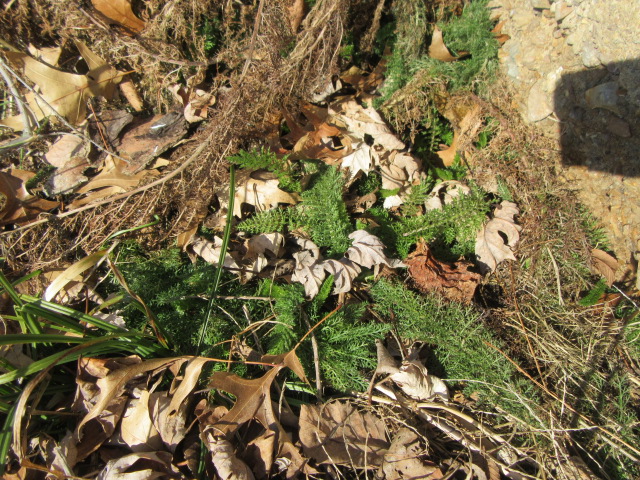
Achillea millefolium (Yarrow)

The old Achillea millefolium flowers are great snow catchers. They are pretty much dormant over the winter but when temps stay mild they regrow new leaves. Since we had a fairly mild January, some new leaves have already appeared.


Cylindropuntia imbricata Tree Cholla)

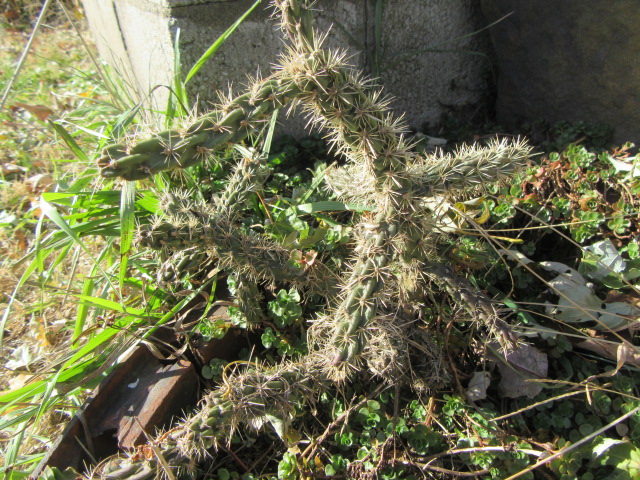
The Cylindropuntia imbricata (Tree Cholla) is very hardy here but not particularly fond of the cold. It turns a maroonish color and kind of shrivels up…


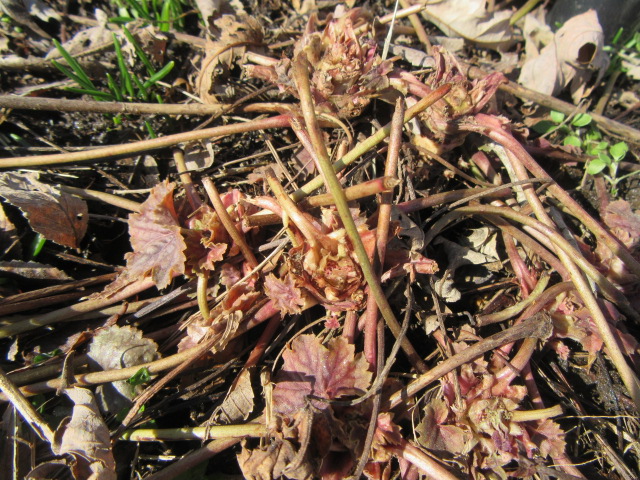
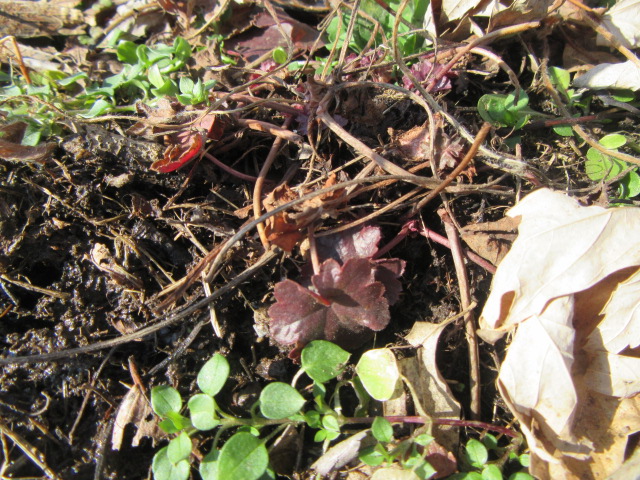
Monarda didyma ‘Cherry Pops’

The Monarda didyma ‘Cherry Pops’ has been really weird this winter. The leaves have stayed green!


Allium ampeloprasum (Elephant Garlic)

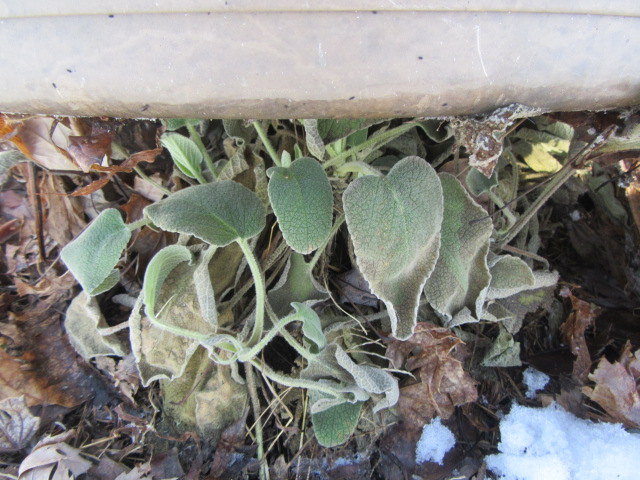
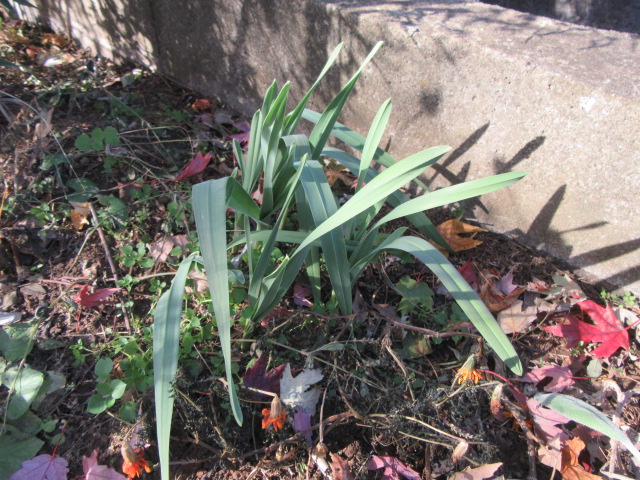
The Elephant Garlic stays green and grows all winter.


Phlomis ‘Edward Bowles’

Yep! Under the pot is Phlomis ‘Edward Bowles’. It doesn’t particularly like to be covered but I like it better this way even though it thinks I am a bit nuts and overprotective.


Allium sp. ?

There are many clumps of some kind of Allium species. I have not been able to identify the species but it is some kind of wild onion… I usually mow around this clump during the summer because they have very interesting flowers…


No comment!


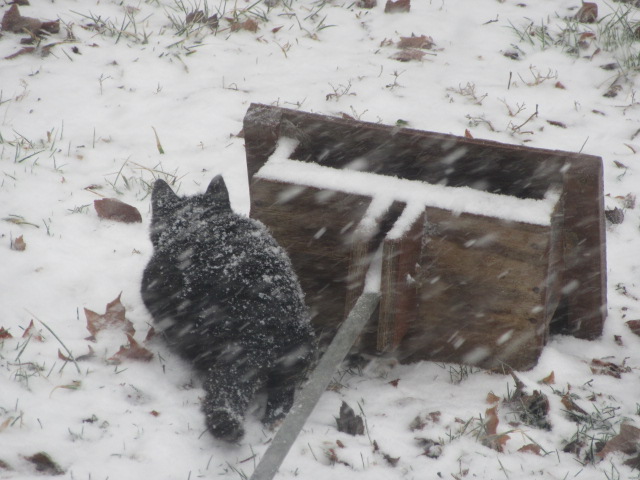
I think this cat is a bit… Ummm… Maybe I shouldn’t call him retarded but that is certainly the word that comes into my mind. He usually sleeps in the wooden box, kind of like a doghouse, on the porch but he has been particularly weird lately. Last week when it was raining he was right out in it and was soaking wet. Now, this morning, he was right out in the snow.

Maybe he is mourning… Thursday morning his brother wasn’t feeling well and growled at me while I was feeding the cats. He has never been friendly and has only recently allowed me to get close to him as long as I didn’t try to touch him. Thursday evening he was lying under a table on a potting soil bag and he growled at me again and was kind of slobbering. Friday morning he didn’t come to eat and I found him dead next to the basement steps…


Kalanchoe x laetivirens (Mother of Thousands)

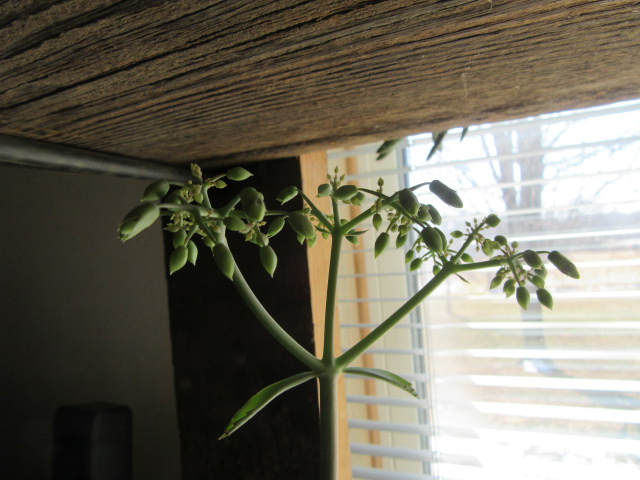
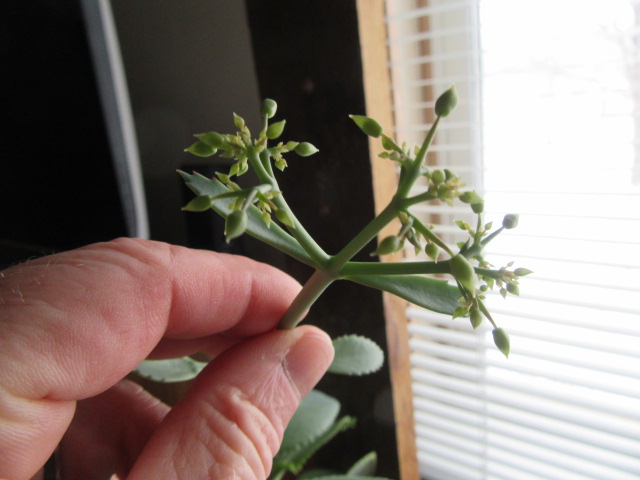
Now for the miracle… I have had this particular Kalanchoe x laetivirens since June 2015 and have regrown it many times. That sounds weird… Anyway, it can get quite tall, so you have to cut the stem below the leaves and regrow it on occasion. If not, the leaves grow smaller and it is much better looking with HUGE leaves. Over the years it has produced countless thousands of plantlets that can’t resist taking root in the pots of its neighbors. I am in and out of the back bedroom every day but this morning I went to see if I could get a photo of the shelf with all the plants. Well, the light was no good but then I noticed something different with this plant… IT IS FLOWERING FOR THE FIRST TIME!

SO, even though this plant is not so exciting and dealing with the plantlets make it even less so on occasion, it really surprised me with flowers. You never know when a new experience will come along. I have several different Kalanchoe species and this is the first one that has flowered. Well, that’s not counting the plants I bought when I lived in California in 2008 that were already flowering. Since 2009, this is the first… I am excited!

It is now about 2 PM and it has stopped snowing for now. It is, of course, still 16° F and tomorrow it is supposed to be 36.

The National Weather Service says it is 14° F but what’s a couple of degrees? It is cold. The forecast from Tuesday evening through Friday doesn’t look that great but we will survive. Spring is right around the corner. 🙂

That’s all I have to say for now. Until next time, be safe and stay positive. There is always plenty to be thankful for.


Stint Removal & Doctors Kidney Stone Prevention Diet

Hello everyone! I hope this post finds you all doing well. Today was the trip to the urologists to have the stint removed that was put in place when I had the laser surgery on January 2. I am not going to go into the details. Well, maybe kind of…

I want to say I have changed my diet somewhat over the past month. I have cooked most of my own food, eating mainly fish and steamed vegetables for dinner. Instead of chips, I have switched to grapes, apples, pineapple, and blueberries (since I have so many in the freezer). I have cut down ice cream to almost none and very little cheese. Even eating before bed was stopped until this past week (I had a bowl or grapes and pineapple a few evenings before bed). I noticed a big difference in the way I slept during the night and with heartburn. No heartburn or indigestion for weeks now.

One of the nurses was in training and as they were preparing to get me ready, I said I bet she is thinking “the things I have seen today.” I was thinking about other things. I have only been in two relationships before and here are two women at once looking at… You know what I mean. The nurse explained what to do with “it” to the other nurse then inserted a syringe or something into my “you know what” to put the stuff in to help numb the urethra. Then she put a clamp on it so the stuff wouldn’t run out. She explained what she was doing and what everything was properly called, but who could remember.

The nurse told me I could watch what the doctor was doing on a screen next to the bed. I first told the nurses I didn’t think I wanted to watch. Once the doctor came in and I saw the size of the “tools”, I knew I didn’t want to watch that either. I opted for the screen…


The doctor ran a probe, or whatever you call it, up through the urethra, the bladder, prostate, ureter, and then inside the kidney. A light and camera were on the probe so I could clearly see what was going on. I was amazed at how fast the doctor was moving through everything. But, I was thankful it was going as fast and smoothly as it was. Then another gizmo was ran inside the tube to grab the stint and pull it out. The nurses in training was the one the doctor selected to open the “grabber.” When the doctor asked her to do it, she said, “You want me to do it?”

While I was watching the screen, she opened it up. I was thinking I hope they don’t grab the wrong thing. They looked around for the stint then finally found it. I thought, “HOLY S–T!” IT LOOKED SO BIG! They grabbed it and pulled out. As far as what it felt like… Let’s just say it was very uncomfortable. Toe-curling uncomfortable…

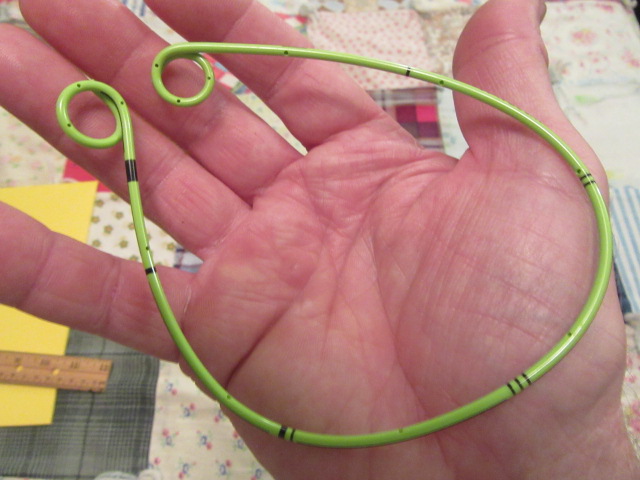
I asked the doctor if I could have the stint and he said, “sure.” As you can see, it is 12″ long! The loops on the end are to keep one end in the bladder and one end in the kidney.

Then came the doctor’s list titled “Kidney Stone Prevention Diet”.

Avoid milk and milk products at all times other than allowed. Only have 1/2 pint daily.

Avoid cheeses, creams soups (made with milk), ice cream and eggs. Avoid products containing amounts of egg yolks.

Avoid dried legumes of all kinds: lentils, beans, peas, and soybeans.

Avoid dried fruit, figs, prunes, peaches, apricots and raisins.

Avoid the following vegetables: cabbage, dandelions, kale, mustard greens, turnips, turnip greens, watercress, and collards.

Rarely eat: almonds, hazelnuts, molasses, maple syrup, clams, canned salmon, bran cereal, bran bread, custard-filled pies, pastries with whipped cream, dried fish and dried meats or oysters.

Reduce tea, dark colas and salt.

To maintain healthy kidney function, an adequate urine output is important, therefore, it is necessary to drink at least 6to 8 glasses water daily. Add a slice of lemon or lemon juice when possible.

It is important to maintain good vitamin intake, especially vitamin “A” and ”C” but eliminate vitamin ”D” from the diet entirely by not eating cod liver oil and codfish.

On the way out, the doctor said that should take care of me for 10-20 years. I am thinking I have 10-20 years to eat differently. LOL!

Seriously, the diet plan won’t be that hard. I drink very little milk unless I use it in cooking. Not eating eggs won’t be hard because I don’t normally eat eggs unless it is in a recipe. I only use dried beans when I make vegetable soup. Avoiding dried fruit is no problem because I eat fresh fruit.

I do like cabbage, kale, and turnips and I suppose this list should include other brassicas such as broccoli, cauliflower, brussels sprouts, etc. All contain calcium oxalite but they are not all on the list. I think “moderation” is called for but I can survive without.

I am not particularly fond of almonds and hazelnuts but I often buy cans of mixed nuts and save them for last. You can buy cans without peanuts but not without almonds. I always wondered why they put in so many almonds in the first place. Pecans, pistachios, and cashews are my favorite.

Avoiding cheese and ice cream would be very tough as I love both. I think maybe to cut down would be better than doing without.

I drink one glass of iced green tea at dinner are rarely drink colas. I wonder why coffee isn’t on the list? I drink 1/2-2 cups in the morning.

Now that the stint is gone I can happily drink 6-8 glasses of water a day. It was very uncomfortable emptying my bladder with the stint inside… I knew I needed to drink more water, but the pain involved when urinating made me not want to.

So, now life is back to normal. The ordeal was quite an experience and I hope not to relive it again. I am very thankful for all the staff and doctors at the Golden Valley Memorial Hospital for their care and expertise. I am thankful for medical technology. I am also thankful for everyone’s prayers and the Angels and guides that watched over the entire ordeal. We are never alone.

Until next time, take care, be safe and give thanks always!

And AGAIN With The Snow

Hello everyone! I hope this post finds you all well. It is easy for me to say I hope you are all staying warm because it is cold here. Currently, at 2:35 PM it is 21° outside. Ummm… That is -6.1° C I think.

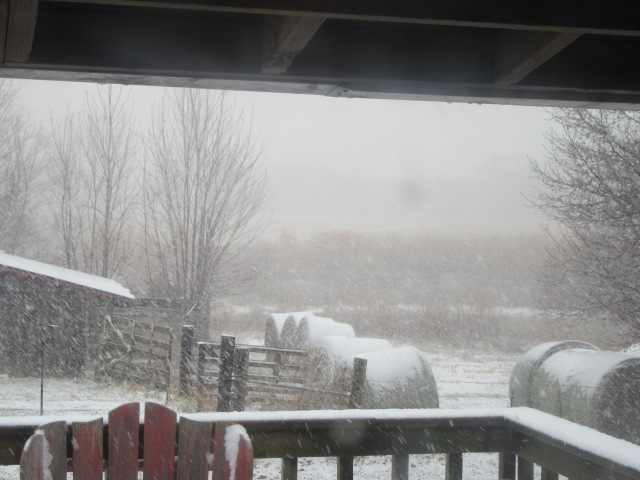
The rain was in the forecast as was a winter storm but the rain was a day late. I got up early on Thursday and Friday morning to feed the cows because of the possibility of rain. As I headed back to town on Friday morning the rain started. It rained most of the day yesterday, which is an understatement. Many times it literally POURED. It rained most of then night then froze. All was calm when I got up and fed the cats and it wasn’t snowing. I looked outside at 11 AM and it had started…

The above photo was taken at 12:12 PM so I thought I would take a few more shots while I was at it…


The birds have been weird this winter because we have had fairly mild weather. The migratory birds were slow to arrive compared to last winter and especially the winter before. The first week in January 2018 saw temperatures of-10° F!


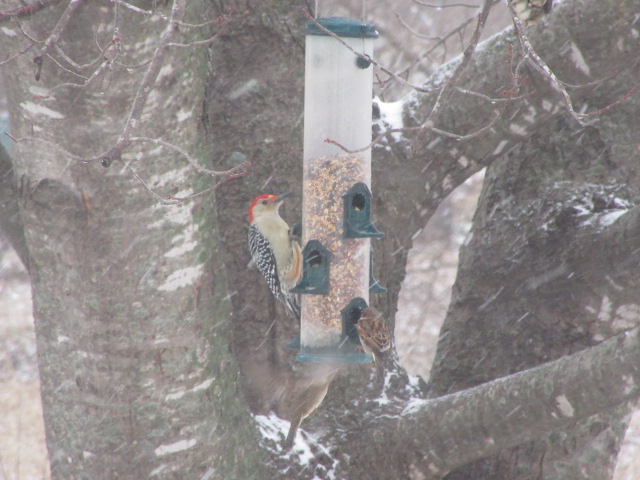
The Red-Bellied Woodpecker is trying his hand at the feeder. Maybe I should say “his beak”. It could be the same one that used to look in m bedroom window. In November I photographed a Downey Woodpecker taking seeds from the feeder and hiding them in the fork of this tree.


The photo above is the Red-Bellied Woodpecker looking at me through the back bedroom window on December 26, 2017. I moved to the back bedroom after mom passed away and I could really watch the birds. I have moved to the front bedroom since then (after dad passed) so I now feed the birds at one of the Maple trees in the front yard. They have gotten used to the traffic from the street.


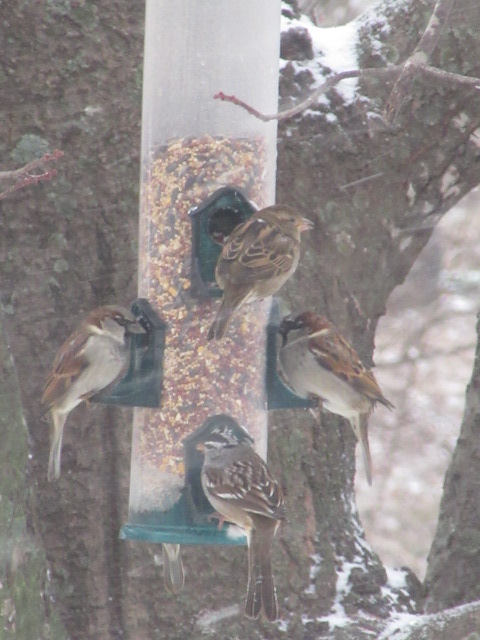
The Cardinals and sparrows enjoy the feeder the most and occasionally I see a Dark-Eyed Junco feeding from it. A few days ago I spotted a Purple Finch at the feeder. Good thing I bought a six-holer.


There are at least three species of Sparrows that come during the winter.


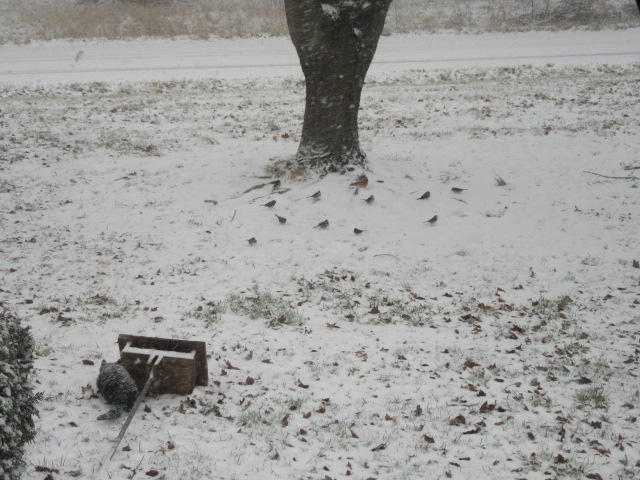
At about 2 PM I looked outside and saw the young tomcat hiding behind a feeder that blew over during the night. I think the feeder may have had some help falling over from deer. A few nights ago I was awakened by a loud racket on the front porch which followed by Jade being in a panic state in the living room. I looked out the window but saw nothing but I think a deer may have walked up the steps and onto the porch…


It was funny to watch the cat as he thought he was unnoticed. I think the birds were well aware of his presence but they had no fear of a young kitten. It seemed he would get ready to jump but the bird he had his eye on would move. He stayed there for about 20 minutes and his back became snow-covered. Once in a while, a bird would get pretty close on the other side of the feeder but he didn’t notice.


Later, a female Cardinal was at the feeder…


The above shot was taken at 2 PM from the back door…


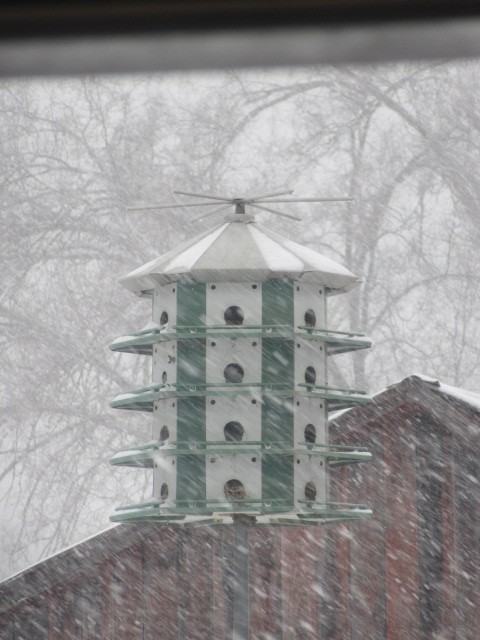
What is really strange is that the House Sparrows have not bothered the Martin house this winter. Last winter they took it over fairly early.


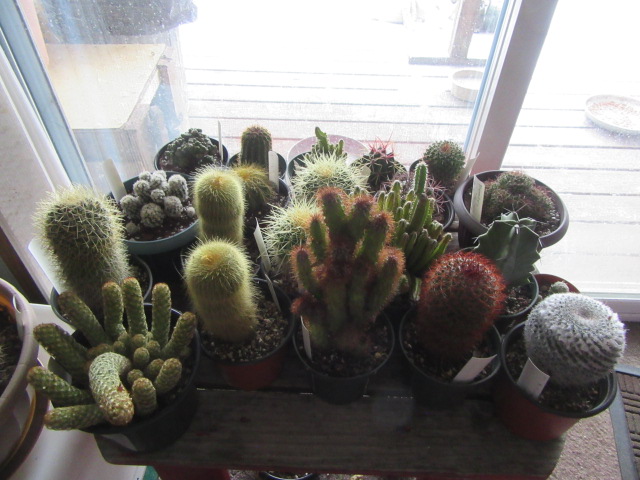
The cactus at the siding door are glad they are inside. They are not complaining one bit.


Every window I look out I see snow. I was hoping to view a tropical paradise from the south window.


Jade wants no part of it… She refuses to look out of the window. I took her to the bedroom window where last month she enjoyed laying on the windowsill. She still refused and jumped on the foot of the bed and turned her back to the window.

I noticed the snow had lightened up to fine flakes a little after 2 PM.


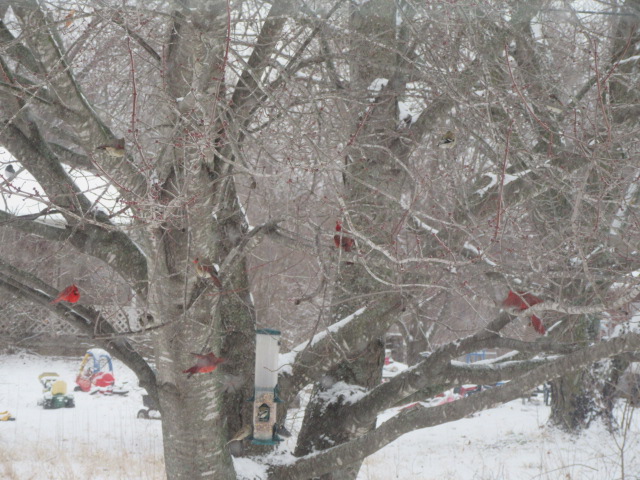
At 3:25 PM were several Cardinals in the tree and birds started flying in from all directions.


Hmmm… I just noticed the time on my photos is an hour ahead! No wonder I thought something was whacky when I looked at the time. I think I noticed that before but the settings in the camera are correct. I will check again.


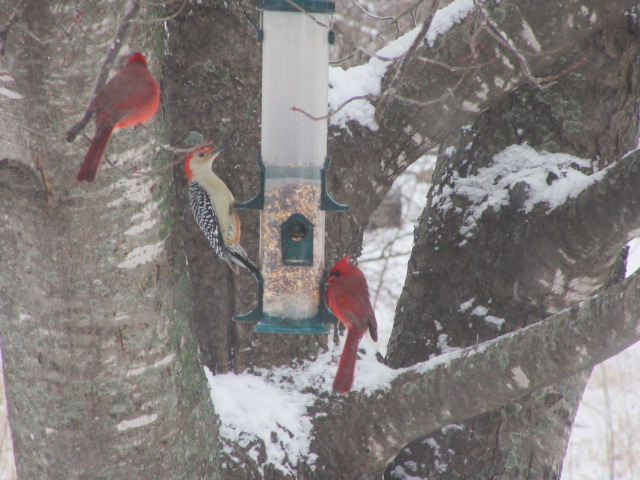
The Red-Bellied Woodpecker didn’t like the company and spent more time trying to defend the feeder than getting seed. He soon tired of that and flew off.


The birds started flying in from all directions for a moment then flew off almost as soon as they landed. Every time I look out the window the scene changes. In one second the feeder is loaded and I want a shot then the next second they fly off. LOL!

SO, at 3:45 I will end this post. GEEZ! An hour has passed already! The forecast says it will get down to 17° tonight and currently it is 19. What’s a few more degrees. 🙂  Tomorrow will be in the 40’s and up to 54 on Monday and in the 50’s on Tuesday and Wednesday.

Be sure to keep Australia in your thoughts and prayers!!!

Until next time, stay well, be safe, stay positive and give thanks.


Harrowing footage of kangaroo carcasses as a billion animals feared dead in bushfires – World News – Mirror Online — Arthur in the Garden.

WARNING – GRAPHIC IMAGES: Experts believe a billion animals have been killed in the fires and fear some species, including the Western ground parrot, could be on the brink of extinction — Read on http://www.mirror.co.uk/news/world-news/harrowing-footage-kangaroo-carcasses-billion-21218397

via Harrowing footage of kangaroo carcasses as a billion animals feared dead in bushfires – World News – Mirror Online — Arthur in the Garden.

Successful Surgery

Hello everyone! I hope this post finds you well. I went for surgery Thursday morning and everything went smoothly. All the staff was friendly, professional, and knew what they were doing. They worked efficiently together as a team.

When I was taken to the operating room, the anesthesiologist but the cup over my face and told me to take a few deep breaths. Then he put pain medication in the IV and said my head would feel funny which happened within seconds. Seconds later, I hear a voice saying “Lonnie, Lonnie wake up. Surgery is over. You are in recovery.” It took only 25 minutes for the surgery…

My sister came from Raytown to stay with me in case I needed help. I am grateful for that because neither one of us knew what I might need afterward.

The urologist put a stint in from my bladder, through the left ureter to the kidney in case of the possibility of the ureter collapsing. The nurse told me if I happen to see a “string” coming out to call them. She said it would be the stint trying to come out. She said the doctor may want me to just pull it out. Otherwise, he will remove it on the 16th in his office.

Each time I urinated, the pain was horrific at first as clots and small pieces of stones passed. The pain always subsided and I would be fine until the next time. The urine was always a reddish-orange from the dye they used during surgery. Several times the urine flow wild stop as a good-sized clot passed through the urethra. Then around 8 PM, a HUGE clot passed which was a very weird feeling. After that, no more clots passed and the pain wasn’t so bad during urination.

I got up to use the restroom a few times during the night, but I did sleep well. This morning I feel normal and all is well.

I just thought I would let you know how the surgery went and that I am still alive and kicking.

Until next time, be safe, stay positive, and be thankful!

Trip To The ER

Hello everyone! I hope this post finds you well. The snow is finally almost gone and today was a lovely day. Couldn’t have been much better

Tuesday was not so good and ended with a trip to the ER. I had this weird pain in my lower left groin area off and on for several months. Tuesday I woke up with kind of a nauseous feeling on top of the pain. I tried this and that and nothing relieved the symptoms. I had two kidney stones back in the 1990’s but this didn’t seem like that. They pretty much hit me att at once. So, around 7:45 PM I decided I better go to the ER. It was an 18-mile trip and I drove myself. Luckily the ER wasn’t busy and I got right in. By the time I was finished talking with the doctor it seemed more like a kidney stone and we were in agreement… Even though it seemed like a long time, they hooked up a bag of fluid and gave me a dose of morphine. They no sooner got me hooked up when the guy came and took me for a scan. GEEZ! Then they finally took me back to the room and hooked me back up again. Even though that process took only maybe 15 minutes, it just as well have been hours.

When the results of the scan came back it was confirmed I had a 6 mm stone in my ureter. Ummm… That’s between the kidney and bladder.

My urine flow was perfectly fine STILL with no pain. But there was still pain in my left groin area and stomach plus nausea. SO, they gave me another dose of morphine and a pill for nausea. At about 12:30 there was hardly any pain but they wanted to give me another dose of pain reliever before they discharged me. The problem was they wouldn’t allow me to drive. I told them I could drive to a friend’s house and he could either let me spend the night or drive me home.

Well, they were very persistent that I not drive… So, I gave the nurse my friend’s number, who is also the minister at church. He came and took me home. It is seriously a good thing because about halfway home I could not keep my eyes open. By the time I was inside I could barely walk. I fumbled around a bit because I thought I had other things to do before I got in bed… I had never been in a situation where I could barely function and it was very weird…

The next morning I got up feeling like a new man. I had no pain and I was wide awake and full of energy. I was supposed to call the urologist and get three prescriptions filled. At that point, I was thinking I would be perfectly fine… Well, by about 10:15 I was getting nauseous again and somewhat uncomfortable. SO, I decided maybe I should go ahead and call the urologist. I have an appointment for Monday at 3:45.

Then I went to the pharmacy and got the prescriptions filled, came back home and took the drugs. One is hydrocodone for pain. One is a tiny pill for nausea. One is Tamsulosin (Flomax)… I am supposed to take the pain and nausea pills only of I need one but the Flomax I am supposed to take once per day. I haven’t taken a pain pill since noon on Wednesday. I took a Flomax and nausea pill at noon whch seems to be my regular schedule.

It is a little strange for me to go to the doctor and certainly not like me to take prescription drugs. If I had have known I had a kidney stone earlier I could have gotten rid of it myself. But, the symptoms I have been having for a while were not like before. So, I didn’t know.

When I had the kidney stones before I guess they were already in the urethra which was why it was a sudden thing. This one may be close to the bladder on the left side which is why there is pain there.

They always say a man having a kidney stone is like a woman going into labor. All I know is that I don’t want another ordeal with a kidney stone. If I were a woman and had a baby, the first would have been the last. LOL!

I have read this and that about what foods and beverages to avoid when it comes to kidney stones. Very seldom do I drink soft drinks anymore. I usually drink 1/2-1 cup of coffee in the morning and have a glass of green tea for dinner. I drink plenty of water the rest of the time. I pretty much eat a healthy diet, just in a weird way. I don’t eat until dinner and I eat a big meal. At almost 59, I think my diet needs to change somewhat and I have been saying that for a while…

I went to the chiropractor on Friday and he is pretty good when it comes to nutrition. He is an older man with a lot of experience and even used to train chiropractors. He asked me about my diet and I told him I ate one meal a day. He looked at me a bit strangely. But, you know, there is a diet plan called OMAD (one meal a day) that I found out about after I had been doing it. The benefits are good but you need to eat healthy all the same. It is kind of like fasting…

He asked if I cooked my own meals and I said yes. He said, “Ahhh, that’s why you only eat one meal a day.” Well, ummm… That may be partly true to some degree. I have never been a big fan of breakfast and it is easy to skip lunch when you get up at 9-10 AM. Just a little coffee and I am good to go. Then 6 PM comes around I am ready for dinner. The problem is not dinner, it is afterward. I snack from then until I go to bed. While do do snack on fruit, there is also the chips, popcorn, nuts, and of course ice cream… Don’t forget the cheese. I don’t think any one meal a day plan or fasting includes junk food eating for several hours before going to bed.

I feel a little hypocritical at times because I advocate health foods, natural supplements, no GMO’s, etc. while I occasionally revert back to my old habits… I really do prefer cooking my own meals, and I enjoy cooking. But sometimes, I do order Chinese, pizza, something from Subway, Sonic, and so on. There is a new cafe in town that makes a great Ruben. 🙂 When you are by yourself, it is very convenient to throw a frozen pizza into the oven or microwave Stauffer’s Lasagna, or even a potpie…

While eating bad foods may not affect you initially, like when you are young, it will catch up with you sooner or later.

So, while my spiritual life is getting better I also need to eat better… I need to commit to me, not just spiritually and emotionally, but also physically. Our cells can heal our bodies, but we need to feed them properly. We can listen to and repeat all kinds of positive affirmations, learn and practice the Law of Attraction, listen to music at certain levels of frequency for this and that… But, we STILL have to commit eating a healthy diet… We can reprogram our subconscious mind and accomplish amazing things but we are still in part what we eat not just what or how we think.

Part of being the amazing creatures we are and having so many abilities is also the ability to choose. To choose a diet for and of life.

Until next time, be safe, stay positive, and always be thankful.

The Snow…

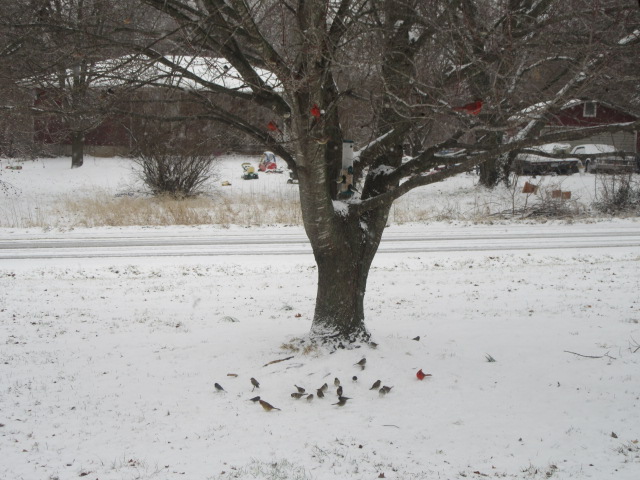
Hello everyone! I hope this post finds you well. We had more snow yesterday which didn’t impress me that much. It was 21° F when I took these photos at about 11:30 AM but it is supposed to warm up to 32 by the afternoon.

That’s the forecast through Sunday…


The Junco’s and several sparrows were enjoying the birdseed on the ground.


While a female Cardinal and a sparrow were at the feeder. I put the feeder in the tree in the front yard to I can watch them from my bedroom window. They are always very alert and seem to spend more time flying off than eating. They are more content feeding in the back yard but I haven’t set up the trough feeder yet.

That’s all I have to say at the moment. The snow kind of leaves me at a loss for words…

Take care, be safe and stay positive!

A Snowy Sunday Leading To A Rambling Post…

Hello everyone! I hope this post finds you all well. This morning I had the alarm set for 9 AM so I could eventually get up and get to church by 10:40. I am not an early riser and it usually seems I have to have a good reason to get up by 10. On occasion, I have to get up much earlier which I don’t mind. I can easily get up at 6 or 7 AM if I need to.

So, this morning the alarm goes off at 9 and I let it beep for a few minutes before turning it off. Well, I went back to sleep and didn’t wake up until a little after 10.

I sprang into action after naming three things to be thankful for. Normally I mainly say thank you for good night sleep and for the day ahead. I then went in to get a cup of coffee and to feed the cats on the back porch. Even though the forecast said there was a chance of snow, I was surprised to see what was waiting outside. There wasn’t much, but it was still there.

I looked out the side door and saw the vehicle’s windows covered with snow. At that point, I may have easily closed the door and decided not to go to church. Except there was a problem… The minister’s grandson from Nebraska was here to be baptized. SO, I decided maybe I should go.

I had cleaned out the baptismal tank on Friday and a few of us guys met at the church on Saturday to start filling it. For a long time, one of the men from church had been doing it but he decided to show me how to do it a couple of years ago. This year he decided a few others needed to learn the tricks as well. It’s a process of turning a few valves on or off depending where they lead to. Then, once the water gets so high, it is recirculated from baptismal through the hot water heater. It’s not complicated and there are written instructions. You can see the pipes hanging from the ceiling in a hallway by the hot water heater and explain where every pipe goes and comes from. Like the wiring in the church, it makes one wonder how it ever works. But, it does work…

Oh, yeah. Lynn turned down the temperature on the water heater because the last time it became too hot in the baptismal. LOL! Luckily he was at church early enough that time to turn it down so the temp was a bit cooler for the baptism. That would have been a shock to step into hot water. Stepping into freezing cold water would also have been a shock.

SO, I went to church and made it on time. Our minister is a retired mortician and I will never forget his first baptism. A week or so after the baptism he presented the certificate of baptism to the girl that was baptized. He said, “I am pleased to present you with your certificate of death.” He was so embarrassed and everyone got a good laugh.

We have fond memories that we carry with us that we like to share with others along the way. Sometimes we have to share not so fond memories to let others know that they are not alone in a particular situation. Then sometimes we find out sharing the situation wasn’t a good idea because they tell others or our experience instead of theirs. We are human and we all do through a lot of different circumstances as we grow up. It is part of our learning process. But it isn’t just our learning process. The divine realm(s) also learn from our experiences…

I deleted MANY paragraphs… I started rambling about my opinion about religion. GEEZ! And to think I am now an elder.

Anyway, Saturday afternoon as I was cleaning the church, one of the minister’s son’s brought a pan of food and put it in the refrigerator. As I left, I saw the minister heading toward the church in his van with some of his family. Later I went back to the church to check the water in the baptismal and there was A LOT of food in the refrigerator. Then after the service, he told me that they were having lunch and invited me to stay. He said there were BBQ ribs. We also had a board meeting…

Well, who can resist BBQ ribs? There was also a pan of coleslaw and potatoes of some kind that was all delicious. Some of the ribs were from Bandanas! One of the furnaces wasn’t working so the fellowship hall was very cold. Then, they had ice cream and homemade cookies. By the time I left, I was stuffed and freezing!

When I left, it was snowing AGAIN. It looked like little styrofoam balls flying around in the air. When I arrived home I noticed a lot of birds looking for food under the feeders. The Juncos and migrating sparrows had finally arrived this past week. I went inside to warm up a bit then went outside to fill the feeders and sprinkle a little on the ground. I checked on the chickens and filled their feeders and made sure they had plenty of water. Even if it is very cold, the water in the chicken house doesn’t freeze unless it gets down to 20° F for several hours. Eventually, I took a little nap.

In all, it was a good day despite the snow and cold temperatures. It is going to be cold all week…

I forgot to post Six on Saturday yesterday because I was busy. Today I thought about taking a snow photo for Silent Sunday but then it became too dark to take a photo. So, I decided to just write a post without photos.

I had been doing good about reading your posts every day in the Reader then got busy updating pages on the blog. So, I became somewhat tardy in reading your posts.

Then one day I received a message on the Goeppertia ornata page. A man from Florida asked me how to pronounce Goeppertia. Normally, I include the pronunciation of the genus and species if it is available on Dave’s Garden. In this case, Geoppertia ornata had no pronunciation. The reason is that Geoppertia ornata became a synonym of Calathea ornata in 1858. At some point, maybe then, the entire Geoppertia genus became invalid. Well, truthfully the same guy published the description in 1858 and 1860 and iPNI has both. PREVIOUSLY, the 1860 date was accepted now the 1858 description is accepted. Hmmm… The reason I know is because my first notes say 1860 with the publication but my page says 1858 with the publication title. I thought I screwed up so I wasted 30 minutes or so to figure that out. Anyway, the latest version of The Plant List (2013) says Calathea ornata was the accepted name but when the NEW Plants of the World Online came out in 2018, the name had changed back to Geoppertia ornata. Apparently in 2012, after 154 years of not being a genus, a lady decided it needed to be resurrected. So, 254 species were moved back into the Goeppertia genus making it the largest in the family. I found that out from Phytotaxa via ResearchGate. So, the guy and I exchanged a few emails. (I first confused him by guessing the pronunciation for Geoppertia instead of Goeppertia). Then I find out this guy’s family owns a large wholesale nursery in Florida and one of their specialties is Calathea species and cultivars (A LOT). So, apparently, he is trying to figure out how to pronounce Goeppertia… Well, I certainly applaud him for that. It would be bad to change the names of plants and not being able to pronunce them. My only guess is that it is pronounced go-PER-tia but that really doesn’t sound right either… There are two P’s”. Maybe gop-PER-tia… I have studdied Latin in reference to plant names but it still is somewhat confusing. So, if you have any ideas, I would love to hear it. I hate to tell someone “I don’t know”. I wound up sending an email to Rafael Goverts from Kew to quiz him about the pronunciation. Then I noticed he didn’t approve the name change. Well, I am sure he will get a good laugh and I will be thankful for brightening up his day. It has been a while since I sent him an email asking how the Celosia argentea ‘Cramer’s Amazon’ was doing. I sent him seeds at his request and his reply then was that they were starting to flower. Of course, I am trying to get his approval to use Celosia argentea var. spicata name instead of merely Celosia argentea on Plants of the World Online. Doubt that will happen though. 🙂 Well, Celosia argentea is supposed to be, in part, native to Africa and ‘Cramer’s Amazon’ were discovered in Peru… Now I have to recheck where Celosia argentea were/are native. Celosia spicata became a synonym of Deeringia spicata which is a shrub in Australia. I don’t get the connection or even how an herbaceous plant was confused with a shrub in the first place.

I seemed to have gotten off subject while writing the above paragraph but decided not to delete it. I already deleted a half hour on pharagraphs earlier. What was the subject anyway? Oh yeah, my apology for not reading your posts this past week. Well, there was an attempt a couple of nights.

So, I guess I better stop writing this post and get to work. Either reading your posts or working on updates. Otherwise, by the time I am finished, it will be Monday already.

So, have a great week ahead! Be safe, well, and stay positive! Keep warm or cool depending on where you may be!


Six on Saturday

Hello everyone! I hope this Six on Saturday post finds you all doing very well. It has been a pretty good week with temps continuing to dance around. Today is sunny and it is supposed to get to 48° F. The forecast says 55° on Sunday, 48° on Monday, then 37 on Tuesday and Wednesday with a LOW of 19° by morning. Then back up to 48° on Thursday with a low of 30. ‘Tis the season…

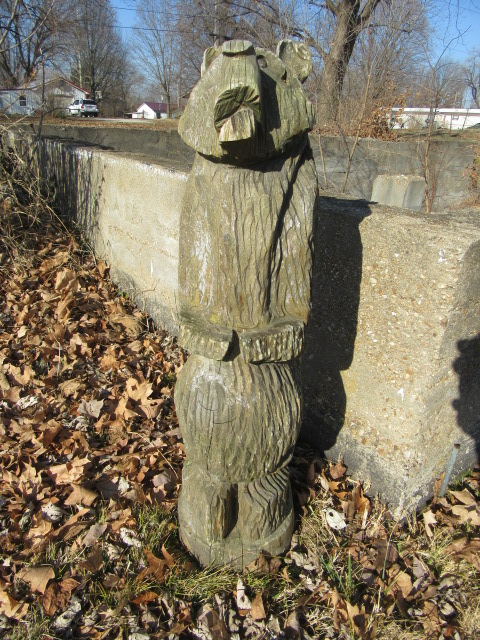
#1 for this Six on Saturday is the cedar carving of a bear given to me on Thursday by friends who were going to throw it out. I could not let him be thrown in the dump sight to be burned so I brought him home. Someone else might have spotted it…

—-

Dryobates pubescens (Downey Woodpecker)

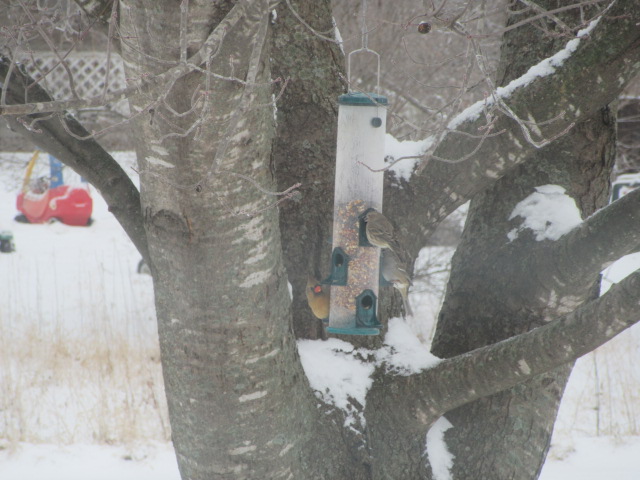
#2-I took a shot of this Downey Woodpecker (Dryobates pubescens) on the hanging feeder. It was pretty happy by itself on the feeder. It seems the migratory birds are slow to come this winter. I did see a few Juncos a few days ago and also a couple of Nuthatches. Even though I haven’t seen many birds, somehow the feeder was empty in a week. Maybe the wind blew the seed out…


Dryobates pubescens (Downey Woodpecker)

No doubt the Downey is hiding seed in the fork of the tree.

—-

Lysimachia nummularia ‘Goldilocks’

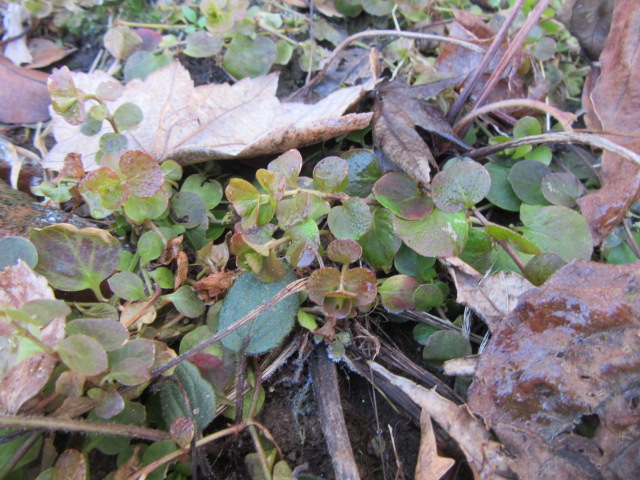
#3-The Lysimachia nummularia ‘Goldilocks (Creeping Jenny) is hanging in there in the north bed. When it gets really cold it will completely disappear.

—-

Achillea millefolium

#4-The Achillea millefolium is pretty tough in the heat of the summer right up until it gets severely cold. They are still growing new leaves!

—-

Nandina domestica (Heavenly Bamboo)

#5-The Nandina domestica (Heavenly Bamboo) still has a few green leaves. I learned something this week from a post shared by Eliza Waters. The post says the berries are poison to birds! I never knew that so I suppose I better remove them.

Click HERE to read the post shared by Eliza about the berries. The post is actually from Cindy Dyer’s Blog.

The red berries of Nandina domestica contain cyanide and other alkaloids that produce hydrogen cyanide (HCN), which can be poisonous to all animals.

Tom Oder writing for Mother Nature Network has this to say: “Nandina berries actually have a low toxicity, but they can be lethal to cedar waxwings specifically because their feeding habits differ dramatically from that of other birds, said Rhiannon Crain, project leader for the Habitat Network with The Nature Conservancy and Cornell Lab of Ornithology. “Other birds don’t eat as much or as rapidly as cedar waxwings,” said Crain. “Cedar waxwings completely stuff every possible part of their body with berries. They will fill their stomach and their crop with berries right up into their mouth until they can’t fit another berry inside of them.”

—-

#6Hmmm… It seems like with nine cats there is always one following me around when I am in the yard. This one is the kitten that was given to me by a friend (Kevin). It showed up at his house and somehow he talked me into bringing it home. That was several months ago when she was very small…


She is a very odd-looking cat with long black hair with silvery streaks. The hair on her legs is shorter giving her an even stranger look (reminding me of a fox). She is very smart, almost human, which can sometimes be annoying. My son called her Little Bit but I have had a few other names for her. She is now an outside cat but teaching her not to dart in every time the door opened wasn’t easy. She is so fast!

Well, that is it for this post. If you wish to participate in Six on Saturday posts, be sure to read the Six On Saturday-a participants guide from The Propagator.

Until next time, be safe, stay positive, and always be thankful! Get dirty if you can. I know I will one way or another… 🙂


Cactus & Succulent Update #5

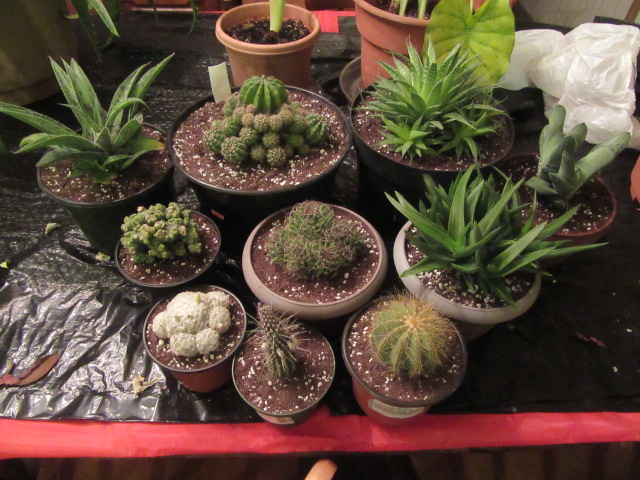
Group photo for Cactus & Succulent Update #5 on 11-24-19.

Hello everyone! I hope this post finds you well. This is the fifth and final cactus and succulent update which I started on November 23rd. The temperature got up into the mid 50’s on the 24th so I decided it would be OK to take the plants in this post outside for a photoshoot (Grammarly continues to argue with itself whether it is photo shoot or photoshoot). I didn’t list the plants in the caption because they are kind of mixed up and there a few that there are several of.


Plant shelf in the back bedroom in a south-facing window on 11-24-19.

I repotted several and whacked the Kalanchoe x laetivirens stem in half s you can see in this photo (bottom left). Although the Kalanchoe orgyalis is also very tall I just put in a larger pot. It was on the bottom shelf and was almost touching the one above it so it is now on the floor between the shelf and window. On the second shelf, on the right, you can see the Huernia schneideriana has some pretty long stems. The room stays fairly cool and the plants get plenty of light from this south-facing window. Hmmm… It seems I forgot to put the other four smaller Kalanchoe x laetivirens back on the top shelf…

Most of the photos on this post were taken on October 11 when I moved the plants inside for the winter (the first time), but I had to take a few more for this post.


Kalanchoe x laetivirens (Mother of Thousands) after being whacked in half and repotted on 11-24-19.

Well, I didn’t take photos of the Kalanchoe x laetivirens (Mother of Thousands) on October 11. I suppose that’s because they dive me nuts and didn’t need the added attention. I was going to take a photo of all of them together for this post but then decided against that as well. This evening I decided to whack the stem in half and stick most of it back in the pot. It was at least 20″ tall now it is 11″ again. I always remove the plantlets from the leaves when I move the plants inside. Actually, they aren’t leaves but only look like leaves…  To say I have five of these plants would be an understatement because several are growing in other pots as usual.

Click HERE to view the Kalanchoe x laetivirens page.

—-

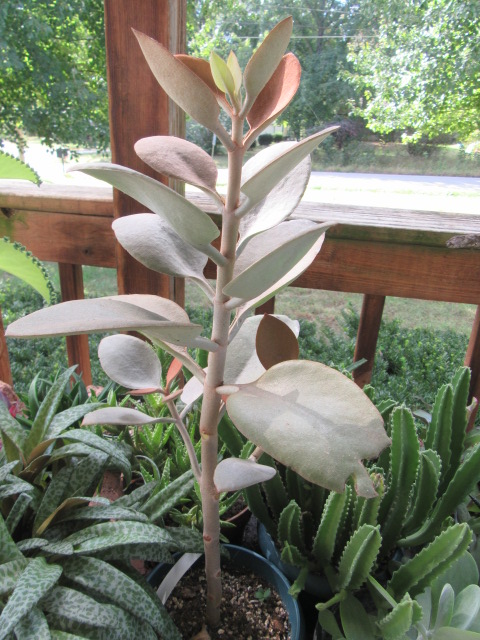
Kalanchoe luciae on 10-11-19.

The Kalanchoe luciae (Paddle Plant) are really neat plants. You may have heard it called by other names because it has many including Flipping Flapjacks, Red Pancakes, Paddle Kalanchoe, Northern White Lady, Pancake Kalanchoe, White Lady, Flapjacks, Paddle Leaf, Desert Cabbage, Paddle Plant, Dog Tongue Plant, and Flap Jack. They don’t seem to grow that tall and like to lean a bit then they grow roots under the lower stems when they are ready to repot. I guess in the wild when they get a certain height and lean far enough they take root in the soil. The leaning stem on the plant to the left is the original plant and it is three years old. The roots on the stem are under the leaves right in the curve. All the other plants were offsets from it. 


Kalanchoe luciae from the back porch on 10-13-19.

I took this Kalanchoe luciae to the back porch for a shot on the 13th because it hadn’t been incuded in the above group photo. It had been growing on the back porch in full sun with the cactus during the summer to see how it would do. I knew the leaves would turn this color because the original plant was in brighter light in 2016. Pretty neat huh? I repotted all the smaller pots of Kalanchoe luciae this evening except the older one which had been done earlier. Another thing I like about these plants is their chalky white stems…


All the Kalanchoe luciae on 11-24-19.

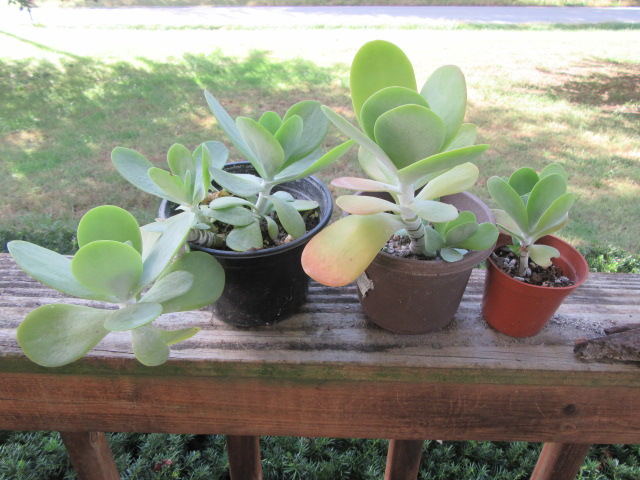
I took a group photo of all the Kalanchoe luciae while the plants were outside for their photoshoot.

Click HERE to view the Kalanchoe luciae page.

—-

Kalanchoe marmorata (Penwiper Plant) on 10-11-19, #639-49.

Hmmm… The Kalanchoe marmorata (Penwiper Plant) and I have made an agreement. As long as it doesn’t die I will keep doing the best I can. I bought this plant from a member of a Facebook group in April 2018 and it went into shock and darn near died. It lost all but two of its upper leaves but started doing much better and growing more leaves within a couple of weeks. Then, the next thing I knew, it sent up an offset. I cut the top off the old plant after a while and then stuck it in the same pot because it looked so weird and the stem was growing roots under the surviving leaves. I put the offset in a different pot… Then, the stem I stuck in the pot started growing roots on its stem and the old stem started growing leaves under the cut… After the above photo was taken, I removed the stem cutting and put it in another pot. Then, when I took the plants outside for a photoshoot for the group photo, I noticed the original stem had died…


Kalanchoe marmorata on 11-24-19.

I decided to take a new photo of what they look like now. The plant in the smaller pot was almost completely out of the potting soil… So, we have had our ups and downs but I hope they survive the winter.

Click HERE to view the Kalanchoe marmorata page.

—-

Kalanchoe orgyalis (Copper Spoons) at 18 1/2″ tall x 10″ wide on 10-11-19, #639-50.

The always AWESOME Kalanchoe orgyalis (Copper Spoons) has done very well and was 18 1/2″ tall x 10″ wide when I brought it inside on October 11. It has grown a little since this photo was taken. I decided it needed a larger pot so I did that before putting it back in the bedroom. It had grown a little since I brought it inside and the larger pot added a little more height as well. It wouldn’t fit on the lower shelf anymore and I didn’t want to raise the second shelf again, so I put it on the floor between the shelf and window. The bottom of the window is only 10″ from the floor so I think it will be fine.

Kalanchoe does not seem to have an extensive root system, so most of the time you can just replace the soil and leave them in the same pot. If they are very tall, you have to consider pot size to keep them from falling over.

Click HERE to view the Kalanchoe orgyalis page.

—-

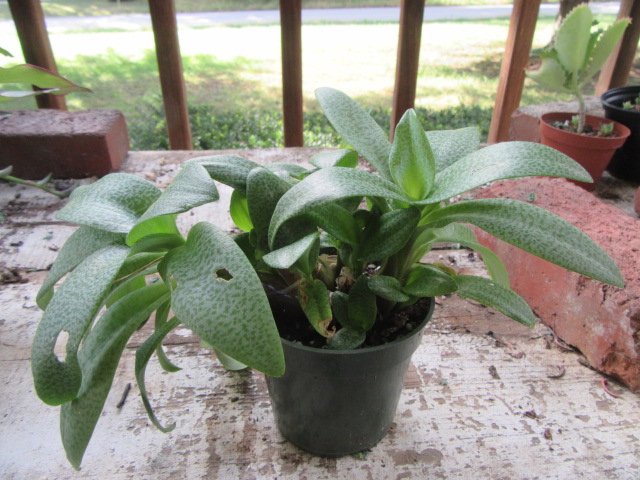
Ledebouria socialis (var. paucifolia) on 10-11-19.

Hmmm… OK, I am not going to vent about the scientific name for the Ledebouria socialis on this post. I need to rewrite their pages or maybe completely redo it and put them both on the same page. Whether you choose to call this one Ledebouria socialis, Ledebouria socialis ‘Paucifolia’, or Ledebouria socialis var. paucifolia is fine by me. 🙂 They were previously in the genus Scilla… Until 1970. Common names include Silver Squill, Violet Squill, Leopard Lily, South African Scillia, Bluebell, and Wood Hyacinth.


Ledebouria socialis (var. paucifolia) leaves on 10-11-19, #639-52.

The leaves of this one are silvery green with darker green spots. But seriously, why am I calling this var. paucifolia?


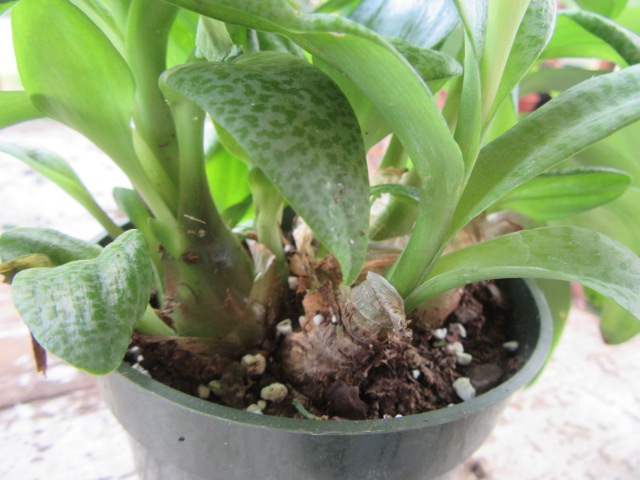
Ledebouria socialis (var. paucifolia) bulbs on 10-11-19, #639-53.

They grow from bulbs and this one doesn’t spread as much as the other.


Ledebouria socialis (var. violacea) on 10-11-19, #639-54.

The other one, which you can call Ledebouria socialis ‘Violacea’, Ledebouria socialis, or Ledebouria socialis var. violacea (as I call it)… Hmmm. I’m doing well not putting in my two cents but it is very difficult. In the spring I removed a bulb for the guy in Alabama that was supposed to do some plant swapping with me. The exchanges never happened and now that one bulb has turned into 6… It has produced most of them since I moved the plants inside for the winter. They have gone NUTS and they should be thinking about dormancy.


Ledebouria socialis (var. violacea) leaves.

This “variety” or “variation” of Ledebouria socialis has the same silvery-green leaves with larger darker green spots. The undersides of the leaves are kind of a maroon color. It was formerly known as Scillia violacea, Ledebouria violacea, and the Pacific Bulb Society calls them Ledebouria socialis ‘Violacea’. I call them Ledebouria socialis var. violacea because they are NOT a cultivar… OOPS! The Pacific Bulb Company lists several, umm, varieties of Ledebouria socialis which used to be species.


Ledebouria socialis (var. violacea) bulbs. That is not mealybugs in the photo. I checked and it’s perlite. 🙂

This one has definitely spread a lot more and makes a nice full pot. Both flowered this past summer.

In all, if you haven’t tried Ledebouria socialis I recommend you do. They are cold hardy in USDA zones 10a-11 (30-40° F) but make great potted specimens where not hardy. You water them normally during the summer, but should not water them during the winter. I am trying to decide when to stop… Mine arrived from a seller on Facebook on October 13 (last year) and I don’t think I watered them until spring. If you continue to water them they will produce longer and narrower leaves during the winter and may not flower the following year. I think the trick is to get them not to grow over the winter so they will do it in the spring. They should also be in a cooler room. So, I suppose I need to stop watering them and put them in the cool bedroom since they are beginning to grow long and narrow leaves… If you give Ledebouria socialis a try, make sure you plant them with 2/3 of their bulbs exposed.

—-

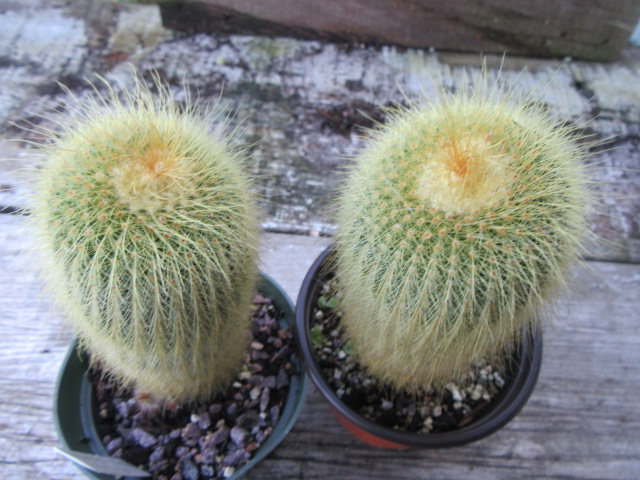
Parodia lenninghausii at 5 1/2″ tall x 2 1/8″ wide (right) and 5 3/4″ tall x 2 1/4″ wide (left) on 10-11-19, #639-77.

The two Parodia lenninghausii (Golden Ball Cactus) are looking and doing great as always. The smaller one in the green pot is now 5 1/2″ tall x 2 1/8″ wide. It has grown a lot from 1 7/8″ tall x 1 3/4″ wide since I brought it home from Wal-Mart on February 1, 2016. The taller one in the red pot is now 5 3/4″ tall x 2 1/4″ wide. It has always been about 1″ taller than the other.


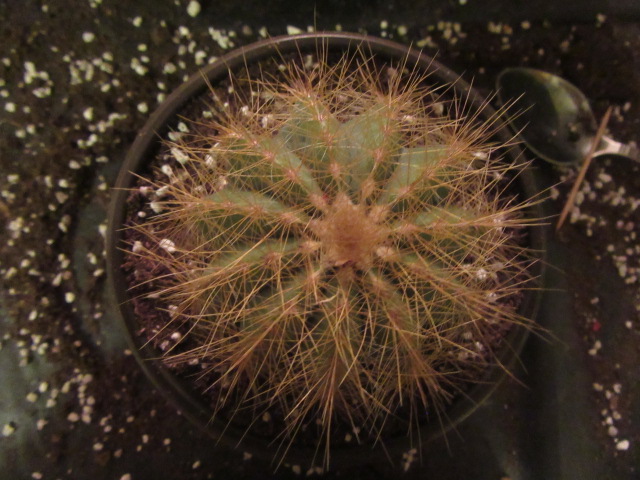
Parodia lenninghausii from the top on 10-11-19, #639-78.

They still have the neatest hairdo.


Parodia lenninghausii with its baby on 10-11-19, #639-79.

I was happy to see the smaller plant had a baby when I took the above photo on October 11. I noticed today it has another one right next to it.

—-

Parodia magnifica at 2 5/8″ tall x 2 5/8″ wide on 10-11-19.

The Parodia magnifica (Ball Cactus, Baloon Cactus) is a nice little cactus that is doing well. It is now 2 5/8″ tall x 2 5/8″ wide. It has grown 1 1/4″ taller and 1/4″ wider since I brought it home from Lowe’s in March. That is 1 1/4″ in only seven months!


Parodia magnifica in its new pot on 11-13-19, #649-21.

It was strange posting the photo from October 11 when I had already posted it in its new pot. In case you missed it, I am sharing it again. With more room, I wonder how much it will grow after another year.

—-

Sedum adolphii (Golden Sedum) on 10-11-19, #639-85.

The Sedum adolphii has done very well since I repotted it in August 2018. Its common names include Golden Sedum, Coppertone Stonecrop, Stonecrop, Coppertone Sedum, and Nussbaumer’s Sedum. It is synonymous with Sedum nussbaumerianum so if you have one by that name is it correctly Sedum adolphii. The industry sells them by both names and one time, in 2012, I bought one of each not realizing at the time they were the same. After I gave up most of my plants in 2014, I found this Sedum adolphii in 2016. They are pretty easy to grow in pots and have to be brought inside for the winter where they continue to do well. Many Sedum species do well in pots but dislike being inside. I have grown MANY species over the years that have done well and others that didn’t survive…


Sedum adolphii ‘Firestorm’ on 10-11-19.

The Sedum adolphii ‘Firestorm’ is one of several cultivars of the species. It has done well despite not really wanting to be on the front porch. If I had it on the back porch in full sun its true colors would have come out better. Right now, being in a south-facing window inside, its leaf tips are taking on more of an orange color. So, next summer, I will put both pots on the back porch to see how they do.


Stapelia gigantea (Zulu Giant) on 10-11-19, #639-86.

OK, I know the Stapelia gigantea (Zulu Giant) looks a bit crowded. It looks crowded because it is crowded. I received six cuttings from a seller on Ebay last October and made the mistake of putting them all in the same 5 1/2″ diameter pot. Well, I had never grown a Stapeliabefore so I had no idea what would happen. I thought about taking a few to Mrs. Wagler (Wagler’s Greenhouse) but decided I would wait until I saw how they did. Remember, the post from November 22 I mentioned I took her cuttings. 🙂


Stapelia gigantea (Zulu Giant) on 10-11-19., #639-88.

I think there are more than six in the pot now. I removed the two branches hanging over the sides and made four cuttings from one and gave them to Mrs. Wagler. I wouldn’t have necessarily cut the branches off but I thought they might break off. When I was taking the cutting I learned there would have been no chance of that happening. They are VERY tough! It is strange how offsets in the center of the pot have no branches while the ones closer to the edge do. It is like they think if they branch out one may reach the ground…


Stapelia gigantea (Zulu Giant) buds on 10-11-19, #639-87.

Of course, the obvious reason I bought the Stapelia gigantea was for it’s AWESOME 10″ flowers. So, I was very excited when I saw buds! I wish I was posting photos of its flowers instead of just buds. BUT, unfortunately, after I moved the plants inside, the buds fell off. They started growing new ones but one day I noticed a few mealybugs on the buds and on the top of a few stems. Do you know how long it has been since I had bugs? Well, I mean on the plants inside the house. Of course, I have bugs outside during the summer. 🙂

Stapelia are Carrion Plants like the Huernia schneideriana I have had for several years. It also came from Mrs. Wagler. While my Huernia has very small maroon flowers, the other species have much larger and very colorful flowers. I went to the Llifle website to ID mine and became hooked. There are several genera of plants known as Carrion Plants that have similar flowers but their stems are somewhat different. As I have found out they are very easy to grow. While the Huernia doesn’t tell me when it needs water, the Stapelia does. Its soft, fuzzy stems get kind of spongy feeling and when it doesn’t need water they are more stiff.

—-

Stenocereus pruinosus at 4 3/4″ tall x 2 3/4″ wide on 10-11-19, #639-89.

I have to whisper, but the Stenocereus pruinosus is one of my favorite cactus. It has several common names including Gray Ghost, Organ Pipe, Pitayo, and Pitaya of October (de Octubre). They are highly prized for their fruit and widely cultivated in Mexico in the states of Oaxaca, Puebla, Veracruz, Guerrero, and Chiapas. It was only 2 7/8” tall x 2 3/4” wide when I brought it home from Wal-Mart in February 2016 and now it is 4 3/4″ tall 2 3/4″ wide. It has been a while since I repotted it so I will do it in the spring. I somehow ran out of pumice…

Llifle says Stenocereus pruinosus “is a large shrubby or tree-like columnar cactus to 4-5(-7) m tall, usually with one or more, definite trunk(s) from which little-branching stems arise from the base for a distinctive V-shape.” Well, we have a ways to go…

—-

Tephrocactus articulatus var. papyracanthus (Paper Spine Cactus) on 10-11-19, #639-91.

Last but not least, Tephrocactus articulatus var. papyracanthus (Paper Spine Cactus) is still doing its thing. I started out with this Paper Spine Cactus as a rescue when I was cactus shopping in February 2016. I spotted a piece that had fallen off so I put it in my pocket and brought it home and we have been friends ever since. It doesn’t grow that tall because the top segments keep falling off and taking root. Sometimes they get lost so I think I will put it in a wider pot. Maybe they won’t wander off then. It is interesting to transplant…

That is finally it for the cactus and succulent update. I have other plants to post about so we shall see what happens next.

Until next time, be safe and stay positive. Don’t forget to be thankful and get dirty every chance you get. Thanks for reading!


Six on Saturday-Ending With A Surprise!

Hello everyone! I hope this post finds you all well. This is my second attempt to make a Six on Saturday post. Jade was looking out the window and I told her I was going to take a few photos for a Six on Saturday post. She said, “good luck with that.” When I came back inside and found there were photos of eight I decided to not include the photo of Jade in the six (although the photo is clearly here). Then I deleted the photo of the Equisetum so I wouldn’t accidentally include it.


Mammillaria karwinskiana (Silver Arrows) flowers on 11-23-19.

#1) I wanted to make a post about the Mammillaria karwinskiana (Silver Arrows) since all the buds were fully opened. I decided including it in this post would be appropriate and was glad they were still looking good this morning. There are a couple of buds on the other side.


Mammillaria vetula subsp. gracilis buds on 11-23-19.

#2) I looked around a bit to see if there was anything else that was exciting then I noticed the little Mammillaria vetula subsp. gracilis (Thimble Cactus) had a couple of buds. That may not sound exciting, but I thought it was. For this plant to be so small and have two buds… Yeah, that is exciting!

I could have easily found all six items to post about inside, but I went outside to see what I could find. It was 37° F and it had rained during the night.


#3) I finally filled the feeder hanging in a maple tree in the front yard yesterday. Although there are very few birds here right now, I saw a group of sparrows in a bush that seemed to be hungry. They were no doubt waiting for me to fill the feeder in “the other yard”, which I did. This morning while taking the photos I saw the “other feeder” was empty already so probably the deer found it during the night. Maybe I am anxious, but it seems the birds are late arriving this Fall.


Phlomis ‘Edward Bowles’ on 11-23-19.

#4) The Phlomis ‘Edward Bowles’ is still alive and well. I did make a note to cover it when nighttime temps dipped a few days ago even though it has proved it didn’t need it. I have a sticky note stuck to the computer that reminds me. 🙂


#5) The old Mulberry tree in an area along the boundary fence behind the chicken house is always worthy of attention. It would be great to know how old it really is.


It is very gnarly and was a very old tree when I was a kid. Sometimes I sit next to this tree, with my back against it and it seems I can feel its energy. A very good place to meditate.


It is by far not the biggest Mulberry tree here now because age has taken a toll on this tree. It has survived many lightning strikes, heavy winds, ice, snow, drought and so on for MANY years. I remember as a kid when I was in the barn with my grandpa as we watched lightning strike an old tree along the fence. I call this the elder tree and hope it has many more years to come.


#6) Hmmm… Could it be? If so, I am shocked I missed it before! This is definitely a species of Physalis (Ground Cherry, Japanese Lantern) and likely it is Physalis longifolia. When I was at Kevin’s farm this past summer I spotted a single Physalis longifolia in the pasture. The plant there was similar in size to the Solanum (Horsenettle) species because it had no doubt been nibbled on by the cows. So, when I looked for it here in the pastures I was looking for a smaller plant similar to the Horsenettle with yellow flowers.


Well, this dead plant is 31″ tall… I checked with the Missouri Plants website and read where Physalis longifolia can grow to 3 meters, which I must have ignored earlier. Missouri Plants lists six species of Physalis.


Common names for Physalis longifolia include Long-Leafed Ground Cherry, Longleaf Ground Cherry, Wild Tomato, and Common Groundcherry.

To think I had been looking for this plant during the summer only to find it NOW when it is all dried up. GEEZ!!! I found it not in the pasture, but on my way back from photographing the old Mulberry tree… Among other tall weeds. You can bet I will have my eye on this area next summer! Hopefully at least one will come up so I can make a proper ID. 🙂

Well, that’s it for my attempt for a Six on Saturday post. Remember, Jade doesn’t count…

If you wish to participate in Six on Saturday posts, be sure to read the Six On Saturday-a participants guide from The Propagator.


Holiday Cactus & Wagler’s Greenhouse Visit…

Hello everyone! I hope this post finds you well. I know the flowers of the Schlumbergera tuncata are really neat, but I have mixed feelings about it.


Schlumbergera truncata on 9-13-18, #507-15.

I brought this plant home from Wagler’s Greenhouse in September last year and the tag clearly says “peach”. She had a lot that she buys from somewhere. Last winter it had a few buds, but because of neglect, they fell off. Hmmm… It was with other plants that don’t require attention during the winter. So, this year I put the plant in the kitchen windowsill where I would be sure to see it every day and water as needed.

Then it grew buds… Then it flowered, as you can tell, but the flowers are PINK not PEACH. So, since I had a little time this afternoon, I went to Wagler’s to see if Ruth had any that were actually peach, or white, or any color besides pink. I also had a few cuttings of Stapelia gigantea to give to her. We trade a lot of plants. 🙂

She wasn’t in the greenhouse so I knocked on her door. She came and I told her I had a present for her and her face lit up as I handed her the cuttings. She said she had some new plants to show me so we went to the greenhouse. OK, I haven’t been there for several months because I know what always happens…


I think when I was there last fall a lady brought her several Bromeliads from a grower in Florida. Well, some of them produced offsets and even flowered. She handed me one and said I could have it if I wanted. Hmmm… Of course, my hands just automatically responded. I looked at several of the others and the one that always caught my eye was solid green. Fortunately, it hadn’t flowered or produced any offsets. Then she handed me another pot of a different Bromeliad and said I could have it, too. Oddly, I declined. I told her I needed to see how the one she gave me already would do before I brought home more. I was quite proud of myself.

Then she showed me a new succulent she had and asked if I had these two particular cactus. Fortunately, the two cactus in question were the Acanthocereus tetragonus and Mammillaria vetula subsp. gracilis. I told her I had those already and they came from her.


The succulent was a different story… She asked what it was and I told her it appeared to be a species of Euphorbia. She asked her if I had one and I told her no. She said, “You can have one.” AGAIN, my hand just reached out and took one like it was an automatic reflex! It is 2 3/8″ tall without the leaves.

Then she said if I saw any other plants I wanted I could have them. GEEZ! There are a few but I have to wait until she has cuttings or plants of them…

She has A LOT succulents that are unnamed that would be a nightmare for me. They are Sedum, Echeveria, etc. hybrids like x Graptovera, x Graptosedum, and so on. Unnamed and many leaf colors, shapes and cultivars that look so much alike. They need bright light in the winter which I don’t have much of at the moment. I have one window that faces south and it is full with three shelves of plants. She still has offspring of plants I gave to her but she doesn’t write their names on the labels. LOL! When she asks me the name of plants and I tell her she says she doesn’t see how I remember all the names. Well, first you have to write their names down on the labels so when you look at the plant you see the label. It’s a way to help subconsciously remember. I have pretty well memorized what I have grown but when I bring home several different cactus it sometimes takes a while to memorize. I have a list handy and the photo folders to help me remember. I have to keep rewriting the labels because the permanent marker is not so permanent. Some genera of cactus and succulents, like any other plants, have certain characteristics that only they have.

Oh yeah! I did ask Mrs. Wagler if she had any more of the Holiday Cactus. I told her the one I brought home that was supposed to be peach turned out pink. She laughed and said that happens if the tags get mixed up. Hmmm… Unfortunately, a man came several times and bought most of the Holiday Cactus so she didn’t have any more available. GEEZ!!! She said she would see if she could get more. Then she said the ones labeled orange look more peach. OK, I might take a few different colors as long as they aren’t pink…

So, now I have a bromeliad and Euphorbia to find the name for. At least I think it is a Euphorbia… 🙂

****UPDATE****

This plant is an Austrocylindropuntia subulata commonly known as Eve’s Needle. I had one before that was a monstrose form… 


Schlumbergera truncata on 12-9-12, #135-2.

The above photo is the Schlumbergera truncata that a friend gave me when I lived at the mansion in Mississippi. One of HUNDREDS of plants I gave up when I moved back to Missouri in February 2013.

That’s all for now, but I do need to post photos of the Mammillaria karwinskiana. It has more flowers and they have all been open for a few days. Still growing more buds, too.

Until next time, be safe and stay positive. Be thankful, open-minded, and allow the Universe to shower you with abundance. Get dirty if you can, something I have no trouble doing.


Cactus Repotting & Lessons Learned

Parodia magnifica on 11-13-19, #649-17.

Hello everyone! I hope tis post finds you well. There were a few cactus and succulents that needed repotting because they needed larger pots. Then, there were a couple that I needed to investigate. I think repotting in the fall is a good time so the potting mix stays nice and loose over the winter. Since I use mainly Miracle Grow Potting soil with a lot of peat, sometimes it can become kind of hard during the winter when I am not watering my cactus and succulents. If this happens, I remove the plant from the pot, remove the old mix and add fresh. Since I switched from using 2 parts potting soil with 1 perlite and 1 part chicken grit to using about 50% potting soil and 50% pumice it seems the mix has remained looser. I know many cactus and succulent enthusiasts say peat is a no no, but it has worked fine for me.

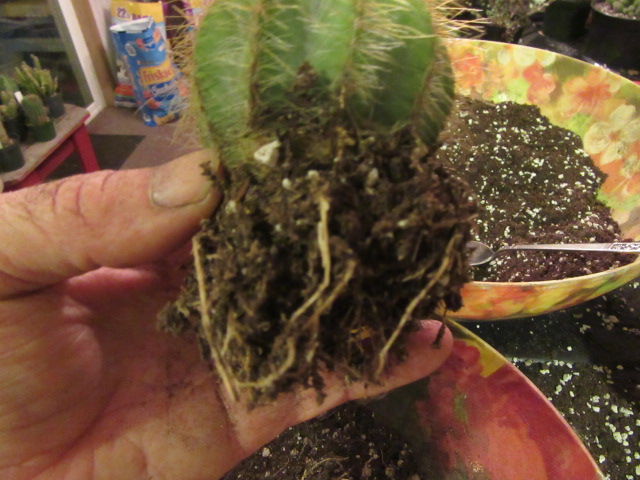
In the above photo, the Parodia magnifica has a nice set of roots. It gets to be the first example


Parodia magnifica on 11-13-19, #649-18.

Some cactus don’t grow a large root system but they still need repotting as the “stem” starts to fill the pot. There was still plenty of soil in the bottom of the pot with this Parodia magnifica but the stem had become almost as large as the pot.


Parodia magnifica on 11-13-19, #649-19.

In years past I would just take the plant from one pot and put it in another without doing anything with the roots. Then later, when I repotted again, sometimes I found the roots still tightly packed in its original wad. So, I started loosening the roots before repotting and sometimes trimming off a few on the bottom. They grow new roots and a little trimming doesn’t bother them. Sometimes you may find rotten or dried roots that need to be trimmed as well.


Parodia magnifica on 11-13-19, #649-20.

Then I always make sure the plants are centered in the new pot.


Parodia magnifica in its new pot on 11-13-19, #649-21.

Here the Parodia magnifica is happy in its new pot… Normally, I only increase the pot size by 1 inch but sometimes I can’t find the right size of pot. I have LOTS of smaller pots so there is always a good selection. You can find pots in quantity on Ebay and Amazon. Of course, you may want a nicer pot…


Mammillaria plumosa on 11-13-19, #649-16.

The Mammillaria plumosa (Feather Cactus) asked for a new pot because she had no more room to grow…


Mammillaria decipiens in its new pot on 11-13-19, #649-13.

I know this pot seems a little large for the Mammillaria decipiens, but I am expecting another growth spurt. After repotting, I read this species of Mammillaria should not be planted in a peaty mix because it grows naturally in canyons and hills generally in volcanic soils… Llifle says “It likes very porous mineral substratum and avoid the use of peat or other humus sources in the potting mixture.” Hmmm… I read that when I was updating its page last week. Llifle also says, “Outside filtered sunlight or afternoon shade, inside it needs bright light, and some direct sun. Subject to sunburn if exposed to direct sun for too long. Does better than most species in lower levels of light, but still prefers bright light or morning sun.” Well, it was growing on the back porch in full sun and did awesomely well. I am wondering, though, if I should have added more pumice to its mix… Maybe some chicken grit as well.


Echinopsis mirabilis in its new pot on 11-13-19, #649-8.

I finally decided to increase the pot size for the Echinipsos mirabilis since it was still in the tiny pot it came in. According to information, this species may be short-lived but only time will tell. It is also said, that although short-lived, it leaves behind many seeds that will come up. Well, I kind of screwed that possibility when I repotted, huh?


Agave (syn. x Mangave) ‘Pineapple Express’ in its new pot on 11-13-19, #649-2.

I figured since the Agave (x Mangave) ‘Pineapple Express’ was an Agave it might have a lot of roots by now. I was right… It also has several pups. NICE!


x Alworthia ‘Black Gem’ in its new pot on 11-13-19, #649-3.

The x Alworthia ‘Black Gem’ grew a lot since I last repotted it, so I thought I would upgrade it again. But, I forgot something which I didn’t think about until after I repotted the Haworthioposis limifolia… It came from Wildwood Greenhouse and he buys a lot of plants in plugs. I forgot to check to see if there were remains of the netting from a plug.


Aristaloe aristata in its new pot on 11-13-19, #649-4.

The Aristaloe aristata (Lace Aloe) was giving me the “look” so I wouldn’t forget about her. I told her I repotted her before but she said it was time again. Sooo… Now she has a larger pot.


Echinopsis ‘Rainbow Bursts’ on 11-13-19, #649-7.

What can I say? I may have gone a little overboard with this one but she said she needed to wean her kids. She said she was tired of them clinging to her. I said OK if she promised to give me a flower. I think she is crossing her fingers and toes.


Cereus forbesii f. monstrose ‘Ming Thing’ on 11-13-19, #649-5.

Hmmm… I hate to tell you, but I severely neglected the Cereus forbesii f. monstrose ‘Ming Thing’. I knew from the previous and much larger plants I had for several years that they don’t have a very large root system and they grow VERY SSSSLLLLOOOOWWWWLLLLYYYY. So I didn’t repot since I brought it home in a tiny pot from Wal-Mart in, ummm… GEEZ! It has been since 2016! It is STILL the same width as when I bought it home at 3 1/2″ wide. It has grown 1/2″ taller to 3 1/2″.


Cereus forbesii f. monstrose ‘Ming Thing’ in its new pot on 11-13-19, #649-6.

Its soil was very hard and dry so I replaced it then put the cactus back in the same pot. Maybe it will grow now. 🙂


Gasteria sp./Hybrid ? on 11-13-19, #649-9.

I decided the Gasteria twins with no name should be in another larger pot. This is its second upgrade. I noticed something weird when I removed it from its pot that I have never seen before.


Gasteria sp./Hybrid ? on 11-13-19, #649-10.

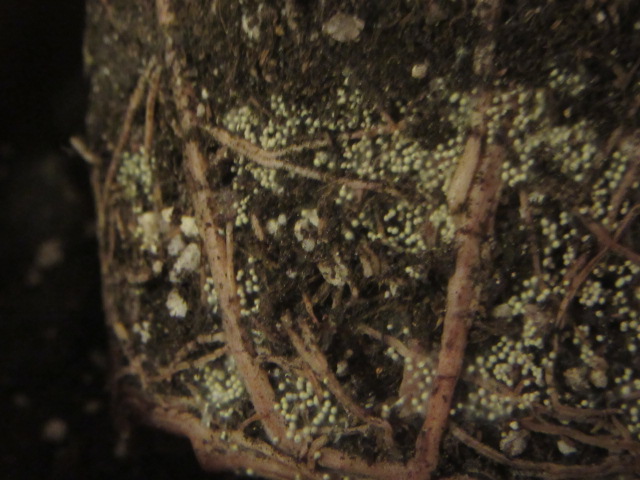
A few weeks ago I saw a post on Succulent Dreamers where a member had posted about the beneficial bacteria (of some sort) growing on the roots of his plant. I thought that was pretty neat and had not seen it before in pots. Actually, it is mycelium which is a “friendly” fungus. Come to think of it, this is the first year I haven’t had ants in at least one pot. I think that is because the pots were on the porches.


Gasteria sp./Hybrid ? on 11-13-19, #649-11.

Now we’ll see how much larger they get in their new pot…


Gasteria sp./Hybrid ? on 11-13-19, #649-12.

With their new child. 🙂


Plants repotted on 11-13-19, #649-1.

This is a group photo of the plants I repotted on November 13. But, I wasn’t quite finished…


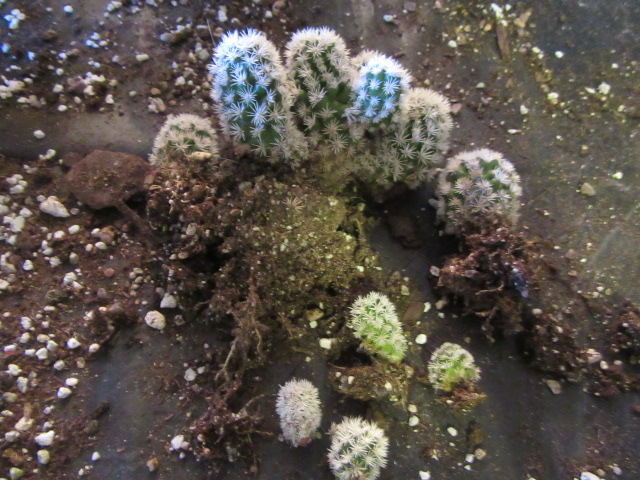
Mammillaria vetula subsp. gracilis ‘Arizona Snowcap’ on 11-16-19, #651-2.

On the 16th I decided it was high time I worked on the Mammillaria vetula subsp. gracilis ‘Arizona Snowcap’.


Mammillaria vetula subsp. gracilis ‘Arizona Snowcap’ on 11-16-19, #651-3.

I posted before how several of the plants in the colony had died… The ones that were nearly all white.


Mammillaria vetula subsp. gracilis ‘Arizona Snowcap’ on 11-16-19, #651-4.

After removing the clump from the pot I had to remove the dead…


Mammillaria vetula subsp. gracilis ‘Arizona Snowcap’ repotted on 11-16-19, #651-5.

Then I kind of centered the live plants around the larger cluster.


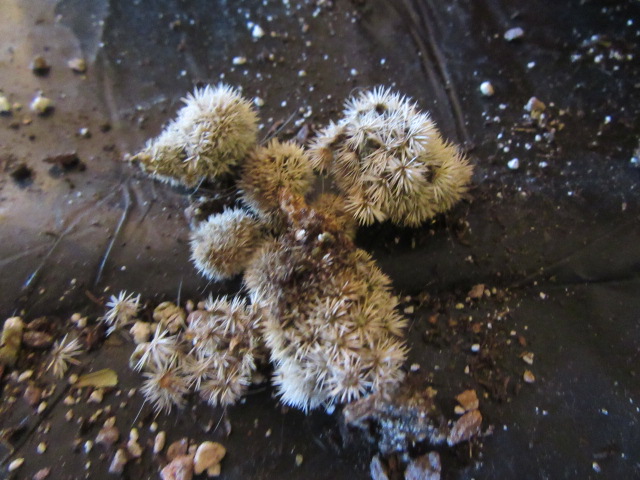
Dead Mammillaria vetula subsp. gracilis ‘Arizona Snowcap’ on 11-16-19, #651-6.

This is part of the dead plants. I had discarded a few earlier in the summer.


Haworthiopsis limifolia on 11-17-19, #652-1.

Then I checked the Haworthiopsis limifolia (Fairy Washboard, ETC.) to check to see if it had been in a plug like the Haworthia ‘Little Warty’. Sure enough there it was… While a few roots did poke through, you can see how many roots were tightly packed inside the plug wrapping. Most of this plants roots had grown out the bottom and up the side.


Haworthiopsis limifolia on 11-17-19, #652-2.

I gently peeled away the netting and from around the roots that grown through it. That’s when I remembered the x Alworthia ‘Black Gem’ could also have this same issue since all three plants came from Wildwood… I have to quiz Mr. Yoder abut removing the netting from the plug when they repot.


Haworthiopsis limifolia repotted on 11-17-19, #652-3.

Now, it is happy…


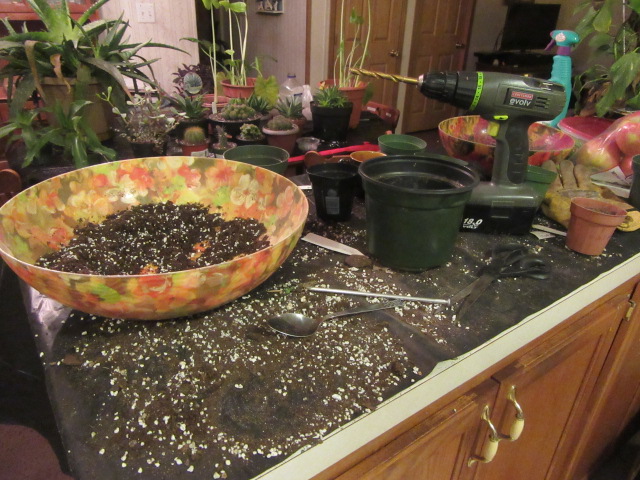
Hmmm… The island in the kitchen made a great potting table but now I have to clean up the mess… You may be wondering what the drill is for? If I use pots from Dollar General, like with the x Alworthia ‘Black Gem’, I have to drill holes in the bottom.

I think that’s it for repotting for a while until I check the x Alworthia ‘Black Gem’ for the plug. I hope all is well with you. Until next time, take care, be safe, and stay warm or cool depending on where you live.

Cactus & Succulent Update Part 4: The Mammillaria Collection

Mammillaria Group Photo on 11-16-19. Back row from left to right: Mammillaria pringlei, Mammillaria elongata, Mammillaria decipiens (in a new pot), and Mammillaria vetula subsp. gracilis ‘Arizona Snowcap’. Middle row from left to right: Mammillaria rhodantha, Mammillaria muehlenpfordtii, Mammillaria hahniana, and Mammillaria karwinskiana. Front Row from left to right: Mammillaria vetula subsp. gracilis, Mammillaria mystax, and Mammillaria plumosa (in a new pot).

Hello Everyone! I hope this post finds you well! Part four of the cactus and succulent update is about the Mammillaria species in my small collection. Mammillarias are among the widest genus of cactus collected for many reasons. Most are very easy to grow and there are a lot of species to choose from. Plants of the World Online currently lists 162 species. As with the previous three updates, these photos were taken on October 11 when I moved the potted plants inside for the winter.

HERE WE GO…


Mammillaria decipiens (Bird’s Nest Pincushion) at 1 1/2″ tall x 4″ wide on 10-11-19, #639-56.

The Mammillaria decipiens (Bird’s Nest Pincushion) always amazes me. It seems like every time I put it in a wider pot it wastes no time filling it up. It was 1 1/2″ tall x 4″ wide on October 11. It was squished in its pot when I brought it home from Wal-Mart at 3″ wide in March 2018. But, the weird thing is that is shrunk 1/2″ in height. 🙂 I think the subspecies for this plant should be Mammillaria decipiens subsp. camptotricha although it is not “currently’ validly recognized. Hmmm… I have been saying that for a while now. I really like this plant because of its long tubercles, the spines that seem to form a web across the entire clump, and the fact that it produces a lot of flowers. There weren’t many flowers when I took this photo on 10-11-19 but there were later. It isn’t uncommon for it to have a few during the summer as well.

To view this plant’s own page, click HERE.


Mammillaria elongata (Ladyfinger Cactus) on 10-11-19, #639-58).

The Mammillaria elongata (Ladyfinger Cactus, Golden Stars) is one of the weirdest cactus in my collection. Sometimes the main stem is leaning over (one way or the other) and sometimes it is straight up. I mentioned before we had a rough start when I accidentally knocked it off the plant table only a few days after I brought it home. Most of the offsets fell off so I just stuck them back in the pot, which was barely big enough at the time. I spaced them out better when I repotted then the main stem got even with so many more offsets. The other weird thing is the measurement… I didn’t take a measurement when I took the photo on 10-11, but I did a few days later when I took photos of its flowers. There were only a few buds when I took the above photo, but on October 19 through early November there were A LOT! Anyway, the measurement I typed in said 6 5/6″ tall… What in the heck did that mean? SO, I decided to take another measurement when I was writing this post. The main stem was standing straight up and the measurement was 7 3/8″. GEEZ! I stood the stem up before to take the measurement so I would be close to accurate. It isn’t uncommon for cactus to shrink and swell when they have ample moisture so it isn’t uncommon for their measurements to be a lot different in just a short period of time. The central stem measured only 4″ tall when I brought it home in March 2018 and the cluster was 3 3/4″ wide. I didn’t measure the width this time because the stems move around so much. I thought maybe they lean toward the sun but sometimes they seem to be leaning toward the shade… Like I said, this plant is weird…

To view this plants page, click HERE.


Mammillaria hahniana (Old Lady Cactus) at 3 1/4″ tall x 3 3/8″ wide on 10-11-19, #639-59.

The Mammillaria hahniana (Old Lady Cactus) is a very neat plant to grow with all its wool. It produces quite a few flowers off and on and right now has a few more buds. It measured 3 1/4″ tall x 3 3/8″ wide on 10-11-19 and I am not about to remeasure it again until next year. It was only 1 7/8″ tall x 2 3/8″ wide when I brought it home from Wal-Mart on February 1, 2016.

Click HERE to view the Mammillaria hahniana page.


Mammillaria karwinskiana (Silver Arrows) at 3 1/4″ tall x 2 3/4″ wide on 10-11-19, #639-61.

The Mammillaria karwinskiana (Silver Arrows) is another fairly wooly cactus companion. It seems a little strange posting this photo since I posted a later photo of it with flowers already. Right now it has 11 buds and flowers. OK, I will go take a photo right now and show you…


Mammillaria karwinskiana flowers on 11-14-19, #660-1.

You can’t see all the flowers and buds, but there are 11. Pretty neat how they are facing the inside of the house instead of being toward the sun.

Anyway, on October 11, the Mammillaria karwinskiana measured 3 1/4″ tall by 2 3/4″ wide. Hmmm… I just double-checked. 🙂 At least it said “about” what it did before. This plant has grown AAAALLLOOOTTT taller! It was only 1 7/8″ tall when I brought it home from Lowe’s in September 2018 and 2 3/16″ wide.

Click HERE to view this plant’s own page.


Mammillaria muehlenpfordtii (Golden Pincushion) at 3 3/4″ tall x 2 7/8″ wide on 10-11-19, #639-64.

This is a BEAUTIFUL plant! The Mammillaria muehlenpfordtii (Golden Pincushion) has this two-tone glow going on. A silvery-white-greenish glow overlaid with a golden glow. It almost looks like it has a halo. It is a bit of a leaner and I kept taking it out of the pot and straightening it up. I realized it is normal and many cactus lean toward the south so I just turn the pot once in a while. You can’t do that in the wild and some large cactus eventually fall over.

Currently, or at least on October 11, this cactus measured 3 3/4″ tall x 2 7/8″ wide. I found this plant out of its pot and laying on its side on the discount rack at Lowe’s in September 2018. I picked it up and thought its club shape looked pretty neat so I brought it home. It has only grown 1/2″ taller and 3/4″ wider since I brought it home even though it seems like it has grown a lot. Hmmm…

The other thing about this plant that you can’t see (because I hide it) is the clump of hot glue STILL stuck to its side. Normally the strawflowers are stuck to the top. If you look close, you can see like a ridge in the center of the plant that goes all the way around it. That is where the clump of glue is stuck to its “skin” on the other side… Just another reason companies should stop using hot glue to stick the dumb strawflowers on cactus. It’s completely ridiculous! Maybe we should all send emails to Altman Plants (thecactuscollection.com). They are the largest producer of cactus and succulents in the United States.

Click HERE to visit this plant’s own page.


Mammillaria mystax at 2 1/4″ tall x 2 1/2″ wide on 10-11-19, #639-67.

The Mammillaria mystax is indeed a humble little plant. It is very quiet and polite, doesn’t get excited, and it never causes any problems. As long as you give it what it needs to live and grow it will be happy and do just that. Nothing else. 🙂 So, what makes this plant special? Well, it is one of several species that divide dichotomically. It also has these strange trichomes (hairs) that grow between the tubercles that the others in my collection don’t have.  It measured 1 3/4″ tall by 2 1/4″ wide when I brought it home from Lowe’s in September 2018. By October 11 it had grown to 2 1/4″ tall x 2 1/2″ wide.

Click HERE to view this plant’s own page.


Mammillaria plumosa (Feather Cactus) at 1 1/2″ tall x 3″ wide on 10-11-19, #639-69.

My feathered friend, the Mammillaria plumosa (Feather Cactus), that I bought from a seller on Ebay in September 2018 has done quite well. The cluster of plants was 3/4′ tall x 2 1/4″ wide when it arrived and now has filled its pot at 1 1/2″ tall x 3″ wide. It produced several good-sized flowers since the above photo was taken that are sort of similar to Mammillaria karwinskiana without the reddish color. It needs a new pot now… OH, it is one of only a few cactus to receive the Royal Horticultural Society’s Award of Garden Merit.

Click HERE to view this plants own page.


Mammillaria pringlei (Lemon Ball Cactus) at 5 1/2″ tall x 2 1/2″ wide on 10-11-19 #639-71.

What can I say about the Mammillaria pringlei (Lemon Ball Cactus)? For one, it is a leaner that I keep turning around. It is a very nice looking plant that I brought home from Lowe’s in October 2017. It flowers freely and abundantly and always looks great. I think it was my first cactus that flowered in 2017. It is now 5 1/2″ tall x 2 1/2″ wide which is around an inch taller and wider than when I brought it home. It is very similar in many ways to the Mammillaria rhodantha and was once named Mammillaria rhodantha subsp. pringlei.

To view this plant’s own page, click HERE.


Mammillaria rhodantha (Rainbow Pincushion) at 4 1/2″ tall x 2 1/2″ wide on 10-11-19, #639-73.

There is no mistaking the Mammillaria rhodantha (Rainbow Pincushion) with its rusty red central spines and white radial spines. It has always been an attention getter. It is a very stately plant, in my opinion, along with Mammillaria pringlei. This one does lean a little but not as much as M. pringlei. It doesn’t produce that many flowers but the spine color make up for it. Maybe because it realizes its pink flowers don’t look that good with the color of its spines. What color would look good, anyway? It is now 4 1/2″ tall x 2 1/2″ wide. Apparently, I didn’t measure this plant when I first brought it home from Wal-Mart in February 2016 then I screwed up and measured the cactus “with” the spines in 2017. It is one of my oldest cactus since I started recollecting in 2016.

To view this plant’s own page, click HERE.


Mammillaria vetula subsp. gracilis at 1 1/2″ tall on 10-13-19, #641-4.

Hmmm… Mammillaria vetula subsp. gracilis (Thimble Cactus). OK… I brought home my first “colony” of Thimble Cactus from Lowe’s in April 2013. It grew by leaps and bounds but, unfortunately, I gave up most of my plants in the summer of 2014. Then, when I took plants to Wagler’s Greenhouse last year I found this very small plant. I didn’t even recognize it as a Thimble Cactus at first. The main plant was very small and had several kids growing from it which have all fallen off but one. I now remember how the colony of the first pot grew so fast… Now, at only 1 1/2″ tall, it is building a successful family.

If you have a pot labeled, or find one labeled, Mammillaria gracilis fragilis or something of the sort, it is this plant…

If you click o this plant’s own page HERE, you will see photos of the previous colony I had as a companion and what this one will become like.


Mammillaria vetula subsp. gracilis ‘Arizona Snowcap’ on 10-11-19, #639-74.

I look at the photo of the Mammillaria vetula subsp. gracilis ‘Arizona Snowcap’ and find myself at a loss for words. I know what I want to say, but there are no words for the definition. Have you ever had that problem? A definition with no words? I think the photo is the definition of GEE WHIZ! OK, I had been to Lowe’s to buy potting soil in July 2018 and ran across a pot with this “cluster” plus a pot of the, umm, M. vetula subsp. gracilis (like the one in the previous photo. I am whispering because I don’t want it to hear me). I left the other pot behind and brought home the one labeled Mammillaria gracilis v. fragilis monstrose… That is what Altman Plants calls it for some reason. Yes, ‘Arizona Snowcap’ is a monstrose form of Mammillaria vetula subsp. gracilis. It has an ABUNDANCE of shorter white spines than the “regular” subspecies. Now, when I brought my pot home, it was bulging and overflowing. I saw photos online of plants that were nearly solid white, like snowballs and I wondered why the pot of plants I brought home was not that solid white. After I repotted it/them and they begin to spread out a bit and do really well over the summer. They looked great and very happy but still, they didn’t look like the photos online. Then, in October (2018) I noticed a completely white plant. I thought, “WOW!” Then afterward, a few others started becoming more white. The weird thing is that the whiter offsets died after I moved the plants outside for the summer… Hmmm… I am going to do some work on this pot so it will look better…

Oh yeah, the tallest plant in the colony is 2″ tall. As with the regular Mammillaria vetula subsp. gracilis, they don’t grow that tall but they freely offset from the bottom and sides. Offsets fall off and form a larger colony.

To view this plant’s own page, click HERE.

That is it for part 4 and there will still be one more plus the repotting post. Then what? 🙂 What would you like for me to post about? I will be working on updating the pages for the cactus on this page, so if you click on the link you may not see current photos. It takes a lot of time to update as I go and may take several days to finish.

Until next time, be safe and stay positive. Go outside and take a deep refreshing breath and say “THANK YOU!” Do it twice more. 🙂 If you can get dirty, do it…


CACTUS AND SUCCULENT UPDATE PART 3

Plants in the Cactus and Succulent Update Part 4. Back row left to right: x Graptosedum ‘California Sunset’, x Gasteraloe ‘Flow’. Middle row left to right: Gymnocalycium saglionis, Haworthiopsis limifolia, Gasteria sp. ?, Espostoa melanostele. Front row left to right Gasteria ‘Little Warty’, Ferocactus wislizeni, and Euphorbia mammillaris. Not pictured in the group photo is the Huernia schneideriana.

Hello everyone! I hope this finds you all well. It is a little strange I am still working on the October 11 update and it is November 14. I still have the 11 Mammillaria and eight other cactus and succulents to post updates about.

The weirdest thing is the Phlomis ‘Edward Bowles’. I always cover it up with a big pot when we are expecting an “F” and keep it covered all winter when cold temps persist. I covered it when we had the “F” on October 11, but forgot about it when we had the “S” and cold temps on the 29th. I noticed a few days ago it was the only plant not affected by the “F’s” and cold.

The daytime temps the past few days have been pretty nice, although a little breezy. I was able to take the plants in this post to the front porch for a photo shoot. All except the Huernia schneideriana because it is on the plant shelf in the bedroom all situated for winter. It is the last plant featured in this post and you will understand why I didn’t move it when you see it.

Without too much to say about anything else at the moment, let’s dive right into the post…


Espostoa melanostele subsp. nana (Peruvian Old Lady) at 7 1/4” tall x 2 3/8” wide on 10-11-19, #639-26.

In the above photo, the Espostoa melanostele subsp. nana (Peruvian Old Lady) is proudly showing off her hairdo. Not that it is new, but there is an inch more of it. She grew to 7 1/4″ tall x 2 3/8″ wide since last October which is 1 ” taller and 1/4″ wider. She was only 2 3/4” tall x 1 3/4” wide when I brought her home from Wal-Mart in February 2016. I am glad to see the subspecies is also an accepted name.

To view the page especially for this cactus, click HERE!


Euphorbia mammillaris (Indian Corn Cob) at 5 3/4″ tall on 10-11-19, #639-27.

The Euphorbia mammillaris (Indian Corn Cob) has done very well and the main stem has now grown to 5 3/4″ tall. The upper parts of the stem and side branches are covered with small ephemeral leaves and the few spines still persist at the lower level. There were remains of flowers on the top of the cutting when I brought it home in March (2019), so hopefully, it will flower soon. The hexagonal tubercles swell when it has ample moisture and shrink during dry periods. There isn’t much online about this plant but most information says they grow 13-15″ tall. Ummm… Llifle says up to 35 cm but it also says they are “moderately fast” growers and “will become large landscape masterpieces in 3-5 years” and “young plants are happy growing indoors where they can easily reach the ceiling.” Hmmm… I don’t about your ceiling, but mine is slightly higher than 35 cm.

Click HERE to view this plant’s own page with more photos.


Ferocactus wislizeni at 2 1/4″ tall x 2 1/2″ wide on 10-11-19, #639-31.

The Ferocactus wislizeni (Arizona Barrel, Candy Barrel, Southwestern Barrel, Fishhook Barrel, Biznaga de Aqua…) is a very interesting plant to watch grow. Not that you would want to sit and watch it. 🙂 Earlier in the summer it started doing something weird as it was growing new spines. It almost looked like it was growing three apexes. Actually, it was growing new tubercles on three ribs at the same time. Of course, all cactus do this but this one caught my eye because the spines were red and prominent. I also like the odd shape of the ribs and the purplish color on top. It has grown to 2 1/4″ tall x 2 1/2″ wide now. It was 1 5/8″ tall x 2 1/8″ wide when I brought it home from Lowe’s on March 29. So, that is pretty amazing. It will be even more amazing when it flowers but that may take some time… This is a long-lived species, from 50-130 years, so I may have to give it to someone in my will. Hopefully, it will show me it’s bright orange flowers in my lifetime. Llifle says specimens up to 9′ have been recorded. Interestingly, in the wild, these plants lean toward the equator which can cause them to fall over after a lot of rain as the soil becomes loose.


Ferocactus wislizeni from the top on 10-11-19, #639-32.

The spines grew quickly, to say the least… I am so glad the hot glue stuck to the top of this plant is gone and it caused no permanent damage. I can’t say the same for some.

To view this plant’s own page click HERE


x Gasteraloe ‘Flow’ at 5 1/2″ tall x 10 1/2″wide on 10-11-19, #639-33.

The x Gasteraloe ‘Flow’ has done quite well this past summer and has grown. She produced her first flower this past summer as well. This plant is now 5 1/2″ tall x 10 1/2″ wide. I removed the offsets in this pot in 2018 and they and been somewhat “iffy”. One of the things we do we later think maybe we shouldn’t have done. Umm, notice I said “you” because I certainly wouldn’t want to blame myself.

I bought this plant unlabeled and posted its photo on Succulent Infatuation for ID. A member suggested it was x Gasteraloe ‘Flow’ and several others agreed. So, that’s what I have been calling it. A while back a blog reader asked what the difference was between x Gaseraloe ‘Flow’ and Aloe beguinii. Well, I had no clue so I looked up that species online. Oddly enough (laughing), some of the online images look like this plant and some do not. Then, when I posted update #1, a reader commented that the Aristaloe aristata was a Lizard Tail and not Aristaloe aristata. “What in the heck is a Lizard Tail?” So, I did a search for “Lizard Tail Aloe” and all I found were images and information of some weed. Well, maybe not a weed, but you know what I mean… When I was updating the page for this plant for this post, out of curiosity I looked up Aloe beguinii again… Low and behold, the common name is Lizard Tail!!!

Sometimes plant ID can be very tricky especially with cultivars and hybrids. What is worse is when we buy plants that are unlabeled. Noticed I said “we” again… “WE” have to rely on others for help and do online searches to figure out the name. Not all information online is 100% accurate and only part of the images are the plant in question. Some are just photos of plants posted on websites that have nothing to do with plants. Being “slightly” familiar with who the suppliers are for the local greenhouses, Lowe’s, and Wal-Mart make it a little easier. Once I get an ID suggestion, I check out the company’s websites to see what similar plants are currently available. Sometimes that is a dead-end… Knowing what is on the market during the time period “you” buy unlabeled plants is important. However, plants with certain cultivar names now could be the same plants with different cultivar names several years ago offered by other growers. Unpatented names are renamed and so on… So, it is a gamble that what we call plants is actually what they are. Just think how many species have so many different common names, and even several scientific names… Then there are times when I have brought home unlabeled plants from local greenhouses. Plants that have been given to the owner by others that were given to them and so on… Passalong plants are great!

I have said it many times but I will say it again. I am not a plant expert. I just like growing plants and writing about them hoping to spark interest and maybe help someone along the way. I always try to share links on the plant pages to websites that have been written by those more knowledgeable than me.


Gasteria sp./Hybrid at 3 7/8″ tall x 6 1/2″ wide on 10-11-19, #639-35.

I really enjoy this Gasteria sp. (Ox Tongue, Cow Tongue, Lawyers Tongue…). It is only fairly attractive but it is weird. Its leaves are very stiff, almost plastic-like. I still haven’t figured out the species and is quite possibly a hybrid. It is just strange how it showed up at Wal-Mart. The two times I posted for an ID on Succulent Infatuation all I received were “likes” or someone telling me it was a Gasteria. I already knew that! I may be able to get a suggestion from a particular hybridizer… Hmmm… Maybe I should meditate with it in my hands. Whatever its name may be, it has grown. Currently, the two plants together are 3 7/8″ tall by 6 1/2″ wide. They were 2 3/4″ tall x 3 3/4″ wide when I brought them home on March 19, 2018. Wow! That’s 2 3/4″ wider!

I sent a message to Kelly Griffin a few days ago, one of the foremost Aloe hybridizers who just happens to work for Altman Plants. He said, “I don’t see it as a species but it does look a little bicolorish. (I assume by saying “bicolorish” he meant Gasteria bicolor, which is a synonym of G. obliqua). We found pillansii in the wild with this milky leaf color. I would suggest it is a hybrid but certainly, without a flower, it is difficult to determine provenance or even narrow it down. Many growers sell both species and hybrids. It very could well be from our nursery as we supply plants for Wal mart and HD and Lowe’s.”

I also just received approval to become a member of Succulent Dreamers. It is a Facebook group with over 100,000 members. I posted photos of this plant so we’ll see if they have any suggestions. Over 200 people have joined in the past month. If you do join this group or Succulent Infatuation, be prepared to drool…

UPDATE: After several days of posting photos of the above Gasteria, only two “likes” and no comments! Weird with over 100,000 members. Some days there are a lot of new posts and maybe mine was posted on an inactive day. Then it was overrun by new posts. I will repost…

Click HERE to view this plant’s own page…


Gasteria ‘Little Warty” at 3 1/2″ tall x 3 1/2″ wide on 10-11-19, #639-34.

The Gasteria ‘Little Warty’ and its kids are doing GREAT. Their leaves are definitely not smooth. The main plant has grown quite a bit since I brought it home from Wildwood Greenhouse in May. It is now 3 1/2″ tall x 3 1/2″ wide. It was only 2″ tall x 2 3/16″ wide! The offsets fell away from the main plant when I repotted it so I put them in their own pot. Together, they have also grown to 1 1/2″ tall x 2 7/8″ wide. I repotted it mainly because the plug wrapping was sticking out above the soil and I wanted to remove the netting. I don’t like it. 🙂 Most commercial growers use plugs to grow their young plants in then greenhouses that buy plugs put them into pots. If I owned a greenhouse I would remove the plug wrapping… From what I have noticed, it is an ordeal for the roots to grow properly. I always remove the wrapping once I know it is there. The roots of some plants grow through the small holes in the wrap with no problem, but others have some difficulty and the roots become very cramped up.

Click HERE to view the Gasteria ‘Little Warty’ page. Gasteria ‘Little Warty’ is a cross between Gasteria batesiana x Gasteria ‘Old Man Silver’ from Australian hybridizer David Cumming.


x Graptosedum ‘California Sunset on 10-11-19, #639-38.

The x Graptosedum ‘California Sunset’ is doing very well. Much better since I have found a proper name for it. My plant collecting friend from Mississippi, Walley, sent me a rooted stem in July 2018. It was pretty tall and the top part broke off. The leaves were green at the time he sent them, but with more light their colors came out. Eventually, I took leaf cuttings and left them on the back porch in full sun. They grew nicely and they have turned into a great looking pot of plants. One they looked like this I was able to find a positive ID. Well, I posted the photo on a Facebook group and several agreed x Graptosedum ‘California Sunset’ was the name. I checked Google Images and it looks good to me. That may not have been its original name, but that is what it is now. 🙂 You can look at photos of many x Graptosedum cultivars and they basically look the same. I don’t have a page for this plant yet…

Walley is an avid plant collector and travels to plant shows and many nurseries buying plants every year. His yard is incredible! Walley is an older gentleman whose wife passed away a while back. Then he started dating… I believe he may have found the right one because they have been spending a lot of time together and traveling for several months. So, I don’t know what his yard looks like now since he had other interests. I haven’t talked to him for a while, but I see his posts on Facebook. He is having a good time and that is very important. 🙂


Gymnocalycium saglionis (Giant Chin Cactus) at 2 3/4″ tall x 2 7/8″ wide on 10-11-19, #639-39.

I really like the Gymnocalycium saglionis (Giant Chin Cactus). How can you not like a plant that looks like this?  It is possibly the subspecies Gymnocalycium saglionis subsp. tilcarense described on Llifle. Plants of the World Online, however, says the subspecies is now a synonym of the species. I still don’t get it. I think maybe the botanists (and many others) that are trying to straighten out the multiple scientific name issue haven’t gotten around to approving many of the infraspecific names. I am sure there is a logical explanation. They were already approved at one point. I turned around and started telling Jade (the cat laying on my bed) my opinion. She looked at me like I was going to say something brilliant then laid her head back down and ave a big sigh. Hmmm… Not even the cat cares what I think about it. 🙂

ANYWAY! This AWESOME cactus now measures 2 3/4″ tall x 2 7/8″ wide. Of course, you can see that in the caption. Hmmm… I guess I need to say those were its measurements on October 11 since it is already November 13. How many more days will go by before I get this post finished?

This plant DOES have its own page which you can view by clicking HERE… There are more photos.


Haworthiopsis limifolia at 3 1/2″ tall x 3 1/8″ wide on 10-11-19, #639-42.

The Haworthiopsis limifolia (Fairy Washboard, File Leafed Haworthia) is looking very interesting as always. It measured 3 1/2″ tall x 3 1/8″ wide on October 11 and measured 2 3/8” tall x 3” when I brought it home from Wildwood Greenhouse in May. It is a really neat looking plant with the raised ridges on its leaves. Llifle lists several varieties of this plant but there are none listed on POWO. I have not repotted this plant since I brought it home because it was in a large enough pot already. I think it was probably bought as a plug then repotted at Wildwood… SOOOO, I should have checked to see if its roots are bound up inside a net. Hmmm… I didn’t think about it until I updated ‘Little Warty’s’ page…

You can view the Haworthiopsis limifolia page by clicking HERE.


Huernia schneideriana (Dragon Flower, Carrion Plant) on 10-11-19, #639-43.

Hmmm… To say the Huernia schneideriana (Dragon flower, Carrion Plant) has been growing would be an understatement. I kept it on an old milk crate along the wall on the front porch because it doesn’t like to much sun. It must have like this location because…


Huernia schneideriana (Dragon Flower, Carrion Plant) on 10-11-19, #639-44.

It is LOADED with flowers!


Huernia schneideriana (Dragon Flower, Carrion Plant) on 10-11-19, #639-45.

The flowers usually grow from the lower parts of the stem but…


Huernia schneideriana (Dragon Flower, Carrion Plant) on 10-11-19, #639-46.

These appear to be growing on the outside of the pot. That is because they are growing from a branch… The flowers are supposed to smell really bad which is where one of the common names comes from. They are so small who could tell.

I have had this particular plant since 2015 To view its own page click HERE.

Hopefully, someday the Stapelia gigantea will flower as much as the Huernia. Their flowers are HUGE so they might stick up the house.

That’s it for the third update! I still have two more which will be a little weird… I repotted a few cactus and succulents so it kind of screwed up the October updates. Hmmm… This is November. 🙂 I suppose I can continue with the updates and pretend I didn’t do the repotting yet. LOL!

Until next time, be safe and stay positive. Keep warm or cool depending on where you are.


Ummm… Another “S”!

Hello everyone! I hope this post finds you all well! I woke up this morning and “you know what” was going on outside! Second time so far this “winter”. When I was a kid we would get “S” before January 1, but then for many years it rarely ever did that and sometimes not until March. I prefer it to do this while I am in bed and be gone by the time I get up. I am not a fan of cold temperatures and would do very well in a tropical or subtropical climate. Growing a garden 12 months a year and not having to bring plants inside for the winter would be great. I know there would be other weather challenges but it wouldn’t involve snow and ice. Just thinking about all the Aroids I can grow gives me goosebumps. Well, maybe the goosebumps are from just coming in from outside.

The above photo was taken at 1:19 in the afternoon and it was snowing every time I looked outside until 3:20. It had stopped.


The only time this thermometer is close to correct is during the winter. It was 21° F when this photo was taken and at 3:30 in the afternoon the internet says it is STILL the same temperature. Every time I look at the weather forecast it gets worse. Now the National Weather Service says it “may” get down to 9° F during the night. I checked other websites to check if there is a more agreeable forecast and they all say about the same thing…

I did cover the Phlomis ‘Edward Bowles” before I went to bed last night…


A few of the cats like the box on the back porch, but the rest don’t seem to like crowded conditions and usually go to the barn. There are probably three cats in this box and it is weird the darker yellow and white fuzzy cat is here. Normally he stays in the barn when it is cold. He has been tamer the last few months for some reason but I still can’t pet him. His brother, the one you can’t see, is just the opposite. If you touch him he won’t leave you alone. The one mom and dad called The Barn Cat and Susie are no doubt in the barn. The two kittens are snuggled under a table on a bag of potting soil. I would let them in but they find too many things to play with. The younger one doesn’t use the litter box either. Simba wants in but I think that would be unfair to let him in when the others are outside. Of course, Jade is sleeping on my bed. Hmmm…


The plants in my bedroom seem to be adapting to being inside so far. The Alocasia gageana would prefer the front porch but she is not objecting since she can see the “S”. There are five pots of Alocasia gageana but only one has made it to the basement (where they overwinter). The other three are on the dining room table. When I brought the plants inside for the winter I was excited to see the Stapelia gigantea had buds. Unfortunately, it appears they all fell off! They appear to be growing new buds but I’m not 100% sure what it is doing but the flowers will be HUGE. I purchased the cuttings in October 2018 and they grew like crazy all summer. It is the pot on the left side by the window. I noticed a few mealybugs on it a few days ago which I quickly removed. I haven’t had bugs on my plants for MANY years…


The Tradescantia ‘Pale Puma’ looks amazing! Most of the other Tradescantia are in the other front bedroom with the Begonias and Oxalis. I am not sure if the ‘Pale Puma’ will continue to look good or if it will stretch. Time will tell.


I didn’t get a good photo of the plants in the kitchen windowsill because of the light from outside. The Schlumbergera truncata (Holiday Cactus, False Christmas Cactus, etc.) has a few buds again. It tried last year but the buds fell off because I didn’t give it enough water. This year it is in the kitchen windowsill so I can keep an eye on it. I tried getting a photo of its buds but it would cooperate. The only good photo didn’t seem appropriate… OH, what the heck…


ANYWAY………….. The flowers will be a peach color. Common names include False Christmas Cactus, Thanksgiving Cactus, Crab Cactus, Zygocactus, Lobster Cactus, Claw Cactus, Holiday Cactus, Linkleaf, Yoke Cactus, Crab’s Claw Cactus, Easter Cactus… After that photo, I can think of a few others.

Interestingly, it is a true cactus species and is in the Cactaceae family to prove it. A native of Brazil and Rio de Janeiro (Serra do Mar and Serra dos Orgãos).


I didn’t notice buds on the Mammillaria karwinskiana (Silver Arrows) when I brought the plants inside for the winter because of all the wool. A few days ago I noticed buds peeking through and now they are beginning to open. This is pretty exciting because these are its first flowers.


The Mammillaria hahniana (Old Lady Cactus) is loaded with buds and a few flowers. This is nothing new for her as she started flowering in October 2017. Ummm… She also flowered this past July.


I need to do some further research about the Zantedeschia species because this one is weird… The other Calla I have is possibly Zantedeschia elliottiana (Golden Calla Lily) (which I have been incorrectly calling Z. aethiopica) because it has spotted leaves and Yellow flowers. It comes up in the spring and is already dormant. It’s label just says “Calla”. This one was given to me by the owner of Wildwood Greenhouse. I mentioned it in several previous posts but I will recap again in case you didn’t see it.  One of several times I was at Wildwood, there were several pots of really terrible looking plants on the floor next to the counter. The owner, I forget his first name, said he had bought seeds of these Calla Lilies and planted them “outside” (the year before if I am not mistaken) and they came up. He put them in pots and they just kind of always looked terrible. Kind of limp and lifeless. He gave me a pot on Jue 13 to see if I would have any luck with it. I didn’t do anything with it for a week or so and it continued looking weird. Just kind of limp and non-energetic although it continued to live. So, I decided to take it out of the pot, shake off all the old soil and put it fresh Miracle Grow Potting Soil. It still did nothing. I moved it to the front porch and then one day in August when I was watering I saw its leaves were standing up! It was like it was a completely different plant. When I brought the plants inside on October 11, it was just amazing so I put it in my bedroom in front of the window. Apparently, it didn’t like it and the older leaves began to die. SO, I took it to the kitchen and trimmed off the dead leaves… Now, what in the heck is going on with this plant? Why didn’t it go dormant like the other Calla? This particular species is likely Zantedeschia aethiopica, but again, I am not 100% sure. The owner of Wildwood didn’t know either. I do know I will need to dig it up at some point and make sure the bulbs, if it has any, are sticking out of the soil. Anyway, when you plant dormant Calla bulbs, you need to make sure they are sticking out of the soil… Well, some websites say to plant six inches deep BUT don’t do that! The other one didn’t flower until I left the bulbs, or rhizomes, or whatever you call them sticking out of the soil about halfway. Hmmm… But these plants aren’t dormant… Am I supposed to force them to go dormant? I don’t know yet. For now, I will just let them grow and see what happens…

What else? Oh yeah, I almost forgot…


The Callisia repens (Bolivian Jew) is doing great although there are a lot of dead leaves. It was like that when I brought it inside. At some point, I have to work it over, give it a hair cut, remove the dead leaves, or something. This plant is incorrectly labeled Callisia nutans with a photo of Callisia repens. So, if you happen to have one of these labeled Callisia nutans, you know that is the wrong name. The Bolivian Jew is Callisia repens… 🙂

The succulents and a few more cactus in the back bedroom are doing great but I couldn’t get a good photo.

That’s it for this post. I should have finished it earlier because it will be the 12th and the day after the first “S” before you know it. HOPEFULLY, the cactus and succulent update #3 will be ready soon! It is almost finished… It was almost finished three days ago.

Currently, at 10:35 PM, it is 18° F and falling…

Until next time, be safe and stay positive.


Walking through fire — talltalesfromchiconia

Hello everyone! I wanted to share this post from Kate about the fires burning in Australia. I know in the US we don’t always know what is going on in other parts of the world. I don’t even watch the news. Keep the residents of Australia in your thoughts and prayers.

“The difference between a good life and a bad life is how well you walk through the fire.” Carl Jung Sometimes, it is only in the fire that a person’s qualities become apparent. We’re seeing a lot of that right now. The east coast of Australia is largely ablaze. Communities are being razed to smoking […]

via Walking through fire — talltalesfromchiconia

Eight On Saturday-OOPS!

Phlomis ‘Edward Bowles’ (Jerusalem Sage) on 11-9-19, #647-11.

Hello everyone! I hope this post finds you all well. This afternoon was very nice and the temp was in the 50’s. Seeing a few Six on Saturday posts this morning inspired me so I went outside to take a few photos. Well, I am a newbie because I don’t think I have ever made a Six on Saturday post. How do you do only six?

#1 is the Phlomis ‘Edward Bowles’. I bought this plant from a seller on Ebay in 2013 for its interesting flowers. It is very borderline hardy here I think so every fall when we have an “F” in the forecast I cover it up with a big flower pot. I did that again when we had the first “F”. Then I oddly forgot about it after that. From 2013 until now I protected this plant to the point of insanity. When it would get cold, I covered it at night until I finally had to keep it covered. We have had several “F’s” and temps have been in the low 20’s. A few days ago I was coming out of the barn and looked toward the corner bed. I thought, “HOLY S—T! I FORGOT ABOUT THE PHLOMIS!” Here it is alive and well while most everything around it is dead.

This is the third location for this plant. It first in the middle of the south bed then I moved it to the southwest corner bed. Then, I planted the Baptisia there and it took up so much room it shaded the Phlomis. My first idea was to move the Baptisia to the southeast corner but it wouldn’t budge. So, I told the Phlomis I was sorry but I had to him again. I suppose it is a “he” since its name is Edward. I dug him up and he wasn’t too thrilled about the whole ordeal… Normally, he gets fairly tall and his leaves get very impressive. This summer, he didn’t grow as well and the leaves didn’t get as large. He did adapt and get over the move and now he is showing off! I now have a sticky note stuck to the computer that says “REMEMBER THE PHLOMIS.”


Allium ampeloprasum var. ampeloprasum (Elephant Garlic) on 11-9-19, #647-1.

#2-The Allium ampeloprasum var. ampeloprasum (Elephant Garlic) are all alive and growing well. They are pictured above in the southeast corner bed but they are scattered all through the south bed ad well. I usually dig a few of their bulbs to use in cooking. They produce a lot of bulbils which make single bulbs the following year then bigger bulbs with cloves the next year. They have amazing flower heads which I think are a good substitute for the more expensive Allium species an cultivars. At some point, I guess I should lose the “var. ampeloprasum” part of the name because it isn’t legit now. I never understood how a variety could be the same name as the species anyway…


Buddleja ‘White Profusion’ on 11-9-19, #647-2.

#3 is the Buddleja ‘White Profusion’. The Butterfly Bush thrived on neglect this past summer. Basically, the entire south bed went wild which is why I haven’t taken many photos of it. 🙂 I have no idea what that is growing to the left and only noticed it after I looked at the photo. GEEZ! I normally keep this bush deadheaded so it will look tidy and keep it flowering well but I think I only did it once this past summer. It will continue to have green leaves until it gets REALLY cold. One year it stayed green all winter and grew HUGE the following summer. When I bought this plant in 2013 it was only supposed to grow around 4′ tall. Labeling has changed since then because this bush gets MUCH taller than 4’… Hmmm… I bought it and put it here because it was supposed to be a smaller cultivar. Even so, I really like this cultivar and it attracts an abundance of butterflies, hummingbirds, and hummingbird moths.


Celosia argentea ver spicata ‘Cramer’s Amazon’ on 11-9-19, #647-4.

#4Celosia argentea var. spicata ‘Cramer’s Amazon’. Well, what can I say? They came up, they grew, they flowered, and now they are dead. Don’t let that fool you because each inflorescence is FILLED with seed than has fallen out, or will fall out, that will come up next spring. DOUBLE GEEZ! Still, they remain my favorite Celosia because of their maroon and green bi-colored leaves and they grow so tall. They make great plants to cover up the wall and are a good background for the plants in the front of the bed. That is until they branch out and try to cover them up, too. We manage, though…


Nandina domestica (Heavenly Bamboo) on 11-9-19, #647-10.

#5Nandina domestica (Heavenly Bamboo). Every time I post about the Nandina I mention it is my favorite shrub and that I brought it with me from Mississippi. While it doesn’t grow as well here as in Mississippi, it is hanging in there which I am very thankful for. Some bird species like the berries, especially the Titmouse, as they migrate through here. I only see a few Titmouse here but they came by the hundreds in Mississippi. I always liked using the leaves of the Heavenly Bamboo in flower arrangements instead of fern and palm leaves. The Nandina is a great all-around shrub in my opinion. I know in some areas they can be a bit invasive, which is why there were so many at the mansion. A few more here would be a good thing…


Cannas on 11-9-19, #647-3.

#6The Cannas… All I can say is they had a pretty good summer. Despite the Japanese Beetles shredding their leaves they still put on an impressive show and grew to their normal 8-12′. Now I have to cut them down and mulch the bed with leaves. Works very good since they aren’t supposed to be cold hardy here. I can’t imagine digging all the rhizomes, storing them for the winter in the basement and planting them again in the spring…


Cylindropuntia imbricata (Tree Cholla) on 11-9-19, #647-5.

#7Cylindropuntia imbricata (Tree Cholla). When I took this photo it asked me where I had been? I had no good answer and I really didn’t want to make excuses. This planter, which came from an old coal furnace, is where the Tree Cholla, Sempervivum ‘Killer” and Sedum kamtschaticum var. variegata are all growing. The Semp did poorly this year after it went banananananas last year. It flowered then mostly died (which it is supposed to do). The offsets are doing only so so, which may or may not be normal. The Sedum kamtschaticum var. variegata looked better than ever this spring and flowered like never before then it just went to crap. I had to pull a little grass to take this photo and noticed the Sedum spurium ‘John Creech’ has infiltrated the planter. I think that is why the Tree Cholla was wondering where I had been because it knows that is not allowed. Oddly, I did manage to remove the grass without getting stuck. I think that was a first. As always, though, the Cylindropuntia imbricata is doing well and has grown a lot more this past summer. It agrees with me and is ready for spring already.

I took a walk to the back of the farm with one thing on my mind…


Diospyros virginiana (Persimmon) on 11-9-19, #647-6.

#8Diospyros virginiana (Persimmon). In my opinion, the most important thing about Fall here is the Persimmons. I visit this tree as often as I can this time of the year because of the delicious fruit. Deer, turkeys, raccoons, and opossum also eat the fruit so it is usually not easy finding them on the ground.


This tree was LOADED with fruit but most have fallen off. Even the lower limbs are too high to reach so I have to throw a stick to see if I can get some of the fruit to fall off.


OOOPS! The stick got stuck…


I only managed to knock three down, but that is OK. Tomorrow is another day. Even if I don’t come back for more, eating only a few is worth the wait. While it is true a “F” does seem to speed up the ripening process, if we have a late “F” the fruit ripens anyway.

On the way back to the house I was wondering if I had taken enough photos for a Six on Saturday Post. As it turned out, I took photos of eight “plants” so I kind of screwed up. I suppose I could have left out a couple, but the plants behind me in the bedroom couldn’t decide which two to leave out… They reminded me there are six of them for next Saturday… It sounds like a plot to me. 🙂

Well, that’s all I have to say except I am still working on the Cactus and Succulent Update #3.

Until next time, stay well, be safe, stay positive, and always be thankful. Thanks for reading and thanks for your comments in advance.

How to Make Elderberry Syrup for Immune Health — Good Witches Homestead

I read the post and watched the video. I use Elderberry capsules all winter and have always wondered about making my own remedies. This blog is GREAT! So, I reblogged to share it with you.

https://youtube.com/watch?v=w20EeRViTxA%3Fversion%3D3%26rel%3D1%26fs%3D1%26autohide%3D2%26showsearch%3D0%26showinfo%3D1%26iv_load_policy%3D1%26wmode%3Dtransparent

Each year as winter approaches, I reliably find my patients asking me about the best herbal remedies to use during the cold weather months. One of the most common questions I encounter is, “What nutritional preparations can I use to help keep my family strong and healthy throughout the sniffle season?”. There’s a wide array […]

via How to Make Elderberry Syrup for Immune Health — Good Witches Homestead

Cactus & Succulent Update Part 2

Plants mentioned in Cactus and Succulent Update Part 2 on 10-26-19, #645-1. On the railing, from left to right, Cereus forbesii f. monstrose ‘Ming Thing’, Cereus repandus f. monstruosus ‘Rojo’, and Cereus hildmannianus subsp. uruguayanus. The large pot in the center is Echinopsis huascha (var. grandiflora ?). Plants to the left of the big pot are Cotyledon orbiculata ‘Silver Storm'(rear) and Echinopsis ‘Rainbow Bursts’. To the right of the big pot are Crassula tetragona (rear) and Crassula ovata ‘Gollum’. In front are the twin Echinocactus grusonii (var. albispinus ?), Echinopsis mirabilis (small pot), and Echinopsis huascha (var. grandiflora ?) on the right.

Hello everyone! I hope this post finds you well. This is part 2 of the cactus and succulent update. After the light “F” we had during the night on October 11, it warmed up again. The plants were giving me crazy looks and probably talking behind my back. I know this because they would get very quiet when I walked in the room and start looking at each other. They had that guilty look… Then sometimes they would be staring out the window with a bit of drool funning down their chin, or a tear in their eyes. ENOUGH WAS ENOUGH, so I put them back outside for a few days. This time, the temps were chilly, it was cloudy and the wind blew every day. I was going to make sure they were ready to come inside and knew “W” was on the way. Even though another “F” wasn’t isn’t in the forecast for a few days, the temperature was going to get below 40 on Thursday night (by morning), so I brought them back inside. This time, they were ready and thankful.

I am continually updating, so if you click on their pages they may or may not be updated with these current photos.

Here we go…


Cereus forbesii f. monstrose ‘Ming Thing’ at 2 1/4″ tall x 3 1/2″wide on 10-11-19, #639-13.

The last Cereus forbesii f. monstrose ‘Ming Thing‘ I bought from Wal-Mart in February 2016 is definitely taking its time growing. I suppose that is petty normal when it started out so small in the first place. It has only grown 1/4″ taller since I brought it home and is now at 2 1/4″. The width is the same at 3 1/2″. It is scarred for life from the crickets in 2016… It has no good side… Maybe the crickets stunted its growth. My complete history with Cereus forbesii f. monstrose ‘Ming Thing’ from 2009 to present can be seen by clicking HERE.


Cereus hildmannianus subsp. uruguayanus (Fairy Castles) at 6 1/2″ tall x 4 1/2″ wide on 6-11-19, #639-14.

The Cereus hildmannianus subsp. uruguayanus (Fairy Castles) is one of very few cactus companions I have whose name has not changed or isn’t controversial. I write that while laughing because there are 27 synonyms associated with this species. At least it hasn’t changed since I brought it home from Wal-Mart in January 2016. This subspecies is also an accepted name because it pretty much only grows in Uruguay (Syn. Cereus uruguayanus). Growing this plant has definitely been an interesting experience from the start. It looked pretty good when I brought it home but it was sopping wet. Then it was nibbled on by crickets in 2016. It turned pale instead of remaining nice and green and I thought it would die. Well, it didn’t die and many of the offsets are almost as tall as the original main stem. Any new offsets don’t seem to be coming from around the plant but within it. Damaged stems produce new growth that sometimes falls off. Since it seemed to sunburn even in light shade, I tried growing it in more shade to see if the color would get better. Well, that didn’t help. So, this year I kept it in full sun on the back porch. Nothing changed one way or the other. It still looks rather odd to me and it is definitely not a showstopper (unless you are a cricket). On the back porch, which is actually a deck 4′ above the ground, there are no cricket issues… I always measure the cactus from soil level to the top of the plant. This one shrunk because the top of the oldest and tallest trunk was damaged and the new growth fell off. Last October it was 7 1/4″ tall and now it is 6 1/2″ tall. It is still the same width as last year at 4 1/2″.

You can view this plant’s own page by clicking HERE


Cereus repandus f. monstruosus ‘Rojo’ at 8″ tall x 3 3/4″ wide on 10-11-19, #639-15.

The Cereus repandus f. monstruosus ‘Rojo’ hasn’t been fooling around! It was 5 1/2″ tall x 3 3/8″ wide when I brought it home from Wal-Mart in March 2018. It had grown to 6 7/8″ tall x 3 3/4″ wide by the time I brought the plants inside in October. Now it measures 8″ tall but it is still 3 3/4″ wide. I bought my first Cereus repandus f. monstruosus ‘Ming Thing’ in 2010 when I lived in Mississippi and it didn’t look anything like this one. As with all monstrose forms in any species, no two are alike. 


Cereus repandus f. monstruosus ‘Rojo’ from the top on 10-11-19, #639-16.

I really like this plant’s growth habit and reddish-brown spines. It is interesting anywhere you look at it.

If you have or encounter a cactus that says Cereus peruvianus f. monstrose ‘Rojo’, it is the same. Cereus peruvianus has been a synonym of Cereus repandus for quite a while but the industry is still using the same old name. The infraspecific name is not an accepted scientific name. Monstruosus forms appear in nature as well as cultivation.

To view this plant’s own page, click HERE


Cotyledon orbiculata ‘Silver Storm’ on 10-26-19, #645-2.

“I saw her before with her silvery glow, tempting me to bring her home. Not just for the evening, but for much longer, maybe a lifetime. Maybe not mine. For I knew parasites may soon come and take her away… So, I hesitated, then went home without her. She haunted me from far away until I returned and gave in. Now she is here with me, her flesh now loaded with brown scale.”

Ummm… While most of the plants are doing well, the Cotyledon orbiculata ‘Silver Storm’ (Pig’s Ear, etc.) is not. For those of you who may have a Cotyledon orbiculata ‘Silver Storm’ that is healthy and growing well, I congratulate you! When I first saw several of these at Wagler’s Greenhouse in 2017, they were AWESOME. Every year they have a few and they have big, beautiful, silver leaves are so amazing. However, although I haven’t asked, I think they purchase them every year. Commercial growers sell to retailers that are unaware of what lurks yet to be seen. The problem is, local greenhouses have a clientele that come often and soon learn to avoid certain plants.  After a few years, they can’t sell certain plants unless they sell them to new customers. This plant, in particular, can lead to frustration because of what happens next. Being very prone to brown scale, and likely invisible when buying, they soon develop these brown spots and the plant starts ailing.


Cotyledon orbiculata ‘Silver Storm’ with a big problem…

I have had only a few plants that have had issues with brown scale. One was the HUGE Crassula ovata (Jade Plant) that always has a few brown scale that I could easily remove with my fingernail. They never became an issue. Then there was the Crassula arborescens ssp. undulatifolia (Ripple Jade Plant) that I brought home from Pleasant Acres Nursery while living in Leland, Mississippi. It looked great when I brought it home, but soon the brown scale started appearing in greater numbers I could remove with my fingernail. I treated the plant with Garden Safe Fungicide 3 (fungicide, insecticide, miticide) which is OMRI listed. I went to the nursery and the plants she had were completely infested as well and MUCH WORSE than mine. The spray helped a lot but the plant was never the same. I brought the plant with me when I moved back here and after a while I ran out of spray. I went to the local hardware store and found a similar product but it wasn’t OMRI listed and smelled of alcohol. It killed the plant within a few days.

To me, I don’t even think the Cotyledon has brown scale. It is something else. I posted the photos on the group Succulent Infatuation on Facebook to see if I can get some answers. I hate to discard this plant because it wants to survive. Last fall I was tempted to leave it outside, but my conscious wouldn’t allow it. Last August I have it a good trim and took several cuttings. Once it regrew the same issues came back as well. I was busy over the summer and somehow I don’t remember what happened with the cuttings.

I hadn’t taken photos of this plant for A LONG TIME because I was wither embarrassed or ashamed. Not sure which… So much for my “green thumb” status. LOL!

To view the Cotyledon orbiculata ‘Silver Storm’ page click HERE. You can see what it looked like when I first brought it home.


Crassula ovata ‘Gollum’ at 7 1/2″ tall x 9 1/4″ wide on 10-11-19, #639-20.

I brought this Crassula ovata ‘Gollum’ (Jade Plant ‘Gollum’) home from the Kuntry Bulk Grocery (one of the local Amish stores) last May. It was unlabeled and I originally thought it was a Crassula ovata ‘Ladyfingers’ like the one I had previously. The more it grew the more “Gollamy” it appeared. I like rolled-up leaves and tree-like growth habit. Somehow I didn’t measure this plant when I brought it home, but it is currently 7 1/2″ tall x 9 1/4″ wide.

Click HERE to view the page for the Crassula ovata ‘Ladyfingers’. Hmmm… I put the photos of the current plant on this page because I thought it was ‘Ladyfingers’ at first. I suppose I either need to change the name of the title or add a separate page for this plant.


Crassula tetragona (Miniature Pine Tree) at 16 1/2″ tall on 10-28-19, #645-4..

Hmmm… I forgot to take photos of this plant on October 11 and didn’t realize it until I went to write about it. There were no photos! The Crassula tetragona, Miniature Pine Tree, has changed quite a lot since I brought it home from Wagler’s Greenhouse last September. For one, it has grown from 11 1/4″ tall to 16 1/2″ tall. It lost A LOT of leaves while it was inside last winter making me wonder if it needs a little more water than other Crassula species over the winter. In their native South African habitat, this species grows in both areas with summer rainfall and areas with winter rainfall. I put the Crassula tetragona on the back porch for the summer with the cactus and it did very well. It was first on the north side of the porch, but as the cats jumped from the raining to the table they kept knocking off the tops of the stems. So, I moved it to the potting table on the south side of the porch.


Crassula tetragona (Miniature Pine Tree) on 10-26-19, #645-5.

Even though the leaves are now concentrated to the top of the plant, I think it looks pretty neat.


Crassula tetragona (Miniature Pine Tree) on 10-26-19, #645-5.

Every time I found a broken stem I put them in the pot. Soon there will be a forest in the pot.

According to information online, the Crassula tetragona is reliably cold hardy down to 28° F or even colder for short periods. They are also popular as bonsai candidates.

Click HERE to view the page for the Crassula tetragona page.


Echinocactus grusonii (var. albispinus ?) on 10-11-19, #639-21.

The twin Echinocactus grusonii (var. albispinus ?), commonly known as the Golden Barrel Cactus, are both doing quite well. As always, they are the comedians of my cactus companions. I had named them Greater and Lesser because one is a little taller and narrower than the other. Greater is taller and narrower while Lessor is a little shorter but wider. They always try to confuse me when I am measuring them. Occasionally, Lessor will stand on its toes and Greater will puff out its stomach. Their long thorns don’t make it any easier. Since last October, Greater has grown from 2 7/8″ tall x 2 1/2″ wide to 3″ tall x 2 3/4″ wide. It was 2 1/2″ tall x 2″ wide when I brought it home from Wal-Mart in February 2016. Lessor has grown from 2 1/2″ tall x 2 3/4″ wide last October to 2 7/8″ tall x 3″ wide. It was 2 1/8″ tall x 2 1/4″ wide when I brought it home the same day as Greater. Those measurements are without the spines…

To view Greater and Lesser’s own page click HERE.


Echinopsis ‘Rainbow Bursts’ at 3 3/8″ tall x 6″ wide on 10-11-19, #639-22.

The Echinopsis ‘Rainbow Bursts’ (Syn. x Echinobivia ‘Rainbow Bursts’) has grown A LOT this past summer and so have its kids! The parent is now 3 3/8 ” tall and the whole cluster is 6″ wide. That is 3/8″ taller and 1″ wider than last October. The real change has been the size size of the offsets which you don’t notice by measuring the whole cluster. It was only 2 1/4” T x 3 1/2” W when I brought it home from Wal-Mart in February 2016.

Echinopsis ‘Rainbow Bursts’ was an intergeneric hybrid between Echinopsis and Lobivia species (or cultivars). That was until Lobivia became a synonym of Echinopsis. Actually, species of Lobivia were moved to several different genera. They are known for their AWESOME flowers and I am STILL waiting…

Click HERE to view the Echinopsis ‘Rainbow Bursts’ page.


Echinopsis huascha (var. grandiflora) at 3 1/2” tall x 2 1/2” wide on 10-11-19, #639-23.

ALL of the Echinopsis huascha (var. grandiflora) are doing very well. Common names include Red Torch Cactus and Desert’s Blooming Jewel. Hard to imagine, but this plant, according to Plants of the World Online, has 42 synonyms and has been in 8 different genera!


Echinopsis huascha (var. grandiflora) on 10-11-19, #639-24.

Ummm… How did I wind up with this many Echinopsis huascha (var. grandiflora)? Well, I wrote about this before, but I will do it again. I was at Lowe’s looking at cactus on September 12 last year and noticed several cactus on a rack I didn’t have. One of those plants was the one pictured above the above photo. When I was walking around the garden center, I spotted a bigger pot with a very large dead cactus in the middle surrounded by 6 offsets. The pot was on clearance for $5.00 and I figured I could repot them. SO, I put the pot in the cart. When I got home I started taking photos, writing the names down and measuring the new companions. Hmmm… I brought home several plants that day… Anyway, I kind of slipped (AGAIN) and wound up with two pots labeled Trichocereus grandiflorus Hybrids. As it turns out, Trichocereus grandiflorus is a synonym of Echinopsis huascha which looks more like photos of the variety Echinopsis huascha var. grandiflora. Well, the later infraspecific is neither approved or listed as a synonym… Anyway, that’s how I came up with seven of these plants. 🙂 I am waiting for their AWESOME flowers!

When I brought home these plants, the one in the pot by itself measured 3″ tall x 2″ wide. It now measures 3 1/2″ tall x 2 1/2″ wide. The largest plant in the center of the pot of six now measures 4 3/4” tall x 3 1/8” wide. It was 3″ tall x 2 3/4″ wide when I brought them home.

Click HERE to view the Echinopsis huascha var. grandiflora page.


LAST ON THE POST

BUT CERTAINLY NOT THE LEAST!

Echinopsis mirabilis (Flower of Prayer) at 3 1/2″ tall on 10-11-19, #639-25.

I have and have had some of the neatest plant companions and will certainly have more to come. I have identified more wildflowers this past summer and some have been really neat. I may never see another pink-flowered Achillea millefolium in nature like I did this past summer. Even so, I would have to say the highlight of this past summer was when the Echinopsis mirabilis started flowering.

Watching and waiting for the bud to open when the flowers only last one night is is quite an ordeal. Especially when I missed the first one. I saw the second and then missed the third. Then the fourth was the day after the third which I did photograph as well. The flowers are AWESOME and worth the anticipation. Like my cousins Cereus, they are night bloomers…

Even though it looks like the plant hasn’t grown to me, it has. When I brought it home, it measured 2 5/8″ tall x 1 1/8″ wide. It now measures 3 1/2″ tall. It needs a new pot…

To view this plant’s own page with the flowers, click HERE!

Now I am finished with part 2. Part 3 and 4, maybe 5 or 6, are coming up. 🙂

I hope you enjoyed this update as much as I enjoy sharing it. Until next time, be safe and stay positive. Make a comment or click like if you can because I really enjoy hearing from you.

Weird WordPress Mystery Solved…

My site showing not logged in… No black bar across the top and the follow button at the bottom right-hand corner.

Hello everyone! Yesterday I went through every blog I follow and clicked “visit site” on each of them to see what would happen. I had gone to system preferences and removed all website data then restarted the computer. Before i did that, I had somehow managed to log in to my blog’s site instead of just on my dashboard. I hope this makes sense because I am almost confusing myself trying to explain. 🙂 Anyway, after I did that and signed back in I could not log back into my site. You know, when you go to your site, the back bar across the top says

Out of 144 blogs, 64 said “following, 64 said “follow” and 10 didn’t give an option. I tried signing in a multitude of times and nothing changed.

What was really weird is that the blog was still behaving normally on the old iMac. The black bar appeared across the top as always. I could get on the reader and when I went to the website of followed blogs that say “follow”, I could click on follow and it then changed to “follow”. That is still a bit odd that blogs I am following already would say “follow”. Once I clicked “follow” it said that their posts would appear in my reader. Hmmm… They are already appearing in my reader otherwise I would have clicked on the site in the first place. Anyway, at least it worked.

Hmmm… Maybe I lost you somewhere. The old iMac is a 2007 model that I bought in 2013. The hard drive needed to be replaced about every year so last year I decided to get a newer model. The new one is a 2013 model with many updated features, bigger screen, and so on. I had reached the point where the old one couldn’t be updated any further. The newer one actually cost me less than the old one did six years ago.

I had compared the setting from one computer to another to make sure they were the same.

Today I contacted WordPress customer support about the ongoing issue because the last guy had no clue. This time I got results…

The rep asked if I was using Safari and I told him I was. He said sometimes different versions of Safari work differently. He suggested I go to Systems Preference and click on “privacy”. He asked if the “prevent cross-site tracking” was checked. I told him yes. He said to uncheck then quit Safari and let him know if it worked.

Hmmm… I thought “prevent cross-site tracking” was a good thing but I did as he suggested then quit Safari…


When I got back on, it worked fine… The back bar appeared across the top like magic. But, just as an experiment, I got back on Sytems Preference and checked the box again. I quit Safari and then reopened it. I got on my blog and it said the same thing as before… So, I unchecked the box again, quit Safari and got back on… It worked AGAIN!

Now, who would think having the “prevent cross-tracking” would be a good thing on one version of Safari and not the other?

Now, when I go to the reader and click “visit site”, the blogs I am following that says “follow” change to “following” when I click to follow just like with the old computer. Huh? So, if you get a notification that says I just followed your blog when I have already been following, you will know why. It’s just weird to me that a blog I am following says “follow” when I am already following. No, I don’t have OCD nor do I want to know what that even means. A friend in Mississippi would always tell me I had OCD when I straightened pictures on the wall. Well, the mansion would shake when someone hit the chug hole on the street and the pictures would get crooked as a result. It had nothing to with always looking at the crooked window at the new house across the street when I went out the door. I just notice things that are a little off.

For the past several weeks, I have been getting a notification to upgrade from macOS Mojave to Catalina… I have been hesitant but I am wondering. I hate making changes sometimes when what I am using works fine.

Well, I feel much better now and I can go happily about working on the blog as before. If you have an issue with WordPress that bugs you, don’t hesitate to contact support. I am certainly not a computer expert and sometimes I need some help. I must say, though, I have had very few issues since I started using an iMac in 2013.

Now back to working on the cactus and succulent updates… Until next time, be safe and stay positive!

Fall 2019 Cactus & Succulent Update Part 1: A’s

Acanthocereus tetragonus (Triangle Cactus) at 4 1:2 T x 2 7:8 W, 10-11-19

Hello everyone! I hope this post finds you all well. I decided to break the cactus and succulent update into several posts instead of making one long post. They are all inside now except for the Cylindropuntia imbricata (Tree Cholla), a few Sedum, and the Sempervivum x ‘Killer’ that always overwinter outside. Hmmm… I forgot to take their photos. In the midst of the updates, I will probably make a few posts to highlight specific plants.

On October 11 I moved all the potted plants inside as I mentioned earlier.  As always, once we get ZAPPED the temps warm back up. So, I moved the cactus and most of the succulents back outside for a few days again. I even put the Alocasia that was on the front porch back on the front porch. 🙂

Now, on with the post. In alphabetical order… Just click on the name of the plant if you want to view their pages. I may or may not have all their pages updated. If you do go to their pages and happen to click on the link to Llifle (Encyclopedia of Living Forms) at the bottom of the page, you may notice it isn’t working well… I sent an email to who I think maintains the site and at least now it does open but it is still not functioning properly. Hopefully, he will get the issue solved because it is an AWESOME website.

The above photo is the Acanthocereus tetragonus commonly known as Triangle Cactus, Fairy Castle, Barbed Wire Cactus, Sword Pear, Dildo Cactus, and Night Blooming Cereus. Some of those names are also associated with other cactus. The species is often confused with Cereus hildmannianus subsp. uruguayanus. Very similar in several ways, but different in many. I had a cactus in 2015 that I gave up on identifying because it was similar but different… Now I think it was probably an Acanthocereus tetragonus, too. They grow very large in the wild, but smaller monstrous forms are what is generally found in the retail market. So, while the native plants are called Triangle Cactus and so on, someone gives the miniatures smaller names like Fairy Castles. That gets very confusing for people when they buy unlabeled plants or have generic tags that say “Cactus”. Then they get confused between Fairy Castles and Fairytale Castle which are two different species.

I brought this plant home from Wagler’s Greenhouse in September 2018. It measured 3″ tall x 2″ wide when I brought it inside last October 10 and now it is 4 1/2″ tall x 2 7/8″ wide. The offsets have grown quite a bit as well. It was in full sun on the back porch all summer so it has a nice tan. Hmmm…


Adromischus cristatus (Crinkle Leaf Plant, Key Lime Pie) on 10-11-19, #639-3.

Ummmmmmmmmmmm……… I know the Adromischus cristatus (Crinkle Plant, Key Lime Pie) doesn’t look all that hot, but it is better than it has been for a long time. It was very small and cute when I bought it from Lowe’s in April 2017 and grew to 4″ wide by October 17 when I moved the plants inside. Over the winter it became very weird and kind of went dormant. It got down to almost nothing and I expected it to die. When I repotted it in 2018 it didn’t seem to help much. I thought surely it would die again during winter. But, guess what? It didn’t die. So, I repotted it a few months ago and it perked up. Hopefully, it will survive the winter without losing most of its leaves and do even better in 2020. The only thing different was adding pumice (50/50) instead of additional perlite and I didn’t add any chicken grit. Using pumice takes the place of amending with additional perlite and grit.


Agave univittata (var. lophantha) (Center Stripe Agave) at 13″ T x 26″ wide on 10-11-19, #639-4.

WELL… This past summer the Agave univittata (var. lophantha) (Center Stripe Agave) has been in full sun on the back porch. I always had it in light shade during the summer pretty much since I brought it home in July of 2016. Back then it had much broader and shorter leaves and I thought perhaps they grew longer because it wasn’t getting enough sun. But, even in full sun, the new leaves this past summer grew long as well. So, maybe this is normal… Maybe that is a good thing because it would look weird with long leaves on the bottom and short, fat leaves on the top. Of course, there are a few Kalanchoe daigremontiana (Mother of Thousands) growing in the pot. Oh, the Agave now measures 13″ tall x 26″ wide.


Agave (Syn. x Mangave) ‘Pineapple Express’ at 4 1/2″ T x 9″ W on 10-11-19, #639-75.

For many years I wanted to try an x Mangave so I was happy to find a few ‘Pineapple Express‘ to chose from at Muddy Creek Greenhouse on June 13. “Pineapple Express” was a 2016 introduction from Walters Gardens and is a cross between x Mangave ‘Jaguar’ and ‘Bloodspot. The x Mangave are/were created by crossing Agave species with Manfreda species. Well, that is until someone had the audacity to decide the genus Manfreda is synonymous with Agave… That is weird because there were several differences between the two genera. Hmmm… In time, this plant will grow to 18″ tall x 24″ wide but for now it is just 4 1/4″ tall x 9″ wide. I can tell it has grown since I brought it home but somehow I forgot to measure it then. If you think that is strange, I haven’t got a page for it yet!


Spotted leaves of the Agave (Syn. x Mangave) ‘Pineapple Express’ on 10-11-19, #639-76.

I really like the spotted leaves which may come from Manfreda maculata, I mean Agave maculata. 🙂


Aloe juvenna (Tiger Tooth Aloe) on 10-11-19, #639-5.

I have had Aloe juvenna (Tiger Tooth Aloe) since 2009 when I rescued a broken piece from Wal-Mart in Greenville, Mississippi. I was Aloe newbie at the time and I thought it was strange it took it almost a year to root. I brought home the above Aloe juvenna from Wagler’s Greenhouse in 2017 and the longest stem in the clump is now 14″ long. This is one plant you want to keep in the right amount of sun. To much shade and the leaves stretch. To much sun and the leaves burn… I think the front porch has been a good spot in the summer with a south-facing window in the winter.


Aloe maculata at 19″ T x 42″ W on 10-11-19, #639-6.

Hmmm… This is what happens when your Aloe maculata is happy! Give it a little attention by complimenting it once in a while and put it where it can be noticed and it will be very happy. It grew its first flower this summer. It’s grandmother, not sure how many greats to add, was given to me by a good friend when I was living in Leland, Mississippi in 2009. I didn’t know the name at the time, so I called it ‘Kyle’s Grandma’ because the offset came from Kyles’s grandmother. The plant in the above photo had growing issues for a while because it wasn’t getting much attention by the shed where the plants used to be. Once I had to move the plants to the front porch last summer because of the Japanese Beetle invasion, I started paying attention to it more. I gave it a new pot and new soil and put it by the steps and it took off. This past summer it has grown like crazy to a whopping 19″ tall x 42″ wide. I need to get the pups out of the pot soon! It is quite a show stopper!


Aloe x ‘Lizard Lips’ at 6″ T x 12″ W on 10-11-19, #639-7.

OH, the Aloe x ‘Lizard Lips’! My second Aloe in 2009 was a ‘Lizard Lips I bought from Lowe’s in Greenville, Mississippi. I had it until I gave up most of my plants in 2014 but I found another when I started collecting again in 2016. Luckily, I had given an offset to Wagler’s Greenhouse so this clump could actually be that offset. It has been a great miniature Aloe, but we have had to learn a few things about each other over the years. My original plant almost died every winter but barely hung on somehow. Apparently, although it was in a beautiful glazed pot, it didn’t like it. Attention is not so much of a requirement (it doesn’t like hugs like Aloe maculata) just as long as you water it when it is thirsty and give it the right amount of sun. It particularly seems to like a bigger pot AT LEAST once a year although it didn’t get one yet in 2019. The potting soil has to be VERY well-draining because it absolutely does NOT like wet feet. That is no problem because there are so many leaves barely any water gets into the soil. It is also a prolific bloomer, sometimes up to 8 stems at the same time. Currently, the clump has filled the pot and measures 6″ tall x 12″ wide.


x Alworthia ‘Black Gem’ at 4 1/2″ T x 8″ W on 10-11-19, #639-9.

The x Alworthia ‘Black Gem’ has been a delightful little plant for sure. It is a hybrid of Aloe speciosa and Haworthia cymbiformis. It has grown A LOT and is currently 4 1/2″ tall x 8″ wide. I notice it definitely needs to be repotted. It was 3 1/2” tall x 6 1/8” when I brought it home from Wildwood Greenhouse in May. It appears this plant will be quite a clumper…


Aristaloe aristata (Lace Aloe) at 4 1/2″ T x 8 1/4″ W on 10-11-19, #639-10.

The Aristaloe aristata (Lace Aloe) is always bright and beautiful! It has always been happy and carefree since I brought it home from Wal-Mart in March 2018. It was originally named Aloe aristata, but phylogenetic studies show the Aloe genus is polyphyletic and this unusual species IS NOT an Aloe. It is closely related to the Astrolabes and to the four Robustipedunculares species of Haworthia. Because its genetics are unique, this species was put a new genus of its own. It was 2 3/4” tall x 4 1/2” wide when I brought it home and now measures 4 1/2″ tall x 8 1/4″ wide. This plant grew quite a lot over last winter inside, so I think I need to give it a larger pot…

Well, that’s it for the A’s. I hope you enjoyed this page as much as I have enjoyed these plants as companions.

Until next time, take care and be safe!

Weird WordPress Issue

Hello everyone! I hope this email finds you well and enjoying the cooler temps.

First of all, I want to say I have no major issues with WordPress. It is a very easy platform to use, make posts, add photos, plenty of good themes, and has a great family of bloggers that is excellent. You are all AWESOME!

Several months ago I noticed something weird and somewhat frustrating. After a while, I contacted support and we looked at the situation. I took several screenshots of what was going on, the guy logged into my blog, got on my reader, and so on. He was pretty thorough and paid attention to my concerns. In the end, he had no clue. He said, “This is indeed weird.” He said he would look further into it and ask other support members and see what they had to say. He said he would follow up with me in a few days by email but I never heard from him. I told him I thought about posting about the issue to see if anyone else has the problem and he said that was a good idea.

So, here it goes…

The above photo shows my blog and you can see the “follow” button in the bottom right-hand corner. I am logged in and using reader but I still had to sign in for the follow button to go away on my blog.

The photo below is a screenshot of Masha’s blog called A SWEETER LIFE. She is a very sweet lady so I am sure she won’t mind if I use her blog for this post. I used her blog as an example because it was the first one on my followed sites (using reader) that shows the issue.


As you can see, the follow button appears in the bottom right-hand corner… I am logged in and I follow Masha’s blog. From the “reader”, I can make comments and “like” with no problem. But, if I click to “visit site”, I get the “follow” pop-up and I cannot make comments unless I sign in “AGAIN”. If I sign in again, it means nothing… It still says “follow” and I get the same options so sign up, log in, etc. Even after signing in AGAIN, I can’t “like”. A big empty white box pops up and goes away after a second… This happens whether I log in using my username or email…

So, I clicked on follow on Masha’s blog and it asks for my email address or I have the option to log in if I already have a WordPress account. UMMM… So, I logged in for the fourth time, clicked follow and it says the same thing…

SO, then I entered my blog email address…

Now, tell me… What does this mean? I know what it means, but why does it say that? My subscription did not succeed because my email address wasn’t valid. UMMMMMM….. I successfully logged in four times in the past 10 minutes then this pops up the fifth time.

Even IF you do not follow a WordPress blog, you should still be able to make comments and “like” if you A) are signed up with WordPress, and/or B) if you have a gravatar.

Some blogs are different. I just click on follow and that’s it. But others I can’t follow unless I follow through the “reader”.

Like I said, most of the blogs I follow say I am following when I go to their site. It’s just a few that say “follow” when I am already following.

If I just read blog posts through reader I have no issues at all and I would have never noticed the issue if I hadn’t have clicked on “visit site” to someone’s blog a few months ago and I noticed the “follow” pop-up. Before then, I had no problems.

I have been blogging since 2009 and I have only contacted support a few times. Sometimes something changes and it freaks me out. Trust me, I don’t get freaked out easily, but when something weird happens with the blog… That is different. I use the old dashboard because I am used to it. One day when I got on the blog it was somehow the new version. I contacted support and they gave me a different URL and it went back to the old version. I don’t like the new editor either and I have tried it a few times. I prefer the classic… I learn new things all the time so it isn’t that I am an old dog that doesn’t want to learn new tricks. When I use the newer editor, sometimes the photos don’t go in the right place and I don’t like the way it acts.

Last year when I was writing pages and I added the “USEFUL INFORMATION” and “FOR FURTHER READING”  at the bottom, there were spaces between each line… That never happened before and I had no clue “WHAT THE HECK” was going on. For five years it never did that! So, I contacted support and was told to use the “Text” format when I do that. So, I did and it worked fine. I never had to switch from visual to text before. Good thing it worked…

The few times I have contacted support I have always been satisfied. The “follow/following” issue is the first time they had no idea…

I have made a FALL RESOLUTION to read your blog posts every night and catch up with the day before. I know I am following many inactive blogs… Things have changed A LOT since 2013 when I started my first Belmont Rooster blog. Many former bloggers I followed are no longer active. I don’t promote my blog as well as before either.

Starting now, I am going to visit all the blogs I am following to make sure I am following both on the reader and your actual site. So, if you notice I have just followed your blog and thought I was already following, you are right. 🙂

At the end of our conversation, I quizzed the guy about random readers of my blog pages being able to”like” or make comments. I don’t just write posts… I have all the pages right, around 450-500 (who’s counting), that get anywhere from 75-250 views per day. They are views from people doing research about certain plants and my blog is on the list. The click, they read, but they cannot “like” or comment unless they enter their email address or whatever. Seriously, I am not sure what they have to do… Once in a while, I get a comment from someone but very seldom. I am the same way, though… When I am doing research and I can’t make a comment unless I go through some kind of hoop, I don’t make a comment. If I need to contact someone, I look for a “contact” link and send an email. You would be surprised how many people never reply because the websites are not maintained… I understand the need for an email or something because of spam… I get this same spam comment from different people every day promoting prescription drugs. A while back it was some bible deal and their comments were almost a page long… Of course, they are in my spam because they have links attached. It is interesting how you hover over the links and it says “page not found”…

OK, I am going to post now… It is almost 2 AM… I am working on a cactus and succulent update which will be in several parts.

I am interested in your comments about the issue and to see if you have the same problem. Until next time, be safe and stay positive!


YESTERDAY & THIS MORNING

A few of the plants on the front porch on 10-11-19.

Hello everyone! I hope this post finds you all well. Earlier this week I was sad to see the forecast for Friday night. It said there was going to be widespread “F”.  While I can think of a few good “F” words, the second letter isn’t “R”.  Knowing what was about to happen didn’t make this past week any easier. I was not anxious to move all the potted plants inside nor were they ready to come. Or, maybe they were ready as the evenings started cooling off but their caretaker was in no hurry.


Colocasia esculenta on 10-11-19, #639-19.

The worse thing is being an aroid fan and watching them grow all summer only have them get ZAPPED in October. Just when they have grown so big and AWESOME! I have to realize that even aroids need a break and would go through their own dormant period whether or not they get ZAPPED or are moved inside. Even in the rainforests or someone’s yard in a tropical climate, they would still go dormant in one way or another.

The Colocasia esculenta in the above photo did very well despite the fact the top of their rhizomes had rotted a little. They grew to a whopping 73″ tall!


Leucocasia gigantea ‘Thailand Giant’ on 10-11-19, #639-55.

The Leucocasia gigantea ‘Thailand Giant’ (syn. Colocasia gigantea) reached 70″ tall and the largest leaf is 42″ long x 36″ wide. It produced 12 flowers just like the one did in 2017.


Colocasia ‘Coffee Cups’ on 10-11-19 at 52″ tall.

I was really impressed with the Colocasia ‘Coffee Cups’. It seemed to struggle for quite a while then it leaped to grow to a final 52″ tall.


Colocasia ‘Distant Memory’ on 10-11-19, #639-18.

The Colocasia ‘Distant Memory’ was quite a show stopper all summer. It grew non-stop and surprisingly produced many flowers and the color is amazing. Its final height was 64″ tall.

So, putting the inevitable off to the last minute, I reluctantly spent Friday afternoon taking photos of each plant before moving them inside. Well, let me back up a minute. I didn’t take photos of the Alocasia… I was mainly concerned with taking photos and measuring the cactus and succulents, which in itself takes a very long time.

It may sound a little strange that I measure the cactus and succulents, but I have been doing that since 2009. I like to compare their size from one year to another and from when I first brought them home. Some seem to grow so slow while others surprise me. I think the cactus and succulents enjoy getting measured and have me tell them how well they have done. Kind of like us when we were kids growing up and our parents had us back up to the wall where they would put a mark on it. Well, maybe your parents didn’t do that, but mine did until they remodeled their old house.


Ruellia simplex (Mexican Petunia) on 10-11-19, #639-83.

NICE! I was so glad to get a start Mrs. Wagler’s Ruellia simplex (Mexican Petunia) and even more glad they have blue flowers instead of pink like the plants I had before. They have been blooming for a while even though there were none open when I took this photo. They are currently 47″ tall.

It was kind of breezy and cool during the afternoon while I was photographing and measuring. Toward the end, while on the back porch with the cactus, I had put on a light jacket. I was getting so cold I could barely remember my own name let alone the plant’s names and the ink pen seemed to be having its own issues. I began to wonder why permanent markers ink faded because the labels I put in the pots with the plants were blank! I realized Then I realized I had forgotten to take a photo of the cactus table before I started removing the plants. GEEZ!

I don’t remember the time, but during the evening while I was going through the 203 photos and writing captions, I had to go outside. I hadn’t measured the “ears” or Mexican Petunia (even though their size is written above). The temperature on the computer said it was 36° F… I went outside with the tape measure and there was already a light “F” on the leaves… The sky was clear and there was no breeze whatsoever. Luckily, the plants were still OK by that time and I was able to get a good measurement.

I didn’t sleep well during the night. I kept wondering if I should have cut the leaves off of the ‘Thailand Giant’ and dug the rhizomes. Out of curiosity, around 5 AM or so, I opened the side door to have a peek. The Colocasia ‘Coffee Cups’ leaves weren’t cupped shaped anymore and the erect leaves of the ‘Thailand Giant’ were facing downward. I closed the door, the temperature on the computer said 32°. I went back to bed and went to sleep… I stayed in bed as long as I could because I wasn’t any to excited to see the results.

When I did decide to get up, I looked outside and it wasn’t a pretty sight…


Jade, Nathan’s cat, has been in my bedroom constantly lately. She is old enough not to be annoying and sleeps most of the time. She is more like a human in a catsuit. I keep Nathan’s other cat, Simba, outside most of the time although be is also very well mannered. Simba had pretty much buffaloed the other cats here and they were afraid of him for months. However, somehow last week that all changed. Instead of all the cats running from him when he went to eat, now Simba stands back and waits for them to finish. This seems to have started to happen when the new kitten came and Simba was the only one that allowed it to eat. Simba is the only cat here that welcomed both of the kittens when they arrived. OH, I guess I didn’t mention yet another kitten beside the one I brought home from Kevin’s… Again, Nathan showed up with another cat. This time a very small kitten was given to him by a deputy who said he found it along the highway… I have to keep it outside because it refuses to use the litter box. It does sneak in faster than greased lightning every chance it gets, though… Jade doesn’t have front claws so, according to theory, she should stay inside. Nathan was told she is a Norwegian Forest Cat, but who knows for sure without the papers.

ANYWAY…


I walked into the kitchen and cactus and succulents had taken over the island.


More cactus by the back door…


No room for guests at the dining room table… More plants on the table in the front bedroom, on the coffee table in the living room, and Alocasia gageana lined up at the door to the basement…

I went outside after a cup of coffee or two.


The Colocasia ‘Distant Memory’…


Colocasia ‘Coffee Cups’… The Mexican Petunia was just fine along with the Astilbe ‘Fanal’ and Hosta ‘Empress Wu’. They are just looking bad because it is time for them to look bad.


The Leucocasia gigantea ‘Thailand Giant’ looked like it had been beaten…


The Colocasia esculenta… Well, they told me they would be alright but their voice didn’t have the sound of confidence…

I walked to the other yard and everything seemed to be much like it was the day before… Even the Hosta looked the same because they are under trees.


A single Echinacea purpurea is still flowering…


No issues at the southwest corner of the house…The Salvia coccinea (Scarlet Sage) is still flowering. I have no clue how the Talinum paniculatum (Jewels of Opar) got there… And what is growing in the bush? Of course, the Baptisia australis is fine.


The Celosia argentea var. spicata ‘Cramer’s Amazon’ is fine and flowering up a storm…


The Phlomis ‘Edward Bowles’ is looking like nothing happened. Well, that is mainly because I covered it with the huge flower pot. I am not sure why I always do that. I cover it up every time it gets cold whether it needs it or not.


The Brocade Marigolds that came up volunteer in the southeast corner are still looking great. For a long time, I saved the seed of the red and had pretty much an all-red strain. So, last year I didn’t save seed because I thought plenty would come up on their own in the bed by the corner of the back porch. Well, that didn’t happen and only one plant came up there. Luckily, these two plants came up here but only one is red… I have to save the seed.

I had to go to town later in the afternoon and didn’t get back home until a little after 6. To my surprise, the Colocasia esculenta had perked up!!! Not like normal, that would be a miracle, but they did look a little better. The petioles on all the Colocasia and the Leucocasia are still standing and if we have warm days without any more “F’s” they will start growing new leaves again. That has happened before… Last year I dug the rhizomes and put them in the basement right after the first ZAP and they started growing new leaves… Well, no matter, I will dig them up in a few days regardless of whether we will have warmer temps. It is time now…

That’s about all I have to say for now. I have to start working on the posts about the plants I brought inside. 🙂

Until next time, be safe and stay positive. Stay well be happy… Get dirty if you can and maybe enjoy a cup of hot chocolate (with marshmallows). 🙂


Perplexing Persicaria

Persicaria punctata (Dotted Smartweed) on the left and Persicaria longiseta (Oriental Lady’s Thumb) on the right. This photo was taken near the pond at the back of the farm on 9-7-19. Persicaria punctata has “dots” on the flowers and Persicaria longiseta has cilia (hairs) on their flowers.

Hello everyone! I hope this post finds you all well. I think it has been three months since I decided to photograph and ID the Persicaria species here and what a journey it has been. I finished just in time because it is supposed to “F” tomorrow night. I hate it when that happens.

I have rewritten the opening I don’t know how many times and this post is very long (I am laughing). I finished and now It seems I am starting back at the top again. I wrote a page for each species as I went along so I could provide links to their pages. There you will see more photos and more ID information if you are interested. Just click on the species names and you will be redirected to their own page.

Persicaria species from left to right: Persicaria hydropiper (Water Pepper), Persicaria longiseta (Oriental Lady’s Thumb), Persicaria maculosa (Lady’s Thumb), Persicaria pensylvanica (Pinkweed), Persicaria punctata (Dotted Smartweed), Persicaria virginiana (Jumpseed), and Persicaria sagittata (Heartleaf Tearthumb) also along the bottom. Photo taken on 9-22-19, #635-3.

Most Persicaria species on the farm have many things in common, so the terminology basically applies to all seven species here (more or less). Their leaves are basically the same except for Persicaria sagittata and Persicaria virginiana. They all have ocrea at the leaf nodes. Their flowers are on racemes which would typically be called an inflorescence on many other species. They all have pedicellate flowers which is why their inflorescence is called a raceme. The flowers all produce a single achene (indehiscent fruit=not splitting open to release the seed when ripe). The seed is fairly large in comparison to the size of the flower and they form very early and remain in the flower. It is almost as if the whole fower is part of the achene. It is different with P. virginiana whose tepals seem to dry and peel off like the skin of an onion. Persicaria flowers have no petals. They commonly self-fertilize, and some are even cleistogamous (self-fertilization that occurs inside a permanently closed flower). I tried to translate most of the botanical terminology and descriptions, but just in case you can have a look at the glossary of terms from the Missouri Plants website by clicking HERE. Wikipedia has one you can view HERE.


Distribution map of Persicaria species Worldwide from Plants of the World Online by Kew. Plants of the World Online. Facilitated by the Royal Botanic Gardens, Kew. Published on the Internet; http://www.plantsoftheworldonline.org/ Retrieved on September 22, 2019.

As of when this post was published on October 11 in 2019, Plants of the World Online by Kew listed 129 accepted species of Persicaria worldwide (that number could change as updates are made on POWO). That doesn’t include subspecies, varieties, or forms (infraspecific names). Version 1.1 of The Plant List (2013) named a total of only 71 accepted species (including infraspecific names), 442 synonyms, and 163 names that hadn’t been assessed at the time. The genus Persicaria was first named and described by Phillip Miller in the fourth edition of Gardener’s Dictionary in 1754 but I didn’t notice any species he reclassified (he just assigned a new genus). And so it was. Many species were first in the Polygonum genus and have been in other genera along the way. The green in the map above represents locations where species are native and the purple where they have been introduced. Ummm… That only includes Cook Island, Falkland Island, Fiji, Hawaii, Society Island, Tonga, Tubuai Island, and Wallis-Futuna Island.

The Missouri Plants website lists ID information for 11 species of Persicaria and Wildflower Search has 14. I have identified seven species here on the farm. I previously thought there were eight. 🙂 I had taken a few photos of them in 2013 but really didn’t pay a lot of attention to them until this year. I guess the cows kept them in check so I really didn’t notice how many species there were right under my nose. Once the hay was baled and I mowed the “weeds” in the area behind the chicken house, behind the barn, and south of the barn, I noticed the Smartweeds had gone bonkers. They like growing in areas they won’t be disturbed, but even if mowed they bounce right back.
Persicaria longiseta (Oriental Lady’s Thumb), Persicaria punctata (Dotted Smartweed), and Persicaria pensylvanica (Pinkweed) all in one spot along the fence next to the barn on 9-15-19.

I decided I would identify the Persicaria species and started taking LOTS of photos of each colony mainly from August 3. Heck, now it is October 11! I don’t even remember when I started this post because I kept adding to it!

Photo of “punctate glandular dots” on the perianth of Persicaria punctata.

Most species were fairly easy to identify because of flower color and other features revolving around their flowers. The worse was trying to figure out Persicaria hydropiper and P. punctata. They are pretty much the same but one feature sets them apart from ALL other Persicaria species. Their flowers have “punctate glandular dots” which you have to use a 10x magnifying glass to see. I thought my magnifying glass must not be a 10x because all I see are weird lumps. Well, I was looking for spots or specks. Their leaves and stems are also supposed to have these weird dots but I cannot see them. P. punctata is supposed to have longer leaves than P. hydropiper, but I found that is not always the case. The largest colony of P. punctata has small leaves with the exception of only a few plants with a few larger leaves. There were a few other characteristics that are supposed to set them apart, but I found those were not always true either. In the end, only ONE thing perfectly sets them apart. The seed. P. hydropiper has dull black to brown seeds and all other species here have shiny black seeds. Taking close-up photos of tiny seeds requires A LOT of patience. Even with a magnifying glass in front of the lens most of the photos I took were not perfect. Persicaria seeds are about the size of the head of a pin. Their seeds seem to form even while still in flower, which was weird in itself. Then again, how can you tell when most species are “flowering”. Most of them seem to be continually in bud and the flowers never seem to open except for P. pensylvanica. A few times I did get photos of others but that was very rare and difficult.

(UPDATE! I wrote the above paragraph before exploring P. virginiana… They have black or brownish seeds and can be either dull or shiny).

Persicaria longiseta (Oriental Lady’s Thumb), Persicaria punctata (Dotted Smartweed), and Persicaria pensylvanica (Pinkweed) on 9-15-19.

Out of seven species present, five are native to the U.S. Three of those seven are hybrids. Non-native species were likely the result of crop and seed contaminants from their native country.

Steyermark’s Flora of Missouri pages 726-727 showing plate #499.

I rented volumes 1, 2, and 3 of Steyermark’s Flora of Missouri by George Yatshievych. Volume 3 has information about the Persicaria genus which covers 20 pages and 18 species. Much of the information is basically the same as information online, but this is where I figured out the species I thought was Persicaria setacea was regretfully more Persicaria longiseta. There is very little information online about P. setacea, and nothing when it comes to ID. Photos online looked exactly like the “wanted to be” Persicaria setacea along the pond in the back of the farm. Then when I checked the photos submitted on iNaturalist, I thought something was really weird. I thought, “Why in the heck do some of their photos show hairs sticking out horizontally from the ocrea?” So, although I only needed volume 3 of Steyermark’s Flora of Missouri, I decided to have them all sent from the main branch to the local branch. You can’t really tell that well, but P. setacea is the one in the lower left-hand corner of the page with the line drawings. This volume alone has 1,382 pages not including MANY pages in the front.

Well, I better begin the actual post now instead of just rambling on and on. I am much more talkative when I am writing than in person, and right now I have the keyboard at my fingertips.
#1-Persicaria hydropiper (Water Pepper)

Persicaria hydropiper (Water Pepper) on 9-4-19, #623-24.

This small colony of Smartweed in the pasture behind the lagoon was VERY perplexing for a while. It has red stems while the other clumps near it have green stems or near-red. Also, its racemes of flowers were very pendulous while the others were more erect and only drooping at the top. Even the larger colony a few feet away in the rock pile had green stems with racemes that go every which direction. As it turned out, all those characteristics are true for Persicaria hydropiper, the Water Pepper. I checked seed in this entire area, both from plants with red stems and green stems, and their seeds were all dull (not shiny) and black to brownish. The above photo was taken on September 4 and the racemes of this colony weren’t that long yet because it had been mowed off.  I took another photo later but there is so much green you can hardly see how pendulous the racemes are.

Persicaria hydropiper (Water Pepper) on 6-19-19, #633-9.

This very large colony of Persicaria hydropiper with mainly green stems is growing next to the rock pile behind the lagoon. Well, not really a pile of rocks so much as large pieces of the old concrete foundation from an old barn. The barn used to be where the lagoon is and was one that my grandpa (mom’s dad) and his brother-in-law (Uncle Arthur) tore down and rebuilt here around 1960 or a few years later. They rebuilt the barn here and used the original square nails to rebuild it. I have a lot of memories of that barn, and not all good. The barn was VERY OLD and not all that sturdy. You had to be very careful walking around in the loft because there were a lot of holes in the floor. One time I fell through all the way to the ground. 🙂 Even though it was very old, it was also very neat. I always loved old barns…

Getting back to the above photo… You can see how the racemes of flowers are kind of growing in every direction.

Persicaria hydropiper (Water Pepper) on 8-30-19, #618-44.

Persicaria hydropiper can typically grow to around 36″ tall, or long. They are mainly decumbent unless they can lean on other plants. Missouri Plants says: “To 1m tall, herbaceous, glabrous or with some pubescence above, typically green or reddish, erect to spreading, multiple or single from base, simple to few-branching.”

Most Smartweeds are decumbent, which means they sprawl but turn upward toward the end. They root at their leaf nodes which allows them to spread quite readily. Even though these plants may appear to be only around 2′ tall (more or less), if you pull them will see the entire plant is much longer and has a lot of stems doing the same thing… Branching out… Some species grow more upright than others especially if they can lean on something.
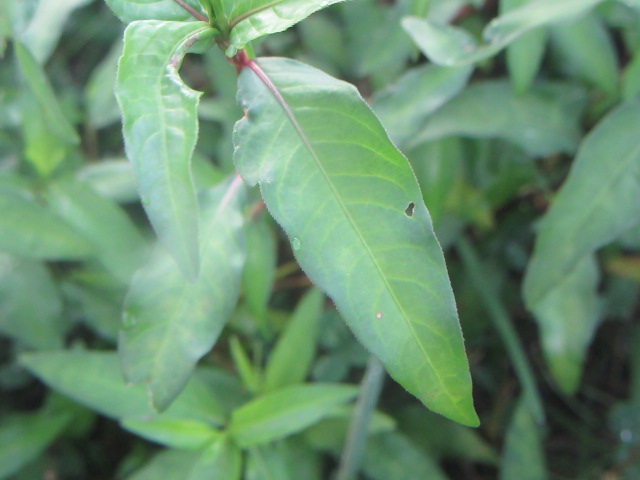
Typical leaf of the Persicaria hydropiper (Water Pepper) on 8-30-19, #618-46.

Their alternate leaves have short petioles, sort of olive green in color, lanceolate to linear, and are around 3 1/2″ long x 3/4″ wide, smooth, and normally hairless. So, if you see a colony of white-flowered Persicaria and some of the leaves are 4″ or longer, they are likely not P. hydropiper and more likely to be P. punctata.
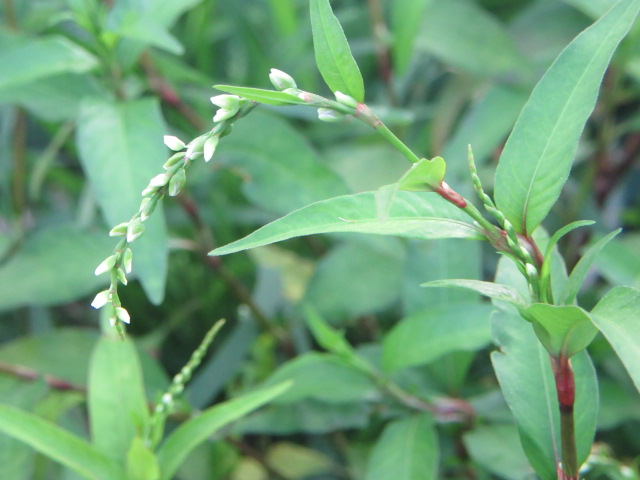
Persicaria hydropiper Water Pepper) on 9-4-19, #623-26.

As with all Persicaria species, P. hydropiper stems end with a raceme of flowers. P. hydropiper racemes are very slender, are pendulous or droop sideways. Their flowers are sparsely placed along the raceme.

Oh, a raceme is an elongated inflorescence with pedicellate flowers. An inflorescence is the part of the plant that contains the flowers, usually starting from the upper leaf node in this case. Umm… A pedicel is a flower stalk with a single flower. The stem part the flowers are on has a specific name but I forgot. So, the part I forgot with the pedicles of flowers and everything that goes along with it is the raceme. Of course, the flowers themselves have many parts but that is for another time. Nevermind that!
Persicaria hydropiper (Water Pepper) flowers on 9-22-19, #635-5.

Now, about their flowers… It took me a while to get a fairly good close-up photo of the flowers of P. hydropiper. I took A LOT of photos and none were as good as the photo above. I will keep trying so I can replace this photo with a better one at some point.

Anyway, Persicaria hydropiper flowers are greenish-white have 5 sepals, 2-3 styles, 4-6 stamens, and no petals. As with P. punctata, the flowers are covered with “glandular punctate dots” which you will only notice with magnification. The “glands” turn brown when the outer sepals dry out. The outer sepals are greenish, as with P. punctata, where other species are not. The sepals of all seven species here fuse together 1/2-1/3 way toward the base.

Persicaria hydropiper (Water Pepper) on 9-4-19, #623-28.

This is a very interesting photo. If you are randomly observing this plant or taking photos without knowing what you are looking at, you would say, “OH, that is pretty cool”.

The ocrea, sometimes spelled ochrea, is the “sheath” surrounding the stem at the node where a leaf emerges. After a while, a branch, or branches, may grow from this same node. Some species only branch out at the lower nodes of the plant. The ocrea on Persicaria species is nearly translucent and is formed by the fusion of two stipules. One word seems to lead to another… A stipule is formed at the base of a petiole. GEEZ! A petiole is the “stem-like” gizmo between the stem and the base of a leaf. A gizmo is what you call it when you don’t know what else to call it. Many species, maybe all, have these cilia growing from their ocrea but fall off fairly soon so they don’t become an ID issue.

Persicaria hydropiper (Water Pepper) on 9-14-19, #631-2.

With Persicaria hydropiper and a few other species, there are a few flowers that develop at their leaf nodes. These are called “axillary racemes”.  Hmmm… A little spider is defending her territory.

Persicaria hydropiper (Water Pepper) on 9-16-19, #633-2.

Several species have this “zig-zag” effect on their stems, but maybe not on all their stems.

Persicaria hydropiper (Water Pepper) on 9-16-19, #633-2.

Another neat photo showing new stems coming from a leaf node.
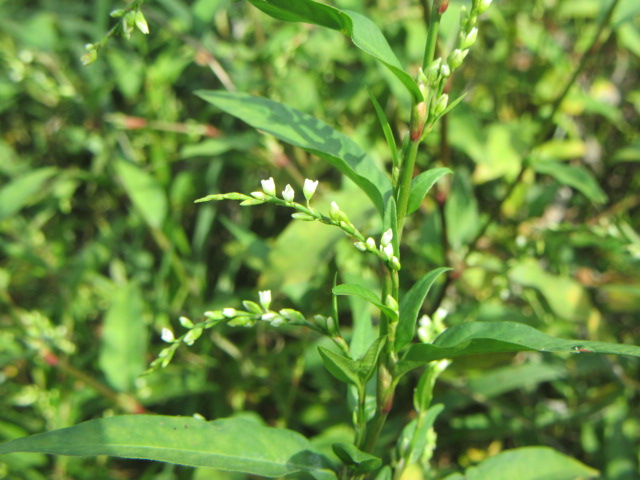
Persicaria hydropiper (Water Pepper) on 9-16-19, #633-5.

This photo shows several racemes of flowers growing from lower nodes. Very common with P. hydropiper. The flowers on many Persicaria species are shy to open, so I was surprised to see a few flowers opened up on the Persicaria hydropiper on September 16.

Dull seeds of the Persicaria hydropiper (Water Pepper) on 9-16-19, #633-6.

Here you can see the seeds of Persicaria hydropiper that are dull, not shiny, and are black to brownish color. The seeds are one of a few ways to really tell P. hydropiper from P. punctata.

For more photos and information, click to go to this species own page HERE.

One thing I might add is that the leaves are edible. I ran across an article on a website called FORAGER/CHEF that talks about eating its leaves. The taste of the leaves is another way to tell this species from Persicaria hydropiperoides. Persicaria hydropiper and P. punctata have a very hot, peppery taste whereas P. hydropiperoides does not. Some information, however, says not to eat it because it will make your mouth burn and swell. I could live without that experience.

Hindawi (Evidence-Based Complementary and Alternative Medicine) has A LOT of information…


#2-Persicaria longiseta (Oriental Lady’s Thumb)

Persicaria longiseta (Oriental Lady’s Thumb) on 8-31-19, #619-9.

Persicaria longiseta, commonly known as Oriental Lady’s Thumb or Creeping Smartweed, is probably the second most abundant of the Smartweeds here on the farm. Ummm… It seems I find more every day, so they could be #1 by now. There didn’t appear to be that many Persicaria longiseta when I first started taking Persicaria photos and writing this post. Within a couple of weeks, I noticed them EVERYWHERE that other Persicaria species are growing. They are either very sociable or a bit nosy.

This species has many common names including Oriental Lady’s Thumb, Bristly Lady’s Thumb, Asiatic Smartweed, Creeping Smartweed, Long-Bristled Smartweed, Asiatic Waterpepper, Bristled Knotweed, Bunchy Knotweed, and Tufted Knotweed. With all those names to choose from, iNaturalist has chosen to call it Low Smartweed.

Persicaria longiseta (Oriental Lady’s Thumb) on 8-31-19, #619-12.

At first, I noticed them growing along the shed in the back yard where my grandparent’s house had been then I realized this was the same species that grow in the flower bed on the north side of the house (and under the porch).

Most Persicaria species have the same basic characteristics but Persicaria longiseta has TWO KEY identifiers that set them apart from all other species here.

Persicaria longiseta (Oriental Lady’s Thumb) showing the ocrea with cilia on 8-31-19, #619-14.

First, Persicaria longiseta has cilia (hairs, bristles…) sticking out around the top of the ocrea. While these cilia fall off of other species with age, they seem to stay on this species.

Persicaria longiseta are decumbent, of course, with light green to reddish-brown stems. They branch out near the base and send stems in every direction. Stems laying on the ground root at the nodes.
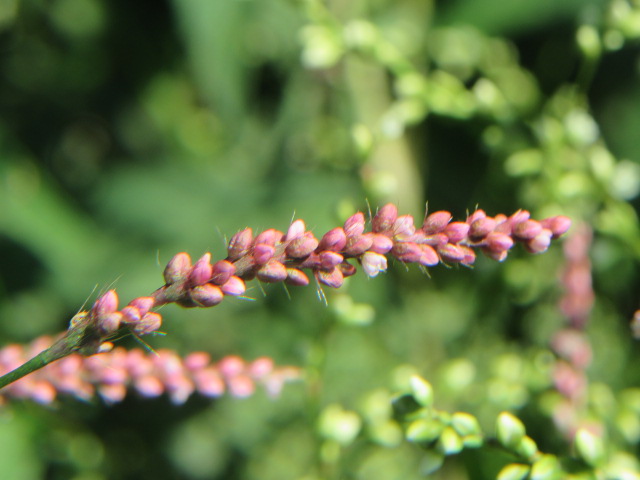
Persicaria longiseta (Oriental Lady’s Thumb) flowers showing cilia on 9-14-19, #631-5.

The second key identifier for Persicaria longiseta is the cilia on the flowers. Now, with age, a lot of the cilia on the flowers may fall off, but there will still be a few on the flowers on the lower part of the raceme. This was a problem with the plants by the shed because most of the cilia had fallen off their flowers by the time I knew they were there. In the above photo taken on September 19 by the twin Mulberry trees in the front pasture, you can not only see the cilia but an open flower… NICE!

Persicaria longiseta racemes are typically 1 1/2″ long. The racemes seem to stay erect instead of drooping, although they may be growing vertically or horizontally.

Persicaria longiseta (Oriental Lady’s Thumb) on 9-14-19, #631-10.

On September 14 I noticed some of the racemes of flowers on the P. longiseta in front of the Mulberry trees looked a little weird. This is the only species I have noticed with this weird feature.
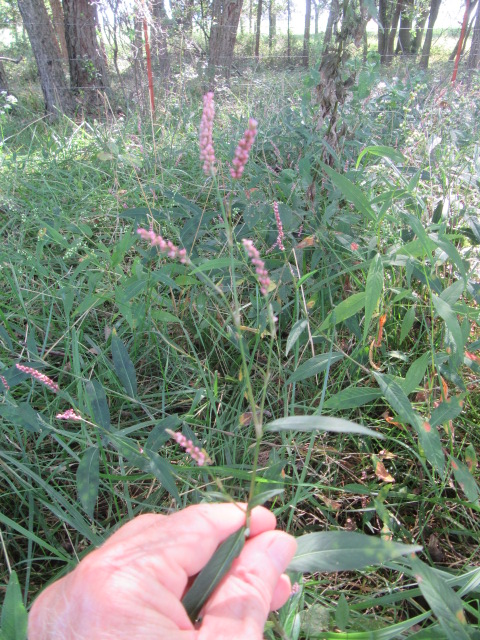
Persicaria longiseta (Oriental Lady’s Thumb) on 9-18-19, #634-40.

The above photo is of a small colony of Persicaria longiseta behind the pond at the back of the farm.
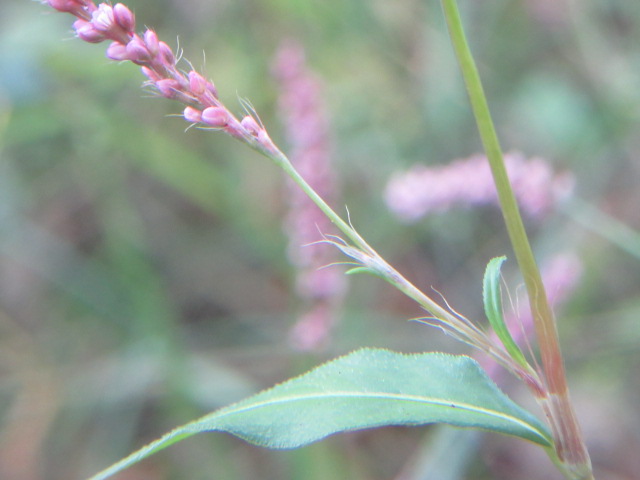
Persicaria longiseta (Oriental Lady’s Thumb) on 9-18-19, #634-42.

This is an interesting photo…

Typical Persicaria longiseta leaf on 9-16-19, #633-14.

The longest leaves I have found on the Persicaria longiseta have been 4″ and may have a faint dark “smudge”. The dark spot is typical of many Persicaria species. They actually do look like a thumbprint.
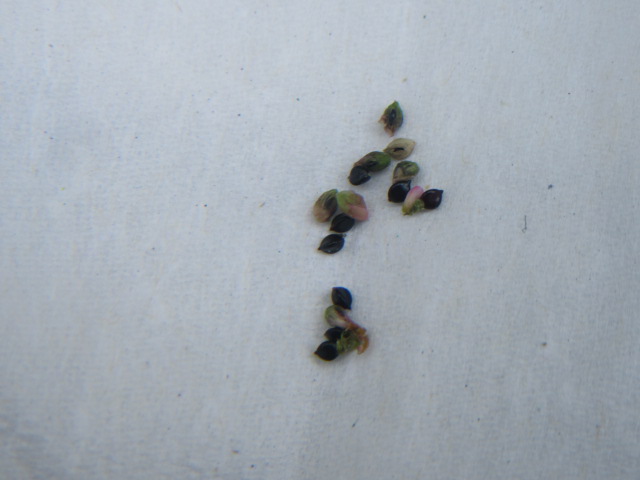
Shiny seeds of Persicaria longiseta on 9-16-19, #633-15.

Kind of hard to tell, but the seeds of Persicaria longiseta are black and shiny.

An interesting thing, Wildflower Search says there is only a 20% chance this species is growing at this location. I haven’t figured out how to “pin” its location on that site, but I can with iNaturalist.

Persicaria longiseta (Oriental Lady’s Thumb) in front of the twin Mulberry trees in the front pasture on 9-22-19, #635-9.

For there to be only a 20% chance of Persicaria longiseta growing at this location there are sure a lot of them. They are everywhere Persicaria grow here in the front pasture, along the sheds and garage, in the yard, in the north flower bed under the porch, the back pasture, along the back pond and behind the pond. The rosy glow in the above photo is from their flowers.

Persicaria longiseta (Oriental Lady’s Thumb) with Salvia coerulea ‘Black and Blue’ on 9-30-19, #636-7.

The above photo shows how the Persicaria longiseta is growing among the Salvia coerulea ‘Black and Blue’ in the northeast corner bed on September 30.

As with most Persicaria species, P. longiseta is not a U.S. native. To view this species own page, click HERE… There are A LOT MORE photos.


#3) Persicaria maculosa (Lady’s Thumb)

Persicaria maculosa on 10-4-18.

Persicaria maculosa (Lady’s Thumb, Redshank, Heart’s Ease, etc.) is very similar to Persicaria longiseta except there are no cilia on their flowers and the bristles around the ocrea on their stems fall off. I am not sure where the above photo was taken here in 2018, but currently, the only colony I have noticed is in front of the twin Mulberry trees in the front pasture. I am sure there are more somewhere.

Persicaria maculosa (Lady’s Thumb) flowers on 9-4-19.

As you can see from the above photo, the flowers of Persicaria maculosa are not hairy… Flowers of this species are densely clustered and not all the same color. Although pink is the usual color, flowers can be red, greenish-white, or purple, even on the same raceme. Illinois Wildflowers uses the word “oblongoid” to describe the shape of the raceme of Persicaria maculosa because they are kind of rounded at the tip. Each stem can end in 1-2 racemes that grow to around 1 1/2″ long and are tightly packed. Flowers have 5 sepals and usually six stamens and no petals.
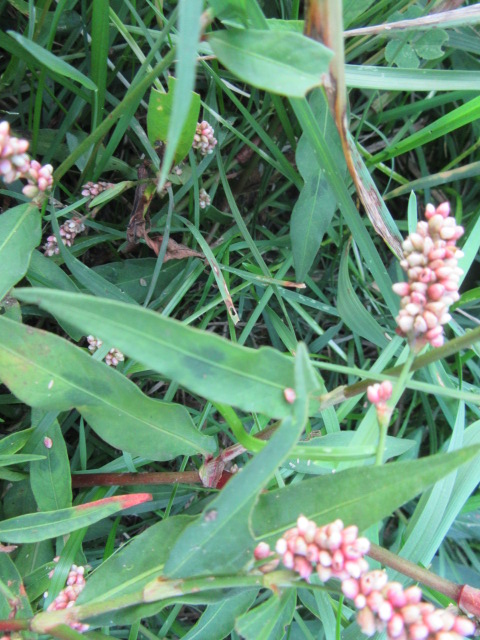
Persicaria maculosa (Lady’s Thumb) leaves on 9-4-19.

The spot on their leaves may be oval or triangular in shape and can be fairly dark to faintly visible. Leaves can grow to around 6″ long and are smooth along the margins and sometimes slightly ciliate. Each leaf has a short petiole or can be nearly sessile (no petiole, or a very short one in this case).
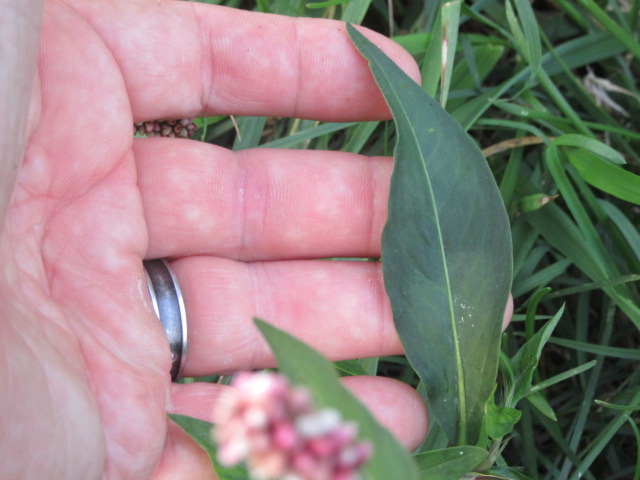
Persicaria maculosa (Lady’s Thumb’) on 9-4-19.

Some of the leaves of P. maculosa don’t have the “spot” either so it isn’t really a good way to make a positive ID all the time. You may even find colonies with no spot at all. Hmmm…

Persicaria maculosa (Lady’s Thumb) on 9-4-19.

I thought this was interesting. New stems emerging at a node with near translucent ocrea and a few cilia that will fall off eventually.

Persicaria maculosa (Lady’s Thumb) on 9-4-19.

Persicaria maculosa is a bit of a rambler…

To view the Persicaria maculosa page with more photos and information, click HERE.


#4) Persicaria pensylvanica (Pinkweed)

Persicaria pensylvanica (Pinkweed) on 8-30-19.

Persicaria pensylvanica (Pinkweed) is plentiful and did rank #2 for a while (until P. longiseta completely went overboard). The above photo is from a large colony behind the barn rambling in a brush pile that didn’t want to burn earlier. Now I can’t find the brush pile. 🙂

Persicaria pensylvanica (Pinkweed) flowers on 8-30-19.

As you can see, their tiny flowers are various shades of light pink and almost white. Some are even two-toned. I noticed several small colonies of this species with pure white flowers while mowing the pasture at a friend’s farm (Kevin’s farm).

Persicaria pensylvanica (Pinkweed) ocrea on 8-30-19.

The translucent ocrea around the leaf (and stem) nodes appear to be cilialess because they have fallen off. It is strange how the top part of the ocrea is so straight, almost like they have been cut perfectly with a pair of scissors.

Persicaria pensylvanica (Pinkweed) on 8-30-19.

There is a smaller colony by the gate at the front of the barn. You can see, in the next photo…
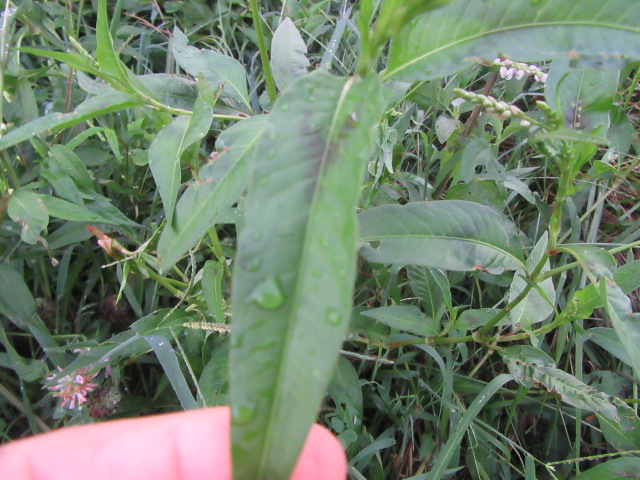
Persicaria pensylvanica (Pinkweed) leaf on 8-30-19.

Some of the leaves have a dark spot that looks kind of v-shaped. A few of the stems on top of the plants were very hairy. I took photos but they were blurry. In technical terms, the stems are mostly glabrous but glandular-pubescent near the inflorescence. 🙂
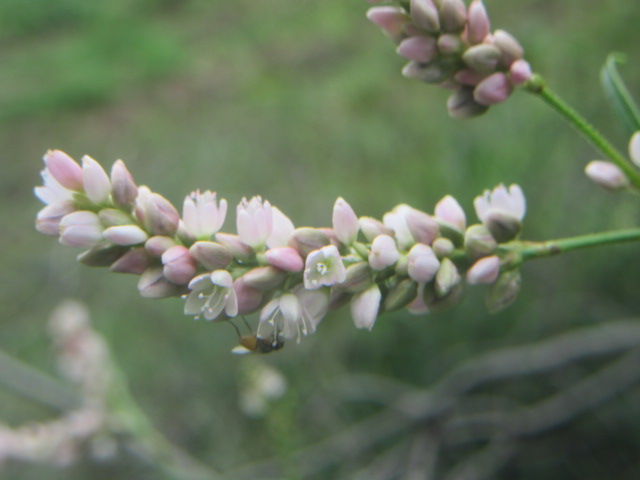
Persicaria pensylvanica (Pinkweed) flowers on 9-1-19.

On September 1, I was pleasantly surprised with open flowers on the P. pensylvanica. Many Persicaria species are very shy and refuse to open their flowers. The magnifying glass did very good with this photo. 🙂 It takes practice and I am not going to mention how many photos I actually took.

Persicaria pensylvanica (Pinkweed) on 9-14-19, #631-15.

I finally got a pretty good shot of the hairy stems on September 14. Not quite as hairy as the one I saw previously.

To view the Persicaria pensylvanica page, click HERE.


#5) Persicaria punctata (Dotted Smartweed)

Persicaria punctata (Dotted Smartweed) on 8-30-19.

Without a doubt, Persicaria punctata, the Dotted Smartweed is the most plentiful of the Smartweeds on the farm. Actually, P. longiseta has become very close to becoming #1 now. A lot of photos I have taken of other Persicaria species have Persicaria punctata and/or P. longiseta in the photo as well. In fact, a lot of photos of other wildflowers, in general, have one or the other in their photos.

Persicaria punctata (Dotted Smartweed) flowers on 8-30-19.

The flowers of Persicaria punctata look pretty much like P. hydropiper in that they are sparsely placed along the raceme. Both species have “punctate glandular dots” on their flowers (and other parts) you can’t see without magnification. BUT, the P. punctata racemes are basically erect or leaning not pendulous like P. hydropiper.
Persicaria pensylvanica (longer leaves) with Persicaria punctata (Dotted Smartweed) leaves on 8-30-19.

The leaves of P. punctata can grow up to 6″ long x 3/4″ wide while those of P. hydropiper are usually only up to 3 1/2″ long x 3/4″ wide.

Persicaria punctata (Dotted Smartweed) ocrea on 8-30-19.

The stems of P. punctata are green and glabrous and have reddish tinted nodes which are somewhat swelled. MOST of the ocrea I observed were “bristleless” because they had fallen off already. It took until September 18 before I photographed ocrea with cilia which you can see on this species own page.

Persicaria punctata (Dotted Smartweed) seeds on 9-16-19, #633-21.

Persicaria punctata seeds are black and shiny while P. hydropiper seeds are black to brownish and dull (not shiny). The seeds are one of the best ways to tell the two species apart.

To read more about the Persicaria punctata and see MORE photos, go to its own page by clicking HERE.


#6) Persicaria sagittata (Arrowleaf Tearthumb)

Persicaria sagittata (Arrowleaf Tearthumb) on 9-25-13, #190-26.

Persicaria sagittata (Arrowleaf Tearthumb, American Tearthumb, Arrowvine, Scratchgrass) was one of the first wildflower species I identified back in 2013. I found them growing in the swamp along with a MASSIVE colony of Impatiens capensis (Jewelweed) and some other neat wildflowers not found anywhere else on the farm. I haven’t been in the swampy area for a couple of years, but last time I checked the Broad-Leaved Panic Grass (Dichanthelium clandestinum) had pretty much taken over.
Persicaria sagittata (Heartleaf Tearthumb) on 9-25-13.

Persicaria sagittata is native to the middle to eastern half of North America and Eastern Asia.
Persicaria sagittata (Arrowleaf Tearthumb) on 9-1-19, #620-46.

I think the Persicaria sagittata (Arrowleaf Tearthumb) is the most interesting of the group here on the farm. It is a very easy species to identify with their arrow-shaped leaves. The largest leaves typically grow to 4″ long x 1″ wide that feels slightly rough because of the tiny hairs.

Persicaria sagittata (Arrowleaf Tearthumb) on 9-1-19, #620-45.

Terminal and axillary flowers are produced on short racemes with 1-10 flowers. Sometimes there are two racemes produced per leaf node on long peduncles up to 6″ long. A peduncle is a stem the flowers grow on. A raceme is an inflorescence with pedicellate flowers that grow at the end of the peduncle. One word leads to another… I can get more technical if you like.

As with all the Persicaria species here, the flowers consist of 5 sepals and no petals. I have only noticed white flowers, but they can also be pink.

Persicaria sagittata (Arrowleaf Tearthumb) stem on 9-1-09, #620-47.

The stems of Persicaria sagittata are actually square instead of being round like the other species here. The stems are covered with short retrorse prickles that point downward. Their stems can grow from 3-6 feet long and can climb on other plants. Stems laying on the ground can root at the leaf nodes. I only saw plants with green stems, but they can also be red or yellowish-green. Using the magnifying glass to get a close-up photo worked pretty good in the above photo.

To view the Persicaria sagittata page click HERE


#7) Persicaria virginiana (Jumpseed)

Persicaria virginiana (Virginia Jumpseed) on 9-8-19, #626-12.

Persicaria virginiana is unique among the other Persicaria species on the farm. They are native to North America from the middle part eastward. Their common names include Jumpseed, Virginia Jumpseed, American Jumpseed, Virginia Knotweed, Woodland Knotweed, and maybe others. I didn’t really notice this species that much until one came up beside the steps to the back porch in 2017. I let the plant grow so I could make a positive ID. Even though they are considered a perennial, I think they probably mainly return from seed ( just my opinion from observation). A few plants have returned by the back porch but not in the same exact spot. This year one or two came up by the AC so I had to keep whacking them off with the trimmer along with the grass. Have to keep good airflow, you know. 🙂

On September 8 when I was on a photo spree in the back of the farm, I noticed a small colony of Persicaria virginiana in the lane near the gate that leads to the back pasture. Ummm… The problem was they are growing among the Poison Ivy so I zoomed in for a few photos.

Persicaria virginiana is more of an upright grower with stronger stems than the other species here. They are not decumbent and do not root from their lower nodes (hmmm… likely because they are not decumbent).

Persicaria virginiana (Virginia Jumpseed) on 9-22-19, #635-22.

Then on September 22, I noticed a single small plant behind the pond in the back pasture. I was able to take quite a few photos but the light was weird so most of them didn’t come out well. I needed more photos but I have been kind of busy lately. Now, as I am writing and have the time it is raining!

Anyway, the two most distinguishing features about Persicaria virginiana is their large ovate leaves and their curious flowers (especially when they start to fruit) on very long racemes up to 16″ long. I haven’t been able to photograph their open flowers but maybe I can still do that before it is too late. Their leaves are ovate and grow up to about 6″long x 3″ wide. Leaves can have a reddish to purplish V-shaped, crescent-shaped, or triangular splotch on the upper surface. I didn’t notice this on any of the plants here but some photos online do show this feature.

While the lower part of the stems are basically smooth, the upper stems and leaf surfaces have appressed hairs. You can’t see the hairs without magnification but they feel slightly rough. I didn’t get good photos of the ocrea around the leaf nodes yet, but they are brownish and weirdly fuzzy and sort of look like someone took a wire brush to them. The ocrea tends to dry and fall off so they are absent on the photos I did get.
Persicaria virginiana (Virginia Jumpseed) on 9-22-19, #635-26.

Umm… Their flowers are very small and I was able to get this close-up when I was taking a group photo of the Persicaria flowers on the back porch. Luckily I was able to find a plant flowering by the AC. If I had have known what their seeds looked like at the time I would have opened up a flower to have a look…  Unfortunately, I didn’t know until I was reading about them in Steyermark’s Flora of Missouri to write their description on October 10 (late in the evening). I am hoping the rain will stop while I am writing so I can get photos! But, if you are reading this and there are no seed photos you will know that didn’t happen… I want to get this post finished!

The most interesting thing about this plant I only read in Steyermark’s Flora of Missouri and not on any other website I have noticed. It says tension builds up at the joint of the fower as the fruit matures which acts as a spring to shoot the seed up to 12 feet away. Passing animals also trigger this action then the seed gets stuck in their fur. The small two-angled seed tapers to a hooked beak (maybe the tail in the above photo is part of the seed). Seed can be black or brown, shiny or dull… I need to get a photo of those seeds!

Persicaria virginiana can have white, green, or pinkish flowers. They are sometimes used in woodland gardens and there are a few cultivars with red flowers and variegated leaves. There is a rare variant of this species in the south with thicker leaves.

You can click HERE to view the page for Persicaria virginiana.

WAIT A MINUTE!!!!

I HIT THE

JUMPSEED JACKPOT!

Persicaria virginiana (Virginia Jumpseed) on 10-10-19, #638-1.

Once it stopped raining this afternoon, Thursday, October 10 at 3 PM depending on when you are reading this, I decided I would see if I could find a closer Persicaria virginiana so I could get better photos of the ocrea, seed, and maybe open flowers. There were no more around the back porch or AC but I didn’t especially want to go to the back of the farm to wade in the Poison Ivy. There was one area I hadn’t been in pretty much all summer north of the chicken house. This area is about 150′ x 150′ and is where my grandparent’s old peach orchard was. I measured in the early 1980’s so I know how big it is. 🙂 Last year I backed the mower (with the tractor) in all this jungle and cleaned it up a bit. Anyway, I walked to the northeast corner and almost s–t! (sorry, but it’s true!)! Here right before my eyes was a HUGE colony of Persicaria virginiana!!! After I thought there were just a few on the whole farm, there is a HUGE colony right in the backyard!

Persicaria virginiana (Virginia Jumpseed) on 10-10-19, #638-2.

There were no open flowers but there were SEEDS GALORE! Remember I mentioned how the seeds shoot out? Well, it is really true! One plant I touched literally vibrated as the seeds shot out!
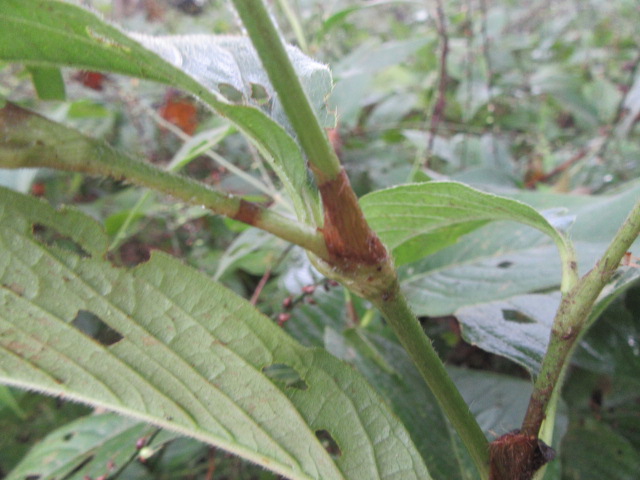
Persicaria virginiana (Virginia Jumpseed) on 10-10-19, #638-4.

And we have fuzzy ocrea! There were so many plants to choose from and I took over 50 photos total. Well, some were not that good and after choosing the best I saved 11. The wind was not being all that cooperative either. I truly hit the JUMPSEED JACKPOT! 🙂
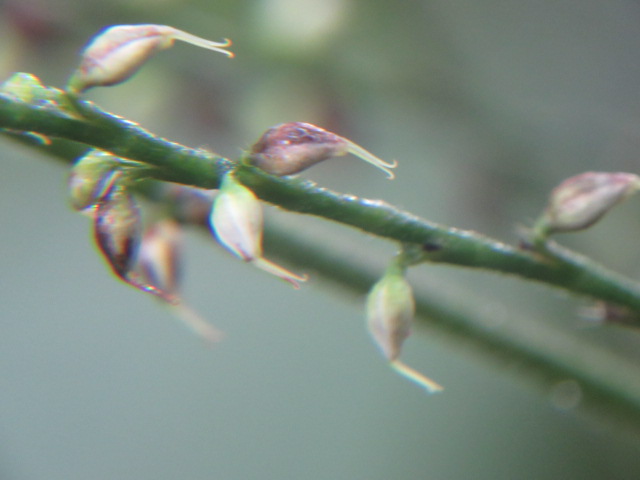
Persicaria virginiana (Virginia Jumpseed) on 10-10-19, #638-7.

The only photos I had trouble were close-ups of the flowers. Seriously, folks, I was experimenting with not one magnifying glass, but two, one on top of the other. (I bought another magnifying glass because I didn’t think the old one was a 10x. But, as it turns out, they seem to be the same.) It works like a charm and is much better than just one but it still takes practice and patience. LOL! The problem is with zooming in, and with two magnifying glasses, you have to be very still. If not, the camera complains about vibration. Zooming in with one magnifying glass was tricky and sometimes the camera would shut off and say “lens error”. With two, I didn’t have to even zoom in that much and the camera never shut off. I think I could take photos of the hair on a gnat’s eyebrow now. (I would say butt, but I already said s–t earlier which could be deemed as inappropriate behavior).

In the above photo, you can really see the “hooked beak” of the fruit. There are two…
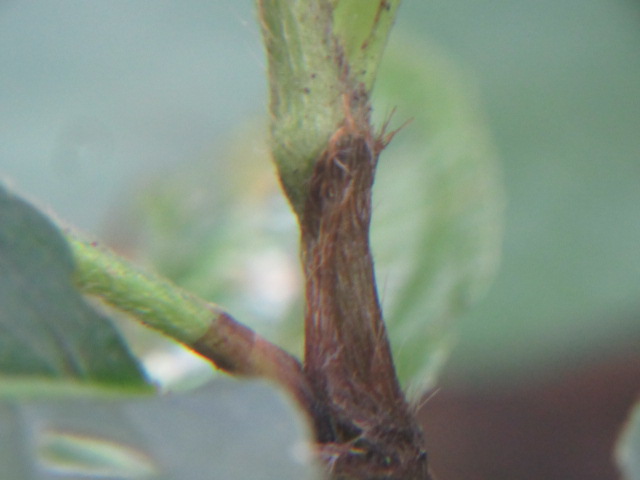
Persicaria virginiana (Virginia Jumpseed) on 10-10-19, #638-8.

Here’s a good one of the ocrea on one plant. The ocrea can be light to dark brown, depending on the preference of the plant. You can clearly see how the ocrea becomes dry and starts to tear away. This photo was taken toward the upper part of the plant so I could get a shot of the appressed hairs on the stem as well.

Persicaria virginiana (Virginia Jumpseed) on 10-10-19, #638-11.

I think half of the photos I took were of the seed. The seeds are fairly small but larger than the other species. When I was removing the outer part of the achene I had to be careful not to remove the “hooked beak”. The seed itself doesn’t have a beak and is part of the entire “fruit”. Hmmm… Like many other plant’s seed, they are part of what is called an achene. An achene is a dry, one-seeded, indehiscent fruit. Indehiscent means the achene (pod or fruit) does not split open to release the seed when ripe. Sunflower and strawberry seeds are two examples… I read that description on the Missouri Plants website’s glossary… 🙂

I can hardly believe it has taken so long to write this post and I am not even sure it is actually finished. It seems like I left out so much!

Now, as temperatures are cooling down I will have to be thinking about moving plants inside for the winter. The dreaded time of the year. The forecast for here says it will be clear Friday night and we will have a widespread “F”. GEEZ!!! I am never ready for that.

I hope you enjoyed this post as much as I did. Not because I did it, but because I learned a lot and that is always a great thing. Until next time, be safe, stay positive, hug someone or something you love (not just anyone because you may get slapped). As always, it is good to GET DIRTY!
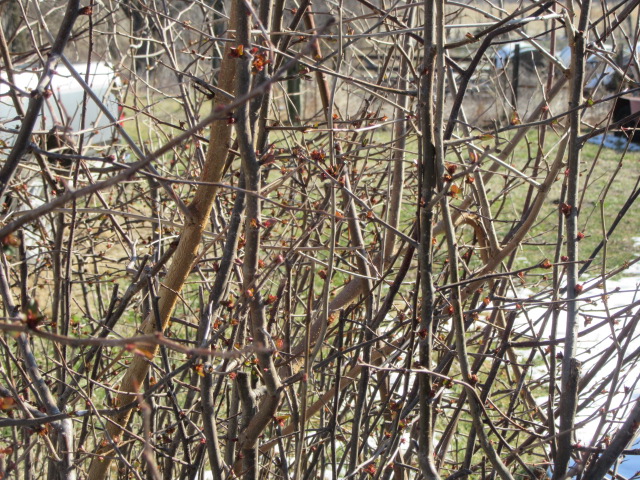
Introduction To The Next Post (Perplexing Persicaria)…

Persicaria species from left to right: Persicaria hydropiper (Water Pepper), Persicaria longiseta (Oriental Lady’s Thumb), Persicaria maculosa (Lady’s Thumb), Persicaria pensylvanica (Pinkweed), Persicaria punctata (Dotted Smartweed), Persicaria virginiana (Jumpseed), and Persicaria sagittata (Heartleaf Tearthumb) (also along the bottom. Photo taken on 9-22-19, #635-3.

Hello everyone! I hope this introduction to the next post finds you well. I have been working on the next post for about two months because it has taken that long to take lots of photos, make proper ID’s, write descriptions, etc. Some plants change a lot in a month as nature takes its course, so I just kept taking photos. GEEZ! All the photos on this post were taken on Sunday, September 22.

I found out there are seven species of Persicaria and the next post will take you on a very interesting journey with each one. Don’t worry, I am not including all the 188 saved photos of Persicaria in the post. Most of the photos will go to each species own page (whenever I get those finished). I have identified 129 wildflowers now, mostly from this small farm. There are A LOT more I haven’t identified or even looked at because I consider them weeds rather than wildflowers. While walking around taking photos of plants, I have also taken a lot of photos of butterflies, spiders, and other critters that are busy working to survive.

Persicaria hydropiper Water Pepper) colony on 9-22-19, #635-4.

The Persicaria hydropiper, commonly known as Water Pepper, own the territory between the lagoon and the pond south of the barn, and approximately 60′ or so southwest of the pond. Persicaria is a friendly and sociable genus, so in the mix are other species as well. Persicaria hydropiper is also one of the most “variable” species here so they had me going for a while until I discovered their secret. I had to wait until plants matured enough to find out, though, which took some time. I will tell you their secret in the next post.


The largest Persicaria longiseta (Oriental Lady’s Thumb) colony on 9-22-19, #635-9.

While the largest colony of Persicaria doesn’t belong to the Persicaria longiseta (Oriental Lady’s Thumb), they are in the running for second place. Not only do they occupy this good-sized area between the ditch and the twin Mulberry trees, they are also growing among ALL other species on the entire farm (even along two sheds, the garage, and the north flower bed). From the front of the farm to behind the back pond and even in the swampy area in the southeast corner. The pink cast you see in the above photo is the Persicaria longiseta. They have two key identifiers, one which almost disappears with age.


Persicaria maculosa (Lady’s Thumb) on 9-22-19, #635-10.

Sad to say, the Persicaria maculosa (Lady’s Thumb) is almost extinct here. They are only growing in an area maybe 12″ x 36″ with only a few plants in front of the Mulberry trees and nowhere else on the farm. Their flowers have pretty much run their course and are now setting seed.


Persicaria pensylvanica (Pinkweed) on 9-22-19, #635-11.

There are only a few small colonies of Persicaria pensylvanica (Pinkweed) here. The one in the above photo is growing east of the largest colony of P. punctata behind the chicken house. There is a small colony by the gate in front of the barn and another small colony on the north side of the twin Mulberry trees. They are growing here and there among other species in several areas as well, but not many.


Persicaria pensylvanica (Pinkweed) on 9-22-19, #635-13.

The good thing about Persicaria pensylvanica is that their flowers open freely. The other species are very shy to open if at all. Persicaria species are self-pollinating and even pollinate without opening.


Persicaria punctata (Dotted Smartweed) on 9-22-19, #635-16.

The most prolific and largest colony of Smartweeds belong to Persicaria punctata (Dotted Smartweed). They occupy the territory behind the chicken house en mass and what a mess! There are a few P. hydropiper and P. longiseta among them and one P. pensylvanica colony are growing among them. The interesting thing about P. punctata is that they are allotetraploid… Its parents are P. hydropiper as the pollen parent and P. hirsuta or P. setacea as the seed parent, all of which are diploid. They just haven’t figured out which of the last two are seed parents. Actually, could be either one or both depending on location. Neither P. hirsuta or P. setacea is growing here or even close, so the hybridization was done elsewhere such as the southeast part of the country. P. punctata shares the characteristic “punctate glandular dots” on their tepals as P. hydropiper with long racemes of flowers with the other two parents. Well, the inflorescence of P. hydropiper are fairly long as well. A PL2int analysis suggested 15 cases of allotetraploid speciation, including 2 hexaploids and an octaploid. It is believed P. punctata has become so widespread through seed contamination. The fact that they are hybrids has given them a distinct edge over diploid species. In some cases, P. punctata has flourished where its parents have failed to spread.

Persicaria punctata isn’t the only species to begin its life as a hybrid. The tetraploid Persicaria maculosa has been traced to the diploid P. foliosa and the parental lineage “seems to be” P. lapathifolia (both native of Eurasia)Testing shows Persicaria pensylvanica is an octaploid whose parent could be P. glabra or P. hispida.


Persicaria sagittata (Arrowleaf Tearthumb) on 9-22-19, #635-17.

The Persicaria sagittata (Arrowleaf Tearthumb) is one of the neatest of the Persicaria species. The stems appear to just go up through the base of their leaves. The common name comes from the short, stiff bristles on the stems. These are only growing in the swampy area in the southeast corner of the farm. I made their positive ID in 2013 when I first ventured into the swamp. There was a good-sized colony back then, but I have no idea what its condition is now. From a distance, it appears the Panic Grass (Dichanthelium latifolium) has taken over. I started to go into the swamp this afternoon but backed off. My DRYSHOD boots (we had rain) were already covered with every kind of stick tights imaginable just to take the above photo and get a sample for the first photo.


Persicaria virginiana (Jumpseed) on 9-22-19, #635-21.

GEEZ! I screwed up! While I was behind the pond at the back of the farm, I found a lonely Persicaria virginiana (Jumpseed). It is strange how a single plant can be growing anywhere here. How did it get here in the first place for there only to be one? The plan was to take a better photo of this species by the back gate (involved with Poison Ivy) or behind the house. I took a few photos anyway, mainly because I didn’t want to get too friendly with the plants by the gate. After I took the photos behind the pond, I ventured to the swampy area to take photos of the P. sagittata. Hmmm… These photos are in alphabetical order, not the way they were taken. 🙂 After I left the swamp I decided to pass on the plants by the gate and wait until I went to the house.


Persicaria virginiana (Jumpseed) leaf on 9-22-19, #635-23.

On the way to the house, I snatched a few racemes to take the group photo (the photo at the top). When I got to the house I snapped a photo of the Leucocasia gigantea ‘Thailand Giant’ and Colocasia esculenta and that was that. The battery was dead… I put the battery in the charger and waited about 30 minutes then took the group photo. I forgot about P. virginiana behind the house.

I met a lady behind the pond and she was a beauty. I asked her name but she was way to busy to stop and talk…


Araneus marmoreus (Marbled Orb Weaver) on 9-22-19, #635-1.

I checked with iNaturalist and found out she is Araneus marmoreus (Marbled Orb Weaver). She didn’t run off like her cousin, the Neoscona crucifera (Spotted Orb Weaver), did a few days ago. Strange how they have the same shape and are a different genus. OK, I’ll show her to you even though the photo was taken on the 18th.


Neoscona crucifera (Spotted Orb Weaver) on 9-18-19, #634-32.

She was working on her web fairly close to where I spotted the Marbled Orb Weaver today. She thought I was being a little too nosy, so she hurried up her web. I tried to get a photo but she was moving around so much I couldn’t get a good shot. She finally moved back down to where she had been working on an insect caught in her web.

Well, that’s all I wanted to say for now. Hopefully, I can finish the next post, Perplexing Persicaria, tonight or tomorrow. OH, heck! It is already tomorrow… 1:14 AM on Monday.

Until next time, take care, be safe and stay positive!


Elephantopus carolinianus and Perilla frutescens Observed

Elephantopus carolinianus (Elephant’s Foot) on 9-9-19.

Hello everyone! I hope this post finds you well. I was helping a friend move cattle from his mother’s farm a few days ago and stumbled across this interesting plant. I helped him move a 1964 Ford Pickup from a hill that had been in the trees for 15 years a couple of days earlier. That was interesting. I didn’t take the camera at the time but I wish I had because seeing the old pickup in the trees and what we went through to get off the hill and up the road to the house would have made an interesting post. His mother sold her farm so we had to get everything moved.


Perilla frutescens (Beefsteak Plant) on 9-9-19.

Now, you have to visualize a shady hillside with a creek running along the side. The hillside is covered in trees with literally THOUSANDS of Perilla frutescens (Beefsteak Plant). While I was waiting for my friend (Jay) and another helper (Jay Wagler, Ruth Wagler’s son from Wagler’s Greenhouse), to drive the cows up from somewhere, I waited on the hill. Of course, I had my camera that day so I took several photos of the Perilla frutescens.


Perilla frutescens (Beefsteak Plant) flowers on 9-9-19.

I thought it was very interesting how the Perilla frutescens there were in full bloom when the plants behind my back pond were just budding.

After a while, the cows came so I had to forget about taking photos. I had to go up the hill from where I was then run down the hill as fast as I could, through all the Perilla, trees, vines, etc. toward the creek, then across the creek so the cows couldn’t go back to where they had come from. While I was running toward the creek, I almost tripped more than a few times. Anyway, as I was running I wasn’t really paying attention to where I was going because I was looking at the plants. I spotted a plant I had never seen before but I didn’t have time to stop… By the time I made it to the creek, the cows were heading that direction. They crossed the creek and so did I.

Now, if you have ever driven cattle through a forest that have no idea why they are being herded in the first place, you will know they aren’t just casually walking. Some of them are calm and in no hurry while most of them have their ears up and are running full speed ahead. The calves were going in circles because they had no clue. Mama cows would run ahead then realize their kid wasn’t with them, so they would turn around. And, of course, there were always a few that just stand way behind the others that think they can get left behind. They try to sneak off while you are trying to get the runners to go where you want them and not where they want to go, which is back to where they were in the first place. The opening we needed them to go through was plain as day and right in front of them. What did they do? They stood there looking at the opening. The opening in the fence was to the pasture where the barn was… Ummm… Where the corral was. Now, if you are a cow that is used to a daily routine you would be wondering why you are being herded to the barn in the morning instead of being called to eat feed later in the afternoon. You would be thinking something is fishy. After a while, a few started toward me. Then the rest followed. As I waved at them they found another opening in the fence so they could circle around to the other opening to try and get away. Well, that didn’t work and finally, they went to the barn.

There is a little more to what happened next, but we did finally get them in the coral. All but a cow named Fuzzy who escaped.

Once the cows were in the trailer, I walked back to the creek. I had to go back up the hill to get the tractor I had left there but the tractor wasn’t on my mind. I had to find that weird plant!


Elephantopus carolinianus (Elephant’s Foot) on 9-9-19.

I crossed the creek and started up the hill through all the vegetation. The hillside was nice and shady and I had to just stand for a minute to admire nature at its finest. There was so much life going on! The bugs were all busy feeding on flowers and each other, birds were flying around, butterflies flying from one flower to another. I found the plant I was looking for with no problem because there were a lot of them along the bottom of the hillside. It was sure a strange plant and I had never seen any quite like it. That evening I identified the plant as Elephantopus carolinianus (el-eh-fun-TOE-pus  kair-oh-lin-ee-AN-us). Common names include Elephant’s Foot, Carolina Elephant’s Foot, and Leafy Elephant’s Foot.


Elephantopus carolinianus (Elephant’s Foot) on 9-9-13.

Reading the description of this plant on the Missouri Plants website can be pretty complicated.

Inflorescence – Capitate cluster (glomerule) of flower heads terminating stems. Peduncles to +10cm, antrorse appressed pubescent. Peduncles subtended by a single foliaceous bract. Flower clusters subtended by typically three foliaceous bracts to +/-4cm long. Bracts with antrorse appressed pubescence.

I think that means the stem ends in a cluster of flower heads that are compact or unusually compressed. Close to the top of the stem is a leaf with another 3 1/2-4″ of stem above it. Then there are 3 leaves (foliaceous bracts) which the flower clusters sit on. Bracts and peduncles have short hairs.

Involucre – Phyllaries loose, to -1cm long, 2mm broad, acute, green in upper 1/2, scarious below.

GEEZ! An involucre is a bract (phyllary) or set of bracts (phyllaries) that surround a flower or cluster of flowers. In this case, I believe there is something a little strange going on… Skip down to the photo after the next one…


Elephantopus carolinianus (Elephant’s Foot) on 9-9-19.

The flowers are rather strange. Although this plant is a member of the Asteraceae (composite) family, the flowers are not “daisy-like”. They only have disc flowers.

“Disk flowers – Corolla lilac to whitish, irregularly 5-lobed. Corolla tube 5mm long, glabrous. Lobes to 5mm long, linear, glabrous. Stamens 5, adnate at base of corolla tube. Anthers connate around style, 2mm long, exserted. Style included. Achene (in flower) white, pubescent, 2mm long. Pappus of 5 bristles. Bristles to 5mm long, slightly flattened and expanded at base.”

Hmmm………………………………………. Something seems a bit odd.


Elephantopus carolinianus (Elephant’s Foot) on 9-9-13.

Some of the plants have lavender-pink flowers. The above photo is somewhat easier to explain… The flower emerges from the phyllaries… WAIT A MINUTE! Take a closer look at that mass of petals… Something is weird! I think I need to jump the fence and have a closer look. How many flowers do you see? One? Count again… I see at least four.

So, using the above descriptions, each bract has a set of four loose phyllaries (actually 2 pairs of 2) in which 4-5 flowers emerge from. Have you ever seen a Fan Flower (Scaevola sp.) where the petals are on only on half the flower? I think that’s what is going on here…

It would have been better to have read the descriptions then searched for this plant so you will know what to look for. For sure you would have known what this plant is when you see it because there is none even similar.


Elephantopus carolinianus (Elephant’s Foot) on 9-9-13.

Lower leaves are quite large and “spatula-like”. One website says these lower leaves are 5″ long, but just guessing, I would say they are closer to at least 8″.

Missouri Plants says: “Alternate, sessile, elliptic to oblanceolate or spatulate, acute to acuminate, shallow serrate to crenate-serrate, slightly scabrous and pubescent below, sparse pubescent and shiny dark green above, to -30cm long, -10cm broad, tapering to base.” That is about 11″ long by about 4″ wide and the leaves attach directly to the stem with no petiole (sessile).


Elephantopus carolinianus (Elephant’s Foot) on 9-9-13.

The plant’s upper leaves are MUCH smaller and kind of oval in shape. Here you can see this leaf is what is meant when Missouri Plants says: “Peduncles subtended by a single foliaceous bract.” This leaf is where the “inflorescence” begins and is part of it as the “single foliaceous bract.” At least that is my opinion. Subtended means “under” so it makes sense.


Elephantopus carolinianus (Elephant’s Foot) on 9-9-13.

Besides a camera, I also need to remember to take the magnifying glass, a small note pad and pen… A field guide would also be promising. I haven’t normally been one to bring plants home from other locations, but I am really tempted with this one. I saw this plant again while I was helping Jay at either his farm or in the back yard of his mothers (the one she sold). Apparently this plant is fairly common in that neck of the woods. I think I may need to check the creek behind here even though I don’t own that property. I normally only go there in the spring to hunt morels. No one will ever know… 🙂


Elephantopus carolinianus (Elephant’s Foot) on 9-9-13.

I think I read somewhere that the bracts contain a single seed that doesn’t fall out. The whole bract falls off with the seed still inside.

Map from USDA Plant Database showing where Elephantopus carolinianus is native.

Plants of the World Online by Kew lists 23 species of Elephantopsis. Four are native to the United States including E. carolinianus, E. elatus, E. nudatus, and E. tomentosus. E. carolinianus most abundant from Kansas down to Texas and eastward to Pennsylvania and down to Florida and has been Introduced to Cuba. Most species are native to several countries in South America and several in a few countries in Africa. 

The cows were loaded into a trailer in the afternoon and taken to another pasture. As far as I know, Fuzzy is still at large.

I have been working on the post about the Persicaria species (Smartweeds) here and ran into a snag. Two species are very much alike and one is variable. One has longer leaves than the other and both have the same identifying features. I think many colonies could have both species which makes it complicated. I was measuring leaves in a very large colony and a few plants have 6″ long leaves while most are 3 1/2 to 4″. The rest of the species were fairly easy to identify. I am going to check out Steyermark’s Flora of Missouri on Monday at the library to see if they can help. The original was written by Julian Steyermark was published in 1963. In 1987, the Missouri Botanical Garden and the Missouri Department of Conservation decided to work together and revise and update the older book in a three-volume set. The first edition, written by Mr. Steyermark was published in 1999 and it is available at the local branch. Volume two was published in 2006 and volume 3 in 2013. Volume 2 and three were written by George Yatskievych. They are at another branch but can be delivered here or I can drive 18 miles to pick them up. Each volume has over 1,000 pages. The post is ready, but I need to make sure about the one (or two) species.

Until next time, be safe and stay positive. Be thankful and observant. Never know what you may will run across.


Delightful Dayflowers

Commelina erecta (Whitemouth Dayflower) on 9-1-19.

NOTE! I messed up and incorrectly identified Commelina communis var. communis as Commelina erecta. That explains A LOT about my confusion. I will be re-writing this post to correct my errors…

Hello everyone! I hope this post finds you all well. Now it is time to post about the Dayflowers. It has been interesting and there are three species of Dayflowers here on the farm. Two species are in a small shady and secluded area behind the chicken house. One of those is also in the back of the farm by the pond but their flowers were already wilted when I noticed that. Their flowers only last for one day but are mostly gone by late afternoon.

I took a few photos of Dayflowers last year but I didn’t really pay much attention to them at the time. When I was getting ready to write a page about them, I noticed something weird… I had all their photos labeled Commelina communis but when I did the research I realized none of the photos were that species… At that point, they hadn’t started flowering so I had to wait. After the hay was baled and I could mow the two lots I stored hay in behind the chicken house I noticed the Dayflowers had started blooming. I almost fell off the tractor. I took photos after I was finished mowing (since I happened to have the camera with me). That was on August 29.

I took photos for several days I concluded is Commelina erecta, commonly known as the Whitemouth Dayflower. I first thought it was surely Commelina communis because the bracts were open the entire length but there was something weird.


Commelina erecta on 8-29-19.

As you can see in the above photo, the bract, the odd-looking part the flower emerges from is entirely open from end to end (like a taco). That is one of the distinguishing features of Commelina communis (Asiatic Dayflower). But, there were a couple of problems with that diagnosis… For one, the color is lighter blue than the photos of Commelina communis online. The second problem is the staminodes of Commelina communis are supposed to have brownish-red dots. I looked at probably 100 flowers from August 29 through September 1. All their bracts were open and there were NO brownish-red dots.

Before I continue, figuring out what species of Commelina, or Dayflowers, you have growing is pretty easy. There are only four species found in Missouri. Two species have two blue upper petals and one lower white petal. One of those has brownish-red dots on their staminodes. One of those has fused bracts and one has open bracts. The one with the reddish-brown spots is supposed to have open bracts and the other has fused bracts.

Then, low and behold, Sunday afternoon a miracle happened… Well, maybe not a miracle, but you know what I mean…


Commelina communis (Asiatic Dayflower) on 9-1-19.

I had walked into the lot where the Dayflowers were, took a few photos, then on the way out I noticed these darker blue Dayflowers on the other side of the opening. I checked and HOLY MOLY there were spots on their staminodes!  As you can see, the flower in the above photo has darker blue upper petals and brownish-red spots on the staminodes…

BUT, there is a problem…


Commelina communis (Asiatic Dayflower) on 9-1-19.

All the flowers in this group have fused bracts when they are supposed to be open! I looked at all the flowers for a few days and they were always the same. I thought perhaps they would be closed earlier when the flower first emerges and open later when the flowers have almost run their course. But, the time didn’t matter.


Commelina communis on the left and Commelina erecta on the right on 9-1-19.

The above photo shows the darker blue Commelina communis with the spots on the staminodes on the left. Commelina erecta, on the right, has lighter blue upper petals and NO reddish-brown spots on the staminodes. All seems as it should… These are the only two species in Missouri with two upper blue petals and a very small lower white petal.


Commelina communis on the left and Commelina erecta on the right on 9-1-19.

But, the above photo clearly shows the Commelina communis with fused bracts and the Commelina erecta with open bracts. Hmmm… Just the opposite of what they are supposed to be. Every website I checked says the same thing.

So, tell me, what is the deal? Maye the fairies in this area didn’t get the memo… I need to check the plants by the pond in the back of the farm to see what they are doing…

But, there is also something else very interesting…


Commelina erecta (Whitemouth Dayflower) on 8-29-19.

Some of the Communis erecta have two flowers coming from the same bract. Typically, each bract produces more than one flower, sometimes three, but not usually on the same day.


Commelina erecta open bract on 8-29-19.

I opened one of the bracts of the Commelina erecta and you can see in the above photo this bract had produced two flowers in succession. It may have produced more, but I kind of ruined that possibility. The egg-like, umm… Are the fruit where the seeds are hiding.

I read the information on several websites for plant ID and for the heck of it. The Iowa Plants website has some very good photographs of the inside of the bracts (and many other good photos). I was going to include some of them in this post, but I don’t have permission. You can see them online when doing an image search as well.


Commelina communis (Asiatic Dayflower) on 9-1-19.

So, it is a little strange that the Commelina communis growing here have fused bracts when they are supposed to be open. But, nonetheless, they have to be Commelina communis because they have the brownish-red spots on their staminodes. No other species has that feature. And, I admit, it is a little odd the Commelina erecta have entirely wide open bracts when they are supposed to be closed. But, they have to be Commelina erecta because they have no spots and they are the only other Commelina species found in Missouri with two upper blue petals and a lower white petal.

One other interesting thing about the Commelina species is that they compete for pollinators… This is why you may rarely if ever find two species growing among each other. Although the photos I took of both species are in the same lot, they are not together. It makes me wonder if they have adapted over time and the Commelina erecta have found out open bracts are better for their survival and the Commelina communis decided the opposite is true for them. Who knows. But for whatever reason, they are doing something weird here.


NOW, for the third species…

Commelina diffusa (Spreading Dayflower) on 9-1-19.

This small colony of Commelina diffusa (Spreading Dayflower) is growing south of the big pond in the front pasture. They are in the low spot where the overflow runs out of the pond and the pasture drains.


Commelina diffusa (Spreading Dayflower) on 9-1-19.

I need to get more and better photos of this species. As you can see, this species has three blue petals. It is one of the two species found in Missouri with three blue petals. The other is Commelina virginica (Virginia Dayflower).


Commelina diffusa (Spreading Dayflower) on 9-1-19.

Commelina diffusa has smaller flowers than Commelina virginica. Hmmm… Isn’t it strange how you notice things in a photo you didn’t when taking the photo? What is the white thing below the lower petal?


Commelina diffusa (Spreading Dayflower) on 9-1-19.

Ahhh, there it is. Hmmm… I have no idea what it is. Another flower? Well, trying to find out blew another 30 minutes and I still have no clue.


Commelina diffusa on 9-1-19.

OH, I almost forgot! Another distinguishing feature is that the bracts of Commelina diffusa are open the entire length and Commelina virginica are basally fused. Hmmm… Like that helped with C. communis and C. erecta!

There is plenty of information about the Commelina species online. I will be including more information plus links for further reading when I get their own pages published. There will be many photos on their pages of their flowers, leaves (upper and lower, topside and underside), their stems, etc. I have found the Dayflowers to be very interesting and they seem so happy. They are also edible but I haven’t tried them.

Next, I will be posting about the Persicaria species (Smartweed) growing here. I have identified seven species and am still somewhat confused about the eighth. One species is highly variable but the key identifier says it all. One species here is VERY rare, but two key identifiers show they are alive and well here. Well, maybe not all that well since they are only in one small area (and very few plants) while most of the other species are quite abundant. Unlike the Dayflowers, the Smartweeds enjoy the company of their cousins.

Until next time, be safe, stay positive, and so on. Just do it, and do it well!

First L.g. ‘Thailand Giant’ and Ruellia simplex Flowers for 2019

Leucocasia gigantea ‘Thailand Giant’ on 9-3-19, #622-3.

Hello everyone! I took a photo of the first Leucocasia gigantea ‘Thailand Giant’ flower on Tuesday but I hadn’t posted it yet. This morning, as I was starting to write the post, I thought I better check to see if it had a second one already.


Leucocasia gigantea ‘Thailand Giant’ second flower on 9-6-19, #624-7.

Sure enough, it already has a second flower. I think the one I grew in 2017 produced twelve by the time it got ZAPPED in October.

As I was going up the steps to back inside, I noticed something else trying to hide…


Ruellia simplex (Mexican Petunia) first flower on 9-6-19, #624-10.

The Ruellia simplex Mrs. Wagler gave me is FINALLY starting to flower. The Ruellia simplex I grew before were pink, so I am very glad these are blue.


Ruellia simplex buds on 6-9-19, #624-12.

More buds are a good sign of more flowers to come. Of course, I will keep you posted. 🙂

As usual, one photo led to another then another…


Colocasia ‘Distant Memory’ on 9-6-19, #624-3.

I still think these funky smaller leaves are weird. I am sure there is a proper name for these appendages but funky is good enough until I find out. NORMAL Colocasia esculenta do not do this so it is no telling what is in its bloodline. A little of this, a little of that… GEEZ! What kind of a monster will be lurking under the porch some morning? 🙂 For sure, this is not a “normal” Colocasia esculenta which is why the species name isn’t used…


Colocasia ‘Coffee Cups’ on 9-6-19, #624-1.

I had to post another photo of the Colocasia ‘Coffee Cups’ because she was waving her newest and largest leaf at me. I was joking around with her pretending I didn’t notice. Some Aroid experts have been trying to confuse each other by saying ‘Coffee Cups’ is a variety, form or whatever of Colocasia esculenta. It was originally found in the wild in Indonesia and looks nothing like any Colocasia esculenta. She is secretly whispering Colocasia fontanesii in my ear. 🙂

That’s it for now. I will be back very soon! Until then, you know the drill. Be safe, stay positive, and so on.

Colocasia Looking Good!

Colocasia ‘Distant Memory’ at 64″ tall on 8-30-19.

Hello everyone! I trust this post finds you all well as summer starts to wind down (here anyway). We have had much cooler temps the past few days but it is supposed to be 90° F on Tuesday.

I wanted to share a few photos of the Colocasia and Leucocasia gigantea ‘Thailand Giant’. They seemed to be growing slow then they went bizurk! The Colocasia ‘Distant Memory’ in the above photo is NOW 64″ tall.

The cat in the photo isn’t my cat… Well, I am not so sure about that now because she has made herself at home. Nathan brought her home one night from a convenience store parking lot. She didn’t look like she was a stray to me and had a flea collar on. I told him he should take her back then he told me “after a week” that she had been in the parking lot for several days. GEEZ! When I came here in 2013, mom and dad had 20 cats. I got all the females and males spayed and neutered and after six years there were only five left. Nathan came and brought two more. Then Kevin gave me the little black kitten (GEEZ!) and now there is this one. Yes, it is a female and Nathan’s male cat Simba has taken a liking to her… I went behind the chicken house this morning to have a look at the Dayflowers and “you know who” followed me…

Colocasia ‘Distant Memory’ flowers on 8-30-19.

As I mentioned before, Colocasia ‘Distant Memory’ is the first black-leaved Colocasia I have grown since 2013. I was thinking about a ‘Black Magic’ but found this one at a local greenhouse. It is a Walters Gardens introduction.

It had been raining before (and after) I took these photos so all the leaves are wet.

Colocasia ‘Distant Memory’ leaf on 8-20-19.

The leaves are pretty neat for sure but not as “puckered” as advertised. I am not complaining at all because this is a nice plant.

Colocasia ‘Distant Memory’ leaf underside on 8-30-19.

The undersides of “Elephant Ear’ leaves are pretty neat and this one is really NEAT!

Colocasia ‘Coffee Cups’ at 39″ on 8-30-19.

I must say the Colocasia ‘Coffee Cups’ has done very well over the past month and is now 39″ tall.

Colocasia ‘Coffee Cups’ leaf holding water on 8-30-19.

It’s always neat how the leaves hold water then dump it out once it gets heavy enough. It would make a nice little video.

Colocasia esculenta on the north side of the house on 8-30-19.

The Colocasia esculenta on the north side of the house and doing really well despite the apex of the rhizomes rotted before I set them out. The tallest plant is 65″ tall…

Cannas and Colocasia esculenta along the garage on 8-30-19.

Hmmm… Ignore the grass and weeds. It was a surprise when the Colocasia came up in the Canna bed this spring and more surprising how well they have done this summer. Well, most of them. The big one in the middle of the photo is 60″ tall. I planted them in front of the Cannas last spring because I had plenty extra. Instead of digging their rhizomes for the winter, I mulched them along with the Cannas and they all came back up this spring. Well, Cannas aren’t supposed to overwinter in the ground here either…

Leucocasia gigantea ‘Thailand Giant’ at 55 1/2″ tall on 8-30-19.

The Leucocasia gigantea ‘Thailand Giant’ finally got with the program and is now 55 1/2″ tall. Hopefully, it will flower like the one did in 2017.

Leucocasia gigantea ‘Thailand Giant’ leaf at 36″ long x 32″ wide on 8-30-18.

Leucocasia gigantea ‘Thailand Giant’ grow MUCH bigger in the south and in tropical climates than here but I am very pleased. We still have until sometime in October for it to grow bigger.

I have still been taking wildflower photos and even found a few new ones this past week. It is weird how I am still finding new plants after I have been here since 2013. I found a nice small white flower a couple of days ago I couldn’t ID then found out they are normally blue. So, let me see… How many wildflowers have I found this year whose flowers have been an unusual color? I think three or four. Then, the weird Dayflowers that have all the features of a particular species except one… That will be the next post. 🙂 Why don’t they have reddish-brown spots like they are supposed to have? OH, and in 2017, the Dayflower photos I took all have three blue petals. Now, where are they? Then there is a colony in the back of the farm near the swamp that is totally different that has not started flowering yet. Need flowers for a positive ID. I am 99% sure they are a species of Commelina (Dayflower) because of the veins on the leaves. Hmmm… Maybe they will have three blue petals. 🙂 Then I can say, “Ahhhh! There you are!”

Probably the hardest wildflowers (weeds) to make a positive ID here are the Persicaria (Smartweed) species… There are at least four species here that only one thing distinguishes them from similar species. I have been using the magnifying glass to try and figure them out. It seems I am looking for the “thing” that is missing to prove they “are or aren’t” particular species. Then this afternoon, I found the missing “thing” on two colonies growing separate from the other three species (or four)… There could also be another species around the back pond. I saw before… Anyway, I have been working on their ID for a couple of years. OH, then there are the three colonies, in another location, that are the same species with different color stems. One has red stems, one has green stems with red nodes, and the other is in-between. Not only in color but location. They are all only a few feet from each other. I will be posting about them once I get them figured out, or at least when I convince myself I have made positive ID’s. Hopefully within a few days. (Scratching my head).

OK, I will close for now…

Until next time, be safe, stay positive, and be thankful! Get dirty if you can because a little dirt is good for you.

Doing Well Even Though…

A few Alocasia doing GREAT!

Hello everyone! I hope this post finds you well. To say this summer has been ordinary would be quite misleading. I don’t have photos of well-maintained beds because there aren’t any here. I have managed to keep up with beds on the north side of the house and just so with the shade beds. The only deterrent with the shade beds has been the mosquitos because of grandmas old goldfish pool. It always has a little water in it which is a mosquito paradise so I have to work quickly and quietly.

The mole repeller has worked wonders in the shade bed and I have no complaints about it at all. The other one quit working a while back, but it did help for a while. I am supposed to write a review at some point, and the company was supposed to send their “upgraded” model to replace the one that stopped working. What I am wondering is how I write a new review on a model that has been replaced? Hmmm…

The Japanese Beetle traps have worked quite well with a few issues that I don’t think is any fault of the company. Most people don’t have as many beetles as there are here. They have slowed down now, but for a while, I was having to empty 2-3 traps about every day. I am not sure what kind of an impact the traps will have on next years population because even though I have eliminated many, there are still thousands that have probably managed to lay eggs. I even see Japanese Beetles when I am taking photos of wildflowers in the back of the farm and on Kevin’s farm. They eat flowers and leaves of quite a variety of plants.


Northeast front porch.

I took a lot of photos of the potted plants earlier but they didn’t make it on a post. I became involved with wildflower ID for a while which took a lot of time. The potted plants are all doing very well and are very easy to manage. The Alocasia are thriving as always and look great! The plants in the above photo were repotted last summer and are doing well on the front porch while the larger pots are next to the shade bed (in the first photo). I still haven’t figured out how offsets from Alocasia ‘Portora” and Mayan Mask’ come up in the same pot… One might think they are cross-pollinating when they flower but that is nearly impossible since they don’t flower at the same time if at all. Alocasia ‘Calidora’ flowers more but there have been no step-children showing up in their pots. Weird…


Billbergia nutans flower on 8-11-19.

The Queen’s Tears or Angel’s Tears (Billbergia nutans) has been flowering for a while and is always AWESOME. If you recall, I divided the HUGE POT last year and gave away many. I still have three pots to give away.


Colocasia ‘Coffee Cups’ on 8-11-19.

Although the Colocasia ‘Coffee Cups’ seemed to have gotten off a little slow, it is doing very well now. I really like the smaller dark cup-shaped leaves and dark stems. They have a little water in their leaves from somewhere most of the time. You would be surprised at how many insects I have seen drinking water from the leaves. If you haven’t tried Colocasia ‘Coffee Cups’, I suggest you do.


Colocasia ‘Distant Memory’ on 8-11-19.

I must say Colocasia ‘Distant Memory’ has been pretty impressive. I planted one of these in a planter at a friends home and it was growing better than this one. I thought maybe it was because the planter was full of Miracle Grow Potting soil so I found the bag of fertilizer Mrs. Wagler had given me last year and mixed a little in the soil in this bed. Normally, I do not use commercial fertilizer but I decided to give it a shot. Well, you can see the results. It is now bigger than the one in the planter. 🙂 The leaves have become a little more “puckered” but not near as much as photos of this plant online. The leaves are also supposed to be much darker when grown in the sun, and this plant gets plenty of that. Whether or not this plant is even a Colocasia ‘Distant Memory’ is somewhat debatable. I have grown Colocasia ‘Black Magic’ in the past and their leaves have always been much darker even in the shade. I am not complaining because this is a really nice plant no matter what it really is.


Hosta ‘Empress Wu’ on 8-11-19.

Hosta ‘Empress Wu’ has been AWESOME as always.


Hosta ‘Guacamole’ on 8-11-19.

Hosta ‘Guacamole’ is now flowering and doing very well. The Hosta in this bed are mainly under a large maple tree and are still doing very well. Except for Hosta sieboldiana ‘Elegans’ which has been struggling all summer. I really miss its awesomeness and it may not survive this winter.


Hosta ‘Krossa Regal’ on 8-11-19.

Hosta ‘Krossa Regal’ is doing OK and has several buds. The plants in the corner shade bed are all doing OK because they still have good shade. The ones on the other side are a different because they are usually shaded by the elms whos leaves have been pretty much dissected by the Japanese Beetles.


Leucocasia gigantea ‘Thailand Giant’ on 8-11-19.

Hmmm… While I am sure this is a Leucocasia gigantea ‘Thailand Giant’ this year, it seems it should be much bigger. I am not sure how tall this one is, but the previous one was 54″ tall on 8-29-17. If you remember, the one I bought last spring turned out to be a Xsanthosoma robustum… The Leococasia gigantea ‘Thailand Giant’ I had in 2017 grew HUGE but it was closer to the porch where the soil is better. Maybe a little of Mrs. Wagler’s fertilizer is on order. I was reserving the space closer to the porch for the Xanthosoma sagittifolium a friend was supposed to send me but it never arrived. The X. robustum from last year rotted. I had plans for this bed but…


Colocasia esculenta on 8-11-19.

The Colocasia esculenta are doing great as always even though not as large as usual. The top part of the rhizomes rotted before I set them out, which never happened before. As a result, I have many offsets with no main plant.


Physostegia virginiana (Obedient Plant) on 8-11-19.

The Physostegia virginiana (Obedient Plant) is strutting its stuff now but the wind and rain knocked some of the plants over. It is flowering really well now, but something is a little weird…


Physostegia virginiana (Obedient Plant) flowers on 8-11-19.

Ummm… Its flowers are PINK! Normally, they look white with just a hint of pink. Some photos make them look pinker that you can see with your eye, which is a little strange. I remember taking photos before that turned out pink and I thought, “Why do they look pink? They aren’t pink!” Well, folks, this time around they are definitely pink!

Supposedly, the Obedient Plant gets its name from the flower stems staying where you put them if you bend them a little. I tried that and it didn’t work. I began to question whether or not this was actually an Obedient Plant but research proved they are definitely Physostegia virginiana. However, mine are disobedient.


Rudbeckia fulgida var. sullivantii ‘Goldsturm’ on 8-11-19.

Well, the Rudbeckia fulgida var. sullivantii ‘Goldsturm‘ are flowering up a storm now. It was strange how they didn’t spread that much until I moved a few to the northeast corner of the old foundation. Now they have gone banananananas.

I don’t know if I mentioned it before, but PREVIOUSLY Rudbeckia fulgida and Rudbeckia sullivantii were two separate species. PREVIOUSLY this cultivar was simply Rudbeckia fulgida ‘Goldsturm’.


Ruellia simplex (Mexican Petunia) on 8-11-19.

The Mexican Petunia (Ruellia simplex) is doing really well here in the north bed by the steps. There are 2-3 more stems but they seem to be laying down on the job. I need to put a little more dirt around them so they will stand up and because their roots are showing. The one in the photo has a few buds and it will have blue flowers. The plants I had in Mississippi (and brought with me in 2013) had pink flowers, so I was glad Mrs. Wagler and the blue “variety” in her flower bed. HOPEFULLY, they will survive the winter. IF they produce offsets I am going to dig them up and overwinter them inside. They actually do well inside if they are small enough. It may be possible to grow these in pots and bring them inside although I haven’t tried it.


Salvia coerulea ‘Black and Blue’ on 8-11-19.

The Salvia coerulea ‘Black and Blue’ have really been impressive. This is the first year I have had this cultivar and I have thoroughly enjoyed them.


Zantedeschia aethiopica on 8-11-19.

There is always a lot going on here and sometimes I get caught up with this and that that I may neglect to notice something interesting. In June, the owner of Wildwood Greenhouse gave me this pot of Calla he had grown from seed. He had several pots and he couldn’t get them to grow or do much of anything. I brought this pot home, put it in fresh potting soil and it did nothing except not die. Every time I looked at it, it was the same. Then, when I was taking photos on the 11th, I noticed it had perked up! You just never know!


Before I close, I want to introduce to, ummm… OK, let me start from the beginning… This kitten showed up at Kevin’s, a friend I have been working for. You know, the guy I have been spraying and digging thistles on his farm, the farm I have taken a lot of wildflower photos on, the guy I have been taking care of his landscaping for him. Yeah, that guy. Anyway, this kitten showed up, obviously from being dumped. He saw it several times and one evening he saw it trying to catch bugs under a porch light so it could have something to eat. Kevin said he could tell it was doing its best to survive so he bought it some kitten food. Eventually, it began coming up to him so he put it in a bathroom so he could tame it down. Then, he attempted to get me to bring it home because his sister didn’t like cats and wouldn’t approve when she came for a visit. So, when she was going to come I told him I would take the cat home and see how it went. On the way home I stopped by the store and bought a litter box and cat litter. GEEZ!!! As soon as we got home, I filled the litter box, put the cat litter in it, then put the cat in the litter box. Even though she probably never saw a litter box, she automatically knew what it was for and she has never failed to use it.

For several days she hid behind my boots in the bathroom. I would reach down and pet her, but she wouldn’t come out when I was around. I told her if she came out I would allow her to come into the bedroom. I couldn’t let her in the rest of the house because Nathans two cats are here now. The next day, she came out and didn’t go hide like she understood what I had said. So, I opened the bathroom door and she came into the bedroom. BUT, she hid under the bed. The next day I told her she couldn’t be hiding under the bed because it was too hard to get her out. Apparently, she understood that, too, because she didn’t do it again.

She has been here several weeks now and last week I let her in the rest of the house. Jade, Nathans female cat, didn’t approve at first and would run from her. Simba, his male cat, has been staying outside. When he first saw her, she was in the hallway and he was in the kitchen watching her. He started talking to her and the kitten came into the kitchen. Simba just watched her and the kitten eventually came up to him. They smelled noses and neither one of them hissed or growled. The problem is, Simba is quite interested in her and would really like to play but he is very big… Once the kitten gets bigger, that may be OK… One of them is going to have to go to the vet, though. 🙂

It has been a long time since I had a kitten to bring up and she is a certainly a fur ball of energy. Everything that moves becomes her toy. When she isn’t playing or sleeping, she wants my attention. Trying to get on the desk where I am working is very annoying. Teaching her not to get on the table or swing on the curtains has been a challenge. Now, she knows better but still does it when I’m not looking. She likes watching me when I wash my hands and shave and darn near gets in the sink. Last week she came in when I was using the restroom and jumped in the toilet… Not kidding! How she thought the lid would have been shut when I am using the toilet is beyond me. She often jumps on the seat when I am at the sink, but never when I am in front of the toilet. I think we both learned a valuable lesson that time, and from now on I make sure I close the door behind me. Of course, when I leave my computer I have to make sure my keyboard is unavailable. Even though the knows I don’t want her on my desk when I leave the room the first place she goes is on the desk. One day she sent messages on Skype. Of course, it wasn’t actual words, but it was evidence that she had been there. Yesterday, I opened the refrigerator and she had to have a peek inside. I left the door open because I was taking items out. I told her NO several times, and she would always back out. She knows what that means but she is somewhat confused about it. Next thing I know, she is IN the refrigerator. She looks at me and meows like she is saying, “See, it is safe.” HMMM… NO to her means to try when no one is looking.

My computer desk is next to my bed where she likes to lay down after she gets worn out from playing. Next thing I know, I can see her out of the corner attempting to get on the desk. I will say “NO” and she backs up. After about the tenth try, she gets on the floor and starts rubbing on my legs. I put her back on the bed and tell her to lay down. After the third try at that, she then jumps on my lap. So, then we go through that ordeal a few times. GEEZ!!!

I am not sure how much stuff she has brought into my bedroom, or even where it all came from. When all is quiet and she isn’t in the bedroom playing with something, sleeping on the bed, or trying to get my attention, I have to wonder what she is doing. Then I go check and she follows me back into the bedroom to repeat the cycle all over again! 🙂

Hmmm… Wonder what she is doing now?

Well, that’s it for this post. It is sprinkling now and that is good and relaxing. Maybe I should go to bed. It is 1:42 AM…

Until next time, be safe, stay positive, be thankful always and give some a big HUG!

My First Luna Moth Sighting

Actias luna (Luna Moth).

Hello folks! I hope this post finds you all well. A few weeks ago my son showed me a photo of a Luna Moth that he, and many others, spotted at a convenience store one night. It was on a brick wall and was almost as wide as the brick. Over the years several people have told me about seeing them at night, usually being attracted to porch lights, street lights, and yard lights. I had never seen one in person until a few nights ago.


Actias luna (Luna Moth).

I had got up at about 3:30 AM and walked into the living room. The yard light shines through the house at night and I could see from the shadow that something fairly large was flying around the light. I looked out the back door and saw it was a Luna Moth. It flew around the light, banging itself on the light and the pole then landed on the grass. I grabbed the camera and went outside to see if I could find it. I thought something that big surely wouldn’t be that hard to find.


Actias luna (Luna Moth).

It wasn’t too happy about being picked up at first and got away twice. The third time I picked it up, I assured it I meant it no harm and it completely calmed down. After that, it seemed perfectly happy to be resting on my hand.

They are quite easily identified. It is large, light green, normally with four “eyes” on their wings, have a pinkish-purple bumper along the front of their wings, have feathery antennae, and normally have a long tail…

The Wikipedia says, “There are some sex-determined and regional differences in appearance. Females will have a larger abdomen compared to males because it contains 200–400 eggs. Both sexes have antennae, but on the male, much longer and wider. Wing color is blue-green in the north and for the over-wintering generation in the central and southern states; second and third generation wing color has more of a yellow-green tint.”

“Based on the climate in which they live, Luna moths produce different numbers of generations per year. In Canada and northern regions of the United States, they are univoltine, meaning one generation per year. Life stages are approximately two weeks as eggs, 6–7 weeks as larvae, nine months as pupae, finishing with one week as winged adults appearing in late May or early June. In the mid-Atlantic states the species is bivoltine, and farther south trivoltine, meaning respectively two and three generations per year. In the central states, the first generation appears in April, second in July. Even farther south, the first generation appears as early as March, with second and third spaced eight to ten weeks later.”


Actias luna (Luna Moth).

This Luna Moth looks a bit ragged and even its long “tail” is missing. The average Luna Moth wingspan is 4 1/2″ wide, but can be up to 7″. The long tails of their hindwings are thought to confuse the echolocation detection used by predatory bats.


Actias luna (Luna Moth).

InsectIdentification.org says the Luna Moth is only found in North America and their population is on the decline. They are very sensitive to light pollution (such as yard and street lights that are constantly on), pesticides and parasitic flies (a parasitic fly that was introduced to the U.S. to control the Gypsy Moth…).

It was interesting to read the Luna Moth is being bred in captivity and is used in classrooms to teach about the lifecycle of butterflies and their role in the environment.

Many years ago I was told the Tomato Hornworm was the caterpillar for the Luna Moth but that is untrue. The Tomato Hornworm is the caterpillar for the Five-Spotted Hawkmoth. Luna Moth caterpillars feed on the leaves of certain trees. Strangely, the adults do not feed.

You can read more about the Luna Moth on Butterflies and Moths of North America.

I am thankful I finally got to see a Luna Moth in person for the first time and hope to see more.

Thanks for reading this post. Until next time, be safe, stay positive, stay well, and always be thankful!

The Quest For Truth Part 2: Wildflower ID-The Swamp Revisited

Agrimonia parviflora (Swamp Agrimony) flowers on 7-28-19.

Hello everyone! I hope you are all doing well. Sunday and Monday I revisited the swamp in the back southeast corner of of the farm then walked the south side. It was very enjoyable and I found a few new wildflowers. I have been here since 2013 taking photos of wildflowers throughout the growing season and it seems there is always something new. The butterflies, bees, grasshoppers, and other insects were very busy. I returned twice on Monday because I found a few new plants and had to go back to take more photos for more positive ID.

The Agrimonia parviflora (Swamp Agrimony) in the above photo is doing well and its flowers are now opening. NICE! A better description is in the previous post.

I do not go into the swampy area that often because it is completely overgrown and getting worse every year.


Hypericum punctatum (Spotted St. John’s Wort) on 7-29-19.

While poking around near the swamp at the edge of where the grass had been mowed for hay, I noticed several wildflowers I hadn’t seen before. One group was this Hypericum punctatum which is commonly known as Spotted St. John’s Wort.


Hypericum punctatum (Spotted St. John’s Wort) on 7-29-19.

I took many photos of these plants flowers, leaves, and stems so I could get an ID. Umm… Missouriplants.com give detailed descriptions for NINE species of Hypericum to choose from. Sooooo… I had to go back later, at 7 PM, for further observation which led to another discovery.


Hypericum punctatum (Spotted St. John’s Wort) on 7-29-19.

Its flowers were closed up for the night. Hmmm… Anyway, there are several differences between the species one being their flowers. Hypericum punctatum have spots and streaks on the surface of their petals. Other species just have dots near their petals margins, but most do not have any. So, I had returned to look at these plants petals with a magnifying glass. Even though the flowers were closed, I can safely say this species is Hypericum punctatum, the Spotted St. John’s Wort.


Hypericum punctatum (Spotted St. John’s Wort) buds on 7-29-19.

Hypericum punctatum was named and described by Jean-Baptiste Pierre Antoine de Monet de Lamarck in Encyclopedie Methodique in 1797. I would hate to have that many names. Plants of the World Online lists 504 accepted species of Hypericum so I am fortunate to only have nine species to choose from.

Bees are attracted to their flowers because of the pollen but their flowers do not produce nectar. Mammals seldom eat these plants foliage because the leaves contain hypericin which can blister the skin and irritate the digestive tract.


Lobelia inflata (Indian Tobacco, Etc.) on 7-29-19.

In the mix and nearly covered by other weeds was this wildflower I finally identified as Lobelia inflata. I made the positive ID after the second trip and looking into its throat with a magnifying glass. OK, maybe that is a bit of an exaggeration. Its main common name is Indian Tobacco, but other names include Asthma Weed, Bladderpod, Gagroot, and Pukeweed.


Lobelia inflata (Indian Tobacco, Etc.) on 7-29-19.

Lobelia is not the only genus that has species with two upper and three lower lips but their flowers are MUCH larger. The petals and throat of the Lobelia inflata are white, usually, with no dots or streaks.


Lobelia inflata (Indian Tobacco, Etc.) flowers on 7-29-19.

Although these plants flowers are very small, it packs an interesting medicinal history. The Wikipedia says it was used by several Native American tribes to treat muscle and respiratory disorders, as a purgative, and as a ceremonial medicine. The leaves were burned by the Cherokee to smoke out gnats. It is still used in medicine today but it can have adverse side effects such as sweating, nausea, vomiting, diarrhea, tremors, rapid heartbeat, mental confusion, convulsions, hypothermia, coma, and possibly death. Possibly? The plant contains 52 different alkaloid compounds, most importantly lobeline.


Phyla lanceolata (Lanceleaf Fogfruit) on 7-29-19.

I first noticed this interesting wildflower on Sunday but all the photos of the flowers were blurry. I found several more of these plants growing under and among the weeds on Monday and took more photos. The magnifying glass works wonders once you get the hang of using it with the camera. I finally found out this wildflower is the Phyla lanceolata, commonly known as Lanceleaf Fogfruit and Lanceleaf Frogfruit. Hmmm… This plant was first named Lippia lanceolata by André Michaux in 1803 but was changed to Phyla lanceolata by Edward Lee Greene in 1899. Missouriplants.com uses the first name even though it was changed 120 years ago! Maybe they didn’t get the memo… There isn’t much online about this plant besides technical ID stuff which I will be adding to its own plant page once I have it finished.

I was hoping to find a connection with fog or frogs…


Prunella vulgaris (Heal-All, etc.) on 7-28-19.

While visiting the back of the farm on Sunday, I noticed this neat plant called Prunella vulgaris. It has many common names including Heal-All, Common Self-Heal, Woundwort, Heart-Of-The-Earth, Carpenter’s Herb, Brownwort, and Blue Curls. I revisited this plant on Monday to take more photos because many of what I took before were blurry but not because the flowers are very small. Some plants just seem somewhat difficult to photo especially in full sun.

Prunella vulgaris is native in almost all of the Northern Hemisphere and introduced in much of South America. Plants of the World Online lists eight species in the genus and only two that are native to the United States and Missouri. Missouriplants.com and Midwest Weeds and Wildflowers only describe one. Most species in the genus are only found in small areas. Although listed as a US native, it was apparently brought here by settlers from Europe.


Prunella vulgaris (Heal-All) on 7-29-19.

The description of the inflorescence on Missouriplants.com says:

Inflorescence – Terminal dense 4-angled spike of verticillasters to +/-7cm tall(long), 1.5-2cm thick. Verticillasters each with 6 flowers(3 flowers per cymule). Cymules subtended by broad ciliate-margined bracts. Bracts decussate, abruptly acuminate, 1.6cm broad. Flowers sessile.


Prunella vulgaris (Heal-All, Etc.) on 7-29-19.

I haven’t experienced this plant that long, but I think the dark areas are buds. While most plants flower from the bottom up, this one seems to have no particular order. About the flowers, Missouriplants.com says:

Flowers – Corolla bilabiate whitish-purple. Corolla tube to 8mm long, glabrous. Upper lip galeate, purple, 6-7mm long, 5mm broad, with a few villous hairs externally on midvein. Lower lip 3-lobed. Lateral lobes 2-3mm long, 1.5mm broad. Central lobe 4mm long, deflexed, fimbriate-erose at apex, light purple. Stamens 4, didynamous, included under the galea, upper pair adnate near base of galea, lower pair adnate near base of corolla tube. Filaments purple, glabrous, the longest to 1.2cm. Anthers purplish-brown. Style inserted between upper pair of stamens, glabrous, lilac, 1.6cm long. Stigma 2-lobed. Ovary 4-parted. Calyx bilabiate, accrescent, 10-nerved. Tube to 5mm long in flower. Upper lip with three mucronate lobes, reddish-purple at apex.  Lower lip 2-lobed. Lobes acuminate, 3mm long in flower, reddish-purple. Calyx villous on margins and on nerves. Nutlets to 2mm long, brownish-yellow, glabrous.

Hmmm… That was an interesting copy and paste.


Prunella vulgaris (Heal-All, Etc.) on 7-29-19.

I originally saw this plant on Sunday and thought it was only growing in the area by the swamp. After my first visit to the area Monday afternoon I walked the fence along the back pasture and saw it growing in MANY areas. Although it isn’t favored by cows, they will eat it along with the grass which is probably I hadn’t noticed it before. This plant is definitely not new to the area or it wouldn’t be so widespread.

The Wikipedia says this plant is edible and can be used in salads, soups, stews, and as a pot herb. It can also be used as a tea. The plant is considered by the Chinese to ‘change the course of a chronic disease”. The plant contains vitamins A, C, and K, as well as flavonoids, rutin, and many other chemical constituents. The VeryWell website has a good article about the benefits of this plant.

This plant was a neat find and almost overlooked because it was growing among taller plants. You just never know unless you have a closer look…

My thanks to Missouriplants.com, the Missouri State University website Midwest Weeds and Wildflowers, Wildflowersearch.org and their many links that helped to make a positive ID. My thanks to Plants of the World Online by Kew for plant name research and to Dave’s Garden for pronunciation. I am also thankful to the many contributors of the Wikipedia pages who work hard to give so much information about plants. I am thankful for having an interest in plants and being part of the abundance and beauty of nature and being able to experience it first hand. I give thanks to God (Mother Father God, the Universe, etc., whichever you prefer) for its creation. OK, I will stop now even though I have more…

I hope you enjoyed this post as much as I enjoyed finding the plants, taking their photos, and doing the research. In time they will have their own pages.

Until next time, take care, be safe, stay positive and be thankful!


Pink Queen’s Ann’s Lace, Swamp Agrimony, & Tall Thistle

Hello everyone! I hope this finds you well and that you are having a great week ahead. Last week the hay was cut and baled here on the farm so now I can resume taking wildflower photos here.

I found something very unusual on Thursday while working at Kevin’s farm north of town…


Daucus carota (Queen Anne’s Lace) on 7-25-19.

There are A LOT of Daucus carota or Queen Anne’s Lace growing everywhere now, but there is something definitely strange about this particular plant…


Daucus carota (Queen Anne’s Lace) on 7-25-19.

It has pink flowers! Just like with the Achillea millefolium a while back with pink flowers, one plant out of hundreds with pink flowers! I think that is so neat and I feel very blessed to witness plants in nature doing something different than most in their species.

I took a few other photos of plants I am watching for positive ID… I think I am confusing myself by taking photos of plants I can’t ID because all I have is leaves.

I have been trying to get a photo of a certain plant here on the farm since 2013. I always see the leaves in the swampy area but never any flowers. This year, I FINALLY did it!


Agrimonia parviflora (Swamp Agrimony) on 7-25-19.

I went to the back of the farm to remove the electric fence in the middle of the back pasture so it would be easier to cut the hay. LOW AND BEHOLD there was one of these plants right next to the electric fence about 12-14′ away from the HUGE OLD Multiflora Rose. It was very tall and getting ready to flower. I removed the fence and put the five electric fence posts around this plant. I put the yellow insulators on top of the posts to sort of act as flags. I told BJ about the plant and where it was and I had put the posts around it so he couldn’t miss it. I told him I wanted a photo of it so not to mow over it. I didn’t have the camera with me at the time or I would have taken photos right then. The next day I went back with the camera to take photos. Well, my thoughts about him not being able to miss it were true… He didn’t miss it! He ran smack over the plant and the five steel posts! Always in the past, there were several of these plants growing down by the swamp so I went to have a look. Sure enough, they were also getting ready to flower so I got my photos after all and made a positive ID. I didn’t complain to BJ about mowing the HUGE specimen because it was already done. He was there to mow and bale the hay and undoubtedly was looking forward and behind and didn’t even think about the plant. I am sure he remembered when he hit the posts, though.


Lower leaves of the Agrimonia parviflora (Swamp Agrimony) on 7-25-19.

There are a few species of Agrimonia in Missouri, but the leaves easily distinguish Agrimonia parviflora from the others. The common name is Swamp Agrimony, Small-Flowered Agrimony, Harvestlice Agrimony, and Harvestlice. Plants of the World Online lists 21 accepted species in the genus but the Wikipedia says about 15. There are seven or so species in the US with three being described on the Missouriplants.com website. This species is found in 32 states in the United States. Out of all the species, Agrimonia parviflora is considered to be the most noxious.


Agrimonia parviflora (Swamp Agrimony) on 7-25-19.

Although bees and other insects feed on the nectar of the flowers, most mammals avoid this plant due to its bitter taste. Certain birds use Agrimony in their nests to keep away parasites such as lice and mites because of its foul aroma and taste. Flowers give way to bur-like seed capsules that cling to the fur of animals.

Even though considered a noxious plant, its burs were used by Native Americans for diarrhea and to reduce fever. The roots can be pulverized and have been used to increase red blood cell count, a gastrointestinal aid, a topical treatment for skin issues, and as a dietary aid. 

Probably the most interesting thing about the Agrimonia parviflora is that it is a member of the Rosaceae Family along with Roses…

Now then… After I took photos of the Agrimony, I walked to the corner to the tree line that borders the south hayfield. It’s a little hard to explain, but trust me, I know where I am going. 🙂 Here again, are plants I had not seen flower because they didn’t have the opportunity before.


Arilus cristatus (Wheel Bug) on the Cirsium altissimum.

Hmmm… I better move to the next plant. This one has a hungry stalker and I wouldn’t want this Wheel Bug to invite me to dinner or think I was interested in his.


Cirsium altissimum (Tall Thistle) on 7-25-19.

In the corner of this area were three of these plants and there are a few more farther north. I was unsure what these plants were so I took lots of photos to help ID. Doing research on several websites, I thought at first they could be a Sonchus species usually referred to as Sow Thistles. There are three Sonchus species mentioned by Missouriplants.com, Wildflowerresearch.org, and Midwest Weeds and Plants but the lower leaves and top of the plant do not match. It is definitely not Sonchus asper because this plant is friendly and S. asper is definitely not. Ummm… I also found one of those in another area. The tallest plant in the corner appears to be well over 8′ tall. Maybe I should take a tape measure and check for sure. It would also be a good idea to measure the leaves. That might sound a little overboard but you will see why in a minute.


Lower leaves of the Cirsium altissimum (Tall Thistle) on 7-25-19.

These plants could be Sonchus oleraceus, the Common Sowthistle but the lower leaves absolutely do not match. Sonchus oleraceus is not a spiny plant either. After looking at many photos on several websites, I came to the conclusion these plants are Cirsium altissimum, comonly known as the Tall Thistle.


Central leaves of the Cirsium altissimim (Tall Thistle) on 7-25-19.

The leaves change shape and become very long, broad, and lance-shaped with toothed margins. Again, they are not spiny. Very similar to Sonchus oleraceus.


Bud of the Cirsium altissimum (Tall Thistle) on 7-25-19.

The buds are globe-shaped. A small spider had made a home on this bud.


Top view of a bud on the Cirsium altissimum (Tall Thistle) on 7-25-19.

You have to admit this is a neat bud… All the photos of buds I have looked at are farther along than these. So, Sonchus bud search was unfruitful. After determining it was probably a Cirsium species, I saw buds that were similar which helped to ID this plant.


Cirsium altissimum (Tall Thistle) on 7-25-19.

Cirsium altissimum (Tall Thistle) is somewhat variable in the way they grow and what they look like from one location to another. I think light plays a big factor. The plant growing in full sun is shorter, has no lobed lower leaves, and the inflorence is more open. The plant  in this photo is growing in a mostly shaded area.


Top part of the Cirsium altissimum (Tall Thistle) on 7-25-19.

As with the Tall Thistle, Sowthistle flowers are normally well above the leaves. The lower leaves and flower buds were the determining factor before the buds open. After that, the Cirsium flowers will be a pinkinsh color while Sonchus species have yellow flowers. Probably, if I had ever seen a Sonchus species in the first place, I wouldn’t have been confused initially. I am sure they are much different in several other ways as well. Hopefully someday I will meet a Sonchus.

UPDATE: THE “could be” Sonchus oleraceus is Cirisium altissimum, a Tall Thistle.

Well, that’s all for this post. Until next time, be safe, stay positive, and always be thankful.

The Quest For Truth: Wildflower ID Part 1

Convolvulus arvensis (Field Bindweed) on 6-24-19.

Hello everyone! I hope this post finds you all well. I guess the title of this post could get some attention for many reasons. Many of us are on a quest for the truth about something because, after all, the truth will set you free. We wonder about the truth of who we are when traditional religious teaching leaves us asking questions we are told have no answers. Some of us accept there are no answers and we go about life la-de-da. Well, I am not one of those people. While I may live in my own little la la land sometimes, it is far from a life of not knowing who I am, where I came from or where I am going. I have concluded it doesn’t really matter where or how we originated. What matters is who we are now and how we embrace life day by day. Growing spiritually, being thankful, and remaining positive are a few keys to living a happy and abundant life. We continue learning and making new discoveries which makes life truly amazing.

I have thoroughly enjoyed working outside this summer. The past several months spraying and digging thistles on Kevin’s farm have allowed me to watch many wildflower species grow and flower. I have identified many species not growing on the 38 (or so) acres where I live which has been pretty exciting. There are many plants I haven’t identified fully because I am waiting for flowers which can get a bit entertaining. Partly because sometimes I can’t find a plant I was watching and partly because the cows eat them before they flower. So many species in different genera look alike while they are growing then they change when they are about to bud and flower. Some plants of the same species look different growing in different areas of the pasture.

Taking a lot of photos of many different plants can be somewhat confusing if you let it be. Going from one plant to the next then finding better specimins later. Maybe a feature you didn’t shoot before to help clarify a species… I usually photograph a finger (or fingers) between plants. I have learned from experience to take as many photos as possible when you have a chance. You may think there will be other plants of the species somewhere else but maybe not. Then later, when you didn’t find any others, you may not be able to find the plant you photographed earlier. Been there, done that more than once.


Convolvulus arvensis (Field Bindweed) on 6-24-19.

One of the many plants I haven’t encountered before is the Convolvulus arvensis commonly known as the Field Bindweed. There were several flowering in the front area of Kevin’s pasture all white flowers with five pale pink stripes. I saw one on the west side with all white flowers and information on Midwest Weeds and Wildflowers says they are commonly all white or mostly pink. There are five pink bracts on the underside of the flowers which may be why the flowers appeared to have pink stripes. The bracts distinguish it from the Hedge Bindweed (Calystegia sepium). Their roots can grow from 8 to 30 feet deep with stems up to 9 feet long. Their roots can send up many shoots and a group of these can spread up to 20′ per year. They produce LOTS of seeds which are viable for up to 30 years!


Asclepias sp. in question on July 17.

The biggest issue I have been dealing with is the cows eating the plants I have been watching. I am certainly not complaining about the cows or anything. It is just the way it is and part of the cycle of life and nature. The milkweeds are a good example. The cluster of milkweed I posted about before that I couldn’t ID was likely because it had been snacked on at an earlier age. I took the above photo on July 17, which you can tell from the caption. 🙂


Asclepias sp. in question on July 17.

This probably caused the leaves to be smaller and is perhaps what caused the stems to a different color than they would have been had if they had been allowed to grow to maturity naturally. While the growth habit, even though nipped earlier, sort of remained the same. So, the Asclepias viridis (Green Milkweed) would still remain a bit of a sprawler. Even though several Asclepias syriaca (Common Milkweed) stems were eaten earlier, the growth that remained would still grow upright. Both the Common Milkweed and Green Milkweed have similar leaf veins but their growth habit, leaf shape and other characteristics remain true for the species.


On Monday, July 22, I went to Kevin’s farm to locate the Milkweed I previously questioned to get more photos. I wanted more in-depth photos of its leaves and stems on the upper and lower parts of the plant. I didn’t work on Monday so I wasn’t taking time away from my duties. Hmmm… I went to where I thought it was and it was not there. I thought maybe I wasn’t in the right spot so I walked around a bit and still couldn’t find it. So, I went back to where I originally thought it was and found a clump that was probably it. I remembered the clover and other weeds growing with the clump which was the determining factor but the whole spot had been eaten. What remained left me somewhat confused. What remained looked like Asclepias viridis (Green Milkweed). The upper part of the stems that left me questioning what species it was earlier was now missing. At least I am fairly certain this is the same cluster… Hmmm… With the cows grazing and eating all the time, the surroundings change. Plants and parts of plants they like get eaten while weeds they don’t care for continue to grow.


Asclepias sullivantii on 7-22-19.

There are a few milkweeds that look similar but have distinguishing features that separate them from the rest. The Asclepias sullivantii (Prairie Milkweed) grow more upright with up facing leaves. The veins on the leaves are also more refined than the Common Milkweed but the midrib is pretty similar. When there are no flowers it can be somewhat difficult so you have to look for other features. Am I 100% certain? Not going to tell you…

There is a fairly large colony of Asclepias sullivantii in one area but the plants are spread out quite a distance from each other. They are supposed to flower in June and July but none of the plants had flowers during the time I have been there. There are no seed pods…


Arctium minus (Burdock) on 7-22-19.

Then there are the plants that completely change in appearance as they mature. The Arctium minus, commonly known as Burdock, is one of these species. The HUGE lower leaves that look like rhubarb are all but completely gone and have been replaced by smaller leaves and flowers (or buds).


Ruellia humilis (Wild Petunia) on 7-22-19.

Rarely have I seen Ruellia humilis, the Wild Petunia (etc.) with this many leaves. Without the flowers, it may be a little difficult to identify because we look at their flowers first. If I saw this plant without flowers, not having seen one this large and with so many leaves, I may not have even recognized it. The only plants I have been around are those that have been in the pastures and the ditch where they are constantly eaten or mowed. The one in the above photo somehow escaped being eaten. When I mowed on Saturday I also noticed a large specimen in an area of the ditch here that hadn’t been mowed. The Wild Petunia is a true survivor.

We depend a lot on flowers for proper identification but sometimes that isn’t enough when there are many species in a genus that all have similar flowers. We have to look to their leaves and stems and sometimes their calyces on the underside of the flower may be the only difference.

Sometimes we get a little surprise and have to rethink what we think we know. Notice I am saying “we” (trying to avoid “I”).


Unidentified species on 7-22-19.

Several clumps I have been watching have done this… It is in an area where there are several Vernonia baldwinii (Baldwin’s Ironweed) that are now beginning to flower. This plant is definitely not an Ironweed. The teeth on the upper leaves look like little nubs…


Hmmm…

The upper leaves are growing upright…


Double HMMM…

The teeth on the lower leaves look similar to many species, including Ironweed… Well, some of them… As these plants grew the teeth on their leaves changed somewhat.

Over the years I have taken a lot of wildflower photos on the farm but not always in every stage. So, it could be I will recognize it once it flowers.


Vernonia sp. (Ironweed) on 7-24-19.

As I mentioned, the Vernonia baldwinii are now beginning to flower. Actually, some had started earlier in another area and I included them in an earlier post. This plant is Baldwin’s Ironweed which most people just call Ironweed. At my place, an Ironweed is an Ironweed but I noticed something a little weird.


Dark stems on this cluster of Ironweed on 7-24-19.

This particular cluster of Ironweed has very dark stems. Some colonies stems are darker than others but have the same general characteristics otherwise. Stems partially dark but not necessarily the entire stem.

Have you ever thought something was right then started feeling maybe not?


Again with the Hmmm…

Notice the stems, or whatever you call them, on the entire inflorescence are a maroonish color… Well, I think it looks pretty neat!


GEEZ!

And then there is this one… No dark stems…


DOUBLE GEEZ!

Its inflorescence looks like this! No maroonish color at all!


TRIPLE GEEZ!

WHAT IS THIS? Its leaves look like the plant in question from before with the little nubs! Hmmm…


Ummm…

Here is a blooming inflorescence of the same, umm, Ironweed in a different spot.


Here is the whole group of Ironweed without dark stems. What you don’t notice in the photo is that these plants have a reddish glow which is quite fascinating in person.

Missouriplants.com gives descriptions of four species of Ironweed. The Missouri State University website, Midwest Weeds and Wildflowers, has five. Looking at their descriptions of Vernonia baldwinii AND photos I took of plants here last year… Ummm… They all are plants with green stems and not dark. Vernonia gigantea (or Vernonia gigantea var. gigantea), the Tall Ironweed, has dark stems. Information says Vernonia baldwinii is “variable” and sometimes difficult to ID. Species in the genus cross to form hybrids as well. The different species can be identified by looking at the bracts surrounding the flower head. The phyllaries are somewhat different, but GEEZ!!!

So, I sent Pamela of Missouri State University some photos to get her input. The photos in the folder are not all labeled because they are not all ID’d. Actually, the photos in the last three folders are not all labeled. Each day of photos is in separate folders… Ummm… 606 folders so far since 2009.

Well, I think I will conclude this post and start on part 2. There may even be a part 3 and 4. I kind of like the name of this post. The Quest For Truth…

Until next time, be safe and stay positive. Be thankful and get out and enjoy the fresh air.

Past Week Wildflowers

Asclepias stenophylla (Narrowleaf Milkweed) on 7-16-19. #602-1.

Hello everyone! I hope all is well with you. The past week has been fairly hot with no rain. I went back to check on the status of the thistles at Kevin’s farm north of town on Tuesday and Wednesday. I think I have them pretty well whipped but there are always a few I missed from before. The Bull Thistles are always a one-time shot and not that big of a problem. The Musk Thistles have been a different story. The bigger plants are all gone but small ones continue to sprout a flowering stem here and there. It is almost like they do this overnight. Supposedly they grow a rosette the first year and flower their second. Well, I can argue that point after spending two months with them. The plants that continue to shoot up flowers are less than a foot tall while earlier the bigger plants were up to around 4′ tall. It has really been an experience.

I have continued to take photos of wildflowers while I worked. There is a combination of two days of photographs in this post but I wanted them in alphabetical order. The Asclepias stenophylla (Narrowleaf Milkweed) in the above photo is getting with it now.


Asclepias stenophylla (Narrowleaf Milkweed) on 7-16-19, #602-2.

The bumblebees really like them.


Asclepias syriaca (Common Milkweed) seed pod on 7-16-19, #602-4.

I had to take a photo of the seed pod of the Asclepias syriaca (Common Milkweed). Its unique seed pods are one of the identifying features of this species of milkweed.


Asclepias syriaca (Common Milkweed) on 7-16-19.

While taking photos, a cow walked by and ate the tops right off this Common Milkweed. You can see the sap oozing out of the stems… Hmmm…


Asclepias syriaca (Common Milkweed) on 7-16-19, # 602-6.

The Common Milkweed is a very robust plant that can grow to over 6′ tall. In pastures, they don’t get that chance and this group is only around 3′ tall, possibly multi-stemmed perhaps from an earlier pruning.


Asclepias viridis (Green Milkweed) seeds on 7-16-19, #602-7.

The Asclepias viridis (Green Milkweed) are among the first of the milkweeds to flower at the farm then are among the first to go to seed.


Asclepias viridis (Green Milkweed) seeds on 7-16-19, #602-8.

By contrast to many other plants, the large seed pods are mainly filled with fluff which helps the seeds float through the air. The distance they travel depends on a few things including wind speed and the height of neighboring plants. Rain can also spoil their trip by making the fluff heavy and wet and then the seeds just fall to the ground close to the parent plant.


Asclepias viridis on 7-17-19, #603-3.

While there are still a few Asclepias viridis (Green Milkweed) flowering, most have gone to seed.


Asclepias sp. on 7-17-19, #603-1.

While most of the milkweeds are pretty easy to identify, especially when flowering, I have found one that has me stumped… When I first saw this plant and took a couple of photos, I didn’t realize what a difficult time I would have identifying it. If I had have known, I would have taken more photos and looked around for other plants like it while I was working.


Asclepias sp. on 7-17-19, #603-2.

If I have a plant I cannot figure out, I contact Pamela Trewatha from the Missouri State University (Springfield, Missouri). I am not sure if she is a botanist, horticulturalist or what but she maintains their Midwest Weeds and Wildflowers website and I think she took most of the photographs. She was stumped on this one as well which was very surprising. She thought it could be Asclepias sullivantii although she said she has never seen one in person. I looked at hundreds of photos online and I haven’t figured it out. This plant does not have the growth habit like Asclepias sullivantii nor are their leaves similar. There are many other differences as well that ruled out A. sullivantii. There were a few possibilities but not close enough. The one species that came close does not grow here and where it does grow it is very rare. There were no flowers on this plant and I didn’t notice any old flowers or seed pods. When I go back I will scout the area and see if there are other plants like this clump and possibly find flowers or seed pods. The spent flower in the above photo is a Red Clover…

There are several wildflower websites I use for ID. While there are milkweeds with similar leaves, some species leaves are “variable” and can be “oval” or have a slight point at the tip. However, the veining on this species leaves are not that “refined”, the tips are round, the midribs are light green (some species can have either maroonish or green midribs), and the central stems on this milkweed are brownish and not green like most… The leaves are also fairly small.


Cotinis nitida (Green June Beetle) on 7-16-19, #602-9.

I found a good-sized group of Bull Thistle I had somehow overlooked right in the middle of a large area. When I was getting ready to spray, the plants came to life as these HUGE beetles started flying out. It was very hot, so apparently, the beetles were farther down inside the thistles. I couldn’t get any photos at first because the beetles were moving pretty fast. Then, several feet away, I noticed this beetle along with a Japanese Beetle on a stem of an old Musk Thistle.


Cotinis nitida (Green June Beetle) on 7-16-19, #602-10.

The Cotinis nitida (Green June Beetle) is a pretty good-sized bug. They feed on flowers in pastures but also eat fruit. I attempted to pick up this guy (or gal) but it wanted no part of a new friendship. Beetles are not the most graceful flyers and sometimes you wonder if they even have a clue as to where they are going. These beetles sound like a small plane (very small) when they fly. When there are hundreds flying at once you might want to take cover because you will get run into.


Croton capitatus (Hogwort) on 7-16-19, #602-11.

This interesting species is the Croton capitatus, commonly known as Hogwort, Wooly Croton, and Goatweed. Croton is a very large genus consisting of 1,173 species (as of this post date) and this species is found through much of the United States. The Missouri Department of Conservation says there are three species of Croton in Missouri. I have two species growing on the farm.


Croton capitatus (Hogwort) flowers on 7-16-19, #602-13.

Their flowers aren’t that particularly interesting unless you take a closer look… The cluster of flowers consists of male flowers toward the tip and female flowers below. Male flowers have 5 tiny white petals and 10-14 anthers. The female flowers don’t have petals but have 6-9 calyx lobes which are split 2-3 times making a total of 12-24 lobes. The fruits are about 1/4” wide and contain only three seeds each. Apparently doves and quail like their seeds.

While many wildflower species have many medicinal benefits, this plant produces Croton Oil which is a powerful laxative.


Dianthus armeria (Deptford Pink) on 7-17-19, #603-5.

The Dianthus armeria (Deptford Pink) grow throughout the farm here as well as at Kevin’s. The flowers are so small it is very hard to get good photos of, especially close-ups. The plants are very short and have narrow, lance-shaped leaves. Although not an original US native, they can be found growing throughout most of the US and Canada.


Dipsacus laciniatus (Cutleaf Teasel) on 7-16-19, #602-14.

While I was walking around the area where the Cutleaf Teasel (Dipsacus laciniatus) were I noticed more flowers. I guess the photos I had taken for a previous post were their buds and now they are flowering.


Dipsacus laciniatus (Cutleaf Teasel) flower on 7-16-19, #602-15.

There were a lot of bumblebees on the flowers as well as a few Japanese Beetles. It was funny watching for a few seconds. It was like the bumblebees were on a mission and no Japanese Beetles were going to get in their way.


Echinacea paradoxa (Yellow Coneflower) on 7-17-19, #603-6.

I needed to go visit a friend Wednesday afternoon so I decided to drive by the large colony of Echinacea paradoxa (Yellow Coneflower). This is where I was going to dig some plants up this spring but… Well, it didn’t happen. Maybe I can collect some seeds later. I love the way the native coneflowers petals droop.

Ummm… While I was taking photos of the Yellow Coneflower, I noticed some really neat leaves but there were no flowers… Then later I spotted them again with flowers… The name begins with an “S” so it is farther down in the post. 🙂


Lotus corniculatus (Bird’s Foot Trefoil) on 7-17-19, #603-7.

I have seen this plant growing along highways for MANY years and have always wondered with it was. Usually, I don’t have time or I don’t have the camera, but mainly because I didn’t want to stop along the highway. Well, when I went to visit my friend on Wednesday I noticed them growing along a different road. Not only them but the plants that begin with the “S”.

The plants in the above photo are Lotus corniculatus commonly known as the Bird’s Foot Trefoil. Hmmm… OK, I know how common the Bird’s Foot Trefoil is but I had never seen any up close and personal until now.

The Lotus corniculatus isn’t a US native. The Wikipedia says the plant is native to parts of North Africa and Eurasia. Hmmm… I learned something. I had to click on Eurasia to find out where it was. I don’t think they taught it was Eurasia when I was in school… It is the largest continent on Earth consisting of all of Europe and Asia with 70% of the world’s population. Hmmm… I didn’t even realize Africa was considered an Asian country. Well, I got stuck reading about Eurasia so I better get back to…

Where was I anyway? Oh yeah! Lotus corniculatus!


Lotus corniculatus (Bird’s Foot Trefoil) on 7-17-19, #603-8.

I lost my train of thought while reading about Eurasia and kind of went blank because I didn’t know… Anyway, it was interesting.

Bird’s Foot Trefoil is grown as a high-quality forage plant for pastures, hay, and silage that does not cause bloat.


Lotus corniculatus (Bird’s Foot Trefoil) on 7-17-19, #603-9.

The flowers are particularly interesting. What is even more interesting is that a plant guy didn’t even realize these yellow flowers growing along the road were Bird’s Foot Trefoil! Several people have asked me what they were over the years but I never knew until now. Now I know and I am thankful. I am also thankful for learning where Eurasia is. 🙂

Ummm… The Lotus genus is a member of the Fabaceae (Pea Family) and contains 124 accepted species.

What we usually think of as a Lotus is the Nelumbo nucifera, also known as the Sacred Lotus Flower, Indian Lotus, Sacred Lotus, Bean of India, Egyptian Bean or simply lotus. It is the only genus in the family Nelumbonaceae with two accepted species. Strange the Water Lily isn’t in the same family, but they are in the Nymphaeaceae family. Hmmm…

I had to check on that because I was wondering why Bird’s Foot Trefoil was a Lotus. Then I find out the Lotus isn’t a Lotus. Double hmmm…


Maclura pomifera (Osage Orange) on 7-16-19, #602-16.

OK, I realize the Maclura pomifera (Osage Orange) isn’t a wildflower and maybe most wouldn’t find them that interesting. For me, though, I think they are a magnificent tree especially when they get very old.


Maclura pomifera (Osage Orange), 7-16-19, #602-17.

Just look at that massive trunk… This tree isn’t quite as large as the old one at my place, but it is still pretty good sized.


Maclura pomifera (Osage Orange) on 7-16-19, #602-21.

This tree, like most very old Osage Orange, have stood the test of time. Just think of how many high winds, thunderstorms, heavy snows, and ice they have been through. If you ever have a chance to visit a very old and large Osage Orange, look up into the tree and you can see how they have twisted and turned over the years. They tell a tale of a long life in the elements of nature and have endured them all. This tree was really talking and I enjoyed our brief visit and feeling the energy surrounding it. It is more than alive, it is A LIFE! 🙂


Nepeta cataria (Catnip) on 7-17-19, #603-10.

While I was spraying in a little area I had rarely gone, I noticed a plant I completely didn’t expect to see in the wild. I said, “It’s a mint! What in the world are you doing here?” Of all places next to a Gooseberry bush and Osage Orange tree where an old fence row had been. Just goes to show you just never know what you might find… Oh! It is a Nepeta catariaCatnip! They have different leaves and flowers than Spearmint.

I suppose the Catnip has to grow in the wild somewhere and there are several mints that are native to Missouri. I have just never seen any in the wild. Of course, they are members of the Lamiaceae family along with 234 other genera of aromatic and tasty culinary herbs.


Physalis longifolia (Common or Smooth Ground Cherry) flower on 7-16-19, #602-22.

Had I not noticed something weird about this plant, I could have easily passed it off as a Horsenettle. All I saw at first was a nearly hidden yellow flower drooping downward so I thought I would have a peek because Horsenettle does not have yellow flowers. Then I saw what else was hidden beneath the leaves. As it turns out this plant is a Physalis longifolia, commonly known as the Common or Smooth Ground Cherry.


Physalis longifolia (Common or Smooth Ground Cherry) flower, on 7-16-19, #602-23.

AH HA, you say! 🙂 Well, at least I thought it looks like the plant called Chinese Lantern, which is actually Physalis peruviana. Perhaps you were thinking about the Tomatillo or Mexican Husk Tomato which is the Physalis philadelphica and/or Physalis ixocarpa. Well, inside of these small lanterns is a fruit which is also edible…


Ruellia humilis (Wild Petunia) on 7-16-19, #602-24.

The Ruellia humilis (Wild Petunia, etc.) are growing here and there on Kevin’s farm as where I live. They seem to be growing as solitary plants rather than in colonies except for in my ditch where there are several. I think there are more in the ditch in front of the house than on the entire pasture and hayfield. While they flower over a long period, they seem to only produce one flower at a time. While one bud is beginning to open, the one before it is fading. Some information online says the flowers open in the morning and fall off in the evening. Hmmm… These plants are very easy to recognize in the wild because, after all, they are a petunia. Not saying all Ruellia species are the same, but all do have similar characteristics. Plants of the World Online currently list 357 accepted species in the genus.

Now that I am down to the mystery plant… Well, maybe I should save it for a post of its own. Just kidding. 🙂 But I do feel a nap coming on…


Silphium laciniatum (Compass Plant) leaves on 7-17-19, #603-13.

OK… The above photo, although taken out of numerical order, is the leaves of the plant with no flowers I saw when photographing the Echinacea paradoxa. They were by the road so apparently, their flower stems had been mowed off. I took the photo because I thought they were quite strange and unusual.


Silphium laciniatum (Compass Plant) on 7-17-19. #603-20.

Hmmm… I realize you are laughing at me AGAIN because anyone who has driven on most highways and backroads has seen this plant. Of course, like me, maybe you just passed them off as some kind of sunflower. I had no idea this plant had so much interest whatsoever.

Found throughout Missouri except for the southeast corner, the Silphium laciniatum is easily identified by its pinnatifid leaves, hairy stems, and big yellow flower heads. Its common name is the Compass Plant because their flowerheads follow the sun across the sky (heliotropism) like many species in the Asteraceae family such as sunflowers.


Silphium laciniatum (Compass Plant) leaves on 7-17-19, #603-14.

Silphium laciniatum has been used as a worm expelling, coughs, lung problems, asthma, and as an emetic. The resin produced on the upper part of the stems was chewed by Native Americans. The mouth cleansing gum is said to be fragrant but bitter.

Contrary to what you might think, the common name comes from their leaves and not their flowers. Pioneers believed that the leaves of the Compass Plant pointed in a north-south direction. The basal leaves do usually grow on a north-south axis thought to minimize intense overhead sun exposure. Of course, their flowers follow an east to west movement following the sun…


Silphium laciniatum (Compass Plant) flower on 7-17-19, #603-23.

The Compass Plant grow from 6-12 feet tall and their flowers can be up to 5″ across. It can take several years for these plants to develop into a full-sized plant but they can live up to 100 YEARS! Their taproots can grow 15′ deep! The basal leaves can grow to 18″ long while the upper leaves are much smaller.

So now we know these plants are Compass Plants and not just another sunflower. 🙂


Solanum carolinense (Horsenettle) on 7-17-19, #603-25.

Of course, this is the common ‘ol run of the mill Horsenettle (Solanum carolinense) we may all love to hate. One of its common names, Tread Softly, says a lot! While it is a member of the Nightshade family (along with tomatoes) and its fruit may look like cherry tomatoes, DO NOT EAT! The Wikipedia says:

“All parts of the plant, including its tomato-like fruit, are poisonous to varying degrees due to the presence of solanine glycoalkaloids which is a toxic alkaloid and one of the plant’s natural defenses. While ingesting any part of the plant can cause fever, headache, scratchy throat, nausea, vomiting, and diarrhea, ingesting the fruit can cause abdominal pain, circulatory and respiratory depression, or even death. “

I may have not taken a photo of the Horsenettle if it weren’t for the flower below which I noticed the day before…


Solanum carolinense (Horsenettle) on 7-16-19, #602-25.

Ummm… As I was working I noticed something a little unusual… While I do have a lot of Horsenettle in my pastures and hayfield, some of the colonies in Kevin’s pasture have these blue flowers. While it is true that some in my pasture do have a slight tint, they are mainly all white. So, I took photos and found that these are also Solanum carolinense. I thought maybe they were a different species, but no, just a different shade.


Verbena stricta (Hoary Vervain) on 7-16-19, #602-29.

One of my favorite wildflowers is Verbena. The interesting thing is that the species growing on Kevin’s farm are different than the ones growing where I live. This one is Verbena stricta commonly known as the Hoary Vervain. The species growing in my pastures and hayfield is the Verbena hastata commonly known as the Blue Vervain. I mainly noticed the difference by the Verbena stricta‘s broader leaves and larger flowers. The one thing that makes them very similar is getting photos that aren’t blurry… While Plants of the World Online list 147 species in the Verbena genus native to most parts of the world, Verbena hastata and Verbena stricta are native to most of the US and Canada.

I am finished for now because I ran out of photos. 🙂 I thoroughly enjoyed this post because I learned A LOT. I am thankful I found out about Eurasia, too!

Until next time, be safe, stay positive, and always, always, be thankful! After a week of heat and no rain, I am thankful we finally had rain this morning and as I am finishing this post.


Friday’s Find

Asclepias syriaca (Common Milkweed) on 7-12-19, #600-2.

Hello everyone! I hope this post finds you well and doing your best to enjoy the summer. We have had some hot days but it cools down nicely in the evening. I hadn’t been out to the farm where I have been working on the thistles for 12 days until Thursday. Friday I made my way to an area where I had been watching a colony of plants. I had been waiting for them to flower so I could make an ID but they flowered while I was away.

While I was in the area I noticed an Asclepias syriaca (Common Milkweed). I have these growing along the lagoon at my house but I hadn’t taken any photos for some strange reason. This species of Milkweed grow pretty tall, up to around 6′, and have nice broad oval leaves. There is another species that is similar in Missouri but they may have gone extinct since none have been seen since 1933.

Asclepias syriaca is known as the Common Milkweed, Butterfly Flower, Silkweed, Silky Swallowwort, and Virginia Silkweed. This species was one of the earliest North American species described by Jacques-Philippe Cornut (French physical and botanist) in Canadensium Plantarum Historia in 1635. Many species of insects feed on the Common Milkweed.

Although the plant’s latex contains large quantities of glycosides which makes it toxic to livestock and humans, the young shoots, leaves, flower buds, and immature fruit are edible (raw). Apparently, it can be cooked like asparagus. I read this information on Wikipedia.

According to Plants of the World Online, there are 206 species in the Asclepias genus. It is a member of the Apocynaceae Family (family of Milkweeds) which currently contains 358 genera. Version 1.1 of The Plant List (updated in 2013) listed 410 genera and 5,745 species. It also lists a WHOPPING 10,568 synonyms (genus and species synonymous with other species) PLUS 3,928 species names that were still unresolved… Well, that was several years ago and those numbers have changed due to the effort of many botanists and horticulturalists. So many species had/have multiple scientific names. It is a continual work in progress.


Arilus cristatus (Wheel Bug) on 7-12-19, #600-1.

While looking at the Milkweed I noticed this assassin bug. It is the dreaded Wheel Bug (Arilus cristatus). The Wheel Bug is one of the largest assassin bugs. I have seen these many times on the farm but didn’t know much about them. I found some good information on the North Carolina State Extension website. They feed on a number of insects including aphids, caterpillars, beetles, and many other problem insects. They inject their prey with a toxin that kills within 30 seconds. Their bite is said to be more painful than a wasp sting so it is best not to handle.

Debbie Roos has a great article titled Birth Of An Assassin Bug! on the North Carolina State University Extension website. The article also shows photos of their eggs.


Daucus carota (Queen Ann’s Lace) on 7-12-19, #600-3.

Earlier there was A LOT of Achillea millefolium (Yarrow) on the farm, and there still is for that matter. I mean, where would they go anyway? Now the Queen Anne’s Lace (Daucus carota) is flowering. Daucus carota is a member of the Apiaceae Family with carrots and 441 other genera. There are 45 accepted species in the Daucus genus.

While the Queen Anne’s Lace flowers are kind of similar in appearance to the deadly Poison Hemlock, their leaves have a mixture of tripinnate leaves, fine hairs, and a root that smells like carrots. Poison Hemlock have larger leaves and the plants grow MUCH taller. I ran across this YouTube video, Poison Hemlock Identification and Yarrow Comparision, that shows the difference between Poison Hemlock, Queen Anne’s Lace and Achillea millefolium.  While their flowers may look similar to people who don’t spend a lot of time in nature, the leaves of Achillea millefolium look nothing like the other two.

Since summer is here, it seems like the interest in “foraging” has returned. If you are interested in this, you really should invest in a field guide to take along with you, or even someone who is experienced. Ummm… Also when you do this, I suggest leaving your cell phones behind or at least turn them off. When you are out in nature, be out in nature and leave any distractions behind. Take time to be aware of the beauty and life around you. Sit quietly someplace with your eyes closed and allow your other senses to observe as well. Sometimes we see best with our eyes closed in nature. Be aware that we are all one with EVERY living thing.


Daucus carota (Queen Ann’s Lace) on 7-12-19, #600-4.

Flowers are used in arrangements and will change color depending on the color of the water, similar to Carnations.

Plants are beneficial companion plants attracting pollinators and improving the microclimate for some vegetables. Some states have it listed as a noxious weed and considered invasive in pastures when established.

Now for the plants I was keeping an eye on…


Dipsacus laciniatus (Cut-Leaved Teasel) on 7-12-19, #600-5.

I took an interest in these plants growing along the highway because I don’t have any like this at my place. I have seen them here and there, normally where there is a ditch or a creek.  It may sound strange but I had no clue what they were even after seeing their flowers but the name Teasel popped into my head on the way home. Well, I guess I must admit, the name didn’t just pop into my head. We are not alone and when we talk to ourselves we are actually talking to “them” as well. GEEZ! It is kind of hard to explain unless you have done the same…

OK, even though you might think I am a bit whacky, I will explain. Once you realize you are not alone and we have guides and Angels and so on with us all the time, when you talk to yourself you are also talking with them. They are here not only to guide us and watch over us, but they are also here to learn from us and our human experiences. They are very OLD and knowledgeable about many things. So, when you have questions about this and that, just ask. You will be surprised at how you receive your answers.

Anyway, this plant is, in fact, the Cut-Leaved Teasel (Dipsacus laciniatus). For some reason, it is a member of the Caprifoliaceae Family, also known as the Honeysuckle Family, which consists of mainly shrubs and vines. It was formerly in the Dipsacaceae Family (the Teasel Family). Plants of the World Online list 21 accepted species in the Dipsacus genus. There are a few other Teasel species found in Missouri but their flowers are a different color and their leaves are also different.


Dipsacus laciniatus (Cut-Leaved Teasel) on 7-12-19, #600-6.

I think they have already flowered but they are still very interesting.


Dipsacus laciniatus (Cut-Leaved Teasel) on 7-12-19, #600-7.

They are monocarpic, living for several years before flowering then dying. The flowers attract bumblebees, bee flies, butterflies, and skippers.


Dipsacus laciniatus (Cut-Leaved Teasel) on 7-12-19, #600-8.

Its leaves are oppositely arranged around the stem. The pinnately lobed leaves are around 16” long. The base of the leaves clasps around the prickly stems.


Dipsacus laciniatus (Cut-Leaved Teasel) on 7-12-19, #600-9.

There is quite a colony in the ditch that apparently aren’t old enough to flower. The leaves of immature plants are usually unlobed.

For more information about this plant, visit the Missouriplants.com, Its Wikipedia page, or just type in Dipsacus laciniatus. There are several state websites with good information.

Well, that’s it for this post. Until next time, take care, stay positive, be safe and always be thankful!

The New Rescue Japanese Beetle Traps

Hello everyone! I hope this post finds you all doing well. The new Japanese Beetle Traps came in the mail on Monday. I sent the company an email about the issues with the first two traps I bought from the local Farmer’s Co-op. I sent a link of my post to her and she said she was glad to see I had caught so many beetles but was sorry to hear about my issues with the traps. She said they had a lot of complaints about the same reason I did so they changed the design. They changed it in October 2018 although the first two I bought the first part of July were the old design. I replied with a couple of links from people who had “re-engineered” the top part of beetle traps and fit them in funnels (like the ones you use to pour oil into motors) and fit them onto 5-gallon buckets. I thought that was very ingenious and maybe they can make a kit to use with buckets.

I didn’t put the traps up until Tuesday evening because I wanted to take one to the Farmer’s Co-op to show them the new design. Well, they had a full box of the old design they just got in. I showed them how the zipper on the old design cut the bags when they were opened and closed and how the new design works. They didn’t seem to enthused. 🙂 🙂 🙂 I may have “implied” the ones they were selling were no good. Even though I said customers complained so the company changed the design. She said, “That is what they sent.” I guess they came from a warehouse and had them leftover from last summer.


The top part of the trap is basically the same as the old design (although not as colorful).


With no sliding zipper to cut the bag…


You just simply pull it apart.


It is kind of “velcro-like”.


To close, you just press the two sides back together. Pretty simple.


Then you snap the “funnel” in place.


I must admit, the attractant does smell pretty good.


The attractant slides into place at the top of the trap.


As you can see, packing tape doesn’t work all that well sometimes. Maybe duct tape would work better but it would be a pain removing it when you have to dump the bag. You would pretty much have to cut the bottom and retape it every time you needed to dump it.


All setup and ready to go next to the shade bed. I put them both where the old ones had been. I didn’t get bombarded with beetles since it was 8 PM when I hung them up.


I am not sure how easy it will be to reseal the bag with it hanging, so I may have to take it down and put it on a flat surface. That’s easy enough to do as long as it works.

Even though some retailers may still be selling the old version, many people don’t have as many Japanese Beetles as there are here so they probably won’t have an issue.

Well, that’s all I have to say for now. I did take a few other photos for another post. Until next time, be safe and stay positive!

HAPPY 4TH OF JULY Plus A Few Photos

Echinacea purpurea on 7-4-19, #598-1.

Hello everyone and HAPPY 4TH OF JULY! As always, the city had their 4th of July celebration at the park down the road from where I live. There was a steady stream of traffic going by most of the day. It rained this afternoon which kind of put a damper on things, but the fireworks display went ahead as planned. I must admit, they do a pretty good job for a community the size of Windsor. I can see the fireworks pretty good from the backyard which lasted about 30 minutes.

Despite it sprinkling most of the afternoon, including one pretty good downpour, I did manage to go out about 6 PM and take a few photos. I took photos all week but have been tardy writing daily posts. Ummm… How many times have mentioned something to that effect? 😐

Last July 4 I moved the plants and plant tables from around the shed in the other yard to the front and back porch. That was because of the Japanese Beetles.

So, in alphabetical order…

In the above photo, the Echinacea purpurea, which may be the cultivar called ‘Magnus’, is now flowering up a storm. The bank in town has a HUGE patch of them I have been meaning to photograph. The Purple Coneflower is one of my favorite plants. GEEZ! I can’t believe I said that because I try not to have favorites! I like the way the petals droop and like the feeling of the cones. Echinacea purpurea is a very beneficial plant in many ways.


Hosta ‘Potomac Pride’ on 7-4-19, #598-2.

Out in the shade bed, several of the Hosta are starting to flower. The Hosta ‘Potomac Pride’ has a lot of buds but they haven’t peeked their way through the foliage yet. Hosta ‘Potomac Pride’ has been an awesome performer over the past at least eight summers. I bought it while in Mississippi at the mansion and the first photo was taken on April 15, 2012, but it seems like I had it longer. I really like its dark green, puckered, and corrugated leaves. The clump had gotten very large and has been the best performer of all the Hosta in my collection.


Hosta ‘Sum and Substance’ on 7-4-19, #598-3.

Even though I just brought the Hosta ‘Sum and Substance’ home last June 7, it has become quite a show-stopper. Very bight and cheery for sure and starting to flower.


Hosta ‘Whirlwind’ on 7-4-19, #598-4.

The Hosta ‘Whirlwind’ is always a dazzler. Its leaves change color with age which just adds to its interest. It isn’t a big plant, but it puts on a big show!


Ledebouria socialis var. pauciflora on 7-4-19, #598-5.

I purchased the two Ledebouria socialis (Silver Squill) varieties last October and have really enjoyed them as companions. The above photo is of the Ledebouria socialis var. pauciflora which used to be Ledebouria pauciflora. I like the silvery leaves with the small green flecks.


Ledebouria socialis var. violacea on 7-4-19, #598-7.

The Ledebouria socialis var. violacea is really growing well. It had many more bulbs than the other one when they arrived. This one was the species Ledebouria violacea but the name changed also.


Ledebouria socialis var. violacea new growth on 7-4-19, #598-9.

The Ledebouria socialis var. violacea also seems to be a bit more of a spreader. These plants are VERY, VERY easy to grow even through the winter in the house. You don’t even need to water them through the winter, in fact, it is best if you don’t.

I am STILL waiting for the two new cultivars to arrive… I think he is a bit behind.

Hmmm… My computer just notified me I have a new memory from summer 2017. Weird… Now I am wondering how it came up with that idea. 🙂


Mammillaria hahniana on 7-4-19, #598-10.

The Mammillaria hahniana (Old Lady Cactus) is starting to bud again. It isn’t looking like its normal fuzzy self because it is wet from the rain. This is our fourth summer as companions.


Mammillaria pringlei on 7-4-19, #598-11.

The Mammillaria pringlei (Rainbow Pincushion) is also starting to flower. This is our third summer together.

I took photos of all the cactus and succulents several days ago but they haven’t made it to a post yet.


Monarda didyma ‘Cherry Pops’ on 7-4-19, #598-12.

I was delighted to see a flower on the Monarda didyma ‘Cherry Pops’. I was amazed that it even returned this spring as it seems most perennials I have bought have not, especially in the north bed.

Let me see… How many perennials have not returned here? I don’t even want to think about it. I have amended the soil with “the good stuff”, added new soil with LOTS of “the good stuff”, raised the whole area only to have it sink during the winter.


Rudbeckia fulgida var. sullivantii ‘Goldsturm’ on 7-4-19, #598-13.

Hmmm… While the Rudbeckia hirta (the native species) have been flowering for a while now, the Rudbeckia fulgida var. sullivantii ‘Goldsturm’ is STILL in bud!


Schizura ipomaeae (Morning Glory Prominent)

I took the above photo this moth a few mornings ago but wanted to share it with you. It was just sitting there trying to blend in with the porch raining. Later I found out is it the Morning Glory Prominent (Schizura ipomaeae). It reminded me of a post called Rainy Season from June 4 on the SKYEENT blog. The second photo on the post is of the Buff Tipped Moth which looks exactly like a decaying birch twig. I find many moth species camouflage very fascinating.

A lot of insects do some very interesting things. There is a small wasp that fills the windchimes on the back porch with grass. It was kind of funny, actually. I had noticed the grass in the wind chimes but didn’t say anything to mom and dad about it. I just kind of ignored it as weird. There is a lot of weird around here sometimes. Anyway, one day dad and I were on the back porch and this small wasp comes flying in with a piece of dry grass about a foot long and somehow manages to put the whole thing in one of the tubes. Dad said it always does that and sometimes the wasp drops the grass and has to get another one. I didn’t notice the wasp last summer and a lot of the grass has fallen out by now. I have been hoping it would return so I can take photos. 🙂

OK, I am finished now. It is 12:35 AM and it is now the 5th of July. It is raining and thundering which will make for a good night sleep (hopefully).

Until next time, be safe, stay positive, be thankful and GET DIRTY if you can.


Rescue Japanese Beetle Trap #2 Video

Hello everyone! I hope this post finds you well. I bought another Japanese Beetle trap Tuesday afternoon. Within three seconds the first beetle was in the trap. I looked out into the yard north of the shade bed and I could see Japanese Beetles coming out of the grass and heading toward the trap.

I decided to make this video…


https://www.youtube.com/watch?v=SlhTxZUeV10


The first trap hasn’t been getting as much activity since I put up the second one. Most of the beetles were coming from that area in the first place because of the Chinese Elms.

Wednesday morning a man came to recharge the AC and he wanted to see the traps. So, I showed him the first one then we went to the new one. Beetles were coming from everywhere but there weren’t that many in the trap yet.

Then at 2:30 Wednesday afternoon…


HOLY COW!!!! THE TRAP IS FULL!


I went to get a bag to empty the trap, but on my way, I stopped to check the first bag…


Hmmm… No wonder there weren’t many beetles in the trap. There is a hole in the bottom! That’s weird! So, I taped the bottom with packing tape.


I went to the new bag, opened the zipper and emptied the trap. Then, when I closed the zipper, there was a tear all away across the bottom. The zipper makes a rip all across the bottom above the zipper! How’s that for a design flaw?!?! The bag is supposed to reusable!


So, I had to put tape all across the bottom of the bag. I guess it is still reusable as long as you use tape.

I am now going to send an email to the company. Did I miss something in the instructions perhaps? There are videos online about this product, like how to use it… It shows a different way to open and close, you just pull it apart and seal it shut like a ziplock bag (without a zipper). Mine is new and it isn’t made to open it that way. It has a ZIPPER!

While it is true the trap works, which I definitely can’t complain about, why does the bag rip when it is supposed to be reusable? Maybe most people don’t have as many beetles, but I highly doubt I am that unique. I did see some traps on Ebay that didn’t use bags…

Well, that’s it for now. Until next time, be safe, stay positive and always be thankful… Even if your Japanese Beetle trap springs a leak. 🙂

UPDATE!

I did send the company an email with a link to this post. The email was promptly replied. The customer rep said she was glad to see the number of beetles I had caught but was sorry to hear about the problem with the bag ripping. She said that because of customer feedback with the same issue they redesigned the bag (like the one in the video I watched). She said they would send me two new traps to try and review. 🙂 Now, I will go to the Farmers Co-op and tell them the news. LOL!

Trying Out A Japanese Beetle Trap

Hello everyone! I hope this post finds you well. Last week when I bought chicken feed, I noticed they had Japanese Beetle traps. I asked if they work and the guy said, “Yes, but you don’t want to be around it or put it close to where you are sitting or working.” So, I decided I would bring it home and give it a try.

A couple of days ago when I was mowing next to the Canna bed, I noticed something was eating the leaves. It was Japanese Beetles.


I checked the roses behind the house and sure enough, they were eating the roses, too. Then I noticed the Miniature Hollyhock had fallen victim to something and there were no leaves or flowers left on the plant. There was a dead caterpillar stuck to one of the bare stems, though. So, I guess that is it for the Malva sylvestris unless it grows new leaves.

I didn’t get the beetle trap set up until Sunday afternoon. I attached it to the support wire to the light pole about 20′ away from the Canna bed. This morning, Monday, I checked the trap when I was getting water for the chickens. There was already about 2″ beetles trapped in the bottom of the bag.


I checked the trap early Monday evening when I was about ready to start mowing again. The trap was already half full and the beetles were flying around it. Good thing it is reusable…

The trees in the background are Chinese Elms which are the main reason the Japanese Beetles are so bad here. There are five trees in “the other back yard” and near the chicken house, two or three behind the chicken house, and two by the pond. By the time the beetles are finished, there will be no more shade under those trees. The shade bed where the Hosta are growing is under two Chinese Elms and a Maple.


Setting the trap up is simple and the “attractant” slips into place on the top. There are no harmful chemicals.


The bottom of the trap snaps into place and acts as a funnel. Beetles aren’t the most coordinated fliers and they can’t figure out how to fly out of the trap. I’m not sure how full the bag should get before I empty it…

I can easily say the beetle trap works. I put it close to the Cannas because I want to get the beetles away from them. I may need to get another trap to put by the shade bed. Depending on how fast they fill up, I may need several…

The Japanese Beetles feed on more than 300 species of plants. They only live for a few weeks, but the females lay more eggs every day. The eggs become grubs which feed on plant roots and can cause a lot of damage to turf grass. Around the first part of June, the grubs become a pupa and emerge from the soil in late June. That’s what it says online, but that could vary from location I’m sure. I have been watching for them, and it was like they weren’t here, then the next day they were. They have just gotten started and have barely even begun on the Chinese Elms. Even though I catch thousands over a few weeks, I am anxious to see the end result. Will I catch enough in time to still have leaves on the Elms, or will enough not get caught they will destroy the shade anyway? We shall see… I suppose the more traps I have the more effective they will be.

I had the Calla Lily on the back porch and it was doing really GREAT there. This evening I noticed the Japanese Beetles were eating its leaves so I chased them off and moved the pot to the front porch. There is nothing in the front yard to attract them, so I have no issues there. They found the Calla on the back porch because it is close to the roses. The sad thing is, the Calla was flowering nicely but now it doesn’t look so good. The damage was done in just a few hours time.

I am getting about ready to write my first review for Thor, the mole repeller. One seems to be working better than the other, but I really have no complaints. Of course, the moles are bad in certain areas because of the Japanese Beetle eggs and grubs. The worse thing about the moles is they tunnel under plants, pushing them up or leaving a hole under the plants where the roots should be growing. When watering, the water also runs down into the mole tunnels.

*ADDITIONAL INFO ADDED THE NEXT DAY:

  1. The bottom of the bag has a zip-lock feature that makes emptying the bag easy. Just be ready for the beetles in the bag to drop into another container you can close quickly. I used a plastic shopping bag and tied it in a knot. You will lose a few but I am sure they will go back in the trap.
  2. Do not place the trap close to where plants are they may be attracted to. The beetles will come from a pretty good distance and may be attracted to plants instead of going into the trap. Place the trap at least 30-40 feet away from where they are feeding to lure the beetles away from them.

Tuesday morning when I went to dump the trap there were beetles swarming around it. I could see them flying from the “other yard” where the elm trees are. Being empty at noon, I will be able to see how many have accumulated by 6 PM. I am not sure how full the bag can get before it should be dumped. It was a little over half full when I dumped it.

To be honest with you, I don’t like harming any type of nature. Even when I spray and dig thistles and feel bad about it in a way. Like the Japanese Beetles, the thistles are not native but so many other plants aren’t either. But they are living beings (or plants, which all have a spirit). Most invasive plants and critters are not native. Most native species are not invasive because nature has made away to control the native populations. Hmmm… I better stop with that… Well, my family is not Native American either but we are all native to the planet. Then again, so are invasive species. OK, I better stop thinking about that or I will go take down the beetle traps.

My plans for writing a post a day went by the wayside, even though I took photos. I am not very good when it comes to making a schedule. It is just in my head. 🙂

Until next time, whenever that may be, be safe and stay positive. The heat is upon us with no rain in the forecast, so be careful. I suppose that depends on where you live. But, regardless of where you live, be safe and always stay positive. Always be thankful for your many blessings. I better stop with that and also say I hope you GET DIRTY (in a clean way). 🙂

Another Flower For The Echinopsis Mirabilis

Echinopsis mirabilis on 6-22-19.

Hello everyone! I hope this post finds you all well. I have been watching the Echinopsis mirabilis (Flower of Prayer) pretty closely for the past few days because it had two buds getting close to opening. Earlier this afternoon, around 4:30, I checked on it and both buds were standing up like they were going to flower once it was dark.

Echinopsis mirabilis at 7:46 PM on 10-26-19.

Then at 7:46, the buds looked like this… Hmmm… One was drooping! Now, how did that happen? Why is one drooping when it was standing up around 4:30? Somehow I must have goofed and maybe it flowered the night before…


Echinopsis mirabilis at 10:20 PM on 6-26-19.

Then at 10:20 PM I went out and saw the flower had opened.


Echinopsis mirabilis at 10:21 PM on 6-26-19.

It is quite exciting when the Echinopsis mirabilis flowers!

I know I say this a lot, but I have taken more photos and I am behind posting. A few days ago (maybe it was last week), I mentioned I was going to try and post every day I take photos, which is about every day. Well, as you can see that didn’t happen. Here it is 1 AM as I am finishing this post.

Sooooo… That’s it for now! Be safe, stay positive and always be thankful.

Twenty Inches In Twenty Days!!!

Amorphophallus sp. on 6-22-19, #593-4.

Hello everyone! I hope this post finds you all well. I took a lot of photos yesterday and many plants have grown A LOT in the past week. None as fast as the Amorphophallus (Voodoo Lily), though. I was almost speechless when I saw them as was taking photos on the front porch on June 22. It was just shy of 20″ tall! Twenty days after I noticed it peeking through the soil on June 3. What is even more amazing is…


Amorphophallus sp. on 6-16-19, #591-5.

It was only around 6″ tall on June 16. So, in only SIX DAYS it grew approximately 14″. Last year, one of the bigger plants came up several days before the other. This year, they came up at the same time.


Amorphophallus sp. baby on 6-22-19, #593-5.

Last year there were nine offsets and so far only one this year… I am sure there will be more.

Next spring I think I may separate the two bigger bulbs. I am especially curious to see how big they are.

You can read about my journey with the Amorphophallus by clicking HERE.

Debbie Lansdown, a faithful reader and friend from the UK, sent a link to the Amorphophallus titanum (Titan Arum) now in flower and on display at the Royal Botanical Garden Edinburgh.

One of the worlds biggest and smelliest blooms… They stayed open until 10 PM on Sunday so people could visit this AWESOME plant.

Amorphophallus titanum has the largest unbranched inflorescence in the world and is a native of Sumatra and can grow around 10′ tall. The corms produce a single petiole and give rise to a single tri-branched leaf which produces many leaflets. Plants can grow to around 20′ tall and the leaf structure can grow to around 16′ wide.

Of course, such a HUGE plant must be from a HUGE corm. The worlds record is from a plant at the Royal Botanical Garden Edinburgh weighing 339 pounds (153.9 kilograms). It reached that massive size in only seven years starting from the size of an orange.

I read that information from the Wikipedia page about the Amorphophallus titanum.

Until next time… Be safe, stay positive, and remember to be thankful. GET DIRTY when you can. We had rain AGAIN, so more delays for working on the south bed. I may just have to do it in the mud. 🙂


More Wildflower ID & New Friends

Hello everyone! I hope this post finds you doing well. I took a few wildflower photos as I was working on Wednesday. It only takes a couple of seconds to whip the camera out of my pocket and take a few photos.

The thistle battle continues at a friend’s farm but I think I have made great progress. On Thursday I was at one small area along the boundary fence and almost fell over. I looked across the fence and saw a patch of hundreds of Musk Thistle flowers laughing at me. I had very few thistles here this year but that doesn’t mean there won’t be A LOT more next year. The seed is good in the soil for many years. You have to have a plan and understand you have to stick with it. Not that you can’t amend it, but you have to have a goal in mind. Even though the seeds will come up every year no matter what you do, the goal is to get rid of the flowers before they go to seed. They come up from seed and remain in a flattish rosette the first year and flower their second year. I am not a fan of spraying, believe me, but sometimes you have to do it. For the most part, digging them up here has worked fine because I never did have that many and just in the front pasture and a few on the pond bank. My friend has a MUCH BIGGER pasture and digging them all would have driven me nuttier than I already am. 🙂

OK, here we go… In alphabetical order…

Asclepias viridis (Green-Flowered Milkweed) on 5-30-19, #578-2.

I first posted about the Asclepias viridis (Green-Flowered Milkweed) a few weeks ago. I have none of this species here but there are quite a few of them in Kevin’s pasture.

Asclepias viridis (Green-Flowered Milkweed) seed pods on 6-19-19, #592-3.

This Milkweed is also known as the Green Milkweed, Green Antelopehorn, and Spider Milkweed. Many Milkweeds are favored by the Monarch Butterfly and Milkweed Tussock Moths, but apparently, this species sheds its leaves before they arrive. The latex sap is toxic to humans and animals so I guess that is one reason the cows avoid them.

Cichorium intybus (Chicory or Road Aster) on 6-19-19, #592-12.

There are quite a few Cichorium intybus, commonly known as Chicory or Road Aster growing in the pasture, and along the highways and back roads. You can’t miss them as they are one of the very few blue wildflowers blooming now. It is one of the many members of the Asteraceae Family along with Dandelions. The roots of the Cichorium intybus var. sativum are ground, baked, and used as a coffee substitute. Although the leaves are strange, they can be eaten in salads. It is also closely related to Cichorium endivia which is also called Chickory and Curly Endive which is popular in salads. An extract from the root of Cichorium intybus, inulin, is used as a sweetener and a source of dietary fiber. Other common names include Blue Daisy, Blue Dandelion, Blue Sailors, Blue Weed, Bunk, Coffeeweed, Cornflower, Hendibeh, Horseweed, Ragged Sailors, Succory, Wild Bachelor’s Buttons, and Wild Endive. I found all that information on Wikipedia… There’s more but I am exhausted… OH, one more thing… I found a cluster of these plants with near-white flowers, kind of bi-colored, but the photos were blurry. So, I will have to locate them again and take better photos.

Dianthus armeria (Deptford Pink) on 6-19-19, #592-14.

This delightful Dianthus armeria commonly known as Deptford Pink or Pink Grass grows just about everywhere in Kevin’s pasture and a few areas here on the farm. Although it is considered a native Missouri plant, it is not originally from North America. Although they are plentiful in “poorer” soils, they don’t compete well with other plants where the ground is more fertile. In other words, they are not pushy. The leaves are high in saponins which makes them fairly unattractive to livestock. Most photos online show plants with white spots on the petals, but as you can see in the above photo, these seem to have maroon spots. Hmmm…

Erigeron sp. on 6-19-19, #592-16.

There are LOTS of this Fleabane (Erigeron sp.) growing just about everywhere. I haven’t correctly identified the species because there are likely to be several that look so much alike that it is hard to tell. The same is true for Symphytotrichum species. 🙂 The two genera mainly differ in petal length and type of calyces, but there may be up to three species of each growing here on the farm. When I got more into wildflower ID here on the farm, I became somewhat frustrated with my many trips back and forth from the computer to the plants. Then there was a group growing along the fence in the front pasture that was 3x taller than normal. Not to mention some of the colonies had pinkish flowers. When I realized they were, I was quite amused with my bewilderment, they said, “We are quite variable.” Quite…

Leucanthemum vulgare (Ox-Eye Daisy) on 6-19-19, #592-21.

The Leucanthemum vulgare (Ox-Eye Daisy) was growing in a few isolated areas on Kevin’s farm but I have not seen any here. They are also not originally native to the United States.

Leucanthemum vulgare (Ox-Eye Daisy) on 6-19-19, #592-22.

They have larger flowers than the Fleabane mentioned above. They have many common names including Ox-Eye Daisy, Dog Daisy, Field Daisy, Marguerite, Moon Daisy, Moon-Penny, Poor-Land Penny, Poverty Daisy, and White Daisy.

Libellula luctuosa (Widow Skimmer) on 6-19-19, #592-25.

I have seen a lot of Dragonflies over the years, but this was the first time I have seen a Widow Skimmer (Libellula luctuosa). It flew down right next to where I was working and I got this photo first shot. That was good because it quickly flew to another spot. I chased it down and took a few other photos but they turned out blurry. I didn’t spend much time because I was on the clock… 🙂

Melilotus officinalis (Yellow Sweet Clover) on 6-19-19, #592-26.

The Melilotus officinalis (Yellow Sweet Clover) is a native of Eurasia. They can grow 4-6 feet tall but rarely have that opportunity in a pasture. Hay containing this clover must be properly dried because the plants contain coumarin that converts to dicoumarol when the plants become moldy. Dicoumarol is a powerful anticoagulant toxin that can lead to bleeding diseases (internal hemorrhaging) and death in cattle. Although a sweet clover, it has somewhat of a bitter taste because of the coumarin which cows have to get used to. As with all sweet clovers, they provide nectar for honeybees.

Rosa setigera (Climbing Rose) on 6-19-19, #592-30.

There are a few trees with Climbing Roses (Rosa setigera) growing in them along a creek. I have several Multiflora Roses (Rosa multiflora) on the farm but none of these (Although I have seen them along the trail next to the farm).

Terrapene carolina triunguis (Three-Toed Box Turtle) on 6-19-19, #592-37.

I almost stepped on this Three-Toed Box Turtle (Terrapene carolina triunguis). I love turtles and wish I would see more of them. I am not sure how many turtle photos I have taken over the years but there are A LOT in the folder.

Terrapene carolina triunguis (Three-Toes Box Turtle) on 6-19-19, #592-38.

This one was very shy and may have not ever encountered a human before. It would not show its face and I didn’t have time to encourage it. I always like to take photos of their faces because they come in many colors. Turtles are very long-lived, up to 50 years or longer.

Verbascum blattaria (Moth Mullein) on 6-19-19, #592-41.

Last week I photographed the Moth Mullein Verbascum blattaria f. albaflora in the front part of the pasture, and this week I found Verbascum blattaria. The same species just a different color of flowers. Although they are beautiful flowers, several states have declared them a noxious weed… Verbascum blattaria are native to parts of Europe, Asia, and North Africa but are flourishing in the United States (even Hawaii) and southern Canada. The Wikipedia article says “A study conducted in 1974 reported that when a number of Aedes aegypti mosquito larvae were exposed to a methanol extract of moth mullein, at least 53% of the larvae were killed. V. blattaria has also long been known to be an effective cockroach repellent, and the name blattaria is actually derived from the Latin word for cockroach, blatta.” Hmmm…

It further says: “In a famous long-term experiment, Dr. William James Beal, then a professor of botany at Michigan Agriculture College, selected seeds of 21 different plant species (including V. blattaria) and placed seeds of each in 20 separate bottles filled with sand. The bottles, left uncorked, were buried mouth down (so as not to allow moisture to reach the seeds) in a sandy knoll in 1879. The purpose of this experiment was to determine how long the seeds could be buried dormant in the soil, and yet germinate in the future when planted. In 2000, one of these bottles was dug up, and 23 seeds of V. blattaria were planted in favorable conditions, yielding a 50% germination rate.” That’s after 121 YEARS!

Of all the hours I have spent digging and spraying thistles, I have only taken photos a couple of days while I was working. Most days I haven’t had my camera with me. Most of the wildflowers on Kevin’s farm are the same as here, but there have been exceptions. Once you have a good camera and some experience, it only takes a few seconds to get good photos. I am using a Canon SX610 HS which I carry in my back pocket. I have used more expensive cameras in the past, but this one takes even better photos and is so handy. Even so, some flowers are hard to take photos of.

I didn’t work today because we had a storm come in. It was nice! (I laughed at that one…) Maybe I am a little strange, but I am not the only one. Dad and I used to sit on the back porch together in many storms. We were under the roof of course.

Until next time, be safe, stay positive, and continue giving thanks. As always, a little dirt is good for you.

Sunday Photos on Wednesday

Amorphophallus sp. on 6-16-19, #591-5.

Hello folks! I hope this post finds you well. The Robins are singing this morning, giving thanks for being the early bird who gets the worms. I remember walking to catch a ride for work at 4:30 AM and they were already hopping about singing. It was quite a chorus! I am just going to post a few highlights of the photos I took on Sunday.

Of all the plants budding and flowering, it is always AWESOME to see the Amorphophallus (Voodoo Lily) when it starts coming up. I stuck my finger down to where the corm was and noticed it was sending up a petiole, but it wasn’t until the 6th of June that it peeked through the soil. Then I noticed on Sunday the leaves were starting to emerge. It is pretty neat! Almost reminds me of a squid. Last year I was gradually rewarded with a lot of babies, so I am wondering how many there will be this year. Of course, it is has been three days since I took the above photo.


Alocasia ‘Mayan Mask’ on the front porch on 6-16-19, #591-2.

This Alocasia ‘Mayan Mask’ on the front porch is doing great now. It spent the winter in my bedroom but was very glad to get back outside.


Aloe juvenna on 6-16-19, #591-3.

The Aloe juvenna (Tiger Tooth Aloe) is quite an interesting Aloe. It needs bright light or the leaves will stretch. In full sun, the leaves will take on a reddish color and too much will burn their leaves. I don’t like my Aloe leaves to burn and at times it hasn’t had enough sun. So, the leaves on this cluster, some being short and some longer, reflect when it has had different periods of light.


xAlworthia ‘Black Gem’ on 6-16-19, #591-4.

I don’t know much about the xAlworthia ‘Black Gem’ since I haven’t had it very long. I still need to check its roots to see if there is a plug wrapping around them… I am curious because I can see the plug wrapping around the Gasteria ‘Little Warty’…


Aristaloe aristata on 6-16-19, #591-6.

The Aristaloe aristata (Lace Aloe) and family are doing very well. I am wondering if it will flower? It is a very nice plant and I am thankful to have found it. You just never know what rarities you will find.


Astilbe x arendsii ‘Fanal’ on 6-16-19, #591-7.

The Astilbe x arendsii ‘Fanal’ is STILL flowering. This is a very nice plant and if you haven’t tried one and have the chance to bring one home, I suggest you do.


The left side of the north bed on 6-16-19, #591-8.

OK, I have to admit the north bed is driving me crazy. That even made me laugh! First of all, the Achillea millefolium is NOT supposed to be there. I try to pretend they aren’t there but the taller they get the harder that becomes. There are actually two there, but one decided to lay down on the job. I suppose it thinks if it lays down it is hiding. I moved the mother clump to the barn last year then these came up this spring along with several others closer to the house. I “intended” to move them to the south bed, so hopefully, I can get that done this week when I “hopefully” have a chance to work there. They need to be moved because the Colocasia ‘Coffee Cups’ is hidden behind them. So is the Echinacea ‘Cherry Pops’ that miraculously returned unexpectedly. Oh, yeah I almost forgot… The two Conoclinum coelestinum that decided so come up are under it. You never know if, when or where they will pop up. I also planted the Xanthosoma robustum to the right of the Astilbe but apparently, it rotted. A friend from Alabama is sending me a Xanthosoma sagittifolium so it will go somewhere between the Astilbe and the Leucocasia gigantea ‘Thailand Giant.


Right side of the north bed on 6-16-19, #591-9.

The right side of the north bed… OK, a series of things… First off, I wanted to extend the north bed out farther. Since my son and his friend are here, and they “said they would help out”, I told them they could extend the bed. I showed Chris what I wanted him to do, in detail. When they said they were finished, they had just dug one strip from the end of the gutter to where it joined with the left curve. It was not even straight. 🙂 I had told him to turn over everywhere there wasn’t plants and to remove the grass. He said, “Oh, I thought you wanted a ditch.” Now, why would I want a ditch? Needless to say, I went ahead and planted the Colocasia esculenta rhizomes and Leucocasia gigantea ‘Thailand Giant’.

Trust me, this bed is normally neat and tidy but this spring has been officially weird. It has rained off and on then the soil stays damp here. Then sometimes when I have time to work here the soil is damp or the grass and weeds are kind of wet. I do not like working in damp soil because it can make it hard. I don’t like working in damp grass and weeds because the chiggers seem to be worse. I rate chiggers at the top of the “do not like” list with poison ivy, thorns (Roses), flat tires, dead batteries, and mosquitos. Eventually, this bed will look great.


The northeast corner bed on 6-16-19, #591-10.

The northeast corner bed looks pretty good especially since Thor seems to be doing a pretty good job keeping the moles away. The only plant you can’t see is the small mound of Achillea tomentosa ‘LoGrow Goldie’. Ummm… It is now under the Salvia coerulea ‘Black and Blue’. So, I guess I need to move it. Maybe to the left of Thor in front of the Colocasia ‘Distant Memory’. There are a few Conoclinum coelestinum in this bed now, too. One next to Thor and a few that have recently came up under the Salvia. This is a small area but I have a tendency to pack plants in it anyway. It looked really good last year.


Begonias on the front porch on 6-16-19, #591-13.

Three of the Begonias are doing well but ‘Brazilian Lady’, which is normally looking great, is a pitiful sight. Normally, I keep them in the basement over the winter where they do fine but I kept them in the front bedroom this year. ‘Brazilian Lady’ didn’t approve…


Miniature Begonia on 6-16-19, #591-12.

The unnamed miniature Begonia did fine during the winter but half rotted when I moved the plants outside. Now I need to re-pot it.

Well, the deadline for naming this post “Sunday Photos on Tuesday” has past. I just looked at the time at it is 1:11 AM Wednesday… SO, I suppose that means I should go to bed and finish later. That screws up my next post and hoping to write a post a day. 🙂 I had to change the title of this post to “Sunday Photos on Wednesday”.

—-

OK, now I am back working on the post at 4:22 PM when I really want to take a nap. I have been digging thistles for about 3 hours.

Euphorbia mammillaris (Indian Corn Cob) on 6-16-19, #591-15.

The Euphorbia mammillaris (Indian Corn Cob) is going GREAT although it looks pretty much like it did the last time I took photos. I think maybe the leaves have grown a little. 🙂


Gasteria obliqua (Ox Tongue) on 6-16-19, #591-18.

This Gasteria has remained unnamed for a while so I have resorted to making a decision to call it Gasteria obliqua. Most Gasteria species of this type have rough leaves and very few are smooth like this one. Since those species are all now synonyms of G. obliqua, I guess that narrows my choice down to one. Unless it is a cultivar or a hybrid… I posted photos on a few Facebook groups twice but only got a few “likes” and no suggestions. One lady said it could be ‘Little Warty’ but that would be impossible. I clearly said it has smooth leaves and ‘Little Warty’ has warts. So, for now, it is Gasteria obliqua.

Gasteria obliqua has 39 synonyms!


Haworthiopsis limifolia (Faries Washboard) on 6-16-19, #591-20.

The Haworthiopsis limifolia (Faries Washboard, File Leafed Haworthia) is a pretty neat plant. There is a strange issue, however, with the species. Well, maybe not an issue, just issues. Apparently, there are several “varieties” which can get a little confusing when you do a little research about Haworthiopsis limifolia. You have to dig a little deeper. There are many photos online of Haworthiopsis limifolia (Syn. Haworthia limifolia) that look nothing like this plant. That is because they are not using the “variety” name. Then there are MANY websites that have the spelling completely wrong by using the name Haworthiopsis limafolia… The many “varieties” made me wonder if the name “Faries Washboard” was a common name or cultivar name. Well, the straight species is known as Fairies Washboard or File Leafed Haworthia. Llifle (Encyclopedia of Living Forms) says, “It obtained its name “limifolia” (File Leafed) from the distinctive, dark brownish-green leaves, with transverse ridges of raised, horny, tubercles which resemble those of a coarse file and give it such a distinctive appearance.” Hmmm… Dave’s Garden says limifolia = From the Latin limes (file), referring to the acicular or linear leaves.


Houttuynia cordata ‘Chameleon’ on 6-16-19, #591-22.

The Houttuynia cordata ‘Chameleon’ is STILL in the pot I brought it home in. I have not decided where I want to put it to spread and pop up here and there. It seems I already have enough plants that pop up unexpectedly, but maybe for this one it would be OK. It is just the re-seeders that take their sweet time coming up that throw me a curve. Most perennials can be moved here early enough in the spring. But, from my past experience with this one in Mississippi, no telling where it will show up. I am not going to talk about the Equisetum hyemale (Horsetail) in this post. I promise. 🙂


Ledebouria socialis var. violacea on 6-16-19, #591-30.

One of the most important discoveries of late was the bud on the Ledebouria socialis var. violacea (Silver Squill) on June 8. Then I noticed it had another one on the 16th.


Ledebouria socialis var. pauciflora on 6-16-19, #591-28.

Then when I went to take a photo of the Ledebouria socialis var. pauciflora, it had one, too! NICE! I am beginning to really like these plants. My plant friend from Alabama is going to send two more and a Drimiopsis maculata, which is similar.


Stapelia gigantea on 6-16-19, #591-41.

The Stapelia gigantea is doing very well and growing. I can hardly wait until it flowers. It is in the same group of plants as the Huernia schneideriana. It is a Carrion Plant, too, whose common name is Zulu Giant or Toad Plant. 🙂 I bought this plant from a seller on Ebay last fall and he sent SIX rooted cuttings which I put in the same pot. Hmmm…

Well, I think I am going to close this post before I have to change the title again. I was distracted earlier by a nap, then I started re-arranging the potting table on the back porch. Then I had to re-pot a couple of cactus. I need to eat dinner, but I wanted to get this post finished first. Now it is already 9:07 PM!

Until next time, be safe, stay positive and always be thankful. If you have time, GET DIRTY!
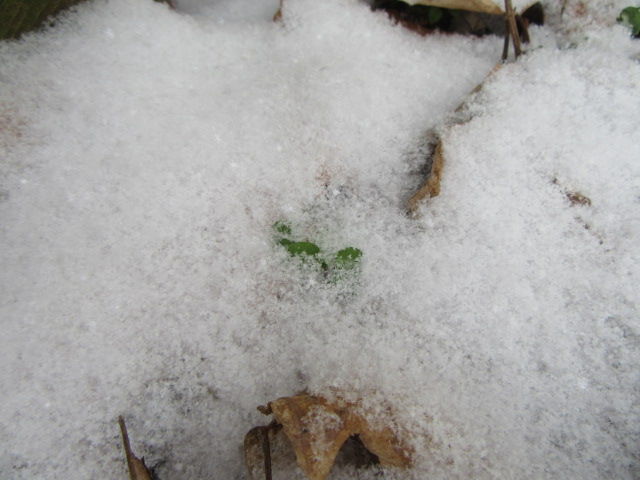
Monday Catch Up Post… Photos From Last Week

Hello everyone! I hope this post finds you all well. You will notice right off the bat I am a day late with this post. The photos on this post were taken from the 12 through the 16th. I am going to “attempt” to write a new post each day I take photos, even if I only take photos of one plant. Ummm… I took photos every day but one last week and 44 on Sunday. So, I think what I will do with this post is kind of catch up with the highlights of the past week through the 16th. Well, maybe I will think about it and have it figured out by the end of this post.

When I was mowing last Tuesday, I spotted this tiny toad running for his life in front of the garage door. I stopped the mower and picked it up so I could move it to a safer location. Over the years I have seen many baby toads, but this one is the smallest yet.


Mammillaria decipiens on 6-12-19, #587-2.

The Mammillaria decipiens has even more buds now. They are probably opening by now but may be closed up by the time I take photos.


Zantedeschia elliottiana (Golden Calla Lily) on 6-12-19, #587-5.

The Golden Calla Lily (Zantedeschia elliottiana) is now starting to flower. It didn’t flower last year so I did something different when I replanted the bulbs this spring. I read the instructions. 🙂 You are supposed to leave the upper half of the bulb exposed. I guess it must have worked since they are starting to flower.

Driving down a street today I saw a HUGE cluster of white Calla Lilies in front of a house. They were very tall and LOADED with flowers. Since I have passed by this house nearly every day and this is the first time I saw them, I guess they are newly planted there. I couldn’t tell, but they may be in a pot.

I am looking at the photo folders for each day… I already posted about the new bed at the church and new plants, so I can skip the 13th.


Achillea millefolium in front of the chicken house on 6-14-19, #589-1.

The Achillea millefolium in front of the chicken house are really doing well this year. I think I already posted about them before but I wanted to do it again. I know they are just a Yarrow and you can see them all over the countryside.


Achillea millefolium flowers on 6-14-19, #589-2.

But, I love their flowers!


Alocasia ‘Calidora’ on 6-14-19, #589-3.

I’m not sure how tall this oldest Alocasia ‘Calidora’ is, but it is taller than me. I am 8′ tall, so the plant is pretty big.


Alocasia ‘Calidora’ on 6-14-19, #589-4.

The other two Alocasia ‘Calidora’ are looking very good, too. I gave a lot of Alocasia to Wagler’s last summer so I am down to just a few pots. Of course, this is not all of them…


Alocasia ‘Portora’ on 6-14-19, #589-5.

Alocasia ‘Portora’ is one of the nicest looking with their darker stems and ruffled leaves. I purchased the great grandmother of these plants from Wellspring Gardens 10 YEARS AGO! She was almost 8 feet tall when I left her behind with a friend when I moved back to Missouri in 2013. I didn’t realize I could have just cut the leaves off and brought it.

I keep forgetting I need to re-pot the Alocasia gageana AGAIN. They are behind a shed I walk by every day when I feed the chickens, where all the plants on the front and back porch used to be. Every time I walk by, I say “I need to get those girls re-potted.” I need to take their photos, too!


Hosta ‘Dancing Queen’ bud on 6-14-19, #589-6.

As I was looking at the plants in the shade bed, I noticed the buds on the Hosta ‘Dancing Queen’ are different than the buds on the other Hosta. Strange I never noticed that before… Isn’t it odd how we can be around something so often and not notice certain details that make them unique?


Hosta ‘Forbidden Fruit’ bud on 6-14-19, #589-7.

Most Hosta buds look similar to this one on Hosta ‘Forbidden Fruit’.


Rudbeckia hirta, left, and Rudbeckia fulgida var. sullivantii ‘Goldsturm’ on 6-14-19, #589-8.

Somehow I think allowing the native Rudbeckia hirta to have its way in this bed was not really a good idea. I moved the Rudbeckia fulgida var. sullivantii ‘Goldsturm’ to this spot from the north bed a few years ago to see how it would do in more sun. At that time, there was only one Rudbeckia hirta in the bed… Ummm… This bed is along the northeast corner of the old foundation of my grandparent’s old house. The house I moved to after my grandfather passed away in 1981. This was my first Hosta bed back then. When I moved back here in 2013, dad and I planted some rhubarb and horseradish we got from a friend, Ross Hampton, in this bed. Ross was the former foreman at Marti Poultry Farm. There were a lot of surviving old Iris along the north side of the foundation, which I didn’t put there in the 80’s, that dad was mowing over. I moved them to the corner of this bed… I had the Marigold ‘Brocade’ in this bed for a couple of years, too.


Sedum kamtschaticum ‘Variegatum’ on 6-14-19, #589-10.

I must admit the change in the Sedum kamtschaticum ‘Variegatum’ has been a transforming experience. We are are here to learn from our experiences and this plant has taught me a lot. When we are down and almost to the point of giving up we have to realize the power we really have and what we are really capable of. Who we really are and what we can do. We can give up, or we can choose to live! A few years ago, this plant was down to just a few stems and now it is AMAZING! It didn’t give up!


Sedum kamtschaticum ‘Variegatum on 6-14-19, #589-11.

One thing you might notice is the color of the flowers now. In previous posts, they were yellow… Actually, the yellow petals have fallen off and these will become seed pods. Notice the swollen clusters at the top of the photo. This is a new experience for me.

On to June Saturday, June 15…


Aloe maculata bud on 6-15-19, #590-2.

The Aloe maculata is very happy and is sprouting it’s first but for 2019. NICE! The Aloe maculata and I have a long history dating back to 2009 in Mississippi when a good friend brought me an offset from his grandmother’s plant. So, this is our 10th Year Anniversary along with Alocasia ‘Portora’…

Hmmm… Maybe I should do a 10th Anniversary post. I actually started blogging in 2009.


Malva sylvestris on 6-15-19, #590-13.

The Malva sylvestris seems to like it in this neglected spot. I have planted a few things in this area that have never taken off. I have even amended the soil with “the Good Stuff” and nothing worked. It looks like this version of the miniature Hollyhock is going to work… Hmmm… This could be a spreader if it likes it here well enough. Time will tell.


The south bed on 6-15-19, #590-18.

Now I have my work cut out for me… Now that the Celosia argentea var. spicata ‘Cramer’s Amazon’ seedlings are ready to transplant in their proper places. I usually put them in two rows along the wall but I may do something a little different. I’m not sure yet…


Possibly Rudbeckia hirta ‘Denver Daisy’ on 6-15-19, #590-14.

I’m not 100% sure, but the “missing” Rudbeckia hirta ‘Denver Daisy’ seedlings may be mostly in the yard along the bed… I will dig them up and transplant them to the bed and see what happens. It would have been nice of them to come up in the bed but… They came up much earlier last spring and were actually beginning to bud on June 3. Here it is June 15 in this photo!


Southeast corner bed on 6-15-19, #590-19.

I am not really happy with the looks of the southeast corner bed either. The Centaurea flowers are really neat but they are a bit sprawly. The Phlomis ‘Edward Bowles’ is still wondering why I relocated it, even though I told it why. I think it needs some fertilizer. If it doesn’t do well here, it may not return in 2020 and I have had this plant since 2013. It is nice to see the Nandina domestica (Heavenly Bamboo) flowering. The Echinacea purpurea on the left has done quite well and the flowers are beginning to open. I didn’t know the cultivar, but while I was writing captions on the photos the name ‘Magnus’ appeared in my mind. I thought, “‘Magnus’? Where did that come from?” I did a search for Echinacea ‘Magnus’ and sure enough it is a cultivar. I guess “someone” is helping me out. I guess I better listen and conclude this cultivar of Echinacea purpurea is ‘Magnus’.

I have done several things with this bed over the past three years that have worked well. I must admit, it certainly doesn’t have much PIZAZZ this year. YET… I would have bought more Angelonia ‘Perfectly Pink’ for this spot, but they were not to be found this year. You never know what will be available from one year to the next…

I think I will stop here since there are 44 photos in the next folder from Sunday, June 16… I will make another post for them then try doing a post a day. GEEZ! Once I catch up. It is Monday already but at least I didn’t take any new photos today… So, I will catch up with the next post, Sunday Photos on Tuesday. Oh, heck, it is already 12:12 AM on Tuesday.

I know I have been very bad about reading your posts for the past, ummm… Well, it has been a while. I have managed to read your new posts over the past few days and I will try to make time every day to stay caught up. I do have to make a post about an issue I am having with WordPress. I had a chat with customer service and explained the issue and he somehow got on my blog, in the reader. I copied and pasted the home page of one of the blogs I follow to show him the issue. His reply was, “That’s weird.” I told him I was thinking about writing a post about it but I wanted to see if it could be fixed before I did that. He agreed posting about it would be a good idea and said he would look into the problem further and email me what be figured out. It has been a couple of weeks and I have heard nothing and the issue still persists. SO, I will be posting about it this week. I hate to complain and I have really enjoyed using WordPress for the past 10 years.

Until next time, take care, stay positive, have fun and be thankful.

New Bed At Church & Six New Plants For Me

Hello everyone! I hope this post finds you all well and getting dirty! I am glad I was asked to help with the bed in front of the church steps. Well, maybe it was kind of my fault in a way that it needed re-planted in the first place. There has been Malva sylvestris (French Hollyhock) growing in the front bed and a couple of daylilies for several years. Two falls ago, after the “F”, I was asked to clean out the bed but I explained I usually do it in the spring (in my own beds). This spring, before I had a chance to do it, someone else did (not to mention names) and they pulled everything up instead of cutting the dead stems. Then “he” asked if I would go with “him” to the greenhouse and find some plants to put in the bed. Well, I needed a good reason to go to the greenhouses, as if I needed a reason at all. So, we made plans and went on Wednesday (the 12th). I took “him” to all four but we just brought back plants from three. I had a few ideas in my head before we went from what I knew was available at Wildwood. We stopped at Wagler’s first but I didn’t see anything that caught my eye. Mrs. Wagler wasn’t there so we didn’t get a chance to visit. Kind of late in the season anyway. Then we went to Wildwood… So, I had this image in my head with what we initially bought from Wildwood, but I wanted to go to Muddy Creek to see what they had. They were almost completely sold out but I found two plants that completely rearranged my initial plan. Then we stopped at Masts and I decided the Purple Fountain Grass would look good on both ends of the bed. Once we came back to the church and I laid all the pots out, I decided we needed more plants. Everything we bought first went on one side so I needed more plants to duplicate the same thing on the other side. 🙂 To be quite honest, the Coleus were not part of the plan but they somehow made their way to the counter and to the church…

From left to right… 1 Purple Fountain Grass, 3 Rudbeckia hirta ‘Becky Cinnamon Bicolor’, 3 Gazinia ‘Arizona Apricot’, 1 Dracaena indivisa (Spikes), 3 Rudbeckia hirta ‘Cherry Brandy, 1 Veronica longifolia ‘Very Van Gogh’, another Dracaena, 1 Achillea ‘Sassy Summer Silver’, another Dracaena, another Veronica longifolia ‘Very Van Gogh, another Dracaena, 3 more Rudbeckia ‘Cherry Brandy… WAIT A MINUTE… Something is weird. Skip the last Dracaena and put here. Then 3 more Gaillardia, umm, ‘Arizona Apricot’, 3 more Rudbeckia ‘Becky Cinnamon Bicolor’, 3 more, no, 1 Purple Fountain Grass. Then, of course, the Coleus, three somewhere in the middle when it is an odd number. OH CRAP! I need another one, or maybe just take cuttings from them all and put them here and there. Hmmm… Now maybe some mulch would be a good idea. 🙂

While we were at Wildwood and Muddy Creek, I saw I needed to go back… So, on Thursday the 13th, I decided I would take them some plants as a good reason to go. I potted up a few Coleus argentea var. spicata ‘Cramer’s Amazon’ and Jewels of Opar (Talinum paniculatum) from the south bed both of them (since I have thousands to spare). I had promised the owners of Muddy Creek some Ajuga reptans ‘Chocolate Chip (Bugleweed) so I took them as well…


Achillea ‘Sassy Summer Silver’.

Well, what can I say? I had been wanting an Achillea ‘Moonshine’ for many years but Achillea just isn’t something you often see at the local garden centers and greenhouses. In fact, Muddy Creek didn’t have these Achillea ‘Sassy Summer Silver’ when I went before. I picked up one for the church then went back and brought one home the next day. It will go in the south bed and it will grow 26-30″ tall.


Flowers of the Achillea ‘Sassy Summer Silver’

The flowers are very interesting with very tight, coarse, stiff, almost hard clusters. Zooming in or getting closer made it a little too blurry but I’ll get a good one later. 🙂


Silvery-green leaves of the Achillea 'Sassy Summer Silver'.

There is no species name on the label, but the leaves look similar to Achillea tomentosa. I checked online, and a few websites say it is Achillea millefolium ‘Sassy Summer Silver’. Ummm… The leaves are NOT Achillea millefolium leaves! So, I went to the source and sent Andrew Jager from Walters Gardens an email. He says Achillea ‘Sassy Summer Silver’ is a complex hybrid with multiple species in the background. One of the parents is Achillea ‘Moonshine’ and the other “unnamed” cultivar is also a complex hybrid. He also said one of the unifying species for the Sassy Summer Series is Achillea sibirica*. He went on to say he could not confirm there was any Achillea tomentosa… Other members of the Sassy Summer Collection have lemon yellow, red, pink, and orange flowers.

From previous research for the Achillea ‘Moondust’ page, which is a “chance” seedling from Achillea ‘Moonshine’ (which is open-pollinated), it is believed Achillea ‘Moonshine’s’ parents are Achillea clypeolata and A. taygetea (in a roundabout way). Achillea ‘Moonshine’ was introduced by Alan Bloom in the 1950’s.

*Ummm… According to Plants of the World Online, Achillea sibirica is NOW a synonym of Achillea alpina. GEEZ!


Veronica longifolia ‘Very Van Gogh’.

PREVIOUSLY, when I made the planters for a friend, I used three Veronica spicata ‘Royal Candles’ I found at Muddy Creek. This time, they had Veronica ‘Very Van Gogh’ and no ‘Royal Candles’. So, I picked out one for the church and then went back AGAIN and got another one. Of course, when I went back the next day I decided to bring one home which I will also try in the south bed. According to the internet, it is a cultivar of Veronica longiflolia, and according to POWO, it is a current and accepted species. 🙂 Of course, it could be a “complex” hybrid and the internet is wrong. Didn’t that happen before? OH, NO! Veronica ‘Very Van Gogh’ is also an introduction of Walters Gardens. I just noticed that or I could have quizzed Andrew about it, too… OK, when he replies to my last reply, I will reply about this one.

Veronica ‘Very Van Gogh’ grows 18-20″ tall x 20-24″ wide. I have grown several Veronica cultivars but I have difficulty getting to return the following year.


xMangave ‘Pineapple Express’ after I brought it home on 6-13-19, #588-4.

While I was waiting for someone to show up at Muddy Creek, I noticed A LOT of this xMangave ‘Pineapple Express’ in a greenhouse by themselves. I have always wanted to try an xMangave or Manfreda, so this was my chance. Most of the plants they had had longer leaves, but I selected one that was wider and more compact. xMangave is a cross between Agave and Manfreda. xMangave ‘Pineapple Express’ is the result of a cross between xMangave ‘Bloodspot’ and xMangave ‘Jaguar’. Ummm… It was also introduced by Walters Gardens as part of their Mad About Mangave Collection.

I checked with Plants of the World Online, and they said xMangave is a synonym of Agave… Of course, so is the genus Manfreda. So, according to them, this would be an Agave ‘Pineapple Express’. So, should I mention to Andrew that Walters Gardens Mad About Mangave Collection is all screwed up? Somehow I think my next reply to him won’t be met with much enthusiasm… Well, you have to admit, the plant in the above photo does look like an Agave


Rosette of the xMangave ‘Pineapple Express’.

OK, so let’s be sensible… Agave species and cultivars always have solid or striped leaves, right? All but a few of the Manfreda species and cultivars I have seen have “spotted” leaves with a few being solid green. Some have very wavy leaves and some of their leaves are fairly narrow and they are spineless. Manfreda also differs from Agave in being herbaceous AND bulbous as is the genus Polianthes and Prochnyanthes. POWO says Polianthes and Prochnyanthes are also synonyms of Agave now.

As it turns out, testing has revealed that ManfredaPolianthes, and Prochnyanthes are Agave… It’s complicated. Most of the species from the three genera have retained their species names while a few were already synonymous with other Agave species. Now, what do you think of that? I learn something every day!

While back at Wildwood…

Sempervivum ‘Cosmic Candy’.

Mr. Yoder and I always talk A LOT about plants in a serious way. He is trying to learn the scientific names. 🙂 He gets A LOT of succulents from a distributor of ChickCharms which specializes in Sempervivum. I really like Sempervivum but there are SOOOOO many cultivars that are exactly the same and have the same parents. It is REALLY whacky! To make it worse, many plants are often mislabeled and customers and employees of garden centers can’t tell the difference. Wildwood had several Sempervivum labeled ‘Berry Bomb’ that are actually ChickCharms cultivar called ‘Cosmic Candy’. ‘Cosmic Candy’ is a cultivar of or a hybrid involving Sempervivum arachnoideum that have all the hairs. S. arachnoideum is commonly known as the Cobweb Houseleek.


A closer look at the Sempervivum ‘Cosmic Candy’ from ChickCharms.

The Sempervivum arachnoideum are typically green with the cobwebs and the rosettes are fairly smaller and tight. Sempervivum arachnoideum subsp. tomentosum have broader and more open rosettes and have the reddish color in the spring and early summer. More than likely, ‘Cosmic Candy’ is a hybrid of the cobwebs would be longer instead of just looking a bit hairy. Maybe they will get longer with time. We shall see. It is a very beautiful Semp!


Tradescantia zebrina from Wildwood.

He has quite a collection of Tradescantia species and he said he would like to have them all. I gave him the species names and he admires how the leaves are so different on some plants. He is really intrigued with the Tradescantia fluminensis var. variegata and how some of their leaves are pure white, striped, and even solid green on the same plant and sometimes on the same stem. I brought this Tradescantia zebrina home because the plant(s) I have leaves with more refined stripes while this one is less refined, more streaked. Weird… I still need to take him a pot of Tradescantia sillamontana (White Gossamer Plant). Last time I was there I took him several Tradescantia pallida (Purple Heart) cuttings and a pot of Billbergia nutans.


Zantedeschia sp. from Wildwood.

While I was at Wildwood before, I noticed several pots of Calla Lily sitting on the floor next to the counter. I looked them over but I didn’t bring any home. We got to talking about them and he said he grew them from seed he found in one of his catalogs. He planted, even outside, and they came up, but he said they don’t look right. Although the tag in the pot says Zantedeschia aethiopica, he said it was just a generic tag he found from a supplier. Strange, though, the photo on the tag shows a Calla with green leaves and white flowers. Ummm… Zantedeschia aethiopica have spotted leaves. This plant’s leaves are more heart-shaped (cordate) while my Zantedeschia aethiopica stand straight up and has more… Anyway, he gave me a pot to see what I could do with it. I put it in a different pot with different soil so we shall see what happens.

Well, I think that is it for this post. I still have more photos I have taken over the past week to post. This week went by so fast and I can’t hardly believe it is Saturday ALREADY! I started out the week attempting to write a post a day with the photos I took every day but that didn’t happen. GEEZ! Maybe I can do better this coming week…

Until then… Be safe and stay positive! Don’t forget to be thankful and GET DIRTY!

The Usual Joys & “Are You Serious?”

Allium ampeloprasum var. ampeloprasum (Elephant Garlic) on 6-9-19, #585-1.

Hello, everyone! I hope this post finds you well. It happens every year… Some perennials come up earlier than others and some you have to wonder about. Then there are the re-seeders you have to wait on to see if they are going to come up at all. You are ready to get the beds tidied up and make decisions about what you are going to do with the beds. You go plant shopping to see what is available and bring home new plants. Some plants you liked the year before aren’t available so you get to try new cultivars and new plants.

The Elephant Garlic (Allium ampeloprasum var. ampeloprasum) in the above photo is now flowering in the south bed. A great example of having your cake and eating it, too.


Alocasia ‘Mayan Mask’ on 6-9-19, #585-2.

A few of the older Alocasia went dormant and this Alocasia ‘Mayan Mask’ is FINALLY waking up. Two others are still thinking about it.


Hmmm… Last spring I bought a Siberian Bugloss, Brunnera macrophylla ‘Jack Frost’. It did very well and was a beautiful plant. Once the Japanese Beetles really set in on the Chinese Elm tree and changed its environment, it started ailing. By the end of July, it was completely dead. I didn’t see anything online about this species going dormant so early, so I just contributed its demise was because of the heat and increased light. I left the label in place just in case it returned in the spring because you never know. I always say, “Just because it is dead doesn’t mean it is dead.” I have been surprised many times. Well, there is a plant coming up beside the label but there is a weed with similar leaves, which I haven’t bothered to ID. So, this is either the Bugloss returning or a weed trying to fool me… Most likely, the latter is the case. But, I am keeping an eye on it. 🙂

By the time I am finished with this post, which is likely to take several days, maybe we can tell what is really going on here.


Celosia argentea var. spicata ‘Cramer’s Amazon’ on 6-9-19, #585-6.

Waiting and waiting… Then all the sudden, “OH, CRAP!” Almost time to transplant the Celosia argentea var. spicata ‘Cramer’s Amazon’ and Talinum paniculatum (Jewels of Opar).


Talinum paniculatum (Jewels of Opar) seedlings on 6-9-19, #585-22.

It happens every spring… It seems I need to work on the south bed but I always think I have to wait for the Celosia and Jewels of Opar to come up. Last spring the Rudbeckia hirta ‘Denver Daisy’ came up in abundance from self-sown seed but barely any came up this spring. In fact, I am not so sure any did and I was beginning to wonder about the Celosia. But when they did come up, they really came up! I think I am pretty safe if I don’t even worry if they will come up and just go ahead and do whatever I want with the south bed when I am in the mood. The Celosia and Jewels of Opar will come up when they are ready and it doesn’t matter where I dig. I will still have more than enough.


Colocasia esculenta on 6-9-19, #585-7.

The Colocasia esculenta are finally coming up in the north bed. I didn’t post photos, but something terrible happened with the BIG rhizomes… The biggest ones had crown rot but the majority of the rhizome was OK. It just made the smaller eyes come up around the rhizomes instead of the main one from the center. Hard to explain but maybe you get the picture… It was unusual, but the small Colocasia esculenta I planted in the front of the Canna bed overwintered with leaf mulch and came up long before the rhizomes I planted… I don’t know what the Xanthosoma robustum is going to do because it sort of had the same problem only in a different way. It rotted from the bottom instead of the top. Last time I checked, the top sprout had broken off but there is some kind of activity on the remainder of the rhizome… Time will tell. The temps have been weird and the soil has remained cool and damp which they don’t like…


Conoclinum coelestinum ‘Aunt Inez’ on 6-9-19, #585-8.

TRIPLE GEEZ! The Conoclinum coelestinum (Blue Mist Flower) I call ‘Aunt Inez’ always comes up so late. It is a perennial or sorts but these always come up from seed. Supposedly, they are an herbaceous perennial that “spreads aggressively” by rhizomes and self-seeding. Dad got his start from Aunt Inez (his mother’s sister) many years ago. They were in a good-sized group on both sides of the steps but they have declined, which may be partly my fault. I have been panting other plants where they grow which had led to their seeds being lost or not being able to come up. It was kind of tiresome waiting for them to come up then having to move them around a bit. (GEEZ! That is like in the south bed!). Then after I get the beds planted, a few come up… I am not complaining at all, and I am thankful that at least a few have made an appearance. I have tried to relocate a few in the past, but they never return the next spring. As far as them spreading “aggressively” by rhizome, I have never had that happen and it would be a good thing if they even tried. They are a nice plant with neat flowers. The worse thing about their seedlings is that one might think they are a weed and pull them up by accident. My dad used to keep an eye on me and was quick to point them out. He would say, “that’s one of those flowers. You have to be careful not to pull them up.” 🙂


Echinacea purpurea (Purple Cone Flower) on 6-9-19, #585-9.

The Echinacea purpurea (Purple Coneflower) “are” now budding. They have done very well and are getting very tall. I am so thankful I have these now! I failed to dig up a few of the Echinacea paradoxa (Yellow Coneflower) along a back road which I wanted to plant somewhere on the farm.

Grammarly thinks “are” should be “is”. I had to remind it “are” is a present and plural form of “be” and “is” the singular present form. 🙂 We are at a stalemate and it is thinking about it.


Heuchera ‘Obsidian’ on 6-9-19, #585-10.

The Heuchera ‘Obsidian’ is looking MUCH better now. I was beginning to wonder for a while if it would make it.


Hosta ‘Abiqua Drinking Gourd’ on 6-9-19, #585-11.

The very nice Hosta ‘Abiqua Drinking Gourd’ is going to bless us with its first flowers this year. It’s first!


Hosta ‘Blue Angel’ wannabe on 6-9-19, #585-12.

Hmmm… The Hosta ‘Blue Angel’ wannabe is getting a little bigger. It is driving me NUTS not knowing the true cultivar name. I am going to turn the label around so it can read that it says “Hosta ‘Blue Angel’.” I am sure it will tell me, “Yes, I am blue (well kind of) and I am an angel. But I am NOT Hosta ‘Blue Angel’.” 🙂


Hosta ‘Blue Mouse Ears’ on 6-9-19, #585-13.

The Hosta ‘Blue Mouse Ears’ definitely has no identity crisis. Its flowers are just as compact, neat and tidy as the whole clump.


Hosta ‘Dancing Queen’ on 6-9-13, #585-14.

The always glowing Hosta ‘Dancing Queen’ is further dazzling us with buds.


Hosta ‘Forbidden Fruit’ on 6-9-19, #585-15.

Hosta ‘Forbidden Fruit’ is looking especially AWESOME this year and flowering right on schedule. I took photos of the Hosta on 6-9-2018 and it didn’t have buds, but it did on the 14th. So, we are pretty much right on schedule.


Monarda didyma ‘Cherry Pops’ on 6-9-19, #585-16.

SURPRISE, SURPRISE! I had almost forgotten about the Monarda didyma ‘Cherry Pops’ (Bee Balm)! I saw it had sprouted a while back, but the Creeping Jenny had completely covered it it. When I was taking photos on Sunday, it said “HERE I AM! DON’T FORGET ABOUT ME!” I smelled its leaves to make sure it was really it. 🙂 I am very thankful it came up. Now, we’ll see if it flowers.


Parthenocissus quinquefolia (Virginia Creeper) on 6-9-19, #585-17.

The Virginia Creeper (Parthenocissus quinquefolia) is one of those “I fooled you” plants when they are very young. You can easily mistake it for a Viola and not pull it up. Sometimes their second set of leaves may even resemble Poison Ivy (Toxicodendron radicans), which fooled me for several years at this stage. I had plenty of both in Mississippi and was always getting a little rash after pulling weeds in the back yard even though I didn’t see any poison ivy where I was working. Then one day I noticed the Violets I didn’t pull had three leaves so I thought Poison Ivy started out looking like Violets. Well, that is not the case. Small Poison Ivy starts out with leaves of three while the Virginia Creeper starts out looking like Viola species. By the second or third set of leaves, you can clearly see the five-leaved Virginia Creeper.  Some people break out in a rash similar to Poison Ivy from the sap of the Virginia Creeper as well.

One interesting thing about Poison Ivy is that it is not an Ivy at all. Believe it or not, it is in the family Anacardiaceae with Cashews, Mangos, Pistachios, and many other ornamental trees that produce “fruit” that are drupes. Many of the plants in this family produce sap with urushiol which is what causes the rash. Virginia Creeper (or Woodbine) is in the family Vitaceae along with grapes. These plants produce raphides (crystals of calcium oxalate) which can also cause irritation by puncturing the skin of sensitive people. Umm… I mean people with sensitive skin.


Rudbeckia fulgida var. sullivantii ‘Goldsturm’ buds on 6-9-19, #585-19.

The Rudbeckia fulgida var. sullivantii ‘Goldsturm’ is starting to bud now. There will be A LOT of flowers because they really like it where the biggest patch is now.


Rudbeckia hirta buds on 6-9-19, #585-19.

I think buds are especially neat on some plants. Here the native Rudbeckia hirta (Black-Eyed Susan) buds resemble brown balls wrapped in golden-yellow petals.


Salvia nemorosa ‘New Dimensions Blue’ on 6-9-19, #585-20.

The Salvia nemorosa ‘New Dimensions Blue’ seems to be having some difficulty expressing itself this spring. It was like it couldn’t speak for a while and was always looking over its shoulder. Then I realized maybe it is the Elephant Garlic… The Salvia x sylvestris ‘Mainacht’ in the other end of the bed had the same difficulty until I removed the garlic next to it. This year it has gone bananananas! Maybe the smell of the garlic and the scent of the Salvia don’t mix well. Chemical reaction. LOL!


Stachys byzantina (Lamb’s Ears) on 6-9-19, #585-21.

The Lamb’s Ears (Stachys byzantina) are blooming once again. They seem to like this spot and I am going to attempt something… I have a plan… Top secret. 🙂


Vitex agnus-castus ‘Shoal Creek’ (Chaste Tree) on 6-9-19, #585-23.

The beautiful Chaste Tree, Vitex agnus-castus ‘Shoal Creek’, is looking great and starting to flower. I really like this shrub but it can be weird sometimes. It made it through the winter like a deciduous shrub instead of having to come up from the bottom like a perennial. It has been a few years since it did that. There are a few advantages to that including their stems are much stronger. Last spring it came up from the ground and next thing you know all the stems were flat as a pancake and growing horizontally because the stems were weak. I have photos to prove it. 🙂 So, I am very thankful it growing normal this year.

That’s all for this post. Until next time, be safe, stay positive, be thankful and you know the rest.


June 1-8 Update

Linnaea (Abelia) x grandiflora on 6-1-19, #580-1.

Hello everyone! I hope this post finds you well. It looks like we are going to have a few days with no rain in the forecast. I have taken quite a few photos over the past week but have been kind of tardy writing posts. Nothing quite as exciting as the Echinopsis mirabilis flower, though. There have been a few surprises, I must admit, which will be in this post… I took a few photos on a friends farm (and along a highway) of a few wildflowers I don’t have here.

I am starting this post with photos I took on June 1 and proceeding through June 8. Some of the photos I took earlier in the week are already out of date and new photos had to be taken throughout the week. Buds become flowers within a few days. 🙂

The Linnaea x grandiflora (syn. Abelia x grandiflora) is flowering up a storm. It was getting very tall so I cut it in half (down to about 5′) in 2017. I am calling this shrub an Abelia x grandiflora, I mean Linnaea x grandiflora, although I am not 100% sure. The photos that “were” on the Missouri Botanic Plant Finder looked like this shrub. Well, I checked again when I made this post and their photos have changed… Hmmm… They are still calling it an Abelia while Plants of the World Online by Kew have changed the name to Linnaea. SO, WHAT IS IT REALLY? The name change wasn’t that recent either!


Linnaea x grandiflora flowers on 6-1-19, #580-2.

There are several cultivars of Abelia/Linnaea x grandiflora, but presently, the only flowers online that look the shrub in my yard are the ones from this blog. GEEZ!!! I guess I will have to go further research AGAIN, because now this shrub doesn’t appear to be what I thought it was in the first place… 🙂 On the bright side, if it isn’t an Abelia or Linnaea, I don’t have to worry about wondering which name I am supposed to use. Any ideas?

(My thanks to Jean Molnar for suggesting this shrub may be a Deutzia scabra ‘Plena’. I believe we have a winner! The cultivar name may not be correct because this shrub is likely to be close to 60 years old.)


Catalpa speciosa on 6-1-19, #580-6.

One of my favorite trees is the Catalpa. I love its huge leaves and its beautiful flowers. There are quite a few HUGE Catalpa in town and they are AWESOME this time of the year. I found this tree growing in the old foundation, maybe in 2017, so I removed it and planted it in the yard. It has grown incredibly FAST!


Catalpa speciosa flowers on 6-1-19, #580-7.

Here again, I was presented with a problem. There are two species of Catalpa that are nearly identical, Catalpa speciosa (Northern Catalpa) and Catalpa bignoniodes (Southern Catalpa). Supposedly, Catalpa speciosa has slightly larger leaves and flowers but it hard to tell unless you have both to compare. Both are present in Missouri and their range varies from one website to another. I believe the tree I planted in the yard is the Northern Catalpa because they grow taller than the Southern Catalpa. The larger trees in town easily exceed 60′ tall.


Lysimachia nummularia ‘Goldilocks’ on 6-1-19, #580-10.

Ummm… My first experience with the gold-leaved Creeping Jenny began with my plant friend, Walley Morse, giving me a start in 2010 when I lived at the mansion in Mississippi. I didn’t bring any with me when I left Mississippi in 2013, but I found ‘Goldilocks’ at Lowe’s in 2014. I put in the center of the bed on the north side of the house, which is mostly shaded, as a groundcover. Although the Creeping Jenny does flower, mine did not for all these years. Most of the Creeping Jenny I have seen in people’s flower beds are growing in the shade. As I have mentioned in earlier posts this year, this Creeping Jenny has found the sun. On June 1, as I was staring up the steps, I almost fell because the Creeping Jenny was LOADED with flowers… Strangely, only the plants in the sun have flowers… While gold-leaved plants brighten a shady area, many of them do quite well in full sun. They make a bright area glow even more.

Then on June 3…

Carduus nutans (Musk Thistle) on 6-1-19, #581-2.

I have been spraying and digging the thistles on a friends farm and it has been very interesting. There were so many it was hard to tell which ones I sprayed and which ones I didn’t. Sometimes I knew I sprayed certain groups and they remained alive and well so I sprayed again. Then the next day they would still be perfectly fine. I finally won when I just dug them up. At home, I have the thistles under control and there were only a few this year. When I say “a few” I mean maybe 20 or so. While I have only had a few Musk Thistle here (two a few years ago and two this year in a different location I never had thistles before), my friend’s farm is LOADED with them. It is like a nightmare! I think the thistles here are mainly Bull Thistle, Cirsium vulgare, but several species look so much alike it is hard to tell, especially from photos. I am NOT a fan of spraying, believe me, and I have controlled the thistles here mainly by digging down about 2″ in the soil and cutting their stem. But, when there are HUNDREDS of them, spraying is the best option. I still plan on writing a post about the thistles but I need to make sure I have the correct ID. Sad to say, thistles are beautiful plants with awesome flowers. Ummm… All parts are edible and apparently loaded with vitamins. You can prepare the buds like artichokes. Nope, I haven’t tried it… Nor have I tried artichokes.


Verbascum blattaria f. albiflora (Moth Mullein) on 6-3-19, #581-16.

While working on his farm I noticed these neat flowers growing here and there. They were not growing in colonies, but rather 1-4 spaced several feet apart and only in a couple of areas. I easily identified them later as Verbascum blattaria f. albiflora whose common name is Moth Mullein.


Verbascum blattaria f. albiflora (Moth Mullein) on 6-3-19, #581-17.

There are several colors of Verbascum blattaria, but the f. albiflora is particularly nice.


Penstemon tubaeflorus (White Wand Beardtongue) on 6-3-19, #581-12.

I had been noticing several large groups of flowers along the highway so I got out and took some photos. I later identified them as Penstemon tubaeflorus, commonly known as White Wand Beardtongue.


Penstemon tubaeflorus on 6-3-19, #581-13.

They have particularly interesting flowers with three lower lips and two upper lips with deep throats. The flowers are a pure, glistening white.

I have been keeping an eye on the pink Achillea millefolium I mentioned in an earlier post. Unfortunately, it disappeared. Maybe a cow ate it…

Later in the afternoon…

Amorphophallus sp. on 6-3-19, #581-1.

The Amorphophallus has finally pushed through the soil! I stuck my fingers into the soil a few weeks ago to make sure the two plants in this pot were going to come up. They were slowly working on it… I would really like to know how big their corms are by now but I guess I won’t venture to check.


x Gasteraloe ‘Flow’ on 6-3-19, #581-6.

After having the x Gasteraloe ‘Flow’ as a companion since 2016, it is going to flower for the first time. AWESOME!


Ledebouria socialis var. pauciflora on 6-4-19, #582-18.

I finally re-arranged the Ledebouria socialis var. pauciflora (Silver Squill) because I was tired of it leaning. This plant is doing very well and SOMEDAY it will start spreading!


Ledebouria socialis var. violacea on 6-4-19, #582-24.

I also re-potted the Ledebouria socialis var. violacea and put it in a larger pot because it is having no problems multiplying. I removed a bulb for a friend in Alabama while I was at it. OUCH! Well, he is sending several new plants that I am trading for a few he doesn’t have. So, I agreed to send him one of these since he is sending a couple cultivars of Ledebouria. Ledebouria are pretty neat plants you may want to give a try and they seem very undemanding.


Achillea millefolium in front of the chicken house on 6-5-19, #583-1.

The Achillea millefolium in front of the chicken house is doing incredibly well this year. They have struggled the past few years because they apparently didn’t have enough sun. I guess all the limbs that fell during the ice storm provided more light for them. They are still inching their way around the corner of the chicken house. The clump I moved in front of the barn last year are doing OK but still haven’t quite gotten with the program. I need to do some research on “older” cultivars that were popular many years ago because this one has been around for a while. My start came from a friend in Mississippi who’s start was given to her by someone else many years earlier. I know it is a cultivar because they grow much different than the Achillea millefolium growing in the pasture and along roadsides.


Group of Alocasia on 6-5-19, #583-3.

The Alocasia are beginning to look much better after a winter in the basement. The biggest Alocasia ‘Calidora’ (on the other side of the barrel) is MUCH taller than I am. Several of the older plants went dormant over the winter and have yet to come to life. GEEZ! Once they go dormant it seems to take a very long time for them to come back to life. Normally, the bigger plants don’t go dormant in the basement over the winter…


Aloe maculata on 6-5-19, # 583-4.

The Aloe maculata is doing very well after being in the house over the winter. I usually keep it in the basement during the winter, but this year I let it stay in the dining room. As you can see, it has several pups that need to be in their own pots. It will start flowering soon. 🙂


Astilbe x arendsii ‘Fanal’ on 6-5-19, #583-5.

The Astilbe x arendsii ‘Fanal’ is strutting its stuff!


Hosta ‘Empress Wu’ on 6-5-19, #583-19.

The Hosta ‘Empress Wu’ is starting to flower…


Hosta ‘Forbidden Fruit’ on 6-5-19, #583-20.

And so is Hosta ‘Forbidden Fruit’. I need to do some work on the shade beds but the mosquitos are crazy there right now.


Equisetum hyemale on 6-5-19, #583-17.

The Horsetail is… Strange how I am at a loss for words. I… Ummm… For the most part I really like the Equisetum hyemale because I don’t ever have to worry about it. It survives and grows no matter what. The only issues are duriing the winter when the cold and wind causes the stems to fall over. Some stand back up, but some do not. Once I get in the mood, I will pull the weeds and grass around and among the Horsetail and cut off the stems laying on the ground. Believe me, there is plenty of new growth, even in the yard 10-15 feet away. But that is no problem for the lawn mower. Nothing distracts the Horsetail’s mission to grow, thrive, and be happy.

The area in front of the chicken house gets neglected quite a lot even though I had plans here originally. The soil is good but the moles work in this area more than I do. The light in this area is also weird. I have put various plants in front of the chicken house over the years and nothing seems to work well. Nothing except for the Horsetail and sometimes the Achillea millefolium at the other corner. I do have a NICE colony of Ajuga reptans ‘Chocolate Chip’ growing along the northeast side that has always done very well, although also neglected.


Malva sylvestris on 6-5-19, #583-22.

When I saw these plants at Wagler’s Greenhouse they were unlabeled. I asked what they were and she said, “she said they were Miniature Hollyhock.” That sounds weird. She didn’t say who “she” was and I didn’t ask. ANYWAY, being unlabeled always gives one side of my brain a red light and the other side a green light. At first the red light wins and I pass by. Then the negotiation between the two sides begins and the green light wins. Yeah, that is a very good way to explain my insanity when it comes to bringing home unlabeled plants. It gives me an opportunity to do research and learn. That can lead to confusion especially when there are several genera in the Malvaceae family that are similar and have similar leaves and flowers. So, you have to wait until they flower. Ummm… The flowers are similar for several genus and species, but fortunately, the flowers of Malva sylvestris are unmistakable. THANK GOODNESS!


Oenothera biennis (Evening Primrose) on 6-5-19, #583-24.

This is another “Ummm…” plant. The Evening Primrose (Oenothera biennis) is a Missouri native (and the rest of central and the eastern part of North America). It somehow thought growing in a crack in the concrete floor would be a good idea (what was the back porch of my grandparent’s old house). I first noticed it when I moved back in 2013, and although I never saw an Evening Primrose, I somehow knew what it was. I didn’t pull it out of the crack so I guess it thought I liked it. Now they come up everywhere they think it is OK along the back of the old foundation.

The Evening Primrose is an interesting plant that only lives for two years. The first year’s leaves grow in a tight rosette and spirally on the stem the second year. The flowers open in the evening and, if you are lucky, last until around noon the following day. I have RARELY seen their flowers… Of course, this is the plant Evening Primrose oil comes from.


Salvia pratensis ‘Midnight Model’ on 6-5-19, #583-31.

The Salvia pratensis ‘Midnight Model’ is an awesome Salvia. Well, in my book, all Salvia are AWESOME! I deadheaded these two plants on May 19 and they started right back blooming again. Last summer I neglected to deadhead once and they didn’t flower for quite a while. I haven’t made that mistake yet this summer. OH, summer has just begun… 🙂

Then finally on June 8…

Amorphophallus sp. on 6-8-19, #584-1.

The Dragon’s Tongue, Voodoo Lily, or whatever you choose to call it has tripled in size since June 3. I won’t really know what the species is until they flower, but I suspect Amorphophallus konjac is the likely candidate. Out of 223 accepted species on Plants of the World Online (as of now), there are only a few that are commonly available that would be passed along at a local greenhouse fairly inexpensive. Actually, maybe just one. Well, maybe we can even narrow that down to zero but that would leave me back where I started. Even though Amorphophallus konjac is a common Voodoo Lily, you probably won’t find it at Lowe’s or Wal-Mart.

Passalong plants are plants that reliably come up and multiply. Plants that everyone has but seldom buys. Plants you usually wind up with so many you have no idea what to do with are sometimes considered passalong plants. Plants that are very nice and you like really well that you hate to pull up and throw on the compost pile because you have so many. Then they will start coming up in and around the compost pile. Plants that you would sometimes like to go to another town and leave on people’s doorstep and run away. Never in your own small hometown because their neighbors may recognize you. 🙂 Believe me, the thought has crossed my mind. Passalong plants are great to trade with people at plant swaps because there are always people that come and have no idea what they are getting into.

Moving right along…

Aptenia cordifolia/Mesembryanthemum cordifolium f. variegata on 6-8-19, #584-3.

The Aptenia cordifolium f. variegata, or Mesembryanthemum cordifolium f. variegata, is doing very well. While I am getting used to typing Mesembryanthemum without checking the spelling my computer wants to spell variegata wrong. It seems to think it should be variegate. GEEZ! I am just reluctant to change the name from Aptenia to Mesembryanthemum because I think it will change back again. The neat little flowers are a challenge to photograph because they close in the afternoon before I normally take photos.


Aptenia cordifolia/Mesembryanthemum cordifolium f. variegata on 6-8-19, #584-2.

Ummm… Yes, this is an “ummm” plant. I am not going to say anything else. Just think of the first thing that comes into your mind. Ummm… Now you see what I mean? What are we thinking? This is a plant and how the bud starts!

It is times like this I wonder if the Angels are reading my mind. How does what we think affect our Karma?  I am just glad we can use the excuse, “I am just human.” After all, the Creator of the Universe and all the divine beings have a sense of humor and probably are thinking the same thing. Nature can be humorous and this is one of those times.


Ledebouria socialis var. violacea on 6-8-19, #584-6.

Well, isn’t that amazing?!?! I just repotted this plant on June 4 and now it has its first bud. That is, it’s first since I have had it here. I have no idea how old as these bulbs (corms or whatever you call them) are. I am very thankful I get to experience the Silver Squill flowering. I think this will be a WOW moment not because they are rare or seldom flower, but because I have never seen one in person. Supposedly you have to be careful how you overwinter these plants or they won’t flower. You have to ignore the heck out of them and don’t give them any water during the winter months. I had to keep them in a room I seldom went in most of the winter to accomplish this. Once I put them in my bedroom in April, I had to give them a little water. For some reason, and I have no idea why, some consider Ledebouria a succulent. They are very popular plants with succulent enthusiasts, too.

No, I didn’t plan using the last two photos in sequence…

I am almost finished…

Ferocactus wislizeni on 6-8-19, #584-4.

I had a photo in the last post showing the red spines of this Ferocactus wislizeni (Fishhook Barrel Cactus). When I was looking at the cactus on June 8 I noticed something very strange… The “apex” of the cactus is where the new spines are formed… How come there are three now? I didn’t notice this earlier perhaps because of the hot glue stuck in its spines. I am very glad the hot glue slid off when I was taking this photo without doing any damage. 🙂 Anyway, information on Llifle says, Ferrocactus wislizeni is “a barrel-shaped or columnar cactus that stay usually a single column; rare specimens may be multiple…” Hmmm… This cactus is only approximately 1 3/4″ tall and it is already doing weird things… I have only had this cactus as a companion since March 30, so it could get interesting. We shall see…


Mammillaria decipiens on 6-8-19, #584-7.

The always witty Mammillaria decipiens (possibly subsp. camptotricha) is starting to flower again. It freely flowers most of the summer and I am thankful they are white instead of pink. This is a neat cactus!

OK, now I am finished for now.

Until next time, be safe, stay positive, and always be thankful. Get as dirty as you can and enjoy!


GOT IT! Echinopsis mirabilis Flower!

Echinopsis mirabilis on 6-3-19, #581-4.

Hello everyone! I hope this post finds you well. I have been keeping an eye on the Echinopsis mirabilis (Flower of Prayer) since I missed the last flower. On June 3, when I took the above photo and the one below, I knew it was getting close.


Echinopsis mirabilis bud on 6-3-19, #581-5.

If you missed the previous post about this plant, I had missed the last time it flowered. Plus, it was the first flower to open after I had brought it home from Lowe’s in March (2019 … Well, I had forgotten this plant flowers at night and only one night. So, when I got up to check the morning after, it was to late.


Echinopsis mirabilis at 7:20 PM on 6-4-19, #582-1.

At about 7:20 PM Tuesday evening, I thought I better go check on this plant to see what the bud looked like.


Echinopsis mirabilis bud at 7:20 PM on 6-4-19, #582-2.

The twisted appearance is pretty neat. Kind of like it is unwinding. 🙂

THEN, AT 10:30 PM…

Echinopsis mirabilis flower at 10:34 PM on 6-4-19, #582-3.

Echinopsis mirabilis

THE FLOWER OF PRAYER!

WOW! AMAZING! BEAUTIFUL! I was nearly speechless! There have been a few times in my life I have seen something so amazing I was speechless! A miracle of nature right before my eyes! I ran back inside to grab the camera…


Echinopsis mirabilis flower at 10:35 PM on 6-4-19, #582-4.

It’s like everything, every movement, every breath, every thought stopped when I was looking at this flower. Everything except taking photos.


Echinopsis mirabilis flower at 10:35 PM on 6-4-19, #582-5.

The flower is so HUGE in comparison to the size of the plant itself!


Echinopsis mirabilis flower at 10:35 PM on 6-4-19, #582-6.

It’s like the love of your life looking you right in your eyes for the first time. Her smile, the twinkle in her eyes as she peered into your very soul! (Then you meet her for the first time after 36 years shopping in Wal-Mart and you strike up a conversation. Then she says, “Who are you?”).


Echinopsis mirabilis flower at 10:35 PM on 6-4-19, #582-7.

So beautiful and amazing! I took a whiff to see what it smelled like. It was weird. Barely any scent at all… Good thing it is self polinating. 🙂

This is the second time I have witnessed a night blooming plant… Last summer I went to my cousins home where they have this HUGE Night Blooming Cereus (Epiphyllum oxypetalum) I wrote a post about it and you can view by clicking HERE. It was an amazing thing to see!

We had our family reunion recently and she (my cousins wife) asked me if I wanted it. She said they hadn’t even moved it outside. Well, of course, it is very hard to refuse but it is HUGE! How do I even get it home? You know what they say, “Where there is a will, there is a way.”

Nature is an amazing thing and we are blessed to have so many miracles around is. Life in itself is a miracle and we are so blessed to live on this amazing planet called Earth. Take time to be aware of the miracles around you, how nature and life unfolds right in front of you.

What miracles of nature have you witnessed?

That’s it for now! Until next time, be safe, stay positive, be thankful and GET DIRTY!


Surprise Pink Achillea and Green-Leaved Milkweed

Achillea millefolium with pink flowers on 5-30-19, #578-1.

Hello everyone! I hope this post finds you all well. I have been working on the thistles at a friends farm and have noticed a few wildflowers I don’t have here. It only takes seconds to take a few photos. Sometimes it is good to have proof of what you saw when it is unusual. I remember a few years ago I found a HUGE Morel growing in the chicken yard in February. I took a photo with my cell phone but had no way of getting it into my computer. I sent the photo to a few people, but now I don’t even have the cell phone. That was probably a once in a lifetime event and a fluke of nature to have a Morel in February.

Well, a few days ago, I was surprised to see a single Achillea millefolium with pink flowers. Achillea millefolium in the wild typically have white flowers and I have seen hundreds, and most likely you have, too. They can be seen growing along highways, back roads, in pastures, along trails, in fence rows, etc. There are many cultivars of Achillea in several different colors but to see an Achillea millefolium, other than white, in nature is a rare find. I feel very blessed and am thankful for witnessing this plant. I am very tempted to dig it up and bring it home so a cow won’t eat it or step on it.


Asclepias viridis (Green-Flowered Milkweed) on 5-30-19, #578-2.

Another wildflower on his farm that I don’t have growing here is the Asclepias viridis (Green-Flowered Milkweed). The Missouri Botanical Garden website says they are commonly found in the Missouri Ozarks and the southeastern corner of the state as well as several other states.


Asclepias viridis (Green-Flowered Milkweed) flowers on 5-30-19, #578-3.

The nectar from the flowers are a source of food for many butterfly species.


Asclepias viridis (Green-Flowered Milkweed) leaves on 5-30-19, #578-5.

The leaves are a source of food for Monarch Butterfly larvae (caterpillars). This milkweed also goes by several other common names. It is known as the Spider Milkweed because the White Crab Spider lives on this plant and Green Antelope Horn because the seed pods resemble an Antelopes horn.


Carduus nutans (Musk Thistle) on 5-30-19, #578-7.

Ummm…  This stately plant may look AWESOME and it does have beautiful flowers. But, if you see these in your yard or garden, take photos and admire the plant then get rid of it. This is the terribly agressive and invasive Carduus nutans commonly known as the Musk Thistle and Nodding Thistle. A few years ago I had a couple of these growing next to the south side of the barn. It was different than the other thistles with its beautiful silvery leaves. I let it grow until it flowered so I could take photos then sprayed it. Then, this spring, I saw a couple more growing next to the hay lot.


Carduus nutans (Musk Thistle on 5-30-19, #578-8.

The wickedly beautiful leaves are lined with very sharp spines.


Carduus nutans (Musk Thistle) flower on 5-30-19, #578-9.

The flowers are really neat on the Carduus nutans but they are different than the “common” thistle. Most thistles are very invasive and NOT native to this country.

When I first did my research on the species of Thistles growing on the farm, I could NOT find this plant. I was looking in the Cirsium genus. I really hadn’t gotten into Thistles for a few good reasons, and concentrated mainly on other wildflower species I have been identyfing on the farm. But, since I have been working on the Thistles on my friends farm, I noticed a few different species so I did some investigating.

He told me about the app from the Missouri Sate University that can be downloaded and used for plant ID. Well, I don’t have a cell phone but I did get on their website. I looked at the many species in the Cirsium genus but could NOT ID this Thistle. I noticed one of the links was redirecting to the wrong plant so I sent an email to Pam Trewatha to tell her about it. Of course, I sent her a photo of this thistle as well as the Achillea millefolium with the pink flowers. She correctly ID’d the thistle and thanked me for bring the error to her attention.

She also said she would be happy to help ID any other mystery plants. Hmmm… I have several so she will be hearing from me again. I have one in particular that comes to mind. 🙂

I will be writing a post on Thistles soon which should be pretty interesting. They aren’t all created equal and, believe it or not, they are edible and nutritious.

Until next time, be thankful, be safe and stay positive. This is a nice sunny day, so I think I will do some mowing and trimming. Of course, I will GET DIRTY. Care to join me?

Neat Flowers! Centaurea & Salvia coerulea ‘Black and Blue’

The yellow flowered Centaurea on 5-30-19.

Hello everyone! I hope this post finds you all well. We made it through a day without any precipitation so far. I thought it was going to rain around 7 PM when I was working in the northeast corner flower bed, though. I noticed a mole had been working the bed over so I had to work it over, too.

That brings me to a message I found in my blog spam… I hardly ever look at the spam comments but I decided I would a couple of weeks ago. There were two comments asking me to try out their products and write reviews. One was for this neat garden planner and the other was for a solar-powered pest repellant for the yard. They both came but I haven’t written a review yet. Since I had the mole issue, I decided to put the new gizmo to work and see what happens. They sent me two, so I will put the other one somewhere between the shade bed and chicken house. I will take photos and write my first review when I set the next one up. I must admit, the quality seems pretty good… Now let’s see if it works as good as it looks.

The yellow flowered Centaurea is still blooming and now the other two have started.


Purple flowered Centaurea on 5-28-19.

OK, I must admit I was expecting something a little different. The tag, written in pencil said Centaurea and purple.


Red flowered Centaurea on 5-28-19.

Ummm… The label with this one said Centaurea and red. Well, the photo isn’t quite as dark as in real life and I must admit the flowers are pretty neat.


Leaves of the Centaurea that has the purple flowers on 5-28-19.

All three of the Centaurea have different leaves but the “red” and “purple” seem to have the same growing habit.


Leaves of the Centaurea who’s label says “red” on 5-28-19.

The leaves of the one with the red label are somewhat larger than the one labeled purple.


Leaves of the Centaurea with the yellow flowers on 5-28-19.

The one with the yellow flowers has much smaller leaves and they are paler green. The plant also has somewhat of a different growth habit.


Salvia coerulea ‘Black and Blue’ on 5-28-19.

NOW THAT IS NEAT! Salvia coerulea ‘Black and Blue” is definitely black and blue! It was pretty funny when they started budding and they were solid black. On the morning of May 28, I was greeted with the first two sets of blue flowers on two of the plants. One of the plants is a little behind and is just now beginning to bud.


Salvia coerulea ‘Black and Blue’ on 5-28-19, #577-8.

I really like Salvia in general. They have really neat flowers and unmistakeable scented leaves. I have grown 13 different Salvia species and I have enjoyed them all. Currently, I still have four species growing and the Salvia coccinea (Scarlet Sage) seedlings haven’t come up for 2019. They reseed and a few have come up every year since 2014. I think I should do a post dedicated to past and present Salvia.

OH, wait a minute… I almost forgot I should have said 15 different Salvia. Rosemary is now in the Salvia genus (Salvia rosmarinus). I grew the Rosemary in 2017 and a variegated cultivar maybe in 2014 or 2015.

I did take a few photos of a few wildflowers at a friend’s farm that I don’t have here. I found the pink-flowered Achillea millefolium. I am so tempted to try and transplant it here. I also took photos of a different Milkweed which I identified with no problem.

Until next time, be safe and stay positive! Of course, you know by now to GET DIRTY!