Revisiting The Elephantopus carolinianus (Leafy Elephant’s Foot)

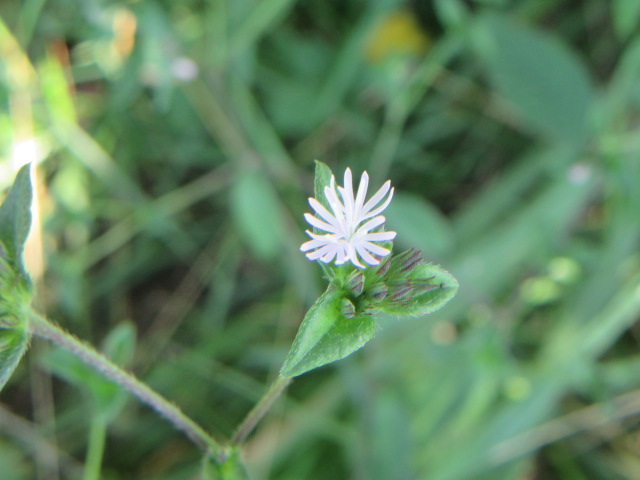
Elephantopus carolinianus (Leafy Elephant’s Foot) on 8-20-22, #906-1.

Hello everyone! I hope this post finds you well. I have been watching the Elephantopus carolinianus (Leafy Elephant’s Foot) under the persimmon tree in the back of the farm all summer. Waiting for flowers can be a pain…

I found my first Leafy Elephant’s Foot on a friend’s mother’s farm while herding cattle in 2019.

Elephantopus carolinianus (Leafy Elephant’s Foot) on 10-12-21, #843-9.

Then, last October 12, I found a single plant in the south hayfield. I wasn’t quite sure what it was at first because the leaves were a maroonish color since it was in full sun. The flowers were wilted but the leaves did have a suspicious shape. The three leafy bracts surrounding the flowers were also a clue. I found it twice, but the day I went to mark the spot I couldn’t find it!

Elephantopus carolinianus (Leafy Elephant’s Foot) at 37″ tall on 10-25-21, #852-4.

Then, on October 25 (after an “F”), I found a small colony behind pond #2 in the back of the farm. They still had a few leaves but the flowers had run their course. I measured the plants at 37″ tall. Ummm… I did mark the spot with an electric fence post.

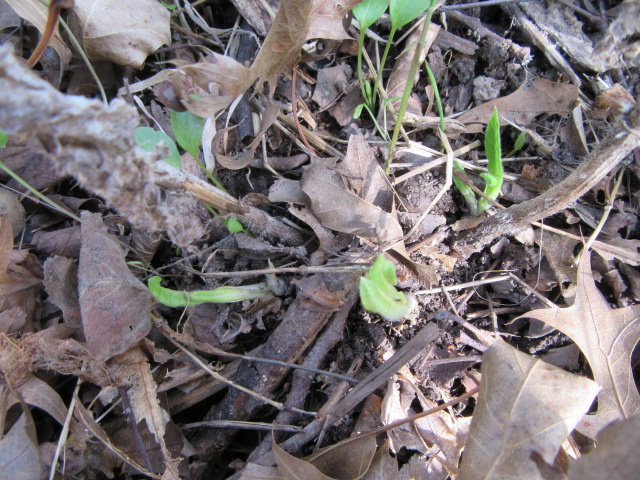
Elephantopus carolinianus (Leafy Elephant’s Foot) on 4-27-22, #874-1.

I was glad when they started coming up this spring.

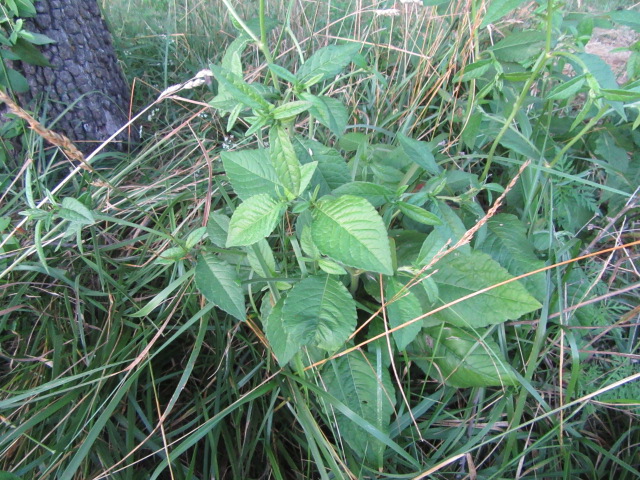
Elephantopus carolinianus (Leafy Elephant’s Foot) on 6-26-22, #896-18.

They had grown quite a bit by the time I took the above photo on June 26. But, so were the weeds and brush around them…

THEN… LO AND BEHOLD!!!

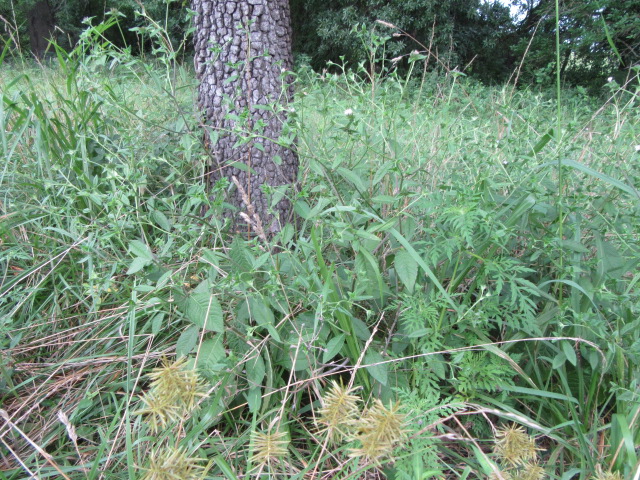
Elephantopus carolinianus (Leafy Elephant’s Foot) under the persimmon tree on 7-9-22, #898-1.

On July 9 while looking at the persimmon tree, I found another small colony. I was happy about that! This one is maybe 100′ or so from the patch behind the pond and is very easy to get to.

By July 28 the flowering stems were getting taller but it was still a ways to go before the flowers emerge… GEEZ!

Elephantopus carolinianus (Leafy Elephant’s Foot) on 8-8-22, #903-8.

I went back to check on them a little after 7 PM on August 8 and there were a few flowers but they were closed. It was a “what the heck” moment!

Elephantopus carolinianus (Leafy Elephant’s Foot) on 8-19-22, #905-1.

I was busy for a while and didn’t get to go back and check on their progress until 6 PM on August 19. WOW! There were A LOT of flowers, but they were all kind of closed and wilted… GEEZ! I did some reading and found out their flowers only last a day. I think it is more like half a day!

Elephantopus carolinianus (Leafy Elephant’s Foot) on 8-20-22, #906-1.

I decided I would go check earlier in the day, so on August 20, I went back at around 12:30. BINGO! Well, perhaps a little earlier would have even been better…

Elephantopus carolinianus (Leafy Elephant’s Foot) on 8-20-22, #906-2.

So, you may wonder what is so special about the flowers of the Leafy Elephant’s Foot… Well, let’s have a closer look…

Elephantopus carolinianus (Leafy Elephant’s Foot) on 8-20-22, #906-3.

The above photo is two flowers, but I need to try to find one I can separate it a little without dissecting it…

Elephantopus carolinianus (Leafy Elephant’s Foot) on 8-20-22, #906-5.

I tried a few, but they didn’t cooperate very well without holding them. With the camera in one hand and the magnifying glass in the other, I couldn’t very well hold the flower at the same time. Finally, one paid attention somewhat.

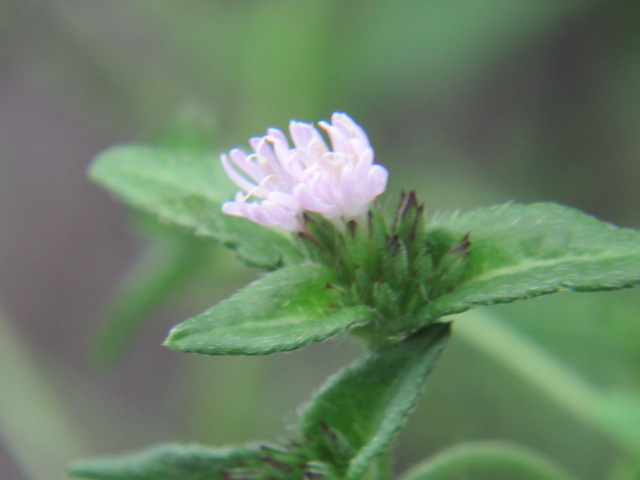
The complicated part is explaining what is going on… First, you have three leafy bracts that surround a cluster of involucral bracts. Each involucral bract produces 2 sets of 2 phyllaries from which (typically) 4 flowers emerge. The flowers produce 5-lobed corollas (petals) that are positioned to one side of the flower. The flowers grow close together giving the appearance of a single four-petaled flower with 20 lobes. Luckily, all four flowers bloom the same day… Since there are quite a few bracts, blooming will continue through sometime in October.

The Missouri Plants website gives a very good technical description, but it can leave you wondering what you read. I found the write-up by Sid Vogelpohl from the Arkansas Native Plant Society to be very helpful.

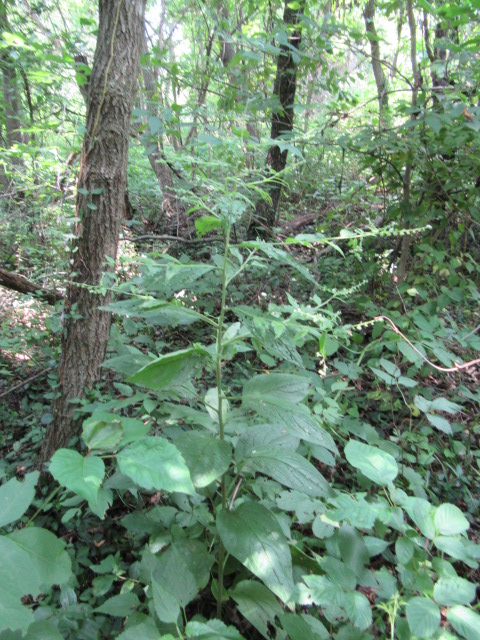
Elephantopus carolinianus (Leafy Elephant’s Foot) on 8-20-22, #906-7.

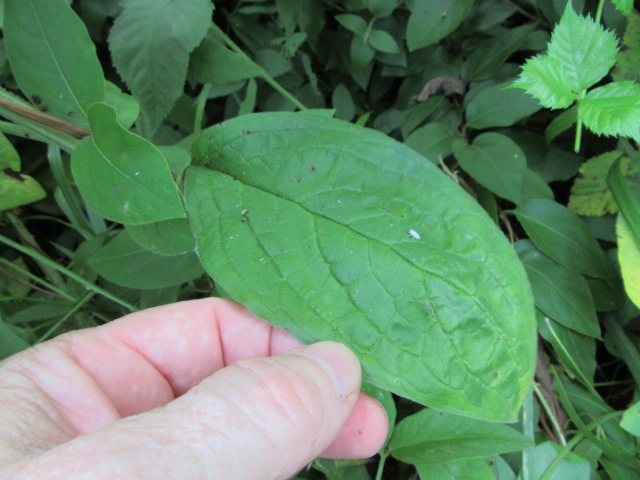
Of course, I have to talk about the leaves because the flowers only help partially identify the species. If you run across a plant with large spatulate leaves before it flowers, you may have found an Elephantopus carolinianus

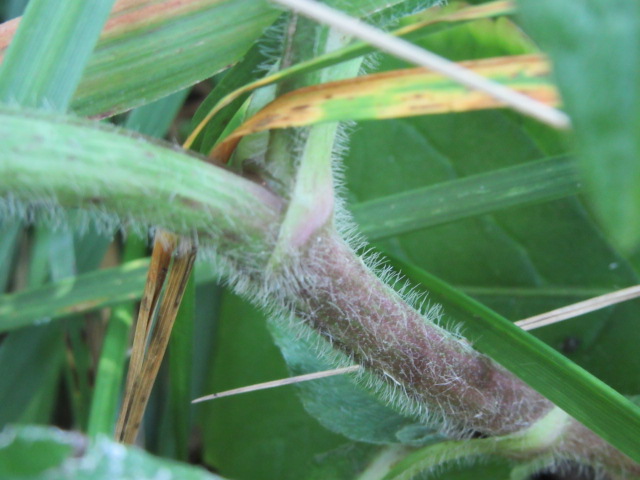
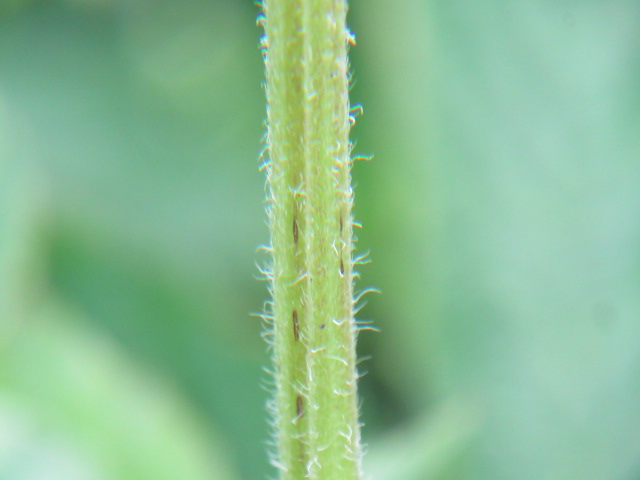
Elephantopus carolinianus (Leafy Elephant’s Foot) on 8-20-22, #906-8.

It also has VERY hairy stems…

The next few posts will be about a couple of species I found south of the barn and my confusing adventure along the fence in the south pasture. Four new species right under my nose in one day!

Until then, be safe, stay positive, and always be thankful. Temps are cooling off and it is a great time to GET DIRTY!

Six on Saturday-Short Walk on the Wild Side

Asclepias hirtella (Tall Green Milkweed)

Hello everyone! I hope you are all doing well. We had a nice week with temperatures not too unbearable at all. I took a walk through the hayfield a couple of days ago to check on the progress of the Elephantopus carolinianus in the back of the farm. It always amazes me how some wildflowers start growing like mad after the hay is cut.

#1-Asclepias hirtella (Tall Green Milkweed)

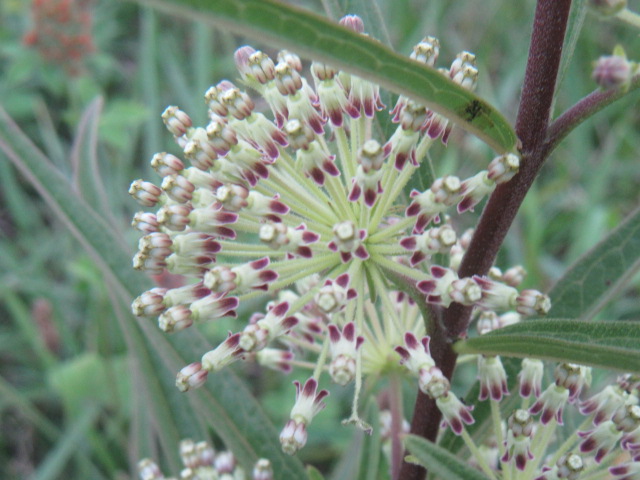
Asclepias hirtella (Tall Green Milkweed)

There were several Asclepias hirtella, the Tall Green Milkweed, blooming again. Normally, they don’t flower the second time but they are this year. I can’t quite figure out why they call this species Tall Green Milkweed when there are other species that grow much taller…


#2)-Elephantopus carolinianus (Leafy Elephant’s Foot)

Elephantopus carolinianus (Leafy Elephant’s Foot) under the persimmon tree.

I have walked to the back of the farm several times over the summer to check on the progress of the Elephantopus carolinianus (Leafy Elephant’s Foot). These are really neat wildflowers that I only noticed growing on the farm last fall after they had already dried up. I found the dried up flowers and leaves in an area that grows up in poison ivy and other brush but I marked the spot…

Elephantopus carolinianus (Leafy Elephant’s Foot)

I was very happy when I found a colony under the persimmon tree so I won’t have to walk to the spot I found them earlier. Well, I usually go there anyway… The plants have mostly buds with a few flowers beginning to open up. Until the flowers are fully open, I can’t show you why I think they are so neat.

I walked through the brush behind the ponds to check on the Symphyotrichum lateriflorum (Calico Aster) and S. ontarionis (Ontario Aster) but so far no flowers. At this point, they still look the same. I wouldn’t be surprised if they are both the same species but only time will tell…

#3)-Vernonia missurica (Missouri Ironweed)

Vernonia missurica (Missouri Ironweed)

This area in front of the two back ponds is LOADED with Vernonia missurica (Missouri Ironweed). The wind was blowing so there wasn’t as much activity on the flowers as usual.

Vernonia missurica (Missouri Ironweed)

The above photo isn’t that great because, as I mentioned, the wind was blowing… Many species of butterflies and other insects love ironweeds. Later on, they will be swarming with Monarch Butterflies and the always interesting hummingbird moths.

Vernonia missurica (Missouri Ironweed)

The Vernonia baldwinii (Baldwin’s or Western Ironweed) grow in another area. Baldwin’s Ironweed have recurved involucral bracts where Missouri Ironweed’s bracts are appressed. To be honest, some of the flowers in this colony have recurved bracts and some don’t… The two species do hybridize which can drive a person batty…

#4-Symphyotrichum novae-angliae (New England Aster)

Symphyotrichum novae-angliae (New England Aster)

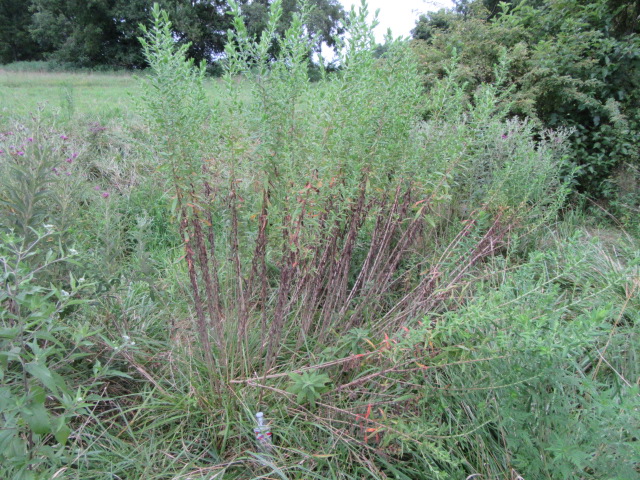
I walked to the pond in the front pasture to check on the Symphyotrichum novae-angliae (New England Aster) which is also a late bloomer. They are also kind of late to come up in the spring which had me wondering if they survived the winter. The New England Aster grows to over 6′ tall. I put a water bottle at the base of the plant for size comparison…

Symphyotrichum novae-angliae (New England Aster)

I only found this species last fall because we had a late “F” and the flowers are pink. Their clusters of flowers caught my attention from quite a distance. I am hoping the same will be true this fall. They are working on it.

#5-Verbesina virginica (White Crownbeard/Frostweed)

Verbesina virginica (White Crownbeard/Frostweed)

One of my favorite wildflowers on the farm is the Verbesina virginica also known as White Crownbeard and Frostweed. These are also very tall plants that grow much taller than me… They are always in the same location every year.

Verbesina virginica (White Crownbeard/Frostweed)

They aren’t exactly early bloomers either, but they are getting there.

Verbesina virginica (White Crownbeard/Frostweed)

They do have neat white flowers in time, but the neatest thing is their winged stems and very long leaves.

#6-Strophostyles helvola (Amberique Bean)

Strophostyles helvola (Amberique Bean/Trailing Fuzzy Bean)

Even though seeing the Elephantopus carolinianus beginning to flower was exciting, I believe the find of the day was the Strophostyles helvola (Amberique Bean/Trailing Fuzzy Bean). The first time I found this species there were only a few flowers and the leaves had all dried up. Since then, I have kept an eye on them. This year I found a few growing closer to the gate and was able to get some good photos.

Strophostyles helvola (Amberique Bean/Trailing Fuzzy Bean)

From a distance, they resemble an off-color sweet pea. I kind of like this color much better than pink. 🙂

That completes my Six on Saturday kindly hosted by The Propagator. Be sure to check out the other Six on Saturday posts.

Well, I better get going for now. Until next time, be safe, stay positive, and always be thankful. Be sure to get dirty if you can!


Tales From The Ditch…

Hello everyone! I hope you are all doing well. We had more rain, up to 3 3/4″ through Thursday with more in the forecast. A few days ago I was trimming the ditch in front of what I always call the “other yard.” It is where my grandparent’s house was and where the garden is. Well, I didn’t plant the garden this year but that is beside the point. The part of the ditch in front of where the garden normally is can get a little wild. I can’t mow it with the riding mower because the ditch was cut too deep. I have mowed the front part with the riding mower in the past but it keeps getting hung up. Then I have to turn it off and pick it up and move it over. I can mow with the push mower, but my son finally moved out and he needed it for his yard. He hasn’t brought it back yet so I have to use the trimmer… Anyway, when I got to the mailbox I stopped dead in my tracks because of what showed up… Then I found more behind the mailbox. I continued trimming until the battery ran out of power then I went to the house to get the camera…

Euphorbia davidii (David’s Spurge) on 7-26-22, #901-17.

I was pretty excited I found what I “thought” was Euphorbia dentata (Green Poinsettia) right in the ditch!

Euphorbia davidii (David’s Spurge) on 7-26-22, #901-18.

Then I saw more behind the mailbox! Look how tall they are! It had been a while since I trimmed this part of the ditch, so perhaps I shouldn’t have been that surprised.

Euphorbia davidii (David’s Spurge) on 7-26-22, #901-19.

There was fruit and what was left of the flowers. NICE!!!  I took quite a few photos and noticed something weird…

Euphorbia davidii (David’s Spurge) on 7-26-22, #901-20.

A lot of the leaves are SPOTTED! Hmmm… It is normal for there to be some maroon tinting on the leaves, but SPOTS?!?!?! I thought only Euphorbia davidii has spots plus the leaves are shaped more like E. dentata… After uploading the photos on the computer and giving them a good look, I realized some of the leaves looked a little iffy… Then I did the drag-and-drop thing on iNaturalist and the top suggestion, actually, the only suggestion, was Euphorbia davidii. GEEZ! That made me scratch my bald head! I wondered how in the heck could it figure that out from the first photo or even the second one? You can’t see spots. Honestly, I was wanting them to be Euphorbia dentata so I was trying to argue to prove my point. I have learned not to label the photos before I use iNaturalist because I think the algorithm can read… But, the more I wanted them to be E. dentata, the more I was beginning to see I was “possibly” mistaken. The leaves are somewhat more pointed than E. dentata, which are more bluntly pointed. Plus, the leaves of E. davidii are somewhat variable, more so than E. dentata.

Euphorbia davidii (David’s Spurge) on 7-26-22, #901-21.

Look at this photo… I know I am new when it comes to Euphorbia davidii and E. dentata, but this is weird among plants… What was a cluster of flowers and fruit with a short pedicel separated into three and grew longer peduncles (flower stems). The flowers and fruit are on one side and the leaves are on the other. That is weird…

Apparently, Euphorbia dentata is a native of Argentina, northern Mexico, California, New Mexico, and Arizona. The species has moved all the way up to Idaho all the way to the east coast and up into Canada. It normally is found hit and miss in a few counties, but it seems once it gets started… I have been trimming the ditch since 2013 (when I moved back here) and never saw it until now. Well, if I disregard the plant I found in the basement of the old foundation last year I identified it as E. dentata. Now there is the huge colony along the park which I wrote about a couple of posts ago…

It was found in a couple of places in Europe 15 or so years ago and is considered an invasive weed in several countries there.

For now, Euphorbia davidii and E. dentata are neat plants to photograph and write about. Time will tell what happens in the future. Sometimes plants show up and then all of a sudden disappear. You just never know…

Apocynum cannabinum (Hemp Dogbane) in the ditch on 7-26-22, #901-7.

Here we go again! Of all the species on the farm, the Apocynum cannabinum (Hemp Dogbane) has definitely spread the quickest since I found the first plant in the hayfield in 2020. Oh, there are plenty of other plants with much larger numbers but they have been here forever. When the conditions are just right for several years in a row, they spread. Remember the Persicaria a few years ago when I identified seven species? They are still here but the colonies aren’t near as large. You never know what will come and go…

Honestly, I think I need to stop mentioning this species and taking their photos. I think it thinks I like it but too much of a good thing…

Ampelamus laevis (right) and Convolvulus arvensis (left) on 7-26-22

I remember many years ago when I was a kid morning glories would come up in the garden. They would twine up the sweet corn and anything else if allowed. I always liked their flowers. Here in the garden, they are always the first plants to come up within a day or so of tilling. One came up and climbed on the asparagus a few years ago, so I left it so I could get photos. Then I noticed a few climbing on the sweet corn, which I left as well. But, then they started blooming they were NOT morning glories… They turned out to be Cynanchum laeve commonly known as the Honey-Vine Climbing Milkweed. I could never get good photos of the flowers until now. I can now write a page for this species since I have more photos. 🙂

Ampelamus laevis (Honey-Vine Climbing Milkweed) on 7-26-22, #901-1.

They definitely have morning glory-looking leaves…

Ampelamus laevis (Honey-Vine Climbing Milkweed) on 7-26-22, #901-6.

But their flowers tell a different story…

Many websites use the scientific name Cynanchum laeve, including iNaturalist with Ampelamus laevis as a synonym. I am sticking with what Plants of the World Online says for now.

Convolvulus arvensis (Field Bindweed) on 7-26-22, #901-9.

The other morning glory-looking vine is Convolvulus arvensis (Field Bindweed). I first identified this species on a friend’s pasture in 2019. It has been growing in the ditch for a few years but I didn’t give it much thought. The flowers are either white to mostly pink…

Convolvulus arvensis (Field Bindweed) on 7-26-22, #901-13.

The underside of the flowers is somewhat strange. When I first saw their flowers on Kevin’s farm, they appeared to have pink stripes on the petals. I haven’t found a website that mentions this feature, but from the underside, the center of the petals seems to have a “thicker” stripe that is sometimes pink. In bright light, the pink color shines through to the upper surface. With this species, mostly single flowers appear on long peduncles produced from the leaf bracts. Another look-alike produces mostly doubles…

Convolvulus arvensis (Field Bindweed) on 7-26-22, #901-14.

From the above photo, you can see the calyx with five short sepals, the outer 3 being slightly shorter and narrower. Farther down the peduncle (flower stem) are a couple of bracts… These bracts fall off during the fruiting stage. In most species of plants, the bracts are part of the calyx…

I seem to be missing something…

Lathyrus latifolius (Bread-Leaved Pea/Everlasting Pea) on 7-26-22, #901-26.

Oh yeah! The sweet peas! Well, that’s what we always called them when I was a kid. The Lathyrus latifolius has been growing here since I was a kid, and even on the fence where I grew up. There is quite a patch of them growing in the area north of the chicken house in varying shades or pink and white. This species is actually a European native that was imported as an ornamental. Other common names include Broad-Leaved Sweet Pea, Everlasting Pea, Wild Sweet Pea, Perennial Pea, Perennial Peavine, Everlasting Vetchling, and probably more.

The ditch is where a few of the daylilies also grow. They don’t normally produce many flowers, but like I mentioned in an earlier post, this has been a day lily year… Another patch in the shade and they rarely flower. There are A LOT of other species of “weeds” and grass in the ditch like the trumpet vine, Horse Nettle, etc. The ditch in front of the house has its own species, including Ruellia humilis (Wild Petunia).

I am not going to talk about the ditch in front of the pasture. It is a complete disaster. Well, there are some interesting plants there, too. For the most part, the sumac has gone mad with threats of a complete takeover. I guess it is doing that because of my threats…

Well, that’s it for now. I am still waiting for the Elephantopus carolinianus (Leafy Elephant’s Foot) and the two asters to flower in the back of the farm to flower… It’s almost August, for crying out loud, and they haven’t a single bud yet! I think possibly the New England Aster (Symphyotrichum novae-angliae) I found by the front pond last year may have come back. It is another late bloomer. I have been looking for it all summer, but it appeared they didn’t come up. Last week, I think I finally spotted it. I didn’t notice it until the end of September last summer when it was blooming… Keep your fingers crossed!

Until next time, be safe, stay positive, and always be thankful.


A Little Catching Up Part 3…

Auricularia americana (Jelly Tree Ear) at 2:22 PM on 6-26-22, #896-9.

Hello everyone! I hope this post finds you all doing well. It has been hot this past week. It is 99° F as I am starting to write this post. There is rain in the forecast for next week so hopefully, the temps will cool off a bit.

I had an interesting walk in the hayfield on June 26, just a couple of days before the hay was cut. It was kind of difficult to walk in the tall grass, but I was on a mission and needed to get to the back of the farm.

Auricularia americana (Jelly Tree Ear) on 6-26-22, #896-10.

I made my way through the trees in an area north of the chicken house to get to the pasture. I ran across a couple of Auricularia americana (Jelly Tree Ear) on a limb that had fallen. I have seen these before and they are very weird and kind of slimy.

I did a little reading on the MushroomExpert.Com and found out a few things… There are several species of jelly fungi (even in other genera) that differ somewhat in characteristics. The issue is “this species is NOT actually Auricularia americana… Auricularia americana grows on conifers, NOT deciduous trees… You can click on the link above to get the whole story.

Interestingly, it was recently discovered there are several genetically distinct species of Auricularia in the United States but there was a snag in naming them. As with other plants, there are strict rules that apply when naming new species. New species of fungi have to be registered online and given an identifier number. When submitting their publication about the new species, they didn’t include the identifier number, so their publication was invalid…

Hmmm… That was in 2015, seven years ago. Did they resubmit the publication again with the correct numbers? It’s like watching a series on TV and being left hanging in the end!!!

Asclepias syriaca (Common Milkweed) on 6-26-22, #896-5.

By 2:32, I had made my way to a nice group of Asclepias syriaca (Common Milkweed). There are plenty of them here on the farm, as I have probably mentioned before, and are hard to miss because of their height.

Asclepias syriaca (Common Milkweed) on 6-26-22, #896-7.

There is always A LOT of activity on milkweed. Not only on their flowers but sometimes on their leaves as well. Milkweed plants serve our ecosystem quite well. More about those little black bugs farther down…

Tetraopes tetrophthalmus (Red Milkweed Beetle) on 6-26-22, #896-28.

Ummm… I was taking photos of the flowers, minding my own business, when a pair of Tetraopes tetrophthalmus (Red Milkweed Beetle) appeared. She started to blush and he said, “Do you mind?” I’m not sure if he was talking to me or the other bug…

Tetraopes tetrophthalmus (Red Milkweed Beetle) on 6-26-22, #896-29.

I moved to a different plant and found another one. I was trying to get good photos of its back, but these guys move rather quickly. I did some reading on several websites about this critter and found out it is very interesting. Interesting facts include:

The genus and species names mean “four-eyes” because their antennas actually separate their eyes, giving them four eyes instead of two.

Tetraopes tetrophthalmus prefers Asclepias syriaca (Common Milkweed) over other milkweed species. Other members of the genus are also generally host-specific and prefer other milkweed species.

Adult Red Milkweed Beetles feed on the plant’s leaves, buds, and flowers. When feeding on the leaves, they cut a slit in the veins and feed on the sap as it runs out of the cut. They have to wipe their mouths on the leaves so their mouth won’t get gummed up… The toxins from the sap is absorbed into the beetles, which also makes them toxic to predators. I read where the toxins give the beetles their color, which is a warning to predators that they are distasteful and toxic.

Females lay clutches of reddish eggs toward the base of the plants and the larvae burrow into the soil and feed on the roots. Perhaps depending on when the eggs are laid, some information says they hibernate in the cells they make around the roots.

If they are startled, they make a shrill noise but they purr when interacting with other beetles… Hmmm…

Red Milkweed Beetles only live for one month…

Chauliognathus marginatus (Margined Leatherwing Beetle) on 6-26-22, #896-11.

Then I ran into a very busy Chauliognathus marginatus (Margined Leatherwing Beetle) which didn’t want to stand still either. Another common name is Margined Soldier Beetle. To its right, hiding, is another one of those small black bugs… These insects are beneficial pollinators and they feed on nectar, pollen, and small insects such as aphids. Their larvae are also vicious predators. The coloration of the adults is quite variable. These are a farmer’s and gardener’s friends, so if you see them in large numbers on your flowers, don’t worry. They have their own mission and they will not damage your plants.

Oebalus pugnax (Rice Stink Bug) on 6-26-22, #896-19.

Then, I ran this Oebalus pugnax (Rice Stink Bug)… I have identified several species of stink bugs here on the farm that look similar, but this one was different. This bug IS NOT a friend, especially for farmers who grow rice, sorghum, wheat, etc. They feed on wild grasses and then migrate to fields to do their damage. They feed on the endosperm of the seed leaving an empty shell or shriveled kernels.

Adults overwinter near the ground in grass then lay their eggs in clusters of 10-30 in double rows on the leaves or seed heads of grasses. The nymphs molt 5 times to become adults in 18-50 days, depending on temperature. They can produce 2 to 5 generations per year…

Tragia betonicifolia (Betony-Leaf Noseburn) on 6-26-22, #896-30.

I moved on a little northeast from the milkweed and stumbled across another plant I hadn’t seen before. I took quite a few photos and uploaded the one above on iNaturalist to get an idea. Its top suggestion was Tragia urticifolia (Nettleleaf Noseburn), the second was Tragia ramosa (Desert Noseburn), the third was Rhynchosida physocalyx (Beaked Sida), then they went downhill after that. The first was a possibility but not the other two.

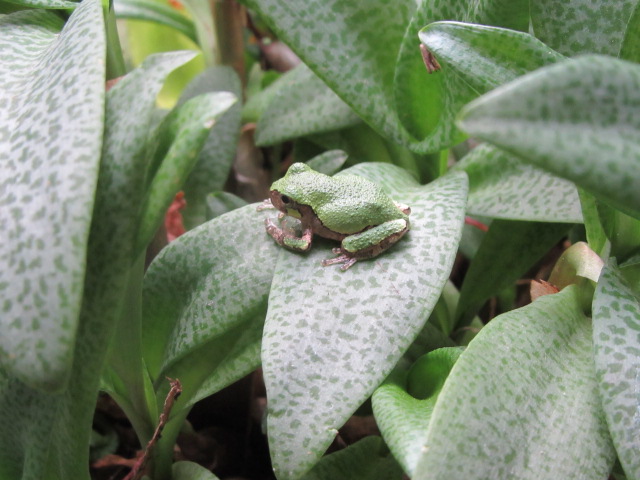
I checked on the Missouri Plants website and it wasn’t on the list but three other species were. The only one I saw that looked close (from the photos) was Tragia betonicifolia (Betony-Leaf Noseburn). At the bottom of the page it says T. urticifolia closely resembles the species but isn’t found in Missouri. I checked the maps on Plants of the World Online, Flora of North America, USDA Plants Database, and BONAP and all agreed T. urticifolia isn’t in Missouri. Well, one would have been enough but I had to try. 🙂 The maps do show Tragia betonicifolia is in Missouri but not in Pettis County where I live. However, the species has been found in Henry County which is across the street, and Johnson County which is only a few miles away. How many times has that happened? Too many to count… Even the tree frogs that like my house are a species not found in Pettis County but they are in Henry, like 100′ away. 🙂

Even though I had my doubts the species was Tragia urticifolia, I went ahead and submitted the observation as such with seven photos. The more detailed photos you have the better especially when you are in doubt… Oddly, no one agreed or suggested a different ID even after a month (when I am writing this). I decided I would go back and do more exploring… There were only two observations of Tragia urticifolia posted in Missouri and one was mine. However, there were seven for T. betonicifolia and three were from botanists. SO, I sent them a message along with a link to my observation. One replied the next day and said “…I hate basing IDs on geography alone, so I keyed it out to confirm the ID. Your plant is T. betonicifolia. They are difficult to distinguish from photos (keying requires an angle of the flowers that shows the right character), so it doesn’t surprise me that iNat’s algorithm had trouble with it.” I can certainly understand that… Out of 909 observations (402 different species) I have submitted to iNaturalist, they have only been a little off a few times. I think that is pretty darn good!

Tragia betonicifolia (Betony-Leaf Noseburn) on 6-26-22, #896-34.

Tragia species are monoecious and produce separate staminate (male) and pistillate (female) flowers on the same plant but in an odd sort of way. Unlike members of the Asteraceae, for example, which produce male and female flowers on the same flower. They produce a single pistillate flower at the base of the inflorescence (floral stem), then a raceme of up to 30 staminate flowers. Compared to other photos I have seen online, the inflorescence in the above photo is, ummm, somewhat short and apparently, the pistillate flower has already been fertilized…

Tragia betonicifolia (Betony-Leaf Noseburn) on 6-26-22, #896-36.

The above photo was taken of a different inflorescence where you can see the fuzzy fruit that has started to develop from the ovary of the pistillate flower. Above the fruit, you can see the remains of a few staminate flowers. There were more staminate flowers at the top of the inflorescence but those photos were all blurry… By the time I went through the photos, the hayfield was cut along with this plant… GEEZ! You know what they say? “He who hesitates…” The ovaries have three large carpels…

OH, I better not forget to mention that Tragia species are members of the spurge family Euphorbiaceae. They are covered with STINGING hairs that are said to cause intense pain. One website said as much pain as you could ever have. When I read that, I was reminded of my kidney stones…

if you want to read more about this species, the Missouri Plants website has some good photos with technical descriptions. The Arkansas Native Plant Society also has great photos and a lot of very good information.

Moving right along…

Apocynum cannabinum (Hemp Dogbane) on 6-26-22, #896-1.

I ran across a good-sized colony of Apocynum cannabinum (Hemp Dogbane), which is beginning to be an old story. I first identified this species from a single plant I found in the south side of the main hayfield in 2020. Since then, they have spread like you wouldn’t believe! In 2021, I found one along the road in front of the garden so I let it grow… After the hay was cut in the south hayfield in 2021, a HUGE patch came up toward the front. This year, the single plant along the road in front of the garden turned into a HUGE colony… GEEZ!!! I think this species could be somewhat invasive…

Apocynum cannabinum (Hemp Dogbane) flowers on 6-26-22, #896-4.

They produce LOTS of flowers. Ummm… There are those darn black bugs AGAIN… Maybe we should have a closer look…

Corimelaena pulicaria (Black Bug) on 6-26-22, #896-13.

Well, I took several photos to get a good one… I uploaded the photos on iNaturalist and they listed several suggestions of species seen nearby. At first, I thought they were possibly Sehirus cinctus (White-Margined Burrower Bug), so I selected that name on the list and went with it hoping someone would have an idea. The color looked similar, but so did the other suggestions. Within no time, a member suggested the genus Corimelaena, a member of the family Thyreocoridae (Ebony Bugs)… So I checked the genus out and found a website that listed several species and what plants they preferred. Low and behold, it said Corimelaena pulicaria feeds on Apocynum cannabinum (among other plants). So, I went with that species and changed the name on the observation. Even though iNaturalist gives the common name Black Bug, many websites don’t even give a common name. There are many species of “Black”, “Ebony”, and “Negro” bugs in several genera that look exactly alike to me… I didn’t feel like catching one looking at this and that part with a magnifying glass… Looking again, they could be Corimelaena obscura… I think I will stop thinking about it for now and just stick with Corimelaena pulicaria or maybe just some kind of a Thyreocoridae. Well, since I can’t pronounce that either, how about just a black bug… 

I went on the back of the pond AGAIN to check on the Calico and Ontario Asters which basically looked the same as they did a month earlier only a little taller… Nothing exciting to report.

Elephantopus carolinianus (Leafy Elephant’s Foot) on 6-26-22, #896-18.

I walked over to where the Elephantopus carolinianus (Leafy Elephant’s Foot) are growing and they were looking GREAT! I don’t remember if I mentioned it before, but there are two small colonies. One behind the pond and one under the persimmon tree. The plants under the persimmon tree are much easier to get to.

Diospyros virginiana (American Persimmon) on 6-26-22, #896-17.

The persimmons are coming along nicely…

Time has sure flown by The next post will be more or less up to date.

Until then, be safe and stay positive. Always be thankful and try to GET DIRTY.


A Little Catching Up Part 2…

Lotus corniculatus (Bird’s Foot Trefoil) on Brandon Road along the south side of Farrington Park on 6-12-22, #890-36.

Hello everyone! I am back again with part two. It has been very hot but we had a little more rain which cooled things down a bit for a couple of days. It will be in the upper 90’s again this week. It’s OK as long as I can keep working in the shade and there is a little breeze.

Nothing exciting to report before I begin on the update for June… The hay has been cut which makes it easier to walk around in the hayfields although all the wildflowers there have also been cut down. There are still wildflowers in the wooded areas, along the fence rows, and around the pond to watch. Oh, yeah, and the trail.

So, let’s continue with June 5.

Tragopogon dubius (Yellow Salsify) on 6-5-22, #887-2.

There are two groups of these darn plants that keep evading getting photos of their flowers taken. They are growing in the jungle along the road in front of the southwest pasture/hayfield. I took photos of the plants and submitted them on iNaturalist for an ID and found out they are “likely” Tragopogon dubius (Yellow Salsify). Supposedly, the large yellow flowers are quite a sight and face the sun (like sunflowers). Unfortunately, on sunny days, the flowers usually close by noon. Even though I drive by them sometimes between 9-10 in the morning, I STILL haven’t managed to see them. They flower from April-August so maybe I still have a shot for a shot. The seed heads are around 5″ across and are a good 3′ in the air. This is the first year I have noticed them and I haven’t run across any on back roads or along the highways. It is also related to Tragopogon porrifolius which is used as an ornamental and their roots which taste similar to oysters. The USDA Plants Database lists 7 species and a few hybrids in North America… Tragopogon dubious (Yellow Salsify), T. porrifolius (Salsify), and T. pratensis (Jack-Go-To-Bed-At-Noon) are found throughout most of North America. All species are introduced species (not native), mainly from Europe and Africa, and have several common names…

JUNE 11… 

Colinus virginianus (Northern Bobwhite Quail), 6-11-22, #889-1.

You know, I have often wondered what happened to all the Bobwhite Quail. They were everywhere when I was a kid. When I moved to the farm in 1981 after grandpa died, there was always a pair that nested in the fence row around the yard and several elsewhere on the farm. When I moved back here in 2013, there were none. Dad said between the hawks and cats, they just disappeared. So, on my way back from a friend’s farm (Jay), a pair was walking down the road in front of me. I slowed down and they didn’t seem to be in any hurry. I stopped to take a few photos. I was very happy to see them and even happier I had my camera. 🙂

June 12

On the way back home from Jay’s on the 11th, I took the road along the south side of the park. I noticed the Winecup Mallow was blooming up a storm. I had my camera so I’m not sure why I didn’t go ahead and take photos. Heck, it was almost a month ago. SO, I went back on the 12th… Ummm… I got a little carried away because I found A LOT of plants to photograph including a new species (new to me)…

Asclepias syriaca (Common Milkweed) along the south side of the park on 6-12-22, #890-7.

I drove down Brandon Road which runs along the south side of the park. I passed what I went for and had to turn around in a driveway on the other side of the road just past the park. On the way back, I had to stop to take a few photos of a good-sized colony of Asclepias syriaca (Common Milkweed). There seems to be an abundance of these along the back roads and highways (at least the few I travel on).

Callirhoe involucrata (Winecup Mallow) on 6-12-22, #890-11.

Then I drove back up to where the Callirhoe involucrata (Winecup Mallow) was. The colony seems to get bigger every year. It is a spectacular sight that brightens up the whole area.

Callirhoe involucrata (Winecup Mallow) on 6-12-22, #890-18.

The flowers are so bright it can be difficult to get photos in bright light.

Euphorbia davidii (David’s Spurge) on 6-12-22, #890-24.

There were several other species of plants growing in and around the Winecup Mallow I had previously identified. But what caught my eye was one I hadn’t seen before but I knew what it was.  Euphorbia davidii (David’s Spurge)

I read about it before while working on the page for Euphorbia dentata (Green Poinsettia/Tooth Spurge) I found growing inside the old foundation last year. I “think” I found several plants growing along the front of the foundation this year, but they haven’t flowered yet…  Ummm, they may have gotten trimmed off earlier… Well, I was looking inside the foundation for them. I did get some seeds from them but I neglected to plant them. GEEZ!

Euphorbia davidii (David’s Spurge) on 6-12-22, #890-27.

The Euphorbia davidii has longer, narrower leaves with maroon spots…

Euphorbia davidii (David’s Spurge) on 6-12-22, #890-30.

Like the Euphorbia dentata, it has these interesting fruits… As with other members of the family, they exude a milky latex sap that is not good for you.

Euphorbia davidii is native to mainly the southwest United States and Argentina, but has spread eastward and can also be found in southeast Canada.

After I was finished taking photos along the road next to the park, I went to the trail. I am still in search of the allusive Cutleaf Grapefern… It was about 6:15 PM.

Sanicula canadensis (Black Snakeroot) on 6-12-22. #890-41.

One of the first plants I ran across was a nice Sanicula canadensis (Black Snakeroot). I first identified this species around the same area in 2021. This year I have found it in several areas on the farm. Despite its name, it is a neat plant that can grow around 4 1/2′ tall. It has odd flowers and neat leaves and has been used as a heart remedy…

Triodanis perfoliata (Clasping Venus’s Looking Glass) on 6-12-22, #890-49.

I then ran across an old friend, the Triodanis perfoliata (Clasping Venus’s Looking Glass). What a neat little plant! I first identified this species from a single plant in the back of the farm in 2020, then found A LOT of them in the south hayfield in 2021.

Anemone virginiana (Tall Thimbleweed) on 6-12-22, #890-1).

Then I ran across the stately Anemone virginiana (Tall Thimbleweed). I first identified this species along the trail a year ago and there aren’t that many. These plants can also grow to around 4′ tall and have neat, good-sized leaves. They grow from a single stem and branch out at the top.

Anemone virginiana (Tall Thimbleweed) on 6-12-22, #890-5.

The flowers emerge at the top of long petioles, while the involucral bracts are 5-15″ below the flowers…

I was finally able to get into the trees in several spots… I looked here and there and there was no sign of the fern…

THEN FINALLY!!!

Sceptridium dissectum (Cutleaf Grapefern) on 6-12-22, #890-46.

There it was!!! The Sceptidium dissectum (Cutleaf Grapefern). I found several in April here and there but they seemed to have disappeared and the one I did find was small and weird… Well, at least I managed to find this one!

Galium circaezans (Forest or Licorice Bedstraw) on 6-12-22, #890-31.

I continued looking to see if I could find more of the Grapefern. I walked into this one spot and turned around and saw this plant that resembled Silene stellata (Starry Campion) but something was a bit off… Silene Stellata isn’t supposed to have flowers like that! I took several photos to upload on iNaturalist and found out it was yet another Galium species called Galium circaezans, commonly known as Forest or Licorice Bedstraw.

Silene stellata (Starry Campion) on 6-12-22, #890-47.

There are A LOT of Silene stellata (Starry Campion) along the trail but finding them in flower is a different story! Missouri Plants say they bloom from June to September, so I thought I could keep an eye on them since they are right next door! Well, I went back to the trail on July 17 and all I found were dried-up flowers. GEEZ!!!

Plagiomnium cuspidatum (Woodsy Thyme-Moss) on 6-12-22, #890-37.

I found several clumps of Plagiomnium cuspidatum (Woodsy Thyme-Moss) which are always neat with their long fern-like leaves.

Entodon seductrix (Seductive Entodon Moss) on 6-12-22, #890-22.

Then, I ran across a new moss called Entodon seductrix (Seductive Entodon Moss).  Hmmm…

Entodon seductrix (Seductive Entodon Moss) on 6-12-22, #890-23.

Mosses are interesting and some species look A LOT alike. I did get some close-ups but they weren’t good enough to save. They did prove the species name, however, with a little imagination and help with iNaturalist and a few other websites.

JUNE 14…

Erigeron divaricatus (Dwarf Conyza or Dwarf Fleabane) on 6-14-22, #891-2.

I decided it was high time I identified these weird fuzzy-looking plants that like growing in the cracks in the driveway. They turned out to be Erigeron divaricatus commonly called Dwarf Conyza or Dwarf Fleabane. Hmmm… It’s an Erigeron species? Related to Erigeron canadensis (Syn. Conyza canadensis) (Horsetail) and Erigeron annuus (Annual Fleabane) Weird! You would never imagine they are related…

Parietaria pensylvanica (Pennsylvania Pellitory) on 6-14-22, #891-8.

Then this other plant said, “WHAT ABOUT ME? I have been here forever and you always pass me by”. So, I said, “OK, OK. I’ll take your photo.” It turned out to be Parietaria pensylvanica (Pennsylvania Pellitory). Considered a common weed found in almost every state in the United States, in Canada, and even down into Mexico.

Parietaria pensylvanica (Pennsylvania Pellitory) on 6-14-22, #891-9.

Their flowers have no petals and appear along the stems at leaf nodes. This species is a non-stinging member of the nettle family Urticaceae… The genus name means “walls” and the common name “Pellitory” also refers to it growing along walls… Hmmm…

JUNE 16…

Galium circaezans (Forest or Licorice Bedstraw) on 6-16-22, #892-6.

Then when I was working on Kevin’s landscaping on June 16, I found another Galium circaezans (Forest or Licorice Bedstraw)! It was growing through the ivy in front of a blue spruce! You just never know what you will find or where when you least expect it…

Galium circaezans (Forest or Licorice Bedstraw) on 6-12-22, #890-34.

Some day I will get better photos of the flowers…

JUNE 22…

When I was driving along the back roads on June 22, I noticed a few clumps of these yellow flowers I hadn’t noticed before. Some of the colonies kind of had a raggy appearance and wasn’t sure if I could get good photos…

Hypericum perforatum (Common St. John’s Wort) on 6-22-22, #894-3.

Then, along a curve, I found a patch that looked a little better. I didn’t recognize the species, so I took A LOT of photos. The wind was blowing and the sun was fairly bright in this location, so I knew some of the photos wouldn’t be that great. When I got home, I uploaded the photos on iNaturalist. The first suggestion was Hypericum perforatum also known as the Common St. John’s Wort. Hmmm…

Hypericum perforatum (Common St. John’s Wort) on 6-22-22, #894-7.

It’s a good thing I was able to get a good close-up or I would have had to go back and take more photos. Even so, you can’t hardly see the spots along the margins of the petals. You may have to use your imagination…

OK, here’s a zoomed-in screenshot…

In 2019, I found a few Hypericum punctatum (Spotted St. John’s Wort) in the southeast corner of the farm. The petals and buds were covered with spots. I have searched for it every year since but never saw the little “wort” again…

JUNE 24…

Hypericum perforatum (Common St. John’s Wort) on 6-24-22, #895-2.

After a couple of days, I went back to the same curve and got a shot of the colony of the Hypericum perforatum

Mimosa nuttallii (Catclaw Briar) on 6-24-22, #894-3.

Right in the same area, I noticed these weird fluffy pink flowers. I went over to examine them and realized it was a plant I had been wondering about for several years. I actually never saw them in bloom, but I could tell from their leaves. When I uploaded the photos on iNaturalist, it confirmed Mimosa nuttallii whose common names are Catclaw Briar, Sensitive Briar (or Brier), and probably others. If you get stuck by their thorns you would likely call them something else…

Mimosa nuttallii (Catclaw Briar) on 6-24-22, #894-5.

The small leaves resemble those from mimosa or locust trees, or a few other plants with similar ferny leaves… I remember as a kid I would find them and tough their leaves to see what happens. I am now 61 and I still do it!

Mimosa nuttallii (Catclaw Briar) on 6-24-22, #894-7.

It was kind of an exciting nostalgic moment when I touched the leaves and they closed up!

Mimosa nuttallii (Catclaw Briar) on 6-24-22, #894-6.

One thing I don’t remember as a kid is the thorns. YIKES! I guess they protect the sensitive leaves…

It is weird how many species of plants are on this same corner. I have stopped there several times in the past to take photos.

Hemerocallis fulva (Orange Day-Lily), 6-24-22, #895-1.

Across the road was a small colony of Hemerocallis fulva (Orange Day-Lily). This has been a great year for them because I have seen them growing here and there on just about every road I have been on (some very large colonies). They are native to several Asian countries but now grow wild in other countries and a good part of the United States. According to the Wikipedia article, they were planted and naturalized in Europe as early as the 16th century. They are listed as wildflowers on several websites, including Missouri Plants. As you know, there are HUNDREDS of cultivars these days, but the plants on my farm (planted by my grandparents) and on many old homesteads have the same old orange flowers. Common names include Orange Day-Lily, Tawny Daylily, Corn Lily, Tiger Daylily, Fulvous Daylily, Ditch Lily, Fourth of July Lily, Railroad Daylily, Roadside Daylily, Outhouse Lily, Wash-House Lily, and probably others…

I think I will close this post and get ready for part 3… It will be about the photos I took on June 26. There are too many to include in this post.

Until then… Be safe, stay positive, keep cool, always be thankful, and GET DIRTY if you get a chance!


A Little Catching Up Part 1…

Ranunculus sardous (Hairy Buttercup) in a friends pasture on 5-22-22, #882-30.

Hello everyone! I hope this post find you all very well. It has been a while since my last post, but I am alive and well. I get busy doing this and that during the day then in the evening I watch something on the TV, sometimes longer than I want. Heck, I haven’t posted since April 24! I have been photographing wildflowers like before and am still finding a few new species on the farm. It seems odd how they just pop up. How did they get here and where did they come from?

I will start the post with the Ranunculus (Buttercup) then begin the update with April 29.
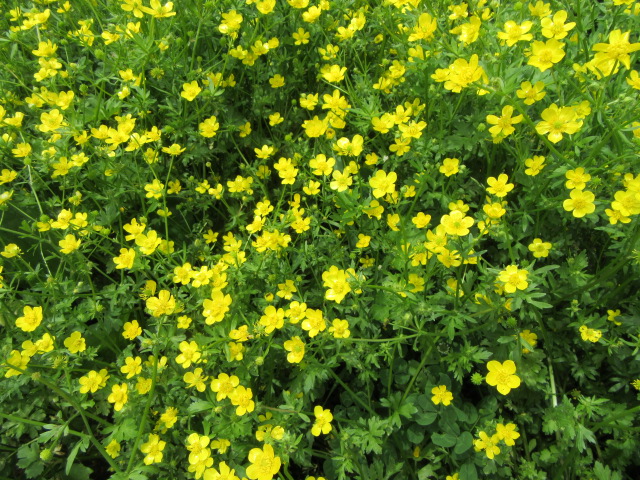
Ranunculus sardous (Hairy Buttercup) on 5-22-22, #882-31.

I did have a breakthrough with the Ranunculus (Buttercup) species here. I am pretty sure I have them figured out, but how sure is a secret. It sometimes seems “we” make things harder than they really are. I don’t want to point the finger at myself so I am saying “we”. My higher self is reminding me that “we” in this case means me, myself, and I… I then remind my higher self I don’t even know what my higher self really is. It just sounds good and makes me sound spiritual. I started writing a post about the Ranunculus, but it was saved to the drafts. You know how it is… I start writing a post about particular wildflowers and once they fade the post is out of date.
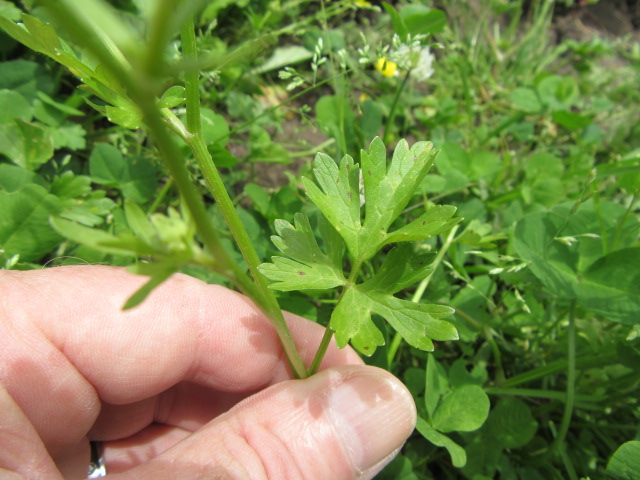
Ranunculus sardous (Hairy Buttercup) on 5-22-22, #882-36.

I had been feeding the cows at Kevin’s and noticed his main pasture was LOADED with what I assumed was probably Ranunculus hispidus (Bristly Buttercup) even though I didn’t think they grew like that. Fortunately I was mistaken because I learned something. When I was taking photos, I took some close-ups of the leaves, stems, flowers, and fruit. I had just been working on the pages of Ranunculus and was writing descriptions, so the descriptions of R. hispidus was fresh in my mind. SO, as I was taking photos of the leaves, I noticed something a bit off… The first two leaflets of R. hispidus leaves “usually” have small petiolules but these didn’t have any. Hmmm…. Also, the fruit, which I had disregarded before, were supposed to be different. SO, I took photos of the fruit to compare them with what was on the Missouri Plants website. USUALLY, flowers and leaves are enough to get a positive ID with most species. But since there are many Ranunculus species that look alike, you have to go further. Unfortunately, the close-ups of the fruit were blurry…

Ranunculus sardous (Hairy Buttercup) on 5-24-22, #883-21.

Later in the evening, I went to check the plants around the pond on my farm but I stopped at the gate by the barn to take photos of a colony of Ranunculus parviflorus. Then I took a few other photos on the way to the pond of this and that… I checked the leaves on the Ranunculus there and was SHOCKED to see the same as the plants at Kevin’s. The darn HUGE colony I had been stumped over for several years were the same!!! By then, it was getting to dark to take good photos. On the 24th I was able to take some good photos, even of the fruit, which confirmed Ranunculus sardous, commonly known as Hairy Buttercup. The fruit of Ranunculus hispidus have long tips (beaks), while R. sardous are more stubby with short tips… Then I realized most of the photos of what I thought were R. hispidus were actually R. sardous. The only R. hispidus were taken in 2020 in another area on Kevin’s farm across the highway along a creek in a shady area. Ranunculus hispidus prefers a damper and less sunny habitat than R. sardous. That’s why I thought it was odd for them to ge growing in mass right out in the sun in the pasture. Ranunculus species are toxic to cattle but usually won’t eat them when they have other vegetation to graze on. Ranunculus sardous can take over when pastures are over-grazed…

Ranunculus parviflorus (Stickseed Crowfoot or Smallflower Buttercup) on 5-24-22, #883-10.

There are some good-sized clumps of Ranunculus parviflorus, known by the common names Stickseed Crowfoot and Smallflower Buttercup (and probably others) growing behind the barn and around the pond.

Ranunculus parviflorus (Stickseed Crowfoot/Smallflower Buttercup) on 5-24-22, #883-11.

Ranunculus parviflorus grow in thick mats and their long stems get tangled up. No mistaking this species here for sure.

Ranunculus parviflorus (Stickseed Crowfoot/Smallflower Buttercup) on 5-24-22, #883-12.

The weird flowers and fruit are very small…

Ranunculus species can be somewhat difficult if you are in an area where you have several species that are very similar. The Missouri Plants website lists 13 species of Ranunculus in Missouri and I thought I had identified six here on my farm and R. sardous wasn’t even in the running. After several years of deliberation, I think there are only three which includes the earlier flowering R. abortivus (Small-Flowered Buttercup/Crowfoot), Ranunculus parviflorus, and now R. sardous… The others I thought were here are likely R. sardous.

There will be more photos and descriptions on the page once I get it finished. I worked on writing descriptions during the winter for plants, but when May came I started taking more photos and pretty much skipped R. parviflorus. I will get back to writing descriptions and making updates once we get an “F” in October…

This post is catch up on new species I found since the last post until now but I have thrown in a few previously identified species as well.  Previously identified species, if they have a page,  are highlighted in green which you can click on to go to their own pages if you want to read more and see more photos. Some of those pages don’t have descriptions… It is a work in progress… 🙂

Starting with April 29…

Viola striata (Cream Violet) on 4-29-22, #875-38.

I really enjoy finding new species of Violets and this Viola striata (Cream Violet) just happened to come up in the north bed close to the Hosta ‘Empress Wu’. The Missouri Plants website says it is the only “stemmed” violet in Missouri with white flowers.

MAY 1…

Viola pubescens (Downy Yellow Violet) on 5-1-22, #877-16).

Then, on May 1, I found the first Viola pubescens (Yellow Downy Violet) on my side of the fence in the back of the farm. The first one I found was along the creek on the other side of the fence and on a friend’s farm in 2020. I went back several times to see if I could find it again to photograph its fuzzy fruit. Unfortunately, I have yet to find it the second time… I am going to start taking old electric fence posts to mark locations… You can go to the plants page to see the fruit, but I haven’t written descriptions.

MAY 5…

Chelydra serpentina (Common Snapping Turtle) on 5-5-22, #578-9.

On May 5, I was walking around the back pond and this snapping turtle was being really weird. It was putting its head in the water and then back up, kind of like it forgot how to swim. The water was pretty shallow and just a few days earlier it was almost dry. After a few minutes, another turtle shot out from under it. Hmmm… Like I have said before, it would have made a great video…

MAY 12…

Potentilla simplex (Common Cinquefoil) on 5-12-22, #881-6.

Almost as exciting as finding a new species, is one that returns in the same area the second year. Well, it is highly likely that the Potentilla simplex (Common Cinquefoil) has been coming up along the fence in the southeast part of the farm for several years. I just found it last year…  Unlike its cousin, Potentilla recta (Sulfur Cinquefoil), this one has much smaller and brighter yellow flowers, and it has trailing stems. The southeast corner of the back pasture/hayfield is the only area I have found it. The Potentilla recta grow everywhere else.

Potentilla simplex (Common Cinquefoil) on 5-12-22, #881-9.

The flowers are rather flat. Some websites say the green calyx has 5 triangular tips that are a little shorter than the petals. The Missouri Plant’s website show flowers with multiple sepals, but they are shorter than the petals.

Potentilla simplex (Common Cinquefoil) on 5-12-22, #881-10.

I think its way of fruiting to be quite strange since the flowers were so flat looking. I have not seen any species except this one whose “receptacle” comes out of the flower. OK, technically, with this species (or genus) it is the hypanthia (hypanthium) which is a tubular or cup-like receptacle on which the stamens, petals, and sepals are borne (Missouri Plants glossary). Hmmm… Looking at the above photo, you try to make sense of that description. It looks like the petals and “cup” the sepals grow from slid down or it grew a longer peduncle… Anyway, I am glad I got a good shot as confusing as it is. 🙂

Valerianella radiata/Valeriana woodsiana (Beaked Corn Salad) on 5-12-22, #881-16.

I also ran across a few nice-sized colonies of Valerianella radiata/Valeriana woodsiana (Beaked Corn Salad) in the pasture. I first identified this species in the area north of the chicken house in 2020. This is certainly a neat plant with small clusters of white flowers and weird leaves (especially the upper leaves.

Although Plants of the World Online says the species is Valeriana woodsiana, basically all other websites and databases say Valerianella radiata. I contacted the editor of Kew and he said Valerianella species have been moved to Valeriana. Sometimes I ask him if he is sure… Some botanists disagree and the curators of some databases don’t either.

ANYWAY…

Tyrannus tyrannus (Eastern Kingbird) on 5-12-22, #881-13.

I continued my walk along the edge of the south hayfield when this bird came along for a visit. At first, it resembled a male Purple Martin, but as I looked at it close-up with the camera I realized it wasn’t. I found out it was an Eastern Kingbird (Tyrannus tyrannus) which I had never seen before. Rather than flying high in the air, this bird flies just over the grass searching for low-flying insects.

MAY 22…

Thlaspi arvense (Field Penny-Cress) on 5-22-22, #882-44.

SOOOO, on May 22 when I was talking to myself about the Ranunculus, I saw this oddity sticking up in the Ranunculus parviflorus next to a gate by the barn. Previously in the day, I had photographed Lepidium virginicum (Poor Man’s Pepper) which had MUCH smaller fruit. Heck, it is so common along my driveway I hadn’t even bothered to identify it until now… Well, the plants along the driveway get mowed off so I photographed a much larger one on a friend’s farm. It was the same day I photographed the Ranunculus that turned out to be R. sardous on Kevin’s farm, which is why I was talking to myself. I was walking through the gate next to the barn and there it was, sticking up through a clump (understatement) of Ranunculus parviflorus… There were NO leaves on this stem so I took a couple of shots of the fruit then went on to the pond to check out the Ranunculus there… Later in the evening, I drug and dropped the photo on iNaturalist and it suggested a species by the name of Thlaspi arvense, also known as Field Penny-Cress

Conium maculatum (Poison Hemlock) on 5-22-22, #882-2.

A friend of mine (Kevin) sent a photo of a HUGE colony of Conium maculatum (Poison Hemlock) in 2021 from one of his pastures. I see them all along the highway and backroads but had never seen any up close and personal. Then in April, I saw one growing along the edge of the yard of the church next door that had been mowed off. On May 1, I spotted one right behind my own yard! It had no flowers, so I thought I would let it grow and then cut it down after it bloomed. Then on May 22, I noticed it had flowered so I went to take a few more photos. The plant was HUGE, taller than me. This is a plant you should be careful with as it is what killed Socrates… I also noticed a few more close to the same area. Time went by and the next thing I knew the hay was cut and they got baled up…

Cruciata pedemontana (Piedmont Bedstraw) on 5-22-21, #882-4.

Previously, on May 1, I photographed this plant when it was much smaller and submitted it to iNaturalist. I thought I had identified it before but apparently not. It turned out to be a large cluster of Cruciata pedemontana, commonly known as Piedmont Bedstraw… It is growing here and there in a few somewhat bare spots.

I am almost certain I identified a similar plant growing at the base of a sycamore tree in my yard last year. Hmmm… I have to do some checking.

Cruciata pedemontana (Piedmont Bedstraw) on 5-22-21, #882-5.

Now, if you look at the above close-up photo it may remind you of the dreaded Galium aparine, also known as Cleavers or Catchweed Bedstraw. Of course, it is a plant we love to hate because of those darn stick-tight seeds that stick on our clothing (the entire plant will stick to you even when green). In fact, the species name of this one used to be Galium pedmontanum… and it doesn’t appear to be sticky…

Cruciata pedemontana is an introduced species that Missouri Plants says was unknown in Missouri when Steyermark’s Flora of Missouri was published in the mid-1970’s. Since then, it has spread like wildfire and was reported in 43% of the counties in Missouri in 2020. The map on the USDA Plants Database is completely whacky for this species…

MAY 24…

Thlaspi arvense (Field Penny-Cress) on 5-24-22, #883-23.

Then, on May 24 after taking more photos of the Ranunculus, I started walking in an area north of the pond. LOW AND BEHOLD I found a good-sized colony of Thlaspi arvense!  Usually when I am walking in this area I am 20′ or so north and headed to the main hayfield which is why I hadn’t noticed them earlier.

Thanks to Dave’s Garden, I learned the scientific name is pronounced THLAS-pee ar-VEN-see. Hmmm…
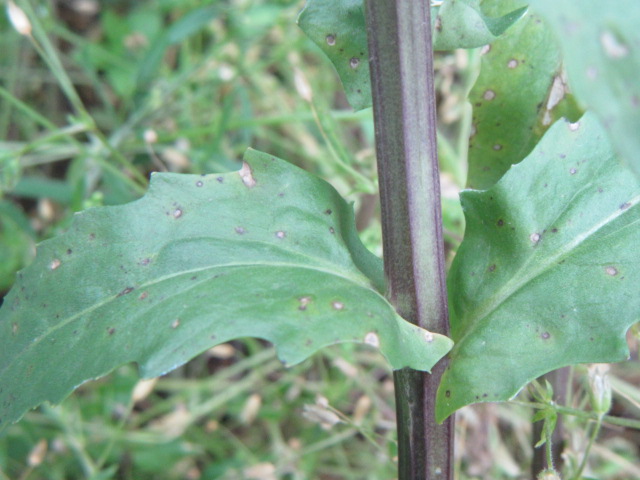
Thlaspi arvense (Field Penny-Cress) on 5-24-22, #883-26.

These plants still had leaves but they can be absent at flowering. I always like clasping leaves. Just look at the ribbed stems!

Thlaspi arvense (Field Penny-Cress) on 5-24-22, #883-30.

A few feet away was several smaller plants that were still in flowering mode. As you can see the flowers are very tiny. It was windy, so I had to take A LOT of photos!

MAY 25…

Packera glabella (Butterweed) on 5-25-22, #884-4.

On May 25 I was walking in an area behind the chicken house that had been covered in chickweed. I had never seen it so insane! Anyway, I spotted this yellow flower sticking up through the chickweed so I decided to check it out. Hmmm… It was definitely a new species I hadn’t seen before! Sticking up through the chickweed was a single plant of Packera glabella also known as the Butterweed, Cressleaf Groundsel, and Yellowtop. Missouri Plants lists four species of Packera in Missouri and says they can be very hard to tell apart and there is A LOT of controversy which is which. According to the maps on the USDA Plants Database, of the four found in Missouri, three are found in Pettis County where I live but none in Henry County (which is across the street). Not that the USDA maps are up-to-date, but you can still get a good idea. You can zoom in on your state and see the counties the species was found in. According to BONAP (Botia of North America Program), they provided maps for the USDA and all I have seen were updated in 2014… A LOT has changed since 2014!

Packera glabella (Butterweed) on 5-25-22, #884-5.

There weren’t many leaves and what there were had been chewed on. Fortunately, judging my the leaves and stem, I believe this plant is definitely Packera glabella. The other two possibilities, Packera obovata (Groundleaf Ragwort) and Packera plattensis (Prairie Groundsel) have different leaves and one is very hairy…

The USDA Plants Database lists 73 species of Packera in the United States and Canada. The species in the genus were formerly species of Senecio

MAY 28…

I decided I needed to go to the back of the farm again to check the progress of the Elephantopus and the asters behind the back pond. I didn’t want to write the “S” word. OK, I’ll do it anyway… The Symphyotrichum lateriflorum and S. ontarionis. I can’t spell those names without looking them up let alone pronounce them! Anyway, I went the same route as on May 25 behind the chicken house.

Sisymbrium officinale (Hedge Mustard) on 5-28-22, #885-38.

I crossed the ditch and was surprised to see the Sisymbrium officinale (Hedge Mustard) had moved to a new location! It was in the vicinity where I found the Field Penny-Cress last year, but it was nowhere to be found in 2022.

In May 2021 I was having difficulties with my camera and it completely went bonkers for good at the end of a wildflower walk with my son. I had already taken quite a few photos with much difficulty and on the way back to the house I ran across a patch of Sisymbrium officinale which was a new species. I tried AGAIN to get the camera to work and it wouldn’t. The viewfinder was completely shot! I had watched a video on YouTube about replacing it, but just watching all that had to be done was exhausting in itself. BUT, Nathan is always eager to take photos, so he showed me how to take photos with his cell phone. He sent them to me once we got in the house but they were HHHHUUUUGGGGEEEE! It took a long time to download all of them and the photos filled my computer screen! At least I did get the species identified… SO, I was very glad to find them again on May 28th, just around 30′ or so west from where they were in 2021 and maybe 20 feet north of where the Field Penny-Cress is located.
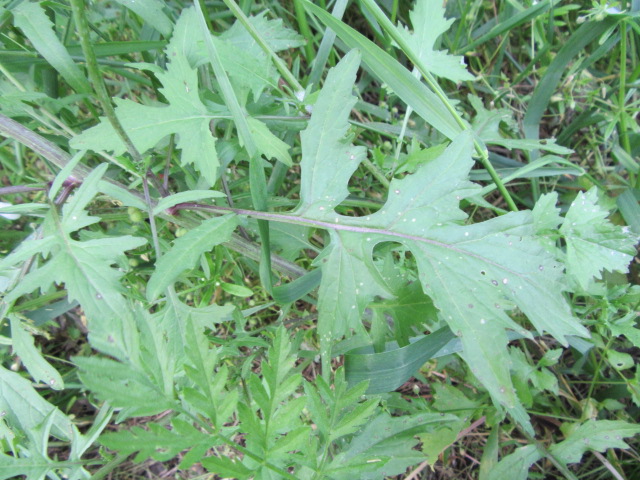
Sisymbrium officinale (Hedge Mustard) on 5-28-22, #885-40.

While the plants are young and not flowering, the leaves could easily be mistaken for a species of Lactuca of even a non-spiny Cirsium. The lower leaves are fairly broad with several lateral lobes.

Sisymbrium officinale (Hedge Mustard) on 5-28-22, #885-44.

This species is a member of the plant family Brassicaceae and has very small yellow flowers. The odd thing about this species is that the fruit (seed pods) lay parallel to the stems…

Asclepias viridis (Green Milkweed) on 5-28-22, #885-1.

Toward the end of the main hayfield, I ran across an Asclepias viridis (Green Milkweed). I have several milkweed species on the farm but this was the first time I had seen the Green Milkweed here.
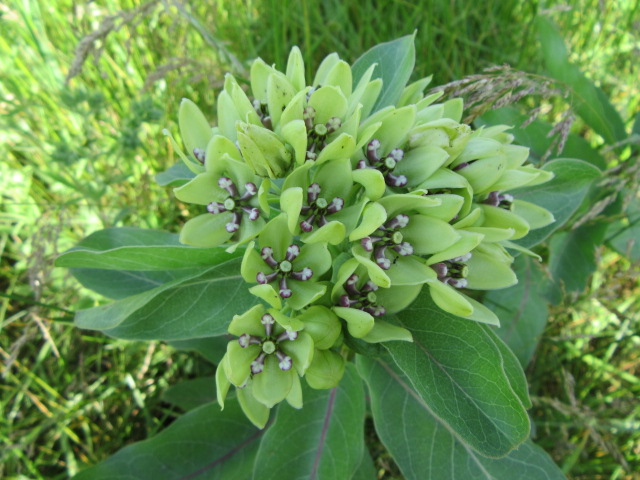
Asclepias viridis (Green Milkweed) on 5-28-22, #886-2.

These are one of my milkweeds I suppose because of the color. I just went back to this plant’s page and realized I need to work on descriptions. GEEZ! The flowers are quite complex…

I made my way to the back of the pond along the drainage ditch to check out the, ummm…

Symphyotrichum lateriflorum (Calico Aster) on 5-28-22, #885-45.

The anticipation is terrible since the Symphyotrichum lateriflorum (Calico Aster) won’t flower until August or later! There is another species, S. ontarionis (Ontario Aster), that is also behind the pond but farther south. Both are so similar they are hard to tell apart. The arrangement of the flowers and hairs on the leaves are somewhat different. I hadn’t noticed them until last fall and one of the curators on iNaturalist filled me in on how they were different and both species became research grade. You remember we had a late “F” last fall, otherwise, I wouldn’t have even noticed them. There are quite a few of both species growing behind the pond, or should I say “ponds” since there are two side by side. The Calico Aster is growing along the drainage ditch behind the old pond, while the Ontario Aster is growing along the fence behind the other. I think probably grandpa had a new pond made with the intention to make one big pond. Likely, the new pond filled with water before it could be finished because of a spring…

Elephantopus carolinianus (Leafy Elephant’s Foot) on 5-28-22, #885-13.

I walked on past the area where the Ontario Asters are to the location I found the Elephantopus carolinianus (Leafy Elephant’s Foot) last fall. I didn’t know they were there until they had gone to seed and the leaves had dried up. The plant’s looked suspicious, even dead, and I realized what they were. Made me scratch my head for a few minutes because, until 2021, the only Elephant’s Foot I had seen was on a friend’s mother’s farm in 2019. Then last year, in October, I ran across a single plant in the south hayfield. Well, after a couple of days, I went to mark its location and couldn’t find it again. SO, I was surprised I found it behind the pond and I did mark the location. I was glad they had come up again in 2022. Then came another surprise, but that is for another day…

Then, I walked toward the southeast part of the farm. You never know what you will run across…

Leucanthemum vulgare (Ox-Eye Daisy) on 6-28-22, #885-22.

I was walking along the fence and spotted a nice colony of Leucanthemum vulgare (Ox-Eye Daisy)… Hmmm… They were on the other side of the fence behind a Multiflora Rose bush. I first identified this species on Kevin’s farm north of town in 2019, then I found them in the hayfield here in 2021. They are pretty neat plants, so I crawled through the fence to get a few more photos.
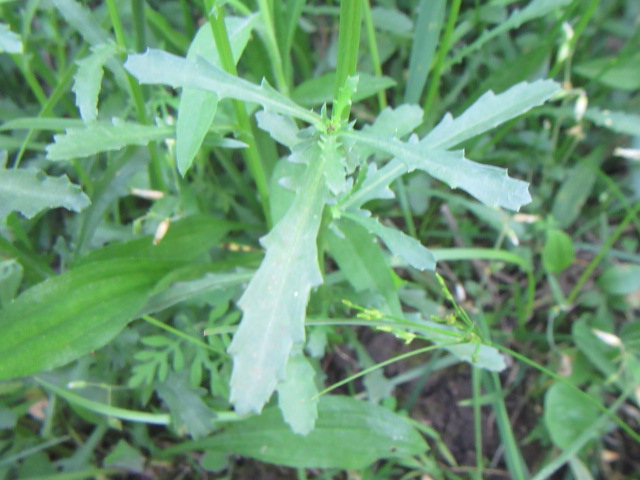
Leucanthemum vulgare (Ox-Eye Daisy) on 6-28-22, #885-25.

They have neat leaves…
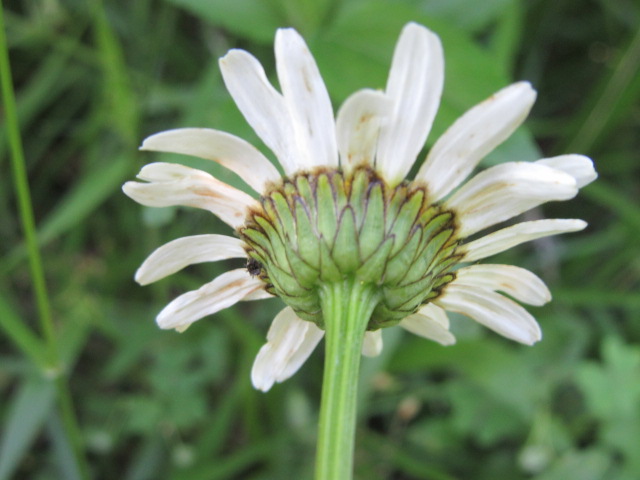
Leucanthemum vulgare (Ox-Eye Daisy) on 6-28-22, #885-27.

Plus their involucral bracts make a great photo…

Coccinella septempuncata (Seven-spotted Lady Beetle) on 5-28-22, #885-12.

I ran across a Rumex crispus (Curled Dock) with aphids being fed on by several Seven-Spotted Lady Beetles (Coccinella septempuncata). I had to take a lot of photos to get one good one. Thank goodness for Lady Bugs always at work…

MAY 29…

I decided to go to the Katy Trail next to the farm to walk around in the trees again to check on the ferns. Yeah, most people walk the trail so I have to be quiet if someone is coming. I may scare the crap out of someone. GEEZ!

Botrypus virginianus (Rattlesnake Fern) on 5-29-22, #886-1.

I did find several Botrypus virginianus (Rattlesnake Fern) but I didn’t find any Sceptridium dissectum (Cutleaf Grapefern). I wanted to photograph the Rattlesnake Fern in flower, so I was glad that mission was accomplished. I have been wondering if I should dig some up in the spring and bring them home with me. Walking through the trees along the trail is not easy when the underbrush starts taking off.
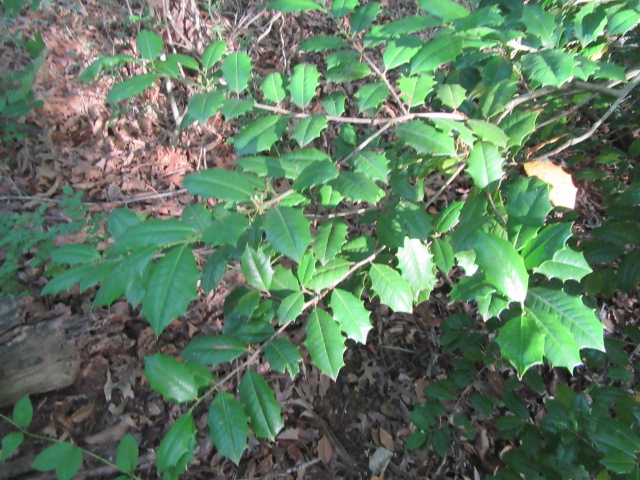
Ilex opaca (American Holly) on 5-29-22, #886-3.

Hmmm… I ran across a couple of  Ilex opaca (American Holly) trees which I thought was quite odd. What was a holly tree doing in the brush along the trail. According to the Missouri Department of Conservation, there are four species of Holly that grow in the wild in Missouri. The other three species lack spiny leaves. When I lived at the mansion in Mississippi, the shrubs in front of the house were holly. I kept them trimmed back and always looked like I had been in a cat fight when I was finished. There was also a tall holly tree in the back yard. They can grow to around 50′.

Polygonatum biflorum (Smooth Solomon’s Seal) on 5-29-22, #886-6.

Then I ran across a Polygonatum biflorum (Smooth Solomon’s Seal) that was actually blooming. The plants along the road in front of the pasture are always in bud or the flowers are closed.
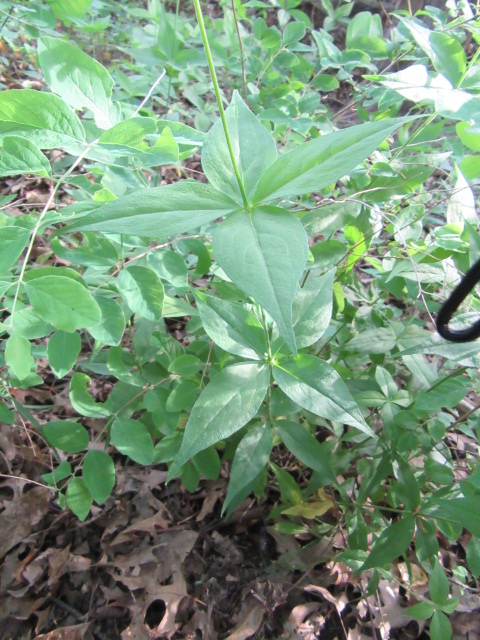
Silene stellata (Starry Campion) on 5-29-22, #886-14.

There are quite a few Silene stellata (Starry Campion) in the woods along the trail. I first identified this species from Kevin’s secured woods in 2020 but I have yet to see their flowers. According to Missouri Plants, they flower from June through September. I better get back to the trail…

I walked back home after I left the trail. It was about 8 PM and still light enough to get a few photos I needed.
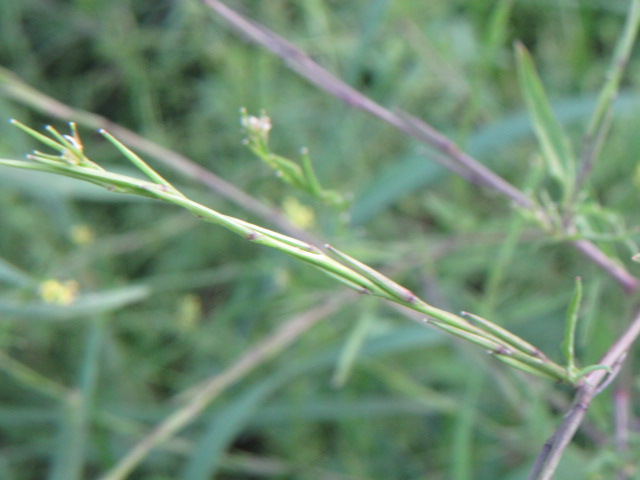
Sisymbrium officinale (Hedge Mustard)on 5-29-22, #886-16.

I wanted to get a photo of the fruit (seed pods) of the Sisymbrium officinale (Hedge Mustard) to show how they lay parallel to the stems. The other species in the family kind of hang outward.

Rumex acetosella (Sheep Sorrel) on 5-29-22, #866-7.

I then walked to the back of the farm again where I found a good-sized colony of Rumex acetosella (Sheep Sorrel). I first identified this species from a patch growing in the yard in 2020. A while back, I ran across  HUGE colony along a back road north of town. This species can become very invasive!

I will end this post and start working on part 2 which is for plants I photographed in June.

Until then, be safe, stay positive, and always be thankful!


Return To The Secluded Woods…

Hypnum cupressiforme (Cypress-Leaved Plait-Moss) on 4-20-22, #870-27.

Hello everyone! I hope this post finds you well. I haven’t been to the secluded woods on a friend’s farm since 2020. This is where in 2020 I found the Green Dragon, Jack-In-The-Pulpit, and several other wildflowers I hadn’t seen before. It is always very interesting going into the woods but it can become hard to walk in as the summer progresses. The mosquitos are also terrible after mid-May.

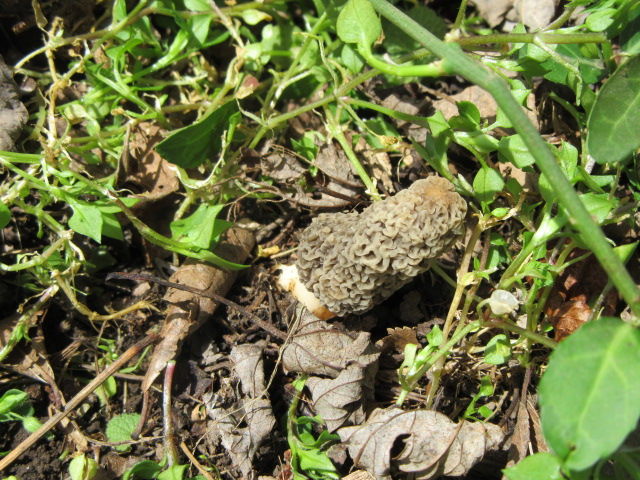
On April 19, after I fed the cows there, I decided to check out the area along the creek where I found a single White Morel in 2020. This area wasn’t far from the driveway. Well, I found five Yellow Morels… Then I decided to walk down the creek (in the water) just to have a quick look. Time flies and I made it home at 3… I didn’t have my camera and it was going to rain so I didn’t go back.

I took my camera with me the next day so I could take photos after I was finished feeding the cows. First I checked to see if there were any more morels where I found them on the 19th. There weren’t anymore, so I stepped into the creek. The hillside on the west side of the creek is very steep, so it is best to just walk in the water.

The first photo I took (top of the post) is the (Hypnum cupressiforme (Cypress-Leaved Plait-Moss) growing at the bottom of a huge tree. I identified it in 2020 from photos I submitted on iNaturalist. This moss is really neat, but it is just getting started. Hopefully, I can make it back into the woods when it is in bloom.

Interestingly, north of this tree is just a regular forest, an open woodland with mostly brush all the way to the driveway. As soon as you go beyond the tree, you step into what seems like a magical world. All along the hillside to the fence. Past the fence is once again an open woodland with a lot of brush. There are open areas where the Jack-In-The-Pulpit and other hit-and-miss wildflowers grow, but mostly it is just low-growing brush that is hard to walk in.

Then I found this one…

Plagiomnium cuspidatum (Woodsy Thyme-Moss) on 4-20-22, #870-35.

How neat is that? The Woodsy Thyme-Moss was really putting on a show. I hadn’t photographed it until now and it was a great find.

Plagiomnium cuspidatum (Woodsy Thyme-Moss) on 4-20-22, #870-36.

When moss is blooming you literally have to get down on your hands and knees with a magnifying glass to have a closer look. Well, I was standing in water so I didn’t get on my knees this time. Different species of moss have different leaves and flowers. A lot of them have similar leaves but their flowers are so weird… Like the Bladder Moss on my farm.

Plagiomnium cuspidatum (Woodsy Thyme-Moss) on 4-20-22, #870-37.

It took quite a few photos using a magnifying glass in front of my lens to get two close-ups that weren’t blurry. It had also been raining off and on for two days and was sprinkling a little when I took the photos. This was the first time I saw this moss in bloom, so I wasn’t going to let a few sprinkles stop me.

There is a lot of moss growing along the creek. On rocks, at the bases of trees, and on the ground.

There are also a lot of decaying branches and trees that have fallen over which is a perfect habitat for many species of fungi.

Now for the highlight of the day, as if flowering moss wasn’t good enough…

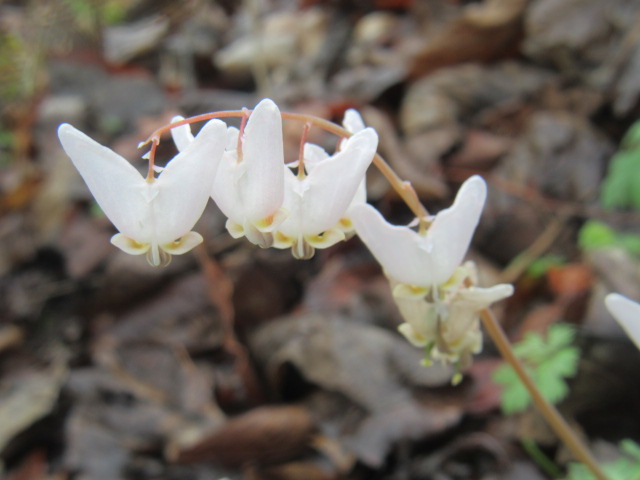
Dicentra cucullaria (Dutchman’s Breeches) on 4-20-22, #870-17.

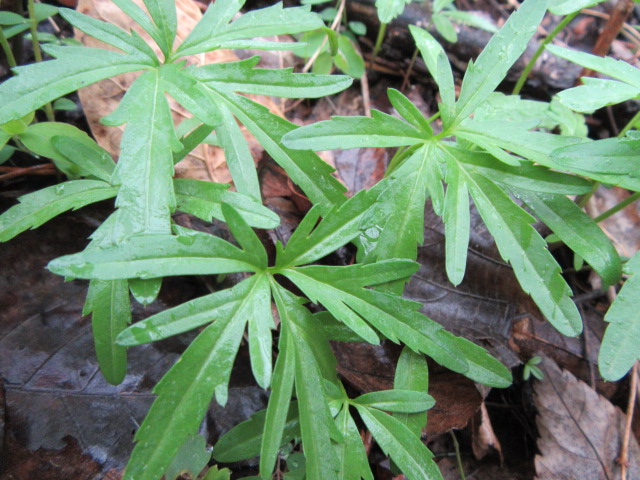
On April 23 in 2020, I found a single Dicentra cucullaria next to the creek on a steep hillside. It was pretty close to the end of the creek and I could see the highway. All that way, I only found one plant like it and there were no flowers. I was able to identify it as Dicentra cucullaria (Dutchman’s Breeches) by its leaves using the “drag and drop” feature on iNaturalist. Anyway, a few days after I saw it, we had a huge storm and the plant was either washed away or covered with mud from water rushing down the hillside. It was gone… If it wasn’t for iNaturalist, I wouldn’t have known what it was.

Dicentra cucullaria (Dutchman’s Breeches) on 4-20-22, #870-18.

SO, on the 19th, I was SHOCKED to see hundreds of Dutchman’s breeches all along the hillside next to the creek. It was AWESOME!

Dicentra cucullaria (Dutchman’s Breeches) on 4-20-22, #870-17.

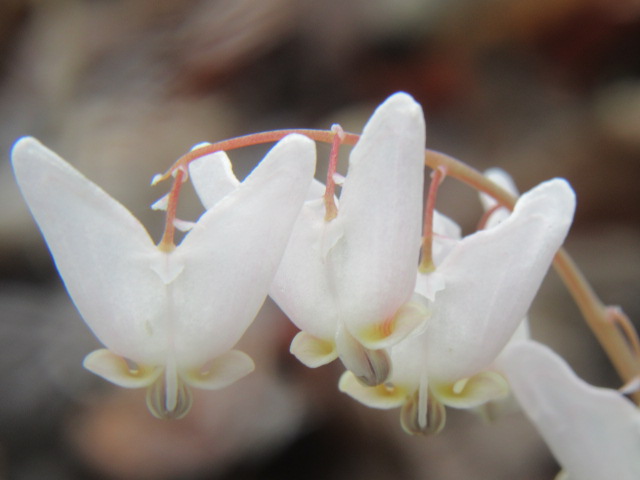
The flowers are really neat for sure but somewhat difficult to explain…

Dicentra cucullaria (Dutchman’s Breeches) on 4-20-22, #870-26.

Hmmm… The spreading petal spurs distinguish this species from Dicentra canadensis (Squirrel Corn) whose spurs are more rounded and parallel.

Dutchman’s Breeches are rhizomatous, but there are bulblets at the base of the long leaf petioles where they emerge from the ground… Hmmm… Perhaps I should dig some up and bring them home. I know just the spot to but them.

Then…

Cardamine concatenata (Cut-leaved Toothwort) on 4-20-22, #870-1.

Another plant I only found one of, and not blooming either, was the Cardamine concatenata also known as the Cut-leaved Toothwort. I looked for it every time I went back into the woods in 2020 but I couldn’t find it again. It just vanished.

This time, like the Dutchman’s Breeches, there were hundreds all along the top of the hillside.

Cardamine concatenata (Cut-leaved Toothwort) on 4-20-22, #870-2.

The area in the above photo was one of a couple that has quite a few Cut-leaved Toothwort growing. They are in danger of being washed away or covered with mud if we get heavy rain. The fallen leaves have already partially washed off the hillside.

Cardamine concatenata (Cut-leaved Toothwort) on 4-20-22, #870-7.

The leaves are a dead giveaway to what these plants are. The only thing I had to go by in 2020 which I uploaded on iNaturalist to identify the species.

Cardamine concatenata (Cut-leaved Toothwort) on 4-20-22, #870-9.

The drooping flowers have 4 bright white petals surrounded by 5 sepals. The flowers will open up but perhaps were closed because of it being cloudy and rainy…

Cardamine concatenata (Cut-leaved Toothwort) on 4-20-22, #870-10.

Somewhere in there are the stamens, filaments, anthers, and the ovary…

There were also AAAALLLLOOOOTTTT of Virginia Spring Beauty (Claytonia virginica) whose flowers were closed. The White Fawn Lily (or Dogtooth Violet) (Erythronium albidum) were all over the place but haven’t started blooming yet. They are very close, though.

In all, it was a great day! Now I can finish the pages for the Dutchman’s Breeches and Cut-leaved Toothwort so I can get them published.

Until next time, be safe, stay positive, and always be thankful. Spring is definitely a great time of the year. Time to GET DIRTY!


Short Wildflower Walk on 4-10-22…

Lamium purpureum (Dead Nettle) behind the barn on 4-10-22..

Hello everyone! We had a thunderstorm move in a little after 1 AM on Tuesday night. With all the wind, rain, thunder, and lightning we still received less than 1/2″ of rain. The Weather Channel said the rain was supposed to stop at 1, so I waited until then to feed Kevin’s cows. It all but stopped when I left but started again at 1:30. Then at 1:45, I noticed a few tiny snowflakes that didn’t last long. I arrived at the other farm, where he lives, at about 2:15 with no rain or anything. Then, when I pulled up to the feed troughs, it started sleeting like mad! It lasted until I was finished then suddenly stopped. By the time I was back at the gate, the sun started shining. That was weird! The wind that had been blowing for DAYS calmed down.

This post is continued from the previous one where I had been looking for plants in the shade bed on Sunday, April 10. When I was finished, I started my walk to the back of the pasture. Actually, finding the morels among the Hosta triggered the desire to take the walk. Of course, I took my camera so I could call it a wildflower walk rather than a mushroom hunt. Just in case I didn’t find any. 🙂

Anyway, without further blabbing…

I walked around the barn and had to get a photo of a good-sized colony of Lamium purpureum (Dead Nettle) (top photo). It seems like this spot changes from year to year as far as what species is growing here. Just so happens, that it is the Dead Nettle’s turn. I am sure you have seen fields that have turned purple in the spring. It is either Lamium purpureum, Lamium amplexicaule (Henbit), or a combination of the two. They like each other and normally where you have one, there are a few of the other. Dead Nettle normally grows taller and the Henbit just seems to fill in the gaps. Of course, chickweed is usually there as well. I have been tempted to walk out into a field just to check.

Barbarea vulgaris (Yellow Rocket/Bitter Wintercress).

Not far from the Lamium purpureum were a few Barbara vulgaris. One was just itching for me to take a photo. There are a few in the south hayfield whose flowers are already open. There are 10,473 Barbarea vulgaris on the farm (just guessing) all in a rush to produce seed. In the spring, the yellow flowers you see first out in the countryside are likely this species.

I ventured on to an area in front of the pond in the back pasture. Ummm, along a ditch that drains into the pond. I rarely go into this spot during the summer because of low branches and a few annoying Multiflora Roses and/or blackberry briars. I never really paid much attention to which. Closer to the pond is much easier access. Anyway, I went right in because it always seemed to be a good spot for “you know what” to be growing. I always look for activity from deer or wild turkeys because they like them, too. There was a lot of evidence of recent activity, so I started looking through the leaves. I found four…

Physcomitrium pyriforme (Common Bladder Moss) on 4-10-22, #866-22.

Closer to the pond were several clumps of Physcomitrium pyriforme (Common Bladder Moss). Moss has always intrigued me and if I lived in the woods I would have it everywhere. There are several clumps in the north flower bed and along the north side of the garage. I submitted this photo to iNaturalist and the suggested species was Physcomitrium pyriforme (Commo Bladder Moss) and a couple of others. Other members had posted VERY detailed close-ups, so the next day I was in another area and I took a few close-up shots. I agree it is the Common Bladder Moss.

The plants growing among this clump of moss is a Solidago sp. (Goldenrod).

Solidago sp.

There is a HUGE colony of Solidago in this area and LOTS of it growing along the edge of the south hayfield, and several other areas. I like it, but it is kind of frustrating I haven’t figured out the species. S. altissima and S. gigantea are the two species I think they are. One or the other or both. They have similar symptoms (I mean, characteristics).

I crossed the fence behind the pond and walked along the creek for a while. The woods back there are becoming a briar jungle, just wasted space where an abundance of native plants could be growing that like dappled shade or open woods. When I was a kid, I used to hunt “you know what’ with my grandpa in this area. I haven’t found hardly any since and most years I find none. I think it was 2013 when I found this HUGE False Morel but I haven’t seen any of those since either. I need a photo!

Podophyllum peltatum (Mayapple).

I ran across one of several colonies of Podophyllum peltatum (Mayapple) that apparently hadn’t been up long. I had never seen any this small, which is kind of odd. Another thing I have heard is that when the Mapapples start to bloom then you will find “you know what.” Well, they are a long way from blooming…

Podophyllum peltatum (Mayapple).

A little farther down was another colony that had leaved out more but they look a little off. Like that had been “F” bit. You know what I mean. 🙂 The word I don’t use in the fall applies in the spring as well.

So, I walked back toward the house to take a few wildflower photos.

Lamium purpureum (Dead Nettle).

The white-flowered Lamium purpureum first showed up in the spring of 2020 in the area northeast of the chicken house. There were only a few the first year but they have multiplied quite a bit. I am not sure how common Dead Nettle with white flowers are, but this is the only spot I have ever seen them. It is quite a treat but rather odd. How about you? Have you ran across any with white flowers? Information online says they can be pale pink, lavender, pinkish-purple, or white…

Ranunculus abortivus (Small-Flowered Buttercup) on 4-10-22, #866-25.

I stumbled on this Ranunculus abortivus (Small-Flowered Buttercup) along the fence in the same area as the white-flowered Dead Nettle a few days ago. Well, heck, it is a few days ago when I took the photo. Anyway, it was last week when I first saw it. I needed to get better flower close-ups for this species so I thought I would give it a shot.

Ranunculus abortivus (Small-Flowered Buttercup) on 4-10-22, #866-27.

This one is pretty good despite it bobbing around in the wind. I could pass for a living manikin waiting for the wind to stop for a few seconds, kind of like a dog on point… I had to keep pressing the trigger to keep it in focus. There are several of this species on the farm, and I even found one in the backyard when I was mowing today (April 14). Of course, I mowed around it. Well, it takes a lot of effort to grow like that.

Identifying Ranunculus species drives me a little crazy. There are two species, I think, that look like this but I am pretty sure I have it correct because of their flowering time. This one is pretty easy. The others… Well, there are three more here that I am maybe 60-75% sure of. If there were more than 3-4, I would check myself in.

Viola rafinesquei (American Field Pansy).

The Viola rafinesquei (American Field Pansy) has the best-looking flowers of the four species of Viola I have identified. The above photo was taken on April 4 at the entrance of the south hayfield but I didn’t get good photos of the leaves and stems. There is a good-sized colony north of the chicken house, so I stopped there to get more photos. This spring I have noticed more of this species than ever before, almost as many as Viola sororia (Common Blue Violet).

Viola rafinesquei (American Field Pansy).

These don’t have the typical “Violet-looking” leaves as the others I have identified.

If you think the flower looks similar to a Johnny-Jump-Up, you would be correct. Johnny-Jump-Up is the common name for Viola bicolor Pursh which was named by Frederick Traugott Pursh in 1813. That name became a synonym of Viola rafinesquei which was named by ‘ol what’s his name… Umm… Edward Lee Greene in 1899. It’s kind of a confusing story, but there was another Viola bicolor named by a guy named Hoffman that became a synonym of Linnaeus’s Viola tricolor. I think Hoffman was confused and could have been looking at Viola tricolor with bicolor flowers. Well, sometimes V. tricolor produces bicolor flowers. GEEZ! Anyway, somehow, even though Pursh’s V. bicolor was named before Hoffman’s V. rafinesquei, the latter name is listed as accepted by Kew Science. I suppose common names of the synonyms get transferred to the accepted species as “other” common names. There are still quite a few websites and databases that use the name Viola bicolor which is perfectly fine. They don’t have to agree. Possibly, both species were accepted for over 100 years before botanists or testing decided they were the same species.

The Missouri Plants website lists 12 species of Viola in Missouri.

OK, I am finished with this post now.

Until next time… Be safe, stay positive, and always be thankful. I think it is about time to GET DIRTY!

The Shade Bed on 4-10-22

Hosta ‘Potomac Pride’.

Hello everyone! I hope this post finds you well. Sunday afternoon I was writing a post and then I decided I wanted to check the progress of the Hosta and Heuchera in the shade bed. Honestly, I was writing a post that was pointing the finger at myself for procrastinating… Who wants to do that? At 61, I think I am allowed to procrastinate a little, then go take a nap.

On March 20, I walked around the house to check on the perennials, which didn’t take long… A few plants had started coming up and the Hosta ‘Empress Wu’ was already in full swing. Even the Phlomis ‘Edward Bowles’ that I didn’t cover up for the winter has a few new leaves. I went to the shade bed to check on the Hosta and they hadn’t started sprouting yet. I was hoping they didn’t fizzle out over the weird winter temps. Previously, I thought I had noticed the Baptisia sprouting, but on the 20th they weren’t there. Either I was hallucinating or “something” ate them. They are up now for sure and so is the Spearmint I planted in 2021… Which spread. Well, other plants have come up now so I will have to take more photos for another post. I can delay the other post I was working on… 🙂

The photos are as I took them instead of in alphabetical order. You can click on the plant’s name to go to their own pages even though I haven’t added these photos.

The top photo is the Hosta ‘Potomac Pride’. I was glad to see it has started coming up. I was wondering about it since the deer (one particular doe in general) completely destroyed it early and kept eating it all summer. But, as you can see, there is hole in the center where the main plant used to be. GEEZ! It had gotten so big before!

Morchella esculenta.

While I was digging around and pulling up chickweed (GEEZ!!!) around the H. ‘Potomac Pride’, I found this Morchella esculenta (White Morel)! Well, I went blank for a few seconds. Of course, that triggered a desire to completely forget about the Hosta and go hunting. But, I left it alone and continued looking for Hosta. Well, kind of. I dug around in the chickweed on the way to the next one… I have never found Morels in this area.

Hosta ‘Sum and Substance’.

Surprise, surprise! Hosta ‘Sum and Substance’ is alive and well, too! What a relief! Two down and 9 to go. It seems like it has only been a couple of years since I brought this Hosta home, but it is working on its fifth summer already!

Morchella esculenta #2.

Then, I found morel #2…

Hosta ‘Guacamole’.

NICE! The Hosta ‘Guacamole’ is up. What would life be without guacamole? Well, I guess that depends… This one had mole issues a few years ago. They like burrowing under their roots over the winter which pushes them up. That’s not good! The mole repeller has helped A LOT…

Ajuga reptans ‘Chocolate Chip’ (Bugleweed).

The Ajuga reptans ‘Chocolate Chip’ made it through the winter wherever it is growing. It seems to spread during the winter and this photo is one that is completely out of place. Well, I just let them grow wherever they want because you never know. One of the main (oldest), umm, clusters is getting too thick and needs some thinning out. They can have issues if they are too thick. I like this cultivar better than some of the others because of its smaller, dark leaves.

I moved over to the corner shade area next to the end of the old goldfish pool. Unfortunately, there was no sign of Hosta ‘Dancing Queen’… Just a small indentation in the soil where it is supposed to be…

Heuchera ‘Palace Purple’.

The Heuchera ‘Palace Purple’ (Coral Bells) is off to a good start with a few new leaves. Coral Bells are great plants that come in a wide variety of leaf colors. They prefer a fairly shady spot, although there are new cultivars that will grow in full sun.

Lumbricus terrestris (Common Earthworm).

I disturbed an earthworm while pulling chickweed. It’s funny how they stretch out so long and then shrink for a few seconds when you pick them up.

Morchella esculenta #3.

Then while digging through the chickweed, I found this TINY morel. I have never seen one that small before. There are plenty of myths surrounding morels including one that I was told when I was a kid about them popping up full-grown. That would mean they grow underground then just pop up all at once. I think people thought that because they would hunt over a spot then come back later and find a few more. Supposedly thinking that walking over an area would cause them to magically appear. That obviously is not the case…

I have them labeled as Morchella esculenta, but I am somewhat confused about the species name ordeal. It has been an ordeal for a long time and even taxonomists are confused. Testing has solved a lot of the confusion which led to A LOT of species becoming synonyms. Of course, it added a few new species of morels. When I submitted the first morel photo on iNaturalist, it suggested Morchella americana and said the common name was White Morel. Hmmm… I looked up Morchella americana and one website said Morchella esculenta was a synonym. I thought that was nuts, so I did some further investigating and found out that was incorrect. Morchella esculentoides is a synonym of M. americana... Morchella esculenta is alive and well and its common names include True Morel, Morel, Yellow Morel, Morel Mushroom, and Sponge Morel (from Wikipedia), and who knows how many more. The “official” common name is apparently Yellow Morel. Morchella americana was “new” to science in 2012 and its “official” common name is White Morel. I got a kick out of the article saying it was “NEW” to science in 2012. No doubt before that, everyone thought they were M. esculenta. I apologize for blabbing so much about the morels but I could continue.

When new species are named and a document about them is submitted, it goes through a long process of evaluation. It takes YEARS. Just think about how many words are written describing a species whose name changed a few years before but was unknown by the author.

One more thing… Species in the Morchella genus, and probably other fungi, are HIGHLY variable. The grays come up first, then the ones that are more white, the yellows. So, no matter what your morels look like or when they come up, they could be (and probably are) the same species. Until now, I have not found the color variation I would assume are what people call greys (grays).

That took three days off and on…

Hosta ‘Krossa Regal’.

I found one spot out of three where I planted the Hosta ‘Krossa Regal’ but I was so excited about the morel I forgot to take its photo. I took it the next day. OOPS! I accidentally broke off the baby morel! I will look for the other ‘Krossa Regal’ in a few days.

Then I moved around to the other side of the pool.

Heuchera ‘Obsidian.

The Heuchera ‘Obsidian’ is putting out a few new leaves. This one seems to be a little slower coming around in the spring. It is also smaller than the other two.

Heuchera ‘Venus’.

Heuchera ‘Venus’ has been growing new leaves for a while. This one is certainly semi-evergreen and doesn’t hide even during very cold temps. Heat and dry soil don’t bother it as much as some either. The deer have never bothered it like they have H. ‘Obsidian’.

Heuchera ‘Lime Rickey’.

As you can tell, Heuchera ‘Lime Rickey’ has been growing new leaves for a while as well. I thought it was kind of fragile at first, but it can take cold temps very well. The heat is sometimes a different story…

Hosta ‘Blue Mouse Ears’.

I thought the Hosta ‘Blue Mouse Ears’ was a goner a few weeks ago. This one heaves quite a lot over the winter and even in the spring. I usually bury it a little deeper in the spring because its roots will start showing. But, this winter it didn’t heave and there is a low spot where the main roots are/were. Hmmm… Maybe the moral of the story is to put soil around it instead of burying it deeper. I was very happy to see it sprouting.

Hosta ‘Red October’.

Being the second oldest Hosta in my collection (2010), it is always GREAT to see the H. ‘Red October’ return in the spring. We have had our difficulties with moles in the past, but it has survived.

I still haven’t found Hosta ‘Forbidden Fruit’, ‘Whirlwind’, ‘Dancing Queen’, or the small unnamed one that was labeled ‘Blue Angel’… I may have to dig for them like before. I have lost a few along the way that haven’t been replaced yet…

I went for a walk to the back of the farm afterward but I decided to make another post about that adventure.

Until next time, be safe, stay positive and always be thankful. GET DIRTY if you can!


Houstonia pusilla (Tiny Bluet): Often Missed Early Spring Wildflower

Houstonia pusilla (Tiny Bluet) on 4-3-22, #864-3.

Hello everyone! I hope this post finds you well. The first early spring wildflowers are off and running and I feel like I have come back to life. Well, I am somewhat tardy since some have been blooming for a while now. I was on a walk to the back of the farm on Sunday and spotted a couple of good-sized colonies of dainty wildflowers. Hmmm… HOLY CRAP! I had not identified these before!

Houstonia pusilla (Tiny Bluet) on 4-3-22, #864-2.

It seems early spring wildflowers are the same every year. The first, whether you notice them or not, are usually Veronica persica (Bird’s-Eye Speedwell). They are the wildflowers that are so tiny you can easily miss them and start blooming when they are still tiny plants. They are followed rather abruptly by Capsella bursa-pastoris (Shepherd’s Purse)Lamium amplexicaule (Henbit), Lamium purpureum (Deadnettle), and Stellaria media (Common Chickweed). The Glechoma hederacea (Ground Ivy) start flowering at about the same time in some areas (in the sun) while the ones in the shade bloom a little later.

Houstonia pusilla (Tiny Bluet) on 4-3-22, #864-6.

Back to the Tiny Bluet… I seem to remember seeing these before somewhere but it was so long ago I had forgotten when and where. Seeing them in the back pasture close to the pond kind of jogged my memory, kind of like deja vu…

Houstonia pusilla (Tiny Bluet) on 4-3-22, #864-7.

Houstonia pusilla is a member of the plant family Rubiaceae along with Cleavers (Galium aparine). You know, the silly plant that sticks to everything.

Houstonia pusilla (Tiny Bluet) on 4-3-22, #864-4.

Actually, the hairy leaves reminded me more of Cerastium glomeratum (Sticky Mouse-Ear Chickweed/Clammy Chickweed) which is in the family Caryophyllaceae… Hmmm… I haven’t seen those for a while.

Houstonia pusilla (Tiny Bluet) on 4-3-22, #864-8.

The flowers of the Houstonia pusilla are trumpet-shaped and have 4-lobed calyces, 1-4 mm long. Just glancing from above, you wouldn’t even notice the flowers are even trumpet-shaped.

Houstonia pusilla (Tiny Bluet) on 4-3-22, #864-9.

One of the colonies had darker, more purplish flowers. Flowers of the Houstonia pusilla are usually sky blue or lavender, but can also be white or pink. All have the reddish ring around the throat that seems to radiate outward.

This species is a winter annual with a fairly weak root system. They only grow 2-4″ tall and blooms in March and April. Apparently, they prefer growing in bare spots where they don’t have much competition with grass. Who could blame them, they are so small and wouldn’t get noticed otherwise.

At last, spring seems to be here. The grass in the backyard already needs mowing. The plants inside are itching to get back on the porches for the summer but they will have to wait a little longer. The wild crocus have bloomed and soon the tulips will have their chance. The Grape Hyacinths are at it now but there don’t seem to be as many as before.

Winter has been weird with temps up and down. The Hosta… Well, it appears ‘Empress Wu’ may be the only one that survived the winter. I keep checking and hopefully, they will return. I have had some of them since 2009…

I am STILL writing descriptions for some of the wildflowers and I still have 20 or so to finish! It is a winter project but I have been kind of lazy in that respect. I get caught up watching a series or a movie instead of working on descriptions. GEEZ!!!

Since the weather is warming up nicely I will have more to write about…

Until next time, be safe, stay positive, and always be thankful. It is getting time to GET DIRTY!

Hmmm…

Hello, everyone! I hope you are all doing well. We have certainly had a strange winter with the temps up and down. It gets cold then the temps go up into the upper 60’s and even the 70’s. It seems like spring is here then winter comes back. It snowed a little yesterday off and on but the roads were fine. Then I got up this morning and looked out the front window and saw A LOT more “S”…

I measured the “S” on a plant table on the back porch and it was 9″ deep… I have been feeding a friend’s cows and I have to drive up a long hill to get to his house. I called him this morning and said I didn’t think I could make it up the hill. He said he had 11″ but he cleared off his drive and it was already melting.

The thermometer on the back porch was in the sun when I took the photo at about 9:30 AM… I think it was actually 21° F. It will warm up to about 30 by noon…

I have been doing another friend’s chores farther out of town on a back road but I can’t get there today. He fell about a month ago and dislocated his shoulder and has a lot of bone fragments. The surgeon said he is going to try to repair it rather than do a replacement… The road to his house drifts pretty bad and likely the county won’t grade the road…

The good news is that spring officially arrives on March 20… We have to remind “whoever” is in charge of the weather so maybe we won’t have anymore “S” and the temperatures will stay warm. Just a thought. 🙂

Until next time… Stay warm, be safe, stay positive, and always be thankful…


I Should Have Done That and What If’s?

Euphorbia dentata (Green Poinsettia, Toothed Spurge, Etc.) on 9-24-21, #835-19.

Hello everyone! I hope this post finds you well. Today started out cloudy but now it is nice and sunny at 53° F at 1:30. The forecast says it will be back down to 25 tomorrow…

I am continuing to update the wildflower pages, writing descriptions, and adding more photos I took over the summer. As I am doing this, I have noticed several occasions where I am thinking “I should have” gone back later and taken more photos. I always take a lot of photos because some don’t always turn out so great. Sometimes I miss something or need better close-ups of the stems and flowers. Then, over the winter when I am working on the pages and descriptions, I can’t go take photos because the plants are gone. Then the “what ifs” set in…

Everyone has those “I should have done” and “what if” moments. For me, it starts with “I need to do” then months later it becomes “I should have”… I know we have all been there many times because I hear it A LOT from other people. Or how about “you should or could have done” this or that. That’s when you reply, “Yes, but…” Then the “what ifs” come along for a ride which can lead us to procrastinate”… How long that list can get?

Euphorbia dentata (Green Poinsettia, Toothed Spurge, etc..) on 9-24-21, #835-20.

The perfect example is the Euphorbia dentata, commonly known as Toothed Spurge, Green Poinsettia, Toothleaf Poinsettia, and Eastern Toothed Spurge (and possibly others). This annual species grows in a variety of habitats and can be found from the central U.S. eastward to the coast, northeast Mexico, and Ontario in Canada. Information online says they grow along streambanks, ledges, tops of bluffs, forests, glades, upland prairies, fields, gardens, ditches, railroads, and so on. The seeds of this species don’t germinate until it gets plenty warm…

So, where did I find it growing? In the basement of the foundation where my grandparent’s house was. There is nothing down there but old boards and brush from the yard. It is weird to me how the seeds got down there in the first place and germinated. I suppose there is enough decaying brush for the seeds to germinate and the plants grow, but it is still weird…

Euphorbia dentata (Green Poinsettia, Tooth Spurged, Etc.) on 9-24-21, #835-21.

It was almost 8 PM when spotted this oddball down in the basement on September 24. Instead of getting a ladder to climb down to it, I just zoomed in and took several photos the best I could. I “should have” went back and took better photos the next day. But, no, I didn’t… Now, “what if” if more seeds don’t come up in 2022?

Well, that got me to thinking… What are the odds the seeds will germinate in 2022? I would say very slim. If they don’t come up I can’t get more photos. Then again, what were the odds the seeds even wound up and germinated in the old foundation in the first place?

I got right up, grabbed the camera, then took the ladder and climbed down into the foundation…

Euphorbia dentata (Toothed Spurge) on 1-24-22, #860-1.

I set the ladder down next to where I thought I had seen the plant. A little to the left and I would have been right on top of it…

Euphorbia dentata (Toothed Spurge) on 1-24-22, #860-2.

I pulled off several of the old flowers hoping there would be a few seeds but I left more than I took. Now, the flowers of many Euphorbia species are weird in the first place. Euphorbia dentata flowers are quite similar to the Poinsettia we buy during Christmas (Euphorbia pulcherrima). In fact, Euphorbia dentata used to be called Poinsettia dentata. Writing descriptions of the flowers is quite difficult, especially without good close-ups. The stems terminate with 1-3 clusters of cyathia with 25-40 staminate flowers and immature fruits. Oddly, the ovaries hang on the outside… They become 3-lobed fruit which contain 3 seeds…

Euphorbia dentata (Toothed Spurge) on 1-24-22, #860-3.

Once I brought my find to the house, I crumbled up everything and started looking for seed. Sorry the photo is a little blurry, but those seeds are only 2-3 mm long… The ruler is on the metric side. Now that I have a few seeds, I will see if I can get them to come up in the spring in a better place than in the old foundation.

Plants of the World lists 2,028 species in the Euphorbia genus worldwide. There are 227 genera in the family Euphorbiaceae. The Missouri Plants website lists 11 species in Missouri and I have identified 3 on my farm. I know there is at least one more that has very tiny leaves that grow prostrate.

Members of this family have a milky sap that can be toxic…

That’s it for now. I hope you are doing well. Take care, everyone! Be safe, stay positive, and always be thankful.


HAPPY NEW YEAR!

HAPPY NEW YEAR! I hope this post finds you well. Another year has gone by and it is time to move forward. 2022 came with the coldest weekend so far this winter. We have had great weather so far.

2021 was difficult for many people throughout the world. Many have lost loved ones, income, and businesses. COVID still lingers and it is likely it will continue to be a problem. Two very good friends of mine now have COVID…

I haven’t posted for a while because I have been working on updates. Well, it is partly because I haven’t had much to talk about either. One day leads to another and now it is 2022.

I don’t get out much but I did go to my sister’s for Thanksgiving and Christmas. It was good to get away for a few days each time. My brother-in-law told me they enjoyed my company and I didn’t have to wait until next Thanksgiving to come for a visit. Hmmm… Getting to their house in Raytown is fairly simple and only takes about 1 1/2 hours. Leaving their house and getting back on the right road is a little different and isn’t just a matter of going in the opposite direction… If I went there more often I know it would be easier.

Anyway, both of their vehicles are broke down, so I was glad I decided to go on Friday afternoon instead of waiting until Christmas morning. We went to their church’s Christmas Eve service Friday evening and again to church on Sunday morning.

I didn’t take my camera but I wish I did. They feed the birds and squirrels and have MANY feeders in their front yard and back deck. The squirrels seem to come from the whole neighborhood and one is a silvery color. Sunday, a couple of interesting wrens showed up on the back deck like I haven’t seen before. They were browner than the wrens that come to my yard in the summer. They also have quite a few hummingbird feeders with perches which is quite interesting. They way they don’t have to hoover and can sit on the perch while they eat. I am going to have to get one of those so I can get better photos…

I bought birdseed a few days ago and filled the tube feeder in the front yard. I haven’t seen many birds yet, but I am sure they will come. I think many of the migrating birds haven’t come because of the mild weather.

There isn’t much else to talk about. My birthday came and went with only four people remembering. 🙂 My own kids didn’t even remember so I didn’t remind them. It’s just another day. It’s odd how when we are young we want to be older, and when we get older we think we need more time to get done with what we wanted to accomplish… Time waits for no one… I am very thankful to be in great shape with no health problems at 61.

I don’t make New Year’s resolutions but I do have a mental list of things I need to accomplish in 2022. It is somehow the same as 2021 and possibly the same as 2020. I have made some progress and I seem to like to use income as an excuse. Then when summer gets here I use the heat as an excuse. The fact that I am 61 now will be another excuse I can use. I always “think to myself” I am too old to get out in the heat even though I wouldn’t like it someone else reminded me of that. In my mind, I am thinking it doesn’t matter how old I am. So, there is this argument in my head… I am still quite capable of doing whatever I need to do so I should just do it… So, I suppose if I were to have a New Year’s resolution, it would be to stop procrastinating and just do it…

I think as we get older, we should challenge ourselves. We somehow get in a rut, and perhaps get comfortable, with thinking we need to slow down, or perhaps maybe we think we don’t have to do as much. If we are still healthy and capable, we need to keep going and do as much as we can. We still have a home (and farm) that needs to be taken care of. Once we retire (not that I am retired), we have more time to do things we want to do, things we have put off for when we have more time. If you slow down, one day you may not be able. You will notice your joints getting stiff, or maybe you will get tired sooner. It gets easier to say, “I can do that tomorrow.” Maybe it will rain tomorrow, or be too hot or cold. Tomorrow leads to another tomorrow and soon that small tree along the foundation gets so big you have to get out the chainsaw…

So, in 2022 I vow to get more done so my small trees won’t get so large. I have some big ones I need to cut because I procrastinated when they were small. Of course, it is not just actual trees I am talking about… 2022 will be a year of accomplishment.

Until next time, be safe, stay positive, and always be thankful! Wishing you the best for the year ahead!


My First White Schlumbergera truncata…

Schlumbergera truncata (Holiday Cactus) on 12-11-21 outside for a photoshoot.

Hello everyone! I hope this post finds you well. Late in November, the local Dollar General had two displays of Schlumbergera truncata (Holiday Cactus). I tried my best not to look at them but one day I finally gave in… Their buds were very small at the time but I noticed the end of their segments had A LOT of buds. Day by day, their buds were getting bigger and I wondered if there were any colors I didn’t have. The problem was, every day their numbers were decreasing. Once the buds grew larger, I spotted one that looked like it might have white flowers. I brought it home on November 30…

On December 11, the flowers had opened enough to get some good photos. For sure, it has white flowers…

Schlumbergera truncata (Holiday Cactus) on 12-11-21.

The lower petals were really reflexed…

Schlumbergera truncata (Holiday Cactus) on 12-11-21.

I think the flower will get longer after a few days…

Schlumbergera truncata (Holiday Cactus) on 12-11-21.

Schlumbergera truncata have very interesting flowers and this time of the year they “should be” budding and blooming.

Schlumbergera truncata (Holiday Cactus) on 11-18-21.

I had kept all the Schlumbergera truncata in the kitchen windowsill all summer except for one which was on the front porch. When I moved the plants inside for the winter, I put the one that was on the front porch on the plant shelf in front of the sliding door in the dining room… They have lost a lot of segments lately and seem to be wanting A LOT of water… How much is too much this time of the year? Most cactus and succulents don’t need water now, but these are in active growth.

Remember last year I hand-pollinated the two plants that produced fruit? Three of them fell off a few months ago and one hung on until a few days ago.

Schlumbergera truncata (Holiday Cactus) on 11-18-21, #856-1.

Hmmm… The one on the shelf bloomed while the plants in the windowsill did nothing. The plants on the windowsill have had plenty of light which decreased as the day length decreased. The one on the shelf had more light on the front porch which decreased when I brought it inside. Then, when we had sunny days, it triggered it to bloom…

Last year, the plant with yellow (cream) flowers bloomed in November then again in February. It all has to do with light and you can force them to bloom just about any time of the year. SO, I moved the Schlumbergera truncata on the windowsill to the shelf and the one from the shelf next to the new one on the windowsill.

Schlumbergera russelliana (Christmas Cactus) on 12-12-21.

Then I moved the Schlumbergera russelliana (Christmas Cactus) to my bedroom in lower light. Ummm… It had been on the windowsill… The Schlumbergera russelliana is doing well but it looks like it needs fertilizer because its leaves are looking pale. It is naturally a drooper.

Rhipsalidopsis gaertneri (Easter Cactus) on 12-12-21.

I have been updating the plant pages and when I came to the Schlumbergera gaertneri (Easter Cactus) page I was shocked to find out its name changed AGAIN! When I brought it home last November I found out the name had changed from Hatiora gaertneri to Schlumbergera gaertneri. Now it is Rhipsalidopsis gaertneri… Back to the name it was given in 1942… This one isn’t supposed to bloom until Easter. Other than having a name issue, it is doing well. Personally, I think it knows what its real name is but it likes keeping botanists guessing. It has 10 synonyms… Well, that isn’t too bad. Schlumbergera truncata has 19 and S. russelliana has only 5.

I am still updating pages and have about 70 more to go. Then I have to go back to the top of the list and update a few things that evolved during the process. Plants of the World Online has been in the process of updating its maps and adding names from the International Plant Names Index that weren’t on POWO. Adding names from IPNI seems to be a workout for them and has changed infraspecific names and A LOT of synonyms. It has affected quite a few of my plant pages so I have to keep going back to see if updates have been made on POWO so I can update my plant pages properly. The number of species has increased for several genera and even several new genera in some families. Kew is always on the ball…

I have some ideas mulling around for a few posts, but for now, I need to get the updates finished. I am still alive and well. 🙂

Until next time, be safe, stay positive, and get as dirty as you can when you can. Don’t forget to always be thankful… Give someone a hug, but be careful who you hug. You may get slapped. 🙂


Fall 2021 Cactus Update Part 2… From The Back Porch

Cactus on the back porch on 9-22-21, #833-2.

Hello everyone! I hope this post finds you well. I am doing fine for the most part… I am just less motivated this time of the year but there are things I need to get done.

Before I begin with this post, let me just say I don’t think I have a green thumb. I like a wide variety of plants that have different but similar requirements. Hmmm… I just confused myself. For the most part, the potted plants on the front porch need a shadier area, and the plants on the back porch prefer full sun. This year a few plants were under the roof on the back porch so they wouldn’t be in full sun and only received morning sun. Some of the plants on the front porch would probably like the back porch better. Maybe next year… We have to get through the winter first. 🙂

Linda, from The Task at Hand, commented on the last post concerning cactus getting wet in direct sunlight. I mentioned in the post what LLIFLE (Encyclopedia of Living Forms) said, but I will quote here what the website says about the cultivation and propagation on the Ferocactus wislizeni page: “Use very draining soil, water during the aestival growth cycle (this plant need plenty of water) But needs to be avoided wetting the bodies of these plants while they are in sunlight. A wet cactus in the sunlight can cause sun burning which can lead to scars or even fungal infections and death. Needs full sun. Keep dry at 10”… Normally, much more is written about cultivation and propagation so I think he didn’t get finished or something went wrong which is why the information stops “at 10”. 10 what? LLIFLE is a very reliable source of information but experience is always the best teacher.

Many cactus have specific requirements in nature which is why they grow in certain areas. I am sure in nature cactus get wet followed by sun which possibly leads to scarring, infection, and death for some species. Other species may not be affected by getting wet in full sun. Personally, I don’t water any of my plants when the sun is on them or if the night temperatures will be cool (especially for cactus and succulents). This can be tricky when it comes time to bring the plants inside for the winter. Last year it was fairly dry when I brought the plants inside, but it was the opposite this year. We had cool temps and it rained. I wasn’t worried about the plants on the front porch because they were under a roof. The cactus on the back porch were in the elements getting wet when temps were around 40° F… Many cactus have no issues with temps even below freezing when they are in the ground in their native habitat because they go dormant. Some species go dormant in the heat of the summer. Some grow way up in the mountains… But, my cactus are in pots and their ancestors grow in many different areas from forests to deserts from high to low elevations. It is a lot different in pots in west-central Missouri than in their native habitat…

Jim, from How I See It, in his comment asked a very good question… “Are plants like these abundant from their places of origin? Do you ever encounter plants that should not be traded on the plant market because they are endangered, etc?’ My reply was that I normally check the IUCN Red List about their status in nature. Many of the species in my collection are not endangered but some are for a variety of reasons. While some species have been collected to near extinction in the past, those species are illegal to collect in the wild now. Some species become endangered due to growing agricultural needs and their environment changes. Many species have been collected and relocated to save them. The plants in my collection come from commercial growers and are likely grown from seed. Even so, it bothers me when I have a species that are endangered in the wild due to overcollection. Upon further research, I found out the UNEP World Conservation Monitoring Centre says trade is controlled to avoid use incompatible with species survival with every species of cactus in my collection…

There are many species that shouldn’t be available on the market for several reasons. One is because they have requirements the average person can’t fill and eventually die. I have noticed in the last few years commercial growers sell seed-grown plants to Wal-Mart, Lowe’s, etc. that are very small that really struggle to survive. Most of the very small plants I have bought in the past few years, like in 2” pots, from Wal-Mart and from Ebay have died.

If you missed the previous post, Fall 2021 Cactus Update Part 1, is about the cactus on the back porch up to the Mammillaria. You can click on the plant’s name to go to their own pages for more information about the species and see all their photos.

Mammillaria decipiens (syn. subsp. camptotricha) (Bird’s Nest Pincushion) at 2″ tall x 4 1/2″ wide on 10-28-21, #853-12.

The Mammillaria decipiens (subsp. camptotricha) (Bird’s Nest Pincushion) did GREAT over the summer. The tallest plant in the cluster measured 2″ tall and the group expanded to 4 1/2″ wide. To think it was only 1 1/2″tall x 3″ wide when I brought it home from Wal-Mart on March 19 in 2018… It is really hard to tell, but I believe we have a few new offsets. There were five plants in the cluster when I brought it home and I think there are 12 now. I really like this species… This species has 19 synonyms and has been in 8 genera. Ummm… The subspecies name is a synonym…

The IUCN Red Lists says this species is stable in its natural habitat. Mammillaria decipiens are native to San Luis Potosi, Guanajuato, and Queretaro in Mexico where they grow at an altitude between around 5,085 to almost 8,000 feet above sea level (1550-2150 meters).

<<<<+>>>>

Mammillaria elongata (Ladyfinger Cactus) on 10-28-21, #853-13.

The Mammillaria elongata (Ladyfinger Cactus) continues to go bananas. The longest stem in the center of the pot broke in half over the winter then died. Now the longer stems measure from 3 to 3 3/4″ long. I counted 39 stems and offsets and some are very tiny. There are even offsets growing along some of the taller stems. Hmmm… I should have taken a photo from a different angle but I was in a hurry. There was one stem with 11 offsets when I brought this plant home from Wal-Mart in 2018.

The IUCN Red List indicates this species in declining in its native habitat due to agriculture, aquaculture, industry, and mining.

LLIFLE (Encyclopedia of Living Forms) says this may be the most common Mammillaria to be found. It occurs in more variations than any other Mammillaria species. It commonly comes in many color and spine variations. Plants of the World Online by Kew lists 52 synonyms and has been in six genera.

<<<<+>>>>

Mammillaria hahniana (Old Lady Cactus) at 3 3/4″ tall x 3 3/4″ wide on 10-28-21, #853-14.

As always, the Mammillaria hahniana did very well over the summer and grew to about 3 3/4″ tall x 3 3/4″ wide. It looks a little strange because it had rained so its wool was wet. This plant was only 1 7/8″ tall x 2 3/8″ wide when I brought it home from Wal-Mart on February 1 in 2016. I have really enjoyed this plant.

The two unlabeled cactus I brought home from Wal-Mart last December 2, that turned out to be different looking Mammillaria hahniana, died over the summer. In fact, all four cactus I brought home that day died… They were all very small…

The IUCN Red List says Mammillaria hahniana is of least concern in its native habitat.

<<<<+>>>>

Mammillaria karwinskiana (syn. subsp. nejapensis) (Silver Arrows) at 4″ tall x 35/8″ wide on 10-28-21, #853-15.

The Mammillaria karwinskiana (syn. subsp. nejapensis) (Silver Arrows) did really well over the summer and grew to 4″ tall x 3 5/8″ wide. It didn’t especially like being photographed with wet wool since it had been sprinkling. I explained it was very important and I would take another photo of it when it starts blooming. It normally starts flowering up a storm shortly after I bring the plants inside. This plant has grown quite a bit from 1 7/8″ tall x 2 3/16 when I brought it home from Lowe’s on September 21 in 2018.

It is one of a few Mammillaria species in my collection that are dichotomous branching. That means it will split to form two plants.

Mammillaria karwinskiana (syn. subsp. nejapensis) (Silver Arrows) from the top on 10-28-21, #853-16.

I really like this plant and the way its wool weaves through its tubercles.

The IUCN Red List says this species is stable in its native habitat in Central and Southwest Mexico and Guatemala.

<<<<+>>>>

Mammillaria muehlenpfordtii (Golden Pincushion) at 4 3/4″ tall x 3 1/4″ wide on 10-28-21, #853-17.

The Mammillaria muehlenpfordtii (Golden Pincushion) did very well over the summer and grew to 4 3/4″ tall x 3 1/4″ wide. It was 3 3/4″ tall x 2 1/8″ wide when I brought it home from Lowe’s on September 21 in 2019. This one is also dichotomous branching. I really like this cactus with its blue-green color and long golden spines. Its shape reminds me of a light bulb…

Mammillaria muehlenpfordtii (Golden Pincushion) from the top on 10-28-21, #853-18.

It has a few more buds to become flowers I will miss AGAIN. This plant was LOADED with buds that were ready to open on June 24. I checked every day to get a photo of its flowers and the next thing I knew the buds had turned to faded flowers. It has had buds multiple times but I have never seen them open…

The IUCN Red List says this species is stable in its native habitat in Guanajuato, Querétaro, and San Luis Potosí in Mexico. It lists no threats.

<<<<+>>>>

Mammillaria mystax at 3 1/8″ tall x 3 1/4″ wide on 10-28-21, #853-19.

The Mammillaria mystax is a very well-behaved cactus that has no issues. It grew to 3 1/8″ tall x 3 1/4″ wide over the summer and was 1 3/4″ tall x 2 1/4″ when I brought it home from Lowes on September 21 in 2018. It has very sharp reddish-brown tipped spines.

The Mammillaria mystax is a pretty straightforward plant with very prominent 4-6 angled tubercles. In the wild, it produces very long, entangled spines on its crown but that seldom happens in cultivation. This species divides dichotomously as well as possibly producing offsets. It will produce a ring of rose flowers with brown mid-veins in up to 3 rows which hasn’t happened yet…

The IUCN Red List says this species population is stable in its native habitat in South Central Mexico.

<<<<+>>>>

Mammillaria plumosa (Feather Cactus) at 1 3/4″ tall x 4 3/8″ wide on 10-28-21, #853-20.

The Mammillaria plumosa (Feather Cactus) may look a little strange in the above photo because its “plumage” was kind of wet from the rain. It did very well over the summer and the largest plant in the cluster grew to 1 3/4″ tall. The entire cluster measured 4 3/8″ wide. It was 3/4″ tall x 2 1/4″ wide when I received it from a seller on Ebay on September 22 in 2019. I still have to smile when I look at the photo when it arrived all wrapped up in toilet paper. I must say, it has done great and was one of my better buys on Ebay. You would be amazed at how many cactus and succulents are listed.

The IUCN Red List states the population is declining and near threatened in its native habitat in Coahuila and Nuevo León in Mexico where it grows on limestone cliffs in sparse xerophytic shrubland. This species is illegally collected for the ornamental trade. The local community in the area also collects plants from the wild and sells them at local markets at Christmas time, as they are used to decorate nativity scenes.

<<<<+>>>>

Mammillaria pringlei (Lemon Ball Cactus) at 6 1/2′ tall x 2 5/8″ wide on 10-28-21, #853-21.

The Mammillaria pringlei Lemon Ball Cactus) did very well again over the summer and grew to 6 1/2″ tall x 2 5/8″ wide. It has leaned over the summer AGAIN so I need to re-pot it and straighten it up. Many species of cactus are leaners and this one does it more than any other in my collection… This time the pot won’t stand up on its own. GEEZ! The Mammillaria pringlei is one of the most abundant bloomers I have. It produces a lot of flowers in multiple rows.

Mammillaria pringlei (Lemon Ball Cactus) on 10-28-21, #853-22.

Blooming again and it appears there is a fruit… Hmmm… A while back I received a comment from a reader who said she had purchased a Mammillaria karwinskiana in the spring and in the last month was producing magenta seed pods. She hadn’t seen any flowers and was wondering could there really be that much of a delay. Well, of course, I sent her a lengthy reply. 🙂 I told her I rarely see any fruit on my cactus, which is true because they need two plants of the same species to pollinate. Usually, I only see fruit on my cactus within a few months after I bring them home if they have been pollinated where they were grown. Mammillaria pringlei, on the other hand, has produced fruit several times and I don’t quite understand why… It could possibly be pollinated from the M. rhodantha since was formerly M. rhodantha subsp. pringlei… It is still considered a part of the Mammillaria rhodantha complex…

The IUCN Red List of Threatened Species lists Mammillaria pringlei as vulnerable in its natural habitat. This is due to its restricted range, being present in only three areas. Llifle (Encyclopedia of Living Forms) states it has experienced declines due to the collection of its flowers and even whole plants for Christmas decorations. Apparently, at one point this species was not found in any of the protected areas.

<<<<+>>>>

Mammillaria rhodantha (Rainbow Pincushion) at 4 1/8″ tall x 2 3/4″ wide on 10-28-21, #853-23.

Who wouldn’t like the Mammillaria rhodantha (Rainbow Pincushion)? Those reddish spines would get anyone’s attention. This plant has always done well and grew to 4 1/8″ tall x 2 3/4″ wide over the summer. It has been a slower grower compared to the Mammillaria pringlei. It was 3 3/4″ tall when I brought it home from Wal-Mart on February 1 in 2016. That measurement likely includes the spines…

“This one” blooms kind of strange… Sometimes it has an abundance of buds but only a few of the flowers will open. Then there will be holes where the old buds were.

Mammillaria rhodantha is a VERY variable species which has led to it having a whopping 132 synonyms. Thirty-five of the synonyms are forms, subspecies, or varieties of M. rhodantha

Mammillaria pringlei and M. rhodantha are also both species that divide dichotomously and also produce offsets.

The IUCN Red List says this species is stable and of least concern in its native habitat. It is a native of high-table lands in Queretaro, Michoacán, Zacatecas, Jalisco, and Hidalgo in Mexico where it grows in fertile soil.

<<<<+>>>>

Mammillaria vetula (syn. subsp. gracilis) (Thimble Cactus) at 1 7/8″ tall on 10-28-21, #853-25.

This Mammillaria vetula (syn. subsp. gracilis) (Thimble Cactus) amuses me. I had one before in a good-sized pot that I gave up in 2014. When I went to Lowe’s to find a new one in 2018, I brought home the ‘Arizona Snowcap’. A few days later, I found this very small plant at Wagler’s Greenhouse with a few offsets along its stem.  I didn’t realize it was a Mammillaria vetula subsp. gracilis at the time because it wasn’t growing like the one I had previously and it only had one stem… When you find them at a garden center they are usually in a cluster.

The original stem grew a little taller over the summer and was 1 7/8″ tall when the above photo was taken. The offsets that grew on the main stem are still attached from last year. Before that, most of them fell off. I should take a photo from the top so you can see how many offsets there are in this little pot. It needs repotting anyway because I noticed the pot is broken… I have had those pots since 2009 so they are bound to be a little brittle. The plant was in too large of a pot when I brought it home so I put it n a smaller one. It kept leaning over so I put the marble next to it to hold it up. Now it thinks the marble belongs to him (or her).

Even though Mammillaria vetula is the accepted name of the species, it is most often labeled Mammillaria gracilis fragilis at garden centers. It has 24 synonyms including Mammillaria gracilis, M. fragilis, M. gracilis var. fragilis, M. vetula subsp. gracilis, and so on.

What sets this “subspecies” apart from the species is that it usually has no central spines where M. vetula has 1 or two. The species has at least 25 radial spines (up to 50 on mature specimens) where the subspecies only has 11-16. Mine has no central spines…

The IUCN Red List says the species is stable and of least concern in its natural habitat in Hidalgo, Guanajuato, and Querétaro in Mexico where they are found in pine forests at high altitudes.

<<<<+>>>>

Mammillaria vetula (syn. subsp. gracilis) ‘Arizona Snowcap’ at 2 1/4″ tall on 10-28-21, #853-24.

The Mammillaria vetula (syn. subsp. gracilis) ‘Arizona Snowcap’ (Thimble Cactus) did well over the summer of 2021 and the largest plant in the cluster grew to 2 1/4″ tall… I brought this cactus home from Lowe’s on July 8 in 2018 when the cluster measured 2″ tall x 5″ wide. The pot was bulging and the spines seemed much thicker and more white than the “regular” Mammillaria vetula subsp. gracilis. The pot was labeled Mammillaria gracilis fragilis monstrose so I did some research. As it turns out, this plant was a monstrous form of Mammillaria vetula subsp. gracilis, likely a nursery-produced cultivar and possibly a hybrid, named ‘Arizona Snowcap’. Over the winter I took a couple of photos and a few of the offsets in the pot were nearly solid white and looked like little snowballs. Those plants died… In fact, half of the offsets died. I re-potted what was left and the rest have done pretty well.

<<<<+>>>>

Parodia lenninghausii (Golden Ball Cactus), Lessor (left) at 6 1/2″ tall x 2 3/8″ wide, Greater (right) at 6 1/2″ tall x 2 3/8″ wide on 10-28-21, #853-26.

The two Parodia lenninghausii (Golden Ball Cactus, ETC.) made it through the summer quite well. Lessor, on the left in the above photo grew to 6 1/2″ tall x 2 3/8″ wide. Greater, on the right, grew to 6 1/8″ tall and is the same width as last year at 2 3/8″ wide. Last year they had the same measurements… These two characters have grown quite a lit since I brought them home from Wal-Mart on February 1 in 2016. It was an accident that I brought two home, like usual when I bring two of the same species home, but I am glad I did. Watching these two side by side has been entertaining. Lessor was only 1 7/8″ tall x 1 3/4″ wide when I brought it home and somehow I didn’t measure Greater, which was taller. Last October they were the same size at 6″ tall x 2 3/8′ wide.

They are supposed to produce bright yellow flowers but I read they may need to be 10 years old… Five more years to go. GEEZ!

Parodia lenninghausii the Lessor’s offsets on 10-28-21, #853-27.

One of Lessor’s kids grew quite a bit over the summer…

The IUCN Red List doesn’t say anything about this species, but LLIFLE says they are abundant in their native habitat in Rio Grande do Sul in Brazil but many subpopulations have been extirpated… The species grows at elevations between about 985 to 4,265 feet (300-1300 meters) in hilly grasslands and in the shade of larger plants where they tolerate a wide range of temperatures.

<<<<+>>>>

Parodia magnifica at 2 1/2″ tall x 3 1/4″ wide on 10-28-21, #853-28.

The Parodia magnifica (Ball or Balloon Cactus) is a neat species that reminds me of the crown for Imperial Margarine. I did very well over the summer and still measured 2 1/2″ tall but it grew to 3 1/4″ wide. It was 1 3/8″ tall x 2 3/8″ wide when I brought it home from Lowe’s on March 29 in 2019.

Parodia magnifica is a native to Rio Grande do Sul in southern Brazil and are also found nearby in Paraguay, Uruguay, and Argentina. The IUCN Red List has them listed as an endangered species. They grow on hilly grasslands and on walls between cracks in rocks or in the shade of larger growing plants in deciduous forests. In this climate, they experience warm and cool seasons and grow in soil with plenty of organic matter from the decomposition of other plants. It is said Parodia magnifica can survive temps as low as 20° F if their soil is dry and they are not subject to frost.

<<<<+>>>>

Stenocereus pruinosus (Gray Ghost) at 6 3/8″ tall x 3 1/8″ wide on 10-28-21, #853-29.

I think the Stenocereus pruinosus (Gray Ghost or Organ Pipe Cactus) is a magnificent plant. It always does great over the summer and grew to 6 3/8″ tall x 3 1/8″ wide. It was 2 7/8″ tall x 2 3/4″ wide when I brought it home from Wal-Mart on February 1 in 2016. It stayed 2 3/4″ wide until this year (except it was 3″ wide in 2019). It has been a great all-around plant. The label said they grow to 20′ in time, but reliable sources say 13-16’…

The IUCN Red List says the population of Stenocereus pruinosus is stable and of least concern in its native habitat in Chiapas, Guerrero, Oaxaca, Puebla, and Veracruz in Mexico. They grow at 2,600 to 6,200 feet (800 to 1,900 meters) above sea level where they can be found in tropical deciduous forests. They are known for their edible fruit.

Well, that is it for the cactus that were on the back porch and their pages have been updated…

I will go back to updating the pages to the right. It is sometimes hard to decide what to write about over the winter but I may do a wildflower series. Not that they are blooming now… 🙂 If you have any suggestions, I would like to hear them.

Until next time, take care, stay positive, and always be thankful!
Fall 2021 Cactus Update Part 1… From The Back Porch

Cactus on the back porch on 9-22-21, #833-2.

Hello everyone! I hope this post finds you well. It has been a strange fall for sure. I was able to let the potted plants stay outside until October 28 this year. While we did have a cold snap and a few light “F’s’, low’s through Wednesday will be 46-54° F. After that we go downhill again. If I wanted, and no one was looking, I could take the plants back outside again until Thursday… Well, maybe that wouldn’t be a good idea since it could rain.

I forgot to take a group photo of the cactus on the back porch before I brought them inside. It was kind of rainy and I was in a bit of a hurry. The Alocasia and Bilbergia nutans (Queen’s Tears) went to the basement and the other plants went on shelves. I already posted about them and was leaving the cactus until last. I already posted about the cactus on the front porch, which leaves those that are on the back porch.

Here we go in alphabetical order…

Acanthocereus tetragonus (Fairytale Cactus) at 5″ tall x 2 3/4″ wide on 10-28-21, #853-1.

The Acanthocereus tetragonus did very well over the summer and grew to 5″ tall and is still 2 3/4″ wide. It probably would have grown taller but apparently, the top of the tallest stem broke off… Even at that, it is 3/4″ taller than when it was last measured on October 15 in 2020. It was 3″ tall when I brought it home from Wagler’s Greenhouse on October 18 in 2018. Mrs. Wagler had two HUGE plants but she said one disappeared… Likely out the other door when no one was around… Her plants of this species always look much better than this one because they aren’t outside in the elements.

<<<<+>>>>

Cereus repandus f. monstruosus ‘Rojo’ at 9 3/4″ tall x 4 3/4″ wide on 10-28-21, #853-2.

The Cereus repandus f. monstruosus ‘Rojo’ grew another 1 1/2″ taller to 9 3/4″ and 1/2″ wider. It was 5 1/2″ tall when I brought it home from Wal-Mart on March 19 in 2018.

Cereus repandus f. monstruosus ‘Rojo’ from the top on 10-28-21, #853-3.

Always a neat plant from any angle… I have had absolutely no issues with this plant.

<<<<+>>>>

Echinopsis ‘Rainbow Bursts’ at 4″ tall x 7 1/2″ wide on 10-28-21, #853-4.

The Echinopsis ‘Rainbow Bursts’ continues to do well and is STILL 4″ tall but has spread out another 1/2″ over the summer. STILL waiting for flowers… The cluster was 2 1/4″ tall x 3 1/2″ wide when I brought it home from Wal-Mart on February 1 in 2016. Back then it was called x Echinobivia ‘Rainbow Bursts’ and was a hybrid between Echinopsis and Lobivia… The Lobivia genus became a synonym of Echinopsis and its species were moved here and there. There were a few other genera that became synonyms of Echinopsis at the time.

The wife of one of my cousins has several old and LARGE clusters of Echinopsis that put on quite a show every year.

<<<<+>>>>

Echinopsis huascha (var. grandiflora)(Desert’s Blooming Jewel) at 5″ tall x 2 1/4″ wide on 10-28-21, #853-5.

What can I say? I am not sure why this particular Echinopsis huascha (var. grandiflora (Desert’s Blooming Jewel) has this fungal disease (or whatever it is). The six in the other pot are just fine and have been treated the same. It is A LOT worse than before. It is supposed to be caused by overwatering in cool temps. Any cactus can have this issue and Echinopsis are no more susceptible than any other. Even so, this plant has grown to 5″ tall over the summer. It was 3 7/8″ tall last October 15 and 3″ tall when I brought it home from Lowe’s on September 21 in 2018.

Echinopsis huascha (var. grandiflora) (Desert’s Blooming Jewel). The largest plant in the center of the pot was 6 3/4″ tall x 3″ wide on 10-28-21, #853-6.

As you can see, the six in this pot are doing just fine and sending out offsets. The largest plant in the center of the pot was 6 3/8″ tall x 3″ wide. SOOO, it either shrunk or I mismeasured it last October… 🙂 The tallest plant in the center was only 3″ tall when I brought them home from Lowe’s on November 29 in 2018. Yes, the same day as the single plant because I goofed. Well, there was a pot of seven cactus in a pot that was on clearance because a bigger plant in the middle of the pot was dead. I repotted them and they have done great! I didn’t notice at the time the label in the pot said Trichocereus grandiflorus like the smaller plant I already had in my cart. If the one with issues doesn’t make it, I still have a pot of six plus the offsets.

The Echinopsis huascha is one of “those” controversial species that hails from Argentina. It has been in multiple genera with many species names becoming synonyms of Echinopsis huascha. When I last updated this plants page last December, Plants of the World Online listed 43  synonyms. They are updating their synonyms so if you happen to check on POWO now they currently list only five… So, I didn’t update the synonyms. Even so, no other database lists 43 synonyms of this species. The other problem with this species is that it is variable in growth, shape, size, spine length and color, flower color, etc. Even so, there is only one accepted infraspecific name. LLIFLE (and other websites) list the particular plants I have as Echinopsis huascha var. grandiflora. That name was invalidly published and somehow isn’t even listed on the International Plant Names Index as an invalid name… SO, I just put var. grandiflora in parenthesis. It isn’t legit. 🙂

<<<<+>>>>

Espostoa melanostele subsp. nana (Peruvian Old Lady) at 8 1/2″ tall x 2 1/2″ wide on 10-28-21, #853-7.

The Espostoa melanostele subsp. nana (Peruvian Old Lady) seems to have shrunk 1/2″ to 8 1/2″ and is still 2 1/2″ wide. Well, that’s OK since it seems perfectly happy and healthy. I guess it took a break since it has grown from 2 3/4″ when I brought it home from Wal-Mart on February 1 in 2016. The subspecies name is legit with this one… 🙂

<<<<+>>>>

Ferocactus wislizeni (Fishhook Barrel Cactus) at 2 1/2′ tall x 3″ wide on 10-28-21, #853-8.

The Ferocactus wislizeni (Fishhook Barrel Cactus) is a slow grower. It now measured 2 1/2′ tall x 3″ wide on the 28th which is 1/8″ taller than last year. It was only 1 5/8″ tall x 2 1/8″ wide when I brought it home from Lowe’s on March 29 in 2019. I like the way its new bristles are a bright red. It doesn’t seem to be looking its best, though. I brought home a Ferocactus latispinus in 2016 but it didn’t live very long…

Information online says these plants need plenty of water during their active growth cycle but not to get their “bodies” wet while in direct sunlight. LLIFLE says, “A wet cactus in the sunlight can cause sun burning which can lead to scars or even fungal infections and death.” Well, I never water any of my plants when the sun is on them… What is a person supposed to do If it rains in the morning and the sun comes out in the afternoon?

<<<<+>>>>

Gymnocalycium saglionis (Giant Chin Cactus) at 2 3/8″ tall x 3 1/2″ wide on 10-28-21, #853-9.

Hmmm… I need to take new photos of this one because its spines are definitely not red or that bright of green! Anyway, the Gymnocalycium saglionis (Giant Chin Cactus) did great over the summer and grew 3/8″ taller to 2 3/8″ wide x 3 1/2″ wide. I really like this plant.

Gymnocalycium saglionis (Giant Chin Cactus) from the top on 10-28-21, #853-10.

The G. saglionis has been a great plant and it has no issues… Not a single blemish anywhere. I just have to have a talk with it when I take new photos… Well, I read where the spines are red when they are wet. While, yes, the cactus were wet when I took their photos on the 28th, this plant’s spines only looked red in the photo… There are photos online of this species with red spines because they are wet. 🙂

I really like this cactus and was glad to find a Gymnocalycium baldianum (Dwarf Chin Cactus) at Wal-Mart on December 2, 2020. It died over the summer…

<<<<+>>>>

Kroenleinia grusonii (Golden Barrel Cactus). Lessor (left) at 3 3/8″ tall x 3 1/4″ wide and Greater (right) at 3 5/8″ tall x 3″ wide on 10-28-21, #853-11.

The two Kroenleinia grusonii (Golden Barrel Cactus) are still the jokers of the bunch. Last October they were the same size at 3 1/2″ tall x 2 3/4″ wide. This time, Greater grew to 3 5/8″ tall x 3″ wide, and Lessor was 3 3/8′ tall x 3 1/4″ wide. I measured several times because they like to fool me and I am sure Lessor was wiggling… I still thought something was off with the measurements as I wrote this so I thought I would get them off the shelf and do it again. As I reached for Lessor, Greater smiled. I thought, “GEEZ! I have been suckered again”. I sat back down then thought I would call their bluff. So, I got back up and took Lessor from the shelf and measured him AGAIN. Sure enough, he was 3 3/8″ tall, give or take a hair, but I couldn’t see him being 3 1/4″ wide. Then, all the sudden he was 3 1/4″ wide. They have done very well despite their issues with crickets scarring them a few years ago and a blemish here and there. Lessor was 2 1/8″ tall x 2 1/4″ wide and Greater was 2 1/2″ tall x 2″ wide when I brought them home from Wal-Mart February 1 in 2016. They have fooled me several times over the years since I accidentally brought two home instead of just one.

Kroenleinia grusonii WAS Echinocactus grusonii from 1886 until 2014 when testing proved the species was more closely related to the genus Ferocactus. SO, they changed the name to Kroenleinia grusonii and now it is in a genus of its very own… all by itself. It always takes a few (to several) years for the new names to be officially approved. Kroenleinia is MUCH harder to spell and I STILL haven’t found the pronunciation… Dave’s Garden is behind…

Well, I think I will stop here and start working on part 2. I don’t want to put too many on the same post.

Until next time, take care and always be thankful!


Cool Weather Is Here…

Hello everyone! I hope this post finds you all well. This has been the weirdest Fall I can remember. I finally had to bring the potted plants inside on the 28th. I haven’t had an “F” yet, but a friend of mine said there has been in lower lying areas around where he lives.

The photo above is from the National Weather Service for Windsor, MO. That changed from a few days ago when they were predicting rain and even snow several days this week. Now it says mostly clear and sunny with temps as low as 31° F. I am sure the forecast will change. The National Weather Service says the high on Saturday will be near 58° F with a low of around 39. The Weather Channel says the high will be 63° with a low of 45. Hmmm… I guess you can take your pick but we will just have to wait to see what happens. No matter, the sun is much better than rain and snow.

The leaves on the old maple tree in “the other yad” didn’t change to their beautiful orange glow. Instead, they are turning kind to a yellowish-orange color then brown before falling off.

The maple on the north side of the front yard is still completely green while the one on the south side is about 1/4 reddish.

The two on the south side are beginning to change color…

Even the Colocasia esculenta have been enjoying the mild temps. The Alocasia are now in the basement…

The first flower on the Stapelia gigantea lasted four or five days. The second one opened on October 30, and the third on November 1. It is inside now and I haven’t noticed such a terrible odor. It just smells somewhat gassy although I haven’t bent down to take a whiff. I am not doing that again…

SO, on October 28, I photographed and measured the cactus on the back porch as I moved them inside for the winter. That means I will be posting about their progress.

I continue to make updates on the plant pages, adding photos I took over the summer and adding new pages. Not so many names have changed in 2021 compared to before. Plants of the World Online by Kew continually make updates sometimes I send the senior editor an email when I see something whacky. Their staff works very hard to keep everything updated and I am sure that is no easy task and very frustrating at times. Right now, they are still working on their synonyms, so some species pages are way off from before. As a result, I can’t update the synonyms list on some of my plant pages. I am close to finishing the species of the family Asteraceae. I have been working on the Asteraceae page for at least two weeks… Well, I got this whacky idea a while back to make updates by family instead of alphabetical order. I wanted to spruce up the family pages with photos and links to each species page. That has proved to be quite a process as I update each species and add new pages in the process. The Asteraceae page is the biggest so far which will have 54 species linked when it is finished… You can check it out to see what you think. I appreciate other people’s opinions. I still haven’t added a top photo because I haven’t decided which one to use… The page is almost finished with only 3-4 more species to add.

Until next time, when I start posting the cactus updates, be safe, stay positive, and always be thankful.

October 24-25 Wildflower ID…

Solidago sp. (Goldenrod) in the main hayfield on 10-24-21, #851-8.

Hello everyone! This is not exactly a normal time of the year to be identifying wildflowers on the farm here in west-central Missouri. Normally, we have had an “F” by now and most everything is dead or dying. Trees that turn bright colors, like many maple cultivars, are still green. The old maple in “the other yard” is changing color and the leaves are falling, but they would normally be orange. The two maples in front of the house and the south side are still green… Here it is, October 25, and still no “F” in the forecast… I am certainly not complaining. 🙂

I went to the south hayfield on October 24 to look at the Ladies’ Tresses again. I was also hoping I would stumble on the Elephant’s Foot again which didn’t happen (at least not in the south hayfield). The flowers of Ladies’ Tresses were beginning to fade, so what I was looking for apparently didn’t happen.  I am still leaning toward Spiranthes magnicamporum even though their lateral sepals didn’t spread outward.  I think the flowers the way they are and the stems with the sheathing bracts are good enough to confirm identity.

Arphia xanthoptera (Autumn Yellow-Winged Grasshopper) on 10-24-21, #851-6.

I walked to the back of the south hayfield to see if there was anything interesting and I spotted this brown grasshopper. Its scientific identity is Arphia xanthoptera and the common name is Autumn Yellow-Winged Grasshopper. I had never seen a grasshopper this color, but photos of the species show they come in many shades. I was surprised it actually let m hold it for a while. Usually, grasshoppers move around to the other side of a stem or leaf so you won’t see them. If you get too close they just fly off. This fellow didn’t seem to mind sitting on my hand to get a photo. After that, it left its calling card and flew off. As he flew, I could see his wings were red and yellow.

I am in an argument with Grammarly at the moment… I know we are both right and wrong at the same time. Grammarly thinks I shouldn’t capitalize the name on both sides of the hyphen, but that is the way I always do it. If a person’s name includes a hyphen, both names are capitalized. We are both wrong because some well-paid taxonomists think common names shouldn’t be capitalized at all. Other taxonomists are in disagreement. According to “some”, even family names shouldn’t be italicized and others yes… I capitalize common names and italicize family names and so do most of the sites I use.

After I finished in the south hayfield I climbed over the fence and entered the main hayfield. Not long after I was in the main hayfield, I stumbled on a strange plant I hadn’t seen before.

Acalypha gracilens (Slender Three-Seeded Mercury) on 10-24-21, #851-2.

It was quite windy so I had to take even more photos than normal. This Acalypha gracilens (Slender Three-Seeded Mercury) was sticking out like a sore thumb adorned in its fall colors. I had never seen it before, so I knew I had identified a new species on the farm. That is always exciting. I knew it was a member of the plant family Euphorbiaceae and I was correct. I only noticed one plant on the 24th but I needed a few more photos so I went back on the 25th. I couldn’t find the exact plant, but I managed to find two more. The second plant I found was only 4 1/4″ tall but the one from the 24th seemed a little larger. They can actually grow to 36″ tall…

Acalypha gracilens (Slender Three-Seeded Mercury) on 10-25-21, #852-3.

The Acalypha gracilens is a native of the southeastern and east part of the United States. It is quite common in some states and quite rare in others. It only has a few observations in the state of Missouri and none anywhere near here.

Plants grow in a variety of soil and light conditions which makes them very adaptable. In some situations, they can become weedy and grow differently from location to location making them somewhat tricky to identify.

The plants produce both male and female flowers on the same raceme. The female flowers are on the lower part while the male flowers are on the upper part. Flowers are wind pollinated and they become more “obvious” after pollination… Hmmm… We have had plenty of wind lately so they should be happy. This species produces fruit with 3 sections with one seed per section. There is a name for that but I can’t think of it at the moment. It is believed the seeds are dispersed by explosion or by ants. Of course, there were no seeds when I took the photos so I couldn’t give it a try. I guess that gives me a reason to go back to experiment. 🙂

I am working on the page for this plant…

<<<<+>>>>

Amanita bisporigera (Eastern North American Destroying Angel) on 10-24-21, #851-4.

While behind the back pond, no one could help but notice the Amanita bisporigera (Eastern North American Destroying Angel) along the creek on the other side of the fence. There were several on top of the bank, but the biggest was growing on the side.

Amanita bisporigera (Eastern North American Destroying Angel) on 10-24-21, #851-5.

This fungi is not one you would want to try in your favorite spaghetti sauce. If you eat it, you will start feeling ill in no time but then you will begin to feel better. The damage has already been done and you will die within 4-6 days…

<<<<+>>>>

Symphyotrichum sp. ? on 10-24-21, #851-12.

By now you will know my confusion when it comes to several members of the Symphyotrichum genus. I found several of these plants growing on both sides of a drainage ditch behind the pond in the back pasture. Right off, I knew I hadn’t identified this one before. I was kind of excited but I soon realized I was going to be in a predicament… Here is a member of the aster family, likely a species of Symphyotrichum with leaves that resemble a species of Erigeron… Why in the heck are there single flowers growing on top of clusters of leaves like that?

Symphyotrichum sp. ? on 10-24-21, #851-10.

It made absolutely no sense to me at all… Later, I went back to the house and went through the photos for the day, and uploaded the observations on iNaturalist. When I got to these photos, INaturalist suggested Symphyotrichum drummondii… I checked out that species on Missouri Plants and a few other sites linked on Wildflower Search and couldn’t see any resemblance as far as the leaves were concerned. I checked out the other suggestions the list and had the same opinion…  The leaves on those species were fairly long and narrow and some of the flowers weren’t right either.

Then I looked at the photos I took and noticed something…

Symphyotrichum sp. ? on 10-24-21, #851-13.

What in the heck is that dead leaf dangling from the stem on this photo? Hmmm… By then it was too late to go to the back of the farm to check. I suppose I could have taken a flashlight.

Symphyotrichum sp. ? on 10-25-21, #852-18.

Would you look at that!?!? It’s a long, narrow leaf! Sometimes I just get so excited to find a new species I don’t look at all the plants in the colony. You know, the bigger picture. Not only the leaves, but the basal flowers on this plant had changed color and they looked like a “certain” species. The disc. flowers change color with the species I am debating which gives it the common name…

Symphyotrichum sp. ? on 10-25-21, #852-21.

What about the involucral bracts? Always check them out with members of the family Asteraceae. They can be appressed, recurved, in multiple rows (ETC.) depending on the species, subspecies, or varieties. In the particular species I am debating, they are appressed this in the above photo.

Symphyotrichum sp. ? on 10-25-21, #852-24.

There are very few of these longer leaves on any of the plants. Most of the lower leaves (basal) fall off on many species during flowering, while the upper leaves are much smaller. Missouri Plants lists 17 species of Symphyotrichum in the state of Missouri. However, they DO NOT have the species I am debating but they mention it as a “look-alike” of S. lanceolatum… I checked the map on the USDA Plants Database for Missouri and the species is supposedly found in many counties but Pettis (where my farm is) is not one of them. It shows they are present in all the counties next to Pettis, including Henry which is across the street… But, you know, they base their evidence mostly on dried, pressed specimens collected many years ago. I checked the BONAP map, which was updated in 2014, and it appears Pettis may be on the map. I say “may” because it is very hard to tell… The species has 60 synonyms and its current scientific name wasn’t accepted until 1982…

So, what species am I debating? Well, I looked at a lot of photos on iNaturalist and several other websites and I found one photo with leaves similar to the plants I had found. It was from an observation that was made by an iNaturalist member in 2013. Fortunately, it was from someone I had contacted before about another species who just happens to be one of the curators. She didn’t know what it was at the time, so she contacted another curator who was good with the genus. I sent her a message and she suggested I contact them as well. SO, I did. I told them I thought it was possibly Symphyotrichum lateriflorum (Calico Aster) and sent links to the observations. They agreed and explained a few things in a reply.

<<<<+>>>>

Symphyotrichum ontarionis (Ontario Aster) on 10-25-21, #852-20.

Then there was this plant growing close to the fence behind the pond which I thought was likely Symphyotrichum lanceolatum (Panicled Aster). It is the one the debatable species is a “look-alike’ of and they both grow in the same type of wooded environment. BUT, when I contacted the iNaturalist member, they suggested it was Symphyotrichum ontarionis (Ontario Aster) but it could also be an aberrant S. lateriflorum. I agreed with S. ontarionis and the observation became Research Grade.

Symphyotrichum ontarionis (Ontario Aster) on 10-25-21, #852-22.

The flowers are similar at this stage and the disc flowers will change color as with “the other” species. It is possible they are the same species but I can’t determine that until 2022.

Symphyotrichum ontarionis (Ontario Aster) on 10-25-21, #852-23.

There were still quite a few long, narrow leaves on this plant but the upper leaves are completely different than those on the Symphyotrichum lateriflorum along the ditch… That doesn’t mean they still can’t be the same species.

I apologize for not writing complete descriptions of this plant’s stems, leaves, and flowers. I have a lot of photos to add I took over the summer, several species pages to write, and updates to make. It is a wintertime project but I do get behind. There are several links below with great descriptions. I will write descriptions as soon as I have time.

HMMM… I forgot to take a photo of this plant’s involucral bracts… GEEZ!

I am using the species name Symphyotrichum lanceolatum for this plant because it was the first name suggested when I uploaded each photo individually on iNaturalist. I read about the species and looked at A LOT of photos before agreeing with that name then I submitted the observation as such. Still, even though there is a name attached, it is unlikely any members will agree. I may have to seek out someone who has posted observations of the “debatable” species that have become Research Grade to get their opinion.

Sometimes a species can grow weird leaves when under stress, like when a deer eats the top off of the plant or its leaves. That could be the case with the debatable plant… So, now I am in the waiting game…

UPDATE on 10-27-21: This species has been confirmed as Symphyotrichum ontarionis (Ontario Aster) by one of the curators of iNaturalist. The curator said it was either S. ontarionis or an aberrant S. lateriflorum. We went with S. ontarionis for the moment and the observation is now Research Grade as such. 🙂

<<<<+>>>>

Symphoricarpos orbiculatus (Coralberry) on 10-25-21, #852-10.

Besides the species I photograph and get an ID of, there are hundreds (probably thousands) I overlook for one reason or another. I have been tromping around the area between the back pond and the fence since I was a kid. Climbing over dead trees, crawling under limbs, and pushing rose vines out of the way just to get through this area. It has always remained a natural habitat and always will be as long as I am here. There is quite a diversity of species all around this area and across the fence along the creek on the neighbor’s side (which used to be my grandparents). The Symphoricarpos orbiculatus (Coralberry) have been here a very long time.

Symphoricarpos orbiculatus (Coralberry) on 10-25-21, #852-11.

Symphoricarpos orbiculatus is a member of the plant family Caprifoliaceae along with honeysuckle with arching branches. They thrive in a wide variety of conditions in the central and eastern half of North America from Canada down into Mexico. They are an arching, suckering shrub that produces bell-shaped flowers in the summer and fruit (called drupes) in the fall. I have not seen their flowers because I likely hadn’t been to the area during that time or just ignored them. Information says a wide variety of birds and small mammals eat the fruit and “browsers” use the plant for food…

<<<<+>>>>

Geum canadense (White Avens) on 10-25-21, #852-9.

In the same area I saw this leaf that looked like it was from a grapevine but it had these weird seeds growing from a petiole in the axial. Then I remembered it was likely Geum canadense (White Avens). Without flowers, it is sometimes difficult to remember what you find this time of the year. This is the same area where I first identified this species in May of 2018. I have since found them growing in other areas.

Geum canadense (White Avens) on 10-25-21, #852-8.

I was glad to be able to get a good photo of the dried achenes with hooked tips…

The next observation on the 25th made me very happy…

<<<<+>>>>

Elephantopus carolinianus (Leafy Elephant’s Foot) at 37″ tall on 10-25-21, #852-4.

I continued walking south toward the end of the area where I spotted a very suspicious looking plant… I looked it over very well and was almost getting goosebumps. OK, so it was a little chilly and the wind was blowing. I looked around and found a bigger patch with several plants… Could it actually be???

Elephantopus carolinianus (Leafy Elephant’s Foot) on 10-25-21, #852-5.

I checked the leaves, and sure enough, these plants are definitely Elephantopus carolinianus… WHAT A FIND! During the summer I don’t hardly ever get a chance to walk to the back of the farm because the grass in the hayfield gets so tall and thick it is hard to walk through. As a result, I missed these growing and flowering. Even when I did venture to the area I hadn’t walked through the spot I found them. Now that I know, there will be nothing to stop me next summer.

Elephantopus carolinianus (Leafy Elephant’s Foot) on 10-25-21, #852-6.

And we have seed… The bracts fall off rather than just the seed falling out.

I am very happy now to find a good-sized colony on my farm. This is a very interesting species for sure.

After that, I walked back to the house.

Maybe next year, maybe even this next week, I will take the mower and mow a path around the farm to areas I want to keep an eye on. That sounds like a good idea to me. 🙂

Until next time… Be safe, stay positive, and always be thankful.

Silly Spiranthes (Ladies Tresses)

Spiranthes cernua (Nodding Ladies Tresses) on 10-3-18, #514-26.

Hello everyone! I hope this post finds you well. The strange fall, or autumn, weather continues. I’m not complaining because it is pleasant and the potted plants are still on the porches. The low Monday evening is supposed to be 39° (likely around 6 AM Tuesday morning) but then back up again.

This post is about my continuing dilemma with the Ladies Tresses on my farm. You can basically take a 25′ swath and go across the farm and find a few scattered here and there and nowhere else. It’s weird.

So, it all began on October 3 in 2018 when I found my first Ladies Tresses. I joined iNaturlist in March 2018 but I didn’t start using it to identify plants or upload observations until 2019. Basically, I was doing my initial searches looking at photos on Missouri Plants and Wildflower Search to figure out what species I found. Missouri Plants lists six species in Missouri and there are 19 on Wildflower Search. As of 10-25-21 when I wrote this post, Plants of the World Online by Kew lists 39 accepted species worldwide. The genus is a member of the plant family Orchidaceae with 729 genera…

Spiranthes cernua (Nodding Ladies Tresses) on 10-4-18, #515-20.

A member suggested the first four photos were Spiranthes cernua commonly known as Nodding Ladies Tresses. I had just begun to identify the wildflowers on the farm, so I readily agreed and I think he was correct. When I clicked on “agree”, the observation said Spiranthes cernua Complex… Little did I know at the time, when it comes to nature “complex” means complicated…

One thing weird that threw me off was Ladies Tresses grow in a spiral. Well, none of the plants in the hayfield, and there were several, were growing like that. Information for Spiranthes cernua from Missouri Plants says, “Flowers appearing as though in 2 or more ranks or intertwined spirals along the flowering stems or sometimes no spirals discernable.”

Then in 2019…

Spiranthes lacera var. gracilis (Southern Slender Ladies’ Tresses) on 9-1-19, #620-58.

I spotted a group of Ladies Tresses on September 1 in 2019 close to where I spotted them in 2018. At the time, I really didn’t notice they were somewhat different, so I uploaded four more photos from that observation and selected Spiranthes cernua Complex. This time, the same member suggested Spiranthes lacera var. gracilis (Southern Slender Ladies’ Tresses), and another member agreed. I did some research and agreed then the observation became research grade. They were indeed different from the 2018 observation.

Spiranthes lacera var. gracilis (Southern Slender Ladies’ Tresses) on 9-1-19, #620-60.

The flowers were much smaller for one thing… Sometimes when you are fairly new to wildflower hunting you don’t remember certain things from one year to the next.

Spiranthes lacera var. gracilis (Southern Slender Ladies’ Tresses) on 9-1-19, #620-61.

One thing you don’t have to worry about is the leaves. They completely disappear on all but one species found in Missouri at flowering time.

I didn’t take any photos of the Ladies Tresses in 2020 but I did in 2021…

Spiranthes magnicamporum (Great Plains Ladies’ Tresses) on 10-21-21, #848-1.

I had gone back out to the SOUTH hayfield on October 21 to see if I could find the Elephantopus again. Not only could I NOT find it, I found the critter in the above photo. Well, I knew it was a Ladies Tresses but its flowers hadn’t opened. I didn’t put the observation on iNaturalist because I figured it would be a guessing game and maybe no one would even pay much attention like that. The flowers help determine the species of any plant.

Spiranthes magnicamporum (Great Plains Ladies’ Tresses) on 10-22-21, #849-21.

I went back the next day and took a few more photos, however, all but one were blurry. I submitted it on iNaturalist as Spiranthes cernua Complex, but no one visited that observation…

Spiranthes magnicamporum (Great Plains Ladies’ Tresses) on 10-23-21, #850-1. Notice the “sheathing bracts” on the stem?

I went back on the 23rd to take more photos, determined to take some good close-ups of these small flowers. There weren’t very many of these plants to begin with, maybe 3-4, so I had to search for them.

Spiranthes magnicamporum (Great Plains Ladies’ Tresses) on 10-23-21, #850-2.

I had my magnifying glass with me to use on the front of the lens of my camera. It works very well, especially when you zoom in a little and get it focused. Practice makes perfect and you still have to take A LOT of photos. Especially of very small flowers.

Spiranthes magnicamporum (Great Plains Ladies’ Tresses) on 10-23-21, #850-3.

These plants were growing in a nice spiral which I think is caused by their flowers turning upside down during their development. I read that somewhere…

Spiranthes magnicamporum (Great Plains Ladies’ Tresses) on 10-23-21, #850-4.

They certainly looked like Spiranthes cernua to me…

Spiranthes magnicamporum (Great Plains Ladies’ Tresses) on 10-23-21, #850-5.

You can see the frilly lower lip in the above photo.

SO, I submitted the fine photos from the 23rd on iNaturalist as Spiranthes cernua. Wouldn’t you know, the same two guys from before both DISAGREED! One suggested Spiranthes magnicamporum (Great Plains Ladies’ Tresses) and the other agreed. SO, again, I did some research and there was a problem… The two upper sepals (one on each side) “should” spread more outward and sometimes curve upward a little. I put that in a comment, and one of the guys said they don’t always curve outward… SO, I did a little more research and found out he was correct. SO, I agreed and the observation became research grade.

You can’t read information from just one or two websites. You have to read everything you can find because some of what you read isn’t exactly correct or up-to-date. For example, some sites may have information on a species that is (or was) a synonym so their descriptions may be somewhat whacky. Spiranthes is a complicated genus that has been divided several times. Some species have their own varieties that act a little different than the species.

The Missouri Plants website is great and they use descriptions from Steyermark’s Flora of Missouri. However, a lot of plant names have changed since the last three volumes were published. Spiranthes magnicamporum was a synonym of S. cernua until 1973 because they are basically indistinguishable from one another. Both have yellow throats, but maybe a little bolder with S. magnicamporum. Both have frilly lower petals that curve downward. Both have relatively larger flowers than other members of the genus. S. cernua flowers from August-November, while S. magnicamporum flowers from September-November. The leaves on both species are absent at flowering, but Missouri Plants says they are reduced to scales on S. cernua white they are reduced to sheathing bracts on the other. I did notice the bracts on the stems of the S. magnicamporum… Both species have a scent, but I could smell nothing by the 24th after their flowers had started to turn a little brown…

OH, I almost forgot… S. magnicamporum is part of the Spiranthes cernua Complex which includes five species and a hybrid. Actually, two of the species are ancient hybrids as well.

I think it is interesting to have three species on my farm when there aren’t that many of them. In 2018, I remember there were quite a lot of S. cernua in one location. I also found it odd the S. magnicamporum are only in the south hayfield, while the other two were in the north hayfield. Strangely, these plants don’t grow in colonies (at least not here) but are quite a distance from one another and there is always just one stem. Since they are perennial, you would think there would be multiple plants together. But then again, there are many species that do the same thing.

Getting back to the Elephantopus I mentioned I was trying to find when I stumbled upon the S. mag. (getting tired of writing the species name)… I just happened to find a single plant, which I posted about earlier. I went back the second day and found it quite easily. I have looked for it multiple times since where I knew it was and could not find it again. There is a small oak tree (or what appears to be an oak in its photo) growing a few inches from it. They are parallel with the second utility pole in kind of a bare spot with dead grass… Both the Elephantopus and tree are MIA… It is so funny to find a single plant somewhere and needing to find it again and it is nowhere to be found. How can I find it twice and it disappears? Maybe a deer ate it and is somewhere laughing at me while I look for it. 🙂 I have waited for plants to flower before and the deer come along and eat the tops right off but there are usually plenty.

OH, on Sunday the 25th, I identified five species. Well, actually four since one is highly debatable. One is rare for this area and it is a single plant. How it got here is a very good question… They will be on the next post, but I need more photos of two of them. Hopefully, they won’t vanish. One sticks out like a sore thumb so I think I can find it again without any problem. 🙂

Until next time, be safe, stay positive, and always be thankful!


The Stapelia gigantea Flower…

Stapelia gigantea (Zulu Giant, Starfish Flower) on 10-22-21, #849-22.

Hello everyone! I hope this post finds you well. After it was dark on Friday evening, I turned the light on the back porch to check on the bud on the Stapelia gigantea and measure it again. The last time I measured it a few days earlier it was 5 3/4″ long. Low and behold, one of the petals had opened and another one had started.

Stapelia gigantea (Zulu Giant, Starfish Flower) on 10-22-21, #849-23.

I checked on it several times during the night and there was no change.

THEN, THE NEXT MORNING…

Stapelia gigantea (Zulu Giant, Starfish Flower) on 10-23-21, #850-7.

Now, that is pretty exciting! Finally, after several years of buds falling off after I moved it in the house, it has bloomed!

Stapelia gigantea (Zulu Giant, Starfish Flower) at 13″ wide on 10-23-21, #850-8.

It measured 13″ wide…

Stapelia gigantea (Zulu Giant, Starfish Flower) on 10-23-21, #850-9.

You can read about these plants and watch videos, but seeing it in person is so much better. Those red lines are raised and they kind of remind me of ripples in a pond.

Stapelia gigantea (Zulu Giant, Starfish Flower) on 10-23-21, #850-10.

It is definitely hairy…

Stapelia gigantea (Zulu Giant, Starfish Flower) on 10-23-21, #850-11.

How neat is that?

Stapelia gigantea (Zulu Giant, Starfish Flower) on 10-23-21, #850-12.

SO, what does it smell like? When I first took a whiff I smelled nothing.

Stapelia gigantea (Zulu Giant, Starfish Flower) on 10-23-21, #850-13..

Then at 4:30, I went to check again. I opened the sliding door and I could smell a faint odor. Naturally, I stuck my nose right in the flower, and HOLY CRAP! It truly does smell like rotting flesh. Honestly, I won’t be doing that again. I have smelled so bad stuff in my life, but that is one I definitely won’t forget. GEEZ!!! Hopefully, the Turkey Buzzards won’t come to my back porch. 🙂

Seriously, it made me remember everything bad I have ever smelled and they now seem pale in comparison. I am VERY thankful the temperatures have been mild enough I didn’t have to bring it in the house! GEEZ! 🙂

There is STILL no chance of an “F” in the forecast.

Until next time, be safe, stay positive, and always be thankful!


Wildflower Catch Up With A Few Bugs…

Hello everyone! It is an interesting time of the year to go wildflower hunting since most of them have gone to seed. There are still a few flowering, especially where the hay was cut. I also noticed there weren’t as many insects as last week but there are still a few Monarch butterflies. The weather has been nice for the most part but we are supposed to have a couple of chilly nights. After that, it will warm up a little again.

Of course, the seeds of the Desmodium paniculatum (Panicledleaf Ticktrefoil) are always trying to hitch a ride. I have done pretty well avoiding them until the last three times I went out. This time was the worse. I walked through the middle of the south hayfield to avoid them which turned out to be a good idea. Unfortunately, I had to go through them to get to where I was going. I was on a mission. 🙂 Then when was finished, I walked out of the briars and looked at my boots. GEEZ! I should start wearing my old rubber boots with the hole in them. After that, I didn’t bother trying to avoid them. When I came back to the house, I removed them off my pants then sat down on an old telephone pole to pick them off my boots.  I removed them from one boot then thought how glad I was they weren’t those other stick tights (from the Torilis japonica). I pulled off the other boot and sat my foot right down on a cluster of the other stick tights I hadn’t noticed when I sat down. GEEZ!!! My sock was LOADED! One of their common names is the Tall Sock Destroyer and they live up to their name.

Asclepias syriaca (Common Milkweed) seed pod…

I originally went out for the walk to check on the last of two milkweed seed pods for the experiment crew at the Augusta University Biology Department in Sioux Falls, South Dakota. They are studying the Showy and Common Milkweed and the hybrid species between the two. The Common Milkweed (Asclepias syriaca) grows in the eastern half of the United States and the Showy Milkweed (Asclepias speciosa) grows in the western half. There is an area where they overlap and hybridize in the middle. They contacted members of iNaturalist that submitted observations of these milkweeds to participate in the study. I agreed to participate so they sent envelopes for the samples. I mailed the two pods on Thursday.

Their information says, “We gave been collecting genetic, metabolomic (any small-molecule chemicals found within a tissue sample), and phenotypic (physical characteristics, such as shape of the leaves, color of flowers, etc.) data by taking leaf and seed pod samples from plants in each species zone and within the hybrid zone. Once we have finished collecting this data, we will begin to analyze the differences between the two species and their hybrid species. With this information, we hope to begin to understand why these species remain geographically separated and how genes are passed between them.” 

On the way to where the milkweed was, I stumbled on something very interesting…

Elephantopus carolinianus (Leafy Elephant’s Foot) on 10-12-21, #843-9.

I remember seeing maroonish leaves on another plant just like this one closer to the briar patch a while back, but this one was more in the center of the hayfield. I didn’t pay much attention earlier because I thought the plant had maroonish leaves because maybe something was wrong with it. You just never know… Weird things happen in nature. Anyway, Wednesday I saw this one with flowers and I completely didn’t recognize it. Of course, I took A LOT of photos. 🙂

Elephantopus carolinianus (Leafy Elephant’s Foot) on 10-12-21, #843-10.

The large leafy bracts should have turned a light on because I have identified only one species like it. The flowers weren’t open which is probably why I still didn’t recognize it.

Elephantopus carolinianus (Leafy Elephant’s Foot) on 10-12-21, #843-11.

After I went through the 94 photos I had taken for the day and deleted the ones I didn’t want. I separated them by species and uploaded the observations on iNaturalist that I already knew. Then, I took the first photo for this one and uploaded it for ID. It suggested ONLY Elephantopus carolinianus. I thought it was completely whacky! I did the same to the second and it said the same thing. I took a better look at the second photo and then it hit me. HOLY CRAP! I have Elephantopus in my hayfield!

I first saw this species on September 9 in 2019 while I was herding cattle on a friend’s mother’s farm. I was in a dead run going down a wooded hillside toward the creek when I spotted them. I almost rolled the rest of the way down. Anyway, you can read about it on THIS POST.

The Elephantopus carolinianus (Leafy Elephant’s Foot) is definitely one of the most interesting wildflowers I have ever seen. I will try and get photos of its flowers opened up, but you can click on the name above to go it its own page.

Ipomoea hederacea (Ivy-Leaved Morning Glory), 10-12-21

There were several Ipomoea hederacea (Ivy-Leaved Morning Glory) blooming in the south hayfield as well. I don’t have a page for this one because I just got a proper ID. 🙂

Then I walked to the southeast corner of the hayfield to go to the back pasture, through the blackberry briars…

Vernonia missurica (Missouri Ironweed) in the southeast corner of the back pasture on 10-12-21, #843-28.

The Vernonia missurica (Missouri Ironweed) are still blooming up a storm. They attract A LOT of pollinators and other insects that have a hard time finding food this time of the year. Normally, they probably aren’t flowering that much now, but they regrew after the hay was cut. I do not have a page for this species yet.

Danaus plexippus (Monarch) on the Vernonia missurica on 10-12-21, #843-5.

There are still a few Monarch’s flying around the ironweed but not near as many as last week. This one let me get very close.

Euthochtha galeator (Helmeted Squash Bug) on 10-12-21, #843-22.

There are many species of insects that look similar to this Helmeted Squash Bug. This one was feeding on what looked like whiteflies when I first saw it and it didn’t really like my intrusion. I asked it to pose and give me a big smile but it kept looking at its food.

Croton capitatus (Wooly Croton) on 10-12-21, #843-3.

There is a lot of Croton capitatus (Hogwort, Wooly Croton, Goatweed Etc.) flowering in the back pasture right now… There aren’t usually that many here…

Then I walked north toward the…

Diospyros virginiana (American Persimmon) on 10-12-21, #843-7.

The Diospyros virginiana (American Persimmon) tree in the back pasture is really LOADED this year.

Diospyros virginiana (American Persimmon) on 10-12-21, #843-8.

Besides being able to cut the milkweed seed pod and seeing the Elephantopus, being able to eat a few persimmons made the whole walk worthwhile. Then I walked to the house to pick off the mess on my boots.

That’s all I have for now. Until next time, be safe, stay positive, and always be thankful.

Stapelia gigantea (Zulu Giant) Bud…

Stapelia gigantea buds on 10-11-12, #842-1.

Hello everyone! I hope this post finds you well. The largest Stapelia gigantea buds are getting bigger!

Stapelia gigantea bud at 4 3/4″ long on 10-11-21, #842-2.

The biggest bud is now 4 3/4″ long. AWESOME! No “F” in the forecast the temps are getting cooler. The Weather Channel is forecasting a low of 39° F Saturday night, but the National Weather Service says 42°.

Until next time, take care, be safe, and always be thankful!

Stapelia gigantea Buds Getting Bigger!

Stapelia gigantea buds on 10-4-21, #840-6.

Hello everyone! I hope you are all well. It is getting exciting on the back porch as the Stapelia gigantea buds are getting bigger.

Stapelia gigantea bud at 1 3/4″ long on 10-4-21, #840-7.

The biggest bud is now 1 3/4″ long. There are several buds but some are quite small… Keep your fingers crossed (and maybe your toes). 🙂

There is no “F” in the forecast, so maybe they will continue to grow at least the bigger one open before I have to move the plants inside for the winter. Even so, when we do get an “F” it warms back up again. You just never know…

Until next time, stay well, be safe, and always be thankful!

Problem Areas and Wild Weeds, ETC. Part 3 PLUS A SURPRISE!

Torilis japonica (Japanese Hedge Parsley)…

Hello everyone! I hope this post finds you well. October is here once again and some of the wildflowers aren’t looking their best. There are a lot of insects and butterflies feeding right now. I have taken a lot of photos the last few days and I am getting behind. 🙂 I now have 655 observations posted on iNaturalist covering 343 species.

This saga of the wild weeds (and wildflowers) and problem areas on the farm continues as I walked out of the main hayfield to the front pasture…

The above photo is the dreaded Torilis japonica (Japanese Hedge Parsley). There doesn’t seem to be as much of this stuff growing as there has been in the past. That is certainly fine with me…


Eleusine indica (Goosegrass)…

As you can imagine, there are A LOT of different species of grass growing on the farm. Heck, pretty much every yard around the world has a lot of species of grass. I don’t know about you, but the worse grass in my yard and pastures has got to be the Eleusine indica (Goosegrass). It is the grass with very tough blades you have to mow over multiple times and even then it still looks raggy. The second worse is the crabgrass which I don’t really want to talk about…


Persicaria hydropiper (Water Pepper)…

There are still a few fairly good-sized colonies of Persicaria hydropiper (Water Pepper) here and there but nothing like 2019 when I identified seven species. That was definitely the year for the Smartweeds.


Persicaria pensylvanica (Pinkweed)…

The Persicaria pensylvanica (Pinkweed) is also scattered among the grass in the front pasture, mainly around the two old mulberry trees. The other six species are scattered about here and there.


Hmmm…

I walked over to what used to be a smallish Multiflora Rose. Dad and I pulled up several rose bushes with the tractor a few years ago but left this one. It wasn’t that big and is it along the drainage area where water runs from the pond. When we pulled up the others it left a HUGE hole and I didn’t that that would be a good idea in this area. Three years ago a White Mulberry grew up in it, then last year I noticed a Celastrus scandens (American Bittersweet) in the mix. To the left is a small colony of Solidago (Goldenrod) and the other cluster is either Eupatorium altissimum (Tall Thoroughwort) or Eupatorium serotinum (Late Boneset/Late Thoroughwort). Those two species look a lot alike and I didn’t take a closer look…

Both of those species have seen better days throughout the farm. There are still quite a few Solidago in bloom along the main hayfield. I am not really sure which species of Solidago are growing here but likely Solidago altissima and maybe also S. gigantea. The galls on a few plants are generally found on both of those species.


Xanthium strumarium (Rough Cocklebur)…

I am not really sure where I took this photo of the Xanthium strumarium (Rough Cocklebur). It is growing here and there and seems to be getting carried away again. I had been “working on it” for several years and seemed to pretty much have it whipped. Well, it seems to be coming back with reinforcements! I don’t have a page for the Cocklebur…

I walked across the ditch to get photos of what I saw as I started the walk. It was this mass of pink right behind the pond in the front pasture I had somehow just noticed. Probably because I hadn’t been paying attention, but that just can’t be. Just last week, or maybe the week before, I had taken photos of a few plants near the pond and I didn’t notice it then. I am saving the photos for the end of this post so I can end it well… 🙂

After I took some photos behind the pond, I walked toward the fence along the road in the front pasture to the biggest eyesore here…

Rhus glabra (Smooth Sumac)…

The Rhus glabra (Smooth Sumac) has spread into the pasture along the fence. This is a big problem…

Rhus glabra (Smooth Sumac)…

I put the camera across the fence to get a photo of the mess between the fence and the street. In the first place, the fence is a little too close to the ditch, and the ditch is cut too steep to mow. Whoever did this had no concept of maintenance and it was done MANY years ago. The county used to come along several times during the summer but now we are lucky if they come once a year. At the end of the yard, there is a telephone pole between the fence and ditch making it impossible to get a mower along the fence. To mow the ditch, I would have to drive down the street to where the gate is and come up… Then, I would have to back the mower all the way back down to the gate… Since the ditch is cut like it is, and part of it has washed out a little, it is kind of unsafe. To fix this problem, the fence would have to be removed and moved back and the ditch smoothed out at a slope allowing it to be mowed safely. It is a real eyesore and I don’t like it one bit. I don’t like using chemicals, but this area needs cut and sprayed. Water from the ditch runs to the lake at the park… Perhaps I can talk to the county or the conservation department to find a solution.

I don’t want to sound like I am complaining because I am very thankful to be here. I have a lot to be thankful for. It seems like I have been given an opportunity and I would like to do much better but I am not quite sure how to go about it…

Getting closer to the surprise…

Vernonia missurica (Missouri Ironweed)…

One of the first plants to grow after the hay is cut is the Vernonia missurica (Missouri Ironweed). Over the years, trying to tell the difference between Verononia baldwinii (Western or Baldwin’s Ironweed) and V. missurica has been somewhat difficult. I know the difference but couldn’t find enough of the latter to get a good confirmation to prove to myself that’s what it was. To make it worse, the two species hybridize… Earlier, all the ironweed were definitely Vernonia baldwinii.

Vernonia missurica (Missouri Ironweed)…

Now, most of the ironweed are likely most definitely (GEEZ) Vernonia missurica. The heads have more florets (30+) and the involucral bracts are appressed. With Vernonia baldwinii, they have fewer florets and the bracts are recurved. I don’t have a page for the Vernonia missurica and the page for Vernonia baldwinii is still in draft mode. They have been driving me crazy so I wanted to make sure what I was talking about. Am I sure now? Well, not really. 🙂

OH, so here we go…

Symphyotrichum novae-angliae (New England Aster)… On 9-28-21…

Don’t laugh like I am. This is probably the first pink flowers I have gotten excited about in my life. For one, the Symphyotrichum novae-angliae (New England Aster) is the first species in the genus I have been able to properly identify and it become research grade on iNaturalist. The flowers are 1 1/2″ wide while the others are 1/2″ (more or less) and most commonly white or a pale lavender-pink. I am sure, almost, I have identified one species as Symphyotrichum pilosum (Hairy White Oldfield Aster) but I can’t get anyone on iNaturalist to stick their neck out and agree. I have submitted a few species that are difficult with the same results… Birds are easy and every species I have submitted are research grade.

Symphyotrichum novae-angliae (New England Aster) on 9-30-21, 1 1/2″ diameter…

The Missouri Plants website lists 16 species of Symphyotrichum in Missouri and most are pink. The USDA Plants Database lists 154 accepted species (including infraspecific names)in North America. Plants of the World Online lists 95 species worldwide including 12 hybrids but not including possible varieties. To find that out, I would have had to click on 95 pages. For grins, I checked out The Plant List which hasn’t been maintained since 2013. It lists 143 species (including infraspecific names), a whopping 1,116 synonyms, and only 37 species unplaced at the time. I would count the list on the Wildflower Research website, but I am sort of exhausted…

the underside and upper leaves of the Symphyotrichum novae-angliae (New England Aster)…

Getting back to the Symphyotrichum novae-angliae… Information online says their flowers are purplish and rarely pink. Well, these are pink fading to white. It also says they supposedly grow to around 40″ or so tall. Hmmm… There is a problem. The huge clusters of pink flowers are on stems in a circle 10-12′ in diameter.  One could mistakenly “think” the stems are 40″ or so tall. BUT, in the center of the circle, there is a cluster of bent over stems (at the base of the plant). I picked one of the stems up and it was about a foot taller than me and I am 5′ 8ish… The stems had gotten so heavy they fell over and curved upward (like sweet corn). I took more photos on the 30th, including the bent-over stems at the base of the plant. Unfortunately, the photos of the base of the plant were blurry so I will have to try AGAIN. Possibly take a tape measure (and photograph the measurement) to prove my point. That happened before with another species of Symphyotrichum growing along the fence in the front pasture. The stem was growing in the fence and it couldn’t fall over and was close to 8′ tall. I do have photos but I have never been able to identify the species…

Danaus plexippus (Monarch Butterfly) on the New England Aster…

There were a lot of small butterflies and insects were very busy. There was a single Monarch enjoying itself as well.

Jocelyn asked me to take a 20-30 minute video of the farm for her YouTube channel so, on Friday, October 2, I decided I would give it a shot. I took a video of the New England Asters and the butterflies then walked up the ditch toward the main hayfield. There was a large colony of Missouri Ironweed at the corner and there were more Monarch feeding than I ever saw before. There were several colonies of ironweeds scattered about halfway across the front of the hayfield so I continued recording. Then I walked to the back pasture where another pond is. There is a HUGE colony of ironweeds where I found HUNDREDS of Monarch feeding and it was quite a sight. There were even several Hummingbird Moths which are impossible to photograph but they came out quite well on the videos. Well, I took 17 videos normally 3 minutes or so each. A couple were 7 minutes because I got a little carried away and a few are around a minute because I had to stop recording to take photos. She will just have to splice the videos together to get 20 minutes or so. I have to upload the videos on Skype, and if I make them too long it takes forever and sometimes it won’t work at all. If I had a better way to do it I would…

Well, I better close for now. I took quite a few photos this past week and I need to do some catching up. 🙂 We have FINALLY gotten some rain…

Until next time, take care, be safe, and always be thankful!


Problem Areas and Wild Weeds, ETC. Part 2…

Hello again, everyone! I hope you had a great weekend and are doing well. This is round two about the problem areas and wild weeds on the farm. I am sure many of you have all encountered similar issues one way or another. Even if you have a house and a regular-sized yard, you still have to deal with weeds and trees sprouting up around your house, fences, and so on. They are more of a problem if you have a garden and flower beds. However, they are more manageable.

I had to add “ETC.” to the title because not everything on this post is a weed or a problem

Well, I have around 3 acres of yard to mow and it isn’t laid out in such a way that I could cut back. The areas that are grown-up now were like that when I moved back here in 2013 except one… I attempted and partially succeeded, clearing off the area north of the chicken house. The problem with clearing and cutting down trees is what to do with the brush… If you keep after them when they are small it is much less of an issue. Now, you may be thinking I should leave the trees and just work around them. That, my friends, depends on the trees, where they are, and how close they are together.

So, the above photo is the jungle that has grown behind the barn. When I moved here in 2013, I cut the trees away from the barn and out of the fences around the corral. Back then I didn’t know about Tordon so they grew back. I’m not sure how many times I cut the trees out of the fence, but as you can see, they are way beyond being easy. The trees in the mess are Chinese Elm, some kind of soft maple, and mostly White Mulberry. They all grow very fast and can be hard to manage. There are also Multiflora Rose, Smilax, and who knows what else in the mix. I get busy in the spring, then it gets hot, then rains. I can come up with several excuses… I am 60, but that one isn’t good enough!

What I would really love to have is a BIG commercial chipper hooked on a trailer to put all the debris. That would be AMAZING. Then I could use the mulch in the flower beds. I would only cut down the scrub trees and leave the good ones.

From this area, I was thinking about going to the pasture. But again, I was met head-on…

Ambrosia trifida (Giant Ragweed)

This is the other side of the Ambrosia trifida Giant Ragweed the last post was closed with. To the left is a gate, the chicken house, and part of the yard. The ragweed wasn’t near this bad last year and it won’t get like this next year. I promised that to myself. There are no cows here now to keep the weeds somewhat topped so they just grow. All but the three acres where the house and yard are leased out to a friend of mine. The guy I help feed cows when he needs me, do his planters and landscape maintenance, wildflower hunt in his woods and pasture, and whatever else he needs me to do. I still have dad’s old Allis-Chalmers 170 and the mower so I will likely get it going and get these weeds cut down. BUT, this is ragweed and mowing right now wouldn’t be a good idea. Several years ago I mowed the ragweed down along the pond bank about this time. Dad always told me he couldn’t go near the stuff but I hadn’t really had any issues… Until after I mowed it down. It didn’t bother me so much at the time, but every year it seems it gets a little worse. Dust and pollen especially if it is sort of windy. I am just going to get a few of those blue COVID masks and see if that helps. Even mowing the crabgrass in the yard right now with all the dust from it being so dry stops me up a little. The goal is to keep this area, and a few others not suitable for hay, mowed next year whether I use my old tractor or Kevin’s. My mower is like maybe 6′ wide, but Kevin’s is maybe 18′ or more with wings. His tractor is also MUCH bigger.

I wanted to walk to the pasture but I decided not to walk in the ragweed like I did before. I decided to walk all the way around the pond.

Amaranthus spinosus (Spiny Amaranth)

Before I forget, also behind the barn is a LARGE colony of Amaranthus spinosus (Spiny Amaranth). It is definitely a weed I love to dislike A LOT (hate is what I would prefer to say). They have been an issue in this area since I was a kid and I watched my grandpa work them over several times. The soil in this area is very loose because it is where dad and I fed the cows hay. Consequently, I used the composted manure in the garden and flower beds so I have this creature coming up in those areas as well. It is a real pain in more ways than one because of its very thorny stems. They produce A LOT of seeds that are edible. Well, so are its leaves but I don’t particularly want any.

The pond is very low now for several reasons. One is the lack of rain, the other is that the cows made a ditch in the bank where they walked to the pond. During periods of heavy rain, the water washed it out even more.


Phytolacca americana (American Pokeweed)…

I walked around to the backside of the pond and across the ditch to an area that is very difficult to maintain. When the cows were still here, the Arctium minus (Lessor Burdock) held this territory. The cows liked laying on the pond bank under an old Chinese Elm and Red Mulberry. Last spring the old elm fell over during a storm which changed the environment somewhat… Now there are several fairly large Phytolacca americana (American Pokeweed) growing here. The largest of these are growing in the south hayfield. I always thought Pokeweed was a neat plant, so I let a few grow around the fence by the chicken house and one (or two) around the garden. But like I said, even wildflowers can become weeds. Mockingbirds, Brown Thrashers, and Cardinals supposedly eat the berries but there aren’t enough of them anymore. Where are all the birds anyway?!?! The plants are deadly to pets, humans, and livestock… GEEZ! Well, I guess enough is enough, or too many is not a good thing. I suppose if there aren’t that many birds around here that feed on the berries there is no point in having so many Pokeweed.


Hmmm… Blackberries…

GEEZ! There used to be an electric fence where these jfhgssk blackberry vines are. There was just a small group that I mowed off now and then. There may also be a Multiflora Rose in the mess that I kept cut down (anyway, it was somewhere along the fence). How this mess of vines got so big I have no clue… I don’t venture out into the hayfield that much during the summer because the grass grows so thick and tall. It is very exhausting to walk through. Once the hay was cut, I went out and saw several problem areas that weren’t there before.

I turned to the left (north) and walked around the other side of the pond…


Datura stramonium (Jimson Weed)…

When I moved back here, and for a few years after, the Datura stramonium (Jimson Weed) and Cirsium vulgare (Bull Thistle) covered the pond bank on the east side. I worked several summers digging the thistles and mowing the Jimson Weed and am glad to say neither one are a problem now. There are still a few here and there but nothing like there was. Thank goodness! In 2019 there was a weed that took over that grew much taller than me. I had never seen them get that tall or in such an abundance. The funny thing is, I didn’t take any photos and I can’t even remember the name. In the few years I have been identifying wildflowers, I don’t think I have taken any of that species photos for ID. HMMM. There never was that much of it but it is very common. Dad always called it Dock or something… Well, I will just have to try to find some…


Chenopodium album (Lamb’s Quarters)…

OH, now I remember! Lamb’s Quarters! Chenopodium album! I don’t have a page for this species and I am not sure why. They don’t usually get as big as they were, but the pond bank was another area where hay was fed over the winter.  Lots of “the GOOD STUFF” made this area very fertile but there is a problem with the soil in this area… There are a lot of plants that refuse to grow here perhaps because of the chemicals left in the soil from the Jimson Weed. I have used it in the garden and it seemed fine. The last time I was scooping the stuff up, I noticed the surface was very fine and weird (it looked kind of like A LOT of bug poop). I put some in a flower bed and water wouldn’t even soak up.

Walking to the main hayfield, I walked to the gate…

Vitis sp. and Rosa multiflora (Multiflora Rose)…

This post is where the electric fence hooked up to the gate that went around the hayfield. This small Multiflora Rose and grapevine have been a part of this post for YEARS. I had to give them a good trimming many times!

I walked on up into the pasture because you have to see this…

DOUBLE HMMM!!!

So, when Kevin’s nephew was finished baling the hay and the bales were moved, he asked me if I would check for armyworm damage where the bales had been sitting. I had noticed there were several patches of dead grass but I thought it was from it being cut and lack of rain. He said there were a lot of hayfields in the area that had been affected by armyworms. I couldn’t really tell because I didn’t know what to look for. What I found online wasn’t about armyworms affecting hayfields. Always when hay isn’t moved pretty quick, the grass will die where the bales are sitting. I always tried to move the hay pretty quick, and last year it was moved as soon s it was baled. This year he had a couple of other guys move it and it took them a few weeks. All I noticed under the bales were A LOT of crickets. At the time, there didn’t seem to be that much dead grass, but after a couple of weeks more, I can see it is pretty bad. There is grass sprouting, but it is very slow. Kevin will be drilling new seed when the time is right.


Solanum carolinense (Horse Nettle)…

Most of what is growing in the dead zones are Solanum carolinense (Horsenettle), Veronica missurica (Missouri Ironweed), Cyperus stringosus (Strae-Colored Flatsedge), and a few other miscellaneous clumps of grass. Mostly the Horsenettle. Well, it grows all over the farm. As soon as the hayfields are cut, the first plants to grow are milkweeds, ironweed, and horsenettle. They want to grow like mad so they can bloom like their life depends on it.

As I was working on this post, I realized I needed additional photos. I needed to confirm the Vernonia missurica, which will be on the next post because the photos I took were in a different area. Then I got this idea I needed to have a look at them in the main hayfield to make sure they were the same species. As I walked up the hayfield, I noticed…

There was a couple of White-Tailed Deer grazing just over the top of the hill. Trust me, I zoomed in quite a bit because it would have been impossible to get this close. I was very surprised they didn’t know I was there. I took several photos as the doe on the right walked closer to the other one.


Then she spotted me. In a second, the one on the left looked at me and in a flash, they turned and ran. In the early evening, almost every day, a doe and her two fawns walk through the back yard and either go through the fence or walk through the gate by the barn. They go to the pond to have a drink then walk up to the hayfield to graze. I have been very close to them when they are in the yard but I have not had my camera. When they see me, they just stand and look at me motionless before moving on. The last time they didn’t bother to get in a hurry and just slowly walked to the gate. Maybe they are getting used to me.

When I added the observation on iNaturalist as Odocoileus virginianus (White-tailed Deer), one member agreed making it research grade. Another member came along and suggested Odocoileus virginianus subsp. macrourus (Kansas White-tailed Deer). I didn’t agree yet because I’m not sure. According to Wikipedia, there are 26 subspecies, 17 in North America and 9 down into South America. Of course, there are disagreements about that and the Wikipedia article may be somewhat out-of-date. 

While I was at it and on the hill, I decided to take a few more shots… You know how one leads to another, then another. 🙂

Asclepias syriaca (Common Milkweed)…

The Asclepias syriaca (Common Milkweed) grew very fast after the hay was cut They won’t be able to flower again before the “you know what” but they give it their best shot.


Asclepias hirtella (Tall Green Milkweed)…

The Asclepias hirtella (Tall Green Milkweed/Prairie Milkweed) on the other hand, grew, flowered, and already has fruit before I knew it.

I think I will close this post and make the next one about as I leave the main hayfield and go to the front pasture…

Until next time, be safe, stay positive, and always be thankful!


Problem Areas and Wild Weeds, ETC. Part 1…

Hedera helix (English Ivy) on the steps of the old foundation…

Hello everyone! I hope this post finds you well. Friday was very windy as the 90° F temperatures attempt to blow in for a few days. To be honest, when those cool temps start coming, I wouldn’t mind 90° 12 months a year. Maybe in the 80’s.

I was working on the plant family Araliaceae so I went outside to get a photo of the English Ivy growing in and around the old foundation. Then I noticed something growing that hadn’t been there before. The next thing I knew I was taking more photos and even found a new wildflower in the foundation. That triggered an idea for this post. Some areas and plants need some attention. Has anyone ever asked you, “Is it a wildflower or a weed?” Well, there are plenty of both here, and sometimes what was once a wildflower becomes a weed. The word invasive comes to mind… Since I moved back here in 2013 I have noticed how some species are invasive one year and the next they have all but disappeared.

The above photo is the English Ivy (Hedera helix) that has engulfed the basement steps of what used to be my grandparent’s old home. I lived in this house for six years in the early 1980’s and I don’t remember it being here. Now that there is just a foundation, it has run rampant on one wall and a few other areas. It is hard to believe the nine varieties of ivy I grew in pots in Mississippi were the same species… Battling this stuff can get rather ridiculous since it wants to get into the beds next to the foundation.

Mixed in with ivy on what used to be the back porch was a vine I hadn’t noticed before. Then I walked around to the northwest corner, looked into the basement, and found a good-sized mess of it. I first thought it was Celastrus scandens (American Bittersweet) like what started growing in the Multiflora Rose in the front pasture. With a closer look, I discovered it was something different…

Ampelopsis cordata (Heart Leaf Peppervine)

I took photos and uploaded them on iNaturalist and found out it is “likely” Ampelopsis cordata, the Heart Leaf Peppervine… I say “likely” because no one has had time to approve the observation. Once it gets approved the photos and observation will become research grade.

Ampelopsis cordata (Heart Leaf Peppervine)

It has likely been there for a while by the looks of it, I just haven’t noticed. Some invasive species grow very fast, though. Information says it is native to the southeastern U.S., but it has been observed in half of the United States and parts of Mexico. It is considered an invasive species outside its native range… YIKES!


Parthenocissus quinquefolia (Virginia Creeper)

I have been battling the Virginia Creeper (Parthenocissus quinquefolia) in the foundation for a long time. I have it almost whipped, or so I like to think. It has also tried growing on the barn and doesn’t like to give up. It is growing on a lot of the trees north of the chicken house and in the fencerows by the hayfield.

Euphorbia dentata (Toothed Spurge/Green Poinsettia)

Then I found this plant in the basement that is “likely” Euphorbia dentata whose common name is Toothed Spurge and Green Poinsettia.

Euphorbia dentata (Toothed Spurge/Green Poinsettia)

I didn’t want to crawl down into the old basement to get good close-ups so I just zoomed in… It is said to be highly variable depending on its growing conditions (prefers damp areas). This is an annual species and it makes me wonder how it got in the basement in the first place. For sure, it is likely damp down there. 🙂


Guess…

I know, I know… A lot of people love the Crape Myrtle but I prefer calling it Crap Mrytle. There were 3-4 growing along the house in the 1980’s and I thought they died one spring. I planted a row of Red Barberry to replace them but the next spring the Crape Myrtle started coming back up. Dad didn’t like the Red Barberry because of its thorns, but I guess he liked the Crape Myrtle. There is only one left in this spot and it has likely been here since 1958 or so. Dad even put two on the south side of their house. GEEZ!!! I will admit, the HUGE Crape Myrtle “trees” growing at the mansion in Mississippi were OK and the one growing at a house across the creek was AWESOME with its beautiful mottled trunk. It was HUGE and AWESOME! I can’t believe I said that! The first time I saw Crape Myrtle trees was when I was living in California for a few months in 2008. I was amazed! They only grow as shrubs here and come up from the ground each spring. The squirrels love their seed pods and nearly drove me insane at the mansion. I had pots hanging in the trees and the squirrels would jump in them to get the seeds. Needless to say, I had to relocate the pots…

Anyway, I will move on from that…

Then, I looked toward the chicken house to my own mistake…

Equisetum hyemale (Horsetail)…

OK, so I should have known better. Actually, I wasn’t 100% sure what would happen, maybe 75%. Anyway, let’s go back in time for a minute so I can explain myself… I was living at the mansion in Leland, Mississippi and I got acquainted with a lady who had an impressive yard. It was so impressive it was in a magazine. I will not mention her name because I am sure she wouldn’t want to be known for this plant. Anyway, when I was at her house for the first time, she had been battling the Equisetum in her backyard and told me how bad it was. She gave me the start of several perennials, one of which I still have. However, she did not give me the start of my Equisetum. Instead, she warned me and didn’t want it at the mansion. Driving around Leland, I found this yard with  HUGE Agave protoamericana and Equisetum growing along the side of her house, in the front yard by the Agave, and even in the ditch (which she kept mowed off). Well, I stopped and got acquainted with the lady and she told me I could dig up some Horsetail… SO, I did. I was very careful with them and kept them in pots. That was in 2010… The next year I put all the plants in the same pot and they took off. I brought the pot with me when I moved back to the farm in 2013 but I still kept them in the pot (which I kept enlarging). I even brought it inside for the winter. After a couple more years I told dad I was thinking about putting it in front of the chicken house. Nothing seemed to grow well there and the moles were bad in that spot. I told him if I did, they might spread like crazy. He said it was OK and we could just keep them mowed off. It seemed to be a slow process at first, but it took over the area in front of the chicken house on the north side. It started growing in the grass, and somehow got across (or under) the concrete slab in front of the door t the other side. The Equisetum is no longer just in front of the chicken house…

Equisetum hyemale (Horsetail)…

It started coming up in the grass where I mow then spread into the area that used to be the peach orchard (a LONG TIME AGO). I have ideas for this area and it doesn’t include the Equisetum…

I seriously do like Equisetum hyemale, but I learned my lesson. I will not give any of this to anyone else even though I could probably take 100 pots or more to the greenhouse. It is an amazing species that has been around since prehistoric times and I can see why.

I walked around the south side of the chicken house to get a photo of a complete nightmare…

Ambrosia trifida (Giant Ragweed)…

The area behind the chicken house is impossible to mow because the roots from the Chinese Elms are sticking up above the ground. The Ambrosia trifida (Giant Ragweed) had taken over. Until a few years ago, the pollen from ragweed didn’t bother me that much. Last fall and this fall I think it has gotten to me a little more. This stuff likes to take over areas it knows I can’t mow.

I walked around the barn into the pasture which will be part 2… I think I will venture farther and take more photos for a few more posts. That way my posts won’t be so long and take so long to get ready.

Until next time, be safe and stay positive. Stay well and always be thankful!


Potted Plants Update #4: Plants on the Back Porch


Alocasia on the back porch on 9-22-21, #833-1.

Hello everyone. I hope you are doing well. The beginning of September was cool, then back in the 90’s, now it has cooled off again. Right now, the forecast says 90° F again on the 27th! I know what October usually brings but I am trying not to think about it. The plants will have to be brought inside for the winter… It kind of makes one wonder where the summer went. No need to complain about the weather because it wouldn’t do any good. 

This update is about the plants on the back porch. I originally took photos for this post on September 18 but I had to take a few more.

The top photo is the Alocasia on the back porch. From 2013 to 2019 I always kept them around the barrel that covers the old well in the “other yard”. They were in mostly shade with a couple hours of afternoon sun. They always did great there but I had to stretch the hose 150′ to water them. In the spring of 2020 I moved the Alocasia to the back porch because they needed re-potted. I didn’t get them all finished and they remained on the porch in full sun all summer. They did amazingly well so I put them on the back porch again in 2021. Who would have thought they would do so well in full sun in the heat of the summer without their leaves burning. Alocasia like kind of moist soil, but they dried completely out many times without any issues. I think if they were in more shade they would have grown much taller like they did in the other yard. That’s just my opinion…

Cactus on the back porch on 9-22-21.

Most of the cactus are happily sitting on a table on the northeast corner of the back porch. They have all done very well and enjoy the sun and heat. The Mammillaria pringlei has been leaning most of the summer and will get a good straightening soon. I am not going to photograph and measure all of the cactus until I bring them inside for the winter in October. It would be nice if the weather would hold off so they could stay out a little longer, but normally around the second week of October they have to come inside. It isn’t that far off… GEEZ! Typically, once we have an “F”, the temps warm back up and I can put them back outside for a while longer. You just never know…

I will take photos and measurements of the cactus as I bring them inside for the winter.

 <<<<+>>>>

Aloe arborescens (Torch Aloe) at 12″ tall on 8-18-21, #827-4.

The Aloe arborescens (Torch Aloe) are doing great on the back porch. I put them in their own pots a couple of months ago and then left them in full sun. They have grown from 6 3/4″ tall to 12″ since I brought them home in November last year and they both have a pup.

I really like Aloe and there are MANY on my wish list. I bought this plant unlabeled so I didn’t know what it was at first, but Aloe arborescens was on the list. I have been taking more of an interest in the smaller cultivars, but these plants will definitely not be small… I probably would have brought the pot home even if it was labeled and I knew how large they could become. Well, what can I say? I like Aloe, this species was on my wish list, and I couldn’t help myself. It really doesn’t matter if they are on my list or not, if I see an Aloe I don’t have and it isn’t too expensive, it will come home with me. There are now 585 species of Aloe so I have a long way to go. Not to mention all the cultivars and hybrids!

<<<<+>>>>

Cyanotis somaliensis (Pussy Ears/Furry Kittens) on 8-18-21, #827-6.

I brought this neat little Cyanotis somaliensis (Pussy Ears/Furry Kittens) home from Wagler’s Greenhouse in March and it has done pretty well. I had it on the table under the roof for most of the summer, but when temps cooled off a bit I put it in full sun. Information online says anywhere from full sun to part shade so I thought I would give full sun a try. Well, even though the temps did drop at the beginning of September, they went back up in the 90’s again. I wouldn’t say this plant was too crazy about that…

This pot had no label, but when I saw it I thought it looked like a species of Tradescantia. It turned out to be a plant I hadn’t heard of before although it is in the plant family Commelinaceae with Tradescantia. There are 50 species in the genus and Cyanotis somaliensis is from Somalia… Who would have guessed that? I can hardly wait until it blooms because it will have very weird flowers.

<<<<+>>>>

Delosperma echinatum (Pickle Plant) on 8-18-21, #827-7.

Go ahead and laugh if you want, but this Delosperma echinatum (Pickle Plant) isn’t going to join you. Let’s start from the beginning… I was at Wagler’s Greenhouse on June 18 when I saw this strange critter. Well, you know I had to pick it up. I saw it had been started from a stem cutting by the way it was growing and it needed to be tidied up a bit. It had no label but Mrs. Wagler told me it was a Pickle Plant. There was another much better-looking and bushier plant in the greenhouse but a lady had it in her hand…

I brought several plants home that day but I was in the middle of working on a friend’s planters and landscaping. Once I came back home, I put the Pickle Plant on the back porch, and a couple of others, while the rest went to the front porch. I didn’t get their photos taken until the 24th, and I still just have a draft page for the Delosperma echinatum… So, clicking on the name will get you nowhere at the moment.

SO, on August 20, I decided it was time I had better do something about the Pickle Plant… I had already horrified it enough every time I watered it… I kept telling it I was going to give it a new pot and give it a good trimming. It just kept growing as if it thought it needed to do better to avoid getting a trimming.

Delosperma echinatum (Pickle Plant) on 8-20-21, #828-3.

I’m not sure what this stuff is growers are using for potting soil this year. This plant was evidently one of “those” that Mrs. Wagler’s son brought from the auction. All of them I brought home and repotted have been in this spongy feeling mixture. It really soaks up water just like a sponge.

Delosperma echinatum (Pickle Plant) on 8-20-21, #828-5.

Once I cut the stem and took leaf cuttings, I cleaned freed the plant’s roots from that weird stuff and placed them all around in the pot. I didn’t even let them scab over for a few days like I normally would have. They seem fine even after 28 days. GEEZ! Time flies!

I guess I should say something about the Delosperma echinatum… It was first named Mesembryanthemum echinatum in 1788 and renamed Delosperma echinatum in 1927. There are a few other synonyms it has accumulated over the years…

This species hails from the Eastern Cape in South Africa. They produce greenish-yellow Mesembryanthemum-like flowers and their leaves and stems have these odd spiny water vesicles… Well, that’s what LLIFLE (Encyclopedia of Living Forms) call them… It is definitely a neat plant…

<<<<+>>>>

The white-flowered Epiphyllum oxypetalum on 8-18-21, #827-10.

So, if you want to talk about strange plants, the Epiphyllum oxypetalum fits the bill. I am thankful to Tony Tomeo for sending these plants to me last December. They have done quite well despite a little neglect. Information online says they need consistently moist soil and to water them when the surface is dry. Well, there have been times when they were VERY dry and they just kept growing. Since they are epiphytic and lithophytic tropical/subtropical plants, in their native habitat they grow in trees and on rocks and get a lot of their moisture from the air. I suppose all the humidity we have during the summer kept them going.

I haven’t written a page for these plants yet because I have no idea where to start. Tony sent one huge mass of the white-flowered variety which I left intact when I put them in a pot. It has grown like crazy and is just simply weird… Farther down you will see a photo of two other white-flowered plants and one that will have fink and white bi-color flowers. The red-flowered plant slowly fizzled out. The bigger pot is on a table on the back porch (under the roof) with the Stapelia gigantea and Kalanchoe gastonis-bonnieri. They get plenty of morning sun and light shade the remainder of the day.

Epiphyllum oxypetalum flattened stems on 8-18-21, #827-11.

The strangest thing about the Epiphyllum oxypetalum is its multitude of weird stem shapes. What appear to be leaves are flattened stems. They are leafless plants.

Epiphyllum oxypetalum square stems on 8-18-21, #827-12.

Then there are these square stems…

Epiphyllum oxypetalum on 8-18-21, #827-13.

The plant to the left is a Stapelia gigantea… These 4-angled stems with hair are on the Epiphyllum oxypetalum. There are also five-angled stems that become four-angled closer to the tip.

Epiphyllum oxypetalum round stems on 8-18-21, #827-14.

Then there are the round stems… Some are quite hairy and they are very long.

The base of the Epiphyllum oxypetalum on 8-18-21, #827-15.

It has been very interesting watching this plant grow. Hopefully, it will bloom at some point…

Epiphyllum oxypetalum (white flowered) (right)) and pink and white (left) on 8-18-21, #827-16.

I take the plant shelf from the bedroom in the spring and use it for pots during the summer. It has also made a great place for the pink and white bi-colored and smaller white plants. The one on the left doesn’t have a strong root system and tries to fall out of the pot.

Smaller Epiphyllum oxypetalum (white-flowered) on 8-18-21, #827-17.

I don’t remember for sure, but I think the fatter stem had fallen off the bigger clump when I unwrapped the plants. It didn’t have any roots so I put it in a small pot by itself and over the summer it has grown offsets. What is strange is that this pot has been in full sun all summer and has dried out multiple times. It has not gotten sunburned or shriveled up from lack of moisture. I was very impressed when it started growing offsets when the original stem hasn’t grown a lick. This pot will be interesting to watch grow and I will no doubt learn a lot from it since it started out so small.

The Epiphyllum oxypetalum has several common names including Dutchman’s Pipe Cactus, Lady of the Night, Princess of the Night, Night-Blooming Cereus, Orchid Cactus, Night Queen, and Jungle Cactus. It shares a few of those names with other species in other genera. Of course, they are night bloomers… There are 14 synonyms from three genera and they are members of the plant family Cactaceae.

They are Mexican natives but have naturalized down into South America, parts of the United States, and MANY other subtropical and tropical parts of the world. They are very easy to grow and are popular throughout the world which has allowed them to escape captivity.

<<<<+>>>>

Kalanchoe gastonis-bonnieri (Donkey Ears) on 9-18-21, #831-1.

The Kalanchoe gastonis-bonnieri (Donkey Ears) has been steadily growing all summer, but it really jumped in September. This is a really neat plant and a Kalanchoe that is really worth giving a shot.

Kalanchoe gastonis-bonnieri (Donkey Ears) at 12″ tall x 22″ wide on 9-18-21, #831-2.

It has grown to 12″ tall x 22″ wide but it may be that tall since it is leaning toward the sun. I rotated it again to lean in the other direction. I have put it in the full sun a few times which it doesn’t seem to mind. I have a tendency to keep my plants in a little shade when some of them would do just fine in more sun.

Kalanchoe gastonis-bonnieri (Donkey Ears) offset at 4″ wide on 9-18-21, #831-3.

The largest “plantlet” is now 4″ wide. If you have one of these it may be a good idea to set the pot on something to raise the plant a little to keep its leaves from touching the table. Putting them in a hanging pot would also be a good idea.

<<<<+>>>>

Mesembryanthemum cordifolia ‘Variegata’ (Heartleaf Ice Plant) on 9-19-21, #832-5.

I first started using the Mesembryanthemum cordifolia ‘Variegata’ (Heartleaf Ice Plant) in 2019 in a friend’s planters and they did GREAT. I used them again this year and hopefully, they will be available for years to come. I decided I would bring home several from the greenhouse for my own planter this year. They branch out and fill in a planter very well and trail over the sides. If you have a bare spot all you have to do is break (or cut) a piece off and stick it in the soil and it will take right off. The red flowers really stand out but they close early in the afternoon. The flowers look bright red, but in the photos they are more of a pinkish-red… The flowers open in the morning and seem to be almost closed by noon even though the pot is in full sun all day. Even now that the day length is shorter, is still in the sun until a little after 5 PM. I prefer to take photos of plants when they aren’t in the sun…

This species was named Mesembryanthemum cordifolium by Carl Linnaeus the Younger (Carl Linnaeus’s son) in 1872. It was moved to the Aptenia genus (est. 1925) and renamed Aptenia cordifolia in 1927. It was returned to the Mesembryanthemum genus in 2007, but in 2009 several botanists suggested the move be reversed. I have to re-read my notes because I see where the Wikipedia article says it was moved back in 1997 when the whole Aptenia genus was reduced to synonymy… Now, where did I get 2007? Ahhh… The paper published about the change was written in 2007, so where did the author of the Wikipedia article get 1997? Oh well, he is still using The Plant List as a reference which has been out of date since 2013.

You know I get somewhat frustrated when a cultivar name is used instead of an infraspecific name (like subspecies, variety, or form). In this case, I have no clue where the variegated leaves even came from. The wild species has green leaves… Llifle (Encyclopedia of Living Forms) lists the scientific name for it as Mesembryanthemum cordifolium f. variegata hort. (“hort.” stands for “horticulture(al) use”). The trend is to use ‘Variegata’ to distinguish it from the species but where it originated I have no clue. I already said that. SO, I have to change my ways and stop calling it Mesembryanthemum cordifolium f. variegata. I had a discussion (through email) with a knowledgeable man (retired professor and trained at Kew) about the use of cultivar names as opposed to infraspecific names. The discussion was basically due to my lack of enthusiasm when it comes to intraspecific names being reduced to synonyms. 🙂 As far as this plant is concerned, I can somewhat agree it is likely a cultivar.

I have not seen any of these plants with labels in their pots but Mrs. Wagler just said they were Ice Plants. So, let me see. How many species are called Ice Plants in the plant family Aizoaceae?

<<<<+>>>>

Stapelia gigantea (Zulu Giant) on 9-22-21, #833-3.

I put the Stapelia gigantea (Zulu Giant, ETC.) on the back deck in the spring of 2021 where it received morning sun and light shade the rest of the day. The back deck is in full sun except for 4′ or so that has a roof. The goal is to sneak it inside when an “F” is in the forecast in October and put it on a table just inside the sliding door. That way it will be in about the same light as it is outside and maybe the buds won’t fall off.

Stapelia gigantea on 9-22-21, #833-4.

The Stapelia gigantea is one of the only species I have bought specifically for its flowers. Even so, its stems are pretty neat. The stems are velvety-green, spineless, and have four ribs. The stems have tubercles that are laterally flattened and vertically joined. Each tubercle has a small rudimentary leaf which is short-lived and leaves a scar at the tip of the tubercle. The stems are considered determinate as they only grow to around 8- 12” tall (20-30 cm). Plants can spread 2-3’ wide if given a chance in pots or in the ground. If grown in pots, they will branch out and hang over the sides.

Stapelia gigantea buds on 9-22-21, #833-5.

When I took these photos on 9-22-21 I noticed a few buds. Keep your fingers crossed!

I think that is all for this post. It took a while to get finished because I was doing this and that. I needed to take more photos but it seemed to get too dark before I had time. I like the longer daylengths during the summer and I’m sure you do as well.

Now I will have to find something else to write about. I spend several hours a day working on the pages, but posting can sometimes be a challenge. I applaud all you folks that can write a post every day or every few days. Maybe I should give writing about other topics a shot. Hmmm…

Until next time, be safe, stay positive and well, and always be thankful!


Potted Plants Update #3: The Front Porch Part 3

Hyla versicolor (Gray Tree Frog) on the Ledebouria socialis (var. paucifolia) (Silver Squill) on 8-17-21, #826-29).

Hello everyone! I hope you are doing well. This is the final update for the plants on the front porch. Cooler temps came in with September and we had a chance of rain Tuesday evening but we didn’t get a drop. We did get 1 1/2″ Saturday which helped. Today, Wednesday is supposed to get up to 82° F, 81 on Thursday, 88 on Friday, then back up to 91 Saturday and Sunday. GEEZ!

The top photo is of a small Gray Tree Frog (Hyla versicolor) that was snoozing in the Ledebouria socialis (var. pauciflora) when I was taking photos. There are A LOT of tree frogs here of all sizes and I have photographed them in some of the strangest places

Previously, I had posted photos of the Gray Treefrog on iNaturalist and a member said, “Hyla versicolor cannot be distinguished from Hyla chrysoscelis using photographic evidence.” Somehow I knew it wouldn’t be that easy… Apparently, Hyla versicolor has twice as many chromosomes as Hyla chrysoscelis and to find that out you would have to do a karyotype. Hyla versicolor is a tetraploid with 48 chromosomes, while Hyla chrysoscelis is a diploid with 24. Another way is to count the cells on their toe pads with a magnifying glass as H. versicolor has slightly larger cells. Well, maybe after looking at hundreds of both species you could figure it out. However, the easiest way is to listen to their calls. The trill of H. chrysoscelis is much faster with shorter intervals between the syllables. Ummm… We are talking about trill rates of 25-65 pulses per second… They used a spectrogram to tell the difference. Apparently, H. chrysoscelis is not supposed to be present in Pettis County but are in Henry County (which is 100 feet away). A tree frog that climbed up the side of the house next to my bedroom window for two summers was a Hyla versicolor (according to its trill rate). One night a few weeks ago, I went across the street to get a recording of the tree frogs because they were louder there. Oddly enough, the recording reveals Hyla chrysoscelis in the mix… Ummm… Henry County is across the street. At any rate, the treefrogs I submitted are listed as “Complex Hyla versicolor (Gray Treefrog Complex)” as members of the genus Hyla (Holarctic Treefrogs). Well, I listed them as Hyla versicolor and other members tweaked it a bit. 🙂

As before, the plant names are clickable and the link will take you to their own page. Their own pages have more photos, plant information, and some rambling about my experience with them. 🙂

HERE WE GO…

Ledebouria socialis (var. violacea) on the left at 22″ wide, and L. socialis (var. paucifolia) at 17″ wide on the right on 8-14-21, #826-34.

I don’ know what to say first about the Ledebouria socialis. For one, they are great plants and so easy to grow. Just give them a little water and they do great. Especially “that one” on the left… They prefer filtered light, light shade, or possibly part shade and do great on my front porch. Too much shade and their leaves will be longer (etiolate). They are natives of the Eastern Cape Province in South Africa where they grow in evergreen woodlands and scrub forests. There are links at the bottom of these plants page, but I particularly enjoyed the PlantzAfrica.com write-up. The Pacific Bulb Society also has a lot of good information.

Several Scilla species were moved to the Ledebouria genus in 1970 based on their bulbs growing out of the ground, erect inflorescences, and small flowers with reflexed petals (tepals). There were several species that were determined to be the same as Ledebouria (Scilla) socialis even though the coloration of their leaves were somewhat different. Don’t worry, I am not going into a lot of taxonomic details. I already deleted two paragraphs then started over the third time trying not to blab so much. ANYWAY, the pot on the left is what I call Ledebouria socialis (var. violacea) even though it isn’t taxonomically correct. The one on the right is Ledebouria socialis (var. paucifolia). They are the same species but different… The Pacific Bulb Society prefers calling them cultivars (Ledebouria socialis ‘Paucifolia’ and L. socialis ‘Violacea’) which is perfectly fine. Due to the definition of cultivar vs. variety, I prefer saying they are varieties rather than cultivars. Since this is my site, I can call them what I want. 🙂 I just put the variety name in parenthesis and I am good to go. ANYWAY, you can go to their page (they are both on the same one) if you want to read more and see more photos.

Both of these pots of plants are the same age (October 2019). I have to use it in a plural sense because both the pots are FULL of bulbs and plants now. ‘Violacea’ has grown so much faster it is ridiculous which is normal for the variety/cultivar.

Fruit on the Ledebouria socialis (var. violacea) on 8-17-21, #826-35.

While taking photos on August 17, I noticed what appeared to be fruit… They fell off but it was interesting because I had never seen that before.

Violacea ledebouria (var. violacea), or ‘Violacea’ is the most popular and make great houseplants. You can grow them as an evergreen plant or stop watering them during the winter so they will go dormant. The latter is the best so they will grow better leaves and flower the next summer. Actually, I have never let them go completely dormant because their bulbs shrivel so much it looks like they will die. 🙂 Mine only produce a few flowers, but it is the leaves and the plant in general that I really like. If you haven’t tried Ledebouria, it is high tie you did. There are 64 species and several “cultivars” of L. socialis. Get one or more of something different than mine so we can trade bulbs…

Let’s move on…

<<<<+>>>>

Mammillaria compressa (var. bernalensis) at 2″ tall on 8-17-21, #826-36.

The Mammillaria compressa (var. bernalensis) is another controversial species I am not naming correctly. Maybe someday it will be correct without the parenthesis. 🙂 There are 42 synonyms and the species is highly variable. Actually, Mammillaria compressa f. bernalensis was attempted by the guy who named it Mammillaria bernalensis but was somehow invalidly published… I am calling it Mammillaria compressa (var. bernalensis) because descriptions of M. compressa do not match this plant. Mammillaria bernalensis, which is a synonym, matches perfectly. I am not sure why Mr. Reppenhagen called it a “form” instead of a “variety”. Well, I suppose there is very little difference.

I brought this pot of three plants home from Wal-Mart in December 2020 with a label that simply said “CACTUS”. Who would have thought they were a cactus? I’m not sure how long it took me to figure out the name and it wasn’t as simple as adding photos on Succulent Infatuation or the CactiGuide forum for a member to suggest an ID. It didn’t work… I think it took several weeks off and on to figure it out. Well, again, I will get carried away writing about what I already did on its page. You can just click on the name if you want to know.

ANYWAY, when I brought this pot of three home in December 2020, they all pretty much measured 1 1/4″ tall x 1 1/2″ wide. Now, the largest plant measures 2″ tall x 1 3/4″ wide (without the spines). The pot is on the front porch because information online says they sunburn easily if exposed to direct sunlight for too long. At some point, I need to put all three in their own pots. One of my favorite sites says this species is “not a quick grower” in one paragraph and that it is a “rapid growing species” in the next. This species is a clumper…

If you see a cactus online or in a store labeled Mammillaria tlayecac (in one way or another), it is absolutely incorrect. I thought I would throw that in for good measure. 🙂 It is quite interesting how that name came about…

<<<<+>>>>

Mammillaria senilis on 8-17-21, #826-37.

I have some strange and interesting cactus in my collection but the Mammillaria senilis wins the prize. For one, although it has 9 synonyms, It has managed to keep the same name since 1850. While we are on the subject of names… The full scientific name is Mammillaris senilis Lodd. ex Salm-Dyck… That means it was described by Joseph Franz Maria Anton Herbert Ignatz Fürst und zu Salm-Reifferscheidt-Dyck in Cactaceae in Horto Dyckensi Cultae in 1850. Mr. “what’s his name” gave credit to Conrad Loddiges for first naming and describing the species. I wanted you to see the author’s full name. 🙂 

Getting back to this cactus… Being a Mammillaria it does have tubercles that are arranged in a spiral pattern. Areoles on top of the tubercles produce 30-40 very thin radial spines that are, um, 20 mm in length… That’s around 3/4”. My cactus was only 1” tall x 1 1/2” wide when it arrived from a seller on Ebay. It looked very very odd to have such long, thin, hair-like spines. It also has 4-6 white central spines with yellowish tips. The upper and lower central spines have tiny hooks that, in case you are wondering, stick in your fingers. The axils between the tubercles also have wool and bristles, but who can tell? There are other species of Mammillaria with hooked spines.

Several times I have noticed it sticking out of the potting soil, roots and all, just sitting on top. With other cactus, even though I may have to use gloves, all I would have to do is pick it up, dig a hole and stick it back in the potting soil. This one isn’t so easy because its hooked spines stick to everything. When I try to let go of it, it won’t let go. Forget about trying to get in the center of the pot. I didn’t measure it on August 17, but I really do need to do that and stick it back in the soil AGAIN… I am sure it is still alive because it does look a little bigger and it hasn’t shriveled up. 🙂

Mammillaria senilis grows “on” moss-covered boulders in pine forests at 7800-9000 feet (2400-2800 meters) above sea level in Chihuahua, Jalisco, and Sinaloa, and southern Zacatecas in Mexico. It does not appear to have a common name, but the species name, senilis, means “of an old man”…

<<<<+>>>>

Mammillaria spinosissima ‘Un Pico’ at 3″ tall x 1 7/8″ wide on 8-18-21, #827-22.

I brought this Mammillaria spinosissima ‘Un Pico’ home from Wagler’s Greenhouse on April 3 when it was just 1 1/2″ tall. It has grown to 3″ already in just 4 months! Mammillaria spinosissima is a HIGHLY variable species with 107 synonyms. ‘Un Pico’ is a stable genetic mutation that only produces one central spine per areola but some spineless areoles are also present… Well, that’s what information online suggests. Photos online show plants with VERY long spines, but that isn’t the case with mine. While there are areoles with no spines, most have two recurved central spines. Hmmm… It may be back to the drawing board with this one although the photo on the label does look similar… With longer spines… Time will tell.

<<<<+>>>>

Opuntia monacantha var. variegata (Joseph’s Coat) at 8 1/2″ tall on 8-17-21, #826-38.

The Opuntia monacantha var. variegata (Joseph’s Coat) has done remarkably well and is now 8 1/4″ tall. It has grown 3 1/2″ since I brought it home in March 2020. The top pad fell off earlier this summer but it grew another one to replace it. I’m normally not an Opuntia fan unless they are growing outside in the ground and I don’t have to do anything with them but avoid their spines. I remember one my brother had when I was a kid that had tiny glochids that I used to get in my fingers. You know how kids are? We have to touch everything and learn. Well, I guess I am still like that to a “point’… Get it? Point (cactus)? Hmmm… Well, I was trying to make a joke…

I really like this cactus because it is neatly variegated and kind of colorful. It is hard to get good photos of this one, especially close-ups. OH, it is a monstrous form which also makes it a neat plant to have in a collection. I really like cacti that have mutated and grow weird. 

<<<<+>>>>

The green Oxalis triangularis on 8-18-21, #827-27.

The green Oxalis triangularis (False Shamrock/Wood Sorrel) I brought home in March has done very well over the summer. That is if I don’t let its soil dry out too much. When the Oxalis start drooping I know it is time to water the plants on the front porch. The Oxalis triangularis (subsp. papilionacea) is doing great except for one thing… Nathan started using the mosquito repellant and I told him to spray it in the house. I told him it would make the leaves on the plants turn brown and may even kill them. Well…The next thing I knew the Oxalis triangularis purple leaves started turning brown. Now how do I take a photo like that? The Oxalis tetraphylla (Iron Cross) has done fair because it had an, um, watering issue. I also think it needs more sun. I put a pot of one of those in one of a friend’s planters and it has done GREAT! He waters his planters daily…

I really like the Oxalis in my collection but some people have issues with them becoming invasive. When I re-potted the Oxalis and put the Amorphophallus in their own pots, I dumped the old potting soil in the corner next to the back porch. I had combed through the old potting soil and thought I had found all the rhizomes. Within a week or so there were Oxalis triangularis in the flower bed. Not only that, somehow a stray Amorphophallus came up in the big pot of Oxalis. Hmmm… Sneaky… 🙂

<<<<+>>>>

Polaskia chichipe (Chichipe). The largest plant in the pot measured 3″ tall on 8-17-21, #826-39.

The pot of three Polaskia chichipe (Chichipe, ETC.) have done very well over the summer on the front porch (even though they may have been fine on the back porch). The tallest plant now measures 3″, so it has grown 1/2″ since last October when I brought them home from Lowe’s. Information on Llifle (Encyclopedia of Living Forms) says they are a slow-growing columnar species with many curved branches. It says they have short trunks and branch out freely at the top… They have a greenish, powdery-gray appearance, almost appearing variegated with a pattern similar to the Stenocereus pruinosus (Gray Ghost) on the back porch. The Polaskia chichipe is supposed to have only a short winter rest period which could be tricky… I’ll figure it out and I am sure we will get along fine.

There are only two species in this genus from Central Mexico.

<<<<+>>>>

Rebutia fabrisii still at 1 1/2″ tall on 8-17-21, #826-40.

I really like this little cluster of plants with its soft spines! The Rebutia fabrisii is another species without a common name. This one has A LOT of rules but I think it will be fine. I brought this plant home from Wagler’s Greenhouse on March 29 (with a label) when the cluster was just 1 1/2″ tall x 3″ wide. Ummm… It is still 1 1/2″ tall x 3″ wide. Information on LLIFLE (Encyclopedia of Living Forms) says this species lives at a high altitude in Argentina where it does best in cool, dry conditions. It can go dormant in hot summers but resume growth when cool temps return in August. Hmmm… We had a fairly hot August but September has been nice. I noticed a few days ago it looks like this cluster is having a growth spurt. Its soft spines come from very small tubercles that look like little bumps.

This species supposedly has deep tap roots which protect it from fires that are set in its native habitat to promote grass growth. This is usually done before the rainy season when the plants are dormant and buried in the ground. Even so, the species has a very limited range of approximately 60 square miles (100 km2)… Hmmm… 60 square miles equals 38,400 acres.

<<<<+>>>>

Sedum adolphi on 8-17-21, #826-42.

The Sedum adolphi (Golden Sedum) has grown more over the summer. I think “someone” has been knocking off its leaves as they walk by… I was planning on re-growing it this summer but I got busy with the garden and avoiding the heat and time just flew by. Now it is September and next month the plants will be moved inside. It will be fine over the winter as usual so I will wait until next spring.

<<<<+>>>>

Sedum adolphi ‘Firestorm’ on 8-17-21, #826-41.

And, of course, the Sedum adolphi ‘Firestorm’ has been doing its thing over the summer as well. GROWING! It is a sprawler like the other Sedum adolphi and I also intended to re-grow it over the summer… They will both be clipped next spring. This one flowers over the winter where the other one never has.

Both of the Sedum adolphi are great plants and even a beginner can grow them. This is the only Sedum I have been able to grow inside and have not tried them in the ground. I do believe their leaves would be too tempting for grasshoppers and crickets… When I re-grow them in the spring I am going to keep a pot of each in full sun on the back porch. Hmmm… I said that last year.

<<<<+>>>>

Sempervivum arachnoideum (left) and ‘Oddity’ on 8-17-21, #826-43.

OK, so I have grown several Sempervivum over the past 8 years… Not a lot, just 5 or 6 different species/cultivars. I have brought home a Sempervivum arachnoideum probably four times (2 cultivars and at least 2 unlabeled). I need to work on that page to include them all. I have had a Sempervivum ‘Oddity’ more times than that. Actually, I had one of those, and its kids, for several years before it went kaput. I had an amazing pot of S. tectorum for over a year and then I had to let it go… The Sempervivum ‘Killer’ did AWESOME outside in a planter for three years until it flowered. Since then its offspring have barely hung on. SO, this spring, I brought home the two in the above photo. They are still in the pots I brought them home in and they have done great. They usually have issues when I transplant them, so if they do better cramped up then so be it. 🙂 One time I had a beautiful Sempervivum ‘Oddity’ until I put it in a larger pot. It had A LOT of offsets that grew even longer stems in the new pot. The mother was so frantic her kids were leaving that she died… Then the kids died as well! OH, YES! There was also the Sempervivum heuffelii Hybrid… It was NICE but a bit strange. It had been a Jovibarba heuffelii until botanists decided it was a Sempervivum AGAIN. It was decided it WASN’T a Sempervivum because it reproduced by dividing. There were only three species of Jovibarba but they “had” different characteristics than Sempervivum. The other two Jovibarba species produced offsets known as “rollers”. 🙂 I bought that plant in 2014 and it was supposed to be hardy down to USDA Zone 3 so I put it in a planter… It didn’t return in 2015 and I haven’t seen it available since…

There are 52 species of Sempervivum and I don’t know how many are cold hardy here. Probably Sempervivum tectorum and its cultivars/hybrids are the most reliably cold hardy. Heck, my brother had them growing outside in St. Paul, Minnesota. I will figure them out. They DO NOT do well inside the house over the winter, although they have survived well in the basement. There is no “good thing” that should be given up on. Of course, I could just grow them as annuals and not worry about it…

<<<<+>>>>

Tephrocactus articulatus var. papyracanthus (Paper Spine Cactus) on 8-17-21, #826-44.

Last but not least by any means is the Tephrocactus articulatus var. papyracanthus (Paper Spine Cactus). I have had it as a companion since February 2016 and it is one of the most interesting cactus in my small collection. It has never had any issues of any kind. Sometimes one of the segments will fall off but I just stick it in the pot and it grows. One fell off a while back and I put it in the pot with the Kalanchoe marmorata temporarily. This cactus does need a larger diameter pot but not a deeper pot. Pots like that are hard to find unless I go buy one. I have such a large collection of pots but none fit its needs… A few of the “stems” have managed to get taller without the segments falling off. The only problem with transplanting this cactus is that it has those darn tiny glochids…

Believe it or not, I am finished with this post and the plants on the front porch. Of course, there are other plants on the front porch… Like at least 10 or so but who’s counting? I guess I need to take photos of the Geraniums, Tradescantia, Callisia fragrans (Grapdpa’s Pipe), Begonias, Bilbergera nutans (Queen’s Tears)… I think that’s all. Some are doing OK but some not so much. Working in the garden and trying to avoid the heat takes a lot of time and some plants need more attention (and water) over the summer. Cactus and succulents just keep doing their thing despite a little neglect. Even tropical plants can go without water to a point as long as it is humid… The Alocasia on the back porch in full sun are a great example.

The next post will probably be about the plants on the back porch.

Until next time, be safe, stay positive, and always be thankful. Thanks for reading and thanks for your comments!


Potted Plants Update #2: The Front Porch Part 2

Hello everyone! I hope this post finds you well. Last week was definitely a hot one starting out at 97° F for a couple of days then just 91-93 for the remainder of the week. A few degrees doesn’t make much difference but it is very hard to want to go outside until after 6 PM. The heat and humidity seem so draining and not very motivational. A few times I walked to the shed and then went back to the house. The crabgrass has taken over the yard but who wants to mow? I didn’t get refrigerant added to the AC again because I get along OK with the ceiling fans. Sometimes it is cooler outside than it is in the house, though.

I have been working on this post since I finished the last one and there is still one more about the plants on the front porch. I was going to put the rest on this post but that might take another week to finish. I haven’t been working on the post as much this week because I seem to have gotten stuck re-watching Warehouse 13 as I am eating dinner. One episode led to another even though I watched them before. Now, it seems what I am watching I didn’t see before. Hmmm…

Anyway, as before, most of the photos on this post were taken on August 17. The Huernia schneideriana photos were taken on the 18th because I ran out of time on the 17th. The last photo was taken on the 28th after I whacked the taller Kalanchoe marmorata in half. As before, the plant’s names are clickable and will take you to their own page.

x Gasteraloe ‘Flow’ at 5″ tall x 9 3/4″ wide on 8-17-21, #826-23.

The x Gasteria ‘Flow’ has done very well over the summer even though we had a slight round of mealybugs late last winter. The mealybugs didn’t really affect this plant, they were just on it. It was sprayed a few times, given a bath, then monitored. It, along with a few other plants, was on an isolation table the last half of the winter. The weird thing was that this plant turned orange but its color came back after I moved the plants back outside for the summer. THANK GOODNESS!

The x Gasteraloe ‘Flow’ is a great plant and one of my favorites. I really like its dark color and very rough leaves. I have had no problems with it for the most part and it would make a great plant for a beginner. I brought it home on October 17 in 2017 and it now measures 5″ tall x 9 3/4″ wide.

<<<<+>>>>

Gasteria ‘Little Warty’ at 6″ tall x 5 3/4″ wide on 8-17-21, #826-24.

AHHH, YES! The Gasteria ‘Little Warty’ continues to do well and has really fascinated me. I brought this plant home from Wildwood Greenhouse on May 8 in 2019 when it was only2″ tall x 2 13/16 wide. It has grown to 6″ tall x 53/4″ wide. Gasteria ‘Little Warty’ is a cross between Gasteria batesiana x Gasteria ‘Old Man Silver’ from Australian hybridizer David Cumming. Its leaves feel like VERY worn-out coarse sandpaper and are a combination of dark and light green. It is AWESOME! If you like Gasteria, you would love this plant.

<<<<+>>>>

Gasteria sp./hybrid ? at 5 1/2″ tall on 5-17-21.

The Gasteria sp./hybrid ? is continuing to do very well. The largest plant was 6″ tall when I measured it on August 17. It is still 6 3/4″ wide and there were 9 offsets in the pot. This is a GREAT plant that wasn’t bothered by mealybugs at all over the winter. Its leaves are far too hard.

I brought this plant home from Wal-Mart, unlabeled, in March 2018, when it was just 2 3/4″ tall. It still hasn’t flowered so I am no closer to finding out whether it is a species or hybrid. It is likely a hybrid involving Gasteria obliqua (syn. G. bicolor) or its cultivars. Possibly with a little G. pillansii thrown in… An expert (one of the world’s foremost hybridizers) told me, “I don’t see it as a species but it does look a little bicolorish. (I assume by saying “bicolorish” he meant Gasteria bicolor, which is a synonym of G. obliqua). We found pillansii in the wild with this milky leaf color. I would suggest it is a hybrid but certainly, without a flower, it is difficult to determine provenance or even narrow it down. Many growers sell both species and hybrids. It very could well be from our nursery as we supply plants for Wal-Mart and HD and Lowe’s.”

I suppose it really doesn’t matter what it is, parentage-wise, but it would be nice to know. It seems such a great plant deserves a better name than ‘?’. All I really know is that it is a neat plant with very hard, smooth leaves whose edges feel like a closed zipper.

<<<<+>>>>

x Graptosedum ‘California Sunset’ on 8-17-21.

Well, what can I say? The x Graptosedum ‘California Sunset’ is certainly doing well. A good friend and fellow plant collector from Mississippi, Walley Morse, send me several cuttings in 2019, including this x Graptosedum cultivar. Well, he didn’t say what it was but I put photos on a Facebook group and x Graptosedum ‘California Sunset’ was the suggestion. I checked out photos online and decided that’s what I would assume it was. There are several x Graptosedum cultivars… It needs to be in more sun than it is getting on the front porch for its color to stand out. Maybe in more sun it wouldn’t get so “leggy” either. I am always somewhat reluctant to do that for some reason. My intention “was” to take cuttings and put a pot with a few in it on the back porch. Well, I can still do that…

I don’t have a page for this plant…

<<<<+>>>>

Haworthiopsis attenuata ‘Super White’ at 3 3/4″ tall x 5 1/2″ wide on 8-17-21, #826-27.

The Haworthiopsis attenuata ‘Super White’ (Zebra Plant) is still alive and well. It is one of three plants from Succulent Market that were hiding in my bedroom over the winter. The other two plants from them bit the dust as a result of the little critters. This Haworthiopsis is one of 19 species of Haworthia that were transferred to the newly formed Haworthiopsis genus in 2013. The species is often confused with Haworthiopsis fasciata, but that species lacks tubercles on the upper surface of its leaves. Cultivars of H. attenuata are more readily available. Several online sources have this species listed as H. fasciata instead of H. attenuata because their sources have them incorrectly labeled… Oh, well. What can I say. I am just a little blogger and I kind of like it that way. 🙂

I had not grown any Haworthia species since 2009 (which I easily killed being a newbie at the time). When Nico Britsch of Succulent Market offered me a few plants if I mentioned his online store, I selected ‘Super White’ to give it a shot. This cultivar was developed by his grandfather to be more “white” and is said to tolerate lower light levels. Since last August when it arrived with five other plants, it has done very well and hasn’t had a single issue. It has grown to 3 3/4″ tall, which is an increase of 1/4″, and is still 5 1/2″ wide. The white tubercles are definitely a great feature of the species. They look like thick paint globbed on the green leaves. It has been difficult for me to get really good close-ups…

<<<<+>>>>

Haworthiopsis limifolia (Fairy Washboard) at 4 1/2″ tall x 5 3/4″ wide on 8-17-21, #826-28.

I’m not sure how many times I have used the word AWESOME, but this Haworthiopsis limifolia (Fairy Washboard) is AWESOME! It is also known as the File-Leaved Haworthia and Fairies Washboard. It measured 2 3/8″ tall x 3″ wide when I brought it home from Wildwood Greenhouse in 2019 and the clump has now grown to 4 1/4″ tall x 5 3/4″ wide. You can’t measure just a single plant when a species is a clumper. 🙂

I really like this plant’s hard-as-a-rock glossy dark green leaves and raised tubercles. The tubercles are also green and the shininess of the plant makes them appear somewhat a lighter shade.

I think it is best to keep the offsets with the parent plant when repotting smaller “Aloe-types”. They just do much better in my opinion. I have had small offsets of some of them fall off so I put them in their own pots and they grow VERY, VERY slowly and don’t do well. It is best to be careful and leave the offsets in the pot (at least until they get fairly large) They are “clumpers” so I guess they like a close-knit family.

<<<<+>>>>

Huernia schneideriana (Red Dragon Flower) on 8-18-21, #827-18.

The Huernia schneideriana (Red Dragon) continues to do well and has been blooming all summer. It is carefree and happy and just keeps growing and blooming…

Huernia schneideriana (Red Dragon ) flowers on 8-18-21, #327-19.

I re-potted it in 2018 and it still seems OK. It might need a bigger pot next year and new potting soil is always appreciated. It isn’t easy to re-pot…

This Tanzanian native has some of the smallest and least colorful flowers of the species in the genus. I am absolutely not complaining because that’s how I made the proper ID once it flowered. I think they are great plants and if I had the funds I would buy more species… I would also buy species of the other genera of Carrion Plants which is what Huernia are. Although their flowers have an odor only appreciated by certain pollinating bugs, I have never noticed any smell at all. I have even taken a good whiff and smelled nothing… The Stapelia gigantea, on the other hand, might be a different story…

One might be tempted to mistake this plant for a hernia, but it is pronounced hew-ERN-ee-uh… Well, I am sure most people wouldn’t pronounce it wrong, but I have a tendency to call it her-NEE-uh…

<<<<+>>>>

Kalanchoe beharensis ‘Fang’ (Stalactite Plant) at 6″ tall on 8-17-21, #826-30.

The Kalanchoe beharensis ‘Fang’ (Stalactite Plant) has grown 3/4″ since I took its last photo on July 21. Now it measures 6″ tall. ‘Fang” grows differently than the “other” Kalanchoe beharensis and isn’t so stiff. It is very interesting with its tubercles on the undersides of its leaves.

<<<<+>>>>

Kalanchoe beharensis (Velvet Elephant Ear) at 5 1/2″ tall on 8-17-21, #826-31.

The Kalanchoe beharensis (Velvet Elephant Ear, Maltese Cross) is such a neat plant. It was 4″ tall on July 21 now it is 5 1/2″… It grew 1 1/2″! I really like this native of Madagascar… My thanks to Sandy Fitzgerald for sending it!

<<<<+>>>>

Kalanchoe x laetivirens (Mother of Thousands) at 18″ and 15″ tall on 8-17-21.

I have said it before but I will say it again… A well-grown Kalanchoe x laetivirens (Mother of Thousands) is an AWESOME plant. I brought my first plant home from Wagler’s in 2014 and it did great. Then, after giving most of my plants up in 2014, I brought home the second one in 2015. It did great until it started growing weird. By 2017, it was a disaster… The main stem died but a few of the plantlets took off like mad. One of them grew much better than the others and grew into an impressive plant. Once it grew taller, I cut the stem (maybe half) and re-rooted it. It was like, “Ahhhh… That’s the way you do it.” 🙂 I had done that before with other plants but not the Kalanchoe. After I cut the stem and stuck it in the pot, it continued growing like nothing had happened. Then the plant bloomed and produced these two offsets. Being monocarpic, the main plant died.

You can start plants from the plantlets, but the offsets grow much better and faster. “Normally” they don’t produce offsets until after they flower which may take YEARS. It can take A LONG TIME to get them to look good from the plantlets and you may just want to throw them out the door. Once a good plant grows “so” tall, cutting the stems in half (more or less) is something you might have to do. Once they get taller and the lower leaves have fallen off, the plants look weird, they may start growing weirder, and the pot becomes top-heavy. The only thing holding it up now is the bricks around the pot. The plantlets can definitely be a pain in the neck and will fall off and attempt to grow in any nearby pot. I normally remove the plantlets on occasion to eliminate that problem. They just grow more…

One day “soon” I will put all four plants in their own pots and at least the taller one should be cut in half. Likely, there will be a post about it.

<<<<+>>>>

Kalanchoe luciae (Paddle Plant) on 8-17-21, #826-32.

The Kalanchoe luciae (Paddle Plant) continues to do quite well on the front porch. When I wrote a previous post in July, there were 5 pots with a total of 16 plants (including offsets). To say they have grown over the summer would be an understatement. I have no idea what they will look like when I pick their pots up to bring them inside for the winter. They really like to sprawl to give the offsets an opportunity to grow. 🙂

<<<<+>>>>

Kalanchoe marmorata (Penwiper Plant), the smaller one, on 8-17-21, #836-33.

You know, sometimes we try plants that just have issues. Photos of Kalanchoe marmorata (Penwiper Plant) look great so when I saw a member on a Facebook group selling them in 2018 I had to have one. After all, it is a Kalanchoe and they do pretty well. It looked great when it arrived in April but went downhill fairly quickly. Come to think of it, I also bought a Sedum spathulifolium subsp. pruinosum ‘Cape Blanco’ from the same member and it did the same thing and eventually bit the dust. It was in April so they may have gotten too cold during shipping. GEEZ! ANYWAY, this Kalanchoe didn’t die, and hasn’t yet, but it has been a difficult species for me and used to drive me batty. It gew and offset then I had two of them to deal with. They grow a few leaves and the lower ones fall off and then they look weird. I cut their stems in half as needed and regrow them. They look like they might be doing better for a while then they look weird again. I am not a man who likes drama, so I told it as long as it lived I would keep trying to figure it out. It has been three years and I still haven’t figured it out…

Kalanchoe marmorata (Penwiper Plant), the taller plant, on 8-28-21, #830-1.

Normally the taller plant, which is the original plant (I think) looks the best while the offset struggles. This summer, it was the reverse. The smaller one looks better while the taller one looked plain weird. It grew to 10″ tall and just had a few smaller leaves on the top… 7″ of stem between the soil and lower leaves! SO, on the 28th I cut the stem in half. Once the stem scabs over I will stick it in a pot up to its lower leaves. The smaller one is now 5 1/2″ tall…

OH… The Kalanchoe orgyalis (Copper Spoons) grew so tall I finally took cuttings. I didn’t throw away the stem which is still alive and has sprouted a new branch. Out of four cuttings, two survived and have taken root. At least they seem firm in their pots. One of those cuttings had no difficulty, but the stem of the other one rotted at first. I had to cut it off again and it finally rooted. They have been on the back porch in FULL sun over the summer which was also an experiment… They will be on a future post since they are on the back porch.

I will close this post and move on to part 3 of the plants on the front porch.

Until next time, be safe, stay positive, be thankful, and get dirty if you can.


Potted Plants Update #1: The Front Porch Part 1

Hello everyone! I hope this post finds you well. I started this post on Tuesday the 17th  and it has taken until the 22nd to get it finished. Actually, I just stopped because I really wasn’t finished. Taking photos led to taking measurements which I normally don’t do until October when I move the plants inside for the winter. There are times when a measurement or two (or more) are necessary in-between if a plant has had a growth spurt and needs to be complimented… Apparently, there have been several of “those” on the front porch. 

On Wednesday I decided to take a few photos of the plant groups on the back porch as a prelude to the next post (or one of the next posts), which led to more photos…

OH, we finally did get a good shower Friday night. We were teased several times over the week but all the drops missed the rain gauge. A friend that lives close to Green Ridge got over 2″ in an hour on Tuesday. Well, at midnight on Friday the wind started blowing and it poured! I went to the back porch and took videos for a possible YouTube post. If she wants to use them, they will be uploaded on the channel called JoyInUs!!!!!. Jocelyn is still working in Kuwait and she has just started her YouTube channel. She is getting off to a good start because she read ALL the directions. 🙂 She has to have a certain amount of followers and views before she can start earning. Anyway, after the initial storm, it continued to sprinkle all night. When I check the rain gauge there was 1 1/2″.

Here we go… Most of the photos were taken on Tuesday (the 17th) until it became too dark… The retakes that were taken on the 18 are thrown in, so the photos are kind of in alphabetical order but not necessarily from the same day… So, the photo numbers aren’t exactly in order. 🙂 If you click on the highlighted plant’s name you will be redirected to the plant’s own page. There are a few plants that don’t have a page yet…

Adromischus cristatus (Key Lime Pie) on 8-17-21, #826-1.

Hmmm… Well, it is weird how the Adromischus cristatus (Key Lime Pie) seems to always be first when in alphabetical order. I guess it is strange to me because one of the plants that hasn’t done so great for me winds up at the top of the list. We have had our ups and downs for the past four years but it refuses to die… It certainly has the will to live. 🙂 It seems to have done better than usual over the summer which may be a good sign.

<<<<+>>>>

Agave (Syn. x Mangave) ‘Pineapple Express’ at 11 1/2″ tall x 20″ wide on 8-17-21, #826-2.

The Agave ‘Pineapple Express’ has done well and has grown to 11 1/2″ tall x 20″ wide. This is a great plant in every way… I am not sure how many offsets are in the pot now. At some point, maybe when I re-pot next time, I will have to put them in their own pots…

Agave (Syn. x Mangave) ‘Pineapple Express’ from the top on 8-17-21, #826-3.

I really like the dark green leaves with maroon spots! It is patented as x Mangave ‘Pineapple Express’ by Walter’s Gardens but x Mangave is now a synonym of Agave… That is because its ancestry includes Agave and ManfredaManfreda became a synonym of Agave… Hmmm… Maybe I should have checked to make sure it hasn’t switched back again.

<<<<+>>>>

Agave univittata (var. lophantha) (Center Stripe Agave) at 17 1/2″ tall x 25″ or so wide on 8-17-21, #826-4.

The Agave univittata (var. lophantha) (Center Stripe Agave) has grown to 17 1/2″ tall x 25″ or so. When I added the measurement to my journal I noticed it was 27 1/2″ wide in 2020. I went back to recheck and noticed I had neglected to consider the oldest leaf on the bottom hanging downward. I kept it on the front porch in 2020 and this summer because it didn’t seem to like the intense sun on the back porch in 2019 summer. Well, it liked it but it seemed to have some sunburn issues. I think she wants the three lower leaves removed because of the brown on them. I am not sure because she doesn’t speak English. All I know is she isn’t happy about something and if I get too close she pokes me.

<<<<+>>>>

Alocasia gageana (Dwarf Upright Elephant Ear) on 8-17-21, #826-5.

Even though not near as large as the other Alocasia, the Alocasia gageana (Dwarf Upright Elephant Ear) is a great species. They don’t require as much space as the larger species and this one multiplies QUICKLY! If you remove the offsets, the next thing you know they are all hurrying to fill their own pots. I keep these two pots on the front porch because they like it there. 🙂

Alocasia gageana (Dwarf Upright Elephant Ear) leaves on 8-17-21, #826-6.

The leaves are quite a bit smaller than the other Alocasia in my collection, but they are very nice. I have had this species since 2012 after I removed these weird plants coming up in a HUGE pot of the Philodendron bipinnatifidum I was keeping for friends of mine in Mississippi. Alocasia gageana has been used in the creation of many hybrid Alocasia

<<<<+>>>>

Aloe x ‘Cha Cha’ at 3 3/4″ tall x 7″ wide on 8-17-21, #826-7.

The Aloe x ‘Cha Cha’ has done very well over the summer and has grown to 3 3/4″ tall x 7″ wide. It has grown 3/4″ taller and 1/4″ wider since October 6 last year. This is one of the plants sent to me by Nico Britsch of Succulent Market. I believe it is a John Bleck hybrid.

<<<<+>>>>

Aloe x ‘Doran Black’ with a 13″ flower stem on 8-17-21, #826-8.

The Aloe x ‘Doran Black’, also from Succulent Market, has done very well over the summer and one of the plants has another 13″ flower stem. It has bloomed several times.

Aloe ‘Doran Black’ at 3″ tall x 6″ wide on 8-17-21, #826-9.

The two larger plants are 3″ tall and the two together are 6″ wide now. One of the larger plants in the pot died, but the smaller one is still going strong. So, there are still three plants in the pot. They have grown 1/2″ taller and wider since October 6, 2019.

Aloe x ‘Doran Black’ was hybridized by Dick Wright and named for the late nurseryman Doran Black.

<<<<+>>>>

Aloe x ‘Lizard Lips at 5″ tall x 12″ wide on 8-17-21, #826-10.

WHEW! I thought the Aloe x ‘Lizard Lips’ was a goner! Several Aloe came down with a case of mealybugs over the winter and the next thing I knew they were on ‘Lizard Lips’. (I know where they came from…) I sprayed it and put it on the front porch when temperatures permitted and kept it isolated in the living room. After a while, there was not a single green leaf and I thought it was dead. Fortunately, it came back to life and is actually looking better than it has for a few years. It’s a miracle! We have had our ups and downs and I don’t think this is a good hybrid for a beginner. There are 43 photos on its page…

Aloe x ‘Lizard Lps’ was the first Aloe I bought in 2009 when living in Mississippi and I brought it with me when I moved back here in 2013. I took an offset to Mrs. Wagler (Wagler’s Greenhouse) in maybe 2014 which was a good thing. I gave up most of my plants later in 2014 and then started collecting again in 2015. I made a dash to Wagler’s and brought this plant back home. 🙂 So, we have history and it would have been tragic if it had have died.

ANYWAY, I may talk more about bug issues later on… I don’t have bug issues and really never have until last winter. I am 99% positive where they came from and I learned a valuable lesson from the battle.

<<<<+>>>>

Aloe juvenna (Tiger Tooth Aloe) on 8-18-21, #827-5.

Well, the Aloe juvenna (Tiger Tooth Aloe) is definitely looking much better than last October when I took its photo. Its leaves were brownish looking last summer and most of the winter while inside. It really perked up over the summer and has done quite well. Its longest stem is around 16″ long and the tallest plant in the pot is 5 1/2″ tall. I need to remove the dead leaves on its longer stems… What do you think? Maybe the dead leaves on the longer stems are kind of like getting gray hair for humans.

Aloe juvenna was one of the first Aloe I brought home from Wal-Mart in 2009 when I was living in Mississippi. I was at Wal-Mart in Greenville and saw a broken stem laying on the shelf. Well, I stuck it in my pocket and looked around for another one to see what the name was. I found a pot labeled Aloe squarrosa then later found out it was an Aloe juvenna. It is an interesting story you can read if you click on its page. I have had this particular Aloe juvenna since 2017 and it has grown A LOT!

In case you haven’t figured it out by now, I really like Aloe and Aloe hybrids. According to Plants of the World Online, there are now 585 species in the Aloe genus.

<<<<+>>>>

Aloe maculata on 8-17-21, #826-11.

GEEZ! I STILL haven’t removed the Aloe maculata offsets from this pot and put them in their own pots. Last spring (2019) before I put the plants outside, I took the HUGE plant in this pot loaded with offsets on the back porch to give it a good soaking. The temperature was fine and we were having sunny days. One night I left it outside because the temperature didn’t seem too cold. The next afternoon I could tell I had screwed up and the mother plant died. It looked like it had been boiled… It was 19″ tall x 42″ wide. I have another plant in a smaller pot with a few offsets (already) that also needs to be put in a bigger pot. Aloe maculata needs a big pot because they can get quite large. My first Aloe was their ancestor given to me by Kyle Hall’s grandmother, Brenda Jeter, in 2009 in Leland, Mississippi. I had hundreds by the time I left in 2013… SERIOUSLY. Go to this plants page and you will see.

<<<<+>>>>

x Alworthia ‘Black Gem’ at 5 1/2″ tall x 11 1/2″ wide on 8-17-21, #826-12.

The x Alworthia ‘Black Gem’ has been a great plant since I brought it home in 2019 from Wildwood Greenhouse. The owner moved his family to another Amish community and started a greenhouse there. I sure miss that guy because he had some great succulents! Anyway, this plant measured 5 1/2″ tall x 11 1/2″ wide on the 17th despite our issue with mealybugs… A lot of its lower leaves had already died (which was normal) but I had to remove them to make sure no bugs were hiding in them. The mealybugs didn’t seem to bother this plant, but they would get down next to the stem and were somewhat difficult to remove. I finally got the bugs under control after cleaning, spraying, and repotting. After that, a weekly spraying and inspection seemed to do the trick.

I really like this plant because of its nice dark green leaves…

<<<<+>>>>

Austrocylindropuntia subulata (Eve’s Needle) at 6″ tall on 8-17-21, #826-13.

The Austrocylindropuntia subulata (Eve’s Needle) is an odd but neat plant. I just realized I don’t have a page for it yet, probably since it was a very small, single-stemmed plant when I brought it home from Wagler’s in November 2019. The plant in the middle is the original plant and its offset on the right is now just a hair taller. Hmmm… I don’t even remember it being in the pot when I moved the plants outside in the spring now it has another one coming on. Anyway, this plant (s) now measures 6″ tall which is about double what it was when I brought it home. I need to re-pot this one to get it back in the center. It seems to have moved over. Maybe she is trying to push her kid out of the nest. 🙂

I used to have a monstrose form of this plant that was AWESOME and it grew very large. I overwatered it during the winter of 2013 and it rotted… I have not found one since.

<<<<+>>>>

Crassula ovata ‘Gollum’ at 9 3/4″ tall x 9 1/2″ wide on 8-17-21.

The Crassula ovata ‘Gollum’ is doing very well and has grown to 9 3/4″ tall x 9 1/2″ wide. We have had some brown scale issues, especially last winter, but it seems to be doing great now. It is 1 1/4″ taller than last October and the same width.

Crassula ovata are great plants but you have to watch for brown scale. You can pick them off with your fingernail and an occasional spraying with GardenSafe Fungicide 3 (fungicide, insecticide, and miticide) may be a good idea. It is OMRI listed and I rarely have issues using it on most succulents. There are exceptions with some cactus, however… Some people recommend using alcohol, but that isn’t safe for all plants either. I killed a Crassula arborescens ssp. undulatifolia ‘Jitters” using a product that smelled of alcohol… It is best if you check your plants regularly and keep on top of brown scale. The plant I killed was infested when I brought it home although the brown scale was completely unnoticeable. When I started noticing the problem, I went to the nursery (when I lived in Mississippi) I brought it home from and her plants were MUCH worse than mine. Her daughter had been watering the plants and she had no clue. She ultimately had to discard all of them.

<<<<+>>>>

Crassula perfoliata var. falcata (Propeller Plant) at 5″ tall x 5 7/8″ wide on 8-17-21, #826-15.

The Crassula perfoliata var. falcata (Propeller Plant) has done very well so far and has grown to 5″ tall. The end of the longer lower leaf on the bottom turned brown so I snipped the brown part off. That’s why it is 1/8″ narrower than when I brought it home on March 29. But, it grew an inch taller in about five months.

This is a neat plant but it can be a bit of a leaner. I used this glass ball to prop it up but now it is trying to lean in the opposite direction… 🙂

<<<<+>>>>

Dracaena hanningtonii (Syn. Sansevieria ehrenbergii) ‘Samurai’/’Samurai Dwarf’ at 3 3/4″ tall x 6 1/8″ wide on 8-17-21, #826-16.

The Dracaena hanningtonii ‘Samurai’ has done GREAT and is now 3 3/4″ tall 6 1/8″ wide. It didn’t grow a lick the first 10 months after I brought it home in January 2020 until I measured again in October. It is great to see it has grown 3/4″ taller and 1/8″ wider. Its leaves are so stiff and hard I was beginning to wonder if it was artificial. Since it grew I am convinced it is real now. 🙂

It is still hard not to call it a Sansevieria since species in that genus were moved to Dracaena. It must be final…

<<<<+>>>>

Echeveria agavoides ‘Ebony’ ? at at 2″ tall x 4 1/2″ wide on 8-18-21, #827-8.

The so labeled Echeveria agavoides ‘Ebony’ has grown to 2″ tall x 4 1/4″ wide even though we got off to a rough start. I brought it home from Wagler’s on March 29 after debating with myself about it. Mrs. Wagler’s son, who actually owns the greenhouse, had bought a lot of succulents (and a few cactus) from the local auction. We have a big auction north of town where people sell produce and plants. I have never been to the auction myself, but I guess it is a pretty big deal. Anyway, I think I went to Wagler’s on March 20 primarily to check on the progress of the Schlumbergera gaertneri (Easter Cactus) and noticed the new succulents. I brought home a few, of course, including the Kalanchoe gastonis-bonnieri. It wasn’t until a few more visits I decided to bring home this Echeveria labeled ‘Ebony’. I had issues growing Echeveria here in the past because they need brighter light over the winter than what I could provide. I decided since I had the plant shelf in the back bedroom in a south-facing window I would give it another shot.

Well, once temperatures warmed up enough I moved the plants to the front and back porch. I keep an eye on the forecast in case nighttime temperatures were going to get too cold and I needed to bring the plants back inside. At any rate, after a few days, I noticed this plant’s leaves had burned, or perhaps it was because it was too cold. It looked as if the leaves had been wet and the sun scalded them. Well, that was virtually impossible because the temps were still fairly cool and plants on the front porch only get a little direct sun in the afternoon. Besides, in May, the sun is still not directly over the plants like it is later in the summer. At any rate, this plant was NOT very photogenic for a while. It started growing new leaves so I knew it would be OK and eventually the burned leaves would be at the bottom of the plant.

This is a photo of the label that is in the pot with the plant. It is a generic label that shows how the leaves are supposed to look if “well-grown”… I figured if I had it in enough light the leaves would darken if this plant was indeed an Echeveria ‘Ebony’. There were two reasons I had my doubts in the first place. One was that this plant was in a greenhouse getting plenty of light and its leaves should have already been darker. The second reason was that online sources of ‘Ebony’, and on Ebay, had them priced from $25-$150… I paid $1.50. I just checked and well-grown ‘Ebony’ are still similarly priced, including one listing for $150 (it looks AWESOME!). Plants without good color on Ebay from Succulent Depot are from $9-18 depending on the size of the pot. Maybe there are “fake” Echeveria ‘Ebony’…

Wonder what would happen if I put it on the back porch? Hmmm… I think not…

<<<<+>>>>

Echeveria nodulosa (Painted Echeveria) at 5 1/2″ tall on 8-17-21.

The Echeveria nodulosa (Painted Echeveria) is still doing GREAT and has grown to 5 1/2″ tall. There are 197 species of Echeveria and MANY, MANY cultivars and hybrids. It is a very diverse genus and species can grow in rosettes or not. Leaves can be smooth, thin, thick, fat, or fuzzy depending on the species.

Echeveria nodulosa (Painted Echeveria) from the top on 8-17-21. #826-18.

I had one of these in 2017, I think, but I screwed up and put it in the ground (pot and all) in the bed behind the old foundation. I became very busy over the summer and the Marigold ‘Brocade’, also in the bed, completely took over. By the time I remembered it, the plant was a disaster and the crickets had pretty much eaten it up. I had a plan but it didn’t work out and nature took its course.

I really like this plant’s color and hope all goes well with it this winter when it is inside. We shall see… It will definitely be on the shelf in front of the south-facing window in the back bedroom.

<<<<+>>>>

Euphorbia mammillaris (Indian Corn Cob) at 11 3/4″ tall on 8-17-21, #826-19.

The Euphorbia mammillaris (Indian Corn Cob) has grown from 8″ tall to 11 3/4″ tall since last October 17. It is 6″ taller since October 2019. I will admit it looks weird the way the stem is wide, then thin, then wide again. The cutting I brought home in 2019 was basically a branch with four side branches which is why it looks lop-sided. I am wondering if I should make five cuttings out of the whole deal and see what happens. It needs to be a stem that branches out and maybe if I snip the stems above where the brown is they will look better. Hmmm… What do you think?

Euphorbia mammillaris (Indian Corn Cob) on 8-17-21, #826-20.

Even though it is somewhat weird, it is still a neat plant. I really like the combination of thorns and leaves. The leaves fall off over the winter when the plant is “somewhat” dormant. At some point, this plant will produce flowers AGAIN. It had the remains of wilted flowers when I brought the cutting home and I have been patiently waiting…

Euphorbia species that live in desert climates have adapted to conserve and store moisture like cactus. The genus and family are one of the most diverse and are found in almost every country. They contain toxic latex, as with all in this family of Spurges. The name “spurge” comes from “purge” because the latex has been used as a purgative… Hmmm… The latex has been used for a lot of things including on poison arrows and making criminals talk…………

<<<<+>>>>

Euphorbia trigona (var. rubra) (African Milk Tree) at 10 3/4″ tall (not including the leaves) on 8-17-21, #826-21.

This is the Euphorbia trigona (var. rubra) (African Milk Tree) I brought home from Mast’s Greenhouse on June 18. I don’t go to Mast’s that often, maybe once a year, but I needed to go there to see what plants they may have left. I was working on a friend’s planters and I needed plants… Of course, I usually find something to bring home. Anyway, I noticed several flats with a few cactus and succulents sitting in water. It appeared they had been in the water for QUITE some time because there was algae in the water and you could tell from the sides of the pot where the water had evaporated… The first time around I passed them by because I thought their roots must be rotting. Well, I had seen this plant and it stuck in my mind. It was like it was speaking to me… “I need a home and you don’t have one of me…” Well, that sounds just too weird. It was more like I was thinking the plant is kind of neat and I never had one like it. Despite the fact it was soaked, and likely had been soaking for no telling how long, I walked back around and picked it up. I think it was the only plant I brought home from Mast’s that day

I am still working on this plant’s own page…

Euphorbia trigona (African Milk Tree) on 8-17-21, #826-22.

I repotted it as soon as I brought it home, and the soil was indeed dripping wet but there didn’t appear to be any sign of rotting. It measured 6 1/4′ tall (not including the leaves) when I brought it home and it is now 10 3/4″ tall. Succulent Euphorbias typically have a VERY small root system, so keep their soil wet for a prolonged period is a NO-NO.

The plant was unlabeled but I pretty well knew it was a Euphorbia of some sort because it looked like a cactus with leaves. To make figuring out the species easier, I posted a couple of photos of it on Succulent Infatuation on Facebook. One member suggested the scientific name was Euphorbia trigona rubra… There are a few other similar species but I think Euphorbia trigona is correct. The “rubra” part was a different story. Llifle (Encyclopedia of Living Forms) has a page for Euphorbia trigona with a very good write-up but there are no photos. A variety called “rubra” is not listed, but there is a link to a cultivar called ‘Royal Red’ which is what this plant could very well be… Llifle says this species does not flower, but someone made a comment that it does. Online, you will see this particular “variety” as var. rubra, ‘Rubra, and ‘Royal Red’. SO, what do I call it since it was unlabeled? How about Euphorbia trigona (var. rubra). Well, that isn’t an official scientific name, so I put the var. rubra in parenthesis. At least it is identifying this plant as being a shade of red. 🙂

Euphorbia trigona (var. rubra) (African Milk Tree) on 8-22-21, #829-1.

GEEZ! I am getting a little carried away with this plant. I had to take more photos. Just wait until part 3 where I talk about the Epiphyllum oxypetalum Tony Tomeo sent me.

When I took more photos I noticed how the leaves were all facing the same direction. Euphorbia trigona has three ribs, so the leaves on one of the ribs were facing inward… When I put the plant back on the table, I rotated it in the opposite direction to see if the leaves would change direction.

Euphorbia trigona (var. rubra) (African Milk Tree) on 8-22-21, #829-2.

So, Plants of the World Online lists 1,995 species in the Euphorbia genus. I read somewhere that less than half are considered succulent plants. The sides of this plant are very slick and shiny like glass and almost feel like plastic. I know it is real because it does have roots and has grown 4 1/2″ in just two months…

Euphorbia trigona (var. rubra) (African Milk Tree) on 8-22-21, #829-3.

Even though some Euphorbia species resemble cactus, there are differences… One is that cactus spines are modified leaves used for photosynthesis… Spines on Euphorbia are simply thorns. The thorns on this Euphorbia species are produced in pairs along the ridges and there are NO areoles like with cactus. The leaves emerge between the pair of thorns.

Probably all Euphorbia species produce leaves, but some don’t last that long and they vary considerably in size and shape.

I better stop talking about this plant or I will have to take more photos… I don’t very often use the word “cool”, but this plant is definitely chilly. 🙂

Well, I think I will end this post for now and start on part 2. There are 25 (or more) plants to go for the front porch… Part 3 will be about the back porch.

Until next time, be safe and stay positive. Always be thankful and GET DIRTY if you can.


Reflecting And Moving Forward…

Sweet corn and green beans on 8-12-21 at 3:24 PM…

Hello everyone! I hope this post finds you well. I am sitting at the desk in front of my computer a little after 2 PM scratching my bald head on occasion trying to think of what to say. It is 93° F outside and the wind has been blowing consistently for several days. Well, it is supposedly blowing in a storm. The different weather websites seem to have mixed opinions. The first time I checked the weather forecast in the drop-down menu on the top right of my screen the Weather Channel said there was a 40% chance this evening. Then I checked again about 1:30 and it said 20%. I checked the National Weather Service and it said it was on its way but I didn’t check the radar. I went to the garden about 3:30 to take photos for this post and there wasn’t hardly a cloud in the sky. Like I mentioned, it was 93° F.

OH, the doe has not been back in the garden since I redid the electric fence and added another wire around the top.

Sweet Corn ‘Ambrosia’ on 8-12-21 at 3:31 PM.

A few days ago when the wind started blowing, the ‘Ambrosia’ Sweet Corn started falling over. Luckily, I had already picked all that was ready and it may be finished. This is the first year I haven’t had to stand the corn back up before it was ready to harvest.

19 bags of ‘Top Crop’ Green Beans in the freezer so far.

I started picking green beans last week and started picking corn on the 8th. I was going to take a photo of the five-gallon bucket of green beans from the first picking but I forgot about it… In total, I have picked 12-13 gallons. Of course, I have already been eating some. I doubt I will can any because I don’t have time to watch the pressure canner. That was dad’s job. 🙂 Well, I suppose I have time, but I just don’t want to do it. I think frozen beans taste fresher anyway. I just cut off the ends and freeze them whole. It is quite simple… Once I get the beans ready, I bring water in a couple of large stock pots to a boil, add the beans and blanch for three minutes, then drain and put them in ice water for three minutes. Then I scatter the beans out on sheet cake pans and put them in the freezer for three hours. You have to scatter the beans out thinly so when you pick them up they won’t be stuck together so bad. Since I like them whole, if they are stuck together they can break more easily when I get them to come apart to put them in bags. Doing it makes more sense than trying to explain it… Maybe I should have done a video or taken photos of the process. It’s an afterthought thing… 🙂 I use quart bags so I can bring a couple from the freezer in the basement as I need them.

231 ears of corn in the freezer as of 8-12-21.

The sweet corn did pretty well, but not as well as I hoped for. It isn’t quite finished and a good rain would help immensely. I picked the ‘Ambrosia’ first (the bi-color counterpart to Bodacious) and so far have frozen 98 ears of it. A few stalks had no “pickable” ears and some had none at all. The same was with the Bodacious, which I was able to freeze 133 ears from so far. I would say 70% of the stalks had one good ear so far. It wasn’t a pollination issue because there was plenty of it. 🙂 I also noticed the good ears were on top, while the lower ears were barely even filled out. You might think the pollen fell on the top ear, but the lower ears are on the opposite side of the stalk… The pollen landed on the silk just fine. Likely, it is a moisture issue and soaker hoses or T-tape would have been great. I don’t have either one and the sprinklers would have been useless with the corn being so tall… Much taller than me at this point. I hope to invest in a T-tape system at some point, but funds are extremely limited…

Sweet corn from the second for of ‘Bodacious’ on 8-11-21.

The second row of Bodacious was AMAZING with 54 beautiful ears. Some were quite large. If all four rows were like that… Most of the ears were filled out from one end to the other. I have seen very few worms this year compared to last year. I have only seen two large caterpillars and four tiny green ones that hadn’t made it inside to the cob. There have been a few of those tiny black bugs… Hmmm… I identified them last summer but have forgotten what they are called and didn’t want to back and look. 🙂 OH, with the bi-color corn in the other section, some of the ‘Bodacious’ at the beginning of the rows have a few white kernels… That is perfectly fine and wonderful… All the corn I planted is SE (Sugar Enhanced).

Mind you, not all the sweet corn has made it to the freezer. About a week before I “officially” started picking the corn, I picked six ears of ‘Ambrosia’ and put them in a pot. They weren’t “quite” ready but I had to give it a shot. It’s funny how you can barely see the white kernels…

Yesterday, after I was finished with the ‘Bodacious’, I picked seven ears of ‘Incredible’ from the first planting. The biggest ear, before it was shucked, turned out to be a dud… Four out of the seven made it to the pan and they were indeed “incredible”.

Sweet Corn ‘Incredible’ on 8-12-21 at 3:26 PM…

SO, I have been eye-balling the ‘Incredible’… Although ‘Incredible’ can prove frustrating in the beginning, it will come around. I proved to myself this variety is very picky when it comes to soil temperature. Once you plant and replant and it gets going, it will live up to its name.

Sweet Corn ‘Incredible’…

Until 2013 when I came back here, I hadn’t grown sweet corn since the early 1980s. For the life of me, I can’t remember ever having any issues with it coming up or blowing over. I remember the first year, 1981 after my grandfather passed away in April, I moved to the farm. I planted 14 rows of sweet corn and only ate a few ears. Grandpa had quite a clientele of elderly ladies that bought his produce and they bought everything I could grow. One man bought all my green beans… 110 pounds!

Hmmm…

I have been pulling up what I “thought” were Morning Glories in the green beans and sweet corn. There is one climbing all over the Asparagus and a few days ago I noticed it had a lot of buds. I thought, “HMMM… That is NOT a Morning Glory.”

Cynanchum laeve (Honey-vine Climbing Milkweed)…

DOUBLE HMMM… I took photos, as you can see, and uploaded them on iNaturalist. Low and behold it is a Milkweed! Well, certainly not in the way we think of as Milkweeds. The scientific name is Cynancum laeve, commonly known as Honey-Vine Climbing Milkweed… I took photos of another vine that has bigger flowers in the briar patch along the south hayfield that turned out to be a Hedge Bindweed. It had bigger flowers like Morning Glories… How many species of these things are there anyway? What happened to the regular old Morning Glories?

Sweet Corn ‘Incredible’…

Where was I? I am just going down the grid of photos as I took them… Oh yeah, the sweet corn. Yesterday I found a stalk with five good-sized ears but I didn’t have the camera and today I couldn’t find it. I was walking through the corn without a long-sleeved shirt on and my arms were beginning to get itchy…

Smut…

There is only one stalk of corn with smut this year. I had to leave it because I wanted to get a photo. Smut is very interesting in a weird kind of way. Last summer I wrote a little about it and how it is actually edible. Well, I am certainly not going to fry any up and give it a shot. It looks way too weird…

Sweet Corn ‘Incredible’..

The last planting of ‘Incredible’ has a ways to go yet but it is looking very well… At least at 3:31 PM when this photo was taken…

One of the ‘Celebrity’ tomato vines…

The tomatoes are SLOW this season because I was late getting them in the ground.

Tomato ‘Celebrity’…

I have picked one already and one is almost ready…

Tomato ‘Brandywine’…

The ‘Brandywine’ tomato vines have grown like crazy!

Tomato ‘Brandywine’…

I have only found two tobacco worms and NO armyworms this year (yet). Hopefully, there won’t be anymore.

Moving along from the garden…

Hosta ‘Potomac Pride’ on 8-12-21…

The clump Hosta ‘Potomac Pride’ is normally at least 2′ tall and over 50″ wide… Thanks to the doe it has not been able to grow… Normally, the deer nibble on the ‘Potomac Pride’ just a little when the Hosta first start to leaf out in the spring then don’t bother any of them the rest of the year.

Hosta ‘Dancing Queen’ on 8-12-21…

The Hosta ‘Dancing Queen’ has met a similar fate. Sadly, the ‘Krossa Regal’ are basically non-existent… I am certainly not happy with the doe… I know it has to be the same one, because I have seen her occasionally in the pasture behind the house all by herself. There is plenty to eat for her in the pasture/hayfield. Oh well, even though the Hosta are shot this summer, hopefully, the doe will relocate and I can find a solution to keep her out of them by next spring. I can’t very well relocate the shade bed and I don’t intend to put up an electric fence around such a small area…


When I was mowing last week, I noticed the right front wheel was getting a little wobbly… Earlier this spring, I had to replace the entire steering rod… Since dad and I brought this mower home it has had its issues. It’s a John Deere LT120… It mows weird, but I think I have that issue figured out… It was all about changing the way I mowed from a 36″ deck to a 48″deck… The Gator blades I started using last summer are still working fine.

Instead of using bearings in the wheel, there are only two bushings… They wear out quite often, as I have just found out. I hadn’t paid much attention until I noticed the wheel wobbling when I was turning. I thought the steering rod gizmo was about to have another issue. I drove the mower into the garage, jacked it up, and had a look… Then I went to the internet and found out people are replacing the bushings with bearings. I did NOT even call John Deere for a price on the conversion kit because they can be bought on Ebay (or Amazon) for at least half the price. The kits on Ebay run from $19.95 on up and include new washers and hubcaps for both wheels… I decided since all I needed were the bearings I would buy four for $9.95 and use the same washers I already have. If I need new washers, I can get them at the hardware store for a few cents… You would think the wheels would have had bearings in the first place. The spindles (axle) are kind of worn because of the bushings cutting into them, but I will have to replace them at a later date…

I went back inside at about 4 PM and decided to have a nap and finish the post later on. Maybe after dinner… There was not a cloud in the sky… The next thing I knew, it seemed to be getting dark and the wind was blowing like crazy. I got up and looked outside and the clouds had arrived…

Looking toward the garden from the front porch at 6:04 PM…

At 6 PM it started POURING like crazy. I went to the front porch and took a shot… The wind had completely changed directions and now was blowing out of the north.

The garden at 6:44 PM…

After the rain stopped, I went to the garden to have a look… The temperature has really dropped! Looking back at the first photo taken at 3:24 PM, you can see the ‘Ambrosia’ had blown to the north since the wind had been blowing out of the south for several days. At 6:44 PM is more leaning toward the south because the wind switched directions…


Sweet Corn ‘Incredible’ at 6:45 PM…

The ‘Incredible’ blew over a little. It could have been much worse…

Sweet Corn ‘Incredible’ at 6:45 PM…

From the north side… It doesn’t appear any of the stalks have been broken…

Sweet Corn ‘Bodacious’…

Not to bad… I have seen it MUCH, MUCH worse. Then again, we have more rain and wind in the forecast through Saturday evening.

View of the sweet corn from the northwest corner at 6:45 PM…

I knew we couldn’t get through a season without the corn blowing over but I was kind of hopeful. We certainly did need the rain so I am not going to complain. I have learned to accept the weather no matter what it does. I had to come back inside because it was starting to rain again.

I checked the rain gauge and it said 7/10″. The temperature dropped from 93 F to 70. That’s a 23° drop! Well, it sure cooled things off a bit and I am sure thankful for the rain. I guess the wind blowing the corn around a bit helped to get the moisture to the roots.

There is more rain, and wind, coming so I won’t bother standing the corn back up until it is finished… Well, we will see about that. It depends. The ‘Ambrosia’ and Bodacious’ were just about finished, but the rain may help what is still not ready. It will certainly help the ‘Incredible’, so I will definitely stand it back up…

Well, now it is 8:54 PM. Time to cook something for dinner. Hmmm… Grammarly says I have four errors but I want to eat dinner. SO, if you read this post before I edit it, you may find some mistakes…

Until next time, be safe, stay positive, and always be thankful!

July 26, 2021 Garden Update…

Hello everyone! I hope this post finds you well. The above photo looks MUCH different from the last photo of the garden. I was almost in panic mode for a while… I was late planting the garden because of the weird weather and then it started raining AGAIN…


The last post about the garden was a month ago on 6-28-21. It had been raining for several days and I was having to wait to till the soil (above photo). FINALLY, after it stopped raining and the soil was dry enough I got in and worked it over. Once the corn and beans were tall enough I hilled all the rows up. With all the moisture, everything was looking a bit yellow. With no cows, there hadn’t been any of the “good stuff” to put on the garden for several years before planting. I know corn needs nitrogen, so I had to make a decision. SO… breaking my organic rules (which I really had very few of) I bought a bag of 12-12-12 from the hardware store for the sweet corn. I checked with the Farmer’s Co-op first and they were completely out because many other people were having the same issues with their sweet corn.

It may sound funny, but I watched videos on YouTube to see how to fertilize the corn… In all the years as a gardener, I have never bought fertilizer for the garden. Giving the green beans 12-12-12 would be an absolute NO but the corn needed some ZIP. I also bought some fertilizer spikes for the tomatoes. Sometime between now and next spring, I plan on cleaning out the chicken house to put on the garden. I usually pile up their old stuff in an open area next to the chicken house, but it just kind of disappears…


Like I mentioned in the last post about the garden, Nathan planted four rows of Ambrosia (bicolor) and I planted four rows of Bodacious along the west side of the garden On June 3. On the 4th, I planted four rows of Incredible next to the Bodacious. The Ambrosia and Bodacious, which I had not tried before, came up pretty good but the Incredible did not come up well at all. Once I was able, I replanted it and it came up MUCH better. But, as you can see in the above photo, the Incredible is just now looking good. It didn’t get fertilized and hilled until a few days ago because it wasn’t ready…


HMMM… Jade saw me go toward the garden, so she had to come as well. She likes being with me in the garden and walking around to see if she can find anything to chase. She seems to enjoy the butterflies…


Last week, I think (or maybe the week before) I noticed the Ambrosia and Bodacious had started tasseling… It was only like 4′ or so tall! I thought, “GEEZ! That is weird…” I am so used to corn being much taller and it seemed too soon. It is 75-day corn so it should be ready around August 17 (or thereabouts). The past week the corn shot up like magic. I am not saying it was because of the fertilizer because the earlier Incredible that did come up did the same thing without being fertilized. Incredible is also a 75-day corn, but it had not started tasseling.


The Ambrosia and Bodacious have ears on the lower half of the stalk, making it easier for raccoons to get to if they have a chance. Since I have the electric fence around the garden with five wires raccoons seldom get in the garden. Kernal row numbers are determined during the 5th and 6th stage.


Not all the stalks are progressing at the same rate, even though the seed germinated at the same time. Some are just beginning to silk while the silk on others are beginning to show more color.


I had wondered about pollination, but there is certainly no need to worry about that. Depending on the sweet corn variety, pollination occurs 45-50 days after emergence. Normally, the last branch of the tassel is visible 2-3 days before silk appears. I may need to hand pollinate the Incredible that came up first…

I had not done any research about the different stages of sweet corn growth until now. Normally, I just get the garden ready to plant and then plant it. Dad always used the seeder and planted the green beans and sweet corn in double rows. While he was still alive, I did it like he wanted, even though at times I may not agree. Last summer I continued planting in double rows with the seeder but I paid closer attention and I learned a few things. The holes in the seeder are big enough for 2-4 seeds to get planted in the same spot a certain many inches apart. Watching the seeder, I noticed that sometimes the seed would fall out and not get planted, especially if too many tried to get in the cup on the seeder disc. Angling the seeder a little helped somewhat. The two problems with the seeder were 1) sometimes it didn’t plant the seed, and 2) the seed was planted too close together. To me, having to thin out that many plants was such a waste of seed.

SO, this year I decided I would plant single rows instead of double and do t by hand instead of using the seeder. I showed Nathan how to plant corn, so he started with the Ambrosia at one end of the garden, and I started planting the Bodacious about 30 or so feet away (25′ row, a five foot space, then another 25′ row). I put a stick where I wanted him to stop and I had a tape measure laid out so “we” could plant one seed every 8 inches. When Nathan was finished with his 25′ row, he kept going and I didn’t notice at first. The next thing I know he had passed the stick and was planting Ambrosia where I already planted Boadacous. GEEZ! Somehow he was faster than I was. (I was thinking, “GEEZ! That kid screwed up somewhere.”). Anyway, after I finished my row, we measured 3′ over, put the stakes in the ground with the string to mark our rows, moved the tape measure over, and started again. This time, I told Nathan we would plant 3-4 seeds every 8 inches. We repeated the process until we had both planted 4 rows.

There are a couple of reasons I planted single rows instead of double… One is because the spacing is somewhat more tricky. To get the spacing right, you have to plant the second row 8″ from the first one. I guess that isn’t so tricky when I think about it, but the other reason makes more sense. Hilling one row is much easier than hilling two together. Not only that, standing a double row of corn back up after the wind has blown it over is a REAL pain in the neck… I figure it will be much easier with a single row. Now all I need is some wind to find out. Wait a minute… I don’t really want that much wind, I am just saying I am prepared.

Before, I noticed there were a lot of stalks that had no ears which is a sign they were too close together. This year, I can assure you that all the corn that emerged at the same time, being 8″ apart, have ears. The majority have four ears, some have three, and I have even noticed several stalks with five. This would be a GREAT time for rain… Using T-tape would be great because corn produces best with consistent moisture. But you know, the soil is still not that dry. If most of the ears fill out well, and they should with all the pollen, I may pass last year’s crop of 373 ears. That will be with less than half as many stalks…

I still don’t understand why some of the seeds didn’t emerge. You would think planting 3-4 seeds per “hill” or “hole” (whatever you call it) at least one would make it. But, that is not the case. I dug down in the soil where the corn didn’t emerge only to find all the seed had sprouted but died before emerging. SO, all the Incredible that didn’t come up simply rotted that was planted a day later in the same conditions. I did find out Incredible has a poor germination rate at cooler temps than Bodacious. Even though the temperature was warm enough when I planted, it started raining and the temps dropped for several days. That was likely the problem… I wouldn’t mind planting four more rows of Incredible, but that would put the harvest date to mid-October. Hmmm… That would be a gamble with the first “F” happening around then… But I have this HUGE 14′ x 53′ bare spot!

I read a very good article about the stages of sweet corn by Seminis which was very helpful. I didn’t realize there were so many stages of growth… I also watched several videos where experiment stations had experimented with spacing on field corn.


The dark spot a little above the center of the photo is where Jade is laying down. She is about 4 feet into the section where the Bodacious is planted. I knew when I got ready to leave she would not come when I called her. She constantly reminds me she is a cat, not a dog.


The ‘Top Crop’ Green Beans are coming along very well and blooming up a storm. I don’t bother them too much because in the heat I think the flowers fall off more easily.


I think I will get my first picking in a couple of days so they are right on schedule. I didn’t take any photos of the tomatoes but they are doing pretty good and growing well. Not too many tomatoes, but the vines look great. Hmmm…


As I suspected, I was ready to leave the garden and Jade didn’t come when I called. I went back where she was before and she was still there. Even when I squatted down at the end of the row she still refused to come. I threw a small clod of dirt at her when she wasn’t looking which made her jump up. At least I got her attention then she followed me out of the garden… 🙂


The Barn Cat was taking it easy on the back porch…


And so was Simba…


Most of the cactus are on the back porch enjoying the heat and sun of the summer.


The Alocasia are also looking GREAT!

Well, that’s about all have today for now. I will take a few photos of the plants on the front porch. They seem to be all in pretty good shape enjoying the summer outside. We won’t talk about the flower beds or the Hosta. The deer have been busy in the shade bed, which usually never happens. They have ruined a few of the Hosta… GEEZ!

Until next time, be safe, stay positive, and always be thankful. As always, GET DIRTY!


AH HA! Finally Hackelia virginiana (Beggar’s Lice, Stickseed) Flowers, ETC.

Hackelia virginiana (Beggar’s Lice, Stickseed, ETC.) on 7-17-21, #813-25.

Hello everyone! I hope this post finds you well. I went back to the blackberry briar wilderness along the south hayfield on Saturday (the 17th) to check on the progress of the Pale Indian Plantain (Arnoglossum atriplicifolium) but their flowers still hadn’t opened. I took about 200 photos of 18 species, most of the plants I already photographed before. Even though I have already identified most species, I either need better photos, more photos, or I just have an itchy trigger finger. Once the mosquitos start coming, I’ll shoot just about anything. 🙂 But, amazingly, they weren’t so bad on Saturday. Walking through all the blackberry briars is bad enough and the taller they get the harder they are to walk through. I feel like hooking up the mower to the tractor and making a path, but I keep finding plants I need photos of. What if I run over something I don’t know is there? GEEZ! I could just take a machete but then I would be fighting the thorny stems I just cut… I will probably wait until after the first “F” and then mow down the whole mess from one end to the other. If I don’t, I won’t even be able to get in and walk around next year.

One example is what I just found on Saturday… (Yeah, I know it is Friday already). I was walking through the thorns and saw a plant I hadn’t seen before, flowers, fruit, and seed… I thoroughly photographed the plant from one end to the other so I could get a positive ID and upload the photos on iNaturalist and write a new page.

Hackelia virginiana (Beggar’s Lice, Stickseed, ETC.) on 7-17-21, #813-30.

I was like, “OH, what is this?” Flowering stems growing in all directions and fruit!

Hackelia virginiana (Beggar’s Lice, Stickseed, ETC.) on 7-17-21, #813-31.

Well, it was just downright neat and growing right in the blackberry jungle… I thought finding this plant made it worth fighting all the thorns.

Hackelia virginiana (Beggar’s Lice, Stickseed, ETC.) on 7-17-21, #813-32.

It isn’t often you find flowers, fruit, and seed at the same time all on the same stem…

Hackelia virginiana (Beggar’s Lice, Stickseed, ETC.) on 7-17-21, #813-33.

The flowers are fairly small…

Hackelia virginiana (Beggar’s Lice, Stickseed, ETC.) on 7-17-21, #813-28.

The leaves are kind of thick and leathery…

Hackelia virginiana (Beggar’s Lice, Stickseed, ETC.) on 7-17-21, #813-29.

Stems are kind of hairy… I took a lot of photos and weeded out some. I just added a few on this post and saved the rest for the plant’s page which isn’t finished yet…

As it turned out, it was a species I found north of the chicken house in 2020 that had not flowered. You know, one of those that grow a rosette of leaves the first year and flower the next… I couldn’t properly identify it for sure until it flowered… When in flower, it looks absolutely nothing like the rosette from the previous year. Hackelia virginiana, also known as Beggar’s Lice, Stickseed, Virginia Stickseed, ETC. Yeah, another sticktight with barbed bristles. 🙂 Another plant with “virginiana” as the species name…

Hackelia virginiana (Beggar’s Lice, Stickseed, ETC) on 7-19-21, #815-2.

On Monday, I was in the trees (and vines) north of the chicken house photographing leaves of the wild grapes (long story) and there the darn plants were, flowering up a storm. There were three… SO, the main species I photographed in the briar patch jungle on Saturday were flowering much closer. They weren’t flowering north of the chicken house the last time I was there, otherwise, I wouldn’t have taken 30 photos (more or less) of them on Saturday.

Honestly, finding out the species I found in the briar patch on Saturday didn’t seem as exciting after I found out what it was. Especially since they are right in the backyard… 🙂 Now, I am laughing about the whole ordeal. 🙂

Well, I do really need to go back to the briar patch jungle to check on the Pale Indian Plantain flowers. It has been a week! I am tempted to walk up the trail next to the farm, walk through the trees, and climb over the fence to get there instead of walking through the tall grass. It is quite a distance and I feel like I have walked up 500 steps by the time I get there. Then I have to fight the briars and walk back. I keep thinking the hay will be cut, but it still hasn’t happened… There is no real threat of rain in the forecast, but temps are definitely on the rise… The forecast says 95° F by next Wednesday!

Well, that’s it for this post. I did find a couple of interesting caterpillars on the walk on the 17th. I got one shot of one of them and it completely jumped off of the leaf. Nothing like it on iNaturalist and I can see why…

OK, I better close this post. Until next time, be safe, stay positive, and be thankful. Get dirty if you can, but maybe wait until later in the afternoon…

Kalanchoe gastonis-bonnieri Has It’s First Kid

Kalanchoe gastonis-bonnieri (Donkey Ears) on 7-19-21, #815-4.

Hello everyone! I hope this post finds you well. Monday afternoon I noticed the Kalanchoe gastonis-bonnieri (Donkey Ears) needed to be rotated. It is sitting on a table on the back porch under the covered part. It gets plenty of morning sun but is protected from full sun. Not that full sun would hurt it as long as it isn’t really hot. When I rotated the pot, I noticed something… I moved it to the propagating table to have a better look.

Kalanchoe gastonis-bonnieri (Donkey Ears) on 7-19-21, #815-5.

It has its first kid… Kalanchoe gastonis-bonnieri is “one of those” Kalanchoe that produces plantlets from its leaves, phylloclades, or whatever you choose to call them. The scientific community calls their leaves phylloclades, which are modified “branches” used for photosynthesis… To the rest of us, they are just odd leaves. 🙂

Kalanchoe gastonis-bonnieri (Donkey Ears) on 7-19-21, #815-6.

I found it quite weird the roots of the plantlets are pink… I guess it’s a girl. I wonder if boys have blue roots? Please don’t take that seriously. I doubt the pink has anything to do with gender.

Kalanchoe gastonis-bonnieri (Donkey Ears) on 7-19-21, #815-7.

The lower leaf on the opposite side of the plant is also pregnant. It appears another one is starting next to it. I will be keeping an eye on it…

The other Kalanchoe are doing fine except for the Kalanchoe orgyalis (Copper Spoons). It grew so tall, and I really liked the plant. It had a few branches so I decided I would cut the main stem and the branches off and start new plants. Well… The old main stem is growing a new plant but only one of the other cuttings has survived and it is iffy. Live and learn…

Kalanchoe beharensis (Velvet Elephant Ear) on 6-24-21, #803-11.

I finally have another Kalanchoe beharensis (Velvet Elephant Ear) thanks to a lady who read its page on March 14. In a comment, she said she could send a leaf which I readily accepted. She not only sent a leaf but also an entire rooted cutting which arrived on April 23… That was great because the leaf didn’t make it. The plant is doing great and is 4″ tall now. I was so glad when it arrived!

Kalanchoe beharensis ‘Fang’ at 5 3/4″ tall on 7-20-21, #816-2.

I decided to bring home another Kalanchoe beharensis ‘Fang’ from Wagler’s on April 3. She always had several to choose from but I had just not brought one home until then. She could have gotten her original start from me, but I am not sure. You can always tell ‘Fang’ from the other Kalanachoe beharensis because of the weird protuberances on the undersides of their leaves, which are also much smaller. When I took the photo on July 20 it was 5 3/4″ tall.

Kalanchoe x laetivirens (Mother of Thousands) on 7-20-21, #816-3.

Of course, the Kalanchoe x laetivirens (Mother of Thousands) is doing great. There are two plants in the pot that are offsets from the mother plant that flowered in January 2020. I had previously thought these baby factories were Kalanchoe daigremontiana but discovered I was mistaken. The leaves of that species have purple markings on their leaves while Kalanchoe x laetivirens just have green leaves. There are a lot of photos online of plants with mistaken identities… I need to get the two plants in this pot separated and may have to regrow them. They are getting quite tall and will start looking very weird soon if they aren’t regrown. These plants look AWESOME when they are grown well.

Kalanchoe luciae (Flapjacks) on 7-20-21, #816-4.

I really like the Kalanchoe luciae (Flapjacks, ETC.). They are easy to grow and undemanding except they like some space so they can sprawl a bit. I like their thick, leathery leaves and the white bloom on their stems (and leaves). I have had this species since I brought a plant home from Wal-Mart in 2016 so we have history. There are 5 pots with 16 plants (including offsets)… GEEZ!

Kalanchoe marmorata (Penwiper Plant) on 7-20-21, #816-5.

The Kalanchoe marmorata (Penwiper Plant) is still hanging in there waiting for me to figure them out. I ordered a plant from a Facebook member and it looked so great when it arrived in April 2018. It just went downhill from there and we have definitely had our ups and downs. Even though the plant had issues, it sent out an offset. The plant’s page is supposed to be a journal and if you read it will see the issues we have had. We made an agreement in 2019 that if it didn’t die I would continue doing the best I can. Well, both plants are still alive and now the smaller one (the original offset) is looking better than the taller one. The taller one looks weird AGAIN and the stem needs cut off and regrown. Hopefully, I will eventually figure out the Kalanchoe marmorata. I can’t help but think there is something it needs I am not doing… It’s a Kalanchoe, for crying out loud!

That’s all for this post! Until next time, be safe and stay positive. Always be thankful and GET DIRTY!


Vanessa atalanta (Red Admiral) Identified

Vanessa atalanta (Red Admiral) on 7-11-21, #8-10-21.

Hello everyone! I hope this post finds you well. While I was taking photos and looking at the fruit/seeds of the Hedge Parsley by the shed on July 11, I noticed this butterfly on the wall. Its wings were closed at first so I didn’t think much about it. Then it opened its wings and I saw it was a butterfly I hadn’t seen before… I took several photos then went to get Nathan. Its wings were closed again when Nathan arrived. I told him not to get close or it would fly off… Strangely, it just stayed for several minutes with him just maybe 2 feet away.

Vanessa atalanta (Red Admiral) on 7-11-21, #810-22.

I posted photos on iNaturalist and it turned out to be a Vanessa atalanta also known as the Red Admiral. Although I hadn’t seen one before, there are several observations posted from Missouri.

Map of observations of Vanessa atalanta (Red Admiral) from iNaturalist members worldwide. The iNaturalist website is published on the internet at https//www.inaturalist.org. The iNaturalist website is a joint initiative of the California Academy of Sciences and National Geographic Society. This map was retrieved and shared on this site with permission on July 15, 2021.

The above map of observations for Vanessa atalanta is from iNaturalist. The maps on iNaturalist are continually updated as new observations are submitted by its members. Anyone can join and it is a great website to confirm and share your observations.

Information online says the Red Admiral is known to be somewhat calm allowing people to get close without flying off. It says they even fly on people and rest for a while.

Information also says the males are very territorial and females ONLY choose males to mate with that have an established territory.

The primary food source for the larvae is Urtica dioica (Stinging Nettle) and they can also be found on Boehmeria cylindrica (False Nettle). I have seen False Nettle here in the back of the farm but I haven’t noticed any closer to the house. I haven’t seen any Stinging Nettle recently but there could be plants by the old Mulberry tree. Well, a few years ago there was this huge colony of plants I suspected was Stinging Nettle but I never took photos for a positive ID…  Adult butterflies also feed on nectar and overripe fruit.

You never know, maybe someday I will see another Red Admiral.

The garden looking great, so I’ll have to take a few photos. I went back to the briar patch along the south hayfield on the 20th to check on the Pale Indian Plantain and took A LOT more photos. The Pale Indian Plantain’s buds still hadn’t opened so I will have to make another trip soon. GEEZ! I will get a post together because I made a new discovery. I FINALLY found a plant I had previously been watching north of the chicken house. It was in the wooly mess of blackberry briars. Then, on the 19th, while I was taking photos of the leaves on the grapevines north of the chicken house, I spotted a few more. Previously, I was observing rosettes from first-year plants with no flowers, so when I spotted it blooming in the briar patch I had no idea what it was. I uploaded photos on iNaturalist and when I saw the name I was surprised… Completely different! Then, on the 19th, when I was in the jungle north of the chicken house taking photos of the leaves on the grapevines, I saw several. Yeah, photos of the leaves on the grapevines. I will tell you why in a future post…

My next post will be about what the Kalanchoe gastonis-bonnieri (Donkey Ears) did. 🙂

OK, it is after 2 AM so I better close and go to bed. Until next time, be safe and stay positive. Always be thankful and GET DIRTY!


Sauromatum venosum… Learning Curve

Sauromatum venosum (Voodoo Lily) tubers on 6-27-21, #805-12.

Hello everyone! I hope this post finds you all well. I have been wanting a Dracunculus vulgaris for a while but when I was looking on Ebay, the listings for the tubers were a bit pricy. I did find some inexpensive Sauromatum venosum which have similar leaves. I bought a Dracunculus vulgaris tuber in 2009 or 2010 when I lived in Mississippi, which I think was really a Sauromatum vulgaris. Unfortunately, I forgot about it and left it behind when I moved back here in 2013. Well, it was dormant at the time and just slipped my mind. I had so many plants and other things to give away and decide what to bring with me.

So, I found this listing on Ebay that said, “Sauromatum venosum HYBRID Indian GiantxNormal Voodoo Lily Amorphophallus Rare”… I looked at the many photos he had uploaded and read his description. Apparently, the guy has A LOT of them including the cultivar called ‘Indian Giant’. He had quite a few tubers that hadn’t broken dormancy so he decided to list them on Ebay. He had crossed his normal Sauromatum venosum with the ‘Indian Giant’ and he said you couldn’t get them anywhere else. I am not sure why he crossed them in the first place unless he was just experimenting. Kind of like me cross-pollinating the two Schlumbergera truncata. I wanted to see what would happen. 🙂 Anyway, by the time I saw the listing, the larger tubers were all gone and he said he would send me four smaller ones for the same price. I was very fortunate to get them in the first place. The cultivar ‘Indian Giant’ has larger leaves, up to 40 or so ” across, and has different spots than the normal Sauromatum venosum on their petioles.

The tubers arrived on June 26 and were quite interesting… They were a bit different than the Amorphophallus tubers I am used to seeing. For one thing, I couldn’t tell the top from the bottom. Amorphophallus tubers have a small dip in the top, but these didn’t have that feature. After looking them over a bit, I decided what I thought was the top and bottom and planted them… I could have very well not planted them until I saw signs of life. They will sprout without soil like the Amorphophallus, but I had never tried it with them either

I started checking to see if they had sprouted after a week by sticking my finger through the soil to the top of the tuber. Then I saw something weird on July 15…

Sauromatum venosum (Voodoo Lily) on 7-15-21, #812-3.

HMMMM… Two of the tubers had sprouted but the petiole was NOT in the center of the pot. I had for sure planted the tubers upsidedown… GEEZ!!!

Sauromatum venosum (Voodoo Lily) on 7-15-21, #812-4.

Now what? I screwed up for sure…

Sauromatum venosum (Voodoo Lily) on 7-15-21, #812-5.

I removed one of the tubers from the pot and was kind of surprised to see roots. The Amorphophallus, so I read, do not produce roots until the leaf starts to emerge from the petiole. I think I will experiment in 2022 and leave a tuber on the shelf and see what happens.

Sauromatum venosum (Voodoo Lily) on 7-15-21, #812-6.

Yep, I screwed up. This is definitely a learning curve! I turned the other two tubers over that haven’t sprouted but I will definitely keep an eye on them… I left the two that already sprouted upsidedown… GEEZ!

The genus Sauromatum is a member of the plant Araceae and hails from tropical Africa, Tropical Asia, and the Arabian Peninsula. According to the Pacific Bulb Society, Sauromatum venosum is a native of the Himalayas and southern India. Common names include at least Voodoo Lily and Monarch of the East. At one point, all species of Sauromatum were moved to the genus Typhonium but DNA analysis proved otherwise. Plants of the World Online lists 10 species in the Sauromatum genus and Sauromatum venosum has 29 synonyms.

The plant listed as Dracunculus vulgaris in Mississippi on April 15 in 2012.

The above photo was taken of the assumed Dracunculus vulgaris when I was living at the mansion in Mississippi. I now believe it was probably a Sauromatum vulgaris because its leaves were solid green while I think Dracunculus vulgaris leaves have whitish markings. The yellow spots on the leaves is pollen from the Ligustrum tree.

Amorphophallus sp. at 32″ tall on July 15, 2021.

The two older Amorphophallus are doing great and have grown to 32″ tall so far. I am still shocked their tubers were still fairly small when I dug them up to put them in their own pots this spring. Heck,  I have had them since 2017 and the tubers were still a little less than 2″ in diameter! I am getting tired of calling these plants Amorphophallus sp. because they need a proper name. I am almost certain they are likely Amorphophallus konjac and I am not really sure what waiting for flowers would prove. I am certainly not an aroid expert.

Amorphophallus sp. on 7-15-21, #812-2.

The seven kids are doing great and are 17″ tall. I will take these to Wagler’s Greenhouse soon… Maybe she has something else I can bring home. I need to pot some of the Aloe maculata pus for her as well. I think she said she wanted more Bilbergera nutans, so I might just take her one of the three pots so she can divide them herself. That is a real challenge! She still has one of several pots I took to her a few years ago but it isn’t for sale. She keeps putting it in a larger pot like I did for many years, and it became a HUGE packed mess. We have traded a lot of plants. 🙂

Well, I will close this post and move on to the next. We received another inch of rain over the past couple of days which helps, but I had work to do in the garden. I also need to go check on the Pale Indian Plantain in the south hayfield… I want to see if the flowers have opened. Rain was in the forecast for the next several days, but that has changed somewhat to just a 20% chance. We shall see what happens. 🙂

Until next time, be safe and stay positive. Always be thankful and GET DIRTY!


Is It Torilis arvensis or Torilis japonica?

Torilis japonica (Japanese Hedge Parsley) among the Giant Ragweed (Ambrosia trifida) on 7-8-21, #809-48.

Hello everyone! I hope this post finds you well. I have been fooled many times over the years when it comes to wildflowers. I have learned a lot as a gardener, expecting one thing and getting another. Plants are not that complicated, or so we might think. Plants in our garden, flower beds, and pots depend on us for their growth and survival. If we take care of them and give them what they need, we are rewarded with flowers and a harvest of fruit and vegetables. But sometimes our perennials may not return the next spring, and our self-seeding annuals may come up God knows where. We do, however, have a lot to say about what grows where in our yard and we can thin or move things around a bit. Plus, there are always new plants to bring home. 🙂 In the wild… Well, that is a different story.

Torilis japonica (Japanese Hedge Parsley) on 7-11-21.

Since 2013 when I returned to the family farm and have been getting more into wildflowers, I have noticed a lot of changes. Many wildflower species come up hit and miss from one end of the farm to the other and don’t necessarily grow in colonies. That being Achillea millefolium (Yarrow) for one. The large colonies of seven species of Persicaria have also changed which I thought were unstoppable… All but one species no longer have large colonies and have been consumed by others. The Persicaria virginiana (Jumpseed), on the other hand, seems to definitely be unstoppable for the moment where it colonized in 2019. Of course, all the Persicaria species identified here are still present, just not in huge numbers. Switching from grazing the pastures to growing hay has made a big difference. Nature is definitely dog-eat-dog and depends on the survival of the fittest.

I started this post a few days ago but always had something better to do. Honestly, anything is better than writing about Hedge Parsley. I thought about taking more photos for this post, like all the places it is growing, but it started raining. I also need to work in the garden, but it started raining. What else? Well, since it started raining my list became very short and the Hedge Parsley draft is staring right at me. GEEZ!!! So, I guess I just as well dive in and get it out of the way and off my mind.

Torilis arvensis/Torilis japonica ? on 9-20-20.

Well, you know I mentioned in the last post I had added several observations of Torolis arvensis to iNaturalist. Then one member had to ask if I was sure it wasn’t Torilis japonica. Honestly, it is always annoying when someone asks me if I am sure about anything. If I wasn’t sure I wouldn’t be saying anything at all. I am not one to exaggerate… If I tell you I caught a fish that was 3 feet long it is because I measured it and have a photo to prove it. I have never caught a fish 3′ long, by the way. 🙂

Torilis arvensis/Torilis japnica ?  on 9-20-20.

But… His question festered inside of me for a long time. I figured since I have been picking those darn stick tights off my clothes since I was a kid, they had to be Torilis arvensis. After all, Torilis japonica wasn’t discovered in Missouri until 1988. Heck, the species wasn’t even named until… OK, so it was first named Caucalis japonica in 1777 and that was a long time ago. They aren’t a native species after all and Torilis arvensis wasn’t even “collected” in Missouri until 1909. Besides that, both species were misidentified by a lot of botanists, horticulturalists (and so on) because they didn’t know the difference between the two. So, which one was actually here in the first place?

Torilis arvensis/Torilis japonica ? on 5-11-20, #698-29.

They are basically exactly the same and some websites even say one species is a synonym of the other, including one of my favorite wildflower sites. According to Steyermark’s Flora of Missouri, many authors mistakenly treated Torilis arvensis as Torilis japonica despite detailed descriptions and reversed the distributional range statements of the two species. Despite Steyermark’s lengthy description about both species, it doesn’t mention the key ingredient. Not even enough to be able to tell the two apart. Likely, by the time the first specimens were collected, both species were fairly widespread. It is just my opinion, but farmers back then didn’t really think about weed species that much, and botanists didn’t really know what was really out there.

Well, I couldn’t take it any longer. Up till now, I hadn’t done much research about the two species because I thought, or assumed, the species here was Torilis arvensis. I had made the page for Torilis arvensis in May, but like a lot of species, I hadn’t written descriptions yet. I got behind and anxious to get pages for all the wildflowers so I just basically added a little information, photos, and links. I didn’t feel I needed to get into research because the two species were so much alike that even experts can’t tell the difference, so how could I possibly do it? WELL, I was mistaken. Once I started reading about Torilis japonica, I found out their fruit has hooked bristles while Torilis arvensis bristles are straight to slightly curved.

Torilis japonica (Japanese Hedge Parsley) on 7-11-21, #810-16.

SO, I took the two magnifying glasses to have a look at the bristles on the plants growing next to a shed in the “other” backyard. Well, the area in question is the old floor of grandpas old garage. One of the sheds is on half of it and the Hedge Parsley likes the other half. All that is left of the floor is old gravel and cinders. When I first came here, dad had used this area to throw anything that wouldn’t burn in the spot. I removed all the junk like old barbed wire, paint cans, oil filters, electric fence wire, and so on so I could keep it looking halfway decent. Anyway, I looked at the bristles on seeds that had been leftover from last year and couldn’t tell…

Torilis japonica (Japanese Hedge Parsley) on 7-11-21, #810-17.

Then I looked at a few other clusters that still had a little green… Hmmm… It was still somewhat hard to tell but they looked VERY suspicious! Taking photos of what I see in I a magnifying glass is very difficult.

Torilis japonica (Japanese Hedge Parsley) on 7-11-21, #810-18.

Then I looked at the bristles on this year’s fruit. HA!!!

Torilis japonica (Japanese Hedge Parsley) on 7-11-21, #810-19.

Low and behold, the bristles have hooks! Well, I went from one spot to another around the barn by the gate, next to the barn, all the way to the twin Mulberry trees. There is no shortage of Hedge Parsley because it grows everywhere. ALL had hooked bristles… I could not believe what my eyes were seeing!!! I have Torilis japonica instead of Torilis arvensis!!! Well, at least the plants fairly close to the house are. I have not checked for hooked bristles everywhere yet. Now I will be checking everywhere I go! Well, at least when no one is looking. 🙂

I will keep experimenting with the camera and magnifying glass in front of the lens. There are just some close-ups I can’t get with just the camera. Some flowers are also very tough, but seeds are in a completely different category… It seems to have a lot to do with light, color, and even the background. It was also somewhat windy when I took the photos on June 11.

Small Marigold and Hedge Parsley seedlings look exactly alike. In the south flower bed where I have had Marigold ‘Brocade’ growing, the Hedge Parsley was also present. In the spring I had to smell the leaves to tell them apart.

Ambrosia artemisifolia (Common Ragweed) on 8-20-19, #615-2.

Ambrosia artemisifolia (Common Ragweed) also grows in the area by the shed among the Hedge Parsley. They also look A LOT alike until they start flowering. Hmmm… Well, looking at that photo again makes me wonder. I was sure at the time.

Well, I better close for now. I have a Torilis page to clean up a bit! I am not sharing the link because it is now weirder than before. 🙂

I have several posts in the making but I am waiting for an email confirmation for one. I think I need permission to use something… Well, while I was looking at the stick-tight seeds, I spotted a butterfly I had not seen before. Wait until you see it!

I also have to post about a goof. Well, I didn’t know any better at the time so I am calling it a learning curve. It really is a curve as you will see.

So, until next time… Be safe and stay positive. Always be thankful and don’t forget to GET DIRTY!


A Walk On The Wild Side…

Hello everyone! I hope this post finds you well. I had been hoping the hay could be baled before I took another trek to the south hayfield but that didn’t happen. Rain plus more in the forecast had put off baling so I thought I needed to go check on the progress of one plant in particular… One photo led to another. The mosquitos were insane as always in the early evening over there, which, along with it getting darker drove me back to the house.

You may remember past photos of the big mess along the boundary of the south hayfield. It was a wooly mess grown up in small trees, blackberries, and the invasive Japanese Honeysuckle. Last summer it was mowed off by one of Kevin’s men so he could put up a new fence. As it turned out, the old fence was in the wrong place and should have been about 20 feet or so more toward the trail. Clearing out the area allowed A LOT of other plants to grow I didn’t even know were there before. BUT, it also allowed the blackberries to run WILD! A few weeks ago, the briars were still fairly short, but that wasn’t the case this time. It was like walking through a thorny maize… Well, I was on a mission, so I didn’t let that stop me. The mosquitos were more of a problem than the thorns so I was glad I was wearing a cap to cover my bald head…

SO, you may be wondering, why would I walk through the tall grass all the way to the south hayfield?

Arnoglossum atriplicifolium (Pale Indian Plantain) on 7-8-21, #809-5.

Yep! To photograph this plant. The Arnoglossum atriplicifolium (arn-oh-GLOS-sum at-ry-pliss-ih-FOH-lee-um). If that is a little too much, its common name is Pale Indian Plantain. So, why have I taken an interest in this species? Well, on October 4 in 2018, I was walking along the edge of the south hayfield and noticed an odd plant with strange leaves…

Arnoglossum atriplicifolium (Pale Indian Plantain) on 10-4-18, #515-31.

I looked around and this one plant was all I found. I took photos but couldn’t identify it because there were no flowers. Trying to identify wildflowers without flowers is almost impossible sometimes. Notice the leaf in the upper part of the photo?

Arnoglossum atriplicifolium (Pale Indian Plantain) on 10-4-18, #515-32.

I have still not figured out what that critter is… It was like a stick stuck to the leaf on both ends with horns! I found this plant again in May 2019 and uploaded the photos on iNaturalist which suggested it was Arnoglossum atriplicifolium. I didn’t see any in 2020…

Arnoglossum atriplicifolium (Pale Indian Plantain) on 6-15-21, #800-1.

THEN, on June 15, when Nathan was with me, we were walking in the area where I first noticed the plant, and there it was… Just as pretty as you please! It was like it was asking, “Are you looking for me?” To be quite honest, I was… Well, it was getting late and I didn’t take the above photo until 8:51 P.M. To make sure this was actually a Pale Indian Plantain, I had to do one thing in particular…

Arnoglossum atriplicifolium (Pale Indian Plantain) on 6-15-21, #800-4.

Flip over its leaves and you will see the abaxial side is a silvery-white… You can’t miss that even in the dark!

Arnoglossum atriplicifolium (Pale Indian Plantain) on 7-8-21, #809-10.

Back to June 8. Yeah, I know it is now 1:05 AM on July 13, but what can I say. It seems like yesterday… The main reason I HAD to check on this plant was to see if it had flowered yet. While the flowers weren’t opened yet, we do have LOADS of buds… By the time I get this post finished maybe the flowers will be open so I will have another excuse to go back. I will not miss this plant among the blackberry vines as it grows up to 10′ tall.

The flowers need to be pollinated to produce seeds, but only a few wasps, flies, and smaller bees visit this plant for the nectar. Even though it is a member of the plant family Asteraceae, it has no ray florets (petals).

I don’t have descriptions for this species on ITS PAGE yet, but there are more photos and links for further information. I am still behind writing descriptions…

Arnoglossum atriplicifolium (Pale Indian Plantain) on 7-8-21, #809-11.

Oh, yeah… There are A LOT of younger plants to flower next year. Apparently, it has been at it for a while, blooming under the brush, because there are a few good-sized patches.


Teucrium canadense (American Germander) on 7-8-21, #809-42.

Around the same area, I noticed several American Germander (Teucrium canadense) growing. Previously, the only place I saw it growing was in the back pasture.

Teucrium canadense (American Germander) on 7-8-21, #809-45.

I think the flowers of the American Germander are pretty neat but sometimes it is really difficult to get close-ups. Right now, their leaves are riddled with holes.

After taking several photos I looked toward the back of the hayfield and decided I wouldn’t venture any farther…


Sambucus canadensis (American Black Elderberry) and Phytolacca americana (Pokeweed) on 7-8-21, #809-26.

Two more interesting plants grow in abundance in this area, the Sambucus canadensis (American Black Elderberry) and Phytolacca americana (Pokeweed). While the Pokeweed grows everywhere, the Elderberry is certainly isolated to the south side of the farm where they like a little shade. Until the wilderness was cut back, I thought they were only growing in the swampy area in the southeast corner. They are actually growing from one end to the other.

Sambucus canadensis (American Black Elderberry) on 7-8-21, #809-27).

I really like the huge clusters of flowers on the Elderberry.

After I finished taking photos in the south hayfield, I looked toward the new gate (cattle panel) that was put up last summer and spotted a Smilax growing on it… Yeah, Smilax tamnoides grows in several places here, but this one was A LOT different…

Smilax tamnoides (Bristly Greenbriar) on 7-8-21, #809-33.

It has HUGE leaves! I thought for sure I had actually found a Smilax rotundifolia (Roundleaf Greenbriar). There are several areas here that the Smilax tamnoides (Bristly Greenbriar) is growing in the trees but finding new species is always exciting. I was fighting the mosquitos even more at 8:20 PM, but GEEZ! I took photos of the leaf underside, thorns, and tendrils hoping to have found a new species. I uploaded them on iNaturalist and messaged a member who I had discussed Smilax with before. Well, she said,

“This is certainly a prizewinner for size, but it is still Smilax tamnoides. I agree it would be hard to ID just from the leaves, but the prickles are needle-thin and all one color. By contrast, Smilax rotundifolia prickles are much stouter and typically 3 colors from base to tip. I’ll try to get a chance to review the iNaturalist observations of Smilax near you in the next few days. I never say never, but the official records don’t show Smilax rotundifolia in Pettis County.”

HMMM… She sent a link to one of her observations PLUS a link to the BONAP map… Well, GEEZ! The USDA Plants Database map doesn’t even show S. tamnoides in Pettis County and mine is the only observation on iNaturalist anywhere near here. They grow EVERYWHERE! The USDA map DOES say S. rotundifolia is present in Johnson County which is only a few miles away. The problem with USDA maps is that they are WAY out of date and most are from old herbarium samples taken YEARS ago. A lot has changed since then and many species were misidentified in the first place. So, why am I even looking at the USDA map? I think it is time for an update with actual new observations nationwide. Many species are now extinct or endangered while other species have traveled.

I started walking back to the house but kept finding more I thought I should give attention to.

Geum canadense (White Avens) on 7-8-21, #809-19.

I spotted this solitary Geum canadense (White Avens) and it was just begging me to take its photo. Maybe it thinks I should put it on a Geum dating site to attract a companion. 🙂

Geum canadense (White Avens) on 7-8-21, #809-20.

You have to admit its small flowers are kind of neat. The most interesting thing about Geum species is how their leaves transform and change as the plant grows. In the spring, the Geum canadense has a rosette of long lobed leaves that die off as long, spindly stems grow with completely different leaves. You wouldn’t even know it was the same plant…


Monarda fistulosa (Wild Bergamot) on 7-8-21, #809-22.

Of course, the Monarda fistulosa (Wild Bergamot) is quite common here now and new colonies pop up here and there every year. Now there is even a cluster in the ditch next to the house. Of course, I let it grow which may look a little strange where it is. Once it gets done blooming will cut it down. Well, I even let the Hemp Dogbane (Apocynum cannabinum) grow in the ditch in front of the garden. I am sure it makes some people driving by wonder why I am letting weeds grow along the street like that… Going wild, I guess. 🙂

When I lived here before, in the 1980’s, I don’t even remember Monarda fistulosa. Now there isn’t a road anywhere you don’t see them.

I went to bed now it is 1:20 PM on Tuesday. Let’s see if I can get this post finished. 🙂 Where was I?

After leaving the Monarda, I walked back toward the two Mulberry trees along the ditch where the pond drains. I noticed something a bit off…

Celastrus scandens (American Bittersweet) on 7-8-21, #809-18.

There is an average size Multiflora Rose growing along the ditch in front of the two Mulberry Trees. Last year, a White Mulberry tree came up in it, and now this weird vine has joined in. I took photos to ID it and it turns out to be Celastrus scandens whose common name is American Bittersweet. Well, there you go… A new species for the day.

There are several Red Mullberry trees here on the farm but only a couple of good-sized White Mullberry. The Red Mulberry behave themselves, but the White Mullberry do not. Their leaves are different, so I always know when one has come up. They grow so fast, so if you think you will cut it down later… You better do it soon or you will have a tree where you don’t want it. I have a nightmare around the corral behind the barn I “should have” taken care of a few years ago. Now I have a big problem and the corral will need to be rebuilt.

Arctium minus (Lesser Burdock) on 7-8-21, #809-1.

There are quite a few Arctium minus (Lesser Burdock) around the two Red Mullberry trees and on the south side of the pond. They can get a bit carried away as far as their population is concerned. I do like their HUGE lower leaves in the spring, but they kind of get old and fall off. Then they grow this tall central stem which terminates in a multi-branched inflorescence.

Arctium minus (Lesser Burdock) on 7-8-21, #809-3.

Burdock has an edible taproot and some eat the heads like artichoke hearts. Young stems can be steamed or boiled. Taproots have been ground and dried and used as a coffee extender similar to chicory… The roots are also used as an herbal remedy.

This is one plant I don’t bother waking through late in the summer because its fruit/seed pods will stick to your clothing. The involucral bracts (phyllaries) are hooked

The last thing I wanted to talk about because I try to avoid it in every way possible is the…

Torilis…. (? Hedge Parsley) on 7-8-21, #809-48.

HEDGE PARSLEY!

If I were to use the word hate, these plants would be in the description… I have mentioned before we have history since I was a little kid, so no need to talk about it again. Until recently, I thought the species here on the farm was likely Torilis arvensis which is the Common Hedge Parsley. It was first observed and documented in Jasper County, Missouri in 1909 but rampantly spread throughout the state. The other similar species, Torilis japonica (Japanese Hedge parsley), wasn’t discovered in Missouri until 1988. I always figured the species growing here was Torilis arvensis and really didn’t pay that much attention. I figured the species had been here for a very long time, even dealing with them in my socks since I was a kid, so at that time they certainly weren’t T. japonica…

I posted the species as Torilis arvensis last year on iNaturalist and a member just had to ask if I was sure it wasn’t T. japonica… GEEZ! SO, I decided I would investigate further a few days ago but I can’t give you the results on this post… This post is for July 8 and I didn’t start checking the bristles until July 11. 🙂 Talk about tough to photograph!!!

I have also been arguing with the Vernonia baldwinii (Baldwin’s/Western Ironweed), Eupatorium altissimum (Tall Thoroughwort), and Eupatorium serotinum (Late Boneset). They aren’t blooming yet, but I discovered that wouldn’t really make that much difference…

SO, I will close this post and start working on the next… I will reveal the identity of the Hedge Parsley…

Until next time, take care, be safe, stay well, and always be thankful. I am going to get dirty and mow the grass… The garden is too wet because we had rain AGAIN.

My Battery Powered Trimmers…

My new Stihl FSA85 on the left and the Cub Cadet BC490 on the right.

Hello everyone! I hope this post finds you well. It appears I have upgraded to a cordless line trimmer. I guess the proper name would be brushless and I think it has something to do with the motor. I never wanted a battery-powered trimmer because I thought it meant a lack of power. In 2018 (I think) I decided we needed a new more powerful trimmer. Well, since I was doing the trimming instead of dad, I was more interested in power and performance. I wanted one with a brush cutter attachment as well. Dad had an Echo, his second one, but it just wasn’t up to snuff. I am not saying Echo isn’t a good brand, it is just that this one was not adequate for all the trimming I was doing. The other problem was the motor would get very hot and burn my arm (I found out I could just turn the motor to solve that issue).

The local small engine shop had several Jonsered trimmers available with brush cutter attachments. They had the saw blade that I thought would be better but the price was over $300. Dad wasn’t going for that so we went to Tractor Supply in Clinton to see what they had… Well, we looked them over and dad decided on the Cub Cadet BC490… The brush cutter attachment was like the ones I was steering away from but since dad was paying for it, I agreed. How much? Over $300! We could have bought the better Jonsared for the same price!

The Cub Cadet BC490 was much better than the old Echo GT225 in many ways. I wanted a 4 cycle so I wouldn’t have to mix gas and oil which I thought was a good thing. But it is so HEAVY buy the time it ran out of gas I was also out of gas. The straight shaft was also a plus and the string is easier to load than the Echo.

Well, in May I started painting the interior of a rental house in Clinton for a friend (also the minister of the church I attend) and I needed to mow the yard. We went to his house and loaded his riding mower on the trailer and he grabbed his trimmer. First of all, I had used his mower a couple of times before… A Simplicity… At first I thought (to myself) Simplicity was some kind of an off-brand. Once I used it I was shocked! It could run circles around my John Deere! It worked great! It was more comfortable and had a better turning radius than my John Deere LT120. The yard at this rental was uneven and there were a lot of holes but the Simplicity did a great job. It is hard to imagine, but it seemed flexible. That sounds whacky, I know, but flexible is the only word I can think of. I quizzed him about the mower and then looked it up online and found out Simplicity is NOT an off-brand at all. Simplicity bought Snapper in 2002, then Simplicity was bought out by Briggs and Stratton in 2004. Well, they also have an interesting history. I had known for a while that green paint isn’t what it used to be…

Now, for his trimmer… It was a Stihl FSA85. With a battery… I thought, “GEEZ!” I picked it up, looked it over, and I was somewhat skeptical. It weighed nothing compared to my Cub Cadet… I didn’t even know how to turn it on and had to ask. He showed me and all I had to do was press the safety switch and throttle and it just came on… It was very quiet, and again, I thought, “GEEZ!” There are two settings, one for high speed and one for a lower speed, depending on the grass and what you are cutting. The lower speed also conserves battery life. Well, everything I use has to be in full throttle…

Stihl FSA85.

Well, I was shocked! This thing really worked so I thought I needed one. Once he paid me for my work, I set out to find one… Before that, I watched several videos on YouTube about the Stihl FSA85 and a few about trimmer reviews. Ace Hardware in Clinton sells Stihl but they didn’t have this model. I went to the mower shop where David bought his, but he didn’t have any in stock either. I did get the prices, though, which wasn’t very pleasant… I knew Heritage Tractor (a John Deere dealership also in Clinton) sold Stihl so I went there. Ummm… Same deal but the price was a little less ($10). The salesman, who I worked with before to get parts for my mower, explained a lot more to me and he said he could have one in a week. He said I was under no obligation and they could just have one sent from another store. So, I agreed…

I could have bought an upgraded battery and charger, but I decided the standard models would be good enough. For me, they are completely fine. If I bought an upgraded battery it would last longer and the upgraded charger would charge faster. The standard battery lasts long enough in the heat anyway. I am not one to know when to quit sometimes, so when what I am using stops working or runs out of gas, it does help to remind me maybe I should take a break.

Some reviews I read were negative, saying the trimmer string would advance well, it wasn’t powerful enough, and so on. Honestly, every trimmer I have used has some issues with the string advancing 100% of the time. I had to fiddle with the Cub Cadet almost every time I used it. As far as power, it has plenty. Reviews and other people’s opinions are sometimes debatable. It is like reading reviews of movies. Even if I think a movie is perfectly great, there are others who think it stinks. Well, I do have to add my opinion to the mix. (I am a movieaholic and have been since the early 1980’s when videos first came out).

SO, how does the Stihl compare to the Cub Cadet? I am was impressed how powerful it was to be so quiet. It cut through tall, heavy, thick clumps of fescue just about as fast as the Cub Cadet. Once I saw this, I didn’t hold anything back and it took everything I dished out. It cut through the clumps right down to the dirt. The Stihl has a wire guard that you can swing down to protect small trees or whatever you don’t want to cut down. I found it works great around steel fence posts that normally play heck with trimmer string. ALSO, and this was a miracle… Tall grass stems, like with fescue and foxtail, were all the time wrapping around the shaft above the trimmer head with the Echo and Cub Cadet. I used the brush guard in the down position and never once had any issues with the stems wrapping around the head. No more repeated stopping to unwrap the grass saved a lot of time. The bottom electric fence wire around the garden is pretty low and it always gave me a few issues when trimming. I just slid the brush guard under the bottom wire and went to town. I know, I know… If I trimmed every time I mow I may not have this issue. I mow approximately three acres, so who wants to trim after that? Consequently, the grass in the two ditches, around fences, trees, foundations, the water hydrant, the martin house pole, the barn, garage, two sheds, the chicken house, the wagon… It gets taller than it should. One time someone mentioned it looked like I need to do some trimming. I told them I was letting the fescue go to seed. 🙂

Oh, yeah. I almost forgot to mention the Stihl trimmer’s motor is not on the top of the handle… It is at the bottom where the guard is, making the trimmer more balanced. The handle is fully adjustable so you can move it to where it is the most comfortable for your height (the others probably do that, too). It only weighs a little over 6 pounds… I suppose all battery-operated (brushless trimmer) motors are at the bottom of the shaft.


From left to right… Weedeater FL25C, Echo GT225, Cub Cadet BC490, Stihl FSA 85, and the old weed whacker.

SO… My first experience owning a trimmer was the Weedeater FL25C that I bought when I was at the mansion in Mississippi. I didn’t have a lot of money, but I needed a trimmer. Well, you know, they always say you get what you pay for. It didn’t have an auto-advance for the line and it was also hard to load by hand… It did get the job done, but it was very frustrating. The letters FL stand for FeatherLite… One day I did some yard work for a friend who had a straight shaft trimmer,  a very expensive brand but I forgot what. I did their landscape maintenance, cleaned and painted a rental for them, and when their housekeeper quit, I started cleaning their house. Anyway, it was my first experience using a professional trimmer with a straight shaft. I am not even going to compare it with my small inexpensive weedeater.

When I came back here in 2013, dad had an Echo GT225. Now, you would think anything that says GT would be badass. Like the Mustang GT and other performance cars, GT meant something about performance. Well, I am sure for an average homeowner with a little trimming to do every week, it would be fine. My problem is, I will admit, I use my tools for all they are worth mainly because I used hand tools with my own power for a long time. As long as I kept the blades sharp there were no issues. SO, I have a tendency to try and force inadequate tools to do more than they were made for. I think I bent the shaft on the Echo because it is weird now… LOL! Truthfully, I never told dad that and he didn’t use it after I started. WHEW! Damn kid! I did read where grass wrapping around the shaft can bend it. I could never see how, but that “could be” what happened. Dad said to start at the top of the grass and go down, but I thought I had enough grass on me for that.


Brushcutter attachment for the Cub Cadet BC490.

Hmmm… The brush cutter on the Cub Cadet BC490 takes A LOT of getting used to. While it works OK on smaller saplings and some thick weeds, there are just some things it refuses to do. Sometimes you have to whack what you are cutting and then it works OK. (Hmmm… That would probably bend the shaft, too, huh?). Like with Ironweed… The first time I tried using it with Ironweed was quite interesting. The sparks flew and there was smoke! I am very tempted to put a small saw blade on it to see what happens… It has to be better than this gizmo but it would probably void the warranty that has now expired… I just have to remember this is a trimmer, not a chainsaw…


Oregon Magnum GATORLINE ™ and Vortex™ Professional Trimmer Line on the right.

Then there is the line issue. All trimmer lines are NOT created equal. I had been using the same line dad had been using from the small engine shop for years and we had to buy a new roll every spring. Fortunately, when we bought the Cub Cadet, it came with line was A LOT different and lasted a long time. I did some investigating online and found out square, or even three-sided line didn’t last that long. I found this Vortex™ Professional Trimmer Line on Ebay in 2018 and I might finally run out this summer. It has lasted that much longer than the other square line of the same thickness.


Vortex™ Professional Trimmer Line.

It looks like two lines wrapped together and it lasts a long time. You have to be careful because the line can eventually wear where it comes out of the head and break off. When I was at Heritage Tractor, the salesman showed me some of the other attachments and line they had that wil also break off before it wears out. If you are interested in the Vortex™ string, it is part #27-12161. It gets a Belmont Rooster 5 Gold Star rating…


Top left to right, Black and Decker 22″ cordless and Black and Decker 16″ corded trimmers; Center, Corona shears; bottom, 100′ extension cord.

When I moved back here in 2013, dad had a Black and Decker hedge trimmer that was kind of dull. I have no clue what happened to the one I had in Mississippi… Well, I mainly used the Corona shears at the mansion because they did a better job. There was an overgrown Privet hedge at least 150′ long and parts of it were probably 12′ tall along the street. There was also holly all along the front porch and sunrooms that were maybe 8′ tall. The hedge had other trees and Poison Ivy mixed in to boot. I managed to get it all trimmed back and they looked very good after a few years. The holly was a nightmare to trim and I had scratches all up and down my arms. It was worth the battle scars in the long run, though.

Dad’s Black and Decker hedge trimmers were just fine with the Yew in front of the house. He always told me to make sure I cleaned up good because the Yew would dull the mower blades. I always mowed the grass before I trimmed the Yew so I could clean up better anyway. The trimmer blades were definitely dull and sometimes I just used the Coronas. In 2019, I think, I started doing the landscape maintenance for Kevin, the friend I have mentioned before several times. Anyway, his Privet hedge runs along one side and in front of his house. I could definitely tell not only were the electric trimmers dull, so was the Corona… I figured it was from all the sap from the Yew. The top of his hedge would literally turn white because of all the smashed leaves. They looked like they were sunburned, but when I looked closer I could tell it was from dull trimmers. I cleaned the trimmers with this stuff that was also a lubricant, and it did seem to help.


Black and Decker 22″ Cordless Trimmer.

Last summer I went to the hardware store to see about buying a new pair but the only thing they had was a cordless trimmer that cost about $100. Well, I passed at first but later in the summer when I had the extra money I went ahead and bought one. My first battery-powered trimmer…  By that time, I didn’t need them for Kevin’s hedge, but I did for my own…

I will tell you I was very impressed. The teeth are farther apart plus I had an additional 6″ of blade and the battery lasted the whole time I was trimming. This trimmer also has a power button to use when you get into thicker branches. On Monday, I went to Kevins to try it out on his hedge for the first time. Unfortunately, his brother-in-law had already done it… GEEZ! I had more plants for his planters, so I finished planting then came back home.

Since I was in the trimming mood, I started in on the Yew in front of the house… When I came here in 2013, dad had been trimming the Yew as individual bushes. I told dad they would look better if they looked more like a hedge. He didn’t care, so I let them fill out. They started growing like weeds and within a couple of years, they looked great. I had to really give the front a good pruning AGAIN because they are getting so wide. I am not finished yet… I cut back so much you can see the gaps between the individual bushes and the top edge needs more work.


The one on the corner is more of an upright grower that I have managed to trim round for a few years. Before, it was just plain weird… There are still a few holes because of the way it grows. Some of the longer branches, or whatever you call them, need to branch out.

Seriously, I think I would prefer other shrubs here besides Yew. They certainly aren’t my favorite bush. Forget about low maintenance, because these are definitely not that… Every time I trim, they seem to get taller. I tied a baling string along the front of the porch a few years ago I used as a guide to keep the hedge level. The yard kind of slopes, so it is hard to keep them level when you are walking downhill… The string is almost a foot below where the top of the hedge is now… Hmmm…

Over the years, I have learned to be open-minded when it comes to tools and brand names. Bigger companies, not necessarily better, have bought out other companies to the point you don’t know who owns who. You have to really do your research because some of the less expensive brand name products are made by not-so-favorable companies… Several years ago, Electrolux bought out Huskavarna and Jonsared. The story goes when Huskvarna became more popular and made more income, they bought the company back from Electrolux and also bought Jonsered. Both Huskvarna and Jonsared are from Sweden like Electrolux. I remember Electrolux vacuum cleaners, but the company also owns a lot of other companies now, mainly vacuums and major appliances. The Weed Eater company was bought out by Emerson Electric which merged with Poulan which was later bought by Electrolux. Now Weed Eater and Poulan are on Huskvarna’s list of brands. Electrolux bought White-Westinghouse which had bought out several other appliance companies. Well, appliance companies are a different ball of wax.

I don’t want to get into MTD, but In September 2018, Stanley Black & Decker bought 20% of MTD Products for $234 million. Stanley Black & Decker will have the option to acquire the remaining 80% of MTD (starting July 1, 2021). With the acquisition of Craftsman by Stanley Black & Decker, the brand’s products are now produced by MTD through this partnership… MTD owns several companies or brands, so Stanley Black and Decker… The list of companies Stanley Black and Decker owns in many segments is VAST and it makes a good read! I am not an MTD fan, by the way…

Stihl is privately owned by the descendants of its founder, Andreas Stihl, and has a manufacturing company in the United States.

I better stop looking up companies or this post will get way out of hand. 🙂

In closing, you have to get the right stuff for your needs that works well or the task at hand becomes more of a chore. Sometimes, I will admit, I splurge on something of better quality that I really can’t afford. If you settle for less, you may be disappointed in the long run.

I started two posts before I wrote this one, but I wanted to write about the new trimmer. Then, I trimmed the shrubbery and thought I would write about the new hedge trimmer, too. Grammarly seems to be running slow, well it is the internet, so there may be a few weird words in this post. Grammarly’s red circle just keeps turning so one only knows… 🙂

Until next time, be safe and stay positive! Always be thankful and GET DIRTY.


The Barn Cat Recovering, R.I.P. Susie & Little Bit, Past Cat Photos

The Barn Cat on 7-1-21.

Hello everyone! I hope this post finds you well. I think the rain may be over for a few days. I did manage to get in the garden early yesterday evening to pull the grass away from the sweet corn. I couldn’t do the green beans because they were still in mud. In all, I would say we received around 7″ of rain. There is no rain in the forecast to speak of (10% chance) until next Wednesday so maybe I can get the garden tilled. GEEZ!

The above photo is The Barn Cat. Well, that is what dad called her. She is very old, and until recently, she was one of the healthiest of mom and dad’s cats. When I moved back to the family farm with mom and dad in 2013, there were 20 cats and more on the way. There was no way dad was going to pay to have them spayed, so I got the help of a local organization and we got it done… Over the years, some died, at least one was hit by a car, and some just simply disappeared. Susie was one of the last of the older cats and she died on April 15. She was perfectly fine the day before…

A couple of weeks before Susie died, the Barn Cat came up to me with an infected tooth. It was bad! Then she disappeared for two days and I thought she had died. Two days later, she was on the back porch and she looked pretty rough and could barely stand up. I started feeding her canned cat food (which I had to share with the others). She started doing better and then one day she was on the propagating table… The next morning she could not move her back legs. It is possible she fell on her back when she tried to get off the table. During two weeks of her dragging herself around, I would pick her up and stand her on her back legs but they just wouldn’t work… Then one morning, she miraculously walked across the porch. That was on April 15, the same day Susie didn’t show up for breakfast. That was odd because Susie never missed a meal.

Susie…

Susie was always one of the most affectionate of the cats. I usually called her Susie Q and she often followed me to the chicken house and the garden. Always, when mom gathered the eggs, Susie was right there at her feet. Dad didn’t know how old she was. Like the other older cats, he just said they were very old… She was a very healthy cat right up to the end… I remember a lot of funny things about Susie. She liked sneaking into the house and looking around hoping I wouldn’t see her. I left her alone a few times to see what she would do and she would wind up laying down on the bed or on top of the couch. She was perfectly content anywhere she was. Strange, but I kind of miss that darn cat…

Little Bit on April 6.

Little Bit was weird but very loving. Little Bit was just a tiny kitten when it showed up at a friend’s house in 2019. He watched her one night while she was catching bugs and eating them so he started feeding her. He eventually caught her and put her in the bathroom. He couldn’t keep her, so he gave her to me. I am not sure how many cats were here at the time, maybe 7-8. Anyway, I brought her home and she was still pretty wild. She hid behind my toilet for two days…

Little Bit on July 29, 2019.

Finally, she tamed down enough I let her walk around in the bedroom. Then, after a few more days she started roaming the house… I found a small ball of yarn and it became her favorite toy. Once she had it all strung out, she would come to me and meow so I could roll it back up again.

She was kind of odd, VERY alert and skittish. She never missed a thing and always, always, eased up to anything new.  Jade did NOT like Little Bit in the house and it took a while for her to accept her. Simba, on the other hand, thought she was cute. The first day Simba and Little Bit met would have made an interesting video. Simba came in from outside and went to the kitchen. He saw her in the hallway and started making weird sounds like he was calling her. Little Bit walked up to him, they touched noses, and that was that. When Little Bit started eating on the back porch, the other cats hissed at her. Simba, who wouldn’t eat with the other cats and wouldn’t let them eat with him, allowed Little Bit to share his cat food. Later on, Nathan brought home a very small black tomcat. Simba also adopted him but now he is as big as Simba and he gets ran off…

Every night when I went to bed, Little Bit was laying on the railing on the side porch. Anyway, early in April after The Barn Cat had her episode, Little Bit was laying out by the garage one morning and wasn’t moving. She was still alive because I could see her breathing. I had to leave and wouldn’t be back home until late in the afternoon. Nathan came to where I was painting a house, 20 miles away, and told me he put food and water next to her and she would just scream at him. No, I don’t have a cell phone, so Nathan drove all the 20 miles to tell me about the cat! After I came back home, I picker her up and put her on the back porch. The next morning she was dead. I am not sure what happened to her, perhaps she ventured to the street and was hit by a car. She always stayed around the back yard, the barn, the back porch, and sometimes the front porch. She was too much of a scaredy-cat to go near the street. It is just a mystery what happened to her.

Jade on the propagating table on the back porch on June 27, 2021.

Jade and Simba are my son’s cats in case you don’t already know from previous posts. He came in maybe January or February in 2019 and didn’t mention the cats were coming, too. I didn’t know until he brought in the cat carrier… When Nathan left, the cats stayed with me. Both Jade and Simba were not used to being outside and Jade doesn’t have front claws. After they were here for a while, I started putting Simba outside. Nathan didn’t like that very well, but I did it anyway. Simba is a male and he tried dominating Jade. He was even growling at the cats through the door, so I thought it was time he went out. Suzie and The Barn Cat already didn’t like him… There were issues but Susie and The Barn Cat did NOT back off, so Simba pretty much left them alone. The other cats pretty much gave him a wide birth.

Normally, Jade does NOT like being on the back porch. I think she was a little uppity toward the other cats and thought maybe she was special because she was in the house. Last summer I started taking her to the garden and she liked it. She got to see what was going on outside and she enjoyed chasing butterflies. Now, she spends most of her time on the front porch and sometimes on the side porch. She likes sitting on the railing on the front porch so she can watch over the neighborhood. I never wanted a cat, or a dog, in the house with long hair but here she is… Hair and all… Before I started putting her outside, she thought she had to be with me constantly. That was OK because she just mainly laid at the foot of the bed while I was working on the computer. If she started toward the pillows, I would just point and she would go back to where she belonged.

Simba…

Simba on February 19, 2019.

Simba is a genuine tomcat but he also loves attention. Nathan says he is a Russian Blue but to me, he is just a gray cat. Well, someone told him Jade is a Norwegian Forest Cat but I don’t know about that either. I don’t have many photos of Simba because he does his own thing during the day but he doesn’t miss a meal.

I would not allow Simba to stay in the house, even though he just lays down somewhere. I feed Jade in the kitchen, and Simba likes to come in and eat her food. Since Nathan and Chris are back, Simba gets to come into the house when I am not looking. He is a very good cat, I will admit. I think it is funny Jade now prefers it outside, while Simba would rather be in the house. I would prefer Simba stayed outside, and Jade be in the house during the night. I told Nathan to make sure Jade is in the house during the night, but that rarely happens. However, I have got up during the night only to find Simba in the house. He always comes to me asking for food…

CATS OF THE PAST…

Over the years, I have posted about the cats. Well, there were a lot, at least 20, so there were cats everywhere. On the back porch, side porch, front porch, the barn, laying in the flower beds, on the old foundation… Most of the cats had names, but a few just had numbers (like the cows).

Spike and her kittens on June 11, 2013.

The above photo is of Spike and her last litter of kittens on June 11 in 2013. There were two of these boxes on the back porch dad had made for the cats to have kittens in. Sometimes, more than one cat would have their kittens in the same box.

Dad’s pickup with 2 cats on 6-12-13.

When I was taking photos of plants, if there was a cat around I took their photos, too. At first, I didn’t even know their names and it was somewhat confusing for a while. Some looked so much alike I couldn’t tell them apart. Dad could tell them apart, just like he could tell the cows apart when they were all black. Well, like the cows, I soon learned their personalities and other features to tell them apart.

My 2002 Ford Explorer with at least two cats on July 24, 2013.

There were at least two cats under the Explorer…

Susie on 7-17-13.

Susie was a wanderer and just showed up many times when I was taking photos. Of course, she would get hers taken, too.

#6 on August 1, 2013.

#6 was one of the older cats that didn’t venture off too far from the back porch.

The Coop Cat’s kitten on August 3, 2013.

The Coop Cat was weird and mom was the only one who could touch her. In 2013, she had one kitten… This kitten was a boy and it took up with dad. Every time dad would sit on the porch to smoke his pipe, this cat would crawl on his lap. When dad died, this cat really missed him. This cat died last summer and really never had a name.

Hmmm… This is #6’s kitten on August 3, 2013.

Like I mentioned, some cats just had numbers and apparently, #6’s kitten didn’t even have a name. Dad and I laughed about that all the time. I don’t know what became of #6 or this cat.

Old Blue on August 3, 2013.

Old Blue sounds more like a dog’s name, but that was what dad called this blue calico. She was a good cat, but a bit strange at times. She had four kittens in 2013 whose father was a HUGE fuzzy cat that came for a visit. Dad didn’t like that tomcat and one day he handed me the 22 and told me to shoot it. Well, there were several tomcats here and none of the cats liked him. I didn’t know where he came from, may have been someone’s pet, so I would have felt bad about shooting him… After seeing what he did with some of the other cats, he did disappear. Nuff said… I think Old Blue was Fuzzy’s kitten… Her fur was a bit longer, but not as long as her mother’s.

Kitten sleeping on a brick on the back porch on August 3, 2013.

You have to admit, if you have cats, they can sleep in some of the strangest positions. This kitten sleeping on a brick was by far the most interesting…

The Barn Cat in her prime on August 3, 2013.

I think a blog reader wanted me to write a post about the cats in 2013, so that’s what I did. That must be why there are so many cat photos from August 3… The Barn Cat was always a mind reader. I could not get anywhere near her for a long time. This was just a lucky shot… It wasn’t until after mom died in 2015 that she even allowed me to touch her. Even now, sometimes she doesn’t want to be bothered. If you hold out your hand, if she is in the mood, you can pet her. Once you start, though, she will drive you nuts. She has really been lovey-dovey the past couple of weeks… The Barn Cat got her name because she always stayed in the barn. For the past couple of years, she has always been on the back porch. She was one of the oldest cats when I came here and she is the last survivor. She was definitely a nice-looking cat in her prime.

The Coop Cat on August 3, 2013.

Another lucky shot for sure. This is The Coop Cat that no one could touch except mom. She always looked so sweet and I tried to pet her several times but no dice… I am not sure how I even managed to get this photo of her on the bottom step of the side porch…

The Coop Cat sleeping on a fence post on August 3, 2013.

Well, I just had to get a photo of The Coop Cat sleeping on this post. I had to zoom in to get it. I took several photos of her while she was there and each time her eyes began to open more. I don’t know what happened to this cat. She just disappeared. One night I saw a fox walk up to her in the driveway. Since the cat didn’t run, the fox just walked away. Dad said the foxes wouldn’t bother the cats as long as they didn’t run. If they ran, that was the end of the cat. Dad always said that was what happened to a lot of the cats.

Shhh… The cats are sleeping.

Who could resist that photo…

Bossy on the front porch on August 5, 2013.

Oh yeah, Bossy… He was the old tomcat. He was friendly but had his limits. One day mom was picking on him when he was on the back porch. He just couldn’t figure out why mom was behaving like that and he eventually had enough so he slapped mom’s hand. Mom thought it was funny and kept picking at him so he just walked away.

Old Maid on August 5, 2013.

I have no clue why dad called her Old Maid. This cat was very sweet but definitely very old. Dad said he had seen a fox walk up to her one night, too, and she didn’t run… She lived to tell the tale, so maybe that was an experience she passed on to the others…

Pee Wee on August 5, 2013.

Pee Wee… I forgot who his mother was (maybe Spike) but he was one of dad’s favorites. This one was also born in early 2013 and would sleep on dad’s lap. I think he got sick somewhere down the line and died…

Another cat with no name on August 5, 2013.

Hmmm… You know, this cat was very sweet but very shy. I could pet her, but it wasn’t one of her favorite ideas. She had the greenest eyes that just kind of glowed. Her fur was always raggy looking, though, and seemed to change color…

Fuzzy on 8-5-13.

This was another cat that dad said was very old. Not only was Fuzzy old, but she was also an oddball. No matter where she was going, she was always in a run. One thing I always remember about her is how she would dart in the side door or front door and run to the back door. It was like she was taking a shortcut… She was a sweet cat, also…

Old Blue’s kittens on August 9, 2013.

Old Blue had kittens in the old foundation and were rarely seen. One day I saw her walking with them toward the barn… If one got behind she would go back and pick it up. On August 9, I heard dad say, “Old Blue has her kittens on the porch.” So, I grabbed the camera…

Another photo of Old Blue’s kittens.

He said I needed to see if I could catch them and put them in the cage in the chicken house (where he raised the baby chicks in the feed room). They were very wild and he thought it we put them in the cage we could tame them down. Eventually, I did catch all four but it wasn’t easy. One died, the lady from Pawsibilities found a new home for one, one tamed down, and one didn’t. The kitten in the front of the photo is the one that found a new home, and the black and white one is the one that died.

Three of the cats ready to go to the vet to get spayed on August 16, 2013.

Finally, little by little, all the cats made their way to the vet to be spayed and neutered. The kittens had to be old enough before they could go and the wild tom cat never made it…

Three cats on the side porch on October 11, 2013.

The lady from Pawsibilities also found a new home for one of the older calico females. I don’t remember the cat’s name but she adapted well to her new home.

How’s that for a family photo?

I think this was as many cats I ever saw at once on the side porch. Usually, there would only be 1-3 cats together on the side porch, so this many here was unusual.

Spike on December 7, 2013.

Spike was also an odd cat. Dad called her spike because she had lost her fang teeth. Dad said she ate too many screws… When he first told me that, I thought “HUH?” Then I realized what he meant. There were some words dad couldn’t pronounce well, so I just had to kind of roll with it. He was saying she ate too many shrews… One day my brother was here for a visit and we were sitting on the back porch when Spike came. Dad told him, “That is Spike. She doesn’t have any front teeth because she ate too many screws.” My brother said, “Screws?” Dad said, “Yeah, screws. She catches them and eats them and they broke out her front teeth.” Leroy had a weird look on his face so I explained dad was talking about shrews, not screws. Then dad laughed because he knew he couldn’t pronounce shrew. He knew Leroy would be confused by calling them screws. I am not sure how eating shrews broke out Spike’s front teeth. I laugh every time I tell this story. My sister brings up the time dad told her the same thing. 🙂

Cats on the back porch on February 13, 2014.

During the day the cats were here and there. Several stayed in the barn most of the time. When it came time for them to be fed, they would all show on or near the porch which is why there were so many at once in the above photo. Mom would count the cats every time she fed them. Mom had dementia, but she knew how many cats were supposed to be there. If one was missing, she would tell us which one…

Old Blue’s kitten, the wild one, on April 13, 2018.

The above photo is of Old Blue’s kitten, the wild one. He just never tamed down. He was a dark yellow and white, while his brother was a lighter yellow and white. This cat became sick and died in 2020 and his brother followed a few weeks later.

Susie and the Coop Cat’s kitten on August 28, 2018.

Susie and the Coop Cat’s kitten were together A LOT.

The Barn Cat, Susie, Simba, Little Bit, and the young tom eating on October 21, 2020.

Usually, Simba eats with Little Bit and the young tom, but here is with The Barn Cat. Susie was somewhat confused about the ordeal and it looks like she was telling Simba he was in the wrong place. Of course, Jade was in the house where her food is.

There are more cat photos, but I think it is time to close this post and work on another one. I am not sure what sparked writing this post, I guess the first photo of The Barn Cat. There are a lot of memories here and many of them make me smile.

Until next time, be safe and stay positive. Always be thankful and GET DIRTY if you can.


The Garden on 6-28-21… Don’t Laugh!

Hello everyone! I hope you are doing well. I also hope your garden looks MUCH better than mine. Earlier in April, I was all ready to plant the garden and was hopeful I could get it planted about the first of May. I had the seed and the garden had been tilled more than once. I was waiting for the temperatures to warm up so I could plant but that didn’t happen. All through May, the temperatures stayed too cool. Then came the non-stop rain… The farmers in the area that managed to get their seed planted early said when, and if their corn did come up, it just sat there. Most farmers didn’t get their corn in until late, and what they had planted earlier had to be replanted. There are only a few fields where the corn looks really good right now. I didn’t get this sweet corn planted until June 3 and 4th. Fortunately, I did get a much better stand than in 2020 for the most part. There were some iffy areas where none of it came up, which was weird.

I planted the sweet corn all by hand this year, single rows instead of double, because of seeder issues. It is frustrating when you are using a seeder that doesn’t plant properly and you didn’t notice until the corn didn’t come up. This year, I planted 2-4 seeds 8″ apart. Nathan helped me on June 3rd and started out planting the Ambrosia (bi-color counterpart to Bodacious). I started out planting Bodacious in the next section. After putting a single seed 8″ apart, I decided we should plant 3 seeds 8″ apart. That way if one or two don’t come up, there would still be a third one that might. SO, we both got 4 rows, 25′ long planted the first day. Then, on June 4, I planted 4 rows of Incredible… BUT, still not all the corn came up. I checked and what didn’t come up, mostly the Incredible, had germinated, had a nice tap root, but the top part died before coming out of the ground. That is weird!

There are two reasons I planted single rows instead of double… For one, standing the corn back up when it blows over will be much easier. The second reason is spacing requirements. When I used the seeder to plant double rows, a lot of the corn was too close together. I attempted to transplant some of it to bare areas, but too much soil fell off the roots and it didn’t work out very well. When I harvested the sweet corn, I noticed A LOT of the stalks didn’t produce any ears. Even though I did put over 300 ears in the freezer, I think I can get just as many by proper spacing and not as many stalks.

I didn’t have the issue with moles because I put the mole repeller in the middle of the sweet corn. Even so, there was a mole run a few days ago, but the seed had already come up…

I don’t want to talk about the peas… Absolutely not. I planted them twice… I planted only 8 tomatoes instead of 20 because that was a bit much. I planted 4 Celebrity and 4 Brandywine. Celebrity was a hit last year and I haven’t tried Brandywine since I lived in Mississippi… In Mississippi, the flowers would fall off during the heat of the summer then set fruit once the temps cooled off a bit. As a result, by the time we had our first “F” in December, the tomatoes still hadn’t ripened. The flowers won’t fall off here (usually don’t anyway) so HOPEFULLY I will have Brandywine to try.

OH, I also planted four rows of Top Crop Green Beans next to the Ambrosia.

The above photo is from the post June 22 Garden Update & Tomato Trellising in 2020. I had watered the corn I think a day before then a storm came and blew it over for the first time. According to the post, we got 1 2/10″ of rain… I am not sure when this corn was planted without going back and reading older posts.

SO, over the weekend it has rained. Nathan and I were in Clinton Friday afternoon and we had to wait to come home because of a HUGE storm. We left Wal-Mart and were driving down a street and all a sudden it started pouring. The wind blew so hard the car was fishtailing. SO, I found a spot in the driveway of a cemetery and waited. Once it seemed where I could drive, I pulled up the street and Nathan rolled down his window… Of course, the rain blew in. I said, “What did you do that for?” He said, “So I could see if anything was coming.” HMMM… Well, the window won’t roll back up on that side (power windows) very well and then my glasses were wet so I couldn’t see anyway. I put a new power window motor on the driver’s side last summer, but not on the passenger side. If someone rolls it down, it only goes back up partway and stops. After a few minutes, it will go up a little more. It takes a while, but it will eventually go all the way. I guess Nathan was having a panic moment and forgot…At least it was on his side so I guess he learned a lesson for the day. Actually, it was his second but I will not go into the first.

Over the weekend we received 6″ of rain! There was already a half-inch in the gauge Friday morning, and almost 3 when we got back home. Then, over the rest of the weekend, it rained a little over 3″ more. There is rain in the forecast every day the rest of the week…

SO, even though it will be a while before I can till the garden and pull weeds and grass, the rain gave the corn, green beans, and tomatoes quite a boost. They doubled in size in one day! Yeah, I will be very busy when the ground is dry enough because right now, I can only look at it… 🙂 🙂 🙂 🙂

The GREAT thing is we got rain AND the corn didn’t blow over…

Well, I better close for now. Take care and be safe. Be thankful and GET DIRTY!


Silent Sunday: Leucocoprunis birnbaumii (Flowerpot Parasol)

Leucocoprunis birnbaumii (Flowerpot Parasol)

Swarm Of Bees In My Tree

Hello everyone! I hope this post finds you well. I was out doing some trimming Wednesday evening and was walking toward one of the Chinese Elms and looked up and saw a swarm of bees. I have not seen a swarm of bees since I was a kid! I called a man who has hives and he called one of his neighbors who has just started beekeeping to see if he wanted them. He came as soon as he could and said it was too late in the day to try to move them. He said if he tried it then it would just make them mad. He also said since it was a small swarm they were likely from a hive that split.

This small piece of honeycomb was found under the branch where the swarm was. This likely means the swarm has been in the tree for several days and that they could be feeding… That is a little odd because swarming bees normally only stay on a tree branch for a few hours before the workers have found and agreed upon a suitable nesting site. Sometimes it can take a few days, though. The guy that was here said he thinks the cluster has been on the branches for several days already. He said that worker bees have been bringing food to the cluster because they have made this cone and is definitely sticky with honey. He said he has seen where clusters have stayed in a branch like this for quite a while although it is uncommon.

He said he would be back this early this morning to get the bees and said he might need to leave the hive for a while to make sure most of the bees enter the new box.

I got up earlier than usual to check to see if he was here or had been here. He came even earlier than I expected and the cluster of bees was already gone. Then it rained for quite a while so it was a good thing he came early. I called him at 11:00 and he said it took him about 30 minutes to get the bees in the box. He had to cut several branches because the cluster was in kind of a fork and a lot of twigs were involved. He managed to get all but a handful of bees into the hive so he didn’t feel like he needed to leave the box until tis evening when they would all be in the box for the night. He left me the branch with the fork and another twig where the bees had already been making honeycomb and filling it with honey. Judging by this, he estimated they had been in the tree for 3-5 days and may have very well planned to stick around even longer. Perhaps because the scout bees had not found a suitable spot for their new nest…

I became curious, so I did a little research on bee swarms, queen bees, etc. I read information on several sites and each one had about the same information, some more than others.

There are a few reasons why bees swarm. One is if they outgrow their hive and need to split and part of their colony moves out. Sometimes there is a lack of food so the entire colony will leave the old hive and find a new spot where food is more plentiful. There are other reasons but they are unlikely the case here.

A lot has to happen before a colony of bees can swarm if a hive has to divide so part of the colony can relocate. Worker bees make “queen cups” for the queen to lay eggs and stop feeding her. She has to lay the eggs and stop eating or she will be too heavy to fly. These eggs will be for future queens, and once the eggs are laid, the queen cups are capped. Queen cups are where the queen wil lay eggs that become new virgin queens.

I didn’t know it, but the queen determines what “type” of eggs she lays and even the sex of the new bees. IF the queen is very old, female worker bees can lay eggs for new queens but they won’t be as large. Also, queen bee larvae are fed ONLY royal jelly, whereas other types of bee larvae are fed a combination of royal jelly and pollen…

Sometimes the bees that leave the old hive will do so with the old queen before virgin queens emerge from the queen cups. Once the virgin queens emerge, they will fight to the death even though worker bees try to keep them from fighting. There may need more than one virgin queen in case the hive has to divide more than once (called “cast swarms” where part of the hive leaves with a virgin queen). They may also kill the virgin queens that have not emerged from the queen cups. If part of the hive doesn’t leave with the old queen before the virgin queens emerge, workers also have to protect the old queen. Up to 2/3 of the bees will leave with the old queen.

OH, another weird thing is that when the virgin queen bee mates, she will leave the nest (hive) and go to where drones have congregated and mate (in flight). She may do this for several days until she is fully mated. She then stores up to 6 million sperm from multiple drones in her spermatheca which she will use for her entire life of 3-7 years. The Wikipedia article says female worker bees gather food for the larvae while the males (drones) function is primarily to mate with the queen then they die.

When a colony is ready to swarm, scout bees go out and find a nearby location for the swarm to cluster, sometimes very close to the original hive. That means the hive they left may even be in this same tree. The bees will eat before they leave and may not eat again until the workers have found a new suitable nesting spot. Once the bees have clustered on a branch, 20-50 scouts set off to find suitable nesting sites. The scouts communicate by dancing in such a way that points to where they have found a possible site (called a waggle dance). If their dance is really excited, it encourages other scouts to have a look at what they have found. This dancing and checking out suitable sites goes on until a location is agreed upon then the swarm will relocate.

I am sure I have missed something because it seems like a lot to take in… There are quite a few good websites about bees, so I will include a few links to the ones I thoroughly read…

SWARMING (HONEY BEES)-Wikipedia article.

QUEEN BEE-Interesting Wikipedia article about queen bees.

WHY BEES SWARM AND WHAT YOU SHOULD-OR SHOULDN’T DO- ABOUT THEM. Article by the UC Master Gardeners of Santa Clara County.

HONEYCOMB IDENTIFICATION-BROOD NEST-Great article by BackYardHive.

Definitely, if you find a swarm of bees, you should contact a beekeeper to see if they will come and remove them and put them in a suitable hive box. Sometimes, homeowners find a swarm on the side of their house under an eve and spray like they would a paper wasp nest. If they have been there for a while and have started making honeycomb, spraying not only kills that colony, it can also endanger other colonies as well. Bees from other nests can come and eat the honey and take the pesticide back to their own nest.

Experienced beekeepers are interesting to watch as they remove swarms and put them into a box. I remember as a kid my grandpa had several hives here. One time we were visiting my cousins on their farm and there was a swarm of bees in a tree next to their house. They had relocated to another farm when the Corps of Engineers bought their old farm because the Truman Dam was being built and water would eventually cover their land. Anyway, the farm they relocated to had a HUGE old farmhouse. There were a few rooms they couldn’t use because honey bees were living in and on the walls. Anyway, my mom called grandpa and he came with a box to remove the swarm. Grandpa put his hand inside the cluster of bees and found the queen. The swarm then circled his arm and he just raked the bees off into the box. He didn’t get stung once!

Swarming bees are usually harmless because they have filled up on honey before they leave the old hive. There are several species of honey bees, but they all generally have the same characteristics and reasons for swarming. However, in some areas, there are more aggressive Africanized bees that can be a problem. Some beekeepers that bring home aggressive species have found them too dangerous and need help getting rid of them. More experienced beekeepers will introduce queens from a docile hive and within 45 days or so, the aggressive bees will be replaced by docile bees. If nests are disturbed or threatened, guard bees can also attack people and pets. More aggressive species will become agitated by mowers or other loud noises…

OK, I better close this post. As I said, there is a lot online about bees, swarms, keeping bees, etc. I learned a lot I didn’t know.

Until next time, take care, be safe, stay well, be positive, and always be thankful…

Finally Flowers of the Triodanis perfoliata (Clasping Venus Looking Glass)

Triodanis perfoliata (Clasping Venus Looking Glass) on 6-16-21, #801-82.

Triodanis perfoliata (L.) Nieuwl.

Hello everyone! I hope this post finds you well. I took the new camera wildflower hunting for the first time on May 15. I took well over 100 photos on the 15th and close to 200 on the 16th and it worked great! Nathan went with me on the 15th and we walked from the house up the north side of the farm, across the back (east side), to the “swamp” on the southeast corner. It was late in the day so I was kind of in a hurry. I had been out of town all afternoon and didn’t get back home until almost 8 but I just had to try out the new camera. 🙂 Nathan was lagging behind because he was taking photos with his cell phone and sending them to some of his friends. Of course, some of them replied and he “had” to answer. Finally, after I finished looking around in the southeast corner, where I call “the swamp”, he caught up with me. As we were crossing over into the southeast corner of the south hayfield, I looked down and spotted a SINGLE Triodanis perfoliata under some other taller plants… I had already given up finding any because I looked where I spotted one in 2020 and there was none. Now, this plant only grows 6-8″ or so tall from a single stem so they are not easy to spot. If you are looking for this plant, just remember the leaves are light green, roundish, and they clasp the stem in kind of a spiral pattern. It was about 8:30 PM when I took a few photos of the plant on the 15th, but we continued walking down the south hayfield along the fence. It was still bright enough to take a few photos. Toward the end, I found several plants of a species I had been unable to identify before… The Arnoglossum atriplicifolium, commonly known as Pale Indian Plantain. By that time, it was too dark to take good photos but I still took a few anyway.

I went back to the south hayfield on the 16th (by myself) mainly to take photos of the Pale Indian Plaintain. I took the direct route this time, walking through the tall, thick grass from the barn and up through the front pasture. The grass is very tall and thick and will be cut for hay in a few days. Talk about a workout! It is like climbing stairs all day long. I finally made it and as soon as I stepped into the area I needed to be in I looked down and HOLY CRAP! There were A LOT of Triodanis perfoliata. I had noticed them on the 15th because by the time we got to this spot it was too dark to tell. The great thing was that some of the plants still had flowers. I was very excited and I took quite a few photos. You have to take a lot, or at least I do, in case some are blurry or a bit weird.

Triodanis perfoliata (Clasping Venus Looking Glass) on 6-16-21, #801-83.

SO, here it is… Triodanis perfoliata, commonly known as the Venus Looking Glass. It was named and described as such by Julius (Aloysius) Nieuwland in American Midland Naturalist in 1914. It was previously named and described as Campanula perfoliata by Carl von Linnaeus in the first volume of the first edition of Species Plantarum in 1753. It has several close cousins, five species of Triodanis are found in Missouri that can be difficult to tell apart. Missouri Plants only has information on three species, one of which is now an infraspecific taxon of T. perfoliata (T. perfoliata sub. biflora). Triodanis perfoliata can be found in every state in the continental United States, a few provinces in Canada, on down through Mexico and South America. Plants of the World Online lists six species of Triodanis and they are members of the plant family Campanulaceae with 89 genera.

Triodanis perfoliata (Clasping Venus Looking Glass) on 6-16-21, #801-84.

I was working in a friend’s planters and at a glance I thought I saw one of these plants. I pulled it up with the other debris and put it aside not really looking close. Kevin came and I was talking to him about the Triodanis perfoliata and I had found one in a planter. He asked what it looked like, so I found it and showed him. As I started to show him the roundish clasping leaves I realized I was mistaken… I hate it when that happens when I am trying to sound smart. Especially Kevin because he is the friend that owns the pasture and secluded woods I wildflower hunt in sometimes. He is also the one who is leasing my pasture/hayfield. He sends photos of plants for me to ID sometimes so he can sound smart (at least that’s what he always says). He is a pretty smart guy anyway and I wouldn’t want to tell him any different since he is bigger than me. He is my age and his family moved back here when we were in high school. His dad was the first vet in town and later became the state veterinarian.

Anyway, the leaves on the plant I discarded were NOT roundish or clasping. They were narrow and sessile but they did run up the stem in a spiral pattern. It did have spent flowers at the leaf axils like T. perfoliata, whereas some species just have terminal flowers (at the top of the stem). There is a cluster of kind of similar plants growing around the base of a Sycamore in my yard that I keep forgetting to photograph. Their leaves are tiny and kind of lance-shaped.

Triodanis perfoliata (Clasping Venus Looking Glass) on 6-16-21, #801-85.

The roundish clasping leaves are a special trait of Triodanis perfoliata. Their fruits are also different than other Triodanis species.

Missouri Plants says, “Plants in this genus usually produce numerous cleistogamous flowers in addition to the normal flowers. These do not open but instead self-fertilize, and appear visually quite distinct.”

Triodanis perfoliata (Clasping Venus Looking Glass) on 6-16-21, #801-86.

Native Americans (Cherokee) used the root of the plant to treat dyspepsia from overeating. The Meskwaki used it as an emetic to make one sick all day long and smoked it at ceremonies.

It was such a relief to find flowers of the Clasping Venus Looking Glass. I thought I was going to have to wait until 2022. It was also a relief to find so many in the south hayfield. I was beginning to think it was a very rare species, but evidently not. It was just here until I found so many after the old fence row along the south hayfield was mowed off. It is incredible how many wildflowers were hiding in all the blackberry briars. Of course, they are growing back, but for now, it is making great hunting for wildflowers.

You can read this species own page by clicking HERE. There aren’t any descriptions of the plant’s parts yet, but you can look at more photos and check out the links at the bottom of the page.

After I was finished photographing a few wildflowers in the south hayfield, I didn’t want to walk in the tall grass again so I climbed over the fence, walked through the trees, and walked down the trail. The trail that used to be the Rock Island Railroad and is now part of the state park system. I took quite a few more photos along the trail and more as I walked along the street next to the front pasture. 🙂

Until next time, be safe and stay positive. Always be thankful, and GET DIRTY when you can.

Back In Action

My son Nathan, next to a Cirsium altissimum (Tall Thistle) on 6-15-21. Don’t even say he looks like me.

Hello everyone! I hope this post finds you well. It has been a while since my last post because of several reasons which, in this case, are kind of just excuses. Last summer my camera would sometimes come on and show a “lens error” message then automatically shut off. I could press the button and it would come back on just fine. This spring it started doing it repeatedly then the lens would come out partway and wouldn’t go back in. I could turn the lens somewhat and it would work OK for a while then it would get weird again. I knew turning the lens was not a good idea and would probably wind up doing more harm than good which is what ultimately happened.

I read up on the issue and it could have been from dirt being in the gizmo. 🙂 I found a video on YouTube on how to replace the lens but it almost gave me a headache watching it. So many tiny screws and this and that to remove. The guy who made the video has a circle of parts all around the camera and he kept saying “make sure” to do this and that. The video was about 30 minutes long and he said “if” you get it all back together properly and it still doesn’t work, you have to start over… He said the new lens cost him $43 on Ebay or Amazon and Cannon had quoted him about $150 to fix it… I opted to buy a new camera.

Over the past couple of months, I started looking at cameras on Ebay. Lack of funds most of the time kept me from purchasing one but finally, I had enough money to bid. A guy was selling a Canon XS610 HS like my old one on Ebay without a charger which was no big deal since I already had one. He didn’t give very much information about the camera except that it had no charger so he couldn’t turn it on to see if it worked. He also said no refunds. That in itself would keep a lot of people from bidding. I senT him a message and he replied that he had bought it new for a two-week vacation then put it in a drawer. When he moved from his parent’s home he couldn’t find the charger so he decided to sell it on Ebay. He had it listed twice before but the buyers didn’t pay so he listed it again. I think they are (were) around $250 new and I bought it for $66 and it arrived on June 15.

A few people, including my son, said I needed a cell phone because they take photos just as well as a camera. Well, he is back AGAIN so I took him wildflower hunting on May 24 when my camera decided to work again. I pressed the power button on and off several times and for some reason it started working so I had to go… Anyway, it worked fine until half way back to the house then it went whacky again. When we were almost back to the house I spotted a plant I hadn’t identified. GEEZ!!! SO, I used his camera. He sent the photos to in an email… Hmmm… He had been taking photos the whole time we were out walking so there were ALOT! The problem was he only sent a few through the email and he said I had to get the rest on some other site I had to sign up for and he sent a link… I was thinking bad words and I didn’t want to do that. He said it was taking to long for him to upload them with email. Fortunately, the photos of the plant I needed were sent in the email but they were HUGE! I started thinking bad words again… I may have even said a few out loud especially when the photos weren’t that good anyway. Last time he was here I wanted him to take my photo with the Colocasia with my camera. He thought he just had to use his iPad instead of the camera. The photos made me look even weirder than I already do so I told him to use the camera. Then I showed him the difference and he didn’t have much to say about that… I was MUCH happier though… 🙂 🙂 🙂

Taking Nathan wildflower hunting was quite interesting, esecially the second time… He would take a photo with his phone then send it to everyone he could think of. Then they would message him back and he would have to reply… Sometimes I would be so far ahead of him I couldn’t even see him. I walked back to see where he was at one point and he was clear over on the other side of the pasture… He lost his signal so he had to move. 🙂 So, I walked all the way down to the “swamp”. Next thing I knew he was calling me so I walked back until I saw him. He was all the way on the other side of the fence on the neighbors property. He said he saw turkeys over there and went to investigate but they ran off…

Not having a camera that worked whenever I needed to take a photo screwed with my brain. Even if the camera came on and I was able to take a few of photos, it wouldn’t continue working. That just put me out of the mood to write a post with the photos I was able to take. So, I just continued working on making updates and writing new wildflower pages with the photos I already had. Normally, I finish with the updates over the winter but I just finished a few days ago. There were some glitches along the way, like when the USDA updated their website and even changed the URL. All the wildflower pages have links, and some maps, from the USDA Plants Database. The old link wouldn’t redirect at first, so I had to START OVER and change the URL on every wildflower page. Sometimes the new USDA website wouldn’t even work so I sent an email to the “guy in change” and he said they were having server issues and a lot of bugs to work out. After a couple of weeks it started working fine. The last time I checked to see if the old links would redirect it just went to a blank blue page. By that time I was almost finished updating AGAIN so I don’t know if they got that fixed or not.

I am not sure how many new wildflower pages I published because I didn’t count them. I don’t even know how many wildflowers are on my list and there are a few that still don’t have pages. I guess the ones without pages are mainly grasses and species I am not sure about at the moment because I need photos of their flowers. It takes A LONG TIME to write descriptions of plant parts, so the last 20 or so pages I just added the photos, wrote species information, a little about the plant and where I saw it, added the maps, and links to other websites. I will go back later and write descriptions as I have time. At least they are published. WHEW! 🙂

After the new camera arrived, I was FINALLY able to go wildflower hunting without wondering when the camera would screw up. I was very glad to find a few Triodanis perfoliata (Clasping Venus Looking Glass). Another few days and there would have been no flowers left. I identified a few more species on the farm (and trail next to the farm) on June 15 and 16. That will be for another post coming up…

I have decided to try and make the posts shorter and spread my observations out. That way I can post more often. I will try anyway.

Until next time, be safe, stay well, stay positive, give thanks, and GET DIRTY!

“S” In The Forecast and Cactus Work

Hello everyone! I hope this post finds you all well. With all the nice weather we have had we were hoping winter was over. Then the extended forecast started showing the weather had other plans… I was hoping the percentages would lessen day by day and the “S” in the forecast would disappear. Well, that didn’t happen. Even so, it is unlikely there will be much accumulation but the temps will drop considerably Tuesday night…

Then the temps will warm and more rain is on the way…

Over the winter I repotted a few of the cactus but I didn’t get them all finished. I took the cactus outside on April 9 to look them over a repot a few more. I was able to get nine repotted but at around 6 PM I had to quit because I thought it would start sprinkling.. SO, I moved everything back inside. I repotted five more on the 14th but I still have a few to go.


A few of the cactus had a few mealy bugs. As I mentioned in a previous post, I had mealy bug issues with a few of the Aloe in the back bedroom. I hadn’t noticed any problems with them anywhere else until I started repotting the cactus on the 9th. The cactus were in my bedroom on the new plant shelf minding their own business over the winter and I thought all was well. Well, you know how it is. Cactus don’t need much attention, especially over the winter, so one may overlook any issues. A couple of weeks ago I had taken the cactus to the kitchen to water them and look them over and didn’t notice any problems.  Well, the kitchen is where I had taken the Aloe that had mealy bugs so maybe there were a few lurking around and hitched a ride on the cactus.


MANY years ago (when I was a kid), mom bought several aluminum nails to poke through potatoes when she baked them in the oven. I have found they make great tools when repotting the cactus. You can use the nails to poke the soil down around their roots and the head to tamp down the soil around the top. It works great when dealing with spiny friends… Using a cotton swab with alcohol on the cactus is kind of difficult because the cotton gets stuck on the spines. The spines can also make it hard to get the end of the swab down between the ribs. So, I dipped the pointed end of the nail in alcohol and was able to remove the mealy bugs.

I was going to take more photos but my camera has been acting up… Some kind of a weird lens issue…

Well, that’s all for this post. I took a few photos of wildflowers a couple of days ago, so maybe another post for them is in order. The Hosta are all up and running but I haven’t taken their photos yet… I need to close now so I can replace a part on the mower. GEEZ! OH, I did get the garden tilled a few days ago before it rained. 🙂

Until net time, be safe and stay positive. I hope you are all doing well. GET DIRTY and always be thankful!

Repotting Amorphophallus & Oxalis triangularis

Amorphophallus with the Oxalis triangularis subsp. papilionaceae on 6-7-20, #708-1.

Hello everyone! I hope you are all doing well. I have been wanting to move the potted plants to the back deck and front porch but the wind has been crazy! It is a few weeks earlier than I normally do it but I think it is safe. Even if I have to move them back inside it isn’t that big of an ordeal. The plants are looking out the windows and some are coming out of dormancy and beginning to need more water. It is much easier to water over 100 pots outside on the plant tables…

I put the Alocasia on the back deck last week and some of the new plants I brought home from Wagler’s are on the front porch. Last spring I moved the Alocasia to the back deck so I could repot them before I moved them to their usual location. I repotted most of them but they seemed to do well on the back porch so I left them there. The wind wasn’t that bad Sunday, so I repotted the biggest Alocasia ‘Calidora’ that I didn’t get repotted last year. I had bought a large bag of Miracle Grow Potting Soil and I used almost all of it for that one pot. Since it was Easter the hardware store was closed so I couldn’t get another bag. SO, I decided to work on the pot with the two Amorphophallus sp. and Oxalis triangularis subsp. papilionaceae

I brought home the pot from Wagler’s Greenhouse in 2017 with two Amorphophallus and the Oxalis growing in it. I hadn’t been in this pot until July 2018 when I removed the smaller Amorophoallus youngsters. I have been itching to get in the pot to see how big the Amorphallus corms are but I needed to do it when they were dormant. Sunday seemed like the perfect opportunity since the Oxalis had gone dormant over the winter as well… Normally, I keep the Oxalis in this pot watered over the winter and they don’t go dormant.

Amorphophallus sp. and Oxalis triangularis subsp. papilionaceae on 4-4-21, 789-1.

SOOOOO….. I dug in and removed the Oxalis rhizomes before digging deeper for the Amorphophallus corms. I was totally amazed at how many Oxalis there were. Some species of Oxalis produce bulbs, but as you can see, the Oxalis triangularis is definitely a rhizomatous species…

Amorphophallus sp. on 4-4-21, #789-2.

Besides the two larger Amorphophallus corms, there were seven small ones. It is kind of funny how there is so much confusion about the difference between what a bulb, tuber, corm, rhizome, etc. is. It seems like every time I write bulb, tuber, corm, or rhizome I have to double-check to make sure. I believe the Amorphophallus have corms rather than bulbs. They produce one stem, (which basically replaces the corm as it grows), produce only one petiole, and only one leaf… When they flower, the flower stalk emerges from the dormant corm… The Amprohphallus corm has no eyes like a bulb or rhizome. Of course, if you read information on other sites, you may see them being called bulbs… I suppose it doesn’t matter what you call them as long as you plant them properly.

Amorphophallus sp. bulb at 2″ on 4-4-21, #789-2.

I was surprised the two larger corms were only 2″ in diameter… I thought they would be maybe twice that size by now. This is actually the first time I have seen them even though I have had the pot since 2017…

Maybe you can’t really tell in the photo, but the corm is kind of concave toward the center…

Amorphophallus sp. in a new pot on 4-4-21, #789-2.

I found two pots of the same size, 8 1/2″ tall x 9″ diameter, for the larger corms. I put a few inches of potting soil in the bottom of the pots, centered the bulbs with the sprout on top, then filled the pot within an inch or so from the top of the rim.

You can get on several sites online to learn how to plant Amorphophallus corms and so many tell you different things. With so many opinions it may leave you confused. Previously, I had read where bulbs should be planted 6″ below the surface, depending on the size of the corms. I knew from locating them in the pot they were, in fact, 6″ or so deep… SO, that is the depth I returned them at. One site says to plant them twice as deep as the size of the corm but I think that would not do… I planted the smaller corms about halfway down in their pots.

One reason you need to plant the bulbs so deep is because the soil is what will anchor the plant until the roots start to grow. The roots grow from the top of the bulbs AFTER the leaves start growing… The growing plant uses energy from the corm which basically vanishes. SO, you don’t want to water the soil because it could cause the corm to rot…

The top of the corms are slightly concave with a sprout in the center and the bottom is round like a bowl. One video I watched said to plant your bulbs slightly tilted so water won’t collect in the concaved area on the top of the corm (he called them bulbs…). Well, I didn’t do that and just planted them flat. The same video says to use slightly moistened potting soil, while other information says not to water until the stem emerges… The guy in the video also used potting soil with timed-release fertilizer and added more fertilizer below where he put the bulb… Other websites say not to add fertilizer until AFTER the roots start growing.

SO, I used a fresh bag of Miracle Grow Potting Soil, which was slightly damp because it was just opened. I did NOT moisten the soil more. I did not add any more fertilizer… I did NOT water the soil after I was finished…

Amorphophallus sp. on 4-4-21, #789-2.

SO, now the two larger Amorphophallus have their own pots. I put several Oxalis rhizomes in the bigger pots with the Amorphophallus because they look good together. 🙂 I will take the smaller pots to Mrs. Wagler once the plants start growing.

I went ahead and watered the Oxalis rhizomes a little in the bigger pots because some of them had a few sprouts. I didn’t soak the soil, though…

I still have no idea what species of Amorphophallus I have… I would guess probably Amorphophallus konjac.

Now for the Oxalis… 

Oxalis triangularis subsp. papilionaceae rhizomes on 4-4-21, #789-6.

Getting back to the Oxalis triangularis subsp. papilionaceae… There were two larger clusters of rhizomes and quite a few single pieces… They are already beginning to grow…

Oxalis triangularis subsp. papilionaceae rhizome.

There several rhizomes similar to the one above and several of them already have leaves… This rhizome is 2 1/2″ long, so put the bottom of it approximately 3″ or so deep in the soil.

Oxalis triangularis subsp. papilionaceae rhizomes in the pot on 4-4-21, #789-7.

I took the large clusters and placed them in the center, with the bottom approximately 3-4″ deep and made sure rhizomes attached to them were verticle. I spaced several of the smaller rhizomes around the bigger clusters in the pot and then covered them all with an inch or so of potting soil.

Little Bit asked if she could help but all she really wanted was a spare hand…


Oxalis triangularis on 4-6-21, #790-2.

The local grocery store had a large display of Oxalis triangularis in the early part of March. They had several pots with purple and black leaves and several with solid green. Since I didn’t have one with solid green leaves I brought one home…

Oxalis triangularis leaves on 4-6-21, #790-3.

Oxalis triangularis leaves can be solid green, maroonish, or black and purple… There are several cultivars available and the pots at the grocery store didn’t have labels…

Maybe I should mention a little about the Oxalis triangularis name… Plants of the World Online by Kew lists 22 synonyms of Oxalis triangularis. One of the typical synonyms you see online for these plants is Oxalis regnellii or Oxalis regnellii subsp. triangularis. The name Oxalis triangularis subsp. papilionaceae is even considered a synonym even though the subspecies has much larger leaves… My first experience with Oxalis triangularis was when a friend and fellow plant collector gave me a start in 2012 when I lived at the mansion in Mississippi. It had much smaller leaves so it wasn’t the subspecies… I choose to recognize my purple and black leaved Oxalis triangularis as the subspecies papilionaceae because of its enormous and beautiful leaves. That is OK as long as the name was validly published which it was in 1983. Both the species Oxalis triangularis and Oxalis papilionaceae were named and described by different botanists in 1825. Of course, the name issues could be cleared up if I used the cultivar name ‘Atropurpurea’. 🙂

Plants of the World Online lists 557 species of Oxalis native to nearly every country the world over. Oxalis is a member of the plant family Oxalidaceae (family of Wood Sorrels) with five genera which include mainly annuals, perennials, and subshrubs. Some species are considered invasive weeds…

Spring is a great time of the year to start getting dirty. The garden is ready to be tilled but there is rain in the forecast for Tuesday evening through Thursday. After that, I will till when the soil is ready. I already have the sweet corn seed because I didn’t want the local farmer’s co-op to sell out before I was ready to plant. I will probably have to go to the Greenstreet Market in Clinton to get the green bean and snap pea seeds…

Until next time… Be safe and stay positive. I hope you are all doing well. Don’t forget to always be thankful.


HAPPY EASTER! Plus A Few More Plants…

Schlumbergera gaertneri (Easter Cactus)

HAPPY EASTER EVERYONE! The Schlumbergera gaertneri (Easter Cactus) at Wagler’s Greenhouse bloomed right on time for Easter.

Schlumbergera gaertneri (Easter Cactus).

I think it was worth the wait, how about you? I went to Wagler’s several times in the past week to check on it and always found something to bring back home…

Wagler’s has A LOT of plants getting ready to go. They have sold quite a few already but the rush for plants hasn’t started yet.

Click HERE to take you to the Schlumbergera gaertneri page.

New Plants on 4-3-21.

When I went out on Friday the greenhouse was closed for Good Friday. The door was open so I went in anyway. Three of Mrs. Wagler’s granddaughters came in for a visit while I was taking photos of the Schlumbergera gaertneri. I wanted to take their photos but I knew that was a no-no. They are Amish… There are five girls in their family and they recently had a baby brother. The oldest of the three may be around 5-6 years old.

One of the girls is very talkative and I told her I found a cactus I wanted but they were closed. I told her I could take it and come back and pay tomorrow. She said, “We can hide it.” She took the cactus from my hand and found a good spot.

Mammillaria spinosissima ‘Un Pico’.

Mammillaria spinosissima ‘Un Pico’

SO, why did we have to hide it? Well, a few days ago when I went there were maybe 40 of these plants. When I went out on Friday, there were none left where they had been. I looked around, before the girls came in, and found only a few left in a different spot. I didn’t pick one up before because I wanted to check to make sure I didn’t already have a Mammillaria spinosissima. Well, I knew I didn’t have one by that name, but I wanted to make sure the name wasn’t a synonym of one I already had. I looked the plants over already and it sure didn’t appear to be one I had, but I also know that had gotten fooled before by “variable” species… Luckily, these were labeled because they came from grower somewhere.

Now as far as the species goes, it can be somewhat variable. The species name, spinosissima, should indicate it is very spiny. BUT, if you look at this cultivar ‘Un Pico’ is doesn’t have many spines… The other weird thing is the common names of Mammillaria spinosissima is supposedly Red-Headed Irishman and Spiny Pincushion Cactus… Some descriptions of the cultivar say it only has one spine per areola, which is where it gets its name. Well, there is more than one spine per areole, but only one central spine…

Echeveria nodulosa (Painted Echeveria).

Echeveria nodulosa (Painted Echeveria)

Well, I screwed up only a little… I had one of these in 2016 but I put in the flower bed behind the old foundation. I had left it in its pot so I could easily remove it if it didn’t work out. HOWEVER, I got very busy over the summer and the flower bed grew up and I completely forgot about it. Then one day it dawned on me one day I had forgotten about it. I went to check on it and apparently had become a favorite meal for crickets. I put the pot back with the other plants on the table but it didn’t recover… I have been seeing several of these at Wagler’s for a few years so I thought I would bring another one home and take better care of it.

BUT, I was thinking it was a Kalanchoe… There were no labels in the pots at Wagler’s to remind me because she takes cuttings from her own plants. I came home, took the photos, and when I was updating my list there was no Kalanchoe nodulosa from before. No past photos either… Hmmm… I scratched my head a little and did some hunting. GEEZ! It is an Echeveria

Kalanchoe beharensis ‘Fang’…

Kalanchoe beharensis ‘Fang’

I brought home my first Kalanchoe beharensis ‘Fang’ when I lived in Mississippi and brought it with me when I moved back to Missouri in 2013. I gave up most of my plants late in the summer of 2014. Mrs. Wagler always has several of these, and I may have given her the start, but I just never brought any home. SO, I decided I would go ahead and bring one home. You can’t have too many Kalanchoe but I am working on it…

Kalanchoe beharensis ‘Fang’.

Kalanchoe beharensis ‘Fang’ is the one that is also called the Stalactite Plant because of its weird “protuberances” that grow from the undersides of the leaves.

Sempervivum arachnoideum (right) and Sempervivum ‘Oddity’.

These are the two Sempervivum I brought home on Tuesday I didn’t post about yet. I have had both of these before, and Mrs. Wagler’s ‘Oddity’ came from a start I gave her several years ago. I really like its tubular leaves.

Sempervivum ‘Oddity’.

Sempervivum ‘Oddity’

Sempervivum ‘Oddity’ was developed by Sandy McPherson and introduced in 1977. It won the 1978 Best Bronze Award for best new variety. Information suggests it is possibly a mutation of Sempervivum x comollii, which is thought to be a natural hybrid between Sempervivum tectorum x Sempervivum wulfenii where the two species grow in the same area.

I bought my first ‘Oddity’ in 2013 and it did very well for several years then fizzled out. I brought my second one home from Wagler’s in 2016, possibly of a descendent of a plant I gave Mrs. Wager earlier. It didn’t do well and died soon after… I brought a third one home from Lowe’s in 2018 and it did absolutely great but didn’t survive the winter inside. These are NOT reliably winter hardy here… SO, this will be my fourth attempt. I am sure it will do well over the summer, but the trick is getting them to survive over the winter inside…

Sempervivum arachnoideum (Cobweb Houseleek).

Sempervivum arachnoideum

The third time is the charm, right? I brought home my first Cobweb Houseleek in 2014 labeled Sempervivum arachnoideum ‘Cebenese’ and it didn’t survive… Then, in 2019, I brought home one that was more colorful from Wildwood Greenhouse labeled ‘Berry Bomb’ that was introduced by Chick Charms. Well, it was really a ‘Cosmic Candy’ that Chick Charms relabeled… Anyway, it did great until the intense sun burned it to a crisp on the back porch over the summer. Yeah, I know. I screwed up and wasn’t paying attention. The new one, which is unlabeled, will go on the front porch where it won’t be in full sun.

Over the years I have tried several Hens and Chicks that just fizzle out. The only one that has lasted outside for several years is the cultivar named ‘Killer’. It has survived the winter again and will be in future posts. It is hard to find a reliably hardy Semp around here unless you get them from someone who has a few to spare from their yard.

I think that wraps up this post.

I hope you have a great Easter and maybe can spend time with family. This is the second Easter with COVID in our midst. Most families didn’t have much of an Easter last year because of the lockdowns. This community even had an Easter celebration for the kids at the park on Saturday and we had a parage in town. Both were canceled last year…

Until next time, be safe and stay positive. I hope you are all well and continue to stay well. Always be thankful and count your blessings. It is time to GET DIRTY!


Classic Editor Issue Fixed Again-New Method

Hello everyone! I just wanted to tell you about my latest issue with WordPress. Last October there was an issue when WordPress updated and our OLD Classic Editor seemed to have disappeared. It was an easy to solve issue and I wrote the post titled “To Use The Classic Editor” on October 7. Well, this time it was WAY weirder… 

Monday evening I was writing a post about my trip to Wagler’s Greenhouse and the pants I picked up. I started out as usual by clicking on the Classic Editor option as I explained to do in the post from October 7, 2020. I added all the photos to the post then clicked “save draft” then went ahead to do some research for the plants.


Tuesday, when I went to finish the post, everything was whacky! I was met with NO option to edit the post using the Classic Editor. I went to the page and the above photo is what I saw. I went ahead and finished the post which was easier since I had already added the photos. Then, when I went to add tags it was a bit frustrating…

Then I spent a long time in a chat with a member from the WordPress support team. Whoever I talked to was helpful but they really didn’t tell me anything I hadn’t figured out before by trial and error. Just a few new details about using the “NEW” Classic Editor and they encouraged me to try it out… They did write a support ticket which would be revied by other members of the support team.

At 2:37 AM I received an email from one of the Happiness Engineers from WordPress. She explained how to get back to the Classic Editor I have been using a different way I didn’t even know existed…

She said for me to go to my profile and click on account settings… You know, go to the top right and click on your gravatar… That takes you to your profile.


Click on account settings.


Like this…


Then scroll down and locate the dashboard appearance settings…


Slide the white button to the right…


Then click to save the settings. For crying out loud, don’t click to close your account. 🙂


Then you go back to your dashboard, go to posts or pages…


When you hover over the titles you will see your options to use Edit (which is the block editor), Classic Editor, Quick Edit, and so on.

I noticed A LOT of the newer pages I had added didn’t allow comments. If you ever have this happen, click on the “Quick Edit” and scroll down and click on the box that says “allow comments” and then click on “update” on the right side. If you are previewing a page and you don’t see where comments are allowed, you can just click on edit on the preview page and scroll down on the right to where you can check allow comments. Probably most of us seasoned bloggers already know that…


NOW all is well again…


One other thing… Say you have already used the block editor to make a draft and you go back to finish after switching to the classic editor. When you hover over the title and click Classic Editor, you will get this pop-up. Just click on “Continue to Classic Editor” and you are good to go.

I just thought I would fill you in on how to get back to the OLD Classic Editor if you are having difficulties. I am 60 and I have been blogging since 2009… 12 years! I don’t mind trying new things when I buy a new product, but when I have to change the way I do something I have done a certain way for so long… Let’s just say it isn’t going to happen. I think we are like that after we have created our blog the way we want it, the way it works for us. We can navigate around it like a pro when we write posts, pages, and add photos. We get used to the flow of things. The block editor doesn’t flow with me, not even when I use the NEW Classic Editor… I am glad we still have options as long as we know how to find them or have the Happiness Engineers from WordPress to lend a hand. If you chat with someone who doesn’t answer your needs, have them to make a support ticket so other members of the team can have a look at your issue. 

There are probably a lot of bloggers who have gotten along fine with the new editor. I congratulate you! 

I hope you are all doing well. Be safe, stay positive, and stay well. Always give thanks even for the little things we all take for granted… We all have a lot to be thankful for… 


Went To Take Photos, Brought Home 5 Plants…

New plants from Wagler’s Greenhouse.

Hello everyone! I hope this post finds you well. I haven’t posted for a while because I really haven’t had much to talk about lately. The weather has been nice but very windy. I was finally able to clean up some of the limbs and brush in the yard last week. Now the yard needs to be mowed already.

The last time I went to Wagler’s her Schlumbergera gaertneri (Easter Cactus) was starting to bud and she thought the flowers would be open in a couple of weeks. So, Monday I went with my camera to check. Well, unfortunately, the flowers hadn’t opened yet.

Of course, I had to look around and I found a couple of interesting plants in one of the front greenhouses (the one with the cactus and succulents). Well, I went to the back greenhouse and there was another table with succulents they had bought for resale. Ummm… I found three more. 🙂

So, let’s begin…

Crassula perfoliata var. falcata (Propeller Plant) at 4″ tall x 6″ wide after I brought it home from Wagler’s Greenhouse on 3-29-21, #785-2.

Crassula perfoliata var. falcata (Propeller Plant)

Three of the five plants are members of the plant family Crassulaceae. Several years ago I had a Crassula cotyledonis that didn’t do so well. One of its common names was Propeller Plant and it was sometimes confused with the Crassula falcata. I had seen these online but never in person until Monday when I went to Wagler’s where there were only two to choose from. Well, I promptly grabbed one. The plant was unlabeled but I definitely knew what it was.

The scientific name was changed to Crassula perfoliata var. falcata (J.C.Wendl.) Toelken thanks to Hellmut R. Toelken in 1975. It was first named Crassula falcata by Johann Christoph Wendland in 1798. Some websites have it listed as Crassula perfoliata var. minor but according to Plants of the World Online, that name is a synonym along with 18 other names…

The Crassula perfoliata var. falcata is native to South Africa and produces a cluster of bright red flowers. Besides its common name Propeller Plant, it is also known as Airplane Plant, Buddha’s Temple, Red Crassula, and Scarlet Paintbrush.

Cyanotis somaliensis (Pussy Ears) after I brought it home from Wagler’s Greenhouse on 3-29-21, #785-4.

Cyanotis somaliensis (Pussy Ears, Furry Kittens)

I spotted this neat little plant that looked similar to the Tradescantia but was more of a succulent with hairy-fringed leaves so I gave it a look and decided to bring it home as well. The reason it looks similar to the Tradescantia species I already have is because it is in the same family, Commelinaceae. It will produce purplish flowers from the ends of the stems just like the Tradescantia, but this one’s flowers are more frilly. Well, it will have the same petals, but they also produce a mass of stringy looking, umm, ?. We will have to wait for flowers to be able to explain it. 🙂 There isn’t much online about this plant except from online stores. Apparently, it is an evergreen perennial that make good houseplants, similar to Tradescantia… One site says they have grown it for many years and it has yet to produce flowers. I am sure a little Miracle Grow will help. 🙂

I have never seen this plant available before but there are 50 species in the genus. Cyanotis somaliensis was named and described by Charles Baron Clarke in 1895 and is a native of northern Somalia in East Africa.

Echeveria agavoides ‘Ebony’ at 1 1/2″ tall x 3 3/4″ wide after I brought it home from Wagler’s Greenhouse on 3-29-21, #785-6.

Echeveria agavoides ‘Ebony’

Well, I have to admit I was beginning to get a little carried away when I decided to bring this Echeveria agavoides ‘Ebony’ home. I like Echeveria but they haven’t done well here for me here over the winter because I didn’t have adequate light. But, since I now have a plant shelf in front of a south-facing window I decided I would give this one a shot. Echeveria agavoides ‘Ebony’ will have reddish margins and reddish-purple tips. That is a characteristic of the species and not necessarily just the cultivar ‘Ebony’.

Echeveria agavoides was first named and described by Antione Lemaire in L’Illustration Horticole in 1863 and it is native to Northeast and Southeast Mexico. The original Echeveria agavoides ‘Ebony’ was wild collected from a habitat near Coahuila, Mexico, by John Trager and Myron Kimnach. It was first distributed by the International Succulent Introduction (ISI 92-44).

This plant may not be an Echeveria agavoides ‘Ebony’ because I have my suspicions. Mr. Wagler bought several cactus and succulents from the local pant and produce auction and several plants labeled Echeveria agavoides ‘Ebony’ were among them. The tags were generic… Anyway, it makes me wonder why a grower would be selling ‘Ebony’ at an auction when they are $25 and up on Ebay? I paid $1.50… 

Kalanchoe gastonis-bonnieri (Donkey Ears) at 5″ tall x 13 3/4″ wide after I brought it home from Wagler’s Greenhouse on 3-29-21.

Kalanchoe gastonis-bonnieri (Donkey Ears)

AHHH YES!!! A while back when I was doing some research about the Kalanchoe x laetivirens, I was on a website called Sucs For You and read about the Kalanchoe gastonis-bonnerieri (Donky Ears). I drooled… When I first spotted this plant at Wagler’s, actually there were only two of them, I thought it was possibly an actual Kalanchoe daigremontiana. Well, the plant I have that I thought was a Kalanchoe daigremontiana turned out to be a Kalanchoe x laetivirens, both have the common name Mother of Thousands and I have posted about it many times. ANYWAY, it seems I was always stuck deciding what species it was because of conflicting information online. Then I figured out that Kalanchoe daigremontiana actually has purplish streaks on its leaves and mine does not. SO, I had to change the name of my plant.

Besides Donkey Ears as a common name, it also goes by Life Plant, Palm Beachballs, and Velvet Ear Kalanchoe.

Kalanchoe gastonis-bonnieri (Donkey Ears) leaf on 3-29-21, #785-9.

Once I brought this plant home, I gave it a better look… I am 99% sure it is a Kalanchoe gastonis-bonnieri… Well, maybe 99% is an exaggeration. I went back to the website, Sucs for You, and then looked at other photos of smaller plants online and I think I actually found a Donkey Ears. WHAT A FIND! I am a classic car buff, too, and it reminds me of what they call a “barn find”. Well, this plant wasn’t in a barn, so I’ll call it a “greenhouse find”. 🙂 I just never know what I will find at Wagler’s.

ANYWAY, the Kalanchoe gastonis-bonnieri will produce flowers similar to the Kalanchoe x laetivirens, which could take QUITE A WHILE. It will grow HUGE leaves!

Kalanchoe gastonis-bonnieri Raym.-Hamet & Perrier is the correct and accepted scientific name for this species of Kalanchoe. It was named and described as such by Raymond-Hamet and Joseph Marie Henry Alfred Perrier de la Bâthie in Annales des Sciences Naturelles in 1912. The species is native to Northwestern Madagascar. It was introduced as a garden plant, it is now naturalized in tropical areas in the Amazon, Africa, Asia, Australia, and elsewhere in the tropics and in Florida… 

Rebutia fabrisii after I brought it home from Wagler’s Greenhouse on 3-29-21, #785-13, #785-13.

Rebutia fabrisii

Then I spotted this pot with a cluster of Mammillaria-looking offsets with a label. Hmmm… It said Rebutia fabrisii… I thought that was interesting because it wasn’t a Mammillaria and I didn’t have any Rebutia. There were a lot of pots to choose from so I brought this one home. 

Rebutia fabrisii was named and described as such by Walter Rausch in Kakteen und Andere Sukkulenten in 1977. The species has a very limited range near Jujuy in Northwest Argentina. Llifle says this species produces deep red flowers but the photo looks more like bright orange-red. There is also a yellow-flowering variety called Rebutia fabrisii var. arueiflora and a smaller variety called Rebutia fabrisii var. nana although both are considered synonyms of the species at this bump in the road. 

Apparently, this species has no common name… 

Mrs. Wagler’s Schlumbergera gaertneri (Easter Cactus) on 3-29-21.

So, as I mentioned, the reason I went to Wagler’s was to get a photo of the Schlumbergera gaertneri (Easter Cactus). Jim of How I See It was kind enough to send photos of his with flowers and it was AWESOME! 

Mrs. Wagler’s Schlumbergera gaertneri (Easter Cactus) on 3-29-21.

The cuttings Mrs. Wagler gave me a while back really struggled so she gave me another pot a few weeks ago. Her plant, the original one with the buds, would be MUCH bigger but she keeps taking cuttings. I guess that’s what you do when you are in the plant business. It will be quite a treat when the flowers open and I can see what they look like in person.

I went back out to Wagler’s today, Tuesday, to tell her what I found out about the Donkey Ears. The flowers still hadn’t opened… I did look around quite a bit more and, umm… Yeah, I brought home a couple more plants. I couldn’t resist bringing home another Sempervivum arachnoideum and another Sempervivum ‘Oddity’ (anyway it has the tubular leaves.

I didn’t add their photos when I wrote this post because of an issue… I first uploaded all the photos for the plants I brought home on Monday and all was well. Then, when I went to finish the post on Tuesday, apparently WordPress had made another upgrade and the old Classic Editor was gone AGAIN. I finished the post then chatted with a WordPress Support member for A LONG TIME. They explained how to use the NEW Classic Editor then made a support ticket. Then I received an email from a support member that explained how to fix the issue so now I am back with the OLD Classic Editor again. THANK GOODNESS!!!

SO, until next time, be safe, stay positive, be thankful, and stay well. It is getting about time to GET DIRTY around here. 🙂


Schlumbergera truncata Flowers In February!

Schlumbergera truncata, the yellow-flowered plant, on 2-23-21, #782-3.

Hello everyone! I hope this post finds you well. The temps are much better now after our cold snap and spring is right around the corner…

I may not always be the most observant fellow but I do usually notice when something is weird. I have the two Schlumbergera truncata that flowered in November on the kitchen windowsill. The others were in my bedroom on the new plant shelf, including the Schlumbergera russelliana and Schlumbergera gaertneri. They are all doing great except the Schlumbergera gaertneri which is having its ups and downs. I think Mrs. Wagler took the cuttings at the wrong time of the year. ANYWAY, I notice the plants on the kitchen windowsill more than the others, especially when I am at the sink. I guess I hadn’t been paying as much attention as I thought because on February 23 I just noticed two HUGE buds on the yellow-flowered plant. I guess I didn’t notice because I never expected that to happen in February, especially since it flowered in November…

Schlumbergera truncata (Holiday (Cactus) on 2-23-21, #782-4.

Hmmm… Mid-February was kind of rough with miserable cold, snowy, and cloudy days. I suppose the cloudy days triggered the yellow-flowered plant to bud. The red-flowered plant didn’t do it and neither did the Schlumbergera in my bedroom. I decided to move the plants from the bedroom to the kitchen windowsill to get more light and see what happens. Remember, I mentioned before that lowering the light and temperature will trigger them to bud any time of the year. The kitchen is also cooler than my bedroom…

Schlumbergera truncata (Holiday Cactus) on 2-26-21, #783-1.

On February 26, one of the flowers on the yellow plant had opened…

Schlumbergera truncata (Holiday Cactus) on 2-26-21, #783-2.

For me, this is a first for a Schlumbergera truncata to flower in February…

Schlumbergera truncata (Holiday Cactus) on 2-26-21, #783-3.

Right next to one of the fruits from the hand-pollinating experiment… The two fruits on both plants are steadily growing. As you can see, the old flowers hang on to the fruit whereas they just fall off if they weren’t pollinated.

Schlumbergera truncata (Holiday Cactus) on 2-26-21, #783-4.

Then today when I was taking photos, I also noticed there are tiny buds on the red-flowered plant as well. I took about 20 photos of that plant, back and forth from the kitchen to the computer several times, to get that photo! Finally, I got one that was good enough. 🙂

All the plants are doing pretty good, well at least the cactus and succulents… Almost everything is dormant or semi-dormant. I have had some issues with mealy bugs or some kind of white scale on, um… the new Aloe. The supposed to be ‘Blue Elf’ that wasn’t a ‘Blue Elf’ got them first then the new Aristaloe aristata was LOADED. It passed them on to the old A. aristata. I sprayed, cleaned, repotted, etc. several times. Giving plants a bath with LOTS of leaves like the A. aristata is quite a chore and they absolutely hate it (especially this time of the year). A few other plants got a few, but they were all in quarantine so most of the succulents were fine. Even if the Kalanchoe luciae had mealy bugs it would be impossible to tell with all the chalky bloom on its stems. They are fine as far as I can tell. The ‘Blue Elf’, which looked more like a ‘California’ died first, then the old Aristaloe aristata. That wasn’t funny… Then the new Aristaloe aristata was LOADED AGAIN. I am not sure how many times I sprayed it but it was getting very frustrating. How was I going to keep the other plants from continually getting bugs if I couldn’t get rid of them on that plant? SO, partly because I was still a little upset that the old A. aristata died and partly because I was just fed up, I threw it out the back door… Enough is enough! I have grown plants for a long time and never had any bug issues to speak of. I know where they came from… The other three of the five plants from the same source are perfectly fine and were not in the back bedroom…

ANYWAY, other than that, all is well… I am almost finished updating all the plant pages in phase 1 then I will go to phase 2… The wildflower pages… 🙂

I hope all is well with you in your neck of the woods. 🙂

Until next time, be safe, stay positive, stay well, be thankful, and GET DIRTY!

1° F Is For The Birds!

Hello everyone! I hope this post finds you well. All is well here but it is very cold. The high for today is 1° F with a windchill of -18. The forecast says the low for the day is -6° F. I could never figure out how the low for the day is usually up to 6 AM the following morning… Anyway, it is very cold no matter when it gets here.

I went through the normal routine of getting up, making coffee, and feeding the cats. When I looked out the bedroom window, a few birds were impatiently waiting for birdseed… The hanging feeder still had plenty of feed, but what was left of the seed I spread on the ground yesterday was covered with snow. The sparrows were doing their backward scratching trying to find something to eat. I also knew I had to go to the chicken house with fresh water as theirs would be frozen. After I drank a little coffee, I went outside…


We had more snow somewhere between the time I went to bed and got up and there were a few more flakes falling off and on during the day. There is a 60% chance on Monday. The forecast says the low for the day is -6° F. I could never figure out how the low for the day is usually up to 6 AM the following morning… Anyway, it is very cold no matter when it gets here.


I went through the normal routine of getting up, making coffee, feeding the cats, and taking the first three photos.

When I looked out the bedroom window, a few birds were impatiently waiting for birdseed… The hanging feeder still had plenty of feed, but what was left of the seed I spread on the ground yesterday was covered with snow. The sparrows were doing their backward scratching trying to find something to eat. I also knew I had to go to the chicken house with fresh water as theirs would be frozen. After I drank a little coffee, I went outside to the chicken house and sprinkled about a gallon of birdseed next to the tree in front of my bedroom/office window.

Then, I came back inside and got the camera…


I went outside and saw the little black tomcat by the corner of the house. He doesn’t look too impressed to me. I already forgot the name I gave him recently so I will have to look at past posts or make up a new one. It’s a good thing I didn’t tell him his name. 🙂

This cat has been coming and going lately, and sometimes he isn’t here to eat feed for several days at a time. He is growing, though, and is almost as big as Simba. A couple of evenings ago I heard Simba and Little Bit growling on the back porch. There was this black tomcat by the steps wanting something to eat but he wasn’t allowed. I thought, “what the heck? Why aren’t they letting him come to eat?” I opened the door and looked at the black tomcat and said, “MAN you grew over the last few days while you were gone.” Simba looked at me and said, “that IS NOT our friend!” Well, I was sort of confused for a minute. I stepped out of the door and the black cat ran down the steps but tried several times later. I think he finally did get something to eat.  The next morning the little black tomcat came to eat and there were no issues… HMMM… I guess we have been having a visitor…


When I was coming back from the chicken house, I noticed the furnace vent had some ice around it. I never saw that before… It’s just on one side but you would think as much as the furnace has been running there wouldn’t ice around the vent! GEEZ!


Thank goodness Phlomis ‘Edward Bowles’ is covered up… 🙂


HMMM… The Cylindropuntia imbricata is covered with snow and taking a bow… It has been warm enough until last week it hasn’t even turned red.


I went back inside and Jade was asking if she could sit on the shelf in the bedroom. I said, “Ahhh, since you successfully snuck in a few days ago and I let you stay now you are asking?”  I let her in but I told her not to make this a habit. 🙂 She ran in and put her front paws on the front of the shelf and looked at me. She snuck on the corner last time, but this time she wanted more room… I picked her up and guided her to the corner in front of the Aloe maculata… She was agreeable…

I used to allow her to stay in the bedroom and sleep on the foot of the bed when I was in there working on the computer, but her hair… I mean, enough is enough! I would go to bed at night and pull hair out of my mustache. SO, when I bought the new flannel blanket for winter, she had to stay out of the bedroom.


When I took the above photo there weren’t many birds eating under the tree. I thought maybe it was so cold they were somewhere out of the wind.


Then, the Blue Jay came and what birds were there flew off. He makes the other birds nervous.

Oh yeah, a few days ago there was a new bird I hadn’t seen before. I didn’t get any photos but I looked on All About Birds and found out it was a male Spotted Towhee. We are a little out of its range, but it for sure was a Spotted Towhee. I have not seen it since.


A few more birds trickled in. Mostly different species of sparrows and the Dark-Eyed Junco. The Red-Bellied Woodpecker would fly down and get seed and then go to the tree to hide it. He was very busy and wouldn’t sit still long enough to get a shot.


I don’t know, but I think that speckled bird is an immature sparrow of some sort… There are several species of Sparrows here but I don’t want to get the list and write them all down… I am sure several species look the same at this stage.


Every time I looked out the window there would be a different bird to take a photo of, so I would get the camera and give it a shot. I saw a female Cardinal only one time…


Then, later, there was a Morning Dove and a couple of male Cardinals. I was lucky and got a good 2 for 1 shot. 🙂


Hmmm… I think this was a time I tried to get a photo of the woodpecker… The Tufted Titmouse came a few times but wasn’t in the mood to get its photo taken.


Then, LOW AND BEHOLD, an Eastern Bluebird flew in the tree. I guess he wanted to see what was going on but he didn’t stay long and went on his way.


Then FINALLY the little Nuthatch came… I took five photos but only this one wasn’t blurry. These are neat birds and I always like watching them…


I took the birds photos over a several hour period but I grew tired of that. It’s days like this that the cactus and other plants are glad to be on the warm side of the window. I completely agree! Jade is now sleeping on the bottom shelf but you can’t see her in this photo. Actually, I think a nap sounds pretty good…

How is the weather in your neck of the woods?

Until next time, be safe, keep warm (or cool wherever you may be), stay well, and always be thankful!

Interview With Dr. Lee Merrit-COVID Vaccine

https://thenewamerican.com/bio-warfare-weaponization-of-medicine-amid-covid/

If you can’t get it to open, try right-clicking and select open in a new tab. You can also go to The New American website by clicking HERE to find it there.

Sonora Desert Dirt Finally Arrived!

Hello everyone! I hope this post finds you well! The Sonora Desert Dirt finally arrived. The seller on Ebay, candacelcolburn, shipped the dirt which was processed through the USPS facility in Mesa, Arizona on January 6. Then it went to Phoenix and was processed through the USPS facility there on the 6th and 7th… That’s where everything stopped, or so it appeared, until January 24 when it arrived at the USPS facility in Kansas City… Normally, once packages arrive in KC, they come on to Windsor but this time it went to Columbia then to Windsor which took another 2 days. Well, I am not going to complain because the USPS is having their own issues… I am thankful the dirt arrived safe and sound.

You may be wondering why I bought dirt on Ebay when I have 40 acres of dirt… Well, this is no ordinary dirt. The listing on Ebay says…

“You will receive 20 pounds of organic sifted cactus soil. This is real Sonoran desert soil. It is sifted to remove medium and large rocks, sticks, leaves, and any other natural occurring objects. This is the soil that cactus have evolved to grow in. Any other cactus soil is an imitation and an inferior soil. Get the best for your plants. This is the gold standard when planting desert plants. There may be a very minor weight variation due to this item being a natural product.”

You can get 20 or 40 pounds but I decided 20 would be enough to check it out…

I opened the box and found an envelope on top…


Seeds and instructions… Hmmmm… Must be a free gift. 🙂


Looks like rocky dirt, huh? I could fill the same size box with dirt from the garden and it would not weigh 20 pounds. This stuff is heavy!


I have not been to the desert but I have no reason to believe it is not authentic. It looks pretty much as I expected. Now I am wondering how to use it in pots… This could get interesting…


Hmmm… The package of seeds has a slip of paper that says “100+ Saguaro”…


The paper with it says “How to grow a Saguaro (Sa-wah-roe).” It is from the National Park Service…


The information on the front is about the Saguaro Cactus (Carnegiea gigantea) and growing instructions…


The back of the paper is about the life cycle of the Saguaro Cactus… It says, “Saguaro Cactus normally live for 150-200 years. Death may come from freezing, lightning, wind, old age or vandalism.”

While I was writing this post, I went back to the box of dirt several times. Some of my thoughts were, “GEEZ! I bought a box of dirt.” I laughed a little but the cactus on the shelf are smiling. They are saying, “I want some of that.”

When you buy cactus plants from a retail garden center or even online, they come in ordinary commercial potting soil that is not exactly suitable for cactus and succulents. I don’t know what the watering schedule is during the winter months with commercial growers but that is a question I may bring up with Nico Britsch (since he is the third generation of cactus and succulent growers).

The issue is using potting soil that is peat-based and how it absorbs water just fine when you first open the bag. There are several other ingredients in the bags that are great for ordinary plants, and even cactus and succulents during the growing period when plants are getting rain and supplemental water. BUT, when the peat dries out, it can be difficult to get it to reabsorb water. “Most plants” I grow in pots need to dry out between watering so when you water again one might think they are getting enough when the water runs out of the bottom of the pot. BUT, if you notice, sometimes when the potting soil dries, it pulls away from the sides of the pot. So, the water you put in may just be running down around the potting soil and out the bottom instead of absorbing into the mix… During periods of rain, the soil the cactus are in will absorb water because they get a good soaking. Sometimes I wonder if they are getting too much water but they are always fine. I have never lost a cactus due to too much rain. Then during the fall and winter months, the cactus are inside and their water is restricted. It is then when their potting soil gets as hard as a brick…

Cactus and succulent enthusiasts recommend using a “loam-based” mix. I cannot find a “loam-based” potting soil at any garden center, or even online. The topsoil around here is loam and I have wondered about using it as an experiment. Actually, when I lived in Mississippi there was an old goldfish pool in the back yard that was full cracks. I used to fill it with leaves and the HUGE earthworms would decompose it. I used the composted soil with a little potting soil and sand that was under the brick floor of the old covered patio. Well, that was quite a few years ago and I was a cactus newbie at the time… The topsoil here is very fine, as most “dirt” is, so I figured it wouldn’t be a good idea to use it, even mixed with pumice or perlite, as a substitute for peat. But you know what? This desert dirt is very fine with a few pebbles… Where cactus grow in deserts, there is a wide variety of plant life that dies and decomposes just like everywhere else. But, everything decomposes more rapidly in the desert so, and from what I glean, most desert soil doesn’t have much nutritional value… So, I am going to experiment with the desert dirt and topsoil in my back yard. Many years ago, one of the favorite sources of dirt for pots was from molehills. As the moles tunnel down, they bring up soil that doesn’t have any weed or grass seed. Ever noticed how long it takes grass to grow on a molehill?

So, I guess I have some experimenting to do. You can’t just plant in regular dirt in pots, or even this desert dirt, without adding pumice, perlite, or something. Anyway…

I better stop or I will be writing down all my thoughts about the situation or this post may get quite long.

Until next time, be safe, stay positive, stay well, and always be thankful. As always, get dirty if you can…


So Much Spam

Hello everyone! I hope this post finds you well. I enjoy getting comments, we all do, but the spam content is just weird… If I don’t delete the spam comments every day, which I don’t always remember to do, they just pile up in the thousands. Most are the same thing by different people. This one, “Muchas gracias…” is just nuts. I get spam about viagra and other drugs, religion, wanting to make guest posts, and this and that. I emptied the spam a couple of days ago and this morning there is 1,118 AGAIN. It takes a while to get them all deleted. I click on “empty spam” and only maybe 1/4 get deleted so it takes several attempts to get them all deleted. I have had as high as almost 5,000 before I deleted them!

Sometimes I click on “empty spam” and after a couple of minutes, I get this “OOPS! Something went wrong…”

I am thankful for the filters otherwise they would be in with the “normal” comments. I can’t imagine!!! I would sure like to know where they come from and how much people get paid for doing this. 🙂 I have to laugh…

Anyway, I just thought I would bring it up out of curiosity…

I am still updating the plant pages which is what I do over the winter. I am on the “G’s” then I will start on the wildflower pages. Adding some color to the fonts and making sure accepted names haven’t changed for the most part. I thought I had updated them all last winter, but some of the pages haven’t been done since 2018. Then I remembered I was working on wildflower pages last winter so I didn’t update them all. I still didn’t get all the wildflower pages added but I need to do these updates before starting on them again.

I would also like to do a post about plant databases and online sources of information…

Spring is right around the corner… I can feel it coming! 🙂 We had quite a lot of rain during the night and I am thankful it wasn’t ice or snow. High today is 41° F and the forecast says the low will be 28…

Until next time, stay well, be safe, be positive, stay thankful… Get dirty if you are able. You could even just stick your hands in a bag of potting soil. That reminds me… My desert dirt has finally made it to Kansas City so it should be here on Tuesday. 🙂


COVID Blues and Quarantine

Sedum adolphi ‘Firestorm’.

Hello everyone! I hope this post finds you well. I don’t know about your thoughts and experiences, but things are weird… I have ordered a few things on Ebay now and then since COVID-19 started and they came through just fine. I decided to order some “dirt” from a seller on Ebay that lives in Arizona. Well, it isn’t just any dirt. It is Sonora Desert Dirt for the cactus. Anyway, it was supposed to be here on January 11 and here it is the 21st and it still hasn’t arrived. The tracking information on Ebay hasn’t been updated since January 7 which says, “Processed through USPS facility Phoenix, Arizona.” I put the tracking number in on the USPS website and it was last updated on January 11. It says, “In Transit, Arriving Late. Your package will arrive later than expected, but is still on its way. It is currently in transit to the next facility.” At the top of the USPS website, it says, “ALERT: USPS IS EXPERIENCING UNPRECEDENTED VOLUME INCREASES AND LIMITED EMPLOYEE AVAILABILITY DUE TO THE IMPACTS OF COVID-19. WE APPRECIATE YOUR PATIENCE.”

What does “LIMITED EMPLOYEE AVAILABILITY” mean? I ordered another item from a different seller the same day that was shipped through UPS. It was delivered to the local post office and arrived on January 12. Often something shipped through UPS gets dropped off at the local post office for them to deliver which started happening last year on occasion. I read somewhere UPS is also delivering some packages for the USPS. SO, “WHERE IS THE DIRT?”

I was curious about the issue, so I typed in “USPS delays” and found this article submitted by NPR… You can read it by clicking HERE. GEEZ! So, I will just be patient. The dirt isn’t going to rot. When I was waiting on Tony’s plants to arrive from California, they were delayed somewhat. I took the tracking number to the local post office and the guy there looked it up for me. I thought maybe he would have better information. Well, that wasn’t the case. He told me then that a lot of the items aren’t even getting scanned as they travel through the system…

The article says that there are several reasons for the delays, mainly due to the impact of COVID-19. Even though USPS has hired 100,000 new workers, many employees and their families have contacted the virus. People shipped a lot more packages over the holidays, and A LOT of those Christmas gifts haven’t even arrived at their destination. All the important mail is also delayed…

It isn’t just the mail that has been affected. In some instances, people are back to work as usual while they try to implement social distancing and by wearing masks. I filed for unemployment benefits online but had an issue so I went to an office 28 miles away… I hadn’t been there for several years and found out they moved in 2017 to a different location. The other office was much bigger and there were a lot of employees. The new office is very small and there were only four people working. I had an issue, like I mentioned, and had to call the regional office from the phone next to the computer I was working on. There was an issue getting my computer to do what it was supposed to so the agent I was speaking with just did it from her end. I was a federal employee last summer as an enumerator for the Census Bureau, so we had some difficulty… That all started on November 13. Each week since, I have been putting in my work searches as I am supposed to… My claim and weekly filings are still processing. I called the regional office several times and they say they are still waiting on the federal office to respond (since I was a federal employee). Well, I decided I would call the Census office. The guy I eventually spoke with asked if I had worked in 2019. I haven’t been “employed” since 2014 except for working five hours a week cleaning the church… He said I wouldn’t be eligible for benefits until maybe June or July anyway (forgot what he said) when the third quarter begins… HMMM… I am 60 and trying to find a job is NUTS! He said I should work online from home… I will continue to file my weekly claim until I am told I have been denied…

ANYWAY…

Quarantined plants…

A FEW MONTHS AGO… I noticed the Aloe called ‘Blue Elf’ shipped from Succulent Market had bugs… I moved it away from the other plants and gave it a good dose of spray. I sprayed it every couple of days, washed it a few times (even the roots) and put it in new soil. As I was doing that, I noticed ‘Blue Elf’ was not a ‘Blue Elf’… Oh, it is not in the above photo because it is in a different room…

I kept an eye out on the other succulents, and within a day or so of when the “Blue Elf’ wannabe was infected, the Aristaloe aristata from Succulent Market also had bugs… Not only that, the older Aristaloe aristata also had a few! The Gasteria sp. had a few bugs but its leaves are very hard so they were easily removed. There were some sticky patches on the Aloe maculata, x Alworthia ‘Black Gem’, and x Gasteraloe ‘Flow’ but I didn’t see any bugs. I sprayed them and moved them to a table away from the other plants. I have had them for quite a while and never had any bug problems. Then I noticed some of the small offsets from x Gasteraloe ‘Flow” also had a few so I moved them to the kitchen…

Older Aristaloe aristata…

The older Aristaloe aristata had some earlier difficulties from being repotted in a pot that was too big. Over the summer it did much better after I put it back in a smaller pot and was getting along fine. Then it got bugs… I have sprayed it several times but I don’t remember if I washed it or not… The bug problem with this plant is not getting better. They got worse and this plant may ultimately die… I washed each leaf of the newer plant individually right down to the base which is not easy… The older A. aristata didn’t have that many bugs at first and seemed to be getting better. Today it looks terrible so I sprayed it again and when I finish this post, I will wash the old girl. I thought I already washed it before, but seeing it this morning makes me wonder. I probably didn’t because it wasn’t this bad before…

Two of the five plants from Succulent Market are in my bedroom and one is in the kitchen. None of them have bugs…

The bugs are either white scale or mealy bugs. It is hard to determine because I have never had white scale before so I am not sure what they are supposed to look like. I rarely ever have bugs of any kind, but last fall the Stapelia gigantea had a few on the tips of their stems. I just removed them and that was that. Mealybugs may look different on Aloe because of the gel inside the leaves… Not only that… You know how ants “farm” aphids? Well, there were ants crawling on the leaves of the Aloe ‘Blue Elf’ wannabe several times. WHERE IN THE HECK DID THEY COME FROM? None of the other plants have had ants… The bugs now are kind of gooey and when I rub them between my fingers it looks and feels like sand… Well, it isn’t the bugs that are gooey. The bugs pierce the leaves of the Aloe and secrete the goo (sugar) which is what the ants on the Aloe were after. Ants will actually take the insects, such as aphids, and put them on other plants…

I am not blaming the plants from Succulent Market or Nico, but it is just suspicious the first plant to have the bugs was the Aloe ‘Blue Elf’ wannabe… I emailed Nico and he apologized and wanted me to send photos. I took a lot of photos at the time but they were too blurry to make out.

Brown scale (?) on the Kalanchoe x laetivirens

Today I also noticed some weirdness on the Kalanchoe x laetivirens (Mother of Thousands). I have had this species for YEARS and never had any issues… I may just remove the leaf…


If the Kalanchoe luciae gets bugs I would never notice. Their stems are white and chalky which look like a bad infestation of bugs…


As I walked past the sliding door in the dining room, I noticed Simba was taking a snooze in one of the chairs on the back deck. Well, he saw me and came to the door. I wanted to get a photo of him, then we had company… The cats aren’t too happy with me lately. Dad always fed Friskies cat food then we switched to Kit and Kaboodle. They seemed to be OK with it at first and what they didn’t eat the raccoons and opossums would finish. Last year I was given a bag of Purina Complete that a friend’s cat wouldn’t eat. Normally, they buy small bags but they had bought a larger bag which must have lost its ZIP so they gave it to me for my cats. They thought it was AWESOME! So, I started buying Purina Complete. Cat food has been something the Dollar General has been having issues keeping stocked since COVID. I have no idea what cat food has to do with COVID, but that was their excuse several months ago. Anyway, I brought home another bag of Kit and Kaboodle last week and the cats weren’t at all happy. They looked at me like “what is this?”

The above photo shows Simba and Little Bit talking over the issue and Suzie walked over to have a look. Suzie told Simba and Little Bit that wasn’t their pan.


A few days later I bought another bag of Purina Complete and mixed the two together. They would pick out the Purina and leave the Kit and Kaboodle… I moved the feed pans and Simba decided to check “his” pan. He doesn’t eat with Suzie and Barn Cat but he shares his pan with Little Bit and the younger tom cat. The younger tom cat didn’t show up today…


He said, “oh, what the heck…”


Old Barn Cat decided to come and see what was going on…


The Barn Cats gets pretty friendly when she is hungry or is hoping for a treat… I could never touch Barn Cat for years until one day she just decided to get friendly. She is always eager for table scraps which the cats don’t normally get… Her and Suzie are very old…


Suzie decided she needed a drink…


Barn Cat decided she would nibble a little since there was a little Purina in the pan…


She really isn’t hungry, though… Probably just bored and waiting for better food.


Getting a good photo of Little Bit is very difficult because she won’t stop moving. She likes a lot of attention sometimes.


Jade prefers the solitude on the front porch and doesn’t like the drama from the other cats. She gets along OK with Little Bit and the younger black tomcat. She thinks Simba is a bully and I am not sure what she thinks about Barn Cat and Suzie. She doesn’t want to talk about them and just gives me a blank look when they come around. Sometimes she will be on the side porch waiting to come inside and they will come when I open the door…

Well, I better get off here. A friend had his gall bladder removed today and I have to his farm for a little bit. Something about a few chickens got out and I have to put them back in the chicken house…

Until next time, be safe, stay positive, be thankful and GET DIRTY if you can…