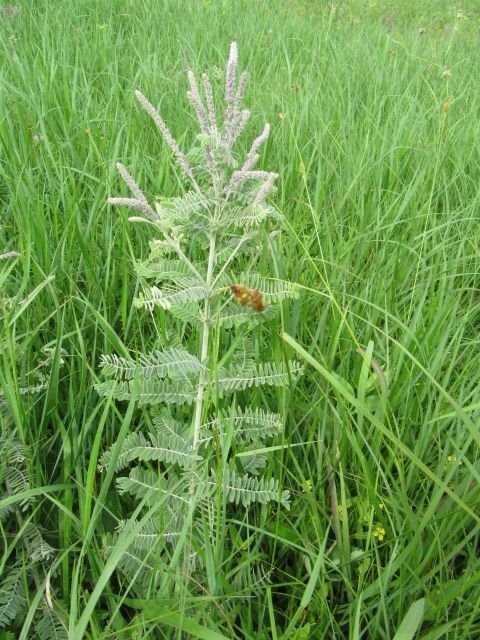
Amorpha canescens (Lead Plant) from the Lordi Marker Prairie on 6-8-26, #1096-1.
Lead Plant, Downey Indigo Bush, Prairie Shoestring, Buffalo Bellows
Amorpha canescens
a-MOR-fa kan-ESS-kens
Synonyms of Amorpha canescens (6) (Updated on 7-4-26 from Plants of the World Online): Amorpha brachycarpa E.J.Palmer (1931), Amorpha canescens f. glabrata (A.Gray) Fassett (1936), Amorpha canescens var. glabrata A.Gray (1852), Amorpha canescens f. glabrescens Zabel (1903), Amorpha canescens var. leptostachya A.Gray (1849), Amorpha canescens var. typica C.K.Schneid. (1907) (not validly publ.)
Amorpha canescens Pursh is the accepted scientific name for this species. It was first named and described as such by Frederick Traugott Pursh in Flora Americae Septentrionalis in 1813.
The genus, Amorpha L., was named and described as such by Carl von Linnaeus in the second volume of the first edition of Species Plantarum in 1753.
As of 7-1-26 when I wrote this document, Plants of the World Online lists 16 species in the Amorpha genus. It is a member of the plant family Fabaceae with 805 accepted genera. Those numbers could change as updates are made on POWO.
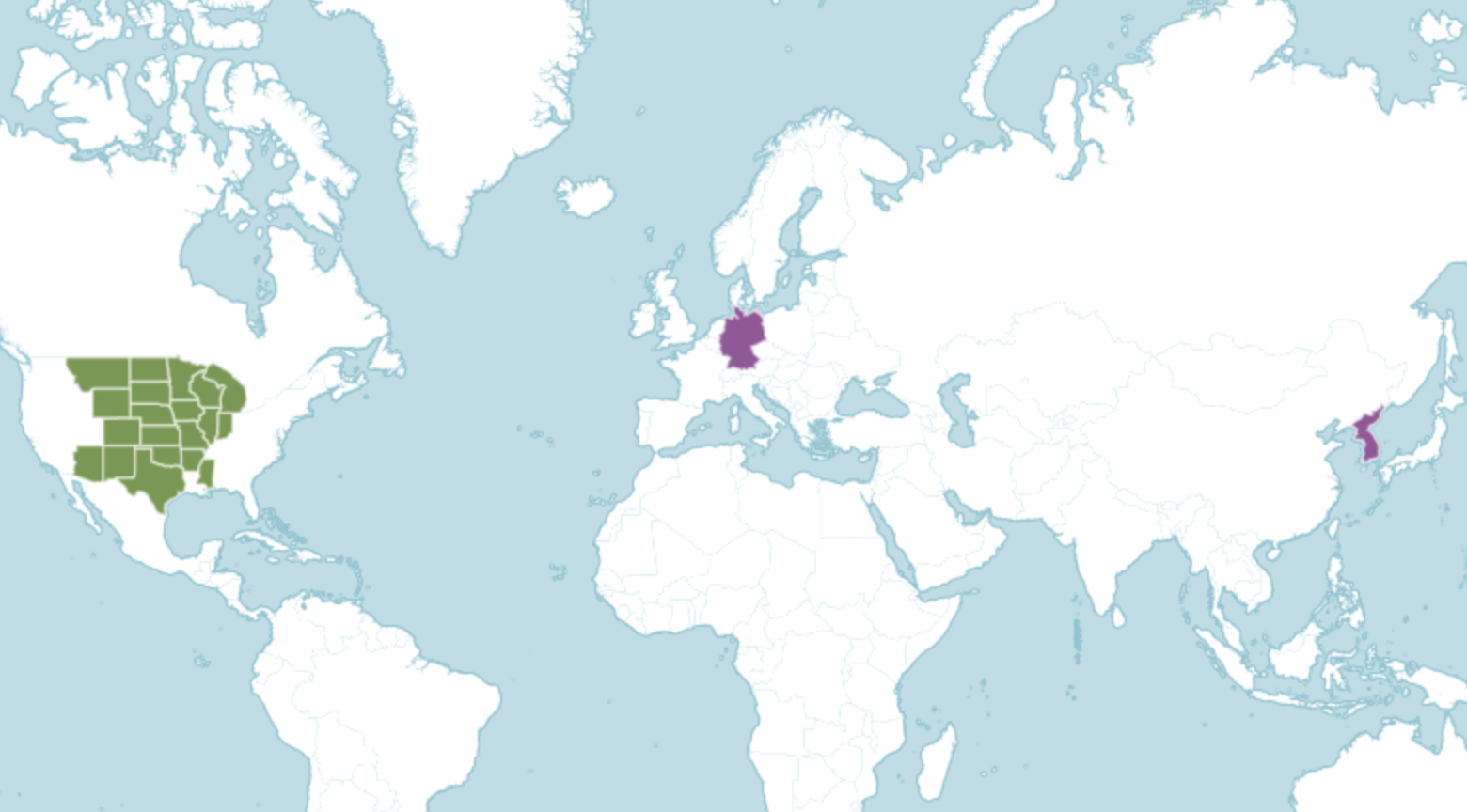
Distribution map of Amorpha canescens from Plants of the World Online. Facilitated by the Royal Botanic Gardens, Kew. Published on the Internet; http://www.plantsoftheworldonline.org/. Retrieved on July 1, 2026.
The above distribution map for Amorpha canescens is from Plants of the World Online. Areas in green are where the species is native and purple where it has been introduced. The map on the USDA Plants Database is similar. No map is perfect, but they give a general idea.
The map on iNaturalist shows where members have made observations. Anyone can join and it is a great website to confirm and share your observations. The maps on iNaturalist are continually updated as members post new observations. I post all my observations on iNaturalist.
THERE ARE SEVERAL LINKS AT THE BOTTOM OF THE PAGE FOR FURTHER READING AND TO HELP WITH A POSITIVE ID.
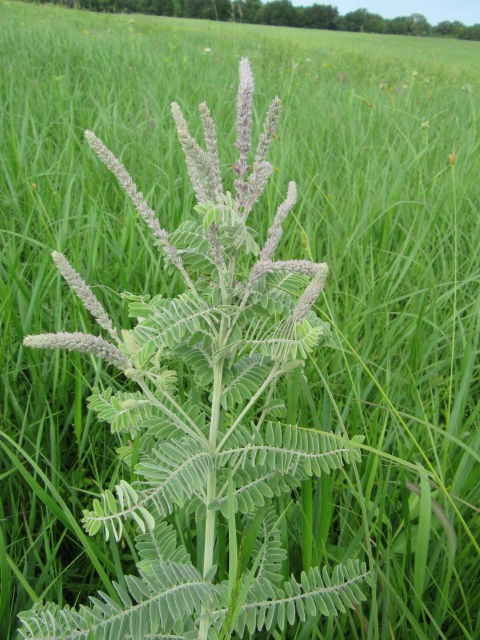
Amorpha canescens (Lead Plant) from the Lordi Marker Prairie on 6-8-26, #1096-2.
Until May 4 in 2025, I had been identifying wildflowers on the family farm, a friends farm and woods, along back roads and highways, etc. Then, on May 4 in 2025, a friend invited me to visit a private native prairie. It was incredible and I photographed 11 new to me species! We went back again on 4-19-26. I took friends on May 3, and there wasn’t much to see then. Then, on June 8 in 2026, he took me to the Lordi Marker Prairie then to Drover’s Prairie where I photographed 19 species, 10 new to me. On 6-22-26, I took my son, and we went to the Friendly Prairie for the first time, then on to the Lordi Marker and Drover’s Prairie. I photographed 22 species at the Friendly Prairie, 6 species at Lordi Marker Prairie, and 17 species at Drover’s Prairie. 11 more new to me. I went back to the Friendly and Drover’s Prairies on July 28 and photographed 12 species with 2 being new-to-me.
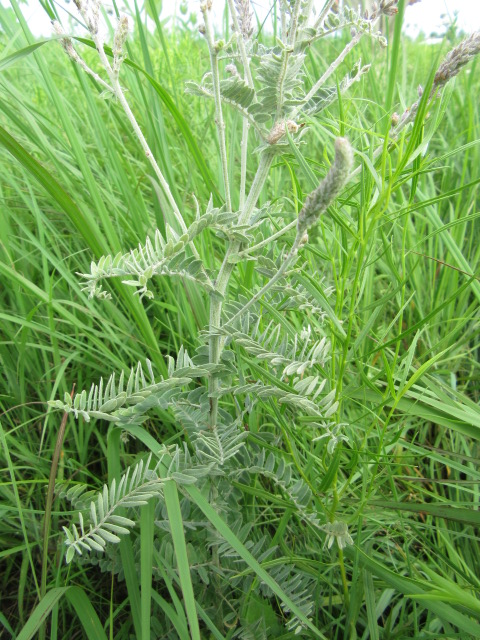
Amorpha canescens (Lead Plant) from the Lordi Marker Prairie on 6-8-26, #1096-3.
I first observed the Amorpha canescens on a trip to the Lordi Marker Prairie with my friend Walter Moser on 6-8-26. This was my first trip to this vast prairie and it was AWESOME!
Then on 6-22-26, I went to Drover’s and Friendly Prairie Conservation Areas and took a lot more photos. Photos of this species from the two prairies are at the bottom of the page below the links for further reading.
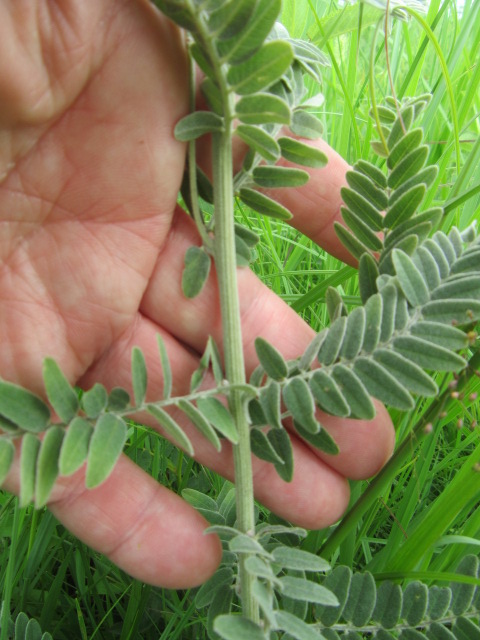
Amorpha canescens (Lead Plant) from the Lordi Marker Prairie on 6-8-26, #1096-4.
Amorpha canescens is a perennial sub-shrub native to North America. It is easily recognized from its pinnately compound leaves due to the whitish hairs on its leaves and dense spikes of densely hairy purplish flowers. The flowers seem to have an orange glow from its yellow anthers.
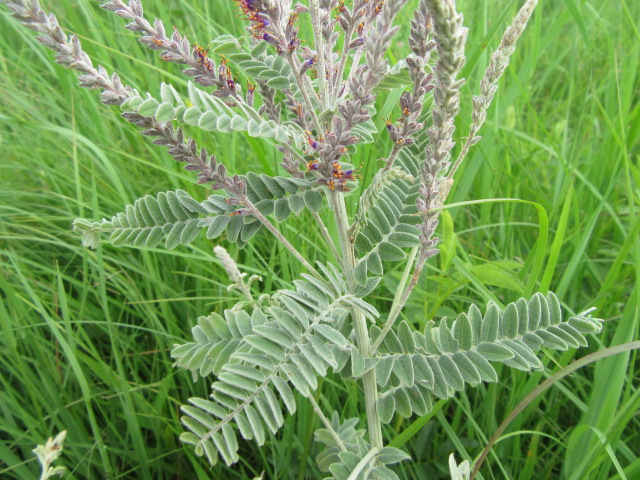
Amorpha canescens (Lead Plant) from the Lordi Marker Prairie on 6-8-26, #1096-5.
The Amorpha canescens is one of the neatest plants on the prairie with the whitish-gray hue of its leaves and stems. The purplish flowers are also interesting with their reddish filaments and orange-yellow anthers.
Missouri Plants says, “The plant is found throughout most of Missouri and the Midwest. The species has been subdivided based on pubescence characters, but in Missouri these intergrade and are not formally recognized. The flowers are protogynous, with the style maturing before the stamens. The fruits are small, reaching a length of 4 mm. The species is also edible. A. canescens was once thought to signal the presence of lead ore. It does well in the garden and is often cultivated for its attractive floral display and gray foliage and stems.”
Amorpha canescens can be found growing in prairies, pastures, forest openings, along railroads and roadsides, savannas, etc. It can grow in a variety of soil types as long as it is well-drained. It tolerates drought very well, and even prefers it a little on the dry side. The presence of this species is a sign of a high quality habitat as their roots release nitrogen.
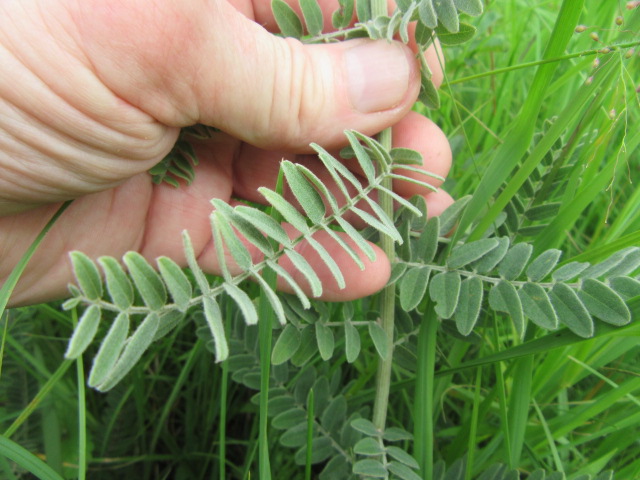
Amorpha canescens (Lead Plant) from the Lordi Marker Prairie on 6-8-26, #1096-6.
Plants are perennial shrubs or small sub-shrubs that can grow to around 3’ tall (70 cm) on single or multiple stems. The stems are hairy (pubescent) and normally become woody with age. Plants growing in full sun will be erect while in partially shaded areas they may be somewhat sprawly. The sprawling stems can grow along the ground to find a sunnier spot. Plants have a knotty rootstock with thick taproots that can grow up to 16 feet deep making them very drought tolerant.
The pinnately compound leaves grow in an alternate manner along the stems. The leaves can have from 12-25 pairs of leaflets plus a terminal leaflet. The leaves grow from 4-12” long while the leaflets are about 1/2” long and 1/4” wide. The leaflets are ovate-oblong to elliptic in shape, rounded to cordate at the base, and rounded to pointed at the tip. Of course, the leaves and stems are covered with whitish hair. Plants growing in full sun will make the hair more dense.
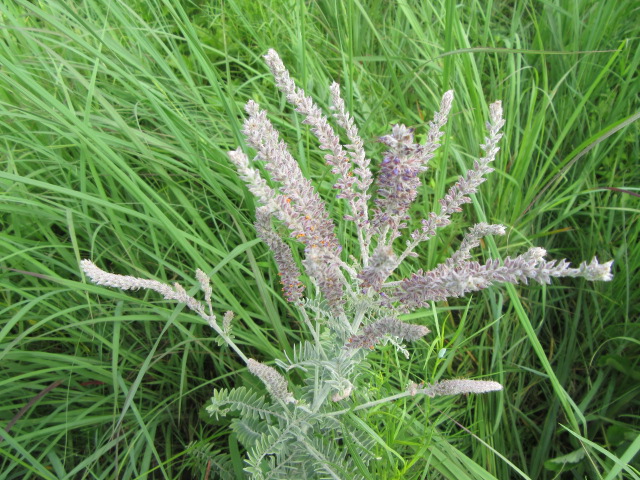
Amorpha canescens (Lead Plant) from the Lordi Marker Prairie on 6-8-26, #1096-7.
Flowers and densely packed on racemes of 5-20 “spikes” that are from 3-6” (8-17 cm) long from the stem, or stems, from the upper part of the plant.
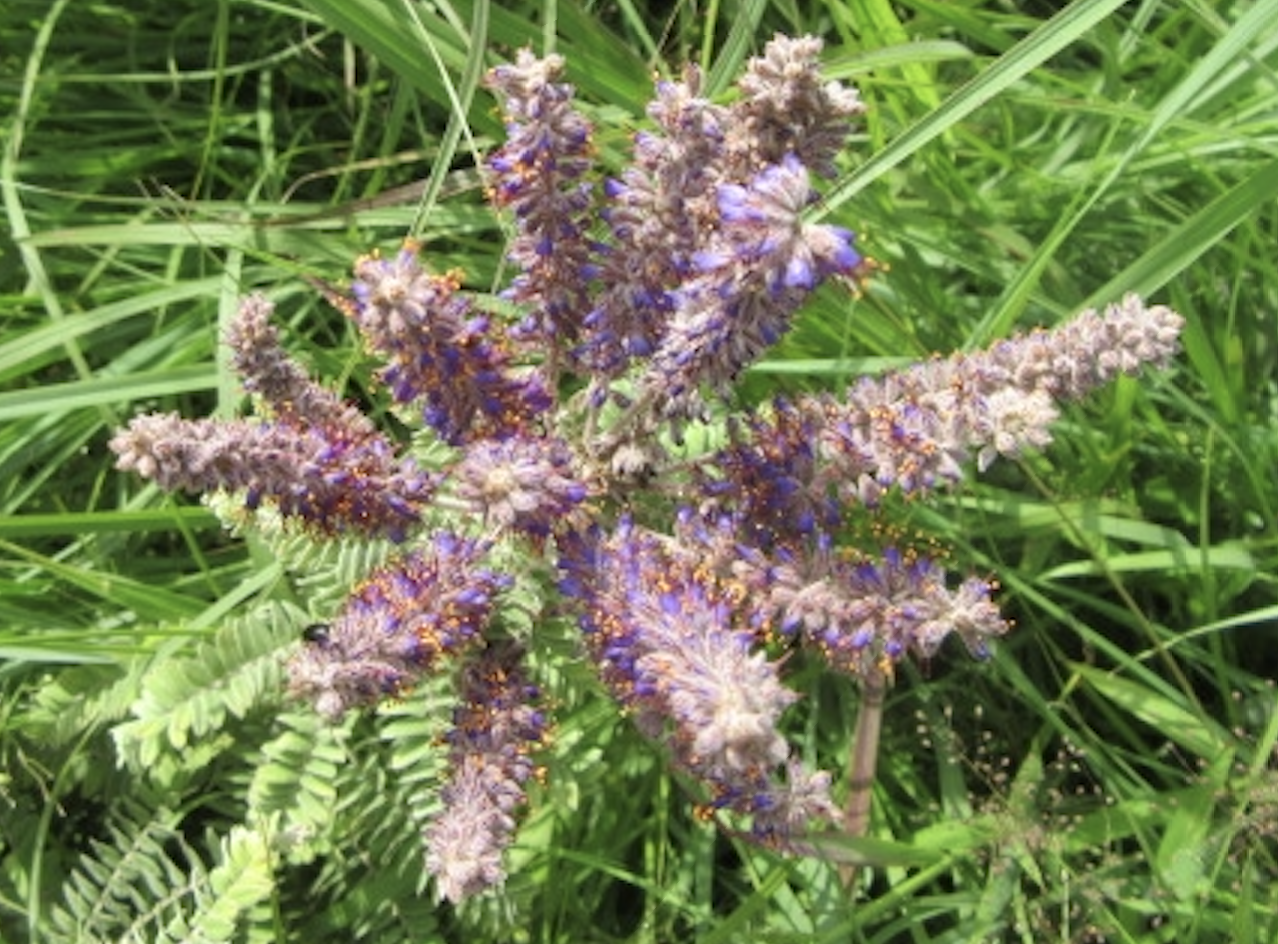
Amorpha canescens (Lead Plant) from the Lordi Marker Prairie on 6-8-26, #1096-8.
Describing flowers can sometimes be tricky… Individual flowers consist of a hairy 5-lobed calyx, a corolla with a single purplish-blue petal that folds around the stamens and pistol, *8-10 exserted reddish stamens, yellow anthers, a superior ovary, and a 3-lobed purplish stigma. The corolla forms a tube that opens horizontally that protect the stamen, pistol, and style.
Unlike typical members of the plant family Fabaceae, the lateral and keel petals are missing. In fact, the genus name Amorpha, comes from the Greek word amorphos meaning ‘shapeless or deformed’ and refers to the single petaled flower.
*There are 8-10 stamens depending on whose description you read.
The plants flowering period is normally between sometime in May through August.
Flowers primarily attract long and short-tongued bees and wasps. Plants are high in protein and are eaten by deer, livestock and rabbits
At maturity, the ovary is replaced by a hard, curved, hairy seed pod that contain 1, sometimes 2, smooth olive, reddish-brown, or brown seeds. Seeds require a short cold stratification period.
There are more photos at the bottom of the page under the links from other dates and locations.
I live on the family farm in Windsor, Missouri in Pettis County (Henry County is across the street, and Benton and Johnson aren’t far away). I have grown over 500 different plants and identified over 250 species of wildflowers (most have pages listed on the right side of the page). I am not an expert, botanist, or horticulturalist. I just like growing, photographing, and writing about my experience. I rely on several websites for ID and a few horticulturalists I contact if I cannot figure them out. Wildflowers can be variable from location to location, so that can be a bit confusing. If you see I have made an error, please let me know so I can correct what I have written.
I hope you found this page useful and be sure to check the links below for more information. They were written by experts and they have provided much more information. Some sites may not be up-to-date but they are always a work in progress. If you can, I would appreciate it if you would click on the “Like” below and leave a comment. It helps us bloggers stay motivated. You can also send an email to me at thebelmontrooster@yahoo.com. I would enjoy hearing from you especially if you notice something is a bit whacky.
FOR FURTHER READING:
PLANTS OF THE WORLD ONLINE (GENUS/SPECIES)
INTERNATIONAL PLANT NAMES INDEX (GENUS/SPECIES)
TROPICOS (GENUS/SPECIES)
FLORA OF MISSOURI (GENUS/SPECIES)
FLORA OF NORTH AMERICA (GENUS/SPECIES)
WORLD FLORA ONLINE (GENUS/SPECIES)
WIKIPEDIA (GENUS/SPECIES)
USDA PLANTS DATABASE
iNATURALIST
MISSOURI PLANTS
MISSOURI BOTANICAL GARDEN
MISSOURI DEPARTMENT OF CONSERVATION
WILDFLOWER SEARCH
FLORA FINDER
FRIENDS OF THE WILDFLOWER GARDEN
GARDENA
ILLINOIS WILDFLOWERS
KANSAS WILDFLOWERS AND GRASSES
LADY BIRD JOHNSON WILDFLOWER CENTER
LURIE GARDEN
MINNESOTA WILDFLOWERS
NORTH CAROLINA STATE UNIVERSITY
PFAF (PLANTS FOR A FUTURE)
SEINet
NOTE: The data (figures, maps, accepted names, etc.) may not match on these websites. It depends on when and how they make updates and when their sources make updates. Some websites have hundreds and even many thousands of species to keep up with. Accepted scientific names change periodically and it can be hard to keep with as well. Some of the links may use a name that is a synonym on other sites. In my opinion, Plants of the World Online by Kew is one of the most reliable and up-to-date plant databases and they make updates regularly. I make updates “at least” once a year and when I write new pages or add new photos but I do get behind. We are all a work in progress. 🙂
MORE PHOTOS…
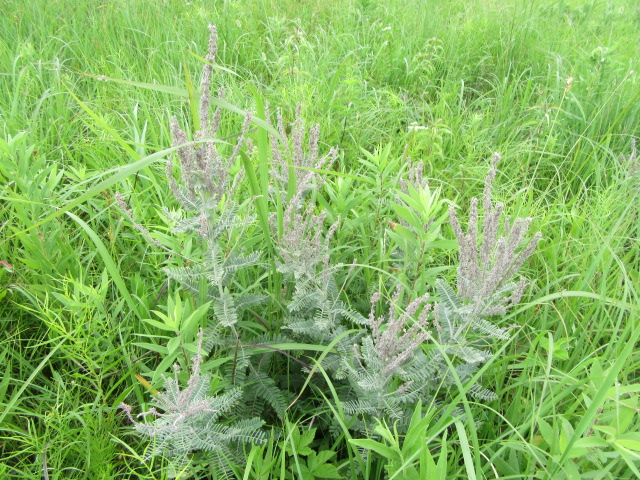
Amorpha canescens (Lead Plant) from Drover’s Prairie Conservation Area on 6-22-26, #1099-1.
The above photo was taken at the Drover’s Prairie Conservation Area on 6-22-26.
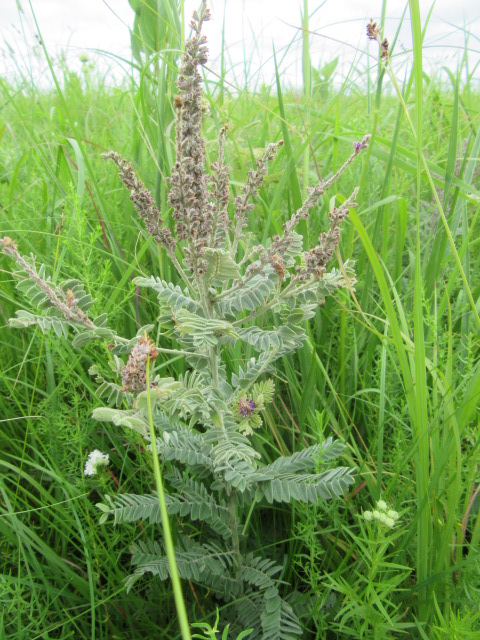
Amorpha canescens (Lead Plant) from the Friendly Prairie Conservation Area on 6-22-26, #1099-2.
The above photo and the one below were taken at the Friendly Prairie Conservation Area on 6-22-26.

Amorpha canescens (Lead Plant) from the Friendly Prairie Conservation Area on 7-28-26, #1101-1.
Went to the Friendly Prairie again on 7-28-26. Took the above photo and the next 3.
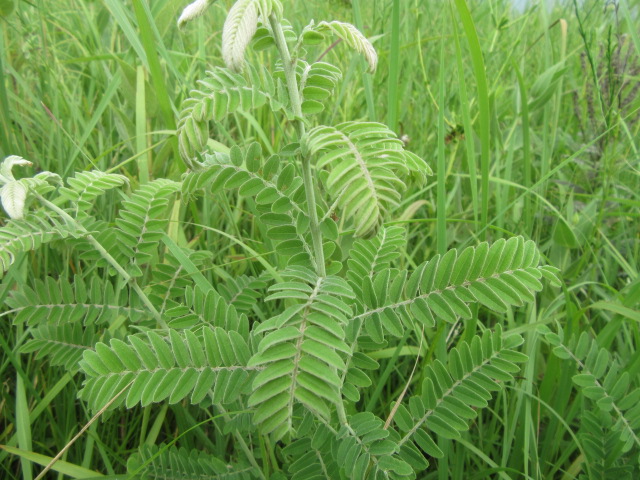
Amorpha canescens (Lead Plant) from the Friendly Prairie Conservation Area on 7-28-26, #1101-2.
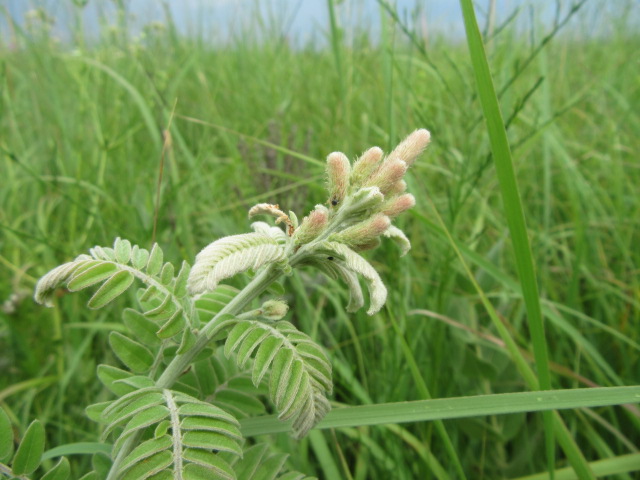
Amorpha canescens (Lead Plant) from the Friendly Prairie Conservation Area on 7-28-26, #1101-3.
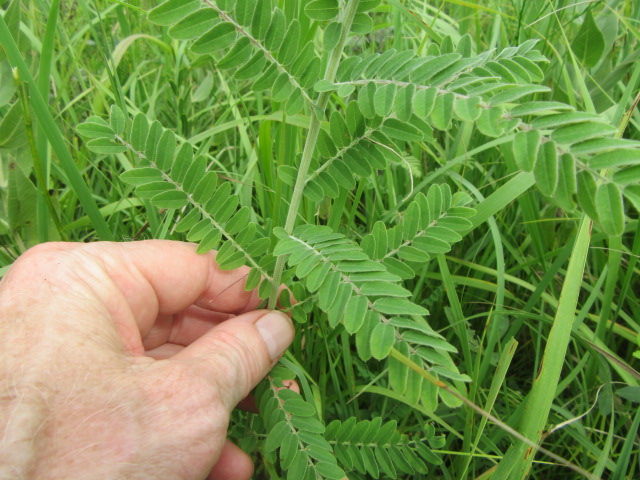
Amorpha canescens (Lead Plant) from the Friendly Prairie Conservation Area on 7-28-26, #1101-4.
That’s all the photos I have for now for this species. There will likely be more to come.

