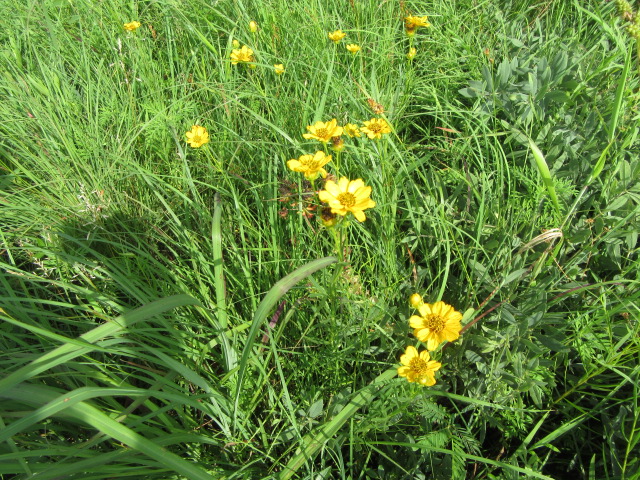
Anacis palmata (Syn. Coreopsis palmata) (Prairie Coreopsis, Etc.) at Drover’s Prairie on 6-8-25, #1097-2.
Prairie Coreopsis, Stiff Tickseed, Wedgeleaf Coreopsis, Prairie Tickseed, Finger Coreopsis
Anacis palmata
un-NAY-sis pal-MAY-tuh
Syn. Coreopsis palmata
kor-ee-OP-sis pal-MAY-tuh
Synonyms of Anacis palmata (5) (Updated on 7-12-26 from Plants of the World Online): Calliopsis palmata (Nutt.) Spreng. (1826), Coreopsis palmata Nutt. (1818), Coreopsis pauciflora Lehm. (1833), Coreopsis praecox Fresen. (1838), Gyrophyllum palmatum (Nutt.) Mesfin & D.J.Crawford (2023)
Anacis palmata (Nutt.) Z.H.Feng, Z.J.Huang & Su Liu is now the accepted scientific name for this species. It was named as such by Zhen Hao Feng, Zhang Jie Huang, and Su Liu in Phytotaxa in 2024. It was first named and described as Coreopsis palmata by Thomas Nuttall in The Genera of North American Plants in 1818.
DNA testing proved Coreopsis palmata did not belong the Coreopsis genus. They found this species was more closely related to species in the Bidens (Beggarticks) genus. Six closely related species were moved (one of those returned) to the resurrected Anacis genus.
The genus, Anacis Schrank, was named and described as such by Franz von Paula von Schrank in Denkschriften der Königlich Akademie der Wissenschaften zu München in 1817.
Now, as of 7-12-26 when this page was written, Plants of the World Online lists 6 species in the Anacis genus. It is a member of the plant family Asteraceae with 1,714 genera. Those numbers could change as updates are made on POWO.
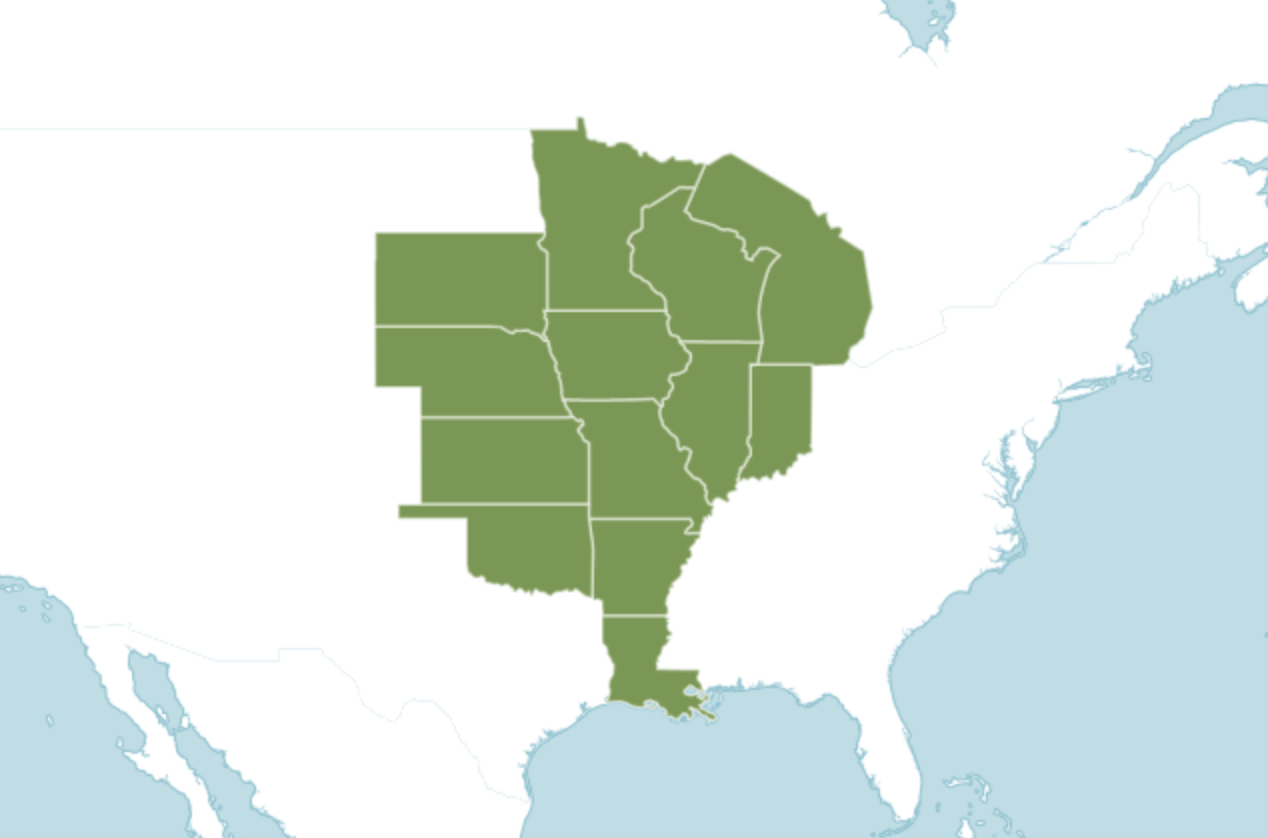
Distribution map of Anacis palmata from Plants of the World Online. Facilitated by the Royal Botanic Gardens, Kew. Published on the Internet; http://www.plantsoftheworldonline.org/. Retrieved on July 12, 2026.
The above distribution map for Anacis palmata is from Plants of the World Online. Areas in green are where the species is native. The map on the USDA Plants Database for Coreopsis palmata is similar.
The map on iNaturalist shows where members have made observations. Anyone can join and it is a great website to confirm and share your observations. The maps on iNaturalist are continually updated as members post new observations. I post all my observations on iNaturalist. The iNaturalist community accepted the name change and all observations of Coreopsis palmata will be changed to Anacis palmata soon.
THERE ARE SEVERAL LINKS AT THE BOTTOM OF THE PAGE FOR FURTHER READING AND TO HELP WITH A POSITIVE ID.
I was first introduced to the Lordi Marker and Drover’s Prairies by a friend of mine on June 8 in 2026. I was really amazed by all the wildflowers and took a lot of photos of new to me species. One of those species was Coreopsis palmata which I found in both prairies. When I started writing this page, I found out the name changed to Anacis palmata… You never know, it may change back again or to another genus…
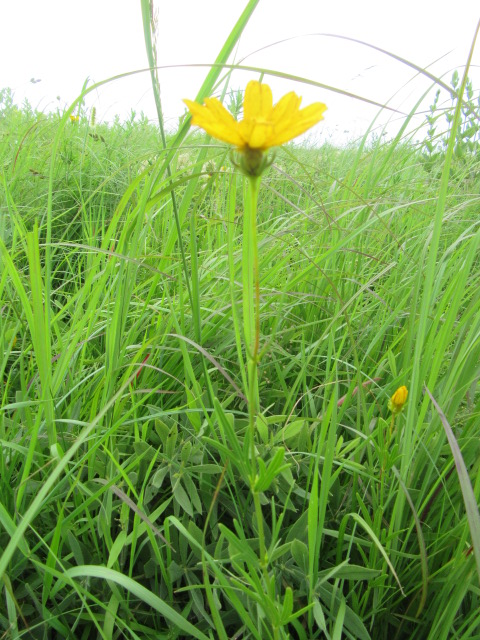
Anacis palmata (Syn. Coreopsis palmata) (Prairie Coreopsis) at the Lordi Marker Prairie on 6-8-26, #1096-33.
Until May 4 in 2025, I had been identifying wildflowers on the family farm, a friends farm and woods, along back roads and highways, etc. Then, on May 4 in 2025, a friend invited me to visit a private native prairie. It was incredible and I photographed 11 new to me species! We went back again on 4-19-26. I took friends on May 3, and there wasn’t much to see then. Then, on June 8 in 2026, he took me to the Lordi Marker Prairie then to Drover’s Prairie where I photographed 19 species, 10 new to me. On 6-22-26, I took my son, and we went to the Friendly Prairie for the first time, then on to the Lordi Marker and Drover’s Prairie. I photographed 22 species at the Friendly Prairie, 6 species at Lordi Marker Prairie, and 17 species at Drover’s Prairie. 11 more new to me. I went back to the Friendly and Drover’s Prairies on July 28 and photographed 12 species with 2 being new-to-me.

Anacis palmata (Syn. Coreopsis palmata) (Prairie Coreopsis) at the Lordi Marker Prairie on 6-8-26, #1096-34.
While at the Lordi Marker and Drover’s Prairies, I ran across this particular species I was unsure of. I took a lot of photos and uploaded the first of the best to the drag-and-drop feature on iNaturalist (you have to be logged in). The first suggestion was Coreopsis palmata so, I checked the species out on the Missouri Plants website and found iNaturalist to be correct. By the time I started writing this page, I found out the species name had changed to Anacis palmata…
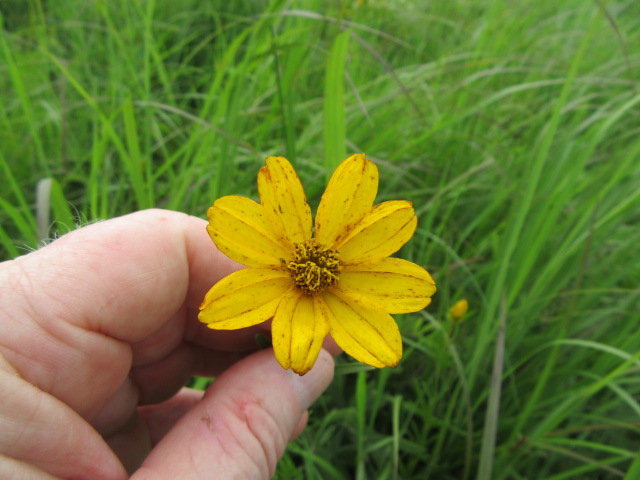
Anacis palmata (Syn. Coreopsis palmata) (Prairie Coreopsis) at the Lordi Marker Prairie on 6-8-26, #1096-35.
The flowers of the Prairie Coreopsis at the Lordi Marker Prairie were fairly faded by 6-8-28, but they were better at Drover’s Prairie.
Anacis palmata is a true plant of the prairie. This species is a native perennial that has a fibrous root system with long, creeping rhizomes. It is easily recognized from its yellow flowers and palm (hand)-shaped leaves. It can be found scattered throughout most of Missouri and from parts of Minnesota down through Louisiana, westward from Nebraska, east through Indiana. The map on iNaturalist shows where members have made observations.
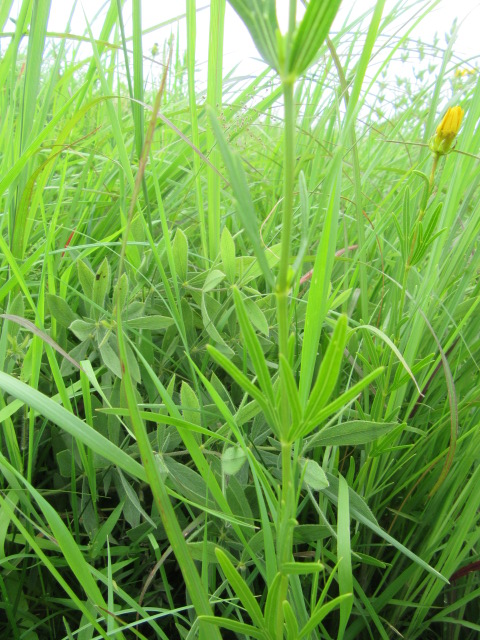
Anacis palmata (Syn. Coreopsis palmata) (Prairie Coreopsis) at the Lordi Marker Prairie on 6-8-26, #1096-36.
Prairie Coreopsis (etc.) can be found growing in prairies, glades, ledges, bluffs, forest openings, fields and pastures, and growing along roadsides. They prefer full sun in loam to clay-loam soil but can tolerate some gravel. They prefer an average amount of moisture (like most plants) but a little on the dry side is OK. This species is easy to cultivate so it would make a great candidate for prairie gardens. Due to their spreading root system, they may become somewhat pushy… If not grown in full sun, they may have a tendency to sprawl somewhat.
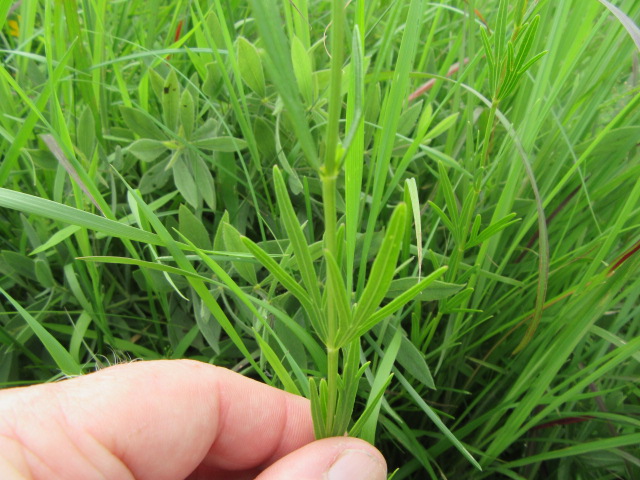
Anacis palmata (Syn. Coreopsis palmata) (Prairie Coreopsis) at the Lordi Marker Prairie on 6-8-26, #1096-37.
Plants grow from 1’ to about 3’ tall with single or multiple stems from the base. Stems are usually unbranched, but occasionally branch out in the upper half (especially if damaged). The stems are typically round (terete) and medium green with lighter green vertical striations. The stems are typically hairless (glabrous) except for possibly a few spreading hairs at the base of leaf nodes. I need better stem photos…
Even when there are no flowers, you can identify the Prairie Coreopsis by their leaves. The leaves grow in opposite pairs (decussate) and are fairly evenly spaced. They are sessile (no petiole/stemless). The leaf blades are deeply 3-5 lobed (two lateral and one terminal) and sometimes lobed again, with upper leaves sometimes unlobed. All lobes are narrowly oblong in shape, the central lobe slightly longer. Leaves are approximately 1-3” long and 1/2 to 1 1/2” wide, unlobed leaves being smaller. The leaves are hairless (glabrous), have smooth margins. The upper surfaces of the leaves are medium to dark green while the lower surface is medium green. The leaves usually turn a reddish color in autumn.
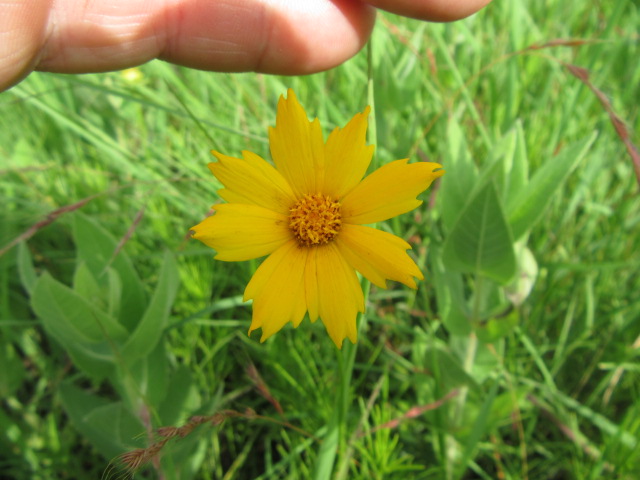
Anacis palmata (Syn. Coreopsis palmata) (Prairie Coreopsis) at Drover’s Prairie on 6-8-26, #1097-1.
Much better flowers at Drover’s, but there weren’t that many. Just a few scattered colonies here and there. I thought I messed up and the above photo might have been Coreopsis grandiflora. BUT, the observation became Research Grade on iNaturalist… Well, I just leave it alone for now and go back and check out the colonies when the flowers are fresh in 2027. GEEZ!!!
Anacis palmata (Syn. Coreopsis palmata) (Prairie Coreopsis, Etc.) at Drover’s Prairie on 6-8-25, #1097-2.
Upper stems terminate in one to several flower heads. The flower heads are borne at the top of leaf stems (peduncles).
Writing flower descriptions for members of the plant family Asteraceae can be a challenge, but I’ll give it a shot. The entire flower can vary in size from 1 1/2 to 2 1/2” in width. The corollas of the disc florets are tubular in shape, are 5-lobed, and yellow. There are 5 stamens, yellow filaments, and brownish-purple anthers. There are supposedly up to 60 or more disc florets, but who’s counting? The disc florets are bi-sexual and fertile. Surrounding the disc florets are 8-10 sterile ray florets. The ray flowers a yellow to yellowish-orange, some information says they are paler in color than other members in the “Coreopsis” genus. Well, I guess they aren’t in that genus anymore… Anyway, the petals, or whatever you call them, have kind of a “ribbed” appearance in my opinion. The tips can be either rounded or have 2-4 tiny teeth giving them a ragged appearance. Flower heads are subtended by a cup-shaped involucre with 8 yellowish-green bracts (phyllaries) in two series (rows), although some information says only one.
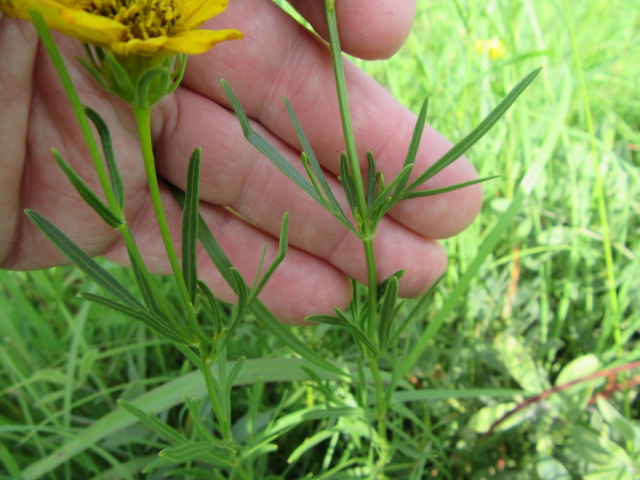
Anacis palmata (Syn. Coreopsis palmata) (Prairie Coreopsis) at Drover’s Prairie on 6-8-26, #1097-3.
Flowers are replaced by seeds called achenes that are 5-6 mm long and brown, grayish brown, to black in color.
Plants flower from May through September in favorable conditions. If you cultivate this species, information suggest deadheading spent flowers promptly to encourage more flowers and to prevent unwanted self-seeding.
Nectar and pollen attract many kinds of insects including various species of bees, flies, and wasps. Deer, rabbits, groundhogs, and livestock occasionally feed on the foliage.
I will be going back to the prairies again soon to take more photos…
I live on the family farm in Windsor, Missouri in Pettis County (Henry County is across the street, and Benton and Johnson aren’t far away). I have grown over 500 different plants and identified over 250 species of wildflowers (most have pages listed on the right side of the page). I am not an expert, botanist, or horticulturalist. I just like growing, photographing, and writing about my experience. I rely on several websites for ID and a few horticulturalists I contact if I cannot figure them out. Wildflowers can be variable from location to location, so that can be a bit confusing. If you see I have made an error, please let me know so I can correct what I have written.
I hope you found this page useful and be sure to check the links below for more information. They were written by experts and they have provided much more information. Some sites may not be up-to-date but they are always a work in progress. If you can, I would appreciate it if you would click on the “Like” below and leave a comment. It helps us bloggers stay motivated. I would enjoy hearing from you especially if you notice something is a bit whacky.
FOR FURTHER READING:
PLANTS OF THE WORLD ONLINE (GENUS/SPECIES)
INTERNATIONAL PLANT NAMES INDEX (GENUS/SPECIES)
TROPICOS (GENUS/SPECIES)
FLORA OF MISSOURI (GENUS/SPECIES)
FLORA OF NORTH AMERICA (GENUS/SPECIES)
WORLD FLORA ONLINE (GENUS/SPECIES)
WIKIPEDIA (GENUS/SPECIES)
USDA PLANTS DATABASE
iNATURALIST
MISSOURI PLANTS
MISSOURI BOTANICAL GARDEN
WILDFLOWER SEARCH
FLORA OF THE SOUTHEASTERN U.S.
FRIENDS OF THE WILDFLOWER GARDEN
GO BOTANY
ILLINOIS WILDFLOWERS
KANSAS NATIVE PLANTS
KANSAS WILDFLOWERS AND GRASSES
LADY BIRD JOHNSON WILDFLOWER CENTER
MINNESOTA WILDFLOWERS
SEINet
NOTE: The data (figures, maps, accepted names, etc.) may not match on these websites. It depends on when and how they make updates and when their sources make updates. Some websites have hundreds and even many thousands of species to keep up with. Accepted scientific names change periodically and it can be hard to keep with as well. Some of the links may use a name that is a synonym on other sites. In my opinion, Plants of the World Online by Kew is one of the most reliable and up-to-date plant databases and they make updates regularly. I make updates “at least” once a year and when I write new pages or add new photos but I do get behind. We are all a work in progress. 🙂

