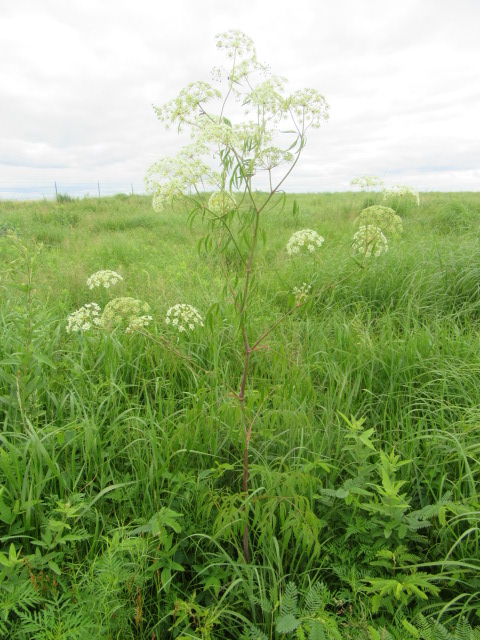
Cicuta maculata (Water Hemlock) from the Drover’s Prairie Conservation Area on 6-22-26, #1099-35.
Water Hemlock, Common Water Hemlock, Beaver Poison, Spotted Hemlock, Spotted Water Hemlock, Spotted Parsley, Cowbane, Spotted Cowbane
Cicuta maculata
sik-YOO-tuh mak-yuh-LAH-tuh
sik-YOO-tuh mak-yuh-LAY-tuh
Synonyms of Cicuta maculata (1) (Updated on 7-10-26 from Plants of the World Online): Cicuta virosa var. maculata (L.) J.M.Coult. & Rose (1888)
Synonyms of Cicuta maculata var. angustifolia (14) (Updated on 7-10-26 from POWO): Cicuta arguta Greene (1912), Cicuta cinicola A.Nelson (1912), Cicuta dakotica Greene (1912), Cicuta dakotica var. pseudomaculata Lunell (1916), Cicuta dakotica var. pseudovirosa Lunell (1916), Cicuta douglasii var. occidentalis (Greene) M.E.Jones (1910), Cicuta grandifolia Greene (1909), Cicuta occidentalis Greene (1889), Cicuta occidentalis f. arizonensis H.Wolff (1927), Cicuta occidentalis f. californica H.Wolff (1927), Cicuta occidentalis f. oregonensi-idahoensis H.Wolff (1927), Cicuta occidentalis f. wyomingensis H.Wolff (1927), Cicuta subfalcata Greene (1912), Cicuta valida Greene (1912)
Synonyms of Cicuta maculata var. bolanderi (1) (Updated on 7-10-26 from POWO): Cicuta bolanderi S.Watson (1876)
Synonyms of *Cicuta maculata var. maculata (autonym) (4) (Updated on 7-10-26 from POWO): Cicuta curtissii J.M.Coult. & Rose (1900), Cicuta maculata var. curtissii (J.M.Coult. & Rose) Fernald (1939), Cicuta mexicana J.M.Coult. & Rose (1899), Cicutaria maculata Lam. (1786)
Synonyms of Cicuta maculata var. victorinii (1) (Updated on 7-10-26 from POWO): Cicuta victorinii Fernald (1939)
Cicuta maculata L. Is the accepted scientific name for this species. The genus and species were both named as such by Carl von Linnaeus in the first volume of the first edition of Species Plantarum in 1753.
Accepted Infraspecific names (4) (updated on 7-10-26 from Plants of the World Online): Cicuta maculata var. angustifolia Hook. (1832), Cicuta maculata var. bolanderi (S.Watson) G.A.Mulligan (1980), *Cicuta maculata var. maculata (autonym), Cicuta maculata var. victorinii (Fernald) B.Boivin (1966). *When an infraspecific taxon is named, an autonym (“type-specimen”) is automatically generated whose description is closest to the (original) species. All have their own list of synonyms…
As of 7-10-26 when this page was written, Plants of the World Online lists 4 species in the Cicuta genus. It is a member of the plant family Apiaceae with 455 genera. Those numbers could change as updates are made on POWO.

Distribution map of Cicuta maculata from Plants of the World Online. Facilitated by the Royal Botanic Gardens, Kew. Published on the Internet; http://www.plantsoftheworldonline.org/. Retrieved on July 10, 2026.
The above distribution map for Cicuta maculata is from Plants of the World Online. Areas in green are where the species is native. The map on the USDA Plants Database is similar. No map is perfect, but they do give a general idea.
The map on iNaturalist shows where members have made observations. Anyone can join and it is a great website to confirm and share your observations. The maps on iNaturalist are continually updated as members post new observations. I post all my observations on iNaturalist.
THERE ARE SEVERAL LINKS AT THE BOTTOM OF THE PAGE FOR FURTHER READING AND TO HELP WITH A POSITIVE ID.

Cicuta maculata (Water Hemlock) from the Drover’s Prairie Conservation Area on 6-22-26, #1099-36.
I was first introduced to the prairies east of town when a friend of mine took me to a private prairie in May of 2025. In April of 2026, he took me to the Drover’s and Lori Marker Prairies. On June 22 in 2026 I went to the Friendly Prairie for the first time and back again to Drover’s and Lordi Marker Prairies. While at Drover’s, I saw a taller plant on a hillside that I worked my way to. It turned out to be another new to me species, which I am always excited about. I took several photos, of course, and uploaded them to iNaturalist when I came back home. The suggested species on iNaturalist was Cicuta maculata which I cross-referenced on the Missouri Plants website. Well, Naturalist was correct.

Cicuta maculata (Water Hemlock) from the Drover’s Prairie Conservation Area on 6-22-26, #1099-37.
I apologize for not writing proper descriptions before I published this page but I wanted to get the photos online. There are several very good websites at the bottom of the page written by experts that can help you with plenty of information and proper ID. I will come back to this page as I have time to write descriptions.
This species, like other members in the family, and highly toxic and should be avoided. This one especially, as it is listed as America’s most toxic native plant. It can kill a mature cow 15 minutes after ingesting…

Cicuta maculata (Water Hemlock) from the Drover’s Prairie Conservation Area on 6-22-26, #1099-38.

Cicuta maculata (Water Hemlock) from the Drover’s Prairie Conservation Area on 6-22-26, #1099-39.
I will continue to go back to the prairies off and on and add more photos.
I live on the family farm in Windsor, Missouri in Pettis County (Henry County is across the street, and Benton and Johnson aren’t far away). I have grown over 500 different plants and identified over 250 species of wildflowers (most have pages listed on the right side of the page). I am not an expert, botanist, or horticulturalist. I just like growing, photographing, and writing about my experience. I rely on several websites for ID and a few horticulturalists I contact if I cannot figure them out. Wildflowers can be variable from location to location, so that can be a bit confusing. If you see I have made an error, please let me know so I can correct what I have written.
I hope you found this page useful and be sure to check the links below for more information. They were written by experts and they have provided much more information. Some sites may not be up-to-date but they are always a work in progress. If you can, I would appreciate it if you would click on the “Like” below and leave a comment. It helps us bloggers stay motivated. I especially want to hear from you if you notice something whacky about what I have written.
FOR FURTHER READING:
PLANTS OF THE WORLD ONLINE (GENUS/SPECIES)
INTERNATIONAL PLANT NAMES INDEX (GENUS/SPECIES)
TROPICOS (GENUS/SPECIES)
FLORA OF MISSOURI (GENUS/SPECIES)
FLORA OF NORTH AMERICA (GENUS/SPECIES)
WORLD FLORA ONLINE (GENUS/SPECIES)
WIKIPEDIA (GENUS/SPECIES)
USDA PLANTS DATABASE
iNATURALIST
U.S. FOREST SERVICE
MISSOURI PLANTS
MIDWEST WEEDS AND WILDFLOWERS
MISSOURI DEPARTMENT OF CONSERVATION
WILDFLOWER SEARCH
BURKE HERBARIUM
DAVE’S GARDEN
FLORA FINDER
FRIENDS OF THE WILDFLOWER GARDEN
GO BOTANY
ILLINOIS WILDFLOWERS
IOWA PLANTS
KANSAS NATIVE PLANTS
KANSAS WILDFLOWERS AND GRASSES
LADY BIRD JOHNSON WILDFLOWER CENTER
MARYLAND BIODIVERSITY PROJECT
MINNESOTA WILDFLOWERS
NORTH CAROLINA STATE UNIVERSITY
SEINet
WILDFLOWERS OF NEW MEXICO
NOTE: The data (figures, maps, accepted names, etc.) may not match on these websites. It depends on when and how they make updates and when their sources make updates. Some websites have hundreds and even many thousands of species to keep up with. Accepted scientific names change periodically and it can be hard to keep with as well. Some of the links may use a name that is a synonym on other sites. In my opinion, Plants of the World Online by Kew is one of the most reliable and up-to-date plant databases and they make updates regularly. I make updates “at least” once a year and when I write new pages or add new photos but I do get behind. We are all a work in progress. 🙂

