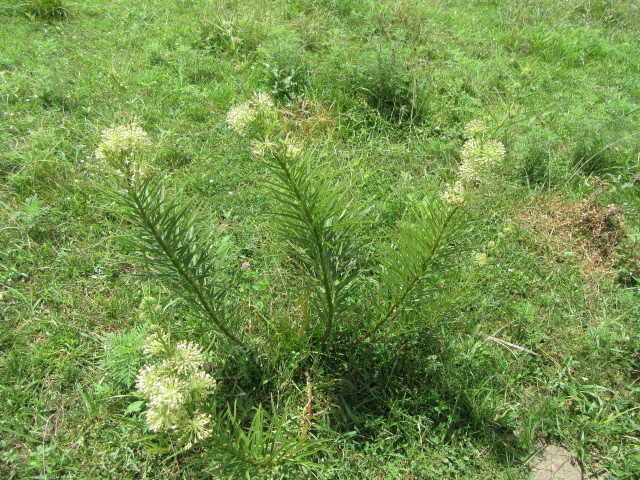
Pink Queen’s Ann’s Lace, Swamp Agrimony, & Tall Thistle

Hello everyone! I hope this finds you well and that you are having a great week ahead. Last week the hay was cut and baled here on the farm so now I can resume taking wildflower photos here.

I found something very unusual on Thursday while working at Kevin’s farm north of town…


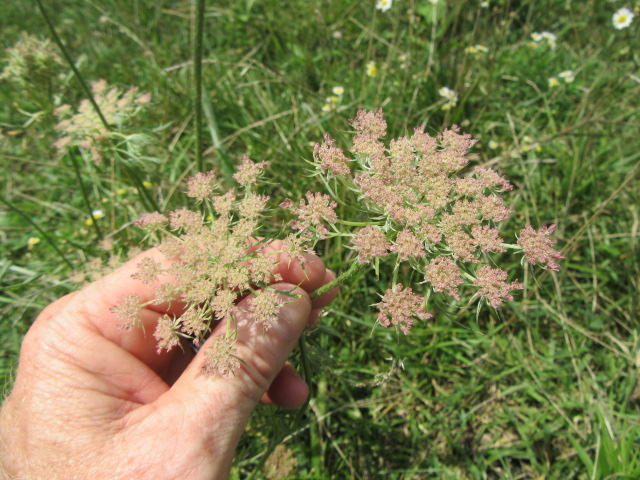
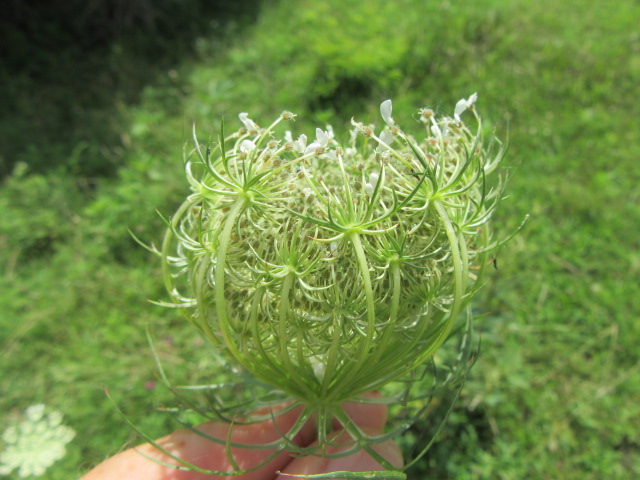
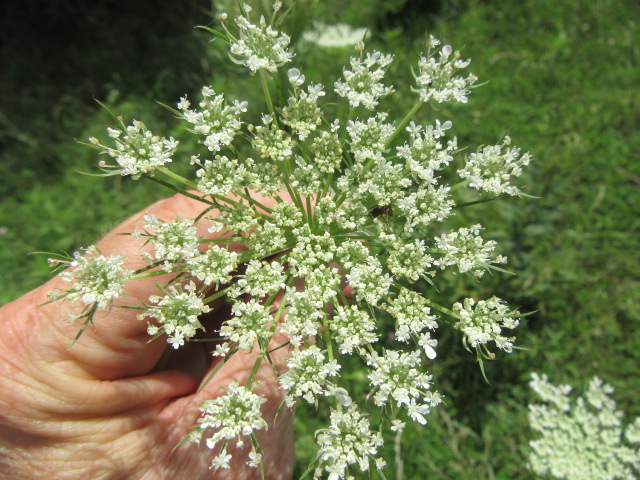
Daucus carota (Queen Anne’s Lace) on 7-25-19.

There are A LOT of Daucus carota or Queen Anne’s Lace growing everywhere now, but there is something definitely strange about this particular plant…


Daucus carota (Queen Anne’s Lace) on 7-25-19.

It has pink flowers! Just like with the Achillea millefolium a while back with pink flowers, one plant out of hundreds with pink flowers! I think that is so neat and I feel very blessed to witness plants in nature doing something different than most in their species.

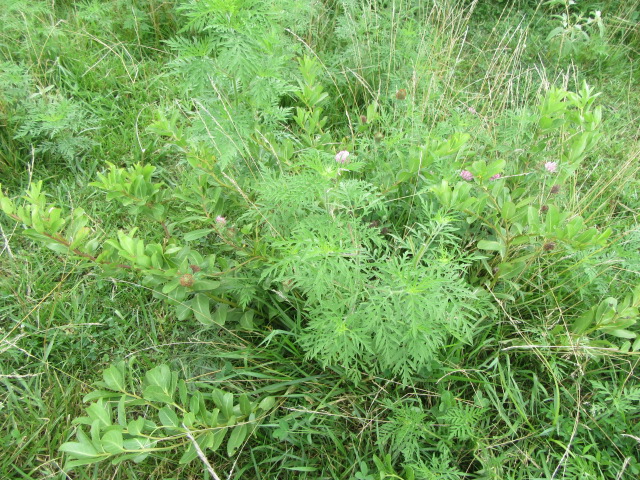
I took a few other photos of plants I am watching for positive ID… I think I am confusing myself by taking photos of plants I can’t ID because all I have is leaves.

I have been trying to get a photo of a certain plant here on the farm since 2013. I always see the leaves in the swampy area but never any flowers. This year, I FINALLY did it!


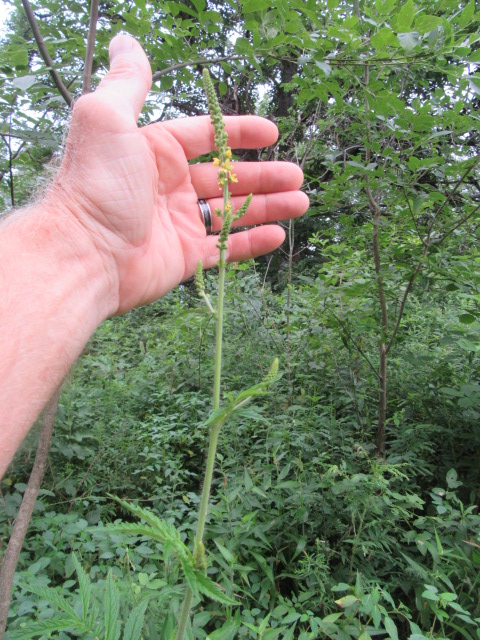
Agrimonia parviflora (Swamp Agrimony) on 7-25-19.

I went to the back of the farm to remove the electric fence in the middle of the back pasture so it would be easier to cut the hay. LOW AND BEHOLD there was one of these plants right next to the electric fence about 12-14′ away from the HUGE OLD Multiflora Rose. It was very tall and getting ready to flower. I removed the fence and put the five electric fence posts around this plant. I put the yellow insulators on top of the posts to sort of act as flags. I told BJ about the plant and where it was and I had put the posts around it so he couldn’t miss it. I told him I wanted a photo of it so not to mow over it. I didn’t have the camera with me at the time or I would have taken photos right then. The next day I went back with the camera to take photos. Well, my thoughts about him not being able to miss it were true… He didn’t miss it! He ran smack over the plant and the five steel posts! Always in the past, there were several of these plants growing down by the swamp so I went to have a look. Sure enough, they were also getting ready to flower so I got my photos after all and made a positive ID. I didn’t complain to BJ about mowing the HUGE specimen because it was already done. He was there to mow and bale the hay and undoubtedly was looking forward and behind and didn’t even think about the plant. I am sure he remembered when he hit the posts, though.


Lower leaves of the Agrimonia parviflora (Swamp Agrimony) on 7-25-19.

There are a few species of Agrimonia in Missouri, but the leaves easily distinguish Agrimonia parviflora from the others. The common name is Swamp Agrimony, Small-Flowered Agrimony, Harvestlice Agrimony, and Harvestlice. Plants of the World Online lists 21 accepted species in the genus but the Wikipedia says about 15. There are seven or so species in the US with three being described on the Missouriplants.com website. This species is found in 32 states in the United States. Out of all the species, Agrimonia parviflora is considered to be the most noxious.


Agrimonia parviflora (Swamp Agrimony) on 7-25-19.

Although bees and other insects feed on the nectar of the flowers, most mammals avoid this plant due to its bitter taste. Certain birds use Agrimony in their nests to keep away parasites such as lice and mites because of its foul aroma and taste. Flowers give way to bur-like seed capsules that cling to the fur of animals.

Even though considered a noxious plant, its burs were used by Native Americans for diarrhea and to reduce fever. The roots can be pulverized and have been used to increase red blood cell count, a gastrointestinal aid, a topical treatment for skin issues, and as a dietary aid. 

Probably the most interesting thing about the Agrimonia parviflora is that it is a member of the Rosaceae Family along with Roses…

Now then… After I took photos of the Agrimony, I walked to the corner to the tree line that borders the south hayfield. It’s a little hard to explain, but trust me, I know where I am going. 🙂 Here again, are plants I had not seen flower because they didn’t have the opportunity before.


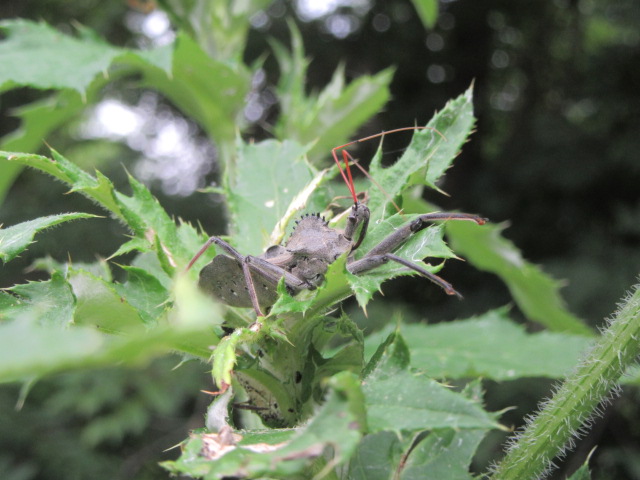
Arilus cristatus (Wheel Bug) on the Cirsium altissimum.

Hmmm… I better move to the next plant. This one has a hungry stalker and I wouldn’t want this Wheel Bug to invite me to dinner or think I was interested in his.


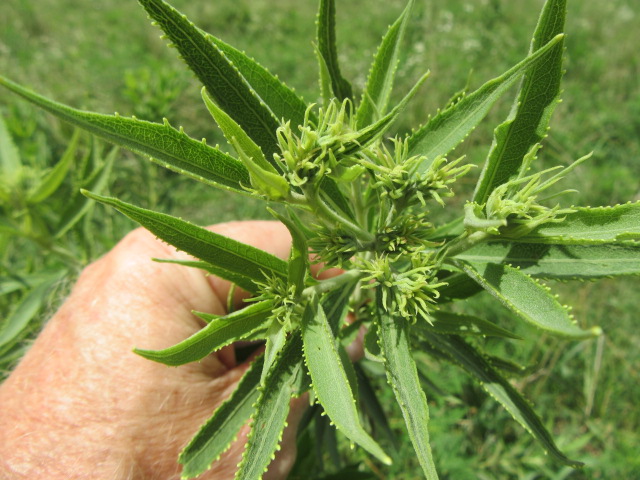
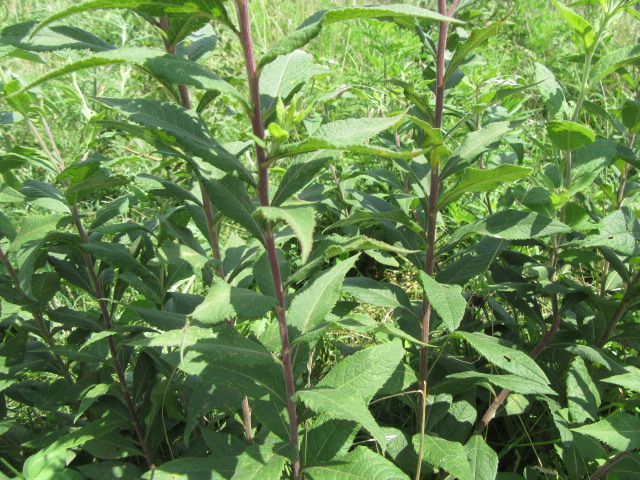
Cirsium altissimum (Tall Thistle) on 7-25-19.

In the corner of this area were three of these plants and there are a few more farther north. I was unsure what these plants were so I took lots of photos to help ID. Doing research on several websites, I thought at first they could be a Sonchus species usually referred to as Sow Thistles. There are three Sonchus species mentioned by Missouriplants.com, Wildflowerresearch.org, and Midwest Weeds and Plants but the lower leaves and top of the plant do not match. It is definitely not Sonchus asper because this plant is friendly and S. asper is definitely not. Ummm… I also found one of those in another area. The tallest plant in the corner appears to be well over 8′ tall. Maybe I should take a tape measure and check for sure. It would also be a good idea to measure the leaves. That might sound a little overboard but you will see why in a minute.


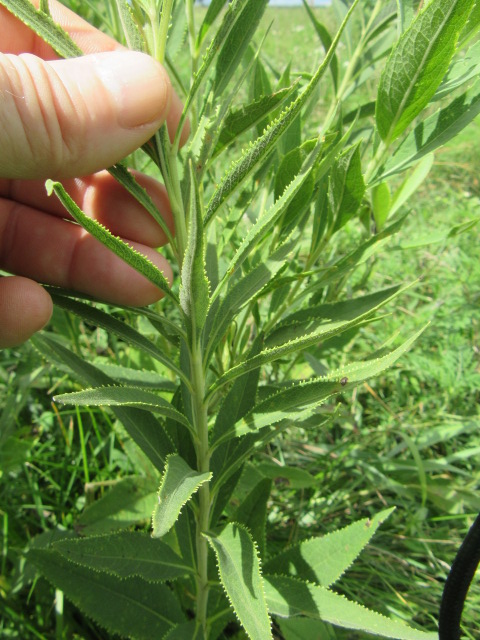
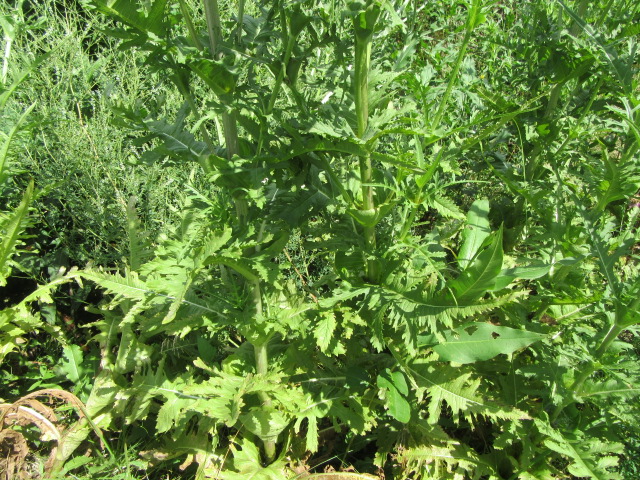
Lower leaves of the Cirsium altissimum (Tall Thistle) on 7-25-19.

These plants could be Sonchus oleraceus, the Common Sowthistle but the lower leaves absolutely do not match. Sonchus oleraceus is not a spiny plant either. After looking at many photos on several websites, I came to the conclusion these plants are Cirsium altissimum, comonly known as the Tall Thistle.


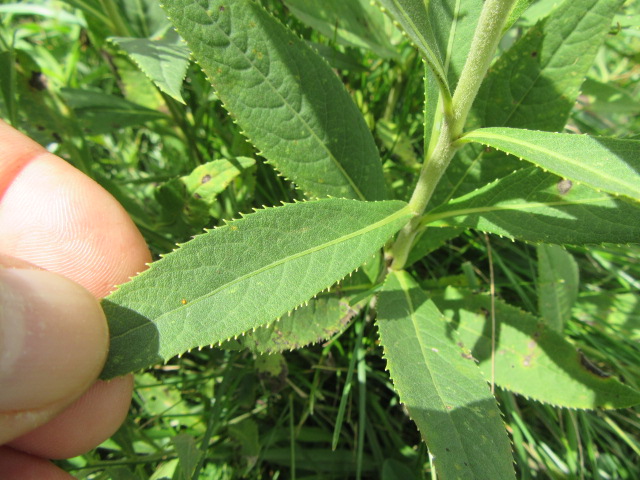
Central leaves of the Cirsium altissimim (Tall Thistle) on 7-25-19.

The leaves change shape and become very long, broad, and lance-shaped with toothed margins. Again, they are not spiny. Very similar to Sonchus oleraceus.


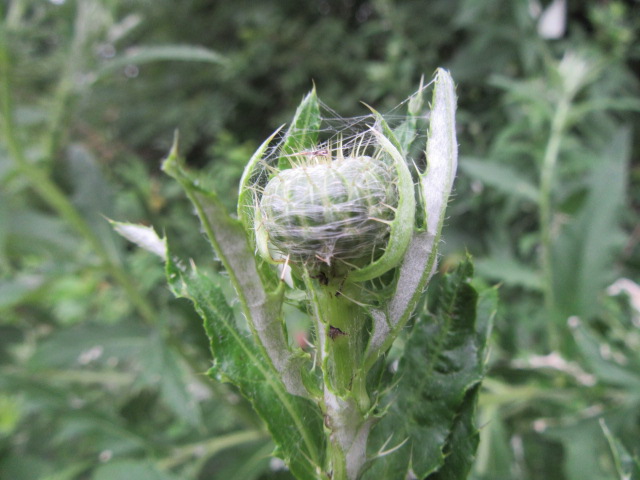
Bud of the Cirsium altissimum (Tall Thistle) on 7-25-19.

The buds are globe-shaped. A small spider had made a home on this bud.


Top view of a bud on the Cirsium altissimum (Tall Thistle) on 7-25-19.

You have to admit this is a neat bud… All the photos of buds I have looked at are farther along than these. So, Sonchus bud search was unfruitful. After determining it was probably a Cirsium species, I saw buds that were similar which helped to ID this plant.


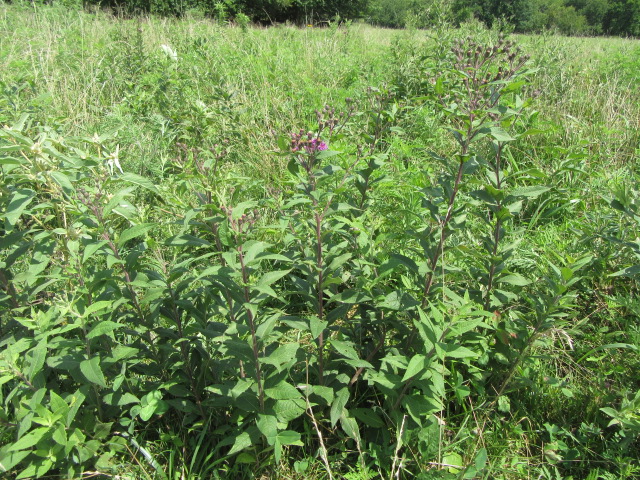
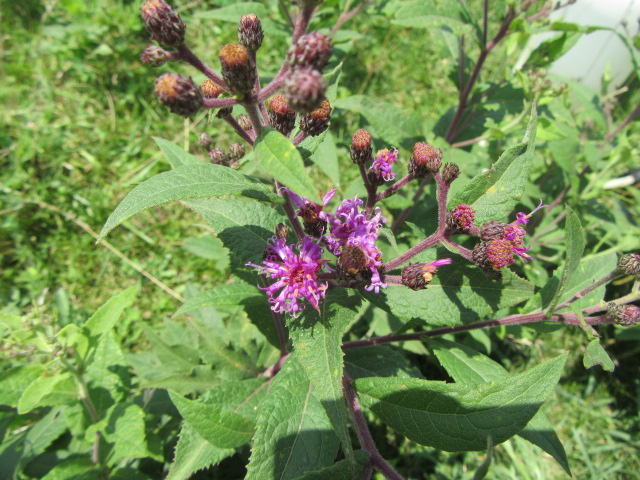
Cirsium altissimum (Tall Thistle) on 7-25-19.

Cirsium altissimum (Tall Thistle) is somewhat variable in the way they grow and what they look like from one location to another. I think light plays a big factor. The plant growing in full sun is shorter, has no lobed lower leaves, and the inflorence is more open. The plant  in this photo is growing in a mostly shaded area.


Top part of the Cirsium altissimum (Tall Thistle) on 7-25-19.

As with the Tall Thistle, Sowthistle flowers are normally well above the leaves. The lower leaves and flower buds were the determining factor before the buds open. After that, the Cirsium flowers will be a pinkinsh color while Sonchus species have yellow flowers. Probably, if I had ever seen a Sonchus species in the first place, I wouldn’t have been confused initially. I am sure they are much different in several other ways as well. Hopefully someday I will meet a Sonchus.

UPDATE: THE “could be” Sonchus oleraceus is Cirisium altissimum, a Tall Thistle.

Well, that’s all for this post. Until next time, be safe, stay positive, and always be thankful.

The Quest For Truth: Wildflower ID Part 1

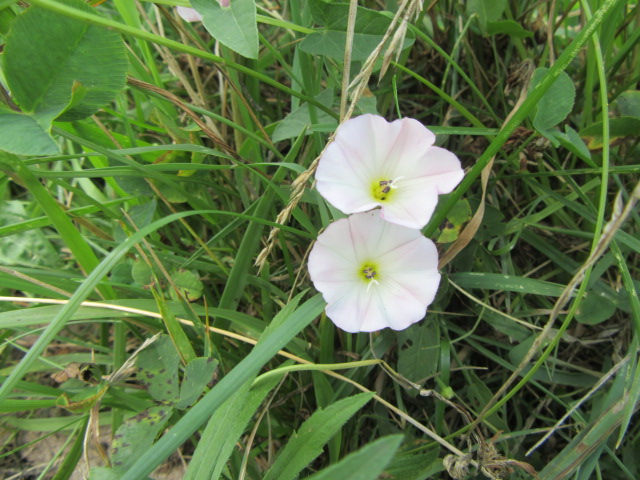
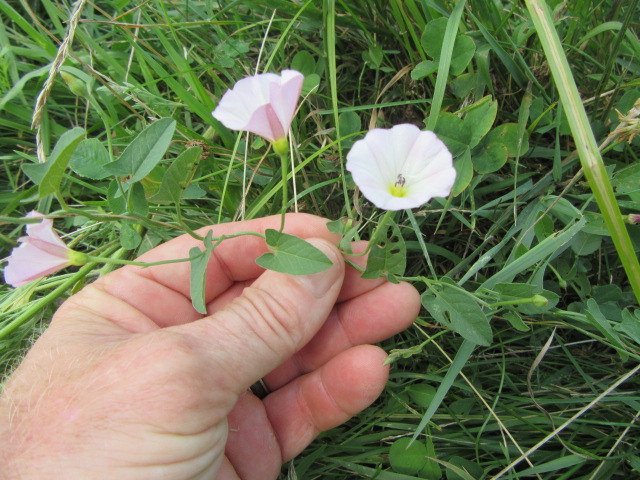
Convolvulus arvensis (Field Bindweed) on 6-24-19.

Hello everyone! I hope this post finds you all well. I guess the title of this post could get some attention for many reasons. Many of us are on a quest for the truth about something because, after all, the truth will set you free. We wonder about the truth of who we are when traditional religious teaching leaves us asking questions we are told have no answers. Some of us accept there are no answers and we go about life la-de-da. Well, I am not one of those people. While I may live in my own little la la land sometimes, it is far from a life of not knowing who I am, where I came from or where I am going. I have concluded it doesn’t really matter where or how we originated. What matters is who we are now and how we embrace life day by day. Growing spiritually, being thankful, and remaining positive are a few keys to living a happy and abundant life. We continue learning and making new discoveries which makes life truly amazing.

I have thoroughly enjoyed working outside this summer. The past several months spraying and digging thistles on Kevin’s farm have allowed me to watch many wildflower species grow and flower. I have identified many species not growing on the 38 (or so) acres where I live which has been pretty exciting. There are many plants I haven’t identified fully because I am waiting for flowers which can get a bit entertaining. Partly because sometimes I can’t find a plant I was watching and partly because the cows eat them before they flower. So many species in different genera look alike while they are growing then they change when they are about to bud and flower. Some plants of the same species look different growing in different areas of the pasture.

Taking a lot of photos of many different plants can be somewhat confusing if you let it be. Going from one plant to the next then finding better specimins later. Maybe a feature you didn’t shoot before to help clarify a species… I usually photograph a finger (or fingers) between plants. I have learned from experience to take as many photos as possible when you have a chance. You may think there will be other plants of the species somewhere else but maybe not. Then later, when you didn’t find any others, you may not be able to find the plant you photographed earlier. Been there, done that more than once.


Convolvulus arvensis (Field Bindweed) on 6-24-19.

One of the many plants I haven’t encountered before is the Convolvulus arvensis commonly known as the Field Bindweed. There were several flowering in the front area of Kevin’s pasture all white flowers with five pale pink stripes. I saw one on the west side with all white flowers and information on Midwest Weeds and Wildflowers says they are commonly all white or mostly pink. There are five pink bracts on the underside of the flowers which may be why the flowers appeared to have pink stripes. The bracts distinguish it from the Hedge Bindweed (Calystegia sepium). Their roots can grow from 8 to 30 feet deep with stems up to 9 feet long. Their roots can send up many shoots and a group of these can spread up to 20′ per year. They produce LOTS of seeds which are viable for up to 30 years!


Asclepias sp. in question on July 17.

The biggest issue I have been dealing with is the cows eating the plants I have been watching. I am certainly not complaining about the cows or anything. It is just the way it is and part of the cycle of life and nature. The milkweeds are a good example. The cluster of milkweed I posted about before that I couldn’t ID was likely because it had been snacked on at an earlier age. I took the above photo on July 17, which you can tell from the caption. 🙂


Asclepias sp. in question on July 17.

This probably caused the leaves to be smaller and is perhaps what caused the stems to a different color than they would have been had if they had been allowed to grow to maturity naturally. While the growth habit, even though nipped earlier, sort of remained the same. So, the Asclepias viridis (Green Milkweed) would still remain a bit of a sprawler. Even though several Asclepias syriaca (Common Milkweed) stems were eaten earlier, the growth that remained would still grow upright. Both the Common Milkweed and Green Milkweed have similar leaf veins but their growth habit, leaf shape and other characteristics remain true for the species.


On Monday, July 22, I went to Kevin’s farm to locate the Milkweed I previously questioned to get more photos. I wanted more in-depth photos of its leaves and stems on the upper and lower parts of the plant. I didn’t work on Monday so I wasn’t taking time away from my duties. Hmmm… I went to where I thought it was and it was not there. I thought maybe I wasn’t in the right spot so I walked around a bit and still couldn’t find it. So, I went back to where I originally thought it was and found a clump that was probably it. I remembered the clover and other weeds growing with the clump which was the determining factor but the whole spot had been eaten. What remained left me somewhat confused. What remained looked like Asclepias viridis (Green Milkweed). The upper part of the stems that left me questioning what species it was earlier was now missing. At least I am fairly certain this is the same cluster… Hmmm… With the cows grazing and eating all the time, the surroundings change. Plants and parts of plants they like get eaten while weeds they don’t care for continue to grow.


Asclepias sullivantii on 7-22-19.

There are a few milkweeds that look similar but have distinguishing features that separate them from the rest. The Asclepias sullivantii (Prairie Milkweed) grow more upright with up facing leaves. The veins on the leaves are also more refined than the Common Milkweed but the midrib is pretty similar. When there are no flowers it can be somewhat difficult so you have to look for other features. Am I 100% certain? Not going to tell you…

There is a fairly large colony of Asclepias sullivantii in one area but the plants are spread out quite a distance from each other. They are supposed to flower in June and July but none of the plants had flowers during the time I have been there. There are no seed pods…


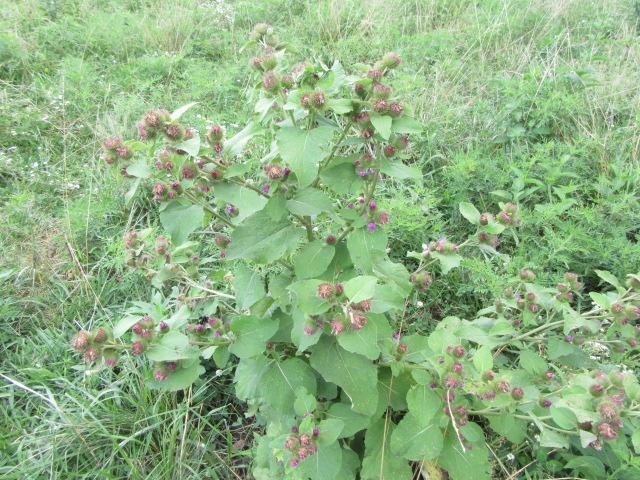
Arctium minus (Burdock) on 7-22-19.

Then there are the plants that completely change in appearance as they mature. The Arctium minus, commonly known as Burdock, is one of these species. The HUGE lower leaves that look like rhubarb are all but completely gone and have been replaced by smaller leaves and flowers (or buds).


Ruellia humilis (Wild Petunia) on 7-22-19.

Rarely have I seen Ruellia humilis, the Wild Petunia (etc.) with this many leaves. Without the flowers, it may be a little difficult to identify because we look at their flowers first. If I saw this plant without flowers, not having seen one this large and with so many leaves, I may not have even recognized it. The only plants I have been around are those that have been in the pastures and the ditch where they are constantly eaten or mowed. The one in the above photo somehow escaped being eaten. When I mowed on Saturday I also noticed a large specimen in an area of the ditch here that hadn’t been mowed. The Wild Petunia is a true survivor.

We depend a lot on flowers for proper identification but sometimes that isn’t enough when there are many species in a genus that all have similar flowers. We have to look to their leaves and stems and sometimes their calyces on the underside of the flower may be the only difference.

Sometimes we get a little surprise and have to rethink what we think we know. Notice I am saying “we” (trying to avoid “I”).


Unidentified species on 7-22-19.

Several clumps I have been watching have done this… It is in an area where there are several Vernonia baldwinii (Baldwin’s Ironweed) that are now beginning to flower. This plant is definitely not an Ironweed. The teeth on the upper leaves look like little nubs…


Hmmm…

The upper leaves are growing upright…


Double HMMM…

The teeth on the lower leaves look similar to many species, including Ironweed… Well, some of them… As these plants grew the teeth on their leaves changed somewhat.

Over the years I have taken a lot of wildflower photos on the farm but not always in every stage. So, it could be I will recognize it once it flowers.


Vernonia sp. (Ironweed) on 7-24-19.

As I mentioned, the Vernonia baldwinii are now beginning to flower. Actually, some had started earlier in another area and I included them in an earlier post. This plant is Baldwin’s Ironweed which most people just call Ironweed. At my place, an Ironweed is an Ironweed but I noticed something a little weird.


Dark stems on this cluster of Ironweed on 7-24-19.

This particular cluster of Ironweed has very dark stems. Some colonies stems are darker than others but have the same general characteristics otherwise. Stems partially dark but not necessarily the entire stem.

Have you ever thought something was right then started feeling maybe not?


Again with the Hmmm…

Notice the stems, or whatever you call them, on the entire inflorescence are a maroonish color… Well, I think it looks pretty neat!


GEEZ!

And then there is this one… No dark stems…


DOUBLE GEEZ!

Its inflorescence looks like this! No maroonish color at all!


TRIPLE GEEZ!

WHAT IS THIS? Its leaves look like the plant in question from before with the little nubs! Hmmm…


Ummm…

Here is a blooming inflorescence of the same, umm, Ironweed in a different spot.


Here is the whole group of Ironweed without dark stems. What you don’t notice in the photo is that these plants have a reddish glow which is quite fascinating in person.

Missouriplants.com gives descriptions of four species of Ironweed. The Missouri State University website, Midwest Weeds and Wildflowers, has five. Looking at their descriptions of Vernonia baldwinii AND photos I took of plants here last year… Ummm… They all are plants with green stems and not dark. Vernonia gigantea (or Vernonia gigantea var. gigantea), the Tall Ironweed, has dark stems. Information says Vernonia baldwinii is “variable” and sometimes difficult to ID. Species in the genus cross to form hybrids as well. The different species can be identified by looking at the bracts surrounding the flower head. The phyllaries are somewhat different, but GEEZ!!!

So, I sent Pamela of Missouri State University some photos to get her input. The photos in the folder are not all labeled because they are not all ID’d. Actually, the photos in the last three folders are not all labeled. Each day of photos is in separate folders… Ummm… 606 folders so far since 2009.

Well, I think I will conclude this post and start on part 2. There may even be a part 3 and 4. I kind of like the name of this post. The Quest For Truth…

Until next time, be safe and stay positive. Be thankful and get out and enjoy the fresh air.

Past Week Wildflowers

Asclepias stenophylla (Narrowleaf Milkweed) on 7-16-19. #602-1.

Hello everyone! I hope all is well with you. The past week has been fairly hot with no rain. I went back to check on the status of the thistles at Kevin’s farm north of town on Tuesday and Wednesday. I think I have them pretty well whipped but there are always a few I missed from before. The Bull Thistles are always a one-time shot and not that big of a problem. The Musk Thistles have been a different story. The bigger plants are all gone but small ones continue to sprout a flowering stem here and there. It is almost like they do this overnight. Supposedly they grow a rosette the first year and flower their second. Well, I can argue that point after spending two months with them. The plants that continue to shoot up flowers are less than a foot tall while earlier the bigger plants were up to around 4′ tall. It has really been an experience.

I have continued to take photos of wildflowers while I worked. There is a combination of two days of photographs in this post but I wanted them in alphabetical order. The Asclepias stenophylla (Narrowleaf Milkweed) in the above photo is getting with it now.


Asclepias stenophylla (Narrowleaf Milkweed) on 7-16-19, #602-2.

The bumblebees really like them.


Asclepias syriaca (Common Milkweed) seed pod on 7-16-19, #602-4.

I had to take a photo of the seed pod of the Asclepias syriaca (Common Milkweed). Its unique seed pods are one of the identifying features of this species of milkweed.
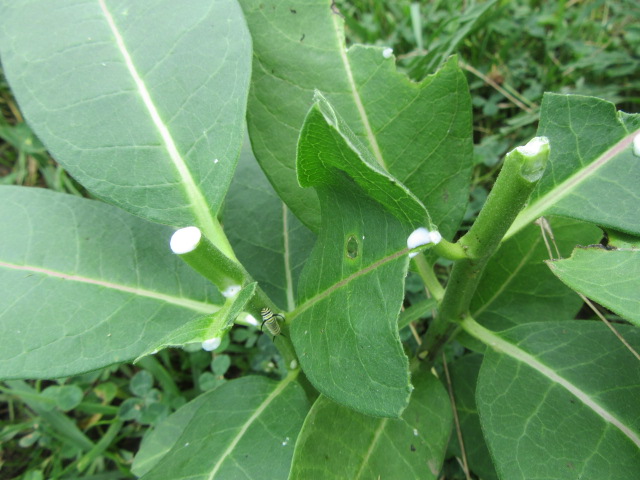
 

Asclepias syriaca (Common Milkweed) on 7-16-19.

While taking photos, a cow walked by and ate the tops right off this Common Milkweed. You can see the sap oozing out of the stems… Hmmm…


Asclepias syriaca (Common Milkweed) on 7-16-19, # 602-6.

The Common Milkweed is a very robust plant that can grow to over 6′ tall. In pastures, they don’t get that chance and this group is only around 3′ tall, possibly multi-stemmed perhaps from an earlier pruning.
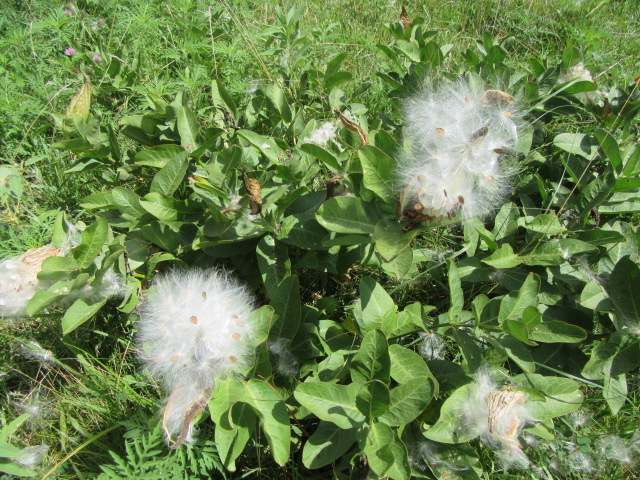
 

Asclepias viridis (Green Milkweed) seeds on 7-16-19, #602-7.

The Asclepias viridis (Green Milkweed) are among the first of the milkweeds to flower at the farm then are among the first to go to seed.


Asclepias viridis (Green Milkweed) seeds on 7-16-19, #602-8.

By contrast to many other plants, the large seed pods are mainly filled with fluff which helps the seeds float through the air. The distance they travel depends on a few things including wind speed and the height of neighboring plants. Rain can also spoil their trip by making the fluff heavy and wet and then the seeds just fall to the ground close to the parent plant.
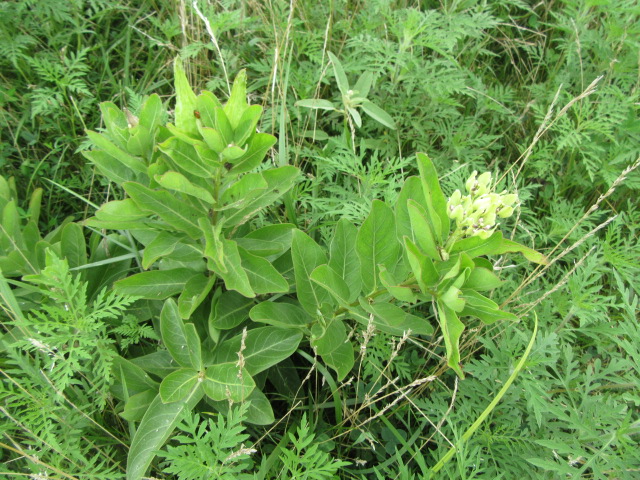
 

Asclepias viridis on 7-17-19, #603-3.

While there are still a few Asclepias viridis (Green Milkweed) flowering, most have gone to seed.


Asclepias sp. on 7-17-19, #603-1.

While most of the milkweeds are pretty easy to identify, especially when flowering, I have found one that has me stumped… When I first saw this plant and took a couple of photos, I didn’t realize what a difficult time I would have identifying it. If I had have known, I would have taken more photos and looked around for other plants like it while I was working.


Asclepias sp. on 7-17-19, #603-2.

If I have a plant I cannot figure out, I contact Pamela Trewatha from the Missouri State University (Springfield, Missouri). I am not sure if she is a botanist, horticulturalist or what but she maintains their Midwest Weeds and Wildflowers website and I think she took most of the photographs. She was stumped on this one as well which was very surprising. She thought it could be Asclepias sullivantii although she said she has never seen one in person. I looked at hundreds of photos online and I haven’t figured it out. This plant does not have the growth habit like Asclepias sullivantii nor are their leaves similar. There are many other differences as well that ruled out A. sullivantii. There were a few possibilities but not close enough. The one species that came close does not grow here and where it does grow it is very rare. There were no flowers on this plant and I didn’t notice any old flowers or seed pods. When I go back I will scout the area and see if there are other plants like this clump and possibly find flowers or seed pods. The spent flower in the above photo is a Red Clover…

There are several wildflower websites I use for ID. While there are milkweeds with similar leaves, some species leaves are “variable” and can be “oval” or have a slight point at the tip. However, the veining on this species leaves are not that “refined”, the tips are round, the midribs are light green (some species can have either maroonish or green midribs), and the central stems on this milkweed are brownish and not green like most… The leaves are also fairly small.
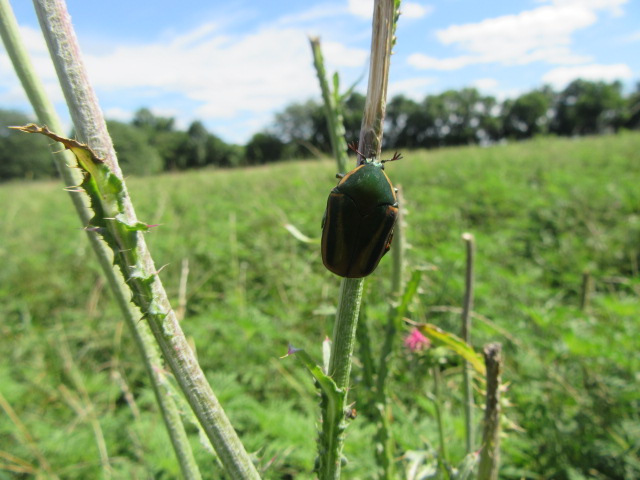
 

Cotinis nitida (Green June Beetle) on 7-16-19, #602-9.

I found a good-sized group of Bull Thistle I had somehow overlooked right in the middle of a large area. When I was getting ready to spray, the plants came to life as these HUGE beetles started flying out. It was very hot, so apparently, the beetles were farther down inside the thistles. I couldn’t get any photos at first because the beetles were moving pretty fast. Then, several feet away, I noticed this beetle along with a Japanese Beetle on a stem of an old Musk Thistle.


Cotinis nitida (Green June Beetle) on 7-16-19, #602-10.

The Cotinis nitida (Green June Beetle) is a pretty good-sized bug. They feed on flowers in pastures but also eat fruit. I attempted to pick up this guy (or gal) but it wanted no part of a new friendship. Beetles are not the most graceful flyers and sometimes you wonder if they even have a clue as to where they are going. These beetles sound like a small plane (very small) when they fly. When there are hundreds flying at once you might want to take cover because you will get run into.


Croton capitatus (Hogwort) on 7-16-19, #602-11.

This interesting species is the Croton capitatus, commonly known as Hogwort, Wooly Croton, and Goatweed. Croton is a very large genus consisting of 1,173 species (as of this post date) and this species is found through much of the United States. The Missouri Department of Conservation says there are three species of Croton in Missouri. I have two species growing on the farm.


Croton capitatus (Hogwort) flowers on 7-16-19, #602-13.

Their flowers aren’t that particularly interesting unless you take a closer look… The cluster of flowers consists of male flowers toward the tip and female flowers below. Male flowers have 5 tiny white petals and 10-14 anthers. The female flowers don’t have petals but have 6-9 calyx lobes which are split 2-3 times making a total of 12-24 lobes. The fruits are about 1/4” wide and contain only three seeds each. Apparently doves and quail like their seeds.

While many wildflower species have many medicinal benefits, this plant produces Croton Oil which is a powerful laxative.
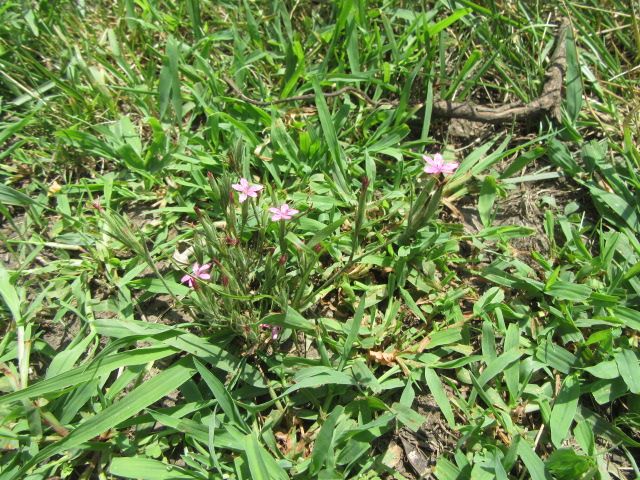
 

Dianthus armeria (Deptford Pink) on 7-17-19, #603-5.

The Dianthus armeria (Deptford Pink) grow throughout the farm here as well as at Kevin’s. The flowers are so small it is very hard to get good photos of, especially close-ups. The plants are very short and have narrow, lance-shaped leaves. Although not an original US native, they can be found growing throughout most of the US and Canada.


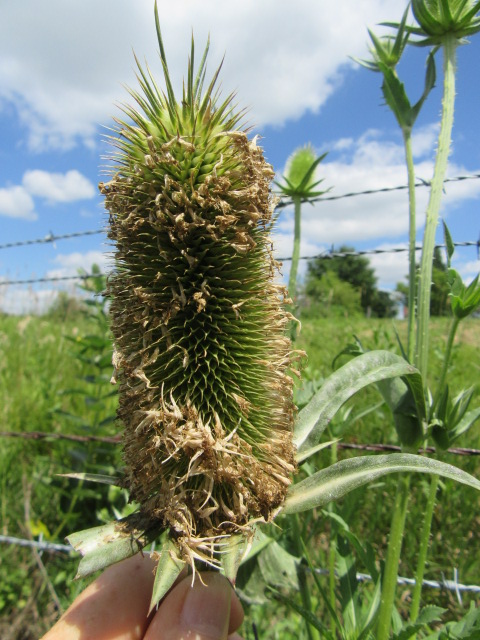
Dipsacus laciniatus (Cutleaf Teasel) on 7-16-19, #602-14.

While I was walking around the area where the Cutleaf Teasel (Dipsacus laciniatus) were I noticed more flowers. I guess the photos I had taken for a previous post were their buds and now they are flowering.


Dipsacus laciniatus (Cutleaf Teasel) flower on 7-16-19, #602-15.

There were a lot of bumblebees on the flowers as well as a few Japanese Beetles. It was funny watching for a few seconds. It was like the bumblebees were on a mission and no Japanese Beetles were going to get in their way.
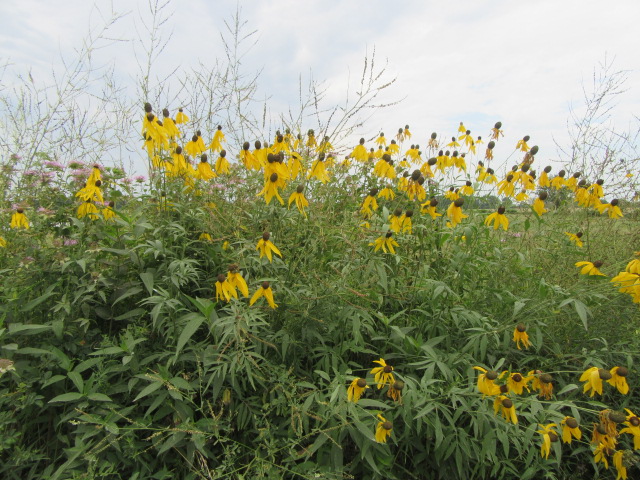
 

Echinacea paradoxa (Yellow Coneflower) on 7-17-19, #603-6.

I needed to go visit a friend Wednesday afternoon so I decided to drive by the large colony of Echinacea paradoxa (Yellow Coneflower). This is where I was going to dig some plants up this spring but… Well, it didn’t happen. Maybe I can collect some seeds later. I love the way the native coneflowers petals droop.

Ummm… While I was taking photos of the Yellow Coneflower, I noticed some really neat leaves but there were no flowers… Then later I spotted them again with flowers… The name begins with an “S” so it is farther down in the post. 🙂
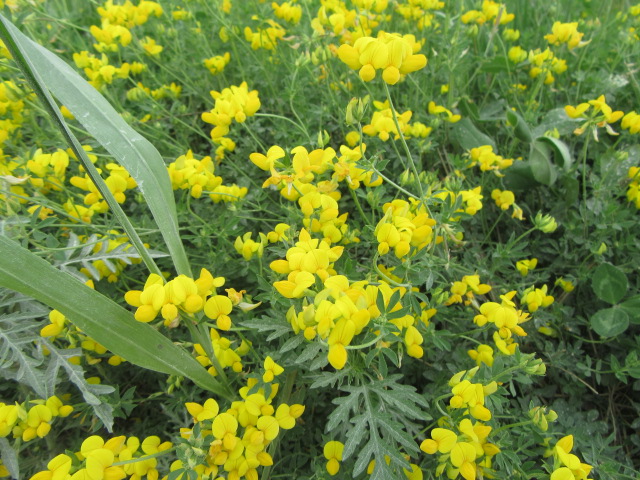
 

Lotus corniculatus (Bird’s Foot Trefoil) on 7-17-19, #603-7.

I have seen this plant growing along highways for MANY years and have always wondered with it was. Usually, I don’t have time or I don’t have the camera, but mainly because I didn’t want to stop along the highway. Well, when I went to visit my friend on Wednesday I noticed them growing along a different road. Not only them but the plants that begin with the “S”.

The plants in the above photo are Lotus corniculatus commonly known as the Bird’s Foot Trefoil. Hmmm… OK, I know how common the Bird’s Foot Trefoil is but I had never seen any up close and personal until now.

The Lotus corniculatus isn’t a US native. The Wikipedia says the plant is native to parts of North Africa and Eurasia. Hmmm… I learned something. I had to click on Eurasia to find out where it was. I don’t think they taught it was Eurasia when I was in school… It is the largest continent on Earth consisting of all of Europe and Asia with 70% of the world’s population. Hmmm… I didn’t even realize Africa was considered an Asian country. Well, I got stuck reading about Eurasia so I better get back to…

Where was I anyway? Oh yeah! Lotus corniculatus!


Lotus corniculatus (Bird’s Foot Trefoil) on 7-17-19, #603-8.

I lost my train of thought while reading about Eurasia and kind of went blank because I didn’t know… Anyway, it was interesting.

Bird’s Foot Trefoil is grown as a high-quality forage plant for pastures, hay, and silage that does not cause bloat.
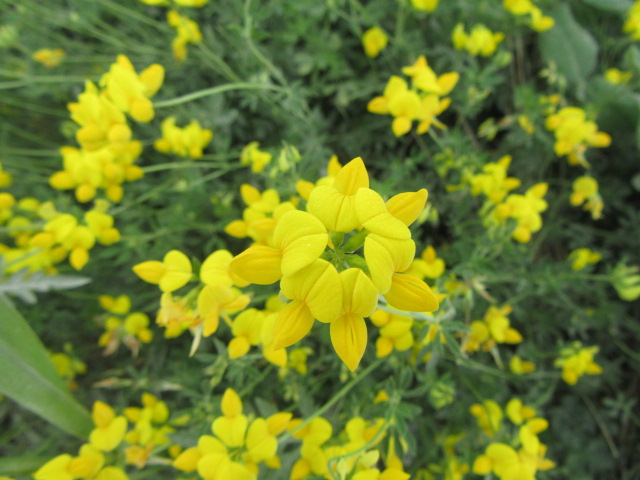
 

Lotus corniculatus (Bird’s Foot Trefoil) on 7-17-19, #603-9.

The flowers are particularly interesting. What is even more interesting is that a plant guy didn’t even realize these yellow flowers growing along the road were Bird’s Foot Trefoil! Several people have asked me what they were over the years but I never knew until now. Now I know and I am thankful. I am also thankful for learning where Eurasia is. 🙂

Ummm… The Lotus genus is a member of the Fabaceae (Pea Family) and contains 124 accepted species.

What we usually think of as a Lotus is the Nelumbo nucifera, also known as the Sacred Lotus Flower, Indian Lotus, Sacred Lotus, Bean of India, Egyptian Bean or simply lotus. It is the only genus in the family Nelumbonaceae with two accepted species. Strange the Water Lily isn’t in the same family, but they are in the Nymphaeaceae family. Hmmm…

I had to check on that because I was wondering why Bird’s Foot Trefoil was a Lotus. Then I find out the Lotus isn’t a Lotus. Double hmmm…


Maclura pomifera (Osage Orange) on 7-16-19, #602-16.

OK, I realize the Maclura pomifera (Osage Orange) isn’t a wildflower and maybe most wouldn’t find them that interesting. For me, though, I think they are a magnificent tree especially when they get very old.


Maclura pomifera (Osage Orange), 7-16-19, #602-17.

Just look at that massive trunk… This tree isn’t quite as large as the old one at my place, but it is still pretty good sized.


Maclura pomifera (Osage Orange) on 7-16-19, #602-21.

This tree, like most very old Osage Orange, have stood the test of time. Just think of how many high winds, thunderstorms, heavy snows, and ice they have been through. If you ever have a chance to visit a very old and large Osage Orange, look up into the tree and you can see how they have twisted and turned over the years. They tell a tale of a long life in the elements of nature and have endured them all. This tree was really talking and I enjoyed our brief visit and feeling the energy surrounding it. It is more than alive, it is A LIFE! 🙂
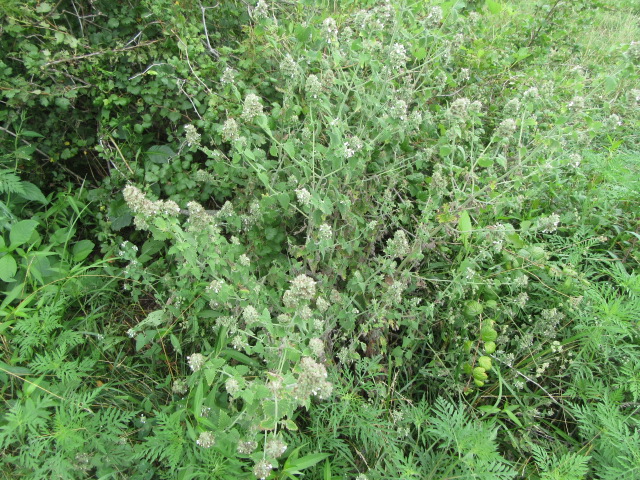
 

Nepeta cataria (Catnip) on 7-17-19, #603-10.

While I was spraying in a little area I had rarely gone, I noticed a plant I completely didn’t expect to see in the wild. I said, “It’s a mint! What in the world are you doing here?” Of all places next to a Gooseberry bush and Osage Orange tree where an old fence row had been. Just goes to show you just never know what you might find… Oh! It is a Nepeta catariaCatnip! They have different leaves and flowers than Spearmint.

I suppose the Catnip has to grow in the wild somewhere and there are several mints that are native to Missouri. I have just never seen any in the wild. Of course, they are members of the Lamiaceae family along with 234 other genera of aromatic and tasty culinary herbs.


Physalis longifolia (Common or Smooth Ground Cherry) flower on 7-16-19, #602-22.

Had I not noticed something weird about this plant, I could have easily passed it off as a Horsenettle. All I saw at first was a nearly hidden yellow flower drooping downward so I thought I would have a peek because Horsenettle does not have yellow flowers. Then I saw what else was hidden beneath the leaves. As it turns out this plant is a Physalis longifolia, commonly known as the Common or Smooth Ground Cherry.
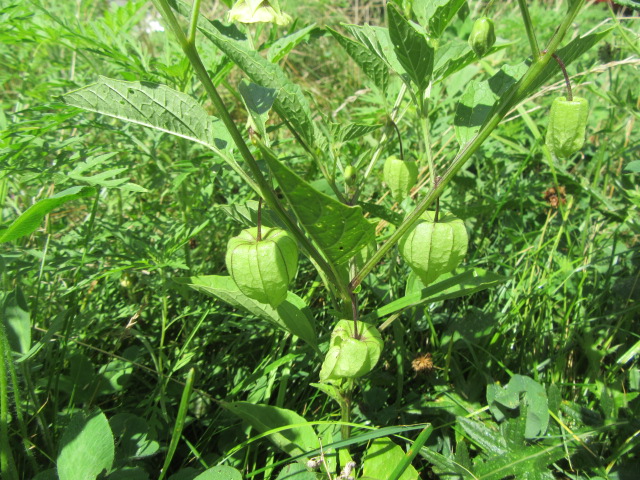
 

Physalis longifolia (Common or Smooth Ground Cherry) flower, on 7-16-19, #602-23.

AH HA, you say! 🙂 Well, at least I thought it looks like the plant called Chinese Lantern, which is actually Physalis peruviana. Perhaps you were thinking about the Tomatillo or Mexican Husk Tomato which is the Physalis philadelphica and/or Physalis ixocarpa. Well, inside of these small lanterns is a fruit which is also edible…


Ruellia humilis (Wild Petunia) on 7-16-19, #602-24.

The Ruellia humilis (Wild Petunia, etc.) are growing here and there on Kevin’s farm as where I live. They seem to be growing as solitary plants rather than in colonies except for in my ditch where there are several. I think there are more in the ditch in front of the house than on the entire pasture and hayfield. While they flower over a long period, they seem to only produce one flower at a time. While one bud is beginning to open, the one before it is fading. Some information online says the flowers open in the morning and fall off in the evening. Hmmm… These plants are very easy to recognize in the wild because, after all, they are a petunia. Not saying all Ruellia species are the same, but all do have similar characteristics. Plants of the World Online currently list 357 accepted species in the genus.

Now that I am down to the mystery plant… Well, maybe I should save it for a post of its own. Just kidding. 🙂 But I do feel a nap coming on…


Silphium laciniatum (Compass Plant) leaves on 7-17-19, #603-13.

OK… The above photo, although taken out of numerical order, is the leaves of the plant with no flowers I saw when photographing the Echinacea paradoxa. They were by the road so apparently, their flower stems had been mowed off. I took the photo because I thought they were quite strange and unusual.
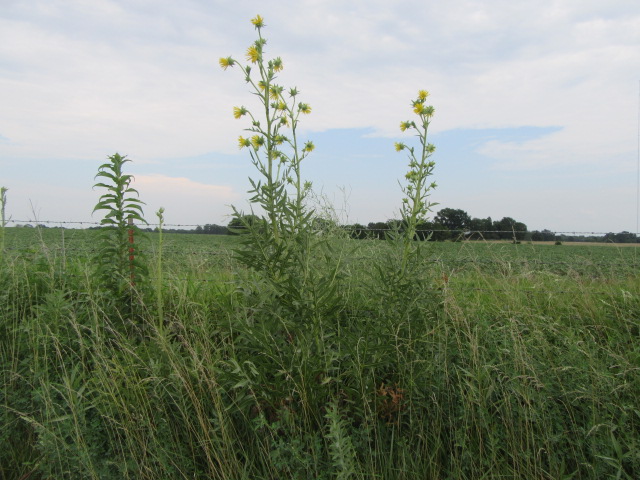
 

Silphium laciniatum (Compass Plant) on 7-17-19. #603-20.

Hmmm… I realize you are laughing at me AGAIN because anyone who has driven on most highways and backroads has seen this plant. Of course, like me, maybe you just passed them off as some kind of sunflower. I had no idea this plant had so much interest whatsoever.

Found throughout Missouri except for the southeast corner, the Silphium laciniatum is easily identified by its pinnatifid leaves, hairy stems, and big yellow flower heads. Its common name is the Compass Plant because their flowerheads follow the sun across the sky (heliotropism) like many species in the Asteraceae family such as sunflowers.


Silphium laciniatum (Compass Plant) leaves on 7-17-19, #603-14.

Silphium laciniatum has been used as a worm expelling, coughs, lung problems, asthma, and as an emetic. The resin produced on the upper part of the stems was chewed by Native Americans. The mouth cleansing gum is said to be fragrant but bitter.

Contrary to what you might think, the common name comes from their leaves and not their flowers. Pioneers believed that the leaves of the Compass Plant pointed in a north-south direction. The basal leaves do usually grow on a north-south axis thought to minimize intense overhead sun exposure. Of course, their flowers follow an east to west movement following the sun…


Silphium laciniatum (Compass Plant) flower on 7-17-19, #603-23.

The Compass Plant grow from 6-12 feet tall and their flowers can be up to 5″ across. It can take several years for these plants to develop into a full-sized plant but they can live up to 100 YEARS! Their taproots can grow 15′ deep! The basal leaves can grow to 18″ long while the upper leaves are much smaller.

So now we know these plants are Compass Plants and not just another sunflower. 🙂


Solanum carolinense (Horsenettle) on 7-17-19, #603-25.

Of course, this is the common ‘ol run of the mill Horsenettle (Solanum carolinense) we may all love to hate. One of its common names, Tread Softly, says a lot! While it is a member of the Nightshade family (along with tomatoes) and its fruit may look like cherry tomatoes, DO NOT EAT! The Wikipedia says:

“All parts of the plant, including its tomato-like fruit, are poisonous to varying degrees due to the presence of solanine glycoalkaloids which is a toxic alkaloid and one of the plant’s natural defenses. While ingesting any part of the plant can cause fever, headache, scratchy throat, nausea, vomiting, and diarrhea, ingesting the fruit can cause abdominal pain, circulatory and respiratory depression, or even death. “

I may have not taken a photo of the Horsenettle if it weren’t for the flower below which I noticed the day before…


Solanum carolinense (Horsenettle) on 7-16-19, #602-25.

Ummm… As I was working I noticed something a little unusual… While I do have a lot of Horsenettle in my pastures and hayfield, some of the colonies in Kevin’s pasture have these blue flowers. While it is true that some in my pasture do have a slight tint, they are mainly all white. So, I took photos and found that these are also Solanum carolinense. I thought maybe they were a different species, but no, just a different shade.


Verbena stricta (Hoary Vervain) on 7-16-19, #602-29.

One of my favorite wildflowers is Verbena. The interesting thing is that the species growing on Kevin’s farm are different than the ones growing where I live. This one is Verbena stricta commonly known as the Hoary Vervain. The species growing in my pastures and hayfield is the Verbena hastata commonly known as the Blue Vervain. I mainly noticed the difference by the Verbena stricta‘s broader leaves and larger flowers. The one thing that makes them very similar is getting photos that aren’t blurry… While Plants of the World Online list 147 species in the Verbena genus native to most parts of the world, Verbena hastata and Verbena stricta are native to most of the US and Canada.

I am finished for now because I ran out of photos. 🙂 I thoroughly enjoyed this post because I learned A LOT. I am thankful I found out about Eurasia, too!

Until next time, be safe, stay positive, and always, always, be thankful! After a week of heat and no rain, I am thankful we finally had rain this morning and as I am finishing this post.


Friday’s Find

Asclepias syriaca (Common Milkweed) on 7-12-19, #600-2.

Hello everyone! I hope this post finds you well and doing your best to enjoy the summer. We have had some hot days but it cools down nicely in the evening. I hadn’t been out to the farm where I have been working on the thistles for 12 days until Thursday. Friday I made my way to an area where I had been watching a colony of plants. I had been waiting for them to flower so I could make an ID but they flowered while I was away.

While I was in the area I noticed an Asclepias syriaca (Common Milkweed). I have these growing along the lagoon at my house but I hadn’t taken any photos for some strange reason. This species of Milkweed grow pretty tall, up to around 6′, and have nice broad oval leaves. There is another species that is similar in Missouri but they may have gone extinct since none have been seen since 1933.

Asclepias syriaca is known as the Common Milkweed, Butterfly Flower, Silkweed, Silky Swallowwort, and Virginia Silkweed. This species was one of the earliest North American species described by Jacques-Philippe Cornut (French physical and botanist) in Canadensium Plantarum Historia in 1635. Many species of insects feed on the Common Milkweed.

Although the plant’s latex contains large quantities of glycosides which makes it toxic to livestock and humans, the young shoots, leaves, flower buds, and immature fruit are edible (raw). Apparently, it can be cooked like asparagus. I read this information on Wikipedia.

According to Plants of the World Online, there are 206 species in the Asclepias genus. It is a member of the Apocynaceae Family (family of Milkweeds) which currently contains 358 genera. Version 1.1 of The Plant List (updated in 2013) listed 410 genera and 5,745 species. It also lists a WHOPPING 10,568 synonyms (genus and species synonymous with other species) PLUS 3,928 species names that were still unresolved… Well, that was several years ago and those numbers have changed due to the effort of many botanists and horticulturalists. So many species had/have multiple scientific names. It is a continual work in progress.


Arilus cristatus (Wheel Bug) on 7-12-19, #600-1.

While looking at the Milkweed I noticed this assassin bug. It is the dreaded Wheel Bug (Arilus cristatus). The Wheel Bug is one of the largest assassin bugs. I have seen these many times on the farm but didn’t know much about them. I found some good information on the North Carolina State Extension website. They feed on a number of insects including aphids, caterpillars, beetles, and many other problem insects. They inject their prey with a toxin that kills within 30 seconds. Their bite is said to be more painful than a wasp sting so it is best not to handle.

Debbie Roos has a great article titled Birth Of An Assassin Bug! on the North Carolina State University Extension website. The article also shows photos of their eggs.


Daucus carota (Queen Ann’s Lace) on 7-12-19, #600-3.

Earlier there was A LOT of Achillea millefolium (Yarrow) on the farm, and there still is for that matter. I mean, where would they go anyway? Now the Queen Anne’s Lace (Daucus carota) is flowering. Daucus carota is a member of the Apiaceae Family with carrots and 441 other genera. There are 45 accepted species in the Daucus genus.

While the Queen Anne’s Lace flowers are kind of similar in appearance to the deadly Poison Hemlock, their leaves have a mixture of tripinnate leaves, fine hairs, and a root that smells like carrots. Poison Hemlock have larger leaves and the plants grow MUCH taller. I ran across this YouTube video, Poison Hemlock Identification and Yarrow Comparision, that shows the difference between Poison Hemlock, Queen Anne’s Lace and Achillea millefolium.  While their flowers may look similar to people who don’t spend a lot of time in nature, the leaves of Achillea millefolium look nothing like the other two.

Since summer is here, it seems like the interest in “foraging” has returned. If you are interested in this, you really should invest in a field guide to take along with you, or even someone who is experienced. Ummm… Also when you do this, I suggest leaving your cell phones behind or at least turn them off. When you are out in nature, be out in nature and leave any distractions behind. Take time to be aware of the beauty and life around you. Sit quietly someplace with your eyes closed and allow your other senses to observe as well. Sometimes we see best with our eyes closed in nature. Be aware that we are all one with EVERY living thing.


Daucus carota (Queen Ann’s Lace) on 7-12-19, #600-4.

Flowers are used in arrangements and will change color depending on the color of the water, similar to Carnations.

Plants are beneficial companion plants attracting pollinators and improving the microclimate for some vegetables. Some states have it listed as a noxious weed and considered invasive in pastures when established.

Now for the plants I was keeping an eye on…


Dipsacus laciniatus (Cut-Leaved Teasel) on 7-12-19, #600-5.

I took an interest in these plants growing along the highway because I don’t have any like this at my place. I have seen them here and there, normally where there is a ditch or a creek.  It may sound strange but I had no clue what they were even after seeing their flowers but the name Teasel popped into my head on the way home. Well, I guess I must admit, the name didn’t just pop into my head. We are not alone and when we talk to ourselves we are actually talking to “them” as well. GEEZ! It is kind of hard to explain unless you have done the same…

OK, even though you might think I am a bit whacky, I will explain. Once you realize you are not alone and we have guides and Angels and so on with us all the time, when you talk to yourself you are also talking with them. They are here not only to guide us and watch over us, but they are also here to learn from us and our human experiences. They are very OLD and knowledgeable about many things. So, when you have questions about this and that, just ask. You will be surprised at how you receive your answers.

Anyway, this plant is, in fact, the Cut-Leaved Teasel (Dipsacus laciniatus). For some reason, it is a member of the Caprifoliaceae Family, also known as the Honeysuckle Family, which consists of mainly shrubs and vines. It was formerly in the Dipsacaceae Family (the Teasel Family). Plants of the World Online list 21 accepted species in the Dipsacus genus. There are a few other Teasel species found in Missouri but their flowers are a different color and their leaves are also different.


Dipsacus laciniatus (Cut-Leaved Teasel) on 7-12-19, #600-6.

I think they have already flowered but they are still very interesting.


Dipsacus laciniatus (Cut-Leaved Teasel) on 7-12-19, #600-7.

They are monocarpic, living for several years before flowering then dying. The flowers attract bumblebees, bee flies, butterflies, and skippers.


Dipsacus laciniatus (Cut-Leaved Teasel) on 7-12-19, #600-8.

Its leaves are oppositely arranged around the stem. The pinnately lobed leaves are around 16” long. The base of the leaves clasps around the prickly stems.


Dipsacus laciniatus (Cut-Leaved Teasel) on 7-12-19, #600-9.

There is quite a colony in the ditch that apparently aren’t old enough to flower. The leaves of immature plants are usually unlobed.

For more information about this plant, visit the Missouriplants.com, Its Wikipedia page, or just type in Dipsacus laciniatus. There are several state websites with good information.

Well, that’s it for this post. Until next time, take care, stay positive, be safe and always be thankful!

The New Rescue Japanese Beetle Traps

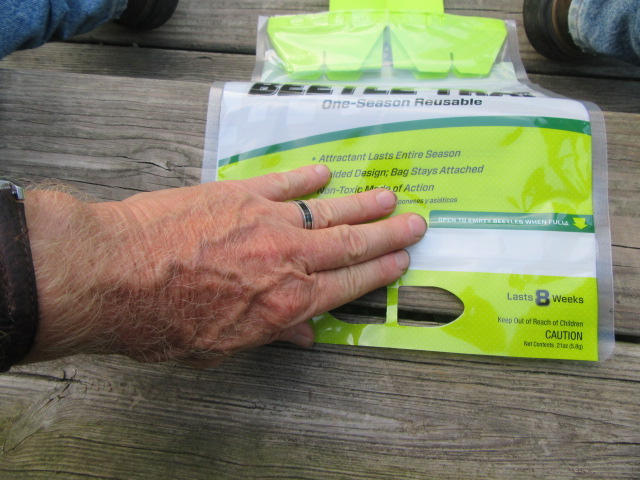
Hello everyone! I hope this post finds you all doing well. The new Japanese Beetle Traps came in the mail on Monday. I sent the company an email about the issues with the first two traps I bought from the local Farmer’s Co-op. I sent a link of my post to her and she said she was glad to see I had caught so many beetles but was sorry to hear about my issues with the traps. She said they had a lot of complaints about the same reason I did so they changed the design. They changed it in October 2018 although the first two I bought the first part of July were the old design. I replied with a couple of links from people who had “re-engineered” the top part of beetle traps and fit them in funnels (like the ones you use to pour oil into motors) and fit them onto 5-gallon buckets. I thought that was very ingenious and maybe they can make a kit to use with buckets.

I didn’t put the traps up until Tuesday evening because I wanted to take one to the Farmer’s Co-op to show them the new design. Well, they had a full box of the old design they just got in. I showed them how the zipper on the old design cut the bags when they were opened and closed and how the new design works. They didn’t seem to enthused. 🙂 🙂 🙂 I may have “implied” the ones they were selling were no good. Even though I said customers complained so the company changed the design. She said, “That is what they sent.” I guess they came from a warehouse and had them leftover from last summer.


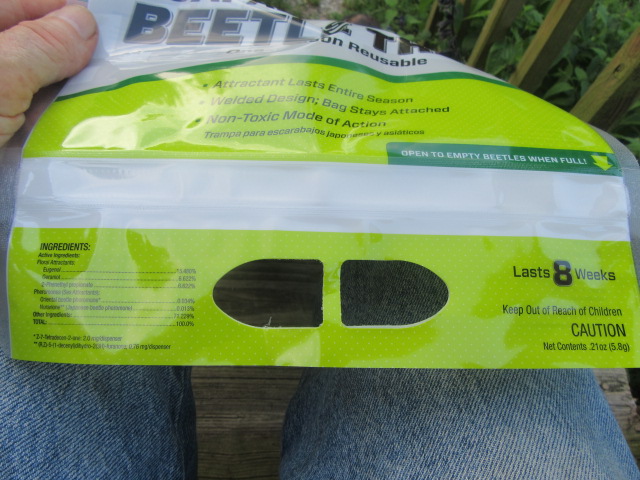
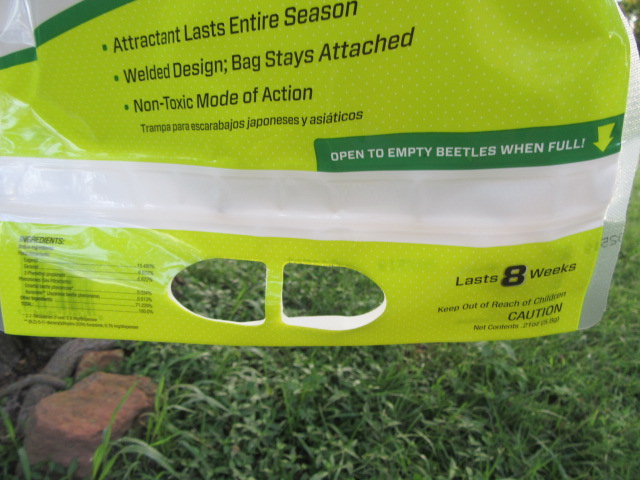
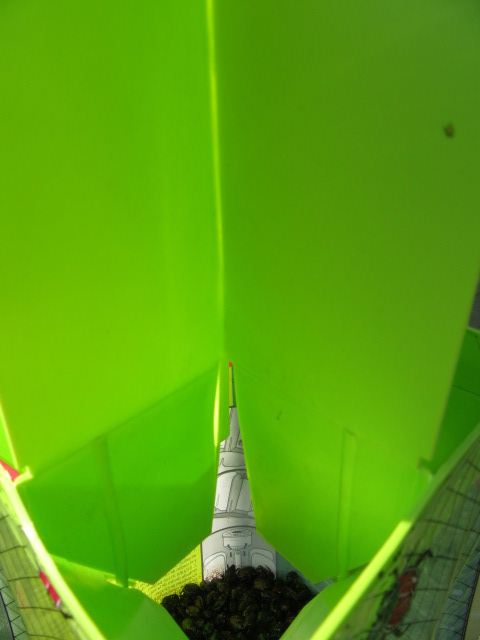
The top part of the trap is basically the same as the old design (although not as colorful).


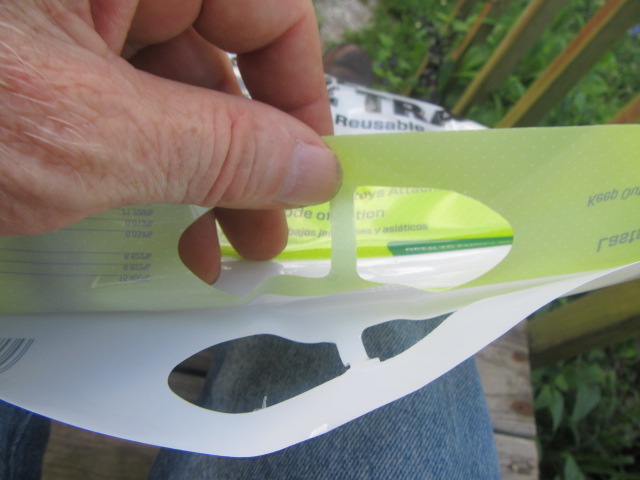
With no sliding zipper to cut the bag…


You just simply pull it apart.


It is kind of “velcro-like”.


To close, you just press the two sides back together. Pretty simple.


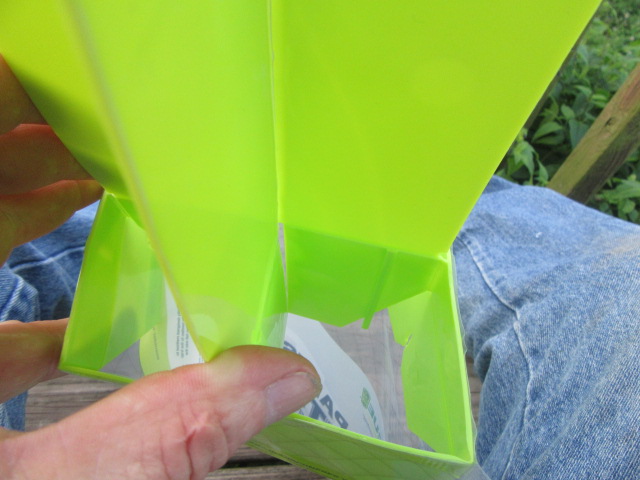
Then you snap the “funnel” in place.


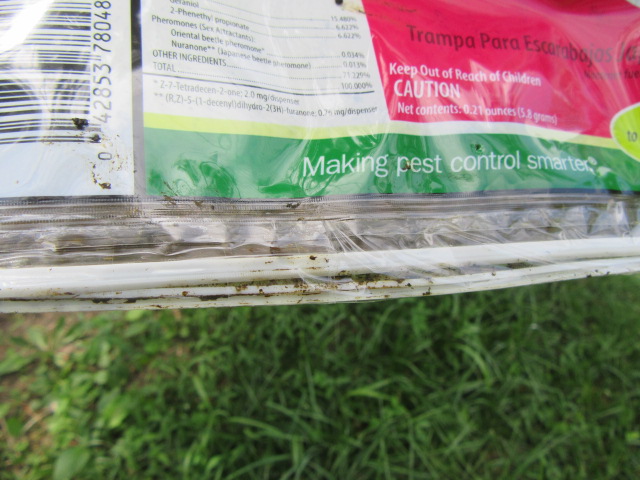
I must admit, the attractant does smell pretty good.


The attractant slides into place at the top of the trap.


As you can see, packing tape doesn’t work all that well sometimes. Maybe duct tape would work better but it would be a pain removing it when you have to dump the bag. You would pretty much have to cut the bottom and retape it every time you needed to dump it.


All setup and ready to go next to the shade bed. I put them both where the old ones had been. I didn’t get bombarded with beetles since it was 8 PM when I hung them up.


I am not sure how easy it will be to reseal the bag with it hanging, so I may have to take it down and put it on a flat surface. That’s easy enough to do as long as it works.

Even though some retailers may still be selling the old version, many people don’t have as many Japanese Beetles as there are here so they probably won’t have an issue.

Well, that’s all I have to say for now. I did take a few other photos for another post. Until next time, be safe and stay positive!

HAPPY 4TH OF JULY Plus A Few Photos

Echinacea purpurea on 7-4-19, #598-1.

Hello everyone and HAPPY 4TH OF JULY! As always, the city had their 4th of July celebration at the park down the road from where I live. There was a steady stream of traffic going by most of the day. It rained this afternoon which kind of put a damper on things, but the fireworks display went ahead as planned. I must admit, they do a pretty good job for a community the size of Windsor. I can see the fireworks pretty good from the backyard which lasted about 30 minutes.

Despite it sprinkling most of the afternoon, including one pretty good downpour, I did manage to go out about 6 PM and take a few photos. I took photos all week but have been tardy writing daily posts. Ummm… How many times have mentioned something to that effect? 😐

Last July 4 I moved the plants and plant tables from around the shed in the other yard to the front and back porch. That was because of the Japanese Beetles.

So, in alphabetical order…

In the above photo, the Echinacea purpurea, which may be the cultivar called ‘Magnus’, is now flowering up a storm. The bank in town has a HUGE patch of them I have been meaning to photograph. The Purple Coneflower is one of my favorite plants. GEEZ! I can’t believe I said that because I try not to have favorites! I like the way the petals droop and like the feeling of the cones. Echinacea purpurea is a very beneficial plant in many ways.


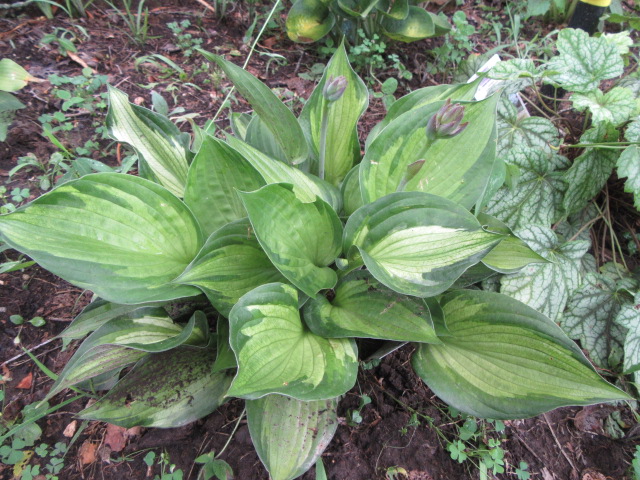
Hosta ‘Potomac Pride’ on 7-4-19, #598-2.

Out in the shade bed, several of the Hosta are starting to flower. The Hosta ‘Potomac Pride’ has a lot of buds but they haven’t peeked their way through the foliage yet. Hosta ‘Potomac Pride’ has been an awesome performer over the past at least eight summers. I bought it while in Mississippi at the mansion and the first photo was taken on April 15, 2012, but it seems like I had it longer. I really like its dark green, puckered, and corrugated leaves. The clump had gotten very large and has been the best performer of all the Hosta in my collection.


Hosta ‘Sum and Substance’ on 7-4-19, #598-3.

Even though I just brought the Hosta ‘Sum and Substance’ home last June 7, it has become quite a show-stopper. Very bight and cheery for sure and starting to flower.


Hosta ‘Whirlwind’ on 7-4-19, #598-4.

The Hosta ‘Whirlwind’ is always a dazzler. Its leaves change color with age which just adds to its interest. It isn’t a big plant, but it puts on a big show!


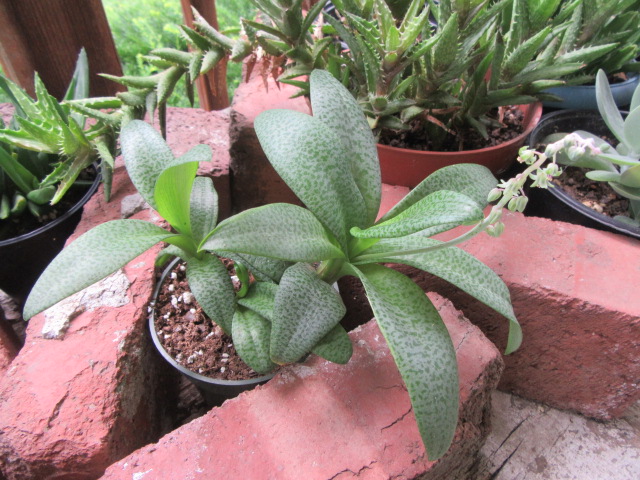
Ledebouria socialis var. pauciflora on 7-4-19, #598-5.

I purchased the two Ledebouria socialis (Silver Squill) varieties last October and have really enjoyed them as companions. The above photo is of the Ledebouria socialis var. pauciflora which used to be Ledebouria pauciflora. I like the silvery leaves with the small green flecks.


Ledebouria socialis var. violacea on 7-4-19, #598-7.

The Ledebouria socialis var. violacea is really growing well. It had many more bulbs than the other one when they arrived. This one was the species Ledebouria violacea but the name changed also.


Ledebouria socialis var. violacea new growth on 7-4-19, #598-9.

The Ledebouria socialis var. violacea also seems to be a bit more of a spreader. These plants are VERY, VERY easy to grow even through the winter in the house. You don’t even need to water them through the winter, in fact, it is best if you don’t.

I am STILL waiting for the two new cultivars to arrive… I think he is a bit behind.

Hmmm… My computer just notified me I have a new memory from summer 2017. Weird… Now I am wondering how it came up with that idea. 🙂


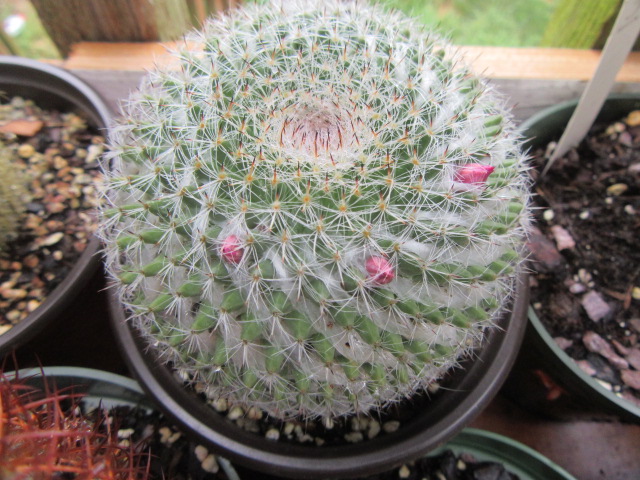
Mammillaria hahniana on 7-4-19, #598-10.

The Mammillaria hahniana (Old Lady Cactus) is starting to bud again. It isn’t looking like its normal fuzzy self because it is wet from the rain. This is our fourth summer as companions.


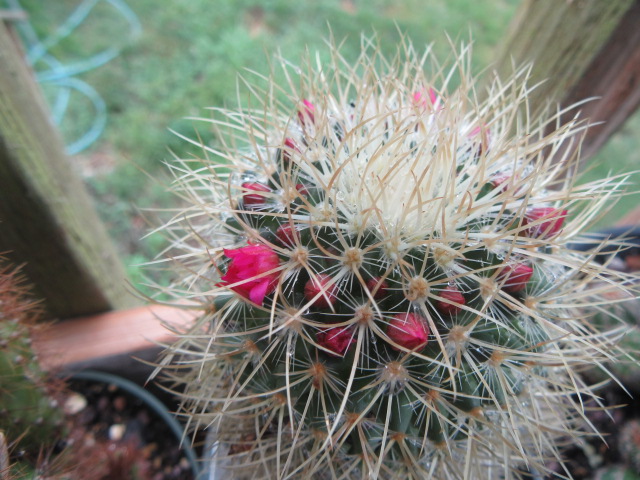
Mammillaria pringlei on 7-4-19, #598-11.

The Mammillaria pringlei (Rainbow Pincushion) is also starting to flower. This is our third summer together.

I took photos of all the cactus and succulents several days ago but they haven’t made it to a post yet.


Monarda didyma ‘Cherry Pops’ on 7-4-19, #598-12.

I was delighted to see a flower on the Monarda didyma ‘Cherry Pops’. I was amazed that it even returned this spring as it seems most perennials I have bought have not, especially in the north bed.

Let me see… How many perennials have not returned here? I don’t even want to think about it. I have amended the soil with “the good stuff”, added new soil with LOTS of “the good stuff”, raised the whole area only to have it sink during the winter.


Rudbeckia fulgida var. sullivantii ‘Goldsturm’ on 7-4-19, #598-13.

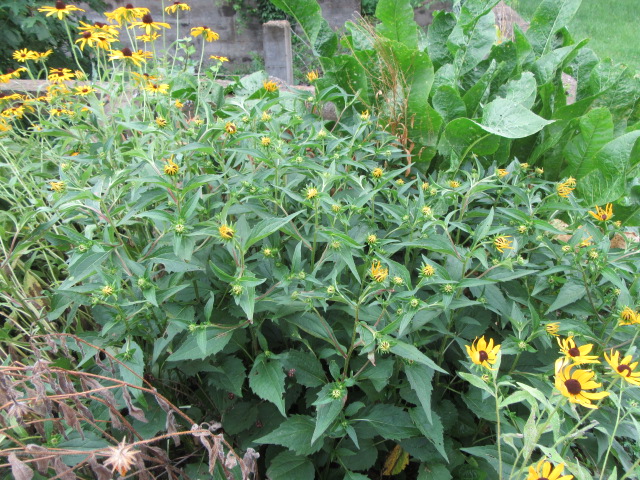
Hmmm… While the Rudbeckia hirta (the native species) have been flowering for a while now, the Rudbeckia fulgida var. sullivantii ‘Goldsturm’ is STILL in bud!


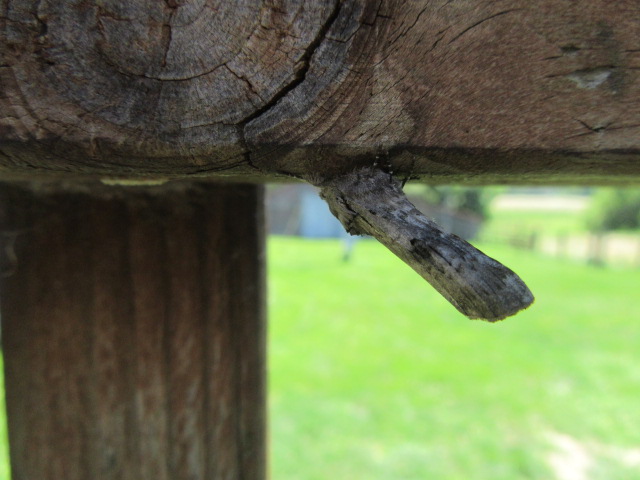
Schizura ipomaeae (Morning Glory Prominent)

I took the above photo this moth a few mornings ago but wanted to share it with you. It was just sitting there trying to blend in with the porch raining. Later I found out is it the Morning Glory Prominent (Schizura ipomaeae). It reminded me of a post called Rainy Season from June 4 on the SKYEENT blog. The second photo on the post is of the Buff Tipped Moth which looks exactly like a decaying birch twig. I find many moth species camouflage very fascinating.

A lot of insects do some very interesting things. There is a small wasp that fills the windchimes on the back porch with grass. It was kind of funny, actually. I had noticed the grass in the wind chimes but didn’t say anything to mom and dad about it. I just kind of ignored it as weird. There is a lot of weird around here sometimes. Anyway, one day dad and I were on the back porch and this small wasp comes flying in with a piece of dry grass about a foot long and somehow manages to put the whole thing in one of the tubes. Dad said it always does that and sometimes the wasp drops the grass and has to get another one. I didn’t notice the wasp last summer and a lot of the grass has fallen out by now. I have been hoping it would return so I can take photos. 🙂

OK, I am finished now. It is 12:35 AM and it is now the 5th of July. It is raining and thundering which will make for a good night sleep (hopefully).

Until next time, be safe, stay positive, be thankful and GET DIRTY if you can.


Rescue Japanese Beetle Trap #2 Video

Hello everyone! I hope this post finds you well. I bought another Japanese Beetle trap Tuesday afternoon. Within three seconds the first beetle was in the trap. I looked out into the yard north of the shade bed and I could see Japanese Beetles coming out of the grass and heading toward the trap.

I decided to make this video…


The first trap hasn’t been getting as much activity since I put up the second one. Most of the beetles were coming from that area in the first place because of the Chinese Elms.

Wednesday morning a man came to recharge the AC and he wanted to see the traps. So, I showed him the first one then we went to the new one. Beetles were coming from everywhere but there weren’t that many in the trap yet.

Then at 2:30 Wednesday afternoon…


HOLY COW!!!! THE TRAP IS FULL!


I went to get a bag to empty the trap, but on my way, I stopped to check the first bag…


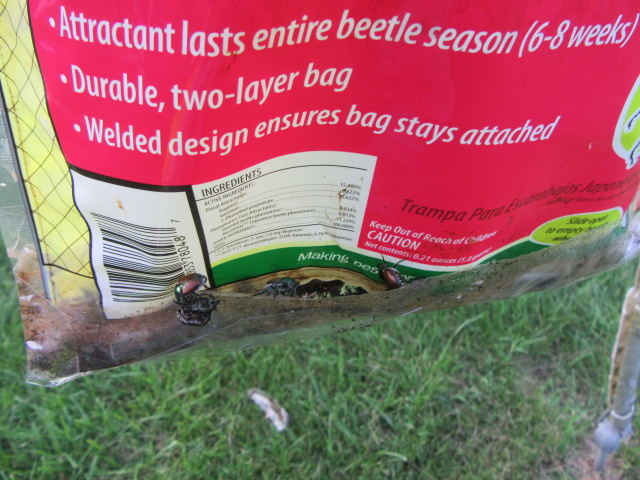
Hmmm… No wonder there weren’t many beetles in the trap. There is a hole in the bottom! That’s weird! So, I taped the bottom with packing tape.


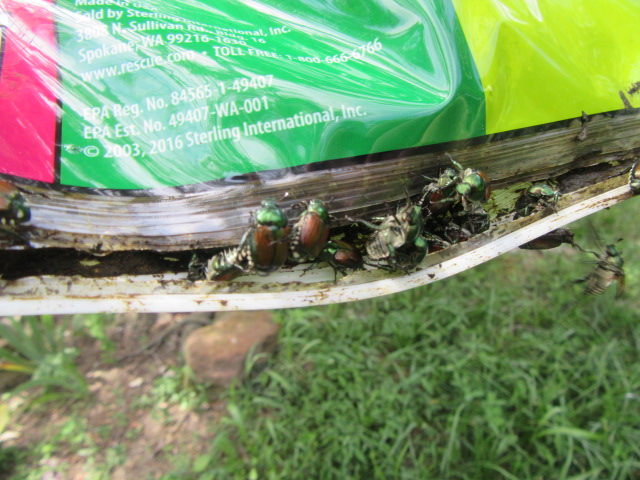
I went to the new bag, opened the zipper and emptied the trap. Then, when I closed the zipper, there was a tear all away across the bottom. The zipper makes a rip all across the bottom above the zipper! How’s that for a design flaw?!?! The bag is supposed to reusable!


So, I had to put tape all across the bottom of the bag. I guess it is still reusable as long as you use tape.

I am now going to send an email to the company. Did I miss something in the instructions perhaps? There are videos online about this product, like how to use it… It shows a different way to open and close, you just pull it apart and seal it shut like a ziplock bag (without a zipper). Mine is new and it isn’t made to open it that way. It has a ZIPPER!

While it is true the trap works, which I definitely can’t complain about, why does the bag rip when it is supposed to be reusable? Maybe most people don’t have as many beetles, but I highly doubt I am that unique. I did see some traps on Ebay that didn’t use bags…

Well, that’s it for now. Until next time, be safe, stay positive and always be thankful… Even if your Japanese Beetle trap springs a leak. 🙂

UPDATE!

I did send the company an email with a link to this post. The email was promptly replied. The customer rep said she was glad to see the number of beetles I had caught but was sorry to hear about the problem with the bag ripping. She said that because of customer feedback with the same issue they redesigned the bag (like the one in the video I watched). She said they would send me two new traps to try and review. 🙂 Now, I will go to the Farmers Co-op and tell them the news. LOL!
Trying Out A Japanese Beetle Trap

Hello everyone! I hope this post finds you well. Last week when I bought chicken feed, I noticed they had Japanese Beetle traps. I asked if they work and the guy said, “Yes, but you don’t want to be around it or put it close to where you are sitting or working.” So, I decided I would bring it home and give it a try.

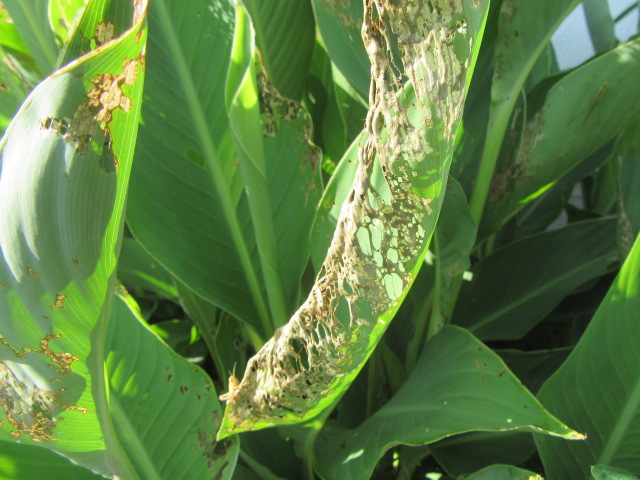
A couple of days ago when I was mowing next to the Canna bed, I noticed something was eating the leaves. It was Japanese Beetles.


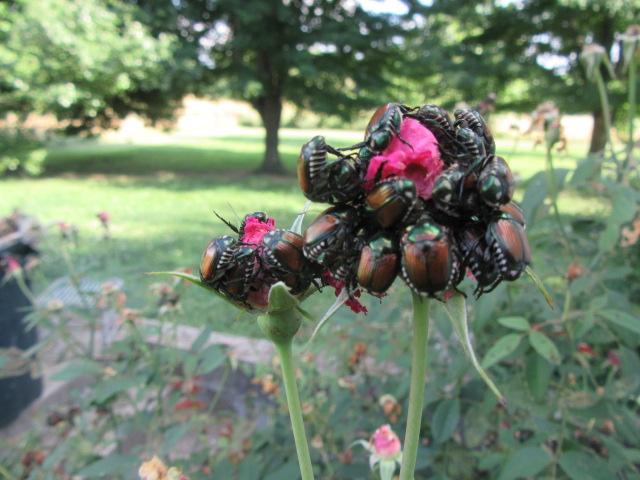
I checked the roses behind the house and sure enough, they were eating the roses, too. Then I noticed the Miniature Hollyhock had fallen victim to something and there were no leaves or flowers left on the plant. There was a dead caterpillar stuck to one of the bare stems, though. So, I guess that is it for the Malva sylvestris unless it grows new leaves.
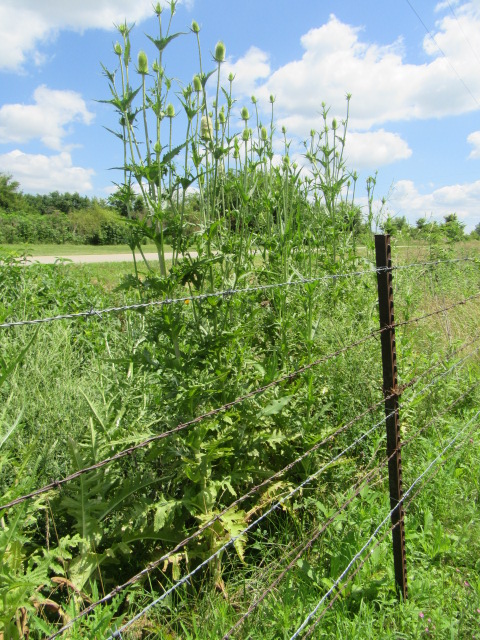
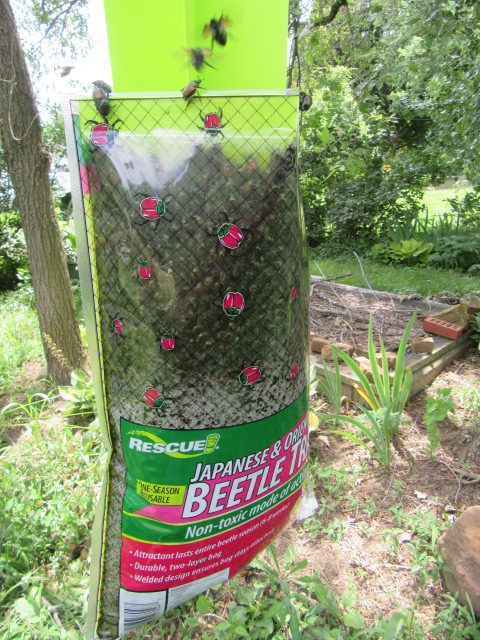
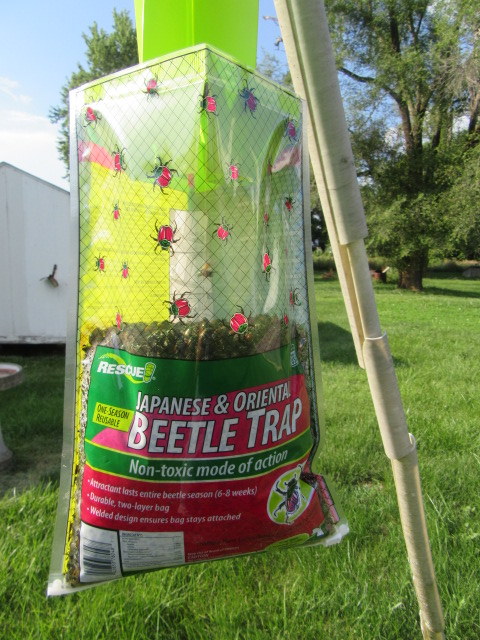
I didn’t get the beetle trap set up until Sunday afternoon. I attached it to the support wire to the light pole about 20′ away from the Canna bed. This morning, Monday, I checked the trap when I was getting water for the chickens. There was already about 2″ beetles trapped in the bottom of the bag.


I checked the trap early Monday evening when I was about ready to start mowing again. The trap was already half full and the beetles were flying around it. Good thing it is reusable…

The trees in the background are Chinese Elms which are the main reason the Japanese Beetles are so bad here. There are five trees in “the other back yard” and near the chicken house, two or three behind the chicken house, and two by the pond. By the time the beetles are finished, there will be no more shade under those trees. The shade bed where the Hosta are growing is under two Chinese Elms and a Maple.


Setting the trap up is simple and the “attractant” slips into place on the top. There are no harmful chemicals.


The bottom of the trap snaps into place and acts as a funnel. Beetles aren’t the most coordinated fliers and they can’t figure out how to fly out of the trap. I’m not sure how full the bag should get before I empty it…

I can easily say the beetle trap works. I put it close to the Cannas because I want to get the beetles away from them. I may need to get another trap to put by the shade bed. Depending on how fast they fill up, I may need several…

The Japanese Beetles feed on more than 300 species of plants. They only live for a few weeks, but the females lay more eggs every day. The eggs become grubs which feed on plant roots and can cause a lot of damage to turf grass. Around the first part of June, the grubs become a pupa and emerge from the soil in late June. That’s what it says online, but that could vary from location I’m sure. I have been watching for them, and it was like they weren’t here, then the next day they were. They have just gotten started and have barely even begun on the Chinese Elms. Even though I catch thousands over a few weeks, I am anxious to see the end result. Will I catch enough in time to still have leaves on the Elms, or will enough not get caught they will destroy the shade anyway? We shall see… I suppose the more traps I have the more effective they will be.

I had the Calla Lily on the back porch and it was doing really GREAT there. This evening I noticed the Japanese Beetles were eating its leaves so I chased them off and moved the pot to the front porch. There is nothing in the front yard to attract them, so I have no issues there. They found the Calla on the back porch because it is close to the roses. The sad thing is, the Calla was flowering nicely but now it doesn’t look so good. The damage was done in just a few hours time.

I am getting about ready to write my first review for Thor, the mole repeller. One seems to be working better than the other, but I really have no complaints. Of course, the moles are bad in certain areas because of the Japanese Beetle eggs and grubs. The worse thing about the moles is they tunnel under plants, pushing them up or leaving a hole under the plants where the roots should be growing. When watering, the water also runs down into the mole tunnels.

*ADDITIONAL INFO ADDED THE NEXT DAY:

  1. The bottom of the bag has a zip-lock feature that makes emptying the bag easy. Just be ready for the beetles in the bag to drop into another container you can close quickly. I used a plastic shopping bag and tied it in a knot. You will lose a few but I am sure they will go back in the trap.
  2. Do not place the trap close to where plants are they may be attracted to. The beetles will come from a pretty good distance and may be attracted to plants instead of going into the trap. Place the trap at least 30-40 feet away from where they are feeding to lure the beetles away from them.

Tuesday morning when I went to dump the trap there were beetles swarming around it. I could see them flying from the “other yard” where the elm trees are. Being empty at noon, I will be able to see how many have accumulated by 6 PM. I am not sure how full the bag can get before it should be dumped. It was a little over half full when I dumped it.

To be honest with you, I don’t like harming any type of nature. Even when I spray and dig thistles and feel bad about it in a way. Like the Japanese Beetles, the thistles are not native but so many other plants aren’t either. But they are living beings (or plants, which all have a spirit). Most invasive plants and critters are not native. Most native species are not invasive because nature has made away to control the native populations. Hmmm… I better stop with that… Well, my family is not Native American either but we are all native to the planet. Then again, so are invasive species. OK, I better stop thinking about that or I will go take down the beetle traps.

My plans for writing a post a day went by the wayside, even though I took photos. I am not very good when it comes to making a schedule. It is just in my head. 🙂

Until next time, whenever that may be, be safe and stay positive. The heat is upon us with no rain in the forecast, so be careful. I suppose that depends on where you live. But, regardless of where you live, be safe and always stay positive. Always be thankful for your many blessings. I better stop with that and also say I hope you GET DIRTY (in a clean way). 🙂