
Rudbeckia fulgida ‘Goldsturm’/’Goldstrum’ on 7-26-20
Rudbeckia fulgida ‘Goldsturm’/’Goldstrum’ on 7-26-20
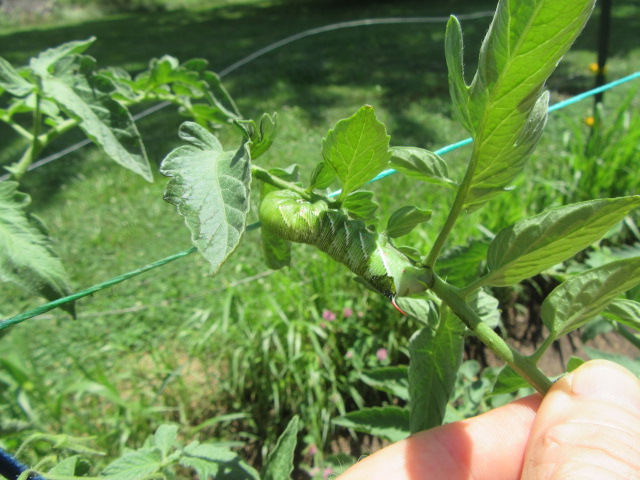
Manduca sexta (Tobacco Hornworm. Larvae of the Carolina Sphinx Moth or Tobacco Hawk Moth).
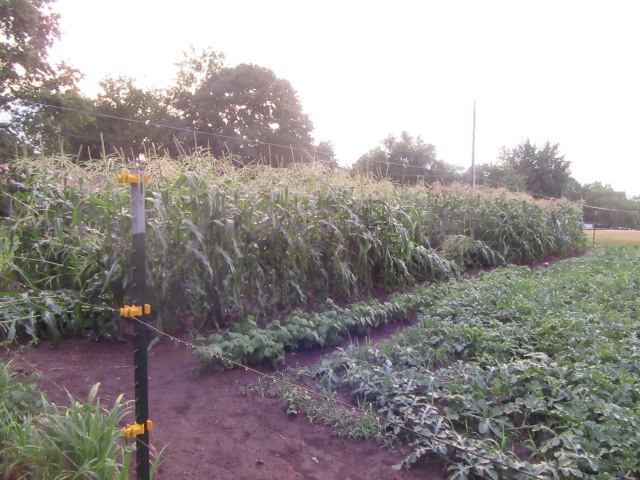
Hello everyone! I hope this post finds you all well. In the last post I mentioned the storm. Well, it came and I made it to the house only getting a little wet. That was about 3:30. Then the wind picked up and we got a pretty good soaking. While it was raining and blowing I was thinking I would have to stand the corn back up. Since I cut the trees down in the old foundation I can see the garden from the porch. The first time I looked the corn seemed OK but the storm wasn’t over. Once the soil gets wet the corn is likely to blow over even though it is hilled more and the roots are bigger and stronger than before. Corn stalks blow over just like big trees. After the storm was almost over I looked out the door again. Well, it did look much better than before, but still, some blew over.
I know I mentioned it before, but the corn is planted in two sections each with four double rows. ‘Peaches and Cream’ in the first section and ‘Incredible’ in the second.
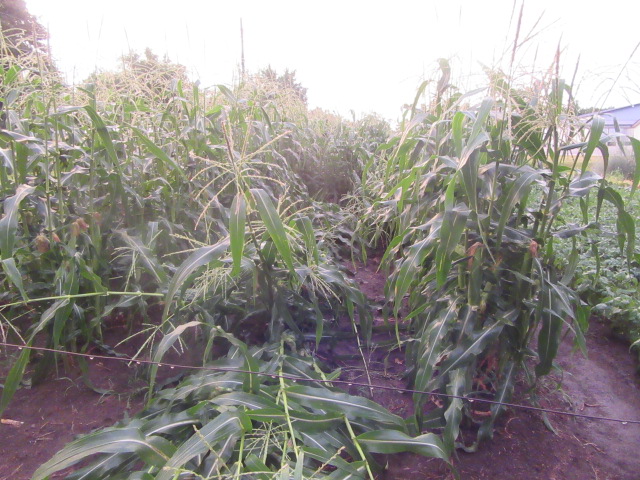
At 7:30, the rain was pretty much over and it was just barely sprinkling so I went to have a look. The worse part was the ‘Peaches and Cream’ in the same spot as before. This is where I found the moles had an old tunnel under the corn… There seems to be NO new mole activity in the garden because of the mole repeller (which I still need to write a post about).

The north side didn’t look too bad… This is the end of the rows of ‘Incredible. Some of the more spindly stalks still want to lean…

The ‘Incredible’ stood up much better and only part of it was leaning. There were a few stalks at the beginning of the ‘Incredible’ in the last row that blew over… From this view, you are looking at the northeast corner of the corn, which is the end of the fourth row.
I am very thankful after four hours rain and wind it didn’t look much worse. The wind wasn’t so bad most of the time which was a good thing. I didn’t want to get right in and start standing it up because the corn was all wet and the soil was soaked. It wasn’t going to start curving during the night anway so I waited until the next morning…

Standing the corn back up after it is tall is not a job you can do with a hoe. I DID NOT take usethe tool I did the last time. I pretty much always work on my knees anyway and that little gizmo on the right is my tool of choice. It has to be the absolute handiest garden tool ever. You can hoe with it, make rows. cultivate, dig holes, and even give something a good whack. 🙂 I found this tool in Suzanne’s (Dr. Skinner) stuff when I was in Mississippi in 2008 and I have been using it every since. When I showed it to dad before he said he had one in the garage. I checked it is also from Publishers Clearing House which I have not used. The hand trowel is from Clarington Forge that I bought in 2009. I bought my first one like it from Smith and Hawkin in 1981 and used it until 2007 when I, ummm… (another story). Anyway, it was a Bulldog which was made at the Clarington Forge. At one point, the name was changed to Record, which was synonymous with Bulldog then the name the company started using was Clarington Forge. Now, the company is using the name Bulldog again, but for Canada and the U.S., you will be prompted to use ClaringtonForge.com. I do miss my Bulldog spade, fork, and hoe which I mentioned before. Ummm, in the last post about standing up the corn I believe. LOL! Well, I need something with grit! Something that when you pick it up tells you it can handle anything… Just the name Bulldog says they are ready and capable. GEEZ! Maybe I need to be an affiliate!
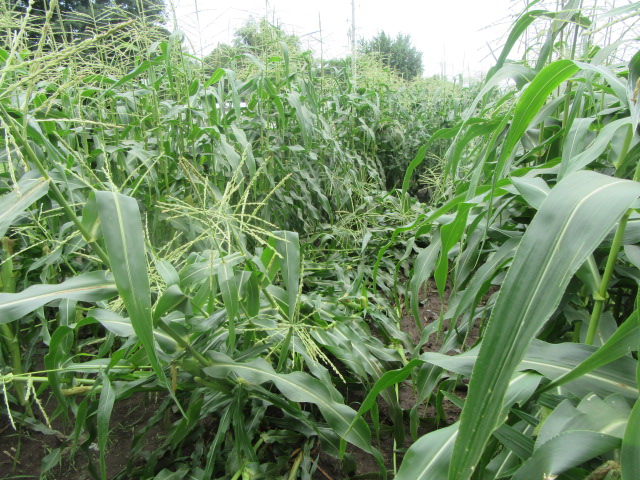
This morning the corn in the third row didn’t miraculously stand back up and neither did any of the rest of it…

I was finished after an hour and now we are ready for the next time.
I know, I know, I said the next post would be about the watermelons but that was before the storm (which was in the forecast at the time). I kind of ignored the forecast on purpose because last week nothing happened… The clouds blew right over and we didn’t get a drop. So, I wasn’t sure and didn’t want to seem anxious for rain. I did take more photos of the watermelon patch which I will use on the next post. Hmmm… Maybe you aren’t going to trust that now. 🙂
Anyway, until next time, hopefully this evening or tomorrow, be safe, stay well, be positive and GET dirty somewhere in there.

The garden on 7-15-20.
Hello everyone! I hope this post finds you well. Well, it is mid-July and the normal summer excitement and issues are upon us. Rain is hit and miss and sometimes we get a little but mostly the clouds just blow over. The grass has slowed down and I was debating on mowing or not. I always keep the mower deck at 4″ and then when it is hot and dry sometimes I don’t mow it at all.
But, a few days ago a friend needed me to change the blades on her zero-turn mower so I did. I had her mow a little in the back yard behind the house and it did a great job. I told her I was going to mow on Wednesday because I didn’t have money for gas at the time. Then I decided maybe I wouldn’t mow because it really wasn’t that tall and wasn’t growing because of no rain. Tuesday morning, when I was still in bed sleeping, I heard a mower go by my bedroom window… I may have heard a mower earlier but thought it was the neighbors. She had come and mowed the entire yard (around 3 acres) before I even knew it. I am very thankful she did that. Even though she had it set at 4″ because I told her before that’s the height I cut it at, it still seemed very short. I am not complaining, though. Even though I installed new Gator blades on my mower, her 54″ zero turn did a tremendous job.
First, let me introduce the tomatoes then I will get on with the worms and other issues… ‘Rutgers’, ‘Goliath’, ‘Mortgage Lifter’ and ‘Cherokee Purple’. I will introduce them the way they are planted…
I rate tomato taste on a score of 1-10, 10 being the best. Of course, tomatoes from the grocery store and what you get on your hamburgers from fast food are 1-5. I worked at Sonic for a while and sometimes I would rate them a negative number. Almost makes me not want a tomato on my hamburger from any fast-food chain or any restaurant for that matter. The tomatoes I picked up from a grower last summer were really good. He sells them in large quantities to someone but he gave me and a good friend of mine what he couldn’t sell for some reason. I would easily rate them 8-9… I don’t consider what the tomato looks like when rating taste…
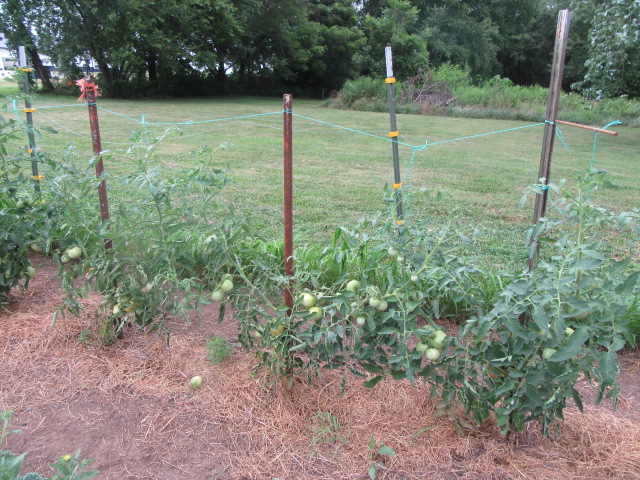
Tomato ‘Rutgers’ on 7-15-20.
‘Rutgers’ was one of the tomato varieties by dad grew when I was a kid along with ‘Super Sioux’. I remember those days of luscious, juicy, mouth-watering tomatoes, and every year it seems I try to relive those days. The first three plants in the row of 16 are the ‘Rutger’s. There were only three plants in the 4-pack… The plants have done very well, but are naturally somewhat smaller than most because they are determinate. I accidentally knocked one of the smaller fruit off

Tomato ‘Rutgers’ on 7-15-20.
‘Rutger’s was developed in 1934 by Rutger University’s New Jersey Agricultural Experiment Station and the Campbell Soup Company’s research facility. It was the most popular variety in the world for many years. During its popular era, ‘Rutgers’ made up more than 60% of commercial tomato sales. Hunt’s and Heinz favored ‘Rutgers’ as well.
Sales plummeted in the 1960’s because the thin skin was not suitable for automated picking. Farmers needed tomatoes with thicker skin that would store longer and travel farther with less spoilage.

Tomato ‘Rutgers’ on 7-15-20.
‘Rutgers’ is a determinate type of plant which means they usually have a large initial harvest with a few tomatoes during the rest of the season. Plants grow 4-5′ feet tall.
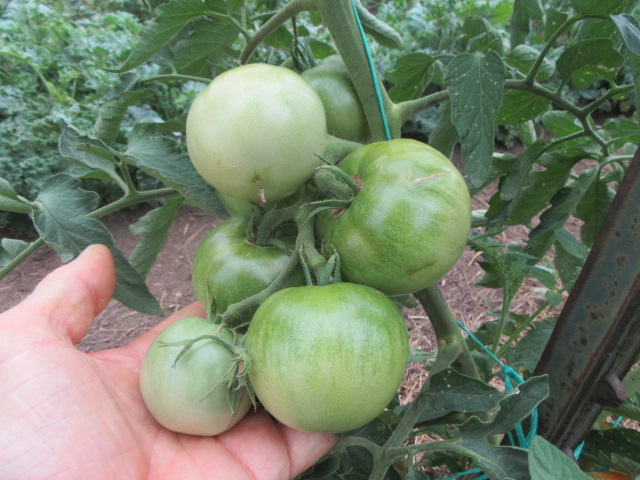
Tomato ‘Rutgers’ on 7-15-20.
Even though they are considered a “beefsteak” type, fruit only averages 7 oz. or so. I have eaten a few of these already and, while they have been pretty good, I was disappointed because they didn’t have that ‘OH MY GOODNESS! HOLY S–T” taste I was hoping for with the first tomato of the season. So, at this moment, I would have to rate the tase as a 7.

Tomato ‘Goliath’ on 7-15-20.
The next four plants in the row are ‘Goliath’. I have grown these for several years and I like them for several reasons. The plants are very hardy and sturdy which they have to be for the abundance of large fruit they produce. ‘Goliath’ isn’t a new variety by no means as the original heirloom variety was introduced in the 1800’s. The indeterminate plants can grow 6-8′ tall and, in optimal conditions, can produce around 70 tomatoes per plant averaging 10-16 oz. and as much as 3 pounds.

Tomato ‘Goliath’ on 7-15-20.
Also, depending on which ‘Goliath’ you grow and the conditions, you can expect ripe fruit anywhere from 65-85 days.
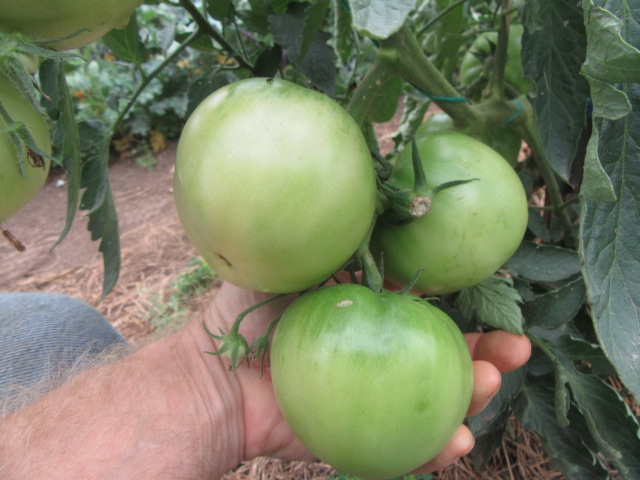
Tomato ‘Goliath’ on 7-15-20.
Sometimes you begin to wonder if those HUGE tomatoes will ever start to ripen. But when they finally do, you will see they were worth the wait. I have had any this year yet, but if I remember correctly they are AWESOME!

Tomato ‘Goliath’ on 7-15-20.
The plants are very strong and have very long leaves that provide good leaf cover. I haven’t eaten any of these yet this year because none have ripened. Once I try one I will give it my score.

Tomato ‘Mortgage Lifter’ on 7-15-20.
Now for the ‘Mortgage Lifter’… I grew this variety when I was in Mississippi in 2009 and it seems like I grew them after that but there are no photos. So, maybe not. I have grown A LOT of different tomatoes mainly because there are so many to try. There are five of these because there was one extra in the 4-pack.
Although ‘Mortgage Lifter’ is said to have been developed by William Estler in 1922, he didn’t register the name until 1932. Some information suggests ‘Mortgage Lifter’ was developed by M.C. “Radiator Charlie” Byles, but he developed ‘Radiator Charlie’ and ‘Radiator Charlie’s Mortgage Lifter’. Not only that, there were several other cultivars with the name ‘Mortgage Lifter’ during the depression era but Estler’s and Byles’ cultivars were the most popular. Of course, the story goes that Radiator Charlie sold plants for $1 each in the 1940’s and was able to pay off his $6,000 mortgage in six years…
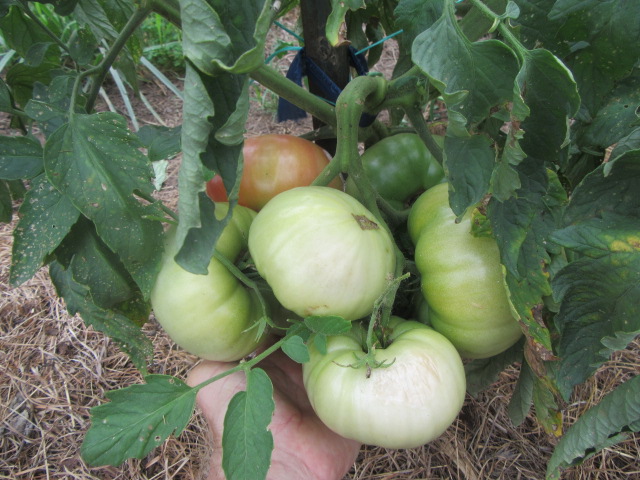
Tomato ‘Mortgage Lifter’ on 7-15-20.
‘Mortgage Lifter’ is an heirloom that produces HUGE fruit up to 2 1/2 pounds or more. Fruit is produced on indeterminate plants that grow very tall, up to 9’. Tomatoes begin to ripen in 80-85 days and produce until “F”.

Tomato ‘Mortgage Lifter’ on 7-15-20.
Hmmm… The plants are great as far as leaf cover goes but they aren’t as strong as ‘Goliath’.

Tomato ‘Mortgage Lifter’ on 7-15-20.
The biggest problem I am having with ‘Mortgage Lifter’ is the weight of these HUGE clusters of HUGE tomatoes. Even though the branches are well supported, the stems with the tomatoes are not supported and some have bent and even split…
Tomato ‘Mortgage Lifter’…
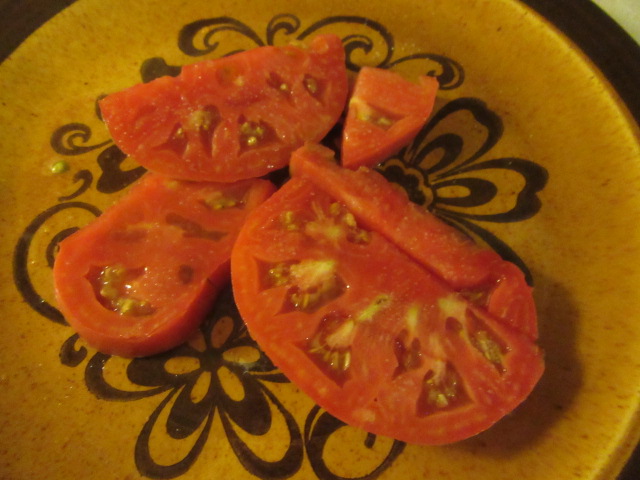
I ate one a few days ago that wasn’t quite at its peak flavor. Then I had another one that was a bit oddly shaped so I had to slice it weird. The flavor? What is the score? I would have to give this one a 9. Being a pink tomato, the flavor isn’t quite so robust so you don’t get that “AHHH, UMMM, OH THAT IS SO GOOD!” It was close, though.

Tomato ‘Cherokee Purple” on 7-15-20.
The last four plants in the row are the ‘Cherokee Purple’. It is considered one of the “black” fruited tomatoes that are supposed to have a distinctive flavor. ‘Black Krim’ was the type I tried in 2017 so I thought I would give this one a try. There is quite a story about the ‘Cherokee Purple’ which you can read by clicking HERE. Southern Exposure Seed Exchange was the first to offer this variety in 1993.
‘Cherokee Purple’ is an indeterminate plant that grows to only 4-6′ tall. They produce 10-12 oz. beefsteak fruit that is a deep, dusky rose with a greenish hue toward the stem with a dark red interior.
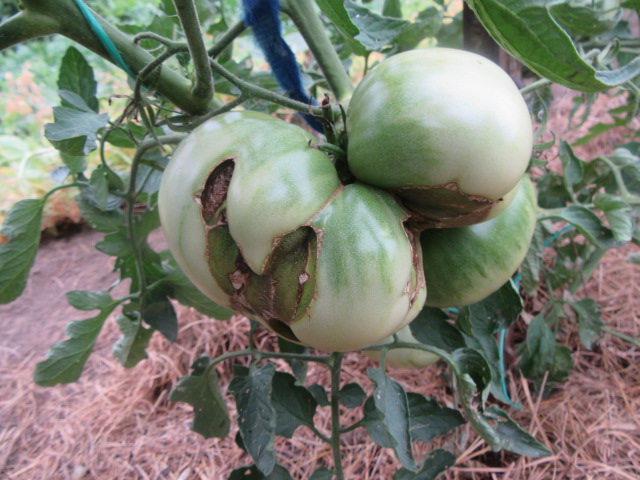
Tomato ‘Cherokee Purple” on 7-15-20.
Hmmm… I had noticed an issue with the fruit on the ‘Cherokee Purple’ but I thought they were just splitting very bad. Unfortunately, that wasn’t the only problem…

Tomato ‘Cherokee Purple” on 7-15-20.
The leaves are very long and provide very good leaf cover and the plants have sturdy stems. I have noticed some heirloom tomatoes can produce some weirdly odd-looking fruit

Tomato ‘Cherokee Purple” on 7-15-20.
There is a lot of good-sized clusters of tomatoes at the bottom of the plants but that seems to be the way they all are this year.
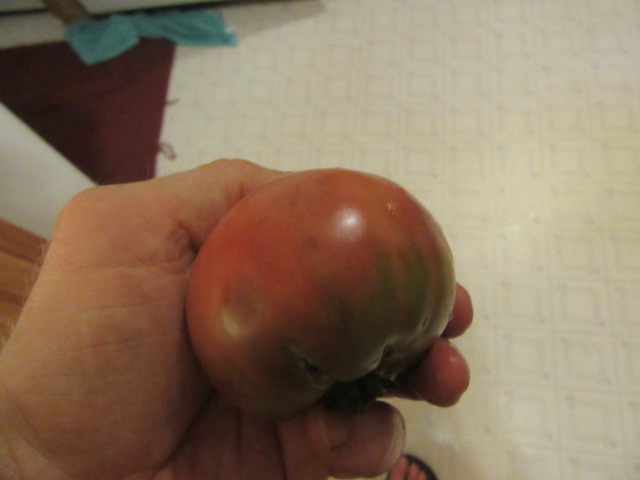
Tomato ‘Cherokee Purple’ getting ready for a taste test on 7-19-20…
This one isn’t that big, but it did ripen on the vine…
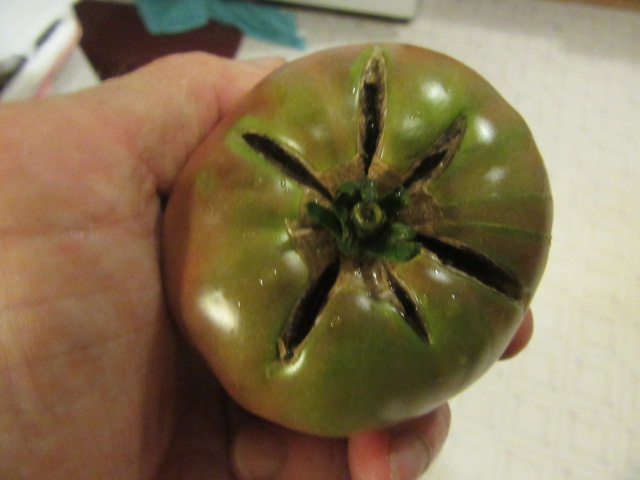
Tomato ‘Cherokee Purple’ on 7-18-20.
Well, the bottom has a lot of cracks but I wonder what the inside is like?

Inside of the Tomato ‘Cherokee Purple’…
Well, information says the inside is dark red with green gel in the seed cavities. So, what does it taste like? I put a piece in my mouth and had that pause. My eyes closed and I got that ‘OH WOW!!! THAT IS AWESOME!” So many words to use but none could quite describe it. A very distinctive flavor but I can’t quite find the right word or words to describe it. Some people say black tomatoes have a smoky flavor but I really couldn’t find the smokiness… Kind of like wine tasters who can come up with an elaborate description of how a wine tastes. I can’t find those flavors either… The score? 9.75!

Everything was fine and wonderful with the tomatoes and they were looking great UNTIL I saw two holes on one of the ‘Rutgers’ on July 9. For the most, the only pests I have ever had on tomatoes were hornworms eating the leaves and occasionally I would have whiteflies. I didn’t have whiteflies until 2017 when I apparently brought them home from the greenhouse on the tomato plants I bought. Anyway, after I saw those first two holes I started looking around for the culprit. I found nothing…

Spodoptera sp. (Armyworm species) on July 14, 2020.
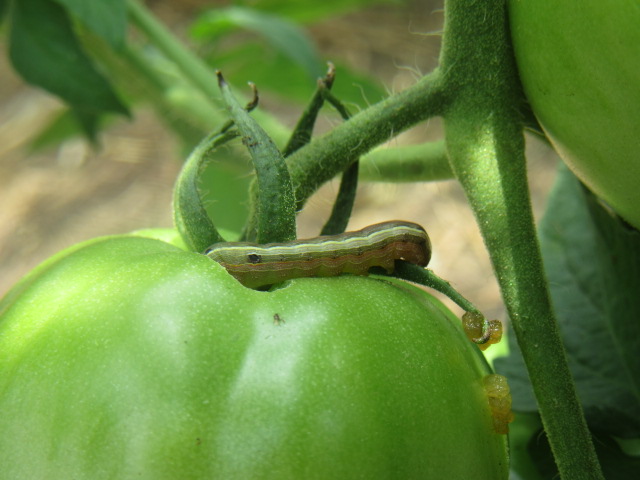
I had been checking the tomatoes daily, sometimes twice a day, for hornworms and whatever I could find because you never know… Up until July 14, I had seen nothing except for an occasional hole since July 9. THEN I found this HUGE worm on one of the tomatoes at 12:12 PM on July 14…

Spodoptera sp. on July 14.
Of course, as you can tell, I took photos to put on iNaturalist… I had never seen these before on my Tomatoes or anywhere else so I had to find out what it was.
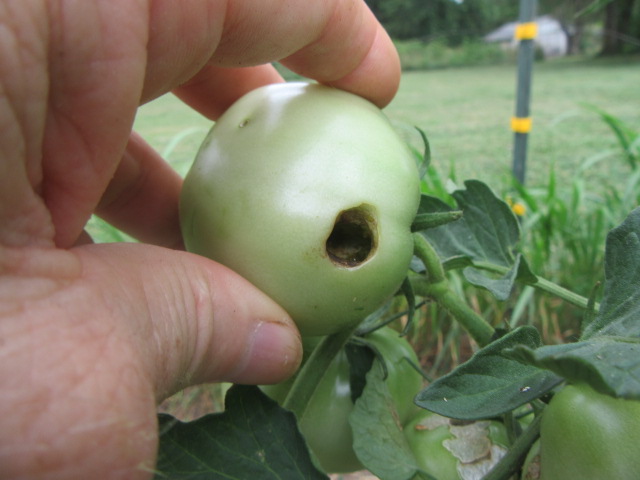
Then I found this tomato with a big hole in it…

Spodoptera sp., two of them, on July 14.
Then I found two huge worms, side by side, that were different colors! WHAT THE HECK!!! (I think I may have used a different word originally).

Spodoptera sp. on July 14.
One of them is mostly black while the other is mostly gray!

More holes and poop!

Whiteflies on a tomato leaf on July 14.
Then there were whiteflies. Whiteflies really don’t cause an issue for me and they usually appear when it gets hot and dry and there isn’t much breeze. I made sure I have a Neem Oil concoction on hand in case they get carried away. A few days later, when we were supposed to have rain, the wind picked up and it sprinkled a little. The next day, the whiteflies were completely gone. Of course, they came back…
Back to the worms…
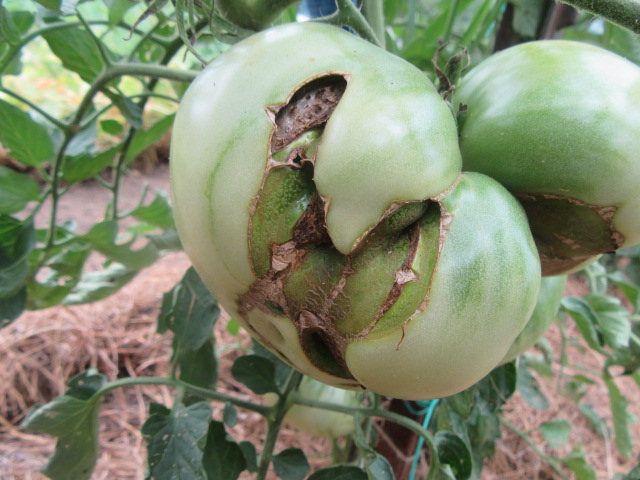
Hmmm… Tomato Cherokee Purple’ on July 14.
Apparently, this was not just a cracking issue…

GEEZ! It was like an overnight disaster. Guerilla warfare! Rather worm warfare! They come in and eat then hide…
I uploaded the photos of the worms I took on iNaturalist to get an ID. Suggestions were the Spodoptera genus, Spodoptera ornithogalli (Yellow Striped Armyworm), and Trichordestra legitima (Striped Garden Caterpillar). The moths of these caterpillars look the same, according to the photos, but I have not seen any in person. I messaged a “caterpillar expert” on iNaturalist so he could check out the photos I uploaded. I had the black one listed as Spodoptera ornithogalli and he commented saying,
“One of the armyworms but I’m not great at telling them apart. These can be physically moved away from plants if they are being destructive. =)”…
I listed the grayer one as Trichordestra legitima and he didn’t make a comment but suggested it also as a member of the Spodoptera genus…
WELL, DOUBLE GEEZ! Apparently, there are quite a few species of both genera and they are variable as far as color goes. They cause the same issues, which is quite obvious… Some information about one or the other mentions the moth lays eggs, a lot of them, and covers them with scales… Hmmm…

I have not seen much evidence of eggs but I did find this weird thing on the 15th… Apparently, it was a newly hatched worm and left this behind… So, why didn’t I notice this before it hatched when I was checking for worms before? Hmmm… Because it wasn’t there…
Darn things!!!

Hmmm… Then I noticed these, ummm, eggs (?) around the stem of a tomato. There is nothing online to suggest whodunit… The moths DO NOT lay eggs around tomato stems… Sometimes other critters, like ants, move eggs and aphids to parts or plants they want to feed on but aren’t capable unless they get something else to do the work… Then they feed off of their secretions or juice…
I only found a few of the hornworms on one occasion, when I didn’t have the camera and haven’t noticed any since. After picking off the larger armyworms on two occasions I have only found small ones on the leaves so no additional damage has been caused. Sometimes I check and find no worms at all. SO, hopefully, I have them in check now. WHEW! 🙂

Tomato ‘Mortgage Lifter’ on 7-15-20.
With the ‘Mortgage Lifter’, many of the tomatoes appear to be so heavy the stem starts to pull away from the fruit. This is a good place for the small armyworms, or whatever they are, to start feeding on the tomatoes. When they are very small they can’t chew a hole very well…
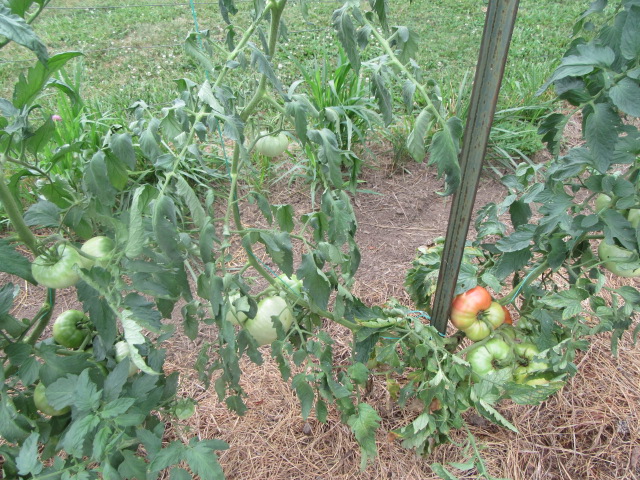
Tomato ‘Mortgage Lifter’ vine dying on July 17…
I noticed this issue with the ‘Mortgage Lifter’… Half of the plant was dying because…

Tomato ‘Mortgage Lifter’ on 7-15-20…
The weight of the vine split where the two branches join. SOOOOO, I learned a lesson and I am correcting the problem. When I tied the string at the post and wrapped it around the vine, I then tied the other end in the center between the posts. As the fruit grew and the vine became heavier, the top string was pulled down causing the branch to break. The solution is to tighten the string wrapped around the vine and move it closer to the post. OH, and don’t use balers twine around the stems… I have been replacing some of the twine with strips of material where I have noticed the twine cutting into the stems. That has only been a problem with a few plants. Some people keep only one main stem and just tie it to the post which also eliminates this issue. You can use cages BUT you would certainly have to use one that is very sturdy… My neighbor in Mississippi tied his tomatoes to cattle panels…

Tomato ‘Mortgage Lifter’ cluster bending the stem…
Besides that one branch splitting, several clusters of ‘Mortgage Lifter’ are so heavy the stems bearing the fruit are also bending. As long as the stems don’t break I think it will be OK.
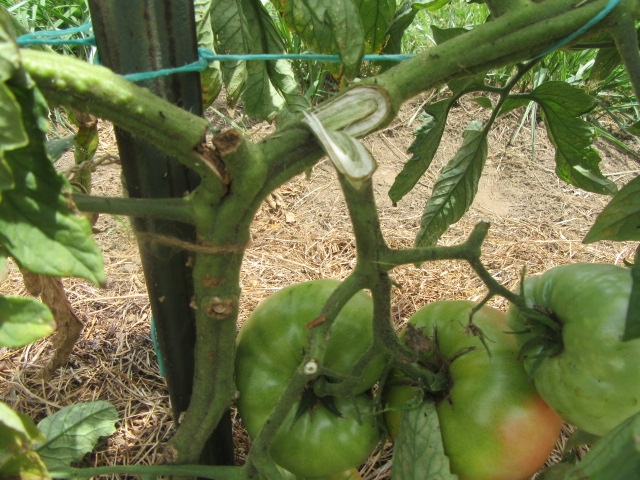
GEEZ!
I attempted to support one of the clusters and the stem broke…
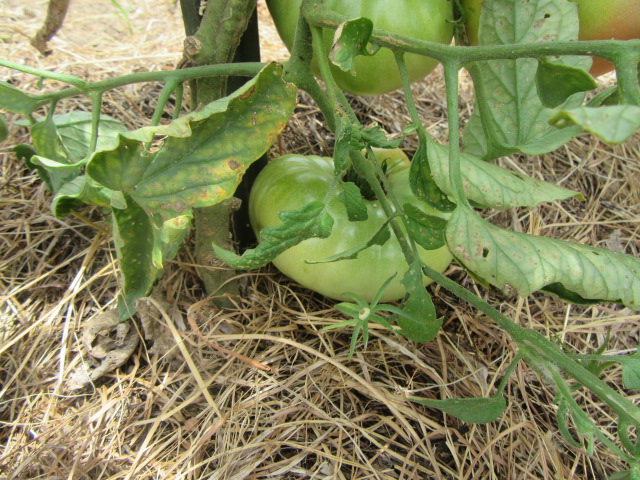
Tomato ‘Mortgage Lifter’ nearly touching the ground…
I know it sounds like I am picking on the ‘Mortgage Lifter’ but I am just pointing out some of the issues I am having with the tomatoes (besides the worms). The cluster in the above photo is close to the ground and is so heavy it is almost touching the mulch. If it weren’t for the hay, it would be sitting on the ground soon.
SOOOO, the issue with the ‘Mortgage Lifter’ is that the vines and stems are not strong enough to support the weight of the fruit.
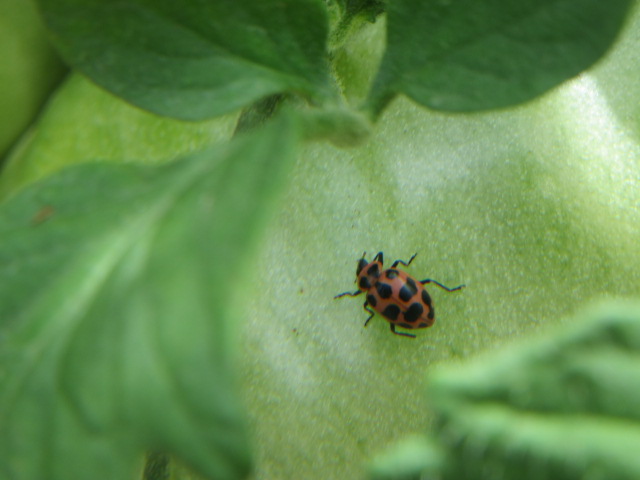
Coleomegilla maculata (Spotted Lady Beetle) on 7-16-20.
With all the different bugs and worms lurking about in the garden it makes you wonder who are friends or enemies. There are quite a few Lady Bugs which are also called Lady Bird Beetles. Well, pretty much everyone I know calls them Lady Bugs but I suppose they are technically supposed to be called Lady Bird Beetles… ANYWAY, I saw this strange beetle on a tomato that wasn’t one of them or quite like any other I had seen before. Before I decided to smash it or not, I thought I better get a photo and identify it. Luckily, it turned out to be a friend called Coleomegilla maculata commonly known as the Spotted Lady Beetle. There are over 6,000 species in the Lady Beetle family Coccinellidae found throughout most of the world…

Coelostathma discopunctana (Batman Moth) ?, 7-18-20.
I found this tiny moth while scouting for worms on a tomato leaf on July 18. I didn’t have the camera so I went back to the house to get it… I was very curious about this tiny moth and wondered what damage its caterpillars might do. Unfortunately, even though I kind of have it identified, there isn’t much online about it. In fact, the photos of this species on iNaturalist show moths of many colors that are likely members of other genera and species… There were several other suggestions, as far as what it could be, with all the same issues. Many photos of varied colored moths look the same as the photos of other species. So, whether it is a Coelostathma discopunctana (Batman Moth) for sure I have no clue… I have to say perhaps the species is variable but you know how I dislike using that word… Species in the bug world are like the plant world. Many species have been named that are synonymous with other species…
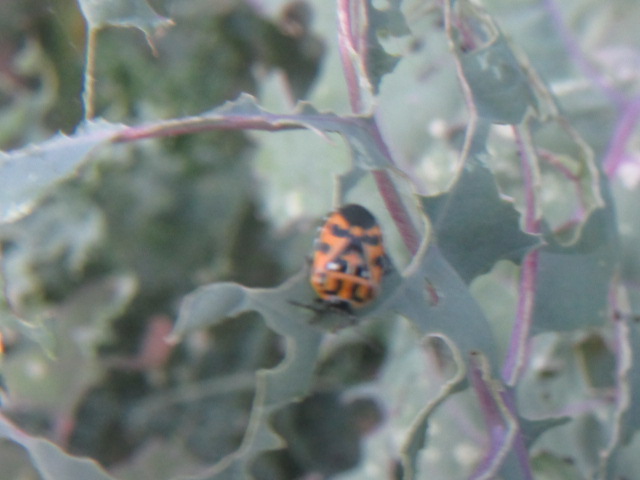
Murgantia histrionica (Harlequin Bug) on 7-18-20.
Then I found this critter on a kale leaf that sort of posed but seemed a little hesitant to be photographed. It was like it was unsure if I would kill it or leave it alone. I told it I wouldn’t kill him unless I knew for sure if he was a friend or foe. With that, he became even more nervous… Sorry, the photos are somewhat blurry. I think the bug was shaking. 🙂
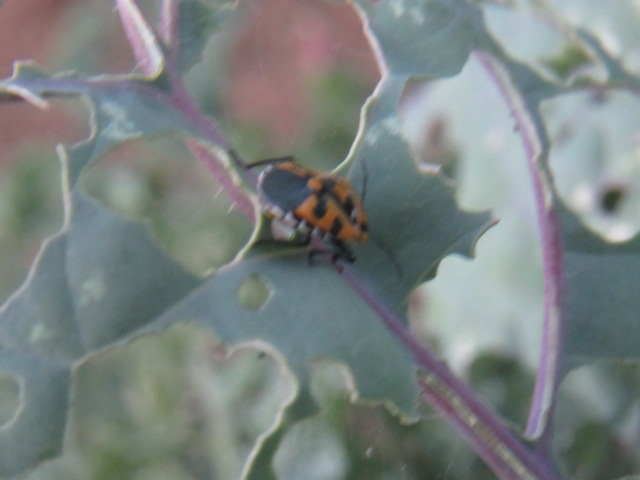
Murgantia histrionica (Harlequin Bug) on 7-18-20.
It seemed to think I was getting a bit nosy and refused to show me his mouth. He turned around and decided it was time to leave. After I went to the house and uploaded the photo I found out it was the dreaded Harlequin Bug (Murgantia histrionica). OK, so I have heard of that one, and although I have seen them before I didn’t know what they were. Now that I do for sure… I also found out they especially like cabbage, kale, and other brassicas. Hmmm… So, along with the worms, there are these. In the past few days, the kale has been ripped to shreds, and now not even the new leaves can be eaten…
During the day so many critters are hiding from the heat and various predators like birds and wasps. They come out at night when it is cooler and they can feed in a little more peace… It is no telling what all lurks around in the dark of night in the garden. Hmmm… Maybe I should go out at 2 AM with the flash lght. Maybe then I will see who is eating what and whom…
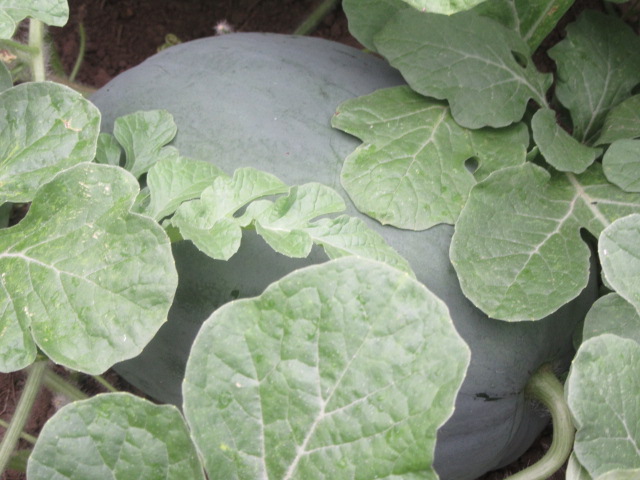
Hopefully, the next post will be about the watermelons. I have been working on it off and on for a few weeks but I get busy with this and that and the post gets delayed. I did harvest some of the ‘Incredible’ sweet corn, which I didn’t photograph. I picked about 50 ears and a few were really nice and the others just so so. Even though the silk was brown and appeared ready, some of the cobs weren’t as plump as they could have been… Maybe I was just anxious… Anyway, I will try and wait a little longer for the next picking even though the silk is brown enough. Maybe the ears will get a little plumper. I know you are supposed to peel back some of the cover leaves (or whatever you call them) to check the kernels and milk, which I did on few earlier. But, then the bugs get inside which eat the corn. So, better I just “feel” before picking without being overly anxious…
OH, one more thing… Maybe two.

The Okra ‘Jing Orange’ has been budding for over a week and the plants have really taken off. They like it hot!

While I was finishing up this post I could hear it thundering. I took this photo when I went out to get a current photo of the Okra buds. I decided I would take ore feed and water to the chickens and by the time I got to the house, it was raining. THANK GOODNESS!!!
Until next time, be safe, stay positive and well, always be thankful, and GET DIRTY and SWEAT!

Kale on 7-10-2020.
Hello everyone! I hope this post finds you well. The garden is doing GREAT and I must say the tomatoes are the best I have ever grown. I think I say that every time I write or talk about them. I harvested my first ripe tomato on July 13, which was a Rutgers. It was very good. 🙂 I still like the new way I am pruning and hanging them up and I also think the mulch has made a big difference. BUT, this post is about the kale so I better stop rambling. I started this post on July 7 and have updated the draft 18 times…
Once you start seeing the Small Cabbage White Butterflies flying around your kale, you know you will start seeing their larvae soon. This year I noticed three newcomers to the table… I a sure they have been here in the past but I didn’t see any. Depending on what time of the day it is, you may or may not see them, but you will see where they have been…
I did learn a new word while I was writing this post… Crucifers… In botany, it refers to plants whose flowers have four petals. I would have thought the information would say the worms in this post prefer members of the Brassicaceae Family, instead, they say they prefer crucifers. Hmmm… Well, that may be true because brassicas are apparently crucifers. I just never saw that word used before but I don’t get out much… 🙂
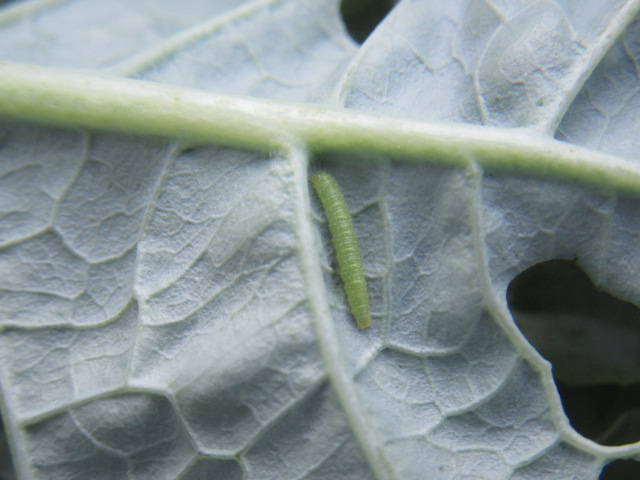
Pieris rapae (Cabbage White Butterfly) larvae.
Interestingly enough, most of the butterflies in the garden are Pieris rapae also known as the Cabbage White. It is called other names such as Small Cabbage White, Cabbage Butterfly, or White Butterfly. It is a member of the white and yellows family Pieridae which consists of about 76 genera and 1,100 species mainly from tropical Africa and Asia. This species is found all across Europe, Asia, and North Africa. It was “accidentally” introduced into Quebec, Canada in the 1860’s and has now spread across North America…

Pieris rapae (Cabbage White Butterfly) larvae.
Most of the worms I find are just sitting there doing nothing but I found this one munching away…

Trichoplusia ni (Cabbage Looper Moth) larvae.
I have seen this worm for many years and I always thought it was the larvae of the Cabbage White Butterfly. BUT, I have learned the error of my thinking. Do you see the way it arches its back? That means it is a lopper similar to inchworms (which are in a different family). Thanks to INaturalist, I found out these critters are the larvae of Trichoplusia ni, commonly known as the Cabbage Looper Moth. I have not seen any of the adults in the garden, but I have seen similar looking moths elsewhere. These caterpillars are called loopers because they don’t have the same amount of legs (or prolegs) as most other caterpillars. They only have 2-3 pairs on the hind end instead of the normal 5 pairs. When they crawl, they clasp with their front legs then draw up the hind end then clasp with the hind legs (prolegs). Then they reach out and grab with their front legs again. This gait is called looping because it arches it back into a loop when crawling.
I thought it was funny how they could be lying flat on the underside of a leaf until I started looking at it and taking photos. Then they would arch their back like they were trying to scare me off.
One very interesting thing about the adult is that they are migratory and are found across North America and Eurasia. According to information, over 160 plants can serve as hosts for this species but “crucifers” are preferred

Evergestis rimosalis (Cross-Striped Cabbageworm Moth).
Evergestis rimosalis (Cross-Striped Cabbageworm Moth)
This is the first year I have seen this critter but it doesn’t mean they haven’t always been around. Certain times of the day you may see no worms of any kind anywhere. This colorful member of the family Crambidae inhabits most of the eastern portion of the United States and can be found on all types of brassicas. The adult is a brownish moth and I have not seen any of them in the garden… I kind of think they do most of the damage to the kale which leads me to believe they have been here before and I just didn’t notice them. I always wondered how could so few very small cabbage worms do so much damage now I know…

Cuerna costalis (Lateral-Lined Sharpshooter).
Cuerna costalis (Lateral-Lined Sharpshooter)
This strange little critter is a member of the leafhopper family Cicadellidae with 26 species in the genus and is a North American native. I have seen a few of these on the kale although it is not necessarily on their menu. Although kale is not on the list, turnips, another member of the Brassicaceae family, is. I did see more on the okra today but I can’t tell what they are doing. They are odd critters for sure… They normally produce two generations per year and adults overwinter in grass and other dead plant material.
In numbers, leafhoppers can cause serious damage in a variety of ways. Several species of this genus are believed to be vectors of a few plant diseases. C. costalis is thought to be a vector of Pierce’s Disease Virus of grapes (in Georgia).
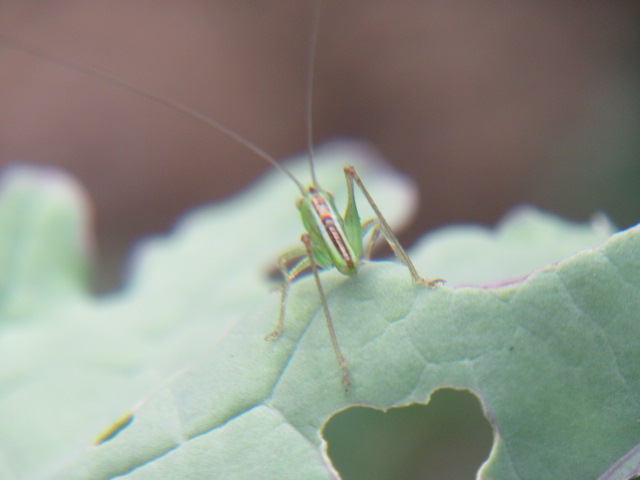
Conocephalus strictus (Straight-Lanced Meadow Katydid).
I always thought this critter was some kind of grasshopper, but when I uploaded the image on iNaturalist it said it was a Straight-Lanced Meadow Katydid (Conocephalus strictus). Information says this species normally feeds on grass but here it is on the kale… I couldn’t get a good photo because this guy, or gal, was a bit photo shy and was about ready to jump. I wonder if it made that hole?
I see a lot of BIG katydids here that I haven’t photographed to get a positive ID. I thought a katydid was a katydid but apparently not… There are several species found worldwide that look a lot alike.

Pieris rapae (Cabbage White Butterfly).
When I work in the garden in the early evening the butterflies and worms seem to be hiding. I was working in the watermelons when I spotted this Cabbage White Butterfly flying around the kale. SO, I ran to where it was to get a photo. It landed under a kale leaf then flew around a bit more but went back to the same spot. It did this several times before it finally decided to stay put. I guess this is where it will spend the night…
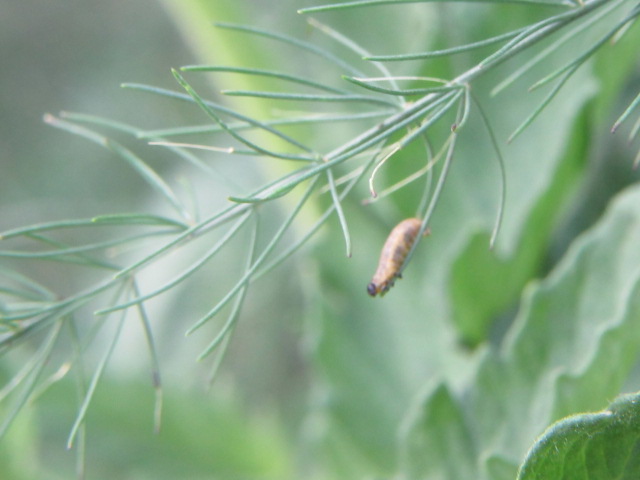
Crioceris duodecimpunctata (Spotted Asparagus Beetle) larvae.
I have been noticing these strange varmints on the Asparagus. One day I stopped briefly to look at one and it appeared almost slug-like. I was busy so I went on about my business and it was happy about that. I couldn’t see where it was doing any damage. Then later when I had the camera and magnifying glass I had a closer look. I touched it and then it did something strange… It pooped. I took the best photo I could, but these guys are VERY SMALL. I uploaded the photo on iNaturalist and it suggested Crioceris duodecimpunctata commonly known as the Spotted Asparagus Beetle. I have no idea how to pronounce the scientific name because Dave’s Garden didn’t have a pronunciation for it. Maybe cry-OH-ser-is DOO-dec-im punct-ata. 🙂 I think I will call it Cryogenus dudepooper. I didn’t see any adults on the Asparagus, but Sunday afternoon I was walking in the yard and this small reddish-orange beetle with black spots landed on my hand. It said, “Are you looking for me?” I told him I wasn’t at the moment because I didn’t have the camera. I asked him if he was lost then he flew off. It was a male because the females are a different color.
According to what I read, the larvae of the Spotted Asparagus Beetle only feeds on the berries. Well, they are going to get hungry because there are no berries on the asparagus at the moment… A few plants are just now beginning to flower… Apparently, most are males that were too small to harvest. I have been getting a few nice spears all summer…
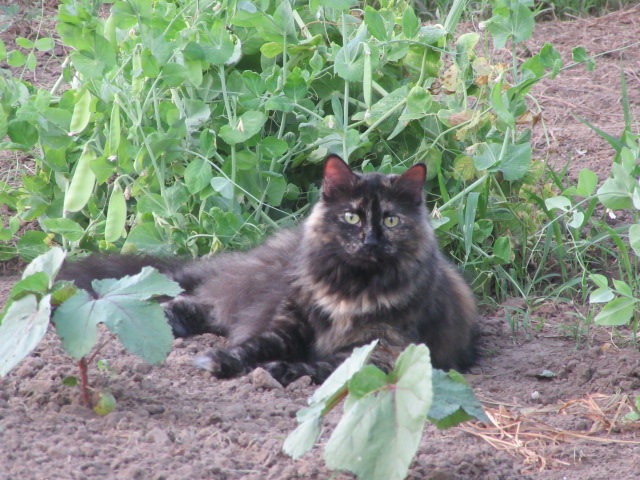
Jade wanted outside but I was a little reluctant to just let her out of the house when I was going to be in the garden. Jade is my son’s cat and he left her behind (and his tomcat) when he and Chris moved out. Jade has no claws so she stays in the house. So, since she wanted out, I carried her all the way to the garden (second time). She had loads of fun exploring and never ventured out of the garden. She seemed to like chasing the Cabbage White Butterflies so they couldn’t land…
I have some catching up to do. I seem to take photos every day but do nothing with them. I have to post about the watermelons and how and why I prune them. Then, today, which is not today by the time I get this post published, I found the tomatoes are under attack by THREE preditors… I noticed a few plants with whiteflies a couple of days ago which need to be sprayed with the neem oil. I hadn’t noticed any hornworms or any damage from them and I check pretty much every day. I did notice a few tomatoes with small holes but I couldn’t find the culprit. THEN, this afternoon (Tuesday) I found a worm I had not seen before. Next thing I knew, I found several. Some were quite large and they were boring holes in the tomatoes and climbing inside… GEEZ! I did have my camera so I have photos. Then, a few hours later, I went back and found a few more as well as SEVERAL hornworms. That time I didn’t have the camera… What I want to know is how can there be no hornworms then they just suddenly appear? SO, I will be posting about the tomatoes as well.
SO, until next time, be safe and well, stay positive, be thankful, and GET DIRTY!
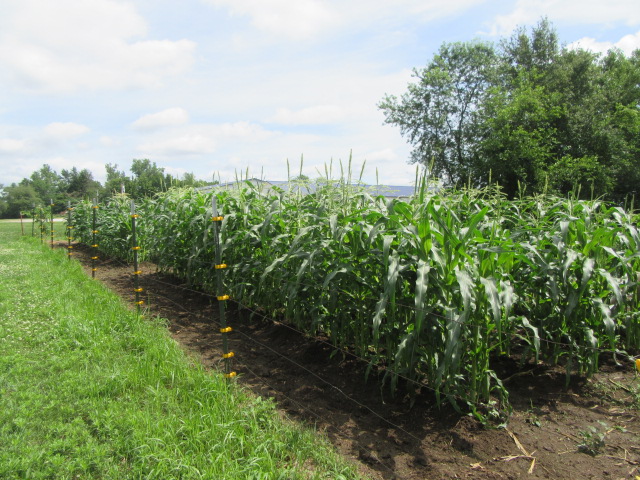
Sweet corn Thursday morning, July 2, 2020.
Hello everyone! I hope this post finds you well. I woke up Thursday morning and the sweet corn was standing up perfectly straight as if nothing had happened the night before… Was it a miracle? Did the garden elves stand it back up? Hmmm…
I finished this post late Thursday evening but I decided to save it as a draft until Friday morning after I checked it over again. At 12:30 Friday night (Saturday morning) I was wondering why no one had commented on this post. Then I thought, “DUH!” I forgot to click on publish when it was finished in the morning…
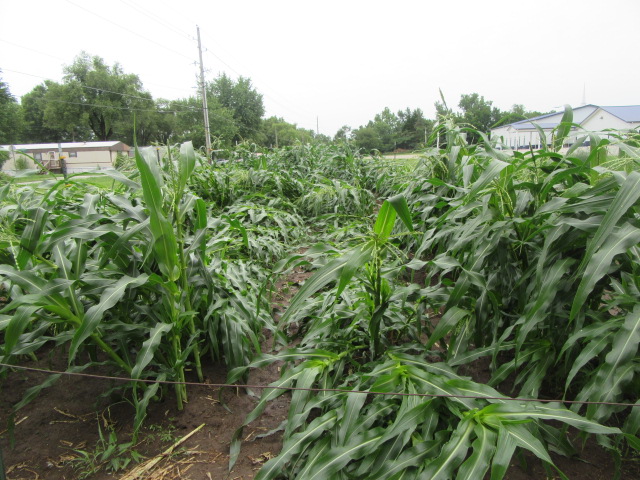
Sweet corn Wednesday morning, July 1, 2020.
For those of you who didn’t see it on the Wordless Wednesday post, the above photo is what I woke up to Wednesday morning. Sometime in the morning, maybe around 4-5 AM, I heard it thundering and then the wind picked up. Then it started pouring. The forecast had said 30% chance of rain, less than one-tenth of an inch with higher amounts possible during thunderstorms. When I heard the wind I thought, “the corn will blow over.” I hadn’ slept a wink hardly until it started raining but it put me to sleep. I got up, not telling when, made coffee, fed the cats, and checked the rain gauge. There was 2″. I didn’t look toward the garden because I really didn’t want to see it until I was more awake.
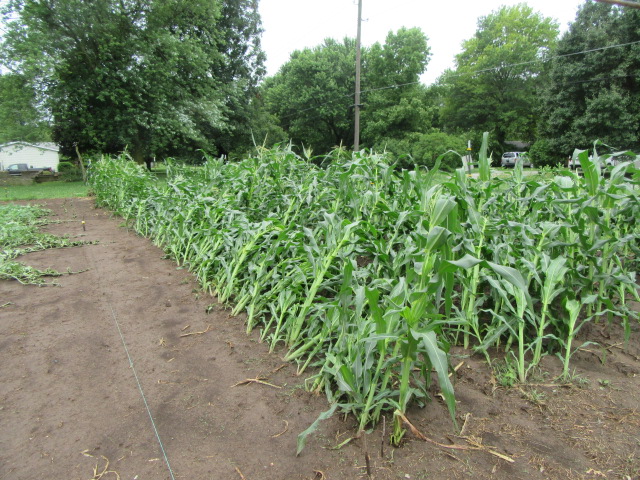
Sweet corn from the north side of the garden Wednesday morning, July 1, 2020.
I walked all around the garden and it wasn’t a very pretty sight. The row on this side had been hilled earlier but it looked like it hadn’t been hilled up at all. The row next to it had not been hilled yet.

Sweet corn on Wednesday, July 1, 2020.
The two rows closest to the fence had been hilled within the past week. Normally, it would have already been hilled up but some of the corn was still fairly small. Then we got a little rain a couple of times and it really shot up…
I commented to a few people in town about the corn blowing over and they said, of course, “It will stand back up.” OK, that may be true in some cases but not always. In the past, I have been very surprised that it has stood back up on its own but that was when it hadn’t blown over that much. It was more or less leaning a little but not severely blown over. I have grown corn enough over the years to know even if corn does stand back up it will not be perfectly straight like it was before it blew over. It will curve upward just like most other plants do and look weird… Who wants weird corn? I knew I needed to get in the there and straighten it back up before it started its curving, and trust me, it starts doing that sooner than you would expect. You can’t wait to see if it stands back up on its own for a few days…
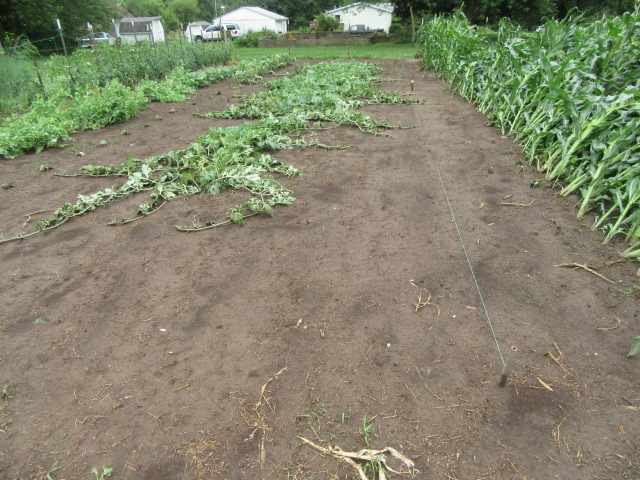
Garden soil flat as a pancake!
Apparently, it rained pretty hard because the beautifully tilled soil was now perfectly flat. Not a clod in sight. I had planted half a double row of green beans and planned on planting the other half on July 1. You might ask why I didn’t plant it all? Hmmm… I keep hearing my dad in my head about planting in the sign. I didn’t plant any of the garden in the sign as far as I know because I hadn’t checked an almanac or online. I did look before I planted the green beans and saw the next good day was July 1st. SO, I was planning on planting the other half in the sign to make a comparison… Well, I can’t very well plant the seed in the mud. I still have quite a few green beans in jars so I hadn’t planned on planting any. A friend had issues with rabbits and deer eating his so I told him I could plant a row in my garden… He happily agreed to that. I first planted old seed which started to expand then rotted… That was partly my fault, I think, but I am not going to talk about that. So, he bought new seed and I think every one has came up.
The watermelons, by the way, are ding great. I have pruned out a lot of the side branches but still have a lot to do. I have found a few tiny watermelons but mostly just a lot of flowers. Only one out of seven flowers will be female and bear fruit so you want to avoid trimming out any vines with flowers. Luckily, the side branches I removed had no flowers or very few. The vines get longer every day and it is amazing how fast they are growing. Not quite as fast as the sweet potatoes I grew a few years ago, though.
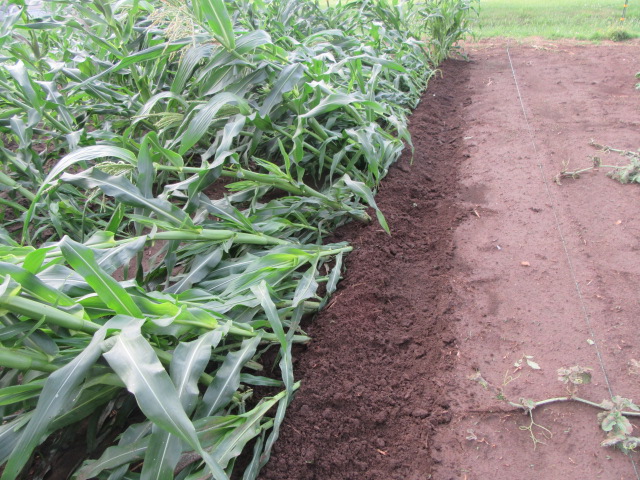
First furrow…
Some of the corn had blown over a couple of weeks earlier when we just had wind and no rain. I was able to get right in and stand it back up with no problem. This time, with 2″ of rain, I couldn’t just jump right in and do it. I also had other obligations in the afternoon so I waited until early evening to get started. By then the soil wasn’t quite as wet.
With so much corn blown over, I just started at the north end and piled dirt up next to the corn. When corn is short you can stand on one side of the row and use a hoe or something to pull the soil toward the corn from the other side. This row had been hilled up several weeks ago but I couldn’t tell it. It is a good thing the soil had been tilled recently so it was still fairly loose even though wet. I couldn’t get as much soil as I wanted on the corn because it was wet, heavy, and kept packing on the gizmo I was using. OK, I was using this strange-looking tool dad had bought from Publishers Clearing house with cultivator prongs on one side and a flat hoe-like deal on the other. It had an extendable handle that says Black and Decker. I had never used it before because I enjoy a sturdy hoe with a strong ash handle. GEEZ! (I miss my hoe I bought in the 1980’s I left behind when I, umm, left my ex-wife after 20 years… It was a Bulldog and I also left behind the Bulldog spade and fork… I wonder what became of them? I have a good idea…) ANYWAY…

Once I had the row hilled up on one side, I went back to the end of the row and one stalk at a time I carefully stood it up and reached through the corn to pull dirt from the other side. You have to pack it a little and push your fingers through the mud next to the roots to make sure there is soil around them.
I did make a discovery while standing the second row in the front section… I had been wondering why it hadn’t been doing as well as the rest and found a mole tunnel right under the corn… The corn in the second photo that is almost flat is where the mole tunnels were. Almost the whole length of the row. There are no moles in the garden now because the mole repeller is doing a great job keeping them out.

The corn that had been hilled up the last was much easier to stand back up. There was still plenty of soil and all I had to do was stand it back up as needed and firm the soil around the stalk. SO, it is a good idea to always hill your corn as often as necessary to keep a good supply of soil to use when it blows over…
I finished at 9:30 PM and I was very dirty and it was nearly dark…
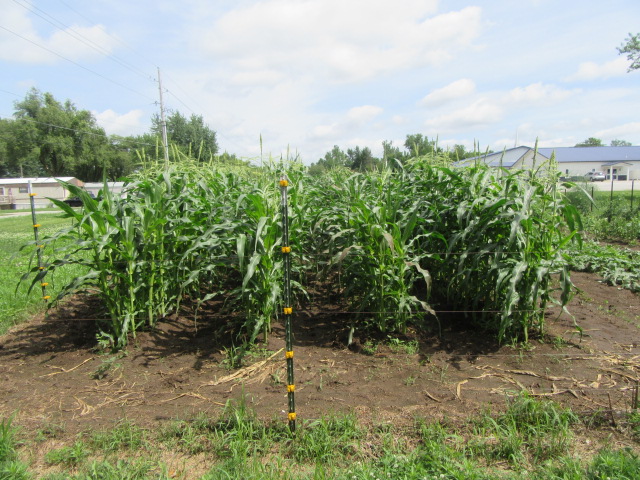
I went out the next morning and the corn looked like it had not blown over at all. I couldn’t tell how it looked in the dark.
Now, I am ready for the next round of wind…
Until next time, be safe and say positive. Stay well and always be thankful. By the way…GET DIRTY!

Hello everyone! I hope this post finds you well. All is well here… Well, kind of. When I went to bed the weather forecast said there was a 30% chance of rain. It said “less than one-tenth of an inch possible with higher amounts during thunderstorms.” Well, early in the morning the wind started blowing and it started pouring. I thought, “GEEZ! The corn will blow over.” Then I went to sleep after not being able to sleep all night. Sure enough, it did as you can see from the Wordless Wednesday photo… Anyway, I started this Homo neglectus Part 2, so I will finish it then write about the sweet corn blowing over.
The original shade bed is doing well as always but the lilac bush next to it some trimming. To the left of this bed is a concrete slab where a metal storage shed was many years ago. The slab gets covered with weeds, Carolina Creeper, and small trees that come up in the cracks. It is a yearly task cleaning it off. I have an idea to tie some pallets together and make a compost pile on the slab…

The corner shade bed, as I call it, is looking great as well. The Hosta ‘Dancing Queen’ (left) is flowering but ‘Krossa Regal’ (right) hasn’t started. The Heuchera ‘Palace Purple’, in the front, is doing good and already flowered.

Ummm… I know it looks like a mess, but this newest addition to the shade garden is doing fine. It just needs some weeding. Being next to the old goldfish pool there is A LOT of mosquitos to deal with when weeding. Sometimes if I am very quiet it takes them a while to know I am there. 🙂

With the mole repeller in the garden, the moles have returned the area next to the shade bed and in the yard in front f the chicken house. GEEZ! When I was mowing I saw one of those dirt piles is not from a mole. It has a good-sized hole. DOUBLE GEEZ!

I have almost completely gotten rid of the poison ivy that was growing in and around the shade bed but this one still lingers.

As I was walking by the old bird feeder I noticed ther was some grass in it. Hmmm… It appears Mr. Wren thought a female might like a nest inside but so far no takers. He completely ignores the wren house and so does the females that come… A few years ago a female was screaming at me and she kept going to the wren house but would not go inside. Then she would come back to where I was and scream some more. So, I went to have a look and there was a HUGE paper wasp nest blocking the entry. I cleaned it out and moved the house to the eve on the north side of the chicken house. I moved it because it was hanging next to the bird feeder and was pretty low. Apparently, she didn’t like my decision. Instead, she made a nest somewhere behind the chicken house… I really like House Wrens and they are certainly entertaining.
Now, let’s go to the south side of the house… In the “other yard”… Where the house is…

Baptisia australis cv. ?.
The Baptisia australis cv. ‘?’ (Wild Blue Indigo, False Indigo) at the southwest corner flowered very well this year and now has seed pods. This is the one I bought a few years ago that was supposed to be ‘Lunar Eclipse’ that turned out not to be… It has grown A LOT and seems to keep getting bigger every year. Good thing I moved the Phlomis ‘Edward Bowles’ to the other corner… It is a hybrid, of course, so maybe a better caption would be Baptisia Hybrid cv. ‘?’. I AM SO CONFUSED!
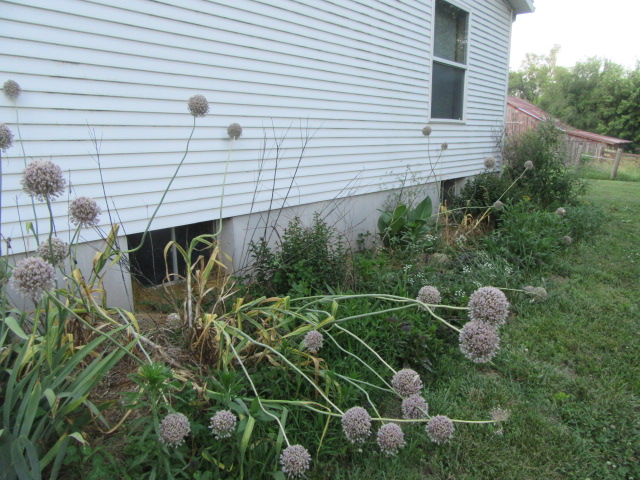
South bed…
I am always a little embarrassed to show the south bed in this condition. So many of you have great looking flower beds and I wish my back yard and beds were so well kept. The Elephant Garlic has done very well this year but the wind had played havoc with them.

Celosia argentea ‘Cramer’s Amazon’ on 6-26-20, #714-8.
One of the main reasons I neglect the south bed so long is because I have to wait for the Celosia ‘Cramer’s Amazon’ seedlings to come up. I am not even going to write the species name because that will lead to venting. 🙂 I sent seeds to Raphael Goverts, Senior Content Editor of Kew (Royal Botanical Gardens-Kew, Plants of the World Online, ETC., ETC.) and was happy to see there are photos posted of them on Plants of the World Online. I am hoping whoever is in charge of plant names will start using infraspecific names (var., subsp. or whatever) instead of putting the many “types” in groups. Oh, crap. I still vented a bit…

Torilis arvensis/Torilis japonica (Hedge Parsley).
Someday I would like to be free of stick tights altogether. I do need better photos of the flowers, leaves, and stems of Torilis arvense (Common Hedge Parsley, Spreading Hedge Parsley, Field Hedge Parsley) or Torilis japonica (Common Hedge Parsley, Erect Hedge Parsley, Japanese Hedge Parsley) for correct ID. Not that it matters for such a pain in the neck to be correctly identified. Missouri Plants says Torilis arvensis is a synonym of Torilis japonica, and it may have been for a while. However, there is apparently an agreement they are separate and distinct species now… Most also seem to agree, depending on location probably, that Torilis arvensis is the most prevalent. SO, I suppose the ones here are likely T. arvensis… The problem with getting good photos is that I am always pulling them up. I did get some good photos for ID before they flowered from the pasture. They are actually a neat, ferny plant before they set seed… GEEZ!

Talinum paniculatum (Jewels of Opar).
There are usually LOADS of Talinum paniculatum (Jewels of Opar) seedlings to transplant along the front of the south bed but so far only this one came up. I didn’t even deadhead them last summer to keep hundreds of seedlings from coming up. I think the seeds are good for several years in the ground because I had them coming up in the old cast iron planter last yere where I didn’t have any plants for several years. Just think, with only one coming up this year, I could have lost it completely… These plants are another reason I don’t do anything with the south bed until its seedlings come up.

Phlomis ‘Edward Bowles’ on 6-26-20, #714-25.
The Phlomis ‘Edward Bowles’ is doing pretty good in its new location for the second year. It doesn’t seem to be mad at me anymore especially since I do try to keep the weeds from growing around it. It is one of my favorite perennials so it does get pampered for fear of losing it. I have had it since 2013…

Stachys byzantina (Lamb’s Ears) on 6-26-20, #714-34.
The Stachys byzantina (Lamb’s Ears) completely died ate last summer so I was happy to see it return a little farther from where it was. That was a good surprise. I guess it didn’t like it to close to the wall of the basement steps or perhaps it didn’t like the Elephant Garlic next to it…
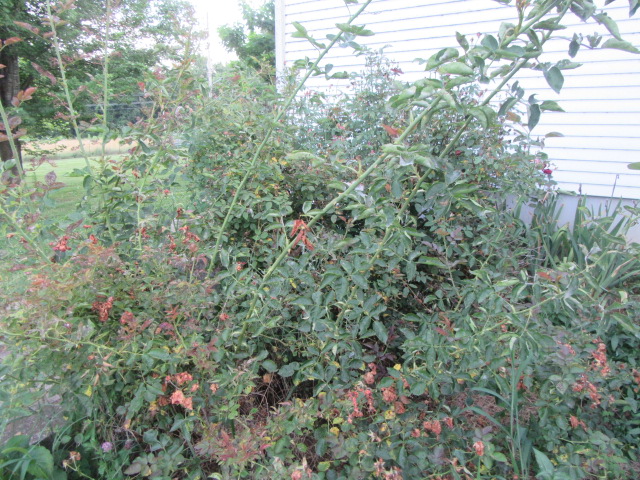
Hmmm…
OK, I am sorry the roses look like this. I know well-kept roses are beautiful but I am just not a fan. I took care of the beds for a lady in Mississippi, including her roses, so it isn’t like I don’t know how to manage them. I just despise the thorns. Mom liked roses and these came from Publisher’s Clearing House. GEEZ!!! When they came in 2014 or 15, before I convinced dad to stop fooling with PCH, he wanted me to plant them along the right side of the basement steps. Before, I had a Zinnia bed here. SOOOO… Since mom and dad have passed, guess what is going to happen here? In the next few weeks you will find out. 🙂 I kind of rate roses up there with Poison Ivy, getting stuck, flat tires, molehills, Japanese Beetles, and dead batteries. I am sure there are a few others that are fighting for number one on the list or maybe at least a space in the top ten. The list does fluctuate depending on the time of the year…
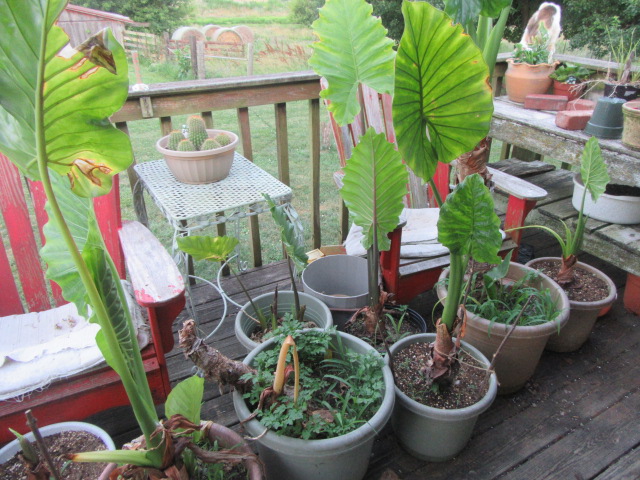
Alocasia on 6-26-20, #714-1.
TRIPLE, MAYBE QUADRUPLE GEEZ! I needed to do a lot of work and replant/repot the Alocasia before taking them to the area next to the shade bed. I always put them on the concrete slab around the barrel that covers the old well. SO, when I brought them from the basement (where they overwinter) I put them on the back porch. I have only got five pots finished… There are a few on the front porch, too. You can’t tell from this photo, but one of the Alocasia ‘Calidora’ is already almost over 8′ tall (including the pot).

Zantedeschia elliottiana (Golden Calla Lily) on 6-26-20, #714-38.
HOLY CRAP! The Japanese Beetles didn’t bother the Calla on the back porch last year but they found it this year already. They love the roses next to the porch. They like the Zantedeschia elliottiana but do not bother the Zantedeschia aethiopica next to it. I have had the Zantedeschia elliottiana for several years but somehow lost several bulbs over the winter. It was AWESOME last year!
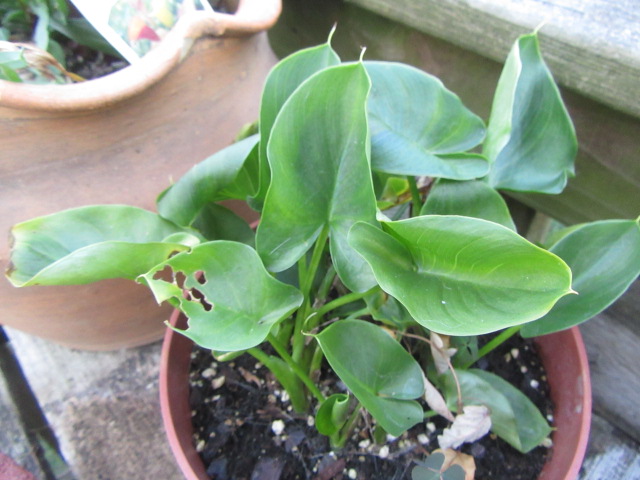
Zantedeschia aethiopica (the white Calla) on 6-26-20, #714-39.
The Zantedeschia aethiopica went dormant in January in the house but I was hoping it wouldn’t. This is the Calla the owner of Wildwood Greenhouse gave me last June that he grew from seed. He said he couldn’t get them to grow or do anything. The plants were healthy but kind of droopy. They just grew to a point then stopped. So, I brought this pot home and repotted it in Miracle Grow Potting Soil and it continued to just sit there. Then, low and behold, in August they kind of perked up and started growing. They kept growing and getting taller even after I brought them inside. Then I think in January they started going dormant… I managed to keep the bulbs from rotting and they came back up again… There are many species of Calla native to different parts of Africa. Some are winter dormant and some are summer dormant because of their rainy seasons. Then there are the hybrids…
When you buy a pot of Calla that is beautiful and flowering they have been growing in a controlled environment. Trying to overwinter them so they will come up and flower is a bit tricky. Zantedeschia aethiopica is a species from South Africa that “can be” evergreen in the wild if they get enough rain… They can also flower in the spring, summer, and fall… Zantedeschia aethiopica can also be used along ponds (fish pools) so it seems to do well in moist conditions. I am just learning about this plant and I do love Calla!

Lavender and Rosemary on 6-26-20, #714-18.
I bought a pot of Lavender and Rosemary way back in, ummm, maybe April but I neglected to put them in the ground somewhere. One of those impulse buys from Wal-Mart. They were fine until we had a hot dry spell and I was busy in the garden and didn’t get them watered… I wonder if I can take them back to Wal-Mart and say I need a refund because they died. 🙂
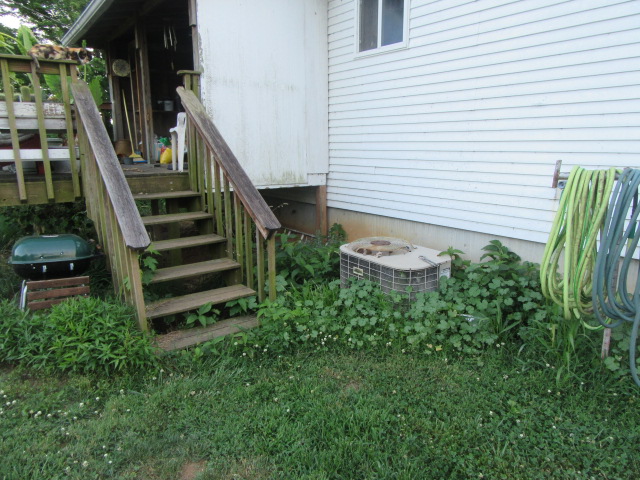
Back of the house on 6-26-20, #714-4.
OK, so I need to do some trimming… The Nepeta x faassenii ‘Walker’s Low’ (Catmint) is in the corner next to the AC. It is blooming up a storm right now and will do so all summer. The Malva neglecta (Common Mallow) has always been growing around the AC and along the foundation and is also now blooming. It thinks I like it so it does really good here. Hmmm… It’s basically a weed but I do suppose I like it for its lush foliage. The Persicaria virginiana (Virginia Knotweed) and Persicaria maculosa (Lady’s Thumb) also think I like it since I did a post about Persicaria last summer. GEEZ! I have news for them as well…

Canna bed.
I have to admit how I screwed up the Canna bed. The Cannas were getting so thick AGAIN it wasn’t funny. I decided not to mulch the bed last fall or even remove the old stalks after the “F”. I knew by doing that I may lose some of them but I thought that would be a good idea to thin them out. Unfortunately, now there are bare spots. What is weird, though, even without mulching the Colocasia esculenta survived the winter. Don’t ask me how that happened…

Colocasia ‘Distant Memory’ on 6-26-20, #714-10.
DOUBLE GEEZ! I managed to overwinter the Colocasia ‘Distant Memory’ rhizome and I knew it also had an offset. I kept the rhizomes separate over the winter but they kind of got mixed up when I got ready to plant them. So, I panted both the larger rhizome and what I thought was its offset together. Well, apparently the offset I planted was a Colocasia esculenta so now I have to dig it up and relocate it. Most of the photos on this post were taken on June 26 and I noticed today the Colocasia esculenta has GROWN A LOT since the above photo was taken. I need to move it ASAP!!!
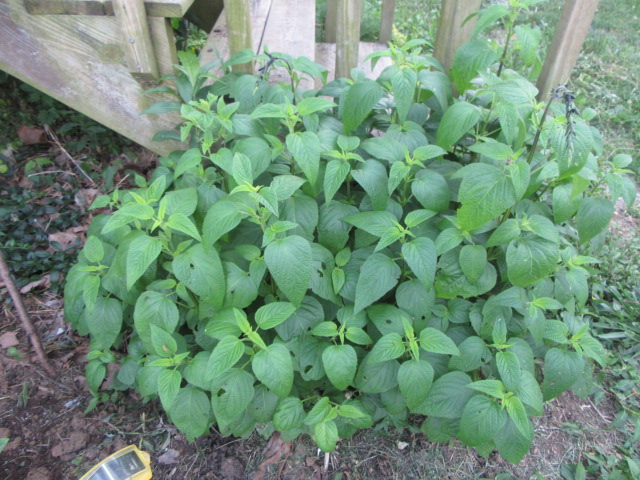
Salvia coerulea ‘Black and Blue’ on 6-26-20, #714-29.
I was very surprised the Salvia coerulea ‘Black and Blue’ returned this spring because I have problems with perennials overwintering in this spot. The Conoclinum coelestinum (Hardy Ageratum) used to reseed here every year but apparently didn’t approve of me putting other plants here and fizzled out. There a couple of plants came up on the other side of the steps but I accidentally pulled one up. GEEZ!

Colocasia ‘Coffee Cups’ on 6-26-20, #714-9.
I attempted to overwinter the Colocasia ‘Coffee Cups’ from last year but was unsuccessful. I was glad Muddy Creek Greenhouse had more this spring.

Hosta ‘Empress Wu’ on 6-26-20, #714-15.
The Hosta ‘Empress Wu’ just keeps getting bigger. The clump is now 32″ tall x 60″ wide and the flower stem is 52″ tall. Not bad, huh? The Astilbe x arendsii ‘Fanal’ thinks I screwed up and planted it to close. Hmmm… It is right so I have to move it somewhat next spring. It doesn’t mind being planted next to royalty, but as with some of the elite, they can be a bit pushy.

Forsythia…
I couldn’t stand it anymore so I gave the Forsythia a good haircut. It went from an afro to a crew cut…
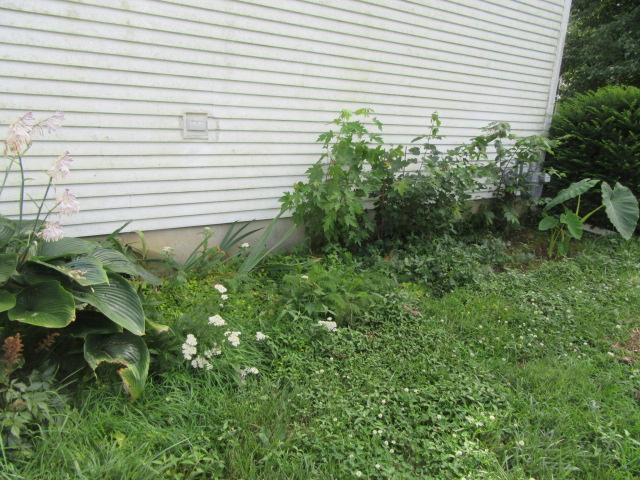
The north bed has been weird… I will get rid of those trees ASAP and dab the stems with Tordon so maybe they will stop coming up. I put four Colocasia esculenta rhizomes in the bed and only one has come up and did well. The others are STILL in the sprouting phase. That never happened before and they always do so great here. I still have several I haven’t planted so I think I will just line them all up here. GEEZ AGAIN!
Now that we had 2″ of rain, and maybe still more to come, I need to mow. The garden is to wet and I have to see how much of the corn stands back up on its own… I did a post in 2017 about corn standing back up and only had 13 views. The post was titled How Does Corn Stand Back Up. There were 7 views in 2018 and 185 in 2019. A few weeks ago I noticed the post was getting a lot of views so I checked and it has got 327 views so far in 2020, 207 in June alone. LOL! SO, I think I will write a new post about the corn since it blew over so bad… The reason I hilled up the corn apparently has nothing to do keeping it from falling over. There are multiple reasons… I will write a new post about the corn and maybe be a little more entertaining and explain the reason for hilling, removing the suckers, and so on. Last night I noticed there were aphids on the tassels of two stalks and, of course, the ants farming them. There were also Ladybugs feeding on the aphids. 🙂
So, until next time… Be safe, stay positive, stay well, and always be thankful. Take care and GET DIRTY!

 The Belmont Rooster