July 26, 2021 Garden Update…

Hello everyone! I hope this post finds you well. The above photo looks MUCH different from the last photo of the garden. I was almost in panic mode for a while… I was late planting the garden because of the weird weather and then it started raining AGAIN…

 

The last post about the garden was a month ago on 6-28-21. It had been raining for several days and I was having to wait to till the soil (above photo). FINALLY, after it stopped raining and the soil was dry enough I got in and worked it over. Once the corn and beans were tall enough I hilled all the rows up. With all the moisture, everything was looking a bit yellow. With no cows, there hadn’t been any of the “good stuff” to put on the garden for several years before planting. I know corn needs nitrogen, so I had to make a decision. SO… breaking my organic rules (which I really had very few of) I bought a bag of 12-12-12 from the hardware store for the sweet corn. I checked with the Farmer’s Co-op first and they were completely out because many other people were having the same issues with their sweet corn.

It may sound funny, but I watched videos on YouTube to see how to fertilize the corn… In all the years as a gardener, I have never bought fertilizer for the garden. Giving the green beans 12-12-12 would be an absolute NO but the corn needed some ZIP. I also bought some fertilizer spikes for the tomatoes. Sometime between now and next spring, I plan on cleaning out the chicken house to put on the garden. I usually pile up their old stuff in an open area next to the chicken house, but it just kind of disappears…


Like I mentioned in the last post about the garden, Nathan planted four rows of Ambrosia (bicolor) and I planted four rows of Bodacious along the west side of the garden On June 3. On the 4th, I planted four rows of Incredible next to the Bodacious. The Ambrosia and Bodacious, which I had not tried before, came up pretty good but the Incredible did not come up well at all. Once I was able, I replanted it and it came up MUCH better. But, as you can see in the above photo, the Incredible is just now looking good. It didn’t get fertilized and hilled until a few days ago because it wasn’t ready…


HMMM… Jade saw me go toward the garden, so she had to come as well. She likes being with me in the garden and walking around to see if she can find anything to chase. She seems to enjoy the butterflies…


Last week, I think (or maybe the week before) I noticed the Ambrosia and Bodacious had started tasseling… It was only like 4′ or so tall! I thought, “GEEZ! That is weird…” I am so used to corn being much taller and it seemed too soon. It is 75-day corn so it should be ready around August 17 (or thereabouts). The past week the corn shot up like magic. I am not saying it was because of the fertilizer because the earlier Incredible that did come up did the same thing without being fertilized. Incredible is also a 75-day corn, but it had not started tasseling.

 

The Ambrosia and Bodacious have ears on the lower half of the stalk, making it easier for raccoons to get to if they have a chance. Since I have the electric fence around the garden with five wires raccoons seldom get in the garden. Kernal row numbers are determined during the 5th and 6th stage.


Not all the stalks are progressing at the same rate, even though the seed germinated at the same time. Some are just beginning to silk while the silk on others are beginning to show more color.
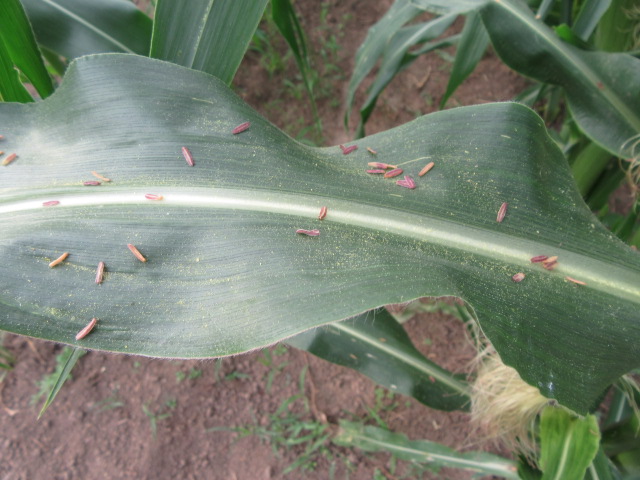
 

I had wondered about pollination, but there is certainly no need to worry about that. Depending on the sweet corn variety, pollination occurs 45-50 days after emergence. Normally, the last branch of the tassel is visible 2-3 days before silk appears. I may need to hand pollinate the Incredible that came up first…

I had not done any research about the different stages of sweet corn growth until now. Normally, I just get the garden ready to plant and then plant it. Dad always used the seeder and planted the green beans and sweet corn in double rows. While he was still alive, I did it like he wanted, even though at times I may not agree. Last summer I continued planting in double rows with the seeder but I paid closer attention and I learned a few things. The holes in the seeder are big enough for 2-4 seeds to get planted in the same spot a certain many inches apart. Watching the seeder, I noticed that sometimes the seed would fall out and not get planted, especially if too many tried to get in the cup on the seeder disc. Angling the seeder a little helped somewhat. The two problems with the seeder were 1) sometimes it didn’t plant the seed, and 2) the seed was planted too close together. To me, having to thin out that many plants was such a waste of seed.

SO, this year I decided I would plant single rows instead of double and do t by hand instead of using the seeder. I showed Nathan how to plant corn, so he started with the Ambrosia at one end of the garden, and I started planting the Bodacious about 30 or so feet away (25′ row, a five foot space, then another 25′ row). I put a stick where I wanted him to stop and I had a tape measure laid out so “we” could plant one seed every 8 inches. When Nathan was finished with his 25′ row, he kept going and I didn’t notice at first. The next thing I know he had passed the stick and was planting Ambrosia where I already planted Boadacous. GEEZ! Somehow he was faster than I was. (I was thinking, “GEEZ! That kid screwed up somewhere.”). Anyway, after I finished my row, we measured 3′ over, put the stakes in the ground with the string to mark our rows, moved the tape measure over, and started again. This time, I told Nathan we would plant 3-4 seeds every 8 inches. We repeated the process until we had both planted 4 rows.

There are a couple of reasons I planted single rows instead of double… One is because the spacing is somewhat more tricky. To get the spacing right, you have to plant the second row 8″ from the first one. I guess that isn’t so tricky when I think about it, but the other reason makes more sense. Hilling one row is much easier than hilling two together. Not only that, standing a double row of corn back up after the wind has blown it over is a REAL pain in the neck… I figure it will be much easier with a single row. Now all I need is some wind to find out. Wait a minute… I don’t really want that much wind, I am just saying I am prepared.

Before, I noticed there were a lot of stalks that had no ears which is a sign they were too close together. This year, I can assure you that all the corn that emerged at the same time, being 8″ apart, have ears. The majority have four ears, some have three, and I have even noticed several stalks with five. This would be a GREAT time for rain… Using T-tape would be great because corn produces best with consistent moisture. But you know, the soil is still not that dry. If most of the ears fill out well, and they should with all the pollen, I may pass last year’s crop of 373 ears. That will be with less than half as many stalks…

I still don’t understand why some of the seeds didn’t emerge. You would think planting 3-4 seeds per “hill” or “hole” (whatever you call it) at least one would make it. But, that is not the case. I dug down in the soil where the corn didn’t emerge only to find all the seed had sprouted but died before emerging. SO, all the Incredible that didn’t come up simply rotted that was planted a day later in the same conditions. I did find out Incredible has a poor germination rate at cooler temps than Bodacious. Even though the temperature was warm enough when I planted, it started raining and the temps dropped for several days. That was likely the problem… I wouldn’t mind planting four more rows of Incredible, but that would put the harvest date to mid-October. Hmmm… That would be a gamble with the first “F” happening around then… But I have this HUGE 14′ x 53′ bare spot!

I read a very good article about the stages of sweet corn by Seminis which was very helpful. I didn’t realize there were so many stages of growth… I also watched several videos where experiment stations had experimented with spacing on field corn.

 

The dark spot a little above the center of the photo is where Jade is laying down. She is about 4 feet into the section where the Bodacious is planted. I knew when I got ready to leave she would not come when I called her. She constantly reminds me she is a cat, not a dog.
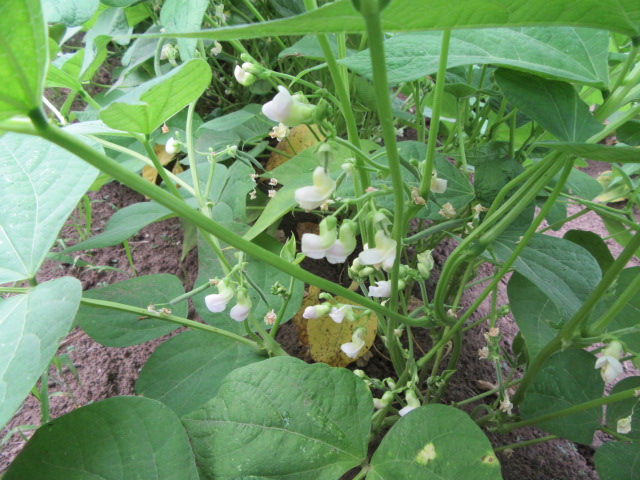
 

The ‘Top Crop’ Green Beans are coming along very well and blooming up a storm. I don’t bother them too much because in the heat I think the flowers fall off more easily.


I think I will get my first picking in a couple of days so they are right on schedule. I didn’t take any photos of the tomatoes but they are doing pretty good and growing well. Not too many tomatoes, but the vines look great. Hmmm…
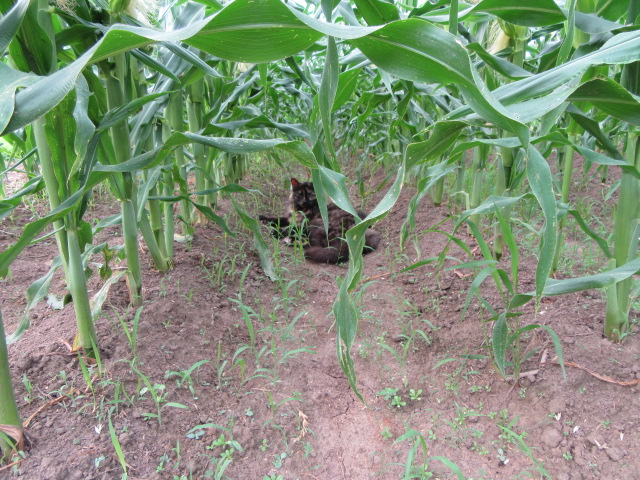
 

As I suspected, I was ready to leave the garden and Jade didn’t come when I called. I went back where she was before and she was still there. Even when I squatted down at the end of the row she still refused to come. I threw a small clod of dirt at her when she wasn’t looking which made her jump up. At least I got her attention then she followed me out of the garden… 🙂
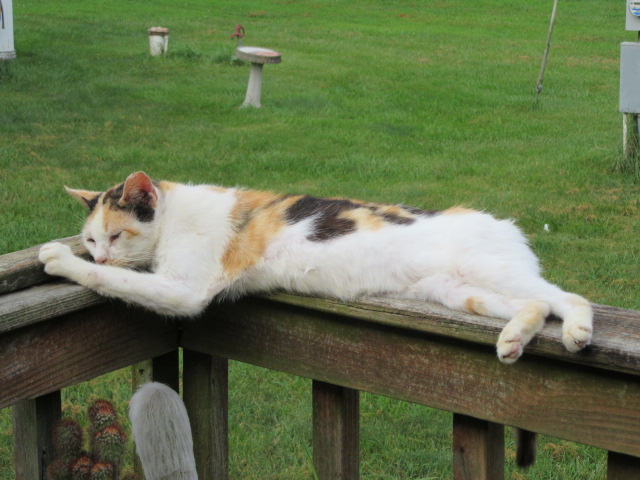
 

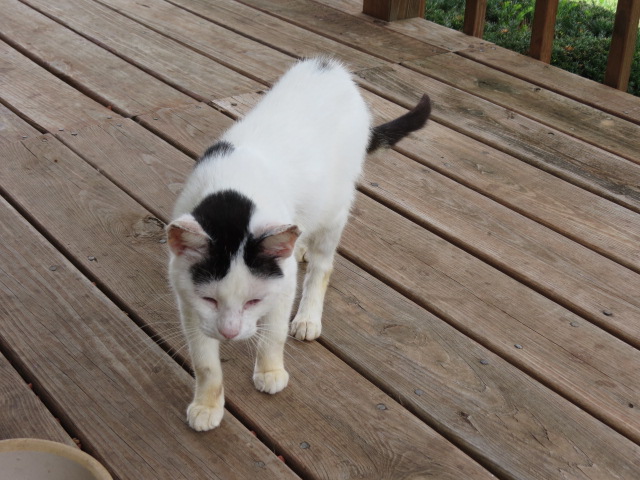
The Barn Cat was taking it easy on the back porch…


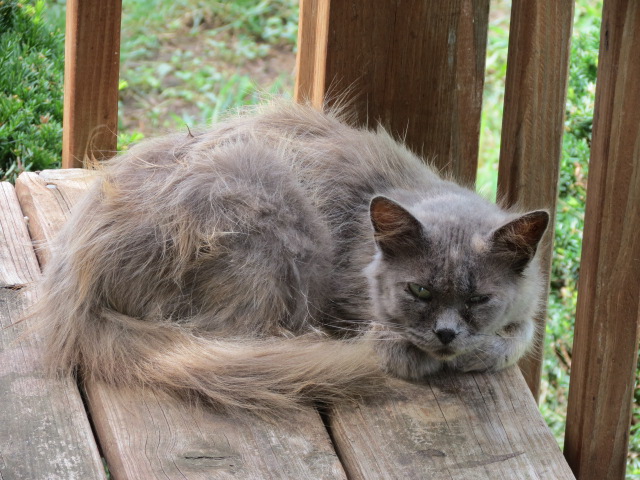
And so was Simba…
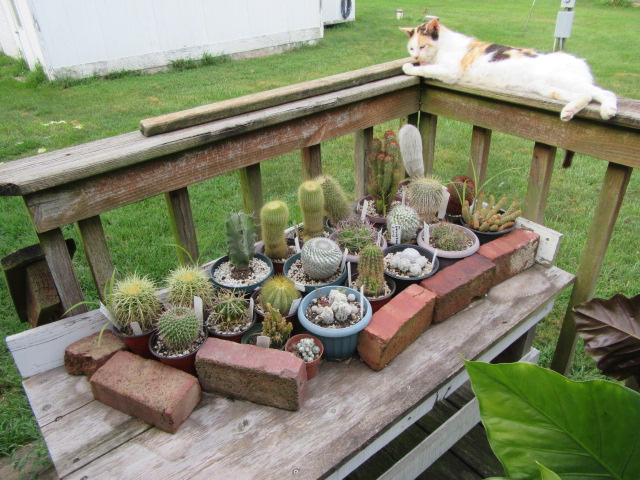
 

Most of the cactus are on the back porch enjoying the heat and sun of the summer.


The Alocasia are also looking GREAT!

Well, that’s about all have today for now. I will take a few photos of the plants on the front porch. They seem to be all in pretty good shape enjoying the summer outside. We won’t talk about the flower beds or the Hosta. The deer have been busy in the shade bed, which usually never happens. They have ruined a few of the Hosta… GEEZ!

Until next time, be safe, stay positive, and always be thankful. As always, GET DIRTY!


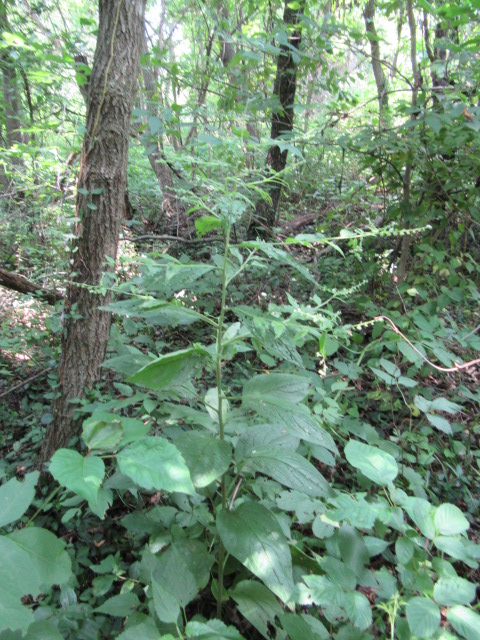
AH HA! Finally Hackelia virginiana (Beggar’s Lice, Stickseed) Flowers, ETC.

Hackelia virginiana (Beggar’s Lice, Stickseed, ETC.) on 7-17-21, #813-25.

Hello everyone! I hope this post finds you well. I went back to the blackberry briar wilderness along the south hayfield on Saturday (the 17th) to check on the progress of the Pale Indian Plantain (Arnoglossum atriplicifolium) but their flowers still hadn’t opened. I took about 200 photos of 18 species, most of the plants I already photographed before. Even though I have already identified most species, I either need better photos, more photos, or I just have an itchy trigger finger. Once the mosquitos start coming, I’ll shoot just about anything. 🙂 But, amazingly, they weren’t so bad on Saturday. Walking through all the blackberry briars is bad enough and the taller they get the harder they are to walk through. I feel like hooking up the mower to the tractor and making a path, but I keep finding plants I need photos of. What if I run over something I don’t know is there? GEEZ! I could just take a machete but then I would be fighting the thorny stems I just cut… I will probably wait until after the first “F” and then mow down the whole mess from one end to the other. If I don’t, I won’t even be able to get in and walk around next year.

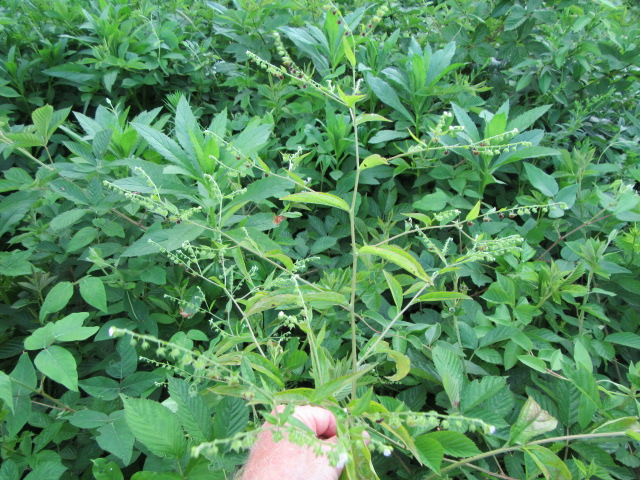
One example is what I just found on Saturday… (Yeah, I know it is Friday already). I was walking through the thorns and saw a plant I hadn’t seen before, flowers, fruit, and seed… I thoroughly photographed the plant from one end to the other so I could get a positive ID and upload the photos on iNaturalist and write a new page.

Hackelia virginiana (Beggar’s Lice, Stickseed, ETC.) on 7-17-21, #813-30.

I was like, “OH, what is this?” Flowering stems growing in all directions and fruit!

Hackelia virginiana (Beggar’s Lice, Stickseed, ETC.) on 7-17-21, #813-31.

Well, it was just downright neat and growing right in the blackberry jungle… I thought finding this plant made it worth fighting all the thorns.

Hackelia virginiana (Beggar’s Lice, Stickseed, ETC.) on 7-17-21, #813-32.

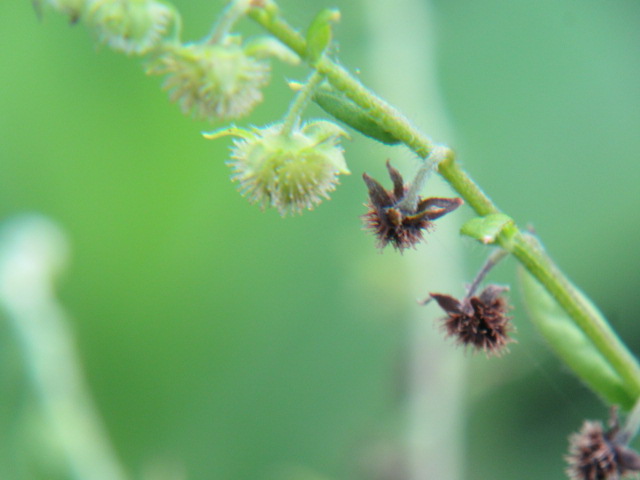
It isn’t often you find flowers, fruit, and seed at the same time all on the same stem…

Hackelia virginiana (Beggar’s Lice, Stickseed, ETC.) on 7-17-21, #813-33.

The flowers are fairly small…

Hackelia virginiana (Beggar’s Lice, Stickseed, ETC.) on 7-17-21, #813-28.

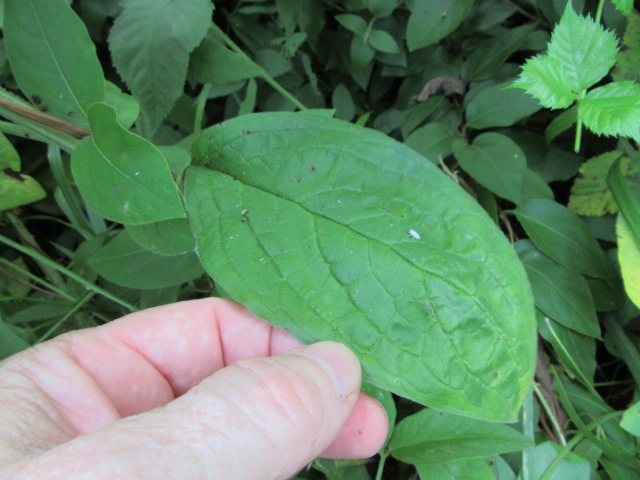
The leaves are kind of thick and leathery…

Hackelia virginiana (Beggar’s Lice, Stickseed, ETC.) on 7-17-21, #813-29.

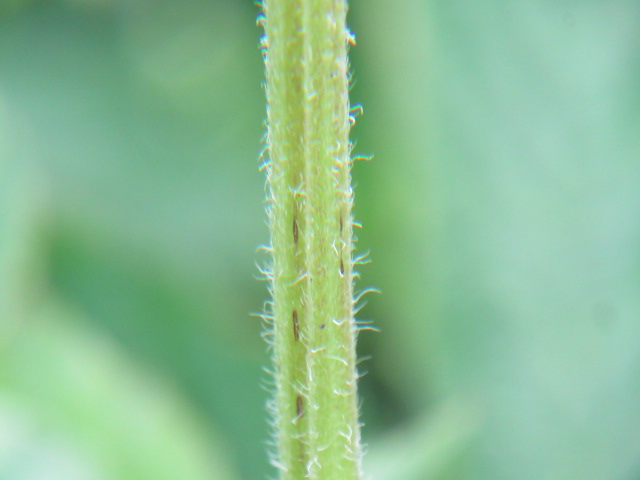
Stems are kind of hairy… I took a lot of photos and weeded out some. I just added a few on this post and saved the rest for the plant’s page which isn’t finished yet…

As it turned out, it was a species I found north of the chicken house in 2020 that had not flowered. You know, one of those that grow a rosette of leaves the first year and flower the next… I couldn’t properly identify it for sure until it flowered… When in flower, it looks absolutely nothing like the rosette from the previous year. Hackelia virginiana, also known as Beggar’s Lice, Stickseed, Virginia Stickseed, ETC. Yeah, another sticktight with barbed bristles. 🙂 Another plant with “virginiana” as the species name…

Hackelia virginiana (Beggar’s Lice, Stickseed, ETC) on 7-19-21, #815-2.

On Monday, I was in the trees (and vines) north of the chicken house photographing leaves of the wild grapes (long story) and there the darn plants were, flowering up a storm. There were three… SO, the main species I photographed in the briar patch jungle on Saturday were flowering much closer. They weren’t flowering north of the chicken house the last time I was there, otherwise, I wouldn’t have taken 30 photos (more or less) of them on Saturday.

Honestly, finding out the species I found in the briar patch on Saturday didn’t seem as exciting after I found out what it was. Especially since they are right in the backyard… 🙂 Now, I am laughing about the whole ordeal. 🙂

Well, I do really need to go back to the briar patch jungle to check on the Pale Indian Plantain flowers. It has been a week! I am tempted to walk up the trail next to the farm, walk through the trees, and climb over the fence to get there instead of walking through the tall grass. It is quite a distance and I feel like I have walked up 500 steps by the time I get there. Then I have to fight the briars and walk back. I keep thinking the hay will be cut, but it still hasn’t happened… There is no real threat of rain in the forecast, but temps are definitely on the rise… The forecast says 95° F by next Wednesday!

Well, that’s it for this post. I did find a couple of interesting caterpillars on the walk on the 17th. I got one shot of one of them and it completely jumped off of the leaf. Nothing like it on iNaturalist and I can see why…

OK, I better close this post. Until next time, be safe, stay positive, and be thankful. Get dirty if you can, but maybe wait until later in the afternoon…

Kalanchoe gastonis-bonnieri Has It’s First Kid

Kalanchoe gastonis-bonnieri (Donkey Ears) on 7-19-21, #815-4.

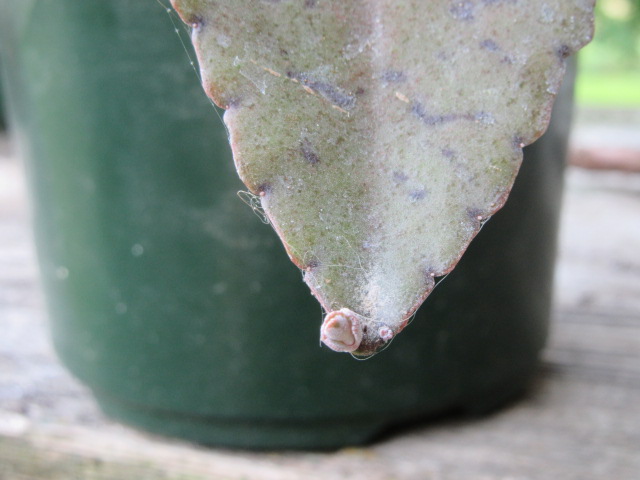
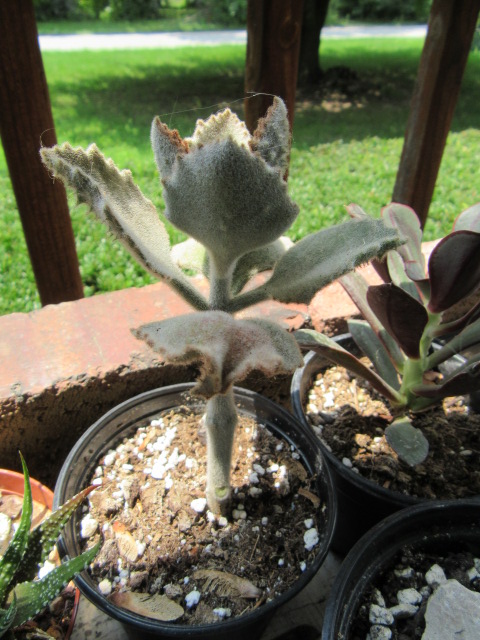
Hello everyone! I hope this post finds you well. Monday afternoon I noticed the Kalanchoe gastonis-bonnieri (Donkey Ears) needed to be rotated. It is sitting on a table on the back porch under the covered part. It gets plenty of morning sun but is protected from full sun. Not that full sun would hurt it as long as it isn’t really hot. When I rotated the pot, I noticed something… I moved it to the propagating table to have a better look.

Kalanchoe gastonis-bonnieri (Donkey Ears) on 7-19-21, #815-5.

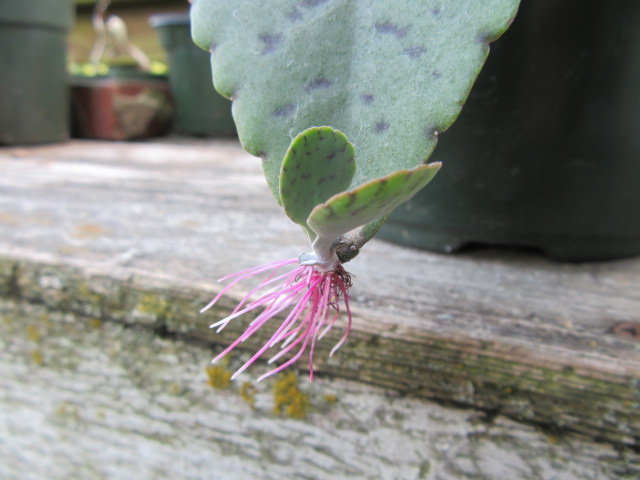
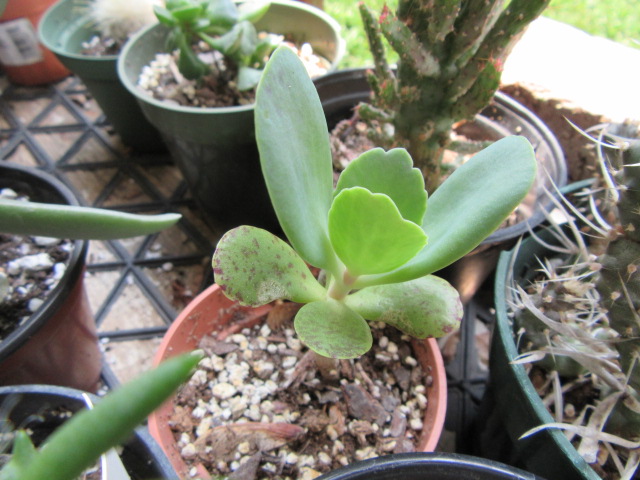
It has its first kid… Kalanchoe gastonis-bonnieri is “one of those” Kalanchoe that produces plantlets from its leaves, phylloclades, or whatever you choose to call them. The scientific community calls their leaves phylloclades, which are modified “branches” used for photosynthesis… To the rest of us, they are just odd leaves. 🙂

Kalanchoe gastonis-bonnieri (Donkey Ears) on 7-19-21, #815-6.

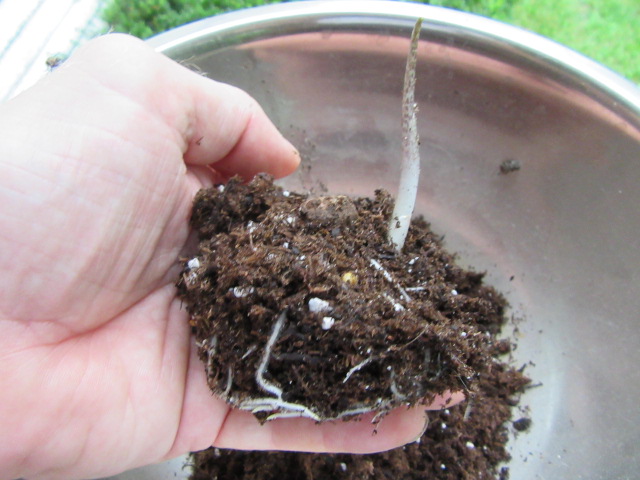
I found it quite weird the roots of the plantlets are pink… I guess it’s a girl. I wonder if boys have blue roots? Please don’t take that seriously. I doubt the pink has anything to do with gender.

Kalanchoe gastonis-bonnieri (Donkey Ears) on 7-19-21, #815-7.

The lower leaf on the opposite side of the plant is also pregnant. It appears another one is starting next to it. I will be keeping an eye on it…

The other Kalanchoe are doing fine except for the Kalanchoe orgyalis (Copper Spoons). It grew so tall, and I really liked the plant. It had a few branches so I decided I would cut the main stem and the branches off and start new plants. Well… The old main stem is growing a new plant but only one of the other cuttings has survived and it is iffy. Live and learn…

Kalanchoe beharensis (Velvet Elephant Ear) on 6-24-21, #803-11.

I finally have another Kalanchoe beharensis (Velvet Elephant Ear) thanks to a lady who read its page on March 14. In a comment, she said she could send a leaf which I readily accepted. She not only sent a leaf but also an entire rooted cutting which arrived on April 23… That was great because the leaf didn’t make it. The plant is doing great and is 4″ tall now. I was so glad when it arrived!

Kalanchoe beharensis ‘Fang’ at 5 3/4″ tall on 7-20-21, #816-2.

I decided to bring home another Kalanchoe beharensis ‘Fang’ from Wagler’s on April 3. She always had several to choose from but I had just not brought one home until then. She could have gotten her original start from me, but I am not sure. You can always tell ‘Fang’ from the other Kalanachoe beharensis because of the weird protuberances on the undersides of their leaves, which are also much smaller. When I took the photo on July 20 it was 5 3/4″ tall.

Kalanchoe x laetivirens (Mother of Thousands) on 7-20-21, #816-3.

Of course, the Kalanchoe x laetivirens (Mother of Thousands) is doing great. There are two plants in the pot that are offsets from the mother plant that flowered in January 2020. I had previously thought these baby factories were Kalanchoe daigremontiana but discovered I was mistaken. The leaves of that species have purple markings on their leaves while Kalanchoe x laetivirens just have green leaves. There are a lot of photos online of plants with mistaken identities… I need to get the two plants in this pot separated and may have to regrow them. They are getting quite tall and will start looking very weird soon if they aren’t regrown. These plants look AWESOME when they are grown well.

Kalanchoe luciae (Flapjacks) on 7-20-21, #816-4.

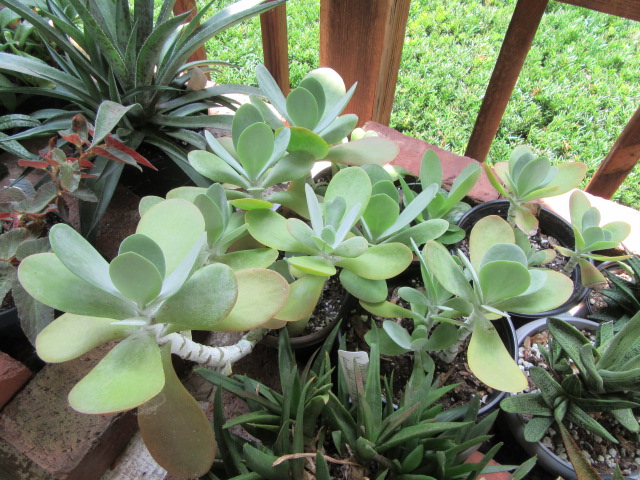
I really like the Kalanchoe luciae (Flapjacks, ETC.). They are easy to grow and undemanding except they like some space so they can sprawl a bit. I like their thick, leathery leaves and the white bloom on their stems (and leaves). I have had this species since I brought a plant home from Wal-Mart in 2016 so we have history. There are 5 pots with 16 plants (including offsets)… GEEZ!

Kalanchoe marmorata (Penwiper Plant) on 7-20-21, #816-5.

The Kalanchoe marmorata (Penwiper Plant) is still hanging in there waiting for me to figure them out. I ordered a plant from a Facebook member and it looked so great when it arrived in April 2018. It just went downhill from there and we have definitely had our ups and downs. Even though the plant had issues, it sent out an offset. The plant’s page is supposed to be a journal and if you read it will see the issues we have had. We made an agreement in 2019 that if it didn’t die I would continue doing the best I can. Well, both plants are still alive and now the smaller one (the original offset) is looking better than the taller one. The taller one looks weird AGAIN and the stem needs cut off and regrown. Hopefully, I will eventually figure out the Kalanchoe marmorata. I can’t help but think there is something it needs I am not doing… It’s a Kalanchoe, for crying out loud!

That’s all for this post! Until next time, be safe and stay positive. Always be thankful and GET DIRTY!
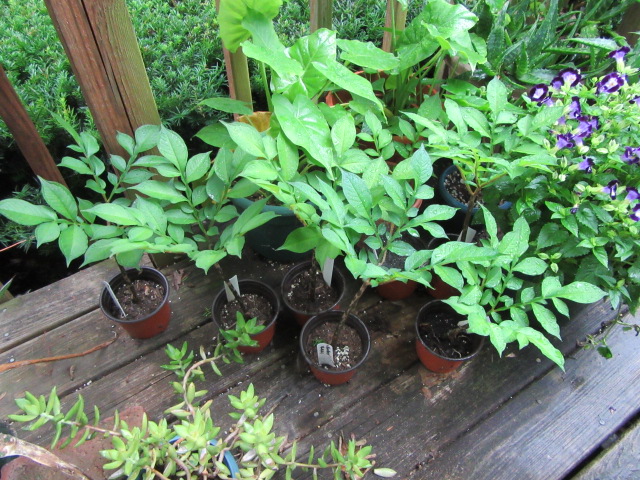


Vanessa atalanta (Red Admiral) Identified

Vanessa atalanta (Red Admiral) on 7-11-21, #8-10-21.

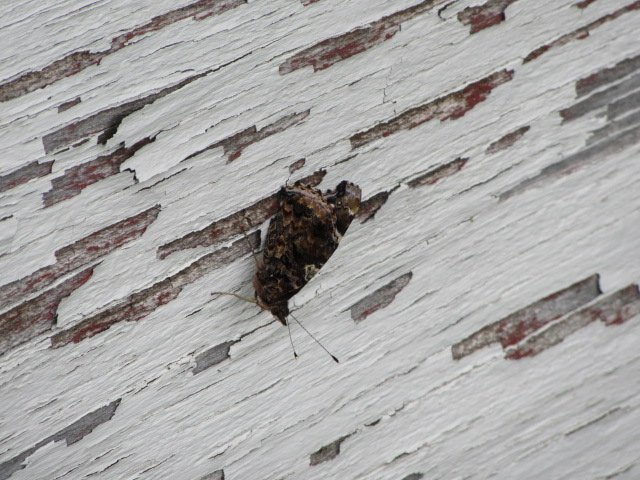
Hello everyone! I hope this post finds you well. While I was taking photos and looking at the fruit/seeds of the Hedge Parsley by the shed on July 11, I noticed this butterfly on the wall. Its wings were closed at first so I didn’t think much about it. Then it opened its wings and I saw it was a butterfly I hadn’t seen before… I took several photos then went to get Nathan. Its wings were closed again when Nathan arrived. I told him not to get close or it would fly off… Strangely, it just stayed for several minutes with him just maybe 2 feet away.

Vanessa atalanta (Red Admiral) on 7-11-21, #810-22.

I posted photos on iNaturalist and it turned out to be a Vanessa atalanta also known as the Red Admiral. Although I hadn’t seen one before, there are several observations posted from Missouri.

Map of observations of Vanessa atalanta (Red Admiral) from iNaturalist members worldwide. The iNaturalist website is published on the internet at https//www.inaturalist.org. The iNaturalist website is a joint initiative of the California Academy of Sciences and National Geographic Society. This map was retrieved and shared on this site with permission on July 15, 2021.

The above map of observations for Vanessa atalanta is from iNaturalist. The maps on iNaturalist are continually updated as new observations are submitted by its members. Anyone can join and it is a great website to confirm and share your observations.

Information online says the Red Admiral is known to be somewhat calm allowing people to get close without flying off. It says they even fly on people and rest for a while.

Information also says the males are very territorial and females ONLY choose males to mate with that have an established territory.

The primary food source for the larvae is Urtica dioica (Stinging Nettle) and they can also be found on Boehmeria cylindrica (False Nettle). I have seen False Nettle here in the back of the farm but I haven’t noticed any closer to the house. I haven’t seen any Stinging Nettle recently but there could be plants by the old Mulberry tree. Well, a few years ago there was this huge colony of plants I suspected was Stinging Nettle but I never took photos for a positive ID…  Adult butterflies also feed on nectar and overripe fruit.

You never know, maybe someday I will see another Red Admiral.

The garden looking great, so I’ll have to take a few photos. I went back to the briar patch along the south hayfield on the 20th to check on the Pale Indian Plantain and took A LOT more photos. The Pale Indian Plantain’s buds still hadn’t opened so I will have to make another trip soon. GEEZ! I will get a post together because I made a new discovery. I FINALLY found a plant I had previously been watching north of the chicken house. It was in the wooly mess of blackberry briars. Then, on the 19th, while I was taking photos of the leaves on the grapevines north of the chicken house, I spotted a few more. Previously, I was observing rosettes from first-year plants with no flowers, so when I spotted it blooming in the briar patch I had no idea what it was. I uploaded photos on iNaturalist and when I saw the name I was surprised… Completely different! Then, on the 19th, when I was in the jungle north of the chicken house taking photos of the leaves on the grapevines, I saw several. Yeah, photos of the leaves on the grapevines. I will tell you why in a future post…

My next post will be about what the Kalanchoe gastonis-bonnieri (Donkey Ears) did. 🙂

OK, it is after 2 AM so I better close and go to bed. Until next time, be safe and stay positive. Always be thankful and GET DIRTY!


Sauromatum venosum… Learning Curve

Sauromatum venosum (Voodoo Lily) tubers on 6-27-21, #805-12.

Hello everyone! I hope this post finds you all well. I have been wanting a Dracunculus vulgaris for a while but when I was looking on Ebay, the listings for the tubers were a bit pricy. I did find some inexpensive Sauromatum venosum which have similar leaves. I bought a Dracunculus vulgaris tuber in 2009 or 2010 when I lived in Mississippi, which I think was really a Sauromatum vulgaris. Unfortunately, I forgot about it and left it behind when I moved back here in 2013. Well, it was dormant at the time and just slipped my mind. I had so many plants and other things to give away and decide what to bring with me.

So, I found this listing on Ebay that said, “Sauromatum venosum HYBRID Indian GiantxNormal Voodoo Lily Amorphophallus Rare”… I looked at the many photos he had uploaded and read his description. Apparently, the guy has A LOT of them including the cultivar called ‘Indian Giant’. He had quite a few tubers that hadn’t broken dormancy so he decided to list them on Ebay. He had crossed his normal Sauromatum venosum with the ‘Indian Giant’ and he said you couldn’t get them anywhere else. I am not sure why he crossed them in the first place unless he was just experimenting. Kind of like me cross-pollinating the two Schlumbergera truncata. I wanted to see what would happen. 🙂 Anyway, by the time I saw the listing, the larger tubers were all gone and he said he would send me four smaller ones for the same price. I was very fortunate to get them in the first place. The cultivar ‘Indian Giant’ has larger leaves, up to 40 or so ” across, and has different spots than the normal Sauromatum venosum on their petioles.

The tubers arrived on June 26 and were quite interesting… They were a bit different than the Amorphophallus tubers I am used to seeing. For one thing, I couldn’t tell the top from the bottom. Amorphophallus tubers have a small dip in the top, but these didn’t have that feature. After looking them over a bit, I decided what I thought was the top and bottom and planted them… I could have very well not planted them until I saw signs of life. They will sprout without soil like the Amorphophallus, but I had never tried it with them either

I started checking to see if they had sprouted after a week by sticking my finger through the soil to the top of the tuber. Then I saw something weird on July 15…

Sauromatum venosum (Voodoo Lily) on 7-15-21, #812-3.

HMMMM… Two of the tubers had sprouted but the petiole was NOT in the center of the pot. I had for sure planted the tubers upsidedown… GEEZ!!!

Sauromatum venosum (Voodoo Lily) on 7-15-21, #812-4.

Now what? I screwed up for sure…

Sauromatum venosum (Voodoo Lily) on 7-15-21, #812-5.

I removed one of the tubers from the pot and was kind of surprised to see roots. The Amorphophallus, so I read, do not produce roots until the leaf starts to emerge from the petiole. I think I will experiment in 2022 and leave a tuber on the shelf and see what happens.

Sauromatum venosum (Voodoo Lily) on 7-15-21, #812-6.

Yep, I screwed up. This is definitely a learning curve! I turned the other two tubers over that haven’t sprouted but I will definitely keep an eye on them… I left the two that already sprouted upsidedown… GEEZ!

The genus Sauromatum is a member of the plant Araceae and hails from tropical Africa, Tropical Asia, and the Arabian Peninsula. According to the Pacific Bulb Society, Sauromatum venosum is a native of the Himalayas and southern India. Common names include at least Voodoo Lily and Monarch of the East. At one point, all species of Sauromatum were moved to the genus Typhonium but DNA analysis proved otherwise. Plants of the World Online lists 10 species in the Sauromatum genus and Sauromatum venosum has 29 synonyms.

The plant listed as Dracunculus vulgaris in Mississippi on April 15 in 2012.

The above photo was taken of the assumed Dracunculus vulgaris when I was living at the mansion in Mississippi. I now believe it was probably a Sauromatum vulgaris because its leaves were solid green while I think Dracunculus vulgaris leaves have whitish markings. The yellow spots on the leaves is pollen from the Ligustrum tree.

Amorphophallus sp. at 32″ tall on July 15, 2021.

The two older Amorphophallus are doing great and have grown to 32″ tall so far. I am still shocked their tubers were still fairly small when I dug them up to put them in their own pots this spring. Heck,  I have had them since 2017 and the tubers were still a little less than 2″ in diameter! I am getting tired of calling these plants Amorphophallus sp. because they need a proper name. I am almost certain they are likely Amorphophallus konjac and I am not really sure what waiting for flowers would prove. I am certainly not an aroid expert.

Amorphophallus sp. on 7-15-21, #812-2.

The seven kids are doing great and are 17″ tall. I will take these to Wagler’s Greenhouse soon… Maybe she has something else I can bring home. I need to pot some of the Aloe maculata pus for her as well. I think she said she wanted more Bilbergera nutans, so I might just take her one of the three pots so she can divide them herself. That is a real challenge! She still has one of several pots I took to her a few years ago but it isn’t for sale. She keeps putting it in a larger pot like I did for many years, and it became a HUGE packed mess. We have traded a lot of plants. 🙂

Well, I will close this post and move on to the next. We received another inch of rain over the past couple of days which helps, but I had work to do in the garden. I also need to go check on the Pale Indian Plantain in the south hayfield… I want to see if the flowers have opened. Rain was in the forecast for the next several days, but that has changed somewhat to just a 20% chance. We shall see what happens. 🙂

Until next time, be safe and stay positive. Always be thankful and GET DIRTY!


Is It Torilis arvensis or Torilis japonica?

Torilis japonica (Japanese Hedge Parsley) among the Giant Ragweed (Ambrosia trifida) on 7-8-21, #809-48.

Hello everyone! I hope this post finds you well. I have been fooled many times over the years when it comes to wildflowers. I have learned a lot as a gardener, expecting one thing and getting another. Plants are not that complicated, or so we might think. Plants in our garden, flower beds, and pots depend on us for their growth and survival. If we take care of them and give them what they need, we are rewarded with flowers and a harvest of fruit and vegetables. But sometimes our perennials may not return the next spring, and our self-seeding annuals may come up God knows where. We do, however, have a lot to say about what grows where in our yard and we can thin or move things around a bit. Plus, there are always new plants to bring home. 🙂 In the wild… Well, that is a different story.

Torilis japonica (Japanese Hedge Parsley) on 7-11-21.

Since 2013 when I returned to the family farm and have been getting more into wildflowers, I have noticed a lot of changes. Many wildflower species come up hit and miss from one end of the farm to the other and don’t necessarily grow in colonies. That being Achillea millefolium (Yarrow) for one. The large colonies of seven species of Persicaria have also changed which I thought were unstoppable… All but one species no longer have large colonies and have been consumed by others. The Persicaria virginiana (Jumpseed), on the other hand, seems to definitely be unstoppable for the moment where it colonized in 2019. Of course, all the Persicaria species identified here are still present, just not in huge numbers. Switching from grazing the pastures to growing hay has made a big difference. Nature is definitely dog-eat-dog and depends on the survival of the fittest.

I started this post a few days ago but always had something better to do. Honestly, anything is better than writing about Hedge Parsley. I thought about taking more photos for this post, like all the places it is growing, but it started raining. I also need to work in the garden, but it started raining. What else? Well, since it started raining my list became very short and the Hedge Parsley draft is staring right at me. GEEZ!!! So, I guess I just as well dive in and get it out of the way and off my mind.

Torilis arvensis/Torilis japonica ? on 9-20-20.

Well, you know I mentioned in the last post I had added several observations of Torolis arvensis to iNaturalist. Then one member had to ask if I was sure it wasn’t Torilis japonica. Honestly, it is always annoying when someone asks me if I am sure about anything. If I wasn’t sure I wouldn’t be saying anything at all. I am not one to exaggerate… If I tell you I caught a fish that was 3 feet long it is because I measured it and have a photo to prove it. I have never caught a fish 3′ long, by the way. 🙂

Torilis arvensis/Torilis japnica ?  on 9-20-20.

But… His question festered inside of me for a long time. I figured since I have been picking those darn stick tights off my clothes since I was a kid, they had to be Torilis arvensis. After all, Torilis japonica wasn’t discovered in Missouri until 1988. Heck, the species wasn’t even named until… OK, so it was first named Caucalis japonica in 1777 and that was a long time ago. They aren’t a native species after all and Torilis arvensis wasn’t even “collected” in Missouri until 1909. Besides that, both species were misidentified by a lot of botanists, horticulturalists (and so on) because they didn’t know the difference between the two. So, which one was actually here in the first place?

Torilis arvensis/Torilis japonica ? on 5-11-20, #698-29.

They are basically exactly the same and some websites even say one species is a synonym of the other, including one of my favorite wildflower sites. According to Steyermark’s Flora of Missouri, many authors mistakenly treated Torilis arvensis as Torilis japonica despite detailed descriptions and reversed the distributional range statements of the two species. Despite Steyermark’s lengthy description about both species, it doesn’t mention the key ingredient. Not even enough to be able to tell the two apart. Likely, by the time the first specimens were collected, both species were fairly widespread. It is just my opinion, but farmers back then didn’t really think about weed species that much, and botanists didn’t really know what was really out there.

Well, I couldn’t take it any longer. Up till now, I hadn’t done much research about the two species because I thought, or assumed, the species here was Torilis arvensis. I had made the page for Torilis arvensis in May, but like a lot of species, I hadn’t written descriptions yet. I got behind and anxious to get pages for all the wildflowers so I just basically added a little information, photos, and links. I didn’t feel I needed to get into research because the two species were so much alike that even experts can’t tell the difference, so how could I possibly do it? WELL, I was mistaken. Once I started reading about Torilis japonica, I found out their fruit has hooked bristles while Torilis arvensis bristles are straight to slightly curved.

Torilis japonica (Japanese Hedge Parsley) on 7-11-21, #810-16.

SO, I took the two magnifying glasses to have a look at the bristles on the plants growing next to a shed in the “other” backyard. Well, the area in question is the old floor of grandpas old garage. One of the sheds is on half of it and the Hedge Parsley likes the other half. All that is left of the floor is old gravel and cinders. When I first came here, dad had used this area to throw anything that wouldn’t burn in the spot. I removed all the junk like old barbed wire, paint cans, oil filters, electric fence wire, and so on so I could keep it looking halfway decent. Anyway, I looked at the bristles on seeds that had been leftover from last year and couldn’t tell…

Torilis japonica (Japanese Hedge Parsley) on 7-11-21, #810-17.

Then I looked at a few other clusters that still had a little green… Hmmm… It was still somewhat hard to tell but they looked VERY suspicious! Taking photos of what I see in I a magnifying glass is very difficult.

Torilis japonica (Japanese Hedge Parsley) on 7-11-21, #810-18.

Then I looked at the bristles on this year’s fruit. HA!!!

Torilis japonica (Japanese Hedge Parsley) on 7-11-21, #810-19.

Low and behold, the bristles have hooks! Well, I went from one spot to another around the barn by the gate, next to the barn, all the way to the twin Mulberry trees. There is no shortage of Hedge Parsley because it grows everywhere. ALL had hooked bristles… I could not believe what my eyes were seeing!!! I have Torilis japonica instead of Torilis arvensis!!! Well, at least the plants fairly close to the house are. I have not checked for hooked bristles everywhere yet. Now I will be checking everywhere I go! Well, at least when no one is looking. 🙂

I will keep experimenting with the camera and magnifying glass in front of the lens. There are just some close-ups I can’t get with just the camera. Some flowers are also very tough, but seeds are in a completely different category… It seems to have a lot to do with light, color, and even the background. It was also somewhat windy when I took the photos on June 11.

Small Marigold and Hedge Parsley seedlings look exactly alike. In the south flower bed where I have had Marigold ‘Brocade’ growing, the Hedge Parsley was also present. In the spring I had to smell the leaves to tell them apart.

Ambrosia artemisifolia (Common Ragweed) on 8-20-19, #615-2.

Ambrosia artemisifolia (Common Ragweed) also grows in the area by the shed among the Hedge Parsley. They also look A LOT alike until they start flowering. Hmmm… Well, looking at that photo again makes me wonder. I was sure at the time.

Well, I better close for now. I have a Torilis page to clean up a bit! I am not sharing the link because it is now weirder than before. 🙂

I have several posts in the making but I am waiting for an email confirmation for one. I think I need permission to use something… Well, while I was looking at the stick-tight seeds, I spotted a butterfly I had not seen before. Wait until you see it!

I also have to post about a goof. Well, I didn’t know any better at the time so I am calling it a learning curve. It really is a curve as you will see.

So, until next time… Be safe and stay positive. Always be thankful and don’t forget to GET DIRTY!
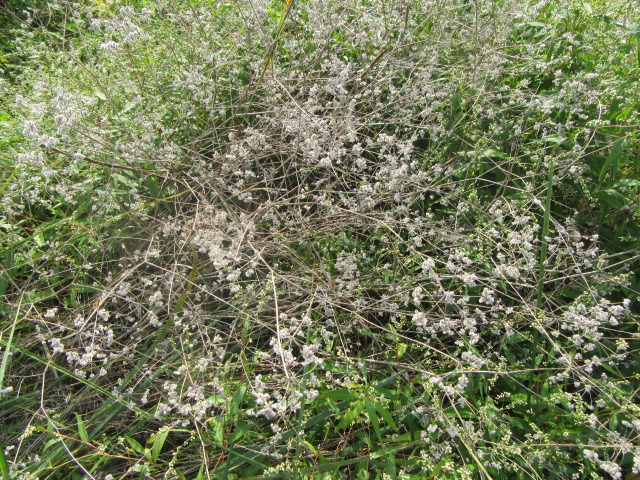
 

A Walk On The Wild Side…

Hello everyone! I hope this post finds you well. I had been hoping the hay could be baled before I took another trek to the south hayfield but that didn’t happen. Rain plus more in the forecast had put off baling so I thought I needed to go check on the progress of one plant in particular… One photo led to another. The mosquitos were insane as always in the early evening over there, which, along with it getting darker drove me back to the house.

You may remember past photos of the big mess along the boundary of the south hayfield. It was a wooly mess grown up in small trees, blackberries, and the invasive Japanese Honeysuckle. Last summer it was mowed off by one of Kevin’s men so he could put up a new fence. As it turned out, the old fence was in the wrong place and should have been about 20 feet or so more toward the trail. Clearing out the area allowed A LOT of other plants to grow I didn’t even know were there before. BUT, it also allowed the blackberries to run WILD! A few weeks ago, the briars were still fairly short, but that wasn’t the case this time. It was like walking through a thorny maize… Well, I was on a mission, so I didn’t let that stop me. The mosquitos were more of a problem than the thorns so I was glad I was wearing a cap to cover my bald head…

SO, you may be wondering, why would I walk through the tall grass all the way to the south hayfield?

Arnoglossum atriplicifolium (Pale Indian Plantain) on 7-8-21, #809-5.

Yep! To photograph this plant. The Arnoglossum atriplicifolium (arn-oh-GLOS-sum at-ry-pliss-ih-FOH-lee-um). If that is a little too much, its common name is Pale Indian Plantain. So, why have I taken an interest in this species? Well, on October 4 in 2018, I was walking along the edge of the south hayfield and noticed an odd plant with strange leaves…

Arnoglossum atriplicifolium (Pale Indian Plantain) on 10-4-18, #515-31.

I looked around and this one plant was all I found. I took photos but couldn’t identify it because there were no flowers. Trying to identify wildflowers without flowers is almost impossible sometimes. Notice the leaf in the upper part of the photo?

Arnoglossum atriplicifolium (Pale Indian Plantain) on 10-4-18, #515-32.

I have still not figured out what that critter is… It was like a stick stuck to the leaf on both ends with horns! I found this plant again in May 2019 and uploaded the photos on iNaturalist which suggested it was Arnoglossum atriplicifolium. I didn’t see any in 2020…

Arnoglossum atriplicifolium (Pale Indian Plantain) on 6-15-21, #800-1.

THEN, on June 15, when Nathan was with me, we were walking in the area where I first noticed the plant, and there it was… Just as pretty as you please! It was like it was asking, “Are you looking for me?” To be quite honest, I was… Well, it was getting late and I didn’t take the above photo until 8:51 P.M. To make sure this was actually a Pale Indian Plantain, I had to do one thing in particular…

Arnoglossum atriplicifolium (Pale Indian Plantain) on 6-15-21, #800-4.

Flip over its leaves and you will see the abaxial side is a silvery-white… You can’t miss that even in the dark!

Arnoglossum atriplicifolium (Pale Indian Plantain) on 7-8-21, #809-10.

Back to June 8. Yeah, I know it is now 1:05 AM on July 13, but what can I say. It seems like yesterday… The main reason I HAD to check on this plant was to see if it had flowered yet. While the flowers weren’t opened yet, we do have LOADS of buds… By the time I get this post finished maybe the flowers will be open so I will have another excuse to go back. I will not miss this plant among the blackberry vines as it grows up to 10′ tall.

The flowers need to be pollinated to produce seeds, but only a few wasps, flies, and smaller bees visit this plant for the nectar. Even though it is a member of the plant family Asteraceae, it has no ray florets (petals).

I don’t have descriptions for this species on ITS PAGE yet, but there are more photos and links for further information. I am still behind writing descriptions…

Arnoglossum atriplicifolium (Pale Indian Plantain) on 7-8-21, #809-11.

Oh, yeah… There are A LOT of younger plants to flower next year. Apparently, it has been at it for a while, blooming under the brush, because there are a few good-sized patches.


Teucrium canadense (American Germander) on 7-8-21, #809-42.

Around the same area, I noticed several American Germander (Teucrium canadense) growing. Previously, the only place I saw it growing was in the back pasture.

Teucrium canadense (American Germander) on 7-8-21, #809-45.

I think the flowers of the American Germander are pretty neat but sometimes it is really difficult to get close-ups. Right now, their leaves are riddled with holes.

After taking several photos I looked toward the back of the hayfield and decided I wouldn’t venture any farther…


Sambucus canadensis (American Black Elderberry) and Phytolacca americana (Pokeweed) on 7-8-21, #809-26.

Two more interesting plants grow in abundance in this area, the Sambucus canadensis (American Black Elderberry) and Phytolacca americana (Pokeweed). While the Pokeweed grows everywhere, the Elderberry is certainly isolated to the south side of the farm where they like a little shade. Until the wilderness was cut back, I thought they were only growing in the swampy area in the southeast corner. They are actually growing from one end to the other.

Sambucus canadensis (American Black Elderberry) on 7-8-21, #809-27).

I really like the huge clusters of flowers on the Elderberry.

After I finished taking photos in the south hayfield, I looked toward the new gate (cattle panel) that was put up last summer and spotted a Smilax growing on it… Yeah, Smilax tamnoides grows in several places here, but this one was A LOT different…

Smilax tamnoides (Bristly Greenbriar) on 7-8-21, #809-33.

It has HUGE leaves! I thought for sure I had actually found a Smilax rotundifolia (Roundleaf Greenbriar). There are several areas here that the Smilax tamnoides (Bristly Greenbriar) is growing in the trees but finding new species is always exciting. I was fighting the mosquitos even more at 8:20 PM, but GEEZ! I took photos of the leaf underside, thorns, and tendrils hoping to have found a new species. I uploaded them on iNaturalist and messaged a member who I had discussed Smilax with before. Well, she said,

“This is certainly a prizewinner for size, but it is still Smilax tamnoides. I agree it would be hard to ID just from the leaves, but the prickles are needle-thin and all one color. By contrast, Smilax rotundifolia prickles are much stouter and typically 3 colors from base to tip. I’ll try to get a chance to review the iNaturalist observations of Smilax near you in the next few days. I never say never, but the official records don’t show Smilax rotundifolia in Pettis County.”

HMMM… She sent a link to one of her observations PLUS a link to the BONAP map… Well, GEEZ! The USDA Plants Database map doesn’t even show S. tamnoides in Pettis County and mine is the only observation on iNaturalist anywhere near here. They grow EVERYWHERE! The USDA map DOES say S. rotundifolia is present in Johnson County which is only a few miles away. The problem with USDA maps is that they are WAY out of date and most are from old herbarium samples taken YEARS ago. A lot has changed since then and many species were misidentified in the first place. So, why am I even looking at the USDA map? I think it is time for an update with actual new observations nationwide. Many species are now extinct or endangered while other species have traveled.

I started walking back to the house but kept finding more I thought I should give attention to.

Geum canadense (White Avens) on 7-8-21, #809-19.

I spotted this solitary Geum canadense (White Avens) and it was just begging me to take its photo. Maybe it thinks I should put it on a Geum dating site to attract a companion. 🙂

Geum canadense (White Avens) on 7-8-21, #809-20.

You have to admit its small flowers are kind of neat. The most interesting thing about Geum species is how their leaves transform and change as the plant grows. In the spring, the Geum canadense has a rosette of long lobed leaves that die off as long, spindly stems grow with completely different leaves. You wouldn’t even know it was the same plant…


Monarda fistulosa (Wild Bergamot) on 7-8-21, #809-22.

Of course, the Monarda fistulosa (Wild Bergamot) is quite common here now and new colonies pop up here and there every year. Now there is even a cluster in the ditch next to the house. Of course, I let it grow which may look a little strange where it is. Once it gets done blooming will cut it down. Well, I even let the Hemp Dogbane (Apocynum cannabinum) grow in the ditch in front of the garden. I am sure it makes some people driving by wonder why I am letting weeds grow along the street like that… Going wild, I guess. 🙂

When I lived here before, in the 1980’s, I don’t even remember Monarda fistulosa. Now there isn’t a road anywhere you don’t see them.

I went to bed now it is 1:20 PM on Tuesday. Let’s see if I can get this post finished. 🙂 Where was I?

After leaving the Monarda, I walked back toward the two Mulberry trees along the ditch where the pond drains. I noticed something a bit off…

Celastrus scandens (American Bittersweet) on 7-8-21, #809-18.

There is an average size Multiflora Rose growing along the ditch in front of the two Mulberry Trees. Last year, a White Mulberry tree came up in it, and now this weird vine has joined in. I took photos to ID it and it turns out to be Celastrus scandens whose common name is American Bittersweet. Well, there you go… A new species for the day.

There are several Red Mullberry trees here on the farm but only a couple of good-sized White Mullberry. The Red Mulberry behave themselves, but the White Mullberry do not. Their leaves are different, so I always know when one has come up. They grow so fast, so if you think you will cut it down later… You better do it soon or you will have a tree where you don’t want it. I have a nightmare around the corral behind the barn I “should have” taken care of a few years ago. Now I have a big problem and the corral will need to be rebuilt.

Arctium minus (Lesser Burdock) on 7-8-21, #809-1.

There are quite a few Arctium minus (Lesser Burdock) around the two Red Mullberry trees and on the south side of the pond. They can get a bit carried away as far as their population is concerned. I do like their HUGE lower leaves in the spring, but they kind of get old and fall off. Then they grow this tall central stem which terminates in a multi-branched inflorescence.

Arctium minus (Lesser Burdock) on 7-8-21, #809-3.

Burdock has an edible taproot and some eat the heads like artichoke hearts. Young stems can be steamed or boiled. Taproots have been ground and dried and used as a coffee extender similar to chicory… The roots are also used as an herbal remedy.

This is one plant I don’t bother waking through late in the summer because its fruit/seed pods will stick to your clothing. The involucral bracts (phyllaries) are hooked

The last thing I wanted to talk about because I try to avoid it in every way possible is the…

Torilis…. (? Hedge Parsley) on 7-8-21, #809-48.

HEDGE PARSLEY!

If I were to use the word hate, these plants would be in the description… I have mentioned before we have history since I was a little kid, so no need to talk about it again. Until recently, I thought the species here on the farm was likely Torilis arvensis which is the Common Hedge Parsley. It was first observed and documented in Jasper County, Missouri in 1909 but rampantly spread throughout the state. The other similar species, Torilis japonica (Japanese Hedge parsley), wasn’t discovered in Missouri until 1988. I always figured the species growing here was Torilis arvensis and really didn’t pay that much attention. I figured the species had been here for a very long time, even dealing with them in my socks since I was a kid, so at that time they certainly weren’t T. japonica…

I posted the species as Torilis arvensis last year on iNaturalist and a member just had to ask if I was sure it wasn’t T. japonica… GEEZ! SO, I decided I would investigate further a few days ago but I can’t give you the results on this post… This post is for July 8 and I didn’t start checking the bristles until July 11. 🙂 Talk about tough to photograph!!!
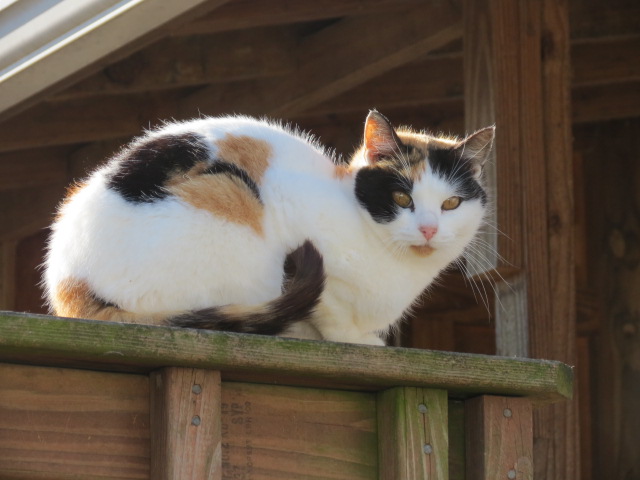
I have also been arguing with the Vernonia baldwinii (Baldwin’s/Western Ironweed), Eupatorium altissimum (Tall Thoroughwort), and Eupatorium serotinum (Late Boneset). They aren’t blooming yet, but I discovered that wouldn’t really make that much difference…

SO, I will close this post and start working on the next… I will reveal the identity of the Hedge Parsley…

Until next time, take care, be safe, stay well, and always be thankful. I am going to get dirty and mow the grass… The garden is too wet because we had rain AGAIN.

My Battery Powered Trimmers…

My new Stihl FSA85 on the left and the Cub Cadet BC490 on the right.

Hello everyone! I hope this post finds you well. It appears I have upgraded to a cordless line trimmer. I guess the proper name would be brushless and I think it has something to do with the motor. I never wanted a battery-powered trimmer because I thought it meant a lack of power. In 2018 (I think) I decided we needed a new more powerful trimmer. Well, since I was doing the trimming instead of dad, I was more interested in power and performance. I wanted one with a brush cutter attachment as well. Dad had an Echo, his second one, but it just wasn’t up to snuff. I am not saying Echo isn’t a good brand, it is just that this one was not adequate for all the trimming I was doing. The other problem was the motor would get very hot and burn my arm (I found out I could just turn the motor to solve that issue).

The local small engine shop had several Jonsered trimmers available with brush cutter attachments. They had the saw blade that I thought would be better but the price was over $300. Dad wasn’t going for that so we went to Tractor Supply in Clinton to see what they had… Well, we looked them over and dad decided on the Cub Cadet BC490… The brush cutter attachment was like the ones I was steering away from but since dad was paying for it, I agreed. How much? Over $300! We could have bought the better Jonsared for the same price!

The Cub Cadet BC490 was much better than the old Echo GT225 in many ways. I wanted a 4 cycle so I wouldn’t have to mix gas and oil which I thought was a good thing. But it is so HEAVY buy the time it ran out of gas I was also out of gas. The straight shaft was also a plus and the string is easier to load than the Echo.

Well, in May I started painting the interior of a rental house in Clinton for a friend (also the minister of the church I attend) and I needed to mow the yard. We went to his house and loaded his riding mower on the trailer and he grabbed his trimmer. First of all, I had used his mower a couple of times before… A Simplicity… At first I thought (to myself) Simplicity was some kind of an off-brand. Once I used it I was shocked! It could run circles around my John Deere! It worked great! It was more comfortable and had a better turning radius than my John Deere LT120. The yard at this rental was uneven and there were a lot of holes but the Simplicity did a great job. It is hard to imagine, but it seemed flexible. That sounds whacky, I know, but flexible is the only word I can think of. I quizzed him about the mower and then looked it up online and found out Simplicity is NOT an off-brand at all. Simplicity bought Snapper in 2002, then Simplicity was bought out by Briggs and Stratton in 2004. Well, they also have an interesting history. I had known for a while that green paint isn’t what it used to be…

Now, for his trimmer… It was a Stihl FSA85. With a battery… I thought, “GEEZ!” I picked it up, looked it over, and I was somewhat skeptical. It weighed nothing compared to my Cub Cadet… I didn’t even know how to turn it on and had to ask. He showed me and all I had to do was press the safety switch and throttle and it just came on… It was very quiet, and again, I thought, “GEEZ!” There are two settings, one for high speed and one for a lower speed, depending on the grass and what you are cutting. The lower speed also conserves battery life. Well, everything I use has to be in full throttle…

Stihl FSA85.

Well, I was shocked! This thing really worked so I thought I needed one. Once he paid me for my work, I set out to find one… Before that, I watched several videos on YouTube about the Stihl FSA85 and a few about trimmer reviews. Ace Hardware in Clinton sells Stihl but they didn’t have this model. I went to the mower shop where David bought his, but he didn’t have any in stock either. I did get the prices, though, which wasn’t very pleasant… I knew Heritage Tractor (a John Deere dealership also in Clinton) sold Stihl so I went there. Ummm… Same deal but the price was a little less ($10). The salesman, who I worked with before to get parts for my mower, explained a lot more to me and he said he could have one in a week. He said I was under no obligation and they could just have one sent from another store. So, I agreed…

I could have bought an upgraded battery and charger, but I decided the standard models would be good enough. For me, they are completely fine. If I bought an upgraded battery it would last longer and the upgraded charger would charge faster. The standard battery lasts long enough in the heat anyway. I am not one to know when to quit sometimes, so when what I am using stops working or runs out of gas, it does help to remind me maybe I should take a break.

Some reviews I read were negative, saying the trimmer string would advance well, it wasn’t powerful enough, and so on. Honestly, every trimmer I have used has some issues with the string advancing 100% of the time. I had to fiddle with the Cub Cadet almost every time I used it. As far as power, it has plenty. Reviews and other people’s opinions are sometimes debatable. It is like reading reviews of movies. Even if I think a movie is perfectly great, there are others who think it stinks. Well, I do have to add my opinion to the mix. (I am a movieaholic and have been since the early 1980’s when videos first came out).

SO, how does the Stihl compare to the Cub Cadet? I am was impressed how powerful it was to be so quiet. It cut through tall, heavy, thick clumps of fescue just about as fast as the Cub Cadet. Once I saw this, I didn’t hold anything back and it took everything I dished out. It cut through the clumps right down to the dirt. The Stihl has a wire guard that you can swing down to protect small trees or whatever you don’t want to cut down. I found it works great around steel fence posts that normally play heck with trimmer string. ALSO, and this was a miracle… Tall grass stems, like with fescue and foxtail, were all the time wrapping around the shaft above the trimmer head with the Echo and Cub Cadet. I used the brush guard in the down position and never once had any issues with the stems wrapping around the head. No more repeated stopping to unwrap the grass saved a lot of time. The bottom electric fence wire around the garden is pretty low and it always gave me a few issues when trimming. I just slid the brush guard under the bottom wire and went to town. I know, I know… If I trimmed every time I mow I may not have this issue. I mow approximately three acres, so who wants to trim after that? Consequently, the grass in the two ditches, around fences, trees, foundations, the water hydrant, the martin house pole, the barn, garage, two sheds, the chicken house, the wagon… It gets taller than it should. One time someone mentioned it looked like I need to do some trimming. I told them I was letting the fescue go to seed. 🙂

Oh, yeah. I almost forgot to mention the Stihl trimmer’s motor is not on the top of the handle… It is at the bottom where the guard is, making the trimmer more balanced. The handle is fully adjustable so you can move it to where it is the most comfortable for your height (the others probably do that, too). It only weighs a little over 6 pounds… I suppose all battery-operated (brushless trimmer) motors are at the bottom of the shaft.


From left to right… Weedeater FL25C, Echo GT225, Cub Cadet BC490, Stihl FSA 85, and the old weed whacker.

SO… My first experience owning a trimmer was the Weedeater FL25C that I bought when I was at the mansion in Mississippi. I didn’t have a lot of money, but I needed a trimmer. Well, you know, they always say you get what you pay for. It didn’t have an auto-advance for the line and it was also hard to load by hand… It did get the job done, but it was very frustrating. The letters FL stand for FeatherLite… One day I did some yard work for a friend who had a straight shaft trimmer,  a very expensive brand but I forgot what. I did their landscape maintenance, cleaned and painted a rental for them, and when their housekeeper quit, I started cleaning their house. Anyway, it was my first experience using a professional trimmer with a straight shaft. I am not even going to compare it with my small inexpensive weedeater.

When I came back here in 2013, dad had an Echo GT225. Now, you would think anything that says GT would be badass. Like the Mustang GT and other performance cars, GT meant something about performance. Well, I am sure for an average homeowner with a little trimming to do every week, it would be fine. My problem is, I will admit, I use my tools for all they are worth mainly because I used hand tools with my own power for a long time. As long as I kept the blades sharp there were no issues. SO, I have a tendency to try and force inadequate tools to do more than they were made for. I think I bent the shaft on the Echo because it is weird now… LOL! Truthfully, I never told dad that and he didn’t use it after I started. WHEW! Damn kid! I did read where grass wrapping around the shaft can bend it. I could never see how, but that “could be” what happened. Dad said to start at the top of the grass and go down, but I thought I had enough grass on me for that.


Brushcutter attachment for the Cub Cadet BC490.

Hmmm… The brush cutter on the Cub Cadet BC490 takes A LOT of getting used to. While it works OK on smaller saplings and some thick weeds, there are just some things it refuses to do. Sometimes you have to whack what you are cutting and then it works OK. (Hmmm… That would probably bend the shaft, too, huh?). Like with Ironweed… The first time I tried using it with Ironweed was quite interesting. The sparks flew and there was smoke! I am very tempted to put a small saw blade on it to see what happens… It has to be better than this gizmo but it would probably void the warranty that has now expired… I just have to remember this is a trimmer, not a chainsaw…


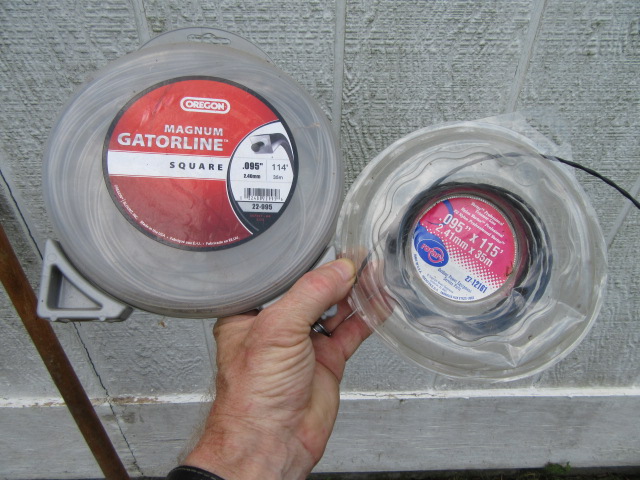
Oregon Magnum GATORLINE ™ and Vortex™ Professional Trimmer Line on the right.

Then there is the line issue. All trimmer lines are NOT created equal. I had been using the same line dad had been using from the small engine shop for years and we had to buy a new roll every spring. Fortunately, when we bought the Cub Cadet, it came with line was A LOT different and lasted a long time. I did some investigating online and found out square, or even three-sided line didn’t last that long. I found this Vortex™ Professional Trimmer Line on Ebay in 2018 and I might finally run out this summer. It has lasted that much longer than the other square line of the same thickness.


Vortex™ Professional Trimmer Line.

It looks like two lines wrapped together and it lasts a long time. You have to be careful because the line can eventually wear where it comes out of the head and break off. When I was at Heritage Tractor, the salesman showed me some of the other attachments and line they had that wil also break off before it wears out. If you are interested in the Vortex™ string, it is part #27-12161. It gets a Belmont Rooster 5 Gold Star rating…


Top left to right, Black and Decker 22″ cordless and Black and Decker 16″ corded trimmers; Center, Corona shears; bottom, 100′ extension cord.

When I moved back here in 2013, dad had a Black and Decker hedge trimmer that was kind of dull. I have no clue what happened to the one I had in Mississippi… Well, I mainly used the Corona shears at the mansion because they did a better job. There was an overgrown Privet hedge at least 150′ long and parts of it were probably 12′ tall along the street. There was also holly all along the front porch and sunrooms that were maybe 8′ tall. The hedge had other trees and Poison Ivy mixed in to boot. I managed to get it all trimmed back and they looked very good after a few years. The holly was a nightmare to trim and I had scratches all up and down my arms. It was worth the battle scars in the long run, though.

Dad’s Black and Decker hedge trimmers were just fine with the Yew in front of the house. He always told me to make sure I cleaned up good because the Yew would dull the mower blades. I always mowed the grass before I trimmed the Yew so I could clean up better anyway. The trimmer blades were definitely dull and sometimes I just used the Coronas. In 2019, I think, I started doing the landscape maintenance for Kevin, the friend I have mentioned before several times. Anyway, his Privet hedge runs along one side and in front of his house. I could definitely tell not only were the electric trimmers dull, so was the Corona… I figured it was from all the sap from the Yew. The top of his hedge would literally turn white because of all the smashed leaves. They looked like they were sunburned, but when I looked closer I could tell it was from dull trimmers. I cleaned the trimmers with this stuff that was also a lubricant, and it did seem to help.


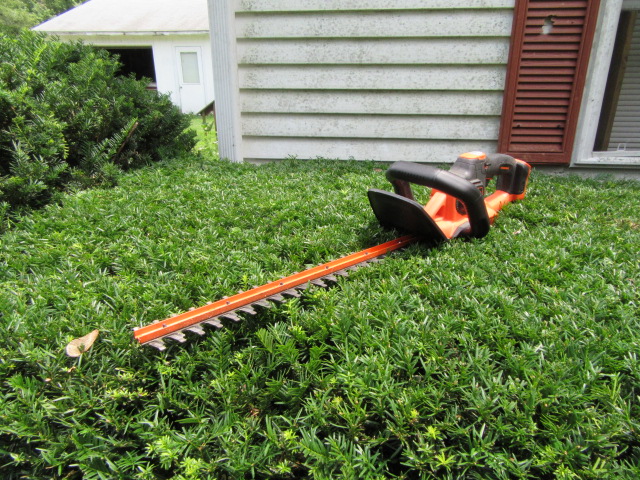
Black and Decker 22″ Cordless Trimmer.

Last summer I went to the hardware store to see about buying a new pair but the only thing they had was a cordless trimmer that cost about $100. Well, I passed at first but later in the summer when I had the extra money I went ahead and bought one. My first battery-powered trimmer…  By that time, I didn’t need them for Kevin’s hedge, but I did for my own…

I will tell you I was very impressed. The teeth are farther apart plus I had an additional 6″ of blade and the battery lasted the whole time I was trimming. This trimmer also has a power button to use when you get into thicker branches. On Monday, I went to Kevins to try it out on his hedge for the first time. Unfortunately, his brother-in-law had already done it… GEEZ! I had more plants for his planters, so I finished planting then came back home.

Since I was in the trimming mood, I started in on the Yew in front of the house… When I came here in 2013, dad had been trimming the Yew as individual bushes. I told dad they would look better if they looked more like a hedge. He didn’t care, so I let them fill out. They started growing like weeds and within a couple of years, they looked great. I had to really give the front a good pruning AGAIN because they are getting so wide. I am not finished yet… I cut back so much you can see the gaps between the individual bushes and the top edge needs more work.


The one on the corner is more of an upright grower that I have managed to trim round for a few years. Before, it was just plain weird… There are still a few holes because of the way it grows. Some of the longer branches, or whatever you call them, need to branch out.

Seriously, I think I would prefer other shrubs here besides Yew. They certainly aren’t my favorite bush. Forget about low maintenance, because these are definitely not that… Every time I trim, they seem to get taller. I tied a baling string along the front of the porch a few years ago I used as a guide to keep the hedge level. The yard kind of slopes, so it is hard to keep them level when you are walking downhill… The string is almost a foot below where the top of the hedge is now… Hmmm…

Over the years, I have learned to be open-minded when it comes to tools and brand names. Bigger companies, not necessarily better, have bought out other companies to the point you don’t know who owns who. You have to really do your research because some of the less expensive brand name products are made by not-so-favorable companies… Several years ago, Electrolux bought out Huskavarna and Jonsared. The story goes when Huskvarna became more popular and made more income, they bought the company back from Electrolux and also bought Jonsered. Both Huskvarna and Jonsared are from Sweden like Electrolux. I remember Electrolux vacuum cleaners, but the company also owns a lot of other companies now, mainly vacuums and major appliances. The Weed Eater company was bought out by Emerson Electric which merged with Poulan which was later bought by Electrolux. Now Weed Eater and Poulan are on Huskvarna’s list of brands. Electrolux bought White-Westinghouse which had bought out several other appliance companies. Well, appliance companies are a different ball of wax.

I don’t want to get into MTD, but In September 2018, Stanley Black & Decker bought 20% of MTD Products for $234 million. Stanley Black & Decker will have the option to acquire the remaining 80% of MTD (starting July 1, 2021). With the acquisition of Craftsman by Stanley Black & Decker, the brand’s products are now produced by MTD through this partnership… MTD owns several companies or brands, so Stanley Black and Decker… The list of companies Stanley Black and Decker owns in many segments is VAST and it makes a good read! I am not an MTD fan, by the way…

Stihl is privately owned by the descendants of its founder, Andreas Stihl, and has a manufacturing company in the United States.

I better stop looking up companies or this post will get way out of hand. 🙂

In closing, you have to get the right stuff for your needs that works well or the task at hand becomes more of a chore. Sometimes, I will admit, I splurge on something of better quality that I really can’t afford. If you settle for less, you may be disappointed in the long run.

I started two posts before I wrote this one, but I wanted to write about the new trimmer. Then, I trimmed the shrubbery and thought I would write about the new hedge trimmer, too. Grammarly seems to be running slow, well it is the internet, so there may be a few weird words in this post. Grammarly’s red circle just keeps turning so one only knows… 🙂

Until next time, be safe and stay positive! Always be thankful and GET DIRTY.


The Barn Cat Recovering, R.I.P. Susie & Little Bit, Past Cat Photos

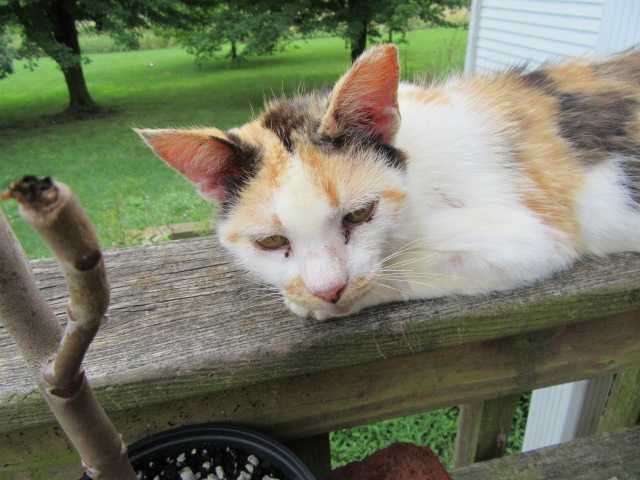
The Barn Cat on 7-1-21.

Hello everyone! I hope this post finds you well. I think the rain may be over for a few days. I did manage to get in the garden early yesterday evening to pull the grass away from the sweet corn. I couldn’t do the green beans because they were still in mud. In all, I would say we received around 7″ of rain. There is no rain in the forecast to speak of (10% chance) until next Wednesday so maybe I can get the garden tilled. GEEZ!

The above photo is The Barn Cat. Well, that is what dad called her. She is very old, and until recently, she was one of the healthiest of mom and dad’s cats. When I moved back to the family farm with mom and dad in 2013, there were 20 cats and more on the way. There was no way dad was going to pay to have them spayed, so I got the help of a local organization and we got it done… Over the years, some died, at least one was hit by a car, and some just simply disappeared. Susie was one of the last of the older cats and she died on April 15. She was perfectly fine the day before…

A couple of weeks before Susie died, the Barn Cat came up to me with an infected tooth. It was bad! Then she disappeared for two days and I thought she had died. Two days later, she was on the back porch and she looked pretty rough and could barely stand up. I started feeding her canned cat food (which I had to share with the others). She started doing better and then one day she was on the propagating table… The next morning she could not move her back legs. It is possible she fell on her back when she tried to get off the table. During two weeks of her dragging herself around, I would pick her up and stand her on her back legs but they just wouldn’t work… Then one morning, she miraculously walked across the porch. That was on April 15, the same day Susie didn’t show up for breakfast. That was odd because Susie never missed a meal.

Susie…

Susie was always one of the most affectionate of the cats. I usually called her Susie Q and she often followed me to the chicken house and the garden. Always, when mom gathered the eggs, Susie was right there at her feet. Dad didn’t know how old she was. Like the other older cats, he just said they were very old… She was a very healthy cat right up to the end… I remember a lot of funny things about Susie. She liked sneaking into the house and looking around hoping I wouldn’t see her. I left her alone a few times to see what she would do and she would wind up laying down on the bed or on top of the couch. She was perfectly content anywhere she was. Strange, but I kind of miss that darn cat…

Little Bit on April 6.

Little Bit was weird but very loving. Little Bit was just a tiny kitten when it showed up at a friend’s house in 2019. He watched her one night while she was catching bugs and eating them so he started feeding her. He eventually caught her and put her in the bathroom. He couldn’t keep her, so he gave her to me. I am not sure how many cats were here at the time, maybe 7-8. Anyway, I brought her home and she was still pretty wild. She hid behind my toilet for two days…

Little Bit on July 29, 2019.

Finally, she tamed down enough I let her walk around in the bedroom. Then, after a few more days she started roaming the house… I found a small ball of yarn and it became her favorite toy. Once she had it all strung out, she would come to me and meow so I could roll it back up again.

She was kind of odd, VERY alert and skittish. She never missed a thing and always, always, eased up to anything new.  Jade did NOT like Little Bit in the house and it took a while for her to accept her. Simba, on the other hand, thought she was cute. The first day Simba and Little Bit met would have made an interesting video. Simba came in from outside and went to the kitchen. He saw her in the hallway and started making weird sounds like he was calling her. Little Bit walked up to him, they touched noses, and that was that. When Little Bit started eating on the back porch, the other cats hissed at her. Simba, who wouldn’t eat with the other cats and wouldn’t let them eat with him, allowed Little Bit to share his cat food. Later on, Nathan brought home a very small black tomcat. Simba also adopted him but now he is as big as Simba and he gets ran off…

Every night when I went to bed, Little Bit was laying on the railing on the side porch. Anyway, early in April after The Barn Cat had her episode, Little Bit was laying out by the garage one morning and wasn’t moving. She was still alive because I could see her breathing. I had to leave and wouldn’t be back home until late in the afternoon. Nathan came to where I was painting a house, 20 miles away, and told me he put food and water next to her and she would just scream at him. No, I don’t have a cell phone, so Nathan drove all the 20 miles to tell me about the cat! After I came back home, I picker her up and put her on the back porch. The next morning she was dead. I am not sure what happened to her, perhaps she ventured to the street and was hit by a car. She always stayed around the back yard, the barn, the back porch, and sometimes the front porch. She was too much of a scaredy-cat to go near the street. It is just a mystery what happened to her.

Jade on the propagating table on the back porch on June 27, 2021.

Jade and Simba are my son’s cats in case you don’t already know from previous posts. He came in maybe January or February in 2019 and didn’t mention the cats were coming, too. I didn’t know until he brought in the cat carrier… When Nathan left, the cats stayed with me. Both Jade and Simba were not used to being outside and Jade doesn’t have front claws. After they were here for a while, I started putting Simba outside. Nathan didn’t like that very well, but I did it anyway. Simba is a male and he tried dominating Jade. He was even growling at the cats through the door, so I thought it was time he went out. Suzie and The Barn Cat already didn’t like him… There were issues but Susie and The Barn Cat did NOT back off, so Simba pretty much left them alone. The other cats pretty much gave him a wide birth.

Normally, Jade does NOT like being on the back porch. I think she was a little uppity toward the other cats and thought maybe she was special because she was in the house. Last summer I started taking her to the garden and she liked it. She got to see what was going on outside and she enjoyed chasing butterflies. Now, she spends most of her time on the front porch and sometimes on the side porch. She likes sitting on the railing on the front porch so she can watch over the neighborhood. I never wanted a cat, or a dog, in the house with long hair but here she is… Hair and all… Before I started putting her outside, she thought she had to be with me constantly. That was OK because she just mainly laid at the foot of the bed while I was working on the computer. If she started toward the pillows, I would just point and she would go back to where she belonged.

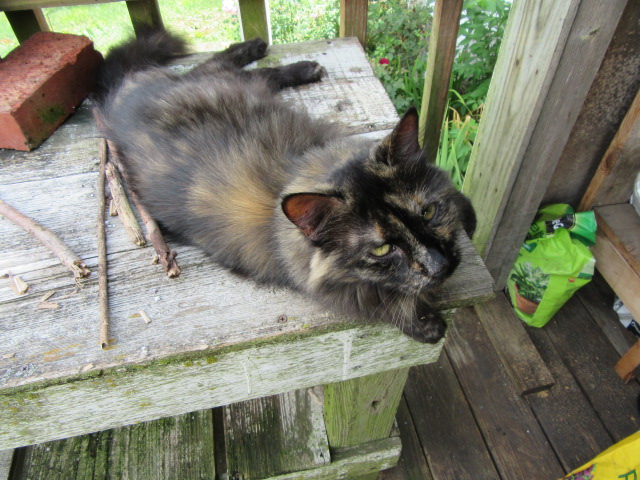
Simba…

Simba on February 19, 2019.

Simba is a genuine tomcat but he also loves attention. Nathan says he is a Russian Blue but to me, he is just a gray cat. Well, someone told him Jade is a Norwegian Forest Cat but I don’t know about that either. I don’t have many photos of Simba because he does his own thing during the day but he doesn’t miss a meal.

I would not allow Simba to stay in the house, even though he just lays down somewhere. I feed Jade in the kitchen, and Simba likes to come in and eat her food. Since Nathan and Chris are back, Simba gets to come into the house when I am not looking. He is a very good cat, I will admit. I think it is funny Jade now prefers it outside, while Simba would rather be in the house. I would prefer Simba stayed outside, and Jade be in the house during the night. I told Nathan to make sure Jade is in the house during the night, but that rarely happens. However, I have got up during the night only to find Simba in the house. He always comes to me asking for food…

CATS OF THE PAST…

Over the years, I have posted about the cats. Well, there were a lot, at least 20, so there were cats everywhere. On the back porch, side porch, front porch, the barn, laying in the flower beds, on the old foundation… Most of the cats had names, but a few just had numbers (like the cows).

Spike and her kittens on June 11, 2013.

The above photo is of Spike and her last litter of kittens on June 11 in 2013. There were two of these boxes on the back porch dad had made for the cats to have kittens in. Sometimes, more than one cat would have their kittens in the same box.

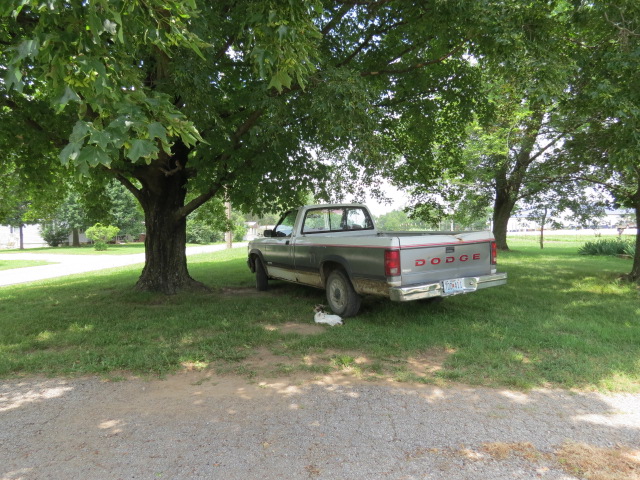
Dad’s pickup with 2 cats on 6-12-13.

When I was taking photos of plants, if there was a cat around I took their photos, too. At first, I didn’t even know their names and it was somewhat confusing for a while. Some looked so much alike I couldn’t tell them apart. Dad could tell them apart, just like he could tell the cows apart when they were all black. Well, like the cows, I soon learned their personalities and other features to tell them apart.

My 2002 Ford Explorer with at least two cats on July 24, 2013.

There were at least two cats under the Explorer…

Susie on 7-17-13.

Susie was a wanderer and just showed up many times when I was taking photos. Of course, she would get hers taken, too.

#6 on August 1, 2013.

#6 was one of the older cats that didn’t venture off too far from the back porch.

The Coop Cat’s kitten on August 3, 2013.

The Coop Cat was weird and mom was the only one who could touch her. In 2013, she had one kitten… This kitten was a boy and it took up with dad. Every time dad would sit on the porch to smoke his pipe, this cat would crawl on his lap. When dad died, this cat really missed him. This cat died last summer and really never had a name.

Hmmm… This is #6’s kitten on August 3, 2013.

Like I mentioned, some cats just had numbers and apparently, #6’s kitten didn’t even have a name. Dad and I laughed about that all the time. I don’t know what became of #6 or this cat.

Old Blue on August 3, 2013.

Old Blue sounds more like a dog’s name, but that was what dad called this blue calico. She was a good cat, but a bit strange at times. She had four kittens in 2013 whose father was a HUGE fuzzy cat that came for a visit. Dad didn’t like that tomcat and one day he handed me the 22 and told me to shoot it. Well, there were several tomcats here and none of the cats liked him. I didn’t know where he came from, may have been someone’s pet, so I would have felt bad about shooting him… After seeing what he did with some of the other cats, he did disappear. Nuff said… I think Old Blue was Fuzzy’s kitten… Her fur was a bit longer, but not as long as her mother’s.

Kitten sleeping on a brick on the back porch on August 3, 2013.

You have to admit, if you have cats, they can sleep in some of the strangest positions. This kitten sleeping on a brick was by far the most interesting…

The Barn Cat in her prime on August 3, 2013.

I think a blog reader wanted me to write a post about the cats in 2013, so that’s what I did. That must be why there are so many cat photos from August 3… The Barn Cat was always a mind reader. I could not get anywhere near her for a long time. This was just a lucky shot… It wasn’t until after mom died in 2015 that she even allowed me to touch her. Even now, sometimes she doesn’t want to be bothered. If you hold out your hand, if she is in the mood, you can pet her. Once you start, though, she will drive you nuts. She has really been lovey-dovey the past couple of weeks… The Barn Cat got her name because she always stayed in the barn. For the past couple of years, she has always been on the back porch. She was one of the oldest cats when I came here and she is the last survivor. She was definitely a nice-looking cat in her prime.

The Coop Cat on August 3, 2013.

Another lucky shot for sure. This is The Coop Cat that no one could touch except mom. She always looked so sweet and I tried to pet her several times but no dice… I am not sure how I even managed to get this photo of her on the bottom step of the side porch…

The Coop Cat sleeping on a fence post on August 3, 2013.

Well, I just had to get a photo of The Coop Cat sleeping on this post. I had to zoom in to get it. I took several photos of her while she was there and each time her eyes began to open more. I don’t know what happened to this cat. She just disappeared. One night I saw a fox walk up to her in the driveway. Since the cat didn’t run, the fox just walked away. Dad said the foxes wouldn’t bother the cats as long as they didn’t run. If they ran, that was the end of the cat. Dad always said that was what happened to a lot of the cats.

Shhh… The cats are sleeping.

Who could resist that photo…

Bossy on the front porch on August 5, 2013.

Oh yeah, Bossy… He was the old tomcat. He was friendly but had his limits. One day mom was picking on him when he was on the back porch. He just couldn’t figure out why mom was behaving like that and he eventually had enough so he slapped mom’s hand. Mom thought it was funny and kept picking at him so he just walked away.

Old Maid on August 5, 2013.

I have no clue why dad called her Old Maid. This cat was very sweet but definitely very old. Dad said he had seen a fox walk up to her one night, too, and she didn’t run… She lived to tell the tale, so maybe that was an experience she passed on to the others…

Pee Wee on August 5, 2013.

Pee Wee… I forgot who his mother was (maybe Spike) but he was one of dad’s favorites. This one was also born in early 2013 and would sleep on dad’s lap. I think he got sick somewhere down the line and died…

Another cat with no name on August 5, 2013.

Hmmm… You know, this cat was very sweet but very shy. I could pet her, but it wasn’t one of her favorite ideas. She had the greenest eyes that just kind of glowed. Her fur was always raggy looking, though, and seemed to change color…

Fuzzy on 8-5-13.

This was another cat that dad said was very old. Not only was Fuzzy old, but she was also an oddball. No matter where she was going, she was always in a run. One thing I always remember about her is how she would dart in the side door or front door and run to the back door. It was like she was taking a shortcut… She was a sweet cat, also…

Old Blue’s kittens on August 9, 2013.

Old Blue had kittens in the old foundation and were rarely seen. One day I saw her walking with them toward the barn… If one got behind she would go back and pick it up. On August 9, I heard dad say, “Old Blue has her kittens on the porch.” So, I grabbed the camera…

Another photo of Old Blue’s kittens.

He said I needed to see if I could catch them and put them in the cage in the chicken house (where he raised the baby chicks in the feed room). They were very wild and he thought it we put them in the cage we could tame them down. Eventually, I did catch all four but it wasn’t easy. One died, the lady from Pawsibilities found a new home for one, one tamed down, and one didn’t. The kitten in the front of the photo is the one that found a new home, and the black and white one is the one that died.

Three of the cats ready to go to the vet to get spayed on August 16, 2013.

Finally, little by little, all the cats made their way to the vet to be spayed and neutered. The kittens had to be old enough before they could go and the wild tom cat never made it…

Three cats on the side porch on October 11, 2013.

The lady from Pawsibilities also found a new home for one of the older calico females. I don’t remember the cat’s name but she adapted well to her new home.

How’s that for a family photo?

I think this was as many cats I ever saw at once on the side porch. Usually, there would only be 1-3 cats together on the side porch, so this many here was unusual.

Spike on December 7, 2013.

Spike was also an odd cat. Dad called her spike because she had lost her fang teeth. Dad said she ate too many screws… When he first told me that, I thought “HUH?” Then I realized what he meant. There were some words dad couldn’t pronounce well, so I just had to kind of roll with it. He was saying she ate too many shrews… One day my brother was here for a visit and we were sitting on the back porch when Spike came. Dad told him, “That is Spike. She doesn’t have any front teeth because she ate too many screws.” My brother said, “Screws?” Dad said, “Yeah, screws. She catches them and eats them and they broke out her front teeth.” Leroy had a weird look on his face so I explained dad was talking about shrews, not screws. Then dad laughed because he knew he couldn’t pronounce shrew. He knew Leroy would be confused by calling them screws. I am not sure how eating shrews broke out Spike’s front teeth. I laugh every time I tell this story. My sister brings up the time dad told her the same thing. 🙂

Cats on the back porch on February 13, 2014.

During the day the cats were here and there. Several stayed in the barn most of the time. When it came time for them to be fed, they would all show on or near the porch which is why there were so many at once in the above photo. Mom would count the cats every time she fed them. Mom had dementia, but she knew how many cats were supposed to be there. If one was missing, she would tell us which one…

Old Blue’s kitten, the wild one, on April 13, 2018.

The above photo is of Old Blue’s kitten, the wild one. He just never tamed down. He was a dark yellow and white, while his brother was a lighter yellow and white. This cat became sick and died in 2020 and his brother followed a few weeks later.

Susie and the Coop Cat’s kitten on August 28, 2018.

Susie and the Coop Cat’s kitten were together A LOT.

The Barn Cat, Susie, Simba, Little Bit, and the young tom eating on October 21, 2020.

Usually, Simba eats with Little Bit and the young tom, but here is with The Barn Cat. Susie was somewhat confused about the ordeal and it looks like she was telling Simba he was in the wrong place. Of course, Jade was in the house where her food is.

There are more cat photos, but I think it is time to close this post and work on another one. I am not sure what sparked writing this post, I guess the first photo of The Barn Cat. There are a lot of memories here and many of them make me smile.

Until next time, be safe and stay positive. Always be thankful and GET DIRTY if you can.