Plants Repotted Part 3…

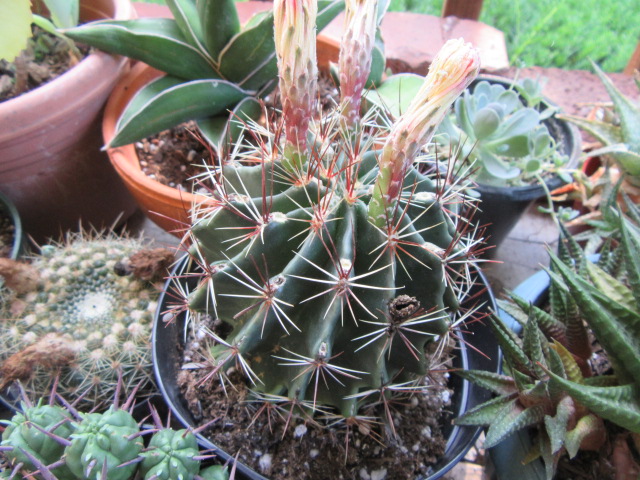
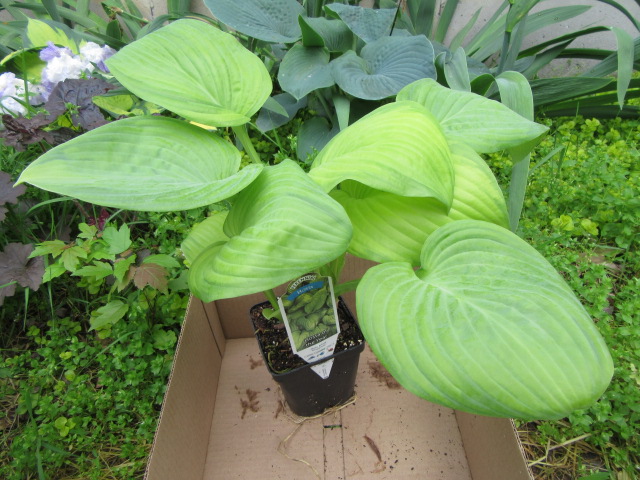
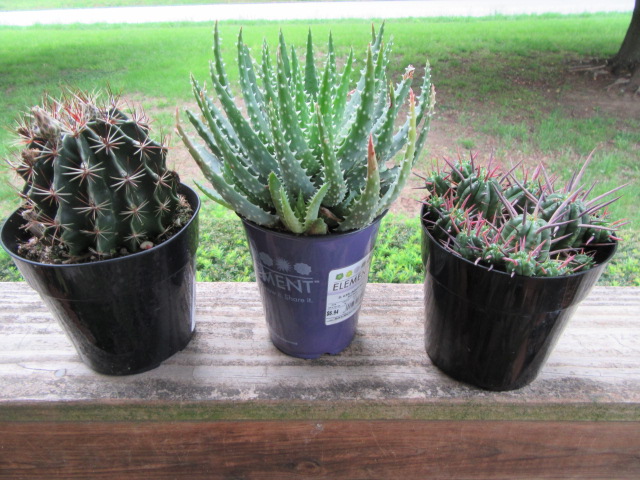
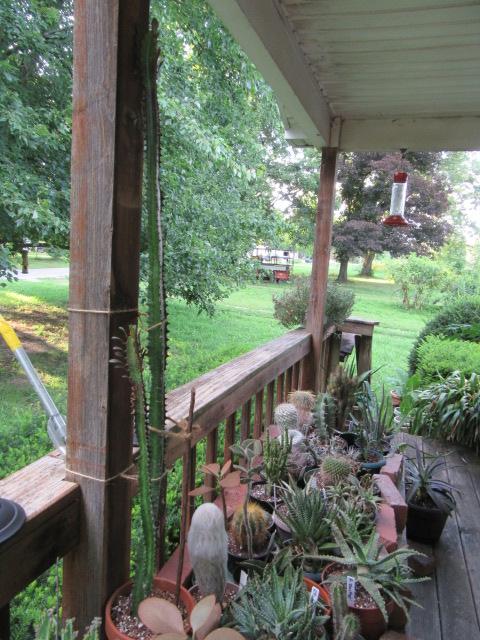
Hello everyone! I hope you are doing well and you are staying cool. It has been quite warm here and the humidity is NUTS! Most of the plants in the above photo have been repotted now, but not all. Of course, there are more that aren’t in the photo…

The Euphorbia trigona ‘Rubra’ (or var. rubra) has grown to 42″ tall and I’m not sure what to do with it… Should I hack it into a few pieces? Hmmm… The top of the stem, and the top of the branch, are looking a little weird and turning a light color. Normally, I don’t replant deeper than they were, but one day last fall the wind knocked it out of its pot. “Someone else” opted to put it in a bigger pot and buried it deeper than it was when I wasn’t home. Some plants have a crown and shouldn’t be replanted deeper than the root ball, but I’m not sure about this one. Normally, well maybe not normally, Euphorbia trigona are cut in pieces so they will branch out… So, I’m not sure about doing that, or what the deal is with it turning a lighter color on top. Maybe is isn’t getting enough light up there… Maybe I should check its roots to see if they are OK… I know it doesn’t have much of a root system. Actually, the plant has grown a little over 6″ since I moved it outside this spring, so maybe that is new growth. Hmmm…

This post is part 3 of Plants Repotted.

If you missed part 1, click HERE.

If you missed part 2, click HERE.

Anyway, here we go with part 3 beginning on…

June 8…

Aristaloe aristata (Lace Aloe) before repotting on 6-8-25, #1054-1.

The Aristaloe aristata (Lace Aloe) has been on the kitchen windowsill for I’m not sure how long. It was looking like it was in need of fresh air, so I put it on the front porch with the rest of the potted plants when temps warmed up enough. I like this plant, but sometimes I think it is a little finicky…

Aristaloe aristata (Lace Aloe) root system on 6-8-25, #1054-2.

I removed the plant from its pot to look at its roots. There was still plenty of room to grow. I trimmed off the dead and dying leaves.

Aristaloe aristata (Lace Aloe) in a larger 4″ tall x 4 1/2″ wide pot on 6-8-25, #1054-.

It was in a 3″ tall x 3 3/4″ wide pot, so I increased the size to 4″ tall x 4 1/2″ wide pot. I used Miracle Grow Cactus Mix with a little extra perlite and chicken grit. There is still another very small offset that that fell off this plant when it was first repotted…

<<<<+>>>>

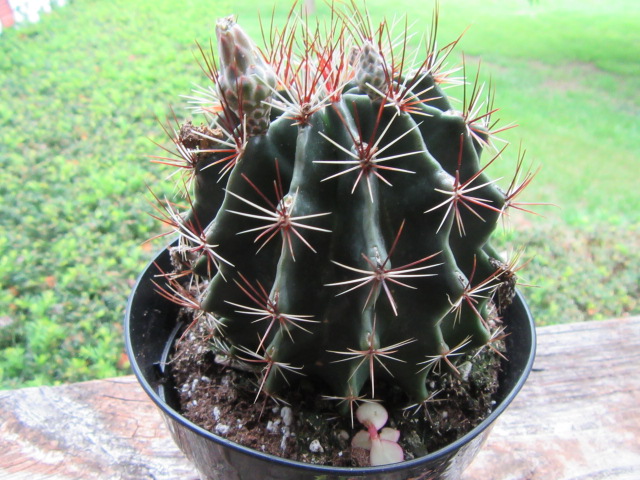
Ferocactus wislizeni (Fishhook Barrel Cactus) before repotting on 6-8-25, #1054-4.

Hmmm… The Ferocactus wislizeni (Fishhook Barrel Cactus) hasn’t looked really great for several years.

Ferocactus wislizeni (Fishhook Barrel Cactus) root system on 6-8-25, #1054-5.

I removed it from its pot to have a look at the roots. To be honest, I’m not sure how alive this cactus really is… Yeah, I know that sounds a little weird… It grew a little from 2022 to 2023, but not from 2023 to 2024. It actually shrunk in diameter 1/2″.

Ferocactus wislizeni (Fishhook Barrel Cactus) after repotting on 6-8-25, #1054-6.

After removing most of the old potting mix and some of the dead roots, I put it back in the same pot with Miracle Grow Potting Mix with a little extra perlite and chicken grit. I noticed a few dead mealybugs, so for now I put it in an area away from the other plants. I’ll keep an eye on it and we’ll see if it grows when I take measurements when I start moving plants inside for the winter…

<<<<+>>>>

Parodia magnifica (Ball Cactus/Balloon Cactus) before repotting on 6-8-25, #1054-7.

The Parodia magnifica (Ball Cactus/Balloon Cactus) is a really neat plant. I brought it home in March 2019 and repotted it in November 2019. It had a really good root system then and needed a larger pot.
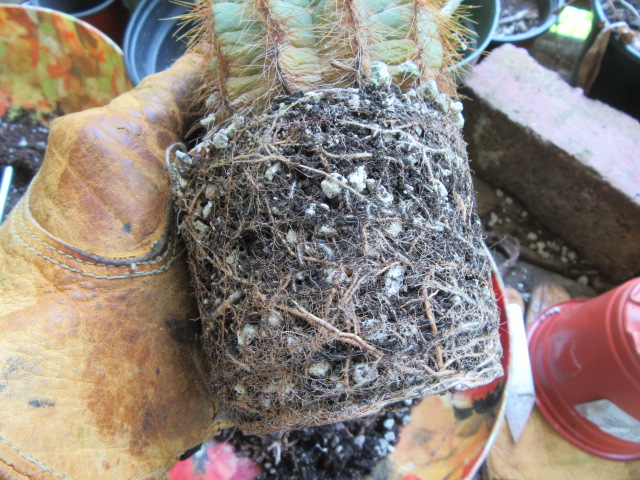
Parodia magnifica (Ball Cactus/Balloon Cactus) root system on 6-8-25, #1054-8.

Well, that is quite a root system! GEEZ!!!

Parodia magnifica (Ball Cactus/Balloon Cactus) in a larger 4 1/2″ tall x 5 3/4″ wide pot on 6-8-25, #1054-9.

After removing most of the old potting mix and some of the dead roots, I put the plant into a larger 4 1/2″ tall x 5 3/4″ diameter pot. I used Miracle Grow Cactus Mix with a little extra perlite and chicken grit. Now, we’ll see how it does.

<<<<+>>>>

June 15…

Ledebouria socialis ‘Paucifolia’ before repotting on 6-15-25, #1058-1.

Well, where do I begin with this one? Actually, the Ledebouria socialis ‘Paucifolia’ is the easy one. It hasn’t grown nearly as much as its cousin which is why it is still in a small pot.
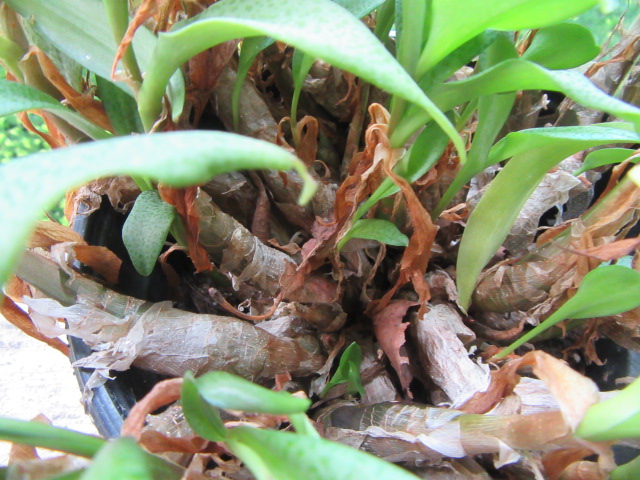
Ledebouria socialis ‘Paucifolia’ before repotting on 6-15-25, #1058-2.

Although not near as crowded as the other one, it is in a smaller pot and still a bit crowded. Looking back at old photos, it was put in a green pot in 2029 and at some point it was put in a somewhat larger black pot. Hmmm…

Ledebouria socialis ‘Paucifolia’ roots on 6-15-25, #1058-1.

It was already growing new roots…

Ledebouria socialis ‘Paucifolia’ in a larger 6″ tall x 9 1/2″ wide pot on 6-15-25, #1058-1.

I pulled the bulbs and roots apart somewhat and put everything in a larger 6″ tall x 9 1/2″ diameter pot. Now it has room to grow more. I used Miracle Grow Potting Mix with a little more perlite and chicken grit.

Ledebouria socialis ‘Violacea’ on 6-12-25, #1056-24.

At some point I need to tackle the Ledebouria socialis ‘Violacea’. It is HUGE!!!

I bought both of the Ledebouria socialis from a seller on Facebook in 2018, so I have had their company for a while now. If you haven’t tried them, I suggest you do. If you want a passalong plant that will produce A LOT, try Ledebouria socialis ‘Violacea’. If you want a plant that doesn’t produce much, try ‘Paucifolia’. They are carefree plants and very easy to grow. Water them regularly during the summer and put them in a cooler room with no water at all during the winter. They have been in the basement with a south facing window over the past two winters with no issues.

<<<<+>>>>

June 27…

Kleinia stapeliiformis (Pickle Plant) before repotting on 6-27-25, #1065-2.

I brought this pot of Kleinia stapeliiformis (Pickle Plant) home from Mast’s Greenhouse in May of 2023. It was from Mr. Mast’s daughters collection. The original stem she used as a cutting was hanging over the pot and there were several smaller “sprouts” a couple of inches tall along one side of the pot. Well, they grew and the original stem broke where it was hanging over the pot (which had grown to about 2′ long). In the spring, I cut the stem that broke in 4 pieces and put them in a pot to see if they would root. The only cutting that survived was the top cutting. Now, I had bought a few cuttings of this species from a seller on Facebook in 2018 and they soon after bit the dust. I was somewhat hesitant to bring home the pot from Mast’s, but I thought anything that weird looking deserved another chance. To be honest, I was surprised they did so well over last summer and even survived the winter on the shelf in my bedroom… But, not only did they survive, they even grew a little during the winter. Since they did so well and looked a little weird on one side of the pot, I thought would al least put them in the middle of the pot…
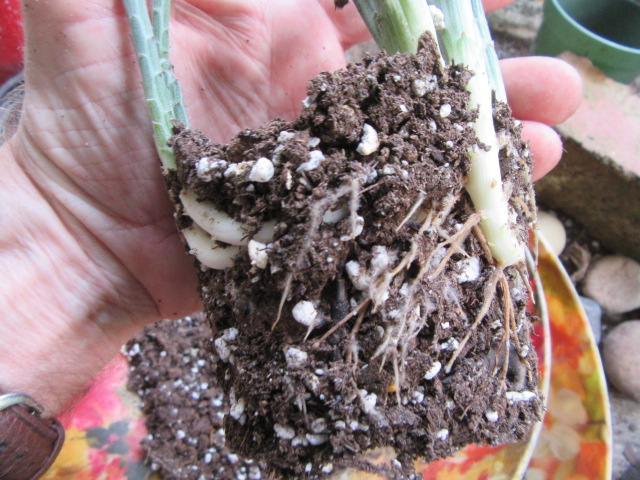
Kleinia stapeliiformis (Pickle Plant) roots on 6-27-25, #1065-3.

So, I carefully removed them from the pot to have a look. I was happy with what I saw.

Kleinia stapeliiformis (Pickle Plant) in a larger 4 1/2″ tall x 5 3/4″ wide pot on 6-27-25, #1065-4.

I didn’t disturb the roots much and carefully put them in a larger 4 1/2″ tall x 5 3/4″ wide pot. I feel like I am whispering… I put the cutting, which hadn’t grown any roots yet, in the pot with the others. I guess it is really their parent… It is the one with the weird shape.
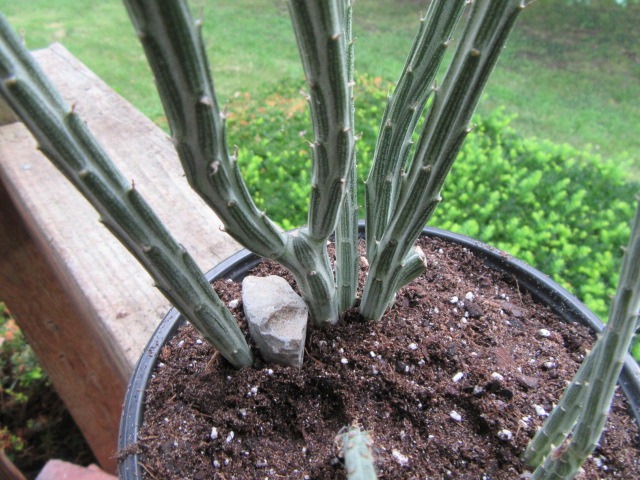
Kleinia stapeliiformis (Pickle Plant) on 6-27-25, #1065-5.

I put in a piece of gravel to hold one of them upright.

When I went to Mast’s on July 3, I walked back to see his daughters collection of plants. A few of her Kleinia stapeliiformis had flowers and seeds. I didn’t have my camera, so I took a few photos with my phone (yeah, I have a cell phone now) but they didn’t come out good. I did get to visit with her and told her I would bring her some Alocasia and the baby Amorphophallus konjac. I guess I should find out her name…

I don’t have a page for this plant yet. I wanted to make sure it would survive…

<<<<+>>>>

Peperomia graveolens (Ruby Peperomia/Ruby Glow) on 6-27-25, #1065-6.

The Peperomia graveolens (Ruby Peperomia/Ruby Glow) is another plant I brought home in 2024 from Mr. Mast’s daughters collection. She first gave me a cutting in 2023, but it didn’t take root. This plant made it through the winter, but wasn’t looking so good. I took it out of the pot and found the stem had broke under the soil and there were just a couple of roots left. SO, emptied the pots old potting soil and put in fresh then buried the plant a little deeper than what it was. Hopefully, it will grow new roots and survive. You just never know…

<<<<+>>>>

Selenicereus anthonyanus (Fish Bone Cactus) before repotting on 6-25-24, #1065-7.

To say the Selenicereus anthonyanus (Fish Bone Cactus) has grown would be an understatement! It only has two leaves sticking out of the pot when I brought it home from Wagler’s Greenhouse in June of 2012. It spent the winter on the kitchen windowsill and continued to grow.
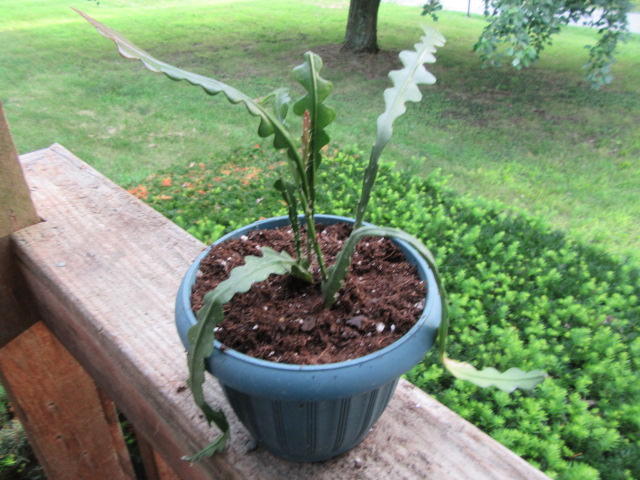
Selenicereus anthonyanus (Fish Bone Cactus) in a larger 4 1/2″ tall x 5 1/2″ wide pot on 6-25-24, #1065-8.

I decided to put it in a larger 4 1/2″ tall x 5 1/2″ diameter pot with Miracle Grow Potting Mix with a little orchid bark. It is an epiphytic cactus from Mexico’s tropical rainforest that grows in trees…
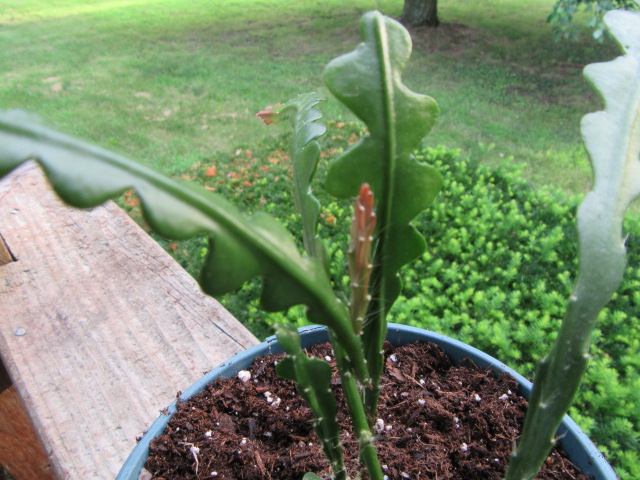
Selenicereus anthonyanus (Fish Bone Cactus) on 6-25-24, #1065-9.

Also known as Ric Rac and Zig-Zag Cactus, this plant is a night bloomer…

<<<<+>>>>

July 2…

x Mangave ‘Inkblot’ before repotting on 7-2-25, #1067-1.

Ummm… I decided it was time to give the x Mangave ‘Inkblot’ a makeover on July 2 and put it in a larger pot. Its kid also needed to be put in a pot of its own. This is an AWESOME plant, by the way.

I need to mention that x Mangave is a hybrid combination of Agave and Manfreda. A few years ago, or whenever it was, I noticed Plants of the World Online said Manfreda (and a few other genera) had become synonyms of Agave. That was kind of confusing for me because there are A LOT of patented x Mangave cultivars. Does that mean the patented x Mangave are now Agave cultivars? Well, I just checked as I was writing this post and it appears Manfreda is ONCE again an accepted genus! So, the hybrid cultivars were once hybrids, then not, now are once again… Now I have to change captions AGAIN… Botanists and taxonomists have to jump few several hoops to change scientific names and it has to be peer reviewed, etc. Then they change the name back AGAIN. What the heck?!?! I’m so glad they have that figured out. 🙂

x Mangave ‘Inkblot’ pup on 7-2-25, #1067-2.

The pup grew almost as tall as the parent…

x Mangave ‘Inkblot’ roots on 7-2-25, #1067-3.

I always think it’s funny how pots get so root bound that the soil disappears. Where does it go?

x Mangave ‘Inkblot’ in a larger 12″ tall x 14 1/2″ wide pot on 7-2-25, #1067-4.

I looked around and found a good-sized pot that I wasn’t 100% happy with. I normally put rocks in the bottom of pots to help with drainage, but this pot has fairly large holes… Oh well, I just went with it. Now, the big plant is in a larger 12″ tall x 14 1/2″ wide pot. Then after I had it finished, I noticed a crack about 3″ long around the bottom of the pot. So, at some point I will have to change the pot again (before the plants come inside for the winter).
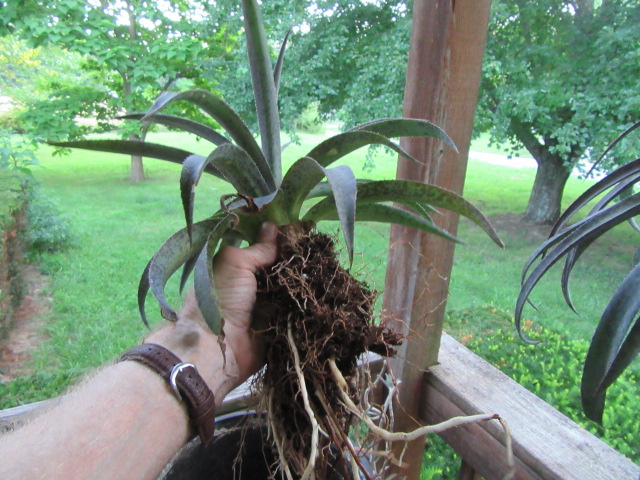
x Mangave ‘Inkblot’ pups roots on 7-2-25, #1067-5.

Now for the pup… I’m not sure why they call the offsets pups… Anyway, it was definitely a good idea to remove the pup from the parent and it really wasn’t attached anymore. It has a nice root system for sure. At least there wasn’t a long runner wrapped around the pot like I have seen before (been there, done that).
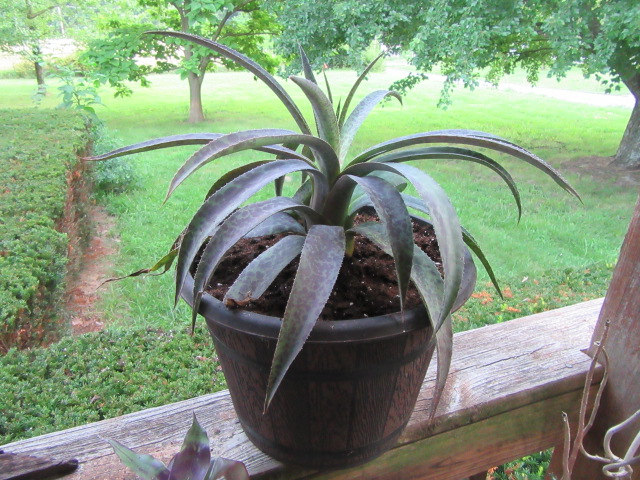
x Mangave ‘Inkblot’ pup in the original 8 1/2″ tall x 10 1/2″ wide pot on 7-2-25, #1067-6.

I put the pup in the original 8 1/2″ tall x 10 1/2″ wide pot.
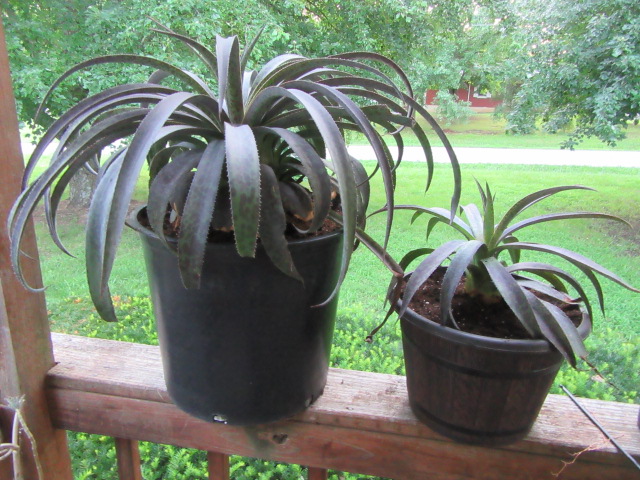
x Mangave ‘Inkblot’ parent and sibling on 7-2-25, #1067-7.

Yep! They were both in the smaller pot…

<<<<+>>>>

July 3…

Callisia fragrans (Grandpa’s Pipe, Etc.) on 7-3-25, #1068-1.

The Callisia fragrans (Grandpa’s Pipe, Inch Plant, Etc.) needed to be repotted, so I put all six in two pots. There were in individual pots, but I decided putting three in two pots would be more than satisfactory. Of course, if they do really well, they will produce a lot of runners and new plants. These plants don’t produce much of a root system, and even with a little neglect, they are virtually indestructible.

<<<<+>>>>

7-10-25…

Mammillaria plumosa (Feather Cactus) before repotting on 7-10-25, #1073-5.

I debated repotting the Mammillaria plumosa (Feather Cactus) for a couple of reasons. For one, I was pretty sure it didn’t need a deeper pot, and two, I thought it might fall apart. 🙂 Now, let me give you a little history (which you can read if you click on it name)… I bought this plant (or clump of plants) from a seller on Ebay in September 2018. It came wrapped in toilet paper and looked like a ball of tiny feathers. I put it in a pot and the rest is history. All you see in the above photo was was what came in the mail only much smaller. It has grown and done extremely well with no issues whatsoever, and it does produce a few flowers. BUT, I don’t believe it has produced any offsets…

Mammillaria plumosa (Feather Cactus) from the top on 7-10-25, #1073-6.

The sides of the cactus were touching the pot in a couple of spots and the soil was almost 2″ from the top of the pot… Well, it hadn’t been repotted since 2019…
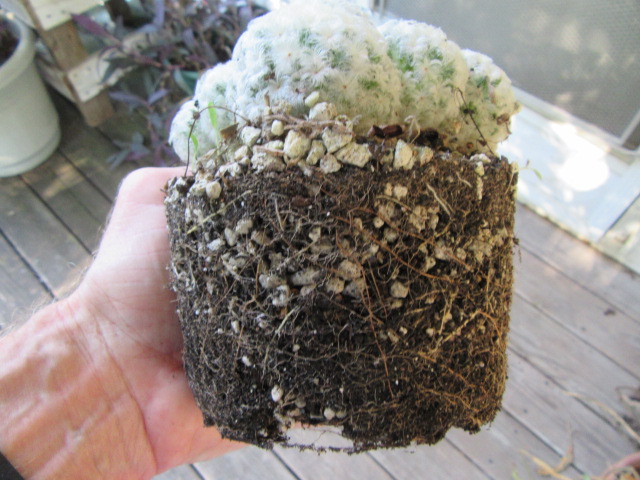
Mammillaria plumosa (Feather Cactus) roots on 7-10-25, #1073-7.

As you can see, there isn’t a massive root system, but still more than I thought there would be. Back in 2019, I used pumice in the mix…

Mammillaria plumosa (Feather Cactus) roots after removing old soil on 7-10-25, #1073-8.

After I removed old potting soil and dead roots, there wasn’t much left. I was very glad the cluster of plants stayed together. I removed the dead roots up to where I saw new ones growing. You don’t have to worry about removing roots because they grow new ones every year. I think I said that before.

Mammillaria plumosa (Feather Cactus) in a larger 5 1/2″ tall x 6 1/4″ wide pot on 7-10-25, #1073-5.

I didn’t like putting it in a deeper pot, but I didn’t have much of a choice for the moment. So, I put it in a 5 1/2″ tall x 6 1/4″ diameter pot with Miracle Grow Cactus Mix with a little additional perlite and chicken grit… I may order a few shallow pots online that are good sized in diameter but shallow. I saw them somewhere…

<<<<+>>>>

x Mangave ‘Pineapple Express’ before repotting on 7-10-25, #1073-11.

I decided July 10 it was time to repot the x Mangave ‘Pineapple Express’. I knew it would be tough… I brought this plant home in May 2019 and first repotted it in November 2019. Information said it was slow to offset, but it already had one by then which I left in the pot. When I moved the plants inside for the winter in 2020, I counted “about” 10… I could have miscounted. 🙂 I still left them all in the same pot. When I measured the plants as I moved them inside in October 2021, this plant measured 11 1/2″ tall x 20″ wide. In 2023, I decided to put it on the back deck in full sun to see how it would do. Well, it did GREAT but changed colors. Then, when it was inside over the winter, it started loosing leaves and I thought it was a goner. But it survived…  After that, I kept it on the porch on the north side of the house. It did fine after that, but measured only 7 1/2″ tall x 13 1/2″ wide when I moved it inside in October 2024. Both of the x Mangave‘s stayed in my bedroom over the winter, which they did not appreciate, and were very glad to get back outside.

x Mangave ‘Pineapple Express’ roots on 7-10-25, #1073-12.Well, to be honest, I knew it was going to be root bound… I’ve been through repotting LARGE Agave when I was in Mississippi. GEEZ!!!

x Mangave ‘Pineapple Express’ pups on 7-10-25, #1073-13.

And, of course, I knew there had been pups in the pot for several years…

x Mangave ‘Pineapple Express’ in a larger 6″ tall x 6 1/4″ wide pot on 7-10-25, #1073-14.

It was not easy unwrapping the old roots and removing the pups, but I managed to get it done. I put the parent in a larger 6″ tall x 6 1/4″ diameter pot with Miracle Grow Cactus Mix with a little extra perlite and chicken grit.

x Mangave ‘Pineapple Express’ with 7 pups in 4″ tall x 4 1/2″ wide pots on 7-10-25, #1073-15.

I successfully removed five pups but I accidentally broke two… I went ahead and put the two I broke in pots like the other 5. I also put the roots of the two that I broke off in a couple of pots, too. The two I broke off will no doubt grow roots (been there, done that), but I’m not sure if the two with just roots will grow new leaves. Time will tell…

That’s all for this post and I am caught up with the plants I have repotted so far, I still have plenty to repot that I will post about soon.

Until next time, be safe, stay positive, be well, stay thankful, and GET DIRTY!


New Plants Update

Aegopodium podagraria (Snow In The Mountain/Goutweed) on 7-5-24, #1000-1.

Hello everyone! I hope this post finds you well. I thought I would write a post about the new plants I brought home in 2024. Some of the new plants complained because I didn’t write a new post when I brought them home, so this is an apology to them. A few are grouping together and are still snubbing me. GEEZ!

Some plants listed are replacements and already have a page (highlighted in green) but most are new and have no page YET. In alphabetical order…

<<<<#1>>>>

I remembered my grandma Miller having plants along the back of their house that were green and white variegated. I didn’t know what they were called and couldn’t find any locally. I saw a house on Main Street that had A LOT next to their house but I didn’t want to stop and ask for a start…

Finally, I found a few at Wagler’s Greenhouse on May 25. Well, of course, I had to grab one. I really knew nothing about their behavior, or even their name, until I drug a photo onto iNaturalist… I think drug is an appropriate word for drag and drop. Anyway, Aegopodium podagraria is the scientific name for this plant that, according to information online, will soon become “plants” as it is a spreader. The common name is Goutweed while the variegated form is usually called Snow-In-The-Mountain… Umm, a different species is called Snow On The Mountain so we don’t want to get confused. Time will tell if I actually want it in the north bed but I can’t hesitate if I choose to relocate it. I read it can be hard to get rid of…

<<<<#2>>>>

Aloe x ‘Amethyst’ on 7-5-24, #1000-2.

I really like Aloe, so when I find a new one of interest I have to bring it home. This Aloe x ‘Amethyst’ caught my eye at Lowe’s on May 9 so I brought it home. Its leaves are definitely unique with all the lumps and strangely toothed margins.

<<<<#3>>>>

Aloe x ‘Pink Blush’ on 7-5-24, #1000-3.

Then on May 10, I ran across this Aloe x ‘Pink Blush’. I had one before, in 2014, that I guessed was ‘Pink Blush’ although it was unlabeled. This time it had a label. Well, I brought it home…

<<<<#4>>>>

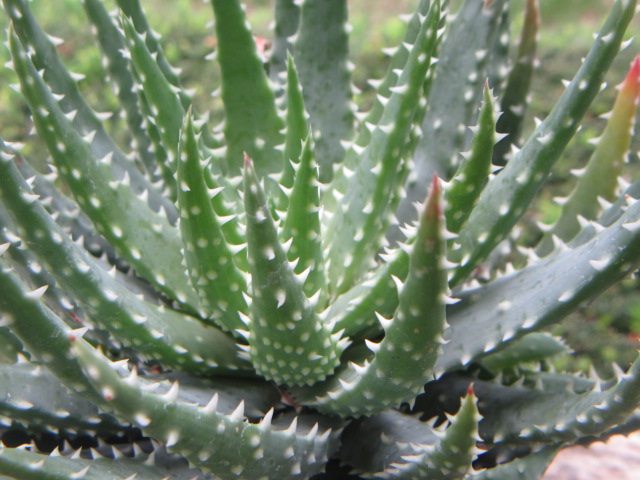
Aloe humilis (Hedgehog Aloe) on 7-5-24, #1000-4.

Then there was this really spiny Aloe at Walmart on May 6 I put in my cart (not alone). This one was unlabeled and I had a heck of a time deciding what it was. I put photos on a couple of Facebook Groups and it seemed, at first, one of the suggestions for Aloe x spinosissima could have been correct. But, when I looked up information online, I hoped it wasn’t. Then, while adding captions to the photos I remembered putting the photo on the SucculentGuide Forum. I checked the post I made and several members posted suggestions that didn’t match this plant. One, however, suggested Aloe humilis (Hedgehog Cactus). I happily changed the caption because I like it much better. I’m certainly hoping it is an Aloe humilis

<<<<#5>>>>

Amaranthus cruentus ‘Red Spike’ (Red Amaranthus) on 7-5-24, #1000-5.

I spotted several Amaranthus cruentus ‘Red Spike’ (Red Amaranthus) at Wagler’s Greenhouse on June 11. At first, I just looked at them as I passed by but then turned around and picked one up. Hmmm… I haven’t grown any Amaranthus since 2012. It has grown A LOT!

Amaranthus cruentus ‘Red Spike’ (Red Amaranthus) on 7-5-24, #1000-6.

Now it has a bud…

<<<<#6>>>>

Coleus ? on 7-5-24, #1000-7.

I haven’t grown any Coleus (Coleus) for several years because I couldn’t find any suitable. I found this one at Wagler’s on May 20 that looked similar to one of the Kong Series so I brought it home. It has done quite well but the flowers need to be removed… I have grown some nice Coleus, and this one is proving itself quite well.

<<<<#7>>>>

Euphorbia ferox (Pincushion Euphorbia/Thorn Noors) on 6-5-24, #1000-8.

You know I couldn’t pass this thorny guy up when I found it at Walmart on May 6. Euphorbia ferox is called Pincushion Euphorbia on many websites, but iNaturalist says its common name is Thorn Noors. Hmmm… I’m not sure what that means but the thorn part is quite evident. If you look closely, you can see small leaves. Yep, it is a Euphorbia… It isn’t fond of being touched…

<<<<#8>>>>

Thelocactus setispinus (Miniature Barrel Cactus) on 7-5-24, #1000-9.

This Thelocactus setispinus (Miniature Barrel Cactus) was the featured photo in the last post. It has had many buds, but it has been somewhat difficult to see them open. I watched every day and all I would see was buds about to open, then the next day they would be wilting like they had already opened. The few times I did see them, they would be fully open for several days. What the heck is that? Now there are three at once… I hope it doesn’t bloom itself to death.

*NOTE: Originally, I thought this cactus was Ferocactus hamatacanthus (Turk’s Head), but thanks to an anonymous reader, I changed the name. So, in alphabetical order, now it should be on the bottom…

<<<<#9>>>>

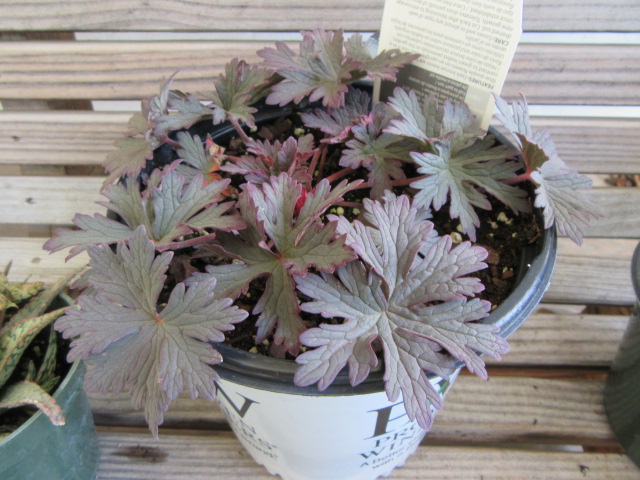
Geranium pratense ‘Boom Chocolatta’ on 7-5-24, #1000-10.

This Geranium pratense ‘Boom Chocolatta’ is from Muddy Creek Greenhouse that I brought home on May 10. It has very dark green leaves and now it has flowers. NICE!!! Muddy Creek usually sells out early, so I was fortunate this one was still there.

Geranium pratense ‘Boom Chocolatta’ on 7-5-24, #1000-11.

How’s that for a happy leaf? I put this plant between the steps on the north side of the house and an Achillea millefolium… The Achillea was taller, so the Geranium had to grow even taller to strut its stuff.

<<<<#10>>>>

Geranium pratense ‘Johnson’s Blue’ on 7-5-24, #1000-12.

I have wanted a Geranium pratense ‘Johnson’s Blue’ for many years and Wagler’s has several to choose from. I didn’t bring one home until May 28 because I didn’t know where I would put it. Finally, I brought one home anyway… On the third trip… It set in its original pot for so long that it started objecting about its roots getting cramped up. SO, I put it in the northeast corner bed next to the steps. Ummm, between the Amaranthus ‘Red Spike’ and Echinacea purpurea I put there previously…

Hmmm… I moved an Echinacea purpurea to this spot because it came up right next to the Phlomis ‘Edward Bowles’ in the southeast corner bed. Edward objected so I moved the Echinacea. When my sister was here plant shopping, when I first saw the Geranium ‘Johnson’t Blue’, I had a plan to give her the Echinacea so I could go back and get the Geranium. Well, it didn’t work… She wants this and that, but for some reason, she doesn’t want a Purple Coneflower…

Geranium pratense ‘Johnson’t Blue’ on 5-28-24, #994-3.

The above photo was taken of its flower when I brought it home on 5-28-24… NICE!

<<<<#11 & 12>>>>

Heuchera sanguinea ‘Coral Forest’ on 7-5-24, #1000-13.

OK, so Wagler’s had quite a few Heuchera but I was somewhat confused. There were plants with variegated leaves and some with plain green leaves all in the same flats. Some of each had the same label that said Heuchera sanguinea ‘Coral Forest’. I brought home one of each on May 25. A few days later, I went back and there were other flats farther down the greenhouse that were the same but with other labels… Some said Heuchera americana ‘Dale’s Strain’ and others said Heuchera sanguinea ‘Firefly’. Hmmm…

Heuchera americana ‘Dale’s Strain’ on 7-5-24, #1000-14.

I did some research and found out that H. ‘Coral Forest’ has variegated leaves, H. ‘Firefly’ has green leaves, and the leaves of H. ‘Dales Strain’ start out green then they develop olive-green markings… At first, I thought I must have an H. ‘Coral Forest’ and an H. ‘Firefly’. The next thing I knew, ‘Firefly’ became ‘Dale’s Strain’. GEEZ!!!

Now, I have to back up a little. In the spring of 2023, I moved the Hosta and Heuchera from the shade bed to the bed along the north side of the house (the north bed). I had lost several and wanted them replaced. So, on May 6 I went to the Green Street Market (a garden center) in Clinton since they always have a good selection of Hosta.

<<<<#13>>>>

Hosta ‘Dancing Queen’ on 7-5-24, #1000-15.

At Green Street, I found a Hosta ‘Dancing Queen’ to replace the one that the deer destroyed in 2021. Only one leaf came up in 2022 then it fizzled out… The new one likes its new spot except for one thing. The Viola sororia are rather pushy…

<<<<#14>>>>

Hosta ‘Guacamole’ on 7-5-24, #1000-16.

The Hosta ‘Guacamole’ also didn’t return in 2024 so I was happy I found a good selection at Green Street. What would a Hosta collection be without this one? As you can see it is looking great and getting ready to flower.

<<<<#15>>>>

Hosta ‘Patriot’ on 7-5-24, #1000-18.

The Hosta ‘Patriot’ is a new one I decided to bring home from Green Street. It is doing well and it has already produced flowers. No page yet…

<<<<#16>>>>

Hosta ‘Krossa Regal’ on 7-5-24, #1000-17.

Then on May 10, I found a Hosta ‘Krossa Regal’ to replace the one that didn’t return in the shade bed in 2023. I had it since 2009… It is OK but seems a little bewildered by so much company… Ummm… Its color is a bit off, too.

<<<<#17>>>>

Kumara plicatilis (Fan Aloe) on 7-5-24, #1000-19.

For #17 is the Kumaria plicatilis (Fan Aloe) from Walmart on May 20. The label said it was Aloe plicatilis, but it was given a new name in 2013. Ummm… The genus name, Kumaria, was conserved and there are only two species in the genus. The other was renamed in 2014. I thought it was a neat plant but after reading about it I found out it can get quite large and tree-like. Hmmm… Perhaps the tag is totally wrong and it is the other species, Kumara haemanthifolia which is a low-growing species. Well, I guess time will tell…

<<<<#18>>>>

Orostachys malacophylla var. iwarenge (Chinese Dunce Cap) on 7-5-24, #1000-20.

Probably the weirdest plant I brought home this year is the Orostachys malacophylla var. iwarenge (Chinese Dunce Cap) I found at Wagler’s on May 28. It is native to Northern China Mongolia, and Japan and it is cold hardy in USDA Zones 5-10. Hmmm… It is a member of the plant family Crassulaceae and its growing habit is similar to Hens and Chicks. It is named for its “spires of silvery lavender cone-shaped rosettes.” As you can probably guess, it spreads from the runners. So far, it seems happy here, but time will tell. According to what I read about its “needs”, it should be repotted into a more suitable potting mixture…

<<<<#19>>>>

Parodia concinna (Sun Cup) on 7-5-24, #1000-21.

I found this Parodia concinna (Sun Cup) at Lowe’s on May 9. I brought this one home because it had several buds. The label said it was a Notocactus elegans, but there was no such accepted name in the Notocactus genus… Notocactus species were mostly moved to the Parodia genus some time back. I put photos on a couple of Facebook groups and the Cactiguide Forum. Several names were suggested which I checked out but none clicked. Finally, someone suggested Parodia ottonis which is a synonym of Parodia concinna. BINGO! It is a short, squatty fellow with a concaved apex which sets it apart from most members of the genus Parodia… There were a few other possibilities, but I am sticking with Parodia concinna.

Parodia concinna (Sun Cup) ? on 5-12-24, #990-2.

How’s that for a flower? It bloomed several times, once with two flowers at once. The above photo was taken on May 12…

<<<<#20>>>>

Pelargonium denticulatum (Tooth-Leaved Pelargonium) on 7-7-24, #1001-1.

Hmmm… I needed photos for the Pelargoniums, but when I was taking photos on July 5 they weren’t looking so hot. Well, I think they were hot and needed water. They looked much better after a good drink. Then on the 7th, they were in too much sun when I was working on the post, so I decided to take a nap. It was sprinkling when I woke up but I stood back under the roof and zoomed in a bit to get a couple of shots.

I found the above mislabeled plant at Wagler’s on May 28. The label said “Mosquito Plant” and said the name was Pelargonium citronellum. I could have easily called it that but the photo on the tag wasn’t the same as the plant I brought home. I had already figured out the above plant was Pelargonium denticulatum (Tooth-Leaved or Toothy Pelargonium) but I became stumped. I had a previous Pelargonium denticulatum in 2014 that looked completely different with more frilly leaves. Then I found a website belonging to a Pelargonium specialist from Greece. It is an awesome site and the Pelargonium denticulatum on her site had leaves like the one in the above photo. Well, she has a Facebook page, so I messaged her. I sent her photos of this plant and the one below. She, like me, said they were P. denticulatum and P. quercifolium like I thought. One thing led to another and I wound up sending photos of the Geraniums in the flower bed and the two native species…

OH, when I sent her a photo of the P. denticulatum from 2014, she replied that it looked like a cultivar called ‘Filicifolium’… Well… The caption under the photo and on its page says Pelargonium denticulatum ‘Filicifolium’… Before she had messaged me back, I had already looked it up online and had a good laugh. The cultivar has more frilly leaves. I wrote the page about it in 2014 which was transferred to this site in 2017. Ummm… That’s all I have to say about it…

If you want to learn more about Pelargoniums, go to Pelargonium Species World. If you have bought a Pelargonium, the name on the tag is likely incorrect like both of mine this year. Click HERE to go to the photo gallery and scroll all the way down for a chart with leaves. There you can click on a links to the various species that match the leaf shapes.

Pelargonium denticulatum (Tooth-Leaved Pelargonium) on 6-29-24, #999-4.

The above photo of the flowers of P. denticulatum was taken on June 29. Oh yeah, it has a caption…

<<<<#21>>>>

Pelargonium quercifolium (Oak-Leaved Geranium) on 7-7-24, #1001-2.

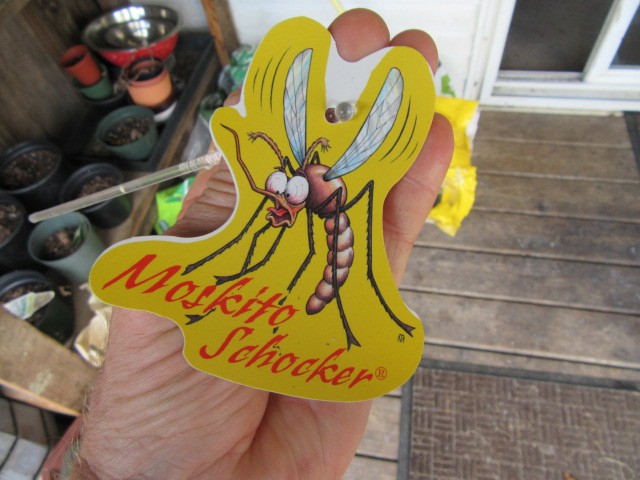
I brought this Pelargonium quercifolium (Oak-Leaved Geranium) home from Walmart on May 20. It had a dangly tag that said… Well, I’ll just show you a photo…

Hmmm…

The back of the tag says “Selection of Pelargonium Crispum or Quercefolia”… Well, it isn’t a P. crispum and P. quercifolium is spelled wrong. 🙂 As far as either one being a mosquito shocker… There are still mosquitos on the back porch. I didn’t buy them to repel mosquitos although they both smell very good.

Pelargonium quercifolium (Oak-Leaved Geranium) on 6-21-24, #997-2.

As the caption says, the above photo was taken on June 21.

<<<<#22>>>>

Peperomia graveolens (Ruby Peperomia/Ruby Glow) on 7-5-24, #1000-22.

When I went to Mast’s Greenhouse last year, I spotted a couple of Peperomia graveolens (Ruby Peperomia/Ruby Glow) in one of Mr. Mast’s daughter’s private collection. She reluctantly gave me a cutting which didn’t work out so well. This year, there were a few available for sale so, of course, I brought one home. It is doing fine so far but it seems to be a slow grower. Of course, it needs a better potting mixture since it is in commercial potting soil…

<<<<#23>>>>

Ptilotus exaltatus ‘Joey’ (Pink Mulla Mulla) on 7-5-24, #1000-23.

The strange flowers of this plant caught my eye when I was at Wagler’s on May 25. There was no label or tag so I used the drag-and-drop feature on iNaturalist. To my surprise, it came up with the name Ptilotus exaltatus (Pink Mulla Mulla). Then I checked online and came up with a cultivar called ‘Joey’. The species is an annual native to Australia… It has done OK, but I don’t think it likes as much rain as we have gotten lately.

<<<<#24>>>>

Selenicereus anthonyanus (Fish Bone Cactus/ Zig Zag Cactus) on 7-5-24, #1000-24.

On my fifth and final trip (so far) to Wagler’s on June 12, I found this Selenicereus anthonyanus (Fish Bone Cactus, Zig Zag Cactus). I asked Mrs. Wagler what it was, and she gave it to me. Well, I asked what it was not because I wanted it, but how could I refuse? According to the Wikipedia article, it was first discovered in 1946 and first flowered in captivity in 1950. It is a rarely collected and most plants in cultivation descend from the first collection. It is an epiphyte growing in trees whose stems are ascending or climbing, branching in clusters at intervals along the stem. The flowers in the photos are quite interesting, but it flowers at night and only for one night… Other common names include Rickrack Cactus and St. Anthony’s Rickrack. Hmmm…

I am finally finished with this post and I promise I will get another one ready soon. Probably about the garden.

Until next time, be safe, stay positive, be thankful, and GET DIRTY!

New Plants for 2024 (So Far)…

New Hosta on 5-6-24.

Hello everyone! I hope this post finds you well. We had more rain during the night… Last Monday I went to the Green Street Market in Clinton (Missouri) to get a few garden seed. Well, it didn’t stop there… I browsed their plants and my feet took me to there selection of Hosta. Last year I moved the Hosta and Heuchera to the bed along the north side of the house because of the mole issue in the former shade bed. I had lost several so I needed to replace them. Well, maybe I didn’t need to but I just wanted to. Green Street always has great plants and their Hosta are always great.
Hosta ‘Dancing Queen’ on 5-6-24, #987-10.

I was glad I ran across this Hosta ‘Dancing Queen’ to bring home to replace the one I lost in 2022. The deer ate it to a point it never recovered in 2021 and onle one sprout came up in 2022 and then it just fizzled out. I brought it home in 2017 and it was always a big hit. Hosta ‘Dancing Queen’ is so bright cheerful you can see it from quite a distance. This hosta was introduced by Kent Terpening and Alttara Scheer in 2005.

Hosta ‘Guacamole’ on 5-6-24, #987-11.

I just had to bring home another Hosta ‘Guacamole’ to replace the one that didn’t return in 2023. I brought home the first one in 2014 and we never had any problems until the moles started messing with its roots in 2018. GEEZ! We had our issues after that and I even moved part of it to another location in the shade bed, then back again… It came back great then barely any sprouts came up in 2022. It didn’t return in 2023. Hosta ‘Guacamole’ is a multiple-award winner introduced by Bob Solberg in 1994. I am so glad to have another one!

Hosta ‘Patriot’ on 5-6-24, #987-13.

I decided to bring this Hosta ‘Patriot’ home to see what it would be like. I don’t know much about it yet, so we shall see what it does. I went to the Hoata Helper website to check it out, but unfortunately, the site wasn’t cooperating… Hmmm… Anyway, I will give it a shot.

From Green Street Market, I needed to go to Walmart for a few things and somehow wound up in the garden center…

New Cactus and Aloe on 5-6-24.

I have brought home quite a few cactus and succulents from Walmart over the years and have had mixed results. I still have a few of them, but you know how plants are. Some do well and others don’t. The ridiculous thing is the labeling not being accurate or just saying “succulent” or “cactus”. DUH! Then I have to figure out what species. I keep telling myself not to bring home plants without a proper label, but when I find one I really like that rule doesn’t seem to apply… The rack of smaller pots of cactus and succulents looked fairly pitiful but there was a rack of bigger plants that looked pretty good. So good most of them had a shocking price of $24.95!  Well, that price was out of the question! I looked around and found 3 plants I hadn’t grown before that were reasonable enough…

Aloe humilis (Hedgehog Aloe) on 5-6-24, #987-1.

Hmmm… The tag on this pot says it is an Aloe. GEEZ! Here we go AGAIN! I took photos and put them on the Facebook group called Succulent Infatuation like I have before with great results. This time it wasn’t so favorable but one suggestion was Aloe x spinosissima (Spider Aloe). Then later on, someone on the SucculentGuide Forum suggested Aloe humilis (Hedgehog Aloe). I decided that was much more favorable, so I am sticking with it…

Aloe humilis (Hedgehog Aloe) on 5-6-24, #987-2.

The plant seemed in great shape and who could resist a thorny Aloe?

Euphorbia ferox (Thorn Noors/Pincushion Euphorbia) on 5-6-24, #987-3.

Then there was this interesting plant that was correctly labeled Euphorbia ferox. Well, I like Euphorbia and they always do well so I put it in my cart.

Euphorbia ferox (Thorn Noors/Pincushion Euphorbia) on 5-6-24, #987-4.

The common names include Thorn Noors (iNaturalist) and Pincushion Euphorbia (Llifle) which seems to be the most common of common names… I like its thorns and small leaves that have just started growing. Ummm… Its stems seem to have a waxy sheen that I’m not sure was added or if it’s a normal thing. If it was added, why only this pot? I guess I’ll have to see what happens to its glow… Maybe it will fade like a car eventually does after a good wax job…

Thelocactus setispinus (Miniature Barrel Cactus) at 3 1/2″ tall x 3 1/2″ wide after I brought it home on 5-6-24, #987-12.

Then there was this gem of a cactus I had to put in the cart. Ummm… It did have a label that says Hamatocactus hamatacanthus. As it turned out, that name is a synonym of Ferocactus hamatacanthus with the common name Turk’s Head. Then an anonymous blog reader suggested Thelocactus setispinus (Miniature Barrel Cactus). After a little research, I think they were correct. I changed the name…

Thelocactus setispinus (Miniature Barrel Cactus) on 9-6-24, #987-13.

This cactus seems to be in good shape besides a few scars and missing spines. It is good-sized at 3 1/2″ tall x 3 1/2″ wide (without the thorns) and has several buds…

Thelocactus setispinus (Miniature Barrel Cactus) on 5-6-24, #987-14.

The largest bud has looked like this for several days. The anticipation for it to fully open is exhausting! Its fully open flower could be a clue to what the species name really is (unless it’s a hybrid)…

Then on May 9, I had to go to Sedalia so I stopped by Lowe’s. I debated stopping and passed the first entrance and drove in the second… My higher self said it would be OK. GEEZ!

I walked through the garden center and then inside because I had to go to the restroom. Then I walked back to the inside garden center to check out the cactus and succulents. Well, it was very disappointing and they were mostly in a pitiful state. Then I went to the outside garden center and walked around quite a bit. Their plants were great and I found a few perennials I thought about bringing home, but then put them down. I left with only two plants…

Aloe x ‘Amethyst’ on 5-9-24, #988-1.

I found this Aloe x ‘Amethyst’ one of the racks inside I decided to rescue. It looked pretty good although somewhat pale from being in low light. We’ll see how this one does… At least it had a correct label to go with it…

Parodia sp. on 5-9-24, #988-5.

I found this one with four buds, one almost open, that I decided to grab. The label said Notocactus elegans which, of course, was not correct. I’ve gone through that before with Notocactus… The genus is a synonym of Parodia and there is no such species name as Notocactus or Parodia elegans. So, it gets labeled Parodia sp

Parodia sp. on 5-9-24, #988-6.

This one is interesting because it is one of those cacti that is, umm, concave at its apex. Kind of like someone sat on it. While it is only 1 1/8″ (ish) tall, it is 3 1/8″ wide.

Parodia sp. on 5-12-24, #990-2.

The flower didn’t fully open until 5-12-24…

I lost my two Parodia lenninghausii to mealy bugs after I had them for several years. Information online said it would take 10 years for them to flower, and maybe not even then. It makes me wonder how old this cactus is, or any of them in my collection for that matter.

Then, on May 10 I went to the three local greenhouses…

Aloe x ‘Pink Blush’ on 5-10-24, #989-1.

I went to Wagler’s first because I needed to check out their tomato plants. They sold out of ‘Celebrity’. They had a lot of tomato plants but I just brought home 4 ‘Pineapple’ and this Aloe x ‘Pink Blush’. I brought one home in 2014 that I murdered, so I’ll give another one a shot.

Hosta ‘Krossa Regal’ on 5-10-24, #989-3.

I was very happy to find a replacement for the Hosta ‘Krossa Regal’. I bought my first one in 2009 while I was in Mississippi and brought here in 2013. It always did very well until the deer kept eating all three clumps in 2021. Only one came up in 2022 and didn’t do well. When I moved the Hosta to the new bed in 2023, there was only one very small plant that I put in a pot. It didn’t do well and didn’t return this spring. I am very glad to have a new one. What would a Hosta bed be like without ‘Krossa Regal’?

Then I went to Mast’s Greenhouse on the other side of town…

Peperomia graveolens (Ruby Peperomia/Ruby Glow) on 5-10-24, #989-4.

Last year Mr. Mast’s daughter gave me a cutting of her Peperomia graveolens (Ruby Peperomia/Ruby Glow) but didn’t have any luck with it. She had three good-sized plants, but she was saving them to take cuttings of. Luckily, she had better luck and Mast’s had several available for sale. I’m not sure how many kids Mr. Mast has, but this daughter is maybe 14… She had her own private collection…

I also bought four ‘Celebrity’ and four ‘Red Duce’ tomato plants while I was there…

Well, I had to go to Muddy Creek Greenhouse since it was right down the road. This is one greenhouse you have to go to early because they seem to sell out sooner than the others. Well, Wagler’s buys more plants throughout the season so they never run out until the end. Muddy Creek only had a few plants left, but…

Geranium pratense ‘Boom Chocolatta’ on 5-10-24, #989-2.

I found this Geranium pratense ‘Boom Chocolatta’ I decided to bring home. I really like its dark leaves and I will put it next to the steps on the north side of the house.

I haven’t found anything to put on the east side of the steps yet, and didn’t plant any Colocasia (yet). I may bring home more plants at some point, but maybe not… Last year’s drought has made me rethink how many beds to try to maintain. So far this year we have had enough rain to last about all summer! GEEZ! The garden isn’t even tilled yet. 🙂

Well, that’s it for this post. Until next time, be safe, stay positive, always be thankful, and GET DIRTY!