
Hello everyone! I hope this post finds you well. We finally had a good soaking on Monday! Lighting, thunder, and lots of rain! The rain gauge said 1 3/4″ in the end.
I went Moral mushroom hunting on Saturday and found around 20, but most of them were on the small side so I left them behind. I found a few that were big enough to fill a 9″ skillet.
Then on Sunday, the day before it rained, I went to my friend Kevin’s secluded woods to look around. I didn’t go in 2023, so I was glad to get back in the woods again. This woodland isn’t really that secluded since it is along the highway, but it is very healthy. Normally, the creek is running but it was mostly dry this time. This rain will get it going and likely wash out a few areas along the hillside. Even though 1 3/4″ doesn’t sound like that much, a little goes a long way in a downpour when the water is going down a steep hillside.
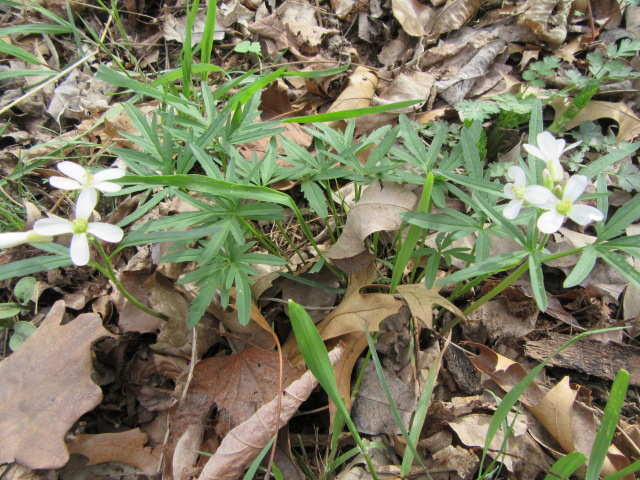
Cardamine concatenata (Cut-Leaved Toothwort) on 3-31-24, #981-1.
There were A LOT of Cardamine concatenata (Cut-Leaved Toothwort) growing on the hillside along the creek. Many were blooming quite well, while even more hadn’t started yet. Most of the flowers were wide open this time.

Cardamine concatenata (Cut-Leaved Toothwort) on 3-31-24, #981-2.
I need to go back to the woods to get photos when they set fruit, dry, and split… I have to replace the ones I borrowed. 🙂

Claytonia virginica (Virginia Spring Beauty) on 3-31-24, #981-3.
There were loads of Claytonia virginica (Virginia Spring Beauty) in several areas along the creek and on the hillside in Kevin’s woods. In 2020 I found a single plant growing close to the fence in the southeast pasture (where I live), and about 20 feet away there A LOT more.

Claytonia virginica (Virginia Spring Beauty) on 3-31-24, #981-5.
Then in 2022, I found hundreds in Kevin’s woods… And again in 2024.

Dicentra cucullaria (Dutchman’s Breeches) on 3-31-24, #981-11.
The Dicentra cucullaria (Dutchman’s Breeches) were just as plentiful as the Cardamine cucullaria and they grow together in many areas. I am going out later to dissect a flower because they are very interesting… Not only do the flowers have nectar glands in a weird place, but the seeds have masses of elaiosomes which ants use as food. They carry the seeds back to their nests and discard them which aids in the spread of the plants.

Dicentra cucullaria (Dutchman’s Breeches) on 3-31-24, #981-10.
I wrote descriptions for this species on March 5 and really learned A LOT. If you want, you can click on the link to its page above to check out the detailed photos I borrowed. I want to dissect a flower to check its inside out for myself and hopefully get a few good close-ups… Practice makes perfect. 🙂
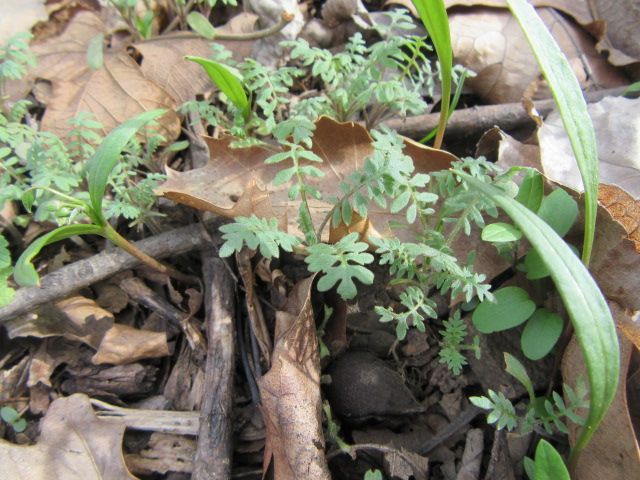
Ellisia nyctelea (Aunt Lucy) on 3-31-24, #981-12.
I climbed the steep hillside and crawled under the fence to look for a certain plant and ran across several colonies of a species I hadn’t identified before. I took a few shots and uploaded them on iNaturalist for an ID and they turned out to be Ellisia nyctelea, commonly known as Aunt Lucy… Hmmm… It is currently the only species in the genus. There were none with flowers, but the Missouri Plants website says they bloom from April to June. Maybe next time I go out there will be flowers.

Ellisia nyctelea (Aunt Lucy) on 3-31-24, #981-13.
The common name will be easy to remember since I had an aunt named Lucy. Once I find flowers, I will be able to write its own page. 🙂 You can check out the species page on the Missouri Plants website by clicking HERE.

Erythronium albidum (White Fawnlily) on 3-31-24, #981-14.
Almost everywhere I looked along the creek and on the hillside were hundreds of Erythronium albidum (White Fawnlily/White Dogtooth Violet). They start flowering sometime in March and continue through May but I haven’t seen any YET. I am determined to find flowers so I can finish its page… The flowers are supposed to be really neat… Check out the page for the species on the Missouri Plants website by clicking HERE.
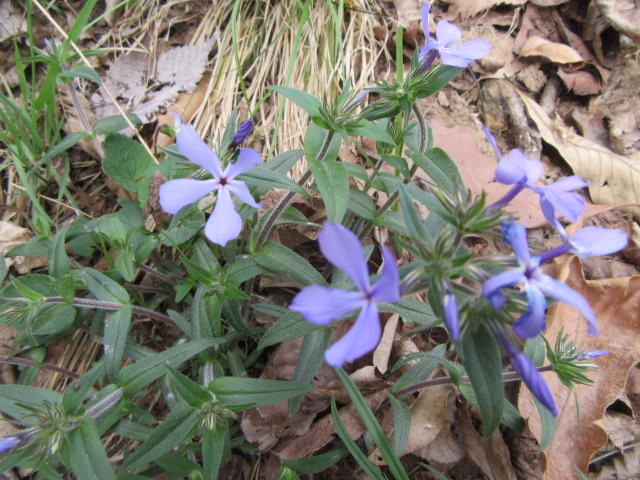
Phlox divaricata subsp. laphamii (Wild Blue Phlox) on 3-31-24, #981-15.
There were several Phlox divaricata subsp. laphamii (Wild Blue Phlox) but not as many as before. They were also very short this time…
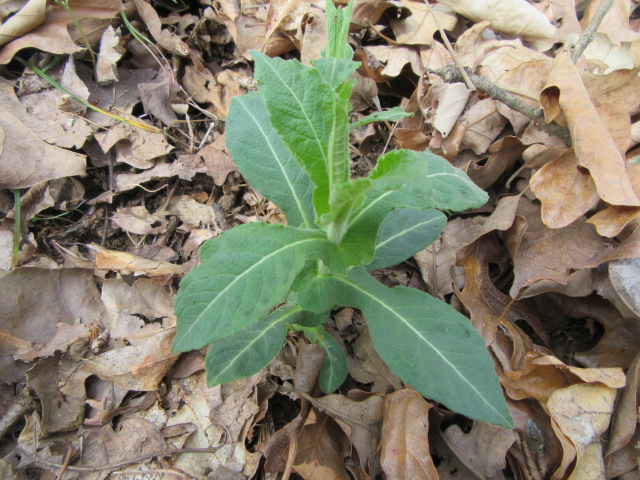
Triosteum perfoliatum (Perfoliate Tinker’s Weed) on 3-31-24, #981-16.
The main reason I climbed up the hillside and crawled under the fence was to see if I could find the Triosteum perfoliatum (Perfoliate Tinker’s Weed). I couldn’t find it the last several times I checked because the brushy undergrowth was too tall and thick. I knew where to look, and to my surprise I found it!

Triosteum perfoliatum (Perfoliate Tinker’s Weed) on 3-31-24, #981-17.
I was very excited! This amazing plant grows fairly tall and has odd flowers, similar to a honeysuckle (in the same family). I went earlier than usual so it was only maybe around 8″ tall and there was only one…

Triosteum perfoliatum (Perfoliate Tinker’s Weed) on 3-31-24, #981-18.
Of course, the perfoliate leaves are one of the highlights of this plant. I like the way they clasp the stem making it look like there is only one with the stem running through the center.

Viola pubescens (Downy Yellow Violet) on 3-31-24, #981-19.
There are several spread-out colonies of Viola pubescens (Downy Yellow Violet) in Kevin’s woods but I only found one with flowers. It’s the fuzzy fruit that is unique to this species… Or was unique…
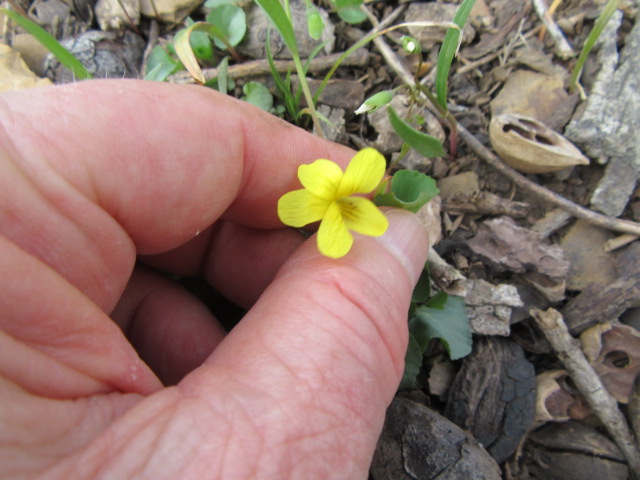
Viola pubescens (Downy Yellow Violet) on 3-31-24, #981-20.
Due to a taxon split, it is possibly now Viola eriocarpa (Smooth Yellow Violet)… On the list of synonyms for V. pubescens is Viola pubescens var. eriocarpa. Viola pubescens was named by William Aiton in 1789 and the variety was named by Thomas Nuttall in 1818. Viola eriocarpa was named by Lewis (or Ludwig) David von Schweinitz in 1822.
Two more attempts were made to make it part of Viola pubescens with Viola pubescens f. eriocarpa by Oliver Atkins Farwell in 1923 and another V. pubescens var. eriocarpa by Norman Hudson Russell in 1965. The last two are synonyms of V. eriocarpa… Just a little extra (useless) information. 🙂
I just found out about the taxon split when I was writing this post. I added the photos to its page and then clicked on the link on iNatualist for the species. To my horror, their page said it is an inactive taxon! While Viola pubescens is still an accepted species (with a different assigned number), apparently it was discovered most of the observations for V. pubescens are now Viola eriocarpa… My former observations for V. pubescens were automatically transferred to V. eriocarpa. Hmmm…
According to iNaturalist, V. eriocarpa differs from V. pubescens by having a virtual absence of basal leaves and having 2-3 cauline leaves clustered in the upper 2/3 of the stem, etc. They further state, “Viola eriocarpa is by far the more common of these two species, occurring over a wider geographic range, and in a greater variety of habitats. When it was included in V. pubescens sensu lato, it was sometimes differentiated as V. pubescens var. scabriuscula. Ummm… They also state “Viola pubescens is very uniform in morphology while V. eriocarpa is much more variable which it is often confused.” Hmmm… Well, according to my photos, it is likely the Viola pubescens I identified are likely Viola eriocarpa. That means I have to check the leaves and stems on the plants in Kevin’s woods. In the past, I found several in the woods behind this farm (the neighbors), and in 2022 I found a few on my side of the fence. I didn’t see them last year, and I noticed “something” has been digging in the ground where they were growing along the fence. Possibly that darn Armadillo!!!
At any rate, I will likely be overhauling the Viola pubescens page…
Hopefully, I will be going back to Kevin’s woods in a few days. The Green Dragon and Jack-In-The Pulpit weren’t up yet.
Until next time, be safe, stay positive, and always be thankful. It’s almost time for me to get my hands in the dirt. 🙂





 The Belmont Rooster