Plants Repotted Part 3…

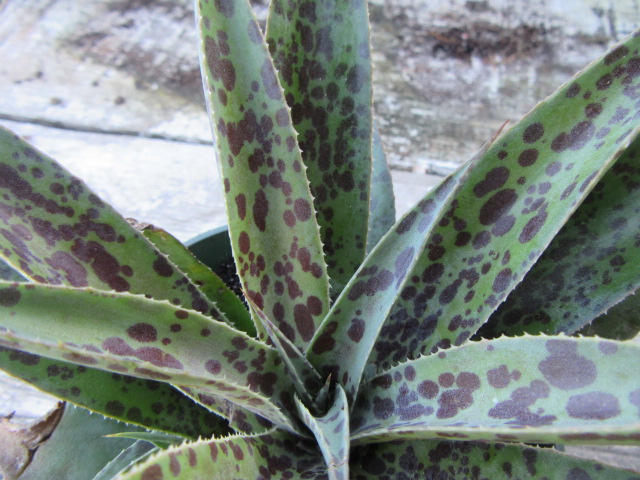
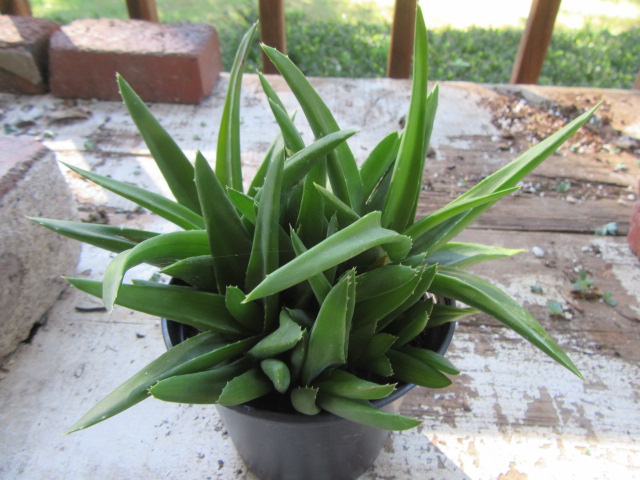
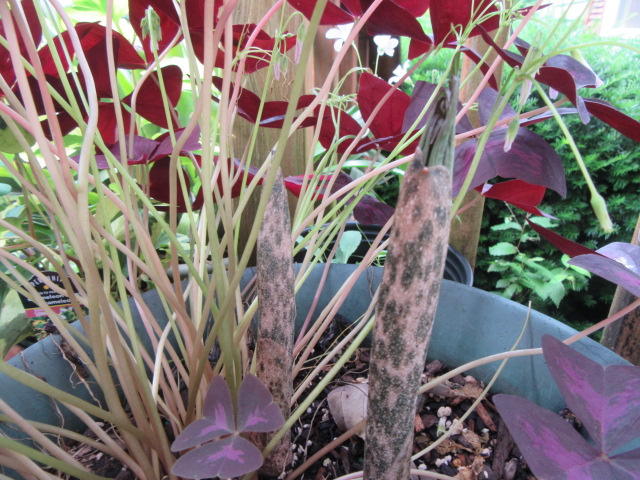
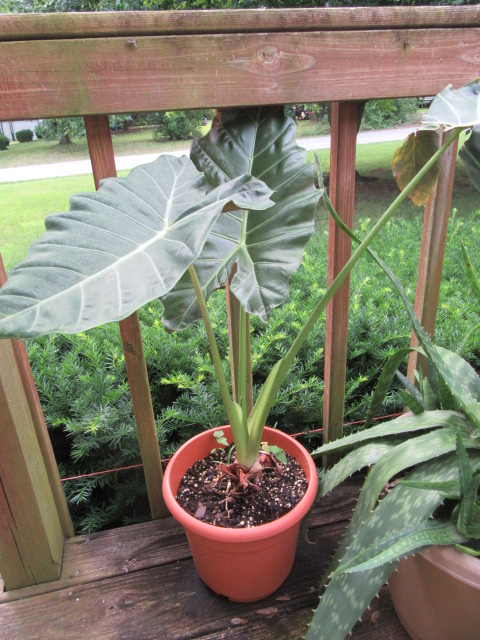
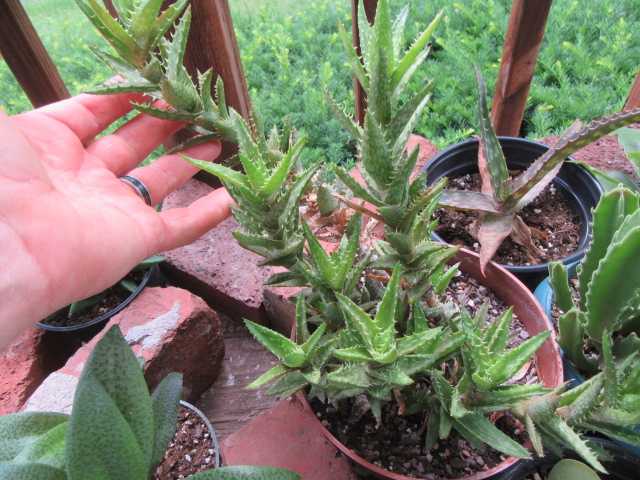
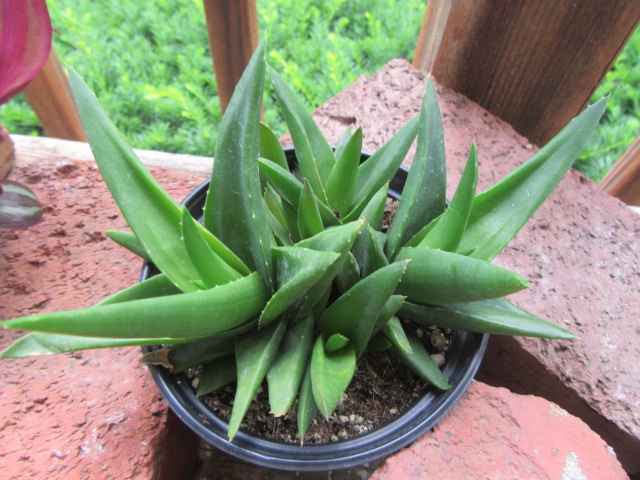
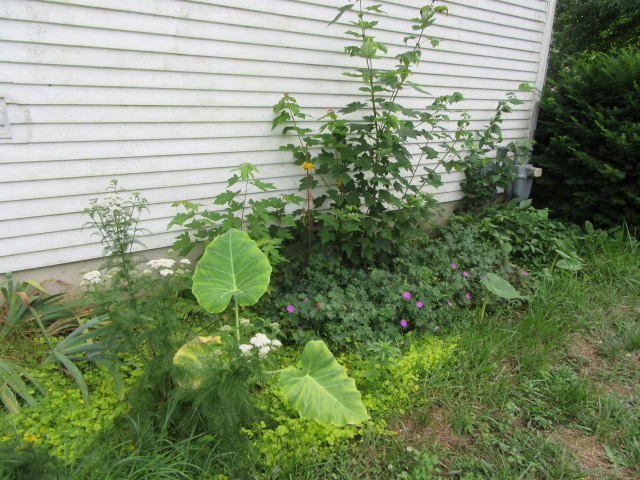
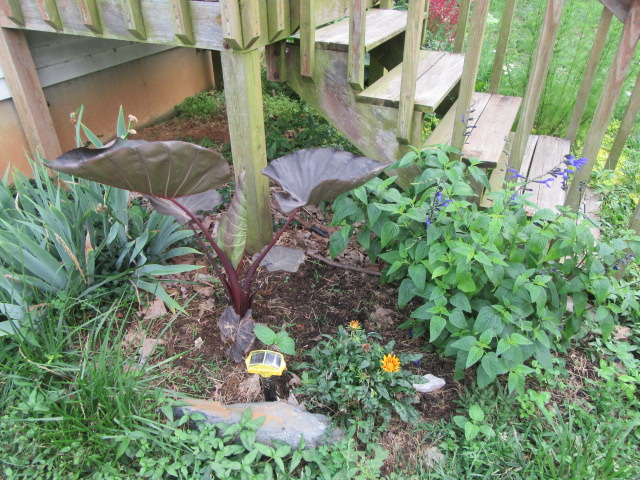
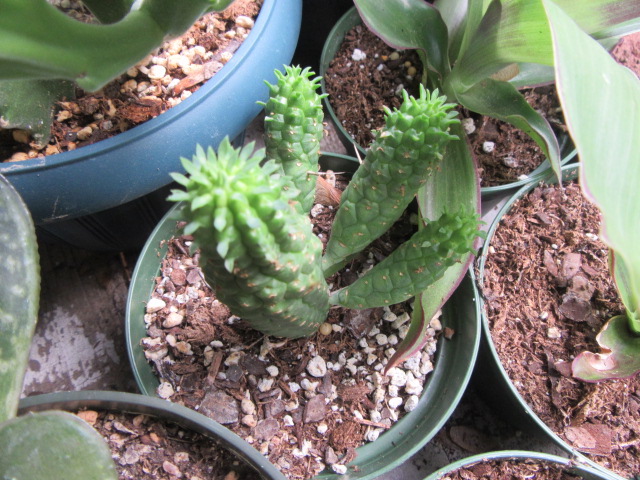
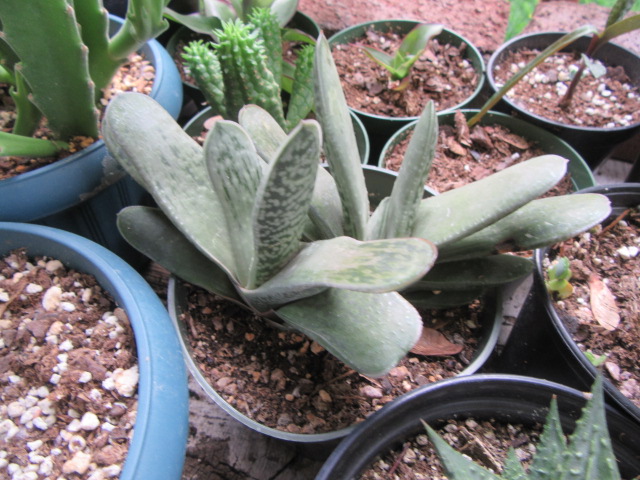
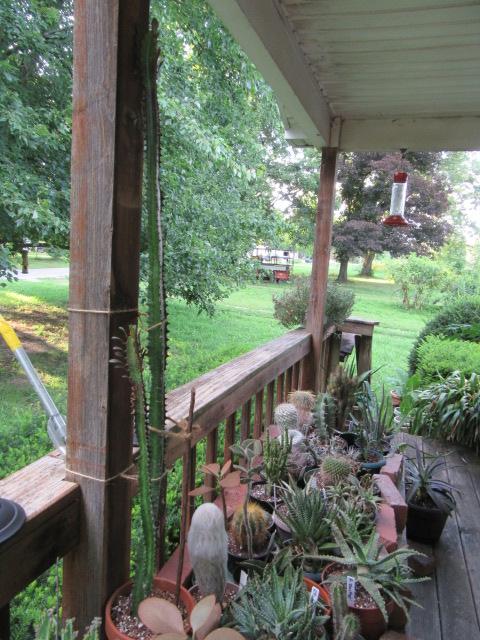
Hello everyone! I hope you are doing well and you are staying cool. It has been quite warm here and the humidity is NUTS! Most of the plants in the above photo have been repotted now, but not all. Of course, there are more that aren’t in the photo…

The Euphorbia trigona ‘Rubra’ (or var. rubra) has grown to 42″ tall and I’m not sure what to do with it… Should I hack it into a few pieces? Hmmm… The top of the stem, and the top of the branch, are looking a little weird and turning a light color. Normally, I don’t replant deeper than they were, but one day last fall the wind knocked it out of its pot. “Someone else” opted to put it in a bigger pot and buried it deeper than it was when I wasn’t home. Some plants have a crown and shouldn’t be replanted deeper than the root ball, but I’m not sure about this one. Normally, well maybe not normally, Euphorbia trigona are cut in pieces so they will branch out… So, I’m not sure about doing that, or what the deal is with it turning a lighter color on top. Maybe is isn’t getting enough light up there… Maybe I should check its roots to see if they are OK… I know it doesn’t have much of a root system. Actually, the plant has grown a little over 6″ since I moved it outside this spring, so maybe that is new growth. Hmmm…

This post is part 3 of Plants Repotted.

If you missed part 1, click HERE.

If you missed part 2, click HERE.

Anyway, here we go with part 3 beginning on…

June 8…

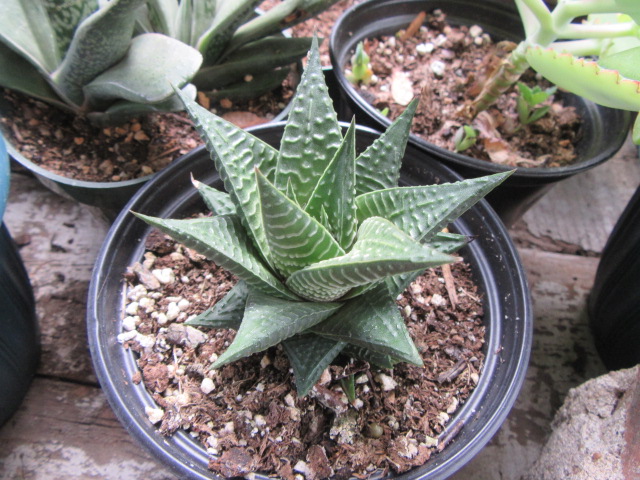
Aristaloe aristata (Lace Aloe) before repotting on 6-8-25, #1054-1.

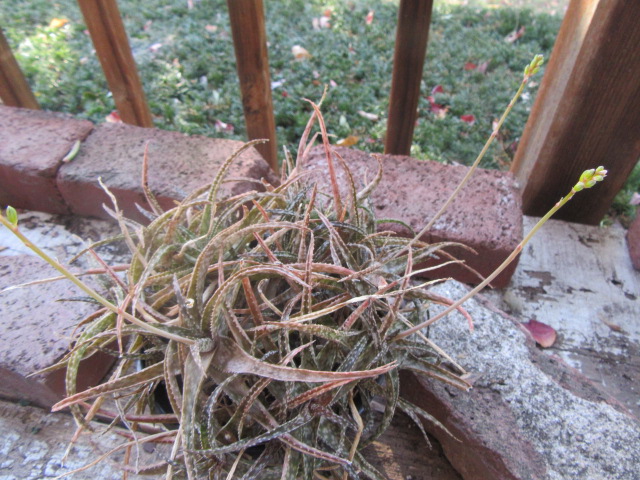
The Aristaloe aristata (Lace Aloe) has been on the kitchen windowsill for I’m not sure how long. It was looking like it was in need of fresh air, so I put it on the front porch with the rest of the potted plants when temps warmed up enough. I like this plant, but sometimes I think it is a little finicky…

Aristaloe aristata (Lace Aloe) root system on 6-8-25, #1054-2.

I removed the plant from its pot to look at its roots. There was still plenty of room to grow. I trimmed off the dead and dying leaves.

Aristaloe aristata (Lace Aloe) in a larger 4″ tall x 4 1/2″ wide pot on 6-8-25, #1054-.

It was in a 3″ tall x 3 3/4″ wide pot, so I increased the size to 4″ tall x 4 1/2″ wide pot. I used Miracle Grow Cactus Mix with a little extra perlite and chicken grit. There is still another very small offset that that fell off this plant when it was first repotted…

<<<<+>>>>

Ferocactus wislizeni (Fishhook Barrel Cactus) before repotting on 6-8-25, #1054-4.

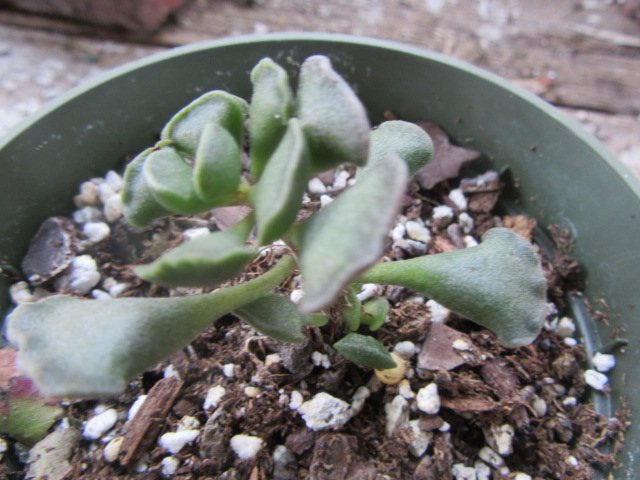
Hmmm… The Ferocactus wislizeni (Fishhook Barrel Cactus) hasn’t looked really great for several years.

Ferocactus wislizeni (Fishhook Barrel Cactus) root system on 6-8-25, #1054-5.

I removed it from its pot to have a look at the roots. To be honest, I’m not sure how alive this cactus really is… Yeah, I know that sounds a little weird… It grew a little from 2022 to 2023, but not from 2023 to 2024. It actually shrunk in diameter 1/2″.

Ferocactus wislizeni (Fishhook Barrel Cactus) after repotting on 6-8-25, #1054-6.

After removing most of the old potting mix and some of the dead roots, I put it back in the same pot with Miracle Grow Potting Mix with a little extra perlite and chicken grit. I noticed a few dead mealybugs, so for now I put it in an area away from the other plants. I’ll keep an eye on it and we’ll see if it grows when I take measurements when I start moving plants inside for the winter…

<<<<+>>>>

Parodia magnifica (Ball Cactus/Balloon Cactus) before repotting on 6-8-25, #1054-7.

The Parodia magnifica (Ball Cactus/Balloon Cactus) is a really neat plant. I brought it home in March 2019 and repotted it in November 2019. It had a really good root system then and needed a larger pot.
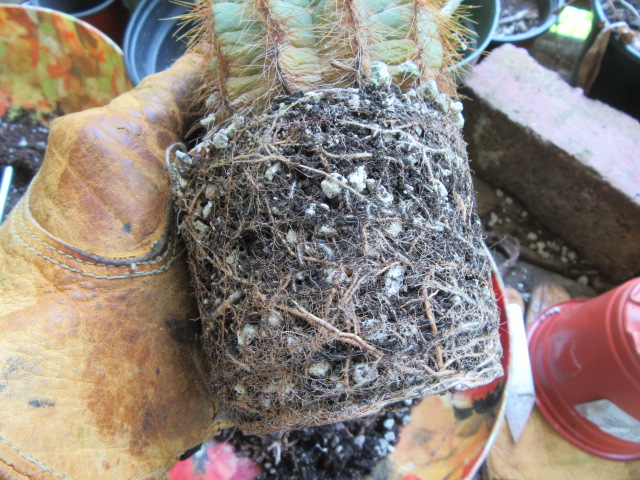
Parodia magnifica (Ball Cactus/Balloon Cactus) root system on 6-8-25, #1054-8.

Well, that is quite a root system! GEEZ!!!

Parodia magnifica (Ball Cactus/Balloon Cactus) in a larger 4 1/2″ tall x 5 3/4″ wide pot on 6-8-25, #1054-9.

After removing most of the old potting mix and some of the dead roots, I put the plant into a larger 4 1/2″ tall x 5 3/4″ diameter pot. I used Miracle Grow Cactus Mix with a little extra perlite and chicken grit. Now, we’ll see how it does.

<<<<+>>>>

June 15…

Ledebouria socialis ‘Paucifolia’ before repotting on 6-15-25, #1058-1.

Well, where do I begin with this one? Actually, the Ledebouria socialis ‘Paucifolia’ is the easy one. It hasn’t grown nearly as much as its cousin which is why it is still in a small pot.
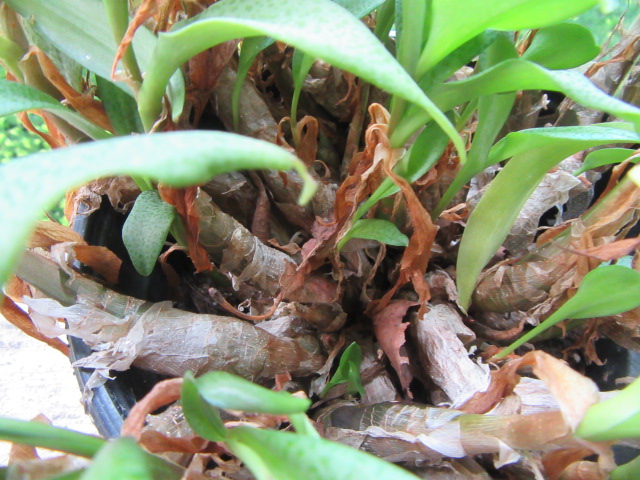
Ledebouria socialis ‘Paucifolia’ before repotting on 6-15-25, #1058-2.

Although not near as crowded as the other one, it is in a smaller pot and still a bit crowded. Looking back at old photos, it was put in a green pot in 2029 and at some point it was put in a somewhat larger black pot. Hmmm…

Ledebouria socialis ‘Paucifolia’ roots on 6-15-25, #1058-1.

It was already growing new roots…

Ledebouria socialis ‘Paucifolia’ in a larger 6″ tall x 9 1/2″ wide pot on 6-15-25, #1058-1.

I pulled the bulbs and roots apart somewhat and put everything in a larger 6″ tall x 9 1/2″ diameter pot. Now it has room to grow more. I used Miracle Grow Potting Mix with a little more perlite and chicken grit.

Ledebouria socialis ‘Violacea’ on 6-12-25, #1056-24.

At some point I need to tackle the Ledebouria socialis ‘Violacea’. It is HUGE!!!

I bought both of the Ledebouria socialis from a seller on Facebook in 2018, so I have had their company for a while now. If you haven’t tried them, I suggest you do. If you want a passalong plant that will produce A LOT, try Ledebouria socialis ‘Violacea’. If you want a plant that doesn’t produce much, try ‘Paucifolia’. They are carefree plants and very easy to grow. Water them regularly during the summer and put them in a cooler room with no water at all during the winter. They have been in the basement with a south facing window over the past two winters with no issues.

<<<<+>>>>

June 27…

Kleinia stapeliiformis (Pickle Plant) before repotting on 6-27-25, #1065-2.

I brought this pot of Kleinia stapeliiformis (Pickle Plant) home from Mast’s Greenhouse in May of 2023. It was from Mr. Mast’s daughters collection. The original stem she used as a cutting was hanging over the pot and there were several smaller “sprouts” a couple of inches tall along one side of the pot. Well, they grew and the original stem broke where it was hanging over the pot (which had grown to about 2′ long). In the spring, I cut the stem that broke in 4 pieces and put them in a pot to see if they would root. The only cutting that survived was the top cutting. Now, I had bought a few cuttings of this species from a seller on Facebook in 2018 and they soon after bit the dust. I was somewhat hesitant to bring home the pot from Mast’s, but I thought anything that weird looking deserved another chance. To be honest, I was surprised they did so well over last summer and even survived the winter on the shelf in my bedroom… But, not only did they survive, they even grew a little during the winter. Since they did so well and looked a little weird on one side of the pot, I thought would al least put them in the middle of the pot…
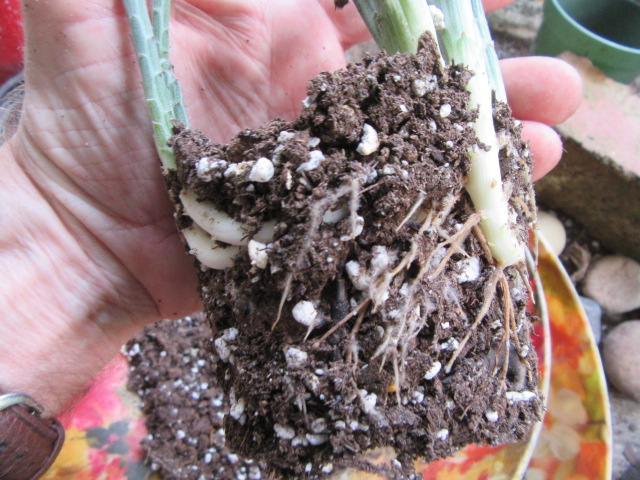
Kleinia stapeliiformis (Pickle Plant) roots on 6-27-25, #1065-3.

So, I carefully removed them from the pot to have a look. I was happy with what I saw.

Kleinia stapeliiformis (Pickle Plant) in a larger 4 1/2″ tall x 5 3/4″ wide pot on 6-27-25, #1065-4.

I didn’t disturb the roots much and carefully put them in a larger 4 1/2″ tall x 5 3/4″ wide pot. I feel like I am whispering… I put the cutting, which hadn’t grown any roots yet, in the pot with the others. I guess it is really their parent… It is the one with the weird shape.
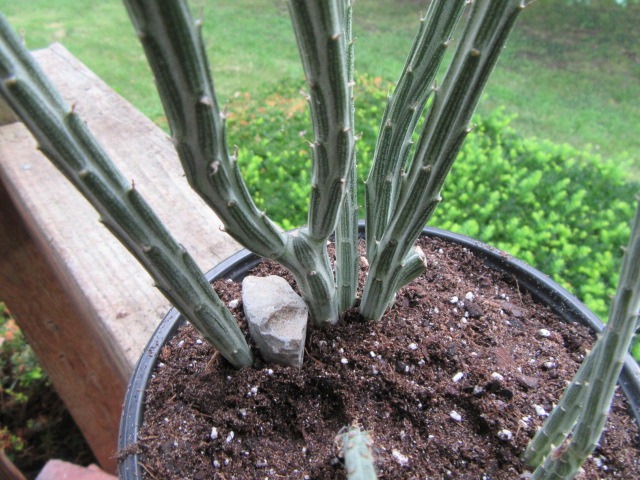
Kleinia stapeliiformis (Pickle Plant) on 6-27-25, #1065-5.

I put in a piece of gravel to hold one of them upright.

When I went to Mast’s on July 3, I walked back to see his daughters collection of plants. A few of her Kleinia stapeliiformis had flowers and seeds. I didn’t have my camera, so I took a few photos with my phone (yeah, I have a cell phone now) but they didn’t come out good. I did get to visit with her and told her I would bring her some Alocasia and the baby Amorphophallus konjac. I guess I should find out her name…

I don’t have a page for this plant yet. I wanted to make sure it would survive…

<<<<+>>>>

Peperomia graveolens (Ruby Peperomia/Ruby Glow) on 6-27-25, #1065-6.

The Peperomia graveolens (Ruby Peperomia/Ruby Glow) is another plant I brought home in 2024 from Mr. Mast’s daughters collection. She first gave me a cutting in 2023, but it didn’t take root. This plant made it through the winter, but wasn’t looking so good. I took it out of the pot and found the stem had broke under the soil and there were just a couple of roots left. SO, emptied the pots old potting soil and put in fresh then buried the plant a little deeper than what it was. Hopefully, it will grow new roots and survive. You just never know…

<<<<+>>>>

Selenicereus anthonyanus (Fish Bone Cactus) before repotting on 6-25-24, #1065-7.

To say the Selenicereus anthonyanus (Fish Bone Cactus) has grown would be an understatement! It only has two leaves sticking out of the pot when I brought it home from Wagler’s Greenhouse in June of 2012. It spent the winter on the kitchen windowsill and continued to grow.
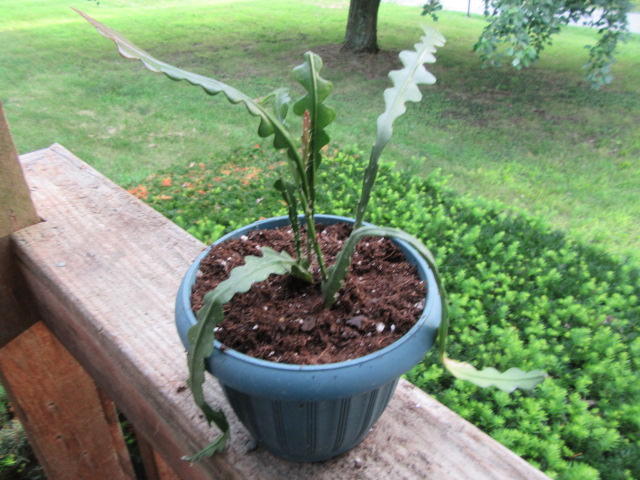
Selenicereus anthonyanus (Fish Bone Cactus) in a larger 4 1/2″ tall x 5 1/2″ wide pot on 6-25-24, #1065-8.

I decided to put it in a larger 4 1/2″ tall x 5 1/2″ diameter pot with Miracle Grow Potting Mix with a little orchid bark. It is an epiphytic cactus from Mexico’s tropical rainforest that grows in trees…
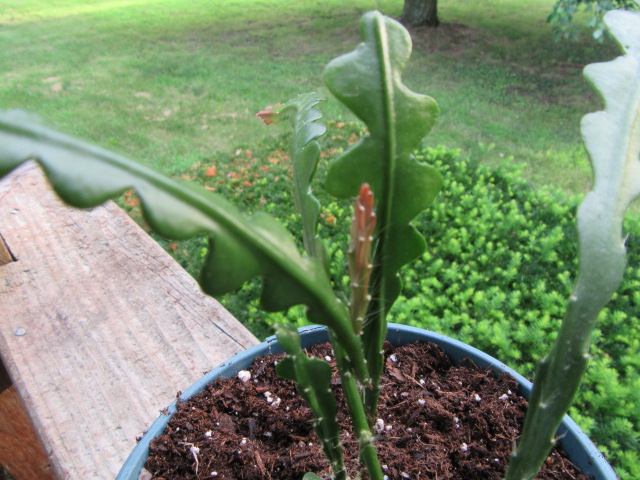
Selenicereus anthonyanus (Fish Bone Cactus) on 6-25-24, #1065-9.

Also known as Ric Rac and Zig-Zag Cactus, this plant is a night bloomer…

<<<<+>>>>

July 2…

x Mangave ‘Inkblot’ before repotting on 7-2-25, #1067-1.

Ummm… I decided it was time to give the x Mangave ‘Inkblot’ a makeover on July 2 and put it in a larger pot. Its kid also needed to be put in a pot of its own. This is an AWESOME plant, by the way.

I need to mention that x Mangave is a hybrid combination of Agave and Manfreda. A few years ago, or whenever it was, I noticed Plants of the World Online said Manfreda (and a few other genera) had become synonyms of Agave. That was kind of confusing for me because there are A LOT of patented x Mangave cultivars. Does that mean the patented x Mangave are now Agave cultivars? Well, I just checked as I was writing this post and it appears Manfreda is ONCE again an accepted genus! So, the hybrid cultivars were once hybrids, then not, now are once again… Now I have to change captions AGAIN… Botanists and taxonomists have to jump few several hoops to change scientific names and it has to be peer reviewed, etc. Then they change the name back AGAIN. What the heck?!?! I’m so glad they have that figured out. 🙂

x Mangave ‘Inkblot’ pup on 7-2-25, #1067-2.

The pup grew almost as tall as the parent…

x Mangave ‘Inkblot’ roots on 7-2-25, #1067-3.

I always think it’s funny how pots get so root bound that the soil disappears. Where does it go?

x Mangave ‘Inkblot’ in a larger 12″ tall x 14 1/2″ wide pot on 7-2-25, #1067-4.

I looked around and found a good-sized pot that I wasn’t 100% happy with. I normally put rocks in the bottom of pots to help with drainage, but this pot has fairly large holes… Oh well, I just went with it. Now, the big plant is in a larger 12″ tall x 14 1/2″ wide pot. Then after I had it finished, I noticed a crack about 3″ long around the bottom of the pot. So, at some point I will have to change the pot again (before the plants come inside for the winter).
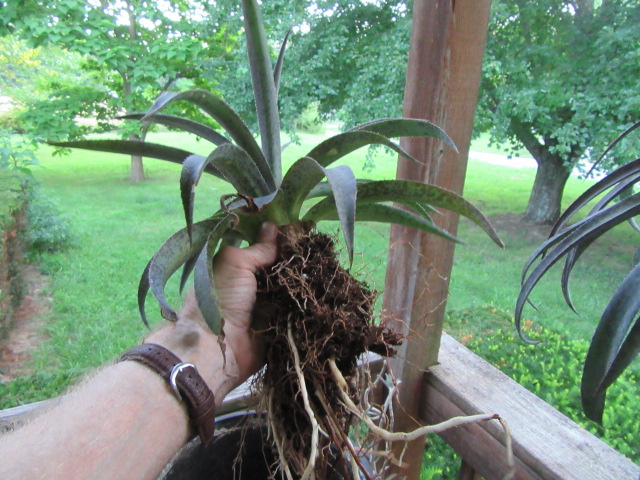
x Mangave ‘Inkblot’ pups roots on 7-2-25, #1067-5.

Now for the pup… I’m not sure why they call the offsets pups… Anyway, it was definitely a good idea to remove the pup from the parent and it really wasn’t attached anymore. It has a nice root system for sure. At least there wasn’t a long runner wrapped around the pot like I have seen before (been there, done that).
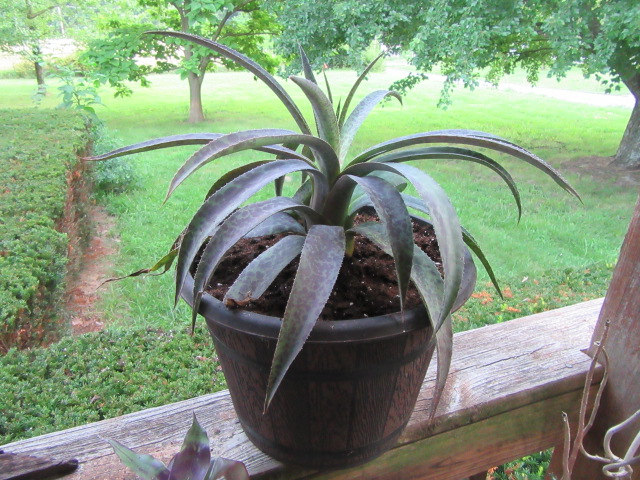
x Mangave ‘Inkblot’ pup in the original 8 1/2″ tall x 10 1/2″ wide pot on 7-2-25, #1067-6.

I put the pup in the original 8 1/2″ tall x 10 1/2″ wide pot.
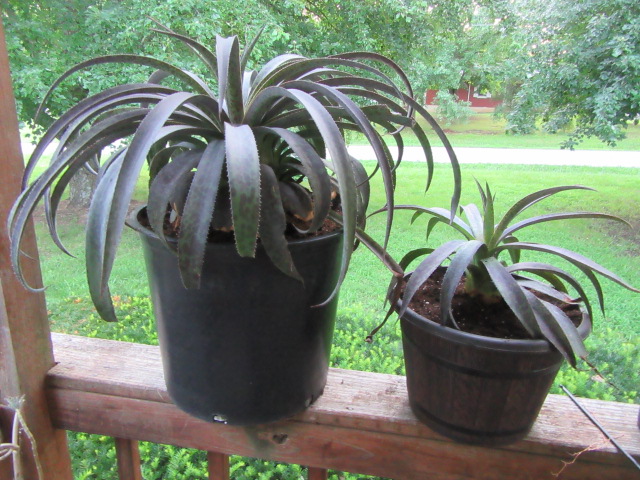
x Mangave ‘Inkblot’ parent and sibling on 7-2-25, #1067-7.

Yep! They were both in the smaller pot…

<<<<+>>>>

July 3…

Callisia fragrans (Grandpa’s Pipe, Etc.) on 7-3-25, #1068-1.

The Callisia fragrans (Grandpa’s Pipe, Inch Plant, Etc.) needed to be repotted, so I put all six in two pots. There were in individual pots, but I decided putting three in two pots would be more than satisfactory. Of course, if they do really well, they will produce a lot of runners and new plants. These plants don’t produce much of a root system, and even with a little neglect, they are virtually indestructible.

<<<<+>>>>

7-10-25…

Mammillaria plumosa (Feather Cactus) before repotting on 7-10-25, #1073-5.

I debated repotting the Mammillaria plumosa (Feather Cactus) for a couple of reasons. For one, I was pretty sure it didn’t need a deeper pot, and two, I thought it might fall apart. 🙂 Now, let me give you a little history (which you can read if you click on it name)… I bought this plant (or clump of plants) from a seller on Ebay in September 2018. It came wrapped in toilet paper and looked like a ball of tiny feathers. I put it in a pot and the rest is history. All you see in the above photo was was what came in the mail only much smaller. It has grown and done extremely well with no issues whatsoever, and it does produce a few flowers. BUT, I don’t believe it has produced any offsets…

Mammillaria plumosa (Feather Cactus) from the top on 7-10-25, #1073-6.

The sides of the cactus were touching the pot in a couple of spots and the soil was almost 2″ from the top of the pot… Well, it hadn’t been repotted since 2019…
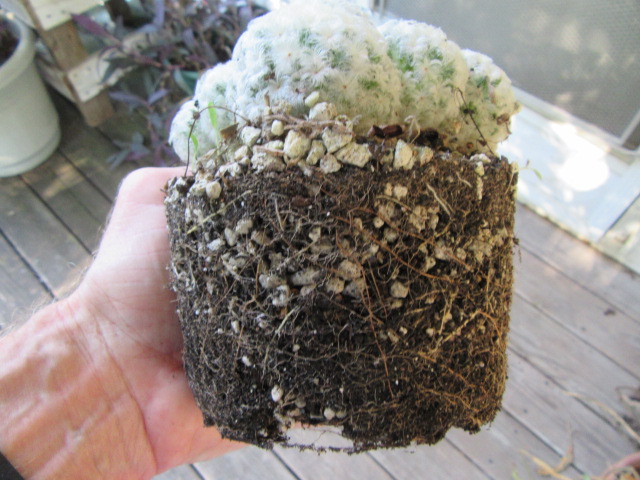
Mammillaria plumosa (Feather Cactus) roots on 7-10-25, #1073-7.

As you can see, there isn’t a massive root system, but still more than I thought there would be. Back in 2019, I used pumice in the mix…

Mammillaria plumosa (Feather Cactus) roots after removing old soil on 7-10-25, #1073-8.

After I removed old potting soil and dead roots, there wasn’t much left. I was very glad the cluster of plants stayed together. I removed the dead roots up to where I saw new ones growing. You don’t have to worry about removing roots because they grow new ones every year. I think I said that before.

Mammillaria plumosa (Feather Cactus) in a larger 5 1/2″ tall x 6 1/4″ wide pot on 7-10-25, #1073-5.

I didn’t like putting it in a deeper pot, but I didn’t have much of a choice for the moment. So, I put it in a 5 1/2″ tall x 6 1/4″ diameter pot with Miracle Grow Cactus Mix with a little additional perlite and chicken grit… I may order a few shallow pots online that are good sized in diameter but shallow. I saw them somewhere…

<<<<+>>>>

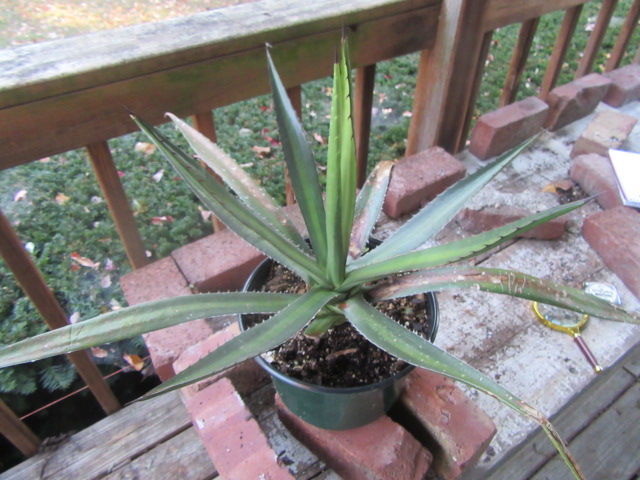
x Mangave ‘Pineapple Express’ before repotting on 7-10-25, #1073-11.

I decided July 10 it was time to repot the x Mangave ‘Pineapple Express’. I knew it would be tough… I brought this plant home in May 2019 and first repotted it in November 2019. Information said it was slow to offset, but it already had one by then which I left in the pot. When I moved the plants inside for the winter in 2020, I counted “about” 10… I could have miscounted. 🙂 I still left them all in the same pot. When I measured the plants as I moved them inside in October 2021, this plant measured 11 1/2″ tall x 20″ wide. In 2023, I decided to put it on the back deck in full sun to see how it would do. Well, it did GREAT but changed colors. Then, when it was inside over the winter, it started loosing leaves and I thought it was a goner. But it survived…  After that, I kept it on the porch on the north side of the house. It did fine after that, but measured only 7 1/2″ tall x 13 1/2″ wide when I moved it inside in October 2024. Both of the x Mangave‘s stayed in my bedroom over the winter, which they did not appreciate, and were very glad to get back outside.

x Mangave ‘Pineapple Express’ roots on 7-10-25, #1073-12.Well, to be honest, I knew it was going to be root bound… I’ve been through repotting LARGE Agave when I was in Mississippi. GEEZ!!!

x Mangave ‘Pineapple Express’ pups on 7-10-25, #1073-13.

And, of course, I knew there had been pups in the pot for several years…

x Mangave ‘Pineapple Express’ in a larger 6″ tall x 6 1/4″ wide pot on 7-10-25, #1073-14.

It was not easy unwrapping the old roots and removing the pups, but I managed to get it done. I put the parent in a larger 6″ tall x 6 1/4″ diameter pot with Miracle Grow Cactus Mix with a little extra perlite and chicken grit.

x Mangave ‘Pineapple Express’ with 7 pups in 4″ tall x 4 1/2″ wide pots on 7-10-25, #1073-15.

I successfully removed five pups but I accidentally broke two… I went ahead and put the two I broke in pots like the other 5. I also put the roots of the two that I broke off in a couple of pots, too. The two I broke off will no doubt grow roots (been there, done that), but I’m not sure if the two with just roots will grow new leaves. Time will tell…

That’s all for this post and I am caught up with the plants I have repotted so far, I still have plenty to repot that I will post about soon.

Until next time, be safe, stay positive, be well, stay thankful, and GET DIRTY!


Fall 2020 Update Part 1: Cactus & Succulents Part 1

Bare plant table on the front porch.

Hello everyone! I hope this post finds you all well. The time of the year has come where I had to bring the potted plants (104) inside on October 15 because an “F” was in the forecast. As usual, we get a ZAP then the temps warm up again. Sometimes I put the plants back outside but that depends on the long-range forecast. It has been very windy for many days and it has been very dry. Monday we had a little shower and a little more yesterday. This morning it has rained quite a lot with thunder and lightning.

This post begins the cactus and succulent update where I photograph and measure the cactus and succulents. I have been measuring plants for probably 10 years, mainly the cactus and succulents. I like doing that because cactus grow so SSSSLLLLOOOOWWW and measuring them is a good way to tell how well they progress from one year to the next.

There will be several posts because I can’t possibly put them all on one… I think I will start the updates in alphabetical order… If you click on the highlighted name of the plant it will take you to its own page (except for a couple that I haven’t made a page for yet).

<<<<Acanthocereus tetragonus ‘Fairytale Castle’>>>>

Acanthocereus tetragonus ‘Fairytale Castle’ at 4 3/4″ tall x 2 3/4″ wide on 10-15-20, #747-1.

First on the list is the Acanthocereus tetragonus ‘Fairytale Castle’. This particular “cultivar” could be a monstrous form of the species. The species can grow to around 23′ tall with stems as long as 10′. Monstrous forms mutate in several species of cactus either in nature or from human intervention and normally grow much slower and remain much smaller than the species. I brought this particular plant home from Wagler’s Greenhouse on 9-13-18 when it was only 3″ tall x 2″ wide. It now measures 4 3/4″ tall x 2 3/4″ wide.

Some have this plant confused with Cereus hildmannianus subsp. uruguayanus (Fairy Castles) which I will discuss later…

<<<<Adromischus cristatus>>>>

Adromischus cristatus (Key Lime Pie) on 10-15-20, #747-2.

Hmmm… That’s all I can say about the Adromischus cristatus (Key Lime Pie). I brought this plant home from Lowe’s on April 23, 2017 and it has been weird. Of course, it looked much better when I brought it home, in fact, it was a very cute plant… It went downhill over the first winter and I thought surely it would die. It didn’t die but it didn’t do much of anything else either. It survived the summer AGAIN so I brought it back in the house for the winter. I guess as long as it wants to live I will support its cause… I have repotted it and provided what it supposedly needs but it doesn’t do anything but survive… Maybe I should talk to it more… 🙂

<<<<Agave univittata>>>>

Agave univittata (var. lophantha) at 13″ tall x 27 1:2 wide on 10-15-20, #747-3.

I kept the Agave univittata (Center Stripe Agave) in a sunnier spot on the front porch this summer instead of the back porch. I tried it on the back porch last year and its leaves seemed to burn a little and left them brown. When I brought this plant home from one of the local Amish greenhouses in 2016 I thought it was going to be a miniature. Well, it was unlabeled and the leaves were short and broad. I have had several HUGE Agave species in the past when I lived in Mississippi and I really liked them, but here my space is limited especially in the winter. As it turned out, this Agave is not a miniature but they don’t get huge. Information suggests this species grows to 12-18 tall x 12-24″ wide. Hmmm… This plant measured 13″ tall x 27 1/2″ wide when I brought it inside. I really do think these leaves should be broader in correct light but I can’t seem to find the sweet spot… It either gets too much sun or not enough…

It is highly possible this plant is NOT an Agave univittata after all. The species has 20 synonyms including Agave lophantha which has several well-known cultivars including ‘Quadracolor’. Several Agave species are variable and its leaves can be a solid color, bi-color, or even tri-color. In the beginning (sometime after creation) these different colors were given separate species names, which were later changed to varieties. This plant here was originally thought to be Agave lophantha, whose common name was the Center Stripe Agave. Later, it was decided it was a variety of Agave univittata. Now even the variety is supposedly a synonym and they just say leaf color is variable. GEEZ!!!

I still use the name Agave univittata var. lophantha because it has a center stripe. It is/was a legit scientific name that was applied to this variety in 1959 even though it is now supposedly a synonym… At one point it was even Agave lophantha var. univittata (1914). After all, this is my blog and I can call it whatever I choose. 🙂 Agave lophantha goes back to 1829 and Agave univittata only dates to 1831… I better stop there.

Agave univittata (var. lophantha) on 10-15-20, #747-4.

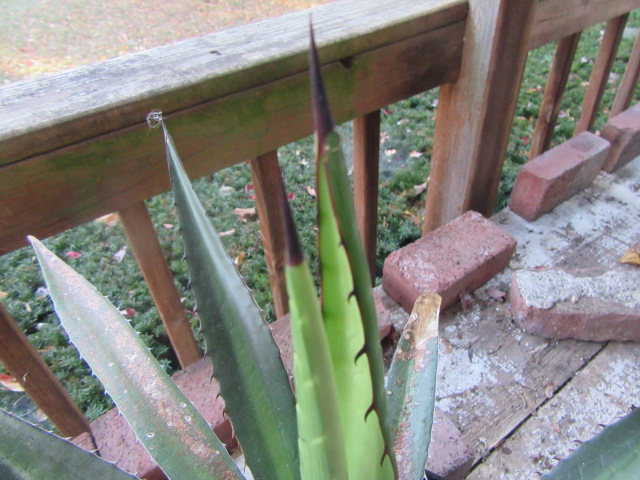
Most Agave species have a VERY sharp needle on the end of their leaves and spines along the margins. Did I mention they are very sharp?

<<<<Agave/x Mangave ‘Pineapple Express’>>>> 

Agave/x Mangave ‘Pineapple Express’ at 9″ tall x 13″ wide on 10-15-20, #747-5.

I always wanted an x Mangave ‘Bloodspot’ but I didn’t see paying the price some online stores were charging for them. Fortunately, I was able to find this Mangave ‘Pineapple Express’ at Muddy Creek Greenhouse in 2019. x Mangave ‘Pineapple Express’ was introduced by Walters Gardens in 2016 and was bred by Hans Hansen. It is a cross between x Mangave ‘Bloodspot’ and x Mangave ‘Jaguar’. It was 4 1/2″ tall x 9″ wide when I brought it home and now it is 9″ tall x 13″ wide. It has the potential to grow 18″tall x 24″ wide… Ummm… I don’t have a page for this one yet.

Agave/xMangave ‘Pineapple Express’ on 10-15-20, #747-6.

I just love the spotted leaves on this plant! It has done very well and is maintaining a nice habit.

The xMangave is, or was, an intergenetic cross between Manfreda and Agave. Unfortunately, those in charge have decided the genus Manfreda is now a synonym of Agave despite its several differences. I had been corresponding with a man from Walters Gardens about a few plants when I bought this one. I mentioned the xMangave was now a synonym of Agave and had no reply. I have now gotten acquainted with a more enthusiastic fellow from Proven Winners, which is a division of Walters Gardens. I wonder what he has to say about name changes. Well, maybe I should wait.

I have to admit I was very excited when I found this plant as an x Mangave but not so much as an Agave. I am not certain if I am ready to call it Agave ‘Pineapple Express. There is something about it being an intergenetic hybrid that makes one tingle. Besides, Agave doesn’t have spotted leaves!!! 🙂

<<<<Aloe juvenna>>>>

Aloe juvenna on 10-15-20, #747-7.

In 2009 I was plant shopping in a Wal-Mart store in Greenville, Mississippi and I saw a piece of a plant on the shelf. I looked around and found a similar potted plant labeled Aloe squarrosa. In 2012 I brought home another similar plant labeled Aloe zanzibarica (Zanzibar Aloe). When I was doing research for the blog I found out there was no scientific name for Aloe zanzibarica and my Aloe squarrosa was actually an Aloe juvenna. In fact, both plants were Aloe juvenna. I gave up those two plants but found the one I have now from Wagler’s Greenhouse in 2017. I think I may have given her this plant in the first place. Anyway, Aloe juvenna are easy to grow and pretty carefree. They are happiest when you leave the colony all together in a pot. You can propagate this one from offsets as well as stem cuttings although it may take them a while to root… Normally, this plant is nice and green if you don’t give it too much sun but for some reason, it started looking a bit off last winter…

<<<<Aloe maculata ‘Kyle’s Grandma’>>>>

Aloe maculata ‘Kyle’s Grandma’ on 10-15-20, #747-8.

I have the longest history with the Aloe maculata ‘Kyle’s Grandma’ than any other succulent here. When I was living in Mississippi, a friend of mine brought me a couple of offsets from his grandmother’s Aloe (spring 2009). I didn’t know what species it was at the time, so I called it Aloe ‘Kyle’s Grandma’. I had even met his grandmother yet but they all liked it that I named the plant after her. I named a lot of plants after the people who gave them to me. Anyway, at first, I found out this Aloe was Aloe saponaria, which it was at the time. When The Plant List first came online in 2010 I found out Aloe saponaria was a synonym of Aloe maculata. As usual, were a few differences between the two species, mainly having to do with their inflorescence (flower cluster). I was told, of course, the species is variable… Whatever you choose to call them, Aloe maculata is a great plant that freely offsets. I have literally potted HUNDREDS of these plants and gave them away to friends or anyone that wanted one. These plants will get HUGE and prefer their offsets to be removed from the pot. If you don’t do that you will have a big problem… The main plant in this pot grew to 19″ tall x 42″ wide by the time I moved the plants inside on October 11 last year. Unfortunately, it died in the spring before I moved the plants outside. I had screwed up and put the pot on the back porch one fine sunny day before spring arrived. I am not sure if it got too cold or if it was too much sun all at once. Whatever happened, it died leaving behind a bunch of orphans… I intended to put them in their own pots but got so busy I didn’t have time… So, here they are still in the pot on October 15… If you want to read more about this plant and my history with them, click on the name above.

<<<<Aloe x ‘Lizard Lips’>>>>

Aloe x ‘Lizard Lips’ on 10-15-20, #747-9.

Aloe x ‘Lizard Lips’ was the first Aloe I purchased when I was living at the mansion in Leland, Mississippi.  I brought it home from Lowe’s in 2009 and we have had our ups and downs… I gave an offset to Mrs. Wagler (Wagler’s Greenhouse) in 2013 and I was glad I did. After I gave up a lot of my plants in 2014, I had to start over again in 2015. Well, I brought home the offset I had gave to Mrs. Wagler the year before… 🙂

Aloe x ‘Lizard Lips’ was hybridized by John Bleck using the offspring of Aloe descoingsii x Aloe calcairophila and crossing it with Aloe bellatula. It is a nice miniature Aloe that offsets like crazy which can pose some interesting issues… The pot gets so full it becomes hard to give it enough water… I gave the plants a good dose of water the day before I moved them inside, but this pot is very light and feels like it had no water at all. GEEZ!!! However, even though it looks sad, it is flowering so it is happy. 🙂

The cluster of plants is approximately the same size as it was in 2019 with nothing exciting to report. Right now it is flowering again which it does periodically throughout the year, inside or out.

Aloe x ‘Lizard Lips’ 10-15-20, #747-10.

Shriveling of its leaves is fairly common when it needs water or if it is getting too much sun. If it does this because it is cold and wet, you have an emergency on your hands. That was a problem I had with it a few times when I lived in Mississippi but I was a newbie at the time. During the summer, water once a week if it needs it, but no matter what, control yourself during the winter. One reason my succulents are in the back bedroom is so I won’t be looking at them every day and be tempted to water them too often. Once or twice during the winter is enough…

Not all Aloe species and hybrids are easy to grow. I have lost a few over the years because they were weird…

<<<<x Alworthia ‘Black Gem’>>>>

x Alworthia ‘Black Gem’ at 5 3/4″ tall x 10″ wide on 10-15-20, #747-11.

The x Alworthia ‘Black Gem’ is a great plant for sure. It is an intergeneric hybrid between Aloe speciosa and Haworthia cymbiformis. I brought this plant home from Wildwood Greenhouse on May 9, 2019 when it was 3 1/2″tall x 6 1/8″ wide. I put it in a larger pot on November 13, 2019 and it has done very well. Now it is 5 3/4″ tall x 10″ wide. I really like this plant and its dark green leaves.

I keep getting confused between intergeneric and intergenetic. When I think of “generic” it reminds me of generic brands of food and drugs. Intergeneric is the hybridization between two genera while intergenetic deals with genes. The “x” before the plant name indicates it is an intergeneric hybrid… I checked to make sure Haworthia cymbiformis is still a Haworthia species. 🙂

<<<<Aristaloe aristata #1>>>>

Aristaloe aristata #1 on 10-15-20, #747-12.

I brought this Aristaloe aristata home from Wal-Mart on March 19, 2018 and it always did well until I messed up. I put it in a larger pot in November 2019 which probably would have been fine. But, toward the end of the winter before I moved the plants outside in the spring, I gave several of the more root-bound Aloe a good soaking. Well, I did it with this one too which I shouldn’t have done since it was in a new and deeper pot. As a result, the lower roots rotted and it started going downhill. I put it in a shallower pot and removed its three offsets and it started slowly recovering. Not knowing if it would recover is the reason I had Nico from Succulent Market send the new one (which I wrote about a couple of posts ago). I didn’t measure this plant this time around because it had shrunk A LOT since so many of its lower leaves died. Right now, the plant from Nico is bigger than this one… OUCH! Live and learn…

<<<<Austrocylindropuntia subulata>>>>

Austrocylindropuntia subulata (Eve’s Needle) at 4 1/2″ tall on 10-15-20, #747-13.

Austrocylindropuntia subulata is definitely a mouth full and you can’t say it really fast three times. I brought this plant home from Wagler’s Greenhouse in November 2019 when I went out to see if she had more Christmas (Holiday) Cactus. The one I brought home from her earlier had a peach label and it turned out to have pink flowers… Anyway, she didn’t have any more peach but I did bring this delightful little Eve’s Needle home. It was very small at the time but it has grown to 4 1/2″ inches. I had a HUGE Austrocylindropuntia subulata f. cristata (Crested Eve’s Needle) but it died in over the 2013-2014 winter. It was AWESOME and I haven’t found a replacement so far.

I don’t have a page for this plant yet…

Well, I got through the “A’s”. There are no “B’s” so I will start with the “C’s” through part of the “E’s” on the next post.

Until next time, be safe and stay positive. Stay well and always be thankful…


Fall 2019 Cactus & Succulent Update Part 1: A’s

Acanthocereus tetragonus (Triangle Cactus) at 4 1:2 T x 2 7:8 W, 10-11-19

Hello everyone! I hope this post finds you all well. I decided to break the cactus and succulent update into several posts instead of making one long post. They are all inside now except for the Cylindropuntia imbricata (Tree Cholla), a few Sedum, and the Sempervivum x ‘Killer’ that always overwinter outside. Hmmm… I forgot to take their photos. In the midst of the updates, I will probably make a few posts to highlight specific plants.

On October 11 I moved all the potted plants inside as I mentioned earlier.  As always, once we get ZAPPED the temps warm back up. So, I moved the cactus and most of the succulents back outside for a few days again. I even put the Alocasia that was on the front porch back on the front porch. 🙂

Now, on with the post. In alphabetical order… Just click on the name of the plant if you want to view their pages. I may or may not have all their pages updated. If you do go to their pages and happen to click on the link to Llifle (Encyclopedia of Living Forms) at the bottom of the page, you may notice it isn’t working well… I sent an email to who I think maintains the site and at least now it does open but it is still not functioning properly. Hopefully, he will get the issue solved because it is an AWESOME website.

The above photo is the Acanthocereus tetragonus commonly known as Triangle Cactus, Fairy Castle, Barbed Wire Cactus, Sword Pear, Dildo Cactus, and Night Blooming Cereus. Some of those names are also associated with other cactus. The species is often confused with Cereus hildmannianus subsp. uruguayanus. Very similar in several ways, but different in many. I had a cactus in 2015 that I gave up on identifying because it was similar but different… Now I think it was probably an Acanthocereus tetragonus, too. They grow very large in the wild, but smaller monstrous forms are what is generally found in the retail market. So, while the native plants are called Triangle Cactus and so on, someone gives the miniatures smaller names like Fairy Castles. That gets very confusing for people when they buy unlabeled plants or have generic tags that say “Cactus”. Then they get confused between Fairy Castles and Fairytale Castle which are two different species.

I brought this plant home from Wagler’s Greenhouse in September 2018. It measured 3″ tall x 2″ wide when I brought it inside last October 10 and now it is 4 1/2″ tall x 2 7/8″ wide. The offsets have grown quite a bit as well. It was in full sun on the back porch all summer so it has a nice tan. Hmmm…


Adromischus cristatus (Crinkle Leaf Plant, Key Lime Pie) on 10-11-19, #639-3.

Ummmmmmmmmmmm……… I know the Adromischus cristatus (Crinkle Plant, Key Lime Pie) doesn’t look all that hot, but it is better than it has been for a long time. It was very small and cute when I bought it from Lowe’s in April 2017 and grew to 4″ wide by October 17 when I moved the plants inside. Over the winter it became very weird and kind of went dormant. It got down to almost nothing and I expected it to die. When I repotted it in 2018 it didn’t seem to help much. I thought surely it would die again during winter. But, guess what? It didn’t die. So, I repotted it a few months ago and it perked up. Hopefully, it will survive the winter without losing most of its leaves and do even better in 2020. The only thing different was adding pumice (50/50) instead of additional perlite and I didn’t add any chicken grit. Using pumice takes the place of amending with additional perlite and grit.


Agave univittata (var. lophantha) (Center Stripe Agave) at 13″ T x 26″ wide on 10-11-19, #639-4.

WELL… This past summer the Agave univittata (var. lophantha) (Center Stripe Agave) has been in full sun on the back porch. I always had it in light shade during the summer pretty much since I brought it home in July of 2016. Back then it had much broader and shorter leaves and I thought perhaps they grew longer because it wasn’t getting enough sun. But, even in full sun, the new leaves this past summer grew long as well. So, maybe this is normal… Maybe that is a good thing because it would look weird with long leaves on the bottom and short, fat leaves on the top. Of course, there are a few Kalanchoe daigremontiana (Mother of Thousands) growing in the pot. Oh, the Agave now measures 13″ tall x 26″ wide.


Agave (Syn. x Mangave) ‘Pineapple Express’ at 4 1/2″ T x 9″ W on 10-11-19, #639-75.

For many years I wanted to try an x Mangave so I was happy to find a few ‘Pineapple Express‘ to chose from at Muddy Creek Greenhouse on June 13. “Pineapple Express” was a 2016 introduction from Walters Gardens and is a cross between x Mangave ‘Jaguar’ and ‘Bloodspot. The x Mangave are/were created by crossing Agave species with Manfreda species. Well, that is until someone had the audacity to decide the genus Manfreda is synonymous with Agave… That is weird because there were several differences between the two genera. Hmmm… In time, this plant will grow to 18″ tall x 24″ wide but for now it is just 4 1/4″ tall x 9″ wide. I can tell it has grown since I brought it home but somehow I forgot to measure it then. If you think that is strange, I haven’t got a page for it yet!


Spotted leaves of the Agave (Syn. x Mangave) ‘Pineapple Express’ on 10-11-19, #639-76.

I really like the spotted leaves which may come from Manfreda maculata, I mean Agave maculata. 🙂


Aloe juvenna (Tiger Tooth Aloe) on 10-11-19, #639-5.

I have had Aloe juvenna (Tiger Tooth Aloe) since 2009 when I rescued a broken piece from Wal-Mart in Greenville, Mississippi. I was Aloe newbie at the time and I thought it was strange it took it almost a year to root. I brought home the above Aloe juvenna from Wagler’s Greenhouse in 2017 and the longest stem in the clump is now 14″ long. This is one plant you want to keep in the right amount of sun. To much shade and the leaves stretch. To much sun and the leaves burn… I think the front porch has been a good spot in the summer with a south-facing window in the winter.


Aloe maculata at 19″ T x 42″ W on 10-11-19, #639-6.

Hmmm… This is what happens when your Aloe maculata is happy! Give it a little attention by complimenting it once in a while and put it where it can be noticed and it will be very happy. It grew its first flower this summer. It’s grandmother, not sure how many greats to add, was given to me by a good friend when I was living in Leland, Mississippi in 2009. I didn’t know the name at the time, so I called it ‘Kyle’s Grandma’ because the offset came from Kyles’s grandmother. The plant in the above photo had growing issues for a while because it wasn’t getting much attention by the shed where the plants used to be. Once I had to move the plants to the front porch last summer because of the Japanese Beetle invasion, I started paying attention to it more. I gave it a new pot and new soil and put it by the steps and it took off. This past summer it has grown like crazy to a whopping 19″ tall x 42″ wide. I need to get the pups out of the pot soon! It is quite a show stopper!


Aloe x ‘Lizard Lips’ at 6″ T x 12″ W on 10-11-19, #639-7.

OH, the Aloe x ‘Lizard Lips’! My second Aloe in 2009 was a ‘Lizard Lips I bought from Lowe’s in Greenville, Mississippi. I had it until I gave up most of my plants in 2014 but I found another when I started collecting again in 2016. Luckily, I had given an offset to Wagler’s Greenhouse so this clump could actually be that offset. It has been a great miniature Aloe, but we have had to learn a few things about each other over the years. My original plant almost died every winter but barely hung on somehow. Apparently, although it was in a beautiful glazed pot, it didn’t like it. Attention is not so much of a requirement (it doesn’t like hugs like Aloe maculata) just as long as you water it when it is thirsty and give it the right amount of sun. It particularly seems to like a bigger pot AT LEAST once a year although it didn’t get one yet in 2019. The potting soil has to be VERY well-draining because it absolutely does NOT like wet feet. That is no problem because there are so many leaves barely any water gets into the soil. It is also a prolific bloomer, sometimes up to 8 stems at the same time. Currently, the clump has filled the pot and measures 6″ tall x 12″ wide.


x Alworthia ‘Black Gem’ at 4 1/2″ T x 8″ W on 10-11-19, #639-9.

The x Alworthia ‘Black Gem’ has been a delightful little plant for sure. It is a hybrid of Aloe speciosa and Haworthia cymbiformis. It has grown A LOT and is currently 4 1/2″ tall x 8″ wide. I notice it definitely needs to be repotted. It was 3 1/2” tall x 6 1/8” when I brought it home from Wildwood Greenhouse in May. It appears this plant will be quite a clumper…


Aristaloe aristata (Lace Aloe) at 4 1/2″ T x 8 1/4″ W on 10-11-19, #639-10.

The Aristaloe aristata (Lace Aloe) is always bright and beautiful! It has always been happy and carefree since I brought it home from Wal-Mart in March 2018. It was originally named Aloe aristata, but phylogenetic studies show the Aloe genus is polyphyletic and this unusual species IS NOT an Aloe. It is closely related to the Astrolabes and to the four Robustipedunculares species of Haworthia. Because its genetics are unique, this species was put a new genus of its own. It was 2 3/4” tall x 4 1/2” wide when I brought it home and now measures 4 1/2″ tall x 8 1/4″ wide. This plant grew quite a lot over last winter inside, so I think I need to give it a larger pot…

Well, that’s it for the A’s. I hope you enjoyed this page as much as I have enjoyed these plants as companions.

Until next time, take care and be safe!

Sunday Photos on Wednesday

Amorphophallus sp. on 6-16-19, #591-5.

Hello folks! I hope this post finds you well. The Robins are singing this morning, giving thanks for being the early bird who gets the worms. I remember walking to catch a ride for work at 4:30 AM and they were already hopping about singing. It was quite a chorus! I am just going to post a few highlights of the photos I took on Sunday.

Of all the plants budding and flowering, it is always AWESOME to see the Amorphophallus (Voodoo Lily) when it starts coming up. I stuck my finger down to where the corm was and noticed it was sending up a petiole, but it wasn’t until the 6th of June that it peeked through the soil. Then I noticed on Sunday the leaves were starting to emerge. It is pretty neat! Almost reminds me of a squid. Last year I was gradually rewarded with a lot of babies, so I am wondering how many there will be this year. Of course, it is has been three days since I took the above photo.


Alocasia ‘Mayan Mask’ on the front porch on 6-16-19, #591-2.

This Alocasia ‘Mayan Mask’ on the front porch is doing great now. It spent the winter in my bedroom but was very glad to get back outside.


Aloe juvenna on 6-16-19, #591-3.

The Aloe juvenna (Tiger Tooth Aloe) is quite an interesting Aloe. It needs bright light or the leaves will stretch. In full sun, the leaves will take on a reddish color and too much will burn their leaves. I don’t like my Aloe leaves to burn and at times it hasn’t had enough sun. So, the leaves on this cluster, some being short and some longer, reflect when it has had different periods of light.


xAlworthia ‘Black Gem’ on 6-16-19, #591-4.

I don’t know much about the xAlworthia ‘Black Gem’ since I haven’t had it very long. I still need to check its roots to see if there is a plug wrapping around them… I am curious because I can see the plug wrapping around the Gasteria ‘Little Warty’…


Aristaloe aristata on 6-16-19, #591-6.

The Aristaloe aristata (Lace Aloe) and family are doing very well. I am wondering if it will flower? It is a very nice plant and I am thankful to have found it. You just never know what rarities you will find.


Astilbe x arendsii ‘Fanal’ on 6-16-19, #591-7.

The Astilbe x arendsii ‘Fanal’ is STILL flowering. This is a very nice plant and if you haven’t tried one and have the chance to bring one home, I suggest you do.


The left side of the north bed on 6-16-19, #591-8.

OK, I have to admit the north bed is driving me crazy. That even made me laugh! First of all, the Achillea millefolium is NOT supposed to be there. I try to pretend they aren’t there but the taller they get the harder that becomes. There are actually two there, but one decided to lay down on the job. I suppose it thinks if it lays down it is hiding. I moved the mother clump to the barn last year then these came up this spring along with several others closer to the house. I “intended” to move them to the south bed, so hopefully, I can get that done this week when I “hopefully” have a chance to work there. They need to be moved because the Colocasia ‘Coffee Cups’ is hidden behind them. So is the Echinacea ‘Cherry Pops’ that miraculously returned unexpectedly. Oh, yeah I almost forgot… The two Conoclinum coelestinum that decided so come up are under it. You never know if, when or where they will pop up. I also planted the Xanthosoma robustum to the right of the Astilbe but apparently, it rotted. A friend from Alabama is sending me a Xanthosoma sagittifolium so it will go somewhere between the Astilbe and the Leucocasia gigantea ‘Thailand Giant.


Right side of the north bed on 6-16-19, #591-9.

The right side of the north bed… OK, a series of things… First off, I wanted to extend the north bed out farther. Since my son and his friend are here, and they “said they would help out”, I told them they could extend the bed. I showed Chris what I wanted him to do, in detail. When they said they were finished, they had just dug one strip from the end of the gutter to where it joined with the left curve. It was not even straight. 🙂 I had told him to turn over everywhere there wasn’t plants and to remove the grass. He said, “Oh, I thought you wanted a ditch.” Now, why would I want a ditch? Needless to say, I went ahead and planted the Colocasia esculenta rhizomes and Leucocasia gigantea ‘Thailand Giant’.

Trust me, this bed is normally neat and tidy but this spring has been officially weird. It has rained off and on then the soil stays damp here. Then sometimes when I have time to work here the soil is damp or the grass and weeds are kind of wet. I do not like working in damp soil because it can make it hard. I don’t like working in damp grass and weeds because the chiggers seem to be worse. I rate chiggers at the top of the “do not like” list with poison ivy, thorns (Roses), flat tires, dead batteries, and mosquitos. Eventually, this bed will look great.


The northeast corner bed on 6-16-19, #591-10.

The northeast corner bed looks pretty good especially since Thor seems to be doing a pretty good job keeping the moles away. The only plant you can’t see is the small mound of Achillea tomentosa ‘LoGrow Goldie’. Ummm… It is now under the Salvia coerulea ‘Black and Blue’. So, I guess I need to move it. Maybe to the left of Thor in front of the Colocasia ‘Distant Memory’. There are a few Conoclinum coelestinum in this bed now, too. One next to Thor and a few that have recently came up under the Salvia. This is a small area but I have a tendency to pack plants in it anyway. It looked really good last year.


Begonias on the front porch on 6-16-19, #591-13.

Three of the Begonias are doing well but ‘Brazilian Lady’, which is normally looking great, is a pitiful sight. Normally, I keep them in the basement over the winter where they do fine but I kept them in the front bedroom this year. ‘Brazilian Lady’ didn’t approve…


Miniature Begonia on 6-16-19, #591-12.

The unnamed miniature Begonia did fine during the winter but half rotted when I moved the plants outside. Now I need to re-pot it.

Well, the deadline for naming this post “Sunday Photos on Tuesday” has past. I just looked at the time at it is 1:11 AM Wednesday… SO, I suppose that means I should go to bed and finish later. That screws up my next post and hoping to write a post a day. 🙂 I had to change the title of this post to “Sunday Photos on Wednesday”.

—-

OK, now I am back working on the post at 4:22 PM when I really want to take a nap. I have been digging thistles for about 3 hours.

Euphorbia mammillaris (Indian Corn Cob) on 6-16-19, #591-15.

The Euphorbia mammillaris (Indian Corn Cob) is going GREAT although it looks pretty much like it did the last time I took photos. I think maybe the leaves have grown a little. 🙂


Gasteria obliqua (Ox Tongue) on 6-16-19, #591-18.

This Gasteria has remained unnamed for a while so I have resorted to making a decision to call it Gasteria obliqua. Most Gasteria species of this type have rough leaves and very few are smooth like this one. Since those species are all now synonyms of G. obliqua, I guess that narrows my choice down to one. Unless it is a cultivar or a hybrid… I posted photos on a few Facebook groups twice but only got a few “likes” and no suggestions. One lady said it could be ‘Little Warty’ but that would be impossible. I clearly said it has smooth leaves and ‘Little Warty’ has warts. So, for now, it is Gasteria obliqua.

Gasteria obliqua has 39 synonyms!


Haworthiopsis limifolia (Faries Washboard) on 6-16-19, #591-20.

The Haworthiopsis limifolia (Faries Washboard, File Leafed Haworthia) is a pretty neat plant. There is a strange issue, however, with the species. Well, maybe not an issue, just issues. Apparently, there are several “varieties” which can get a little confusing when you do a little research about Haworthiopsis limifolia. You have to dig a little deeper. There are many photos online of Haworthiopsis limifolia (Syn. Haworthia limifolia) that look nothing like this plant. That is because they are not using the “variety” name. Then there are MANY websites that have the spelling completely wrong by using the name Haworthiopsis limafolia… The many “varieties” made me wonder if the name “Faries Washboard” was a common name or cultivar name. Well, the straight species is known as Fairies Washboard or File Leafed Haworthia. Llifle (Encyclopedia of Living Forms) says, “It obtained its name “limifolia” (File Leafed) from the distinctive, dark brownish-green leaves, with transverse ridges of raised, horny, tubercles which resemble those of a coarse file and give it such a distinctive appearance.” Hmmm… Dave’s Garden says limifolia = From the Latin limes (file), referring to the acicular or linear leaves.


Houttuynia cordata ‘Chameleon’ on 6-16-19, #591-22.

The Houttuynia cordata ‘Chameleon’ is STILL in the pot I brought it home in. I have not decided where I want to put it to spread and pop up here and there. It seems I already have enough plants that pop up unexpectedly, but maybe for this one it would be OK. It is just the re-seeders that take their sweet time coming up that throw me a curve. Most perennials can be moved here early enough in the spring. But, from my past experience with this one in Mississippi, no telling where it will show up. I am not going to talk about the Equisetum hyemale (Horsetail) in this post. I promise. 🙂


Ledebouria socialis var. violacea on 6-16-19, #591-30.

One of the most important discoveries of late was the bud on the Ledebouria socialis var. violacea (Silver Squill) on June 8. Then I noticed it had another one on the 16th.


Ledebouria socialis var. pauciflora on 6-16-19, #591-28.

Then when I went to take a photo of the Ledebouria socialis var. pauciflora, it had one, too! NICE! I am beginning to really like these plants. My plant friend from Alabama is going to send two more and a Drimiopsis maculata, which is similar.


Stapelia gigantea on 6-16-19, #591-41.

The Stapelia gigantea is doing very well and growing. I can hardly wait until it flowers. It is in the same group of plants as the Huernia schneideriana. It is a Carrion Plant, too, whose common name is Zulu Giant or Toad Plant. 🙂 I bought this plant from a seller on Ebay last fall and he sent SIX rooted cuttings which I put in the same pot. Hmmm…

Well, I think I am going to close this post before I have to change the title again. I was distracted earlier by a nap, then I started re-arranging the potting table on the back porch. Then I had to re-pot a couple of cactus. I need to eat dinner, but I wanted to get this post finished first. Now it is already 9:07 PM!

Until next time, be safe, stay positive and always be thankful. If you have time, GET DIRTY!