It was 5 PM, I think, on Saturday the 11th when I decided to go to the back of the farm to check on the fences, I took these photos along the way. Now, I fully intended to make this post later that evening, but one thing led to another. SO, here we go!

Seems like you can go nowhere without being watched around here. We still have 10 cats, I think. Several have died since I last blogged, but at least we won’t be having more kittens.

This is a new cactus I acquired last year from Wagler’s Greenhouse. She said it would survive through the winter outside. It is a good thing, because when i was moving plants inside I completely forgot about it. It was over shadowed by the Celosia ‘Cramer’s Amazon’ in the flower bed where I put it. I have no idea what the genus and species name is YET because, like so many other of her plants, she had no idea either. GEEZ!!! You know how that drives me NUTS! Like I said, I had forgotten all about this cactus until one night in January I remembered. It was very cold that night, but I went outside with the flashlight to check on it. It was fine. WHEW!
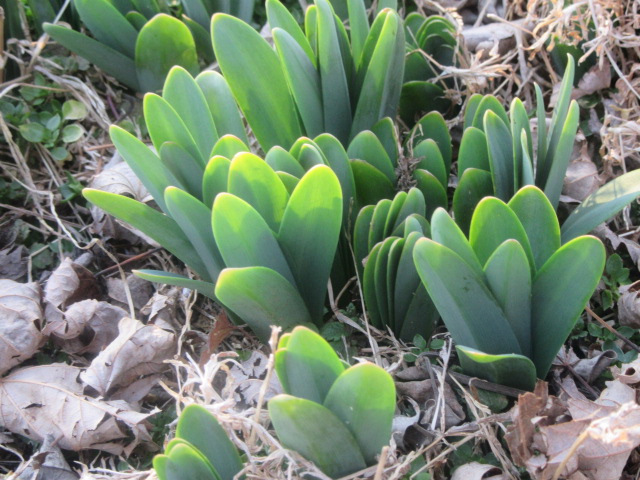
Amaryllis belladonna on February 11, 2017.
The temperatures have been so warm lately that there are signs of life. The Amaryllis belladonna (Surprise Lilies, Naked Ladies, etc.) are up. I am not sure when they usually come up but I imagine I have other photos from pervious years.

Grape Hyacinth (Mascara armeniacum) on February 11, 2017.
The Grape Hyacinths are coming up by the chicken house. As are the…

Achillea millefolium on February 11, 2017.
Fern-Leaf Yarrow.

The chicken house is all closed up for the winter. Yeah, I know it needs painted. It kind of gives a rustic appearance wth the paint falling off, though. Grandpa built this chicken house maybe in 1958-1960. It was a plan provided by the Missouri Poultry Association. Well, that may not have been what they called it. I found it in the old 1952 year book I used to have. I collected a lot of old poultry books when I was in the hatchery business in the early 1980’s.
Now, let’s go inside.
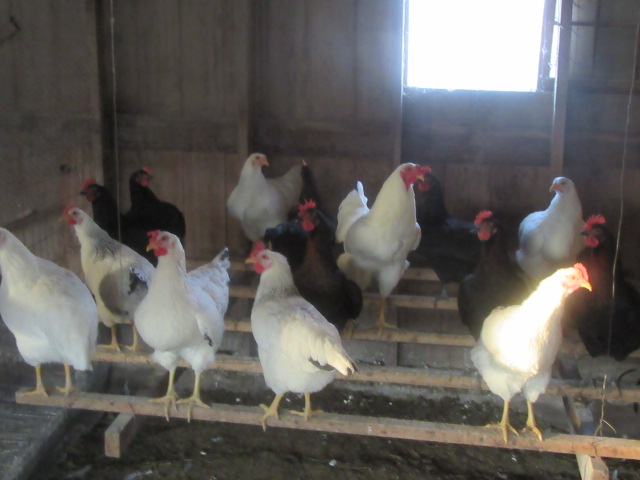
The bigger chickens were all on the roost ready for bed… 4 Delaware hens, 7 black sex-link (we used to call them Rock Reds because they are the progeny of Barred Rock hens with Rhode Island Red roosters), 3 White Chantecler hens, 1 White Chantecler rooster. BUT there us one rooster missing!!!
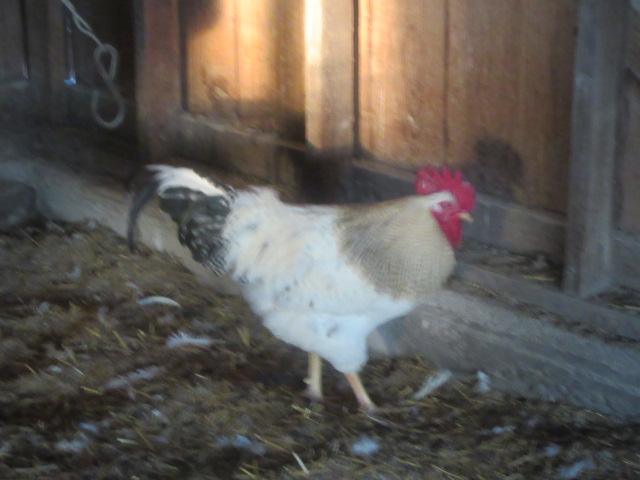
The big Delaware rooster. He is HUGE and he thinks he is the sheriff now. I butchered the other two Delaware roosters a couple of weeks ago because this Delaware and the White Chantecler were fighting them because they were on the bottom of the totem pole. It is strange how well this Delaware and the White Chantecler get along.
The Delaware was originally a sport of the black sex-link cross.

This is a closer photo of the White Chantecler rooster. They were developed in Quebec, Canada by the monks of the Cistercian Abbey under the supervision of Brother Wilfred Chatelain. There were no breeds of chickens that had been developed in Canada. Brother Wilfred’s goal was to develop a breed that was more suitable for the cold conditions of Canada that was a dual purpose breed. As you can see, they have a small cushion type comb and hardly any wattles. Work began on creating this breed in 1908 but wasn’t released to the public until 1918. The Chantecler was created by first crossing a Dark Cornish male (pea comb) with a White Leghorn female (single comb), and a Rhode Island Red male (single comb) with a White Wyandotte female (rose comb). The following season pullets from the first cross were mated to a cockerel from the second cross. Then selected pullets from this last mating were mated to a White Plymouth Rock male, thus producing the fowl as seen today. They were admitted to the American Standard of Perfection in 1921. Interesting how crosses with pea, rose and singe comb parents produced offspring with a cushion comb… Actually, there are rose comb White Leghorn and Rhode Island Red.
Later, another variety, the Partridge Chantecler, was developed. In the 1980’s I wanted to get a start of White and Partridge Chantecler’s for the hatchery. BUT they were quite rare. They still are, for the most part. These cost me about $9.00 each. OH, but I have paid more. In 1985 I bought 12 Red Shouldered Yokohama hatching eggs for $120.00… They had been covered in sheep poop and then washed… Only 2 hatched. YES, they became pets and slept in a box on the back porch until the rooster started crowing.

This is one of the White Chantecler pullets. I will put the White Chantecler’s in a separate pen later…

The bigger chickens were on the roost ready for bed, but the Old English Game Bantams were still wide awake. It was still daylight, so I asked them if the wanted to go outside for a while. Well, I never have to ask them twice. I opened the door to their pen and they eagerly followed me to the outside door.

They wasted no time snacking on some green weeds. 3 Hens and 3 roosters. I was supposed to dub their combs and wattles, but I decided not to this time around. Well, they are Old English Game and it is a custom to dub them. I was watching a video on YouTube about how to do it and it said that in some states it is against the law. Even so, I do believe to show them they have to be dubbed. Ummm… If you use them in cock fights they also need to be dubbed. OH, that is illegal, too.

This one seems to be my buddy. He likes to get on my lap and be talked to and petted. But what he really likes is to fly on my shoulder and peck my ears. He is a little smaller than the other two and has a smaller comb. A few months ago, I noticed they had been in a fight and I think he got the worse end of it. But no fighting since.

Now the roosters get along very well. They still like fighting the bigger chickens, though, even MUCH larger than they are now. The pullets used to love flying over into the bigger chickens pen so they could chase them around. Even now, if I let the bantams out, I leave the outside door open. If the bantams go inside the chicken house, the other hens run into the back pen. BUT, even though the Delaware rooster was raised with the bantams, he doesn’t want them around his hens now. The White Chantecler’s also try and stand their ground. No doubt due to the Dark Cornish Game in their bloodline.
Now it is time to head to the hayfield…

The cows are enjoying the hay right now, so I walked past them to the hayfield.
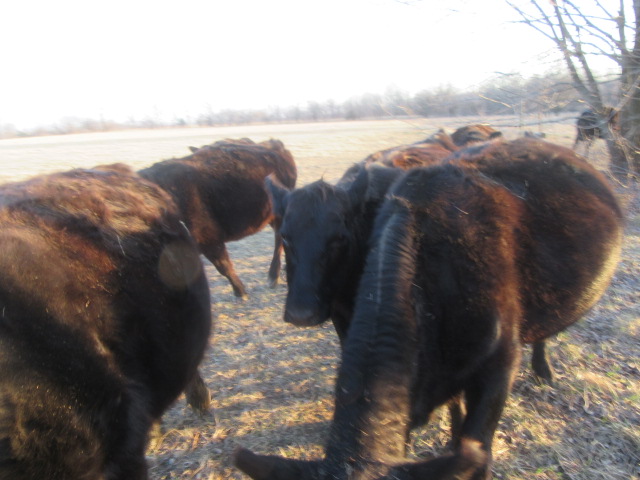
Then I noticed I wasn’t alone… I had company! Ummm… Notice anything odd about this photo?
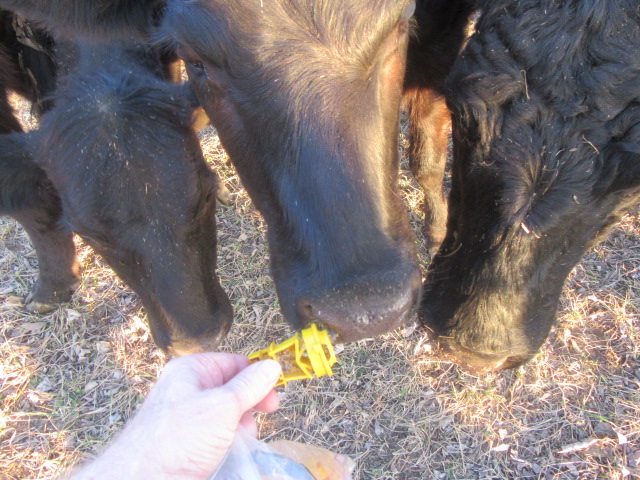
I thought maybe they were following me because I had a bag of insulators. But NO, they weren’t interested.

Yeah, I know this one is blurry, but there is a reason I put this photo here. Can you see? ORBS!!! 5 of them in this photo. You know, supposedly they only show up on digital photography and videos…
Check this out: https://www.ghostcircle.com/orb-photos-page/
Just saying… Maybe I was more “not alone” than I thought.

They continued to follow me, the cows… Apparently the orbs stayed behind. LOL
A couple of the cows get a little to close sometimes. If i stop and turn around they lower their head and want it scratched. They like it a little to much in fact, I also learned that when they follow like this to keep a slow pace. The faster you walk the faster they follow. Sometimes when i slow down they go around me. They followed me all the way to the end of the hay field. Then crossed the electric fence and left them behind. But they were waiting for me when I came returned from the back pasture.
Well, that’s all I have to say for now. Take care, have fun and GET DIRTY!
 The Belmont Rooster
I love the section on your poultry, who all look very happy and healthy. Is that small comb on the hen what they call a ‘rose comb’, a sort of small tufted cushion rather than a tall flat peaked one?
LikeLike
No. The White Chantecler have cushion combs. There are nine comb types: Single, rose, pea, cushion, walnut, V, buttercup, strawberry and Silkie… Ummm. The Silkie breed can either have a strawberry comb or a “Silkie” comb which is somewhat different than a strawberry comb. BUT breeds with rose combs produce chicks with single combs, too. SO, when we select breeders we cull out the single comb chicks. BUT, even after years of selective breeding, they still produce a few single comb chicks.
LikeLiked by 1 person
Lots of young shoots starting to come up. We were out for a walk yesterday and looked for evidence of growth. Nothing yet here. Today will start the stimulus with near 70˚.
LikeLike
Glad to hear you are having nice walking weather, too. I know we are enjoying it. Much better than breaking ice on the pond everyday. Thanks for the comment! 🙂
LikeLike
Lovely to see your poultry – glad their combs are complete, I really don’t like the idea of dubbing and it’s not required for showing in the UK.
LikeLike
It does sound kind of bad to dub, but It does give them a scary look. LOL Maybe that is part of the intimidation part in cock fights. One reason I didn’t is because that is the way I tell them apart… All three of their combs are a different height. Other than that they look the same. Of course, only one of them jumps on my lap, one comes up to me but doesn’t care to be picked up and thinks he can whip me, and the one with the tallest comb is more dominant and isn’t as friendly. To quick to even pick up. From what I have read it needs to be done when they are no older than 6 months.
LikeLike
What a fine flock you have there. Beautifully cared for. I’m planning to get some Black Rocks next month. A friend has offered me some Old English Game, but we have to be careful here as they are sometimes stolen for cock fighting. A despicable crime. I’m debating the possibilities. All the best with your animals.
LikeLike
Are the Black Rock Rocks you are referring to the black sex-link? Cross between Rhode Island x Barred Rocks? They are very good chickens for sure. The Old English Game are very interesting but getting them stolen for cockfighting is a shame for sure. Thanks for the comment.
LikeLiked by 2 people
Yes they are – and also known over here as Rhode Rocks. They are sex linked so the hens are distinguishable from the cockerels at hatching. The feathers are a beautiful pearlescent lustre and they lay 300 eggs a year. Most importantly they are easy to train. So I can coax them in and out of their high fenced run. When I’m in the garden. They can be outside, but as soon as I go indoors, I have to put them back in their orchard run, because the fox is always watching. All the best with your flock. Karen
LikeLiked by 1 person
Oh, yeah. The fox knows when you leave and then he would try and sneak into your chicken house. Very clever!
LikeLiked by 1 person