
My Amorphophallus after I brought them home on 7-1-17, #353-1.
Hello everyone! I hope this post finds you well. It took me a week to write this post because I kept taking more photos…
Tragedy has struck… The above photo is of the two Amorphophallus I brought home from Wagler’s Greenhouse on July 7 in 2017. I picked this pot because not only were there two, but there was also an Oxalis tetraphylla (False Shamrock) with them. Since 2017, the Amorphophallus have produced MANY, MANY offspring (corms) and the Oxalis has done quite well, too.

Amorphophallus konjac (Konjac) on 7-9-24, #1002-.4.
When I took the plants to the front porch, I checked both Amorphophallus by sticking my finger in the hole where the petiole (stem) was before. Both had sprouted but it takes a while for them to emerge from potting soil. After a while, one came up but the other was still way down in the hole. I thought something was weird, so I took the pot to the table on the back porch and removed the potting soil down to the corm. It seemed fine, so I covered it back up. I found several corms that I put in the potting soil along with Oxalis triangularis rhizomes, which I had to remove.
After about a month, the second Amorphophallus started to emerge from the potting soil. Once its leaves unfurled, I saw something very weird… Its leaves were variegated… Hmmm… That never happened before.
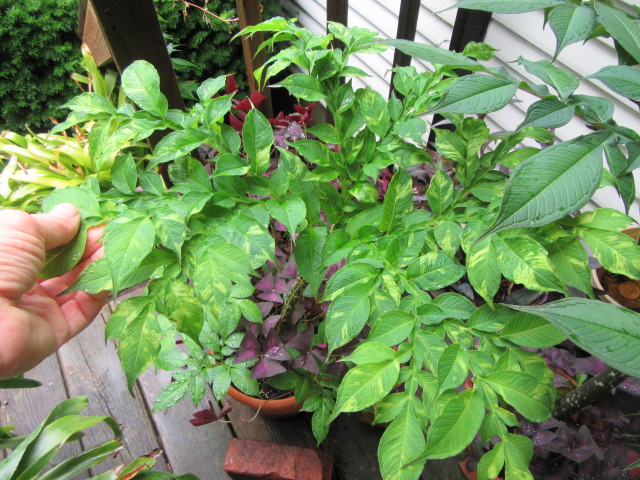
Amorphophallus konjac (Konjac) #2 on 7-9-24, #1002-6.
Hmmm… I was very puzzled.
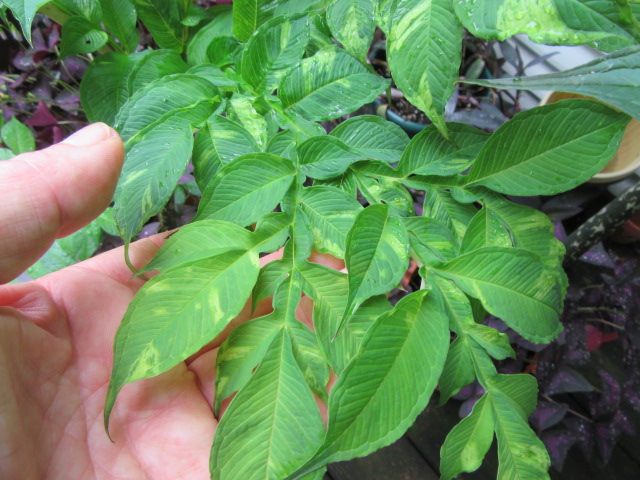
Amorphophallus konjac (Konjac) #2 on 7-9-24, #1002-7.
Well, I went to Facebook and messaged a friend from Alabama, Robert McCracken, and sent the photos. He is an avid plant collector, which is putting it mildly. Then I typed in the browser, “Why is my Amorphophallus leaf variegated?”
Well, a link to the IAS Aroid Quasai Forum came up. It is a forum on the International Aroid Society website. The question I read was similar to mine for this fellow’s variegated leaf on what he believed was an Amorphophallus muelleri. He wrote, “I have what I believe is an Amorphophallus muelleri that has put up a variegated leaf. I don’t believe I have heard anyone mention such an animal. Do I have a sick plant/tuber? Or is this something that happens once in a blue moon?”
There were various answers suggesting nutrient deficiencies or a virus… I checked out the virus and did some reading, but nothing hit the nail on the head as far as I was concerned that would hit the nail on the head, so to speak. The articles I read were more about seed-grown plants in fields where Amorphophallus konjac were grown for medicinal uses. I found out that China grows over 170,000 hectares of A. konjac and around 10% have the virus! It’s either Konjac Mosaic Virus or Dasheen Mosaic Virus. While the Konjac Mosaic Virus is specific to two Amorphophallus species, the Dasheen Mosaic Virus affects several species of members in the Araceae (Aroid) family.
Later on in the evening, Robert messaged me and we started talking. He started mentioning what I already read about the viruses. I told him I already read this and that or he would have started sending links… 🙂 He said he didn’t know much about Amorphophallus and suggested putting photos on a Facegroup called Amorphophallus. He sent a link for me to join, which I did. I wrote a post and submitted the photos and once I was approved to join, the post was up and running.
After a while, there were three comments and 11 likes… Hmmm… LIKES? Two of the comments agreed it was a virus, while the other was completely irrelevant. Apparently, to find out which virus it is I would have to send samples to a lab. Which is also irrelevant… It is a virus! Not only do I have to discard the plant but also the offspring that came up from the corms… It doesn’t matter which virus it is!
The only good thing that came out of this virus is that I am now pretty sure my Amorphophallus is A. konjac… I had been waiting for flowers to figure it out, but instead, it took a virus…
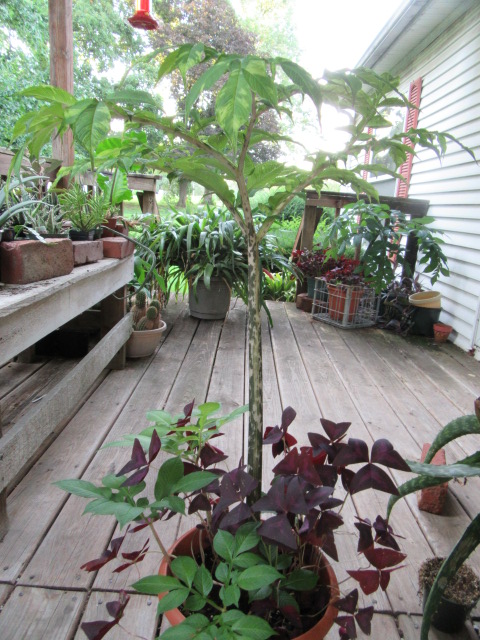
Amorphophallus konjac (Konjac) #2 on 7-14-24, #1004-5.
A lot of questions ran through my mind… How could it contact a virus after 7 years? Why does only one have it when there were two in the same pot for several years? Do I have to get rid of the new plants from the corms in the pot? Being a virus from seed-grown plants, how did my plant get it when it likely came from a corm instead of from a seed? Likely, both plants had the same parent so why does only one have the virus? I moved #2 to the other side of the porch…

Amorphophallus konjac (Konjac) #1 on 7-14-24, #1004-2.
One appears perfectly healthy. I might mention here for those of you who haven’t experienced an Amorphophallus… The corm produces one petiole (stem) which produces a single leaf with many leaflets. The leaf is round in outline (sort of) and it is like a big umbrella. Very neat! It takes several years for the corm to produce a flower from the dormant corm which is what I have been waiting for. Oh yeah, it stinks like rotting flesh…
As of today, Plants of the World Online lists 245 species of Amorphophallus… Until the virus showed its ugly face, I didn’t know for sure what species my plants were. I was pretty sure it was A. konjac since it was likely to be the most common. Amorphophallus is commonly referred to as a Voodoo Lily, Dragon Tongue, Corpse Lily, etc. As it turns out, A. konjac is simply called Konjac…
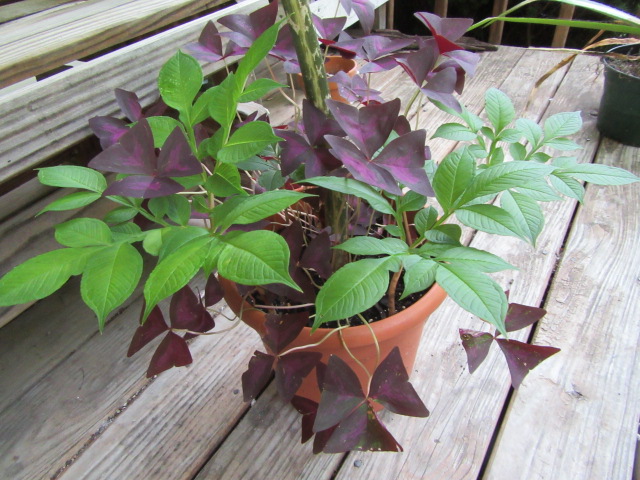
Amorphophallus konjac (Konjac) #2 on 7-15-24, #1005-7.
It’s sad to have to dispose of my friend of 7 years and its 7 new offspring. Just think I have given away so many of its offspring that are possible carriers of the virus…
I took a lot of photos over several days trying to get a few that were good enough for this post. They are all at the bottom of its own page which you can view by clicking HERE. The page is about my journey with the two Amorphophallus since I brought them home in 2017.
Once looking at all the photos on the page, I realized #2 had always been slow to emerge, something I hadn’t thought about until now. Now, I realize it probably had the virus all along…
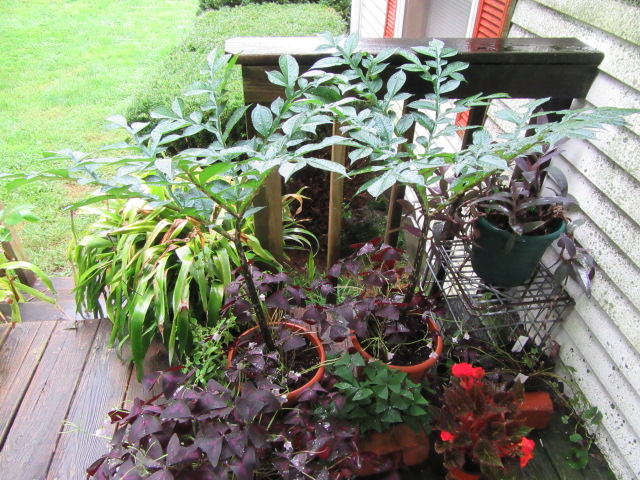
Amorphophallus konjac (Konjac) at 32″ tall on 7-15-21, #812-1.
Well, we’ve had some interesting and memorable moments together, but that time is coming to a close with #2. #1 and I will continue… The above photo and the one below were taken on July 15 in 2021.

Amorphophallus konjac (Konjac) plants from the smaller rhizomes on 7-15-21, #812-2.
One of the memorable moments was in the spring of 2021 when I decided to put the larger Amorphophallus in their own pots (before they started sprouting). I wrote two posts when I repotted the Amorphophallus, the last one titled, “Repotting the Amorphophallus & Oxalis triangularis” on April 6, 2021. The above photo was the result of their offspring…
I could add more memorable photos, but you can visit their page…

Sauromatum venosum (Voodoo Lily) on 7-19-24, #1006-1.
Of course, we aren’t alone. The Sauromatum venosum (Voodoo Lily) is on the front porch, too… I bought four corms from a seller on Ebay in 2021 and they are doing quite well. The seller stated in the listing, “These are my own mixed hybrids of a cross between normal venosum and Indian Giant, you can get these anywhere else.” Plant Delight’s says, “Sauromatum venosum ‘Indian Giant’ is similar to the species, except the tropical-looking leaves are about trice as large (up to40” across), and the stalk is a dusty light-green with fewer, but much larger, black freckles. This stem pattern is much more dramatic than the typical form and, so far, it has proven equally as hardy.” I’m not sure if they misspelled twice or if they meant 3 times the size…
Monarch of the East is another common name for Sauromatum venosum if you want a name that isn’t so dark sounding…
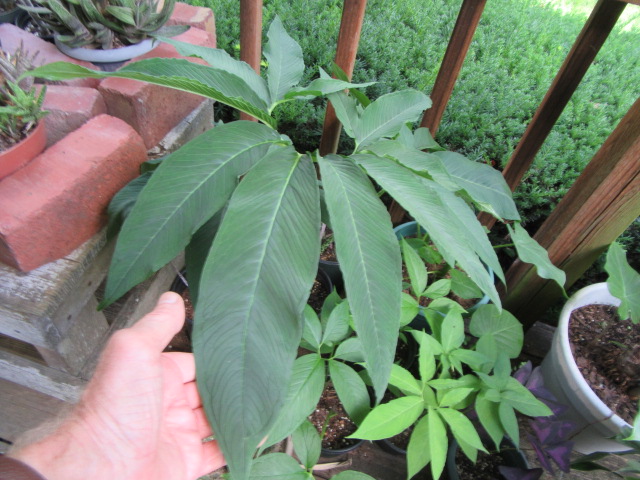
Sauromatum venosum (Voodoo Lily) on 7-19-24, #1006-2.
How’s that for a leaf? Umm… I’m not finished with its page yet…
Well, that’s it for this post! NEXT, I will post about the garden…
Until next time, be safe, stay positive, and ALWAYS be thankful. GET DIRTY!
 The Belmont Rooster