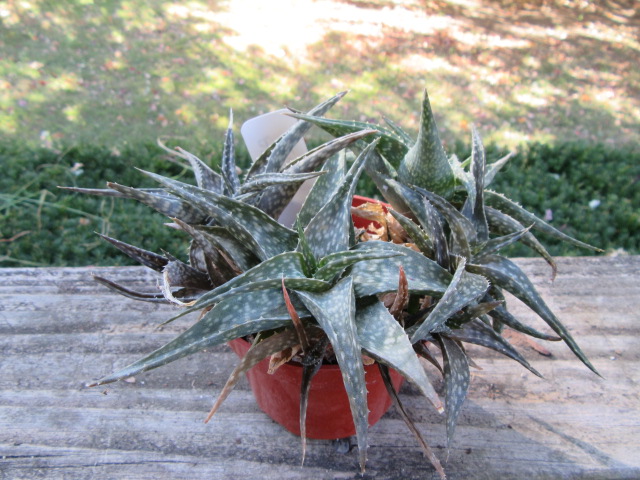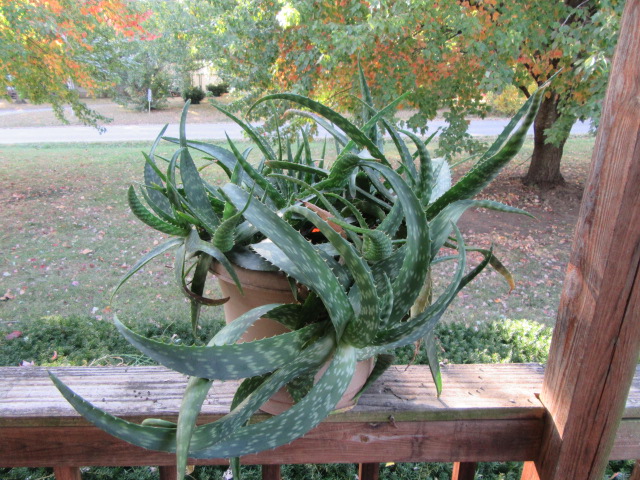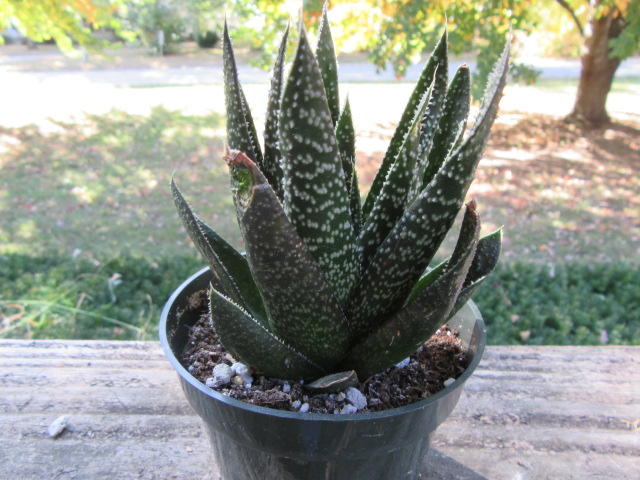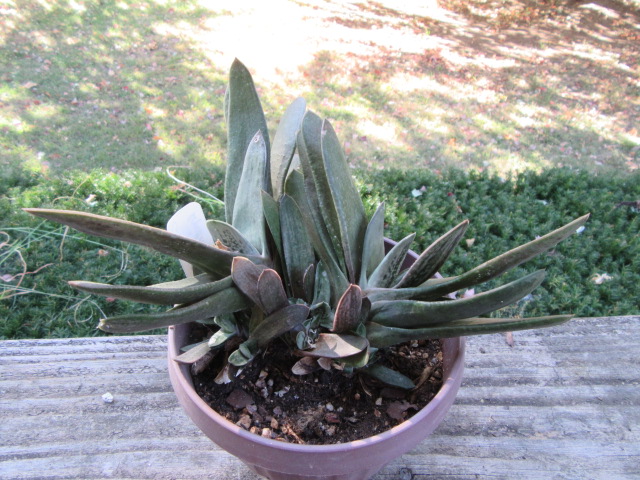
Plants Repotted Part 3…

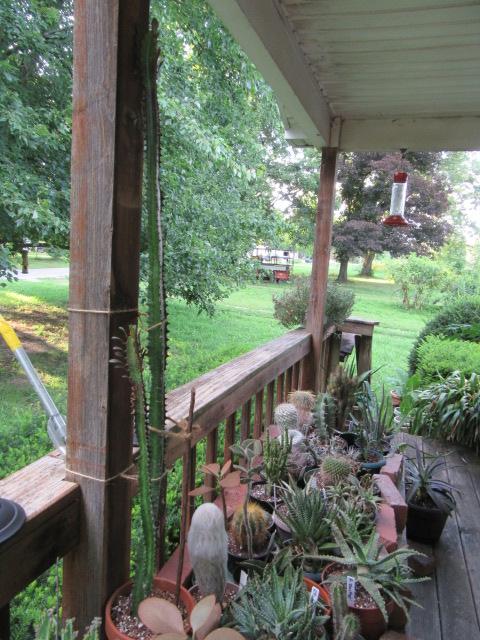
Hello everyone! I hope you are doing well and you are staying cool. It has been quite warm here and the humidity is NUTS! Most of the plants in the above photo have been repotted now, but not all. Of course, there are more that aren’t in the photo…

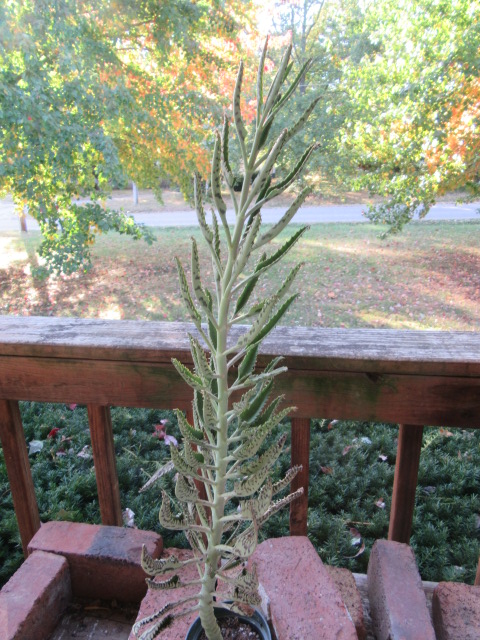
The Euphorbia trigona ‘Rubra’ (or var. rubra) has grown to 42″ tall and I’m not sure what to do with it… Should I hack it into a few pieces? Hmmm… The top of the stem, and the top of the branch, are looking a little weird and turning a light color. Normally, I don’t replant deeper than they were, but one day last fall the wind knocked it out of its pot. “Someone else” opted to put it in a bigger pot and buried it deeper than it was when I wasn’t home. Some plants have a crown and shouldn’t be replanted deeper than the root ball, but I’m not sure about this one. Normally, well maybe not normally, Euphorbia trigona are cut in pieces so they will branch out… So, I’m not sure about doing that, or what the deal is with it turning a lighter color on top. Maybe is isn’t getting enough light up there… Maybe I should check its roots to see if they are OK… I know it doesn’t have much of a root system. Actually, the plant has grown a little over 6″ since I moved it outside this spring, so maybe that is new growth. Hmmm…

This post is part 3 of Plants Repotted.

If you missed part 1, click HERE.

If you missed part 2, click HERE.

Anyway, here we go with part 3 beginning on…

June 8…

Aristaloe aristata (Lace Aloe) before repotting on 6-8-25, #1054-1.

The Aristaloe aristata (Lace Aloe) has been on the kitchen windowsill for I’m not sure how long. It was looking like it was in need of fresh air, so I put it on the front porch with the rest of the potted plants when temps warmed up enough. I like this plant, but sometimes I think it is a little finicky…

Aristaloe aristata (Lace Aloe) root system on 6-8-25, #1054-2.

I removed the plant from its pot to look at its roots. There was still plenty of room to grow. I trimmed off the dead and dying leaves.

Aristaloe aristata (Lace Aloe) in a larger 4″ tall x 4 1/2″ wide pot on 6-8-25, #1054-.

It was in a 3″ tall x 3 3/4″ wide pot, so I increased the size to 4″ tall x 4 1/2″ wide pot. I used Miracle Grow Cactus Mix with a little extra perlite and chicken grit. There is still another very small offset that that fell off this plant when it was first repotted…

<<<<+>>>>

Ferocactus wislizeni (Fishhook Barrel Cactus) before repotting on 6-8-25, #1054-4.

Hmmm… The Ferocactus wislizeni (Fishhook Barrel Cactus) hasn’t looked really great for several years.

Ferocactus wislizeni (Fishhook Barrel Cactus) root system on 6-8-25, #1054-5.

I removed it from its pot to have a look at the roots. To be honest, I’m not sure how alive this cactus really is… Yeah, I know that sounds a little weird… It grew a little from 2022 to 2023, but not from 2023 to 2024. It actually shrunk in diameter 1/2″.

Ferocactus wislizeni (Fishhook Barrel Cactus) after repotting on 6-8-25, #1054-6.

After removing most of the old potting mix and some of the dead roots, I put it back in the same pot with Miracle Grow Potting Mix with a little extra perlite and chicken grit. I noticed a few dead mealybugs, so for now I put it in an area away from the other plants. I’ll keep an eye on it and we’ll see if it grows when I take measurements when I start moving plants inside for the winter…

<<<<+>>>>

Parodia magnifica (Ball Cactus/Balloon Cactus) before repotting on 6-8-25, #1054-7.

The Parodia magnifica (Ball Cactus/Balloon Cactus) is a really neat plant. I brought it home in March 2019 and repotted it in November 2019. It had a really good root system then and needed a larger pot.
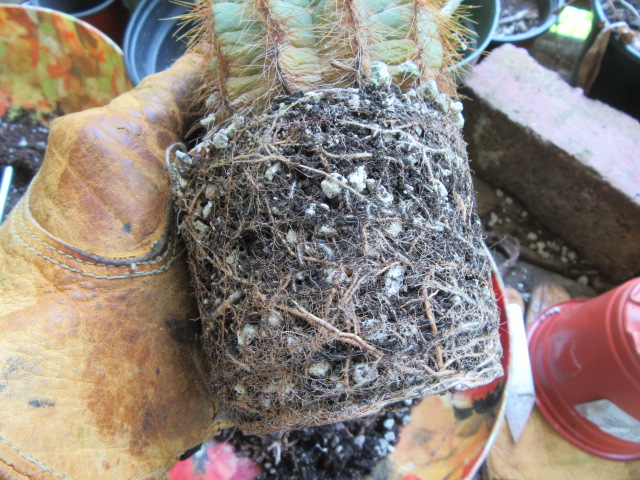
Parodia magnifica (Ball Cactus/Balloon Cactus) root system on 6-8-25, #1054-8.

Well, that is quite a root system! GEEZ!!!

Parodia magnifica (Ball Cactus/Balloon Cactus) in a larger 4 1/2″ tall x 5 3/4″ wide pot on 6-8-25, #1054-9.

After removing most of the old potting mix and some of the dead roots, I put the plant into a larger 4 1/2″ tall x 5 3/4″ diameter pot. I used Miracle Grow Cactus Mix with a little extra perlite and chicken grit. Now, we’ll see how it does.

<<<<+>>>>

June 15…

Ledebouria socialis ‘Paucifolia’ before repotting on 6-15-25, #1058-1.

Well, where do I begin with this one? Actually, the Ledebouria socialis ‘Paucifolia’ is the easy one. It hasn’t grown nearly as much as its cousin which is why it is still in a small pot.
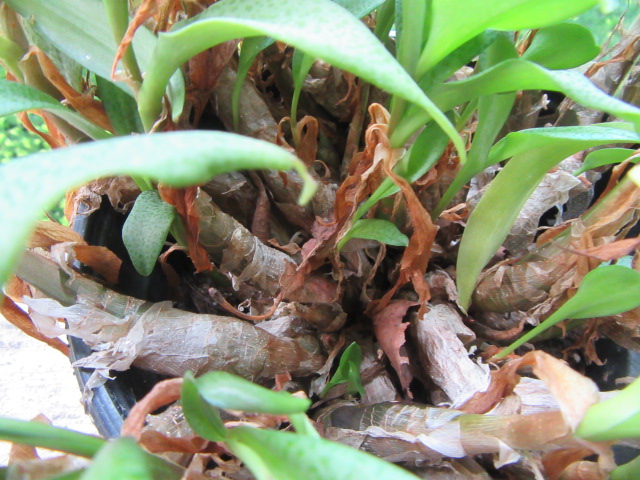
Ledebouria socialis ‘Paucifolia’ before repotting on 6-15-25, #1058-2.

Although not near as crowded as the other one, it is in a smaller pot and still a bit crowded. Looking back at old photos, it was put in a green pot in 2029 and at some point it was put in a somewhat larger black pot. Hmmm…

Ledebouria socialis ‘Paucifolia’ roots on 6-15-25, #1058-1.

It was already growing new roots…

Ledebouria socialis ‘Paucifolia’ in a larger 6″ tall x 9 1/2″ wide pot on 6-15-25, #1058-1.

I pulled the bulbs and roots apart somewhat and put everything in a larger 6″ tall x 9 1/2″ diameter pot. Now it has room to grow more. I used Miracle Grow Potting Mix with a little more perlite and chicken grit.

Ledebouria socialis ‘Violacea’ on 6-12-25, #1056-24.

At some point I need to tackle the Ledebouria socialis ‘Violacea’. It is HUGE!!!

I bought both of the Ledebouria socialis from a seller on Facebook in 2018, so I have had their company for a while now. If you haven’t tried them, I suggest you do. If you want a passalong plant that will produce A LOT, try Ledebouria socialis ‘Violacea’. If you want a plant that doesn’t produce much, try ‘Paucifolia’. They are carefree plants and very easy to grow. Water them regularly during the summer and put them in a cooler room with no water at all during the winter. They have been in the basement with a south facing window over the past two winters with no issues.

<<<<+>>>>

June 27…

Kleinia stapeliiformis (Pickle Plant) before repotting on 6-27-25, #1065-2.

I brought this pot of Kleinia stapeliiformis (Pickle Plant) home from Mast’s Greenhouse in May of 2023. It was from Mr. Mast’s daughters collection. The original stem she used as a cutting was hanging over the pot and there were several smaller “sprouts” a couple of inches tall along one side of the pot. Well, they grew and the original stem broke where it was hanging over the pot (which had grown to about 2′ long). In the spring, I cut the stem that broke in 4 pieces and put them in a pot to see if they would root. The only cutting that survived was the top cutting. Now, I had bought a few cuttings of this species from a seller on Facebook in 2018 and they soon after bit the dust. I was somewhat hesitant to bring home the pot from Mast’s, but I thought anything that weird looking deserved another chance. To be honest, I was surprised they did so well over last summer and even survived the winter on the shelf in my bedroom… But, not only did they survive, they even grew a little during the winter. Since they did so well and looked a little weird on one side of the pot, I thought would al least put them in the middle of the pot…
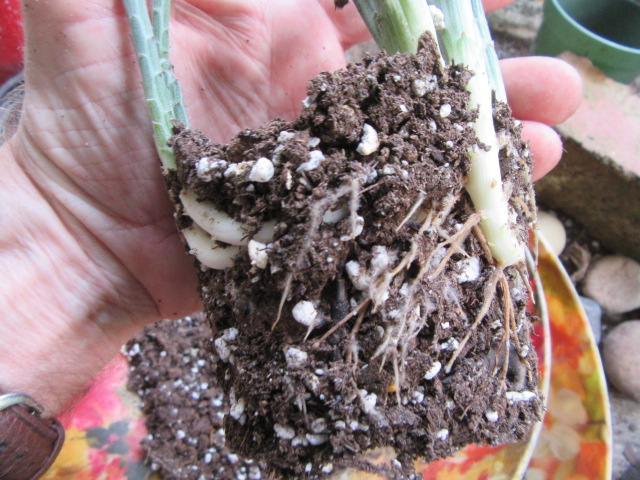
Kleinia stapeliiformis (Pickle Plant) roots on 6-27-25, #1065-3.

So, I carefully removed them from the pot to have a look. I was happy with what I saw.

Kleinia stapeliiformis (Pickle Plant) in a larger 4 1/2″ tall x 5 3/4″ wide pot on 6-27-25, #1065-4.

I didn’t disturb the roots much and carefully put them in a larger 4 1/2″ tall x 5 3/4″ wide pot. I feel like I am whispering… I put the cutting, which hadn’t grown any roots yet, in the pot with the others. I guess it is really their parent… It is the one with the weird shape.
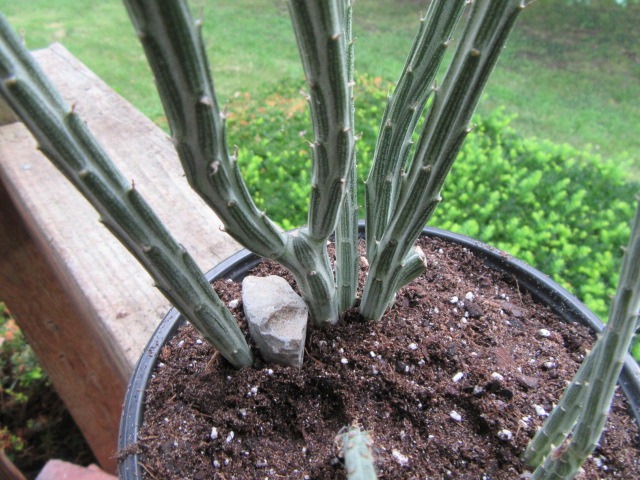
Kleinia stapeliiformis (Pickle Plant) on 6-27-25, #1065-5.

I put in a piece of gravel to hold one of them upright.

When I went to Mast’s on July 3, I walked back to see his daughters collection of plants. A few of her Kleinia stapeliiformis had flowers and seeds. I didn’t have my camera, so I took a few photos with my phone (yeah, I have a cell phone now) but they didn’t come out good. I did get to visit with her and told her I would bring her some Alocasia and the baby Amorphophallus konjac. I guess I should find out her name…

I don’t have a page for this plant yet. I wanted to make sure it would survive…

<<<<+>>>>

Peperomia graveolens (Ruby Peperomia/Ruby Glow) on 6-27-25, #1065-6.

The Peperomia graveolens (Ruby Peperomia/Ruby Glow) is another plant I brought home in 2024 from Mr. Mast’s daughters collection. She first gave me a cutting in 2023, but it didn’t take root. This plant made it through the winter, but wasn’t looking so good. I took it out of the pot and found the stem had broke under the soil and there were just a couple of roots left. SO, emptied the pots old potting soil and put in fresh then buried the plant a little deeper than what it was. Hopefully, it will grow new roots and survive. You just never know…

<<<<+>>>>

Selenicereus anthonyanus (Fish Bone Cactus) before repotting on 6-25-24, #1065-7.

To say the Selenicereus anthonyanus (Fish Bone Cactus) has grown would be an understatement! It only has two leaves sticking out of the pot when I brought it home from Wagler’s Greenhouse in June of 2012. It spent the winter on the kitchen windowsill and continued to grow.
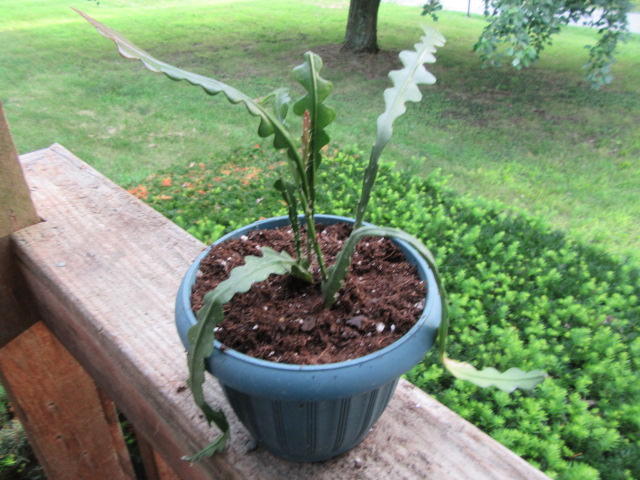
Selenicereus anthonyanus (Fish Bone Cactus) in a larger 4 1/2″ tall x 5 1/2″ wide pot on 6-25-24, #1065-8.

I decided to put it in a larger 4 1/2″ tall x 5 1/2″ diameter pot with Miracle Grow Potting Mix with a little orchid bark. It is an epiphytic cactus from Mexico’s tropical rainforest that grows in trees…
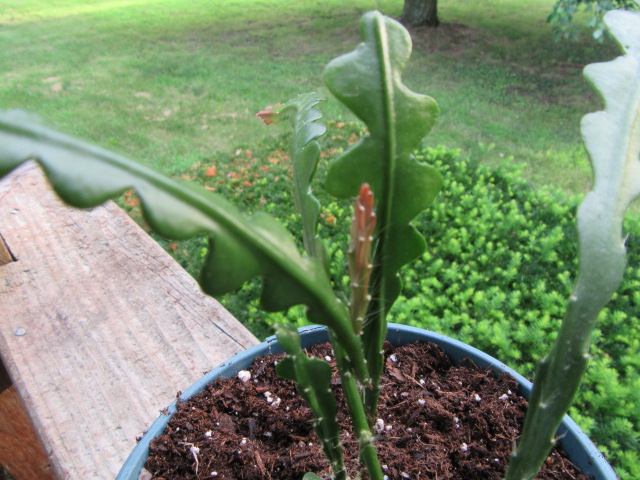
Selenicereus anthonyanus (Fish Bone Cactus) on 6-25-24, #1065-9.

Also known as Ric Rac and Zig-Zag Cactus, this plant is a night bloomer…

<<<<+>>>>

July 2…

x Mangave ‘Inkblot’ before repotting on 7-2-25, #1067-1.

Ummm… I decided it was time to give the x Mangave ‘Inkblot’ a makeover on July 2 and put it in a larger pot. Its kid also needed to be put in a pot of its own. This is an AWESOME plant, by the way.

I need to mention that x Mangave is a hybrid combination of Agave and Manfreda. A few years ago, or whenever it was, I noticed Plants of the World Online said Manfreda (and a few other genera) had become synonyms of Agave. That was kind of confusing for me because there are A LOT of patented x Mangave cultivars. Does that mean the patented x Mangave are now Agave cultivars? Well, I just checked as I was writing this post and it appears Manfreda is ONCE again an accepted genus! So, the hybrid cultivars were once hybrids, then not, now are once again… Now I have to change captions AGAIN… Botanists and taxonomists have to jump few several hoops to change scientific names and it has to be peer reviewed, etc. Then they change the name back AGAIN. What the heck?!?! I’m so glad they have that figured out. 🙂

x Mangave ‘Inkblot’ pup on 7-2-25, #1067-2.

The pup grew almost as tall as the parent…

x Mangave ‘Inkblot’ roots on 7-2-25, #1067-3.

I always think it’s funny how pots get so root bound that the soil disappears. Where does it go?

x Mangave ‘Inkblot’ in a larger 12″ tall x 14 1/2″ wide pot on 7-2-25, #1067-4.

I looked around and found a good-sized pot that I wasn’t 100% happy with. I normally put rocks in the bottom of pots to help with drainage, but this pot has fairly large holes… Oh well, I just went with it. Now, the big plant is in a larger 12″ tall x 14 1/2″ wide pot. Then after I had it finished, I noticed a crack about 3″ long around the bottom of the pot. So, at some point I will have to change the pot again (before the plants come inside for the winter).
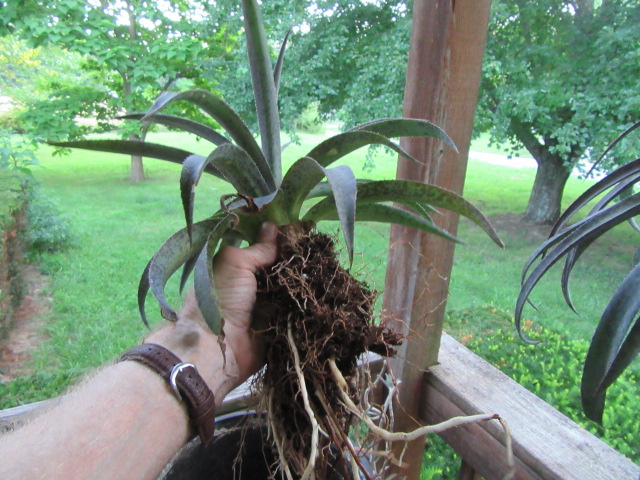
x Mangave ‘Inkblot’ pups roots on 7-2-25, #1067-5.

Now for the pup… I’m not sure why they call the offsets pups… Anyway, it was definitely a good idea to remove the pup from the parent and it really wasn’t attached anymore. It has a nice root system for sure. At least there wasn’t a long runner wrapped around the pot like I have seen before (been there, done that).
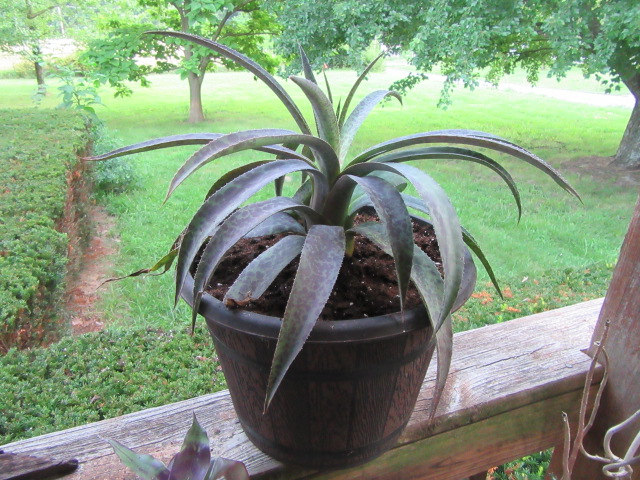
x Mangave ‘Inkblot’ pup in the original 8 1/2″ tall x 10 1/2″ wide pot on 7-2-25, #1067-6.

I put the pup in the original 8 1/2″ tall x 10 1/2″ wide pot.
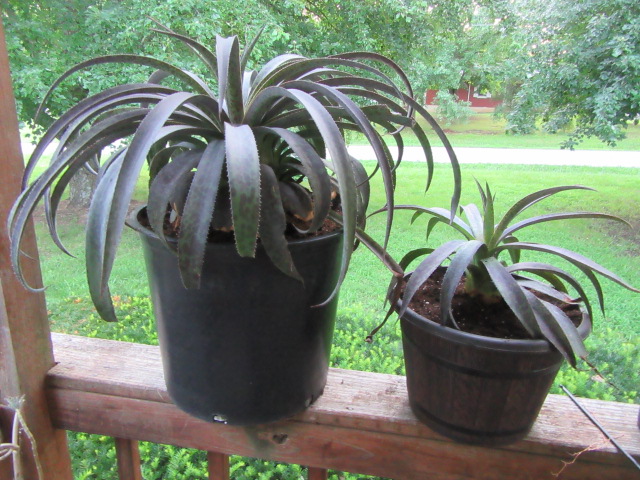
x Mangave ‘Inkblot’ parent and sibling on 7-2-25, #1067-7.

Yep! They were both in the smaller pot…

<<<<+>>>>

July 3…

Callisia fragrans (Grandpa’s Pipe, Etc.) on 7-3-25, #1068-1.

The Callisia fragrans (Grandpa’s Pipe, Inch Plant, Etc.) needed to be repotted, so I put all six in two pots. There were in individual pots, but I decided putting three in two pots would be more than satisfactory. Of course, if they do really well, they will produce a lot of runners and new plants. These plants don’t produce much of a root system, and even with a little neglect, they are virtually indestructible.

<<<<+>>>>

7-10-25…

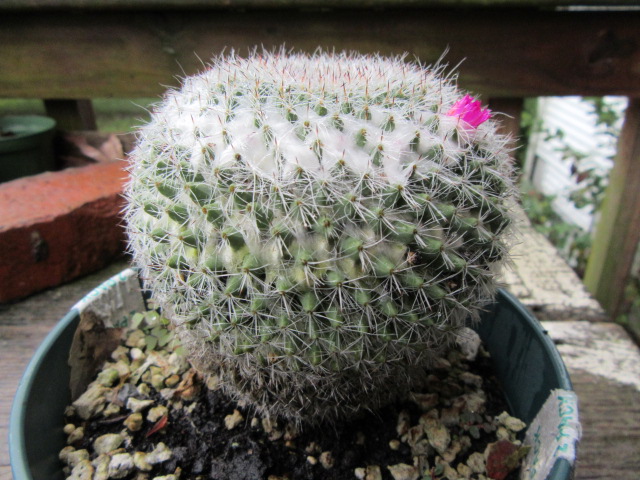
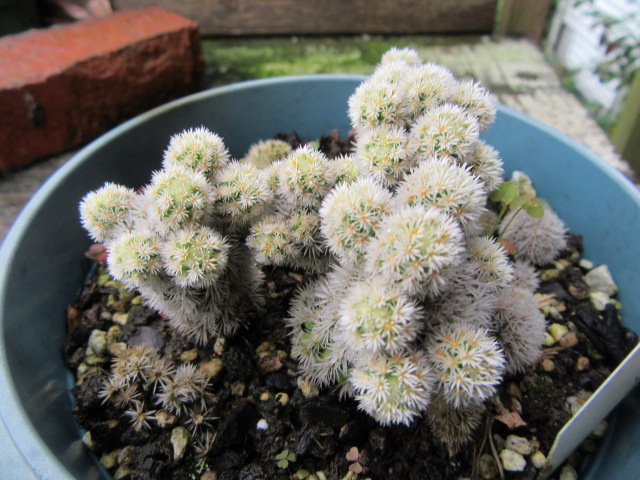
Mammillaria plumosa (Feather Cactus) before repotting on 7-10-25, #1073-5.

I debated repotting the Mammillaria plumosa (Feather Cactus) for a couple of reasons. For one, I was pretty sure it didn’t need a deeper pot, and two, I thought it might fall apart. 🙂 Now, let me give you a little history (which you can read if you click on it name)… I bought this plant (or clump of plants) from a seller on Ebay in September 2018. It came wrapped in toilet paper and looked like a ball of tiny feathers. I put it in a pot and the rest is history. All you see in the above photo was was what came in the mail only much smaller. It has grown and done extremely well with no issues whatsoever, and it does produce a few flowers. BUT, I don’t believe it has produced any offsets…

Mammillaria plumosa (Feather Cactus) from the top on 7-10-25, #1073-6.

The sides of the cactus were touching the pot in a couple of spots and the soil was almost 2″ from the top of the pot… Well, it hadn’t been repotted since 2019…
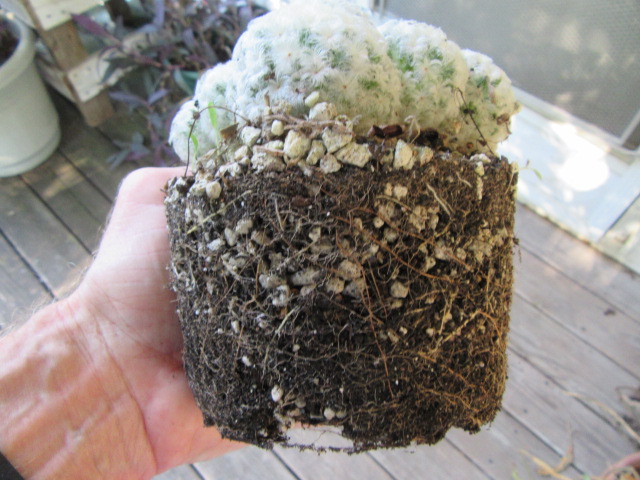
Mammillaria plumosa (Feather Cactus) roots on 7-10-25, #1073-7.

As you can see, there isn’t a massive root system, but still more than I thought there would be. Back in 2019, I used pumice in the mix…

Mammillaria plumosa (Feather Cactus) roots after removing old soil on 7-10-25, #1073-8.

After I removed old potting soil and dead roots, there wasn’t much left. I was very glad the cluster of plants stayed together. I removed the dead roots up to where I saw new ones growing. You don’t have to worry about removing roots because they grow new ones every year. I think I said that before.

Mammillaria plumosa (Feather Cactus) in a larger 5 1/2″ tall x 6 1/4″ wide pot on 7-10-25, #1073-5.

I didn’t like putting it in a deeper pot, but I didn’t have much of a choice for the moment. So, I put it in a 5 1/2″ tall x 6 1/4″ diameter pot with Miracle Grow Cactus Mix with a little additional perlite and chicken grit… I may order a few shallow pots online that are good sized in diameter but shallow. I saw them somewhere…

<<<<+>>>>

x Mangave ‘Pineapple Express’ before repotting on 7-10-25, #1073-11.

I decided July 10 it was time to repot the x Mangave ‘Pineapple Express’. I knew it would be tough… I brought this plant home in May 2019 and first repotted it in November 2019. Information said it was slow to offset, but it already had one by then which I left in the pot. When I moved the plants inside for the winter in 2020, I counted “about” 10… I could have miscounted. 🙂 I still left them all in the same pot. When I measured the plants as I moved them inside in October 2021, this plant measured 11 1/2″ tall x 20″ wide. In 2023, I decided to put it on the back deck in full sun to see how it would do. Well, it did GREAT but changed colors. Then, when it was inside over the winter, it started loosing leaves and I thought it was a goner. But it survived…  After that, I kept it on the porch on the north side of the house. It did fine after that, but measured only 7 1/2″ tall x 13 1/2″ wide when I moved it inside in October 2024. Both of the x Mangave‘s stayed in my bedroom over the winter, which they did not appreciate, and were very glad to get back outside.

x Mangave ‘Pineapple Express’ roots on 7-10-25, #1073-12.Well, to be honest, I knew it was going to be root bound… I’ve been through repotting LARGE Agave when I was in Mississippi. GEEZ!!!

x Mangave ‘Pineapple Express’ pups on 7-10-25, #1073-13.

And, of course, I knew there had been pups in the pot for several years…

x Mangave ‘Pineapple Express’ in a larger 6″ tall x 6 1/4″ wide pot on 7-10-25, #1073-14.

It was not easy unwrapping the old roots and removing the pups, but I managed to get it done. I put the parent in a larger 6″ tall x 6 1/4″ diameter pot with Miracle Grow Cactus Mix with a little extra perlite and chicken grit.

x Mangave ‘Pineapple Express’ with 7 pups in 4″ tall x 4 1/2″ wide pots on 7-10-25, #1073-15.

I successfully removed five pups but I accidentally broke two… I went ahead and put the two I broke in pots like the other 5. I also put the roots of the two that I broke off in a couple of pots, too. The two I broke off will no doubt grow roots (been there, done that), but I’m not sure if the two with just roots will grow new leaves. Time will tell…

That’s all for this post and I am caught up with the plants I have repotted so far, I still have plenty to repot that I will post about soon.

Until next time, be safe, stay positive, be well, stay thankful, and GET DIRTY!


Cactus & Succulent Update 2022

Cereus repandus f. montruosus ‘Rojo’ on 10-16-22, #919-6.

Hello everyone! I hope this post finds you well. The dreaded time of the year has arrived and I had to move the potted plants inside on January 16. I was still working on one last new wildflower ID and still needed a few leaf and stem photos. I had already taken photos, but the leaf and stem photos were blurry. I’m not sure if I can still take any since the “F”, and since then the wind has been blowing. Of course, it warmed back up…

As always, I take photos and measure the cactus and some of the succulents as I bring them back inside. Most of the plants were on the front porch this summer because the heat and the intense sun seemed a little too much for some of them last summer. Yeah, I know they are cacti, but that doesn’t necessarily mean they like intense sun. Many smaller species grow in the shade of taller plants.

Last winter was not too good… My son and his friend were still here so they used the back bedroom. I usually kept the back bedroom cooler with a plant shelf in the south-facing window for the succulents and part of the cacti. but the shelf was placed in front of the east-facing sliding door in the dining room. Instead of the cactus being on a table in front of the sliding door, they were on another shelf in my bedroom. I couldn’t very well keep the temperature cooler in either place. They are gone now, thank goodness, so the plants are basically where they should be.

As a result of more heat, for one thing, I lost a few plants over last winter from mealybugs… GEEZ! I think the worst was losing both Mammillaria pringlei and rhodantha… I also lost the Aloe ‘Lizard Lips’. I had all three of those for MANY YEARS.

Anyway, here we go in alphabetical order… You can click on the plant’s name under the photo to go to their own pages.

<<<<Aloe ‘Cha Cha’>>>>

Aloe ‘Cha Cha’ on 10-16-22, #919-1.

Aloe ‘Cha Cha’ is the last survivor of the five plants I received from Succulent Market in 2020. Ummm… I am trying not to mention… No, I’m not going to do it! I did mention A. ‘Lizard Lips’ contacted mealybugs, but not from A. ‘Cha Cha’. Somehow it never had them and has done weirdly well… Of course, as you may be able to tell, it is a miniature.

<<<<Aloe maculata>>>>

Aloe maculata on 10-16-22, #919-2.

Hmmm… I just discovered a problem with starting at the beginning of the alphabet. Maybe I should have started at the end. Although the Aloe maculata are all doing GREAT as always, I have been promising it I would divide their pot for a couple of years. Maybe three. I had one in another pot that “somehow” contacted mealy bugs last winter and they kept coming back. So, I did a terrible thing and threw it out the back door. The big pot was in my bedroom and it would get an occasional bug but nothing serious. Isolating this plant would be a problem, so I decided to put it in the basement in front of a window. I remember I kept a lot of plants in the basement during the winter before and they always did fine. Well, the bugs didn’t like the conditions and they left and the Aloe came through with flying colors like it had been in perfect conditions. These plants are descendants of the Aloe maculata I called ‘Kyle’s Grandma’ that was given to me by a good friend, Kyle, when I was living in Mississippi. The plant, actually I think there were two, were from his grandma, Brenda, in 2009.

I was just thinking maybe I should use the basement as a quarantine station. 🙂 Well, if the plants are halfway dormant…

<<<<Austrocylindropuntia subulata (Eve’s Needle)>>>>

Austrocylindropuntia subulata (Eve’s Needle) at 7″ tall on 10-16-22, #919-3.

Another hmmm… As I looked at this plant, it started tapping its feet. It asked, “Do you notice something?” I said, “Ummm…” Last fall I told this Austrocylindropuntia subulata that I would move it back to the center of the pot in the spring. As you can see, it is still not in the center. Maybe, in the back of my mind, I was thinking it would move by itself. I know the original plant was in the center when I brought it home from Wagler’s Greenhouse in 2019 when it was just a single stub at only 4 1/2″ tall. Now, it has grown appendages and its offset is 7″ tall…

<<<<Cereus repandus f. montruosus ‘Rojo’>>>>

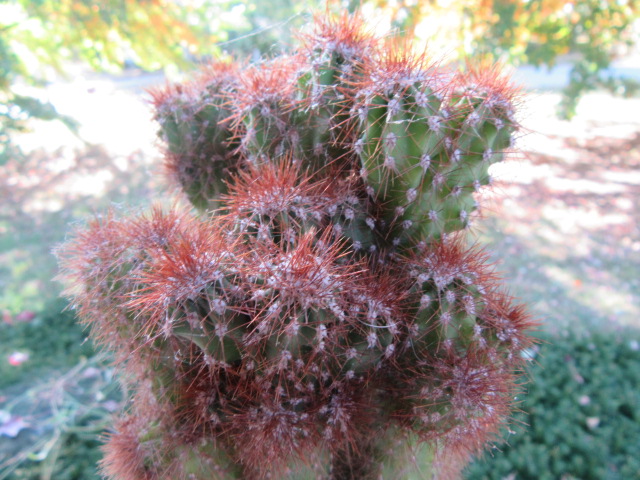
Cereus repandus f. montruosus ‘Rojo’ at 10″ tall x 4 1/4″ wide on 10-16-22, #919-5.

At least the Cereus repandus f. montruosus ‘Rojo’ didn’t give me any dirty looks and seemed to be quite content on the front porch. It grew another 1/4″ and is now 10″ tall. The top photo is the upper portion of this plant. I brought this plant home in 2018 when it was only 5 1/2″ tall. I really like monstrous forms of cacti.

<<<<Crassula ovata ‘Gollum’>>>>

Crassula ovata ‘Gollum’ at 10 1/2 tall x 10″ wide on 10-16-22, #919-7.

The Crassula ovata ‘Gollum’ did very well in its usual spot over the summer on the front porch. I brought this plant home in 2018 when it was 7″ tall and it is now 10 1/2″ tall. I always like the tree-like appearance of older Crassula ovata. I had a fairly large Crassula ovata and a nice C. ovata ‘Lady Fingers’ that were AWESOME!

Crassula ovata ‘Gollum’ on 10-16-22, #919-8.

They can attract brown scale (from somewhere) which are easily removed with your fingernail. If you don’t keep an eye on them, the scale can spread to all the leaves and become a pain… Especially when you have a bigger plant with A LOT of leaves

<<<<Echinopsis ‘Rainbow Bursts’>>>>

Echinopsis ‘Rainbow Bursts’ at 4 1/4″ tall x 7 1/4″ wide on 10-16-22, #919-9.

The Echinopsis ‘Rainbow Bursts”…GEEZ! I lost my train of thought. I have thought about removing her kids, but then I think about what she would look like all naked. No doubt, her trunk would be all brown and terribly unsightly so I just keep the family together. Someday, I hope to see flowers. After all, I have had this pot since 2016 and who knows how old it was before I brought it home. The main plant was only 2 1/4″ tall x 3 1/2″ wide when I brought it home, and the offsets were growing along its ribs. Now it is 4 1/4″ tall and the whole cluster is 7 1/4″ wide. This plant was originally x Echinobivia ‘Rainbow Bursts’ and was described as an intergeneric cross between Echinopsis and Lobivia. Lobivia is now a synonym of Echinopsis, so I guess it wasn’t an intergeneric cross after all. 🙂 It was named “Rainbow Bursts” because of their “spectacular colors” (so the label said) over the spring and summer. STILL WAITING…

I was watching a YouTube video from Morris Park in the Ozarks a couple of pots that looked similar. With all the offsets and everything.

I still have the big pot of Echinopsis huascha, but they are looking very weird…

<<<<Espostoa melanostele subsp. nana>>>>

Espostoa melanostele subsp. nana (Peruvian Old Lady)at 9″ tall on 10-16-22, #919-10.

The Espostoa melanostele subsp. nana (Peruvian Old Lady) always seems happy no matter where she is sitting. She may have been happier on the front porch out of the wind so her hair doesn’t get messed up. She has grown another 1/2″ over the summer to 9″ tall. Hard to imagine she was only 2 3/4″ tall when I brought her home in 2016.

<<<<Euphorbia trigona ‘Rubra’>>>>

Euphorbia trigona ‘Rubra’ (African Milk Tree) at 19 1/2″ tall on 10-16-22, #919-11.

To say this Euphorbia trigona ‘Rubra’ has grown would be an understatement. I brought it home from Mast’s Greenhouse in June of 2021 when it was 6 1/4″ tall. By the time I moved the plants inside in October, it had grown to 10 3/4″. Every time I looked at the plants over the summer, I noticed this plant was growing and even had an offset. Well, lately, I had been busy and hadn’t paid much attention to the plants on the front porch. So, when I started moving the plants inside in 2022 I was SHOCKED! This plant had grown to 19 1/2″ tall!

Euphorbia trigona ‘Rubra’ on 10-16-22, #919-12.

Euphorbia trigona was named and described as such by Philip Miller in the eighth edition of The Gardener’s Dictionary in 1768. I don’t know where he found it exactly, but it wasn’t in the wild… You see, there are no known plants of this species in the wild, and it is possibly of hybrid origin. Information also says this species does not produce flowers. Hmmm… As with all Euphorbia, it does produce a milky latex sap.

<<<<Ferocactus wislizeni>>>>

Ferocactus wislizeni (Fishhook Barrel Cactus) at 3 1/8″ tall x 3″ wide on 10-16-22, #919-13.

The Ferocactus wislizeni (Fishhook Barrel Cactus) has done quite well on the front porch and has now reached 3 1/8″ tall. This guy always got a little sunburned on the back porch, but it has had no problems on the front porch. It was only 1 5/8″ tall when I brought it home in 2019, so it has done well.

<<<<x Gasteraloe ‘Flow’>>>

x Gasteraloe ‘Flow’ at 4″ tall x 4″ wide on 10-16-22, #919-14.

I had to throw out my older x Gasteraloe ‘Flow’ in January because of mealybugs. I had sprayed, washed them off, etc. and I finally had to give up. Repeatedly working the plant over seemed to make the plant suffer more (especially during its rest period). I was happy to find a new one at the Kuntry Store in July that was 3″ tall x 3 3/4″ wide. There were some really nice larger plants in combination planters, but I only wanted ‘Flow’. GEEZ, I hate it when that happens. It has grown to 4″ tall x 4″ wide since I brought it home. The plant didn’t have any sort of label, but I am assuming it is x Gasteraloe ‘Flow’.

<<<<Gasteria ‘Little Warty’>>>>

Gasteria ‘Little Warty’ at 6 7/8″ tall x 7 1/8″ wide on 10-16-22, #919-16.

The Gasteria ‘Little Warty’ continued to do well and is now 6 7/8″ tall x 7 1/8″ wide. I really like this little guy. It was only 2″ tall x 2 13/16″ wide when I brought it home in 2019. The mealy bugs tried to infect this plant but had no luck.

<<<<Gasteria sp. ?>>>>

Gasteria sp. at 5 1/4″ tall x 7 1/8″ wide on 10-19-22, #919-16.

I thought I was going to lose this Gasteria last winter because of its issues with mealybugs. It still isn’t quite back to normal but it is OK. It even grew to 5 1/4″ tall x 7 1/8″ wide. I think I may put it in the cool front bedroom with plants that aren’t bothered by critters and keep an eye on it. Maybe I should put it in the basement… I would hate to lose it after almost 5 years. I was kind of surprised it had mealy bug issues since its leaves are so hard, but they attacked way down where the leaves attach. A very hard spot to get to.

<<<<Gymnocalycium saglionis>>>>

Gymnocalycium saglionis (Giant Chin Cactus) at 2 3/4″ tall x 3 3/4″ wide on 10-16-22, #919-17.

The Gymnocalycium saglionis (Giant Chin Cactus) had never had one single issue. No rust spots, sunburn, bugs, or anything. It has grown from 1 1/8″ tall x 2 5/8″ wide in 2019 to 2 3/4″ tall x 3 3/4″ wide. It had its biggest growth spurt in the first 7 months after I brought it home, and since then it has just grown slow and steady. At least it is still alive and well.

<<<<Haworthiopsis limifolia>>>>

Haworthiopsis limifolia (File-Leaved Haworthia) at 5 1/8″ tall x 6″ wide on 10-16-22, #919-18.

Formerly Haworthia limifolia, the Haworthiopsis limifolia continues to do remarkably well without a hitch. These plants are normally sold under the name Haworthia limifolia ‘Fairy Washboard’, but that is actually a common name along with File-Leaved Haworthia, Fairies Washboard, Swaiti Haworthia, and possibly others. The last name is possibly what it is called in Southeast Africa where the species grows in the wild. There are five varieties of the species… This plant has now grown to 5 1/8″ tall x 6″ wide from 2 3/8″ tall x 3″ wide when I brought it home in May of 2019. Who wouldn’t like its dark green color with all those ridges on the leaves?

<<<<Kalanchoe daigremontiana>>>>

Kalanchoe daigremontiana (Alligator Plant) at 27 3/4″ tall x 7 1/2″ wide on 10-16-22, #919-19.

I finally found a nice Kalanchoe daigremontiana (Alligator Plant). You may remember the “other” Kalanchoe daigremontiana (Mother Of Thousands) I have… I always thought something was a little whacky with the name, and then I finally figured out it was a Kalanchoe laetivirens. Anyway, when I was plant shopping at Wagler’s Greenhouse this summer, I saw they had quite a few of real Kalanchoe daigremontiana. Of course, I had to bring one home… It was 13 1/4″ tall x 13 1/2″ wide when I brought it home in May and now it is a shocking 27 3/4″ tall. Some of the lower leaves have fallen off, so the width has shrunk to 7 1/2″ wide.

Normally, I would have repotted this plant, but since I was a bad parent in 2022 it is STILL in its 4 1/2″ pot I brought it home in. GEEZ! Luckily, it performs a balancing act quite well. It was between two bricks on the plant table, which most of the plants were (or tucked in pot-to-pot) so the wind would blow them around. Right now, it is standing next to the kitchen sink. I am trying to figure out where to put it for the winter…

Kalanchoe daigremontiana (Alligator Plant) on 10-16-22, #919-20.

Like the Kalanchoe laetivirens (or x laetivirens since it is a cross between two species), this one also gives birth to plantlets along its leaves (which aren’t really leaves). I removed them before I brought it into the house. I learned a lesson from before…

Kalanchoe daigremontiana (Alligator Plant) on 10-16-22, #919-21.

This species has the purplish marking on its, umm… You know what I mean. A spider decided this plant’s “leaves” made a good home and it was COVERED in webs. I should have taken a photo, but that would have proved my neglect… I guess I could have said it was decorated for Halloween. 🙂 I don’t have a page for this plant yet.

<<<<Kalanchoe thyrsiflora>>>>

Kalanchoe thyrsiflora (Paddle Plant) at 14 1/4 ” tall on 10-16-22, #919-22.

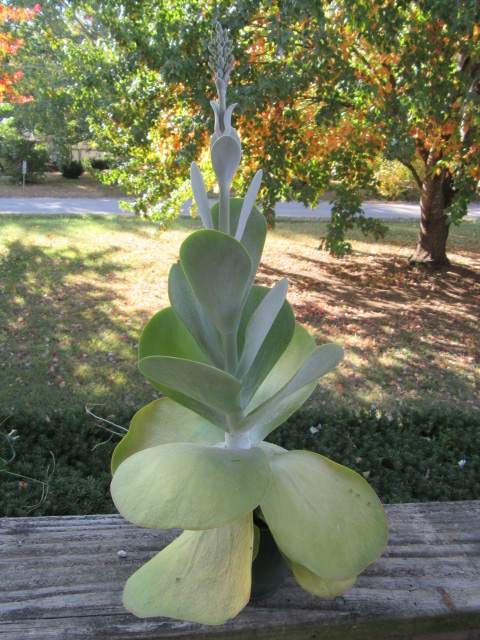
I found several awesome Kalanchoe thyrsiflora (Paddle Plant) at Mast’s Greenhouse in May and thought I needed to bring one home. I was surprised with buds when I was bringing the plants inside since they weren’t there the week before (unless I wasn’t paying attention). It was 6″ tall x 7 3/4″ wide when I brought it home, and now it is 14 1/4″ tall including the buds. Won’t this be interesting? Ummm… I have no page for this plant yet either.

The Kalanchoe beharensis ‘Fang’, K. laetivirens, all the K. luciae, and K.orgyalis (Copper Spoons) are still alive but need some work… Sadly, the K. gastonis-bonnieri (Donky Ears) and K. beharensis didn’t survive last winter. The K. marmorata (Penwiper Plant) also finally gave it up. We had our ups and downs since 2018.

<<<<Kroenleinia grusonii>>>>

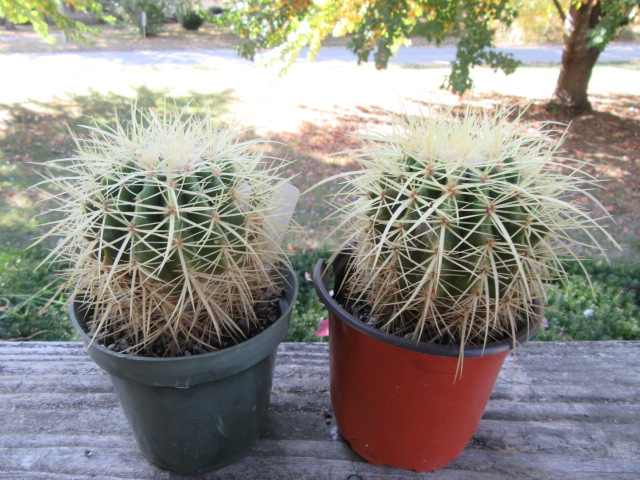
Kroenleinia grusonii (Golden Barrel Cactus)… Greater (green pot) at 3 1/2″ tall x 3 1/4″ wide, and Lessor (orange pot) at 3 3/4″ tall x 3 1/4″ wide on 10-16-22, #919-23.

These two comedians of the group are still alive and well. The Kroenleinia grusonii (Golden Barrel Cactus) both continue growing head to head. I named them Greater and Lessor in 2016 because the one in the green pot has always been a little taller than the other. Lessor, in the orange or red pot (I can’t decide what color it is), has always been a little shorter and wider. Well, this year they are both 3 1/4″ wide, but Lessor is 1/4″ taller than Greater. Of course, they tried their best to convince me they traded pots. Crazy guys! Measuring them is tricky enough with them jiggling around and standing on their toes.

Apparently, the orange spots on these two guys was rust. Rust can be treated if you know what it is in the first place. Well, the rust issue has gone away, and the orange spots have turned white. Now that I know what it was, I will keep an eye on them.

<<<<Mammillaria hahniana>>>>

Mammillaria hahniana (Old Lady Cactus) at 5 1/2″ tall x 3 3/8″ wide on 10-16-22, #919-24.

This Mammillaria hahniana (Old Lady Cactus) is now the oldest Mammillaria in my collection since M. pringlei and M. rhodantha died. This awesome cactus has now grown to 5 1/2″ tall x 3 3/8″ wide from 1 7/8″ tall x 2 3/8″ wide in 2016. It has been a great cactus and is a free bloomer when it gets in the mood. Old Woman Cactus is the common name iNaturalist gives this species…

<<<<Mammillaria karwinskiana>>>>

Mammillaria karwinskiana (Silver Arrows) at 4 1/2″ tall x 3 1/2″ wide on 10-16-22, #919-25.

When I was measuring Mammillaria karwinskiana (Silver Arrows) it told me it had an itch and asked me to give it a scratch. I was kind of speechless. It has barely ever spoken to me and now it wants a scratch. GEEZ! It just as well ask for a massage. Anyway… This cactus has done very well and has grown another 1/2″ taller and is about the same width as last year. It now stands at 4 1/2″ tall and is 3 1/2″ wide. To think it was just 1 7/8″ tall x 2 3/16″ when I brought it home in 2019. I really like its wool, hairiness, and those long, straight, white spines. But a scratch is out of the question.

<<<<Mammillaria muehlenpfordtii>>>>

Mammillaria muehlenpfordtii (Golden Pincushion) at 5 1/4″ tall x 3″ wide on 10-16-22, #919-26.

The Mammillaria muehlenpfordtii (Golden Pincushion) has been a great plant since I brought it home from Lowe’s in September in 2019. Its pot was lying on the plant shelf with the plant not even in the pot. I am sure it appreciates being brought home. I have always admired its blue-green color and all those golden spines, but the long central spines and short radial spines are also neat. It has grown to 5 1/4″ tall x 3″ wide and was 3 1/4″ tall x 2 1/8″ wide when I brought it home.

<<<<Mammillaria mystax>>>>

Mammillaria mystax at 2 3/4″ tall x 3 1/8″ wide on 10-16-22, #919-27.

Very funny… The Mammillaria mystax shrunk! The measurement from last year was 3 1/4″ tall x 3 1/4″ wide and now it is 2 3/4″ tall x 3 1/8″ wide. Heck, it was 2 3/4″ tall in 2020. It has grown quite a bit, though, since it was just 1 3/4″ tall x 2 1/4″ wide when I brought it home in 2018. Sometimes that happens with cacti when they don’t have enough water. That is likely the case since they were under the roof of the front porch and most of the time just received rain as it blew in on them. I am not complaining that it shrunk especially since it is partly my fault. OK, it was likely all my fault. But, it was safe from the scorching sun on the front porch which I know it appreciated. How do I know? Well, it was smiling at me when I measured it and took its photo.

<<<<Mammillaria plumosa>>>>

Mammillaria plumosa (Feather Cactus) at 2″ tall x 4 1/4″ wide on 10-16-22, #919-28.

It is certainly a good thing this Mammillaria plumosa (Feather Cactus) hasn’t had any problems with mealybugs. How would you tell? I bought this cactus from a seller on Ebay in 2018 and it has been great. In fact, it is the only cactus I bought from Ebay that has survived. Even though it was very small at 3/4″ tall x 2 1/4″ wide it has done very well. The main plant has grown to 2″ tall and the whole cluster is now 4 1/2″ wide. This one you can pet if you so desire…

I lost several Mammillaria since last winter including M. decipiens (Bird’s Nest Cactus) that did very well since 2018, M. elongata (Lady Finger Cactus) that I brought home in 2018, M. pringlei and M. rhodantha I already mentioned, M. senilis (the one with the hooked spines I could never tell if it was alive or dead) since 2020, both M. vetula including ‘Arizona Snowcap’, and M. compressa from 2020. The M. spinosissima ‘Un Pico’ is still alive but looks terrible with A LOT of rust or something… One of the plants in the pot of 3 already died… I have learned that even though many species of Mammillaria are some of the best cacti to grow, when you bring home very small plants you are taking a risk. Also, many species on the market haven’t been in cultivation that long and may not be good choices. Big growers plant seeds by the thousands and don’t necessarily care if they are good choices for pot culture. These days some companies aren’t even putting the names on the pots because they have no clue.

<<<<Opuntia monacantha var. variegata>>>>

Opuntia monacantha var. variegata (Joseph’s Coat) at 12 3/8″ tall x 4 1/2″ wide on 10-16-22, #919-29.

You know, I really haven’t been into variegated cacti, but this Opuntia monacantha var. variegata (Joseph’s Coat) I saw at Wagler’s Greenhouse in 2020 caught my eye. It was only 4 3/4″ tall when I brought it home, and it has grown to 12 3/8″. It is very interesting…

Opuntia monacantha var. variegata (Joseph’s Coat) on 10-16-22, #919-30.

Actually, Llifle (Encyclopedia of Living Forms) has it listed as Opuntia monacantha f. monstruosa variegata (syn. Opuntia monacantha var. variegata cv. Maverick variegata). Which is a synonym of Opuntia monacantha… You know, someone always has to give it a cultivar name when it isn’t necessarily a cultivar. It is one of very few naturally occurring variegated cacti and it is a monstrose form. It is a dwarf, teratological variant of the larger Opuntia monacantha. Anyway, something weird is going on with its main stem… What are those protruberances? Could they be buds? I checked out photos on iNaturalist for the species and that could be very possible… Time will tell and keep your fingers crossed they don’t fall off if they are buds. You never know since I moved it into the house in a different light.

<<<<Parodia lenninghausii>>>>

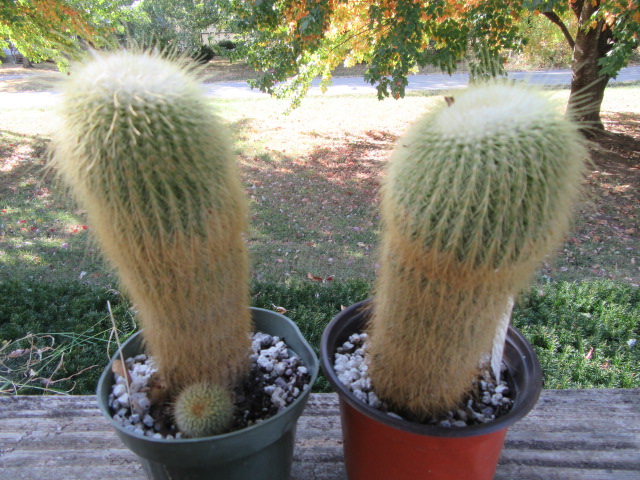
Parodia lenninghausii, the orange pot on the right is 6 1/2″ tall x 2 3/4″ wide, and the green pot on the left is 7″ tall x 2 1/8″ wide on 10-16-22, #919-31.

The two Parodia lenninghausii (Golden Ball or Lemon Ball Cactus) are more serious than the two Kroenleinia grusonii, but they do have their moments. Sometimes these two agree with each other, and at other times they seem to have had a disagreement and won’t even look at each other. I kind of screwed up and named them Greater and Lessor as well, so I may have to change that. They have also done the switch… Lessor, in the green pot, is now taller than Greater… Lessor is now 7″ tall x 2 1/8″ wide, and Greater is 6 1/2″ tall x 2 1/8″ wide. Hmmm… I have been enjoying these two since 2-1-16. That was when I bought several cacti from Walmart and didn’t notice I bought two Parodia lenninghausii and two Kroenleinia grusonii until I was home… I am glad I brought two of each home to compare with each other as they grow.

<<<<Parodia magnifica>>>>

Parodia magnifica (Ball or Balloon Cactus) at 2 7/8″ tall x 3 1/8″ wide on 10-16-22, #919-32.

The Parodia magnifica (Ball or Balloon Cactus) has done very well and has grown to 2 7/8″ tall but has shrunk 1/8″ to 3 1/8″ wide. It has a few brown spots that I am not sure what the cause is. I was watching a video on YouTube from Morris Park in the Ozarks where he talked about several issues with his cactus. This could be scarring from getting cold or perhaps from stretching as it grows… Apparently, it isn’t hurting it since it is growing and seems healthy otherwise. The marks are smooth without any sign of any kind of infection, past or present.

Parodia magnifica from the top on 10-16-22, #919-33.

I really like the top view with its wool along the tips of the ridges and golden spines.

<<<<Polaskia chichipe>>>>

Polaskia chichipe (Chichipe), the taller plant on the right was 3 7/8″ tall x 1 1/2″ wide, and the one on the right was 3 1/4″ tall x 2 5/8″ wide on 10-16-22, #919-34.

The Polaskia chichipe (Chichipe, ETC.) has done pretty well considering they don’t look that great. I’m not sure what happened to the one on the left, but the one on the right had straw flower damage. You know, those silly fake flowers they stick on with some kind of glue. Perhaps the other marks are naturally occurring as the plants grow. The big scar on the one on the right is likely from the straw flower. There were three plants in the pot, but one died last winter. The plant on the right now measures 3 7/8″ tall x 1 1/2″ wide, while the one on the left is 3 1/4″ tall x 2 5/8″ wide.

<<<<Stenocereus pruinosus>>>>

Stenocereus pruinosus (Gray Ghost, ETC.) at 6 1/4″ tall x 3 1/8″ wide on 10-16-22, #919-35.

The Stenocereus pruinosus (Gray Ghost, Organ Pipe, ETC.) is still alive and well. This has been a great cactus. It now measures 6 1/4″ tall x 3 1/8″ wide from 2 7/8″ tall x 2 3/4″ wide when I brought it home in 2016. I always liked the V-shaped pattern on its trunk. This seems to be an easy-to-grow species, so if you find one…

<<<<Tephrocactus articulatus var. papyracanthus>>>>

Tephrocactus articulatus var. papyracanthus (Paper Spine Cactus) on 10-16-22, #919-36.

The Tephrocactus articulatus var. papyracanthus is always the last on the list but is usually one of the first to be photographed. This Paper Spine Cactus caught my eye when I was plant shopping at Walmart on February 9 in 2016 because of its unusual spines. I was about to put it in my cart when I found a segment lying on the shelf. I decided to take the segment and put the pot back on the shelf. It has been very interesting to watch grow to say the least.

Tephrocactus articulatus var. papyracanthus (Paper Spine Cactus) on 919-37.

In the wild, their segments fall off and take root wherever they land. If an animal passes by, they also hitch a ride on its fur and do a little traveling. When I notice a segment has fallen off I just face it upward in the pot and it takes root. It has done well for the last couple of years and none of the segments have fallen off. The tallest has made it to 4″ tall without falling apart. The pot is getting crowded, so I should give it more space. Ummm… It has been in this pot since 2018. I did put a segment that had fallen off into another pot and it is doing well. I may give it to Mrs. Wagler of Wagler’s Greenhouse since we share plants. I haven’t seen any of these for sale at Wal-Mart or Lowe’s since 2016, so I am very glad I brought the stub home.

Overwintering “desert” cactus isn’t that hard as long as you don’t water them. If you do, just a little no more than once a month )or so) is sufficient. Tropical cacti, like Christmas Cactus and Epiphyllum, need a comfortable temperature and pretty much regular watering. I still have the three Epiphyllum that Tony Tomeo sent and they are doing well. They are quite interesting and somewhat entertaining. One was on the front porch and two on the back porch over the summer with the Stapelia gigantea. The Schlumbergera have had their ups and downs over the summer because they didn’t get enough water (bad parenting). One has buds already and it was outside!

Anyway, there are many websites online about overwintering cacti inside. Reading one is sufficient because if you read several you might be confused. The care they suggest is somewhat controversial especially as far as the temperature. Once temps outside cools off and the day length decreases, they go into dormancy mode. I always put them somewhere the temperature will be about the same when I bring them in. You don’t really want to bring them in from 40° F outside temp to 70° inside. Typically, I water them pretty well a week or so before I bring them inside so I won’t have to water them for a while. Well, I didn’t do that this time because I simply screwed up then evening temps started getting too cool. The debate right now is do I put the cactus in the south-facing window in a cool bedroom, or the west-facing window in the front bedroom, also kept cool. Cool temps do help control parasites, but the light really doesn’t matter because the cactus are sort of dormant. Then again, the cactus did fine with no parasite issues until last winter, and only a few at that. Cactus don’t like to be bothered with sprays over the winter. At least that is my opinion.

Anyway, I will close for now. I have two posts in the making. One about Euphorbia (wildflowers) and the other about the Symphyotrichum species on the farm. I am waiting for the Euphorbia dentata and E. davidii seeds to dry which will determine the species. At least I hope. Both genera have been quite entertaining.

Until next time, be safe, stay positive, and always be thankful!


Fall 2021 Cactus Update Part 2… From The Back Porch

Cactus on the back porch on 9-22-21, #833-2.

Hello everyone! I hope this post finds you well. I am doing fine for the most part… I am just less motivated this time of the year but there are things I need to get done.

Before I begin with this post, let me just say I don’t think I have a green thumb. I like a wide variety of plants that have different but similar requirements. Hmmm… I just confused myself. For the most part, the potted plants on the front porch need a shadier area, and the plants on the back porch prefer full sun. This year a few plants were under the roof on the back porch so they wouldn’t be in full sun and only received morning sun. Some of the plants on the front porch would probably like the back porch better. Maybe next year… We have to get through the winter first. 🙂

Linda, from The Task at Hand, commented on the last post concerning cactus getting wet in direct sunlight. I mentioned in the post what LLIFLE (Encyclopedia of Living Forms) said, but I will quote here what the website says about the cultivation and propagation on the Ferocactus wislizeni page: “Use very draining soil, water during the aestival growth cycle (this plant need plenty of water) But needs to be avoided wetting the bodies of these plants while they are in sunlight. A wet cactus in the sunlight can cause sun burning which can lead to scars or even fungal infections and death. Needs full sun. Keep dry at 10”… Normally, much more is written about cultivation and propagation so I think he didn’t get finished or something went wrong which is why the information stops “at 10”. 10 what? LLIFLE is a very reliable source of information but experience is always the best teacher.

Many cactus have specific requirements in nature which is why they grow in certain areas. I am sure in nature cactus get wet followed by sun which possibly leads to scarring, infection, and death for some species. Other species may not be affected by getting wet in full sun. Personally, I don’t water any of my plants when the sun is on them or if the night temperatures will be cool (especially for cactus and succulents). This can be tricky when it comes time to bring the plants inside for the winter. Last year it was fairly dry when I brought the plants inside, but it was the opposite this year. We had cool temps and it rained. I wasn’t worried about the plants on the front porch because they were under a roof. The cactus on the back porch were in the elements getting wet when temps were around 40° F… Many cactus have no issues with temps even below freezing when they are in the ground in their native habitat because they go dormant. Some species go dormant in the heat of the summer. Some grow way up in the mountains… But, my cactus are in pots and their ancestors grow in many different areas from forests to deserts from high to low elevations. It is a lot different in pots in west-central Missouri than in their native habitat…

Jim, from How I See It, in his comment asked a very good question… “Are plants like these abundant from their places of origin? Do you ever encounter plants that should not be traded on the plant market because they are endangered, etc?’ My reply was that I normally check the IUCN Red List about their status in nature. Many of the species in my collection are not endangered but some are for a variety of reasons. While some species have been collected to near extinction in the past, those species are illegal to collect in the wild now. Some species become endangered due to growing agricultural needs and their environment changes. Many species have been collected and relocated to save them. The plants in my collection come from commercial growers and are likely grown from seed. Even so, it bothers me when I have a species that are endangered in the wild due to overcollection. Upon further research, I found out the UNEP World Conservation Monitoring Centre says trade is controlled to avoid use incompatible with species survival with every species of cactus in my collection…

There are many species that shouldn’t be available on the market for several reasons. One is because they have requirements the average person can’t fill and eventually die. I have noticed in the last few years commercial growers sell seed-grown plants to Wal-Mart, Lowe’s, etc. that are very small that really struggle to survive. Most of the very small plants I have bought in the past few years, like in 2” pots, from Wal-Mart and from Ebay have died.

If you missed the previous post, Fall 2021 Cactus Update Part 1, is about the cactus on the back porch up to the Mammillaria. You can click on the plant’s name to go to their own pages for more information about the species and see all their photos.

Mammillaria decipiens (syn. subsp. camptotricha) (Bird’s Nest Pincushion) at 2″ tall x 4 1/2″ wide on 10-28-21, #853-12.

The Mammillaria decipiens (subsp. camptotricha) (Bird’s Nest Pincushion) did GREAT over the summer. The tallest plant in the cluster measured 2″ tall and the group expanded to 4 1/2″ wide. To think it was only 1 1/2″tall x 3″ wide when I brought it home from Wal-Mart on March 19 in 2018… It is really hard to tell, but I believe we have a few new offsets. There were five plants in the cluster when I brought it home and I think there are 12 now. I really like this species… This species has 19 synonyms and has been in 8 genera. Ummm… The subspecies name is a synonym…

The IUCN Red Lists says this species is stable in its natural habitat. Mammillaria decipiens are native to San Luis Potosi, Guanajuato, and Queretaro in Mexico where they grow at an altitude between around 5,085 to almost 8,000 feet above sea level (1550-2150 meters).

<<<<+>>>>

Mammillaria elongata (Ladyfinger Cactus) on 10-28-21, #853-13.

The Mammillaria elongata (Ladyfinger Cactus) continues to go bananas. The longest stem in the center of the pot broke in half over the winter then died. Now the longer stems measure from 3 to 3 3/4″ long. I counted 39 stems and offsets and some are very tiny. There are even offsets growing along some of the taller stems. Hmmm… I should have taken a photo from a different angle but I was in a hurry. There was one stem with 11 offsets when I brought this plant home from Wal-Mart in 2018.

The IUCN Red List indicates this species in declining in its native habitat due to agriculture, aquaculture, industry, and mining.

LLIFLE (Encyclopedia of Living Forms) says this may be the most common Mammillaria to be found. It occurs in more variations than any other Mammillaria species. It commonly comes in many color and spine variations. Plants of the World Online by Kew lists 52 synonyms and has been in six genera.

<<<<+>>>>

Mammillaria hahniana (Old Lady Cactus) at 3 3/4″ tall x 3 3/4″ wide on 10-28-21, #853-14.

As always, the Mammillaria hahniana did very well over the summer and grew to about 3 3/4″ tall x 3 3/4″ wide. It looks a little strange because it had rained so its wool was wet. This plant was only 1 7/8″ tall x 2 3/8″ wide when I brought it home from Wal-Mart on February 1 in 2016. I have really enjoyed this plant.

The two unlabeled cactus I brought home from Wal-Mart last December 2, that turned out to be different looking Mammillaria hahniana, died over the summer. In fact, all four cactus I brought home that day died… They were all very small…

The IUCN Red List says Mammillaria hahniana is of least concern in its native habitat.

<<<<+>>>>

Mammillaria karwinskiana (syn. subsp. nejapensis) (Silver Arrows) at 4″ tall x 35/8″ wide on 10-28-21, #853-15.

The Mammillaria karwinskiana (syn. subsp. nejapensis) (Silver Arrows) did really well over the summer and grew to 4″ tall x 3 5/8″ wide. It didn’t especially like being photographed with wet wool since it had been sprinkling. I explained it was very important and I would take another photo of it when it starts blooming. It normally starts flowering up a storm shortly after I bring the plants inside. This plant has grown quite a bit from 1 7/8″ tall x 2 3/16 when I brought it home from Lowe’s on September 21 in 2018.

It is one of a few Mammillaria species in my collection that are dichotomous branching. That means it will split to form two plants.

Mammillaria karwinskiana (syn. subsp. nejapensis) (Silver Arrows) from the top on 10-28-21, #853-16.

I really like this plant and the way its wool weaves through its tubercles.

The IUCN Red List says this species is stable in its native habitat in Central and Southwest Mexico and Guatemala.

<<<<+>>>>

Mammillaria muehlenpfordtii (Golden Pincushion) at 4 3/4″ tall x 3 1/4″ wide on 10-28-21, #853-17.

The Mammillaria muehlenpfordtii (Golden Pincushion) did very well over the summer and grew to 4 3/4″ tall x 3 1/4″ wide. It was 3 3/4″ tall x 2 1/8″ wide when I brought it home from Lowe’s on September 21 in 2019. This one is also dichotomous branching. I really like this cactus with its blue-green color and long golden spines. Its shape reminds me of a light bulb…

Mammillaria muehlenpfordtii (Golden Pincushion) from the top on 10-28-21, #853-18.

It has a few more buds to become flowers I will miss AGAIN. This plant was LOADED with buds that were ready to open on June 24. I checked every day to get a photo of its flowers and the next thing I knew the buds had turned to faded flowers. It has had buds multiple times but I have never seen them open…

The IUCN Red List says this species is stable in its native habitat in Guanajuato, Querétaro, and San Luis Potosí in Mexico. It lists no threats.

<<<<+>>>>

Mammillaria mystax at 3 1/8″ tall x 3 1/4″ wide on 10-28-21, #853-19.

The Mammillaria mystax is a very well-behaved cactus that has no issues. It grew to 3 1/8″ tall x 3 1/4″ wide over the summer and was 1 3/4″ tall x 2 1/4″ when I brought it home from Lowes on September 21 in 2018. It has very sharp reddish-brown tipped spines.

The Mammillaria mystax is a pretty straightforward plant with very prominent 4-6 angled tubercles. In the wild, it produces very long, entangled spines on its crown but that seldom happens in cultivation. This species divides dichotomously as well as possibly producing offsets. It will produce a ring of rose flowers with brown mid-veins in up to 3 rows which hasn’t happened yet…

The IUCN Red List says this species population is stable in its native habitat in South Central Mexico.

<<<<+>>>>

Mammillaria plumosa (Feather Cactus) at 1 3/4″ tall x 4 3/8″ wide on 10-28-21, #853-20.

The Mammillaria plumosa (Feather Cactus) may look a little strange in the above photo because its “plumage” was kind of wet from the rain. It did very well over the summer and the largest plant in the cluster grew to 1 3/4″ tall. The entire cluster measured 4 3/8″ wide. It was 3/4″ tall x 2 1/4″ wide when I received it from a seller on Ebay on September 22 in 2019. I still have to smile when I look at the photo when it arrived all wrapped up in toilet paper. I must say, it has done great and was one of my better buys on Ebay. You would be amazed at how many cactus and succulents are listed.

The IUCN Red List states the population is declining and near threatened in its native habitat in Coahuila and Nuevo León in Mexico where it grows on limestone cliffs in sparse xerophytic shrubland. This species is illegally collected for the ornamental trade. The local community in the area also collects plants from the wild and sells them at local markets at Christmas time, as they are used to decorate nativity scenes.

<<<<+>>>>

Mammillaria pringlei (Lemon Ball Cactus) at 6 1/2′ tall x 2 5/8″ wide on 10-28-21, #853-21.

The Mammillaria pringlei Lemon Ball Cactus) did very well again over the summer and grew to 6 1/2″ tall x 2 5/8″ wide. It has leaned over the summer AGAIN so I need to re-pot it and straighten it up. Many species of cactus are leaners and this one does it more than any other in my collection… This time the pot won’t stand up on its own. GEEZ! The Mammillaria pringlei is one of the most abundant bloomers I have. It produces a lot of flowers in multiple rows.

Mammillaria pringlei (Lemon Ball Cactus) on 10-28-21, #853-22.

Blooming again and it appears there is a fruit… Hmmm… A while back I received a comment from a reader who said she had purchased a Mammillaria karwinskiana in the spring and in the last month was producing magenta seed pods. She hadn’t seen any flowers and was wondering could there really be that much of a delay. Well, of course, I sent her a lengthy reply. 🙂 I told her I rarely see any fruit on my cactus, which is true because they need two plants of the same species to pollinate. Usually, I only see fruit on my cactus within a few months after I bring them home if they have been pollinated where they were grown. Mammillaria pringlei, on the other hand, has produced fruit several times and I don’t quite understand why… It could possibly be pollinated from the M. rhodantha since was formerly M. rhodantha subsp. pringlei… It is still considered a part of the Mammillaria rhodantha complex…

The IUCN Red List of Threatened Species lists Mammillaria pringlei as vulnerable in its natural habitat. This is due to its restricted range, being present in only three areas. Llifle (Encyclopedia of Living Forms) states it has experienced declines due to the collection of its flowers and even whole plants for Christmas decorations. Apparently, at one point this species was not found in any of the protected areas.

<<<<+>>>>

Mammillaria rhodantha (Rainbow Pincushion) at 4 1/8″ tall x 2 3/4″ wide on 10-28-21, #853-23.

Who wouldn’t like the Mammillaria rhodantha (Rainbow Pincushion)? Those reddish spines would get anyone’s attention. This plant has always done well and grew to 4 1/8″ tall x 2 3/4″ wide over the summer. It has been a slower grower compared to the Mammillaria pringlei. It was 3 3/4″ tall when I brought it home from Wal-Mart on February 1 in 2016. That measurement likely includes the spines…

“This one” blooms kind of strange… Sometimes it has an abundance of buds but only a few of the flowers will open. Then there will be holes where the old buds were.

Mammillaria rhodantha is a VERY variable species which has led to it having a whopping 132 synonyms. Thirty-five of the synonyms are forms, subspecies, or varieties of M. rhodantha

Mammillaria pringlei and M. rhodantha are also both species that divide dichotomously and also produce offsets.

The IUCN Red List says this species is stable and of least concern in its native habitat. It is a native of high-table lands in Queretaro, Michoacán, Zacatecas, Jalisco, and Hidalgo in Mexico where it grows in fertile soil.

<<<<+>>>>

Mammillaria vetula (syn. subsp. gracilis) (Thimble Cactus) at 1 7/8″ tall on 10-28-21, #853-25.

This Mammillaria vetula (syn. subsp. gracilis) (Thimble Cactus) amuses me. I had one before in a good-sized pot that I gave up in 2014. When I went to Lowe’s to find a new one in 2018, I brought home the ‘Arizona Snowcap’. A few days later, I found this very small plant at Wagler’s Greenhouse with a few offsets along its stem.  I didn’t realize it was a Mammillaria vetula subsp. gracilis at the time because it wasn’t growing like the one I had previously and it only had one stem… When you find them at a garden center they are usually in a cluster.

The original stem grew a little taller over the summer and was 1 7/8″ tall when the above photo was taken. The offsets that grew on the main stem are still attached from last year. Before that, most of them fell off. I should take a photo from the top so you can see how many offsets there are in this little pot. It needs repotting anyway because I noticed the pot is broken… I have had those pots since 2009 so they are bound to be a little brittle. The plant was in too large of a pot when I brought it home so I put it n a smaller one. It kept leaning over so I put the marble next to it to hold it up. Now it thinks the marble belongs to him (or her).

Even though Mammillaria vetula is the accepted name of the species, it is most often labeled Mammillaria gracilis fragilis at garden centers. It has 24 synonyms including Mammillaria gracilis, M. fragilis, M. gracilis var. fragilis, M. vetula subsp. gracilis, and so on.

What sets this “subspecies” apart from the species is that it usually has no central spines where M. vetula has 1 or two. The species has at least 25 radial spines (up to 50 on mature specimens) where the subspecies only has 11-16. Mine has no central spines…

The IUCN Red List says the species is stable and of least concern in its natural habitat in Hidalgo, Guanajuato, and Querétaro in Mexico where they are found in pine forests at high altitudes.

<<<<+>>>>

Mammillaria vetula (syn. subsp. gracilis) ‘Arizona Snowcap’ at 2 1/4″ tall on 10-28-21, #853-24.

The Mammillaria vetula (syn. subsp. gracilis) ‘Arizona Snowcap’ (Thimble Cactus) did well over the summer of 2021 and the largest plant in the cluster grew to 2 1/4″ tall… I brought this cactus home from Lowe’s on July 8 in 2018 when the cluster measured 2″ tall x 5″ wide. The pot was bulging and the spines seemed much thicker and more white than the “regular” Mammillaria vetula subsp. gracilis. The pot was labeled Mammillaria gracilis fragilis monstrose so I did some research. As it turns out, this plant was a monstrous form of Mammillaria vetula subsp. gracilis, likely a nursery-produced cultivar and possibly a hybrid, named ‘Arizona Snowcap’. Over the winter I took a couple of photos and a few of the offsets in the pot were nearly solid white and looked like little snowballs. Those plants died… In fact, half of the offsets died. I re-potted what was left and the rest have done pretty well.

<<<<+>>>>

Parodia lenninghausii (Golden Ball Cactus), Lessor (left) at 6 1/2″ tall x 2 3/8″ wide, Greater (right) at 6 1/2″ tall x 2 3/8″ wide on 10-28-21, #853-26.

The two Parodia lenninghausii (Golden Ball Cactus, ETC.) made it through the summer quite well. Lessor, on the left in the above photo grew to 6 1/2″ tall x 2 3/8″ wide. Greater, on the right, grew to 6 1/8″ tall and is the same width as last year at 2 3/8″ wide. Last year they had the same measurements… These two characters have grown quite a lit since I brought them home from Wal-Mart on February 1 in 2016. It was an accident that I brought two home, like usual when I bring two of the same species home, but I am glad I did. Watching these two side by side has been entertaining. Lessor was only 1 7/8″ tall x 1 3/4″ wide when I brought it home and somehow I didn’t measure Greater, which was taller. Last October they were the same size at 6″ tall x 2 3/8′ wide.

They are supposed to produce bright yellow flowers but I read they may need to be 10 years old… Five more years to go. GEEZ!

Parodia lenninghausii the Lessor’s offsets on 10-28-21, #853-27.

One of Lessor’s kids grew quite a bit over the summer…

The IUCN Red List doesn’t say anything about this species, but LLIFLE says they are abundant in their native habitat in Rio Grande do Sul in Brazil but many subpopulations have been extirpated… The species grows at elevations between about 985 to 4,265 feet (300-1300 meters) in hilly grasslands and in the shade of larger plants where they tolerate a wide range of temperatures.

<<<<+>>>>

Parodia magnifica at 2 1/2″ tall x 3 1/4″ wide on 10-28-21, #853-28.

The Parodia magnifica (Ball or Balloon Cactus) is a neat species that reminds me of the crown for Imperial Margarine. I did very well over the summer and still measured 2 1/2″ tall but it grew to 3 1/4″ wide. It was 1 3/8″ tall x 2 3/8″ wide when I brought it home from Lowe’s on March 29 in 2019.

Parodia magnifica is a native to Rio Grande do Sul in southern Brazil and are also found nearby in Paraguay, Uruguay, and Argentina. The IUCN Red List has them listed as an endangered species. They grow on hilly grasslands and on walls between cracks in rocks or in the shade of larger growing plants in deciduous forests. In this climate, they experience warm and cool seasons and grow in soil with plenty of organic matter from the decomposition of other plants. It is said Parodia magnifica can survive temps as low as 20° F if their soil is dry and they are not subject to frost.

<<<<+>>>>

Stenocereus pruinosus (Gray Ghost) at 6 3/8″ tall x 3 1/8″ wide on 10-28-21, #853-29.

I think the Stenocereus pruinosus (Gray Ghost or Organ Pipe Cactus) is a magnificent plant. It always does great over the summer and grew to 6 3/8″ tall x 3 1/8″ wide. It was 2 7/8″ tall x 2 3/4″ wide when I brought it home from Wal-Mart on February 1 in 2016. It stayed 2 3/4″ wide until this year (except it was 3″ wide in 2019). It has been a great all-around plant. The label said they grow to 20′ in time, but reliable sources say 13-16’…

The IUCN Red List says the population of Stenocereus pruinosus is stable and of least concern in its native habitat in Chiapas, Guerrero, Oaxaca, Puebla, and Veracruz in Mexico. They grow at 2,600 to 6,200 feet (800 to 1,900 meters) above sea level where they can be found in tropical deciduous forests. They are known for their edible fruit.

Well, that is it for the cactus that were on the back porch and their pages have been updated…

I will go back to updating the pages to the right. It is sometimes hard to decide what to write about over the winter but I may do a wildflower series. Not that they are blooming now… 🙂 If you have any suggestions, I would like to hear them.

Until next time, take care, stay positive, and always be thankful!