
Hello everyone! I hope this post finds you well. I went outside this morning and it is definitely getting colder… The leaves are almost completely gone from the maple trees now. We always know it will happen sooner or later. Prepared? Not exactly but it doesn’t take long since I have been through it many times. I prefer the plants being outside, and I’m sure they do too, but it is kind of nice to have plants inside over the winter months. I neglect them outside, now I can neglect them inside with them watching. 🙂
I messed up! I was working on this post very late one night and clicked on “save draft” and went to bed. The next morning there were 3 comments. I guess I accidentally clicked publish instead. So, I clicked on draft so I could finish… GEEZ!!!

Agave ‘Inkblot’ at 9 1/2″ tall x 30″ wide on 10-24-23, #968-1.
So, I was at Muddy Creek Greenhouse in June and found this Agave (x Mangave) ‘Inkblot’… I looked at the price and it was OK at the time because I had a little extra cash. I always liked Agave and have grown a few, but some can get QUITE large. I really liked this one, so without reading the label, I put it on the counter. I put it on the side porch and it did quite well and kept growing… To a whopping 9 1/2″ tall x 30″ wide! I measured it three times to be sure. It has at least one pup…
Ummm… I don’t have a page for this one yet…
I checked Plants of the World Online to make sure xMangave and Manfreda are still synonyms of Agave. So far, the name change has stuck… There were other genera involved in this change as well. Many Manfreda species were originally species of Agave. I also noticed many of the species names of Manfreda had to be changed when the move occurred because there was already Agave with the same name. Hmmm…
OK, I promised my wife I wouldn’t talk about taxonomy. OH, wait a minute… I don’t have a wife.
<<<<+>>>>

Aloe ‘Cha Cha’ at 4 1/4″ tall x 8 1/4″ wide on 10-24-23, #968-3.
Aloe ‘Cha Cha’ has done great and the tallest plant is 4 1/4″ tall and the entire clump measured 8 1/4″ wide at the widest point. This is the only plant from Succulent Market that was shipped in 2020 that has survived. This one never had mealybugs while the others succumbed to them. I’m not going to accuse Succulent Market because the plants they shipped were AWESOME so they deserve the benefit of the doubt.
<<<<+>>>>

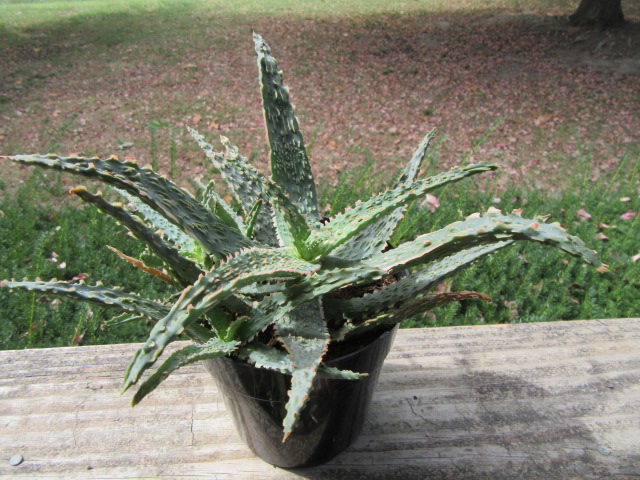
Aloe juvenna (Tiger Tooth Aloe) on 10-24-23, #968-4.
WHEW! The Aloe juvenna (Tiger Tooth Aloe) had a close call. It was much bigger but it started having a weird issue in 2021 and and darn near died. Fortunately, it has survived and is now growing new offsets. This Aloe has been a steady grower (until its near demise). One stem still looks a little iffy…
<<<<+>>>>

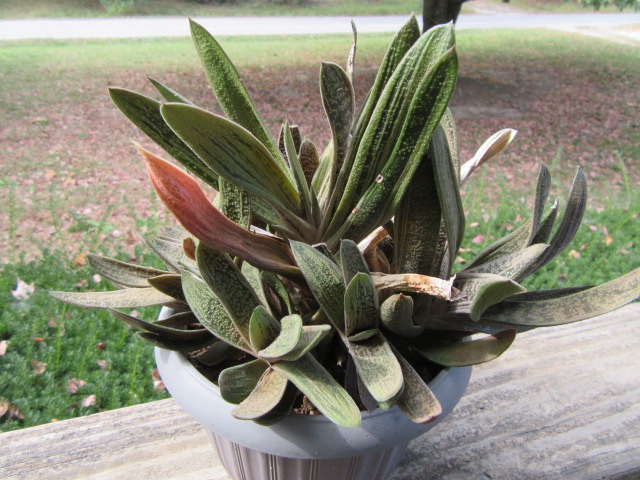
x Alworthia ‘Black Gem’ on 10-24-23, #968-5.
I have had the x Alworthia ‘Black Gem’ since 2019 and it was perfectly fine until last year. It started getting infested with scale. I think it is OK now and I haven’t noticed any scale lately. The plant has done much better over the summer. It is isolated from the other plants and I will keep an eye on it.
<<<<+>>>>

Epiphyllum oxypetalum (Queen of the Night) on 10-24-23, #968-6.
Tony Tomeo sent several Epiphyllum oxypetalum (Queen of the Night) in December 2020 and two have grown by leaps and bounds. The others did well for a while, but eventually died for some reason. There are several common names like Dutchman’s Pipe Cactus, Princess of the Night, Queen of the Night, etc. The official name from iNaturalist is Queen of the Night which it shares with other night-blooming cactus. This plant grows several types of branches. Cactus-like branches grow from main branches that are round with odd spines. As they get older, they flatten out. Strange but true…

Epiphyllum oxypetalum (Queen of the Night) on 10-24-23, #968-7.
I really don’t know much about this species except that they grow in trees in their native habitat. During the summer, I have been keeping the bigger plant in the previous photo next to the Stapelia gigantea on a table under the roof of the back porch. In 2021, the one in the above photo was on a shelf on the back porch, but in 2022 I put it on the front porch. This past summer it was back on the plant shelf on the back porch. On the 23rd I had to move the shelf to my bedroom, so I thought I would temporarily put the plant next to the other one… Well, it had grown a branch that was all the way to the ceiling…

Epiphyllum oxypetalum (Queen of the Night) on 10-24-23, #968-8.
I laid the tall branch along the wall next to a 2 x 4 so it wouldn’t fall over… It had started growing aerial roots…
I need to repot these two and put them in more suitable pots, something that will allow them to hang. I have watched several videos on YouTube about how to grow them… They are definitely interesting and it will be exciting when they bloom. Thanks, Tony! I have a page for this species, but it isn’t finished…
<<<<+>>>>

Euphorbia mammillaris (Indian Corn Cob) on 10-24-23, #968-9.
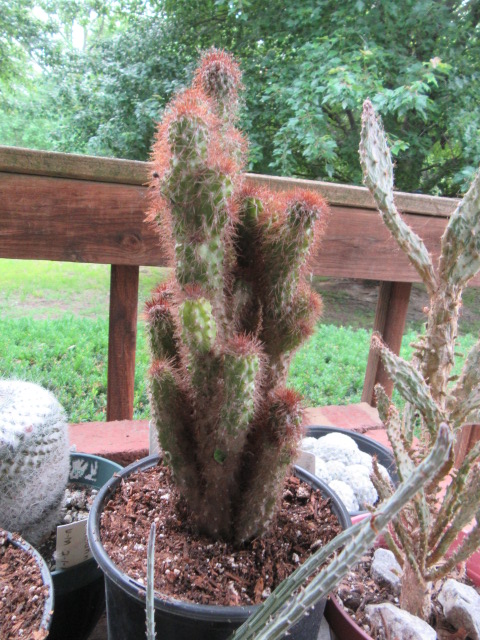
Hmmm… The Euphorbia mammillaris (Indian Corn Cob) is an oddball of sorts. The main stem and its branches keep getting longer. They don’t want to grow like I want them to, so I have to keep a brick next to the pot to keep it from falling over… Yeah, it has an intruder…

Euphorbia mammillaris (Indian Corn Cob) on 10-24-23, #968-10.
I like its small leaves that grow during the summer…
<<<<+>>>>

x Gasteraloe ‘Flow’ at 6 1/2″ tall x 6 3/4″ wide on 10-24-23, #968-11.
This is my second x Gasteraloe ‘Flow’. I brought home the first one in 2016 and threw it out the back door in January 2021. I could not get rid of its mealy bugs and realized it would die anyway and the bugs could spread to more plants. It looked GREAT before its ordeal which you will see if you go to its page. Fortunately, I found this one in 2022 at the Kuntry Store in 2022. Although they had larger ones, they were all in combination planters. I settled on one 3″ tall x 3 3/4″ wide. I told the owner I wanted one of the larger plants, but not all that came with it. He just smiled… GEEZ! The plant has grown well and looks great at 6 1/2″ tall x 6 3/4″ wide. It has a faster growth rate than the old one. Now, I should mention I bought both plants unlabeled so I am just guessing at the name… There are so many to choose from that look alike, but I am sticking with this one. It is pretty well known.
<<<<+>>>>

Gasteria sp. ? on 10-24-23, #968-12.
The Gasteria sp. ‘?’ survived a bout with mealy bugs two winters in a row… This plant is so tough-skinned you wouldn’t think it would have an issue. The bugs get way down where the leaves emerge and it is hard to get to them. It has been sprayed, cleaned, washed, and repotted multiple times… I have had this plant for six summers and I would hate to have to throw it out the door… It looked very iffy when I photographed it already needs a going over. I keep it isolated or around plants that are not susceptible to unwanted critters. It grew A LOT of offsets this summer.
<<<<+>>>>

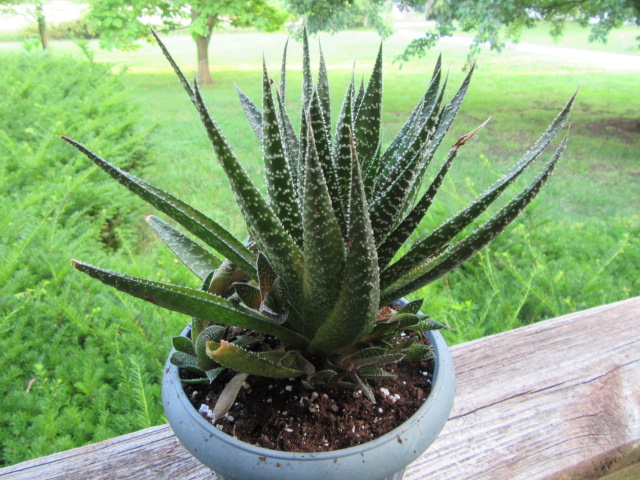
Haworthiopsis limifolia (Fairy Washboard/Swati Haworthia) at 5 3/4″ tall x 7″ wide on 10-24-23, #968-23.
The Haworthiopsis limifolia (Fairy Washboard/Swati Haworthia) is one neat plant! I really like its dark green color and the raised tubercles. Common names include File-Leaved Haworthia, Fairy Washboard, and Fairies Washboard. The iNaturalist website lists the common name as Swati Haworthia… I brought it home in 2019 and it has grown to 5 3/4″ tall x 7″ wide with absolutely no issues.

Haworthiopsis limifolia and kids on 10-24-23, #968-15.
This genus is fairly new, being named in 2013 by George Douglas Rowley. There are currently 19 species in the genus, 15 of which were transferred by Mr. Rowley. There are FIVE accepted varieties of this species including the type specimen. I have no idea which this one is…
<<<<+>>>>

Huernia schneideriana (Red Dragon Flower) on 10-24-23, #968-16.
The Huernia schneideriana (Red Dragon Flower) just keeps growing longer and growing more offsets. It has grown A LOT since I brought it home in 2015. It produces a lot of small maroon flowers with black centers at several different times of the year. This is a carrion flower, but the flowers are so small you don’t notice the smell. I have repotted this plant a few times and it isn’t easy…
Like the Stapelia gigantea (farther down), it is a member of the plant family Apocynaceae, the Milkweeds…
<<<<+>>>>

Kalanchoe daigremontiana (Alligator Plant) at 43″ tall on 10-24-23, #968-17.
OK, I seem to be at a loss for words… I really like Kalanchoe and for the most part, they are easy to grow. The first one I brought home from Wagler’s Greenhouse in 2014. She said it was a Mother of Thousands. Some information online said that the plant was a Kalanchoe daigremontiana, while Llifle (Encyclopedia of Living Forms) showed a completely different plant… After having it misnamed for several years, I put a photo on a Facebook Group and was told it was a Kalanchoe laetivirens (or x laetivirens)… Then finally on May 7 in 2022, Wagler’s had several really nice Kalanchoe daigremontiana… The real deal! Well, I was very excited so I brought one home that was 13 1/2″ tall and it just kept on growing… It was 27 1/2″ tall by the time I moved the plants inside on October 16. It kept growing… I had to rearrange the shelves just for this plant! Well, it started growing buds…
The above photo shows a bent-over stem where the flowers were…

Kalanchoe daigremontiana (Alligator Plant) on 11-6-22, #920-1.
The above photo shows the buds touching the bottom of the shelf on November 6 in 2022… I took it outside for a photo and measurement on November 11 and it was 40 1/2″ tall!

Kalanchoe daigremontiana (Alligator Plant) on 10-24-23, #968-18.
On the 24th, the plant has grown, without the old flower stem, to 43″ tall! I wonder if it will bloom again. Fortunately, it doesn’t have as many kids as the K. laetivirens. Let me rephrase that… Not as many per leaf, which aren’t leaves… What we think of as leaves on these birthing machines, are actually phylloclades which are flattened branches modified for photosynthesis. The Kalanchoe daigremontiana has MANY MORE phylloclades, so in reality, it produces more plantlets. I remove them before I bring them inside or they would be growing in every pot around it…
I thought this species was monocarpic, which means they die after flowering… Guess again! It didn’t die!
<<<<+>>>>

Kalanchoe delagoensis (Mother of Thousands) at 16 1/2″ tall on 10-24-23, #968-20.
I found this Kalanchoe delagoensis (Mother of Thousands) at Mast’s Greenhouse in May this year. It has grown to 16 1/2″ tall and is another one that produces plantlets along its phylloclades.

Kalanchoe delagoensis (Mother of Thousands) on 10-24-23, #968-21.
This one definitely doesn’t produce as many kids…
<<<<+>>>>

Kalanchoe laetivirens (Mother of Thousands) on 10-24-23, #968-22.
The Kalanchoe laetivirens (Mother of Thousands) is the one I had confused with Kalanchoe daigremontiana. I have learned a lot about Kalanchoe with this species, and we have had our ups and downs. This species is actually a hybrid between Kalanchoe daigremontiana and Kalanchoe laxiflora which many list as Kalanchoe x laetivirens. It really doesn’t matter at this point. Like all members of the Kalanchoe genus with phylloclades, it has been in and out of the Bryophyllum genus multiple times, which is currently listed as a synonym on “most” databases.
I have often said that a well-grown Kalanchoe laetivirens is a beautiful plant and I have experienced that several times. If you don’t have time to cut the stem in half on occasion, they can get tall and just plain weird… Ummm… Like mine are now.
The common names Alligator Plant, Mother of Thousands, Mother of Millions, and so on are shared by other members of the genus that produce plantlets along their phylloclades…
<<<<+>>>>

Kalanchoe luciae (Paddle Plant) group on 10-24-23, #968-23.
GEEZ! The Kalanchoe luciae (Paddle Plant)… I brought home the first plant in 2016 and it has multiplied. They grow plenty of offsets that can lead to more plants. Their stems can grow fairly long if not in full sun which mine, for the most part, haven’t been in full sun. I repotted a few of them this spring since I promised them I would. I became busy and didn’t finish. The odd thing is, the plants I didn’t repot still look better than the ones I did. Some of their stems still need cut and replanted and a couple have bent over the edge of the pot and cut themselves. GEEZ! Once I get situated, I will take care of them better over the winter. Ummm… Kalanchoe luciae are monocarpic and are supposed to die after flowering. Well, as you can see, the plant in the back bloomed last year and didn’t die… Well, not yet anyway.
There is another similar species called Kalanchoe thyrsiflora. It is so similar that most of the K. thyrsiflora being sold are actually K. luciae. Last year, I was at Mast’s Greenhouse and found a few unlabeled plants that were growing in better light and really looked good, “OH WOW! Could it be a K. thyrsiflora?” One thing different about the two species is their flowers… Well, I brought one home and it grew and grew and I knew it was going to flower. I thought it was definitely going to be a K. thyrsiflora so I wrote a page about it. Once it was inside, it started budding and bloomed. Hmmm… It was a Kalanchoe luciae… Click HERE to go to the page about this plant. I suppose being grown in a greenhouse with plenty of light, it was growing the way it was supposed to… Now I have to do something about the page… When I go plant shopping I sometimes forget what I have learned when there is a prospect of bringing home a new species.
Apparently, K. thrysiflora is fairly rare so if you find a plant labeled as such, it may very well be a K. luciae…
I intended to put a few K. luciae on the back this summer after I repotted them, but I didn’t. Possibly, if they are in more light, they will grow differently and produce flowers. I have had a few growing in the sun before and they stayed fairly compact and the leaves turned an orangy red. You can see in the above photo one of the plants has orangy leaves from being in more sun.
Hmmm… I should have written a separate post about the Kalanchoe…
<<<<+>>>>

Kleinia stapeliiformis (Pickle Plant) on 10-24-23. #968-26.
I found this plant at Mast’s Greenhouse in May 2023 and just had to bring it home. It was unlabeled, and although I said no more unlabeled plants, I couldn’t help myself AGAIN. So, I brought it home and did a little research and found out it was a Kleinia stapeliiformis (Pickle Plant). Then the thought, “OH NO! I brought home a Senecio!” Sure enough, Senecio stapeliiformis is a synonym. I have had issues with other Senecio species before… This one, however, has done quite well… It has grown more offsets and there are two smaller ones on the other side of the pot.

Kleinia stapeliiformis (Pickle Plant) on 10-24-23, #968-27.
Likely, Mast’s stuck the above stem in the pot and it grew offsets… I think it is pretty neat even though it is a Senecio… I will be even more surprised if it survives the winter… Maybe changing the name gave it confidence. 🙂
<<<<+>>>>

Sedum adolphi (Golden Sedum/Coppertone Stonecrop) on 10-24-23, #968-28.
I first brought a Sedum adolphi (Golden Sedum. Coppertone Stonecrop) home in 2012 and brought it with me when I homed back to the family farm in 2013. The second one almost died in 2017, but it managed to survive. To be honest, I think it would be much better on the back deck in more light so it won’t grow so spindly. You should also take leaf cuttings and put them in their own pot (s) just in case something happens. Sedum adolphi is the only Sedum species I have successfully grown in a pot inside over the winter.
<<<<+>>>>

Sedum adolphi ‘Firestorm’ on 10-24-23.
I brought this Sedum adolphi ‘Firestorm’ home from Lowe’s in 2018. It, like the other Sedum adolphii, probably would do better in more sun than the front porch has to offer. GEEZ! There are certainly plenty of leaves to experiment with. This one has produced flowers inside over the winter.

Sedum adolphi ‘Firestorm’ on 10-24-23, #968-30.
It gets its name ‘Firestorm’ from the orangy margins of the leaves. They get brighter with more light.
<<<<+>>>>

Soehrensia huascha (Desert’s Blooming Jewel) on 10-24-23, #968-31.
This pot of Soehrensia huascha (Desert’s Blooming Jewel) used to be a pot of Echinopsis huascha until the name was changed. For the past couple of winters inside, it has had a few mealy bugs. I think it was because it got them from the Echinopsis ‘Rainbow Bursts’. It looked pretty rough in the spring, but I put it on the side porch over the summer and it now looks GREAT again. Yeah, it has a few blemishes, but that is quite normal. I think this is the subspecies grandiflorus with 39 synonyms… It has been in MANY other genera so no wonder it looks a little rough. It keeps getting passed around. I am almost impatiently waiting for it to bloom… The center plant now measures 7 1/2″ tall.
<<<<+>>>>

Stapelia gigantea (Zulu Giant) on 10-24-23, #968-32.
Last but certainly not the least is the Stapelia gigantea (Zulu Giant) from the back porch. I purchased several cutting from a seller on Ebay in 2018 and have been amazed. It produced but while on the fromt porch in 2019 and 2020 but they fell off when I moved the plant inside for the winter. In 2021, I decided to put in on a table under the roof on the back porch. I figured I could move it inside in front of the sliding door when the time came without that much of a change in light. Well, it bloomed before I had to move it inside. It did the same last year as well. This year, it started blooming in September instead of October. I’m not sure how many flowers have opened, but there have been more than before.
Normally, its leaves are green, but the intense heat of the summer must have turned them a reddish color. It has been in the same spot for three years and it never happened before this year.

Stapelia gigantea (Zulu Giant) on 10-24-23, #968-33.
There are still two buds (one behind my hand) and now this plant is in my bedroom! I had to put it in the bedroom because my son’s cats will play with this plant… Once they go, I will put it in the dining room where it belongs. It is supposed to warm up again, so I may be able to put this plant (at least) back outside after Thursday.
I took a few more photos on the 25th so I will probably be posting about them next.
If you missed update #1, you can view it HERE, and number 2 HERE.
Until next time, take care, be safe, and always be thankful!








 The Belmont Rooster