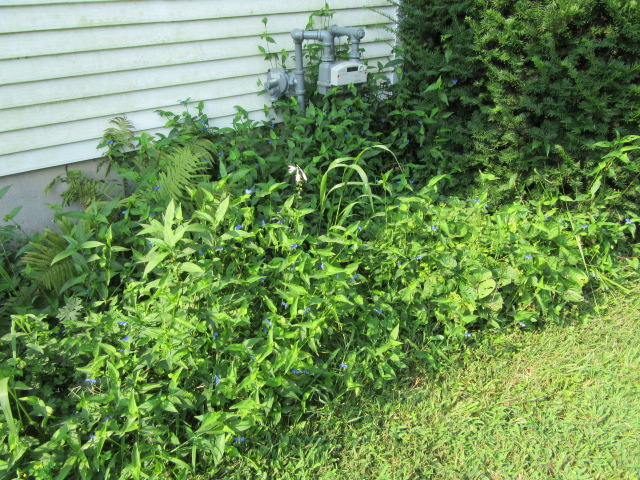
Commelina communis var. ludens (Asiatic Dayflower) on 7-25-24, #1010-1.
Hello everyone! I hope this post finds you well. As I started this post at 10:48 AM, it is a sunny Thursday morning at 82° F. It is supposed to get up to 90…
I thought I would highlight the Commelina communis var. ludens (Asiatic Dayflower) that are growing in the north bed in this post. It has been a great year for the Asiatic Dayflower…

Commelina communis var. ludens (Asiatic Dayflower) on 7-25-24, #1010-2.
They have been producing A LOT of flowers for a while and seem to be trying to become a common weed…

Commelina communis var. ludens (Asiatic Dayflower) on 7-25-24, #1010-3.
Commelina communis is an introduced species from several Asian countries. It can be found in North America from the midwest eastward. Commelina communis var. ludens has a much smaller range being found in only a handful of states, and a small range in their native countries.

Commelina communis var. ludens (Asiatic Dayflower) on 7-25-24, #1010-4.
Here on the farm, Commelina communis var. ludens primarily grows in the north bed and several other areas in the yard. This year, they have been pretty abundant…

Commelina communis var. ludens (Asiatic Dayflower) on 7-25-24, #1010-5.
This subspecies features maroon dots on their false anthers which sets them apart from from Commelina communis var. communis.

Commelina communis var. ludens on the left and Commelina communis var. communis on the right on 9-1-19, #620-10.
I had a lot of fun with both of them in 2019 when both varieties were quite abundant. In fact, Commelina communis var. communis had quite a territory in two areas… Strange, but I haven’t found any since 2019…
You will notice Commelina communis var. communis on the right has paler petals and there are no maroon dots on their false anthers. I initially thought they were Commelina erecta, which is a native species with a BROAD range, but I was mistaken…

Commelina communis var. ludens (Asiatic Dayflower) on 7-25-24, #1010-6.
Dayflowers always seem so happy-looking. Perhaps looks are deceiving and those filaments hanging down could be perceived as fangs…
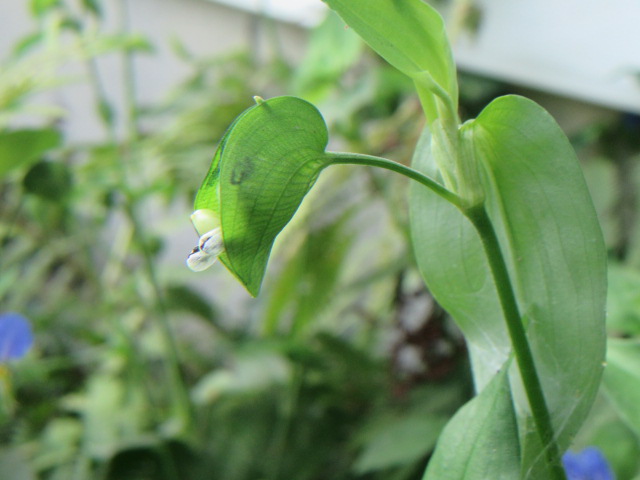
Commelina communis var. ludens (Asiatic Dayflower) on 7-25-24, #1010-7.
Looks like the kids are trying to leave their cradle…
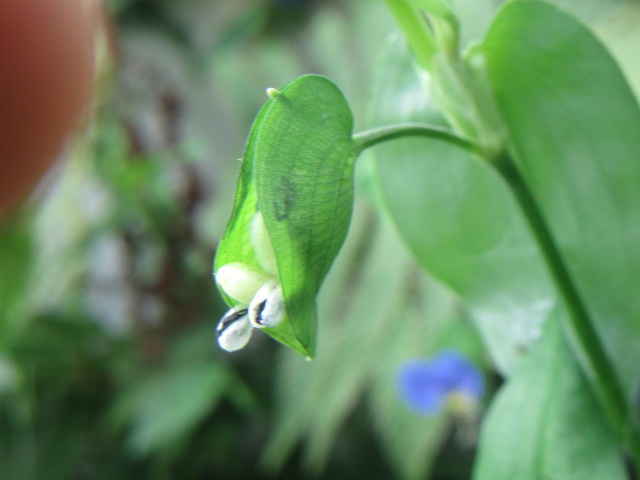
Commelina communis var. ludens (Asiatic Dayflower) on 7-25-24, #1010-8.
Hmmm…

Commelina communis var. ludens (Asiatic Dayflower) on 7-25-24, #1010-9.
The spath-like bracts resemble a taco, folded in the center, with the flowers emerging… One of the distinguishing features of this species is that the spath-like bracts enclosing the flowers are free to the base… In other words, the outer margins of the bract are not fused together from about the midpoint to the base as with C. erecta… With some flowers, they may appear fused, but they can easily be separated. Up to three flowers can emerge from the same bract in succession (usually). The ovaries are formed inside the bracts…

Commelina communis var. ludens (Asiatic Dayflower) on 7-25-24, #1010-10.
The bracts are smoothly rounded, while they have kind of a flat area with C. erecta. I have not personally found any C. erecta, but that’s what the descriptions say.
As with many wildflower species, Commelina communis can be somewhat variable which can make ID more challenging…
I have pages for both varieties which you can view by clicking Commelina communis var. communis and Commelina communis var. ludens…
Until next time, be safe, stay positive, always be thankful, and GET DIRTY!
 The Belmont Rooster