
Viola eriocarpa (Smooth Yellow Violet) on 4-18-20, #689-13.
NOTE: The Viola represented on this page is now Viola eriocarpa (Smooth Yellow Violet), not Viola pubescens due to a taxon split.
Smooth Yellow Violet
Viola eriocarpa
vy-OH-la er-ee-oh-KAR-puh
Downy Yellow Violet
Viola pubescens
vy-OH-la pew-BES-senz
Synonyms of Viola eriocarpa (17) (Updated on 1-8-26 from Plants of the World Online): Crocion achlydophyllum (Greene) Kaczm. (1915), Crocion eriocarpum (Schwein.) Nieuwl. (1914), Crocion scabriuscum Kaczm. (1915), Viola achlydophylla Greene (1902), Viola dasyneura Greene (1910), Viola eriocarpa var. leiocarpa Fernald & Wiegand (1921), Viola eriocarpa f. leiocarpa (Fernald & Wiegand) Deam (1940), Viola eriocarpa var. sessilis Clute (1914), Viola eriocarpa var. typica Grover (1939) (not validly publ.), Viola pensylvanica var. leiocarpa (Fernald & Wiegand) Fernald (1941), Viola pubescens f. achlydophylla (Greene) Farw. (1930), Viola pubescens f. eriocarpa (Schwein.) Farw. (1923), Viola pubescens var. eriocarpa (Schwein.) N.H.Russell (1965), Viola pubescens var. leiocarpa (Fernald & Wiegand) B.Boivin (1967), Viola pubescens f. leiocarpa (Fernald & Wiegand) Farw. (1923), Viola pubescens var. scabriuscula Torr. & A.Gray (1838), Viola scabriuscula (Torr. & A.Gray) Shafer (1901)
Synonyms of Viola pubescens (8) (Updated on 1-8-26 from Plants of the World Online): Crocion pubescens (Aiton) Nieuwl. (1914), Viola pensylvanica Michx. (1803), Viola pubescens var. eriocarpon Nutt. (1818), Viola pubescens var. glabriuscula A.Gray (1895), Viola pubescens f. peckii (House) Lévesque & Dans. (1966), Viola pubescens var. peckii House (1923), Viola pubescens var. typica Grover (1839) (not validly publ.), Viola uniflora var. pubescens (Aiton) Regel (1862)
Viola eriocarpa Schwein. is the accepted scientific name for this species of Viola. It was named and described as such by Lewis (or Ludwig) David von Schweinitz in the American Journal of Science and Arts in 1822.
Viola pubescens Aiton is the accepted scientific name for the Downy Yellow Violet. It was named and described as such by William Aiton in Hortus Kewensis in 1789.
The genus, Viola L., was named and described as such by Carl von Linnaeus in the second volume of the first edition of Species Plantarum in 1753.
As of 1-7-25 when this page was last updated, Plants of the World Online lists 695 species and quite a few hybrids in the Viola genus. The genus is a member of the plant family Violaceae with a total of 25 genera. Those numbers could change periodically as updates are made on POWO.
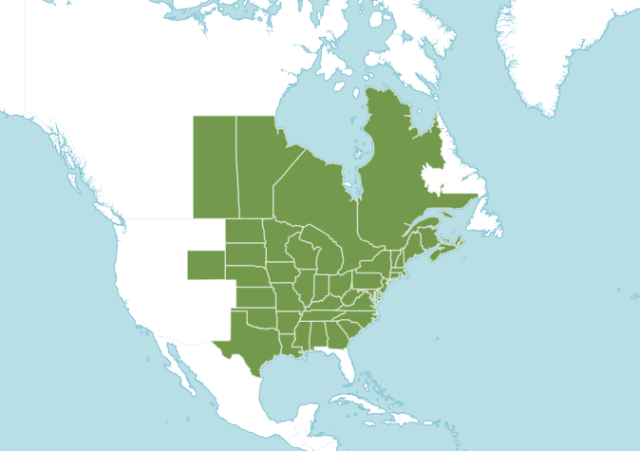
Distribution map of Viola eriocarpa from Plants of the World Online. Facilitated by the Royal Botanic Gardens, Kew. Published on the Internet; http://www.plantsoftheworldonline.org/. Retrieved on May 15, 2024.
The above distribution map for Viola eriocarpa is from Plants of the World Online. Areas in green are where the species is native.
The map on iNaturalist for Viola eriocarpa shows where members have made observations. Anyone can join and it is a great website to confirm and share your observations. The maps on iNaturalist are continually updated as members post new observations.

Distribution map of Viola pubescens from Plants of the World Online. Facilitated by the Royal Botanic Gardens, Kew. Published on the Internet; http://www.plantsoftheworldonline.org/. Retrieved on May 15, 2024.
The above distribution map for Viola pubescens is from Plants of the World Online. Areas in green are where the species is native.
The map for Viola pubescens on the USDA Plants Database is the same as the map for V. eriocarpa on Plants of the World Online.
The map on iNaturalist for Viola pubescens shows where members have made observations. Once Viola eriocarpa became an accepted species, adjustments were made on iNaturalist.
THERE ARE SEVERAL LINKS AT THE BOTTOM OF THE PAGE FOR FURTHER READING AND TO HELP WITH A BETTER POSITIVE ID.
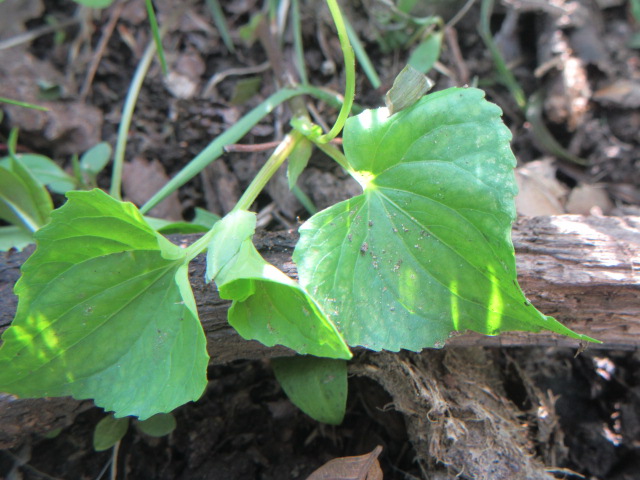
Viola eriocarpa (Smooth Yellow Violet) on 4-18-20, #689-14.
I found several nice-sized colonies of what was (at the time) Viola pubescens in the woods along the creek behind my farm (across the fence) a few years ago but didn’t take photos until April 18 in 2020. I really like this species of Viola because it has yellow flowers instead of the normal shades you would expect from Violets. The other interesting thing is their fruit… They look like little balls of cotton. Further down the page, you will see photos of their fruit that I took in the secluded woods on a friend’s farm on May 3, also in 2020. Then in 2022, I found a small colony next to a fence in the back pasture. This was great so I won’t have to cross the fence and go on a neighbor’s property or even leave the farm. Or so I thought. I haven’t seen it there since…
Due to a taxon split because of certain evidence, what I identified as Viola pubescens is actually now Viola eriocarpa…
Previously, Viola pubescens var. eriocarpa was a synonym of Viola pubescens. Of course, there are other synonyms as well but we aren’t going through all that.
The change to make Viola eriocarpa an accepted species was approved in 2023 (I think) due to several factors. The change made Viola eriocarpa the dominant species of yellow-flowered violets…
Viola pubescens is more uniform in morphology while Viola eriocarpa is quite variable leading to widespread misidentification. The following differences were published on iNaturalist concerning the taxon split committed on 5-9-23.
Typically, Viola pubescens can be identified by the following features:
-Typical solitary stems.
-densely spreading hirsute foliage and peduncles,
-2-3 cauline leaves in the upper fifth to a third of the stem,
-typically ovate stipules with cuneate bases,
-broader cauline leaf blades with broadly cuneate to truncate bases,
-first fully expanded leaf (at the second node) with 13-26 marginal teeth per side. In northern populations where both species overlap, there may be 16 or more teeth per side.
Viola eriocarpa can typically be identified by the following:
-Typically produces multiple stems (usually declined or curved at the base,
-one or more basal leaves per stem,
-glabrous to hirtellous foliage and peduncles
-leaves commonly 4 or more and inserted along most of the stem length,
-the first fully expanded leaf (at the second node) with 5-15 marginal teeth per side,
-lanceolate to ovate stipules that are often cordate-auriculate on the outer side.
Below under the links for further reading, a few websites including Minnesota Wildflowers, have pages for both species which helps to explain the differences in populations in their state. They may be somewhat different than the above explanations.
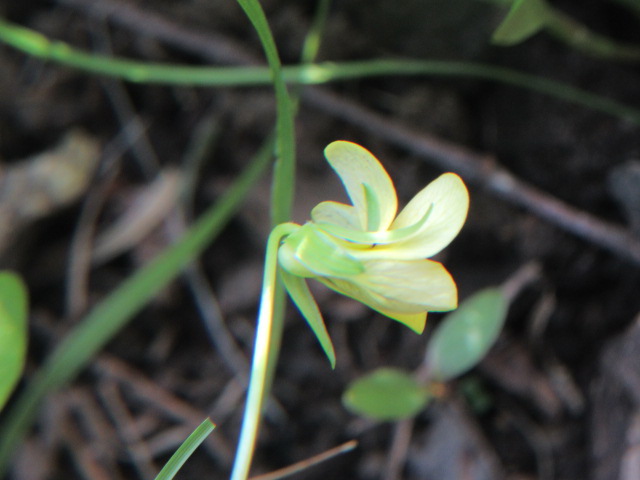
Viola pubescens (Downy Yellow Violet) on 4-18-20, #689-15.
Viola pubescens and Viola eriocarpa are two of the neatest Violets I have encountered. Well, I have to rephrase that now… Viola eriocarpa is the neatest Viola species I have seen since apparently I haven’t found any V. pubescens. Not only because it has yellow flowers, but also for its fuzzy fruit. When I am out wildflower hunting, the first thing I notice is the flowers. Both species are easily spotted and recognized as something way different than the norm, especially for violets.
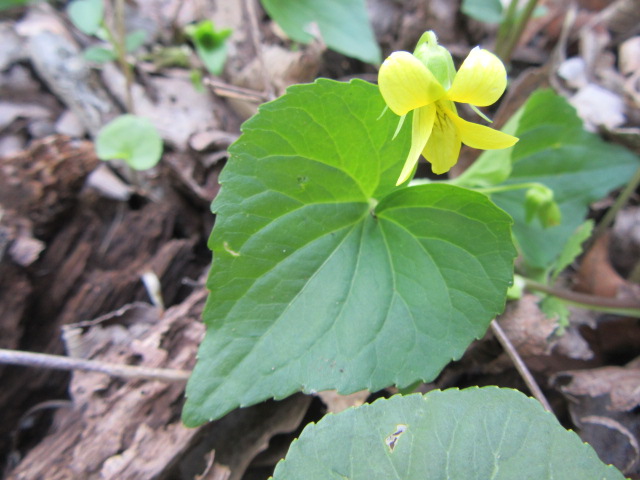
Viola eriocarpa (Smooth Yellow Violet) on 4-18-20, #689-16.
As with all violets, they can be found mainly in wooded areas in light to part shade (or part sun). I have yet to understand the difference between part shade and part sun. They prefer loamy soil with organic matter with consistent moisture they normally get in the spring and early summer. They get a little more sun in the spring when the leaves start growing on the trees, then more shade later when the leaves have fully developed.
They are hardly seen in yards, or even flower beds, because they prefer undisturbed areas.
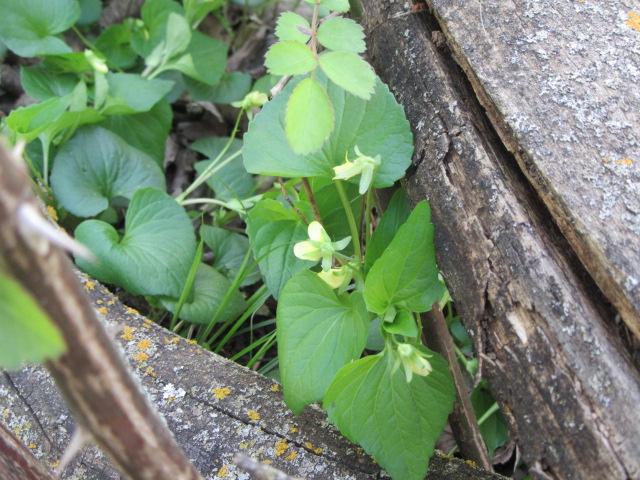
Viola eriocarpa (Smooth Yellow Violet) on 4-18-20, #689-17.
I usually only cross the fence onto the neighbor’s farm when I go morel mushroom hunting in the spring. I always run across several wildflowers to photograph as well. It was great to see several colonies of Viola eriocarpa. I had never seen any until I found them in this wooded area along a creek. It seems weird to change the captions…
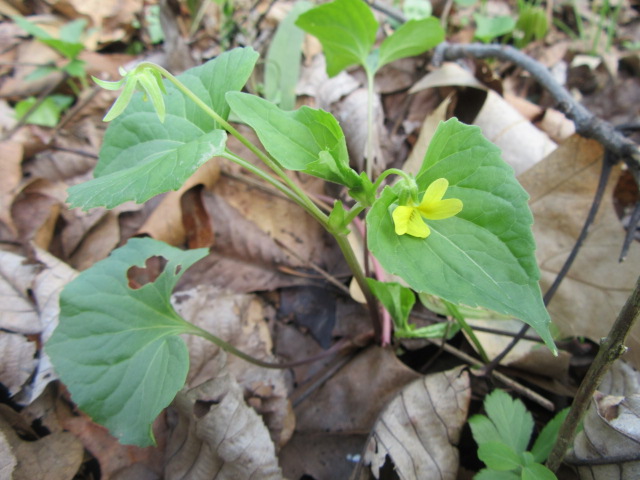
Viola eriocarpa (Smooth Yellow Violet) on 4-23-20, #690-112.
Viola pubescens and Viola eriocarpa are perennial wildflowers whose “stems” grow from an underground rhizome. Different violet species are either caulescent (having stems) or acaulescent (lacking stems). These two species are caulescent since they do produce stems. Typically, Viola pubescens produces a single stem while V. eriocarpa typically produces multiple stems per rhizome. The stems are short, maybe 1” or so, and are not that strong so they have a tendency to flop (ascending). Well, apparently, the stems of V. eriocarpa can be much longer.
They are mostly hairless (glabrous) or can have some hairs (pubescent) that grow in longitudinal lines on the stem ridges. Ummm… Rewriting this page has proven somewhat difficult…
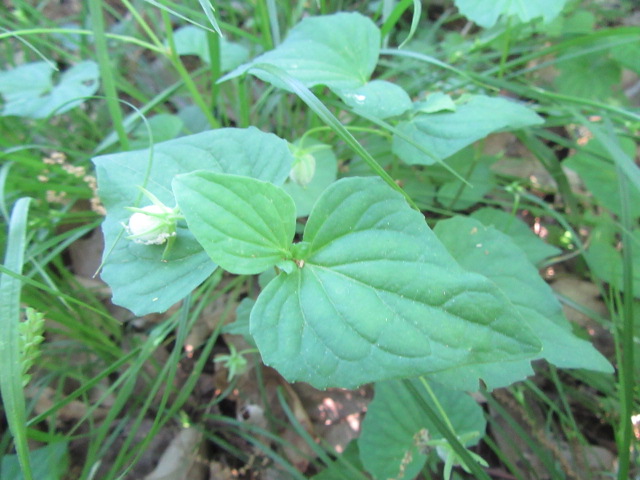
Viola eriocarpa (Smooth Yellow Violet) on 5-3-20, #695-61.
Besides having interesting yellow flowers for violets, they have neat fuzzy fruit. Apparently, according to information online, their fruit can also be glabrous (hairless) but I haven’t seen any like that.

Viola eriocarpa (Smooth Yellow Violet) on 5-3-20, #695-62.
Viola pubescens may not produce basal leaves and produces 1-3 cauline leaves while Viola eriocarpa produces 1 or more basal leaves… Some websites may differ in that opinion, and I’m not throwing a dog in this fight…
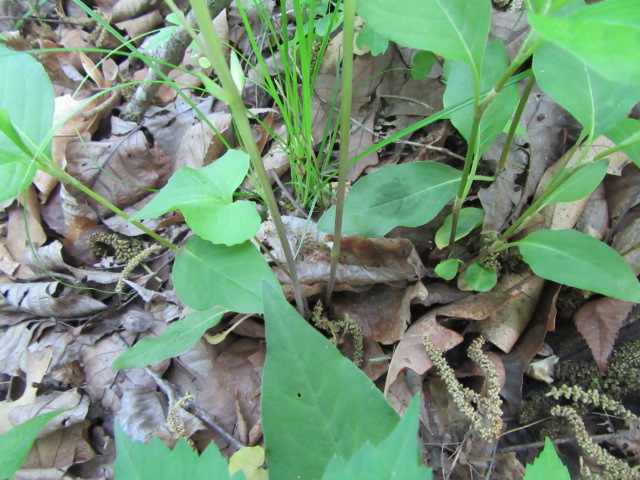
Viola eriocarpa (Smooth Yellow Violet) on 5-3-24, #986-38.
The above photo was taken in a friend’s woods on 5-3-24… Ummm… This is evidence of the lack of basal leaves… Well, heck. That is evidence of V. pubescens… Ignore the Persicaria virginiana in the photo…

Viola eriocarpa (Smooth Yellow Violet) on 5-3-20, #695-63.
Cauline leaves grow in an alternate fashion along the stems are smaller in size with shorter petioles. The basal and cauline leaves are heart-shaped (cordate) and have blunt to pointed teeth along the margins. There are stipules that emerge at the base of the cauline leaves which is an interesting feature common to all the violets I have observed.

Viola eriocarpa (Smooth Yellow Violet) on 5-3-20, #695-64.
The above photo is a closer look at the fuzzy fruit…
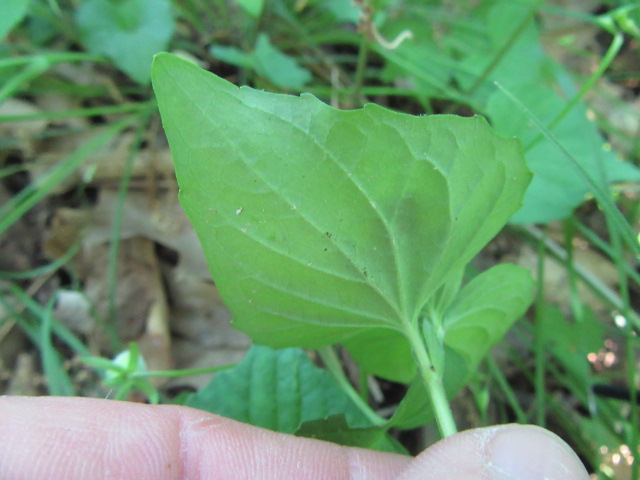
Viola eriocarpa (Smooth Yellow Violet) on 5-3-20, #695-65.
Leaves are either glabrous or may have a few very small hairs.

Viola pubescens (Downy Yellow Violet) on 5-3-20, #695-66.
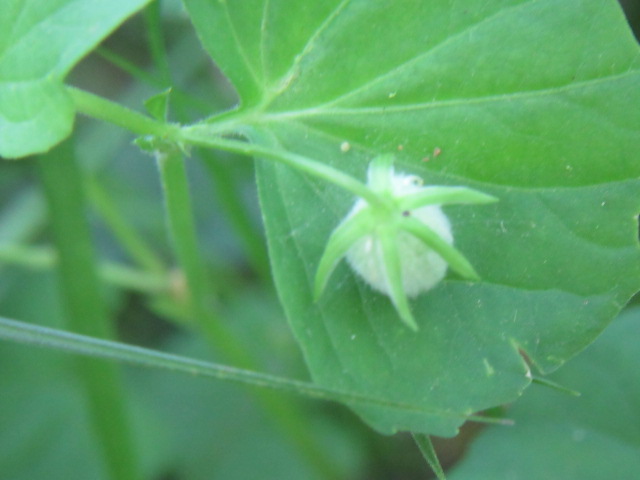
Viola eriocarpa (Smooth Yellow Violet) on 5-3-20, #695-67.
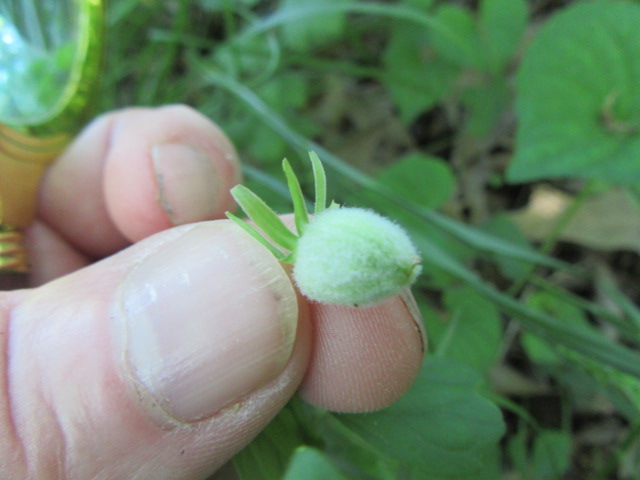
Viola eriocarpa (Smooth Yellow Violet) on 5-3-20, #695-68.

Viola eriocarpa (Smooth Yellow Violet) on 5-3-20, #695-69.
The above photo is of the stipules that grow from the base of the cauline leaves.
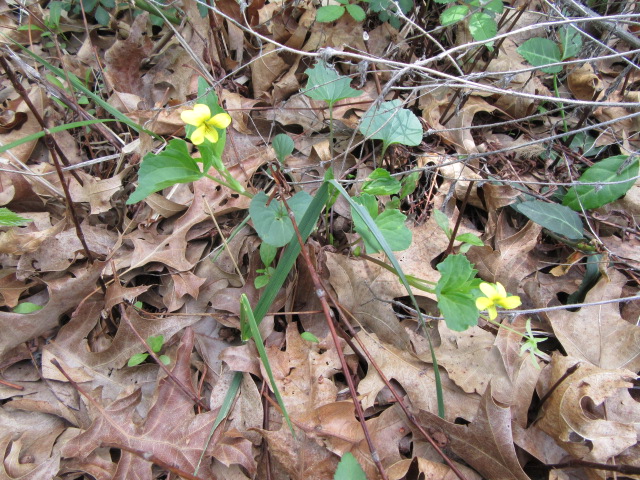
Viola eriocarpa (Smooth Yellow Violet) on 5-1-22, #877-15.
While I was out wildflower hunting in the back of the farm on May 1 in 2022, I spotted a very small colony of Viola eriocarpa close to the fence. It was an exciting moment to find this species on the farm. I hadn’t seen it here before.

Viola eriocarpa (Smooth Yellow Violet) on 5-1-22, #877-16).
The flowers emerge from the axils of cauline leaves on 2-3” long peduncles (flower stems). The peduncle nods downward at the top (apices) causing the flower to face outward. Flowers are around 3/4” wide and consist of five rounded petals and five light green sepals. The two lower lateral petals have white beards and may have a few dark veins beside the beards. The lower petal in the center has purple markings. The two upper petals have no markings. Later, inconspicuous cleistogamous (closed) flowers appear that are self pollinating due to the fact that very few pollinating insects visit their flowers. Well, I think both types of flowers are self-pollinating…
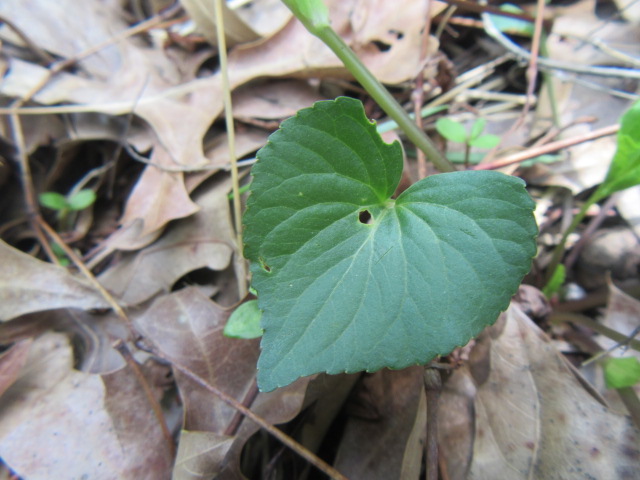
Viola eriocarpa (Smooth Yellow Violet) on 5-1-22, #877-17.
The above photo is a basal leaf. Notice the margins… Scratch that… This leaf “likely” emerged from the rhizome and is “probably” not part of the “petiole” behind it…
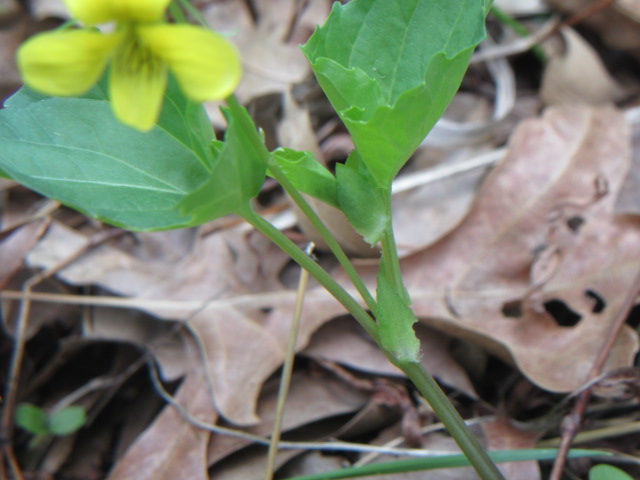
Viola eriocarpa (Smooth Yellow Violet) on 5-1-22, #877-18.
The above photo shows a leaf petiole, stipules, and a pundicle.
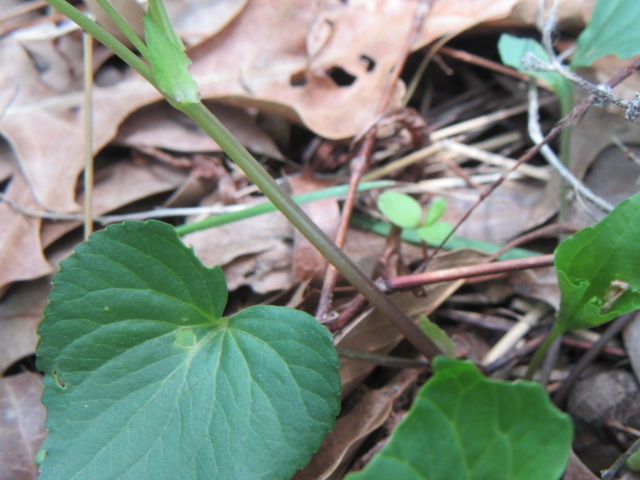
Viola eriocarpa (Smooth Yellow Violet) on 5-1-22, #877-19.
Hmmm… Looking at this photo while I am updating the captions really makes me wonder… The leaves really look like basal leaves… Oh, yeah! That points to V. eriocarpa.
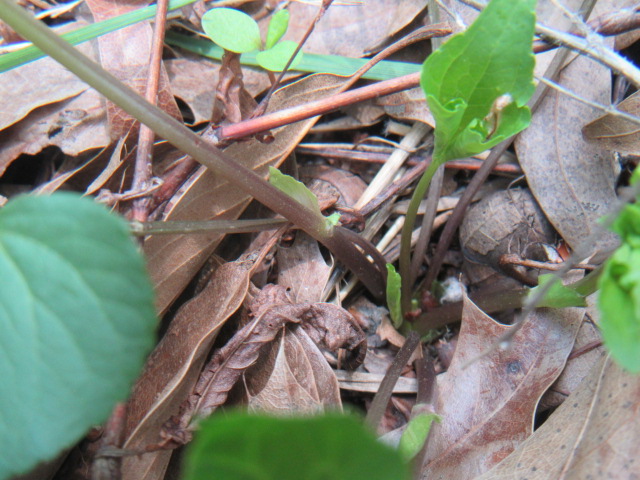
Viola eriocarpa (Smooth Yellow Violet) on 5-1-22, #877-20.
Hmmm… I think I need to forward this observation from May 1 in 2022 to an expert… Well, when the taxon split, this observation became research grade for V. eriocarpa…

Viola eriocarpa (Smooth Yellow Violet) on 5-1-22, #877-21.
Several species of bees, butterflies, and flies feed on the nectar and pollen of violets but are not reliable pollinators. Caterpillars of some butterflies and moths feed on their leaves. Seeds are consumed to some extent by various birds. Ants seem to collect the seeds helping them to spread.

Viola eriocarpa (Smooth Yellow Violet) on 5-1-22, #877-22.
Hmmm…

Viola eriocarpa (Smooth Yellow Violet) on 5-1-22, #877-23.
The above photo shows the curve at the apice of the peduncle.
It always seems weird changing captions from one species to another. You never know when the accepted scientific name will change back. I would not like to be a botanist…
There are a few more photos at the bottom of the page. I will re-arrange the photos at some point…
I have enjoyed photographing and learning about the many wildflowers growing on the family farm and in other areas. The farm is in Windsor, Missouri in Pettis County (Henry County is across the street, and Benton and Johnson aren’t far away). I have grown over 500 different plants and identified over 250 species of wildflowers (most have pages listed on the right side of the page). I am not an expert, botanist, or horticulturalist. I just like growing, photographing, and writing about my experience. I rely on several websites for ID and a few horticulturalists I contact if I cannot figure them out. Wildflowers can be somewhat variable from location to location, so sometimes it gets a bit confusing. If you see I have made an error, please let me know so I can correct what I have written.
I hope you found this page useful and be sure to check the links below for more information. They were written by experts and provide much more information. Some sites may not be up-to-date but they are always a work in progress. If you can, I would appreciate it if you would click on the “Like” below and leave a comment. It helps us bloggers stay motivated. You can also send an email to me at thebelmontrooster@yahoo.com. I would enjoy hearing from you especially if you notice something is a bit whacky.
Some of the links below are for Viola pubescens and some for V. eriocarpa…
*Viola pubescens-Well, likely the website published the page when V. eriocarpa wasn’t an accepted name so the descriptions could be somewhat whacky…
**Viola eriocarpa-Websites use V. eriocarpa and was updated after it became an accepted scientific name. A few use the name Viola pubescens var. eriocarpa (or eriocarpon).
***Flora of North America has a link for Viola pubescens var. scabruiscula which is a synonym of V. eriocarpa, according to POWO. On FNA it is the other way around. Actually… Flora of North America is supposed to be the authority in the United States. It’s POWO that get’s their information and maps from FNA… However, the FNA page hasn’t been updated since 2020… GEEZ! It is so confusing sometimes…
FOR FURTHER READING:
PLANTS OF THE WORLD ONLINE (GENUS/V. pubescens/V. eriocarpa)
INTERNATIONAL PLANT NAMES INDEX (GENUS/V. pubescens/V. eriocarpa)
TROPICOS (GENUS/V. pubescens)
FLORA OF MISSOURI (GENUS/V. pubescens)
***FLORA OF NORTH AMERICA (GENUS/V. pubescens/V. p. var. scabriuscula)
*WORLD FLORA ONLINE (GENUS/SPECIES)
WIKIPEDIA (GENUS/V. pubescens/V. eriocarpa)
*USDA PLANTS DATABASE
*DAVE’S GARDEN
*MISSOURI PLANTS
**MISSOURI BOTANICAL GARDEN
*MISSOURI DEPARTMENT OF CONSERVATION
iNATURALIST (V. eriocarpa/V. pubescens)
*WILDFLOWER SEARCH
ILLINOIS WILDFLOWERS (V. eriocarpa/V. pubescens)
MINNESOTA WILDFLOWERS (V. eriocarpa/V.pubescens)
*KANSAS WILDFLOWERS AND GRASSES
*NORTH CAROLINA STATE UNIVERSITY
*GO BOTANY
*LADY BIRD JOHNSON WILDFLOWER CENTER
*FLORA FINDER
*FRIENDS OF THE WILDFLOWER GARDEN
*MARYLAND BIODIVERSITY PROJECT
MID ATLANTIC NATURE
OHIO UNIVERSITY
*SASKATCHEWAN WILDFLOWERS
*ONTARIO WILDFLOWERS
*EDIBLE WILD FOOD
*LAKE FOREST COLLEGE
NOTE: The data (figures, maps, accepted names, etc.) may not match on these websites. It depends on when and how they make updates and when their sources make updates. Some websites have hundreds and even many thousands of species to keep up with. Accepted scientific names change periodically and it can be hard to keep with as well. Some of the links may use a name that is a synonym on other sites. In my opinion, Plants of the World Online by Kew is one of the most reliable and up-to-date plant databases and they make updates regularly. I make updates “at least” once a year and when I write new pages or add new photos but I do get behind. We are all a work in progress. 🙂
A FEW MORE PHOTOS…

Viola eriocarpa (Smooth Yellow Violet) on 3-31-24, #981-19.
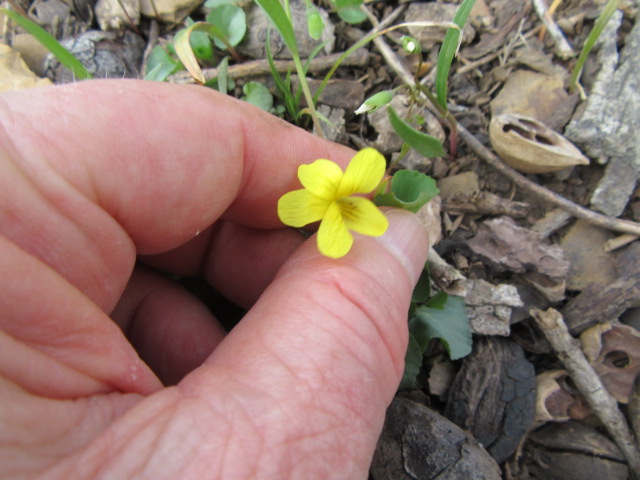
Viola eriocarpa (Smooth Yellow Violet) on 3-31-24, #981-20.

Viola eriocarpa (Smooth Yellow Violet) on 5-3-24, #986-37.
 The Belmont Rooster