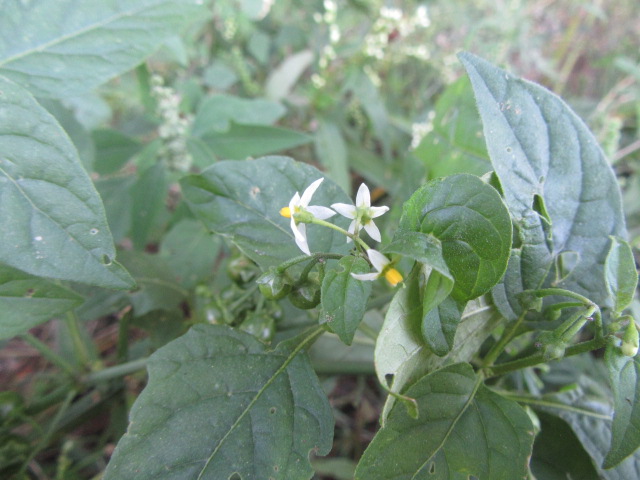
Solanum emulans (Eastern Black Nightshade) on 9-14-18, #508-2.
Eastern Black Nightshade
Solanum emulans
so-LAN-num (so-LAY-num) EM-yoo-lanz
Synonyms of Solanum emulans Moench (5) (Updated on 1-3-26 from Pants of the World Online): Solanum adventitium Polg. (1925 publ. 1926), Solanum dillenianum Polgar (1939) (nom. superfl.), Solanum heterogonum Dunal (1852) (not validly publ.), Solanum nigrum var. virginicum L. (1753)Solanum pterocaulon var. heterogonum Dunal (1852)
Solanum emulans Raf. is the accepted scientific name for the Eastern Black Nightshade. It was named and described as such by Constantine Samuel Rafinesque in Autikon Botanikon in 1840.
The genus, Solanum L., was described as such by Carl von Linnaeus in the first volume of the first edition of Species Plantarum in 1753.
Commonly used scientific names for Eastern Black Nightshade:
Solanum emulans Raf. as named and described by Constantine Samuel Rafinesque in Autikon Botanikon in 1840.
The name was accepted following a document published in PhytoKeys, “A revision of the Morelloid Clade of Solanum L. (Solanaceae) in North and Central America and the Caribbean” in 2019… To read click HERE.
Several websites are using the name Solanum ptycanthum Dunal ex DC. as documented by Augustin Pyramus de Candolle in Prodromus Systematis Naturalis Regni Vegetabilis in 1852. The ascribed author was, ummm, Michel Felix Dunal. Tropicos has an annotation that says “orth. var. of “ptychanthum””, incorrect authorship… (orthographical variant, which is a variant spelling of the same name), This scientific name is not on Plants of the World Online, even as a synonym or IPNI (International Plant Names Index), although it is used by MANY websites…
The nomenclaturally correct scientific name for the above, and used by a few websites, is Solanum ptychanthum Dunal. It was named and described as such by Michel Felix Dunal in the same publication as above. I can’t read the publication because it isn’t in English… Plants of the World Online says this species is now a synonym of Solanum americanum…
There are several species in the Black Nightshade or Solanum nigrum Complex and they are hard to distinguish from one another.
The genus, Solanum L., was described as such by Carl von Linnaeus in the first volume of the first edition of Species Plantarum in 1753.
As of 1-3-26 when this page was last updated, Plants of the World Online lists 1,237 species in the Solanum genus. The genus is a member of the nightshade family, Solanaceae with 103 genera. Those numbers could change as updates are made by POWO.
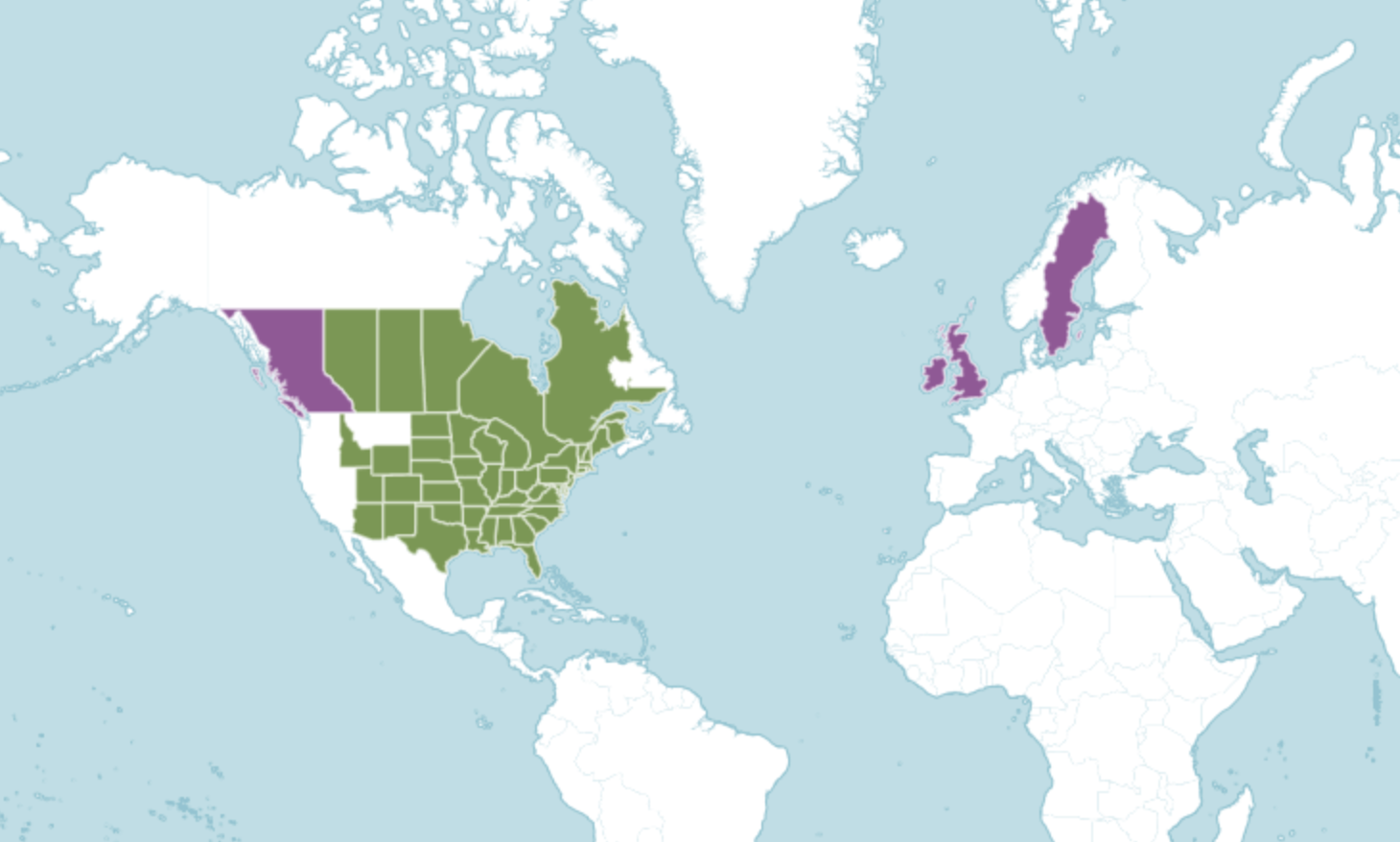
Distribution map of Solanum emulans from Plants of the World Online. Facilitated by the Royal Botanic Gardens, Kew. Published on the Internet; http://www.plantsoftheworldonline.org/. Retrieved on January 3, 2026 (updated).
The above distribution map for Solanum alatum is from Plants of the World Online. Areas in green are where the species is native and purple is where it has been introduced. The map on the USDA Plants Database is not only a little different, they are using the scientific name S. ptycanthum with the common name West Indian Nightshade… They list S. ptychanthum as a synonym and say the name is a database artifact. Hmmm… The USDA gets their data from The Biota of North America Program (BONAP) and they use the correct spelling…
The map on iNaturalist is for Solanum emulans and shows where members have made observations. Anyone can join and it is a great website to confirm and share your observations. The maps on iNaturalist are continually updated as members post new observations.
THERE ARE SEVERAL LINKS AT THE BOTTOM OF THE PAGE FOR FURTHER READING AND TO HELP WITH A BETTER PLANT ID.
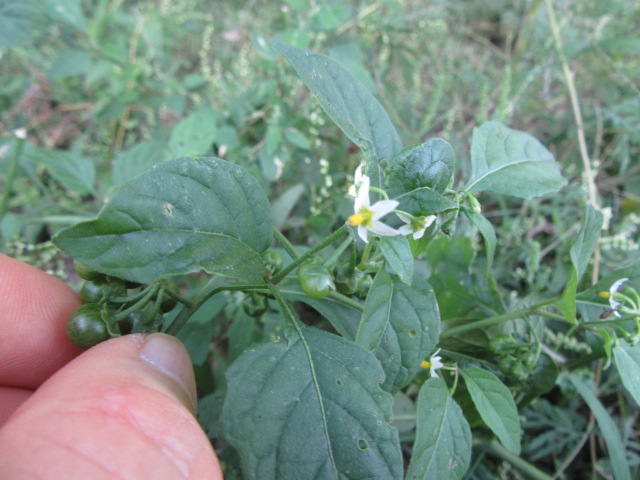
Solanum emulans (Eastern Black Nightshade) on 9-14-18, #508-3.
I spotted a few Black Nightshade on the farm while taking wildflower photos for a post on September 14 in 2018. Strange I had never seen these plants before even though I had been in the spot they were growing many times over the summer. I thought they were Black Nightshade even though I had not seen one in person before. I double-checked with a few websites and I thought they were indeed Solanum americanum. I went back to take more photos after a couple of days and the plants were completely gone… No sign of the stems, leaves, berries, or anything. Like they had never been there! I suppose the only explanation would be that the cows ate them. I find that quite weird since they had apparently been there for quite some time for the plants to have been as big as they were. Why would the cows just decide to eat them then? These plants are highly toxic, even to livestock… Unfortunately, I have not seen any more Black Nightshade on the farm or anywhere else I go wildflower hunting since 2018…
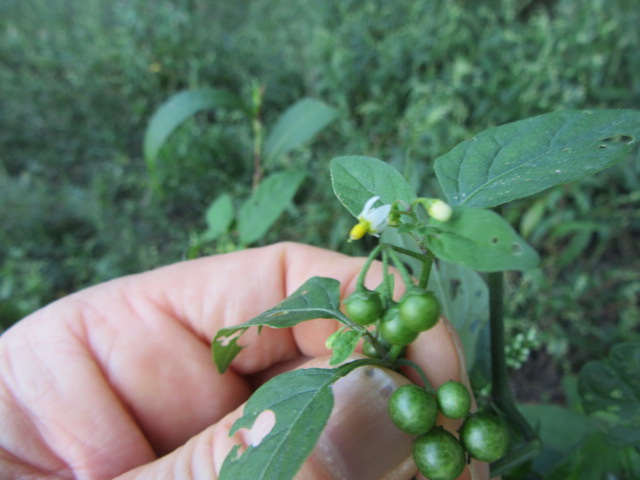
Solanum emulans (Eastern Black Nightshade) on 9-14-18, #508-4.
So, I wrote this page on October 10 in 2018 thinking this plant was Solanum americanum. I didn’t post the observation on iNaturalist until February in 2020 because I hadn’t started using the site until about then. After a few days, a member agreed. Then, 2 years later, another member suggested Solanum emulans. Well, I couldn’t find any information about S. emulans at the time, which seemed a little odd. I asked him why he thought it it was S. emulans instead of S. americanum…
His reply was, “S. emulans is a synonym of S. ptycanthum. I’m not sure why iNat uses it instead of S. ptycanthum.” He continued, “S. americanum’s ripe fruit has reflexed sepals; this plant has sepals adhering to the fruit (as in S. emulans). S. americanum’s unripe fruits are flecked with tiny white dots; these have a veiny white pattern consistent with S. emulans. Few flowered inflorescences, sparse pubescence and deflexed fruiting pedicels are also consistent with S. emulans.”
Well, that led me on a search again. Missouri Plants doesn’t list either one of those species, and the closest match was be S. nigrum. Plants of the World Online said, at the time, S. emulans was a synonym of S. alatum, and there was no species listed by the name of S. ptycanthum. Well, I found out on Tropicos that S. ptycanthum Dunal ex DC is “orth. var.” of Solanum ptychantham Dunal, which means the name is an orthographical variant of the spelling. Dunal, was the French botanist that first named and described the species in 1852. Well, someone screwed up and misspelled the name which was then used, incorrectly, by a few sources which is why it is misspelled online by several sources and the iN member… GEEZ!
Anyway, since iNaturalist was using the name S. emulans and Plants of the World Online said it was a synonym of S. alatum, I changed the name to S. alatum. At the time, Flora of North America hadn’t made species in the plant family Solanaceae available online so I realized that “possibly” Plants of the World Online was not correct. POWO gets their data for North American species from FNA. Then again, before iNaturalist changes a name, it has to go through their own process which can take YEARS, so it was possible that they were not correct…
Well, I had plenty of other work to do on the site, so I stuck with S. alatum… Then, on January 2 in 2026, I started updating the pages for the species in the plant family Solanaceae. Up until then, there were no surprising name changes. I had updated a few maps, but that was about it. THEN, when I got to Solanaceae, I saw Flora of North America had made the family and its species for North America available online. I was very glad! However, that changed a few things, and not just maps…
Solanum alatum is now a synonym of S. americanum which means it is NOT the scientific name for the Eastern Black Nightshade anymore… It turns out, iNaturalist was correct in the first place. Solanum emulans is the scientific name for the Eastern Black Nightshade. Oddly, even S. ptychanthum is also a synonym of S. americanum. So, I changed the map I had on this page and went to the USDA Plants Database to find the species they were using for the Eastern Black Nightshade. Nothing… I searched every species associated with that name and found ZIP. So, I went down the species list and found Solanum ptycanthum… The incorrect spelling for S. ptychanthum. How long did it take to figure that out?
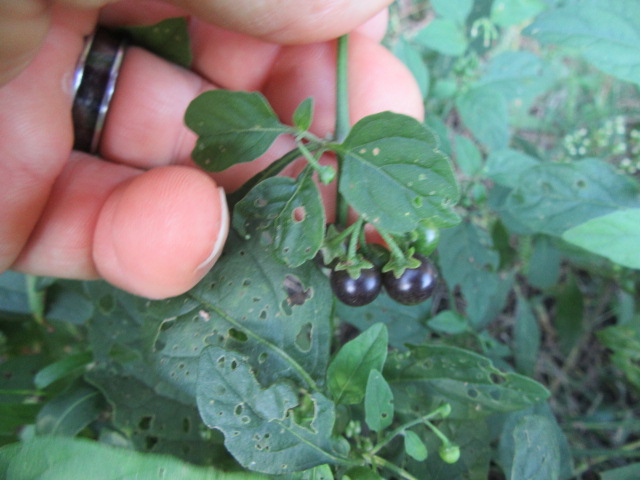
Solanum emulans (Eastern Black Nightshade) on 9-14-18, #508-5.
At some point, I will come back and write descriptions for this plant. I would like to find this species again to take more photos.
Interestingly, there was a plant in the flower bed of the local bank a few years ago. I should have taken more photos then!
Cornel University College of Agricultural discussion comparing three species of Nightshade HERE.]
I have enjoyed photographing and learning about the many wildflowers growing on the family farm and in other areas. The farm is in Windsor, Missouri in Pettis County (Henry County is across the street, and Benton and Johnson aren’t far away). I have grown over 500 different plants and identified over 250 species of wildflowers (most have pages listed on the right side of the page). I am not an expert, botanist, or horticulturalist. I just like growing, photographing, and writing about my experience. I rely on several websites for ID and a few horticulturalists I contact if I cannot figure them out. Wildflowers can be somewhat variable from location to location, so sometimes it gets a bit confusing. If you see I have made an error, please let me know so I can correct what I have written.
I hope you found this page useful and be sure to check the links below for more information. They were written by experts and provide much more information. Some sites may not be up-to-date but they are always a work in progress. If you can, I would appreciate it if you would click on the “Like” below and leave a comment. It helps us bloggers stay motivated. You can also send an email to me at thebelmontrooster@yahoo.com. I would enjoy hearing from you especially if you notice something is a bit whacky.
The links below have been updated, however the Tropicos and Flora of Missouri sites were having issues while I was making the latest updates. Different sites use different scientific names, so…
*=Solanum emulans, **=Solanum ptychantham, ***=S. americanum, ****=S. villosum.
FOR FURTHER READING:
*PLANTS OF THE WORLD ONLINE (GENUS/SPECIES)
*INTERNATIONAL PLANT NAMES INDEX (GENUS/SPECIES)
TROPICOS (GENUS/S. ptychanthum/S. alatum)
*FLORA OF NORTH AMERICA (GENUS/SPECIES)
*FLORA OF MISSOURI (GENUS/S. ptychantham)
*WORLD FLORA ONLINE (GENUS/SPECIES)
WIKIPEDIA (GENUS/SPECIES)
USDA PLANTS DATABASE
**DAVE’S GARDEN
MISSOURI PLANTS (S. nigrum)
**UNIVERSITY OF MISSOURI WEED ID
*iNATURALIST
*WILDFLOWER SEARCH
**ILLINOIS WILDFLOWERS
**IOWA STATE UNIVERSITY
**MARYLAND BIODIVERSITY PROGRAM
**MICHIGAN STATE UNIVERSITY
**MINNESOTA WILDFLOWERS
*MINNESOTA SEASONS
***NORTH CAROLINA STATE UNIVERSITY
***PFAF (PLANTS FOR A FUTURE)
**GO BOTANY
**LADY BIRD JOHNSON WILDFLOWER CENTER
**FRIENDS OF THE WILDFLOWER GARDEN
**RUTGERS UNIVERSITY
EAT THE WEEDS
SOUTH DAKOTA STATE UNIVERSITY
NOTE: The data (figures, maps, accepted names, etc.) may not match on these websites. It depends on when and how they make updates and when their sources make updates. Some websites have hundreds and even many thousands of species to keep up with. Accepted scientific names change periodically and it can be hard to keep with as well. Some of the links may use a name that is a synonym on other sites. In my opinion, Plants of the World Online by Kew is one of the most reliable and up-to-date plant databases and they make updates regularly. I make updates “at least” once a year and when I write new pages or add new photos but I do get behind. We are all a work in progress. 🙂
 The Belmont Rooster