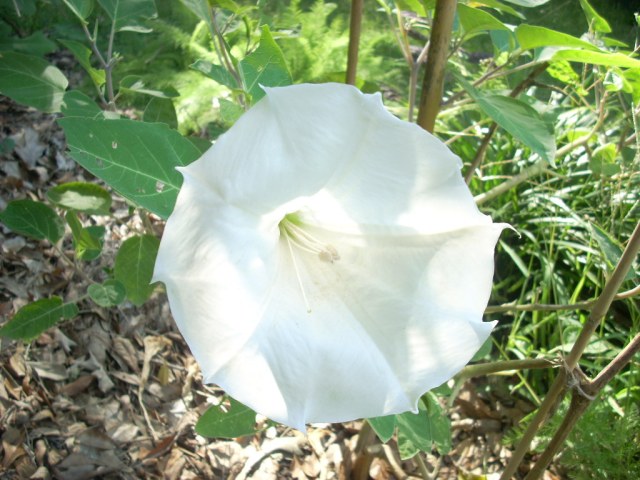
Datura innoxia (Moon Flower) on 9-6-12, #118-3.
Moon Flower, Thorn Apple
Datura innoxia
duh-TOO-ruh in-OKS-see-uh
Synonyms of Datura innoxia (4) (Updated on 1-2-26 from Plants of the World Online): Datura guayaquilensis Kunth (1818), Datura metel L. (1759) (nom. illeg.), Datura meteloides DC. ex Dunal (1852), Datura velutinosa V.R.Fuentes (1981)
Datura innoxia Mill. is the accepted name of this species of Datura. It was named and described as Datura inoxia by Philip Miller in Gardener’s Dictionary in 1768. However, this is an incorrect spelling. When Mr. Miller first described this species, he purposely misspelled the Latin word “innoxius” which means unoffensive. Any Datura is offensive and can be lethal. This is what TROPICOS says about the misspelling:
“Annotation: as “Inoxia”. “in-” is an inseparable particle prefixed to an adjective to reverse the meaning. The adjective here is noxius/a/um so the correct form of the compound is innoxius/a/um. Miller misspelled the epithet as “inoxius” which is correctable under Art. 60.1.”
The genus, Datura L., was named and described as such by Carl von Linnaeus in the first volume of the first edition of Species Plantarum in 1753.
As of 1-2-26 when this page was last updated, Plants of the World Online by Kew lists 14 accepted species in the Datura genus. It is a member of the plant family Solanaceae with 103 genera. Those numbers could change as updates are made on POWO.
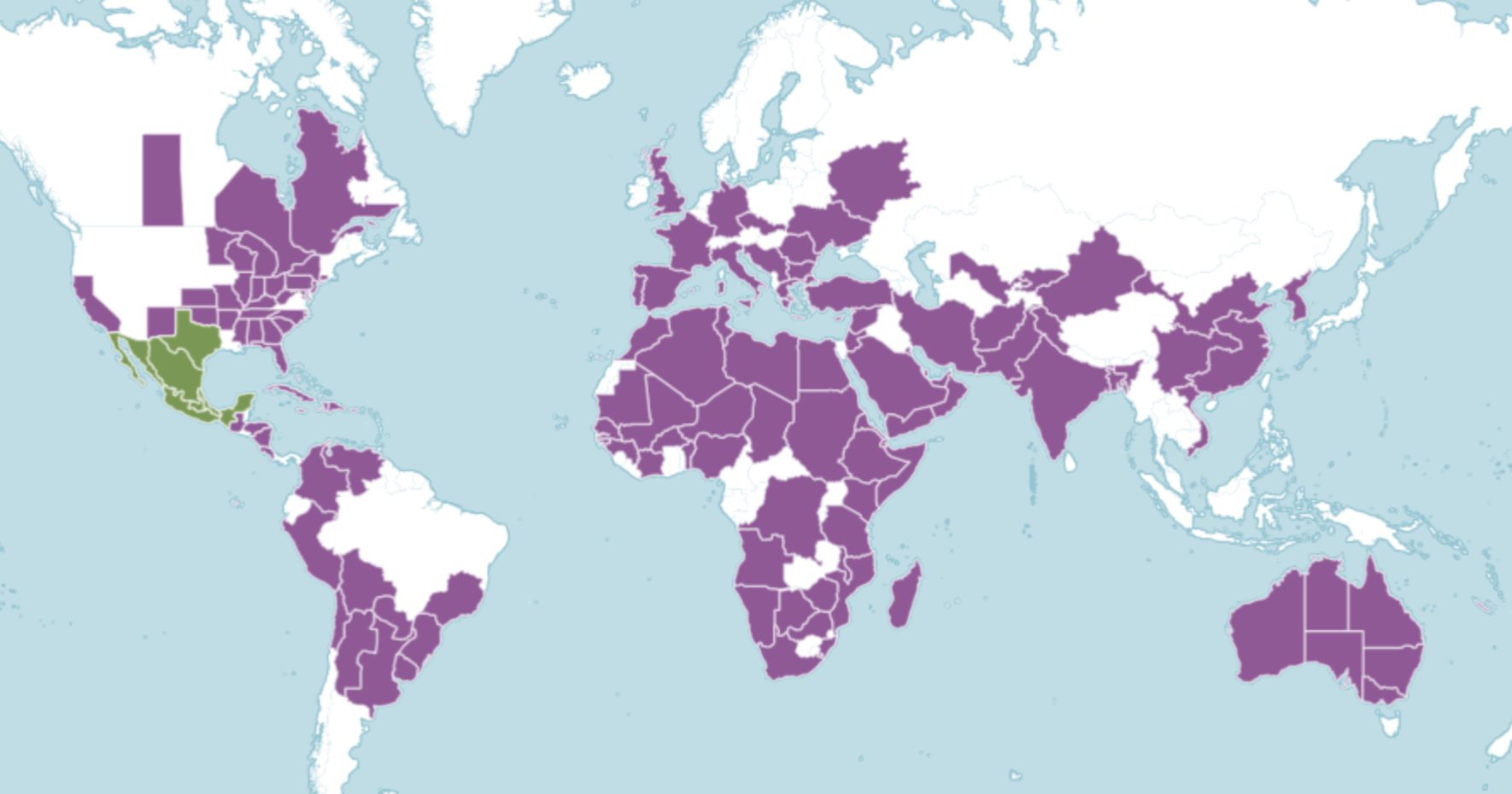
Distribution map of Datura innoxia from Plants of the World Online. Facilitated by the Royal Botanic Gardens, Kew. Published on the Internet; http://www.plantsoftheworldonline.org/. Retrieved on January 6, 2026.
The above distribution map for Datura innoxia is from Plants of the World Online. Areas in green are where the species is native and purple where it has been introduced.
Flora of North America information for the plant family Solanaceae is now available online! To view their page for Datura innoxia, click HERE. I didn’t realize Datura innoxia was as widespread as a wildflower until I found the species on FNA during the last update of this site…
The map on iNaturalist shows where members have made observations. Anyone can join and it is a great website to confirm and share your observations. The maps on iNaturalist are continually updated as members post new observations. I post all my observations on iNaturalist.
THERE ARE SEVERAL LINKS AT THE BOTTOM OF THE PAGE FOR FURTHER READING.

Datura innoxia (Moon Flower) on 10-21-12, #123-6.
One day in July of 2012, while I was living at the mansion in Mississippi, there was a plant on my step. It looked like a Datura but I wasn’t 100% sure. I figured my good friend, Walley, had been the stork so I gave him a call. Sure enough, it was him that brought the plant. He said it was a Moon Flower. I looked it up online and found out it was a Datura innoxia. Besides being called a Moon Flower, it also is called Thorn Apple as well as other names. I could go into a good story about this Datura species but I am just going to give you several links below to check out.

Datura innoxia (Moon Flower) on 10-8-12, #120-6.
USEFUL INFORMATION:
Family: Solanaceae
Origin: Central America
Zones: USDA zones 9-10
Height: 2-3’
Flowers: Produces white, cream, pink, or lavender flowers from July until frost.
Light: Full sun to part shade. Mine were in part shade and still did well and flowered.
Although considered a herbaceous perennial, here in mid-Missouri they are grown as annuals. Seed dispersed from the seed pods may come up the following spring, otherwise, collect the seed for replanting. Information online also suggests the flowers only last one night, but I am not so sure about that…
If you grow this plant, just remember to be careful because of its toxicity. Wash your hands after touching it and keep children away from it.
I hope you enjoyed this page and maybe found it useful. I would like to hear from you if you have any comments, questions, or suggestions. Please click on “like” if you visited this page. It helps us bloggers stay motivated. 🙂 You can check out the links below for further reading. The links take you directly to the genus and species of this plant.
 The Belmont Rooster