
Comandra umbellata (Bastard Toadflax) on 5-5-24, #1041-17.
Bastard Toadflax
Comandra umbellata
Comandra umbellata subsp. umbellata)
koh-MAN-druh um-bell-AY-tuh
Synonyms of Comandra umbellata (1) (Updated on 1-1-26 from Plants of the World Online): Thesium umbellatum L. (1753)
Synonyms of Comandra umbellata subsp. umbellata (12) (Updated on 1-1-26 from POWO): Comandra cuneifolia Raf. (1837), Comandra elliptica Raf. (1837), Comandra media Raf. (1837), Comandra obovata Raf. (1837), Comandra obtusifolia Raf. (1837), Comandra richardsiana Fernald (1905), Comandra umbellata var. decumbens E.J.Hill (1884), Comandra umbellata var. lanceolata Nutt. (1834), Comandra umbellata subsp. richardsiana (Fernald) Á.Löve & D.Löve (1982), Comandra umbellulata Raf. (1837), Hamiltonia umbellata Spreng. (1824), Thesium corymbosulum Michx. (1803)
Synonyms of Comandra umbellata subsp. californica (3) (Updated on 1-1-26 from POWO): Comandra californica Eastw. ex Rydb. (1923), Comandra nudiflora Davidson (1925), Comandra umbellata var. californica (Eastw. ex Rydb.) C.L.Hitchc. (1964)
Synonyms of Comandra umbellata subsp. elegans (3) (Updated on 1-1-26 from POWO): Comandra elegans (Rochel ex Spreng.) Rchb.f. (1849), Hamiltonia elegans (Rochel ex Spreng.) Rchb.f. (1855), Thesium elegans Rochel ex Spreng. (1824)
Synonyms of Comandra umbellata subsp. pallida (5) (Updated on 1-1-26 from POWO): Comandra linearis Rydb. (1917), Comandra pallida A.DC. (1857), Comandra pallida var. angustifolia A.DC. (1856), Comandra umbellata var. angustifolia (A.DC.) Torr. (1859), Comandra umbellata var. pallida (A.DC.) M.E.Jones (1895)
Comandra umbellata (L.) Nutt. is the accepted scientific name for this species. The genus and species were named as such by Thomas Nuttall in The Genera of North American Plants in 1818. It was first named Thesium umbellatum by Carl von Linneaus in the first volume of the first edition of Species Plantarum in 1753.
Accepted Infraspecific Names of Comandra umbellata (4) (Updated on 1-1-26 from POWO): Comandra umbellata subsp. californica (Eastw. ex Rydb.) Piehl (1965), Comandra umbellata subsp. elegans (Rochel ex Spreng.) Piehl, Comandra umbellata subsp. pallida (A.DC.) Piehl, *Comandra umbellata subsp. umbellata (autonym). *When an infraspecific taxon is named, an autonym (“type-specimen”) is automatically generated whose description is closest to the (original) species. All have their own list of synonyms… This page is about Comandra umbellata subsp. umbellata which is present where I live.
As of 1-1-26 when this page was added, Plants of the World Online lists only one species in the genus Comandra. It is a member of the plant family Santalaceae with 40 genera. Those numbers could change as updates are made on POWO.

Distribution map of Comandra umbellata from Plants of the World Online. Facilitated by the Royal Botanic Gardens, Kew. Published on the Internet; http://www.plantsoftheworldonline.org/. Retrieved on May 13, 2025.
The above distribution map for Comandra umbellata is from Plants of the World Online. The map on the USDA Plants Database for North America is about the same. You can click on the links to see where the individual subspecies are native.
The map on iNaturalist shows where members have made observations. Anyone can join and it is a great website to confirm and share your observations. The maps on iNaturalist are continually updated as members post new observations. I post all my observations on iNaturalist.
THERE ARE SEVERAL LINKS AT THE BOTTOM OF THE PAGE FOR FURTHER READING AND TO HELP WITH A POSITIVE ID.

Comandra umbellata (Bastard Toadflax) on 5-5-24, #1041-18.
I was invited to visit a private well-maintained native prairie not far from home on 5-5-25. It was quite amazing! I ran across 11 species I hadn’t seen before including this Comandra umbellata (Bastard Toadflax).
Comandra umbellata (Bastard Toadflax) is a hemiparasitic from the new-to-me plant family Santalaceae. The genus name comes from the Greek word for “male hairs” that refers to the hairs at the base of it’s flowers stamens…
Some authorities place this genus in the plant family Comandraceae with two genera.

Comandra umbellata (Bastard Toadflax) on 5-5-24, #1041-19.
Comandra umbellata is a native U.S. perennial wildflower that cam be found throughout North America, down into Mexico, and even Bulgaria, Greece, Romania, and Turkey. The species may be encountered in other countries but not recorded.
The preferred habitat is full to part sun in mesic to dry conditions. They can thrive in acidic to neutral loam, sandy, or rocky soil. They can be found in prairies, savannas, barren areas, and upland woods.
Bastard Toadflax is known to be hemiparasitic growing from a a horizontal rhizome with underground suckers (haustoria) that parasitize the roots of other plants. It also produces food from photosynthesis, making it hemiparasitic rather than just parasitic. Information online says they parasitize over 200 known plant species…

Comandra umbellata (Bastard Toadflax) on 5-5-24, #1041-20.
Plants only grow to about 12” tall on normally light green, glabrous (smooth) stems. The stems are normally unbranched until toward the top.
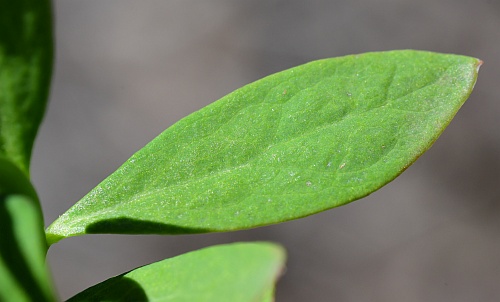
The above photo of Comandra umbellata is from the Missouri Plants website. Missouri Plants is published on the internet at http://www.missouriplants.com/index.html. Photo used by permission and retrieved on January 24, 2026.
Their abundance of leaves grow in an alternate manner along the stems and are said to be oblanceolate, ovate, linear-elliptic oblong, etc. Take your pick… They taper to a narrowed pointed tip. The leaves are small, being only 1-2 inches long an about 3/4” wide. They are either sessile (no leaf stems/petioles) or have very short petioles. Both leaf surfaces are kind of a medium green. Some sources say the leaves are thick and fleshy, but I don’t remember that part. I need to go back again and check it out and take more photos…
I think the plants were barely in bud when I visited the prairie on May 5, so I didn’t get good photos of the flowers. After looking at the photos on other sites and iNaturalist and reading various descriptions, I think I can do OK writing a description I can understand. I am using a few photos taken by others, with permission, until I can take better ones of my own.
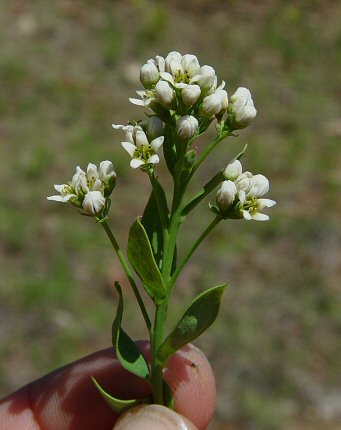
The above photo of Comandra umbellata is from the Missouri Plants website. Missouri Plants is published on the internet at http://www.missouriplants.com/index.html. Photo used by permission and retrieved on January 24, 2026.
The upper part of the stem branches out somewhat (auxiliary branches), and each stem terminates in several umbellate clusters of 5-12 flowers. Each flower is attached by short pedicles (flower stems). The pedicles are somewhat of different lengths giving the clusters a flat-topped appearance, as a whole, the inflorescence is more or less dome-shaped.
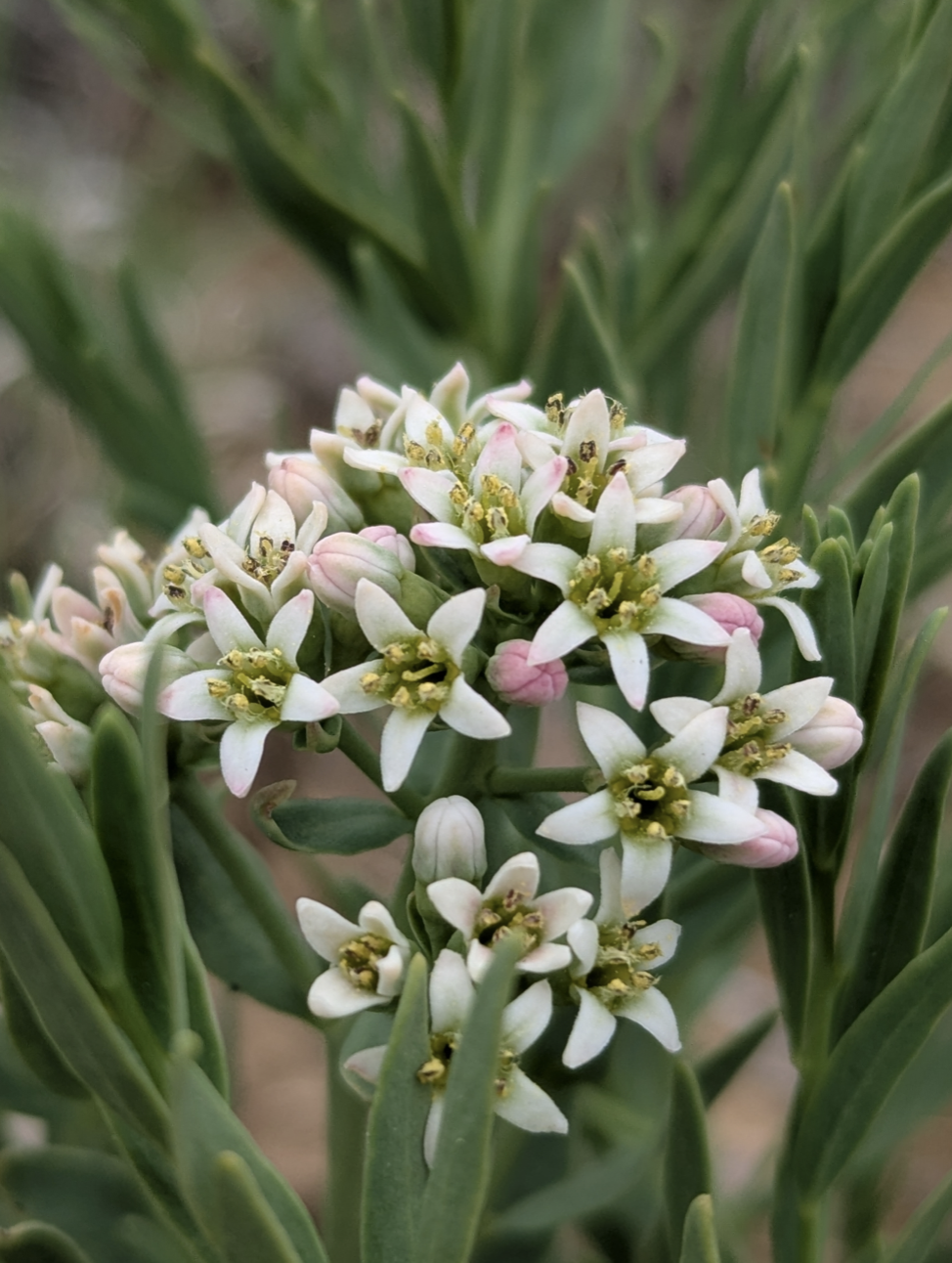
The above photo of Comandra umbellata was taken by iNaturalist member Eric Watts at Waters Edge in Aurora, Colorado on 5-14-25 and submitted as an observation on iNaturalist. Used by permission and retrieved on January 24, 2026.
Some flowers are difficult to describe, but this one takes the cake! A flower is a flower, right? Wrong!
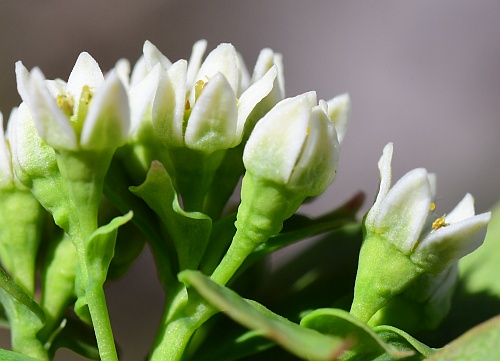
The above photo of Comandra unbellata is from the Missouri Plants website. Missouri Plants is published on the internet at http://www.missouriplants.com/index.html. Photo used by permission and retrieved on January 24, 2026.
From the side view, on the the top of the flower stem (pedicle) is a cup-shaped hypanthium. On the inner surface of the hypanthium is a prominent, shallowly-lobed nectary. There are 5 white sepals growing from the rim of the hypanthium, usually with tiny hairs on the upper surface and with a small tuft of hairs at the base (on the inside). There are no petals…
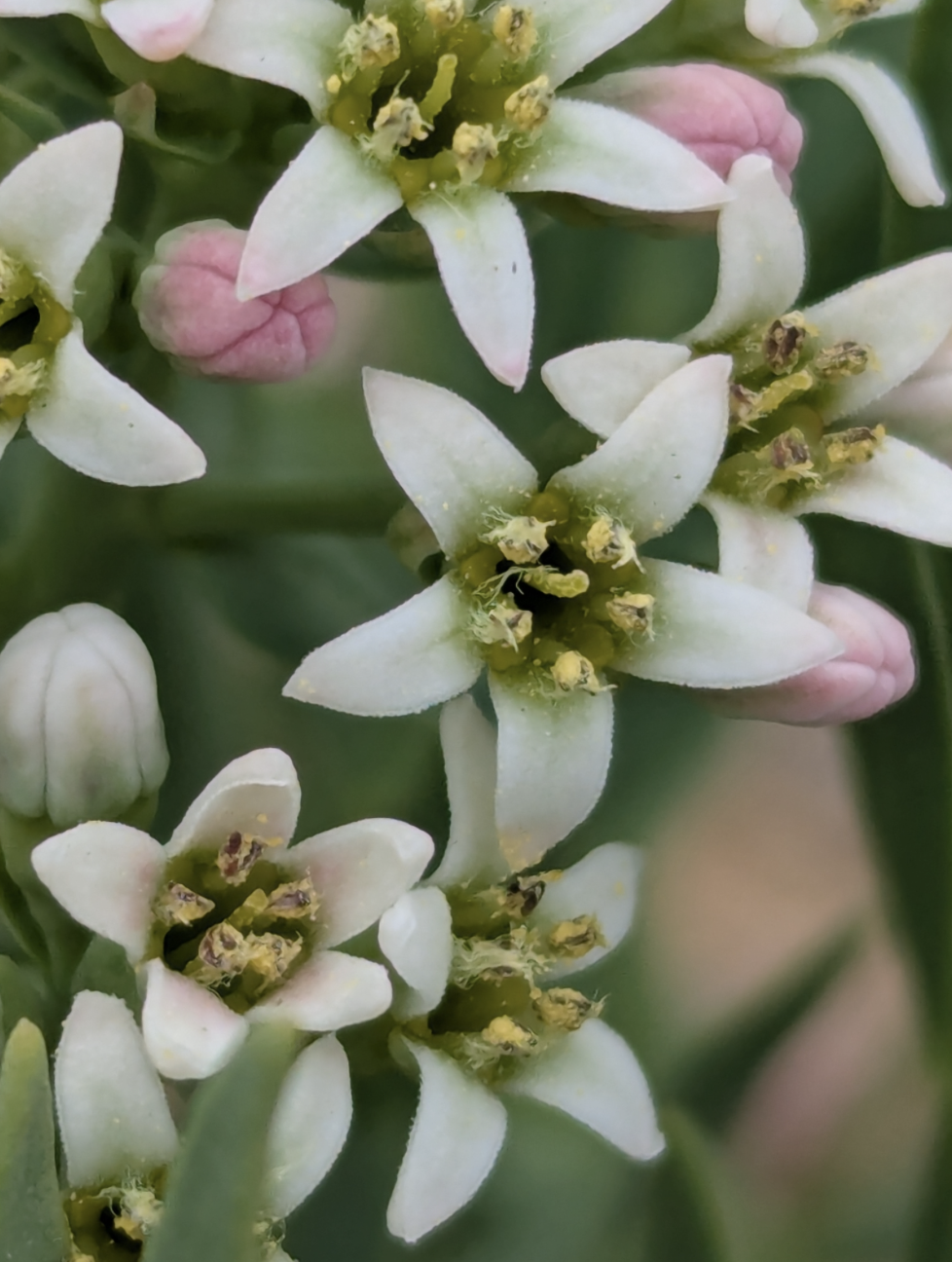
The above photo of Comandra umbellata was taken by iNaturalist member Eric Watts at Waters Edge in Aurora, Colorado on 5-14-25 and submitted as an observation on iNaturalist. Used by permission and retrieved on January 24, 2026.
There are 5 stamens attached to the rim of the hypanthium opposite the sepals. The filaments are short with yellow anthers. There is one pistil per flower, usually with 3 fused carpels. I think that is enough to keep you curious…
*NOTE: Hypanthium is used by Missouri Plants, but other sites call it a 5-lobed calyx, bell-shaped corolla, etc. The definition of a hypanthium is “ a tubular or cup-shaped receptacle on which the stamens, petals, and sepals are borne.”
Here in Missouri, plants produce flowers from May through sometime in July. The flowers open sporadically, each one lasting 2-3 days.
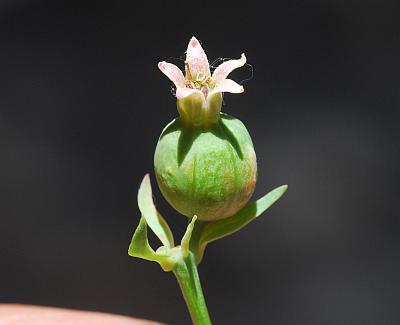
The above photo of Comandra umbellata is from the Missouri Plants website. Missouri Plants is published on the internet at http://www.missouriplants.com/index.html. Photo used by permission and retrieved on January 24, 2026.
The central ovary swells to form a 1-seeded fruit, called a drupe, that turn a brownish color at maturity. Ummm… The fruit is oddly edible…
The above photo from Missouri Plants is of a drupe of a Comandra umbellata subsp. pallida from Chiracahua National Monument in Cochise County, Arizona in 2016.
The genus name, Comandra, comes from the Greek for “male hairs” referring to the hairs at the base of the stamens. The species name, umbellata, refers to plants that have an umbrella-like flower cluster. The common name, Bastard Toadflax, is somewhat strange since this plant isn’t a Toadflax at all. Possibly someone thought the leaves resembled those of the true Toadflax (a member of the plant family Scrophulariaceae). Perhaps they used the name “Bastard” rather than a proper name to say it isn’t a real Toadflax… What common names would you have chose?
Hopefully, I can get back to the prairie, or a public site near it, to take more photos. I would like to see the flowers open in person.
I want to thank the Missouri Botanical Garden for making Missouri Plants website available online. I have learned a lot about wildflowers from this site. They also maintain Tropicos and Flora of Missouri.
I also want to thank iNaturalist member Eric Watts for allowing me to use a few of his amazing photos. Eric is a Colorado State University Extension Native Plant Master and the Open Space & Natural Resources Division Superintendent for City of Aurora, Colorado.
The iNaturalist website is published on the internet at https://inaturalist.org. The iNaturalist website is a joint initiative of the California Academy of Sciences and National Geographic Society.
I live on the family farm in Windsor, Missouri in Pettis County (Henry County is across the street, and Benton and Johnson aren’t far away). I have grown over 500 different plants and identified over 250 species of wildflowers (most have pages listed on the right side of the page). I am not an expert, botanist, or horticulturalist. I just like growing, photographing, and writing about my experience. I rely on several websites for ID and a few horticulturalists I contact if I cannot figure them out. Wildflowers can be variable from location to location, so that can be a bit confusing. If you see I have made an error, please let me know so I can correct what I have written.
I hope you found this page useful and be sure to check the links below for more information. They were written by experts and they have provided much more information. Some sites may not be up-to-date but they are always a work in progress. If you can, I would appreciate it if you would click on the “Like” below and leave a comment. It helps us bloggers stay motivated. You can also send an email to me at thebelmontrooster@yahoo.com. I would enjoy hearing from you especially if you notice something is a bit whacky.
FOR FURTHER READING:
PLANTS OF THE WORLD ONLINE (GENUS/SPECIES)
INTERNATIONAL PLANT NAMES INDEX (GENUS/SPECIES)
TROPICOS (GENUS/SPECIES)
FLORA OF NORTH AMERICA (GENUS/SPECIES)
WORLD FLORA ONLINE (GENUS/SPECIES)
WIKIPEDIA (GENUS/SPECIES)
USDA PLANTS DATABASE
iNATURALIST
MISSOURI PLANTS
WILDFLOWER SEARCH
BURKE HERBARIUM
FRIENDS OF THE WILDFLOWER GARDEN
GO BOTANY
GRASSLAND RESTORATION NETWORK
ILLINOIS WILDFLOWERS
KANSAS WILDFLOWERS AND GRASSES
LADY BIRD JOHNSON WILDFLOWER CENTER
LAKE FOREST COLLEGE
MINNESOTA WILDFLOWERS
PFAF (PLANTS FOR A FUTURE)
SEINet
SOUTHWEST DESERT FLORA
UNIVERSITY OF ALBERTA
NOTE: The data (figures, maps, accepted names, etc.) may not match on these websites. It depends on when and how they make updates and when their sources make updates. Some websites have hundreds and even many thousands of species to keep up with. Accepted scientific names change periodically and it can be hard to keep with as well. Some of the links may use a name that is a synonym on other sites. In my opinion, Plants of the World Online by Kew is one of the most reliable and up-to-date plant databases and they make updates regularly. I make updates “at least” once a year and when I write new pages or add new photos but I do get behind. We are all a work in progress. 🙂
 The Belmont Rooster