
Houstonia pusilla (Tiny Bluet) on 4-3-22, #864-2.
Tiny Bluet, Small Bluet, Least Bluet, Star Violet
Houstonia pusilla
hoos-TOH-nee-uh pus-ILL-uh
Synonyms of Houstonia pusilla (17) (Updated on 1-1-26 from Plants of the World Online): Ereicoctis crassifolia Kuntze, Hedyotis caerulea var. minima (Beck) Fosberg, Hedyotis caerulea var. minor (Michx.) Torr. & A.Gray, Hedyotis crassifolia Raf., Hedyotis crassifolia f. albiflora (Standl.) W.H.Lewis, Hedyotis geniculata Raf., Hedyotis minima (Beck) Torr. & A.Gray, Houstonia caerulea var. minor (Michx.) Pursh, Houstonia geniculata Raf., Houstonia linnaei var. minor Michx., Houstonia minima Beck, Houstonia minor Britton, Houstonia patens Elliott, Houstonia pusilla f. albiflora Standl., Houstonia pusilla f. rosea Steyerm., Oldenlandia caerulea var. patens (Elliott) M.Gómez, Oldenlandia patens (Elliott) Chapm.
Houstonia pusilla Schöepf is the accepted scientific name for this species of Houstonia. It was named and described as such by Johann David Schöepf in Reise Nordamerikananischen Staaten (short version) in 1788.
The genus, Houstonia L., was described by Carl von Linnaeus in the first volume of the first edition of Species Plantarum in 1753. He cited Johan Frederik Gronovius as previously naming the genus.
As of 1-1-26 when this page was last updated, Plants of the World Online lists 24 species in the Houstonia genus. It is a member of the plant family Rubiaceae with 621 genera. Those numbers could change as updates are made on POWO.

Distribution map for Houstonia pusilla from the USDA Plants Database. Published on the internet at https://plants.sc.egov.usda.gov/home. Retrieved on April 4, 2022.
The above distribution map for Houstonia pusilla is from the USDA Plants Database. Areas in green are where the species is native.
The map on iNaturalist shows where members have made observations. Anyone can join and it is a great website to confirm and share your observations. The maps on iNaturalist are continually updated as members post new observations.
THERE ARE SEVERAL LINKS AT THE BOTTOM OF THE PAGE FOR FURTHER READING AND TO HELP WITH A BETTER POSITIVE ID.

Houstonia pusilla (Tiny Bluet) on 4-3-22, #864-3.
I ran across two nice-sized colonies of Houstonia pusilla close to the pond in the back of the farm on April 4 in 2022. It had been a long time since I stumbled on these tiny flowers, so long I can’t remember when. It was kind of like they jogged my memory.
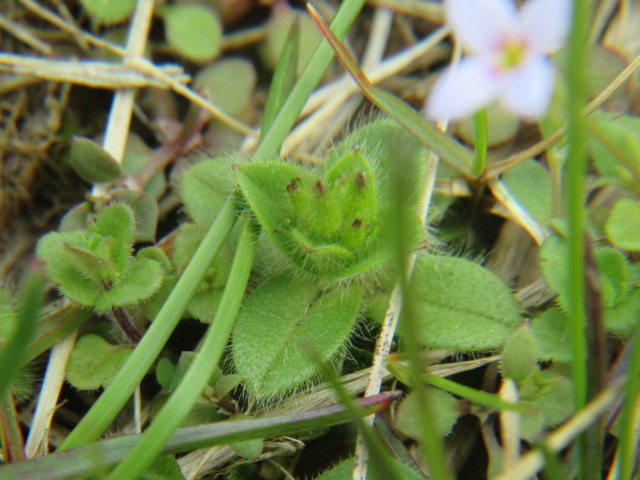
Houstonia pusilla (Tiny Bluet) on 4-3-22, #864-4.
The small hairy leaves reminded me of the leaves of the Sticky Mouse- Ear Chickweed (Cerastium glomeratum) from the family Caryophyllaceae.
Houstonia pusilla is a U.S. native wildflower that can be found throughout most of Missouri and from the middle part of the U.S. eastward. They are often overlooked since they are very small and start blooming as early as March and continue only until sometime in April. In some areas, it is so abundant that lawns and roadsides can can appear to have a haze of lavender.

Houstonia pusilla (Tiny Bluet) on 4-3-22, #864-5.
Tiny Bluets prefer full sun in moist to fairly dry soil. Although not particularly picky, they seem to prefer fairly rocky, sandy soil where more prolific grasses and other plants to avoid competition and being overshadowed. They grow well in abandoned fields, pastures, glades, open disturbed areas, open rocky woodlands, eroded pond banks, hillsides, streambanks, etc., where competition is at a minimal.

Houstonia pusilla (Tiny Bluet) on 4-3-22, #864-6.
Being a mat-forming herbaceous winter annual, H. pusilla forms a small rosette of basal leaves that last throughout the winter. During the spring, the stems grow from 3-6” tall, occasionally to around 10” under optimal conditions, and are ascending (sprawly) to erect. The 4-angled stems can be single or multiple from the base, light green to reddish brown, and are usually glabrous (not hairy) but can have a few short, appressed hairs (slightly pubescent).
The leaves grow in an opposite manner in pairs along the stems, fairly close together toward the base, but farther apart along the upper portion of the stems. The small leaves are elliptic, ovate, to oblanceolate in shape that taper to a broad to narrow point. They can be somewhat pubescent (hairy) to glabrous (not hairy). Lower leaves have short petioles (leaf stems) while upper leaves are sessile (no petioles).
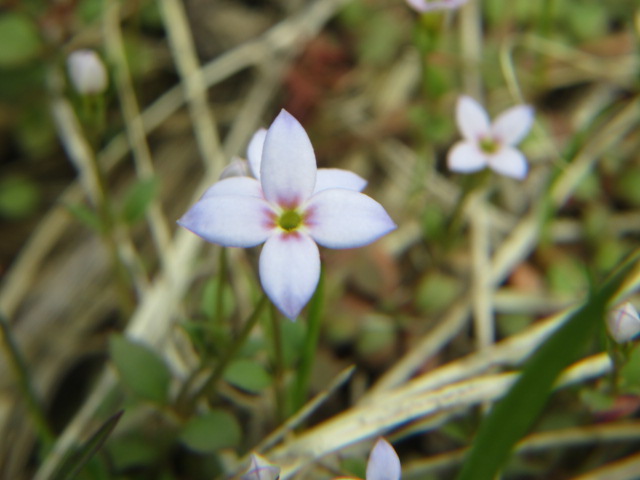
Houstonia pusilla (Tiny Bluet) on 4-3-22, #864-7.
Single flowers emerge at the tips of fairly long peduncles (flower stems) from the axiles of middle to upper leaves.

Houstonia pusilla (Tiny Bluet) on 4-3-22, #864-8.
The small trumpet-shaped flowers consist of a 4-lobed corolla that can be light blue, lavender, to violet in color (occasionally white or pink can be found). The there is a contrasting reddish ring at the top of the throat. The corollas are glabrous (hairless) on the outside while the inside of the upper part of the tube is pubescent (hairy). The corolla is subtended by 4 small triangular calyx lobes that can be green or reddish in color.

Houstonia pusilla (Tiny Bluet) on 4-3-22, #864-9.
The flowers have 4 stamens (male part) that alternate with the corolla lobes and a pistol (female part) with a single inserted style. Ovoid yellow anthers, a green style, and an inferior ovary surrounded by the calyx tube. Flowers are produced from March to sometime in April.
After flowering, the ovaries are replaced by 1-2 lobed fruit which become seed capsules. Each capsule contains several tiny seeds.
I am usually in the area where I found the Tiny Bluets during Morel Mushroom hunting time, so I will check to see if I can find any.
I have enjoyed photographing and learning about the many wildflowers growing on the family farm and in other areas. The farm is in Windsor, Missouri in Pettis County (Henry County is across the street, and Benton and Johnson aren’t far away). I have grown over 500 different plants and identified over 250 species of wildflowers (most have pages listed on the right side of the page). I am not an expert, botanist, or horticulturalist. I just like growing, photographing, and writing about my experience. I rely on several websites for ID and a few horticulturalists I contact if I cannot figure them out. Wildflowers can be somewhat variable from location to location, so sometimes it gets a bit confusing. If you see I have made an error, please let me know so I can correct what I have written.
I hope you found this page useful and be sure to check the links below for more information. They were written by experts and provide much more information. Some sites may not be up-to-date but they are always a work in progress. If you can, I would appreciate it if you would click on the “Like” below and leave a comment. It helps us bloggers stay motivated. You can also send an email to me at thebelmontrooster@yahoo.com. I would enjoy hearing from you especially if you notice something is a bit whacky.
FOR FURTHER READING:
PLANTS OF THE WORLD ONLINE (GENUS/SPECIES)
INTERNATIONAL PLANT NAMES INDEX (GENUS/SPECIES)
TROPICOS (GENUS/SPECIES)
WIKIPEDIA (GENUS/SPECIES)
USDA PLANTS DATABASE
DAVE’S GARDEN
MISSOURI PLANTS
MISSOURI DEPARTMENT OF CONSERVATION
iNATURALIST
WILDFLOWER SEARCH
ILLINOIS WILDFLOWERS
KANSAS WILDFLOWERS AND GRASSES
IOWA PLANTS
LADY BIRD JOHNSON WILDFLOWER CENTER
MARYLAND BIODIVERSITY PROJECT
NOTE: The data (figures, maps, accepted names, etc.) may not match on these websites. It depends on when and how they make updates and when their sources make updates. Some websites have hundreds and even many thousands of species to keep up with. Accepted scientific names change periodically and it can be hard to keep with as well. Some of the links may use a name that is a synonym on other sites. In my opinion, Plants of the World Online by Kew is one of the most reliable and up-to-date plant databases and they make updates regularly. I make updates “at least” once a year and when I write new pages or add new photos but I do get behind. We are all a work in progress. 🙂
 The Belmont Rooster