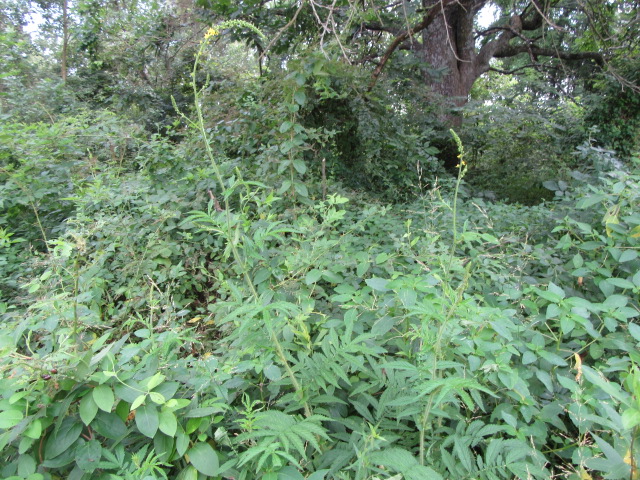
Agrimonia parviflora (Swamp Agrimony) on 7-28-19, #607-3.
Small-Flowered Agrimony, Harvestlice Agrimony, Swamp Agrimony, and Harvestlice
Agrimonia parviflora
ag-rih-MO-nee-uh par-VEE-flor-uh
Synonyms of Agrimonia parviflora (6) (Updated on 1-1-26 from Plants of the World Online): Agrimonia eupatoria var. parviflora (Aiton) Hook., Agrimonia eupatoria var. suaveolens (Pursh) Kuntze, Agrimonia polyphylla Urb., Agrimonia serrifolia Wallr., Agrimonia suaveolens Pursh, Eupatorium parviflorum (Aiton) Nieuwl.
Agrimonia parviflora Aiton is the accepted scientific name for this species of Agrimonia. It was named and described by William Aiton in Hortus Kewensis in 1789.
The genus, Agrimonia L., was named and described as such by Carl von Linnaeus in the first volume of the first edition of Species Plantarum in 1753.
As of 1-1-26 when this page was last updated, Plants of the World Online lists 22 accepted species of Agrimonia. Agrimonia is a member of the plant family Rosaceae with 104 genera. Those numbers could change as updates are made on POWO.
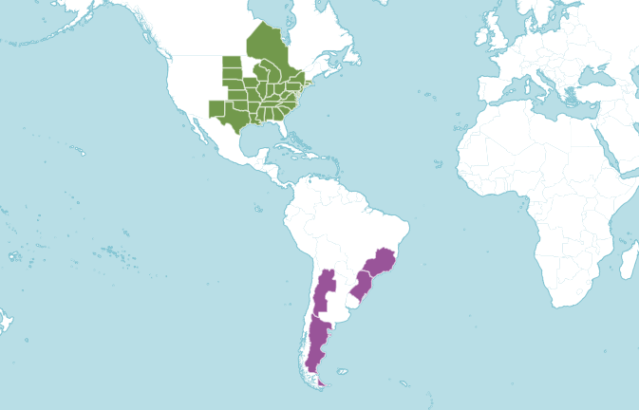
Distribution map of Agrimonia parviflora from Plants of the World Online. Facilitated by the Royal Botanic Gardens, Kew. Published on the Internet; http://www.plantsoftheworldonline.org/. Retrieved on 3-21-21.
The distribution map above for the Agrimonia parviflora is from Plants of the World Online. Areas in green are where the plant is native and purple is where it has been introduced. The USDA Plants Database is similar but doesn’t include a few states… The species could have a wider range than what the maps show.
The map on iNaturalist shows where members have made observations. Anyone can join and it is a great website to confirm and share your observations. The maps on iNaturalist are continually updated as members post new observations. I post all of my observations of wildflowers and birds on iNaturalist. It is very addictive!
There are a few species of Agrimonia in Missouri, but the leaves easily distinguish Agrimonia parviflora from the others. The common names are Swamp Agrimony, Small-Flowered Agrimony, Harvestlice Agrimony, Harvestlice, and possibly others. There are seven or so species in the US with three being described on the Missouri Plants website. Agrimonia parviflora is found in at least 32 states in the United States. Out of all the species, Agrimonia parviflora is considered to be the most noxious.
THERE ARE A FEW LINKS AT THE BOTTOM OF THE PAGE FOR FURTHER READING AND TO HELP WITH A POSITIVE ID.

Agrimonia parviflora (Swamp Agrimony) on 7-25-19, #606-1.
I saw this plant growing near the swampy area at the northeast corner of the farm for several years, but 2019 was the first year I saw its flowers. Flowers are usually the first thing you notice when wildflower hunting, but for some like this species, the leaves caught my eye since there were no flowers. Once I saw its flowers, I was able to make a positive ID on the Missouri Plants website (that was before I started using iNaturalist).
The Swamp Agrimony is a very interesting species. It is native to the U.S. and is found in pretty much the entire state of Missouri, and central to eastern United States and into Canada.
Swamp Agrimony is a perennial plant that grows from a fibrous and rhizomatous root system.

Agrimonia parviflora (Swamp Agrimony) on 7-25-19, #606-2.
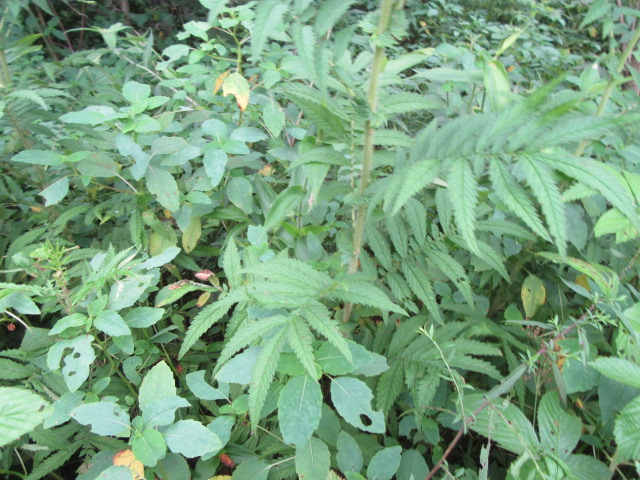
The pinnately compound leaf blades grow up to 24” long and 6” across and have 9-23 primary leaflets. Leaflets are said to be narrowly lanceolate, narrowly oblanceolate, or elliptic in shape with coarsely toothed margins. Between the primary leaflets are numerous smaller secondary leaflets. The upper surface (adaxial) is mostly smooth (glabrous), while the under surface (abaxial) is glandular and hairy (pubescent). The petioles and rachis of each compound leaf are hairy, sometimes longer hairs. There is also a pair of large stipules with pointed lobes.
Only one of the three species of Agrimonia described on the Missouri Plants website has leaves exactly like this. The leaves grow alternately along the stems and are somewhat difficult to explain. You can read the information from the links below to get the technical descriptions. Once you have identified this plant, you can easily recognize it.
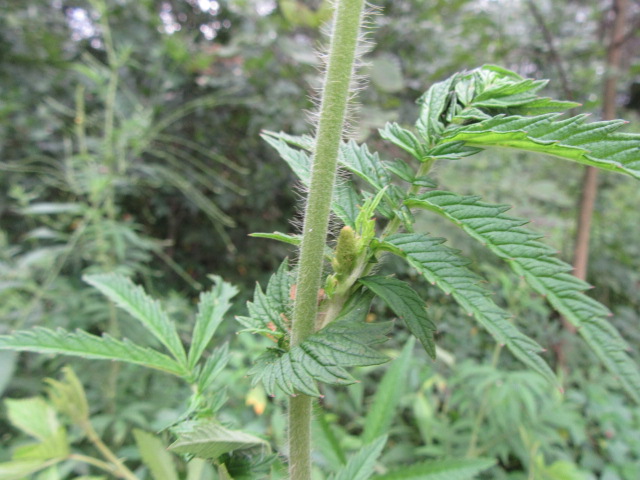
Agrimonia parviflora (Swamp Agrimony) on 7-25-19, #606-3.
Agrimony parviflora can grow to almost 6’ tall in ideal conditions on stout stems. I am 5’ 8” and I have seen them taller than me. The central stems are unbranched and can be light green, reddish green, or brownish green. They are round without any ridges and covered with white or light brown hairs (pubescent).
Swamp Agrimony prefers full sun to light shade in moist conditions in just about any type of soil. I have seen a few on the farm in dryer areas as well.
USEFUL INFORMATION:
Family: Rosaceae.
Origin: U.S. Native.
Zones: USDA Zones 4a-8b + (-30-15° F).
Size: 4-6’ PLUS.
Light: Sun to part shade.
Soil: Prefers consistently moist soil.
Water: Water regularly.
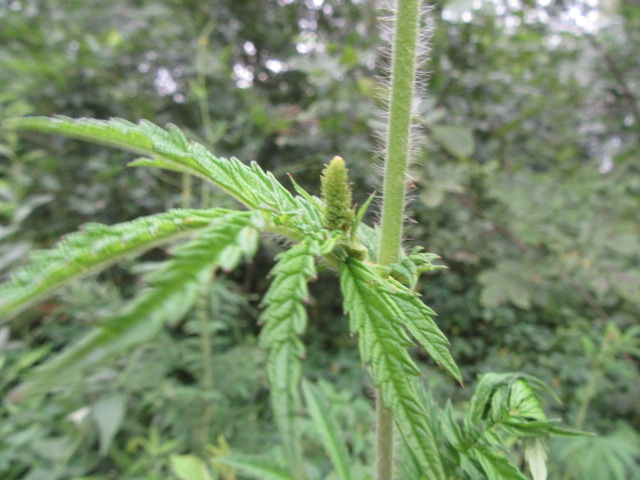
Agrimonia parviflora (Swamp Agrimony) on 7-25-19, #606-4.
The above photo shows an axillary raceme growing from an axil of an upper leaf.
Agrimonia parviflora (Swamp Agrimony) on 7-25-19, #606-5.
Even though considered a noxious plant, its burs were used by Native Americans for diarrhea and to reduce fever. The roots can be pulverized and have been used to increase red blood cell count, a gastrointestinal aid, a topical treatment for skin issues, and as a dietary aid.
Agrimonia parviflora (Swamp Agrimony) on 7-28-19, #607-4.
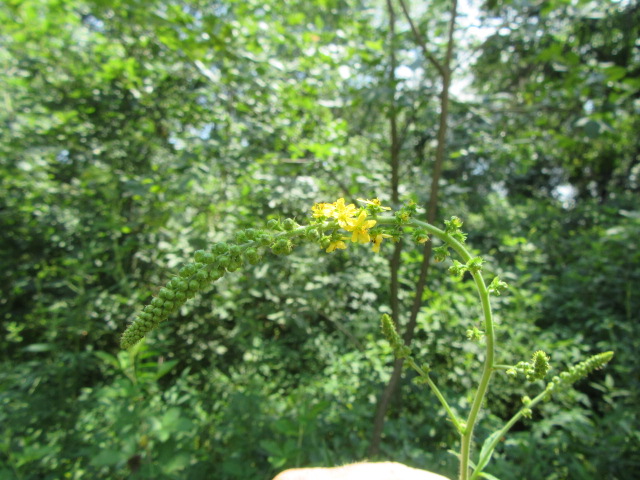
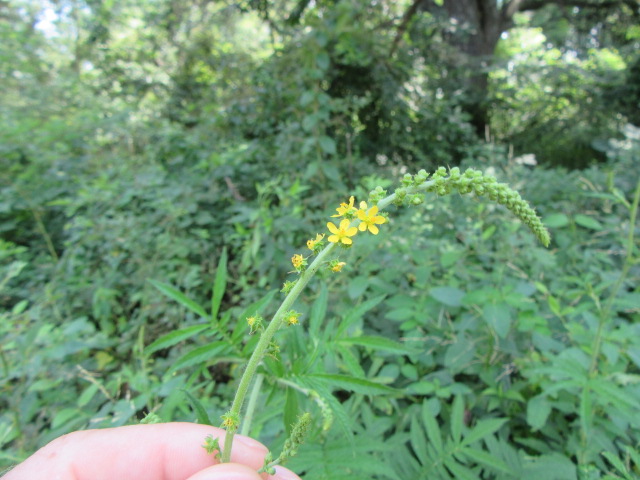
The main stem terminates with a spike-like raceme that can grow to about 2 1/2’ long. Bigger plants usually also produce secondary racemes that are much shorter from the axils of the upper leaves.
Agrimonia parviflora (Swamp Agrimony) on 7-28-19, #607-5.
The racemes are erect at first, but the ones I have seen curve downward as they get longer.
Agrimonia parviflora (Swamp Agrimony) on 4-11-20, #686-2.
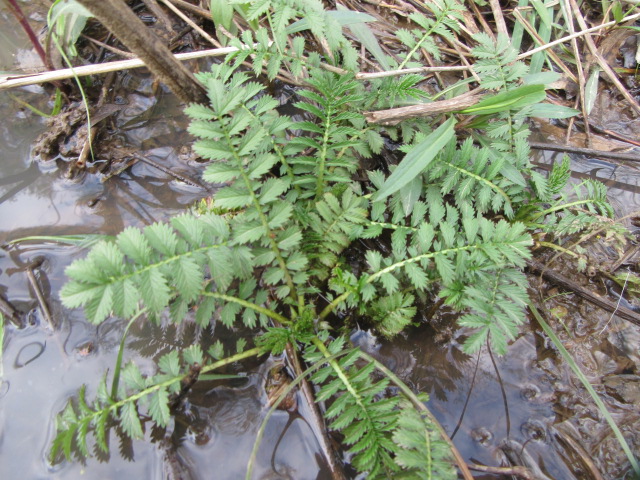
The above photo shows young plants growing in the swampy area in the back of the farm on April 11, 2020.
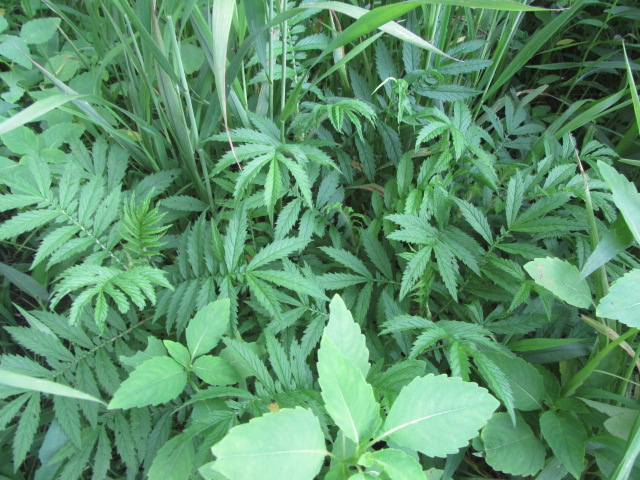
Agrimonia parviflora (Swamp Agrimony) on 6-14-20, #710-1.
The above photo taken on June 14, 2021 shows smaller plants with the dreaded Impatiens capensis (Jewelweed). Both like similar conditions but only one, the Jewelweed, is invasive. Interestingly, the Jewelweed did get pushed out of the swampy area…
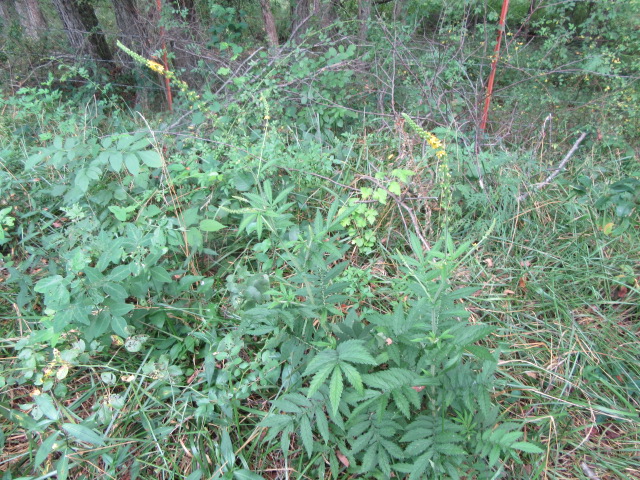
Agrimonia parviflora (Swamp Agrimony) on 8-9-21, #823-1.
The above photo was taken along the boundary fence between the Rock Island Spur of the Katy Trail and the south hayfield on August 9, 2021. I wouldn’t say this area is “ideal” as far as moisture is concerned, but here it is…

Agrimonia parviflora (Swamp Agrimony) on 8-9-21, #823-2.
The above photo is leaves of the same plant… You can never have too many photos…
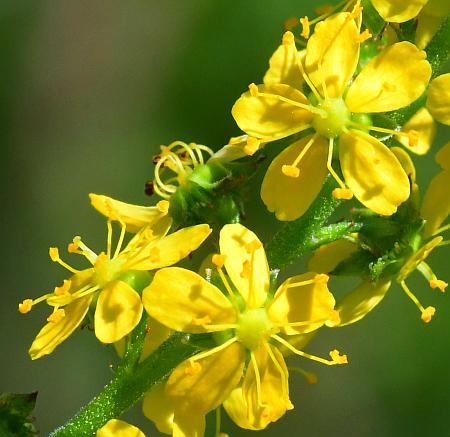
The above photo of Agrimonia parviflora flowers is from the Missouri Plants website. Missouri Plants is published on the internet at http://www.missouriplants.com/index.html. Photo used by permission and retrieved on January 17, 2024.
The racemes produce numerous bright yellow flowers on short stalks (pedicles). I think the flowers are surrounded by a calyx and a ribbed obconic hypanthium with hooked bristles toward the rim. I need to dissect a flower… Each flower is about 1/4” across and have 5 small sepals, 5 bright yellow petals, 5-10 stamens, and a pistol. The blooming period in my neck of the woods in west-central Missouri is from August through September.

The above photo of Agrimonia parviflora fruits is from the Missouri Plants website. Missouri Plants is published on the internet at http://www.missouriplants.com/index.html. Photo used by permission and retrieved on January 17, 2024.
Once pollinated, the flowers give way to strange-looking fruit. In the above photo from Missouri Plants, you can see an inflated-looking hypanthium surrounding surrounding the fruit, including “beaks” from erect sepals…
Missouri Plants is a great website with amazing photos and great descriptions of thousands of species. It may be a Missouri website, but the species are found in many other states as well. This is my number one source for wildflower ID along with iNaturalist. Luckily, they also have a glossary so you can understand the terminology…
Although bees and certain flower flies feed on the nectar of the flowers, most mammals avoid this plant due to its bitter taste. Certain birds use Agrimony in their nests to keep away parasites such as lice and mites because of its foul aroma and taste. Flowers give way to bur-like seed capsules that cling to the fur of animals.
I live on a small farm in Windsor, Missouri where my grandparents and parents used to live. I enjoy gardening, collecting plants, and identifying wildflowers mainly on this farm. The farm is in Pettis County but Henry County is across the street, and Benton and Johnson aren’t far away. I have grown over 500 different plants and identified over 250 species of wildflowers (most have pages listed on the right side of the blog). I am not an expert, botanist, or horticulturalist. I just like growing, photographing, and writing about my experience. I rely on several websites for ID and a few horticulturalists I contact if I cannot figure them out. Wildflowers can be somewhat variable from location to location, so sometimes it gets a bit confusing. If you see I have made an error, please let me know so I can correct what I have written.
I hope you found this page useful and be sure to check the links below for more information. They were written by experts and provide much more information. Some sites may not be up-to-date but they are always a work in progress. If you can, I would appreciate it if you would click on the “Like” below and leave a comment. It helps us bloggers stay motivated. You can also send an email to me at thebelmontrooster@yahoo.com. I would enjoy hearing from you especially if you notice something is a bit whacky.
FOR FURTHER READING:
PLANTS OF THE WORLD ONLINE (GENUS/SPECIES)
INTERNATIONAL PLANT NAMES INDEX (GENUS/SPECIES)
TROPICOS (GENUS/SPECIES)
FLORA OF MISSOURI (GENUS/SPECIES)
FLORA OF NORTH AMERICA (GENUS/SPECIES)
WORLD FLORA ONLINE (GENUS/SPECIES)
WIKIPEDIA (GENUS/SPECIES)
DAVE’S GARDEN
USDA PLANTS DATABASE
MISSOURI PLANTS
WILDFLOWER SEARCH
iNATURALIST
ILLINOIS WILDFLOWERS
LADY BIRD JOHNSON WILDFLOWER CENTER
KANSAS NATIVE PLANTS
PFAF (PLANTS FOR A FUTURE)
WILDFLOWERS OF THE UNITED STATES
DISCOVER LIFE
MARYLAND BIODIVERSITY PROJECT
NOTE: The data (figures, maps, accepted names, etc.) may not match on these websites. It depends on when and how they make updates and when their sources make updates. Some websites have hundreds and even many thousands of species to keep up with. Accepted scientific names change periodically and it can be hard to keep with as well. Some of the links may use a name that is a synonym on other sites. In my opinion, Plants of the World Online by Kew is one of the most reliable and up-to-date plant databases and they make updates regularly. I make updates “at least” once a year and when I write new pages or add new photos but I do get behind. We are all a work in progress. 🙂
 The Belmont Rooster