
Primula meadia (Common or Eastern Shooting Star) on 5-5-25, #1041-36.
Common Shooting Star, Eastern Shooting Star, Pride of Ohio
Primula meadia
PRIM-yew-luh MEE-dee-uh
Synonyms of Primula meadia (42) (Updated on 12-31-25 from Plants of the World Online): Dodecatheon angustifolium Raf. (1818), Dodecatheon brachycarpum Small (1903), Dodecatheon californicum A.Murray bis (1853) (nom. subnud.), Dodecatheon cordatum Raf. (1833), Dodecatheon crenatum Raf. (1833), Dodecatheon cuneatum Raf. (1833), Dodecatheon ellipticum Raf. (1833), Dodecatheon flexuosum Raf. (1833), Dodecatheon hugeri Small (1903), Dodecatheon integrifolium Michx. (1803), Dodecatheon integrifolium var. album Nutt. (1835), Dodecatheon lemoinei Anon. (1889), Dodecatheon longifolium Raf. (1833), Dodecatheon lutescens C.Z.Nelson (1923), Dodecatheon meadia L. (1753), Dodecatheon meadia f. album J.F.Macbr. (1930) (nom. illeg.), Dodecatheon meadia var. album Tubergen (1906), Dodecatheon meadia var. brachycarpum (Small) Fassett (1944), Dodecatheon meadia subsp. brachycarpum (Small) R.Knuth (1905), Dodecatheon meadia subsp. eumeadia R.Knuth (1905) (not validly publ.), Dodecatheon meadia var. genuinum Fassett (1944) (not validly publ.), Dodecatheon meadia subsp. hugeri (Small) R.Knuth (1905), Dodecatheon meadia var. integrifolium Durand (1855), Dodecatheon meadia var. obesum Fassett (1944), Dodecatheon meadia f. pallidum Fassett (1944), Dodecatheon meadia f. sedens Fassett (1944), Dodecatheon meadia var. stanfieldii (Small) Fassett (1944), Dodecatheon obovatum Raf. (1833), Dodecatheon obtusum Raf. (1833), Dodecatheon ovatum Raf. (1833), Dodecatheon parviflorum Raf. (1833), Dodecatheon pauciflorum var. exquisitum J.F.Macbr. & Payson (1917), Dodecatheon reflexum Salisb. (1796), Dodecatheon serratum Raf. (1833), Dodecatheon splendidum Anon. (1888), Dodecatheon stanfieldii Small (1903), Dodecatheon triflorum Raf. (1833), Dodecatheon undatum Raf. (1833), Dodecatheon uniflorum Raf. (1833), Meadia crenata (Raf.) Kuntze (1891), Meadia dodecathea Crantz (1766), Meadia dodecatheon Mill. (1768)
Primula meadia (L.) A.R.Mast & Reveal is the accepted scientific name for this species. It was named as such by Austin R. Mast and James Lauritz Reveal in Brittonia in 2007. It was first named Dodecatheon meadia by Carl von Linnaeus in the first volume of the first edition of Species Plantarum in 1753.
Many websites and databases use Dodecatheon media as an accepted scientific name with Primula media as a synonym. That’s perfectly fine and wonderful. You can choose whichever name you want…
The genus, Primula L., was named as such by Carl von Linnaeus in the first volume of the first edition of Species Plantarum in 1753.
As of 12-31-25 when this page was added, Plants of the World Online lists 549 species plus a few hybrids in the Primula genus. It is a member of the plant family Primulaceae with 55 genera. Those numbers could change as updates are made on POWO.

Distribution map of Primula meadia from Plants of the World Online. Facilitated by the Royal Botanic Gardens, Kew. Published on the Internet; http://www.plantsoftheworldonline.org/. Retrieved on May 25, 2025.
The above distribution map for Primula meadia is from Plants of the World Online. Areas in green are where the species is native. The map on the USDA Plants Database is similar but uses the name Dodecatheon media, which is a synonym on POWO.
The map on iNaturalist shows where members have made observations. Anyone can join and it is a great website to confirm and share your observations. The maps on iNaturalist are continually updated as members post new observations. I post all my observations on iNaturalist.
THERE ARE SEVERA LINKS AT THE BOTTOM OF THE PAGE FOR FURTHER READING AND TO HELP WITH A POSITIVE ID.

Primula meadia (Common or Eastern Shooting Star) on 5-5-25, #1041-37.
I was invited to visit a private well-maintained native prairie not far from home on 5-5-25. It was quite amazing! I ran across 11 species I hadn’t seen before including Primula media.
After we had walked into the prairie for a while, Walter mentioned me hadn’t seen any Shooting Star yet. He said they would be growing above the other plants. After a few minutes, I looked off in the distance and saw what could be a few. We walked in that direction, and sure enough, found a few. Primula meadia may remind you of a plant that grows from a bulb, but in fact is a rhizomatous perennial member of the plant family Primulaceae. Their common name is Common or Eastern Shooting Star, and likely others. It was previously named Dodecatheon meadia by Carl von Linnaeus in the first volume of the first edition of Species Plantarum in 1753. You know, Linnaeus re-named A LOT of species which was a good thing…
I will come back later and write descriptions, but here is a little information to hold you over…
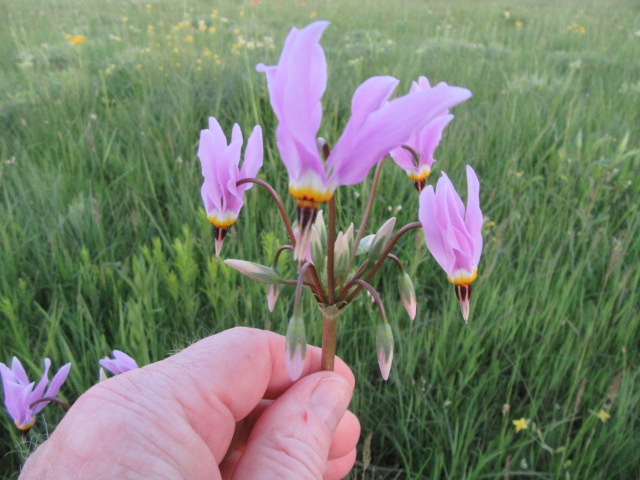
Primula meadia (Common or Eastern Shooting Star) on 5-5-25, #1041-38.
The plants produce good-sized clumps of wide leaves. Plants send up single stems terminating with 5-20 nodding, deeply-lobed flowers with 5 exerted stamens.
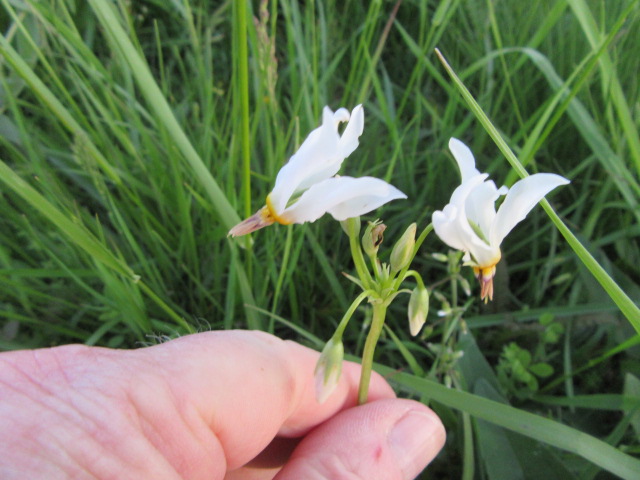
Primula meadia (Common or Eastern Shooting Star) on 5-5-25, #1041-39.
The Missouri Plants website says Steyermark (Steyermark’s Flora of Missouri) commented that the flowers have an aroma of grape juice and the rootstock like that of cored beef…
There were even a few plants with white flowers…
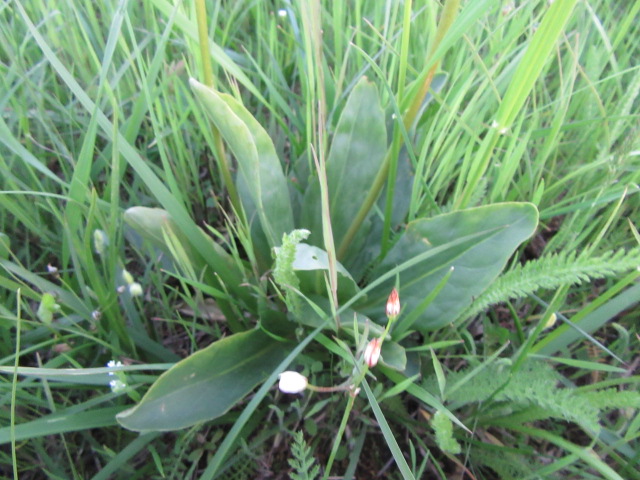
Primula meadia (Common or Eastern Shooting Star) on 5-5-25, #1041-40.
This species had gained the Royal Horticultural Society’s Award of Garden Merit. There is also at least one cultivar that produces larger flowers on taller plants.
Hopefully, I can get back to the prairie soon to take more photos…
To visit the post where I wrote about the visit to the prairie, chick HERE.
I live on the family farm in Windsor, Missouri in Pettis County (Henry County is across the street, and Benton and Johnson aren’t far away). I have grown over 500 different plants and identified over 250 species of wildflowers (most have pages listed on the right side of the page). I am not an expert, botanist, or horticulturalist. I just like growing, photographing, and writing about my experience. I rely on several websites for ID and a few horticulturalists I contact if I cannot figure them out. Wildflowers can be variable from location to location, so that can be a bit confusing. If you see I have made an error, please let me know so I can correct what I have written.
I hope you found this page useful and be sure to check the links below for more information. They were written by experts and they have provided much more information. Some sites may not be up-to-date but they are always a work in progress. If you can, I would appreciate it if you would click on the “Like” below and leave a comment. It helps us bloggers stay motivated. You can also send an email to me at thebelmontrooster@yahoo.com. I would enjoy hearing from you especially if you notice something is a bit whacky.
FOR FURTHER READING:
PLANTS OF THE WORLD ONLINE (GENUS/SPECIES)
INTERNATIONAL PLANT NAMES INDEX (GENUS/SPECIES)
TROPICOS (GENUS/SPECIES)
FLORA OF NORTH AMERICA (GENUS/SPECIES)
WORLD FLORA ONLINE (GENUS/SPECIES)
WIKIPEDIA (GENUS/SPECIES)
USDA PLANTS DATABASE
iNATURALIST
MISSOURI PLANTS
MISSOURI BOTANICAL GARDEN
MISSOURI DEPARTMENT OF CONSERVATION
WILDFLOWER SEARCH
DAVE’S GARDEN
FLORA FINDER
FRIENDS OF THE WILDFLOWER GARDEN
GARDENIA
ILLINOIS WILDFLOWERS
IOWA PLANTS
KANSAS WILDFLOWERS AND GRASSES
LADY BIRD JOHNSON WILDFLOWER CENTER
LAKE FOREST COLLEGE
MINNESOTA WILDFLOWERS
NORTH CAROLINA STATE UNIVERSITY
SEINet
U.S. WILDFLOWERS
UNIVERSITY OF WISCONSIN
VASCULAR PLANTS OF NORTH CAROLINA
WF OF THE NATIONAL CAPITAL REGION
NOTE: The data (figures, maps, accepted names, etc.) may not match on these websites. It depends on when and how they make updates and when their sources make updates. Some websites have hundreds and even many thousands of species to keep up with. Accepted scientific names change periodically and it can be hard to keep with as well. Some of the links may use a name that is a synonym on other sites. In my opinion, Plants of the World Online by Kew is one of the most reliable and up-to-date plant databases and they make updates regularly. I make updates “at least” once a year and when I write new pages or add new photos but I do get behind. We are all a work in progress. 🙂
 The Belmont Rooster