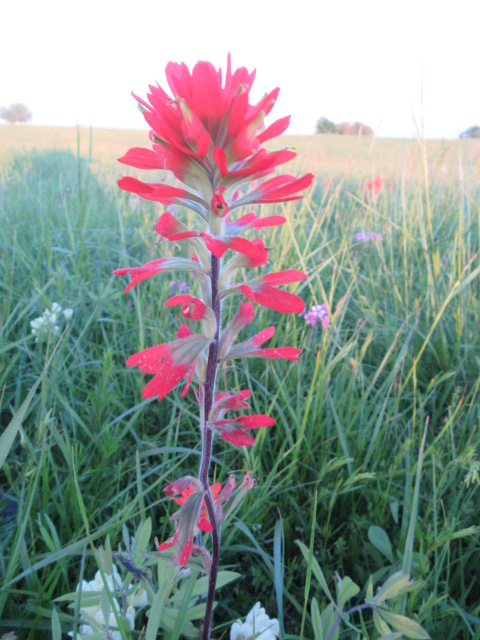
Castilleja coccinea (Indian Paintbrush/Painted-Cup Paintbrush) on 5-5-25, #1041-12.
Indian Paintbrush, Painted-Cup Paintbrush, Scarlet Indian Paintbrush, Wyoming Indian Paintbrush
Castilleja coccinea
kas-tee-LEE-uh kok-SIN-ee-uh
kas-til-LEE-uh kok-SIN-ss-uh
Synonyms of Castilleja coccinea (8) (Updated on 12-8-25 from Plants of the World Online): Bartsia coccinea L. (1753), Bartsia coccinea var. pallens Michx. (1803), Castilleja coccinea f. alba Farw. (1923), Castilleja coccinea f. lutescens Farw. (1923), Castilleja coccinea f. pallens (Michx.) Pennell (1935), Castilleja ludoviciana Pennell (1935), Euchroma coccinea (L.) Nutt. (1818), Rhinanthus coccineus (L.) Lam. (1786)
Castilleja coccinea (L.) Spreng. is the accepted scientific name for this species. It was named as such by Curt Polycarp Joachim Sprengel in Systema Vegetabilium in 1825. It was first named and described as Bartsia coccinea by Carl von Linnaeus in the second volume of the first edition of Species Plantarum in 1753.
The genus, Castilleja Mutis ex L.f., was described by Carl Linneaus the Younger (the son of Carl von Linneaus) in Supplementum Plantarum in 1782. He gives credit to José Celestino Bruno Mutis for using his description.
As of 12-28-25 when this page was last updated, Plants of the World Online lists 216 species in the Castilleja genus. It is a member of the plant family Orobanchaceae with 99 genera. Those numbers could change as updates are made on POWO.
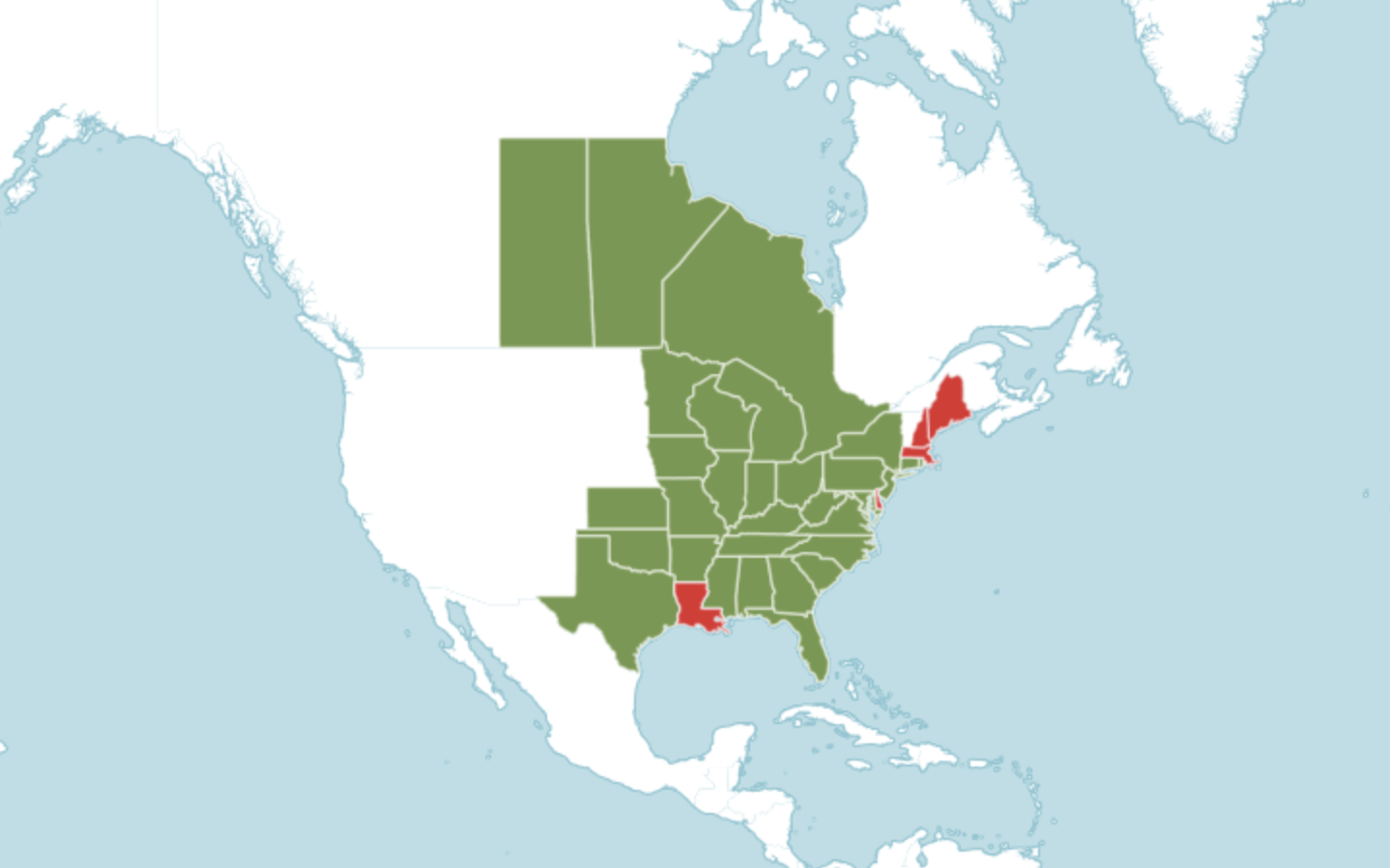
Distribution map of Castilleja coccinea from Plants of the World Online. Facilitated by the Royal Botanic Gardens, Kew. Published on the Internet; http://www.plantsoftheworldonline.org/. Retrieved on May 11, 2025.
The above distribution map for Castilleja coccinea is from Plants of the World Online. Areas in green are where the species is native and red where it is extinct. The map on the USDA Plants Database is similar.
The map on iNaturalist shows where members have made observations. Anyone can join and it is a great website to confirm and share your observations. The maps on iNaturalist are continually updated as members post new observations. I post all my observations on iNaturalist.
THERE ARE A FEW LINKS AT THE BOTTOM OF THE PAGE FOR FURTHER READING AND TO HELP WITH A POSITIVE ID.

Castilleja coccinea (Indian Paintbrush/Painted-Cup Paintbrush) on 5-5-25, #1041-13.
I was invited to visit a private, well-maintained native prairie not far from home on 5-5-25. It was quite amazing! I ran across 11 species I hadn’t seen before including this Castilleja coccinea.
I will come back later and write descriptions, but here is a little information to hold you over…

Castilleja coccinea (Indian Paintbrush/Painted-Cup Paintbrush) on 5-5-25, #1041-14.
Finally! The Castilleja coccinea were in large colonies here and there throughout the prairie. I have seen them here and there in the same area along the highway and always wondered what they were. Common names include Indian Paintbrush, Painted-Cup Paintbrush, Scarlet Indian Paintbrush, and a few others.
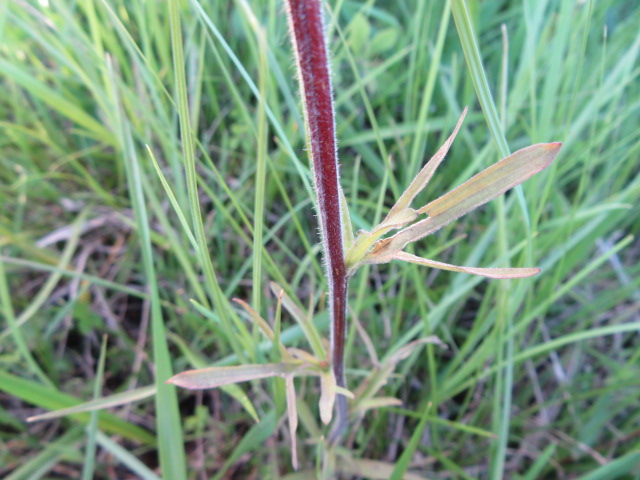
Castilleja coccinea (Indian Paintbrush/Painted-Cup Paintbrush) on 5-5-25, #1041-15.
This species is a member of the plant family Orobanchaceae which is also a new family for me. In fact, there were members of three families I was unfamiliar with. Like this species, three were hemiparasitic meaning they get part of nutrients from the roots of of other species. Also new to me. Never heard of hemiparasitic before…
The color was so vivid! As with Poinsettias, the red color is not from petals but leaf-like bracts. The flowers are inconspicuous with red-tinged sepals.

Castilleja coccinea (Indian Paintbrush/Painted-Cup Paintbrush) on 5-5-25, #1041-16.
Let’s get a little closer… According to information online, the color has polymorphism meaning they can be scarlet or yellow depending on the availability of pollinators. More pollinators means better pollination so the color is scarlet. Less pollination and the color will be yellow. Yellow flowered specimens were formerly Castilleja coccinea f. lutescens which is now a synonym according to Plants of the World Online. I guess someone figured that out… Apparently, red colors are harder for insects to see but hummingbirds also pollinate the flowers… Hmmm… I didn’t see any hummingbirds or even any bees for that matter…
This species can be either perennial or biennial. Some seeds will germinate in the fall and and produce flowering plants in the spring. Seeds that germinate in the spring will produce plants that flower the following year. Fruits have 2 divisions and once ripe, they split open allowing up to 300 seeds to be dispersed by the wind.
I read where Native Americans used the flowers as a love charm but also as a poison against their enemies… Hmmm… I “think” the roots of an eastern species was cooked and eaten like potatoes. NOT this species and don’t quote me on that…
Hopefully, I can get back to the prairie and surrounding public areas soon!
I live on the family farm in Windsor, Missouri in Pettis County (Henry County is across the street, and Benton and Johnson aren’t far away). I have grown over 500 different plants and identified over 250 species of wildflowers (most have pages listed on the right side of the page). I am not an expert, botanist, or horticulturalist. I just like growing, photographing, and writing about my experience. I rely on several websites for ID and a few horticulturalists I contact if I cannot figure them out. Wildflowers can be variable from location to location, so that can be a bit confusing. If you see I have made an error, please let me know so I can correct what I have written.
I hope you found this page useful and be sure to check the links below for more information. They were written by experts and they have provided much more information. Some sites may not be up-to-date but they are always a work in progress. If you can, I would appreciate it if you would click on the “Like” below and leave a comment. It helps us bloggers stay motivated. You can also send an email to me at thebelmontrooster@yahoo.com. I would enjoy hearing from you especially if you notice something is a bit whacky.
FOR FURTHER READING:
PLANTS OF THE WORLD ONLINE (GENUS/SPECIES)
INTERNATIONAL PLANT NAMES INDEX (GENUS/SPECIES)
TROPICOS (GENUS/SPECIES)
FLORA OF MISSOURI (GENUS/SPECIES)
FLORA OF NORTH AMERICA (GENUS/SPECIES)
WORLD FLORA ONLINE (GENUS/SPECIES)
WIKIPEDIA (GENUS/SPECIES)
USDA PLANTS DATABASE
iNATURALIST
U.S. FOREST SERVICE
MISSOURI PLANTS
MISSOURI WEED ID GUIDE
MISSOURI BOTANICAL GARDEN
MISSOURI DEPARTMENT OF CONSERVATION
WILDFLOWER SEARCH
DAVE’S GARDEN
ARKANSAS ACADEMY OF SCIENCE
AWESOME NATIVE PLANTS
GO BOTANY
IN DEFENSE OF PLANTS
IOWA PLANTS
KANSAS WILDFLOWERS AND GRASSES
LADY BIRD JOHNSON WILDFLOWER CENTER
LAKE FOREST COLLEGE
MARYLAND BIODIVERSITY PROJECT
MINNESOTA WILDFLOWERS
NEW JERSEY GOV.-RARE PLANTS PROFILE
NEW YORK HERITAGE PROGRAM
NORTH CAROLINA STATE UNIVERSITY
THE BUCKEYE BOTANIST
U.S. WILDFLOWERS
UNIVERSITY OF WISCONSIN
NOTE: The data (figures, maps, accepted names, etc.) may not match on these websites. It depends on when and how they make updates and when their sources make updates. Some websites have hundreds and even many thousands of species to keep up with. Accepted scientific names change periodically and it can be hard to keep with as well. Some of the links may use a name that is a synonym on other sites. In my opinion, Plants of the World Online by Kew is one of the most reliable and up-to-date plant databases and they make updates regularly. I make updates “at least” once a year and when I write new pages or add new photos but I do get behind. We are all a work in progress. 🙂
 The Belmont Rooster