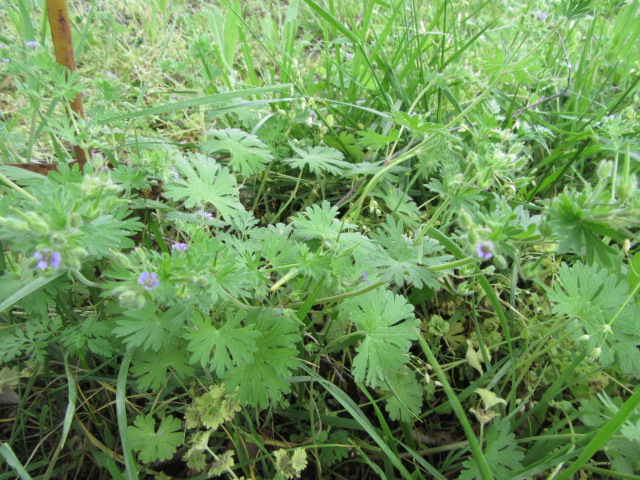
Geranium pusillum (Small-Flowered Cranesbill) on 4-27-24, #985-1.
Small-Flowered Cranesbill, Small Cranesbill, Little Geranium, Small Geranium
Geranium pusillum
jer-AY-nee-um pus-ILL-um
Synonyms of Geranium pusillum (24) (Updated on 12-26-25 from Plants of the World Online): Geranium baumgartenianum Schur (1866), Geranium circinatum Kanitz (1863), Geranium delicatulum Ten. & Guss. (1836), Geranium divaricatum var. tenuisectum Sennen (1917) (nom. nud.), Geranium dubium Chaix (1786), Geranium haussknechtii Soó (1980), Geranium humile Cav. (1787), Geranium hybridum Hausskn. (1891) (nom. illeg.), Geranium malvifolium Scop. (1771), Geranium parviflorum Curtis (1791) (nom. illeg.), Geranium parviflorum var. humile (Cav.) Chevall. (1828), Geranium pseudopusillum Schur (1868), Geranium pusillum var. albiflorum Schur (1877), Geranium pusillum var. axilliflorum Schur (1866), Geranium pusillum var. condensatum Druce (1917), Geranium pusillum var. elatum Picard (1837), Geranium pusillum var. gracillimum Schur (1877), Geranium pusillum var. humile (Cav.) Gray (1821 publ. 1822), Geranium pusillum var. humile Picard (1838) (nom. illeg.), Geranium pusillum var. majus-grandifolium Schur (1877), Geranium pusillum var. rigidum Schur (1877), Geranium pusillum var. tenuilobum Sennen (1928), Geranium pusillum var. viscidulifolium C.G.Westerl. (1898)
Geranium pusillum L. is the accepted scientific name for this species of Geranium. It was first named and described as such by Carl von Linnaeus in Systema Naturae in 1759.
The genus, Geranium Tourn. ex L.. was described by Carl von Linnaeus in the second volume of the first edition of Species Plantarum in 1753. The genus was named by Joseph Pitton de Tournefort.
As of 12-26-25 when this page was last updated, Plants of the World Online lists 345 species in the Geranium genus. It is a member of the plant family Geraniaceae with 7 genera. Those numbers could change as updates are made on POWO.

Distribution map of Geranium pusillum from Plants of the World Online. Facilitated by the Royal Botanic Gardens, Kew. Published on the Internet; http://www.plantsoftheworldonline.org/. Retrieved on April 30, 2024.
The above distribution map for Geranium pusillum is from Plants of the World Online. Areas in green are where the species is native and purple is where it has been introduced. The map on the USDA Plants Database is a little different.
The map on iNaturalist shows where members have made observations. Anyone can join and it is a great website to confirm and share your observations. The maps on iNaturalist are continually updated as members post new observations. I post all my observations on iNaturalist.
THERE ARE SEVERAL LINKS AT THE BOTTOM OF THE PAGE FOR FURTHER READING AND TO HELP WITH A POSITIVE ID.
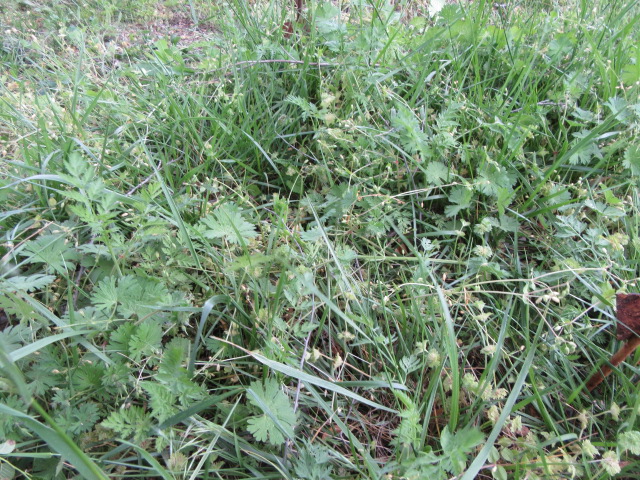
Geranium pusillum (Small-Flowered Cranesbill) on 4-22-24, #984-16.
My riding mower broke down again, so I had to have a friend mow my yard on April 22. I was walking around the area in front of the chicken house when I spotted a colony of what appeared to be a species of Geranium under one of the Chinese Elm trees. I took a closer look and the leaves looked different than the usual Geranium carolinianum (Carolina Cranesbill) that grows in the pasture and around the garden. I took photos and then added them to iNaturalist’s drag-and-drop feature for an ID. The suggestion was Geranium pusillum (Small-Flowered Cranesbill) so I checked out the species on the Missouri Plants website. I think they hit the nail on the head again…
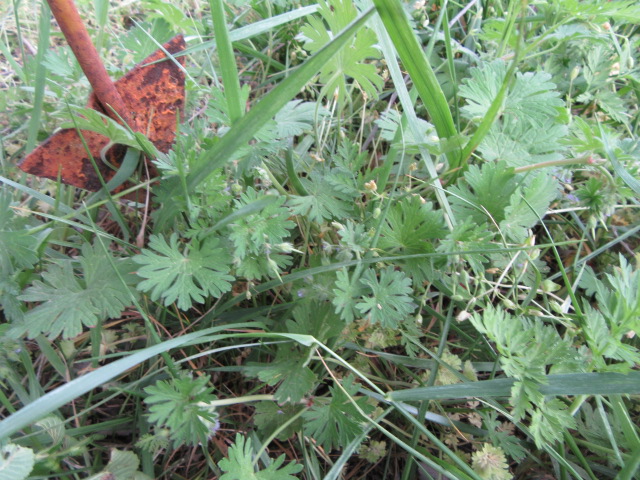
Geranium pusillum (Small-Flowered Cranesbill) on 4-22-24, #984-17.
Geranium pusillum is native to Eurasia but has been introduced to nearly every state in the U.S. It is easily mistaken for Geranium carolinianum, so observations for one or the other could be, well, the other species… Going by the shape of the leaves and the fact the flowers are smaller than G. carolinianum, I am pretty sure the the photos on this page represent G. pusillum.
Besides my observation under the elm tree, Geranium pusillum can be found along edges of woodlands, along river and stream banks, old fields, along back roads, cemeteries, fields, pastures, disturbed areas like gardens and flower beds, etc…
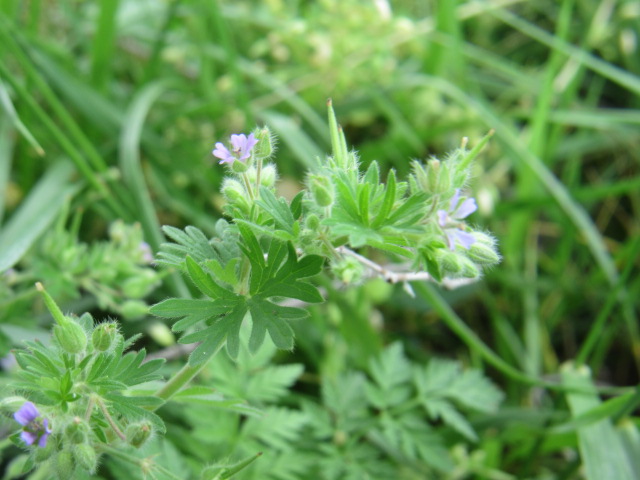
Geranium pusillum (Small-Flowered Cranesbill) on 4-27-24, #985-2.
Plants grow to about 20 inches tall on spreading to ascending stems that are moderately too densely pubescent (hairy).
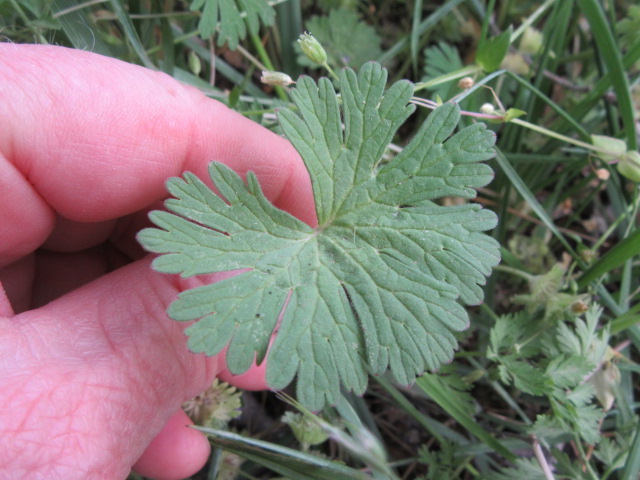
Geranium pusillum (Small-Flowered Cranesbill) on 4-22-24, #984-19.
Plants have both basal (attached at the base) and cauline (from the stem) leaves. The leaves, kind of circular in outline, are palmately lobed with 5-9 lobes. These lobes also divided. The leaves are not near as divided as G. carolinianum. The lower leaves have fairly long petioles (leaf stems) that become shorter as they progress up the stem, basal leaves growing in an opposite manner but sometimes upper leaves grow alternate one another. The upper and lower surfaces have short hairs (pubescent).

Geranium pusillum (Small-Flowered Cranesbill) on 4-27-24, #985-3.
Flowers are borne in pairs at the end of flowering stems. Sometimes there may be more than one stem close together making it appear there are more than one pair.
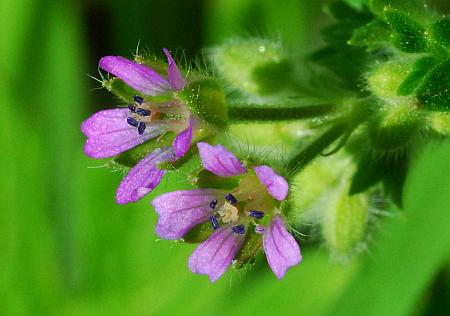
The above photo of Geranium pusillum is from the Missouri Plants website. Missouri Plants is published on the internet at http://www.missouriplants.com/index.html. Photo used by permission and retrieved on February 11, 2026.
The bisexual (hermaphroditic) flowers are very small and consist of 5 pinkish-purple petals that are kind of wedge-shaped with notched tips. Male parts include 5 fertile stamens with purple anthers and 5 staminodes (infertile stamens). The staminodes may appear scale-like or even be absent. The female parts include a hairy pistol with a superior, 5-lobed ovary, an elongated style, and a stigma with 5 free lobes. The ovary has five fused carpels, each containing two ovules, but usually only one survived to produce a single seed. Surrounding the flower is a sepal with 5 hairy lobes, almost as long as the petals, that taper to a fine point.
Flowers are produced from April through August, sometimes into September.
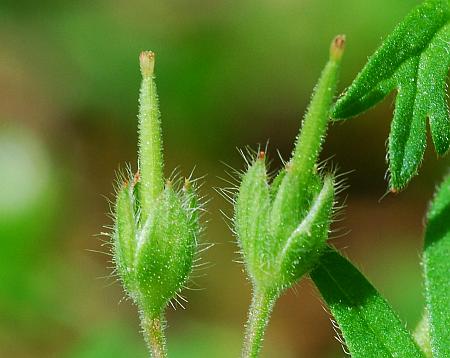
The above photo of Geranium pusillum is from the Missouri Plants website. Missouri Plants is published on the internet at http://www.missouriplants.com/index.html. Photo used by permission and retrieved on February 11, 2026.
Once flowering is complete, the transformation from flower to fruit to seed begins. Now let me see if I can explain it…
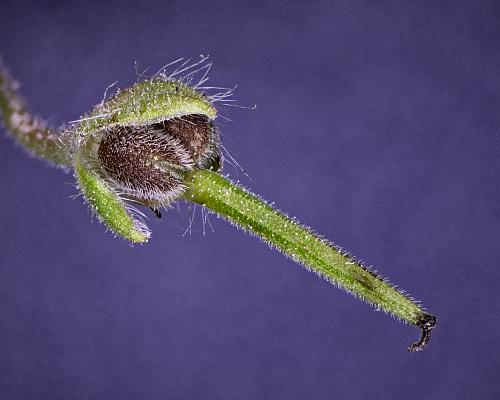
The above photo of Geranium pusillum is from the Missouri Plants website. Missouri Plants is published on the internet at http://www.missouriplants.com/index.html. Photo used by permission and retrieved on February 11, 2026.
As I mentioned, the pistol, the female part of the flower, contains the ovary, style, and stigma. The ovary, after fertilization at maturity, becomes the fruit. As the fruit hardens, the fruit becomes the schizocarp, whose 5 carpels become mericarps… The five fused styles of the flower elongate and stiffen and becomes the stylar column (the beak). Then, at just the right moment, after drying enough, the beaks spring outward to eject the seed. Seeds
Hopefully, the Geranium pusillum will return again in 2026 so I can take more and better photos. I need some close-ups so I can replace what I have borrowed.
I want to thank the Missouri Plants website for using such great photos and descriptions on their website and making them available for educational purposes (with permission). The Missouri Plants website is an effort of the Missouri Botanical Garden as is Tropicos and Flora of Missouri.
I live on the family farm in Windsor, Missouri in Pettis County (Henry County is across the street, and Benton and Johnson aren’t far away). I have grown over 500 different plants and identified over 250 species of wildflowers (most have pages listed on the right side of the page). I am not an expert, botanist, or horticulturalist. I just like growing, photographing, and writing about my experience. I rely on several websites for ID and a few horticulturalists I contact if I cannot figure them out. Wildflowers can be variable from location to location, so that can be a bit confusing. If you see I have made an error, please let me know so I can correct what I have written.
I hope you found this page useful and be sure to check the links below for more information. They were written by experts and they have provided much more information. Some sites may not be up-to-date but they are always a work in progress. If you can, I would appreciate it if you would click on the “Like” below and leave a comment. It helps us bloggers stay motivated. You can also send an email to me at thebelmontrooster@yahoo.com. I would enjoy hearing from you especially if you notice something is a bit whacky.
FOR FURTHER READING:
PLANTS OF THE WORLD ONLINE (GENUS/SPECIES)
INTERNATIONAL PLANT NAMES INDEX (GENUS/SPECIES)
TROPICOS (GENUS/SPECIES)
FLORA OF MISSOURI (GENUS/SPECIES)
WORLD FLORA ONLINE (GENUS/SPECIES)
WIKIPEDIA (GENUS/SPECIES)
USDA PLANTS DATABASE
iNATURALIST
MISSOURI PLANTS
MIDWEST WEEDS AND WILDFLOWERS
WILDFLOWER SEARCH
BURKE HERBARIUM
DAVE’S GARDEN
FLORAVEG.EU
GO BOTANY
KANSAS WILDFLOWERS AND GRASSES
MARYLAND BIODIVERSITY PROJECT
OREGON FLORA
OREGON FLORA IMAGE PROJECT
PFAF (PLANTS FOR A FUTURE)
SEINet
MORE PHOTOS…
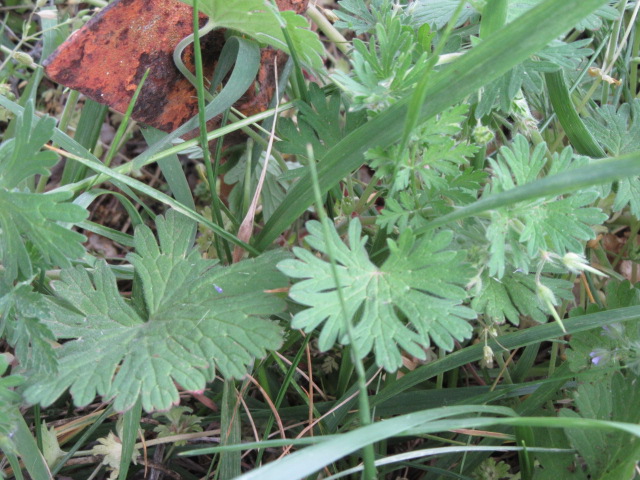
Geranium pusillum (Small-Flowered Cranesbill) on 4-22-24, #984-18.
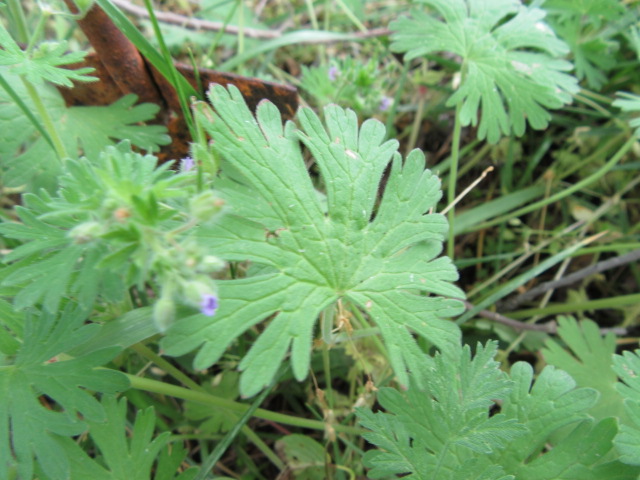
Geranium pusillum (Small-Flowered Cranesbill) on 4-27-24, #985-4.
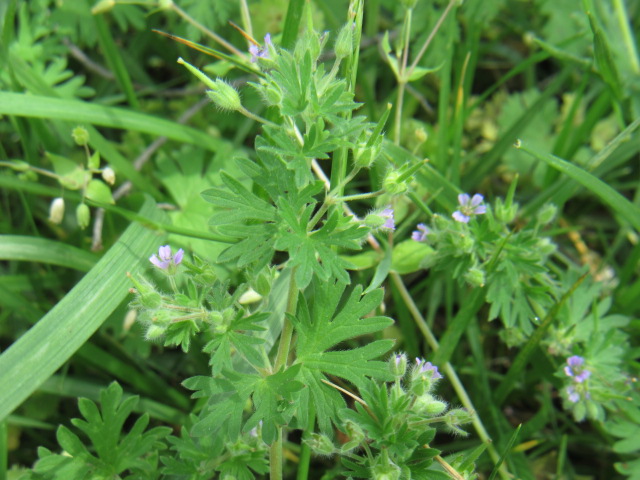
Geranium pusillum (Small-Flowered Cranesbill) on 4-27-24, #985-5.
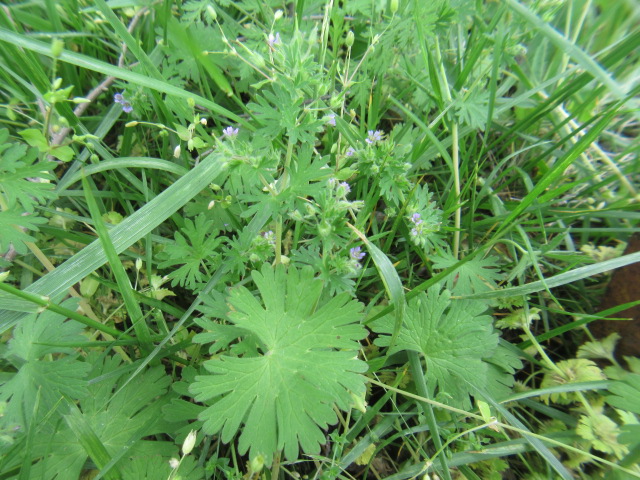
Geranium pusillum (Small-Flowered Cranesbill) on 4-27-24, #985-6.
 The Belmont Rooster