
Euphorbia ferox (Thorn Noors/Pincushion Euphorbia) after I brought it home on 5-6-24. The tallest in the pot was 2″ tall. #987-3.
Pincushion Euphorbia, Thorn Noors
Euphorbia ferox
yoo-FOR-bee-uh FER-oks
Euphorbia ferox Marloth is the accepted scientific name for this species of Euphorbia. It was named and described as such by Hermann Wilhelm Rudolf Marloth in Transactions of the Royal Society of South Africa.
Accepted Infraspecific Names (2) (Updated on 12-19-25 from POWO): Euphorbia ferox subsp. calitzdorpensis Bruyns, Euphorbia ferox subsp. ferox (autonym).
The genus, Euphorbia L., was named and described as such by Carl von Linnaeus in the first volume of the first edition of Species Plantarum in 1753.
As of 12-19-25 when this page was last updated, Plants of the World Online lists 2,060 species in the Euphorbia genus. It is a member of the plant family Euphorbiaceae with 230 genera. Those numbers could change as updates are made on POWO.
THERE ARE A FEW LINKS AT THE BOTTOM OF THE PAGE FOR FURTHER READING.

Euphorbia ferox (Thorn Noors/Pincushion Euphorbia) on 5-6-24, #987-4.
I spotted this Euphorbia ferox at Walmart on May 6, 2024, and liked it right away. One thing that caught my eye was the glossy appearance of its stems and very sharp, stiff spines. The tallest in the cluster was 2″ tall and it was in a bulging 5″ tall x 4 3/4″ diameter pot.
The plant family Euphorbiaceae is one of the most diverse families of plants. They can be trees and shrubs, annuals, perennials, succulents, etc. As a wildflower hunter, I have identified 11 species in the family on the farm, all with weird flowers. I have grown seven species of Euphorbia over the past 15 years and still have 3 (including E. ferox).
According to Llifle (Encyclopedia of Living Forms), Euphorbia ferox is native to the Great Karoo area in the Cape of Good Hope in South Africa. Llifle says Euphorbia ferox is a small spiny succulent shrublet that branches out at the base and forms rounded clusters… It further states they are common and easy to grow. We shall see…
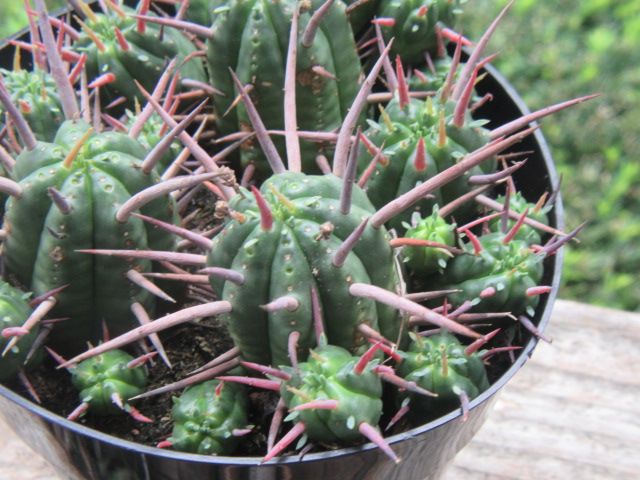
Euphorbia ferox (Thorn Noors/Pincushion Euphorbia) on 5-6-24, #987-5.
I put the pot on a table with most of my other succulents on the west-facing front porch. The porch has a roof, but the plants receive light shade with direct sun in the afternoon. Some of the succulents would be fine in full sun in some areas, but it gets very hot here so I keep them on the front porch so they won’t get sunburned…

Euphorbia ferox (Thorn Noors/Pincushion Euphorbia) on 5-6-24, #987-6.
USEFUL INFORMATION:
Family: Euphorbiaceae
Origin: Cape of Good Hope in the Great Karoo area in South Africa.
Zones: USDA Zones 9a (20-24° F) (-6.7 to -3.9° C)
Size: Clusters up to 24” in diameter, stems about 2” in diameter, up to 12″ tall.
Light: Light shade. Can be grown in full sun but may bleach out or sunburn when it gets really hot. While more sun helps to keep them compact, they have their best color in light shade.
Soil: Not particular as long as it is well-draining.
Water: Hmmm… According to Llifle, “The area to which the plant is native receives rains in both winter and summer, so it can be watered moderately all year round (except for the coldest month of the winter, as it rots easily, especially if overly wet).”
For me, I water the succulents in my collection every week (or so) when th soil is dry from the time I put the pots outside in the spring until I move them inside when an “F” is in the forecast. Once inside for the winter, I leave their soil on the dry side, depending on the species. Since the Euphorbia ferox is new to me, we are in experimental mode and getting to know each other… It is on the front porch where it is fairly shady until the afternoon…

Euphorbia ferox (Pincushion Euphorbia/Thorn Noors) on 6-5-24, #1000-8.
One thing is for sure… It has A LOT of long thorns.
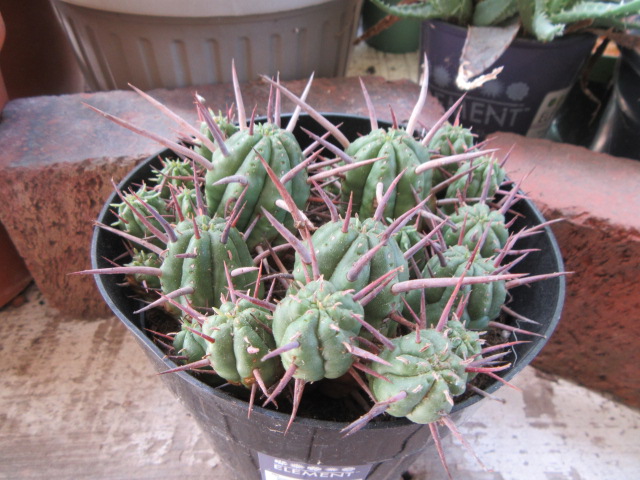
Euphorbia ferox (Thorn Noors/Pincushion Euphorbia) on 10-14-24.
I intially moved the potted plants inside on 10-14-24 since the temps were getting cooler and a frost was in the forecast. I moved them back outside after a few days because temps warmed back up as usual. They were back outside until 11-17 when I had to move them back inside, probably for the winter.
This plant was perfectly fine when I moved it inside for the winter. Then, the next thing I knew, it had completely shriveled up and died… I hope to find another one at some point because I thought it was really neat…
I hope you enjoyed this page and maybe found it useful. If you have any comments, questions, or suggestions, I would like to hear from you. Please click on “like” if you visited this page. It helps us bloggers stay motivated. 🙂 You can check out the links below for further reading. The links take you directly to the genus and species of this plant. If you see I have made an error, please let me know in a comment or email me at thebelmontrooster@yahoo.com.
 The Belmont Rooster