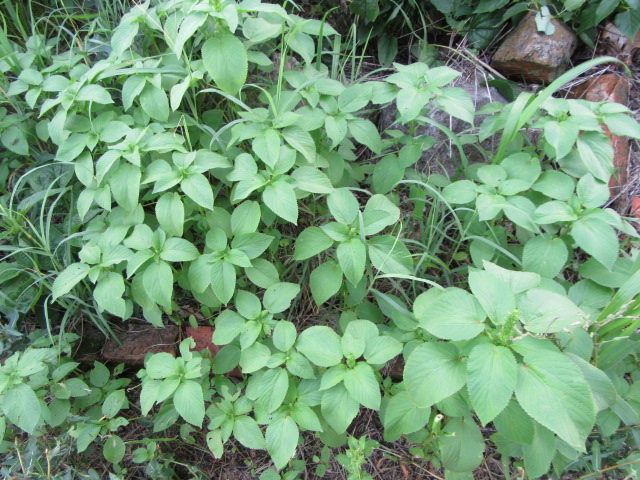
Acalypha persimilis (Hophormbeam Copperleaf, Pineland Threeseed Mercury, etc.) on 8-1-23, #958-1.
Recent name change from Acalypha ostryifolia to Acalypha persimilis…
Hophornbeam Copperleaf, Hornbeam Coppleaf, Hop-Hornbeam Copperleaf, Hornbeam Mercury, Persimmon Acalypha, Persimmon Copperleaf, Pineland Threeseed Mercury, Roughpod Copperleaf
Acalypha persimilis
ak-uh-LY-fuh ?
Syn.
Acalypha ostryifolia
Synonyms of Acalypha persimilis (10) (Updated on 12-18-25 from Plants of the World Online): Acalypha caroliniana Elliott (1824) (nom. illeg.), Acalypha corchorifolia A.Rich. (1850) (nom. illeg.), Acalypha ostryifolia Riddell ex J.M.Coult. (1894), Acalypha pedunculata Klotzsch ex Pax & K.Hoffm. (1924) (pro syn.), Acalypha persimilis var. corchorifolia Müll.Arg. (1866), Acalypha persimilis var. scabra Müll.Arg. (1865), Acalypha polystachya Griseb. (1859) (nom. illeg.), Acalypha setosa Bello (1883) (nom. illeg.), Ricinocarpus carolinianus Kuntze (1891), Ricinocarpus persimilis (Müll.Arg.) Kuntze (1891)
Acalypha persimilis Müll.Arg. is the accepted scientific name for this species of Acalypha. It was named and described as such by Johannes (Jean) Müller Argoviensis in Linnea in 1865.
Now considered a synonym on Plants of the World Online, Acalypha ostryifolia Riddell ex J.M.Coult. is used by many websites and databases. It was described as such by John Merle Coulter in Memoirs of the Torrey Botanical Club in 1894. Mr. Coulter gives John Leonard Riddell credit for first naming and describing the species.
The genus, Acalypha L., was named and described as such by Carl von Linnaeus in the second volume of the first edition of Species Plantarum in 1753.
As of 12-18-25 when this page was last updated, Plants of the World Online lists 430 species in the Acalypha genus. It is a member of the plant family Euphorbiaceae with 230 genera. Those numbers could change as updates are made on POWO.

Distribution map of Acalypha persimilis from Plants of the World Online. Facilitated by the Royal Botanic Gardens, Kew. Published on the Internet; http://www.plantsoftheworldonline.org/. Retrieved January 1, 2023.
The above distribution map for Acalypha persimilis is from Plants of the World Online. Areas in green are where the species is native and purple is where it has been introduced. The map on the USDA Plants Database for Acalypha ostryifolia is similar.
The map on iNaturalist shows where members have made observations. Anyone can join and it is a great website to confirm and share your observations. The maps on iNaturalist are continually updated as members post new observations. I post all my observations on iNaturalist and it can be addictive. The species name was recently changed from Acalypha ostryifolia to A. persimilis on iNaturalist. To view their page for A. ostryifolia while it is still available, click HERE. The observations for A. ostryifolia should automatically transfer to A. persimilis at some point…
THERE ARE A FEW LINKS AT THE BOTTOM OF THE PAGE FOR FURTHER READING AND TO HELP WITH A POSITIVE ID.

Acalypha persimilis (Hophormbeam Copperleaf, Pineland Threeseed Mercury, etc.) on 8-1-23, #958-2.
I have noticed these wildflowers many times but really never paid much attention to them until 2023. It was very hot and dry and by mid-summer, most of the wildflowers growing in the hayfield and pasture had already fizzled out. It was so hot I stayed closer to the house and didn’t even work in the garden until it was in the shade. As a result, I was paying more attention to the wildflowers (weeds) growing in the flower beds and garden. I noticed a few of these plants growing in two beds next to the old foundation where my grandparent’s house used to be. Then, I found a few along the south side of the garage behind the Castor Oil Plants.
I took several photos and uploaded them on iNaturalist for a suggested ID. The name Acalypha ostryifolia was top on the list, so I went to the Missouri Plants website for confirmation. Once again, I found iNaturalist to be correct and my observation became Research Grade. However, when I started writing this page on January 1 (2024), I went to Plants of the World Online to verify the scientific name. It had changed to Acalypha persimilis… I then went to iNaturalist to flag Acalypha ostryifolia for a name change, but someone beat me to it… Four years earlier. Then, later that evening, I saw where the change was approved.

Acalypha persimilis (Hophornbeam Copperleaf, Pineland Threeseed Mercury, etc.) on 9-22-23, #962-1.
As a member of the plant family Euphorbiaceae, it naturally has weird flowers. I have identified 10 wildflowers in the family, and all their flowers are weird. Once you get used to them, you can easily recognize members of the family at a glance.
You can see from the above map that Acapypha persimilis is a native American species. What the map doesn’t show is how widespread the species is in each state. If you want, you can click HERE to go to the BONAP (Biota of North America Program) to view the map that shows counties. The only problem is, you can’t zoom in on the maps, so you have to know exactly where your county is.
A. persimilis typically prefers locations in full sun to part shade in fairly fertile loamy soil. Of course, they also prefer soil that gets plenty of moisture, but they thrived here in 2023 in the heat and drought with pretty much no rain for several months. Information online says they have been reported along streambanks, in fields, gardens, along railroads, open disturbed areas, along roadsides, and along buildings.

Acalypha persimilis (Hophornbeam Copperleaf, Pineland Threeseed Mercury, etc.) on 9-22-23, #962-2.
Acalypha persimilis is an annual taprooted forb that grows up to 2 1/2’ tall, more or less, and forms kind of a pyramid shape. The stems and branches are densely covered with short strongly recurved white hairs, somewhat longer at the tips, many of the hairs could be gland-tipped. The stems and branches are light green, but some photos indicate they can also be reddish-brown toward the top.
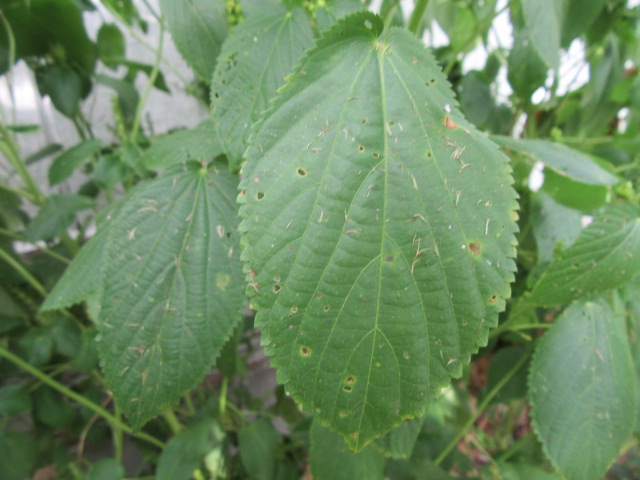
Acalypha persimilis (Hophornbeam Copperleaf, Pineland Threeseed Mercury, etc.) on 9-22-23, #962-4.
The alternate leaves, up to 4” long and 2 1/2” wide and are somewhat thin textured that wilt in the heat. In shape, they are narrowly to broadly ovate or heart-shaped. The base of the leaves can be cordate, rounded, or angled, while the tips are bluntly to sharply pointed. The margins have 18-26 sharp teeth. The upper surface and underside of the leaves are sparsely hairy (pubescent) as are the petioles (leaf stems). The leaves have prominent veins and some have a reddish spot where the petiole attaches below. The leaves turn a coppery color in the fall which is where the name “copperleaf” comes from.

Acalypha persimilis (Hophornbeam Copperleaf, Pineland Threeseed Mercury, etc.) on 9-22-23, #962-3.
Members of the plant family Euphorbiaceae are known for their weird flowers and this one is no exception. Acalypha persimilis are monoecious plants meaning male and female flowers are on the same plant. Sorry about the blur in the above photo. My camera doesn’t always take great close-ups. Surely it couldn’t be the operator’s fault…

Photo of terminal pistillate inflorescences and lateral staminate inflorescences of the Acalypha ostryifolia. Photo taken by Gerrit Davidse on 10-9-11 in Perry County, MO, and published on Tropicos.org. (Missouri Botanical Garden). Published on the internet: https://www.tropicos.org/home. Retrieved on January 4, 2024.
In this case, they are produced on different inflorescences (flower stems).

Staminate inflorescence of Acalypha ostryifolia. Photo taken by Gerrit Davidse on 10-9-11 in Perry County, MO, and published on Tropicos.org. (Missouri Botanical Garden). Published on the internet: https://www.tropicos.org/home. Retrieved on January 4, 2024.
Staminate (male) flowers are densely packed on an inflorescence that is about 1/2-2” long and develops from the axils of upper leaves. They consist of 4 green to translucent white sepals, several white stamens, and have no petals or bracts. The pistillate (female) flowers grow on inflorescences at the end (terminate) of branches and stems and usually above the male flowers.
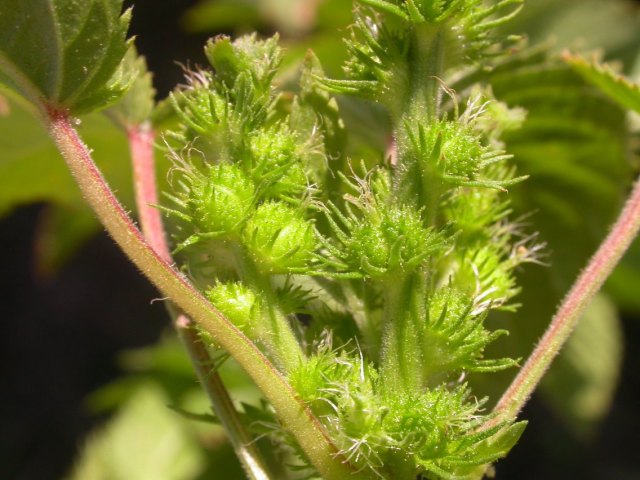
Pistillate inflorescence of Acalypha ostryifolia showing the weird bracts and spiky ovaries. Photo taken by Gerrit Davidse on 10-9-11 in Perry County, MO, and published on Tropicos.org. (Missouri Botanical Garden). Published on the internet: https://www.tropicos.org/home. Retrieved on January 4, 2024.
Female flowers are supposedly about 1/4” across and densely crowded. Female flowers consist of 3 white styles that are deeply divided into long-attenuate to hair-like divisions… The globe-shaped ovaries are spiny. The female flowers also do not have petals. Flowers are wind-pollinated. The flowering season is from June through October.
After flowering, the ovaries become the fruit (schizocarp) that are divided into 3 sections (3-locular) each containing a single seed.
The flowers aren’t pollinated by insects, but flea beetles feed on their leaves. Spotted Lady Beetles are said to like this species to lay their eggs on…
Hopefully, the Acalypha persimilis will show up again in 2024 so I can take more and better photos. Maybe good enough close-ups so I won’t have to borrow photos…
I live on the family farm in Windsor, Missouri in Pettis County (Henry County is across the street, and Benton and Johnson aren’t far away). I have grown over 500 different plants and identified over 250 species of wildflowers (most have pages listed on the right side of the page). I am not an expert, botanist, or horticulturalist. I just like growing, photographing, and writing about my experience. I rely on several websites for ID and a few horticulturalists I contact if I cannot figure them out. Wildflowers can be variable from location to location, so that can be a bit confusing. If you see I have made an error, please let me know so I can correct what I have written.I hope you found this page useful and be sure to check the links below for more information. They were written by experts and they provide much more information. Some sites may not be up-to-date but they are always a work in progress. If you can, I would appreciate it if you would click on the “Like” below and leave a comment. It helps us bloggers stay motivated. You can also send an email to me at thebelmontrooster@yahoo.com. I would enjoy hearing from you especially if you notice something is a bit whacky.
*Since the scientific name changed recently, some of the links below are for Acalypha ostryifolia and some are for A. persimilis.
FOR FURTHER READING:
PLANTS OF THE WORLD ONLINE (GENUS/SPECIES)
INTERNATIONAL PLANT NAMES INDEX (GENUS/SPECIES)
TROPICOS (GENUS/SPECIES)
FLORA OF MISSOURI (GENUS/SPECIES)
FLORA OF NORTH AMERICA (GENUS/SPECIES)
WORLD FLORA ONLINE (GENUS/SPECIES)
WIKIPEDIA (GENUS/SPECIES)
USDA PLANTS DATABASE
iNATURALIST
MISSOURI PLANTS
MIDWEST WEEDS AND WILDFLOWERS
UNIVERSITY OF MISSOURI WEED ID
WILDFLOWER SEARCH
CAMBRIDGE UNIVERSITY
FLORA FINDER
ILLINOIS WILDFLOWERS
KANSAS WILDFLOWERS AND GRASSES
LADY BIRD JOHNSON WILDFLOWER CENTER
LEAF LIBRARY
SEINet
THE NATIONAL GARDENING ASSOCIATION
NOTE: The data (figures, maps, accepted names, etc.) may not match on these websites. It depends on when and how they make updates and when their sources make updates. Some websites have hundreds and even many thousands of species to keep up with. Accepted scientific names change periodically and it can be hard to keep with as well. Some of the links may use a name that is a synonym on other sites. In my opinion, Plants of the World Online by Kew is one of the most reliable and up-to-date plant databases and they make updates regularly. I make updates “at least” once a year and when I write new pages or add new photos but I do get behind. We are all a work in progress. 🙂
 The Belmont Rooster
