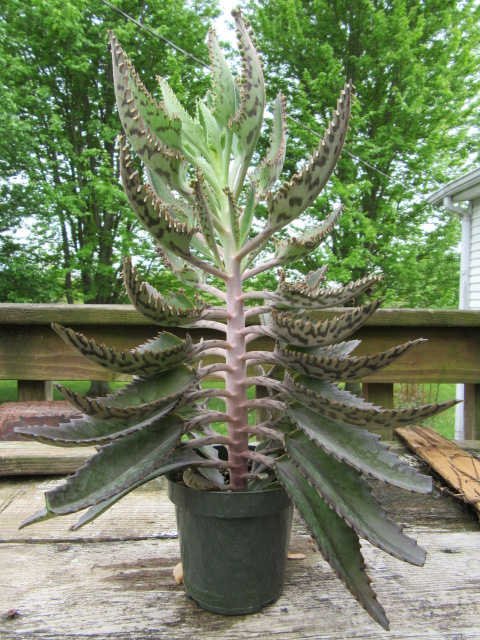
Kalanchoe daigremontiana (Alligator Plant) after I brought it home on 5-6-22, #879-2.
Mother-Of-Thousands, Alligator Plant, Maternity Plant, Devil’s Backbone, Mexican Hat Plant
Kalanchoe daigremontiana
kal-un-KOH-ee day-ee-gree-mon-tee-AH-nuh
Synonyms of Kalanchoe daigremontiana (1) (Updated on 12-17-25 from Plants of the World Online): Bryophyllum daigremontianum (Raym.-Hamet & H.Perrier) A.Berger (1930)
Kalanchoe daigremontiana Raym.-Hamet & H. Perrier is the accepted scientific name for this species of Kalanchoe. It was named and first described by Raymond-Hamet and Joseph Marie Henry Alfred Perrier de la Bâthie in Annales du Musée Colonial de Marseille in 1914.
Kalanchoe Adans. is the accepted scientific name for this genus of flowering plants in the Crassulaceae Family. The genus was named and described by Michel Adanson in Familles des Plantes in 1763.
As of 12-17-25 when this page was last updated, Plants of the World Online lists 176 species in the Kalanchoe genus. It is a member of the plant family Crassulaceae with 39 genera. Those numbers could change as updates are made on POWO.
This species has been moved in out of the Bryophyllum genus several times. For now, that genus is once again a synonym of Kalanchoe. How long it will remain that way is anyone’s guess…
THERE ARE SEVERAL LINKS AT THE BOTTOM OF THE PAGE FOR FURTHER READING.

Kalanchoe daigremontiana (Alligator Plant) on 5-6-22, #879-3.
For several years I had gotten the Kalanchoe daigremontiana confused with Kalanchoe laetivirens. I had grown a plant for many years with the wrong name. Finally I figured out the error of my ways then I found an actual Kalanchoe daigremontiana from Wagler’s Greenhouse on May 6 in 2022. There were several to choose from so I promptly grabbed one and put it on the counter then finished shopping. The plants were good-sized specimens, and the one I brought home measured 13 1/2″ tall x 13 1/2″ wide.

Kalanchoe daigremontiana (Alligator Plant) on 5-6-22, #879-4.
Kalanchoe daigremontiana is a native of southwest Madagascar where MANY interesting species are found. I really like growing Kalanchoe species and this one is very interesting.
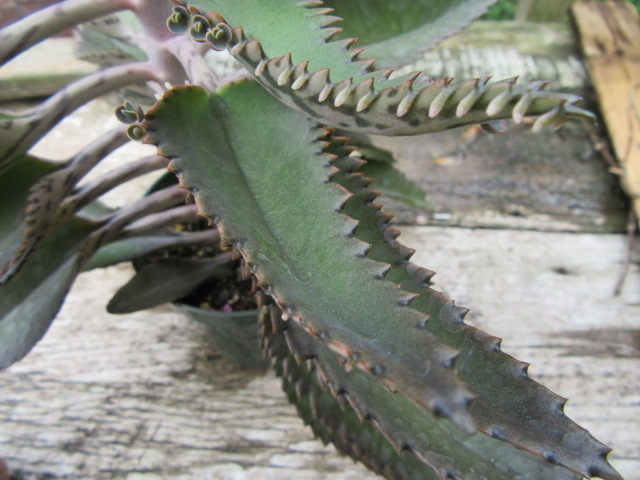
Kalanchoe daigremontiana (Alligator Plant) on 5-6-22, #879-5.
What appear to be leaves on several species are actually phylloclades which are flattened branches modified for photosynthesis. Ummm… Flattened stems are called cladodes. Interesting that phylloclades still have a petiole that attaches to the stem. I wonder if a plant with a cladode that produces a phylloclade is attached to a petiole? 🙂
A multitude of plantlets are produced along these phylloclades which I normally remove. If not, they come up in all the pots nearby. I have had this issue with the Kalanchoe laetivirens for YEARS. The first time I had this experience was an OMG moment! I always wondered if they would grow in the carpet when the plants are inside…

Kalanchoe daigremontiana (Alligator Plant) on 5-6-22, #879-6.
Now, the leaves can be quite variable as you can tell if you go online and look at photos. Some are shaped more like K. laetivirens but they have purplish markings on the undersides of the leaves. If they don’t have purple markings, they are K. laetivirens. That’s what always threw me… If my plants were K. daigremontiana, how come they didn’t have purple markings? Well, it was because they weren’t K. daigremontiana. 🙂 To complicate matters, there are a lot of photos online that are incorrect on several websites. It would be funny (NOT) if I am still wrong.

Kalanchoe daigremontiana (Alligator Plant) at 27 3/4″ tall x 7 1/2″ wide on 10-16-22, #919-19.
As it happens every year, I had to move the potted plants inside for the winter on October 16 in 2022 because a “you know what” was in the forecast. I was amazed the Kalanchoe daigremontiana had grown to 27 3/4″ tall. It was only 7 1/2″ wide because many of the longer lower leaves had fallen off. That’s normal…

Kalanchoe daigremontiana (Alligator Plant) on 10-16-22, #919-20.
Now I have a few photos without words. I will replace the blank spots with descriptions later. I just wanted to get these photos and the page online while I was making initial updates on 12-17-22. It always seems like I am behind. 🙂

Kalanchoe daigremontiana (Alligator Plant) on 10-16-22, #919-21.

Kalanchoe daigremontiana (Alligator Plant) on 11-6-22, #920-1.
I put the Kalanchoe daigremontiana on a plant shelf in my bedroom for the winter. I had to remove the second shelf for this plant and the Kalanchoe luciae. The latter had buds when I brought them inside, but this plant started afterward. The next thing I knew the inflorescence was touching the bottom of the shelf. I had to move its pot to the floor.

Kalanchoe daigremontiana (Alligator Plant) on 11-22-22, #925-4.
On November 11 (2022), I took this plant to the back deck to take a few photos. It was a bit windy and cloudy which wasn’t a great combination to take photos.

Kalanchoe daigremontiana (Alligator Plant) on 11-22-22, #925-5.

Kalanchoe daigremontiana (Alligator Plant) at 40 1/2″ tall on 12-8-22, #927-1.
Then on December 8, I took it to the front porch… I measured it again at 40 1/2″ tall.

Kalanchoe daigremontiana (Alligator Plant) on 12-8-22, #927-2.
I’ll admit the flowers are interesting, but the photo isn’t that great. I had to zoom in quite a bit and use two magnifying glasses.

Kalanchoe daigremontiana (Alligator Plant) on 12-8-22, #927-3.
The plant was producing several side branches…
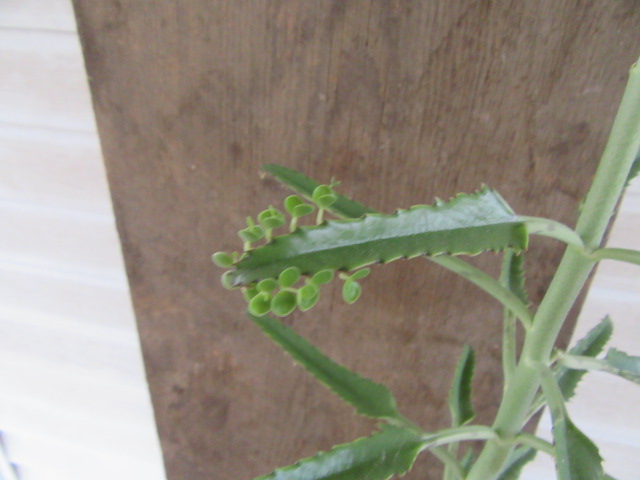
Kalanchoe daigremontiana (Alligator Plant) on 12-8-22, #927-4.
There are more plantlets to remove. 🙂
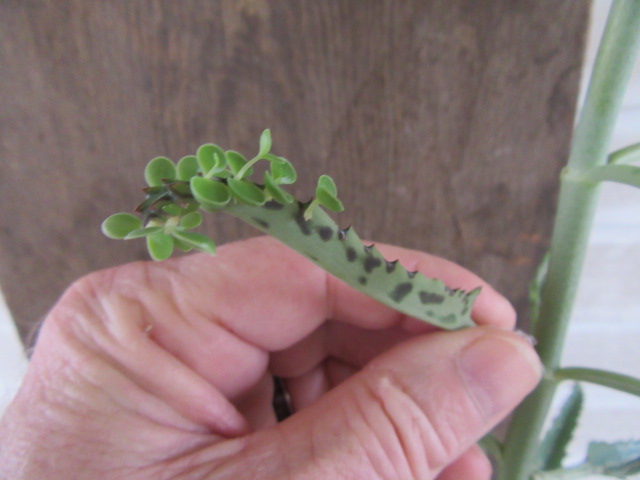
Kalanchoe daigremontiana (Alligator Plant) on 12-8-22, #927-5.
Well, I should let a few grow since this species of Kalanchoe is monocarpic. All the species that produce these funky plantlets are monocarpic, meaning the main plant will die after flowering. Fortunately, they are supposed to produce offsets (from the stem). With the K. laetivirens, which has bloomed several times, the offsets make much better plants and grow MUCH quicker than plants grown from the plantlets. I am hoping the same will be true for this plant. I read on the International Crassulaceae Network,
“After flowering the plant dies back and produces its bulbils. So we will not loose it in collections. But the bulbils will not always be identical to their mother and may differ from one year to the next. It is interesting to watch the parallel lines of succession.”
<<<<2023>>>>

Kalanchoe daigremontiana (Alligator Plant) on 2-18-23. #931-3.
Once the flowers faded, they were replaced by odd-looking plantlets… The light wasn’t so great while in the bedroom in front of a west-facing window. I am certain that’s why the plantlets looked weird.

Kalanchoe daigremontiana (Alligator Plant) on 2-18-23, #931-4.
Probably stretching for light…
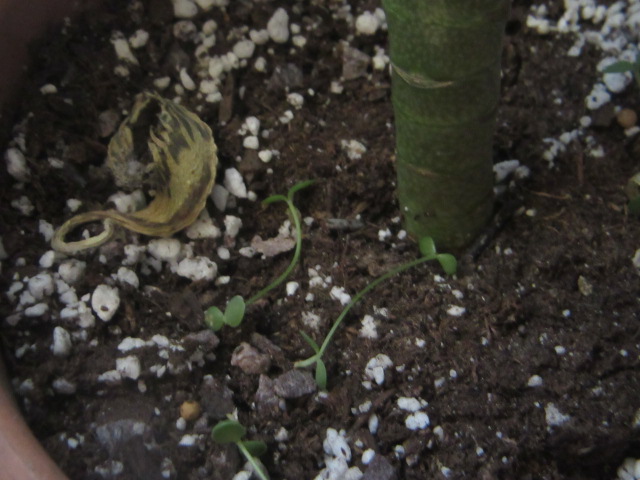
Kalanchoe daigremontiana (Alligator Plant) on 2-18-23, #231-5.
A lot of the plantlets fell into the pot…

Kalanchoe daigremontiana (Alligator Plant) at 43″ tall on 10-24-23, #968-17.
Even though there was no “F” in the forecast until October 30, it was going to be a rainy week so I moved the potted plants inside on the 23rd and 24th. Time for photos and measurements…
The Kalanchoe daigremontiana did very well during the summer on the front porch despite the heat and drought. The plant was 43″ tall…
The bent over stem is the one that produced flowers…

Kalanchoe daigremontiana (Alligator Plant) on 10-24-23, #968-18.
Supposedly, Kalanchoe daigremontiana is monocarpic which means it was supposed to die after flowering. Well, it didn’t die and it doesn’t appear to be dying either. It grew branches next to the stem that produced flowers earlier…
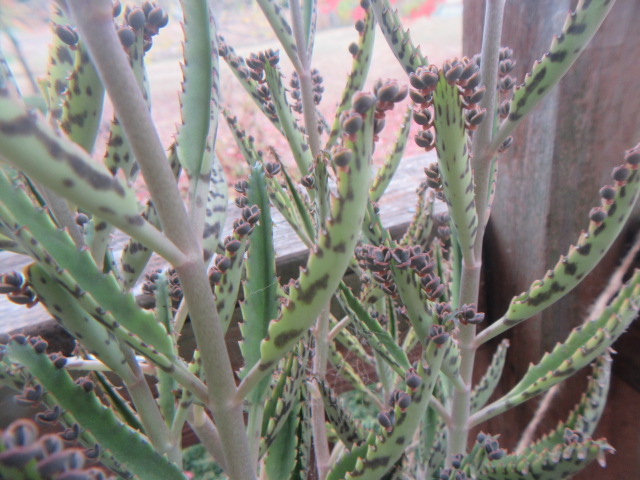
Kalanchoe daigremontiana (Alligator Plant) on 10-24-23, #968-19.
Plenty of plantlets to remove before bringing inside for the winter…
USEFUL INFORMATION:
Family: Crassulaceae
Origin: Madagascar
Zones: USDA Zones 9b-11 (25 to 40° F)
Size: 36” to 48” tall
Light: Sun to part shade
Soil: Fast-draining mix amended with grit and pumice or perlite
Water: Normal watering during the growing period, barely in winter
Propagation: Plantlets from leaves and stem cuttings
Concerns: Guess…
The above information is a guess based on what several websites say. Personally, I would not put these plants in full sun if you aren’t experienced with them. If you have several, you can put them in different locations to see where they do the best. If you have your plants inside for the winter, it would be best to acclimate them to full sun gradually.
<<<<2024>>>>
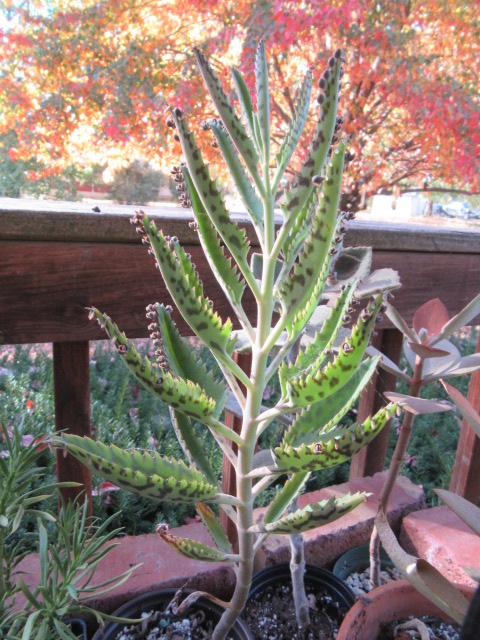
Kalanchoe daigremontiana (Alligator Plant) at 15 1/2″ tall on 10-23-24.
Ummm… A few plantlets sprouted here and there and the one in the above photo measured 15 1/2″ tall when I took the above photo on 10-23-24.
I originally brought the potted plants inside on 10-14-24 because temps were going to get cooler and there was a frost in the forecast. I put them back outside after a couple of days because the temps warmed back up.

Kalanchoe daigremontiana (Alligator Plant) at 34″ tall on 10-24-24, #1024-9.
The above photo is of the original plant that has gotten a little weird. After a little trimming, it measured 34″ tall on 10-24-24.

Kalanchoe daigremontiana (Alligator Plant) at 16″ tall on 10-24-24, #1024-10.
This one with the weird stem measured 16″ tall on 10-24-24.
The plants were moved back inside, probably for the winter, on November 17.
I didn’t take any photos of this plant in 2025, but it it alive and well. Now overwintering in the house…
I hope you enjoyed this page and maybe found it useful. If you have any comments, questions, or suggestions, I would like to hear from you. Please click on “like” if you visited this page. It helps us bloggers stay motivated. 🙂 You can check out the links below for further reading. The links take you directly to the genus and species of this plant. If you see I have made an error, please let me know in a comment or email me at thebelmontrooster@yahoo.com.
 The Belmont Rooster