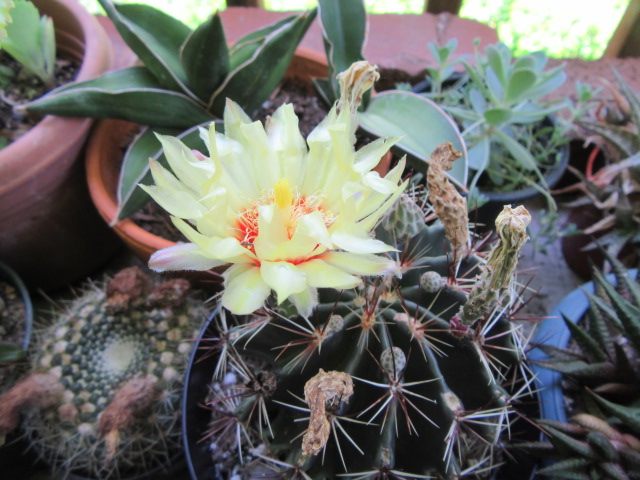
Thelocactus setispinus (Miniature Barell Cactus) on 6-12-24, #996-7.
Miniature Barrel Cactus, Hedgehog Cactus
Thelocactus setispinus
thel-oh-KAK-tus set-AY-spin-us
Synonyms of Thelocactus setispinus (31) (Updated on 11-15-24 from Plants of the World Online): Cactus bicolor Terán & Berland. (1832), Echinocactus cachetianus (Labour.) Hildm. (1885), Echinocactus hamatus Muehlenpf. (1848), Echinocactus hamulosus Regel (1856), Echinocactus muehlenpfordtii J.H.Fennell (1847), Echinocactus nodosus (Linke) Hemsl. (1880), Echinocactus setispinus Engelm. (1845), Echinocactus setispinus f. cachetianus (Labour.) Schelle (1907), Echinocactus setispinus var. cachetianus Labour. (1853), Echinocactus setispinus f. hamatus (Muehlenpf.) Schelle (1907), Echinocactus setispinus var. hamatus (Muehlenpf.) Engelm. (1850), Echinocactus setispinus var. martelii Schelle (1907), Echinocactus setispinus f. mierensis (K.Schum.) Schelle (1907), Echinocactus setispinus var. mierensis K.Schum. (1898), Echinocactus setispinus var. muehlenpfordtii (J.H.Fennell) J.M.Coult. (1896), Echinocactus setispinus f. orcuttii (K.Schum.) Schelle (1907), Echinocactus setispinus var. orcuttii K.Schum. (1898), Echinocactus setispinus var. robustus Poselg. (1853), Echinocactus setispinus var. setaceus Engelm. (1850), Echinopsis nodosa Linke (1858), Ferocactus setispinus (Engelm.) L.D.Benson (1969), Hamatocactus bicolor (Terán & Berland.) I.M.Johnst. (1924), Hamatocactus setispinus (Engelm.) Britton & Rose (1922), Hamatocactus setispinus f. cachetianus (Labour.) Krainz (1965), Hamatocactus setispinus f. flavibaccatus G.Unger (1981), Hamatocactus setispinus f. orcuttii (K.Schum.) Krainz (1965), Mammillaria engelmannii Cory (1936), Thelocactus setispinus var. cachetianus (Labour.) Pilbeam (1996), Thelocactus setispinus var. hamatus (Muehlenpf.) Pilbeam (1996), Thelocactus setispinus var. mierensis (K.Schum.) Pilbeam (1996), Thelocactus setispinus var. orcuttii (K.Schum.) Pilbeam (1996)
Thelocactus setispinus (Engelm.) E.F.Anderson is the accepted scientific name for this species of Thelocactus. It was named and described as such by Edward Frederick Anderson in Bradleya in 1987. It was first named Echinocactus setispinus by Georg (George) Engelmann in the Boston Journal of Natural History in 1845.
The genus, Thelocactus (K.Schum.) Britton & Rose, was named and described by Nathaniel Lord Britton and Joseph Nelson Rose in volume 49 of the Bulletin of the Torrey Botanical Club in 1922. Karl Moritz Schumann first named it as a subgenus of Echinocactus in Kakteen in 1898.
As of 11-15-24 when this page was last updated, Plants of the World Online lists 13 species in the Thelocactus genus. It is a member of the plant family Cactaceae with 150 genera. Those numbers could change as updates are made on POWO.
THERE ARE A FEW LINKS AT THE BOTTOM OF THE PAGE FOR FURTHER READING.
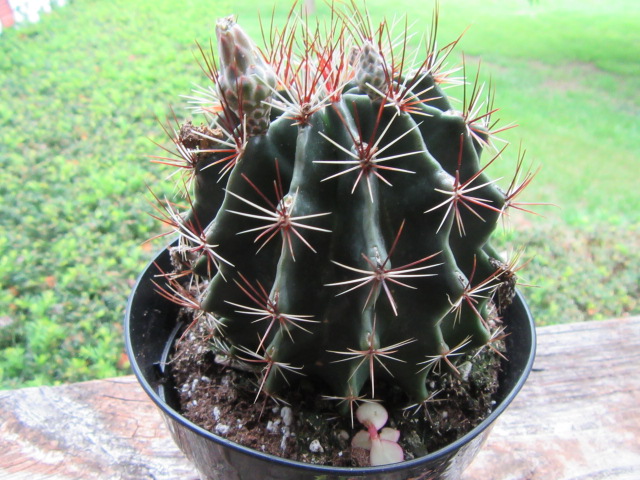
Thelocactus setispinus (Miniature Barrel Cactus) at 3 1/2″ tall x 3 1/2″ wide after I brought it home on 5-6-24, #987-12.
I found the neat cactus while plant shopping at Walmart on May 6, 2016. It had a plant label with an actual name on it and the price was OK so I put it in my shopping cart. One of my pet peeves is pots without plant names because then I have to figure them out. That can be a challenge sometimes with cactus. Anyway, I brought home several new plants to try.
Once home, I took photographs and measurements. This cactus seemed to be in good shape besides a few scars and missing spines. It was a good-sized plant at 3 1/2″ tall x 3 1/2″ wide (without the thorns) and had several buds…

Yeah, I paid $12.96 for this plant, which I rarely do. But, this plant was good-sized and in a 4 3/4″ wide x 5″ tall pot.
Now for the name issue… Hamatocactus hamatacanthus is a synonym of Ferocactus hamatacanthus, commonly known as the Turks Head Cactus. So, I thought I had a Ferocactus hamatacanthus. However, once the buds opened I became somewhat confused… It has yellow flowers with red centers while Ferocactus hamatacanthus produces flowers that are all yellow… Then an anonymous blog reader suggested Thelocactus setispinus (Miniature Barrel Cactus). After a little research, I think they were correct. I changed the name… I always appreciate help when plants don’t have correct labels… I am no expert.
According to Llifle (Encyclopedia of Living Forms), Thelocactus setispinus is native to southern Texas and northern Mexico where it grows in thickets of taller vegitation such as Mesquite.

Thelocactus setispinus (Miniature Barrel Cactus) on 9-6-24, #987-13.
In the wild, Thelocactus setispinus is a variable species usually growing as solitary plants but sometimes forming large clusters. Stem sizes can also vary from location to location and are normally 2 3/4 to about 6″ (7-15 cm) in height but can grow up to 8″. They are “globe-shaped” when young, sometimes elongating with age.

Thelocactus setispinus (Miniature Barrel Cactus) on 5-6-24, #987-14.
Stems are yellow-green to blue-green in color and have 12-15 thin ribs that are sometimes oblique or twisted. The areoles have 9-17 radial spines and 1-3 central spines.
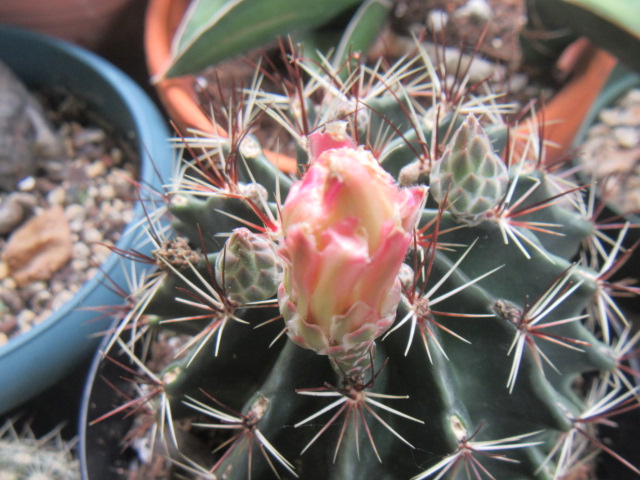
Thelocactus setispinus (Miniature Barrel Cactus) on 5-16-24, #991-2.
Information says Thelocactus setispinus is an easy cactus to grow. Of course, it has a few rules… As with all cacti, they require a good, well-draining soil. They like to be watered thoroughly once a week and their soil needs to dry out between watering.
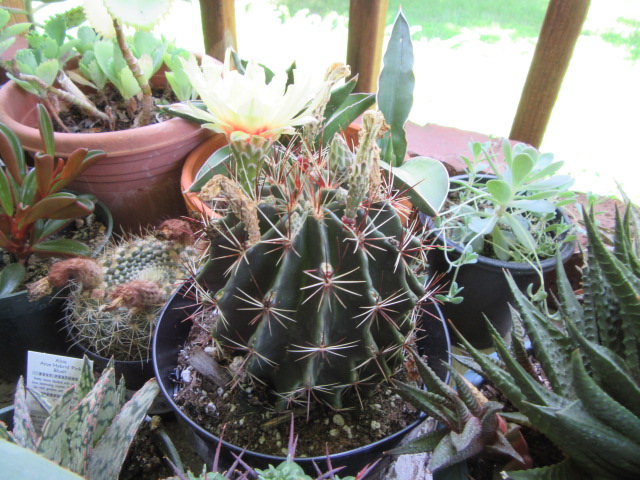
Thelocactus setispinus (Miniature Barrel Cactus) on 6-12-24, #996-6.
There are a lot of good potting soil recipes for cacti online, or you can use a commercial mix specially formulated for cactus and succulents. I used 2 parts Miracle Grow Potting Soil with 1 part chicken grit and 1 part perlite for many years with favorable results. Then I started using pumice rather than chicken grit and perlite and really didn’t notice any difference. Just do some research and experimenting and you will figure out what your plants like. I am no expert, and I have had several species for many years. It is also wise to add rocks to the bottom of the pot for better drainage.
Thelocactus setispinus (Miniature Barell Cactus) on 6-12-24, #996-7.
Some cactus species like growing in full sun on the back porch and others prefer light shade from the covered front porch. Since I haven’t had this one that long, I kept it on the front porch. Information on Llifle says it grows among mesquite and other shrubs, so I assume it prefers some light shade, especially during the summer. In their care instructions, it also says, “It is suited for any rich, well-drained soil in full sun throughout the year (but do better with light shade in the summer.”
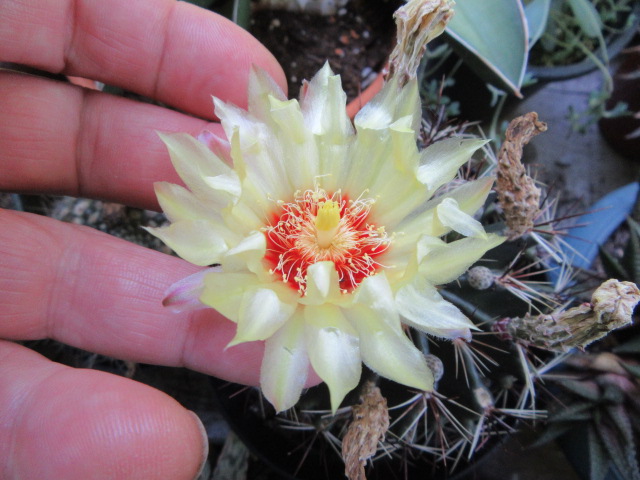
Thelocactus setispinus (Miniature Barrel Cactus) on 6-12-24, #996-8.
As you can see in the above photo, this Thelocactus setispinus has yellow flowers with red centers. Other species of Thelocactus have flowers of different colors.

Thelocactus setispinus (Miniature Barrel Cactus) on 6-12-24, #996-9.
Normally, I don’t have cacti that produce so many flowers in succession. They bloom and that’s it. One of the reasons I think the blog reader was correct in saying this is a Thelocactus setispinus is that they produce several flowers in succession.
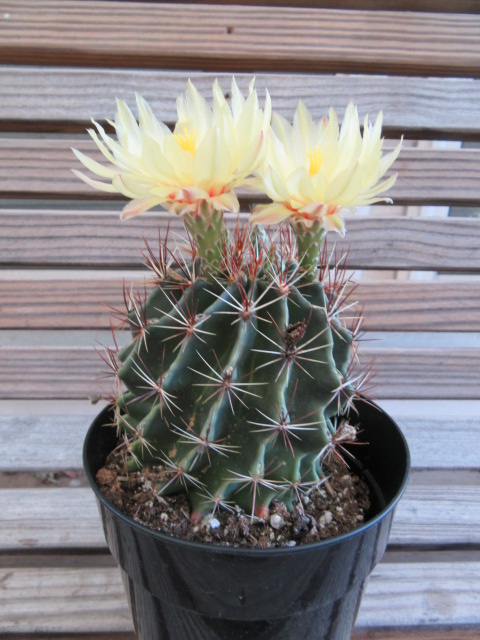
Thelocactus setispinus (Miniature Barrel Cactus) on 6-23-24, #998-1.
I am running out of words…
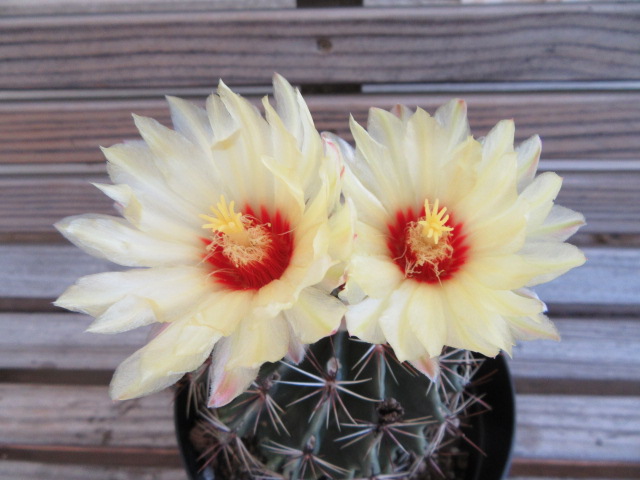
Thelocactus setispinus (Miniature Barrel Cactus) on 6-23-24, #998-2.
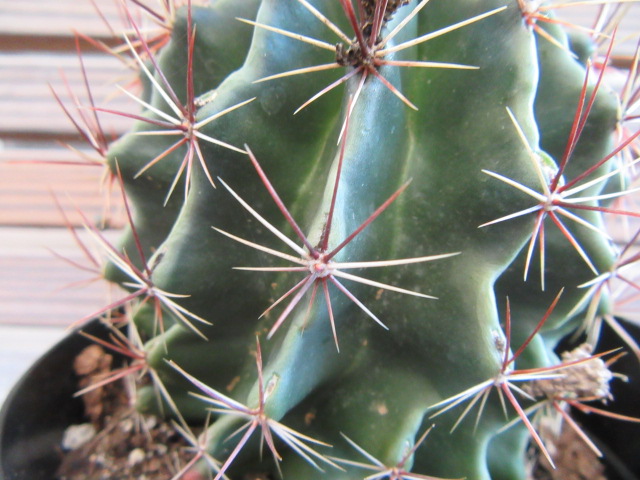
Thelocactus setispinus (Miniature Barrel Cactus) on 6-23-24, #998-3.
OH, one other thing I would like to mention that Llifle refers to… Thelocactus and a few other genera have what is called extrafloral nectaries (EFNs). I have noticed, but you may see yellow, white, or red glands on the areoles and a watery secretion. I found an article on ResearchGate that says these EFNs may produce sugary water to attract ants and other insects. Not much is known yet, but it could be so the ants and other insects can patrol it, clean it, and even protect it from various harmful organisms ranging from fungi to insects.
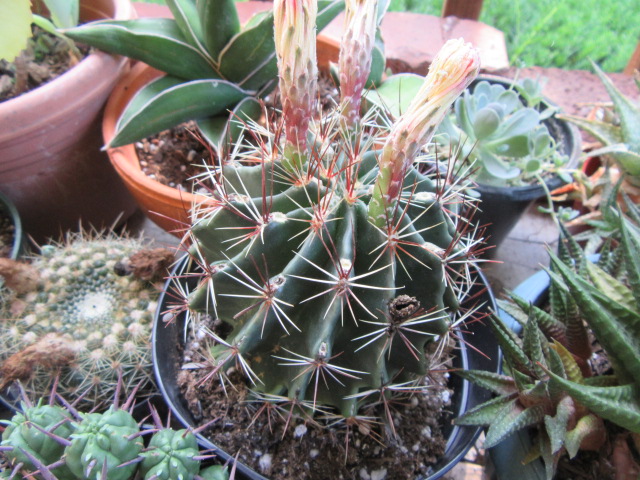
Thelocactus setispinus (Miniature Barrel Cactus) on 7-5-24, #1000-9.
It has had many buds, but it has been somewhat difficult to see them open. I watched every day and all I would see was buds about to open, then the next day they would be wilting like they had already opened. The few times I did see them, they would be fully open for several days. What the heck is that? Now there are three at once… I hope it doesn’t bloom itself to death.
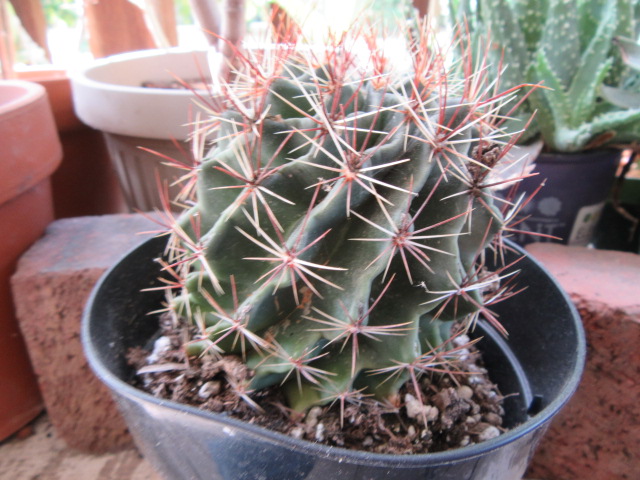
Thelocactus setispinus (Miniature Barrel Cactus) at 3 1/4″ tall x 3 wide on 10-14-24, #1022-33.
I will continue to add more photos and information as time goes by.
I hope you enjoyed this page and maybe found it useful. If you have any comments, questions, or suggestions, I would like to hear from you. Please click on “like” if you visited this page. It helps us bloggers stay motivated. 🙂 You can check out the links below for further reading. The links take you directly to the genus and species of this plant. If you see I have made an error, please let me know in a comment or email me at thebelmontrooster@yahoo.com.
 The Belmont Rooster