
Echinopsis huascha after I brought it home on 9-21-18, #510-3.
THE NAME HAS CHANGED BACK AGAIN!
Desert’s Blooming Jewel, Red Torch
Echinopsis huascha
ek-in-OP-sis WAS-kuh
Syn.
Trichocereus grandiflorus
try-koh-KER-ee-us gran-dih-FLOR-us
Synonyms of Echinopsis huascha (6) (Updated on 12-14-25 from Plants of the World Online): Cereus huascha F.A.C.Weber (1893), Helianthocereus huascha (F.A.C.Weber) Backeb. (1951), Lobivia huascha (F.A.C.Weber) W.T.Marshall (1938), Salpingolobivia huascha (F.A.C.Weber) Y.Itô (1957), Soehrensia huascha (F.A.C.Weber) Schlumpb. (2013), Trichocereus huascha (F.A.C.Weber) Britton & Rose (1920)
Synonyms of Echinopsis huascha subsp. huascha (autonym) (39) (Updated on 12-10-23 from POWO): Acanthocalycium hyalacanthum (Speg.) Backeb. (1936), Cereus andalgalensis F.A.C.Weber ex K.Schum. (1897), Cereus huascha var. rubriflorus F.A.C.Weber (1893), Echinopsis huascha var. auricolor (Backeb.) H.Friedrich & G.D.Rowley (1974), Echinopsis huascha var. rubriflora (F.A.C.Weber) H.Friedrich & G.D.Rowley (1974), Echinopsis hyalacantha (Speg.) Werderm. (1931), Echinopsis pecheretiana (Backeb.) H.Friedrich & G.D.Rowley (1974), Echinopsis vatteri (R.Kiesling) G.D.Rowley (1976 publ. 1979), Helianthocereus andalgalensis (F.A.C.Weber ex K.Schum.) Backeb. (1951), Helianthocereus huascha (F.A.C.Weber) Backeb. (1951), Helianthocereus huascha var. auricolor (Backeb.) Backeb. (1955), Helianthocereus huascha var. macranthus Backeb. (1966), Helianthocereus huascha var. rubriflorus (F.A.C.Weber) Backeb. (1955), Helianthocereus hyalacanthus (Speg.) Backeb. (1959), Helianthocereus pecheretianus Backeb. (1955), Helianthocereus pecheretianus var. viridior Backeb. (1966), Lobivia andalgalensis Britton & Rose (1922), Lobivia formosa var. hyalacantha (Speg.) Rausch (1985-1986 publ. 1987), Lobivia grandiflora Werderm. (1936)(nom. illeg.), Lobivia grandiflora var. lobivioides (F.Ritter) Rausch (1985-1986 publ. 1987), Lobivia huascha var. andalgalensis (F.A.C.Weber ex K.Schum.) Rausch (1977), Lobivia huascha var. calliantha (F.Ritter) Rausch (1985-1986 publ. 1987), Lobivia huascha var. purpureominiata (F.Ritter) Rausch (1977)(no basionym ref.), Lobivia huascha var. rubriflora (F.A.C.Weber) G.D.Rowley (1982), Lobivia hyalacantha Speg. (1925), Lobivia purpureominiata F.Ritter (1980), Salpingolobivia andalgalensis (F.A.C.Weber ex K.Schum.) Y.Itô (1957), Soehrensia huascha var. rosiflora Y.Itô (1962), Soehrensia lobivioides (F.Ritter) Schlumpb. (2012), Trichocereus andalgalensis (F.A.C.Weber ex K.Schum.) Hosseus (1939), Trichocereus andalgalensis var. auricolor (Backeb.) F.Ritter (1980)(no basionym page.), Trichocereus auricolor Backeb. (1936), Trichocereus callianthus F.Ritter (1980), Trichocereus catamarcensis F.Ritter (1980), Trichocereus grandiflorus Backeb. (1966), Trichocereus huascha var. flaviflora Hosseus (1926), Trichocereus huascha var. pecheretianus (Backeb.) R.Kiesling (1978), Trichocereus lobivioides F.Ritter (1980), Trichocereus vatteri R.Kiesling (1976)
Synonyms of Echinopsis huascha subsp. robusta (3): Lobivia huascha var. robusta Rausch (1985-1986 publ. 1987), Soehrensia hauscha subsp. robusta (Rausch) Schlumpb. (2021), Trichocereus huascha subsp. robustus (Rausch) Guiggi (2012)
Echinopsis huascha (F.A.C.Weber) H.Friedrich & G.D.Rowley is the accepted name for this cactus. It was named and described as such by Heimo Friedrich and Gordon Douglas Rowley in ISO Bulletin in 1974. It was first named and described as Cereus huascha by Frédéric Albert Constantin Weber in Monatsschrift für Kakteenkunde (Berlin) in 1893.
Accepted Infraspecific Names (2) (Updated on 12-14-24 from POWO): *Echinopsis huascha subsp. huascha (autonym), Echinopsis huascha subsp. robusta (Rausch) Schlumpb (2021). *When an infraspecific taxon is named, an autonym (“type-specimen”) is automatically generated whose description is closest to the (original) species. All have their own list of synonyms…
The genus, Echinopsis Zucc., was named and described as such by Joseph Gerhard Zuccarini in Abhandlungen der Mathematisch (short version) in 1837.
As of 12-14-25 when this page was last updated, Plants of the World Online by Kew lists 80 accepted species in the Echinopsis genus. It is a member of the plant family Cactaceae with 157 genera. Those numbers could change as updates are made on POWO.
THERE ARE SEVERAL LINKS AT THE BOTTOM OF THE PAGE FOR FURTHER READING.

Soehrensia huascha on 9-21-18, #510-4.
I bought these Echinopsis huascha from Lowe’s on clearance on September 21, 2018. The labels said they were Trichocereus grandiflorus Hybrids. When I checked with Plants of the World Online and Llifle, I found the name had changed. Plants of the World Online says Trichocereus grandiflorus is now a synonym of Echinopsis huascha. Llifle (Encyclopedia of Living Forms) agreed but also listed three infraspecific names and another species in the Echinopsis huascha Group. Reading their descriptions, I find that the species and the other varieties have longer spines than the plant I brought home. The Echinopsis huascha var. grandiflora has shorter spines like mine but that name and its description wasn’t validly published.
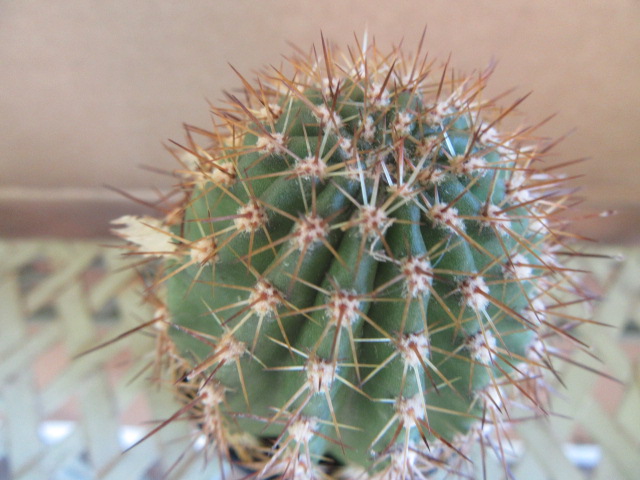
Soehrensia huascha on 9-21-18, #519-5.
The label says:
Drought tolerant once established. Needs well-draining soil. Water thoroughly when soil is dry to the touch. Protect from frost to prevent possible scarring. Looks best with regular watering during the hotter months.
The above plant was growing in a 4 oz. (2 1/2” diameter x 2 1/4” tall) pot. The plant measures approximately 3” tall x 2” wide without the spines.

Echinopsis huascha on 9-21-18, #510-2.
I also bought a cluster of cacti on clearance in a bulging 3.8-quart pot (8” diameter x 6 3/8”). There are 6 individual plants of varying sizes around the pot but the one that was in the center had died. I didn’t realize I had already selected the above cactus until I came home and read the label on the big pot… The label says the same thing with the addition of: Height: 18”+ Width: 12”. Temp.: 15° F.
USEFUL INFORMATION:
Family: Cactaceae
Origin: Northwest Argentina
Zones: USDA Zones 9b-11 (25-40° F)
Size: Hmmm… Dave’s Garden says 24-36” but that is for the species. The other varieties grow much smaller.
Light: Full sun to light shade
Soil: Very well-draining soil. If grown in pots, use 2 parts potting soil with one part grit (chicken grit) and one part additional perlite. You can use 50% potting soil and 50% pumice.
Water: Average water needs during the growing period and sparsely, if any, from fall until spring.
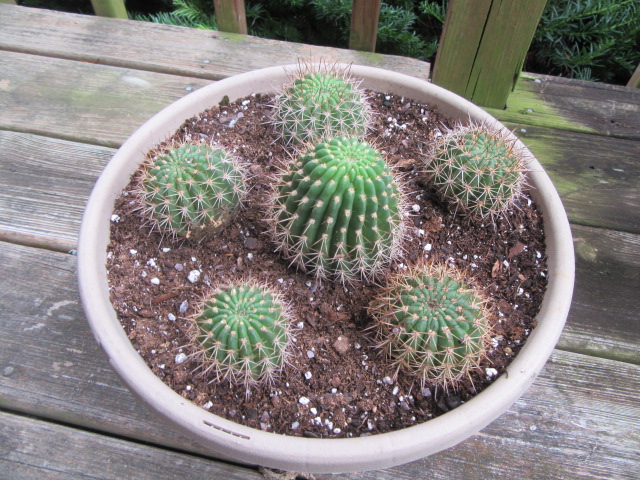
Echinopsis huascha on 10-10-18, #519-28.
I moved all the potted plants inside on 10-10-18 because there was a chance of frost predicted in a few days. I re-potted several cacti that day including the big pot of Soehrensia huascha. Normally I keep the cacti in pots not much bigger than the base of the plant but I kept these five plants in a pot together and discarded the dead one that was in the center when I bought it. Of course, anyone would have probably done that. 🙂 Since I had also purchased a smaller plant, I didn’t want seven individual plants.

Echinopsis huascha, the smaller one, on 10-10-18, #519-29.
I also put the smaller one in a larger pot with fresh potting soil. I had just received a bag of pumice so I used it in the mix. I just realized fall was a good time to re-pot cacti and succulents so their soil would stay nice and loose over the winter. After watering regularly during the summer months, the potting soil can become very hard while not watering during the winter.

Echinopsis huascha on 11-29-18, #534-11.
November 29 was a nice spring-like day so I took the cactus outside for a photoshoot. I was working on a new post comparing the different cacti in my collection. The six plants I put in this pot are all doing well. The largest plant in the center measures approximately 3″ tall x 2 3/4″ wide.
Echinopsis huascha is an upright or sprawling basally branching cactus that can grow up to 36″ tall. They are known for their beautiful flowers that grow about 4″ long and grow on top of the plant. Flowers can be yellow, orange, and red.
The post is titled Cactus Talk and Update…OUCH! and there is a lot of information.

The smaller Echinopsis huascha on 11-29-18 #534-12.
The smaller Echinopsis huascha in its own pot still measures approximately 3″ tall x 2″ wide.
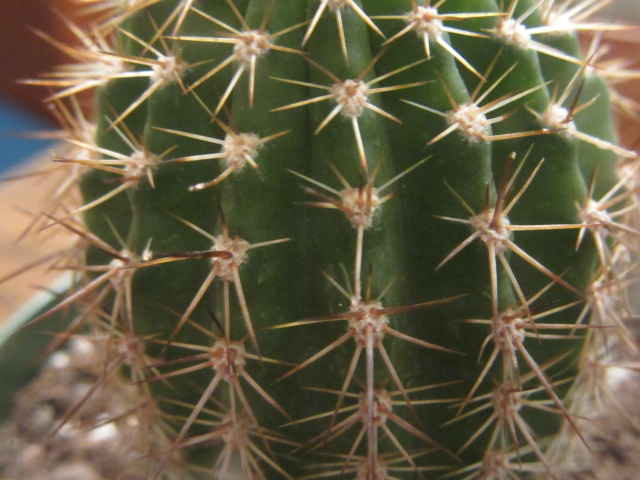
Echinopsis huascha close-up on 12-1-18, #535-10.
The species is “variable” and some photos show plants with longer spines. According to the Llifle (encyclopedia of Living Forms), the species can have spines as long as 5-6 cm., which is about 2-1 1/4″. Echinopsis huascha var. grandiflora grow shorter spines, around 1 cm., which is less than 1/4″. However, that infraspecific name isn’t accepted and is considered a synonym of Echinopsis huascha… At some point, I hope the botanists “in charge” of what is and isn’t accepted will realize the need to “accept” the many varieties, forms, etc. which further identifies the plants based on specific characteristics.
<<<<2019>>>>

Echinopsis huascha on 6-22-19, #593-12.
The Echinopsis huascha are on the back porch enjoying the summer in the sun.
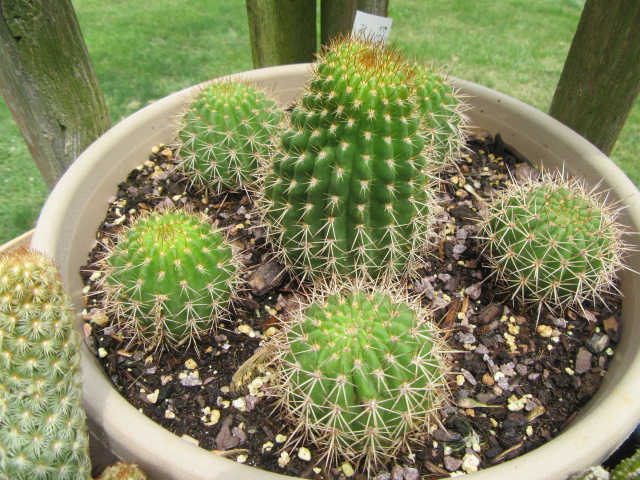
Echinopsis huascha on 6-22-19, #593-13.
The six plants seem to be enjoying their new pot…
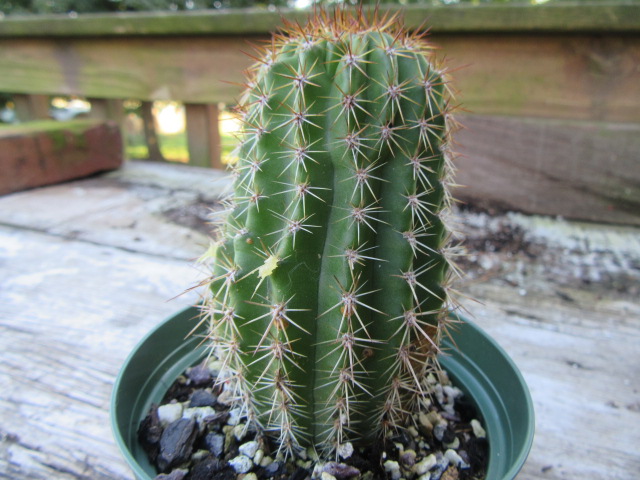
Echinopsis huascha at 3 1/2” tall x 2 1/2” wide on 10-11-19, #639-23.
I had to move the potted plants inside because an “F” and lower even temperatures were in the forecast. I don’t leave the plants outside if evening temps fall below 40° F. As always, I photographed and took measurements before bringing them inside. The smaller plant by itself measured 3 1/2″ tall x 2 1/2″ wide. That is 1/2″ taller and wider since the last measurement on 9-21-18 when I brought it home from Lowe’s.

Echinopsis huascha on 10-11-19, #639-24.
The six plants have enjoyed their pot. The largest plant in the center measured 4 3/4″ tall x 3 1/8″ wide. It was 3″ tall x 2 3/4″ wide on 9-21-18. So, it grew quite a bit.
<<<<2020>>>>

The smallest Echinopsis huascha, 3 7/8″ tall x 2 1/4″ wide on 10-15-20, #747-27.
I had to move the potted plants inside for the winter on October 15. As always I photographed and measured the cactus. The smaller Echinopsis huascha in the pot by itself measured 3 7/8″ tall x 2 1/4″ wide. So, it grew 5/8″ taller and lost a little around the waist. It’s not uncommon for cactus to do this and it depends on the amount of water they have retained. I accidentally took a photo of its bad side. Hmmm… Brown spots can be caused by several things but this looks like possibly fungal lesions that can be caused by cool, damp weather.

The pot of six Echinopsis huascha. The largest plant in the center measured 6 7/8″ tall x 3 1/2″ wide on 10-15-20, #747-28.
The pot of six Echinopsis huascha were doing very well. The latest plant in the center measured 6 7/8″ tall x 3 1/2″ wide on October 15. This photo is a little weird and they seem smaller than in person. These cacti are all touching each other now because they have grown so much.
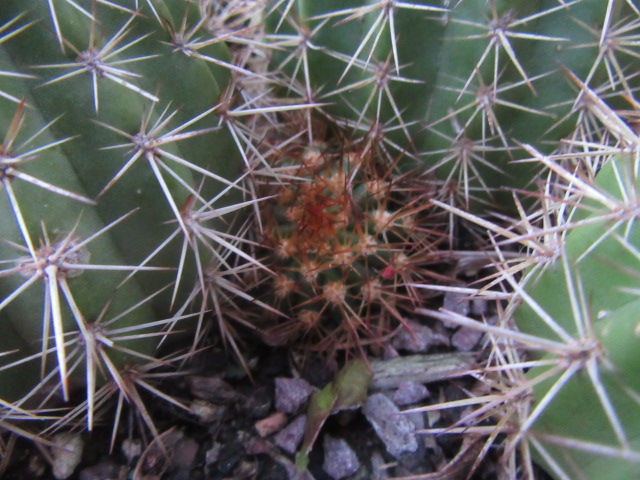
Echinopsis huascha offset on 10-15-20, #747-29.
The big plant in the center of the pot has a new kid… 🙂
<<<<2021>>>>

Echinopsis huascha (Desert’s Blooming Jewel) at 5″ tall x 2 1/4″ wide on 10-28-21, #853-5.
What can I say? I am not sure why this particular Echinopsis huascha has this fungal disease (or whatever it is) when the six in the other pot are just fine and have been treated the same. It is A LOT worse than before. It is supposed to be caused by overwatering in cool temps. Any cactus can have this issue and Soehrensia are no more susceptible than any other. Even so, this plant has grown to 5″ tall over the summer. It was 3 7/8″ tall last October 15 and 3″ tall when I brought it home from Lowe’s on September 21 in 2018.

Echinopsis huascha (Desert’s Blooming Jewel). The largest plant in the center of the pot was 6 3/4″ tall x 3″ wide on 10-28-21, #853-6.
As you can see, the six in this pot are doing just fine and sending out offsets. The largest plant in the center of the pot was 6 3/8″ tall x 3″ wide. So, it either shrunk or I measured it wrong last October… 🙂
NOTE: The single plant was looking even worse over the winter and also attracted mealybugs. I had to dispose of it. The pot of six also had a little mealybug issue, but they were controllable. It didn’t look so great in 2022 so I didn’t take its photo…
<<<<2023>>>>

Echinopsis huascha (Desert’s Blooming Jewel) on 10-24-23, #968-31.
Even though there was no “F” in the forecast until October 30, it was going to be a rainy week so I moved the potted plants inside on the 23rd and 24th. Time for photos and measurements…
The pot of Echinopsis huascha did very well during the summer on the side porch despite the heat and drought. It the plant in the center measured 7 1/2” tall when I moved them inside for the winter. This pot of six plus 2 offsets is looking MUCH better now but I will still have to keep an eye on it. They have a few blemishes, but nothing compared to what some specimens may look like in their native habitat. Perhaps I shouldn’t say that since I haven’t been to their neck of the woods.
<<<<2024>>>>

Echinopsis huascha (Desert Blooming Jewel), tallest in the pot at 9″ tall on 10-23-24, #1023-8.
I had to move the potted plants inside on 11-14-24 because there was a frost in the forecast. I took photos and measurements as I brought them inside but I didn’t do this one until 10-23. The tallest plant in the pot of Soehrensia huascha measured approximately 9″ tall despite a little neglect. They hadn’t received any water for a while which is why some of the cacti shrunk… After a few days, I moved the plants back outside for a while and gave them a good soaking. They like it better outside…
As of 12-14-25 when this page was last updated, the pot of six plants are alive and doing well.
I will continue adding more photos and information as time goes by.
I hope you enjoyed this page and maybe found it useful. If you have any comments, questions, or suggestions, I would like to hear from you. Please click on “like” if you visited this page. It helps us bloggers stay motivated. 🙂 You can check out the links below for further reading. The links take you directly to the genus and species of this plant.
Since the name changed, not all the links have the new accepted scientific name.
 The Belmont Rooster