
Aloe humilis (Hedgehog Aloe) after I brought it home at 5 1/8″ tall x 6 1/2″ wide on 5-6-24, #987-1.
Hedgehog Aloe, Spider Aloe, Blue Dwarf Aloe, Dwarf Hedgehog Aloe
Aloe humilis
AL-oh HEW-mil-is
Synonyms of Aloe humilis (26) (Updated on 12-7-25 from Plants of the World Online): Aloe acuminata Haw. (1812)(nom. illeg.), Aloe acuminata var. major Salm-Dyck (1817), Aloe echinata Willd. (1809), Aloe humilis var. acuminata Baker (1880), Aloe humilis var. candollei Baker (1880), Aloe humilis var. echinata (Willd.) Baker (1896), Aloe humilis var. incurva Haw. (1804), Aloe humilis var. macilenta Baker (1880), Aloe humilis subvar. minor Salm-Dyck (1837), Aloe humilis subvar. semiguttata Haw. (1821), Aloe humilis var. suberecta (Aiton) Baker (1836), Aloe humilis var. subtuberculata (Haw.) Baker (1896), Aloe incurva (Haw.) Haw. (1812), Aloe macilenta (Baker) G.Nicholson (1884), Aloe perfoliata var. humilis L. (1753), Aloe perfoliata var. suberecta Aiton (1789), Aloe suberecta (Aiton) Haw. (1804), Aloe suberecta var. semiguttata Haw. (1821), Aloe subtuberculata Haw. (1825), Aloe tuberculata Haw. (1804), Aloe verrucosospinosa All. (1773), Aloe virens Haw. (1804), Aloe virens var. macilenta Baker (1800), Catevala humilis (L.) Medik. (1786), Haworthia fasciata var. armata Poelln. (1937), Haworthia ferox Poelln. (1932)
Aloe humilis (L.) Mill. is the accepted scientific name for this species of Aloe. It was named and described as such by Philip Miller in the 8th edition of Gardeners Dictionary in 1768. It was first named Aloe perforoliata var. humilis by Carl von Linnaeus in the first edition of Species Plantarum in 1753.
The genus, Aloe L., was named and described as such by Carl von Linnaeus in the first edition of Species Plantarum in 1753.
As of 12-7-25 when this page was last updated, Plants of the World Online lists 592 species in the Aloe genus. It is a member of the plant family Asphodelaceae with 41 genera. Those numbers could change as updates are made on POWO.
THERE ARE A FEW LINKS AT THE BOTTOM OF THE PAGE FOR FURTHER READING.
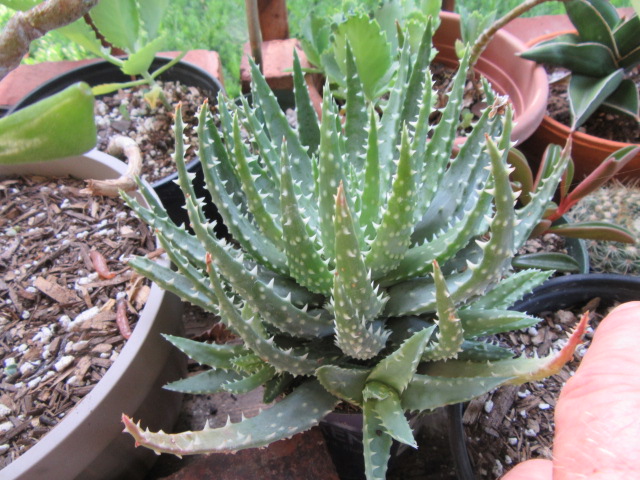
Aloe humilis (Hedgehog Aloe) on 7-5-24, #1000-4.
I brought this Aloe home from Walmart on 5-6-24. The label didn’t have the species name, but several members of the Facebook group Succulent Infatuation suggested it was perhaps Aloe humilis. It measured 5 1/8” tall by 6 1/2” wide and was in a 4 1/2” wide x 5” tall pot.
Information I have read says Aloe humilis is a low-growing Aloe that produces a lot of offsets. Llifle (Encyclopedia of Living Forms) says, “It is very easy to grow requiring little care.”

Aloe humilis (Hedgehog Aloe) on 5-6-24, #987-2.
Aloe humilis produces 20-30 slightly incurved blue-green to gray-green leaves per rosette The margins have small white teeth and the leaves are covered with small white tubercles, sometimes arranged in transverse lines on the upper and lower surface. Plants grow up to 8″ tall and form nice clusters of offsets.
Plants produce around 18-20 tubular orange-red flowers around 2″ long toward the top of 8-12″ spikes. Well, information says 20-30 cm, so we shall see how tall they actually get when this plant flowers. Some sites say it produces flowers during the winter and others say spring…
I really like Aloe and have grown several different species and hybrids for many years. Although a few have bit the dust, most are very easy to grow. For them to thrive, they need a good soaking every week during the summer when it is hot and not so much during cooler periods. Always allow their soil to dry between watering. During the winter while inside, I rarely give them any water.
USEFUL INFORMATION:
Family: Asphodelaceae
Origin: Western and Eastern Cape, South Africa
Zones: USDA Zones 10-13 (° F)
Size: 8” or so
Light: Full sun to part shade, depending on climate
Soil: Very well-draining
Water: Water thoroughly during the growing period, barely ever during the winter. Always allow soil to dry between watering.
I grow my Aloe, and most of the other succulents, on the covered front porch where they get a few hours of sun with light to part shade the remainder of the day. It depends on your climate and it is a trial-and-error process. Too much sun can burn their leaves.
They need very well-draining soil that dries out well between watering. I have experimented A LOT with potting mixtures over the years and still do, and I can’t say for sure what the perfect mix is. When the pots get full of plants, it is hard to get your fingers in the soil to check to see if it is dry or damp. Plus, when the pot gets full of roots, the soil kind of disappears. You can also pick up the pot and check its weight. For many years I used two parts Miracle Grow Potting Mix amended with 1 part perlite and 1 part chicken grit and had pretty good results. Remember, there is a difference between “potting mix” and “potting soil” (you don’t want the later). There are MANY recipes online and several brands of good cactus and succulent mixes available. As I said, it is a trial-and-error process and you have to get to know your plants to see what they do best with. It’s not necessarily the same for everyone or every plant.
With most “clumping” Aloe, I have found not to get too excited when the pots get full of plants. Sometimes you buy pots that are already full when you bring them home and you rush to get them in a larger pot. If you do, only add an inch or so in diameter at a time, and barely deeper. Finding the right size pot, especially the depth, is more tricky than finding the right soil mix. Too much soil under the roots, especially if it remains damp, can be a killer. Make sure to add rocks in the bottom of the pot for best drainage.
Over the winter while indoors, Aloe needs fairly bright light, much less water, and cooler conditions. Too much heat can lead to pest issues, like mealy bugs. You can bring pests home with the plant that you are unaware of until the winter months. Keep an eye on the leaves and if you notice the leaves have sticky areas, you need to check for mealy bugs where the leaves join the stem. That is the problem area with Aloe…
If the infestation is too bad, sorry to say, just throw your plant out the door. If you try to save your plant you put other plants at risk. If the infestation isn’t so bad, wash off the plant, put it in new potting soil, and spray with something like a GardenSafe product for mealy bugs (etc.) that is organic (OMRI listed). Quarantine your plant from your other plants and keep an eye on it. Plants, like Aloe, with a lot of leaves in a cramped rosette, are very difficult… Remember, the more plants you bring home, the more chances you take bringing home unwanted guests…
Make sure to remove dead and dried leaves to keep your plants looking tidy and so unwanted pests can’t hide in them.

Aloe humilis (Hedgehog Aloe) at 5 1/2″ tall x 6 3/4″ wide on 10-14-24, #1022-1.
I had to bring the potted plants inside on 10-14-24 because the weather forecast said there was a chance of frost. Even though the plants were under a roof, the temps were still taking a dip. I always photograph all the plants and measure most of them. The Aloe humilis measured 5 1/2″ tall and the entire cluster measured 6 3/4″ wide at the widest point.
After a couple of days, evening temps warmed back up and I put the plants back outside. I usually have no problems with my plants being outside even if evening temps get down to 38° F, especially if it is for only one evening. Below that, I get a little nervous…
<<<<2025>>>>

Aloe humilis (Hedgehog Aloe) on 6-2-25, #1050-1.
I started repotting the potted plants, so on 6-2-25 I took at look at the Aloe humilis. It was still in the 4 1/2″ diameter x 5″ tall pot I brought it home in, and to my surprise, the roots had filled it up!

Aloe humilis (Hedgehog Aloe) on 6-2-25, #1050-2.
I had ran out of the cactus mix I was trying and the right size pot was hard to come by. By the looks of its root system, I figured it needed a lot more space. So, I found a 6″ tall x 6 1/2″ diameter pot I thought would do the trick. Normally, most Aloe aren’t that picky about their potting mix, so I used Miracle Grow Potting Mix and added a little more perlite and chicken grit. Of course, I put a few small rocks in the bottom of the pot to help with weight and drainage. Rocks also keep the soil from coming out of the holes.
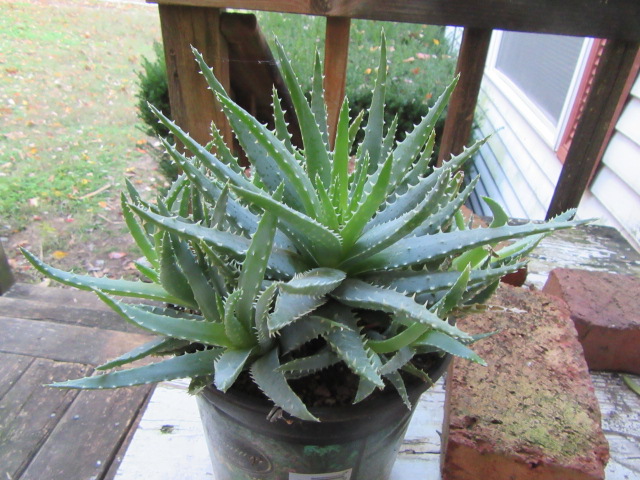
Aloe humilis (Hedgehog Aloe) at 6 1/2″ tall x 11 1/4″ wide on 11-5-25, #1080-1.
I didn’t have to bring the potted plants inside for the winter until November 5 in 2025. The Aloe humilis has done great and measured 6 1/2″ tall x 11 1/4″ wide.
I may repot this plant again when I get a better mix. I’ll keep an eye on it…
I am new to this Aloe species, so we shall see how it goes. So far, so good…
I hope you enjoyed this page and maybe found it useful. If you have any comments, questions, or suggestions, I would like to hear from you. Please click on “like” if you visited this page. It helps us bloggers stay motivated. 🙂 You can check out the links below for further reading. The links take you directly to the genus and species of this plant. If you see I have made an error, please let me know in a comment or email me at thebelmontrooster@yahoo.com.
 The Belmont Rooster