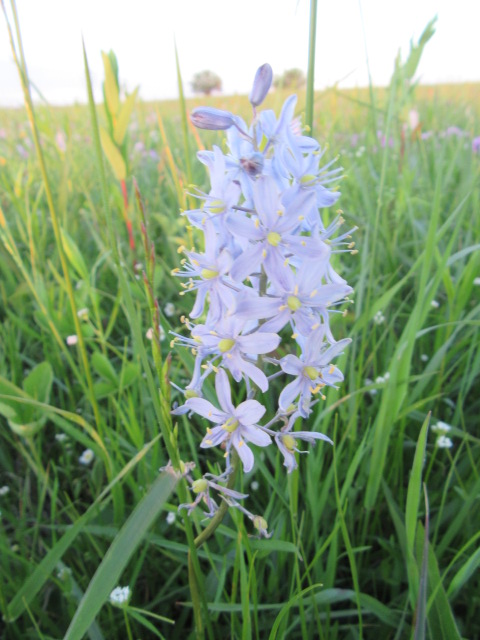
Camassia scilloides (Wild Hyacinth/Atlantic Camas) on 5-5-25, #1041-6.
Wild Hyacinth, Atlantic Camas, Blue Camas, Quamash, Eastern Camas, Eastern Camas Lily
Camassia scilloides
kuh-MAS-ee-uh sil-OY-dees
Synonyms of Camassia scilloides (21) (Updated on 12-6-25 from Plants of the World Online: Anthericum nuttallianum Schult. & Schult.f. (1829), Camassia esculenta (Ker Gawl.) B.L.Rob. (1908) (nom. illeg.), Camassia fraseri Torr. (1857), Camassia gawleri Torr. (1855), Camassia hyacinthina (Raf.) E.J.Palmer & Steyerm. (1935), Camassia scilloides f. candida McGregor (1957), Camassia scilloides f. petersenii Steyerm. (1938), Camassia scilloides f. variegata Steyerm. (1949), Cyanotris scilloides Raf. (1817), Lemotrys hyacinthina Raf. (1837), Ornithogalum nuttallianum (Schult. & Schult.f.) Kunth (1843), Ornithogalum texanum Scheele (1850), Oxytria texana (Scheele) Pollard (1897), Phalangium croceum Nutt. (1818) (nom. illeg.), Phalangium luteum Nutt. ex Kunth (1843) (pro syn.), Quamasia hyacinthina (Raf.) Britton (1896), Quamasia scilloides (Raf.) Raf. (1824), Schoenolirion texanum (Scheele) A.Gray (1876), Scilla esculenta Ker Gawl. (1813), Scilla fraseri (Torr.) A.Gray (1867), Stilla carolinensis W.Young (1783) (nom. nud.)
Camassia scilloides (Raf.) Cory is the accepted scientific name for this species. It was named as such by Victor Louis Cory in Rhodora: Journal of the New England Botanical Club in 1936. It was first named and described as Cyanotris scilloides by Constantine Samuel Rafinesque in the American Monthly Magazine and Critical Review in 1818.
The genus, Camassia Lindl., was named and described as such by John Lindley in Edward’s Botanical Registry in 1932.
As of 12-6-25 when this page was added, Plants of the World Online lists 6 species in the genus Camassia. It is a member of the plant family Asparagaceae with 126 genera. Those numbers could change as updates are made on POWO.
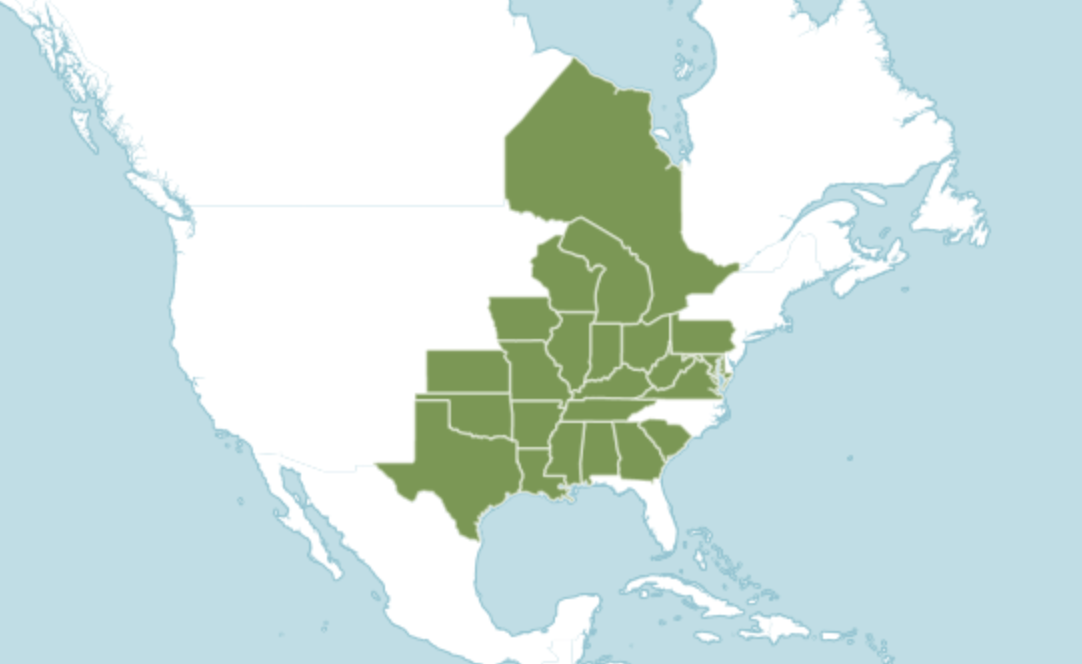
Distribution map of Camassia scilloides from Plants of the World Online. Facilitated by the Royal Botanic Gardens, Kew. Published on the Internet; http://www.plantsoftheworldonline.org/. Retrieved on May 10, 2025.
The above distribution map for Camassia scilloides is from Plants of the World Online. Areas in green are where the species is native. The map on the USDA Plants Database is similar.
The map on iNaturalist shows where members have made observations. Anyone can join and it is a great website to confirm and share your observations. The maps on iNaturalist are continually updated as members post new observations. I post all my observations on iNaturalist.
THERE ARE SEVERAL LINKS AT THE BOTTOM OF THE PAGE FOR FURTHER READING AND TO HELP WITH A POSITIVE ID.
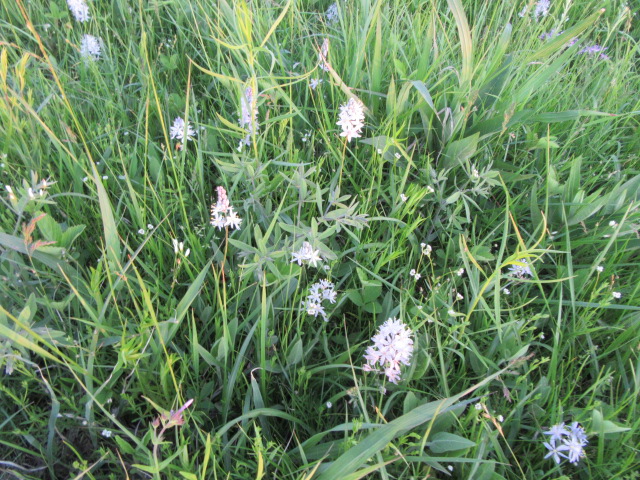
Camassia scilloides (Wild Hyacinth/Atlantic Camas) on 5-5-25, #1041-7.
I was invited to visit a private well-maintained native prairie not far from home on 5-5-25. It was quite amazing! I ran across 11 species I hadn’t seen before including many colonies of Camassia scilloides. Common names include Wild Hyacinth, Atlantic Camas, Blue Camas, Quamash, Eastern Camas, Eastern Camas Lily, and possibly others.
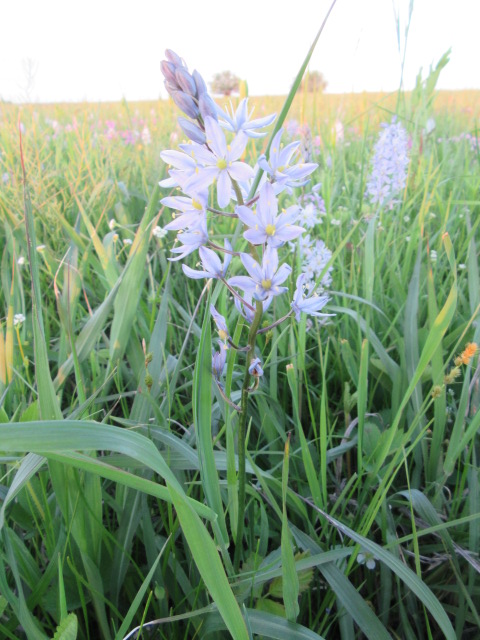
Camassia scilloides (Wild Hyacinth/Atlantic Camas) on 5-5-25, #1041-8.
Camassia scilloides is a U.S. native perennial wildflower found from Texas eastward and up into Canada. They are found throughout most of Missouri, and there are reportedly more abundant here than in any other state.
This species prefers full sun to part shade, moist conditions, and rich loamy soil. They can be found in a variety of areas including open woods, stream banks, glades, prairies, fields, along roadsides, rocky wooded slopes, etc.
Camassia scilloides can be slow to develop, but are fairly long-lived. They come up in the spring when adequate moisture is available and bloom in Missouri from April through May.
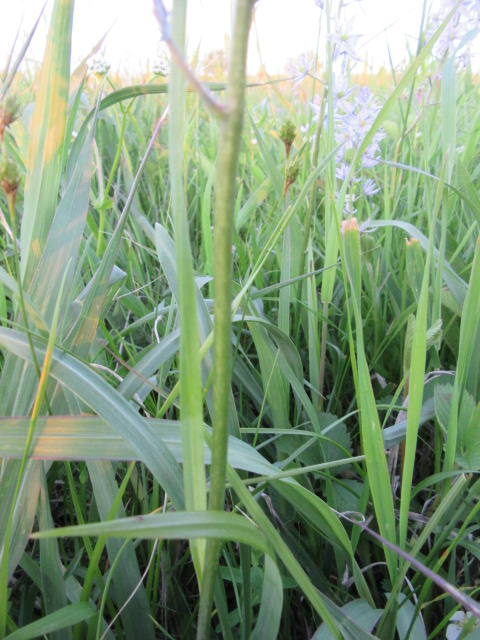
Camassia scilloides (Wild Hyacinth/Atlantic Camas) on 5-5-25, #1041-9.
The stems grow from a bulb with a fibrous root system. They are single, unbranched, and leafless, growing up to about 2 1/2 feet tall. The stems are glabrous (smooth, not hairy).
Basal leaves grow from the roots and are around 1/3 “ wide and 6-18” long. The somewhat floppy, twisted, strap-like leaves are a dull green on the upper surface and deep shiny green on the undersurface. Leaves are somewhat folded in the lower half with prominent midribs, glabrous (not hairy), with smooth margins. The leaves die back in early to late summer.
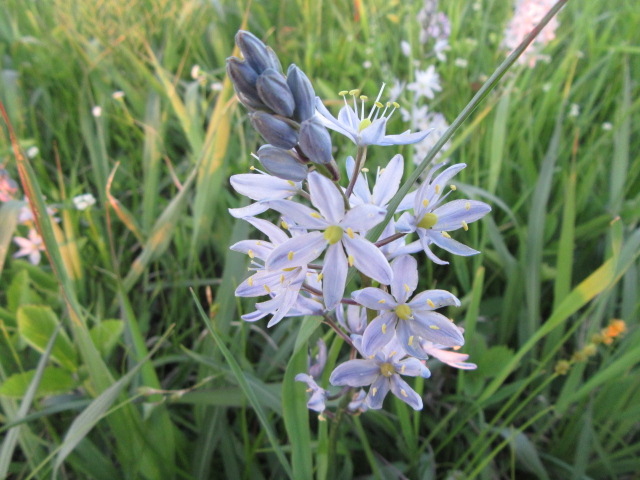
Camassia scilloides (Wild Hyacinth/Atlantic Camas) on 5-5-25, #1041-10.
The stems produce terminal, indeterminate racemes with 7-50 flowers that are subtended by small linear bracts. The light green bracts fall off as the flowers open. The inflorescence (flower cluster) is 7-18 inches tall and appear at the upper 1/3 of the stem. The flowers open from the bottom upwards and last 2-3 days each.
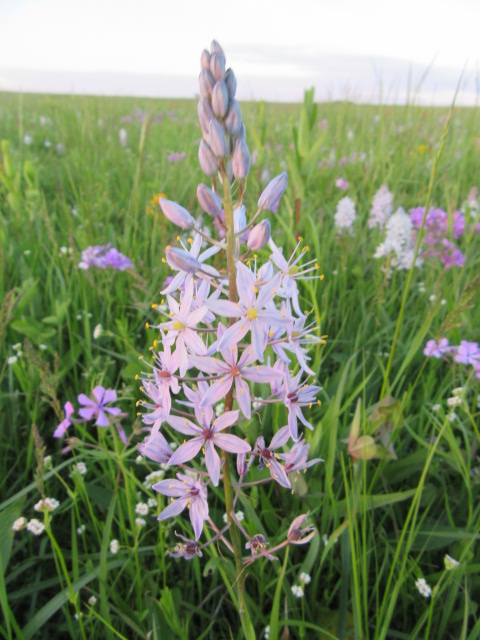
Camassia scilloides (Wild Hyacinth/Atlantic Camas) on 5-5-25, #1041-11.
Each flower is approximately 3/4-1” across with 6 tepals and 6 stamens with bright yellow anthers. The tepals are kind of a combination of petals and sepals and are segments of of the perianth… Not going to get to technical here, but a tepal is another word used instead of petal or sepals when it isn’t clear if the perianth has petals or sepals. Hmmm… Some sites say there are 3 petals and 3 sepals, while others just say 6 tepals… Anyway, they are basically white with lilac to pale blue shading. The six stamens (male part of the flower) have bright yellow anthers. At the central part of the flower is a large 3-celled ovary (3 locules) with 2-5 ovules each. Well, there is more to it than that, but I am beginning to rub my bald head…
The flowers are visited by several species of bees, flies, wasps, and butterflies.
After flowering, the ovary is replaced by a 3-celled capsule with 3-5 shiny black seeds.
The bulbs were used as a food source by Native Americans and can be eaten raw, baked, roasted, boiled, and dried. However, the bulbs an be confused with those of similar-looking highly poisonous species, including Toxicoscordion nuttallii (Death Camas).
Of course, I need to go back to this prairie and get more photos of this species and see what else I can find. There are are several other public prairies in the area to visit.
I live on the family farm in Windsor, Missouri in Pettis County (Henry County is across the street, and Benton and Johnson aren’t far away). I have grown over 500 different plants and identified over 250 species of wildflowers (most have pages listed on the right side of the page). I am not an expert, botanist, or horticulturalist. I just like growing, photographing, and writing about my experience. I rely on several websites for ID and a few horticulturalists I contact if I cannot figure them out. Wildflowers can be variable from location to location, so that can be a bit confusing. If you see I have made an error, please let me know so I can correct what I have written.
I hope you found this page useful and be sure to check the links below for more information. They were written by experts and they have provided much more information. Some sites may not be up-to-date but they are always a work in progress. If you can, I would appreciate it if you would click on the “Like” below and leave a comment. It helps us bloggers stay motivated. I would enjoy hearing from you especially if you notice something is a bit whacky.
FOR FURTHER READING:
PLANTS OF THE WORLD ONLINE (GENUS/SPECIES)
INTERNATIONAL PLANT NAMES INDEX (GENUS/SPECIES)
TROPICOS (GENUS/SPECIES)
FLORA OF MISSOURI (GENUS/SPECIES)
FLORA OF NORTH AMERICA (GENUS/SPECIES)
WORLD FLORA ONLINE (GENUS/SPECIES)
WIKIPEDIA (GENUS/SPECIES)
USDA PLANTS DATABASE
U.S. FOREST SERVICE
iNATURALIST
MISSOURI PLANTS
MISSOURI BOTANICAL GARDEN
WILDFLOWER SEARCH
ARKANSAS NATIVE PLANT SOCIETY
DAVE’S GARDEN
FRIENDS OF THE WILDFLOWER GARDEN
ILLINOIS WILDFLOWERS
KANSAS WILDFLOWERS AND GRASSES
LADY BIRD JOHNSON WILDFLOWER CENTER
NORTH CAROLINA STATE UNIVERSITY
PFAF (PLANTS FOR A FUTURE)
SEINet
U.S. WILDFLOWERS
NOTE: The data (figures, maps, accepted names, etc.) may not match on these websites. It depends on when and how they make updates and when their sources make updates. Some websites have hundreds and even many thousands of species to keep up with. Accepted scientific names change periodically and it can be hard to keep with as well. Some of the links may use a name that is a synonym on other sites. In my opinion, Plants of the World Online by Kew is one of the most reliable and up-to-date plant databases and they make updates regularly. I make updates “at least” once a year and when I write new pages or add new photos but I do get behind. We are all a work in progress. 🙂
 The Belmont Rooster