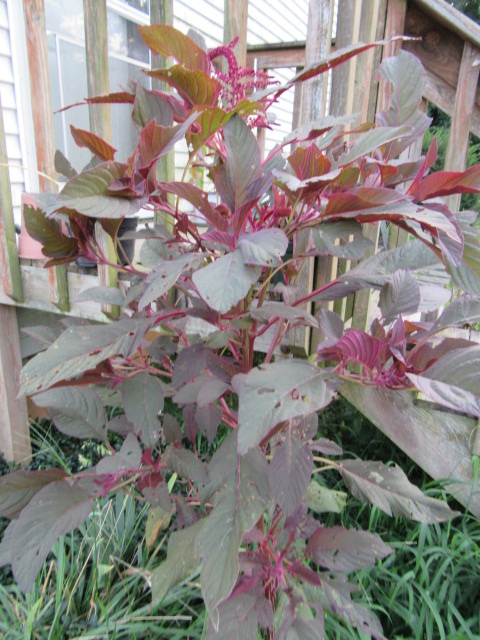
Amaranthus cruentus ‘Red Spike’ on 7-25-24, #1011-1.
Blood Amaranth, Red Amaranth, Purple Amaranth, Prince’s Feather, Mexican Grain Amaranth
Amaranth cruentus ‘Red Spike’
am-uh-RANTH-us kroo-EN-tus
Amaranthus cruentus L. is the accepted scientific name for this species of Amaranthus. It was named and described as such by Carl von Linnaeus in the tenth edition of Systema Naturae in 1759. The genus name was first published as such by Mr. Linnaeus in the second edition of Species Plantarum in 1753.
As of 12-2-25 when this page was last updated, Plants of the World Online lists 92 species in the Amaranth genus. It is a member of the plant family Amaranthaceae with 179 genera. Those numbers could change as updates are made on POWO.

Distribution map of Amaranthus cruentus from Plants of the World Online. Facilitated by the Royal Botanic Gardens, Kew. Published on the Internet; http://www.plantsoftheworldonline.org/. Retrieved on September 4, 2024.
I have included a distribution map of Amaranthus cruentus just to show how widespread the species has become. Areas in green are where the species is native and purple is where it has been introduced. No map is perfect and is basically just a guide.
THERE ARE A FEW LINKS AT THE BOTTOM OF THE PAGE FOR FURTHER READING.
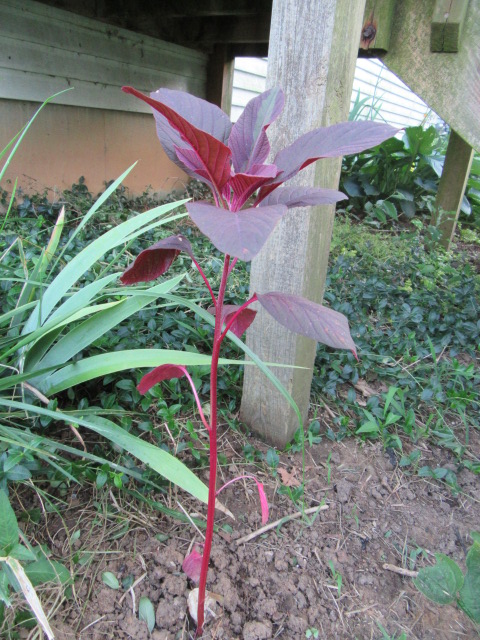
Amaranthus cruentus ‘Red Spike’ on 6-12-24, #996-2.
I brought this Amaranthus cruentus ‘Red Spike’ home from Wagler’s Greenhouse on 6-11-24. I saw them there a week or so earlier but I wasn’t sure where I would put one. Once I figured it out, I went back and brought one home. There were quite a few to choose from…

Amaranthus cruentus ‘Red Spike’ on 6-12-24. #996-3.
I really liked the dark maroon leaves…

Amaranthus cruentus ‘Red Spike’ on 6-12-24, #996-4.
Several websites online say Amaranthus ‘Red Spike’ was the darkest red Amaranth in their trials. Several other cultivars of Amaranthus cruentus have won the Royal Horticultural Society’s Award of Garden Merit. Maybe this one will be next.

Amaranthus cruentus ‘Red Spike’ on 7-5-24, #1000-5.
I have grown other Amaranthus when I lived in Mississippi, but this is the first one I have tried here on the farm in Missouri. It has proven itself very well.
USEFUL INFORMATION:
Family: Amaranthaceae.
Origin: Central America.
Type: Annual.
Zones: USDA Zones 3-10.
Size: 48-60” tall.
Light: Prefers full sun.
Soil: Prefers well-draining, organic, loamy soil.
Water: Normal.

Amaranthus cruentus ‘Red Spike’ on 7-5-24, #1000-6.
I noticed a new bud on July 5… NICE!
Amaranth are very easy to grow. If you can’t find them at your local greenhouse/garden center, they can easily be grown from seed. You can direct sow them in the ground or start them indoors 4-6 weeks before your average last frost date. One website I read says to plant the seeds 1/16″ deep, but you may just want to press them into the soil lightly. Seeds germinate in 7-14 days and need to be kept slightly moist so they don’t dry out. Seeds germinate best at a temperature between 70-75° F. If planted indoors, once seeds germinate you should transplant them individually into their own pots to be transplanted outdoors later. They may need to be hardened off by moving them into the sun outside for a few hours a day. This prevents them from getting to leggy and gets them ready to be placed in their permanent summer home.
Plants grow from 48-60″ tall and they do a lot of branching out. You should place them 4-5 feet apart… They will probably need to be staked up once they start branching out and producing flowers…
Amaranth may not be that picky about their soil type, but they “prefer” a well-draining loamy soil. So, if you have crappy soil, you may need to amend it with a nice compost. They are somewhat drought-tolerant, but when Mother Nature doesn’t provide, they will appreciate a little extra water (like once a week). Just don’t overwater…
I rarely fertilize my flower gardens because I have good soil. BUT, mixing your soil with a timed release or other fertilizer high in nitrogen and phosphorus may be a good idea, but too much can cause them to be leggy. You may want to start off using none. Sometimes I mix a little Miracle Grow Potting Soil or Garden Soil in with the soil around the plant. Bigger plants like this need all the help they can get.
OH, Amaranthus cruentus ‘Red Spike’ is open-pollinated so you can save their seeds to plant the following year,
Amaranthus cruentus ‘Red Spike’ on 7-25-24, #1011-1.
Although Amaranth is supposedly deer-resistant, other critters like grasshoppers and other critters like their leaves.

Amaranthus cruentus ‘Red Spike’ on 7-25-24, #1011-2.
According to information online, Amaranthus cruentus was cultivated as a food crop in North and Central America as early as 4,000 BC.

Amaranthus cruentus ‘Red Spike’ on 9-3-24, #1021-1.
The plant had grown to approximately 80″ tall x 60″ wide when the above photo was taken on 9-3-24.
Interesting, but the seed can supposedly be popped like popcorn. Young leaves can be cooked like spinach although I have not tried it yet. Germinated seeds can be used as nutritious sprouts… Information online lists other things this plant is used for in several countries.

Amaranthus cruentus ‘Red Spike’ on 9-3-24, #1021-2.
NICE COLOR!

Amaranthus cruentus ‘Red Spike’ on 9-3-24, #1021-3.
Ummm… As I mentioned, grasshoppers like this plant. They eat the leaves and seem to enjoy hiding in the flowers. Maybe they eat those, too.

Amaranthus cruentus ‘Red Spike’ on 9-3-24, #1021-4.
I found this inchworm snacking on the leaves as well when taking photos on September 3. I’m not sure if he was saying hi or get lost…
I haven’t found any reviews about Amaranthus ‘Red Spike’ online since it is fairly new. Most information online is about the species, how to grow Amaranthus in general, or companies offering seeds for sale… Please leave a comment if you have grown this cultivar and tell me what you think. I’m sure other readers would like to hear from you.
I hope you enjoyed this page and maybe found it useful. If you have any comments, questions, or suggestions I would like to hear from you. Please click on “like” if you visited this page. It helps us bloggers stay motivated. 🙂 You can check out the links below for further reading. The links take you directly to the genus, species, and/or cultivar of this plant. If you notice I made an error, please let me know. Of course, you can always send me an email at thebelmontrooster@yahoo.com.
FOR FURTHER READING:
PLANTS OF THE WORLD ONLINE (GENUS/SPECIES)
INTERNATIONAL PLANT NAMES INDEX (GENUS/SPECIES)
WIKIPEDIA (GENUS/SPECIES)
GARDENING CHANNEL
HEALTHLINE
THE SPRUCE
VANDERBILT UNIVERSITY
NOTE: The data (figures, maps, accepted names, etc.) may not match on these websites. It depends on when and how they make updates and when their sources make updates. Some websites have hundreds and even many thousands of species to keep up with. Accepted scientific names change periodically and it can be hard to keep with as well. Some of the links may use a name that is a synonym on other sites. In my opinion, Plants of the World Online by Kew is the most reliable and up-to-date plant database and they make updates on a regular basis. I make updates “at least” once a year and when I write new pages or add new photos, but I do get behind. We are all a work in progress. 🙂
 The Belmont Rooster